Understanding
Sampling Methods
Simple Random Sampling &
Judgment Sampling
By,
Aashish
2
Sampling:
Sampling is the process of
selecting a subset of individuals or
items from a larger population to
make inferences about the whole
population.
Importance of Sampling:
Sampling allows researchers to
gather data efficiently and make
valid statistical inferences about
populations.
Simple Random
Sampling (SRS)
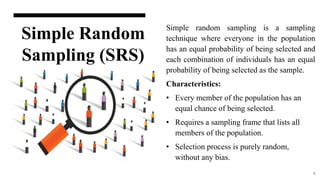
Simple random sampling is a sampling
technique where everyone in the population
has an equal probability of being selected and
each combination of individuals has an equal
probability of being selected as the sample.
Characteristics:
• Every member of the population has an
equal chance of being selected.
• Requires a sampling frame that lists all
members of the population.
• Selection process is purely random,
without any bias.
3
Simple Random Sampling (Contd.)
Example:
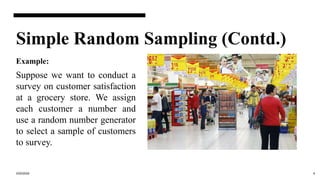
Suppose we want to conduct a
survey on customer satisfaction
at a grocery store. We assign
each customer a number and
use a random number generator
to select a sample of customers
to survey.
3/20/2024 4
Advantages of Simple Random
Sampling
• Unbiased representation of the
population.
• Easy to understand and implement.
• Results are statistically reliable and
generalizable.
5
Limitations of Simple Random
Sampling
• Requires a complete list of the
population (sampling frame), which
may not always be available.
• Not suitable for large populations
due to the time and cost involved.
• Potential for underrepresentation or
overrepresentation of certain groups.
Simple Random Sampling (Contd.)
Judgment Sampling Judgment sampling is a non-probability sampling
technique where the researcher selects a sample
based on their judgment and expertise.
Characteristics:
• Relies on the researcher's subjective judgment.
• Used when the population is not easily
accessible or when specific criteria need to be
met.
• Convenience sampling, purposive sampling,
and quota sampling are types of judgment
sampling.
6
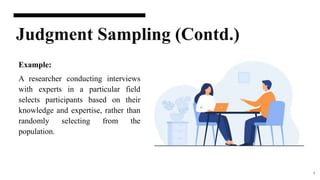
Judgment Sampling (Contd.)
Example:
A researcher conducting interviews
with experts in a particular field
selects participants based on their
knowledge and expertise, rather than
randomly selecting from the
population.
7
Limitations of Judgment Sampling
• Subject to researcher bias, leading to
potential inaccuracies.
• Results may not be generalizable to
the entire population.
• Lack of randomness makes it
difficult to assess the
representativeness of the sample.
8
Advantages of Judgment Sampling
• Convenient and efficient, especially
when the population is hard to
access.
• Allows for targeted sampling based
on specific criteria.
• Useful for exploratory research or
when detailed insights are needed.
Judgment Sampling (Contd.)
Conclusion
• Both simple random sampling and
judgment sampling are valuable sampling
techniques with their own advantages
and limitations.
• The choice between these methods
should be based on the specific
requirements of the research study and
the characteristics of the population
being studied.
9
Questions?
10

Understanding Sampling Methods, Simple Random Sampling & Judgment Sampling

  • 1.
    Understanding Sampling Methods Simple RandomSampling & Judgment Sampling By, Aashish
  • 2.
    2 Sampling: Sampling is theprocess of selecting a subset of individuals or items from a larger population to make inferences about the whole population. Importance of Sampling: Sampling allows researchers to gather data efficiently and make valid statistical inferences about populations.
  • 3.
    Simple Random Sampling (SRS) Simplerandom sampling is a sampling technique where everyone in the population has an equal probability of being selected and each combination of individuals has an equal probability of being selected as the sample. Characteristics: • Every member of the population has an equal chance of being selected. • Requires a sampling frame that lists all members of the population. • Selection process is purely random, without any bias. 3
  • 4.
    Simple Random Sampling(Contd.) Example: Suppose we want to conduct a survey on customer satisfaction at a grocery store. We assign each customer a number and use a random number generator to select a sample of customers to survey. 3/20/2024 4
  • 5.
    Advantages of SimpleRandom Sampling • Unbiased representation of the population. • Easy to understand and implement. • Results are statistically reliable and generalizable. 5 Limitations of Simple Random Sampling • Requires a complete list of the population (sampling frame), which may not always be available. • Not suitable for large populations due to the time and cost involved. • Potential for underrepresentation or overrepresentation of certain groups. Simple Random Sampling (Contd.)
  • 6.
    Judgment Sampling Judgmentsampling is a non-probability sampling technique where the researcher selects a sample based on their judgment and expertise. Characteristics: • Relies on the researcher's subjective judgment. • Used when the population is not easily accessible or when specific criteria need to be met. • Convenience sampling, purposive sampling, and quota sampling are types of judgment sampling. 6
  • 7.
    Judgment Sampling (Contd.) Example: Aresearcher conducting interviews with experts in a particular field selects participants based on their knowledge and expertise, rather than randomly selecting from the population. 7
  • 8.
    Limitations of JudgmentSampling • Subject to researcher bias, leading to potential inaccuracies. • Results may not be generalizable to the entire population. • Lack of randomness makes it difficult to assess the representativeness of the sample. 8 Advantages of Judgment Sampling • Convenient and efficient, especially when the population is hard to access. • Allows for targeted sampling based on specific criteria. • Useful for exploratory research or when detailed insights are needed. Judgment Sampling (Contd.)
  • 9.
    Conclusion • Both simplerandom sampling and judgment sampling are valuable sampling techniques with their own advantages and limitations. • The choice between these methods should be based on the specific requirements of the research study and the characteristics of the population being studied. 9
  • 10.