2023
Preventing Cloud Data Breaches
Chinatu Uzuegbu
Managing Cyber /Cloud Security Consultant
RoseTech CyberCrime Solutions Limited
❖Content Contributor.
❖Security Congress Event Advisory
Committee.
❖Chapters Advisory
Committee(CAC).
❖Blogger.
❖Authorized Instructor.
❖Founding Past President , Nigeria
Chapter.
Volunteering
VigiTrust Chartered Advisory Board.
❖Global Speaker, Mentor, Volunteer
and Delegate.
❖Over 20 years wealth of
experience as an IT/Cyber Security
Professional
Professional
❖CISSP, CCISO, CISM, CISA, CEH, Others.
❖Top 50 Women in Cyber Security , Africa, 2020.
Educational
❖Honorary Doctorate, London Graduate School.
❖MSc. Information Systems Management,
University of Liverpool.
❖Bsc. Computer Science/Maths, University of
Port Harcourt.
❖Global Conference Speaker.
❖Global Ambassador.
❖Mentor.
Chinatu Uzuegbu
https://www.linkedin.com/in/chinatu-uzuegbu-67593119/
https://www.slideshare.net/Chinatu/presentations
The Cloud as The New Normal
https://www.founderjar.com/cloud-computing-statistics/
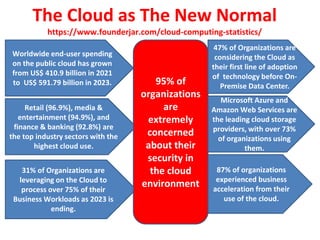
Worldwide end-user spending
on the public cloud has grown
from US$ 410.9 billion in 2021
to US$ 591.79 billion in 2023.
Retail (96.9%), media &
entertainment (94.9%), and
finance & banking (92.8%) are
the top industry sectors with the
highest cloud use.
31% of Organizations are
leveraging on the Cloud to
process over 75% of their
Business Workloads as 2023 is
ending.
47% of Organizations are
considering the Cloud as
their first line of adoption
of technology before On-
Premise Data Center.
Microsoft Azure and
Amazon Web Services are
the leading cloud storage
providers, with over 73%
of organizations using
them.
87% of organizations
experienced business
acceleration from their
use of the cloud.
95% of
organizations
are
extremely
concerned
about their
security in
the cloud
environment
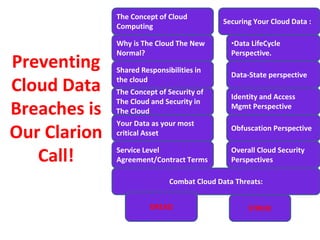
Preventing
Cloud Data
Breaches is
Our Clarion
Call!
Combat Cloud Data Threats:
The Concept of Cloud
Computing
Why is The Cloud The New
Normal?
Shared Responsibilities in
the cloud
The Concept of Security of
The Cloud and Security in
The Cloud
Your Data as your most
critical Asset
Service Level
Agreement/Contract Terms
Overall Cloud Security
Perspectives
Obfuscation Perspective
Identity and Access
Mgmt Perspective
Data-State perspective
•Data LifeCycle
Perspective.
Securing Your Cloud Data :
DREAD STRIDE
The Concept of Cloud Computing
A Model for ubiquitous convenient On-
demand Network Access from Shared Pool
of Configurable Resources that could be
rapidly provisioned and released with
minimal management efforts or Service
Providers Interactions.
Please refer to slides(5-7) from the link below to learn more on the Concepts of Cloud
Computing:
https://www.slideshare.net/Chinatu/securing-the-clouds-proactivelyblackistechpptx
Why is The Cloud The New Normal?
• Reduced Total Cost of Assets Ownership(Capital
Expenditure).
• Reduced Cost of Operating Expenditure.
• Rapid Provisioning of Services(Speed).
• On-Demand Self-Service.
• Broad-band Network Access.
• Rapid Elasticity.
• Shared Pool of Resources(Servers, Networks, Host, OS,
Applications, Databases, others).
• Resource Scalability: Reservation, Limits, Shares.
• Measured Services: Pay-as-Used.
Please refer to slides(8-9) from the link below to learn more on the Concepts of Cloud Computing:
https://www.slideshare.net/Chinatu/securing-the-clouds-proactivelyblackistechpptx
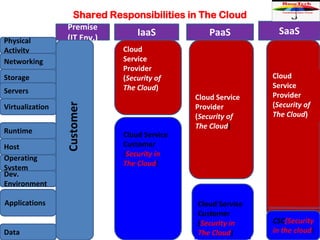
Shared Responsibilities in The Cloud
The concept of Security of The Cloud and in The Cloud
Physical
Activity
Networking
Storage
Servers
Virtualization
Applications
Data
Runtime
Operating
System
Host
Dev.
Environment
Premise
(IT Env.)
IaaS SaaS
PaaS
Customer
Cloud
Service
Provider
(Security of
The Cloud)
Cloud Service
Customer
(Security in
The Cloud)
CSC(Security
in the cloud)
Cloud Service
Provider
(Security of
The Cloud)
Cloud
Service
Provider
(Security of
The Cloud)
Cloud Service
Customer
(Security in
The Cloud)
The Concept of Security of The Cloud
and
Security in The Cloud
• Security of The Cloud is the bother
of The Cloud Service provider.
• The Cloud Service Provider is
ultimately responsible for the
Physical Environment and Basic
Infrastructures whatsoever.
• The Cloud Service Provider remains
the Data Processor as he processes
the data on behalf of the
Customer, data Owner based on
endorsed terms and agreement.
• The Security in The Cloud is the
bother of The Cloud Service
Customer or Subscriber.
• In any situation or with any Cloud
Service Model, the Customer or
subscriber is ultimately
responsible for Data and is the
Data Owner or Data Controller.
• The Customer remains liable to
any breach or loss of Data due to
Lack of due diligence.
•Cases of Data Litigations and Breaches could be shared even though the Customer is ultimately Liable.
•If the cloud Service Provider caused the breach or loss due to lack of due diligence, he would pay some percentage of
the fine or sanction.
Please refer to slides(11-18) from the link below to learn more on the Service Models and Deployment Models :
https://www.slideshare.net/Chinatu/securing-the-clouds-proactivelyblackistechpptx
Your Cloud Data as your most critical
Asset
• The end-result of most of the
subscriptions in the Cloud is
for seamless Data Processing
and Retrieval.
• You could achieve this with
any of the Cloud Service and
Deployment Models of your
choice even though your roles
and responsibilities as a Cloud
Service Customer could be
more or less pending on the
service Model.
• Data Portability Measures
must apply for seamless
movement of Data from
one platform to the other.
• Ensuring threats such as
Vendor Lock-in/Vendor
lock-out are minimized is
critical.
• Seamless Inter-Operability
Measures must apply to
ensure seamless
interactions and easy re-use
of data as it flows through
the platforms.
Service Level Agreement/Contract Terms
• Your Service Level
Agreement must
measurable and
quantifiable and clearly
endorsed by all parties.
• Your Contract Terms
must be concise with
roles, responsibilities and
necessary operational
level agreement defined
in details.
• Cloud Service Customers
should understand that
they are legally liable to
any line of service not
clearly defined in the
contract and endorsed
by ALL parties.
• Ambiguous terms that
could lead to embedding
too many services into
one could be liable to loss
as a result of lack of due
diligence in clearly
distinguishing tasks by
the Customer.
Securing Your Cloud Data:
Data LifeCycle Perspective
Security Measures That must apply:
• Data Creation: Appropriate Data Classifications and
Labels with a verifiable authoritative sources.
• Data Storing: Good security principles that go with
Data constraints and in-put validations. The best
storage type and encryption algorithms .
• Data-in-Use: Digital signatures with non-repudiation
and time-stamp to ensure the Data is being used by
the authorized parties that could not deny it at any
time.
• Data Sharing: Egress Monitoring with Data Loss
Prevention(DLP) and Data Rights Mgmt.
• Data Archival: Data Retention Policies, Back-up
Policy, Data Recoverability, Data Resilience, Business
Continuity Planning.
• Data Disposal: Data Ramenesence in the Cloud, Cloud
shredding techniques, overwriting, Crypto-shredding.
Create Store
U
s
e
Share
Archive
D
i
s
p
o
s
e
Data Phase Life-
Cycle
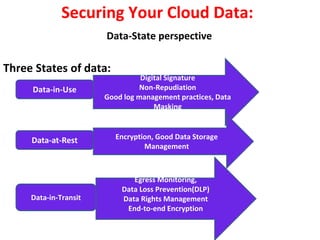
Securing Your Cloud Data:
Data-State perspective
Three States of data:
Data-in-Use
Data-at-Rest
Data-in-Transit
Digital Signature
Non-Repudiation
Good log management practices, Data
Masking
Encryption, Good Data Storage
Management
Egress Monitoring,
Data Loss Prevention(DLP)
Data Rights Management
End-to-end Encryption
Securing Your Cloud Data:
Identity and Access Mgmt Perspective
• The Provisioning and De-
Provisioning Concept
must apply with each
Identity traceable to the
authoritative source.
• The concept of
Identification,
Authentication,
Authorization and
Accounting(IAAA) must
apply.
• The concepts of Least
Privilege and Need to
know must apply.
• The Concept of Just-in-
time must apply.
• Privileged accounts must
be managed with minimal
authorization creeps and
Escalation of privilege.
Securing Your Cloud Data:
Obfuscation Perspective
• Data masking
• Data Tokenization
• Data Anonymization
• Data Encryption
Securing Your Cloud Data:
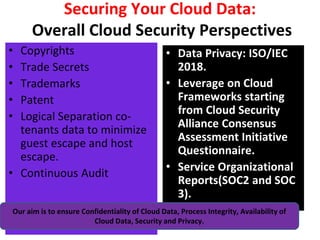
Overall Cloud Security Perspectives
• Copyrights
• Trade Secrets
• Trademarks
• Patent
• Logical Separation co-
tenants data to minimize
guest escape and host
escape.
• Continuous Audit
• Data Privacy: ISO/IEC
2018.
• Leverage on Cloud
Frameworks starting
from Cloud Security
Alliance Consensus
Assessment Initiative
Questionnaire.
• Service Organizational
Reports(SOC2 and SOC
3).
Our aim is to ensure Confidentiality of Cloud Data, Process Integrity, Availability of
Cloud Data, Security and Privacy.
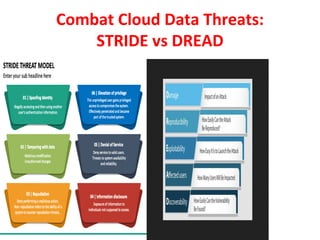
Combat Cloud Data Threats:
STRIDE vs DREAD
Putting IT ALL Together
• Securing Cloud Data is ongoing as the tools keep
evolving.
• However, paying close attention to your due
diligence right from inception of adoption would go
a long way in ensuring we are running with good
security hygiene both of the Cloud and In the Cloud
THANK YOU

Preventing Cloud Data Breaches.pdf

  • 1.
    2023 Preventing Cloud DataBreaches Chinatu Uzuegbu Managing Cyber /Cloud Security Consultant RoseTech CyberCrime Solutions Limited
  • 2.
    ❖Content Contributor. ❖Security CongressEvent Advisory Committee. ❖Chapters Advisory Committee(CAC). ❖Blogger. ❖Authorized Instructor. ❖Founding Past President , Nigeria Chapter. Volunteering VigiTrust Chartered Advisory Board. ❖Global Speaker, Mentor, Volunteer and Delegate. ❖Over 20 years wealth of experience as an IT/Cyber Security Professional Professional ❖CISSP, CCISO, CISM, CISA, CEH, Others. ❖Top 50 Women in Cyber Security , Africa, 2020. Educational ❖Honorary Doctorate, London Graduate School. ❖MSc. Information Systems Management, University of Liverpool. ❖Bsc. Computer Science/Maths, University of Port Harcourt. ❖Global Conference Speaker. ❖Global Ambassador. ❖Mentor. Chinatu Uzuegbu https://www.linkedin.com/in/chinatu-uzuegbu-67593119/ https://www.slideshare.net/Chinatu/presentations
  • 3.
    The Cloud asThe New Normal https://www.founderjar.com/cloud-computing-statistics/ Worldwide end-user spending on the public cloud has grown from US$ 410.9 billion in 2021 to US$ 591.79 billion in 2023. Retail (96.9%), media & entertainment (94.9%), and finance & banking (92.8%) are the top industry sectors with the highest cloud use. 31% of Organizations are leveraging on the Cloud to process over 75% of their Business Workloads as 2023 is ending. 47% of Organizations are considering the Cloud as their first line of adoption of technology before On- Premise Data Center. Microsoft Azure and Amazon Web Services are the leading cloud storage providers, with over 73% of organizations using them. 87% of organizations experienced business acceleration from their use of the cloud. 95% of organizations are extremely concerned about their security in the cloud environment
  • 4.
    Preventing Cloud Data Breaches is OurClarion Call! Combat Cloud Data Threats: The Concept of Cloud Computing Why is The Cloud The New Normal? Shared Responsibilities in the cloud The Concept of Security of The Cloud and Security in The Cloud Your Data as your most critical Asset Service Level Agreement/Contract Terms Overall Cloud Security Perspectives Obfuscation Perspective Identity and Access Mgmt Perspective Data-State perspective •Data LifeCycle Perspective. Securing Your Cloud Data : DREAD STRIDE
  • 5.
    The Concept ofCloud Computing A Model for ubiquitous convenient On- demand Network Access from Shared Pool of Configurable Resources that could be rapidly provisioned and released with minimal management efforts or Service Providers Interactions. Please refer to slides(5-7) from the link below to learn more on the Concepts of Cloud Computing: https://www.slideshare.net/Chinatu/securing-the-clouds-proactivelyblackistechpptx
  • 6.
    Why is TheCloud The New Normal? • Reduced Total Cost of Assets Ownership(Capital Expenditure). • Reduced Cost of Operating Expenditure. • Rapid Provisioning of Services(Speed). • On-Demand Self-Service. • Broad-band Network Access. • Rapid Elasticity. • Shared Pool of Resources(Servers, Networks, Host, OS, Applications, Databases, others). • Resource Scalability: Reservation, Limits, Shares. • Measured Services: Pay-as-Used. Please refer to slides(8-9) from the link below to learn more on the Concepts of Cloud Computing: https://www.slideshare.net/Chinatu/securing-the-clouds-proactivelyblackistechpptx
  • 7.
    Shared Responsibilities inThe Cloud The concept of Security of The Cloud and in The Cloud Physical Activity Networking Storage Servers Virtualization Applications Data Runtime Operating System Host Dev. Environment Premise (IT Env.) IaaS SaaS PaaS Customer Cloud Service Provider (Security of The Cloud) Cloud Service Customer (Security in The Cloud) CSC(Security in the cloud) Cloud Service Provider (Security of The Cloud) Cloud Service Provider (Security of The Cloud) Cloud Service Customer (Security in The Cloud)
  • 8.
    The Concept ofSecurity of The Cloud and Security in The Cloud • Security of The Cloud is the bother of The Cloud Service provider. • The Cloud Service Provider is ultimately responsible for the Physical Environment and Basic Infrastructures whatsoever. • The Cloud Service Provider remains the Data Processor as he processes the data on behalf of the Customer, data Owner based on endorsed terms and agreement. • The Security in The Cloud is the bother of The Cloud Service Customer or Subscriber. • In any situation or with any Cloud Service Model, the Customer or subscriber is ultimately responsible for Data and is the Data Owner or Data Controller. • The Customer remains liable to any breach or loss of Data due to Lack of due diligence. •Cases of Data Litigations and Breaches could be shared even though the Customer is ultimately Liable. •If the cloud Service Provider caused the breach or loss due to lack of due diligence, he would pay some percentage of the fine or sanction. Please refer to slides(11-18) from the link below to learn more on the Service Models and Deployment Models : https://www.slideshare.net/Chinatu/securing-the-clouds-proactivelyblackistechpptx
  • 9.
    Your Cloud Dataas your most critical Asset • The end-result of most of the subscriptions in the Cloud is for seamless Data Processing and Retrieval. • You could achieve this with any of the Cloud Service and Deployment Models of your choice even though your roles and responsibilities as a Cloud Service Customer could be more or less pending on the service Model. • Data Portability Measures must apply for seamless movement of Data from one platform to the other. • Ensuring threats such as Vendor Lock-in/Vendor lock-out are minimized is critical. • Seamless Inter-Operability Measures must apply to ensure seamless interactions and easy re-use of data as it flows through the platforms.
  • 10.
    Service Level Agreement/ContractTerms • Your Service Level Agreement must measurable and quantifiable and clearly endorsed by all parties. • Your Contract Terms must be concise with roles, responsibilities and necessary operational level agreement defined in details. • Cloud Service Customers should understand that they are legally liable to any line of service not clearly defined in the contract and endorsed by ALL parties. • Ambiguous terms that could lead to embedding too many services into one could be liable to loss as a result of lack of due diligence in clearly distinguishing tasks by the Customer.
  • 11.
    Securing Your CloudData: Data LifeCycle Perspective Security Measures That must apply: • Data Creation: Appropriate Data Classifications and Labels with a verifiable authoritative sources. • Data Storing: Good security principles that go with Data constraints and in-put validations. The best storage type and encryption algorithms . • Data-in-Use: Digital signatures with non-repudiation and time-stamp to ensure the Data is being used by the authorized parties that could not deny it at any time. • Data Sharing: Egress Monitoring with Data Loss Prevention(DLP) and Data Rights Mgmt. • Data Archival: Data Retention Policies, Back-up Policy, Data Recoverability, Data Resilience, Business Continuity Planning. • Data Disposal: Data Ramenesence in the Cloud, Cloud shredding techniques, overwriting, Crypto-shredding. Create Store U s e Share Archive D i s p o s e Data Phase Life- Cycle
  • 12.
    Securing Your CloudData: Data-State perspective Three States of data: Data-in-Use Data-at-Rest Data-in-Transit Digital Signature Non-Repudiation Good log management practices, Data Masking Encryption, Good Data Storage Management Egress Monitoring, Data Loss Prevention(DLP) Data Rights Management End-to-end Encryption
  • 13.
    Securing Your CloudData: Identity and Access Mgmt Perspective • The Provisioning and De- Provisioning Concept must apply with each Identity traceable to the authoritative source. • The concept of Identification, Authentication, Authorization and Accounting(IAAA) must apply. • The concepts of Least Privilege and Need to know must apply. • The Concept of Just-in- time must apply. • Privileged accounts must be managed with minimal authorization creeps and Escalation of privilege.
  • 14.
    Securing Your CloudData: Obfuscation Perspective • Data masking • Data Tokenization • Data Anonymization • Data Encryption
  • 15.
    Securing Your CloudData: Overall Cloud Security Perspectives • Copyrights • Trade Secrets • Trademarks • Patent • Logical Separation co- tenants data to minimize guest escape and host escape. • Continuous Audit • Data Privacy: ISO/IEC 2018. • Leverage on Cloud Frameworks starting from Cloud Security Alliance Consensus Assessment Initiative Questionnaire. • Service Organizational Reports(SOC2 and SOC 3). Our aim is to ensure Confidentiality of Cloud Data, Process Integrity, Availability of Cloud Data, Security and Privacy.
  • 16.
    Combat Cloud DataThreats: STRIDE vs DREAD
  • 17.
    Putting IT ALLTogether • Securing Cloud Data is ongoing as the tools keep evolving. • However, paying close attention to your due diligence right from inception of adoption would go a long way in ensuring we are running with good security hygiene both of the Cloud and In the Cloud
  • 18.