Perception of
environment
Khimsuriya mona
The ability of animals to respond to changes in
the external environment depends upon
sensory process designed to detect such
changes.
1. These range from simple discrimination of differences in light intensity,
temperature, to the recognition of complex patterns.
Sensation
1. Sense organs sense the changes in the external environment (stimuli) and send
a stream of inform along nerves to the brain.
2. The brain sorts out the signals and they makes the body react to them .
Different animals rely on different senses according to their way of life.
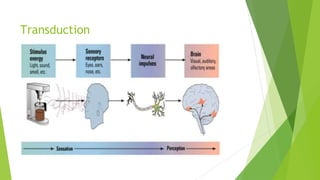
Transduction
 All senses involve receptor cells. Receptor cells transduce ( translate) physical
stimulation and energy from the environment into electrochemical messages
that the brain can understand.
 Sense organs transduce sensory energy into neural energy.
 Converting one type of energy into another type is the process of
transduction.
Sensory mechanism
1. Visual
2. Auditory
3. Olfactory
4. Chemical
5. Electrical
6. Mechanical
Visual perception
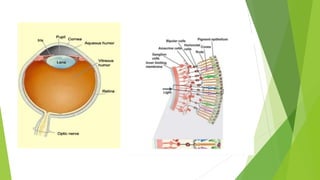
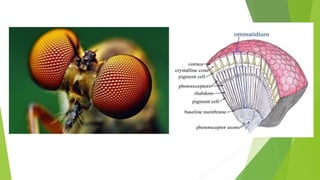
Insects bear one pair of compounds eye which cover most part of their head.
Bees can use the pattern of polarization of light to locate the sun’s position
even when it is covered by clouds.
 Bees have a small dorsal region of the retina which has a row of analyser each
of which is maximally sensitive to a different e- vector direction.
 When a bee looks at a patch of polarized sky- light,the perceived direction of
the e-vector is determined by which analyser in the array produce the largest
output.
 Flying insects,fish and birds are also sensitive to ultraviolet light.
 These animals are able to see light of much shorter wavelength which are
invisible to human eye.
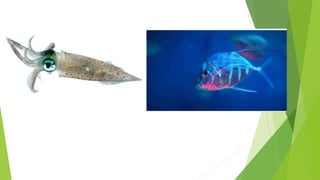
 Squid,fish and birds are sensitive to the plane of polarization of light.squid
appears to detect their food , by responding to the pattern of polarized light
that is reflected off their shiny bodies.
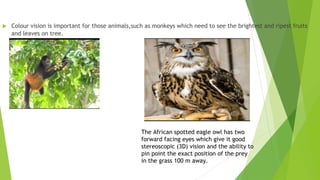
 Colour vision is important for those animals,such as monkeys which need to see the brightest and ripest fruits
and leaves on tree.
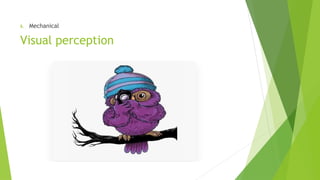
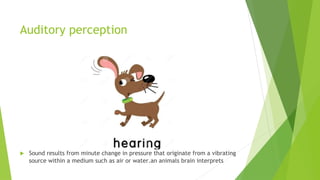
The African spotted eagle owl has two
forward facing eyes which give it good
stereoscopic (3D) vision and the ability to
pin point the exact position of the prey
in the grass 100 m away.
Auditory perception
 Sound results from minute change in pressure that originate from a vibrating
source within a medium such as air or water.an animals brain interprets
waves of pressure traveling through the medium and detected by the ears,As
sound.
 The auditory systems of animals, though diverse have basic features in
common.for example, there is a peripheral mechanism for converting sound
pressure to vibratory motion into nerve impulses that can be decoded by the
central nervous system.
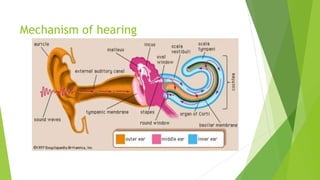
Mechanism of hearing
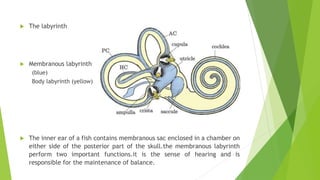
 The labyrinth
 Membranous labyrinth
(blue)
Body labyrinth (yellow)
 The inner ear of a fish contains membranous sac enclosed in a chamber on
either side of the posterior part of the skull.the membranous labyrinth
perform two important functions.it is the sense of hearing and is
responsible for the maintenance of balance.
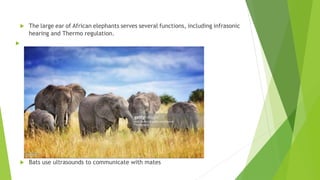
 The large ear of African elephants serves several functions, including infrasonic
hearing and Thermo regulation.

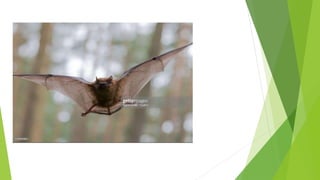
 Bats use ultrasounds to communicate with mates
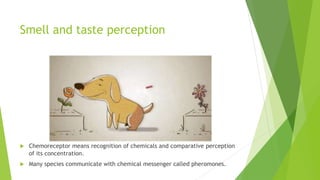
Smell and taste perception
 Chemoreceptor means recognition of chemicals and comparative perception
of its concentration.
 Many species communicate with chemical messenger called pheromones.
 Small volatile molecules that are secreted in the exocrine gland of those
species and released into the environment.
 Animals use pheromones to communicate danger, ownership of territory and
advertisement for mating.
 Olfaction – sense of smell, involving detections of airborne chemicals called
odorants
 Gustation – sense of taste , involved detection of dissolved chemicals called
tastants.
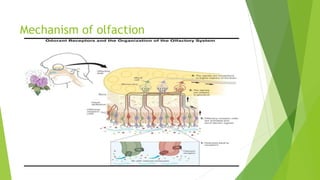
Mechanism of olfaction
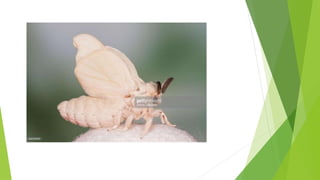
 In male silk-worm moth the smell plays a vital role in sexual reproduction and
survival of the species.female silk-worm moth bear a pair of sacs on abdomen
which emits a sex pheromone bombykol.male silk-worm moth find female silk-
worm moth of its other species with the help of this scent and mate her
successfully.
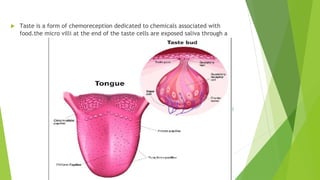
 Taste is a form of chemoreception dedicated to chemicals associated with
food.the micro villi at the end of the taste cells are exposed saliva through a
pore in the taste bud.
 Insects are extremely good at detecting and producing minute traces of
certain chemicals. Social insects such as ants and termites use such chemicals
as a means of communicating simple messages.
 Many insects have chemosensillae on their front legs they can “taste”with
their feet.
 Most fishes are able to detect odour with the help of a pair of olfactory lobe
connected to the brain by means of olfactory nerves.
 Snacks and lizards taste the air with their forked tongues,noses,tonguesand
other smelling organs are linked with sensitive organs are linked with sensitive
cells which can analyse a huge range of chemicals that float in the air or exist
in food.
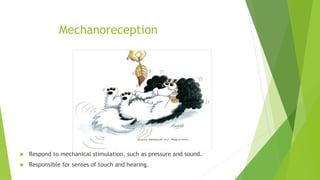
Mechanoreception
 Respond to mechanical stimulation, such as pressure and sound.
 Responsible for senses of touch and hearing.
 Sensory receptors in the skin and surroundings hair follicles respond to
pressure.
 Mechanoreception also termed tactile sense,or touch, is an important source
of information for animals.
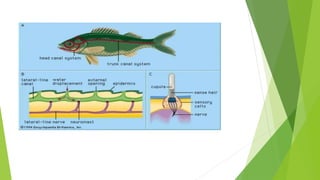
Lateral line system
used to sense movement of water.
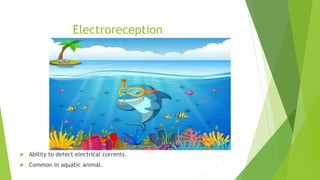
Electroreception
 Ability to detect electrical currents.
 Common in aquatic animal.
 Passive involves detecting bioelectric fields generated by surrounding
animals.
 Active has an animal generating a field and detecting distortion.
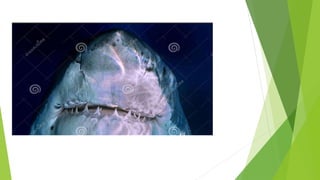
Sharks have electro receptors called ampulla of lorenzinion their heads
that may also be used to locate prey.
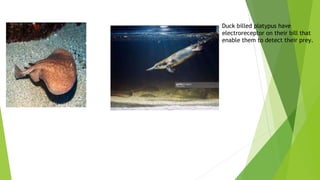
Duck billed platypus have
electroreceptor on their bill that
enable them to detect their prey.
References
 https://www.researchgate.net/publication/285858446_Sensory_mechanisms_
in_animal_communication
 Animal behavior – Michael D.breed and Janice moore

Understanding Environmental Perception: How We Experience and Interpret Our Surroundings"

  • 1.
  • 2.
    The ability ofanimals to respond to changes in the external environment depends upon sensory process designed to detect such changes. 1. These range from simple discrimination of differences in light intensity, temperature, to the recognition of complex patterns. Sensation 1. Sense organs sense the changes in the external environment (stimuli) and send a stream of inform along nerves to the brain. 2. The brain sorts out the signals and they makes the body react to them . Different animals rely on different senses according to their way of life.
  • 3.
  • 4.
     All sensesinvolve receptor cells. Receptor cells transduce ( translate) physical stimulation and energy from the environment into electrochemical messages that the brain can understand.  Sense organs transduce sensory energy into neural energy.  Converting one type of energy into another type is the process of transduction. Sensory mechanism 1. Visual 2. Auditory 3. Olfactory 4. Chemical 5. Electrical
  • 5.
  • 8.
    Insects bear onepair of compounds eye which cover most part of their head. Bees can use the pattern of polarization of light to locate the sun’s position even when it is covered by clouds.  Bees have a small dorsal region of the retina which has a row of analyser each of which is maximally sensitive to a different e- vector direction.  When a bee looks at a patch of polarized sky- light,the perceived direction of the e-vector is determined by which analyser in the array produce the largest output.  Flying insects,fish and birds are also sensitive to ultraviolet light.  These animals are able to see light of much shorter wavelength which are invisible to human eye.  Squid,fish and birds are sensitive to the plane of polarization of light.squid appears to detect their food , by responding to the pattern of polarized light that is reflected off their shiny bodies.
  • 11.
     Colour visionis important for those animals,such as monkeys which need to see the brightest and ripest fruits and leaves on tree. The African spotted eagle owl has two forward facing eyes which give it good stereoscopic (3D) vision and the ability to pin point the exact position of the prey in the grass 100 m away.
  • 12.
    Auditory perception  Soundresults from minute change in pressure that originate from a vibrating source within a medium such as air or water.an animals brain interprets
  • 13.
    waves of pressuretraveling through the medium and detected by the ears,As sound.  The auditory systems of animals, though diverse have basic features in common.for example, there is a peripheral mechanism for converting sound pressure to vibratory motion into nerve impulses that can be decoded by the central nervous system.
  • 14.
  • 15.
     The labyrinth Membranous labyrinth (blue) Body labyrinth (yellow)  The inner ear of a fish contains membranous sac enclosed in a chamber on either side of the posterior part of the skull.the membranous labyrinth perform two important functions.it is the sense of hearing and is responsible for the maintenance of balance.
  • 16.
     The largeear of African elephants serves several functions, including infrasonic hearing and Thermo regulation.   Bats use ultrasounds to communicate with mates
  • 18.
    Smell and tasteperception  Chemoreceptor means recognition of chemicals and comparative perception of its concentration.  Many species communicate with chemical messenger called pheromones.
  • 19.
     Small volatilemolecules that are secreted in the exocrine gland of those species and released into the environment.  Animals use pheromones to communicate danger, ownership of territory and advertisement for mating.  Olfaction – sense of smell, involving detections of airborne chemicals called odorants  Gustation – sense of taste , involved detection of dissolved chemicals called tastants.
  • 20.
  • 21.
     In malesilk-worm moth the smell plays a vital role in sexual reproduction and survival of the species.female silk-worm moth bear a pair of sacs on abdomen which emits a sex pheromone bombykol.male silk-worm moth find female silk- worm moth of its other species with the help of this scent and mate her successfully.
  • 23.
     Taste isa form of chemoreception dedicated to chemicals associated with food.the micro villi at the end of the taste cells are exposed saliva through a
  • 24.
    pore in thetaste bud.
  • 25.
     Insects areextremely good at detecting and producing minute traces of certain chemicals. Social insects such as ants and termites use such chemicals as a means of communicating simple messages.  Many insects have chemosensillae on their front legs they can “taste”with their feet.  Most fishes are able to detect odour with the help of a pair of olfactory lobe connected to the brain by means of olfactory nerves.  Snacks and lizards taste the air with their forked tongues,noses,tonguesand other smelling organs are linked with sensitive organs are linked with sensitive cells which can analyse a huge range of chemicals that float in the air or exist in food.
  • 26.
    Mechanoreception  Respond tomechanical stimulation, such as pressure and sound.  Responsible for senses of touch and hearing.
  • 27.
     Sensory receptorsin the skin and surroundings hair follicles respond to pressure.  Mechanoreception also termed tactile sense,or touch, is an important source of information for animals. Lateral line system used to sense movement of water.
  • 29.
    Electroreception  Ability todetect electrical currents.  Common in aquatic animal.
  • 30.
     Passive involvesdetecting bioelectric fields generated by surrounding animals.  Active has an animal generating a field and detecting distortion. Sharks have electro receptors called ampulla of lorenzinion their heads that may also be used to locate prey.
  • 32.
    Duck billed platypushave electroreceptor on their bill that enable them to detect their prey.
  • 33.