Part D Payment
Modernization Model
Model Overview
Centers for Medicare & Medicaid Services (CMS) Innovation Center
1
CMS Introductions
Center for Medicare and Medicaid Innovation
Laura McWright, Seamless Care Models Group, Deputy Director
Mark Atalla, Seamless Care Models Group, Model Lead
Franklin Hendrick, Research and Rapid Cycle Evaluation Group
2
Agenda
• CMS Introductions
• CMMI Statute
• Model Goals
• Model Design Review
• Application Process
• Question and Answer Session
3
CMS Innovation Center Statute
The Innovation Center was established by section 1115A of the Social
Security Act (as amended by section 3021 of the Affordable Care Act)
“The purpose of the [Center] is to test innovative payment and service
delivery models to reduce program expenditures…while preserving or
enhancing the quality of care furnished to individuals under such titles”
Three scenarios for success outlined in the Statute:
1. Quality improves and costs are neutral
2. Quality neutral and costs are reduced
3. Quality improves and costs are reduced (best case scenario)
If a model meets one of these three criteria and other statutory prerequisites,
the statute allows the Secretary to expand the duration and scope of a model
through rulemaking
4
Model Goals
• Create new incentives for plans, patients, and
providers to choose drugs with lower list prices to
better manage catastrophic coverage phase federal
reinsurance subsidy spending
• Ensure Medicare beneficiaries are able to maintain
affordable access to the prescription drugs that they
need
5
Model Design Review
6
Key Model Design Elements
• Voluntary Model
• Five-year performance period (2020 – 2024)
• Open to eligible Prescription Drug Plans (PDPs) and Medicare
Advantage Prescription Drug Plans (MA-PDs) in all states and
territories
• All current bid, payment, and reconciliation processes are
maintained
• All CMMI models are monitored and receive an independent
evaluation
7
Key Model Design Elements
• The model allows for a targeted focus on lower Part D
prescription drug spending and improved quality and access to
Part D covered drugs
• A retrospective spending target benchmark allows CMS to test the
impact of two-sided risk on federal reinsurance subsidy spending
• New Part D Rewards and Incentives Programs allow CMS to test
how plans can better promote improved health outcomes,
medication adherence, and the efficient use of health care resources
for their enrollees
8
Part D Defined Standard Benefit
• The Part D standard benefit consists of four phases:
• Deductible Phase
• Initial Coverage Phase
• Coverage Gap Phase
• Catastrophic Coverage Phase
• The negotiated price of the medication determines:
• movement through the different phases of the Part D benefit
• cost-sharing for non-low-income subsidy (non-LIS) enrollees
• When enrollees reach a set out-of-pocket threshold, they enter
the catastrophic coverage phase
9
Part D Sponsor Payments
Part D sponsor payments consist of:
• Enrollee Premiums
• Direct Subsidy (Sponsor Risk):
• Initial Coverage: 75% of costs (net liability)
• Coverage Gap: 5% (brand) and 75% (generic) of costs
• Catastrophic Coverage: 15% of costs (net liability)
• Federal Reinsurance Subsidy (No Sponsor Risk)
• Catastrophic Coverage: 80% of costs (after any DIR)
• Part D sponsors also receive federal low-income cost-sharing
subsidies and low-income premium subsidies, as well as other
payments through direct and indirect remuneration (DIR)
10
Part D Sponsor Risk Sharing
• Risk Adjustment
• Direct Subsidy Risk Corridors
• Federal Reinsurance Subsidy
• Federal reinsurance is prospectively bid annually
• Included in base beneficiary premium calculation
• CMS fully reconciles federal reinsurance subsidy
spending, net of direct and indirect remuneration (DIR)
11
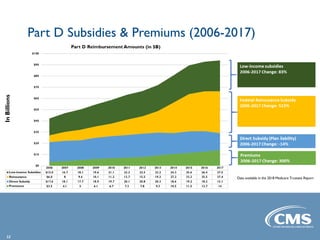
Part D Subsidies & Premiums (2006-2017)
12
Data available in the 2018 Medicare Trustees Report
Model Eligibility
• Eligible: PDP and MA-PD plans, including those that offer standard or
alternative Part D coverage, may apply to participate
• Not eligible: Special needs plans, private fee-for-service plans,
employer/union only direct contract plans, section 1876 cost contract
plans, section 1833 health care prepayment plans, PACE, Medicare-
Medicaid plans, and religious fraternal benefit plans
• Part D sponsors will be required to submit all Plan Benefit Packages
(PBPs) in the PDP regions for which they are applying for participation
• Medicare Advantage Organizations (MAOs) that apply with an MA-PD
must include all of the eligible MA-PD PBPs offered in or across the Part
D region(s) that the MA-PD serves
13
SpendingTarget Benchmark
• Intended to represent the amount of federal reinsurance
subsidy spending that CMS would have paid model
participants, in the absence of the model
• Calculated at an aggregate level for participating
organizations
• Calculated separately for PDPs and MA-PDs
• Calculated after the performance year
• Includes necessary benchmark adjustment factors
14
Performance-Based Payments or Losses
• Based on performance relative to the spending target
benchmark, model participants will be eligible for
performance-based payments or will be accountable for
losses
15
SpendingTarget Benchmark Outcome % Result
Losses Any 10% penalty on the difference
Savings 0% up to 3% 30% of savings
Savings 3%+ 50% of savings greater than 3%
Part D Rewards and Incentives Programs
• CMS is permitting model participants to propose Part D Rewards and
Incentives (RI) programs that, in connection with medication use, focus
on promoting improved health, medication adherence, and the efficient
use of health care resources
• The goals include rewarding and incentivizing enrollees’:
• Participation in a disease state management program
• Engaging in medication therapy management with pharmacists or
providers
• Receipt of preventive health services, such as vaccines
• Active engagement with their plans in understanding their
medications, including clinically-equivalent alternatives that may be
more cost-accessible
16
Application Process
17
18
Online Application Portal is opened
Model applications due to CMS (11:59 PM EST)
Provisionally approved model participants identified
CY 2020 bids due
Contract addendum for model participants signed
February 2019
March 15, 2019
April 2019
June 3, 2019
September 2019
ApplicationTimeline
Application Process and Resources
• The application process will be competitive to preserve the
ability of CMS to create an evaluable comparison group
• The Model Request for Applications (RFA) outlines additional
specifics on model eligibility, spending target benchmark
methodology, and additional programmatic model design
elements
• The main source of information is the Model website:
https://innovation.cms.gov/initiatives/part-d-payment-
modernization-model/
• Please email PartDPaymentModel@cms.hhs.gov with any
questions about this model
19
Thank you for your interest in CMMI and
the Part D Payment Modernization Model
Website: https://innovation.cms.gov/initiatives/part-d-
payment-modernization-model/
Email: PartDPaymentModel@cms.hhs.gov
Question and Answer Session
20

Webinar: Part D Payment Modernization Model - Overview Repeat

  • 1.
    Part D Payment ModernizationModel Model Overview Centers for Medicare & Medicaid Services (CMS) Innovation Center 1
  • 2.
    CMS Introductions Center forMedicare and Medicaid Innovation Laura McWright, Seamless Care Models Group, Deputy Director Mark Atalla, Seamless Care Models Group, Model Lead Franklin Hendrick, Research and Rapid Cycle Evaluation Group 2
  • 3.
    Agenda • CMS Introductions •CMMI Statute • Model Goals • Model Design Review • Application Process • Question and Answer Session 3
  • 4.
    CMS Innovation CenterStatute The Innovation Center was established by section 1115A of the Social Security Act (as amended by section 3021 of the Affordable Care Act) “The purpose of the [Center] is to test innovative payment and service delivery models to reduce program expenditures…while preserving or enhancing the quality of care furnished to individuals under such titles” Three scenarios for success outlined in the Statute: 1. Quality improves and costs are neutral 2. Quality neutral and costs are reduced 3. Quality improves and costs are reduced (best case scenario) If a model meets one of these three criteria and other statutory prerequisites, the statute allows the Secretary to expand the duration and scope of a model through rulemaking 4
  • 5.
    Model Goals • Createnew incentives for plans, patients, and providers to choose drugs with lower list prices to better manage catastrophic coverage phase federal reinsurance subsidy spending • Ensure Medicare beneficiaries are able to maintain affordable access to the prescription drugs that they need 5
  • 6.
  • 7.
    Key Model DesignElements • Voluntary Model • Five-year performance period (2020 – 2024) • Open to eligible Prescription Drug Plans (PDPs) and Medicare Advantage Prescription Drug Plans (MA-PDs) in all states and territories • All current bid, payment, and reconciliation processes are maintained • All CMMI models are monitored and receive an independent evaluation 7
  • 8.
    Key Model DesignElements • The model allows for a targeted focus on lower Part D prescription drug spending and improved quality and access to Part D covered drugs • A retrospective spending target benchmark allows CMS to test the impact of two-sided risk on federal reinsurance subsidy spending • New Part D Rewards and Incentives Programs allow CMS to test how plans can better promote improved health outcomes, medication adherence, and the efficient use of health care resources for their enrollees 8
  • 9.
    Part D DefinedStandard Benefit • The Part D standard benefit consists of four phases: • Deductible Phase • Initial Coverage Phase • Coverage Gap Phase • Catastrophic Coverage Phase • The negotiated price of the medication determines: • movement through the different phases of the Part D benefit • cost-sharing for non-low-income subsidy (non-LIS) enrollees • When enrollees reach a set out-of-pocket threshold, they enter the catastrophic coverage phase 9
  • 10.
    Part D SponsorPayments Part D sponsor payments consist of: • Enrollee Premiums • Direct Subsidy (Sponsor Risk): • Initial Coverage: 75% of costs (net liability) • Coverage Gap: 5% (brand) and 75% (generic) of costs • Catastrophic Coverage: 15% of costs (net liability) • Federal Reinsurance Subsidy (No Sponsor Risk) • Catastrophic Coverage: 80% of costs (after any DIR) • Part D sponsors also receive federal low-income cost-sharing subsidies and low-income premium subsidies, as well as other payments through direct and indirect remuneration (DIR) 10
  • 11.
    Part D SponsorRisk Sharing • Risk Adjustment • Direct Subsidy Risk Corridors • Federal Reinsurance Subsidy • Federal reinsurance is prospectively bid annually • Included in base beneficiary premium calculation • CMS fully reconciles federal reinsurance subsidy spending, net of direct and indirect remuneration (DIR) 11
  • 12.
    Part D Subsidies& Premiums (2006-2017) 12 Data available in the 2018 Medicare Trustees Report
  • 13.
    Model Eligibility • Eligible:PDP and MA-PD plans, including those that offer standard or alternative Part D coverage, may apply to participate • Not eligible: Special needs plans, private fee-for-service plans, employer/union only direct contract plans, section 1876 cost contract plans, section 1833 health care prepayment plans, PACE, Medicare- Medicaid plans, and religious fraternal benefit plans • Part D sponsors will be required to submit all Plan Benefit Packages (PBPs) in the PDP regions for which they are applying for participation • Medicare Advantage Organizations (MAOs) that apply with an MA-PD must include all of the eligible MA-PD PBPs offered in or across the Part D region(s) that the MA-PD serves 13
  • 14.
    SpendingTarget Benchmark • Intendedto represent the amount of federal reinsurance subsidy spending that CMS would have paid model participants, in the absence of the model • Calculated at an aggregate level for participating organizations • Calculated separately for PDPs and MA-PDs • Calculated after the performance year • Includes necessary benchmark adjustment factors 14
  • 15.
    Performance-Based Payments orLosses • Based on performance relative to the spending target benchmark, model participants will be eligible for performance-based payments or will be accountable for losses 15 SpendingTarget Benchmark Outcome % Result Losses Any 10% penalty on the difference Savings 0% up to 3% 30% of savings Savings 3%+ 50% of savings greater than 3%
  • 16.
    Part D Rewardsand Incentives Programs • CMS is permitting model participants to propose Part D Rewards and Incentives (RI) programs that, in connection with medication use, focus on promoting improved health, medication adherence, and the efficient use of health care resources • The goals include rewarding and incentivizing enrollees’: • Participation in a disease state management program • Engaging in medication therapy management with pharmacists or providers • Receipt of preventive health services, such as vaccines • Active engagement with their plans in understanding their medications, including clinically-equivalent alternatives that may be more cost-accessible 16
  • 17.
  • 18.
    18 Online Application Portalis opened Model applications due to CMS (11:59 PM EST) Provisionally approved model participants identified CY 2020 bids due Contract addendum for model participants signed February 2019 March 15, 2019 April 2019 June 3, 2019 September 2019 ApplicationTimeline
  • 19.
    Application Process andResources • The application process will be competitive to preserve the ability of CMS to create an evaluable comparison group • The Model Request for Applications (RFA) outlines additional specifics on model eligibility, spending target benchmark methodology, and additional programmatic model design elements • The main source of information is the Model website: https://innovation.cms.gov/initiatives/part-d-payment- modernization-model/ • Please email PartDPaymentModel@cms.hhs.gov with any questions about this model 19
  • 20.
    Thank you foryour interest in CMMI and the Part D Payment Modernization Model Website: https://innovation.cms.gov/initiatives/part-d- payment-modernization-model/ Email: PartDPaymentModel@cms.hhs.gov Question and Answer Session 20