PRINCIPLES OF CURRICULUM
CONSTRUCTION
BY - SHRUTI AGARWAL
LIMITLESSEDUCATION
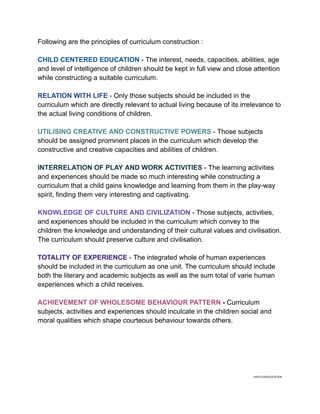
Following are the principles of curriculum construction :
CHILD CENTERED EDUCATION - The interest, needs, capacities, abilities, age
and level of intelligence of children should be kept in full view and close attention
while constructing a suitable curriculum.
RELATION WITH LIFE - Only those subjects should be included in the
curriculum which are directly relevant to actual living because of its irrelevance to
the actual living conditions of children.
UTILISING CREATIVE AND CONSTRUCTIVE POWERS - Those subjects
should be assigned prominent places in the curriculum which develop the
constructive and creative capacities and abilities of children.
INTERRELATION OF PLAY AND WORK ACTIVITIES - The learning activities
and experiences should be made so much interesting while constructing a
curriculum that a child gains knowledge and learning from them in the play-way
spirit, finding them very interesting and captivating.
KNOWLEDGE OF CULTURE AND CIVILIZATION - Those subjects, activities,
and experiences should be included in the curriculum which convey to the
children the knowledge and understanding of their cultural values and civilisation.
The curriculum should preserve culture and civilisation.
TOTALITY OF EXPERIENCE - The integrated whole of human experiences
should be included in the curriculum as one unit. The curriculum should include
both the literary and academic subjects as well as the sum total of varie human
experiences which a child receives.
ACHIEVEMENT OF WHOLESOME BEHAVIOUR PATTERN - Curriculum
subjects, activities and experiences should inculcate in the children social and
moral qualities which shape courteous behaviour towards others.
LIMITLESSEDUCATION
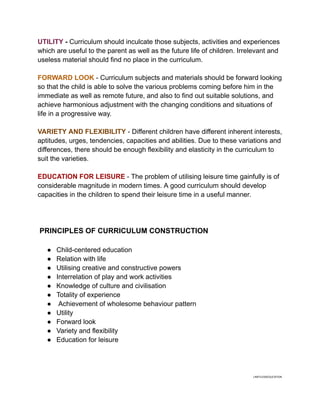
UTILITY - Curriculum should inculcate those subjects, activities and experiences
which are useful to the parent as well as the future life of children. Irrelevant and
useless material should find no place in the curriculum.
FORWARD LOOK - Curriculum subjects and materials should be forward looking
so that the child is able to solve the various problems coming before him in the
immediate as well as remote future, and also to find out suitable solutions, and
achieve harmonious adjustment with the changing conditions and situations of
life in a progressive way.
VARIETY AND FLEXIBILITY - Different children have different inherent interests,
aptitudes, urges, tendencies, capacities and abilities. Due to these variations and
differences, there should be enough flexibility and elasticity in the curriculum to
suit the varieties.
EDUCATION FOR LEISURE - The problem of utilising leisure time gainfully is of
considerable magnitude in modern times. A good curriculum should develop
capacities in the children to spend their leisure time in a useful manner.
PRINCIPLES OF CURRICULUM CONSTRUCTION
●​ Child-centered education
●​ Relation with life
●​ Utilising creative and constructive powers
●​ Interrelation of play and work activities
●​ Knowledge of culture and civilisation
●​ Totality of experience
●​ Achievement of wholesome behaviour pattern
●​ Utility
●​ Forward look
●​ Variety and flexibility
●​ Education for leisure
LIMITLESSEDUCATION
Some more principles of curriculum construction are :-
●​ Flexibility
●​ Continuity
●​ Sequence
●​ Integration
●​ Relevance
●​ Validity
●​ Comprehensiveness
●​ Clear objectives
●​ Evaluation
LIMITLESSEDUCATION
THANK YOU
LIMITLESSEDUCATION

Principles of curriculum construction.pdf

  • 1.
    PRINCIPLES OF CURRICULUM CONSTRUCTION BY- SHRUTI AGARWAL LIMITLESSEDUCATION
  • 2.
    Following are theprinciples of curriculum construction : CHILD CENTERED EDUCATION - The interest, needs, capacities, abilities, age and level of intelligence of children should be kept in full view and close attention while constructing a suitable curriculum. RELATION WITH LIFE - Only those subjects should be included in the curriculum which are directly relevant to actual living because of its irrelevance to the actual living conditions of children. UTILISING CREATIVE AND CONSTRUCTIVE POWERS - Those subjects should be assigned prominent places in the curriculum which develop the constructive and creative capacities and abilities of children. INTERRELATION OF PLAY AND WORK ACTIVITIES - The learning activities and experiences should be made so much interesting while constructing a curriculum that a child gains knowledge and learning from them in the play-way spirit, finding them very interesting and captivating. KNOWLEDGE OF CULTURE AND CIVILIZATION - Those subjects, activities, and experiences should be included in the curriculum which convey to the children the knowledge and understanding of their cultural values and civilisation. The curriculum should preserve culture and civilisation. TOTALITY OF EXPERIENCE - The integrated whole of human experiences should be included in the curriculum as one unit. The curriculum should include both the literary and academic subjects as well as the sum total of varie human experiences which a child receives. ACHIEVEMENT OF WHOLESOME BEHAVIOUR PATTERN - Curriculum subjects, activities and experiences should inculcate in the children social and moral qualities which shape courteous behaviour towards others. LIMITLESSEDUCATION
  • 3.
    UTILITY - Curriculumshould inculcate those subjects, activities and experiences which are useful to the parent as well as the future life of children. Irrelevant and useless material should find no place in the curriculum. FORWARD LOOK - Curriculum subjects and materials should be forward looking so that the child is able to solve the various problems coming before him in the immediate as well as remote future, and also to find out suitable solutions, and achieve harmonious adjustment with the changing conditions and situations of life in a progressive way. VARIETY AND FLEXIBILITY - Different children have different inherent interests, aptitudes, urges, tendencies, capacities and abilities. Due to these variations and differences, there should be enough flexibility and elasticity in the curriculum to suit the varieties. EDUCATION FOR LEISURE - The problem of utilising leisure time gainfully is of considerable magnitude in modern times. A good curriculum should develop capacities in the children to spend their leisure time in a useful manner. PRINCIPLES OF CURRICULUM CONSTRUCTION ●​ Child-centered education ●​ Relation with life ●​ Utilising creative and constructive powers ●​ Interrelation of play and work activities ●​ Knowledge of culture and civilisation ●​ Totality of experience ●​ Achievement of wholesome behaviour pattern ●​ Utility ●​ Forward look ●​ Variety and flexibility ●​ Education for leisure LIMITLESSEDUCATION
  • 4.
    Some more principlesof curriculum construction are :- ●​ Flexibility ●​ Continuity ●​ Sequence ●​ Integration ●​ Relevance ●​ Validity ●​ Comprehensiveness ●​ Clear objectives ●​ Evaluation LIMITLESSEDUCATION
  • 5.