UNDER-
STANDING
BLOCKCHAINRAZI SALIH
2
UNDERSTANDING
BLOCKCHAIN
RAZI SALIH
Also known as a distributed ledger
technology (DLT), blockchain is a
technology that allows blocks of digital
information to be stored in a public
database.
Data is distributed across multiple servers (or nodes)
globally, an aspect that allows anyone on the block-
chain’s network to have near real-time access to en-
tries on the chain. As such, it’s difficult for a single user
to manipulate or delete data.
Blockchain’s decentralised nature is a major talking
point. However, privacy and security are additional
aspects that the technology can provide for various
applications.
Privacy
Users who wish to receive a copy of the blockchain
can connect to the network as nodes. In doing so, they
join multiple other users (millions in the case of Bitcoin,
blockchain’s most high-profile use case) who have an
identical copy of the blockchain. This is significant,
as having information shared across so many nodes
makes it more difficult to delete or manipulate it.
3
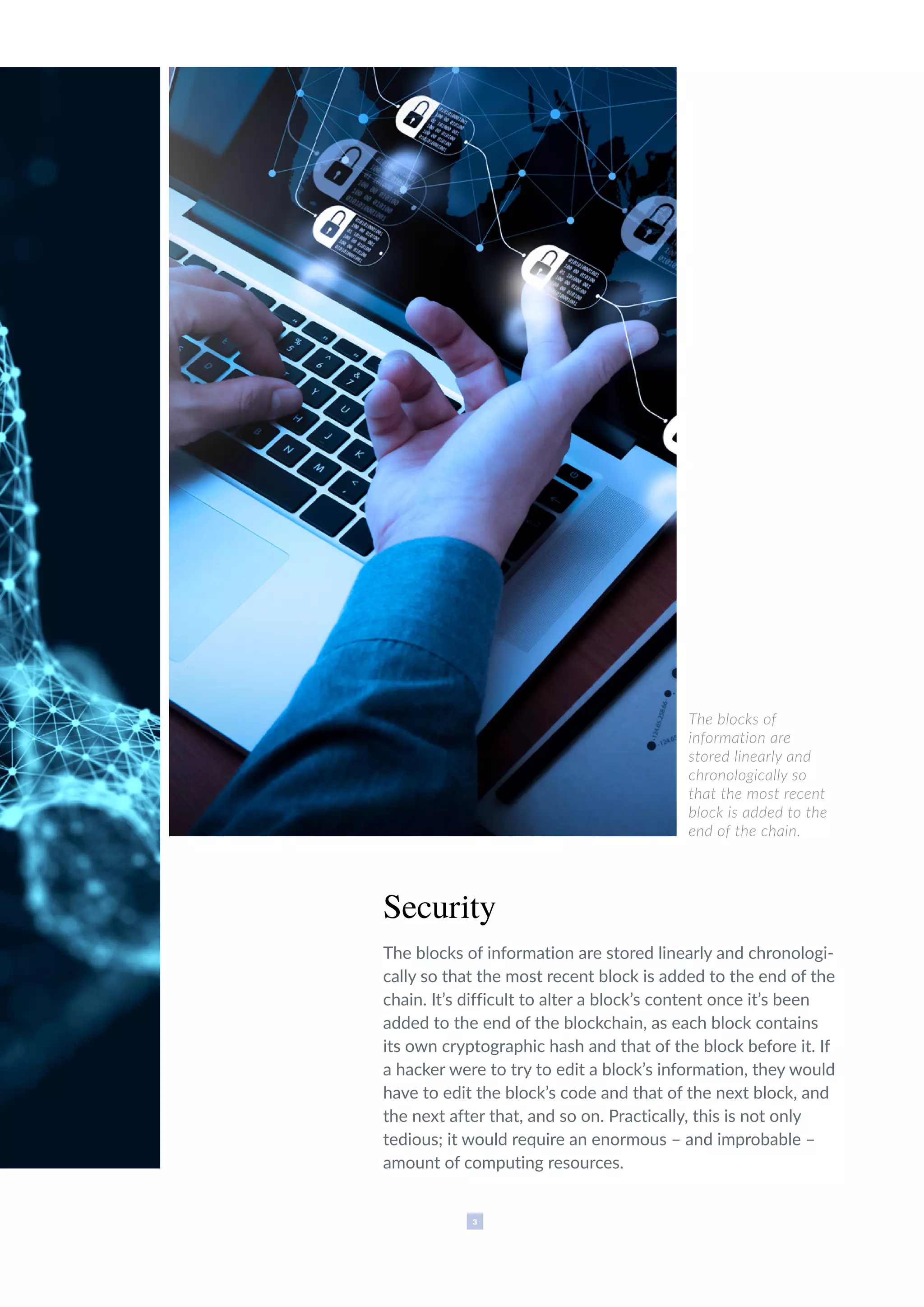
The blocks of
information are
stored linearly and
chronologically so
that the most recent
block is added to the
end of the chain.
Security
The blocks of information are stored linearly and chronologi-
cally so that the most recent block is added to the end of the
chain. It’s difficult to alter a block’s content once it’s been
added to the end of the blockchain, as each block contains
its own cryptographic hash and that of the block before it. If
a hacker were to try to edit a block’s information, they would
have to edit the block’s code and that of the next block, and
the next after that, and so on. Practically, this is not only
tedious; it would require an enormous – and improbable –
amount of computing resources.
To learn more about this topic,
visit the blog of Razi Salih.

Understanding Blockchain

  • 1.
  • 2.
    2 UNDERSTANDING BLOCKCHAIN RAZI SALIH Also knownas a distributed ledger technology (DLT), blockchain is a technology that allows blocks of digital information to be stored in a public database. Data is distributed across multiple servers (or nodes) globally, an aspect that allows anyone on the block- chain’s network to have near real-time access to en- tries on the chain. As such, it’s difficult for a single user to manipulate or delete data. Blockchain’s decentralised nature is a major talking point. However, privacy and security are additional aspects that the technology can provide for various applications. Privacy Users who wish to receive a copy of the blockchain can connect to the network as nodes. In doing so, they join multiple other users (millions in the case of Bitcoin, blockchain’s most high-profile use case) who have an identical copy of the blockchain. This is significant, as having information shared across so many nodes makes it more difficult to delete or manipulate it.
  • 3.
    3 The blocks of informationare stored linearly and chronologically so that the most recent block is added to the end of the chain. Security The blocks of information are stored linearly and chronologi- cally so that the most recent block is added to the end of the chain. It’s difficult to alter a block’s content once it’s been added to the end of the blockchain, as each block contains its own cryptographic hash and that of the block before it. If a hacker were to try to edit a block’s information, they would have to edit the block’s code and that of the next block, and the next after that, and so on. Practically, this is not only tedious; it would require an enormous – and improbable – amount of computing resources.
  • 4.
    To learn moreabout this topic, visit the blog of Razi Salih.