Blockchain
Building Blocks for a Better World
1. Asiqul Islam --18193203003
2. Chayan Roy --18193203002
3. Mesbahur Rahman --18193203004
4. Ambiya khatun Sathi --18193203005
5. Mehede Hasan --19201203045
6. Mehrab Hossain --19201203046
7. Tarikul Islam --19201203050
8. Arafat Hossain Helal --18193203010
9. Nahida Akter --18193203007
Team Members
TABLE OF
CONTENTS
Introduction 1.
2.
8.
Features & Advantages of
Blockchain
3.
Blockchain Decentralization,
Transparency
4.
Workflow of Blockchain
5.
Uses Field of Blockchain
Bank Vs Blockchain
Blockchain Development
7.
9. Impotency , Limitation of
Blockchain
Conclusion
10.
6.
Cryptocurrency Vs
Blockchain
11. Reference
Introduction:
One of the most secure places to store data is the block chain. Which no one can spoil and hack.
Basically, various data of Bitcoin, cryptocurrency, banking and investing are stored in the blockchain.
Blockchain is a collection of blocks (chain of blocks) which are connected to each other in the form of
a chain. These separate blocks contain the data store, each block has a unique number known as hash
for security and each block contains the hash information of the previous block.
A short history of Blockchain:
Blockchain technology was invented in 1991 by Stuart Haber and W. Scott Stornetta. But then the popularity of this
blockchain technology was not important.
Satoshi Nakamoto invented Bitcoin in 2008 and was the first to use blockchain technology for Bitcoin transactions,
but since then its popularity has grown exponentially. All transaction history of Bitcoin transactions are stored in the
blockchain without the control of any trusted organization or individual. It is said that the journey of Blockchain
started after the invention of Bitcoin.
Introduction:
Definition:
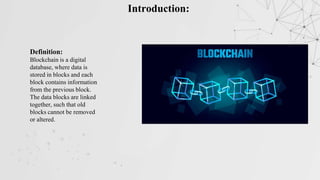
Blockchain is a digital
database, where data is
stored in blocks and each
block contains information
from the previous block.
The data blocks are linked
together, such that old
blocks cannot be removed
or altered.
Features
Increased Capacity: Blockchain This is the first and an important feature of Blockchain. The most
remarkable thing about this Blockchain technology is that it increases the capacity of the whole network.
Because of the reason that there are a lot of computers working together which in total offers a great power
then few of the devices where the things are centralized.
Better Security: Blockchain technology is considered more secure than its contemporaries because of
lack of a single point of failure. Blockchain operates on a well-distributed network of nodes, hence data at
all times is circulated through not one but multiple nodes, which makes sure that even if one node is hacked
or faulty in any way the integrity of the original data will not be compromised.
Immutability: Creating immutable ledgers is one of the main values of Blockchain. Any database that is
centralised is destined for hacks and frauds since it requires trust in some third party intermediary to keep
the database secure.
Features
Faster Settlement: Traditional banking systems are unbelievably slow, probably because they require a
lot of settlement time and usually take days to proceed. This is one of the main reasons why these banking
institutes need to upgrade their banking systems. We can solve this problem by the means of Blockchain as
it can settle money transfer at really fast speeds. This ultimately saves a lot of time and money from these
institutions and provides convenience to the consumer also
Decentralized System: Decentralized technology gives you the power to store your assets in a network
without the oversight and control of a single person organization or entity. Through this owner has direct
control over their account by the means of a key that is linked to the account which gives the owner a
power to transfer his assets to anyone they want. Blockchain technology proves to be a really effective tool
for decentralizing the web which could be nothing short of revolution in the world of internet.
Advantages
1. Improved accuracy by removing human involvement in verification.
2. Cost reductions by eliminating third-party verification.
3. Decentralization makes it harder to tamper with.
4. Transactions are secure, private, and efficient.
5.Transparent technology.
6. Provides a banking alternative and a way to secure personal information for citizens of
countries with unstable or underdeveloped governments.
Decentralization
Definition: In the blockchain, decentralization alludes to the transfer of supervision and decision-making from a
centralized association (individual, corporation, or group of people) to a dispersed network. Decentralized networks
endeavor to decrease the degree of trust that members should put in each other and dissuade their capacity to put
forth authority or command over each other in a manner that corrupts the potency of the network.
Decentralization in Blockchain:
1. Almost everyone in the tech world knows about blockchain, and it has spurred a massive assortment of
applications in different domains. As the name implies, a blockchain is a chain of consecutive blocks attached to
each other.
2. If blockchain is popular, then decentralization automatically deserves attention. However, is it necessary to
emphasize decentralization as a core theme for the future of technology? Decentralization has been around for quite
some time, and network architectures such as centralized and decentralized options have offered some crucial
advantages. Any decentralized blockchain example would showcase the use of decentralized networks.
Decentralization
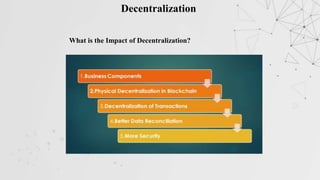
What is the Impact of Decentralization?
Decentralization
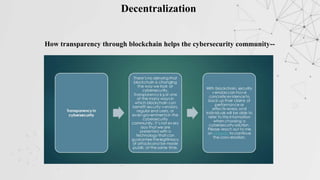
How transparency through blockchain helps the cybersecurity community--
Workflow
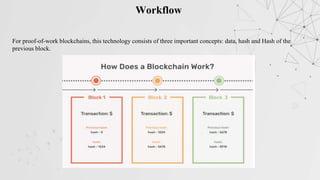
For proof-of-work blockchains, this technology consists of three important concepts: data, hash and Hash of the
previous block.
Workflow
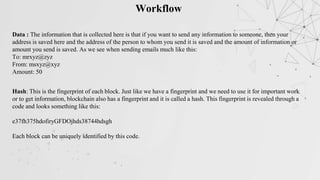
Data : The information that is collected here is that if you want to send any information to someone, then your
address is saved here and the address of the person to whom you send it is saved and the amount of information or
amount you send is saved. As we see when sending emails much like this:
To: mrxyz@zyz
From: msxyz@xyz
Amount: 50
Hash: This is the fingerprint of each block. Just like we have a fingerprint and we need to use it for important work
or to get information, blockchain also has a fingerprint and it is called a hash. This fingerprint is revealed through a
code and looks something like this:
e37fh375hdofiryGFDOjhds38744hdsgh
Each block can be uniquely identified by this code.
Workflow
Hash of the previous block:
Its function is that each block stores the hash or fingerprint of the block behind it. When information or data is
transferred, everyone will understand where the information or data is going or going. If we look at an example
image, we can see that the first block has two unit codes, one is the hash code and the other is the previous hash. If
we look at the second block we can see that it also has its own hash code and it has stored its previous hash code in
its own block. Thus if we look at the third and fourth blocks in a row, each one has its own hash code as well as
storing the hash or fingerprint of its previous block.
We know that each block of the blockchain contains the data of that block, its own hash and the hash of the previous
block. Hash (hash) is the identity number (identity numbers) through this hash, each block is connected to each other
in the form of a chain. But the hash of each block cannot be the same. The hash of each block is always different.
This hash is generated according to the stored data of each block. If the data of a block changes, then the hash of that
block will automatically change.
Uses-Field
Blockchain isn’t only used for financial transactions. Due to its secure and transparent nature, the
technology is versatile to needs beyond one area of expertise. Industries covering energy, logistics,
education and more are utilizing the benefits of blockchain every day.
As we now know, blocks on Bitcoin’s blockchain store data about monetary transactions. Today, there
are more than 10,000 other cryptocurrency systems running on blockchain. But it turns out that
blockchain is actually a reliable way of storing data about other types of transactions as well.
Some companies that have already incorporated blockchain include Walmart, Pfizer, AIG, Siemens,
Unilever, and a host of others. For example, IBM has created its Food Trust blockchain to trace the
journey that food products take to get to their locations.
Uses-Field
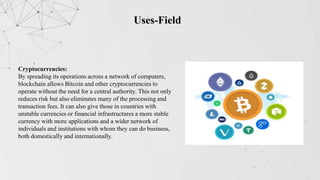
Cryptocurrencies:
By spreading its operations across a network of computers,
blockchain allows Bitcoin and other cryptocurrencies to
operate without the need for a central authority. This not only
reduces risk but also eliminates many of the processing and
transaction fees. It can also give those in countries with
unstable currencies or financial infrastructures a more stable
currency with more applications and a wider network of
individuals and institutions with whom they can do business,
both domestically and internationally.
Uses-Field
Banking and Finance :
By integrating blockchain into banks, consumers can see their
transactions processed in as little as 10 minutes—basically
the time it takes to add a block to the blockchain, regardless
of holidays or the time of day or week. With blockchain,
banks also have the opportunity to exchange funds between
institutions more quickly and securely. In the stock trading
business, for example, the settlement and clearing process can
take up to three days (or longer, if trading internationally),
meaning that the money and shares are frozen for that period
of time.
Uses-Field
Healthcare:
Healthcare providers can leverage blockchain to securely store
their patients’ medical records. When a medical record is
generated and signed, it can be written into the blockchain,
which provides patients with the proof and confidence that the
record cannot be changed. These personal health records could
be encoded and stored on the blockchain with a private key, so
that they are only accessible by certain individuals, thereby
ensuring privacy.
Uses-Field
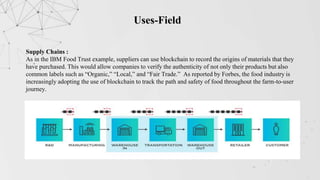
Supply Chains :
As in the IBM Food Trust example, suppliers can use blockchain to record the origins of materials that they
have purchased. This would allow companies to verify the authenticity of not only their products but also
common labels such as “Organic,” “Local,” and “Fair Trade.” As reported by Forbes, the food industry is
increasingly adopting the use of blockchain to track the path and safety of food throughout the farm-to-user
journey.
Uses-Field
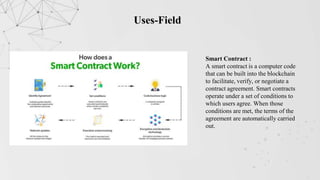
Smart Contract :
A smart contract is a computer code
that can be built into the blockchain
to facilitate, verify, or negotiate a
contract agreement. Smart contracts
operate under a set of conditions to
which users agree. When those
conditions are met, the terms of the
agreement are automatically carried
out.
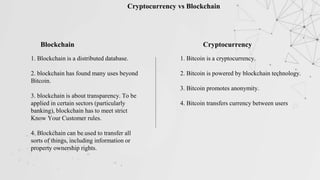
Cryptocurrency vs Blockchain
Blockchain Cryptocurrency
1. Blockchain is a distributed database.
2. blockchain has found many uses beyond
Bitcoin.
3. blockchain is about transparency. To be
applied in certain sectors (particularly
banking), blockchain has to meet strict
Know Your Customer rules.
4. Blockchain can be used to transfer all
sorts of things, including information or
property ownership rights.
1. Bitcoin is a cryptocurrency.
2. Bitcoin is powered by blockchain technology.
3. Bitcoin promotes anonymity.
4. Bitcoin transfers currency between users
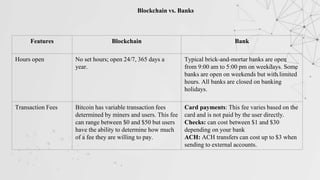
Blockchain vs. Banks
Features Blockchain Bank
Hours open No set hours; open 24/7, 365 days a
year.
Typical brick-and-mortar banks are open
from 9:00 am to 5:00 pm on weekdays. Some
banks are open on weekends but with limited
hours. All banks are closed on banking
holidays.
Transaction Fees Bitcoin has variable transaction fees
determined by miners and users. This fee
can range between $0 and $50 but users
have the ability to determine how much
of a fee they are willing to pay.
Card payments: This fee varies based on the
card and is not paid by the user directly.
Checks: can cost between $1 and $30
depending on your bank
ACH: ACH transfers can cost up to $3 when
sending to external accounts.
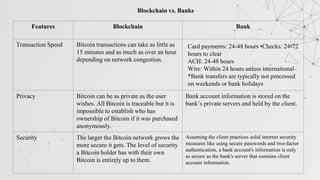
Blockchain vs. Banks
Features Blockchain Bank
Transaction Speed Bitcoin transactions can take as little as
15 minutes and as much as over an hour
depending on network congestion.
Card payments: 24-48 hours •Checks: 24-72
hours to clear
ACH: 24-48 hours
Wire: Within 24 hours unless international
*Bank transfers are typically not processed
on weekends or bank holidays
Privacy Bitcoin can be as private as the user
wishes. All Bitcoin is traceable but it is
impossible to establish who has
ownership of Bitcoin if it was purchased
anonymously.
Bank account information is stored on the
bank’s private servers and held by the client.
Security The larger the Bitcoin network grows the
more secure it gets. The level of security
a Bitcoin holder has with their own
Bitcoin is entirely up to them.
Assuming the client practices solid internet security
measures like using secure passwords and two-factor
authentication, a bank account's information is only
as secure as the bank's server that contains client
account information.
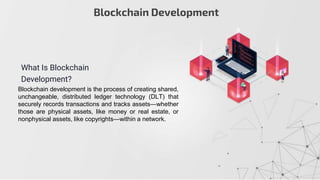
Blockchain Development
What Is Blockchain
Development?
Blockchain development is the process of creating shared,
unchangeable, distributed ledger technology (DLT) that
securely records transactions and tracks assets—whether
those are physical assets, like money or real estate, or
nonphysical assets, like copyrights—within a network.
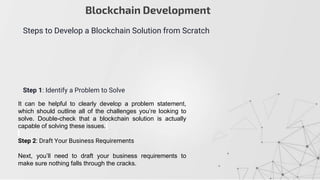
Step 1: Identify a Problem to Solve
It can be helpful to clearly develop a problem statement,
which should outline all of the challenges you’re looking to
solve. Double-check that a blockchain solution is actually
capable of solving these issues.
Step 2: Draft Your Business Requirements
Next, you’ll need to draft your business requirements to
make sure nothing falls through the cracks.
Blockchain Development
Steps to Develop a Blockchain Solution from Scratch
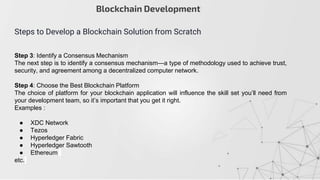
Step 3: Identify a Consensus Mechanism
The next step is to identify a consensus mechanism—a type of methodology used to achieve trust,
security, and agreement among a decentralized computer network.
Step 4: Choose the Best Blockchain Platform
The choice of platform for your blockchain application will influence the skill set you’ll need from
your development team, so it’s important that you get it right.
Examples :
● XDC Network
● Tezos
● Hyperledger Fabric
● Hyperledger Sawtooth
● Ethereum
etc.
Blockchain Development
Steps to Develop a Blockchain Solution from Scratch
Step 5: Design Your Blockchain Nodes
It’s crucial to determine whether you’ll need a permissioned or permissionless blockchain network,
which programming languages you’ll use, and any other elements that may affect development. Do you
need a private, public, or hybrid solution to meet your business needs? Will the blockchain nodes run on
the cloud, on-premises, or both? Which operating system will your application run on (e.g., Ubuntu,
CentOS, Debian, Windows, or Red Hat)? There are a lot of factors at play in this step, so make sure
you research all of your options and measure them against your objectives, available resources, and
budget.
Step 6: Plan Your Blockchain Configuration
For the majority of blockchain platforms, you’ll need to plan for a variety of configuration elements,
including:
● Permissions
● Asset issuance
● Asset re-issuance
● Key management
Etc.
Blockchain Development
Steps to Develop a Blockchain Solution from Scratch
Blockchain Development
Steps to Develop a Blockchain Solution from Scratch
Step 7: Build Your APIs
Depending on your needs, you may need to build APIs for:
● Generation of key pairs and addresses
● Performance of audit-related functions
● Data authentication (through digital signatures and hashes)
● Data storage and retrieval
● Smart-asset lifecycle management
● Smart contracts
Step 8: Design the User Interface
Once you’ve planned the entire app, you can start designing the user interface (UI) for each software
component
Blockchain Developer
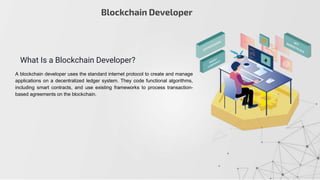
What Is a Blockchain Developer?
A blockchain developer uses the standard internet protocol to create and manage
applications on a decentralized ledger system. They code functional algorithms,
including smart contracts, and use existing frameworks to process transaction-
based agreements on the blockchain.
Blockchain Developer
Reasons you might want to become a blockchain developer-
1. The blockchain is diverse/variant
Whenever some people hear about blockchain, they think it only revolves around Bitcoin, Ethereum, and other
cryptocurrencies. In the real sense, blockchain is a broader term that describes an entire internet space.In essence,
blockchain decentralizes data in blocks into distributed but linked computers (nodes). Indeed, its concept is more
inclusive and not only deals with cryptocurrencies.
2. Web 3.0 is based on blockchain technology .
Web 3.0 isn't synonymous with blockchain, though. But how are they related?
Here's the thing: web 3.0 is decentralized. Most of its core uses blockchain technology. So if you're already a
blockchain programmer, you can boldly call yourself a developer of the future web.
Blockchain Developer
Reasons you might want to become a blockchain developer-
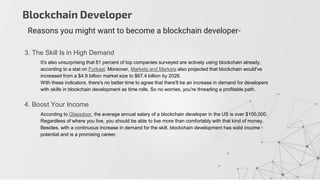
3. The Skill Is in High Demand
It's also unsurprising that 81 percent of top companies surveyed are actively using blockchain already,
according to a stat on Forkast. Moreover, Markets and Markets also projected that blockchain would've
increased from a $4.9 billion market size to $67.4 billion by 2026.
With these indicators, there's no better time to agree that there'll be an increase in demand for developers
with skills in blockchain development as time rolls. So no worries, you're threading a profitable path.
4. Boost Your Income
According to Glassdoor, the average annual salary of a blockchain developer in the US is over $100,000.
Regardless of where you live, you should be able to live more than comfortably with that kind of money.
Besides, with a continuous increase in demand for the skill, blockchain development has solid income
potential and is a promising career.
Blockchain Developer
Reasons you might want to become a blockchain developer-
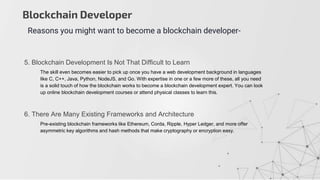
5. Blockchain Development Is Not That Difficult to Learn
The skill even becomes easier to pick up once you have a web development background in languages
like C, C++, Java, Python, NodeJS, and Go. With expertise in one or a few more of these, all you need

is a solid touch of how the blockchain works to become a blockchain development expert. You can look
up online blockchain development courses or attend physical classes to learn this.
6. There Are Many Existing Frameworks and Architecture
Pre-existing blockchain frameworks like Ethereum, Corda, Ripple, Hyper Ledger, and more offer
asymmetric key algorithms and hash methods that make cryptography or encryption easy.
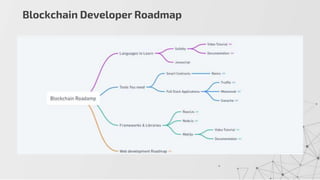
Blockchain Developer Roadmap
Impotency
Importance: The field of Blockchain in the IT sector is growing very fast.
It is estimated that Blockchain technology has been adopted by more than
one-third of the companies in the world and demand for blockchain
developers are ever-increasing. Blockchain technology provides one of the
most secure and safe online transactions which has shaken all the
industries. Due to its numerous benefits to the industry, many companies
and professionals have started to adopt blockchain technology.
limitation
Limitation or Disadvantage:
1. Significant technology cost associated with mining bitcoin
2. Low transactions per second
3. History of use in illicit activities, such as on the dark web
4. Regulation varies by jurisdiction and remains uncertain
5. Data storage limitations
Conclution
We are trying to make a perfect presentation about blockchain technology. Covered all the
information on Blockchain like Features of Blockchain, Uses of Blockchain, Workflow of
Blockchain, Advantages and Limitations of Blockchain. A lot of things can be learned about
blockchain by reading the presentation
Reference
https://www.mytechnicalbangla.com/2022/04/what-is-blockchain-in-bangla.html (intro)
https://www.cryptobankbd.com/2021/08/blockchain-technology-details-in-bangla.html (intro)
https://data-flair.training/blogs/features-of-blockchain/ --(features)
https://101blockchains.com/decentralization-in-blockchain/(Decentralization)
Https://www.Blockchain-council.Org/blockchain/what-is-decentralization-in-blockchain/
https://www.investopedia.com/terms/b/blockchain.asp#toc-how-does-a-blockchain-work
https://bernardmarr.com/what-is-the-difference-between-blockchain-and-bitcoin/
Blockchain development -
1. https://www.xilinx.com/products/design-tools/resources/the-developers-guide-to-blockchain-
development.html#:~:text=Blockchain%20development%20is%20the%20process,like%20copyrights%E2%80%94within%
20a%20network.
2. https://www.makeuseof.com/reasons-to-learn-blockchain-development/
CREDITS: This presentation template was created by Slidesgo, including
icons by Flaticon, and infographics & images by Freepik.
Please keep this slide for attribution.
THANKS
Does anyone have any questions?

Blockchain.pptx

  • 1.
  • 2.
    1. Asiqul Islam--18193203003 2. Chayan Roy --18193203002 3. Mesbahur Rahman --18193203004 4. Ambiya khatun Sathi --18193203005 5. Mehede Hasan --19201203045 6. Mehrab Hossain --19201203046 7. Tarikul Islam --19201203050 8. Arafat Hossain Helal --18193203010 9. Nahida Akter --18193203007 Team Members
  • 3.
    TABLE OF CONTENTS Introduction 1. 2. 8. Features& Advantages of Blockchain 3. Blockchain Decentralization, Transparency 4. Workflow of Blockchain 5. Uses Field of Blockchain Bank Vs Blockchain Blockchain Development 7. 9. Impotency , Limitation of Blockchain Conclusion 10. 6. Cryptocurrency Vs Blockchain 11. Reference
  • 4.
    Introduction: One of themost secure places to store data is the block chain. Which no one can spoil and hack. Basically, various data of Bitcoin, cryptocurrency, banking and investing are stored in the blockchain. Blockchain is a collection of blocks (chain of blocks) which are connected to each other in the form of a chain. These separate blocks contain the data store, each block has a unique number known as hash for security and each block contains the hash information of the previous block. A short history of Blockchain: Blockchain technology was invented in 1991 by Stuart Haber and W. Scott Stornetta. But then the popularity of this blockchain technology was not important. Satoshi Nakamoto invented Bitcoin in 2008 and was the first to use blockchain technology for Bitcoin transactions, but since then its popularity has grown exponentially. All transaction history of Bitcoin transactions are stored in the blockchain without the control of any trusted organization or individual. It is said that the journey of Blockchain started after the invention of Bitcoin.
  • 5.
    Introduction: Definition: Blockchain is adigital database, where data is stored in blocks and each block contains information from the previous block. The data blocks are linked together, such that old blocks cannot be removed or altered.
  • 6.
    Features Increased Capacity: BlockchainThis is the first and an important feature of Blockchain. The most remarkable thing about this Blockchain technology is that it increases the capacity of the whole network. Because of the reason that there are a lot of computers working together which in total offers a great power then few of the devices where the things are centralized. Better Security: Blockchain technology is considered more secure than its contemporaries because of lack of a single point of failure. Blockchain operates on a well-distributed network of nodes, hence data at all times is circulated through not one but multiple nodes, which makes sure that even if one node is hacked or faulty in any way the integrity of the original data will not be compromised. Immutability: Creating immutable ledgers is one of the main values of Blockchain. Any database that is centralised is destined for hacks and frauds since it requires trust in some third party intermediary to keep the database secure.
  • 7.
    Features Faster Settlement: Traditionalbanking systems are unbelievably slow, probably because they require a lot of settlement time and usually take days to proceed. This is one of the main reasons why these banking institutes need to upgrade their banking systems. We can solve this problem by the means of Blockchain as it can settle money transfer at really fast speeds. This ultimately saves a lot of time and money from these institutions and provides convenience to the consumer also Decentralized System: Decentralized technology gives you the power to store your assets in a network without the oversight and control of a single person organization or entity. Through this owner has direct control over their account by the means of a key that is linked to the account which gives the owner a power to transfer his assets to anyone they want. Blockchain technology proves to be a really effective tool for decentralizing the web which could be nothing short of revolution in the world of internet.
  • 8.
    Advantages 1. Improved accuracyby removing human involvement in verification. 2. Cost reductions by eliminating third-party verification. 3. Decentralization makes it harder to tamper with. 4. Transactions are secure, private, and efficient. 5.Transparent technology. 6. Provides a banking alternative and a way to secure personal information for citizens of countries with unstable or underdeveloped governments.
  • 9.
    Decentralization Definition: In theblockchain, decentralization alludes to the transfer of supervision and decision-making from a centralized association (individual, corporation, or group of people) to a dispersed network. Decentralized networks endeavor to decrease the degree of trust that members should put in each other and dissuade their capacity to put forth authority or command over each other in a manner that corrupts the potency of the network. Decentralization in Blockchain: 1. Almost everyone in the tech world knows about blockchain, and it has spurred a massive assortment of applications in different domains. As the name implies, a blockchain is a chain of consecutive blocks attached to each other. 2. If blockchain is popular, then decentralization automatically deserves attention. However, is it necessary to emphasize decentralization as a core theme for the future of technology? Decentralization has been around for quite some time, and network architectures such as centralized and decentralized options have offered some crucial advantages. Any decentralized blockchain example would showcase the use of decentralized networks.
  • 10.
    Decentralization What is theImpact of Decentralization?
  • 11.
    Decentralization How transparency throughblockchain helps the cybersecurity community--
  • 12.
    Workflow For proof-of-work blockchains,this technology consists of three important concepts: data, hash and Hash of the previous block.
  • 13.
    Workflow Data : Theinformation that is collected here is that if you want to send any information to someone, then your address is saved here and the address of the person to whom you send it is saved and the amount of information or amount you send is saved. As we see when sending emails much like this: To: mrxyz@zyz From: msxyz@xyz Amount: 50 Hash: This is the fingerprint of each block. Just like we have a fingerprint and we need to use it for important work or to get information, blockchain also has a fingerprint and it is called a hash. This fingerprint is revealed through a code and looks something like this: e37fh375hdofiryGFDOjhds38744hdsgh Each block can be uniquely identified by this code.
  • 14.
    Workflow Hash of theprevious block: Its function is that each block stores the hash or fingerprint of the block behind it. When information or data is transferred, everyone will understand where the information or data is going or going. If we look at an example image, we can see that the first block has two unit codes, one is the hash code and the other is the previous hash. If we look at the second block we can see that it also has its own hash code and it has stored its previous hash code in its own block. Thus if we look at the third and fourth blocks in a row, each one has its own hash code as well as storing the hash or fingerprint of its previous block. We know that each block of the blockchain contains the data of that block, its own hash and the hash of the previous block. Hash (hash) is the identity number (identity numbers) through this hash, each block is connected to each other in the form of a chain. But the hash of each block cannot be the same. The hash of each block is always different. This hash is generated according to the stored data of each block. If the data of a block changes, then the hash of that block will automatically change.
  • 15.
    Uses-Field Blockchain isn’t onlyused for financial transactions. Due to its secure and transparent nature, the technology is versatile to needs beyond one area of expertise. Industries covering energy, logistics, education and more are utilizing the benefits of blockchain every day. As we now know, blocks on Bitcoin’s blockchain store data about monetary transactions. Today, there are more than 10,000 other cryptocurrency systems running on blockchain. But it turns out that blockchain is actually a reliable way of storing data about other types of transactions as well. Some companies that have already incorporated blockchain include Walmart, Pfizer, AIG, Siemens, Unilever, and a host of others. For example, IBM has created its Food Trust blockchain to trace the journey that food products take to get to their locations.
  • 16.
    Uses-Field Cryptocurrencies: By spreading itsoperations across a network of computers, blockchain allows Bitcoin and other cryptocurrencies to operate without the need for a central authority. This not only reduces risk but also eliminates many of the processing and transaction fees. It can also give those in countries with unstable currencies or financial infrastructures a more stable currency with more applications and a wider network of individuals and institutions with whom they can do business, both domestically and internationally.
  • 17.
    Uses-Field Banking and Finance: By integrating blockchain into banks, consumers can see their transactions processed in as little as 10 minutes—basically the time it takes to add a block to the blockchain, regardless of holidays or the time of day or week. With blockchain, banks also have the opportunity to exchange funds between institutions more quickly and securely. In the stock trading business, for example, the settlement and clearing process can take up to three days (or longer, if trading internationally), meaning that the money and shares are frozen for that period of time.
  • 18.
    Uses-Field Healthcare: Healthcare providers canleverage blockchain to securely store their patients’ medical records. When a medical record is generated and signed, it can be written into the blockchain, which provides patients with the proof and confidence that the record cannot be changed. These personal health records could be encoded and stored on the blockchain with a private key, so that they are only accessible by certain individuals, thereby ensuring privacy.
  • 19.
    Uses-Field Supply Chains : Asin the IBM Food Trust example, suppliers can use blockchain to record the origins of materials that they have purchased. This would allow companies to verify the authenticity of not only their products but also common labels such as “Organic,” “Local,” and “Fair Trade.” As reported by Forbes, the food industry is increasingly adopting the use of blockchain to track the path and safety of food throughout the farm-to-user journey.
  • 20.
    Uses-Field Smart Contract : Asmart contract is a computer code that can be built into the blockchain to facilitate, verify, or negotiate a contract agreement. Smart contracts operate under a set of conditions to which users agree. When those conditions are met, the terms of the agreement are automatically carried out.
  • 21.
    Cryptocurrency vs Blockchain BlockchainCryptocurrency 1. Blockchain is a distributed database. 2. blockchain has found many uses beyond Bitcoin. 3. blockchain is about transparency. To be applied in certain sectors (particularly banking), blockchain has to meet strict Know Your Customer rules. 4. Blockchain can be used to transfer all sorts of things, including information or property ownership rights. 1. Bitcoin is a cryptocurrency. 2. Bitcoin is powered by blockchain technology. 3. Bitcoin promotes anonymity. 4. Bitcoin transfers currency between users
  • 22.
    Blockchain vs. Banks FeaturesBlockchain Bank Hours open No set hours; open 24/7, 365 days a year. Typical brick-and-mortar banks are open from 9:00 am to 5:00 pm on weekdays. Some banks are open on weekends but with limited hours. All banks are closed on banking holidays. Transaction Fees Bitcoin has variable transaction fees determined by miners and users. This fee can range between $0 and $50 but users have the ability to determine how much of a fee they are willing to pay. Card payments: This fee varies based on the card and is not paid by the user directly. Checks: can cost between $1 and $30 depending on your bank ACH: ACH transfers can cost up to $3 when sending to external accounts.
  • 23.
    Blockchain vs. Banks FeaturesBlockchain Bank Transaction Speed Bitcoin transactions can take as little as 15 minutes and as much as over an hour depending on network congestion. Card payments: 24-48 hours •Checks: 24-72 hours to clear ACH: 24-48 hours Wire: Within 24 hours unless international *Bank transfers are typically not processed on weekends or bank holidays Privacy Bitcoin can be as private as the user wishes. All Bitcoin is traceable but it is impossible to establish who has ownership of Bitcoin if it was purchased anonymously. Bank account information is stored on the bank’s private servers and held by the client. Security The larger the Bitcoin network grows the more secure it gets. The level of security a Bitcoin holder has with their own Bitcoin is entirely up to them. Assuming the client practices solid internet security measures like using secure passwords and two-factor authentication, a bank account's information is only as secure as the bank's server that contains client account information.
  • 24.
    Blockchain Development What IsBlockchain Development? Blockchain development is the process of creating shared, unchangeable, distributed ledger technology (DLT) that securely records transactions and tracks assets—whether those are physical assets, like money or real estate, or nonphysical assets, like copyrights—within a network.
  • 25.
    Step 1: Identifya Problem to Solve It can be helpful to clearly develop a problem statement, which should outline all of the challenges you’re looking to solve. Double-check that a blockchain solution is actually capable of solving these issues. Step 2: Draft Your Business Requirements Next, you’ll need to draft your business requirements to make sure nothing falls through the cracks. Blockchain Development Steps to Develop a Blockchain Solution from Scratch
  • 26.
    Step 3: Identifya Consensus Mechanism The next step is to identify a consensus mechanism—a type of methodology used to achieve trust, security, and agreement among a decentralized computer network. Step 4: Choose the Best Blockchain Platform The choice of platform for your blockchain application will influence the skill set you’ll need from your development team, so it’s important that you get it right. Examples : ● XDC Network ● Tezos ● Hyperledger Fabric ● Hyperledger Sawtooth ● Ethereum etc. Blockchain Development Steps to Develop a Blockchain Solution from Scratch
  • 27.
    Step 5: DesignYour Blockchain Nodes It’s crucial to determine whether you’ll need a permissioned or permissionless blockchain network, which programming languages you’ll use, and any other elements that may affect development. Do you need a private, public, or hybrid solution to meet your business needs? Will the blockchain nodes run on the cloud, on-premises, or both? Which operating system will your application run on (e.g., Ubuntu, CentOS, Debian, Windows, or Red Hat)? There are a lot of factors at play in this step, so make sure you research all of your options and measure them against your objectives, available resources, and budget. Step 6: Plan Your Blockchain Configuration For the majority of blockchain platforms, you’ll need to plan for a variety of configuration elements, including: ● Permissions ● Asset issuance ● Asset re-issuance ● Key management Etc. Blockchain Development Steps to Develop a Blockchain Solution from Scratch
  • 28.
    Blockchain Development Steps toDevelop a Blockchain Solution from Scratch Step 7: Build Your APIs Depending on your needs, you may need to build APIs for: ● Generation of key pairs and addresses ● Performance of audit-related functions ● Data authentication (through digital signatures and hashes) ● Data storage and retrieval ● Smart-asset lifecycle management ● Smart contracts Step 8: Design the User Interface Once you’ve planned the entire app, you can start designing the user interface (UI) for each software component
  • 29.
    Blockchain Developer What Isa Blockchain Developer? A blockchain developer uses the standard internet protocol to create and manage applications on a decentralized ledger system. They code functional algorithms, including smart contracts, and use existing frameworks to process transaction- based agreements on the blockchain.
  • 30.
    Blockchain Developer Reasons youmight want to become a blockchain developer- 1. The blockchain is diverse/variant Whenever some people hear about blockchain, they think it only revolves around Bitcoin, Ethereum, and other cryptocurrencies. In the real sense, blockchain is a broader term that describes an entire internet space.In essence, blockchain decentralizes data in blocks into distributed but linked computers (nodes). Indeed, its concept is more inclusive and not only deals with cryptocurrencies. 2. Web 3.0 is based on blockchain technology . Web 3.0 isn't synonymous with blockchain, though. But how are they related? Here's the thing: web 3.0 is decentralized. Most of its core uses blockchain technology. So if you're already a blockchain programmer, you can boldly call yourself a developer of the future web.
  • 31.
    Blockchain Developer Reasons youmight want to become a blockchain developer- 3. The Skill Is in High Demand It's also unsurprising that 81 percent of top companies surveyed are actively using blockchain already, according to a stat on Forkast. Moreover, Markets and Markets also projected that blockchain would've increased from a $4.9 billion market size to $67.4 billion by 2026. With these indicators, there's no better time to agree that there'll be an increase in demand for developers with skills in blockchain development as time rolls. So no worries, you're threading a profitable path. 4. Boost Your Income According to Glassdoor, the average annual salary of a blockchain developer in the US is over $100,000. Regardless of where you live, you should be able to live more than comfortably with that kind of money. Besides, with a continuous increase in demand for the skill, blockchain development has solid income potential and is a promising career.
  • 32.
    Blockchain Developer Reasons youmight want to become a blockchain developer- 5. Blockchain Development Is Not That Difficult to Learn The skill even becomes easier to pick up once you have a web development background in languages like C, C++, Java, Python, NodeJS, and Go. With expertise in one or a few more of these, all you need is a solid touch of how the blockchain works to become a blockchain development expert. You can look up online blockchain development courses or attend physical classes to learn this. 6. There Are Many Existing Frameworks and Architecture Pre-existing blockchain frameworks like Ethereum, Corda, Ripple, Hyper Ledger, and more offer asymmetric key algorithms and hash methods that make cryptography or encryption easy.
  • 33.
  • 34.
    Impotency Importance: The fieldof Blockchain in the IT sector is growing very fast. It is estimated that Blockchain technology has been adopted by more than one-third of the companies in the world and demand for blockchain developers are ever-increasing. Blockchain technology provides one of the most secure and safe online transactions which has shaken all the industries. Due to its numerous benefits to the industry, many companies and professionals have started to adopt blockchain technology.
  • 35.
    limitation Limitation or Disadvantage: 1.Significant technology cost associated with mining bitcoin 2. Low transactions per second 3. History of use in illicit activities, such as on the dark web 4. Regulation varies by jurisdiction and remains uncertain 5. Data storage limitations
  • 36.
    Conclution We are tryingto make a perfect presentation about blockchain technology. Covered all the information on Blockchain like Features of Blockchain, Uses of Blockchain, Workflow of Blockchain, Advantages and Limitations of Blockchain. A lot of things can be learned about blockchain by reading the presentation
  • 37.
    Reference https://www.mytechnicalbangla.com/2022/04/what-is-blockchain-in-bangla.html (intro) https://www.cryptobankbd.com/2021/08/blockchain-technology-details-in-bangla.html (intro) https://data-flair.training/blogs/features-of-blockchain/--(features) https://101blockchains.com/decentralization-in-blockchain/(Decentralization) Https://www.Blockchain-council.Org/blockchain/what-is-decentralization-in-blockchain/ https://www.investopedia.com/terms/b/blockchain.asp#toc-how-does-a-blockchain-work https://bernardmarr.com/what-is-the-difference-between-blockchain-and-bitcoin/ Blockchain development - 1. https://www.xilinx.com/products/design-tools/resources/the-developers-guide-to-blockchain- development.html#:~:text=Blockchain%20development%20is%20the%20process,like%20copyrights%E2%80%94within% 20a%20network. 2. https://www.makeuseof.com/reasons-to-learn-blockchain-development/
  • 38.
    CREDITS: This presentationtemplate was created by Slidesgo, including icons by Flaticon, and infographics & images by Freepik. Please keep this slide for attribution. THANKS Does anyone have any questions?