






6.16.2014
Customer Research & Personas
Brian Winters
@bwinters
WHAT WE’LL COVER
Personas Overview
Research to Personas
Listening Sessions
A FEW QUESTIONS
How well do you know your customers?
How do you use personas?
What is the value of personas to your organization?
P E R S O N A S O V E R V I E W
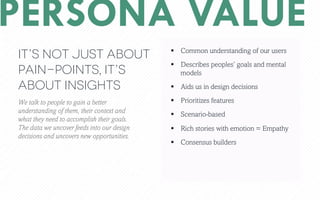
PERSONA VALUE
We talk to people to gain a better
understanding of them, their context and
what they need to accomplish their goals.
The data we uncover feeds into our design
decisions and uncovers new opportunities.
§  Common understanding of our users
§  Describes peoples’ goals and mental
models
§  Aids us in design decisions
§  Prioritizes features
§  Scenario-based
§  Rich stories with emotion = Empathy
§  Consensus builders
It’s not just about
pain-points, it’s
about insights
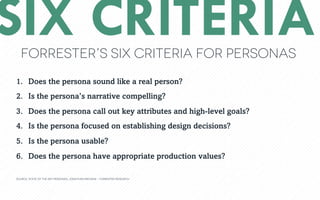
Forrester’s six criteria for personas
SIX CRITERIA
1.  Does the persona sound like a real person?
2.  Is the persona’s narrative compelling?
3.  Does the persona call out key attributes and high-level goals?
4.  Is the persona focused on establishing design decisions?
5.  Is the persona usable?
6.  Does the persona have appropriate production values?
Source: state of the art personas, jonathan browne – forrester research
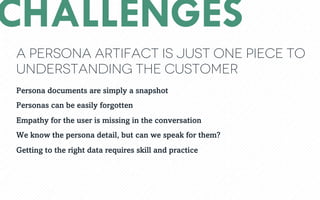
A persona artifact is just one piece to
understanding the customer
CHALLENGES
Persona documents are simply a snapshot
Personas can be easily forgotten
Empathy for the user is missing in the conversation
We know the persona detail, but can we speak for them?
Getting to the right data requires skill and practice
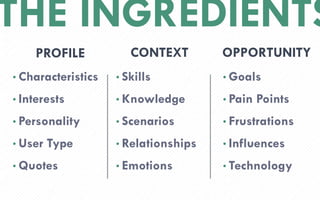
THE INGREDIENTS
• Characteristics
• Interests
• Personality
• User Type
• Quotes
• Skills
• Knowledge
• Scenarios
• Relationships
• Emotions
• Goals
• Pain Points
• Frustrations
• Influences
• Technology
PROFILE CONTEXT OPPORTUNITY
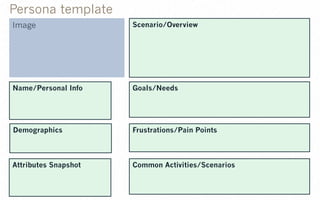
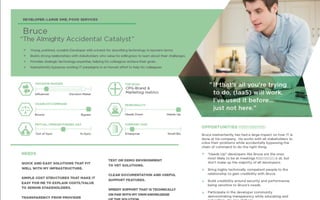
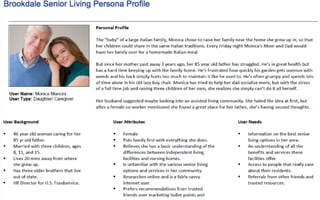
Image
Name/Personal Info
Demographics
Scenario/Overview
Goals/Needs
Frustrations/Pain Points
Persona template
Common Activities/ScenariosAttributes Snapshot
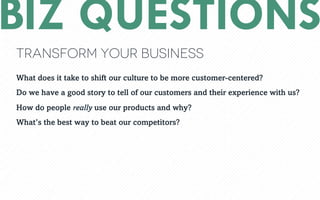
Transform your business
BIZ QUESTIONS
What does it take to shift our culture to be more customer-centered?
Do we have a good story to tell of our customers and their experience with us?
How do people really use our products and why?
What’s the best way to beat our competitors?
R E S E A RC H F O R P E R S O N A S
RESEARCH TO PERSONA
Research Data:
•  Quotes
•  Pain Points/Needs
•  Observations
•  Insights
•  Tasks
•  Scenarios
Data Analysis
Finding Patterns:
•  Affinity Clustering
•  Relationships
•  Emotions
•  Behaviors
•  Needs Identification
•  Context Attributes
Develop Insights & Persona
•  What does it mean?
•  Follow-up research
•  Storytelling
•  Common Understanding
•  Research, test, iterate
Synthesis
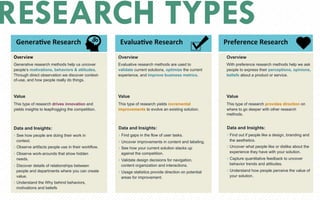
Overview
Generative research methods help us uncover
people’s motivations, behaviors & attitudes,
Through direct observation we discover context-
of-use, and how people really do things.
Value
This type of research drives innovation and
yields insights to leapfrogging the competition.
Genera&ve	
  Research	


Evalua&ve	
  Research	


Preference	
  Research	


Data and Insights:
› See how people are doing their work in
context.
› Observe artifacts people use in their workflow.
› Observe work-arounds that show hidden
needs.
› Discover details of relationships between
people and departments where you can create
value.
› Understand the Why behind behaviors,
motivations and beliefs
Overview
Evaluative research methods are used to
validate current solutions, optimize the current
experience, and improve business metrics.
Value
This type of research yields incremental
improvements to evolve an existing solution.
Data and Insights:
› Find gaps in the flow of user tasks.
› Uncover improvements in content and labeling.
› See how your current solution stacks up
against the competition.
› Validate design decisions for navigation,
content organization and interactions.
› Usage statistics provide direction on potential
areas for improvement.
Overview
With preference research methods help we ask
people to express their perceptions, opinions,
beliefs about a product or service.
Value
This type of research provides direction on
where to go deeper with other research
methods.
Data and Insights:
› Find out if people like a design, branding and
the aesthetics.
› Uncover what people like or dislike about the
experience they have with your solution.
› Capture quantitative feedback to uncover
behavior trends and attitudes.
› Understand how people perceive the value of
your solution.
RESEARCH TYPES
Genera&ve	
  Research	


Evalua&ve	
  Research	


Preference	
  Research	


METHOD SELECTION
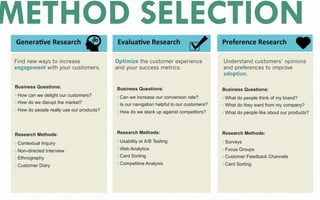
Find new ways to increase
engagement with your customers.
Business Questions:
› How can we delight our customers?
› How do we disrupt the market?
› How do people really use our products?
Research Methods:
› Contextual Inquiry
› Non-directed Interview
› Ethnography
› Customer Diary
Optimize the customer experience
and your success metrics.
Business Questions:
› Can we increase our conversion rate?
› Is our navigation helpful to our customers?
› How do we stack up against competitors?
Research Methods:
› Usability or A/B Testing
› Web Analytics
› Card Sorting
› Competitive Analysis
Understand customers’ opinions
and preferences to improve
adoption.
Business Questions:
› What do people think of my brand?
› What do they want from my company?
› What do people like about our products?
Research Methods:
› Surveys
› Focus Groups
› Customer Feedback Channels
› Card Sorting
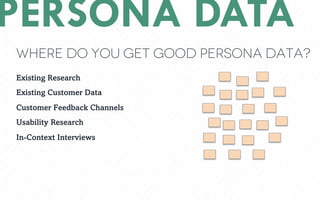
Where do you get good Persona Data?
PERSONA DATA
Existing Research
Existing Customer Data
Customer Feedback Channels
Usability Research
In-Context Interviews
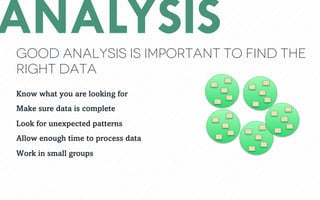
Good analysis is important to find the
right data
ANALYSIS
Know what you are looking for
Make sure data is complete
Look for unexpected patterns
Allow enough time to process data
Work in small groups
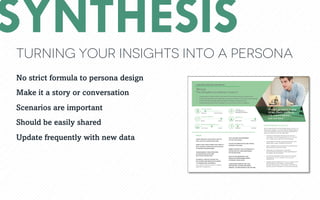
Turning your insights into a persona
SYNTHESIS
No strict formula to persona design
Make it a story or conversation
Scenarios are important
Should be easily shared
Update frequently with new data
L I S T E N I N G S E S S I O N S
LISTENING SESSION
Immersion in your
customer’s experience
•  Focus on listening Deep, active listening helps us uncover latent needs and
unexpected insights.
•  Facilitated Session Facilitate the analysis of what you are hearing from the
customer to drive towards new ideas and uncover new ways to think about your
solution.
•  Real-Time You’ll walk away from every the sessions with insights that you can
immediately apply to your project work.
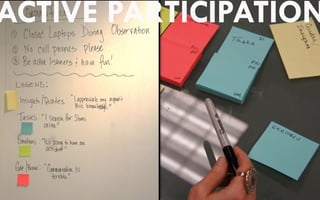
•  Active Participation Share with a broader group how to analyze usability
research data, teaching your team how to think about the data and findings, for
maximum impact on your designs.
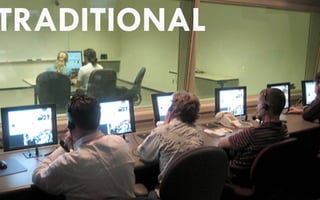
TRADITIONAL
Interview questions & tips
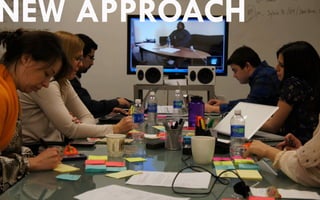
NEW APPROACH
Active participation
The interview
ACTIVE PARTICIPATION
The interview
COLLABORATION
The interview
EXPERT FACILITATION
The interview
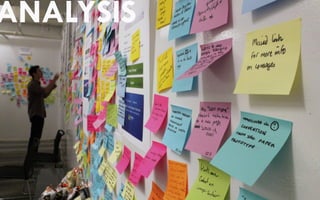
ANALYSIS
Interview questions & tips
STORYTELLING
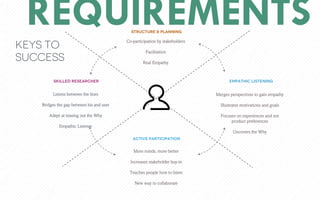
REQUIREMENTS
Listens between the lines
Bridges the gap between biz and user
Adept at teasing out the Why
Empathic Listener
Skilled researcher
Co-participation by stakeholders
Facilitation
Real Empathy
Structure & planning
Keys to
success
Empathic listening
Merges perspectives to gain empathy
Illustrates motivations and goals
Focuses on experiences and not
product preferences
Uncovers the Why
Active participation
More minds, more better
Increases stakeholder buy-in
Teaches people how to listen
New way to collaborate
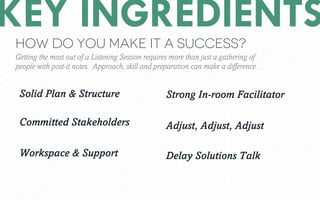
KEY INGREDIENTS
How do You make it a success?
Getting the most out of a Listening Session requires more than just a gathering of
people with post-it notes. Approach, skill and preparation can make a difference.
Solid Plan & Structure Strong In-room Facilitator
Workspace & Support
Committed Stakeholders Adjust, Adjust, Adjust
Delay Solutions Talk
QUESTIONS?
FIN
Brian Winters
brian.winters@manifestdigital.com
@bwinters

Customer Research & Personas

  • 1.
    6.16.2014 Customer Research &Personas Brian Winters @bwinters
  • 2.
    WHAT WE’LL COVER PersonasOverview Research to Personas Listening Sessions
  • 3.
    A FEW QUESTIONS Howwell do you know your customers? How do you use personas? What is the value of personas to your organization?
  • 4.
    P E RS O N A S O V E R V I E W
  • 5.
    PERSONA VALUE We talkto people to gain a better understanding of them, their context and what they need to accomplish their goals. The data we uncover feeds into our design decisions and uncovers new opportunities. §  Common understanding of our users §  Describes peoples’ goals and mental models §  Aids us in design decisions §  Prioritizes features §  Scenario-based §  Rich stories with emotion = Empathy §  Consensus builders It’s not just about pain-points, it’s about insights
  • 6.
    Forrester’s six criteriafor personas SIX CRITERIA 1.  Does the persona sound like a real person? 2.  Is the persona’s narrative compelling? 3.  Does the persona call out key attributes and high-level goals? 4.  Is the persona focused on establishing design decisions? 5.  Is the persona usable? 6.  Does the persona have appropriate production values? Source: state of the art personas, jonathan browne – forrester research
  • 7.
    A persona artifactis just one piece to understanding the customer CHALLENGES Persona documents are simply a snapshot Personas can be easily forgotten Empathy for the user is missing in the conversation We know the persona detail, but can we speak for them? Getting to the right data requires skill and practice
  • 8.
  • 9.
  • 12.
    Transform your business BIZQUESTIONS What does it take to shift our culture to be more customer-centered? Do we have a good story to tell of our customers and their experience with us? How do people really use our products and why? What’s the best way to beat our competitors?
  • 13.
    R E SE A RC H F O R P E R S O N A S
  • 14.
    RESEARCH TO PERSONA ResearchData: •  Quotes •  Pain Points/Needs •  Observations •  Insights •  Tasks •  Scenarios Data Analysis Finding Patterns: •  Affinity Clustering •  Relationships •  Emotions •  Behaviors •  Needs Identification •  Context Attributes Develop Insights & Persona •  What does it mean? •  Follow-up research •  Storytelling •  Common Understanding •  Research, test, iterate Synthesis
  • 15.
    Overview Generative research methodshelp us uncover people’s motivations, behaviors & attitudes, Through direct observation we discover context- of-use, and how people really do things. Value This type of research drives innovation and yields insights to leapfrogging the competition. Genera&ve  Research     Evalua&ve  Research     Preference  Research     Data and Insights: › See how people are doing their work in context. › Observe artifacts people use in their workflow. › Observe work-arounds that show hidden needs. › Discover details of relationships between people and departments where you can create value. › Understand the Why behind behaviors, motivations and beliefs Overview Evaluative research methods are used to validate current solutions, optimize the current experience, and improve business metrics. Value This type of research yields incremental improvements to evolve an existing solution. Data and Insights: › Find gaps in the flow of user tasks. › Uncover improvements in content and labeling. › See how your current solution stacks up against the competition. › Validate design decisions for navigation, content organization and interactions. › Usage statistics provide direction on potential areas for improvement. Overview With preference research methods help we ask people to express their perceptions, opinions, beliefs about a product or service. Value This type of research provides direction on where to go deeper with other research methods. Data and Insights: › Find out if people like a design, branding and the aesthetics. › Uncover what people like or dislike about the experience they have with your solution. › Capture quantitative feedback to uncover behavior trends and attitudes. › Understand how people perceive the value of your solution. RESEARCH TYPES
  • 16.
    Genera&ve  Research     Evalua&ve  Research     Preference  Research     METHOD SELECTION Find new ways to increase engagement with your customers. Business Questions: › How can we delight our customers? › How do we disrupt the market? › How do people really use our products? Research Methods: › Contextual Inquiry › Non-directed Interview › Ethnography › Customer Diary Optimize the customer experience and your success metrics. Business Questions: › Can we increase our conversion rate? › Is our navigation helpful to our customers? › How do we stack up against competitors? Research Methods: › Usability or A/B Testing › Web Analytics › Card Sorting › Competitive Analysis Understand customers’ opinions and preferences to improve adoption. Business Questions: › What do people think of my brand? › What do they want from my company? › What do people like about our products? Research Methods: › Surveys › Focus Groups › Customer Feedback Channels › Card Sorting
  • 17.
    Where do youget good Persona Data? PERSONA DATA Existing Research Existing Customer Data Customer Feedback Channels Usability Research In-Context Interviews
  • 18.
    Good analysis isimportant to find the right data ANALYSIS Know what you are looking for Make sure data is complete Look for unexpected patterns Allow enough time to process data Work in small groups
  • 19.
    Turning your insightsinto a persona SYNTHESIS No strict formula to persona design Make it a story or conversation Scenarios are important Should be easily shared Update frequently with new data
  • 20.
    L I ST E N I N G S E S S I O N S
  • 21.
    LISTENING SESSION Immersion inyour customer’s experience •  Focus on listening Deep, active listening helps us uncover latent needs and unexpected insights. •  Facilitated Session Facilitate the analysis of what you are hearing from the customer to drive towards new ideas and uncover new ways to think about your solution. •  Real-Time You’ll walk away from every the sessions with insights that you can immediately apply to your project work. •  Active Participation Share with a broader group how to analyze usability research data, teaching your team how to think about the data and findings, for maximum impact on your designs.
  • 22.
  • 23.
  • 24.
  • 25.
  • 26.
  • 27.
  • 28.
    Interview questions &tips STORYTELLING
  • 29.
    REQUIREMENTS Listens between thelines Bridges the gap between biz and user Adept at teasing out the Why Empathic Listener Skilled researcher Co-participation by stakeholders Facilitation Real Empathy Structure & planning Keys to success Empathic listening Merges perspectives to gain empathy Illustrates motivations and goals Focuses on experiences and not product preferences Uncovers the Why Active participation More minds, more better Increases stakeholder buy-in Teaches people how to listen New way to collaborate
  • 30.
    KEY INGREDIENTS How doYou make it a success? Getting the most out of a Listening Session requires more than just a gathering of people with post-it notes. Approach, skill and preparation can make a difference. Solid Plan & Structure Strong In-room Facilitator Workspace & Support Committed Stakeholders Adjust, Adjust, Adjust Delay Solutions Talk
  • 31.
  • 32.