Uncertainty
Management Theory
COM 685
Theories of Health Communication
Master of Arts in Communication
1
Caroline Ngonyo Kamau
Uncertainty Management Theory
2
A body of thought by Dale Brashers that attempts to
explain how people cope with uncertainty,
particularly health-related uncertainties.
It seeks to improve one's ability to communicate
effectively by bringing feelings of doubt and anxiety
down to more manageable levels.
It also explains how people manage uncertainty
through information seeking or avoiding behaviors.
Uncertainty is a state
of the mind where one
is unsure of the
known/unknown
Uncertainty is a
thought; anxiety is a
feeling.
Gudykunst defined
anxiety as
"the feeling of being
uneasy, tense,
worried, or
apprehensive about
what might
happen."
Uncertainty Management Theory
3
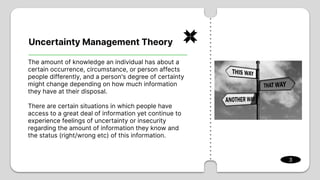
The amount of knowledge an individual has about a
certain occurrence, circumstance, or person affects
people differently, and a person's degree of certainty
might change depending on how much information
they have at their disposal.
There are certain situations in which people have
access to a great deal of information yet continue to
experience feelings of uncertainty or insecurity
regarding the amount of information they know and
the status (right/wrong etc) of this information.
Effective
Communication
Communication is effective “to the extent that the person interpreting the
message attaches a meaning to the message that is relatively similar to what
was intended by the person transmitting it” (Gudykunst, 1995, p. 15)
4
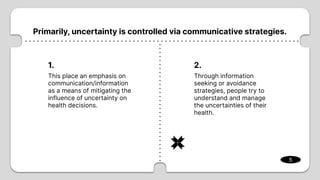
Primarily, uncertainty is controlled via communicative strategies.
Through information
seeking or avoidance
strategies, people try to
understand and manage
the uncertainties of their
health.
This place an emphasis on
communication/information
as a means of mitigating the
influence of uncertainty on
health decisions.
2.
1.
5
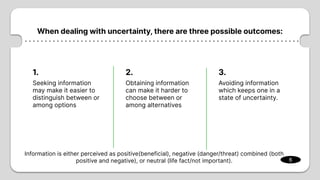
When dealing with uncertainty, there are three possible outcomes:
Seeking information
may make it easier to
distinguish between or
among options
Obtaining information
can make it harder to
choose between or
among alternatives
Avoiding information
which keeps one in a
state of uncertainty.
1. 2. 3.
6
Information is either perceived as positive(beneficial), negative (danger/threat) combined (both
positive and negative), or neutral (life fact/not important).
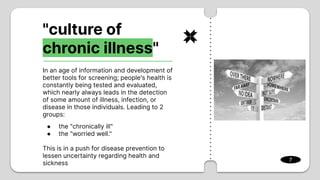
"culture of
chronic illness"
In an age of information and development of
better tools for screening; people's health is
constantly being tested and evaluated,
which nearly always leads in the detection
of some amount of illness, infection, or
disease in those individuals. Leading to 2
groups:
● the "chronically ill"
● the "worried well."
This is in a push for disease prevention to
lessen uncertainty regarding health and
sickness
7
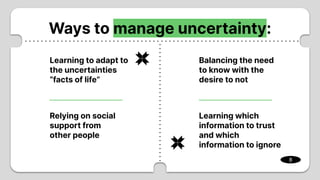
Ways to manage uncertainty:
Learning to adapt to
the uncertainties
“facts of life”
Balancing the need
to know with the
desire to not
Relying on social
support from
other people
Learning which
information to trust
and which
information to ignore
8
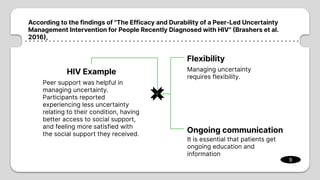
According to the findings of "The Efficacy and Durability of a Peer-Led Uncertainty
Management Intervention for People Recently Diagnosed with HIV" (Brashers et al.
2016),
9
HIV Example
Peer support was helpful in
managing uncertainty.
Participants reported
experiencing less uncertainty
relating to their condition, having
better access to social support,
and feeling more satisfied with
the social support they received.
Ongoing communication
Flexibility
Managing uncertainty
requires flexibility.
It is essential that patients get
ongoing education and
information
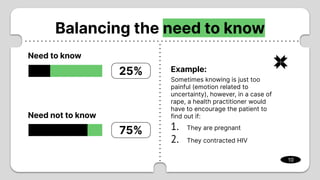
25%
Need not to know
75%
Need to know
Sometimes knowing is just too
painful (emotion related to
uncertainty), however, in a case of
rape, a health practitioner would
have to encourage the patient to
find out if:
1. They are pregnant
2. They contracted HIV
Example:
Balancing the need to know
10
Coping with uncertainty may lead to emotions of stress, avoidance, and
resistance, all of which are harmful to an individual's wellbeing. It is
helpful to understand how communication assists people to make sense
of health and sickness, so that compelling messages may be designed
for healthcare campaigns and treatments.
11
Conclusion
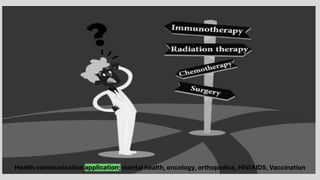
Health communication application; mental health, oncology, orthopedics, HIV/AIDS, Vaccination
Coping with uncertainty may lead to emotions of stress, avoidance, and
resistance, all of which are harmful to an individual's wellbeing. It is
helpful to understand how communication assists people to make sense
of health and sickness, so that compelling messages may be designed
for healthcare campaigns and treatments.
12
Conclusion
CREDITS: This presentation template was created by Slidesgo, and
includes icons by Flaticon, and infographics & images by Freepik
THANKS!
DO YOU HAVE ANY
QUESTIONS/COMMENTS?
13
CREDITS: This presentation template was created by Slidesgo, and
includes icons by Flaticon, and infographics & images by Freepik
References
Brashers, D. E. (2001). Communication and uncertainty management. Journal of Communication, 51(3),
477–497.
Brashers, D. E., Goldsmith, D. J. and Hsieh, E. (2002). Information Seeking and Avoiding in Health
Gudykunst, William (1995). "The Uncertainty Reduction and Anxiety-Uncertainty Reduction Theories of Berger,
Gudykunst, and Associates". Watershed Research Traditions in Human Communication Theory. SUNY Press:
67–100.
Uncertainty management theory. (2020, December 18). In Wikipedia.
https://en.wikipedia.org/wiki/Uncertainty_management_theory
14

Uncertainty Management Theory

  • 1.
    Uncertainty Management Theory COM 685 Theoriesof Health Communication Master of Arts in Communication 1 Caroline Ngonyo Kamau
  • 2.
    Uncertainty Management Theory 2 Abody of thought by Dale Brashers that attempts to explain how people cope with uncertainty, particularly health-related uncertainties. It seeks to improve one's ability to communicate effectively by bringing feelings of doubt and anxiety down to more manageable levels. It also explains how people manage uncertainty through information seeking or avoiding behaviors. Uncertainty is a state of the mind where one is unsure of the known/unknown Uncertainty is a thought; anxiety is a feeling. Gudykunst defined anxiety as "the feeling of being uneasy, tense, worried, or apprehensive about what might happen."
  • 3.
    Uncertainty Management Theory 3 Theamount of knowledge an individual has about a certain occurrence, circumstance, or person affects people differently, and a person's degree of certainty might change depending on how much information they have at their disposal. There are certain situations in which people have access to a great deal of information yet continue to experience feelings of uncertainty or insecurity regarding the amount of information they know and the status (right/wrong etc) of this information.
  • 4.
    Effective Communication Communication is effective“to the extent that the person interpreting the message attaches a meaning to the message that is relatively similar to what was intended by the person transmitting it” (Gudykunst, 1995, p. 15) 4
  • 5.
    Primarily, uncertainty iscontrolled via communicative strategies. Through information seeking or avoidance strategies, people try to understand and manage the uncertainties of their health. This place an emphasis on communication/information as a means of mitigating the influence of uncertainty on health decisions. 2. 1. 5
  • 6.
    When dealing withuncertainty, there are three possible outcomes: Seeking information may make it easier to distinguish between or among options Obtaining information can make it harder to choose between or among alternatives Avoiding information which keeps one in a state of uncertainty. 1. 2. 3. 6 Information is either perceived as positive(beneficial), negative (danger/threat) combined (both positive and negative), or neutral (life fact/not important).
  • 7.
    "culture of chronic illness" Inan age of information and development of better tools for screening; people's health is constantly being tested and evaluated, which nearly always leads in the detection of some amount of illness, infection, or disease in those individuals. Leading to 2 groups: ● the "chronically ill" ● the "worried well." This is in a push for disease prevention to lessen uncertainty regarding health and sickness 7
  • 8.
    Ways to manageuncertainty: Learning to adapt to the uncertainties “facts of life” Balancing the need to know with the desire to not Relying on social support from other people Learning which information to trust and which information to ignore 8
  • 9.
    According to thefindings of "The Efficacy and Durability of a Peer-Led Uncertainty Management Intervention for People Recently Diagnosed with HIV" (Brashers et al. 2016), 9 HIV Example Peer support was helpful in managing uncertainty. Participants reported experiencing less uncertainty relating to their condition, having better access to social support, and feeling more satisfied with the social support they received. Ongoing communication Flexibility Managing uncertainty requires flexibility. It is essential that patients get ongoing education and information
  • 10.
    25% Need not toknow 75% Need to know Sometimes knowing is just too painful (emotion related to uncertainty), however, in a case of rape, a health practitioner would have to encourage the patient to find out if: 1. They are pregnant 2. They contracted HIV Example: Balancing the need to know 10
  • 11.
    Coping with uncertaintymay lead to emotions of stress, avoidance, and resistance, all of which are harmful to an individual's wellbeing. It is helpful to understand how communication assists people to make sense of health and sickness, so that compelling messages may be designed for healthcare campaigns and treatments. 11 Conclusion Health communication application; mental health, oncology, orthopedics, HIV/AIDS, Vaccination
  • 12.
    Coping with uncertaintymay lead to emotions of stress, avoidance, and resistance, all of which are harmful to an individual's wellbeing. It is helpful to understand how communication assists people to make sense of health and sickness, so that compelling messages may be designed for healthcare campaigns and treatments. 12 Conclusion
  • 13.
    CREDITS: This presentationtemplate was created by Slidesgo, and includes icons by Flaticon, and infographics & images by Freepik THANKS! DO YOU HAVE ANY QUESTIONS/COMMENTS? 13
  • 14.
    CREDITS: This presentationtemplate was created by Slidesgo, and includes icons by Flaticon, and infographics & images by Freepik References Brashers, D. E. (2001). Communication and uncertainty management. Journal of Communication, 51(3), 477–497. Brashers, D. E., Goldsmith, D. J. and Hsieh, E. (2002). Information Seeking and Avoiding in Health Gudykunst, William (1995). "The Uncertainty Reduction and Anxiety-Uncertainty Reduction Theories of Berger, Gudykunst, and Associates". Watershed Research Traditions in Human Communication Theory. SUNY Press: 67–100. Uncertainty management theory. (2020, December 18). In Wikipedia. https://en.wikipedia.org/wiki/Uncertainty_management_theory 14