Unattended SVM
parameters fitting for
monitoring nonlinear
profiles
Emilio L. Cano (University of Castilla-La Mancha)
Javier M. Moguerza (Rey Juan Carlos University)
Mariano Prieto (ENUSA Industrias Avanzadas)
Statistical Process Control
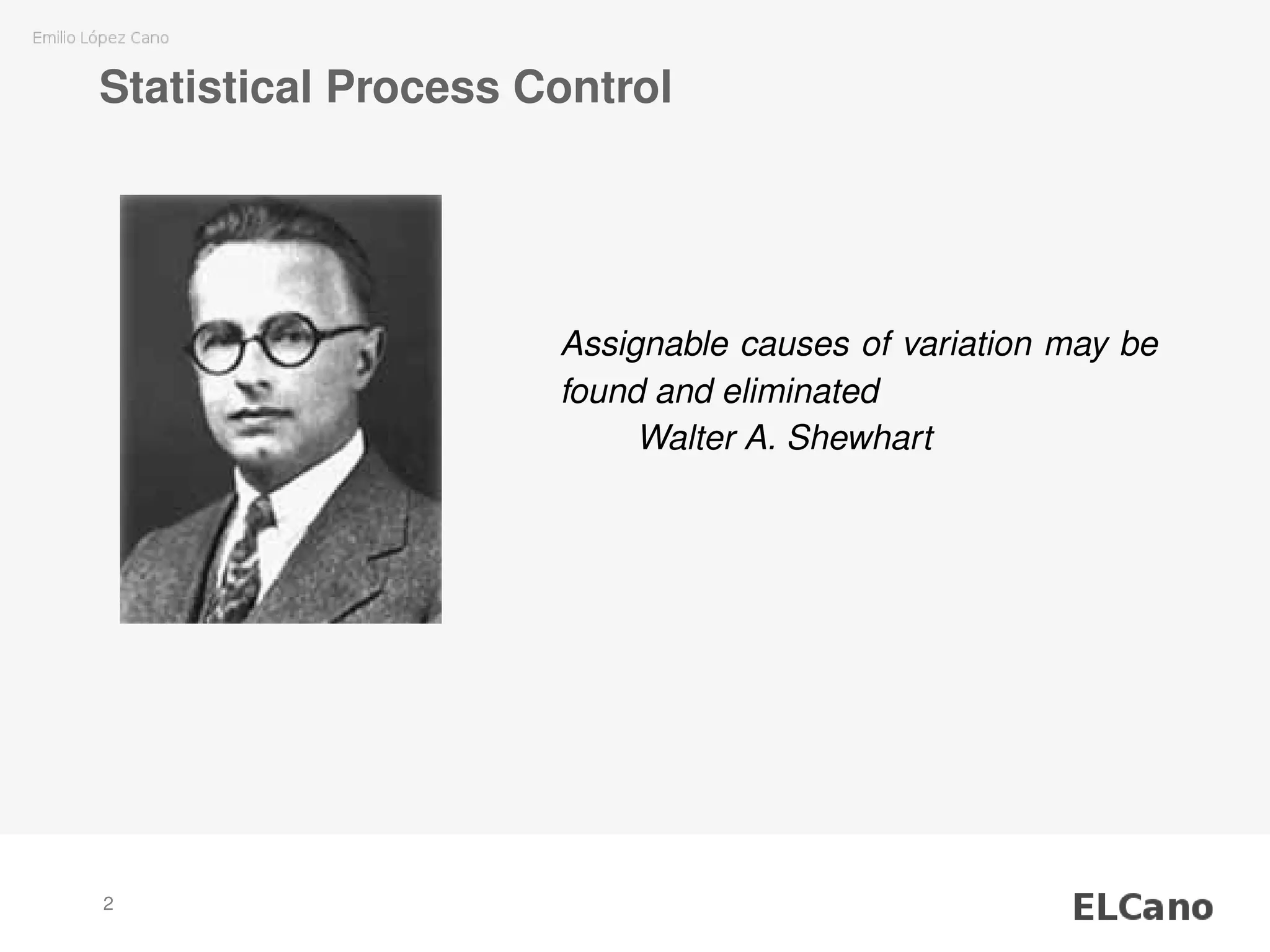
Assignable causes of variation may be
found and eliminated
Walter A. Shewhart
2
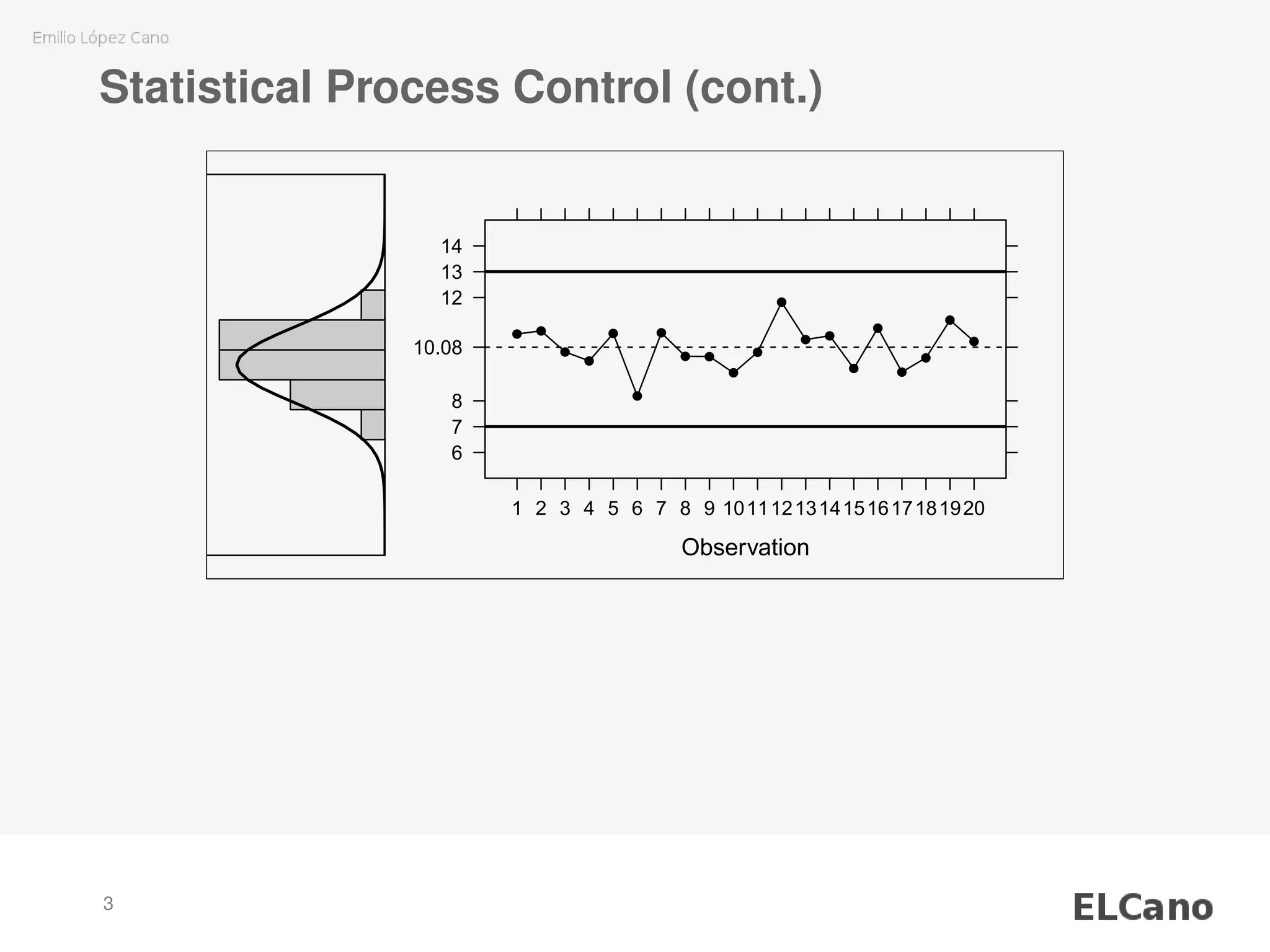
Statistical Process Control (cont.)
Observation
6
7
8
12
13
14
10.08
1 2 3 4 5 6 7 8 9 1011121314151617181920
q q
q
q
q
q
q
q q
q
q
q
q q
q
q
q
q
q
q
3
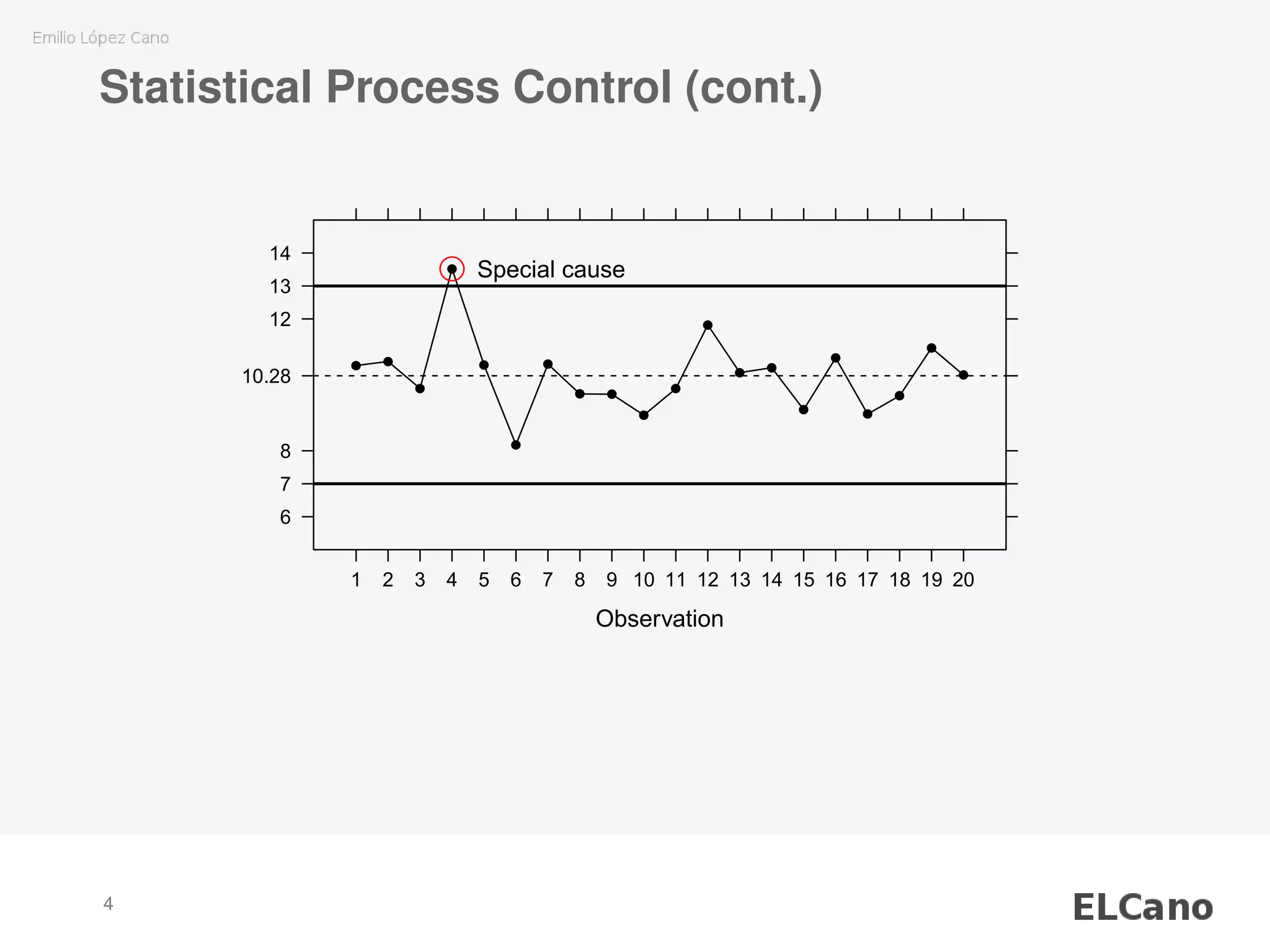
Statistical Process Control (cont.)
Observation
6
7
8
12
13
14
10.28
1 2 3 4 5 6 7 8 9 10 11 12 13 14 15 16 17 18 19 20
q q
q
q
q
q
q
q q
q
q
q
q q
q
q
q
q
q
q
q Special cause
4
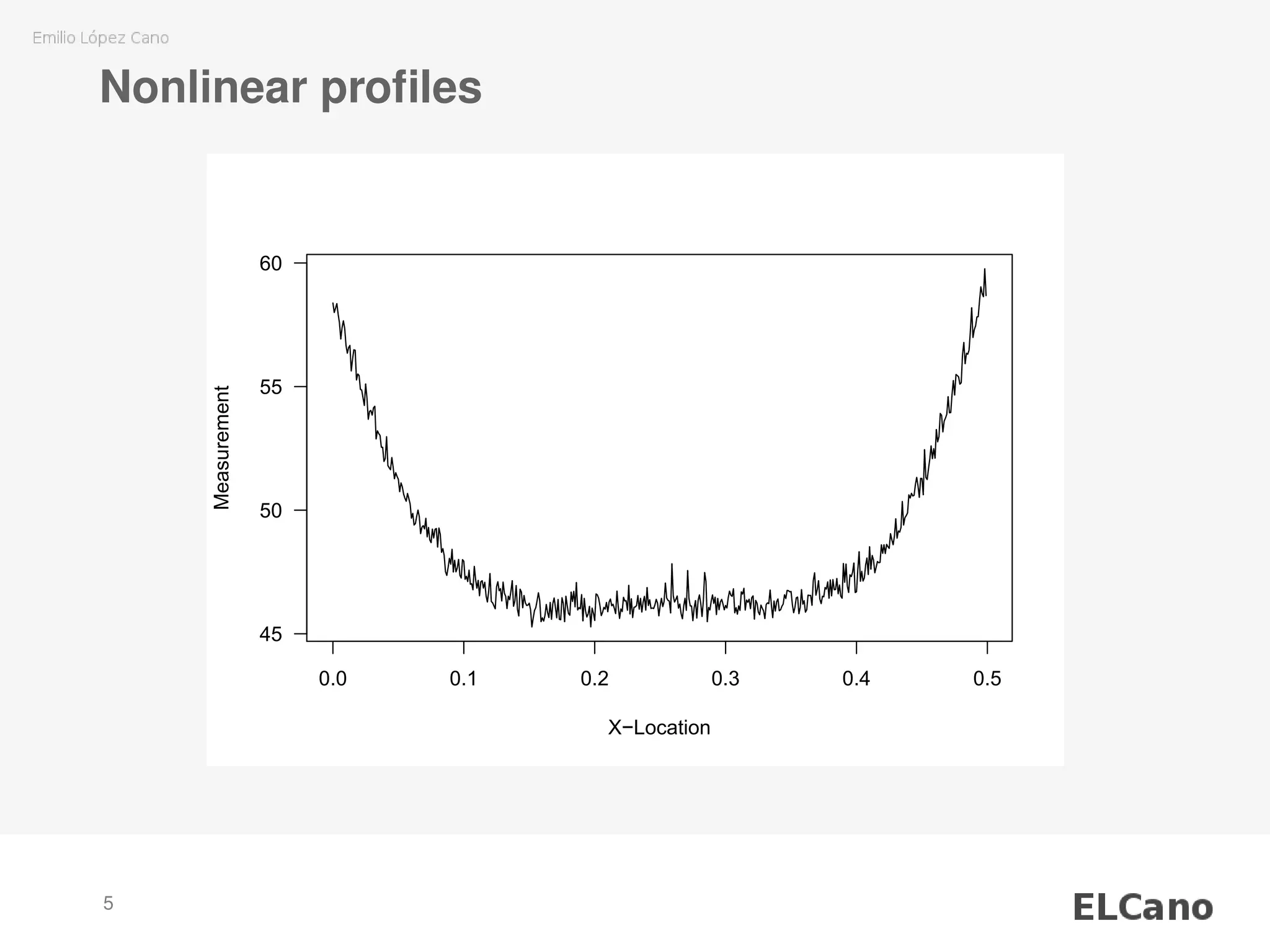
Nonlinear profiles
0.0 0.1 0.2 0.3 0.4 0.5
45
50
55
60
X−Location
Measurement
5
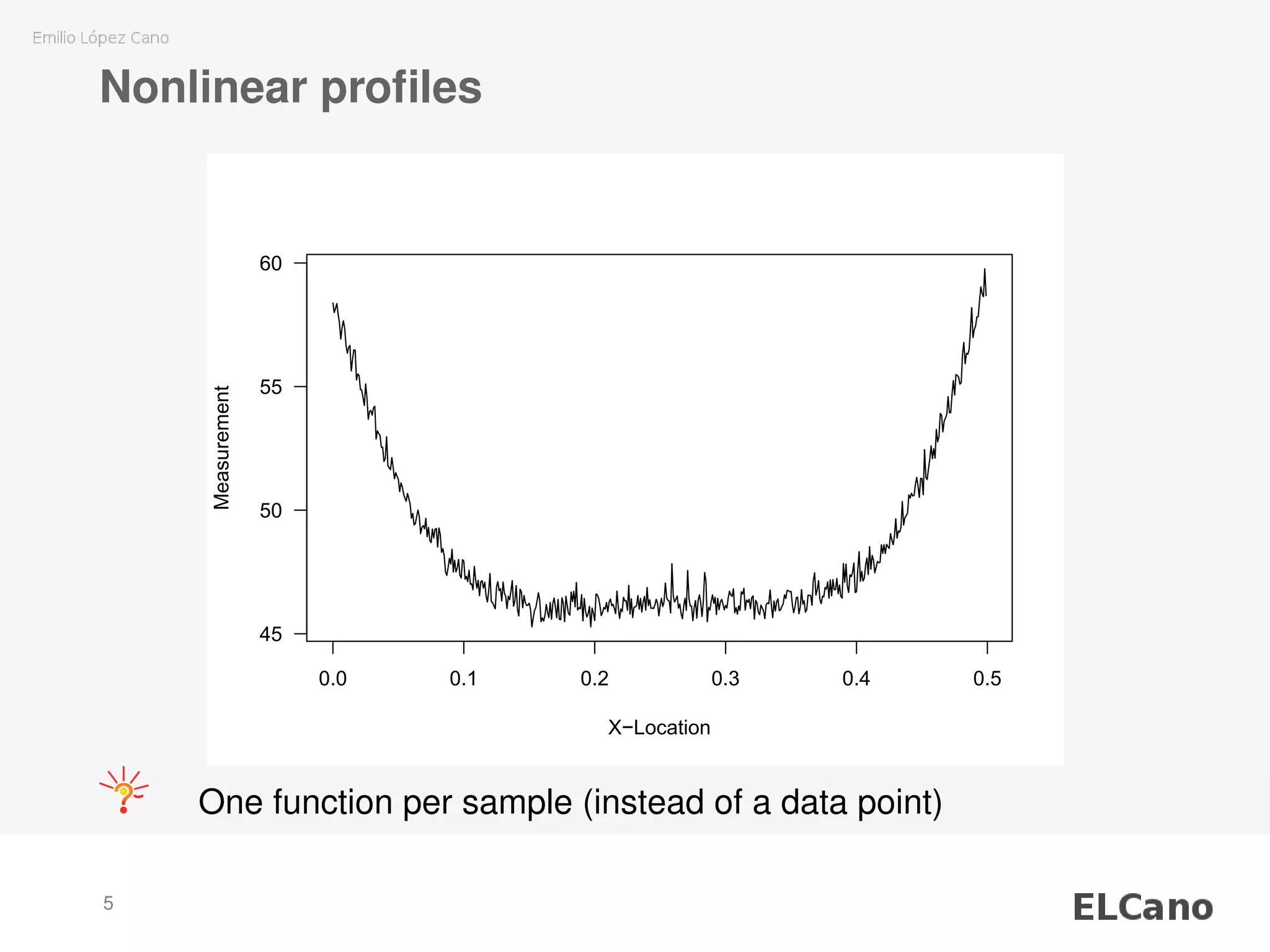
Nonlinear profiles
0.0 0.1 0.2 0.3 0.4 0.5
45
50
55
60
X−Location
Measurement
One function per sample (instead of a data point)
5
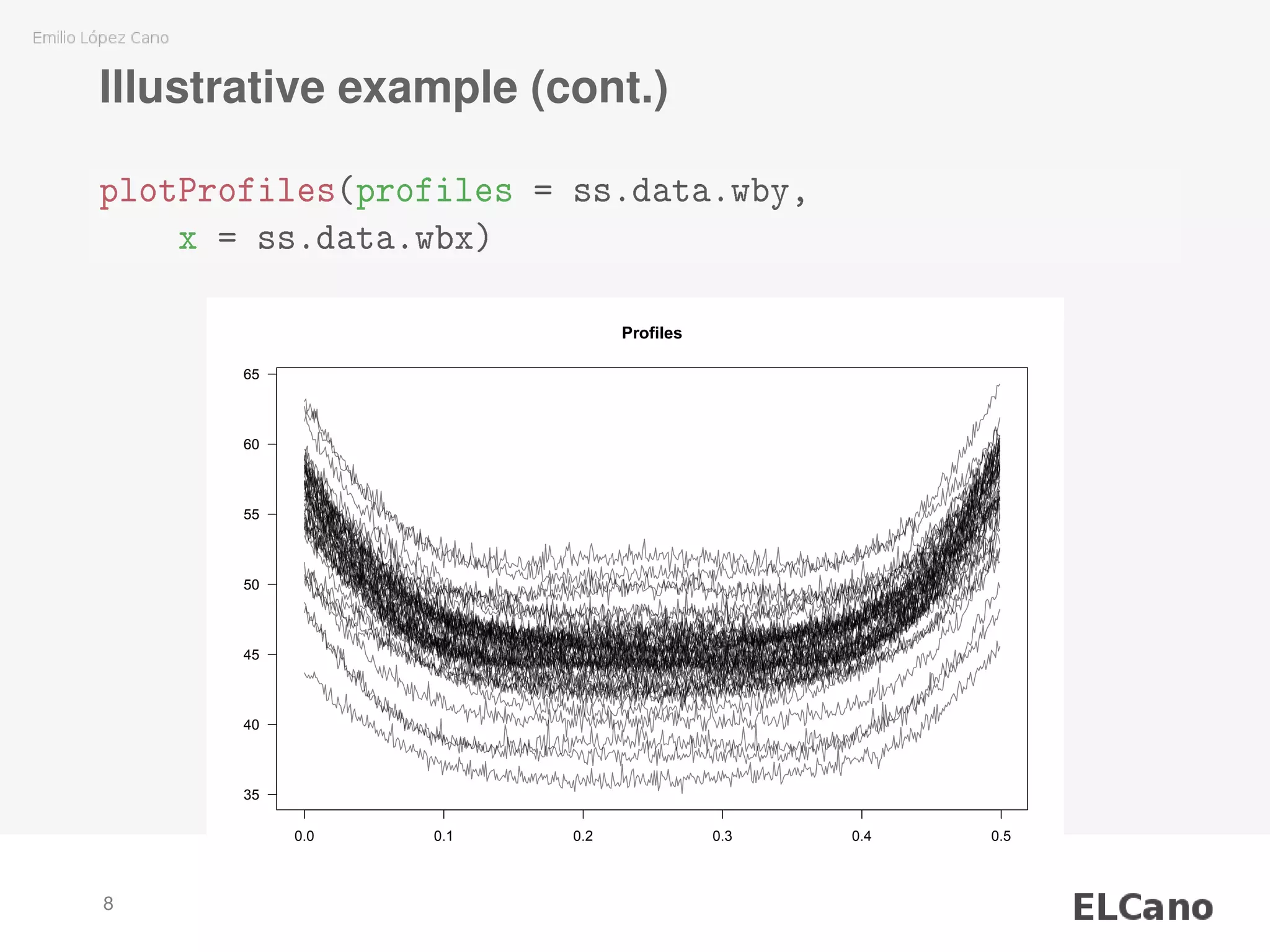
Illustrative example
Engineered woodboards
Data set of 50 boards
Sample of 5 boards per shift
Quality characteristic: density
Total measurements: 500
Every 0.001 in along the board
6
Illustrative example (cont.)
Data
library(SixSigma)
str(ss.data.wbx)
## num [1:500] 0 0.001 0.002 0.003 0.004 0.005 0.006 0.007
str(ss.data.wby)
## num [1:500, 1:50] 58.4 58 58.2 58.4 57.9 ...
## - attr(*, "dimnames")=List of 2
## ..$ : NULL
## ..$ : chr [1:50] "P1" "P2" "P3" "P4" ...
7
Illustrative example (cont.)
plotProfiles(profiles = ss.data.wby,
x = ss.data.wbx)
0.0 0.1 0.2 0.3 0.4 0.5
35
40
45
50
55
60
65
Profiles
8
Support Vector Machines (SVM)
SVM regression model
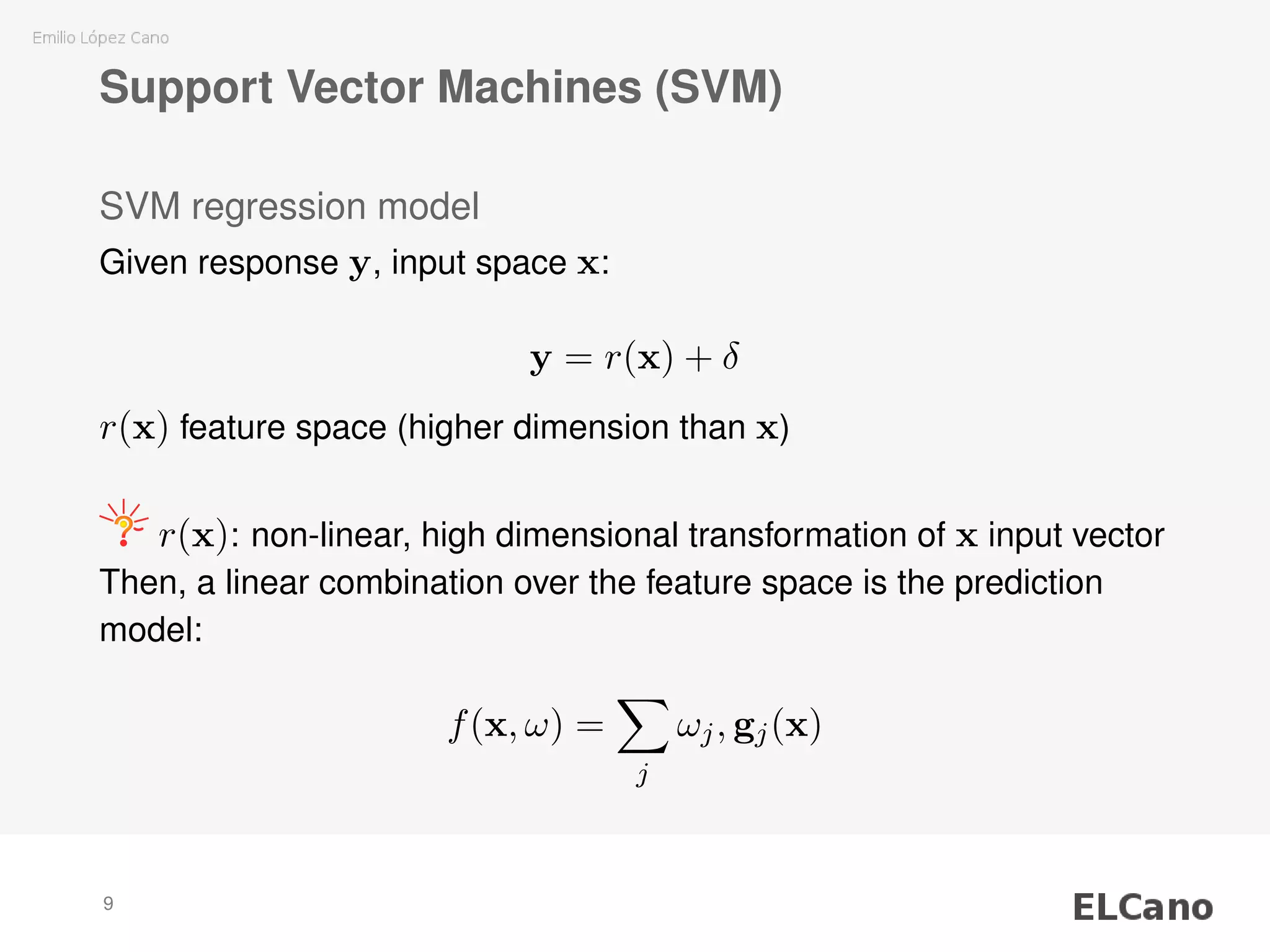
Given response y, input space x:
y = r(x) + δ
r(x) feature space (higher dimension than x)
r(x): non-linear, high dimensional transformation of x input vector
Then, a linear combination over the feature space is the prediction
model:
f(x, ω) =
j
ωj, gj(x)
9
Support Vector Machines (SVM) (cont.)
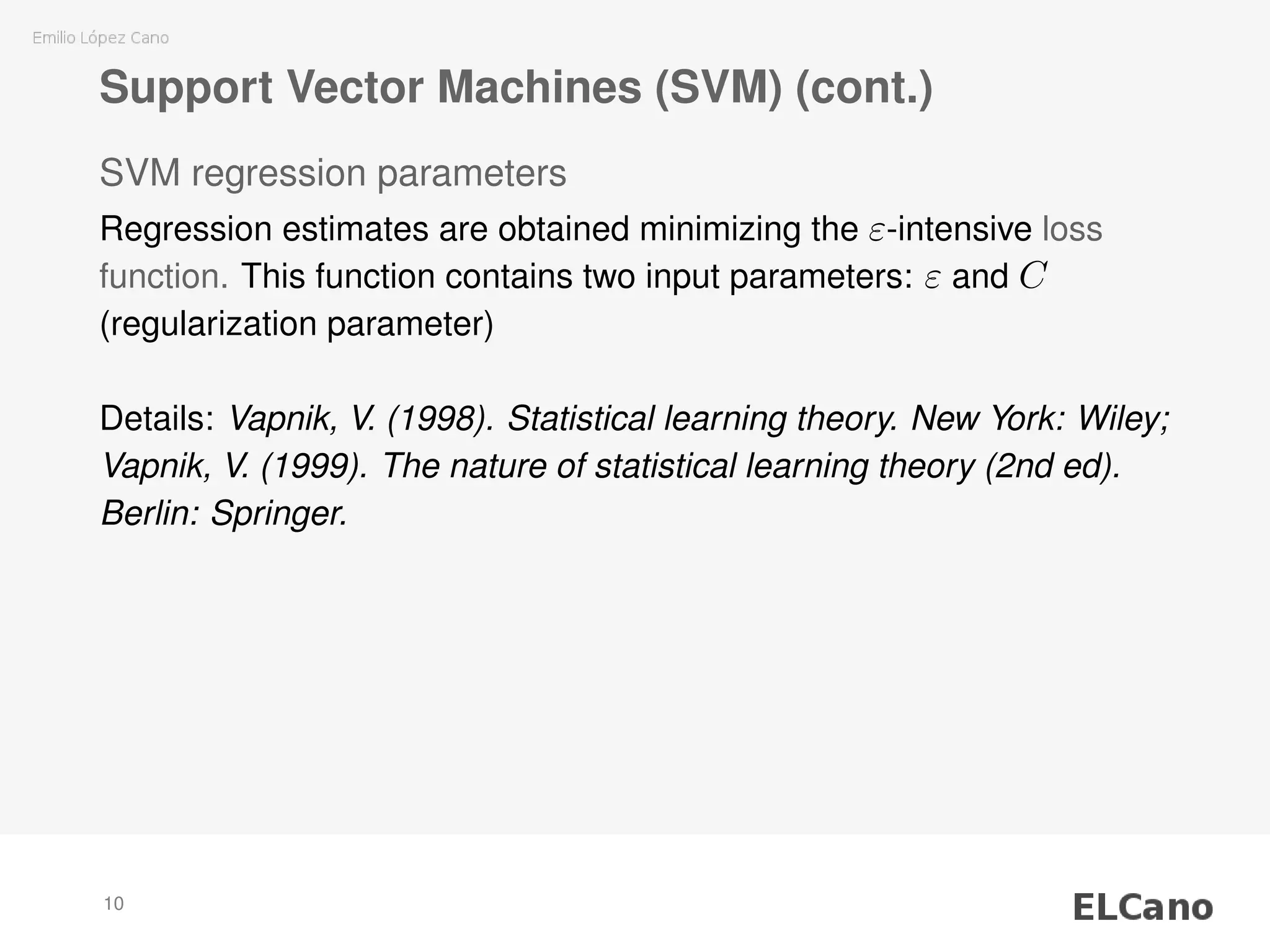
SVM regression parameters
Regression estimates are obtained minimizing the ε-intensive loss
function. This function contains two input parameters: ε and C
(regularization parameter)
Details: Vapnik, V. (1998). Statistical learning theory. New York: Wiley;
Vapnik, V. (1999). The nature of statistical learning theory (2nd ed).
Berlin: Springer.
10
Support Vector Machines (SVM) (cont.)
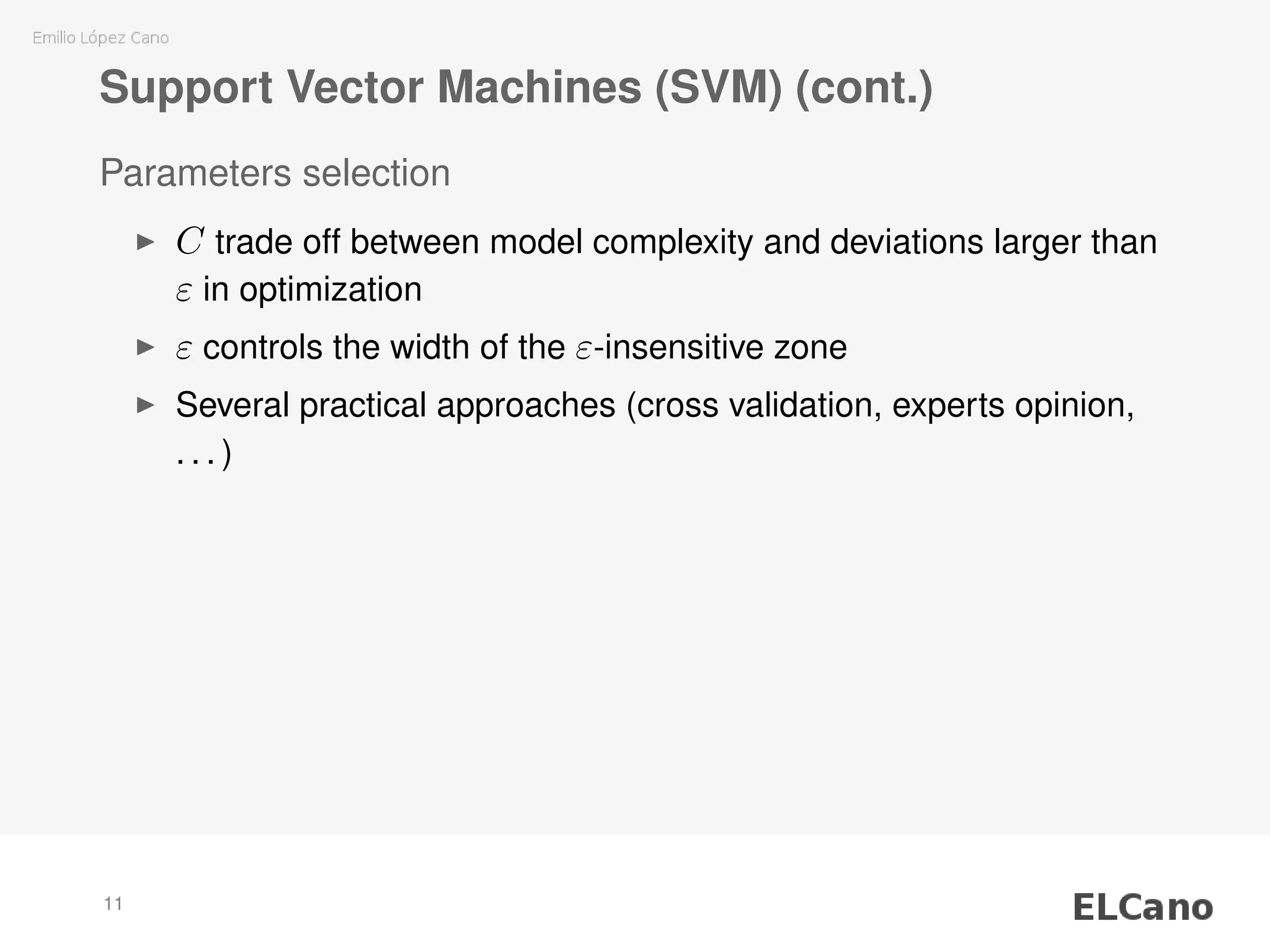
Parameters selection
C trade off between model complexity and deviations larger than
ε in optimization
ε controls the width of the ε-insensitive zone
Several practical approaches (cross validation, experts opinion,
. . . )
11
(unattended) Parameters selection
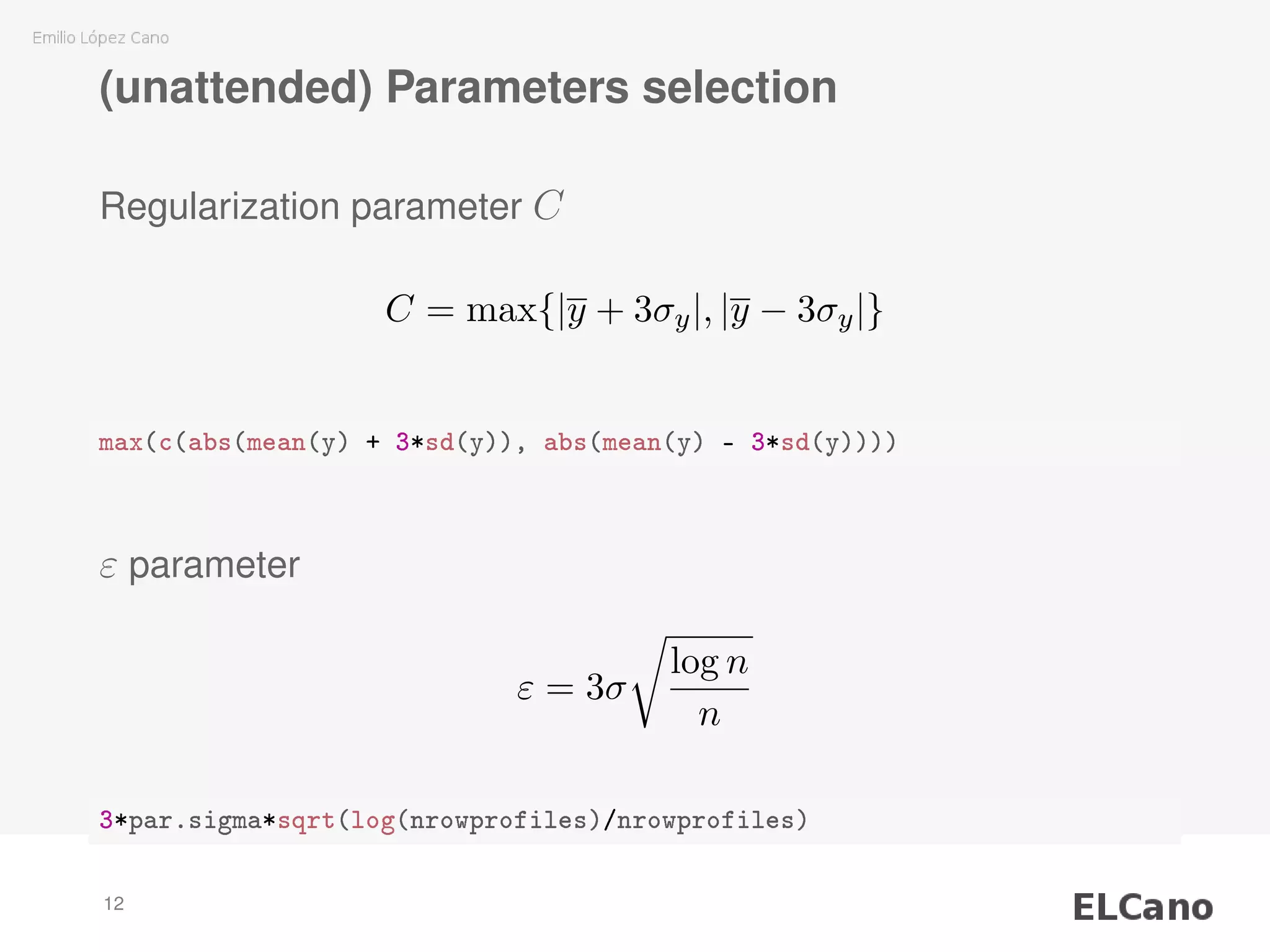
Regularization parameter C
C = max{|y + 3σy|, |y − 3σy|}
max(c(abs(mean(y) + 3*sd(y)), abs(mean(y) - 3*sd(y))))
ε parameter
ε = 3σ
log n
n
3*par.sigma*sqrt(log(nrowprofiles)/nrowprofiles)
12
(unattended) Parameters selection (cont.)
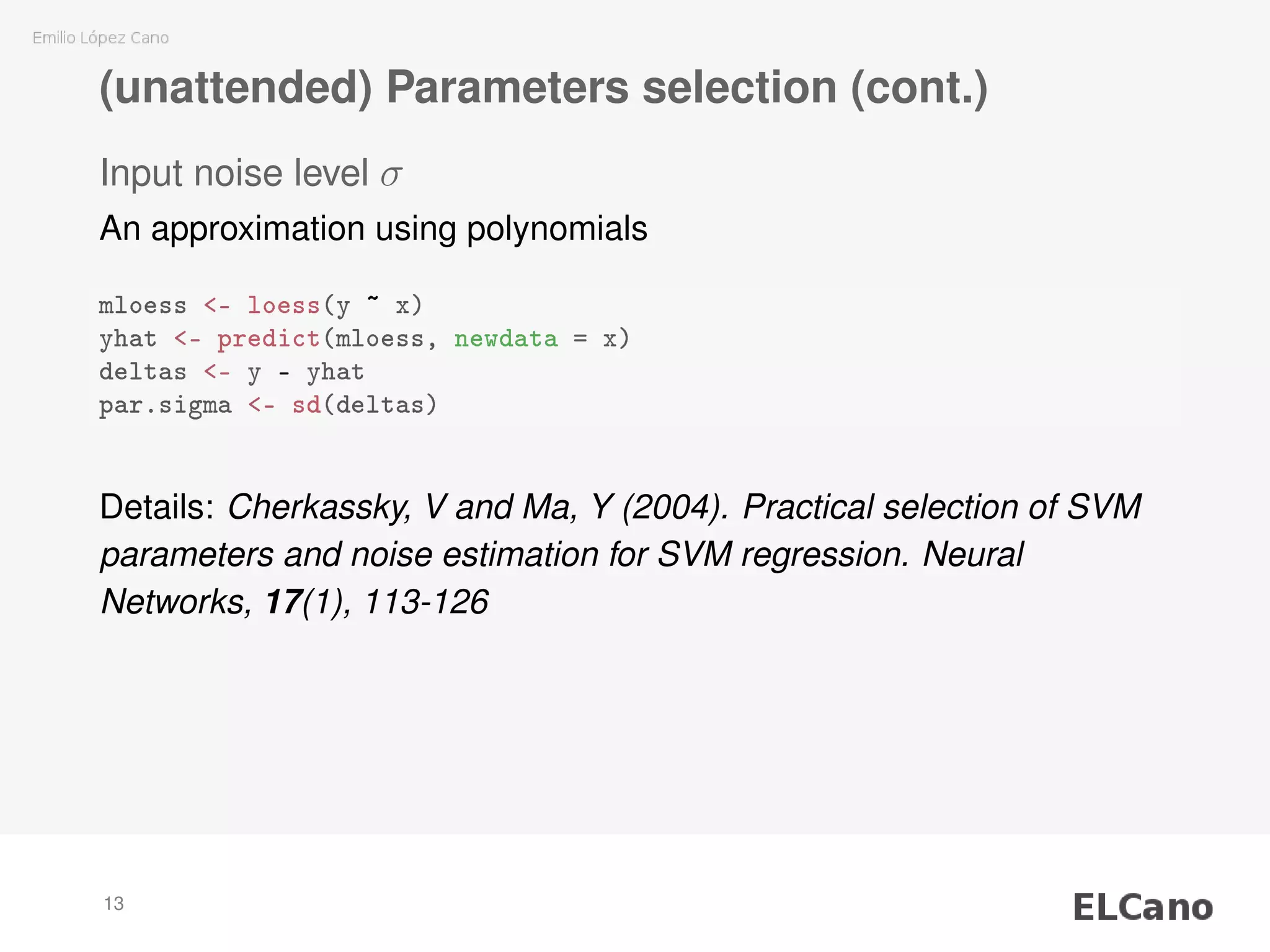
Input noise level σ
An approximation using polynomials
mloess <- loess(y ~ x)
yhat <- predict(mloess, newdata = x)
deltas <- y - yhat
par.sigma <- sd(deltas)
Details: Cherkassky, V and Ma, Y (2004). Practical selection of SVM
parameters and noise estimation for SVM regression. Neural
Networks, 17(1), 113-126
13
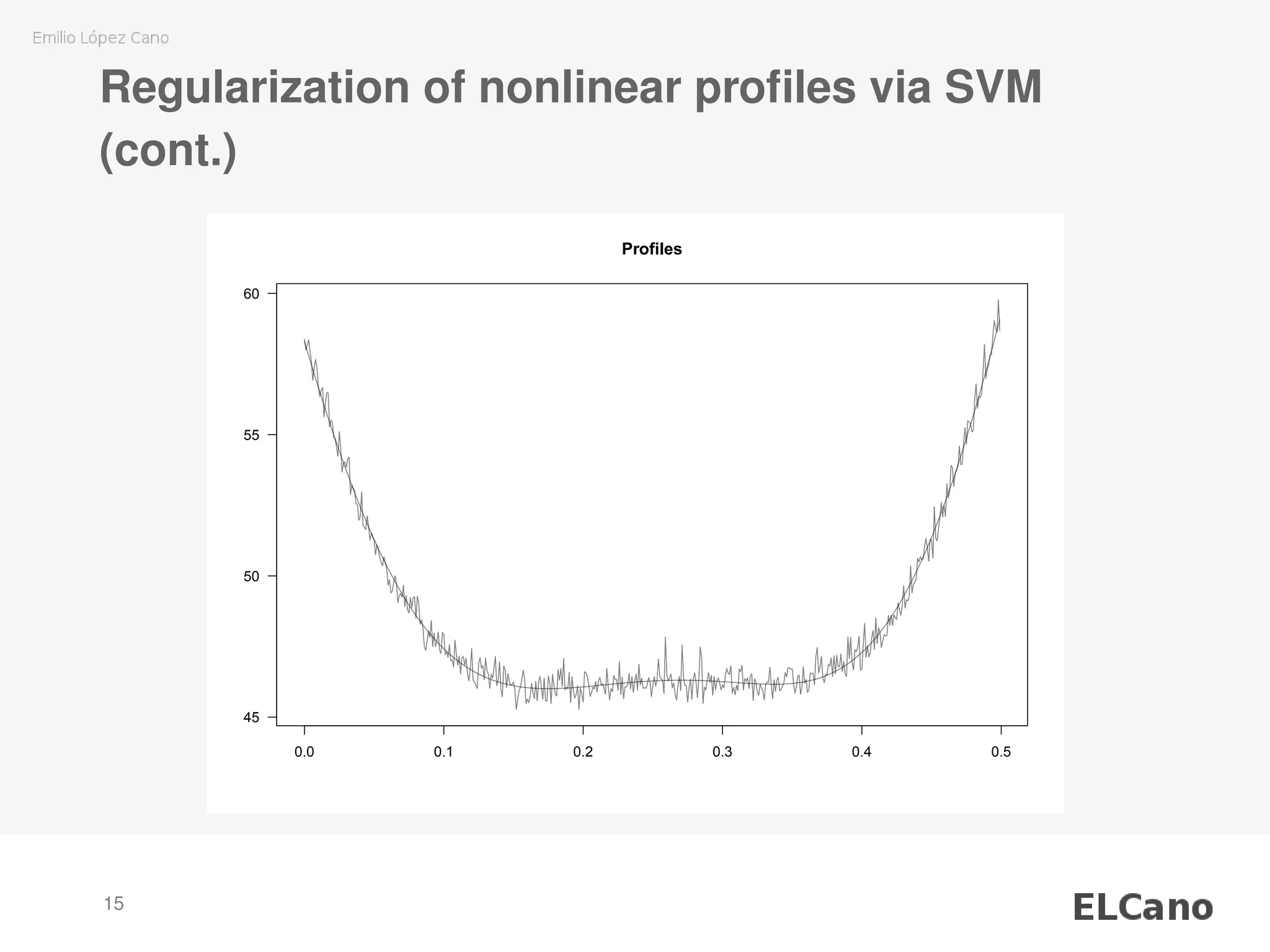
Regularization of nonlinear profiles via SVM
P1.smooth <- smoothProfiles(
profiles = ss.data.wby[, "P1"],
x = ss.data.wbx)
plotProfiles(profiles = cbind(P1.smooth,
ss.data.wby[, "P1"]),
x = ss.data.wbx)
14
Regularization of nonlinear profiles via SVM
(cont.)
0.0 0.1 0.2 0.3 0.4 0.5
45
50
55
60
Profiles
15
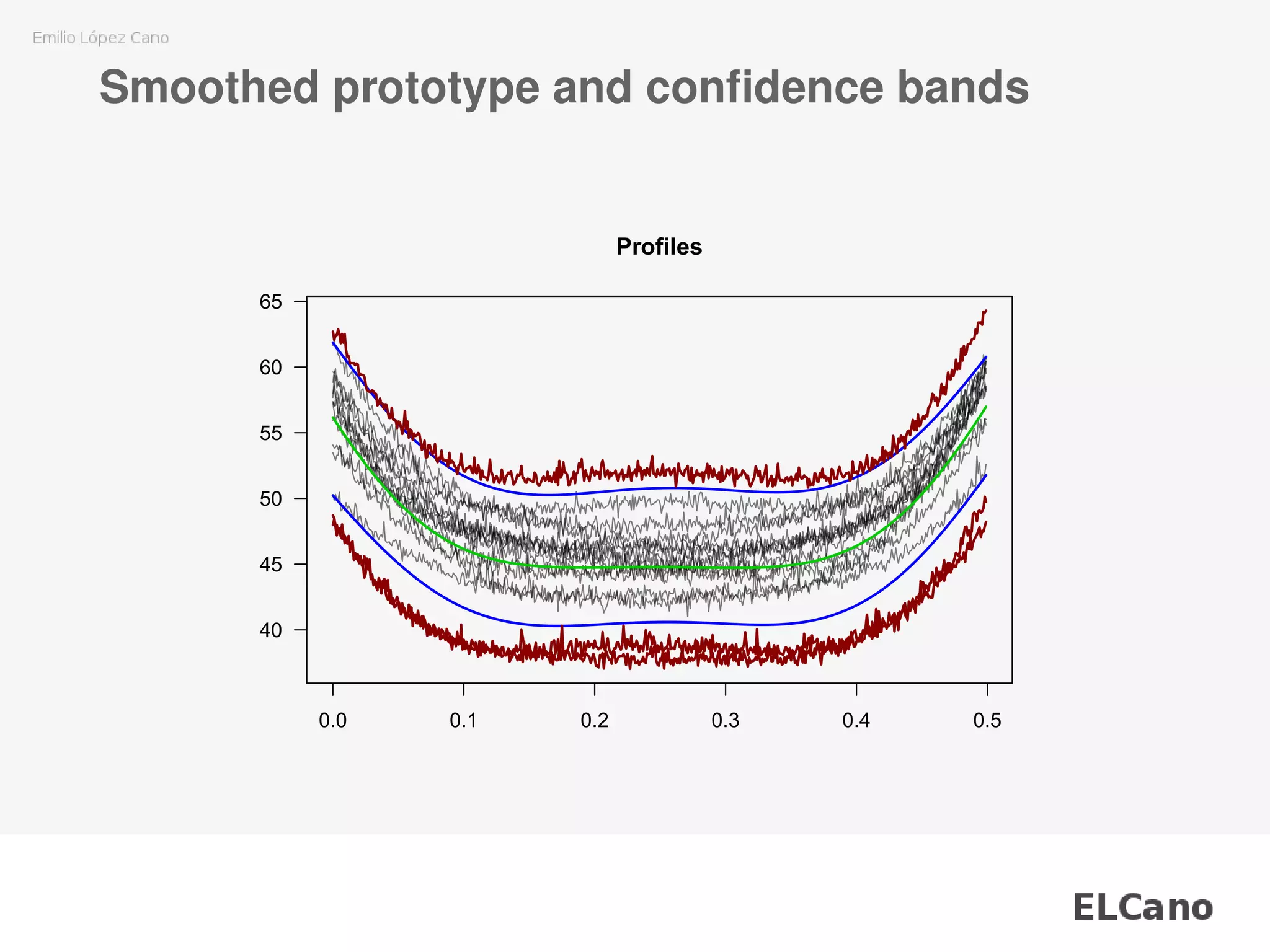
Smoothed prototype and confidence bands
0.0 0.1 0.2 0.3 0.4 0.5
40
45
50
55
60
65
Profiles
Smoothed prototype and confidence bands
(cont.)
wby.phase1 <- ss.data.wby[, 1:35]
wb.limits <- climProfiles(profiles = wby.phase1[, -28],
x = ss.data.wbx,
smoothprof = TRUE,
smoothlim = TRUE)
wby.phase2 <- ss.data.wby[, 36:50]
wb.out.phase2 <- outProfiles(profiles = wby.phase2,
x = ss.data.wbx,
cLimits = wb.limits,
tol = 0.8)
plotProfiles(wby.phase2,
x = ss.data.wbx,
cLimits = wb.limits,
outControl = wb.out.phase2$idOut,
onlyout = FALSE)
Questions
Thanks!
emilio.lcano@uclm.es
18

Unattended SVM parameters fitting for monitoring nonlinear profiles

  • 1.
    Unattended SVM parameters fittingfor monitoring nonlinear profiles Emilio L. Cano (University of Castilla-La Mancha) Javier M. Moguerza (Rey Juan Carlos University) Mariano Prieto (ENUSA Industrias Avanzadas)
  • 2.
    Statistical Process Control Assignablecauses of variation may be found and eliminated Walter A. Shewhart 2
  • 3.
    Statistical Process Control(cont.) Observation 6 7 8 12 13 14 10.08 1 2 3 4 5 6 7 8 9 1011121314151617181920 q q q q q q q q q q q q q q q q q q q q 3
  • 4.
    Statistical Process Control(cont.) Observation 6 7 8 12 13 14 10.28 1 2 3 4 5 6 7 8 9 10 11 12 13 14 15 16 17 18 19 20 q q q q q q q q q q q q q q q q q q q q q Special cause 4
  • 5.
    Nonlinear profiles 0.0 0.10.2 0.3 0.4 0.5 45 50 55 60 X−Location Measurement 5
  • 6.
    Nonlinear profiles 0.0 0.10.2 0.3 0.4 0.5 45 50 55 60 X−Location Measurement One function per sample (instead of a data point) 5
  • 7.
    Illustrative example Engineered woodboards Dataset of 50 boards Sample of 5 boards per shift Quality characteristic: density Total measurements: 500 Every 0.001 in along the board 6
  • 8.
    Illustrative example (cont.) Data library(SixSigma) str(ss.data.wbx) ##num [1:500] 0 0.001 0.002 0.003 0.004 0.005 0.006 0.007 str(ss.data.wby) ## num [1:500, 1:50] 58.4 58 58.2 58.4 57.9 ... ## - attr(*, "dimnames")=List of 2 ## ..$ : NULL ## ..$ : chr [1:50] "P1" "P2" "P3" "P4" ... 7
  • 9.
    Illustrative example (cont.) plotProfiles(profiles= ss.data.wby, x = ss.data.wbx) 0.0 0.1 0.2 0.3 0.4 0.5 35 40 45 50 55 60 65 Profiles 8
  • 10.
    Support Vector Machines(SVM) SVM regression model Given response y, input space x: y = r(x) + δ r(x) feature space (higher dimension than x) r(x): non-linear, high dimensional transformation of x input vector Then, a linear combination over the feature space is the prediction model: f(x, ω) = j ωj, gj(x) 9
  • 11.
    Support Vector Machines(SVM) (cont.) SVM regression parameters Regression estimates are obtained minimizing the ε-intensive loss function. This function contains two input parameters: ε and C (regularization parameter) Details: Vapnik, V. (1998). Statistical learning theory. New York: Wiley; Vapnik, V. (1999). The nature of statistical learning theory (2nd ed). Berlin: Springer. 10
  • 12.
    Support Vector Machines(SVM) (cont.) Parameters selection C trade off between model complexity and deviations larger than ε in optimization ε controls the width of the ε-insensitive zone Several practical approaches (cross validation, experts opinion, . . . ) 11
  • 13.
    (unattended) Parameters selection Regularizationparameter C C = max{|y + 3σy|, |y − 3σy|} max(c(abs(mean(y) + 3*sd(y)), abs(mean(y) - 3*sd(y)))) ε parameter ε = 3σ log n n 3*par.sigma*sqrt(log(nrowprofiles)/nrowprofiles) 12
  • 14.
    (unattended) Parameters selection(cont.) Input noise level σ An approximation using polynomials mloess <- loess(y ~ x) yhat <- predict(mloess, newdata = x) deltas <- y - yhat par.sigma <- sd(deltas) Details: Cherkassky, V and Ma, Y (2004). Practical selection of SVM parameters and noise estimation for SVM regression. Neural Networks, 17(1), 113-126 13
  • 15.
    Regularization of nonlinearprofiles via SVM P1.smooth <- smoothProfiles( profiles = ss.data.wby[, "P1"], x = ss.data.wbx) plotProfiles(profiles = cbind(P1.smooth, ss.data.wby[, "P1"]), x = ss.data.wbx) 14
  • 16.
    Regularization of nonlinearprofiles via SVM (cont.) 0.0 0.1 0.2 0.3 0.4 0.5 45 50 55 60 Profiles 15
  • 17.
    Smoothed prototype andconfidence bands 0.0 0.1 0.2 0.3 0.4 0.5 40 45 50 55 60 65 Profiles
  • 18.
    Smoothed prototype andconfidence bands (cont.) wby.phase1 <- ss.data.wby[, 1:35] wb.limits <- climProfiles(profiles = wby.phase1[, -28], x = ss.data.wbx, smoothprof = TRUE, smoothlim = TRUE) wby.phase2 <- ss.data.wby[, 36:50] wb.out.phase2 <- outProfiles(profiles = wby.phase2, x = ss.data.wbx, cLimits = wb.limits, tol = 0.8) plotProfiles(wby.phase2, x = ss.data.wbx, cLimits = wb.limits, outControl = wb.out.phase2$idOut, onlyout = FALSE)
  • 19.