Six Sigma as a Quality Improvement
Tool for Academic Programs
E.L. Cano, M. González-de-Lena, J.M. Moguerza,
A. Redchuk
8th annual International Conference on Education and New Learning
Technologies - EDULEARN16 - Barcelona (Spain)
4th - 6th of July, 2016
E.L. Cano, M. González-de-Lena, J.M. Moguerza, A. Redchuk Six Sigma as a Quality Improvement Tool for Academic Programs
Introduction
Objective
Design and improvement of an Internal System
Quality Assurance (ISQA)
Compliance with the Spanish National Agency for
Quality Assessment and Accreditation (ANECA)
Based on the Six Sigma methodology
Contributions
Extend and adapt an industrial quality improvement
methodology to the academic environment
Development of a typologies catalogue of processes
E.L. Cano, M. González-de-Lena, J.M. Moguerza, A. Redchuk Six Sigma as a Quality Improvement Tool for Academic Programs
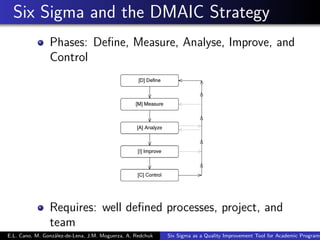
Six Sigma and the DMAIC Strategy
Phases: Define, Measure, Analyse, Improve, and
Control
Requires: well defined processes, project, and
team
E.L. Cano, M. González-de-Lena, J.M. Moguerza, A. Redchuk Six Sigma as a Quality Improvement Tool for Academic Programs
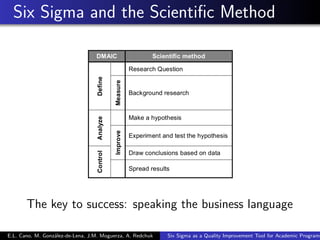
Six Sigma and the Scientific Method
The key to success: speaking the business language
E.L. Cano, M. González-de-Lena, J.M. Moguerza, A. Redchuk Six Sigma as a Quality Improvement Tool for Academic Programs
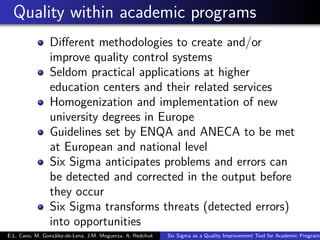
Quality within academic programs
Different methodologies to create and/or
improve quality control systems
Seldom practical applications at higher
education centers and their related services
Homogenization and implementation of new
university degrees in Europe
Guidelines set by ENQA and ANECA to be met
at European and national level
Six Sigma anticipates problems and errors can
be detected and corrected in the output before
they occur
Six Sigma transforms threats (detected errors)
into opportunities
E.L. Cano, M. González-de-Lena, J.M. Moguerza, A. Redchuk Six Sigma as a Quality Improvement Tool for Academic Programs
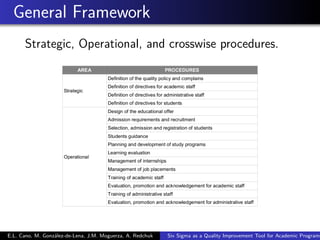
General Framework
Strategic, Operational, and crosswise procedures.
E.L. Cano, M. González-de-Lena, J.M. Moguerza, A. Redchuk Six Sigma as a Quality Improvement Tool for Academic Programs
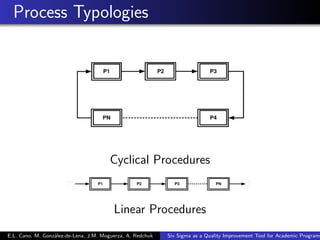
Process Typologies
Cyclical Procedures
Linear Procedures
E.L. Cano, M. González-de-Lena, J.M. Moguerza, A. Redchuk Six Sigma as a Quality Improvement Tool for Academic Programs
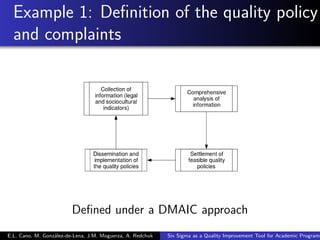
Example 1: Definition of the quality policy
and complaints
Defined under a DMAIC approach
E.L. Cano, M. González-de-Lena, J.M. Moguerza, A. Redchuk Six Sigma as a Quality Improvement Tool for Academic Programs
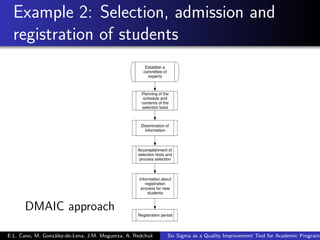
Example 2: Selection, admission and
registration of students
DMAIC approach
E.L. Cano, M. González-de-Lena, J.M. Moguerza, A. Redchuk Six Sigma as a Quality Improvement Tool for Academic Programs
Concusions
Six Sigma applied throughout the development
of the ISQA
Identify the sources of variation within the
procedures
Evolving procedures constantly being improved
In this work we only present two typologies from
a catalogue listing a whole set of structures
New procedures are associated to one of the
typologies in the catalogue
New typologies can be incorporated in a
systematic manner
E.L. Cano, M. González-de-Lena, J.M. Moguerza, A. Redchuk Six Sigma as a Quality Improvement Tool for Academic Programs
Acknowledgements
This work is partially funded by projects GROMA (MTM2015-63710-P),
PPI (RTC-2015-3580-7), and UNIKO (RTC-2015-3521-7).
Images credits: all diagrams authors’ own work.
E.L. Cano, M. González-de-Lena, J.M. Moguerza, A. Redchuk Six Sigma as a Quality Improvement Tool for Academic Programs
Questions?
Thank you
emilio.lopez@urjc.es
E.L. Cano, M. González-de-Lena, J.M. Moguerza, A. Redchuk Six Sigma as a Quality Improvement Tool for Academic Programs

Six Sigma as a Quality Improvement Tool for Academic Programs

  • 1.
    Six Sigma asa Quality Improvement Tool for Academic Programs E.L. Cano, M. González-de-Lena, J.M. Moguerza, A. Redchuk 8th annual International Conference on Education and New Learning Technologies - EDULEARN16 - Barcelona (Spain) 4th - 6th of July, 2016 E.L. Cano, M. González-de-Lena, J.M. Moguerza, A. Redchuk Six Sigma as a Quality Improvement Tool for Academic Programs
  • 2.
    Introduction Objective Design and improvementof an Internal System Quality Assurance (ISQA) Compliance with the Spanish National Agency for Quality Assessment and Accreditation (ANECA) Based on the Six Sigma methodology Contributions Extend and adapt an industrial quality improvement methodology to the academic environment Development of a typologies catalogue of processes E.L. Cano, M. González-de-Lena, J.M. Moguerza, A. Redchuk Six Sigma as a Quality Improvement Tool for Academic Programs
  • 3.
    Six Sigma andthe DMAIC Strategy Phases: Define, Measure, Analyse, Improve, and Control Requires: well defined processes, project, and team E.L. Cano, M. González-de-Lena, J.M. Moguerza, A. Redchuk Six Sigma as a Quality Improvement Tool for Academic Programs
  • 4.
    Six Sigma andthe Scientific Method The key to success: speaking the business language E.L. Cano, M. González-de-Lena, J.M. Moguerza, A. Redchuk Six Sigma as a Quality Improvement Tool for Academic Programs
  • 5.
    Quality within academicprograms Different methodologies to create and/or improve quality control systems Seldom practical applications at higher education centers and their related services Homogenization and implementation of new university degrees in Europe Guidelines set by ENQA and ANECA to be met at European and national level Six Sigma anticipates problems and errors can be detected and corrected in the output before they occur Six Sigma transforms threats (detected errors) into opportunities E.L. Cano, M. González-de-Lena, J.M. Moguerza, A. Redchuk Six Sigma as a Quality Improvement Tool for Academic Programs
  • 6.
    General Framework Strategic, Operational,and crosswise procedures. E.L. Cano, M. González-de-Lena, J.M. Moguerza, A. Redchuk Six Sigma as a Quality Improvement Tool for Academic Programs
  • 7.
    Process Typologies Cyclical Procedures LinearProcedures E.L. Cano, M. González-de-Lena, J.M. Moguerza, A. Redchuk Six Sigma as a Quality Improvement Tool for Academic Programs
  • 8.
    Example 1: Definitionof the quality policy and complaints Defined under a DMAIC approach E.L. Cano, M. González-de-Lena, J.M. Moguerza, A. Redchuk Six Sigma as a Quality Improvement Tool for Academic Programs
  • 9.
    Example 2: Selection,admission and registration of students DMAIC approach E.L. Cano, M. González-de-Lena, J.M. Moguerza, A. Redchuk Six Sigma as a Quality Improvement Tool for Academic Programs
  • 10.
    Concusions Six Sigma appliedthroughout the development of the ISQA Identify the sources of variation within the procedures Evolving procedures constantly being improved In this work we only present two typologies from a catalogue listing a whole set of structures New procedures are associated to one of the typologies in the catalogue New typologies can be incorporated in a systematic manner E.L. Cano, M. González-de-Lena, J.M. Moguerza, A. Redchuk Six Sigma as a Quality Improvement Tool for Academic Programs
  • 11.
    Acknowledgements This work ispartially funded by projects GROMA (MTM2015-63710-P), PPI (RTC-2015-3580-7), and UNIKO (RTC-2015-3521-7). Images credits: all diagrams authors’ own work. E.L. Cano, M. González-de-Lena, J.M. Moguerza, A. Redchuk Six Sigma as a Quality Improvement Tool for Academic Programs
  • 12.
    Questions? Thank you emilio.lopez@urjc.es E.L. Cano,M. González-de-Lena, J.M. Moguerza, A. Redchuk Six Sigma as a Quality Improvement Tool for Academic Programs