
1
Gaziantep University
College of Engineering
Civil Engineering Department
REPORT ON
Ultra Sonic Pulse Velocity Test For
Concrete As Nondestructive Test Method
In Structural Engineering
Submitted by
Mohammed Layth Abbas
Student No:201444956
Supervisor
Assoc.Prof. Esra Mete Güneyisi
CE 550
(Nondestructive Testing and Evaluation in Structural Eng)
2
Ultrasonic pulse velocity in concrete (UPV) ASTM C597
Introduction:
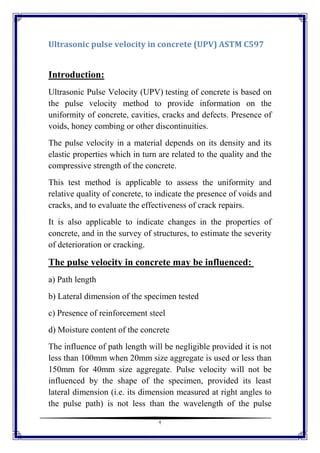
Ultrasonic Pulse Velocity (UPV) testing of concrete is based on
the pulse velocity method to provide information on the
uniformity of concrete, cavities, cracks and defects. Presence of
voids, honey combing or other discontinuities.
The pulse velocity in a material depends on its density and its
elastic properties which in turn are related to the quality and the
compressive strength of the concrete.
This test method is applicable to assess the uniformity and
relative quality of concrete, to indicate the presence of voids and
cracks, and to evaluate the effectiveness of crack repairs.
It is also applicable to indicate changes in the properties of
concrete, and in the survey of structures, to estimate the severity
of deterioration or cracking.
The pulse velocity in concrete may be influenced:
a) Path length
b) Lateral dimension of the specimen tested
c) Presence of reinforcement steel
d) Moisture content of the concrete
The influence of path length will be negligible provided it is not
less than 100mm when 20mm size aggregate is used or less than
150mm for 40mm size aggregate. Pulse velocity will not be
influenced by the shape of the specimen, provided its least
lateral dimension (i.e. its dimension measured at right angles to
the pulse path) is not less than the wavelength of the pulse
3
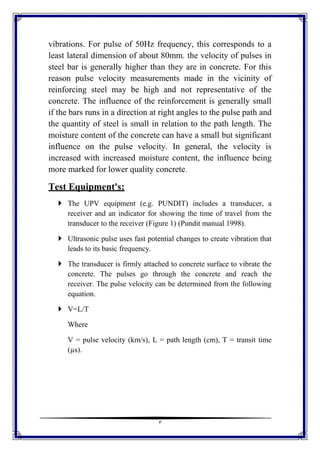
vibrations. For pulse of 50Hz frequency, this corresponds to a
least lateral dimension of about 80mm. the velocity of pulses in
steel bar is generally higher than they are in concrete. For this
reason pulse velocity measurements made in the vicinity of
reinforcing steel may be high and not representative of the
concrete. The influence of the reinforcement is generally small
if the bars runs in a direction at right angles to the pulse path and
the quantity of steel is small in relation to the path length. The
moisture content of the concrete can have a small but significant
influence on the pulse velocity. In general, the velocity is
increased with increased moisture content, the influence being
more marked for lower quality concrete.
Test Equipment's:
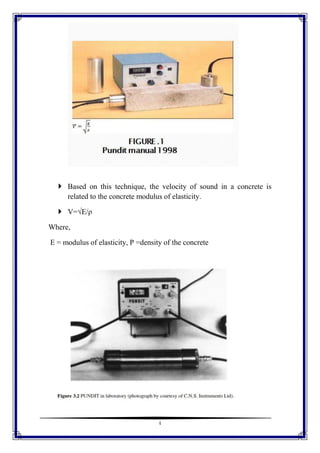
 The UPV equipment (e.g. PUNDIT) includes a transducer, a
receiver and an indicator for showing the time of travel from the
transducer to the receiver (Figure 1) (Pundit manual 1998).
 Ultrasonic pulse uses fast potential changes to create vibration that
leads to its basic frequency.
 The transducer is firmly attached to concrete surface to vibrate the
concrete. The pulses go through the concrete and reach the
receiver. The pulse velocity can be determined from the following
equation.
 V=L/T
Where
V = pulse velocity (km/s), L = path length (cm), T = transit time
(µs).
4
 Based on this technique, the velocity of sound in a concrete is
related to the concrete modulus of elasticity.
 V=√E/ρ
Where,
E = modulus of elasticity, Ρ =density of the concrete
5
Arrangement of equipment:
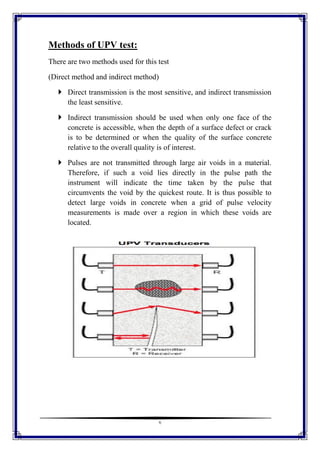
There are three basic ways in which the transducers may be arranged
 Opposite faces (direct transmission)
 Adjacent faces (semi-direct transmission)
 Same face (indirect transmission).
How it works:
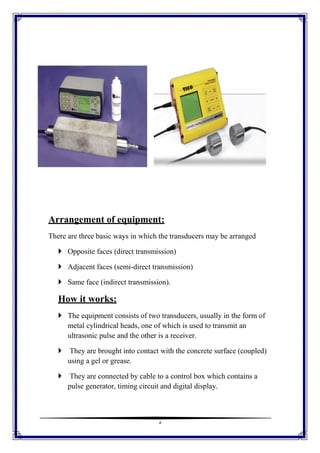
 The equipment consists of two transducers, usually in the form of
metal cylindrical heads, one of which is used to transmit an
ultrasonic pulse and the other is a receiver.
 They are brought into contact with the concrete surface (coupled)
using a gel or grease.
 They are connected by cable to a control box which contains a
pulse generator, timing circuit and digital display.
6
 The digital display indicates the time for the ultrasonic pulse to
travel between the transmitting and receiving transducers.
 It is possible to develop an empirical relationship between pulse
velocity and strength but this relationship is influenced by type of
cement, type and size of aggregate, presence of reinforcement,
moisture condition, compaction and age of concrete.
7
Methods of UPV test:
There are two methods used for this test
(Direct method and indirect method)
 Direct transmission is the most sensitive, and indirect transmission
the least sensitive.
 Indirect transmission should be used when only one face of the
concrete is accessible, when the depth of a surface defect or crack
is to be determined or when the quality of the surface concrete
relative to the overall quality is of interest.
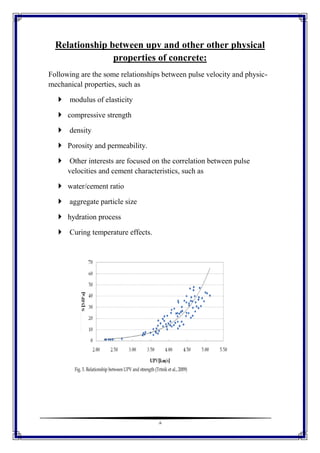
 Pulses are not transmitted through large air voids in a material.
Therefore, if such a void lies directly in the pulse path the
instrument will indicate the time taken by the pulse that
circumvents the void by the quickest route. It is thus possible to
detect large voids in concrete when a grid of pulse velocity
measurements is made over a region in which these voids are
located.
8
Relationship between upv and other other physical
properties of concrete:
Following are the some relationships between pulse velocity and physic-
mechanical properties, such as
 modulus of elasticity
 compressive strength
 density
 Porosity and permeability.
 Other interests are focused on the correlation between pulse
velocities and cement characteristics, such as
 water/cement ratio
 aggregate particle size
 hydration process
 Curing temperature effects.
9
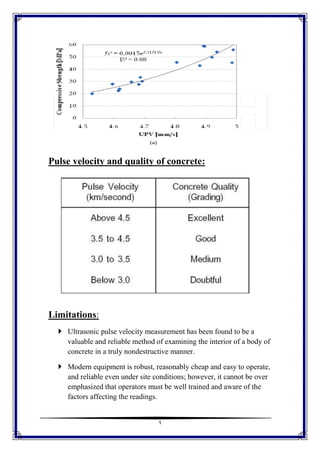
Pulse velocity and quality of concrete:
Limitations:
 Ultrasonic pulse velocity measurement has been found to be a
valuable and reliable method of examining the interior of a body of
concrete in a truly nondestructive manner.
 Modern equipment is robust, reasonably cheap and easy to operate,
and reliable even under site conditions; however, it cannot be over
emphasized that operators must be well trained and aware of the
factors affecting the readings.
11
Conclusions:
From this report we conclude that UPV is used for the following finding
the following properties of concrete.
 Measurement of concrete uniformity.
 Detection of cracking and honeycombing.
 Strength estimation.
 Measurement of layer thickness
 Measurement of elastic modulus.
 Strength development monitoring.

Ultra sonic pulse velocity test for concrete as nondestructive test method in structural engineering

  • 1.
    1 Gaziantep University College ofEngineering Civil Engineering Department REPORT ON Ultra Sonic Pulse Velocity Test For Concrete As Nondestructive Test Method In Structural Engineering Submitted by Mohammed Layth Abbas Student No:201444956 Supervisor Assoc.Prof. Esra Mete Güneyisi CE 550 (Nondestructive Testing and Evaluation in Structural Eng)
  • 2.
    2 Ultrasonic pulse velocityin concrete (UPV) ASTM C597 Introduction: Ultrasonic Pulse Velocity (UPV) testing of concrete is based on the pulse velocity method to provide information on the uniformity of concrete, cavities, cracks and defects. Presence of voids, honey combing or other discontinuities. The pulse velocity in a material depends on its density and its elastic properties which in turn are related to the quality and the compressive strength of the concrete. This test method is applicable to assess the uniformity and relative quality of concrete, to indicate the presence of voids and cracks, and to evaluate the effectiveness of crack repairs. It is also applicable to indicate changes in the properties of concrete, and in the survey of structures, to estimate the severity of deterioration or cracking. The pulse velocity in concrete may be influenced: a) Path length b) Lateral dimension of the specimen tested c) Presence of reinforcement steel d) Moisture content of the concrete The influence of path length will be negligible provided it is not less than 100mm when 20mm size aggregate is used or less than 150mm for 40mm size aggregate. Pulse velocity will not be influenced by the shape of the specimen, provided its least lateral dimension (i.e. its dimension measured at right angles to the pulse path) is not less than the wavelength of the pulse
  • 3.
    3 vibrations. For pulseof 50Hz frequency, this corresponds to a least lateral dimension of about 80mm. the velocity of pulses in steel bar is generally higher than they are in concrete. For this reason pulse velocity measurements made in the vicinity of reinforcing steel may be high and not representative of the concrete. The influence of the reinforcement is generally small if the bars runs in a direction at right angles to the pulse path and the quantity of steel is small in relation to the path length. The moisture content of the concrete can have a small but significant influence on the pulse velocity. In general, the velocity is increased with increased moisture content, the influence being more marked for lower quality concrete. Test Equipment's:  The UPV equipment (e.g. PUNDIT) includes a transducer, a receiver and an indicator for showing the time of travel from the transducer to the receiver (Figure 1) (Pundit manual 1998).  Ultrasonic pulse uses fast potential changes to create vibration that leads to its basic frequency.  The transducer is firmly attached to concrete surface to vibrate the concrete. The pulses go through the concrete and reach the receiver. The pulse velocity can be determined from the following equation.  V=L/T Where V = pulse velocity (km/s), L = path length (cm), T = transit time (µs).
  • 4.
    4  Based onthis technique, the velocity of sound in a concrete is related to the concrete modulus of elasticity.  V=√E/ρ Where, E = modulus of elasticity, Ρ =density of the concrete
  • 5.
    5 Arrangement of equipment: Thereare three basic ways in which the transducers may be arranged  Opposite faces (direct transmission)  Adjacent faces (semi-direct transmission)  Same face (indirect transmission). How it works:  The equipment consists of two transducers, usually in the form of metal cylindrical heads, one of which is used to transmit an ultrasonic pulse and the other is a receiver.  They are brought into contact with the concrete surface (coupled) using a gel or grease.  They are connected by cable to a control box which contains a pulse generator, timing circuit and digital display.
  • 6.
    6  The digitaldisplay indicates the time for the ultrasonic pulse to travel between the transmitting and receiving transducers.  It is possible to develop an empirical relationship between pulse velocity and strength but this relationship is influenced by type of cement, type and size of aggregate, presence of reinforcement, moisture condition, compaction and age of concrete.
  • 7.
    7 Methods of UPVtest: There are two methods used for this test (Direct method and indirect method)  Direct transmission is the most sensitive, and indirect transmission the least sensitive.  Indirect transmission should be used when only one face of the concrete is accessible, when the depth of a surface defect or crack is to be determined or when the quality of the surface concrete relative to the overall quality is of interest.  Pulses are not transmitted through large air voids in a material. Therefore, if such a void lies directly in the pulse path the instrument will indicate the time taken by the pulse that circumvents the void by the quickest route. It is thus possible to detect large voids in concrete when a grid of pulse velocity measurements is made over a region in which these voids are located.
  • 8.
    8 Relationship between upvand other other physical properties of concrete: Following are the some relationships between pulse velocity and physic- mechanical properties, such as  modulus of elasticity  compressive strength  density  Porosity and permeability.  Other interests are focused on the correlation between pulse velocities and cement characteristics, such as  water/cement ratio  aggregate particle size  hydration process  Curing temperature effects.
  • 9.
    9 Pulse velocity andquality of concrete: Limitations:  Ultrasonic pulse velocity measurement has been found to be a valuable and reliable method of examining the interior of a body of concrete in a truly nondestructive manner.  Modern equipment is robust, reasonably cheap and easy to operate, and reliable even under site conditions; however, it cannot be over emphasized that operators must be well trained and aware of the factors affecting the readings.
  • 10.
    11 Conclusions: From this reportwe conclude that UPV is used for the following finding the following properties of concrete.  Measurement of concrete uniformity.  Detection of cracking and honeycombing.  Strength estimation.  Measurement of layer thickness  Measurement of elastic modulus.  Strength development monitoring.