VAT and
Exports
Basic principles
…..A refresher
• A world wide tax (almost)
• C130 countries (and growing)
• Compare US SALT taxes
VAT law
• European legislation – EU VAT Directive
• UK legislation – Value Added Tax Act
1994
• Secondary/Tertiary legislation
(Statutory instruments etc)
• Case Law
• HMRC Notices & Leaflets – generally
interpretive only – not law
Scope of the tax
• VAT shall be charged on:
- any supply of goods or services
- made in the United Kingdom
- where it is a taxable supply
- made by a taxable person
in the course of furtherance of any
business carried on by him
VAT Act 1994 Section 4(1)
… any supply of goods or services …
What is a supply? – no legislative
definition, but:
- “includes all forms of supply, but not
anything done otherwise for a
consideration”
… any supply of goods or services …
• Supply of goods = transfer of title (the
right to dispose of)
• Supply of services = anything which is
not a supply of goods .. done for a
consideration
… any supply of goods or services …
• Distinguishing between goods and
services is important:
- VAT liability
- Place of supply
- Time of supply
… made in the United Kingdom …
• UK VAT only applies to supplies made
in the UK:
- “place of supply” rules
… where it is a taxable supply…
• Taxable supplies:
- Standard rate – 20%
- Zero rate – 0% (e.g. books, new houses,
exports of goods)
- Reduced rate – 5% (e.g. domestic fuel &
power, residential conversions)
• Exempt supplies (e.g. finance, education,
some residential accommodation etc)
• Difference between zero rate and exempt
… where it is a taxable
supply…continued
• Other supplies/transactions:
- Outside the scope of VAT (e.g.
compensation, grants etc)
- Disregarded supplies, i.e. neither
goods or services (e.g. sales within
VAT group, TOGC)
- Deemed supplies (e.g. gifts,
“movements of own goods” etc)
… made by a taxable person….
• A person who makes or intends to
make taxable supplies and is (or is
liable to be) registered for VAT:
- Compulsory registration -
£81,000p.a.
- Voluntary registration
- Caution – thresholds differ between
EU countries
… in the course of business
• ‘Business’ not defined, but includes
‘any trade or vocation’
- Purely private transactions are
outside the scope of VAT
- EC law (VAT Directive) refers to
‘economic activity’
- Includes ‘not-for-profit’
activities & organisations
Key principles - recap
• VAT is a tax on business transactions
• Collected through the supply chain
• VAT systems worldwide – but the
detailed rules vary
• Not all transactions are subject to VAT
• Need to understand the transaction to
determine the VAT treatment
Time of supply
• Determines when to account for VAT
• Goods:
–Basic tax point is date when goods
are removed or made available for
customer use
• Services:
–Basic tax point is time when the
services are performed
Actual tax point
• Actual tax point overrides the basic tax
point
• Actual tax point created by:
–VAT invoice being issued or a payment
being received before the basic tax
point; or
–Invoice being issued up to 14 days after
the basic tax point. This does not
override a tax point created by an early
payment
Goods tax point?
• Goods delivered on 8 June 2013
• Payment received 31 May 2013
• Invoice issued 12 June 2013
• What is tax point?
• Answer - 31 May 2013
Services tax point?
• Services performed on 27 September
2012
• Payment received on 4 November
2012
• Invoice issued on 5 October 2012
• What is tax point?
• Answer - 5 October 2012
Place of supply of goods
–For goods being transported = where
the goods are when journey begins
–For goods not being transported =
where they are physically located
–For goods being supplied and installed =
place where the goods are being
installed
• Special rules for intra-EU movements
(dispatches, distance sales) and exports to
non-EU countries
Place of supply – Goods…..continued
• A UK supplier supplies goods to a US
customer and the goods are transported
to the US
• Place of supply = UK
• But – export rules may apply
Place of supply – Goods…..continued
• A UK supplier supplies goods to a US
customer but goods remain in the UK
• Place of supply = UK
• A UK supplier supplies goods to a US
customer. Goods are installed in Germany
• Place of supply = Germany
Place of supply of services
• Basic rule: “where the recipient has established his
business”
• If recipient has more than one place of business: place
of business which is “most closely connected” to the supply
• Exceptions to basic rule for:
– Land/immovable property e.g. property
management, surveying, legal services on
conveyancing
– Transport services
– Live artistic, sporting, cultural and exhibition
services e.g. pop concert
– Intellectual services e.g. engineering services
– Electronic services (will change in 2015)
Place of supply – Services…..continued
• A UK supplier supplies office rental property in
the UK to a US customer
• Place of supply where the property is located =
UK
• A UK supplier supplies office rental property in
the UK to German customer
• Place of supply = UK
• A UK supplier supplies office rental property in
Germany to a German customer
• Place of supply = Germany
International and cross border
Terminology
• Import/Export (non-EU)
• Acquisition/Dispatch
• Goods vs. Services
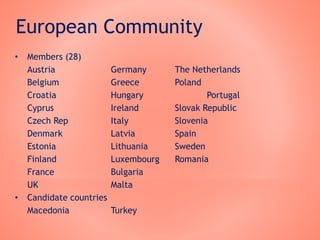
European Community
• Members (28)
Austria Germany The Netherlands
Belgium Greece Poland
Croatia Hungary Portugal
Cyprus Ireland Slovak Republic
Czech Rep Italy Slovenia
Denmark Latvia Spain
Estonia Lithuania Sweden
Finland Luxembourg Romania
France Bulgaria
UK Malta
• Candidate countries
Macedonia Turkey
Imports
• Goods from outside the EU
• Import VAT
- same rate of VAT as if goods supplied in UK
- payable as a duty of Customs
- payable when duty is due (i.e when goods
cleared)
- taxable amount = value for Customs purposes
- deferment
- import VAT is reclaimable - Box 4
Imports (continued)
• Documentation
- deferment statement
- agent's invoice
- C79 (import VAT certificate)
• VAT recovery?
- C79
*
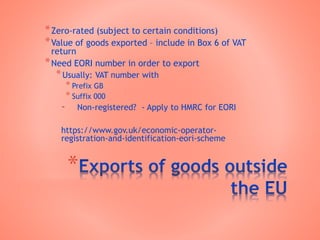
*Zero-rated (subject to certain conditions)
*Value of goods exported – include in Box 6 of VAT
return
*Need EORI number in order to export
*Usually: VAT number with
* Prefix GB
* Suffix 000
- Non-registered? - Apply to HMRC for EORI
https://www.gov.uk/economic-operator-
registration-and-identification-eori-scheme
*
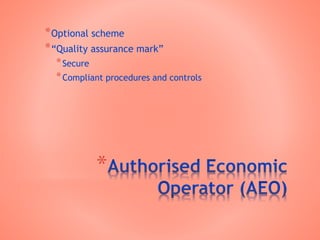
*Optional scheme
*“Quality assurance mark”
*Secure
*Compliant procedures and controls
*
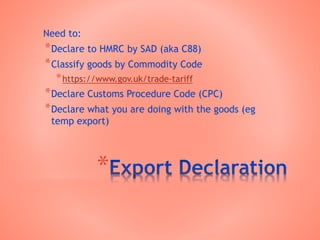
Need to:
*Declare to HMRC by SAD (aka C88)
*Classify goods by Commodity Code
*https://www.gov.uk/trade-tariff
*Declare Customs Procedure Code (CPC)
*Declare what you are doing with the goods (eg
temp export)
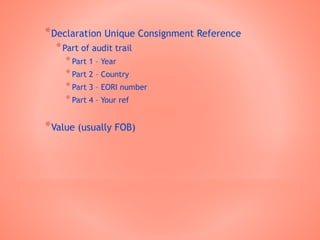
*Declaration Unique Consignment Reference
*Part of audit trail
*Part 1 – Year
*Part 2 – Country
*Part 3 – EORI number
*Part 4 – Your ref
*Value (usually FOB)
*
*internationally recognised standard trade
terms
*Set out responsibility for:
*cost of transporting the goods, including
insurance, taxes and duties
*where the goods should be picked up from and
transported to
*who is responsible for the goods at each step
during transportation
*
See handout for further details
*
“Customs Handling of Import and Export Freight”
Allows you to track the movement of your goods
through ports and airports, and complete customs
information electronically.
https://www.gov.uk/chief-trader-import-and-export-
processing-system
*
National Export System for export declarations
Enables export declarations to be made electronically
Use of NES is mandatory for exporters and you must
be authorised to use it.
https://www.gov.uk/export-declarations-and-the-
national-export-system-export-procedures#the-
national-export-system-and-how-to-use-it
*
Export Control System - The EU system for the
control of indirect exports, such as export
consignments that are declared for export at a
location in one Member State but exit the EU via
another Member State.
https://www.gov.uk/export-control-system-ecs-
supporting-guidance
*
Goods go directly from UK to non-EU country
Proof of export required to support zero-rating
*
Goods travel through other EU country or
countries before arriving in non-EU country
Additional VAT requirements
*
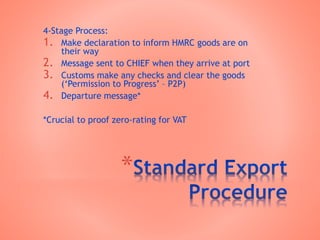
4-Stage Process:
1. Make declaration to inform HMRC goods are on
their way
2. Message sent to CHIEF when they arrive at port
3. Customs make any checks and clear the goods
(‘Permission to Progress’ – P2P)
4. Departure message*
*Crucial to proof zero-rating for VAT
*
*Postal exports
*Other?
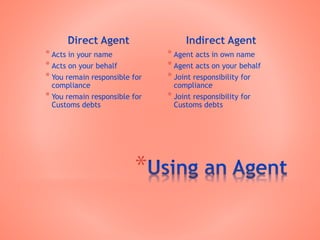
* Acts in your name
* Acts on your behalf
* You remain responsible for
compliance
* You remain responsible for
Customs debts
* Agent acts in own name
* Agent acts on your behalf
* Joint responsibility for
compliance
* Joint responsibility for
Customs debts
*
*
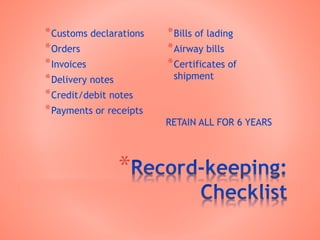
*Customs declarations
*Orders
*Invoices
*Delivery notes
*Credit/debit notes
*Payments or receipts
*Bills of lading
*Airway bills
*Certificates of
shipment
RETAIN ALL FOR 6 YEARS
*
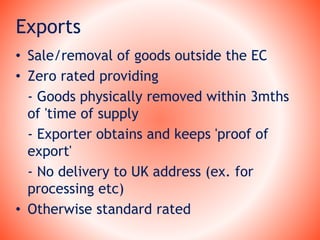
Exports
• Sale/removal of goods outside the EC
• Zero rated providing
- Goods physically removed within 3mths
of 'time of supply
- Exporter obtains and keeps 'proof of
export'
- No delivery to UK address (ex. for
processing etc)
• Otherwise standard rated
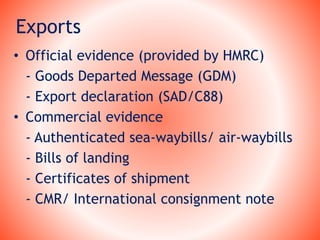
Exports
• Official evidence (provided by HMRC)
- Goods Departed Message (GDM)
- Export declaration (SAD/C88)
• Commercial evidence
- Authenticated sea-waybills/ air-waybills
- Bills of landing
- Certificates of shipment
- CMR/ International consignment note
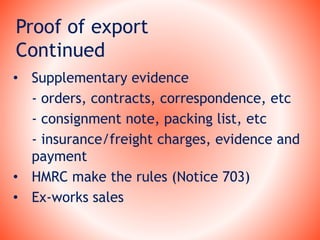
Proof of export
Continued
• Supplementary evidence
- orders, contracts, correspondence, etc
- consignment note, packing list, etc
- insurance/freight charges, evidence and
payment
• HMRC make the rules (Notice 703)
• Ex-works sales
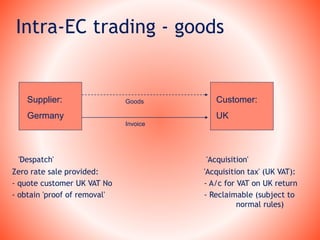
Intra-EC trading - goods
Supplier:
Germany
Customer:
UK
Goods
Invoice
'Despatch' 'Acquisition'
Zero rate sale provided: 'Acquisition tax' (UK VAT):
- quote customer UK VAT No - A/c for VAT on UK return
- obtain 'proof of removal' - Reclaimable (subject to
normal rules)
Acquisitions
• Goods from elsewhere in the EC
• VAT registered customer responsible for
'acquisition tax' accounting
• Acquisition tax
Dispatches
• Sale/removal of goods to other EC member
states
• Zero rated provided:
- goods physically removed from UK
- goods 'acquired' by VAT registered customer
- supplier quotes customer VAT number
- supplier obtains and keeps 'evidence of
removal'
• Otherwise standard rated
• Movements of own goods
• VAT return: boxes 6 and 8
EC Sales List (ESL)
• Details of zero rated supplies of goods to
EC customers
- customers VAT number
- 'total value' of goods supplied
• Calendar quarters
• Sent automatically by HMRC (Box 8)
• Now required for services
Intrastat
• Statistics on trade in goods between EC
countries
• Boxes 8 and 9 of VAT return
• Supplementary declarations:
- Dispatches (£250k)
- Arrivals (£600k)
- Monthly
• Physical movements of goods
• Penalty regime
Overseas expenses
• EC 8th Directive - recovery of VAT
incurred elsewhere in EC
• Conditions - taxable person etc
• Claim - period, original invoices
• EC 13th Directive – recovery of EU VAT by
businesses not registered or established
in the EU
VAT on services: international
issuesVAT impact of services supplied into and out
of UK/EU
• Place of supply
• “Importation” of services into UK/EU
• May be subject to “reverse charge” VAT
Headline Rate
• SR VAT - 1/6th of gross value
- Impact on margin
• Compare other taxes
• Ignore it at your peril!
Complexity of Regime
• Old legislation – needs updating (e.g. food,
handicapped persons)
• New legislation – Torture!
• Pace of change – Continuous process (Budget
Day no longer “an event”)
• Volume of material
• Volume and range of case law (FTT – CJEU)
(28 countries)
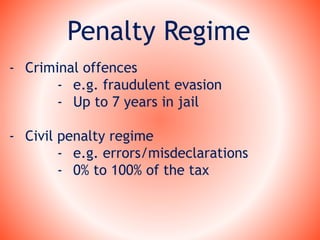
Penalty Regime
- Criminal offences
- e.g. fraudulent evasion
- Up to 7 years in jail
- Civil penalty regime
- e.g. errors/misdeclarations
- 0% to 100% of the tax
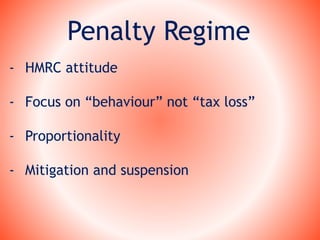
Penalty Regime
- HMRC attitude
- Focus on “behaviour” not “tax loss”
- Proportionality
- Mitigation and suspension
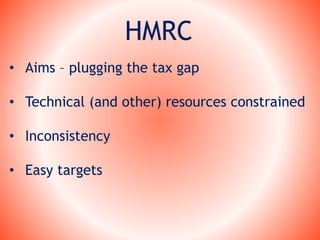
HMRC
• Aims – plugging the tax gap
• Technical (and other) resources constrained
• Inconsistency
• Easy targets
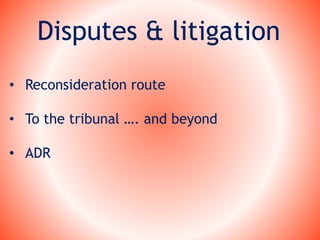
Disputes & litigation
• Reconsideration route
• To the tribunal …. and beyond
• ADR
= VAT has never been a bigger risk to business
What can we do?
Contact
vat@taxadvicedirect.co.uk

Ukti vat exports masterclass

  • 1.
  • 2.
  • 3.
    • A worldwide tax (almost) • C130 countries (and growing) • Compare US SALT taxes
  • 4.
    VAT law • Europeanlegislation – EU VAT Directive • UK legislation – Value Added Tax Act 1994 • Secondary/Tertiary legislation (Statutory instruments etc) • Case Law • HMRC Notices & Leaflets – generally interpretive only – not law
  • 5.
    Scope of thetax • VAT shall be charged on: - any supply of goods or services - made in the United Kingdom - where it is a taxable supply - made by a taxable person in the course of furtherance of any business carried on by him VAT Act 1994 Section 4(1)
  • 6.
    … any supplyof goods or services … What is a supply? – no legislative definition, but: - “includes all forms of supply, but not anything done otherwise for a consideration”
  • 7.
    … any supplyof goods or services … • Supply of goods = transfer of title (the right to dispose of) • Supply of services = anything which is not a supply of goods .. done for a consideration
  • 8.
    … any supplyof goods or services … • Distinguishing between goods and services is important: - VAT liability - Place of supply - Time of supply
  • 9.
    … made inthe United Kingdom … • UK VAT only applies to supplies made in the UK: - “place of supply” rules
  • 10.
    … where itis a taxable supply… • Taxable supplies: - Standard rate – 20% - Zero rate – 0% (e.g. books, new houses, exports of goods) - Reduced rate – 5% (e.g. domestic fuel & power, residential conversions) • Exempt supplies (e.g. finance, education, some residential accommodation etc) • Difference between zero rate and exempt
  • 11.
    … where itis a taxable supply…continued • Other supplies/transactions: - Outside the scope of VAT (e.g. compensation, grants etc) - Disregarded supplies, i.e. neither goods or services (e.g. sales within VAT group, TOGC) - Deemed supplies (e.g. gifts, “movements of own goods” etc)
  • 12.
    … made bya taxable person…. • A person who makes or intends to make taxable supplies and is (or is liable to be) registered for VAT: - Compulsory registration - £81,000p.a. - Voluntary registration - Caution – thresholds differ between EU countries
  • 13.
    … in thecourse of business • ‘Business’ not defined, but includes ‘any trade or vocation’ - Purely private transactions are outside the scope of VAT - EC law (VAT Directive) refers to ‘economic activity’ - Includes ‘not-for-profit’ activities & organisations
  • 14.
    Key principles -recap • VAT is a tax on business transactions • Collected through the supply chain • VAT systems worldwide – but the detailed rules vary • Not all transactions are subject to VAT • Need to understand the transaction to determine the VAT treatment
  • 15.
    Time of supply •Determines when to account for VAT • Goods: –Basic tax point is date when goods are removed or made available for customer use • Services: –Basic tax point is time when the services are performed
  • 16.
    Actual tax point •Actual tax point overrides the basic tax point • Actual tax point created by: –VAT invoice being issued or a payment being received before the basic tax point; or –Invoice being issued up to 14 days after the basic tax point. This does not override a tax point created by an early payment
  • 17.
    Goods tax point? •Goods delivered on 8 June 2013 • Payment received 31 May 2013 • Invoice issued 12 June 2013 • What is tax point? • Answer - 31 May 2013
  • 18.
    Services tax point? •Services performed on 27 September 2012 • Payment received on 4 November 2012 • Invoice issued on 5 October 2012 • What is tax point? • Answer - 5 October 2012
  • 19.
    Place of supplyof goods –For goods being transported = where the goods are when journey begins –For goods not being transported = where they are physically located –For goods being supplied and installed = place where the goods are being installed • Special rules for intra-EU movements (dispatches, distance sales) and exports to non-EU countries
  • 20.
    Place of supply– Goods…..continued • A UK supplier supplies goods to a US customer and the goods are transported to the US • Place of supply = UK • But – export rules may apply
  • 21.
    Place of supply– Goods…..continued • A UK supplier supplies goods to a US customer but goods remain in the UK • Place of supply = UK • A UK supplier supplies goods to a US customer. Goods are installed in Germany • Place of supply = Germany
  • 22.
    Place of supplyof services • Basic rule: “where the recipient has established his business” • If recipient has more than one place of business: place of business which is “most closely connected” to the supply • Exceptions to basic rule for: – Land/immovable property e.g. property management, surveying, legal services on conveyancing – Transport services – Live artistic, sporting, cultural and exhibition services e.g. pop concert – Intellectual services e.g. engineering services – Electronic services (will change in 2015)
  • 23.
    Place of supply– Services…..continued • A UK supplier supplies office rental property in the UK to a US customer • Place of supply where the property is located = UK • A UK supplier supplies office rental property in the UK to German customer • Place of supply = UK • A UK supplier supplies office rental property in Germany to a German customer • Place of supply = Germany
  • 24.
  • 25.
    Terminology • Import/Export (non-EU) •Acquisition/Dispatch • Goods vs. Services
  • 26.
    European Community • Members(28) Austria Germany The Netherlands Belgium Greece Poland Croatia Hungary Portugal Cyprus Ireland Slovak Republic Czech Rep Italy Slovenia Denmark Latvia Spain Estonia Lithuania Sweden Finland Luxembourg Romania France Bulgaria UK Malta • Candidate countries Macedonia Turkey
  • 27.
    Imports • Goods fromoutside the EU • Import VAT - same rate of VAT as if goods supplied in UK - payable as a duty of Customs - payable when duty is due (i.e when goods cleared) - taxable amount = value for Customs purposes - deferment - import VAT is reclaimable - Box 4
  • 28.
    Imports (continued) • Documentation -deferment statement - agent's invoice - C79 (import VAT certificate) • VAT recovery? - C79
  • 29.
    * *Zero-rated (subject tocertain conditions) *Value of goods exported – include in Box 6 of VAT return *Need EORI number in order to export *Usually: VAT number with * Prefix GB * Suffix 000 - Non-registered? - Apply to HMRC for EORI https://www.gov.uk/economic-operator- registration-and-identification-eori-scheme
  • 30.
    * *Optional scheme *“Quality assurancemark” *Secure *Compliant procedures and controls
  • 31.
    * Need to: *Declare toHMRC by SAD (aka C88) *Classify goods by Commodity Code *https://www.gov.uk/trade-tariff *Declare Customs Procedure Code (CPC) *Declare what you are doing with the goods (eg temp export)
  • 32.
    *Declaration Unique ConsignmentReference *Part of audit trail *Part 1 – Year *Part 2 – Country *Part 3 – EORI number *Part 4 – Your ref *Value (usually FOB)
  • 33.
    * *internationally recognised standardtrade terms *Set out responsibility for: *cost of transporting the goods, including insurance, taxes and duties *where the goods should be picked up from and transported to *who is responsible for the goods at each step during transportation
  • 34.
    * See handout forfurther details
  • 35.
    * “Customs Handling ofImport and Export Freight” Allows you to track the movement of your goods through ports and airports, and complete customs information electronically. https://www.gov.uk/chief-trader-import-and-export- processing-system
  • 36.
    * National Export Systemfor export declarations Enables export declarations to be made electronically Use of NES is mandatory for exporters and you must be authorised to use it. https://www.gov.uk/export-declarations-and-the- national-export-system-export-procedures#the- national-export-system-and-how-to-use-it
  • 37.
    * Export Control System- The EU system for the control of indirect exports, such as export consignments that are declared for export at a location in one Member State but exit the EU via another Member State. https://www.gov.uk/export-control-system-ecs- supporting-guidance
  • 38.
    * Goods go directlyfrom UK to non-EU country Proof of export required to support zero-rating
  • 39.
    * Goods travel throughother EU country or countries before arriving in non-EU country Additional VAT requirements
  • 40.
    * 4-Stage Process: 1. Makedeclaration to inform HMRC goods are on their way 2. Message sent to CHIEF when they arrive at port 3. Customs make any checks and clear the goods (‘Permission to Progress’ – P2P) 4. Departure message* *Crucial to proof zero-rating for VAT
  • 41.
  • 42.
    * Acts inyour name * Acts on your behalf * You remain responsible for compliance * You remain responsible for Customs debts * Agent acts in own name * Agent acts on your behalf * Joint responsibility for compliance * Joint responsibility for Customs debts *
  • 43.
    * *Customs declarations *Orders *Invoices *Delivery notes *Credit/debitnotes *Payments or receipts *Bills of lading *Airway bills *Certificates of shipment RETAIN ALL FOR 6 YEARS
  • 44.
  • 45.
    Exports • Sale/removal ofgoods outside the EC • Zero rated providing - Goods physically removed within 3mths of 'time of supply - Exporter obtains and keeps 'proof of export' - No delivery to UK address (ex. for processing etc) • Otherwise standard rated
  • 46.
    Exports • Official evidence(provided by HMRC) - Goods Departed Message (GDM) - Export declaration (SAD/C88) • Commercial evidence - Authenticated sea-waybills/ air-waybills - Bills of landing - Certificates of shipment - CMR/ International consignment note
  • 47.
    Proof of export Continued •Supplementary evidence - orders, contracts, correspondence, etc - consignment note, packing list, etc - insurance/freight charges, evidence and payment • HMRC make the rules (Notice 703) • Ex-works sales
  • 48.
    Intra-EC trading -goods Supplier: Germany Customer: UK Goods Invoice 'Despatch' 'Acquisition' Zero rate sale provided: 'Acquisition tax' (UK VAT): - quote customer UK VAT No - A/c for VAT on UK return - obtain 'proof of removal' - Reclaimable (subject to normal rules)
  • 49.
    Acquisitions • Goods fromelsewhere in the EC • VAT registered customer responsible for 'acquisition tax' accounting • Acquisition tax
  • 50.
    Dispatches • Sale/removal ofgoods to other EC member states • Zero rated provided: - goods physically removed from UK - goods 'acquired' by VAT registered customer - supplier quotes customer VAT number - supplier obtains and keeps 'evidence of removal' • Otherwise standard rated • Movements of own goods • VAT return: boxes 6 and 8
  • 51.
    EC Sales List(ESL) • Details of zero rated supplies of goods to EC customers - customers VAT number - 'total value' of goods supplied • Calendar quarters • Sent automatically by HMRC (Box 8) • Now required for services
  • 52.
    Intrastat • Statistics ontrade in goods between EC countries • Boxes 8 and 9 of VAT return • Supplementary declarations: - Dispatches (£250k) - Arrivals (£600k) - Monthly • Physical movements of goods • Penalty regime
  • 53.
    Overseas expenses • EC8th Directive - recovery of VAT incurred elsewhere in EC • Conditions - taxable person etc • Claim - period, original invoices • EC 13th Directive – recovery of EU VAT by businesses not registered or established in the EU
  • 54.
    VAT on services:international issuesVAT impact of services supplied into and out of UK/EU • Place of supply • “Importation” of services into UK/EU • May be subject to “reverse charge” VAT
  • 55.
    Headline Rate • SRVAT - 1/6th of gross value - Impact on margin • Compare other taxes • Ignore it at your peril!
  • 56.
    Complexity of Regime •Old legislation – needs updating (e.g. food, handicapped persons) • New legislation – Torture! • Pace of change – Continuous process (Budget Day no longer “an event”) • Volume of material • Volume and range of case law (FTT – CJEU) (28 countries)
  • 57.
    Penalty Regime - Criminaloffences - e.g. fraudulent evasion - Up to 7 years in jail - Civil penalty regime - e.g. errors/misdeclarations - 0% to 100% of the tax
  • 58.
    Penalty Regime - HMRCattitude - Focus on “behaviour” not “tax loss” - Proportionality - Mitigation and suspension
  • 59.
    HMRC • Aims –plugging the tax gap • Technical (and other) resources constrained • Inconsistency • Easy targets
  • 60.
    Disputes & litigation •Reconsideration route • To the tribunal …. and beyond • ADR
  • 61.
    = VAT hasnever been a bigger risk to business What can we do?
  • 62.