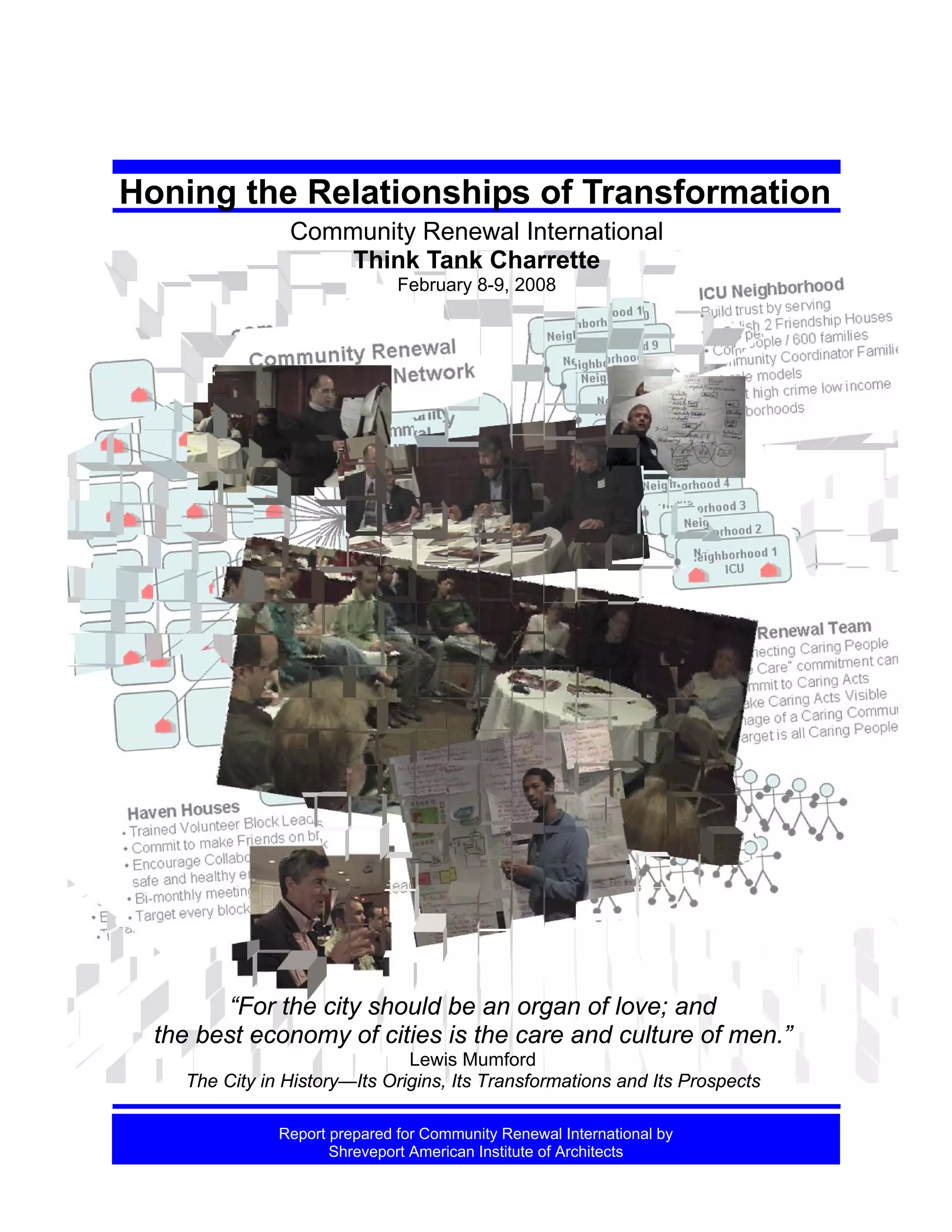
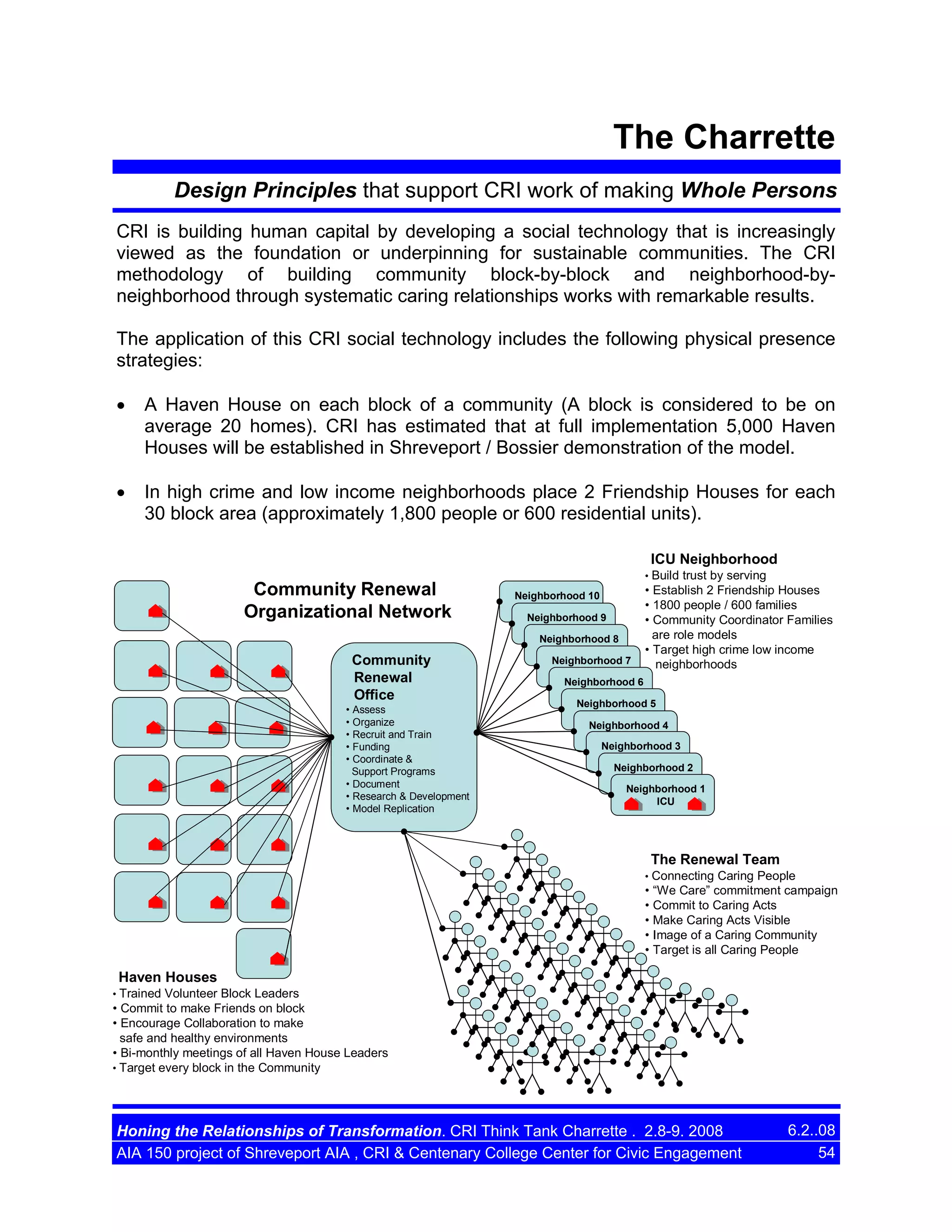
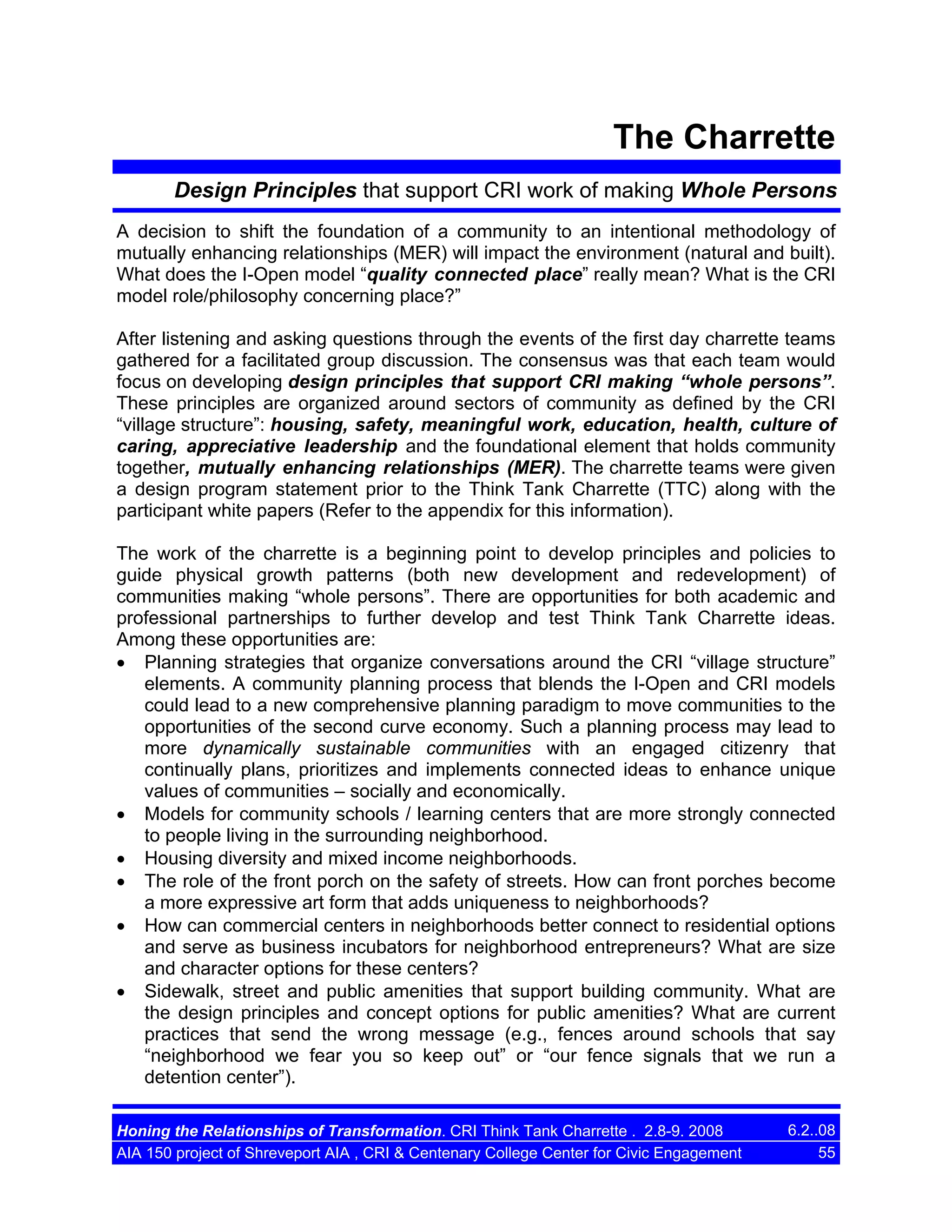
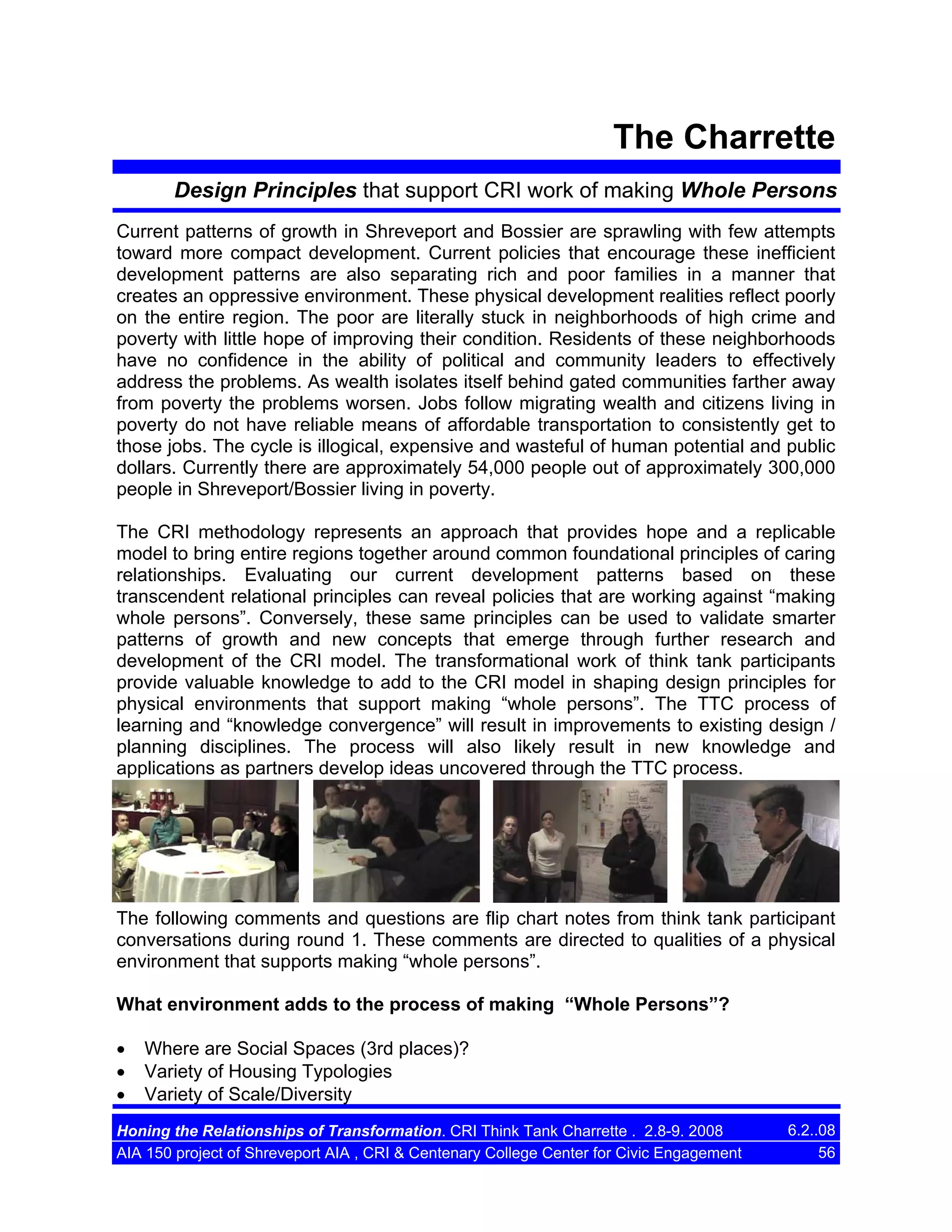
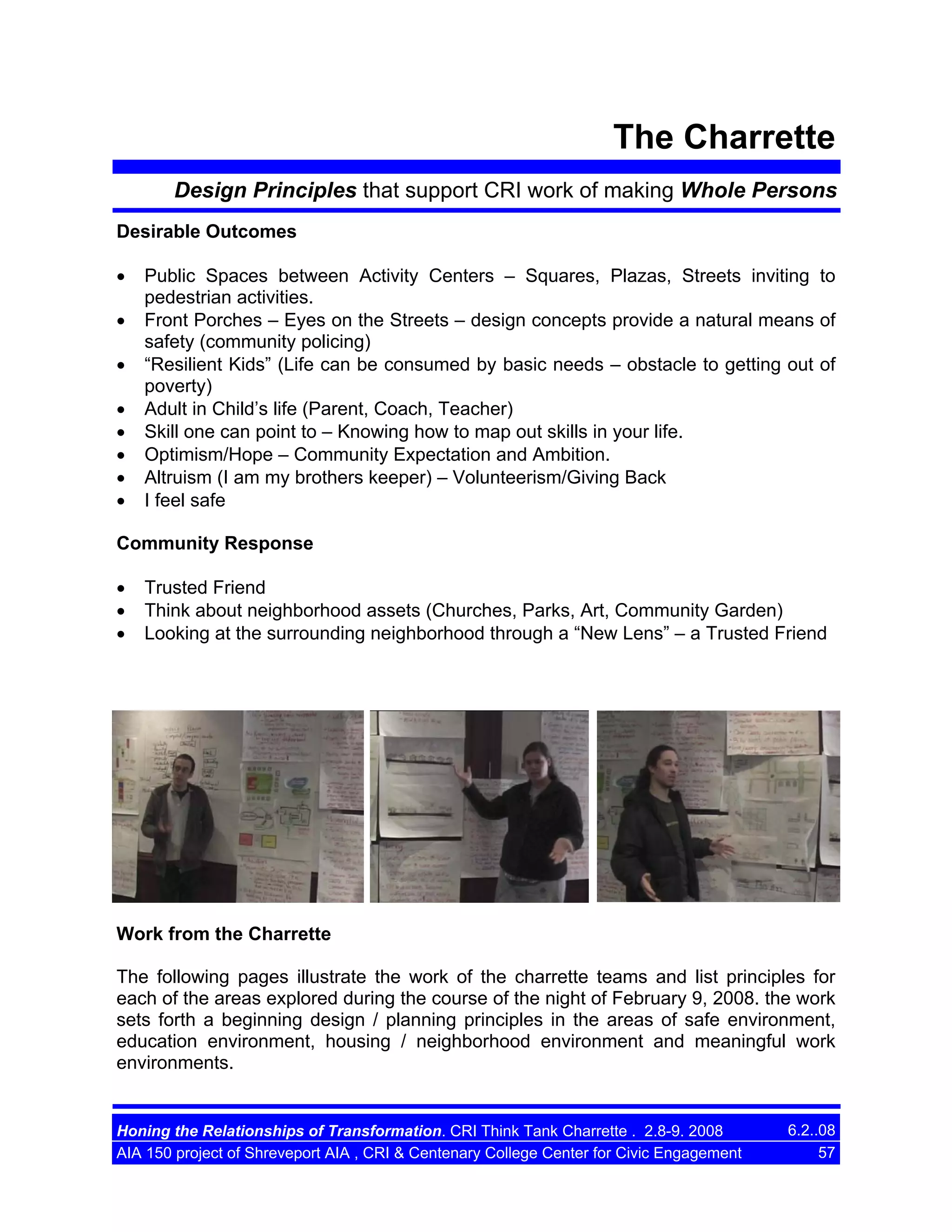
Honing the Relationships of Transformation
Community Renewal International
Think Tank Charrette
February 8-9, 2008

โ€œFor the city should be an organ of love; and
the best economy of cities is the care and culture of men.โ€
Lewis Mumford
The City in Historyโ€”Its Origins, Its Transformations and Its Prospects
Honing the Relationships of Transformation. CRI Think Tank Charrette . 2.8-9. 2008
Report prepared for Community Renewal International by
Shreveport American College Center for Civic Engagement
AIA 150 project of Shreveport AIA , CRI & CentenaryInstitute of Architects

6.2..08
1
Index

Acknowledgements

3

Executive Summary โ€” Ideas & Actions

4

The Think Tank Charrette Process & Methodology

9

CRI & Think Tank Conversation Rounds 1, 2, 3 & 4

17

Learning the CRI Model
Safety, Education, Culture & the Relational Foundation - Round 1
Comments on the Charrette - Round 2
Meaningful Work, Leadership, Culture & Relational F. - Round 3
Strategic Doing Session - Round 4
Stories, Convergence and Wisdom - Round 4

18
23
32
32
41
43

The Charrette

53

What We Learned & Next Steps

65

Appendix list and reference to a separate document

69

Honing the Relationships of Transformation. CRI Think Tank Charrette . 2.8-9. 2008
AIA 150 project of Shreveport AIA , CRI & Centenary College Center for Civic Engagement

6.2..08
2
Acknowledgements
The first Community Renewal International
Think Tank and Design Charrette:
Honing the Relationships of Transformation
The Think Tank Charrette was held February 8-9, 2008 at Bynum
Commons on the Centenary College Campus. This report documents the
process and outcomes of this project.
The event was a National A.I.A. 150 Initiative of Shreveport A.I.A. in
partnership with Community Renewal International, hosted and
cosponsored by Centenary College and its newly forming Center for Civic
Engagement. Partial funding for this event was provided through a
competitive grant program of the American Architectural Foundation to
celebrate 150 years of the American Institute of Architects. We offer
special thanks for additional funding provided by Steve Scrivanos on
behalf of Centenary College.
Think Tank Participants:
Jack Calhoun, Bruce Daigle, Ed Morrison & Mack McCarter
Community Renewal International staff assisting with the event:
Mack McCarter, Coordinator
Mike Leonard, Associate-Coordinator
Eve Goins, Assistant
Harold Ledford, National Center & Curriculum Development
Dianne Loridans, Videographer
Lynn Bryan, Tour guide for Friendship House neighborhoods
Yul Taylor, Coordinator for all Friendship House Community Coordinators
James Melvin, Queensboro Friendship House Community Coordinator
Centenary College and The Center for Civic Engagement:
Ken Schwab, President
Steve Shelburne, Center for Civic Engagement
Steve Scrivanos, donor for all meals and refreshments during the think
tank charrette
Louisiana Tech University Architecture Department:
Kevin Singh, professor
Third and fourth year students: Jared Boudreaux, Marcus Calhoun,
Sereya Yorn, Sean Smith, Mindy Mosley, Brian Wyatt, Melody
McNabb, Rhia Kelsick, and Amy Garrett
AIA 150 Committee:
Kim Mitchell, AIA Champion (chairman, facilitator & report author)
Deana Lohnes, Co-chair
Jeff Spikes, Chris Dzurik, Chris Elberson, Dawn Banks, Patsy Foster and
Carol Grey
Honing the Relationships of Transformation. CRI Think Tank Charrette . 2.8-9. 2008
AIA 150 project of Shreveport AIA , CRI & Centenary College Center for Civic Engagement

6.2..08
3
Executive Summary
Ideas and Actions
The CRI Think Tank is one of the ongoing functions of
Community Renewal Internationalโ€™s (CRI) Institute for
Community Renewal that will be located in the National
Center for Community Renewal (NCCR). The NCCR is a
facility planned for downtown Shreveport, Louisiana that
will house training facilities necessary for the replication of
CRI social technology. This inaugural event began the
work of CRIโ€™s Think Tank. The event is a partnership with
Shreveport American Institute of Architects through a
National AIA 150 grant program, Centenary Collegeโ€™s
Center for Civic Engagement and student / faculty
volunteers from Louisiana Tech Department of
Architecture.

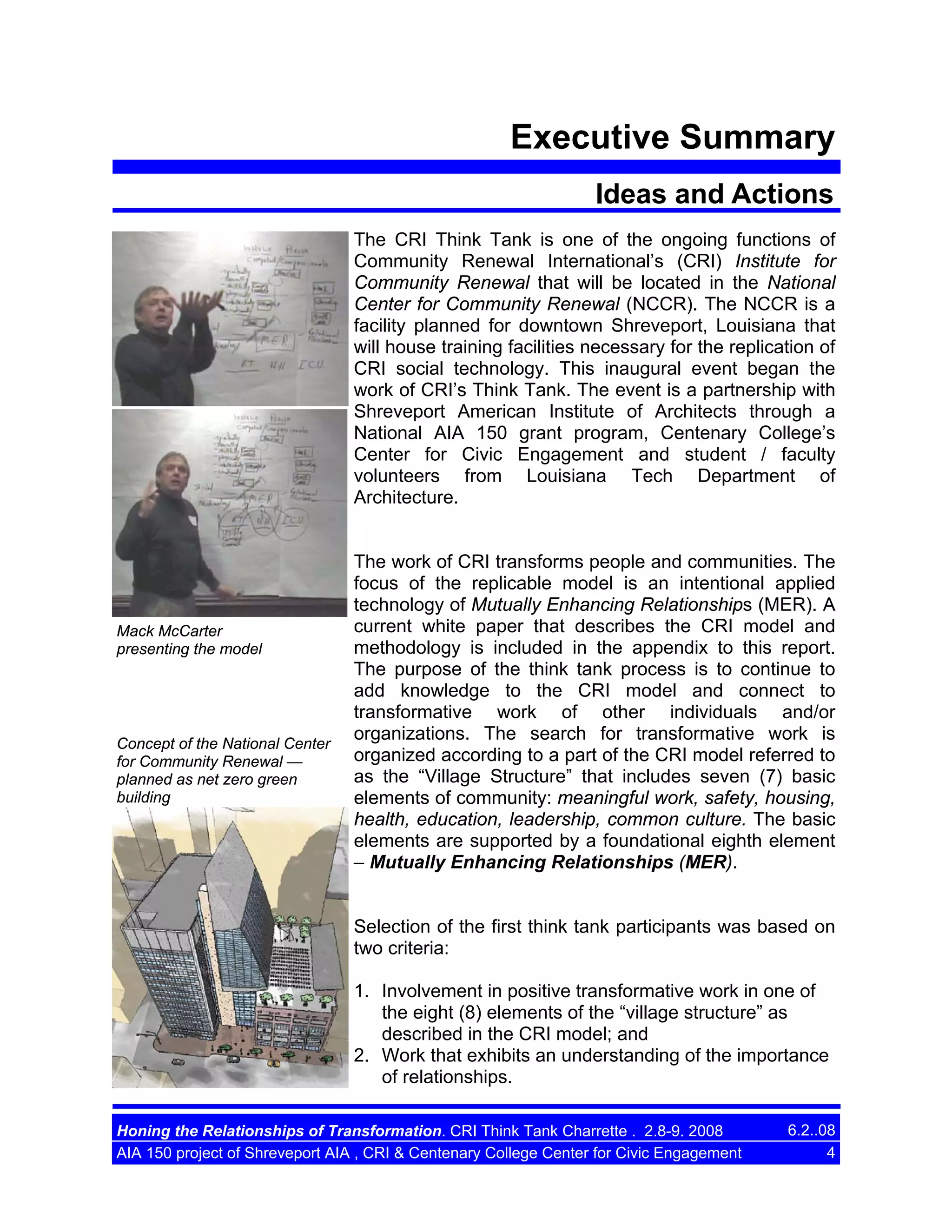
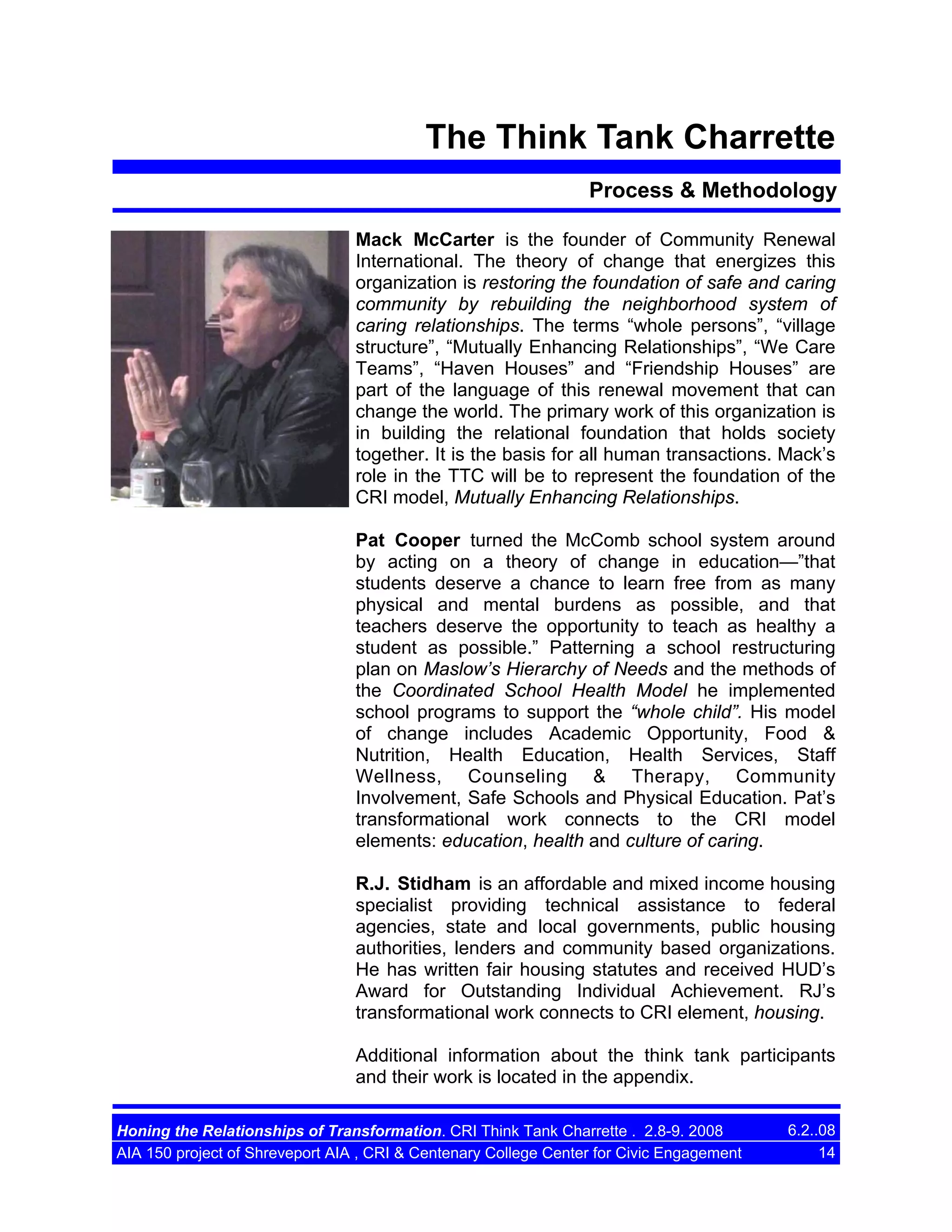
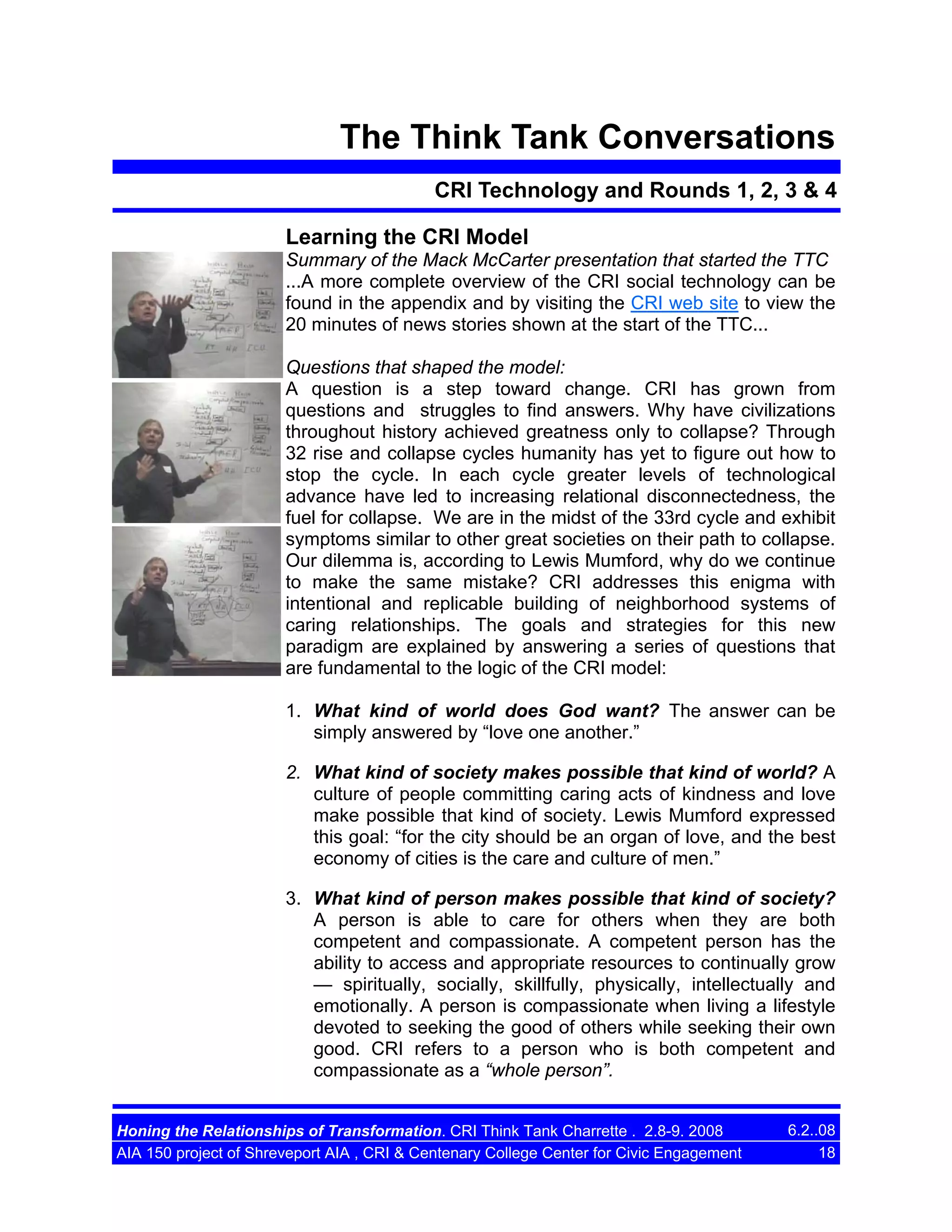
Mack McCarter
presenting the model

Concept of the National Center
for Community Renewal โ€”
planned as net zero green
building

The work of CRI transforms people and communities. The
focus of the replicable model is an intentional applied
technology of Mutually Enhancing Relationships (MER). A
current white paper that describes the CRI model and
methodology is included in the appendix to this report.
The purpose of the think tank process is to continue to
add knowledge to the CRI model and connect to
transformative work of other individuals and/or
organizations. The search for transformative work is
organized according to a part of the CRI model referred to
as the โ€œVillage Structureโ€ that includes seven (7) basic
elements of community: meaningful work, safety, housing,
health, education, leadership, common culture. The basic
elements are supported by a foundational eighth element
โ€“ Mutually Enhancing Relationships (MER).

Selection of the first think tank participants was based on
two criteria:
1. Involvement in positive transformative work in one of
the eight (8) elements of the โ€œvillage structureโ€ as
described in the CRI model; and
2. Work that exhibits an understanding of the importance
of relationships.
Honing the Relationships of Transformation. CRI Think Tank Charrette . 2.8-9. 2008
AIA 150 project of Shreveport AIA , CRI & Centenary College Center for Civic Engagement

6.2..08
4
Executive Summary
Ideas and Actions

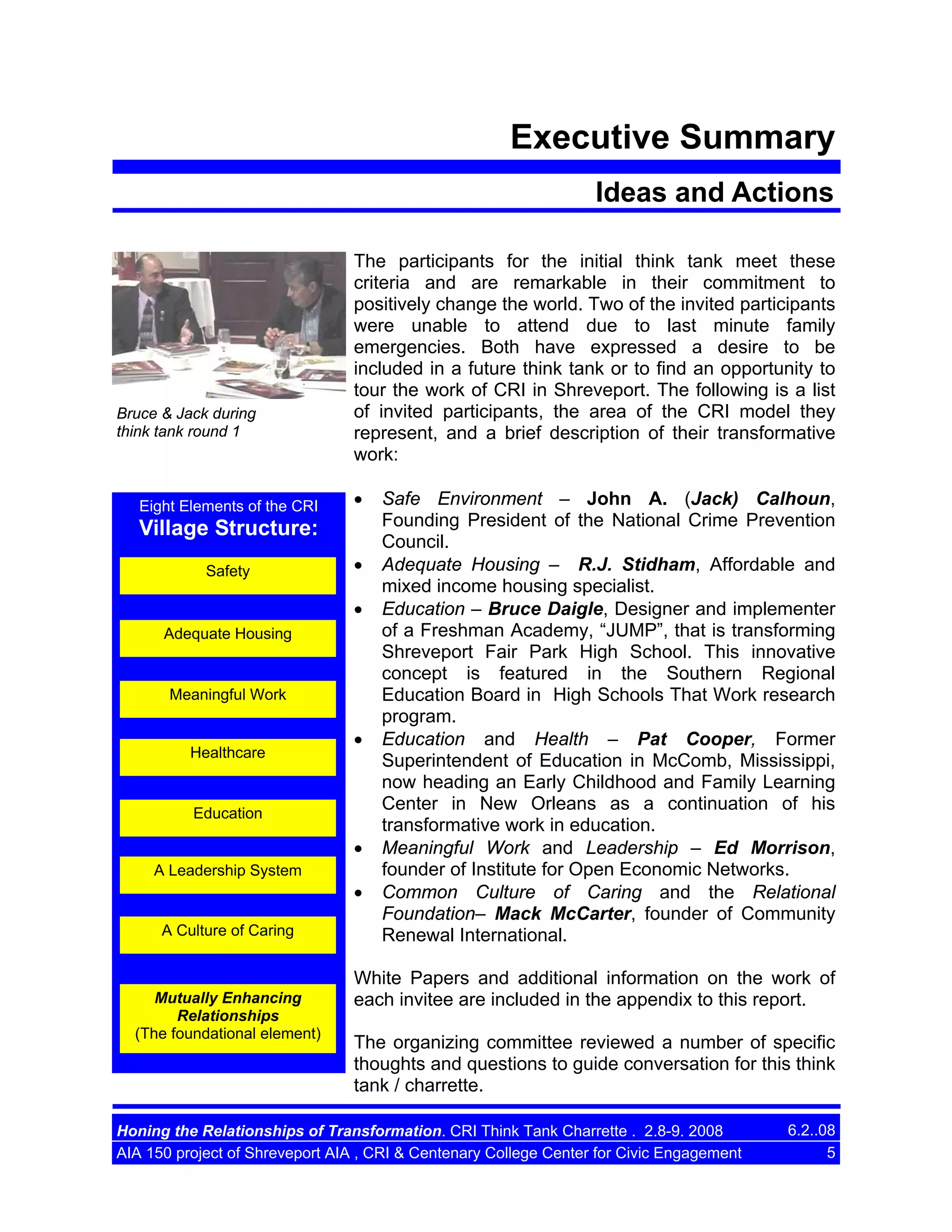
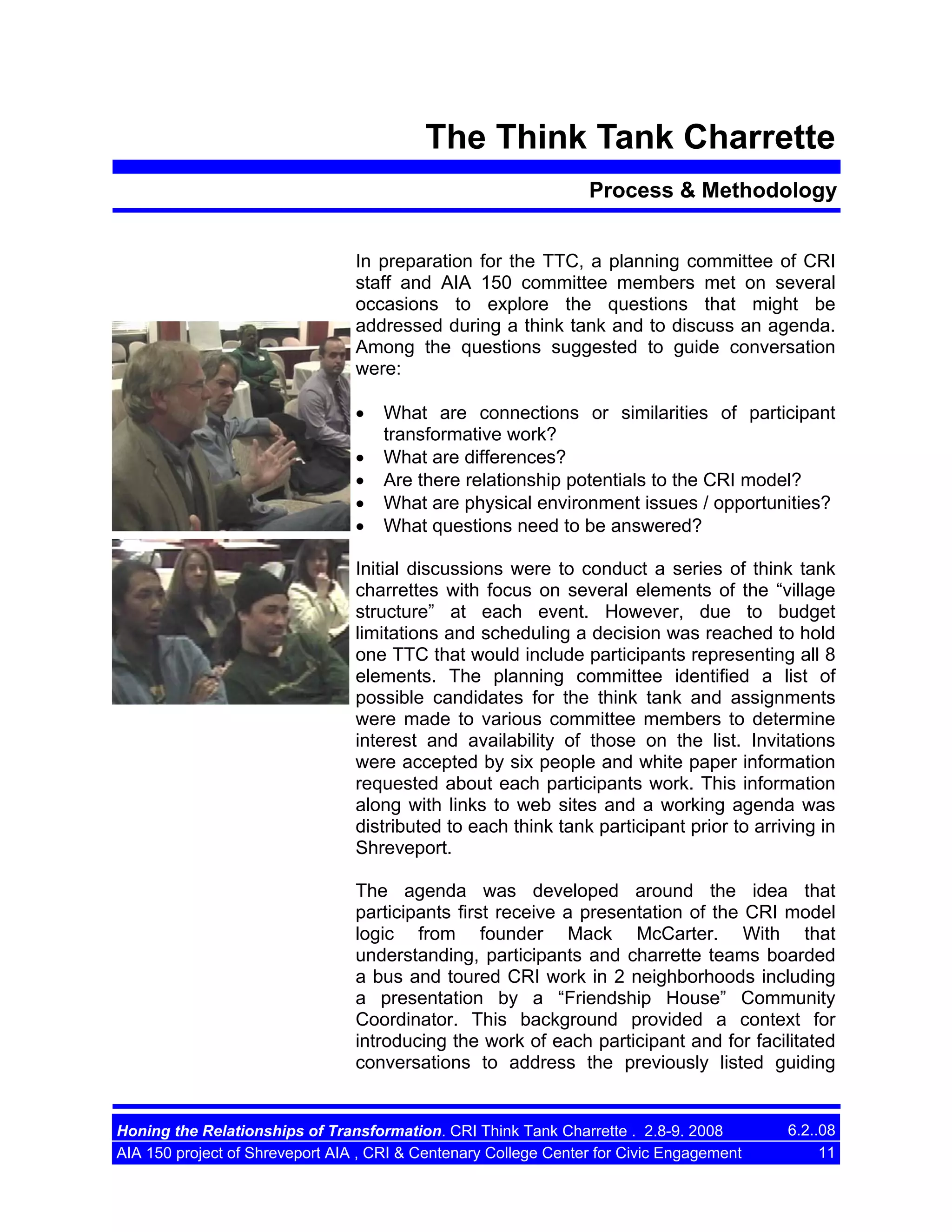
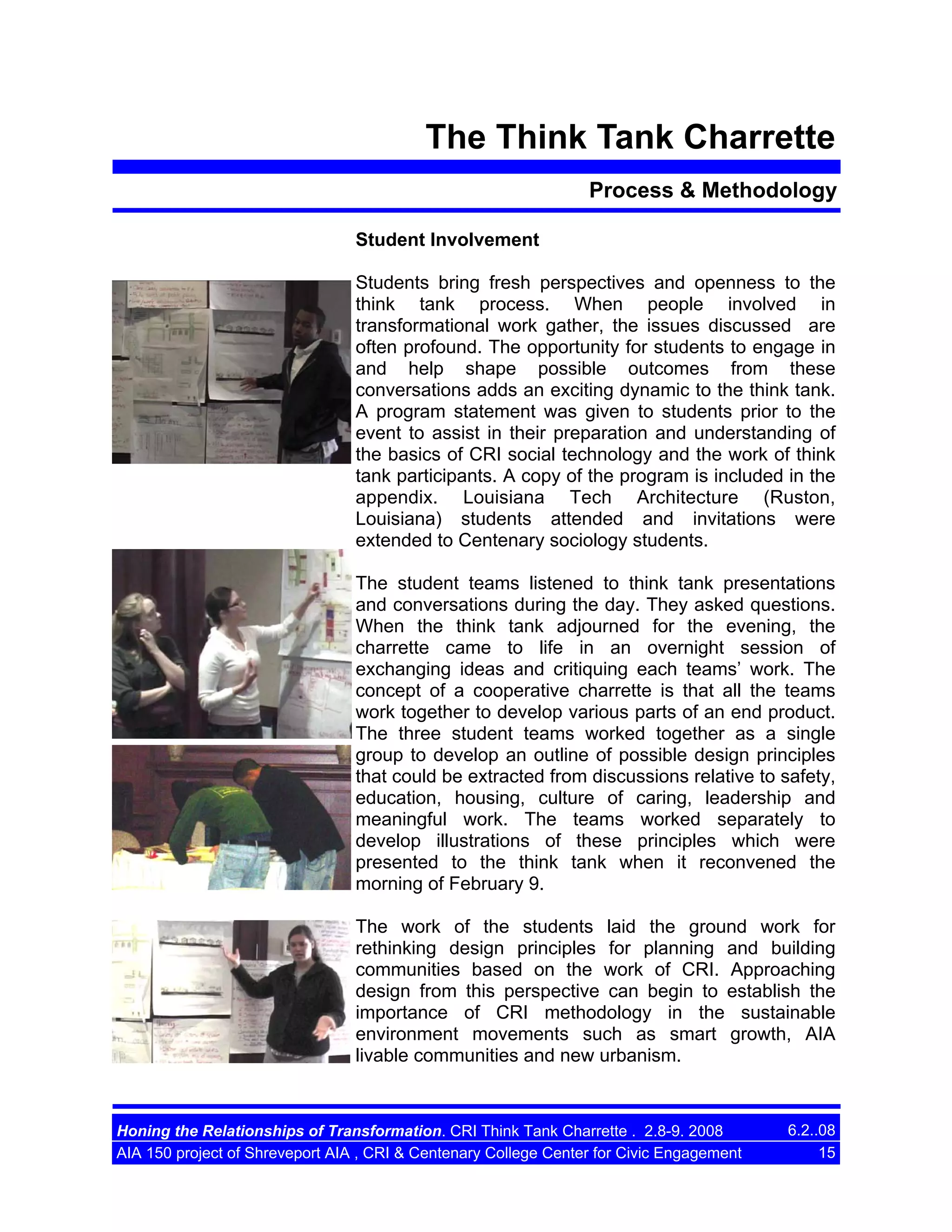
Bruce & Jack during
think tank round 1

Eight Elements of the CRI

The participants for the initial think tank meet these
criteria and are remarkable in their commitment to
positively change the world. Two of the invited participants
were unable to attend due to last minute family
emergencies. Both have expressed a desire to be
included in a future think tank or to find an opportunity to
tour the work of CRI in Shreveport. The following is a list
of invited participants, the area of the CRI model they
represent, and a brief description of their transformative
work:
โ€ข

Village Structure:
Safety

โ€ข
โ€ข

Adequate Housing

Meaningful Work

Healthcare

โ€ข

Education

โ€ข
A Leadership System

โ€ข
A Culture of Caring

Mutually Enhancing
Relationships
(The foundational element)

Safe Environment โ€“ John A. (Jack) Calhoun,
Founding President of the National Crime Prevention
Council.
Adequate Housing โ€“ R.J. Stidham, Affordable and
mixed income housing specialist.
Education โ€“ Bruce Daigle, Designer and implementer
of a Freshman Academy, โ€œJUMPโ€, that is transforming
Shreveport Fair Park High School. This innovative
concept is featured in the Southern Regional
Education Board in High Schools That Work research
program.
Education and Health โ€“ Pat Cooper, Former
Superintendent of Education in McComb, Mississippi,
now heading an Early Childhood and Family Learning
Center in New Orleans as a continuation of his
transformative work in education.
Meaningful Work and Leadership โ€“ Ed Morrison,
founder of Institute for Open Economic Networks.
Common Culture of Caring and the Relational
Foundationโ€“ Mack McCarter, founder of Community
Renewal International.

White Papers and additional information on the work of
each invitee are included in the appendix to this report.
The organizing committee reviewed a number of specific
thoughts and questions to guide conversation for this think
tank / charrette.

Honing the Relationships of Transformation. CRI Think Tank Charrette . 2.8-9. 2008
AIA 150 project of Shreveport AIA , CRI & Centenary College Center for Civic Engagement

6.2..08
5
Executive Summary
Ideas and Actions

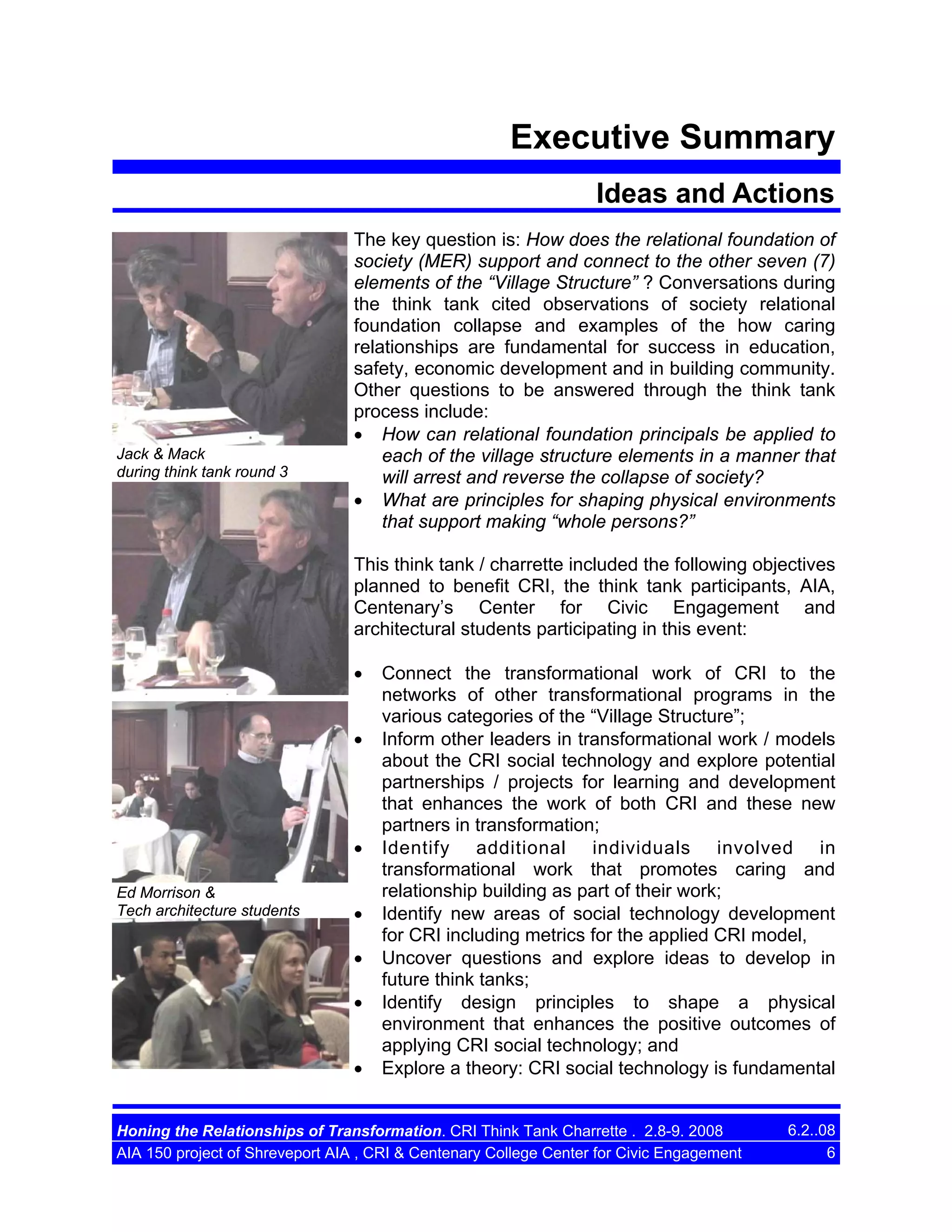
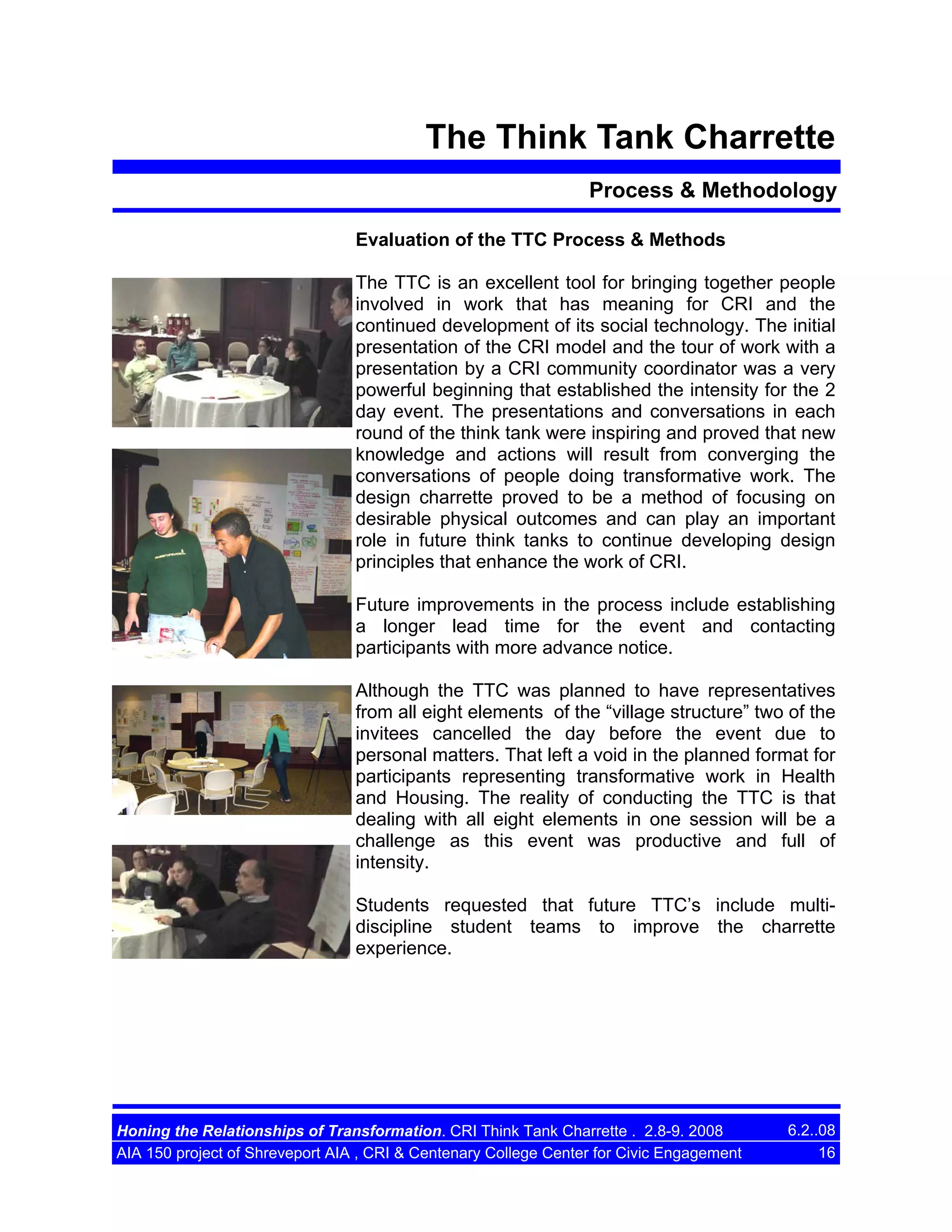
Jack & Mack
during think tank round 3

The key question is: How does the relational foundation of
society (MER) support and connect to the other seven (7)
elements of the โ€œVillage Structureโ€ ? Conversations during
the think tank cited observations of society relational
foundation collapse and examples of the how caring
relationships are fundamental for success in education,
safety, economic development and in building community.
Other questions to be answered through the think tank
process include:
โ€ข How can relational foundation principals be applied to
each of the village structure elements in a manner that
will arrest and reverse the collapse of society?
โ€ข What are principles for shaping physical environments
that support making โ€œwhole persons?โ€
This think tank / charrette included the following objectives
planned to benefit CRI, the think tank participants, AIA,
Centenaryโ€™s Center for Civic Engagement and
architectural students participating in this event:
โ€ข
โ€ข

โ€ข
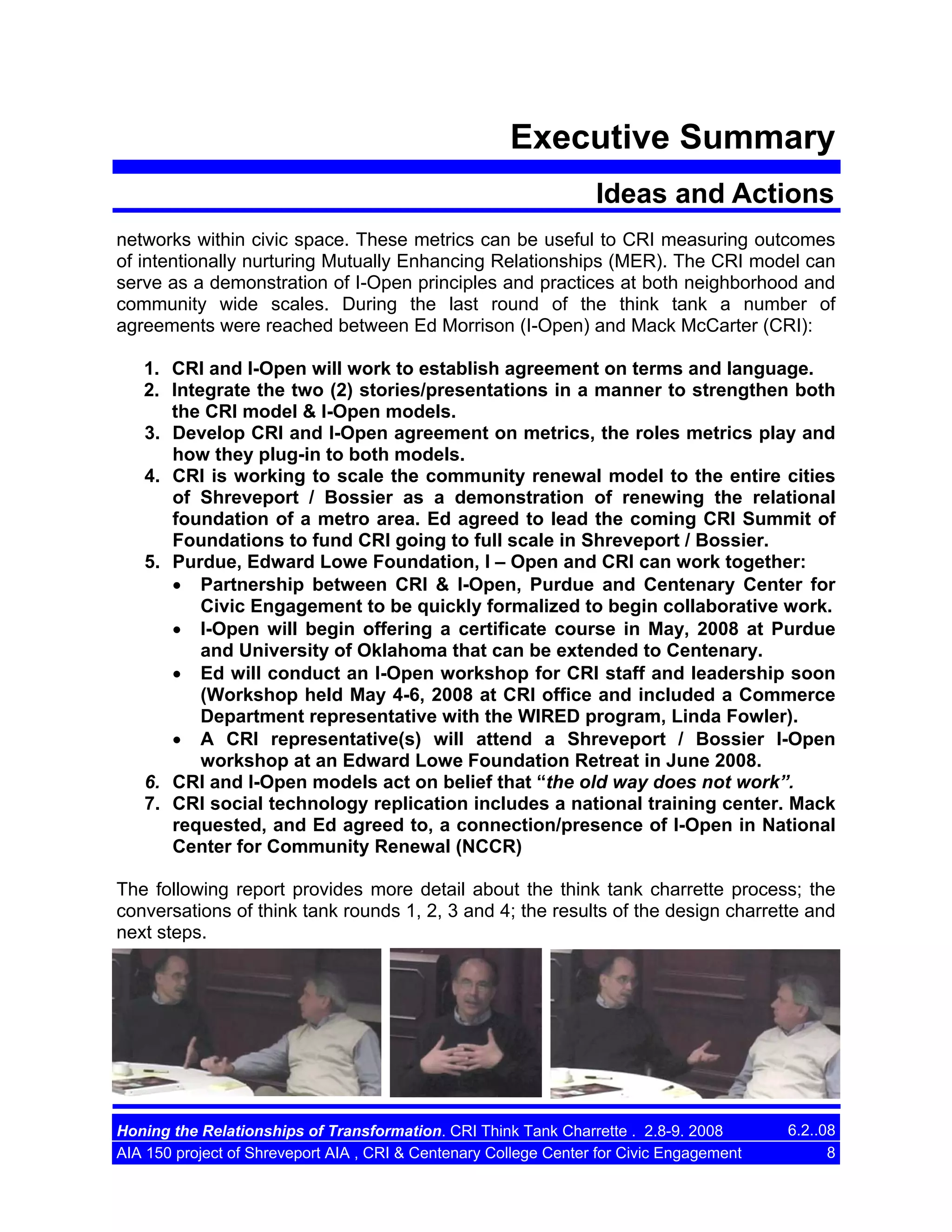
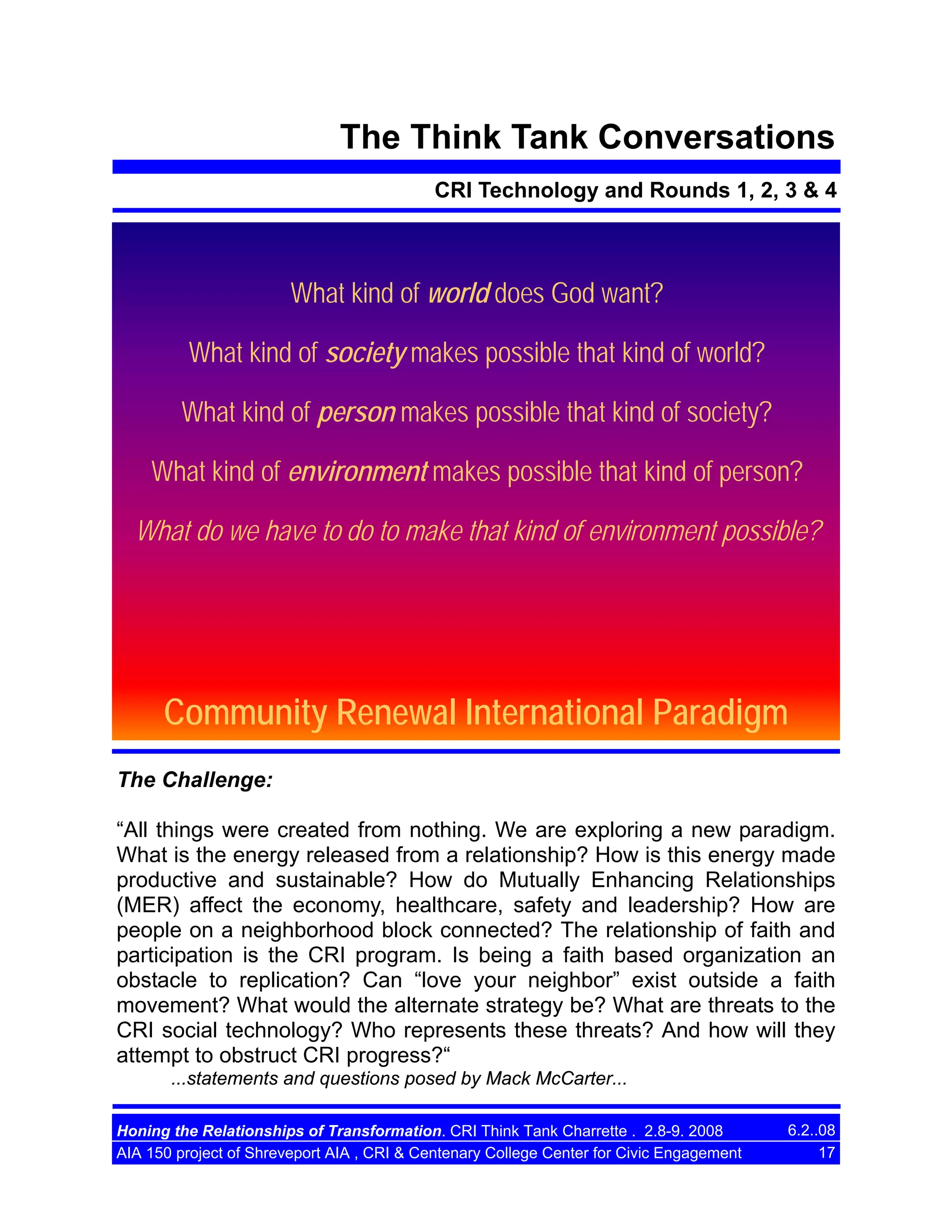
Ed Morrison &
Tech architecture students

โ€ข
โ€ข
โ€ข
โ€ข

Connect the transformational work of CRI to the
networks of other transformational programs in the
various categories of the โ€œVillage Structureโ€;
Inform other leaders in transformational work / models
about the CRI social technology and explore potential
partnerships / projects for learning and development
that enhances the work of both CRI and these new
partners in transformation;
Identify additional individuals involved in
transformational work that promotes caring and
relationship building as part of their work;
Identify new areas of social technology development
for CRI including metrics for the applied CRI model,
Uncover questions and explore ideas to develop in
future think tanks;
Identify design principles to shape a physical
environment that enhances the positive outcomes of
applying CRI social technology; and
Explore a theory: CRI social technology is fundamental

Honing the Relationships of Transformation. CRI Think Tank Charrette . 2.8-9. 2008
AIA 150 project of Shreveport AIA , CRI & Centenary College Center for Civic Engagement

6.2..08
6
Executive Summary
Ideas and Actions
to be a sustainable community and is a principle that
should be added to sustainability initiatives (e.g., AIA
Livable Community Principles, Smart Growth
Principles, Traditional Neighborhood Design, New
Urbanism and others).

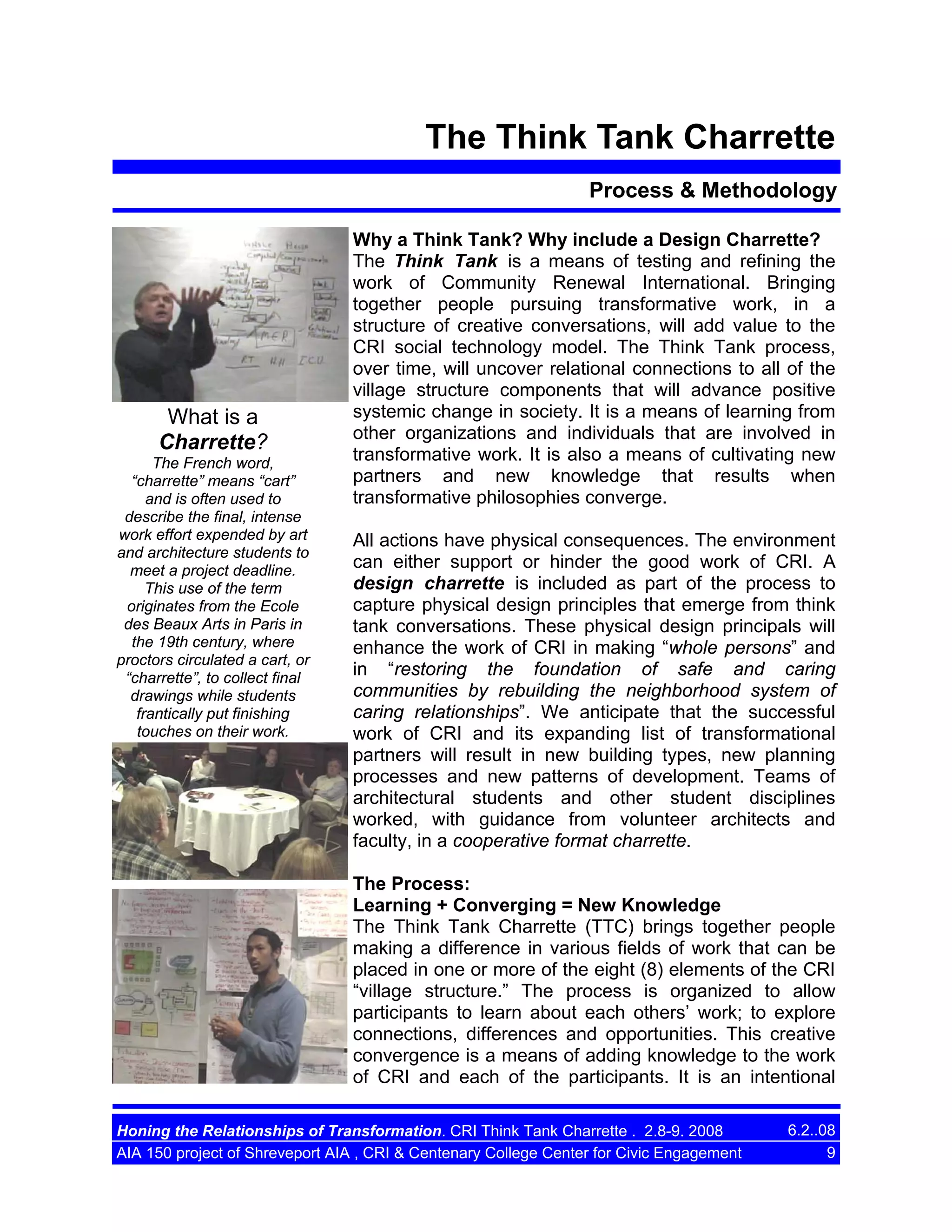
Think Tank round 4 discussion

Charette
presentations & comments

The Think Tank Charrette was an intense session
beginning 8 A.M. the morning of February 8 and
continuing without stop until 5 P.M. the evening of
February 9, 2008. A copy of the agenda is included in the
appendix to this report. Outcomes of the event include:
โ€ข
โ€ข

โ€ข
โ€ข
โ€ข

โ€ข

Agreement of participants to connect networks of
each of the individuals and organizations;
Two initiatives to connect Fair Park High School and
the CRI Friendship House in the Queensboro
Neighborhood of Shreveport โ€“ 1) a mentoring
program based at the Friendship House and 2) a
teacher open house at the Friendship House to better
acquaint teachers and neighborhood residents;
Initial work on community design principles that
enhance the ability of CRI to nurture the making of
โ€œwhole personsโ€ as defined in the CRI white paper;
Identifying several initial ideas for new building types
and planning processes that incorporate and support
the CRI social technology;
Initial discussions that may lead to collaboration
between Centenaryโ€™s emerging Center for Civic
Engagement and researchers with I-Open, Purdue
and Case Western Reserve; and
Experience for Louisiana Tech architectural students
in collaborative work in new working models of
change / transformation.

The think tank also revealed philosophical parallels in
the transformative models of I-Open (Open Networks
and strategic doing) and CRI (Mutually Enhancing
Relationships and intentional caring acts). The I-Open
model includes methodologies for growing and measuring

Honing the Relationships of Transformation. CRI Think Tank Charrette . 2.8-9. 2008
AIA 150 project of Shreveport AIA , CRI & Centenary College Center for Civic Engagement

6.2..08
7
Executive Summary
Ideas and Actions
networks within civic space. These metrics can be useful to CRI measuring outcomes
of intentionally nurturing Mutually Enhancing Relationships (MER). The CRI model can
serve as a demonstration of I-Open principles and practices at both neighborhood and
community wide scales. During the last round of the think tank a number of
agreements were reached between Ed Morrison (I-Open) and Mack McCarter (CRI):
1. CRI and I-Open will work to establish agreement on terms and language.
2. Integrate the two (2) stories/presentations in a manner to strengthen both
the CRI model & I-Open models.
3. Develop CRI and I-Open agreement on metrics, the roles metrics play and
how they plug-in to both models.
4. CRI is working to scale the community renewal model to the entire cities
of Shreveport / Bossier as a demonstration of renewing the relational
foundation of a metro area. Ed agreed to lead the coming CRI Summit of
Foundations to fund CRI going to full scale in Shreveport / Bossier.
5. Purdue, Edward Lowe Foundation, I โ€“ Open and CRI can work together:
โ€ข Partnership between CRI & I-Open, Purdue and Centenary Center for
Civic Engagement to be quickly formalized to begin collaborative work.
โ€ข I-Open will begin offering a certificate course in May, 2008 at Purdue
and University of Oklahoma that can be extended to Centenary.
โ€ข Ed will conduct an I-Open workshop for CRI staff and leadership soon
(Workshop held May 4-6, 2008 at CRI office and included a Commerce
Department representative with the WIRED program, Linda Fowler).
โ€ข A CRI representative(s) will attend a Shreveport / Bossier I-Open
workshop at an Edward Lowe Foundation Retreat in June 2008.
6. CRI and I-Open models act on belief that โ€œthe old way does not workโ€.
7. CRI social technology replication includes a national training center. Mack
requested, and Ed agreed to, a connection/presence of I-Open in National
Center for Community Renewal (NCCR)
The following report provides more detail about the think tank charrette process; the
conversations of think tank rounds 1, 2, 3 and 4; the results of the design charrette and
next steps.

Honing the Relationships of Transformation. CRI Think Tank Charrette . 2.8-9. 2008
AIA 150 project of Shreveport AIA , CRI & Centenary College Center for Civic Engagement

6.2..08
8
The Think Tank Charrette
Process & Methodology

Photos of the TTC
and the tour
including the
houses in
Allendale
What is a
Charrette?
The French word,
โ€œcharretteโ€ means โ€œcartโ€
and is often used to
describe the final, intense
work effort expended by art
and architecture students to
meet a project deadline.
This use of the term
originates from the Ecole
des Beaux Arts in Paris in
the 19th century, where
proctors circulated a cart, or
โ€œcharretteโ€, to collect final
drawings while students
frantically put finishing
touches on their work.

Why a Think Tank? Why include a Design Charrette?
The Think Tank is a means of testing and refining the
work of Community Renewal International. Bringing
together people pursuing transformative work, in a
structure of creative conversations, will add value to the
CRI social technology model. The Think Tank process,
over time, will uncover relational connections to all of the
village structure components that will advance positive
systemic change in society. It is a means of learning from
other organizations and individuals that are involved in
transformative work. It is also a means of cultivating new
partners and new knowledge that results when
transformative philosophies converge.
All actions have physical consequences. The environment
can either support or hinder the good work of CRI. A
design charrette is included as part of the process to
capture physical design principles that emerge from think
tank conversations. These physical design principals will
enhance the work of CRI in making โ€œwhole personsโ€ and
in โ€œrestoring the foundation of safe and caring
communities by rebuilding the neighborhood system of
caring relationshipsโ€. We anticipate that the successful
work of CRI and its expanding list of transformational
partners will result in new building types, new planning
processes and new patterns of development. Teams of
architectural students and other student disciplines
worked, with guidance from volunteer architects and
faculty, in a cooperative format charrette.
The Process:
Learning + Converging = New Knowledge
The Think Tank Charrette (TTC) brings together people
making a difference in various fields of work that can be
placed in one or more of the eight (8) elements of the CRI
โ€œvillage structure.โ€ The process is organized to allow
participants to learn about each othersโ€™ work; to explore
connections, differences and opportunities. This creative
convergence is a means of adding knowledge to the work
of CRI and each of the participants. It is an intentional

Honing the Relationships of Transformation. CRI Think Tank Charrette . 2.8-9. 2008
AIA 150 project of Shreveport AIA , CRI & Centenary College Center for Civic Engagement

6.2..08
9
The Think Tank Charrette
Process & Methodology
Eight Elements of the CRI

Village Structure:
Safety

Adequate Housing

Meaningful Work

forming of โ€œmutually enhancing relationshipsโ€ between the
participants, their transformative work and their networks
of support. Starting with an extended presentation and
tour of the CRIโ€™s work, each participant presented their
work followed by a round of facilitated conversation. The
conversations of think tank participants were open to the
students and other visitors to the event. Comments were
recorded on flip charts and posted around the room to
visually track the progress of discussions over the 2 days
of work. These notes are included in the following chapter
of this report. The presentations and conversations were
also video recorded.

Healthcare

Education

A Leadership System

A Culture of Caring:

Mutually Enhancing
Relationships
(The foundational element)

TTC Agenda and Preparation
The TTC event was planned primarily to bring together
selected participants in a creative environment that allows
the work of CRI to connect with the work of other
innovators in positive change. Although not promoted as a
public event, the TTC was designed to welcome anyone
to stop by, any time, day or night to observe the process.
Invited participants were treated as special guests and
encouraged to arrive the evening before the event began
for a social dinner at Columbia Cafe. Accommodations for
participants were a local Bed and Breakfast, Fairfield
Place, located in a historic district near Centenary College
(TTC location). A social dinner was held for the
participants at Olive Street Bistro to conclude the event.
During their stay CRI staff provided transportation for
guests as a means of getting better acquainted and
having more time to share experiences of CRI from
various perspectives.
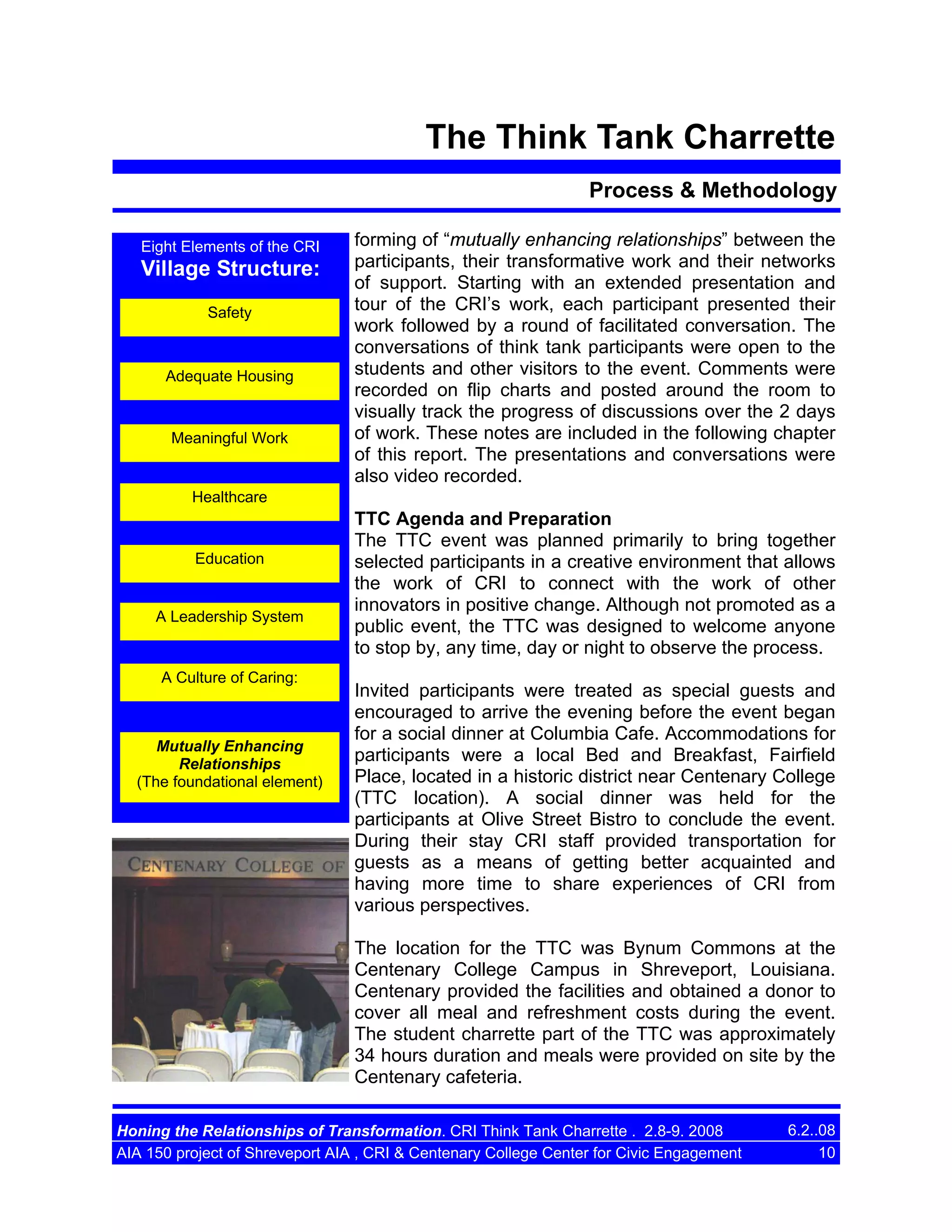
The location for the TTC was Bynum Commons at the
Centenary College Campus in Shreveport, Louisiana.
Centenary provided the facilities and obtained a donor to
cover all meal and refreshment costs during the event.
The student charrette part of the TTC was approximately
34 hours duration and meals were provided on site by the
Centenary cafeteria.

Honing the Relationships of Transformation. CRI Think Tank Charrette . 2.8-9. 2008
AIA 150 project of Shreveport AIA , CRI & Centenary College Center for Civic Engagement

6.2..08
10
The Think Tank Charrette
Process & Methodology
In preparation for the TTC, a planning committee of CRI
staff and AIA 150 committee members met on several
occasions to explore the questions that might be
addressed during a think tank and to discuss an agenda.
Among the questions suggested to guide conversation
were:
โ€ข
โ€ข
โ€ข
โ€ข
โ€ข

What are connections or similarities of participant
transformative work?
What are differences?
Are there relationship potentials to the CRI model?
What are physical environment issues / opportunities?
What questions need to be answered?

Initial discussions were to conduct a series of think tank
charrettes with focus on several elements of the โ€œvillage
structureโ€ at each event. However, due to budget
limitations and scheduling a decision was reached to hold
one TTC that would include participants representing all 8
elements. The planning committee identified a list of
possible candidates for the think tank and assignments
were made to various committee members to determine
interest and availability of those on the list. Invitations
were accepted by six people and white paper information
requested about each participants work. This information
along with links to web sites and a working agenda was
distributed to each think tank participant prior to arriving in
Shreveport.
The agenda was developed around the idea that
participants first receive a presentation of the CRI model
logic from founder Mack McCarter. With that
understanding, participants and charrette teams boarded
a bus and toured CRI work in 2 neighborhoods including
a presentation by a โ€œFriendship Houseโ€ Community
Coordinator. This background provided a context for
introducing the work of each participant and for facilitated
conversations to address the previously listed guiding

Honing the Relationships of Transformation. CRI Think Tank Charrette . 2.8-9. 2008
AIA 150 project of Shreveport AIA , CRI & Centenary College Center for Civic Engagement

6.2..08
11
The Think Tank Charrette
Process & Methodology
questions. During the four rounds of think tank
conversations, student teams listened for comments that
could lead to design principles or concepts to be
developed in charrette sessions during the night.
A program statement was given to each student along
with the white paper information from each of the
participants. This information allowed students to better
understand their important role in this TTC. A copy of the
agenda and the program statement are included in the
appendix.
Organizational sub committees for the TTC included:
speakers, agenda, room organization, lodging, food and
location, charrette supplies, transportation, student
liaison, budget and general coordination.
Selecting Think Tank Participants
Selection of persons to invite to the first think tank was
based on two criteria:
1. Involvement in positive transformative work in one or
more of the eight elements of the โ€œvillage structureโ€ as
described in the CRI model; and
2. Work that exhibits an understanding of the importance
of relationships.

The speakers and their theory of change are:
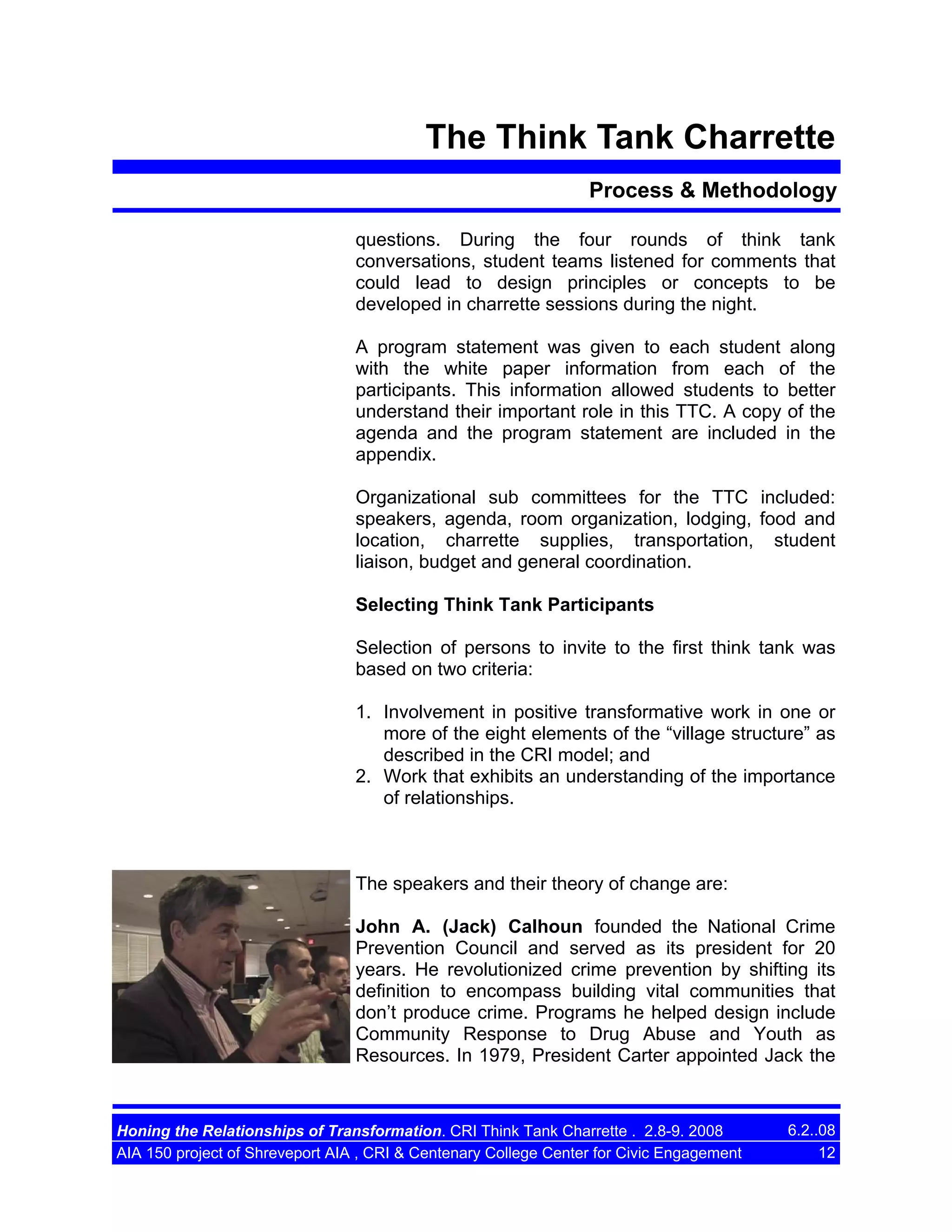
John A. (Jack) Calhoun founded the National Crime
Prevention Council and served as its president for 20
years. He revolutionized crime prevention by shifting its
definition to encompass building vital communities that
donโ€™t produce crime. Programs he helped design include
Community Response to Drug Abuse and Youth as
Resources. In 1979, President Carter appointed Jack the

Honing the Relationships of Transformation. CRI Think Tank Charrette . 2.8-9. 2008
AIA 150 project of Shreveport AIA , CRI & Centenary College Center for Civic Engagement

6.2..08
12
The Think Tank Charrette
Process & Methodology
Commissioner of Administration for Children, Youth and
Families. He helped write and saw congress enact the
landmark Child Welfare and Adoption Act of 1980. Jack
has recently completed a book, Hope Matters, that tells
the stories of how faith is making a difference in the
United States. To find out more about his current work
visit his web site, hopematters. Jackโ€™s transformational
work connects to the CRI model elements safety and
culture of caring.

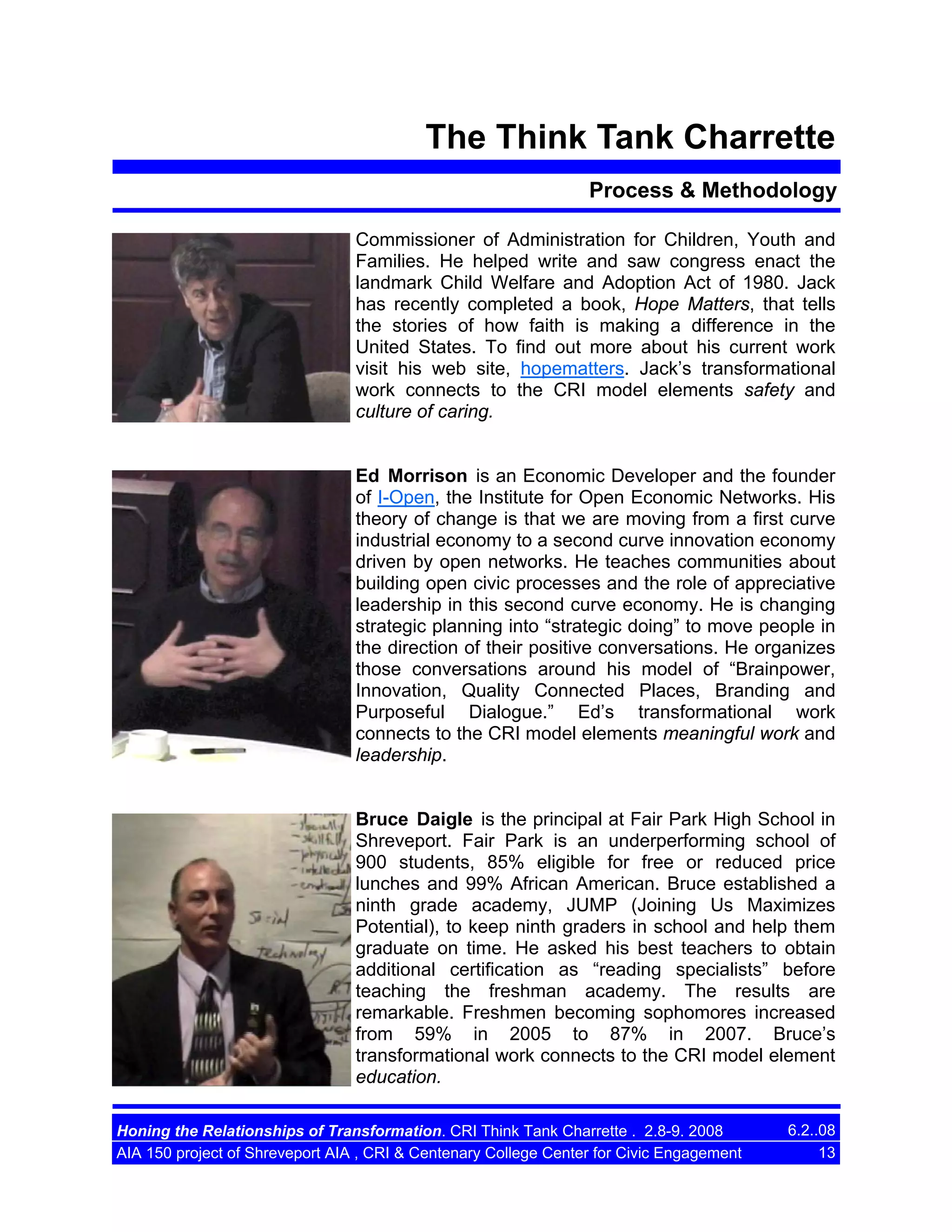
Ed Morrison is an Economic Developer and the founder
of I-Open, the Institute for Open Economic Networks. His
theory of change is that we are moving from a first curve
industrial economy to a second curve innovation economy
driven by open networks. He teaches communities about
building open civic processes and the role of appreciative
leadership in this second curve economy. He is changing
strategic planning into โ€œstrategic doingโ€ to move people in
the direction of their positive conversations. He organizes
those conversations around his model of โ€œBrainpower,
Innovation, Quality Connected Places, Branding and
Purposeful Dialogue.โ€ Edโ€™s transformational work
connects to the CRI model elements meaningful work and
leadership.

Bruce Daigle is the principal at Fair Park High School in
Shreveport. Fair Park is an underperforming school of
900 students, 85% eligible for free or reduced price
lunches and 99% African American. Bruce established a
ninth grade academy, JUMP (Joining Us Maximizes
Potential), to keep ninth graders in school and help them
graduate on time. He asked his best teachers to obtain
additional certification as โ€œreading specialistsโ€ before
teaching the freshman academy. The results are
remarkable. Freshmen becoming sophomores increased
from 59% in 2005 to 87% in 2007. Bruceโ€™s
transformational work connects to the CRI model element
education.
Honing the Relationships of Transformation. CRI Think Tank Charrette . 2.8-9. 2008
AIA 150 project of Shreveport AIA , CRI & Centenary College Center for Civic Engagement

6.2..08
13
The Think Tank Charrette
Process & Methodology
Mack McCarter is the founder of Community Renewal
International. The theory of change that energizes this
organization is restoring the foundation of safe and caring
community by rebuilding the neighborhood system of
caring relationships. The terms โ€œwhole personsโ€, โ€œvillage
structureโ€, โ€œMutually Enhancing Relationshipsโ€, โ€œWe Care
Teamsโ€, โ€œHaven Housesโ€ and โ€œFriendship Housesโ€ are
part of the language of this renewal movement that can
change the world. The primary work of this organization is
in building the relational foundation that holds society
together. It is the basis for all human transactions. Mackโ€™s
role in the TTC will be to represent the foundation of the
CRI model, Mutually Enhancing Relationships.
Pat Cooper turned the McComb school system around
by acting on a theory of change in educationโ€”โ€that
students deserve a chance to learn free from as many
physical and mental burdens as possible, and that
teachers deserve the opportunity to teach as healthy a
student as possible.โ€ Patterning a school restructuring
plan on Maslowโ€™s Hierarchy of Needs and the methods of
the Coordinated School Health Model he implemented
school programs to support the โ€œwhole childโ€. His model
of change includes Academic Opportunity, Food &
Nutrition, Health Education, Health Services, Staff
Wellness, Counseling & Therapy, Community
Involvement, Safe Schools and Physical Education. Patโ€™s
transformational work connects to the CRI model
elements: education, health and culture of caring.
R.J. Stidham is an affordable and mixed income housing
specialist providing technical assistance to federal
agencies, state and local governments, public housing
authorities, lenders and community based organizations.
He has written fair housing statutes and received HUDโ€™s
Award for Outstanding Individual Achievement. RJโ€™s
transformational work connects to CRI element, housing.
Additional information about the think tank participants
and their work is located in the appendix.
Honing the Relationships of Transformation. CRI Think Tank Charrette . 2.8-9. 2008
AIA 150 project of Shreveport AIA , CRI & Centenary College Center for Civic Engagement

6.2..08
14
The Think Tank Charrette
Process & Methodology
Student Involvement
Students bring fresh perspectives and openness to the
think tank process. When people involved in
transformational work gather, the issues discussed are
often profound. The opportunity for students to engage in
and help shape possible outcomes from these
conversations adds an exciting dynamic to the think tank.
A program statement was given to students prior to the
event to assist in their preparation and understanding of
the basics of CRI social technology and the work of think
tank participants. A copy of the program is included in the
appendix. Louisiana Tech Architecture (Ruston,
Louisiana) students attended and invitations were
extended to Centenary sociology students.
The student teams listened to think tank presentations
and conversations during the day. They asked questions.
When the think tank adjourned for the evening, the
charrette came to life in an overnight session of
exchanging ideas and critiquing each teamsโ€™ work. The
concept of a cooperative charrette is that all the teams
work together to develop various parts of an end product.
The three student teams worked together as a single
group to develop an outline of possible design principles
that could be extracted from discussions relative to safety,
education, housing, culture of caring, leadership and
meaningful work. The teams worked separately to
develop illustrations of these principles which were
presented to the think tank when it reconvened the
morning of February 9.
The work of the students laid the ground work for
rethinking design principles for planning and building
communities based on the work of CRI. Approaching
design from this perspective can begin to establish the
importance of CRI methodology in the sustainable
environment movements such as smart growth, AIA
livable communities and new urbanism.

Honing the Relationships of Transformation. CRI Think Tank Charrette . 2.8-9. 2008
AIA 150 project of Shreveport AIA , CRI & Centenary College Center for Civic Engagement

6.2..08
15
The Think Tank Charrette
Process & Methodology
Evaluation of the TTC Process & Methods
The TTC is an excellent tool for bringing together people
involved in work that has meaning for CRI and the
continued development of its social technology. The initial
presentation of the CRI model and the tour of work with a
presentation by a CRI community coordinator was a very
powerful beginning that established the intensity for the 2
day event. The presentations and conversations in each
round of the think tank were inspiring and proved that new
knowledge and actions will result from converging the
conversations of people doing transformative work. The
design charrette proved to be a method of focusing on
desirable physical outcomes and can play an important
role in future think tanks to continue developing design
principles that enhance the work of CRI.
Future improvements in the process include establishing
a longer lead time for the event and contacting
participants with more advance notice.
Although the TTC was planned to have representatives
from all eight elements of the โ€œvillage structureโ€ two of the
invitees cancelled the day before the event due to
personal matters. That left a void in the planned format for
participants representing transformative work in Health
and Housing. The reality of conducting the TTC is that
dealing with all eight elements in one session will be a
challenge as this event was productive and full of
intensity.
Students requested that future TTCโ€™s include multidiscipline student teams to improve the charrette
experience.

Honing the Relationships of Transformation. CRI Think Tank Charrette . 2.8-9. 2008
AIA 150 project of Shreveport AIA , CRI & Centenary College Center for Civic Engagement

6.2..08
16
The Think Tank Conversations
CRI Technology and Rounds 1, 2, 3 & 4

What kind of world does God want?
What kind of society makes possible that kind of world?
What kind of person makes possible that kind of society?
What kind of environment makes possible that kind of person?
What do we have to do to make that kind of environment possible?

Community Renewal International Paradigm
The Challenge:
โ€œAll things were created from nothing. We are exploring a new paradigm.
What is the energy released from a relationship? How is this energy made
productive and sustainable? How do Mutually Enhancing Relationships
(MER) affect the economy, healthcare, safety and leadership? How are
people on a neighborhood block connected? The relationship of faith and
participation is the CRI program. Is being a faith based organization an
obstacle to replication? Can โ€œlove your neighborโ€ exist outside a faith
movement? What would the alternate strategy be? What are threats to the
CRI social technology? Who represents these threats? And how will they
attempt to obstruct CRI progress?โ€œ
...statements and questions posed by Mack McCarter...
Honing the Relationships of Transformation. CRI Think Tank Charrette . 2.8-9. 2008
AIA 150 project of Shreveport AIA , CRI & Centenary College Center for Civic Engagement

6.2..08
17
The Think Tank Conversations
CRI Technology and Rounds 1, 2, 3 & 4
Learning the CRI Model
Summary of the Mack McCarter presentation that started the TTC
...A more complete overview of the CRI social technology can be
found in the appendix and by visiting the CRI web site to view the
20 minutes of news stories shown at the start of the TTC...
Questions that shaped the model:
A question is a step toward change. CRI has grown from
questions and struggles to find answers. Why have civilizations
throughout history achieved greatness only to collapse? Through
32 rise and collapse cycles humanity has yet to figure out how to
stop the cycle. In each cycle greater levels of technological
advance have led to increasing relational disconnectedness, the
fuel for collapse. We are in the midst of the 33rd cycle and exhibit
symptoms similar to other great societies on their path to collapse.
Our dilemma is, according to Lewis Mumford, why do we continue
to make the same mistake? CRI addresses this enigma with
intentional and replicable building of neighborhood systems of
caring relationships. The goals and strategies for this new
paradigm are explained by answering a series of questions that
are fundamental to the logic of the CRI model:
1. What kind of world does God want? The answer can be
simply answered by โ€œlove one another.โ€
2. What kind of society makes possible that kind of world? A
culture of people committing caring acts of kindness and love
make possible that kind of society. Lewis Mumford expressed
this goal: โ€œfor the city should be an organ of love, and the best
economy of cities is the care and culture of men.โ€
3. What kind of person makes possible that kind of society?
A person is able to care for others when they are both
competent and compassionate. A competent person has the
ability to access and appropriate resources to continually grow
โ€” spiritually, socially, skillfully, physically, intellectually and
emotionally. A person is compassionate when living a lifestyle
devoted to seeking the good of others while seeking their own
good. CRI refers to a person who is both competent and
compassionate as a โ€œwhole personโ€.
Honing the Relationships of Transformation. CRI Think Tank Charrette . 2.8-9. 2008
AIA 150 project of Shreveport AIA , CRI & Centenary College Center for Civic Engagement

6.2..08
18
The Think Tank Conversations
CRI Technology and Rounds 1, 2, 3 & 4
4. What kind of environment makes possible that kind of
person? Throughout history one relational environment, the
village, has survived the rise and fall of societies. CRI defines
the โ€œvillage structure" with eight (8) connected elements โ€”
safety, adequate housing, meaningful work, healthcare,
education, a culture of caring, a system of leadership, and the
foundational element โ€” mutually enhancing relationships
(MER).
5. What do we have to do to make possible that kind of
environment? Shaping this nurturing environment that creates
โ€œwhole personsโ€ requires a replicable, systematic approach.
CRI is developing a Social Technology that focuses on three
initiatives: 1. Renewal Team that connects caring people from
all neighborhoods in a community to rebuild the relational
foundation, 2. Haven Houses that are volunteers trained as a
network of block leaders, and 3. The Internal Care Unit /
Friendship House that places families in high crime / lowincome neighborhoods to combat isolation and grow
โ€œwhole personsโ€.

Competent
- willingness & ability to access & appropriate resources to continually grow :
Spiritually, Socially, Skillfully, Physically, Intellectually & Emotionally

Compassionate
- lifestyle devoted to seeking the good of others while seeking their own good

Whole Person = competent & compassionate
Community Renewal International Paradigm
Honing the Relationships of Transformation. CRI Think Tank Charrette . 2.8-9. 2008
AIA 150 project of Shreveport AIA , CRI & Centenary College Center for Civic Engagement

6.2..08
19
The Think Tank Conversations
CRI Technology and Rounds 1, 2, 3 & 4

Village Structure
Safety
Adequate Housing

Culture of Caring

Meaningful Work

Servant Leadership

Healthcare

Education

Mutually Enhancing Relationships
The Relational Foundation of Community

Community Renewal International Paradigm
Relational Foundation = Social Capital = Mutually connected together
SBCR produces MER by doing 3 things: RT, HH & ICU

Renewal Team

Haven House

Caring alone does not
stop collapseโ€ฆ

We are disconnected / isolated
on our streets &
in our neighborhoodsโ€ฆ

There is the reality of
decay & problems of
oppression, race &
povertyโ€ฆ

Connect Caring People:
1. Visible
2. Connected
3. Committed

Take city back, systematically:
1. Rebuild relational foundation
2. Build social networks
3. Block leaders form connected
nurturing structure

Renew whole persons:
1. Build trust by serving
2. Friendship Houses
3. Model the family unit
4. Paid staff

Internal Care Unit

Social Technology
Community Renewal International Paradigm
Honing the Relationships of Transformation. CRI Think Tank Charrette . 2.8-9. 2008
AIA 150 project of Shreveport AIA , CRI & Centenary College Center for Civic Engagement

6.2..08
20
The Think Tank Conversations
CRI Technology and Rounds 1, 2, 3 & 4
A Tour of CRIโ€™s Model at Work
Building Community through Friendship Housesโ€”Allendale and
Queensboro Neighborhoods
After learning the basics of the CRI social technology, both think
tank participants and charrette teams boarded a CRI bus at
Centenary. The tour, facilitated by Lynn Brian, focused on one
aspect of the CRI model, the Friendship House. The group visited
two of the five poverty neighborhoods where CRI has placed
Friendship Houses (ICU), Allendale and Queensboro. The current
strategy is to establish two (2) Friendship Houses to serve an area
of approximately 30 blocks or 1,800 people.
Allendale is a disinvested neighborhood near the Central
Business District of Shreveport. In the past 20 years neighborhood
abandonment resulted in population loss from approximately
16,000 to a current population of approximately 5,000. It was an
environment of high crime and hopelessness. CRI placed
Community Coordinators in two Friendship Houses in this
neighborhood and began to apply the CRI social technology.
Remarkable positive change is happening for children and adults
in Allendale. Lives are improving and hope now fills this
neighborhood.
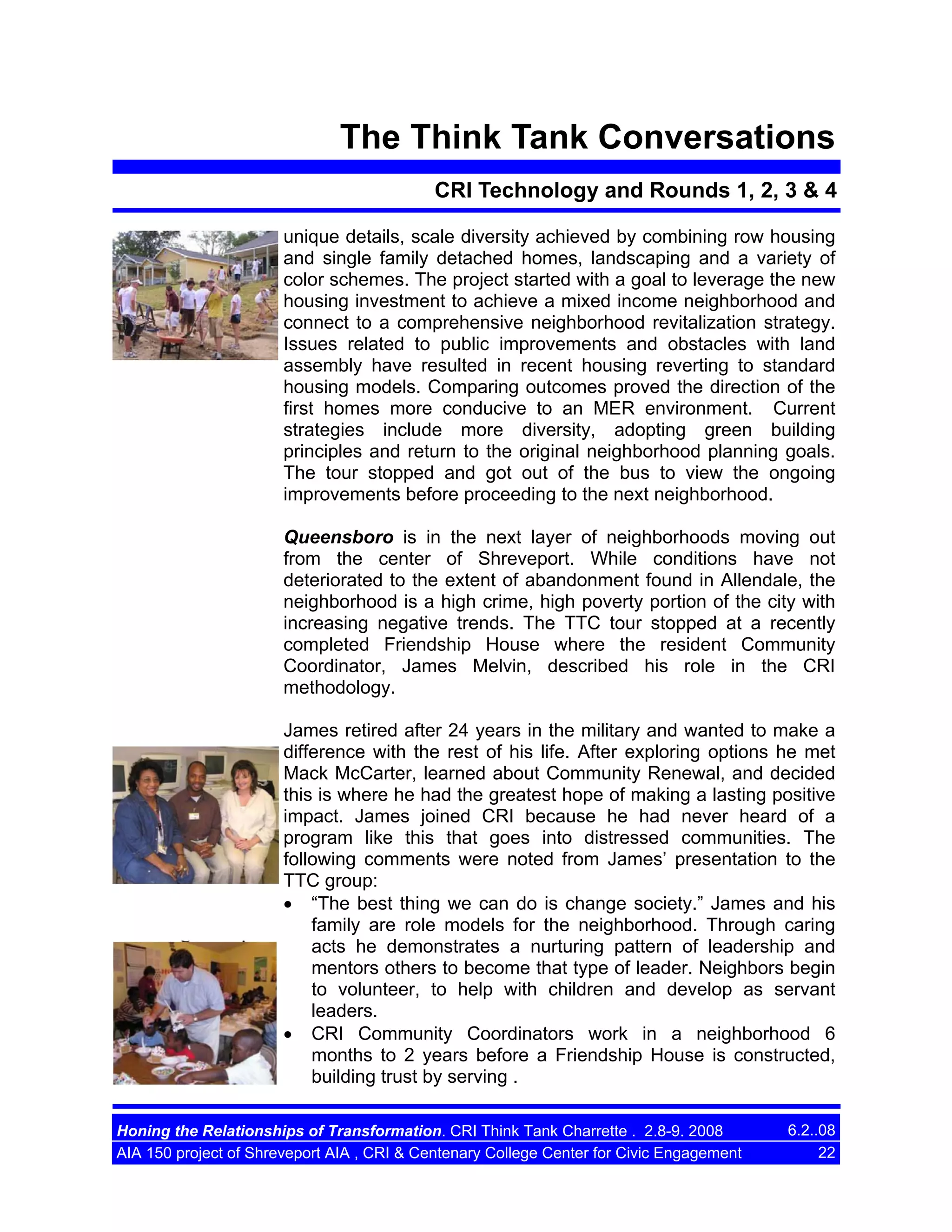
CRI began a home building project on blighted land around the 2
Allendale friendship houses, in partnership with Millard Fuller and
the Fuller Center for Housing, named โ€œBuilding on Higher Groundโ€.
The first block of the target 60 new homes made an attempt to
incorporate some traditional neighborhood design principles:
rebuilding alleys, houses closer to the street, front porches with

Honing the Relationships of Transformation. CRI Think Tank Charrette . 2.8-9. 2008
AIA 150 project of Shreveport AIA , CRI & Centenary College Center for Civic Engagement

6.2..08
21
The Think Tank Conversations
CRI Technology and Rounds 1, 2, 3 & 4
unique details, scale diversity achieved by combining row housing
and single family detached homes, landscaping and a variety of
color schemes. The project started with a goal to leverage the new
housing investment to achieve a mixed income neighborhood and
connect to a comprehensive neighborhood revitalization strategy.
Issues related to public improvements and obstacles with land
assembly have resulted in recent housing reverting to standard
housing models. Comparing outcomes proved the direction of the
first homes more conducive to an MER environment. Current
strategies include more diversity, adopting green building
principles and return to the original neighborhood planning goals.
The tour stopped and got out of the bus to view the ongoing
improvements before proceeding to the next neighborhood.
Queensboro is in the next layer of neighborhoods moving out
from the center of Shreveport. While conditions have not
deteriorated to the extent of abandonment found in Allendale, the
neighborhood is a high crime, high poverty portion of the city with
increasing negative trends. The TTC tour stopped at a recently
completed Friendship House where the resident Community
Coordinator, James Melvin, described his role in the CRI
methodology.
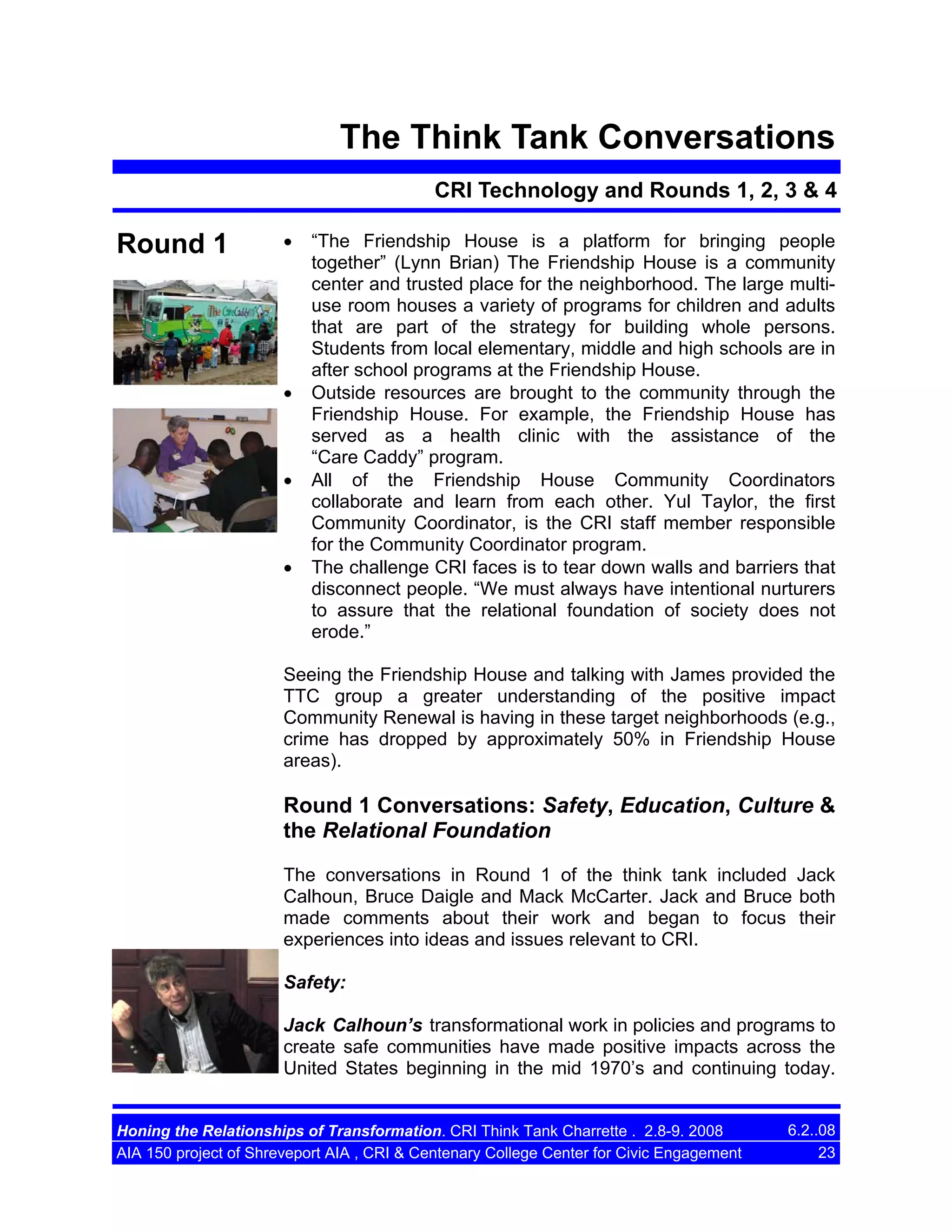
James retired after 24 years in the military and wanted to make a
difference with the rest of his life. After exploring options he met
Mack McCarter, learned about Community Renewal, and decided
this is where he had the greatest hope of making a lasting positive
impact. James joined CRI because he had never heard of a
program like this that goes into distressed communities. The
following comments were noted from Jamesโ€™ presentation to the
TTC group:
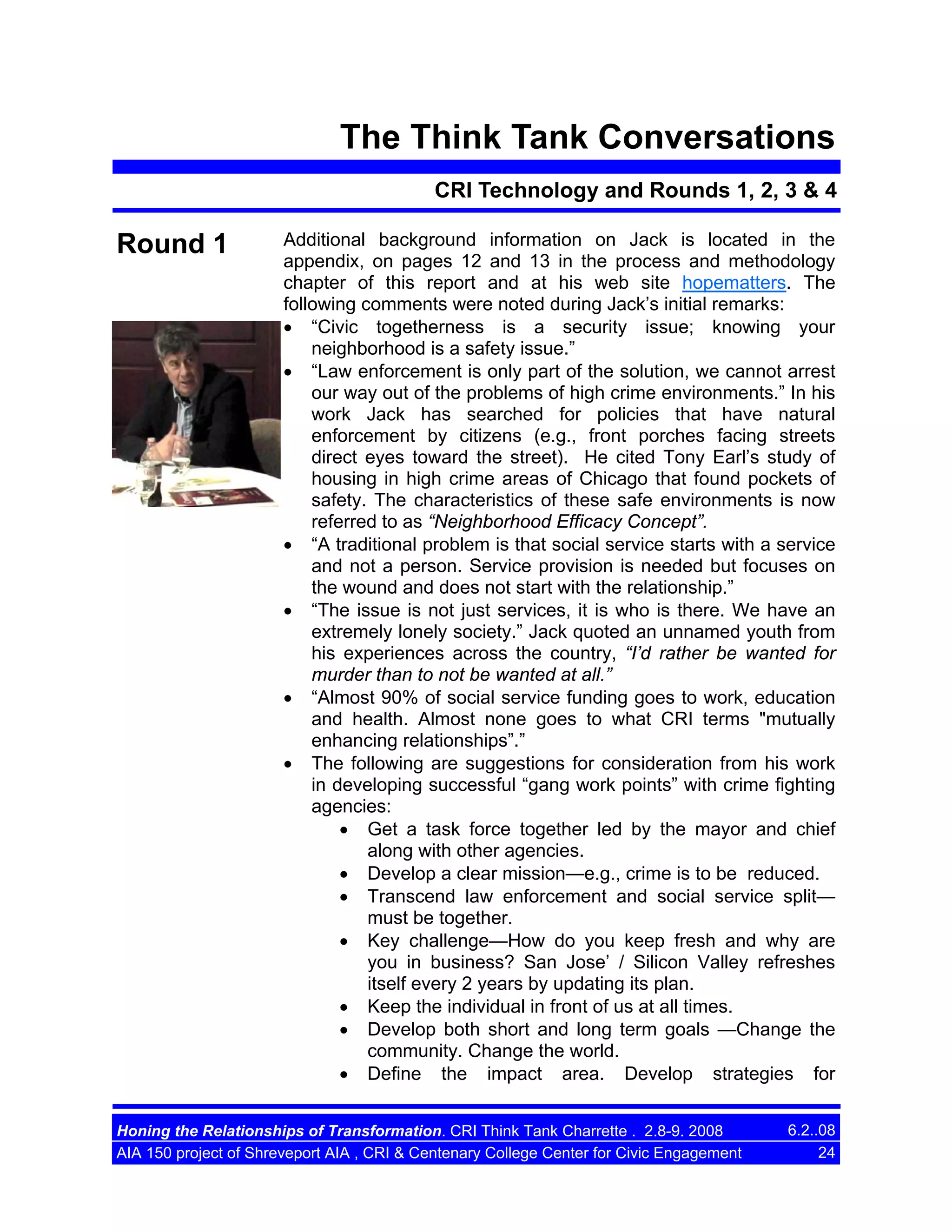
โ€ข โ€œThe best thing we can do is change society.โ€ James and his
family are role models for the neighborhood. Through caring
acts he demonstrates a nurturing pattern of leadership and
mentors others to become that type of leader. Neighbors begin
to volunteer, to help with children and develop as servant
leaders.
โ€ข CRI Community Coordinators work in a neighborhood 6
months to 2 years before a Friendship House is constructed,
building trust by serving .
Honing the Relationships of Transformation. CRI Think Tank Charrette . 2.8-9. 2008
AIA 150 project of Shreveport AIA , CRI & Centenary College Center for Civic Engagement

6.2..08
22
The Think Tank Conversations
CRI Technology and Rounds 1, 2, 3 & 4

Round 1

โ€ข

โ€ข

โ€ข

โ€ข

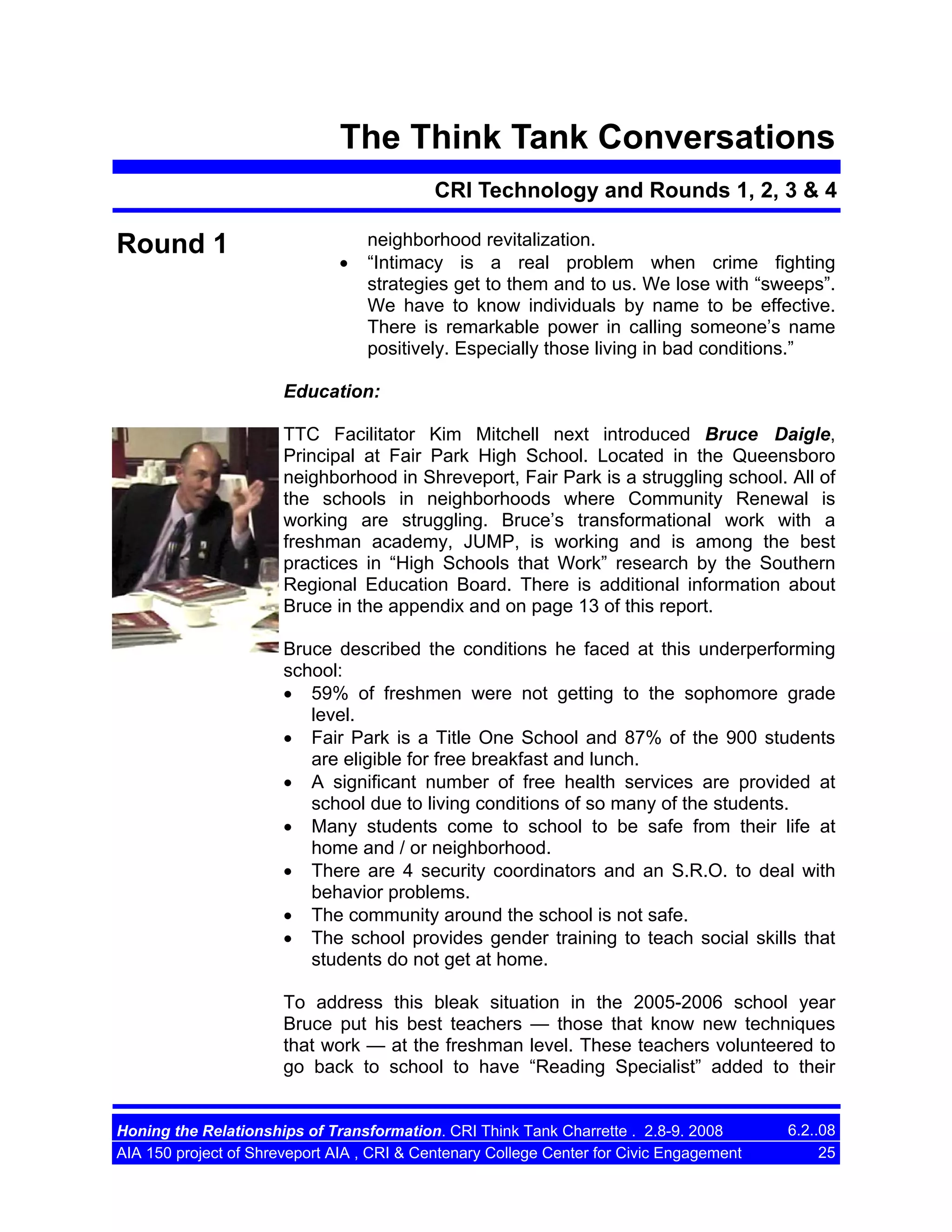
โ€œThe Friendship House is a platform for bringing people
togetherโ€ (Lynn Brian) The Friendship House is a community
center and trusted place for the neighborhood. The large multiuse room houses a variety of programs for children and adults
that are part of the strategy for building whole persons.
Students from local elementary, middle and high schools are in
after school programs at the Friendship House.
Outside resources are brought to the community through the
Friendship House. For example, the Friendship House has
served as a health clinic with the assistance of the
โ€œCare Caddyโ€ program.
All of the Friendship House Community Coordinators
collaborate and learn from each other. Yul Taylor, the first
Community Coordinator, is the CRI staff member responsible
for the Community Coordinator program.
The challenge CRI faces is to tear down walls and barriers that
disconnect people. โ€œWe must always have intentional nurturers
to assure that the relational foundation of society does not
erode.โ€

Seeing the Friendship House and talking with James provided the
TTC group a greater understanding of the positive impact
Community Renewal is having in these target neighborhoods (e.g.,
crime has dropped by approximately 50% in Friendship House
areas).

Round 1 Conversations: Safety, Education, Culture &
the Relational Foundation
The conversations in Round 1 of the think tank included Jack
Calhoun, Bruce Daigle and Mack McCarter. Jack and Bruce both
made comments about their work and began to focus their
experiences into ideas and issues relevant to CRI.
Safety:
Jack Calhounโ€™s transformational work in policies and programs to
create safe communities have made positive impacts across the
United States beginning in the mid 1970โ€™s and continuing today.

Honing the Relationships of Transformation. CRI Think Tank Charrette . 2.8-9. 2008
AIA 150 project of Shreveport AIA , CRI & Centenary College Center for Civic Engagement

6.2..08
23
The Think Tank Conversations
CRI Technology and Rounds 1, 2, 3 & 4

Round 1

Additional background information on Jack is located in the
appendix, on pages 12 and 13 in the process and methodology
chapter of this report and at his web site hopematters. The
following comments were noted during Jackโ€™s initial remarks:
โ€ข โ€œCivic togetherness is a security issue; knowing your
neighborhood is a safety issue.โ€
โ€ข โ€œLaw enforcement is only part of the solution, we cannot arrest
our way out of the problems of high crime environments.โ€ In his
work Jack has searched for policies that have natural
enforcement by citizens (e.g., front porches facing streets
direct eyes toward the street). He cited Tony Earlโ€™s study of
housing in high crime areas of Chicago that found pockets of
safety. The characteristics of these safe environments is now
referred to as โ€œNeighborhood Efficacy Conceptโ€.
โ€ข โ€œA traditional problem is that social service starts with a service
and not a person. Service provision is needed but focuses on
the wound and does not start with the relationship.โ€
โ€ข โ€œThe issue is not just services, it is who is there. We have an
extremely lonely society.โ€ Jack quoted an unnamed youth from
his experiences across the country, โ€œIโ€™d rather be wanted for
murder than to not be wanted at all.โ€
โ€ข โ€œAlmost 90% of social service funding goes to work, education
and health. Almost none goes to what CRI terms "mutually
enhancing relationshipsโ€.โ€
โ€ข The following are suggestions for consideration from his work
in developing successful โ€œgang work pointsโ€ with crime fighting
agencies:
โ€ข Get a task force together led by the mayor and chief
along with other agencies.
โ€ข Develop a clear missionโ€”e.g., crime is to be reduced.
โ€ข Transcend law enforcement and social service splitโ€”
must be together.
โ€ข Key challengeโ€”How do you keep fresh and why are
you in business? San Joseโ€™ / Silicon Valley refreshes
itself every 2 years by updating its plan.
โ€ข Keep the individual in front of us at all times.
โ€ข Develop both short and long term goals โ€”Change the
community. Change the world.
โ€ข Define the impact area. Develop strategies for

Honing the Relationships of Transformation. CRI Think Tank Charrette . 2.8-9. 2008
AIA 150 project of Shreveport AIA , CRI & Centenary College Center for Civic Engagement

6.2..08
24
The Think Tank Conversations
CRI Technology and Rounds 1, 2, 3 & 4

Round 1

โ€ข

neighborhood revitalization.
โ€œIntimacy is a real problem when crime fighting
strategies get to them and to us. We lose with โ€œsweepsโ€.
We have to know individuals by name to be effective.
There is remarkable power in calling someoneโ€™s name
positively. Especially those living in bad conditions.โ€

Education:
TTC Facilitator Kim Mitchell next introduced Bruce Daigle,
Principal at Fair Park High School. Located in the Queensboro
neighborhood in Shreveport, Fair Park is a struggling school. All of
the schools in neighborhoods where Community Renewal is
working are struggling. Bruceโ€™s transformational work with a
freshman academy, JUMP, is working and is among the best
practices in โ€œHigh Schools that Workโ€ research by the Southern
Regional Education Board. There is additional information about
Bruce in the appendix and on page 13 of this report.
Bruce described the conditions he faced at this underperforming
school:
โ€ข 59% of freshmen were not getting to the sophomore grade
level.
โ€ข Fair Park is a Title One School and 87% of the 900 students
are eligible for free breakfast and lunch.
โ€ข A significant number of free health services are provided at
school due to living conditions of so many of the students.
โ€ข Many students come to school to be safe from their life at
home and / or neighborhood.
โ€ข There are 4 security coordinators and an S.R.O. to deal with
behavior problems.
โ€ข The community around the school is not safe.
โ€ข The school provides gender training to teach social skills that
students do not get at home.
To address this bleak situation in the 2005-2006 school year
Bruce put his best teachers โ€” those that know new techniques
that work โ€” at the freshman level. These teachers volunteered to
go back to school to have โ€œReading Specialistโ€ added to their

Honing the Relationships of Transformation. CRI Think Tank Charrette . 2.8-9. 2008
AIA 150 project of Shreveport AIA , CRI & Centenary College Center for Civic Engagement

6.2..08
25
The Think Tank Conversations
CRI Technology and Rounds 1, 2, 3 & 4

Round 1

teaching certificates. The freshman academy, JUMP (Joining Us to
Maximizes Potential), uses block scheduling with 4 classes per
day (100 minutes per class for freshmen only). This allows up to 8
credits per yearโ€”only 5 are required. The results of this innovation
are impressive:
โ€ข In the first year of JUMP 86% of freshmen graduated to the
10th grade (up from 40% prior to JUMP). 79% of the freshmen
earned all 8 credits.
โ€ข In the second year 87% of freshmen moved up to the 10th
grade and 75% earned 8 credits.
โ€ข This year there are 180 Juniors from the first JUMP class. This
compares to the non-JUMP senior class of 60.
The philosophy of effective teaching expressed by Bruce is:
1. Students need to hear that teachers care;
2. Teach bell to bell;
3. Good planning.
Although the innovation at Fair Park is producing results, the
system of rating schools works against this innovation in low
performing schools. There are several realities of โ€œNo Child Left
Behindโ€ that are troubling:
โ€ข
โ€ข
โ€ข

The โ€œunacceptable ratingโ€ has a negative impact on student
and community self-image. It adversely impacts making โ€œwhole
peopleโ€.
The system allows good students to leave when a school is
branded as unacceptable which contributes to poor school
performance.
โ€œThe No Child Left Behind rating is crushing the human spirit.โ€

How do we (society) change this rating system before the negative
consequences become community wide problems?

Honing the Relationships of Transformation. CRI Think Tank Charrette . 2.8-9. 2008
AIA 150 project of Shreveport AIA , CRI & Centenary College Center for Civic Engagement

6.2..08
26
The Think Tank Conversations
CRI Technology and Rounds 1, 2, 3 & 4

Round 1

Measuring Outcomes and Funding the CRI model:
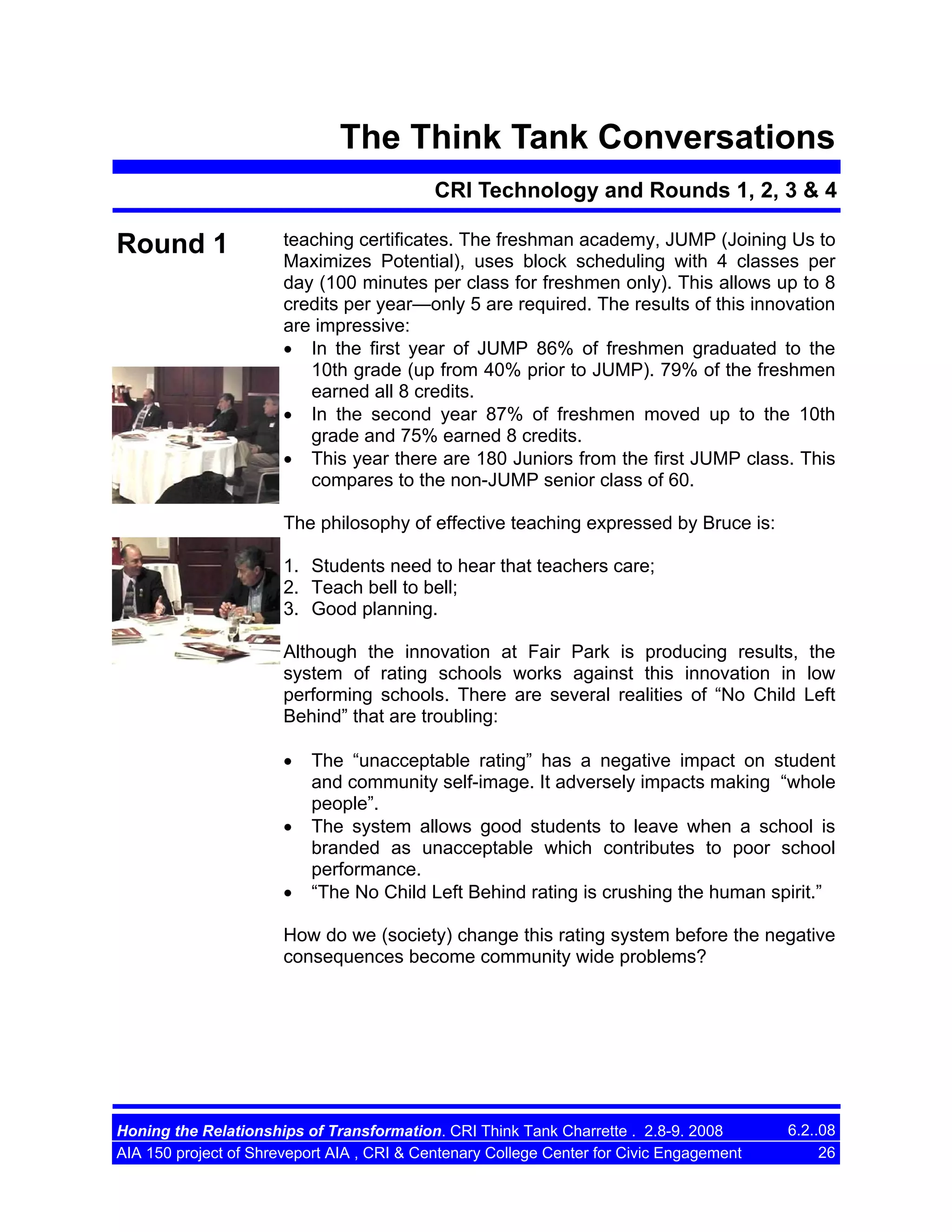
After presentations by Jack and Bruce the conversation was
opened to the think tank table and the audience. These
discussions focused on connections between CRI, education and
safety. Conversations also included exploring possible outcome
measures (metrics) of the CRI social technology to better
communicate results to potential funding sources. The following
are notes from those discussions:
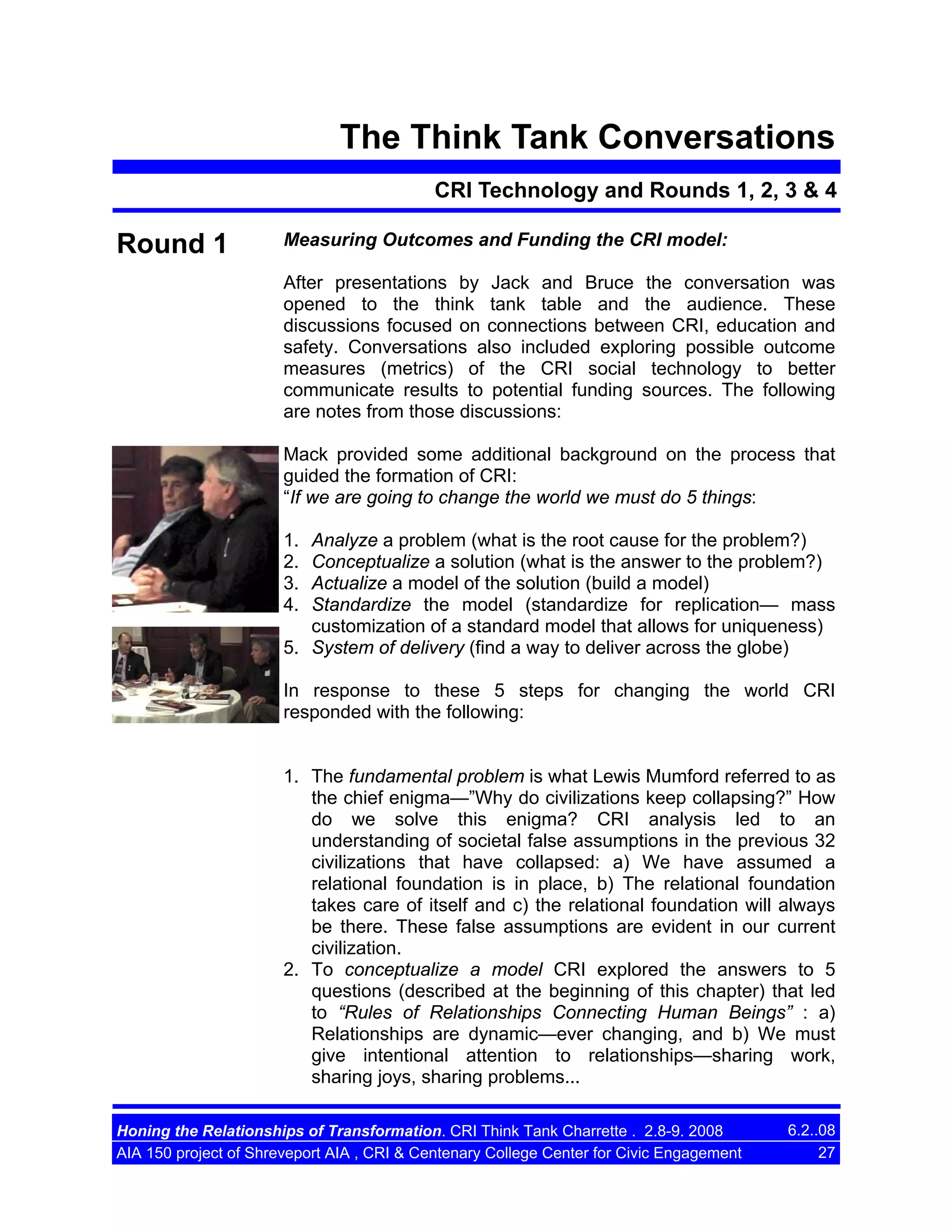
Mack provided some additional background on the process that
guided the formation of CRI:
โ€œIf we are going to change the world we must do 5 things:
1.
2.
3.
4.

Analyze a problem (what is the root cause for the problem?)
Conceptualize a solution (what is the answer to the problem?)
Actualize a model of the solution (build a model)
Standardize the model (standardize for replicationโ€” mass
customization of a standard model that allows for uniqueness)
5. System of delivery (find a way to deliver across the globe)
In response to these 5 steps for changing the world CRI
responded with the following:

1. The fundamental problem is what Lewis Mumford referred to as
the chief enigmaโ€”โ€Why do civilizations keep collapsing?โ€ How
do we solve this enigma? CRI analysis led to an
understanding of societal false assumptions in the previous 32
civilizations that have collapsed: a) We have assumed a
relational foundation is in place, b) The relational foundation
takes care of itself and c) the relational foundation will always
be there. These false assumptions are evident in our current
civilization.
2. To conceptualize a model CRI explored the answers to 5
questions (described at the beginning of this chapter) that led
to โ€œRules of Relationships Connecting Human Beingsโ€ : a)
Relationships are dynamicโ€”ever changing, and b) We must
give intentional attention to relationshipsโ€”sharing work,
sharing joys, sharing problems...
Honing the Relationships of Transformation. CRI Think Tank Charrette . 2.8-9. 2008
AIA 150 project of Shreveport AIA , CRI & Centenary College Center for Civic Engagement

6.2..08
27
The Think Tank Conversations
CRI Technology and Rounds 1, 2, 3 & 4

Round 1

3. Actualizing the model had to answer, how do we connect
caring people? The model CRI developed to answer this
question includes: a) Renewal Team, b) Haven Houses and c)
ICU / Friendship Houses. What unites us as human beings is
our capacity for caring. CRI builds trust by serving and โ€œmodels
the familyโ€ in the ICU neighborhoods.
4. & 5. CRI is standardizing the model and the system of delivery
by current replication projects in other communities around the
globe, by curriculum development , by developing a National
Center for Community Renewal and with current plans for a
demonstration project at a community wide scale in
Shreveport / Bossier, Louisiana.โ€
Comments and Questions from Think Tank Round 1:
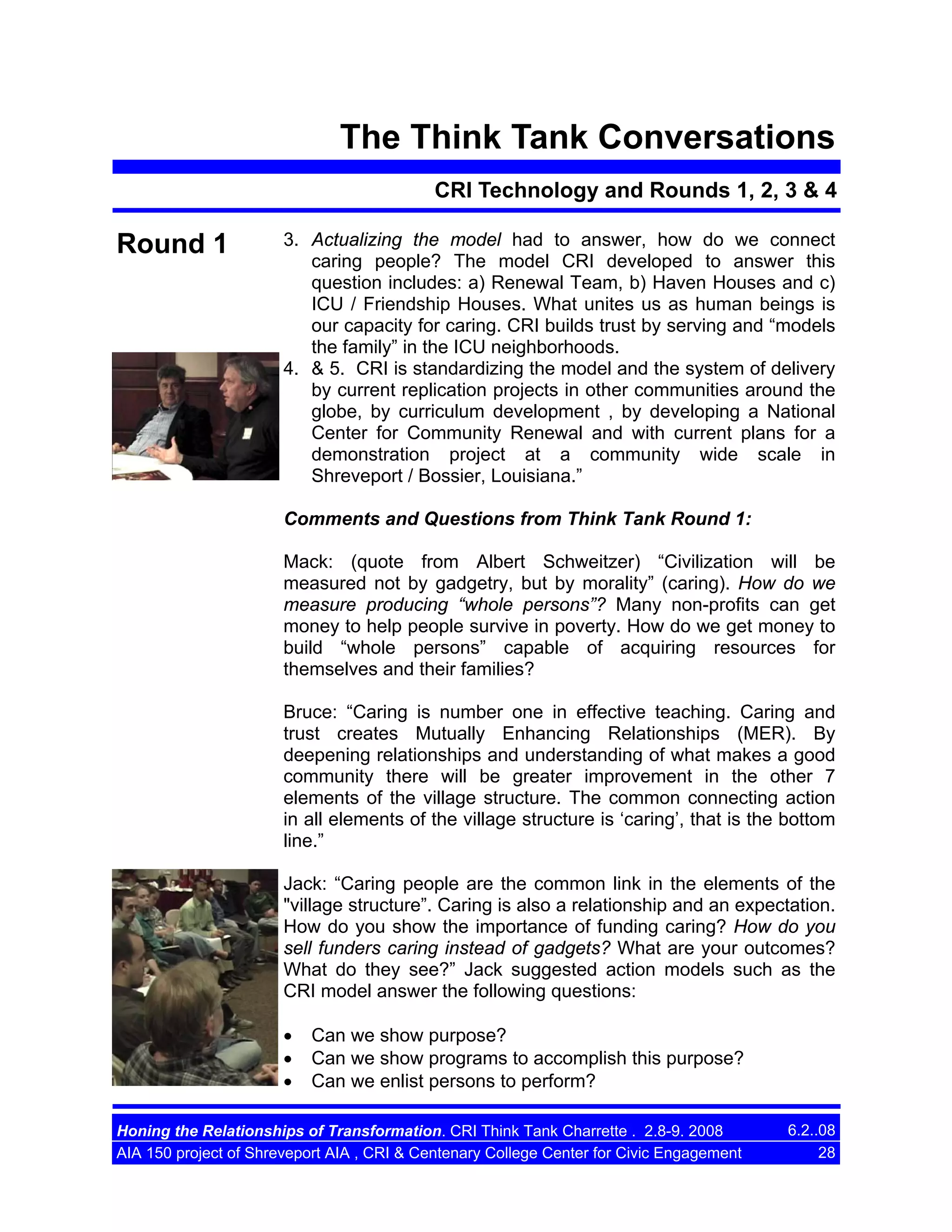
Mack: (quote from Albert Schweitzer) โ€œCivilization will be
measured not by gadgetry, but by moralityโ€ (caring). How do we
measure producing โ€œwhole personsโ€? Many non-profits can get
money to help people survive in poverty. How do we get money to
build โ€œwhole personsโ€ capable of acquiring resources for
themselves and their families?
Bruce: โ€œCaring is number one in effective teaching. Caring and
trust creates Mutually Enhancing Relationships (MER). By
deepening relationships and understanding of what makes a good
community there will be greater improvement in the other 7
elements of the village structure. The common connecting action
in all elements of the village structure is โ€˜caringโ€™, that is the bottom
line.โ€
Jack: โ€œCaring people are the common link in the elements of the
"village structureโ€. Caring is also a relationship and an expectation.
How do you show the importance of funding caring? How do you
sell funders caring instead of gadgets? What are your outcomes?
What do they see?โ€ Jack suggested action models such as the
CRI model answer the following questions:
โ€ข
โ€ข
โ€ข

Can we show purpose?
Can we show programs to accomplish this purpose?
Can we enlist persons to perform?

Honing the Relationships of Transformation. CRI Think Tank Charrette . 2.8-9. 2008
AIA 150 project of Shreveport AIA , CRI & Centenary College Center for Civic Engagement

6.2..08
28
The Think Tank Conversations
CRI Technology and Rounds 1, 2, 3 & 4

Round 1

โ€ข
โ€ข
โ€ข
โ€ข
โ€ข

Can we organize to perform?
Can we find funding?
Can we sustain this?
What are outcomes?
How will we measure our outcomes?

Mack: โ€œCaring makes economic sense. Community is essential for
good health. Poverty is the greatest risk to health. A good
relational community will have good health.โ€
โ€œPeople need to be socialized to understand solutions that do not
work? There are current trends and systems (e.g., gated
communities, sprawl, separating rich/poor, widening gaps between
rich/poor) that are symptoms of the decline of our civilization.โ€
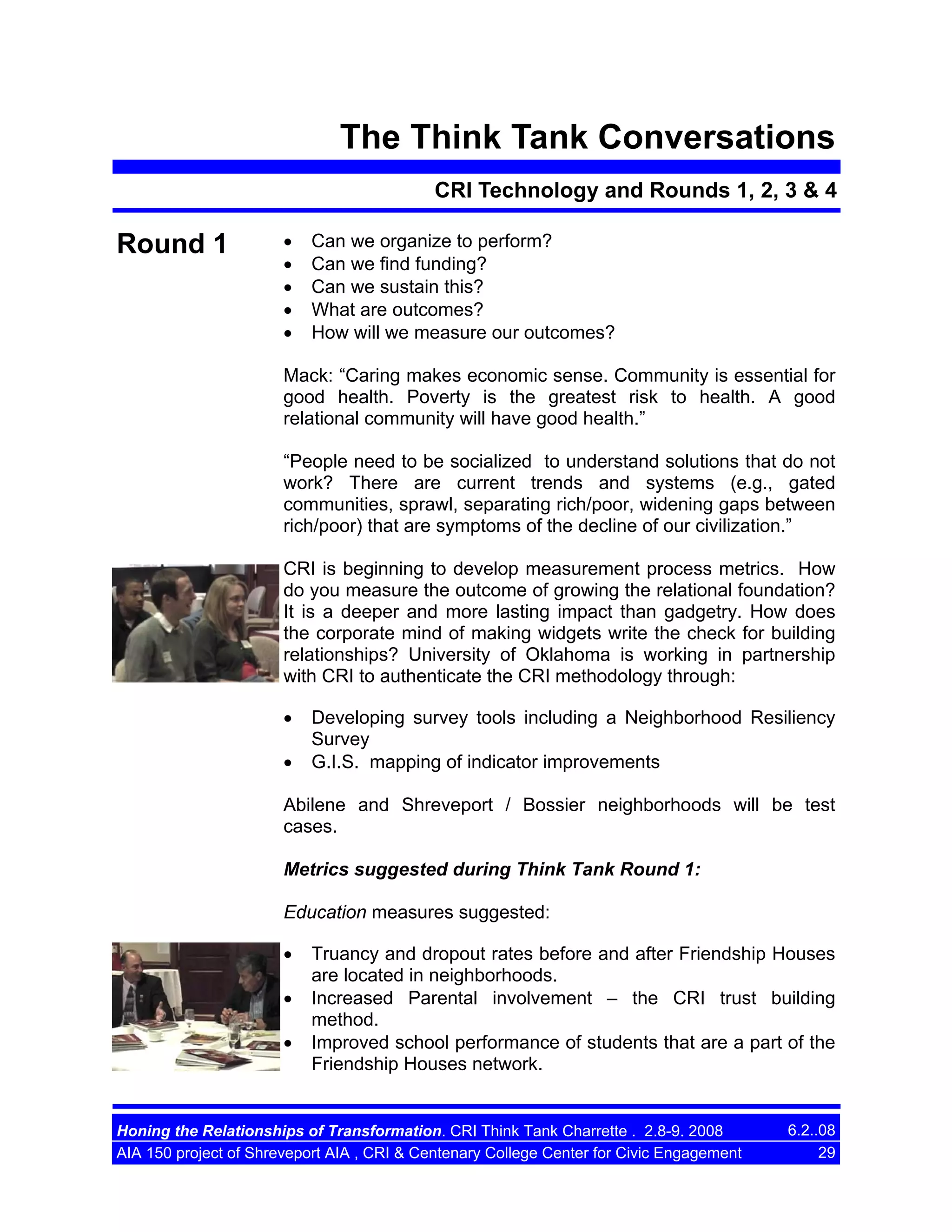
CRI is beginning to develop measurement process metrics. How
do you measure the outcome of growing the relational foundation?
It is a deeper and more lasting impact than gadgetry. How does
the corporate mind of making widgets write the check for building
relationships? University of Oklahoma is working in partnership
with CRI to authenticate the CRI methodology through:
โ€ข
โ€ข

Developing survey tools including a Neighborhood Resiliency
Survey
G.I.S. mapping of indicator improvements

Abilene and Shreveport / Bossier neighborhoods will be test
cases.
Metrics suggested during Think Tank Round 1:
Education measures suggested:
โ€ข
โ€ข
โ€ข

Truancy and dropout rates before and after Friendship Houses
are located in neighborhoods.
Increased Parental involvement โ€“ the CRI trust building
method.
Improved school performance of students that are a part of the
Friendship Houses network.

Honing the Relationships of Transformation. CRI Think Tank Charrette . 2.8-9. 2008
AIA 150 project of Shreveport AIA , CRI & Centenary College Center for Civic Engagement

6.2..08
29
The Think Tank Conversations
CRI Technology and Rounds 1, 2, 3 & 4

Round 1

Civic and leadership measures suggested:
โ€ข
โ€ข

โ€ข

โ€ข
โ€ข
โ€ข
โ€ข

Number of elderly volunteering, working or otherwise engaged
in the community.
Measure the โ€œProgression of the Friendship Houseโ€: serving
the neighborhoodโ€™s treasured possessionsโ€”children; to
attracting parents and other adults; to increasing parental
involvement in schools; to becoming role models / mentors.
(the system of growing relationships)
When neighborhood successes return to their neighborhood to
re-invest and live. (e.g., High school student at Fair Park from
family in Queensboro gets scholarship to Tulane and a Degree
in Molecular Biology)
Capacity of community residents to dream of a better future.
Quantity of relationships and how often they interact.
Number of volunteers from outside the neighborhood assisting
at Friendship Houses.
How do people feel about their communities? Sample Surveys
to determine perceptions (Perception often becomes reality):
a) Safety, b) Appearance, c) Hope for the Future

Health measures suggested:
โ€ข

Child obesity improvement as a result of Community Center /
Friendship House

Safety Measures suggested:
โ€ข

Crime before and after Friendship Houses

Meaningful Work measures suggested:
โ€ข
โ€ข
โ€ข
โ€ข

โ€œReaching the unreachablesโ€. Helping young men that have
dropped out of school get off the porch and into employment
(Number of adults getting G.E.D. through Friendship Houses).
Job shadowing / mentoring.
Workforce from Adult Renewal Academy that brings technical
college and other resources to Friendship House communities.
Job attendance and keeping a job.

Honing the Relationships of Transformation. CRI Think Tank Charrette . 2.8-9. 2008
AIA 150 project of Shreveport AIA , CRI & Centenary College Center for Civic Engagement

6.2..08
30
The Think Tank Conversations
CRI Technology and Rounds 1, 2, 3 & 4

Round 1

What does a caring community look like? (outward measures)
โ€ข
โ€ข
โ€ข
โ€ข
โ€ข
โ€ข
โ€ข
โ€ข

School connected to surrounding neighborhood.
Connection between Schools and Friendship Houses.
Business creation by residents of Neighborhoods.
Kids playing in the neighborhood and on safe streets in all
neighborhoods.
Teachers living in neighborhoods surrounding schools.
People not moving out of the neighborhood.
Taking the fence down around schools.
Successful people returning to the neighborhood to live.

Strategies from Think Tank Round 1:
โ€ข
โ€ข
โ€ข
โ€ข
โ€ข
โ€ข

โ€ข

โ€ข

Open house where Teachers come to Friendship House for
relational connection to the families and neighborhood.
Mentor programs for students administered through Friendship
Houses, Haven Houses and We Care Teams in partnership
with school system.
Workforce Development by bringing existing programs or new
variations of existing programs to Friendship Houses for skills
and entrepreneurship training.
Explore concepts for various scales of friendship housesโ€“
Rural and Urban forms
Use Friendship House to change expectations of children of
the uneducated. Friendship is a portal for changing lives and
expectations.
Nurture Small Business/Entrepreneurship through Friendship
Houses. Assist in mapping out life strategies (mentoring).
Programs to help residents participate in building / re-building
neighborhoods.
Friendship network that intervenes in cyclic problems of
poverty. This is a new network formed intentionally to build new
caring communities. This new network is critical for the U.S.
leadership in humanitarian and economic leadership in the
world.
Review work of Robert Landry โ€“ Researcher from Houston
(Micro Area Improvement is a successful strategy)

Honing the Relationships of Transformation. CRI Think Tank Charrette . 2.8-9. 2008
AIA 150 project of Shreveport AIA , CRI & Centenary College Center for Civic Engagement

6.2..08
31
The Think Tank Conversations
CRI Technology and Rounds 1, 2, 3 & 4
Round 2 Conversations: Comments on Charette
Design Principles & Concepts
Think Tank participants convened at 8:30 A.M. on the morning of
February 9 to review the results from the student charrette teams
that collaborated through the night. The charrette work is based on
published information from participants (included in the appendix)
and conversations from the first day of the TTC. The teams
developed initial lists of design principles to shape physical
environments that support the CRI model of caring communities.
Concepts were also explored to illustrate these principles. The
work is presented in the Charrette chapter of this report.

Round 3 Conversations: Meaningful Work,
Leadership, Culture and the Relational Foundation
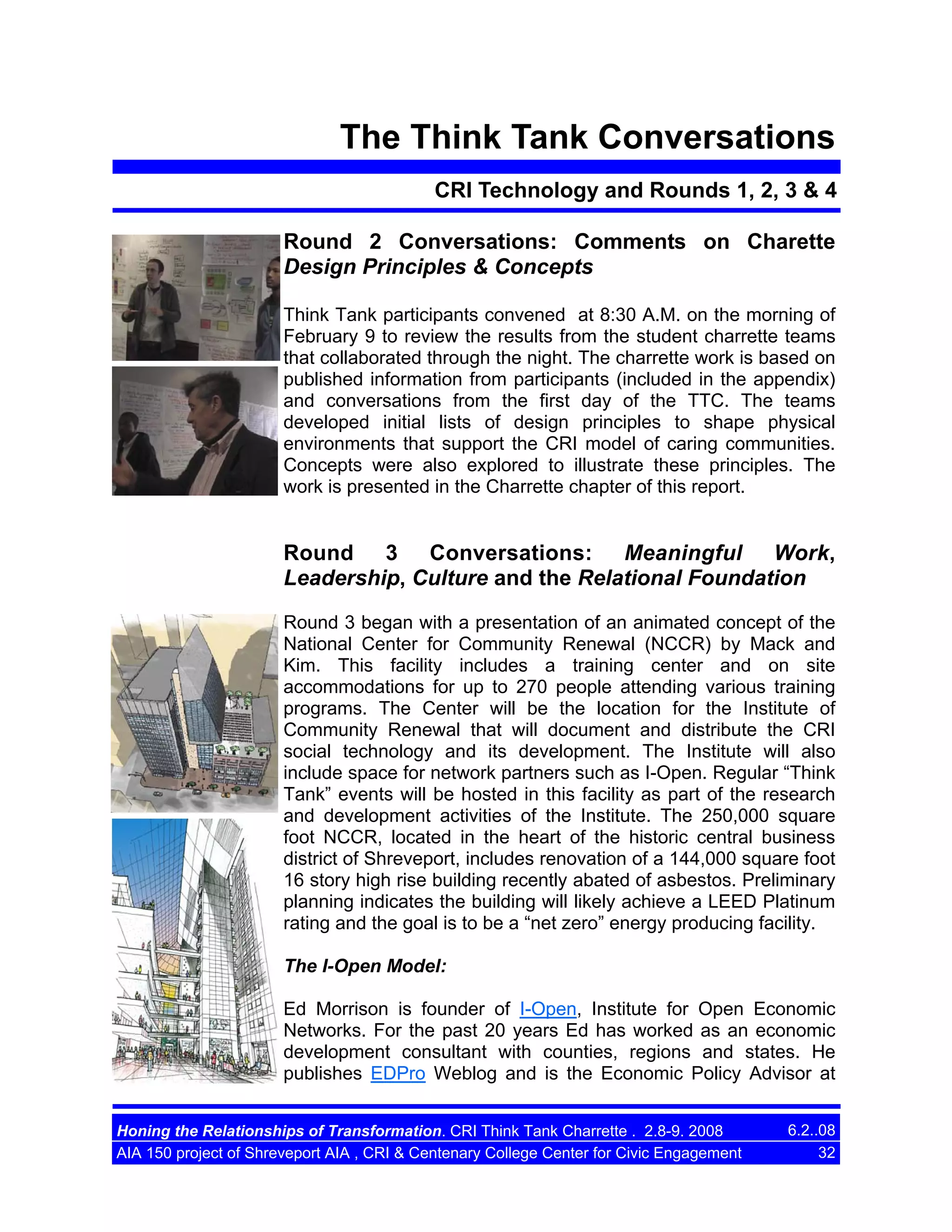
Round 3 began with a presentation of an animated concept of the
National Center for Community Renewal (NCCR) by Mack and
Kim. This facility includes a training center and on site
accommodations for up to 270 people attending various training
programs. The Center will be the location for the Institute of
Community Renewal that will document and distribute the CRI
social technology and its development. The Institute will also
include space for network partners such as I-Open. Regular โ€œThink
Tankโ€ events will be hosted in this facility as part of the research
and development activities of the Institute. The 250,000 square
foot NCCR, located in the heart of the historic central business
district of Shreveport, includes renovation of a 144,000 square foot
16 story high rise building recently abated of asbestos. Preliminary
planning indicates the building will likely achieve a LEED Platinum
rating and the goal is to be a โ€œnet zeroโ€ energy producing facility.
The I-Open Model:
Ed Morrison is founder of I-Open, Institute for Open Economic
Networks. For the past 20 years Ed has worked as an economic
development consultant with counties, regions and states. He
publishes EDPro Weblog and is the Economic Policy Advisor at
Honing the Relationships of Transformation. CRI Think Tank Charrette . 2.8-9. 2008
AIA 150 project of Shreveport AIA , CRI & Centenary College Center for Civic Engagement

6.2..08
32
The Think Tank Conversations
CRI Technology and Rounds 1, 2, 3 & 4

Round 3

the Purdue Center for Regional Development. For the past six
years Ed has developed a new economic development approach
based on networks. He calls this approach โ€œOpen Source
Economic Developmentโ€ to emphasize the strategic value of
collaboration in todayโ€™s global economy.
The processes of Open Source software development provide
insight into methods that successfully balance open participation
and leadership direction. With a few simple rules the collective
wisdom and energies of these open communities are able to
develop extremely complex projects quickly. Borrowing from these
insights, Open Source Economic Development promotes open
innovation networks to accelerate regional prosperity. To translate
these ideas into action the Open Source model calls for new tools
and practices of civic engagement. One of these practices is the
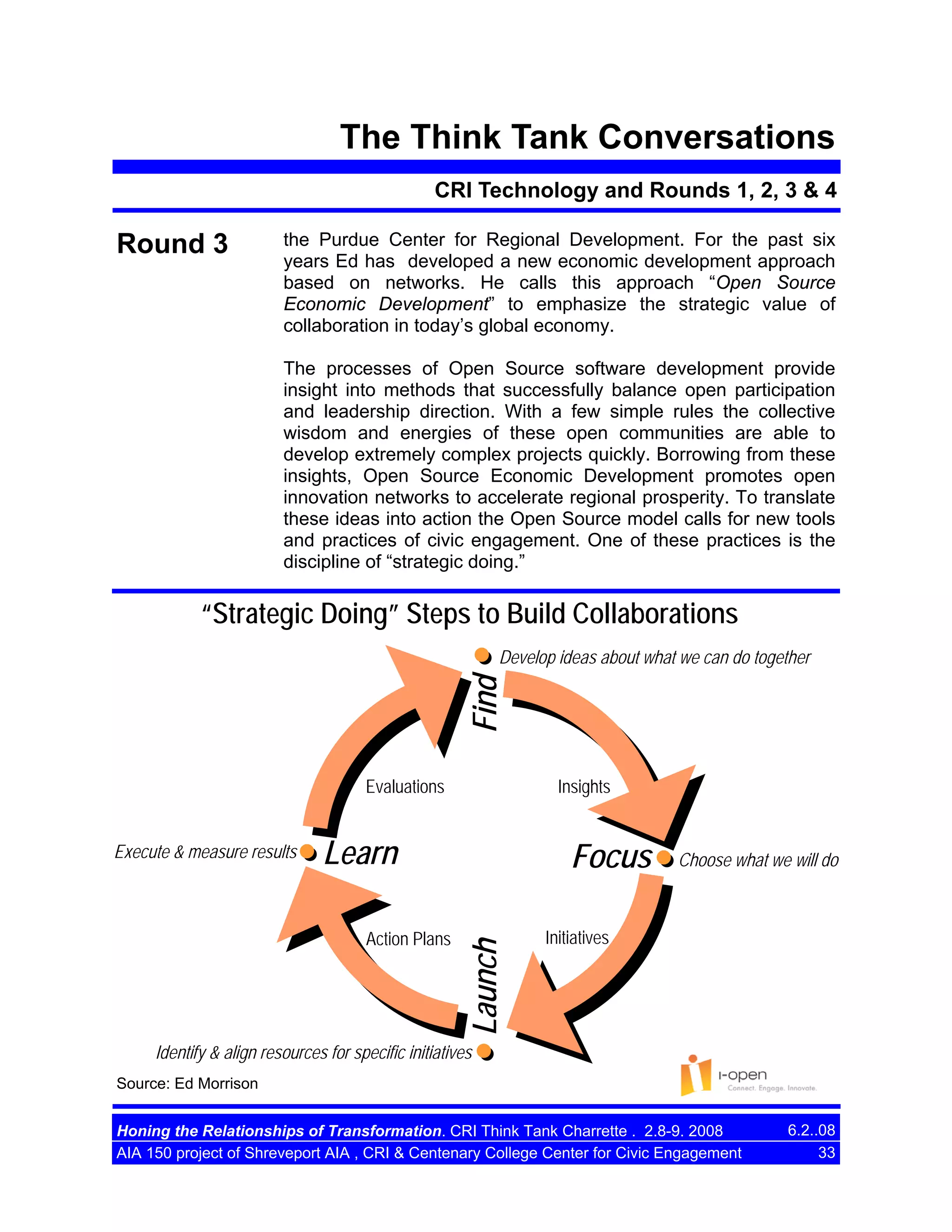
discipline of โ€œstrategic doing.โ€

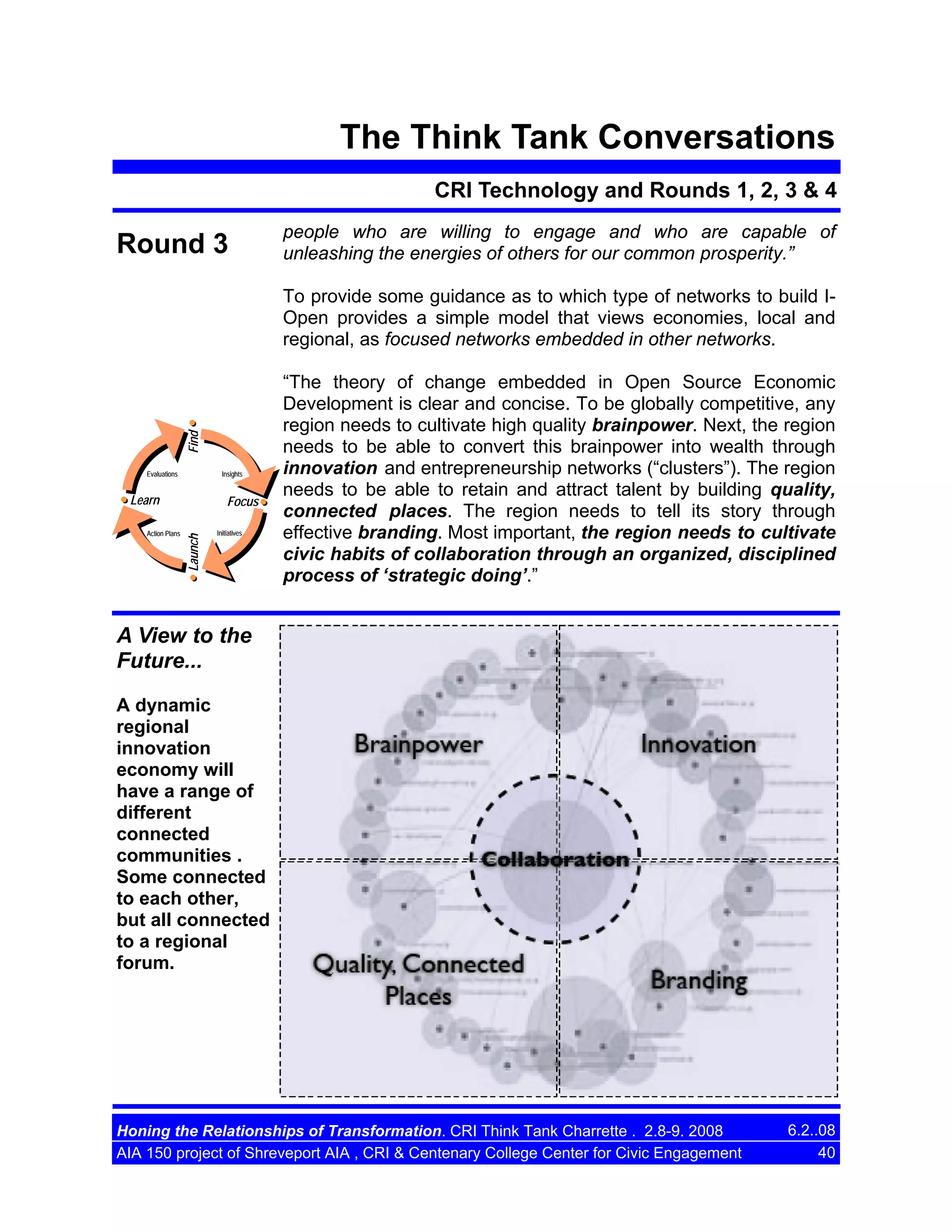
โ€œStrategic Doingโ€ Steps to Build Collaborations

Find

Develop ideas about what we can do together

Evaluations

Learn
Action Plans

Focus
Launch

Execute & measure results

Insights

Choose what we will do

Initiatives

Identify & align resources for specific initiatives
Source: Ed Morrison
Honing the Relationships of Transformation. CRI Think Tank Charrette . 2.8-9. 2008
AIA 150 project of Shreveport AIA , CRI & Centenary College Center for Civic Engagement

6.2..08
33
The Think Tank Conversations
CRI Technology and Rounds 1, 2, 3 & 4

Round 3

The following statements from the I-Open home page provide a
basic understanding for this transformational work:
โ€œStrap on your goggles. Itโ€™s a whole new gameโ€ฆ
Look out over the landscape of our national economy. New
connections are forming. Remarkable opportunities are
embedded in these connections, if we can train ourselves to
see โ€” and act on โ€” them.
I-Open is focused on the habits we need to innovate in the
โ€œcivic spaceโ€.
Regions and communities with thick civic networks will be
more prosperous. They will learn faster, spot opportunities
faster, align their resources faster, and act faster.
I-Open helps you understand this new world. We are
moving civic leaders from strategic planning to strategic
doing.โ€
A white paper is included in the appendix and can be downloaded
at I-Open. These new tools are spread by I-Open using a Creative
Commons 3.0 attribution license.
To demystify the dynamics of economic development Ed
suggested the easiest understanding is to divide money flowing
through a regional or neighborhood economy into three parts:
good, neutral and bad. โ€œGood Moneyโ€ flows into a community
from outside through what are referred to as โ€œtraded businessesโ€
vital to introducing new money into an economy. โ€œNeutral Moneyโ€
circulates through local businesses (โ€œmultiplier effectโ€) that make
major contributions to our quality of life. โ€œBad Moneyโ€ represents
money flowing our of our communities (โ€œleakageโ€) when we make
purchases outside our communities or from non-local business.
The strategy for economic development is simply:
1. Increase the volume of Good Money.
2. Increase the velocity of Neutral Money.
3. Reduce the flow of Bad Money.

Honing the Relationships of Transformation. CRI Think Tank Charrette . 2.8-9. 2008
AIA 150 project of Shreveport AIA , CRI & Centenary College Center for Civic Engagement

6.2..08
34
The Think Tank Conversations
CRI Technology and Rounds 1, 2, 3 & 4

Round 3

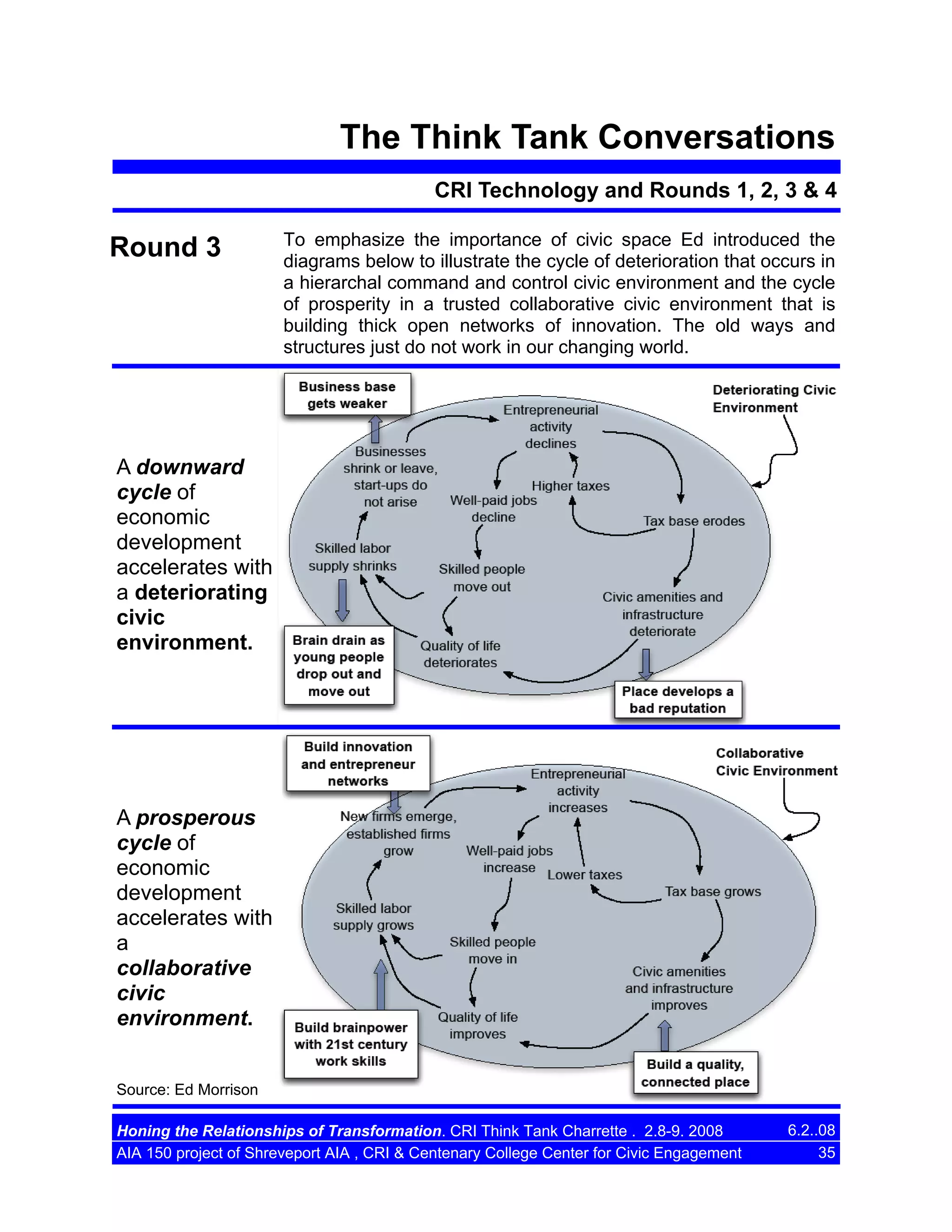
To emphasize the importance of civic space Ed introduced the
diagrams below to illustrate the cycle of deterioration that occurs in
a hierarchal command and control civic environment and the cycle
of prosperity in a trusted collaborative civic environment that is
building thick open networks of innovation. The old ways and
structures just do not work in our changing world.

A downward
cycle of
economic
development
accelerates with
a deteriorating
civic
environment.

A prosperous
cycle of
economic
development
accelerates with
a
collaborative
civic
environment.
Source: Ed Morrison
Honing the Relationships of Transformation. CRI Think Tank Charrette . 2.8-9. 2008
AIA 150 project of Shreveport AIA , CRI & Centenary College Center for Civic Engagement

6.2..08
35
The Think Tank Conversations
CRI Technology and Rounds 1, 2, 3 & 4

Round 3

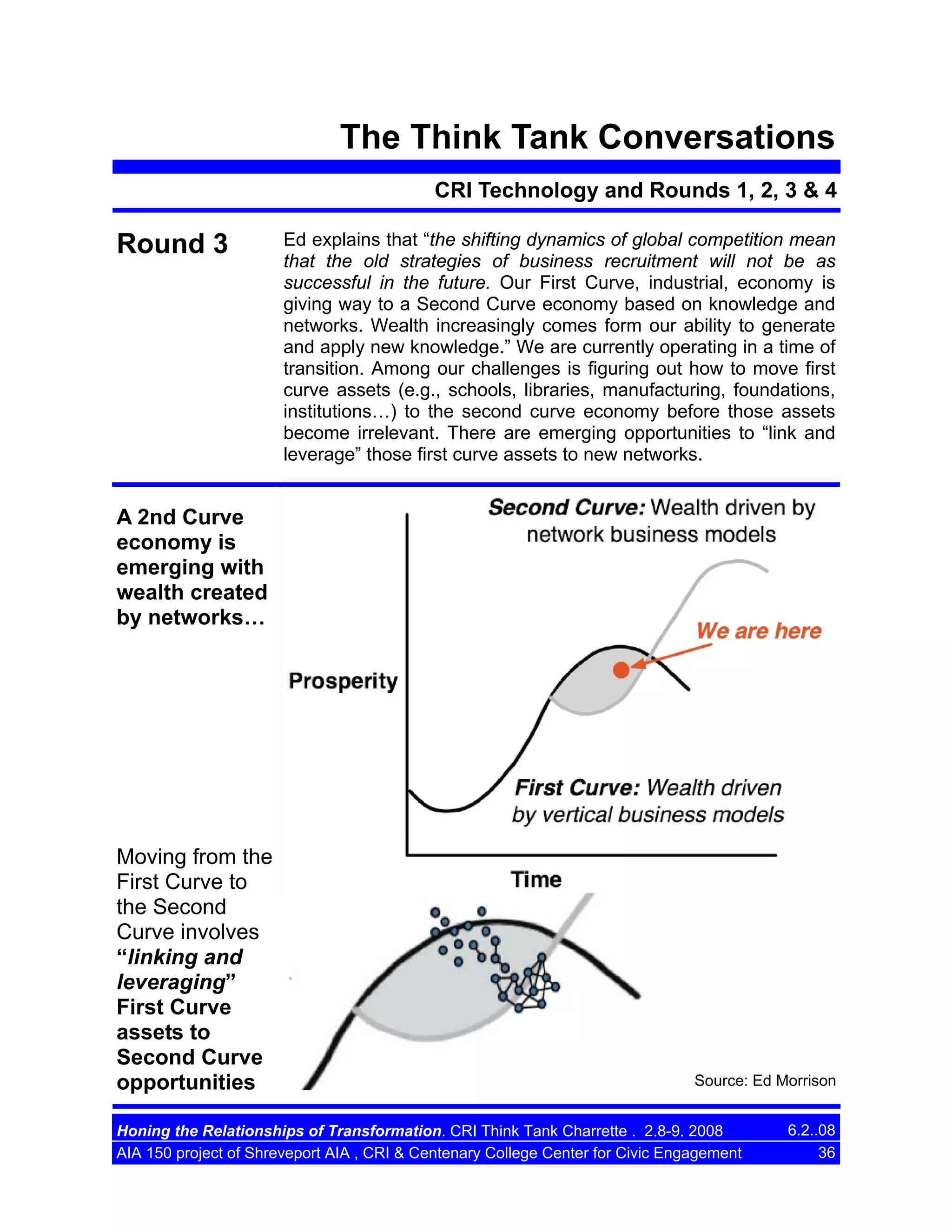
Ed explains that โ€œthe shifting dynamics of global competition mean
that the old strategies of business recruitment will not be as
successful in the future. Our First Curve, industrial, economy is
giving way to a Second Curve economy based on knowledge and
networks. Wealth increasingly comes form our ability to generate
and apply new knowledge.โ€ We are currently operating in a time of
transition. Among our challenges is figuring out how to move first
curve assets (e.g., schools, libraries, manufacturing, foundations,
institutionsโ€ฆ) to the second curve economy before those assets
become irrelevant. There are emerging opportunities to โ€œlink and
leverageโ€ those first curve assets to new networks.

A 2nd Curve
economy is
emerging with
wealth created
by networksโ€ฆ

Moving from the
First Curve to
the Second
Curve involves
โ€œlinking and
leveragingโ€
First Curve
assets to
Second Curve
opportunities

Source: Ed Morrison

Honing the Relationships of Transformation. CRI Think Tank Charrette . 2.8-9. 2008
AIA 150 project of Shreveport AIA , CRI & Centenary College Center for Civic Engagement

6.2..08
36
The Think Tank Conversations
CRI Technology and Rounds 1, 2, 3 & 4

Round 3
The challenge
is to build and
support
productive,
focused
networks
around
strategic
issues
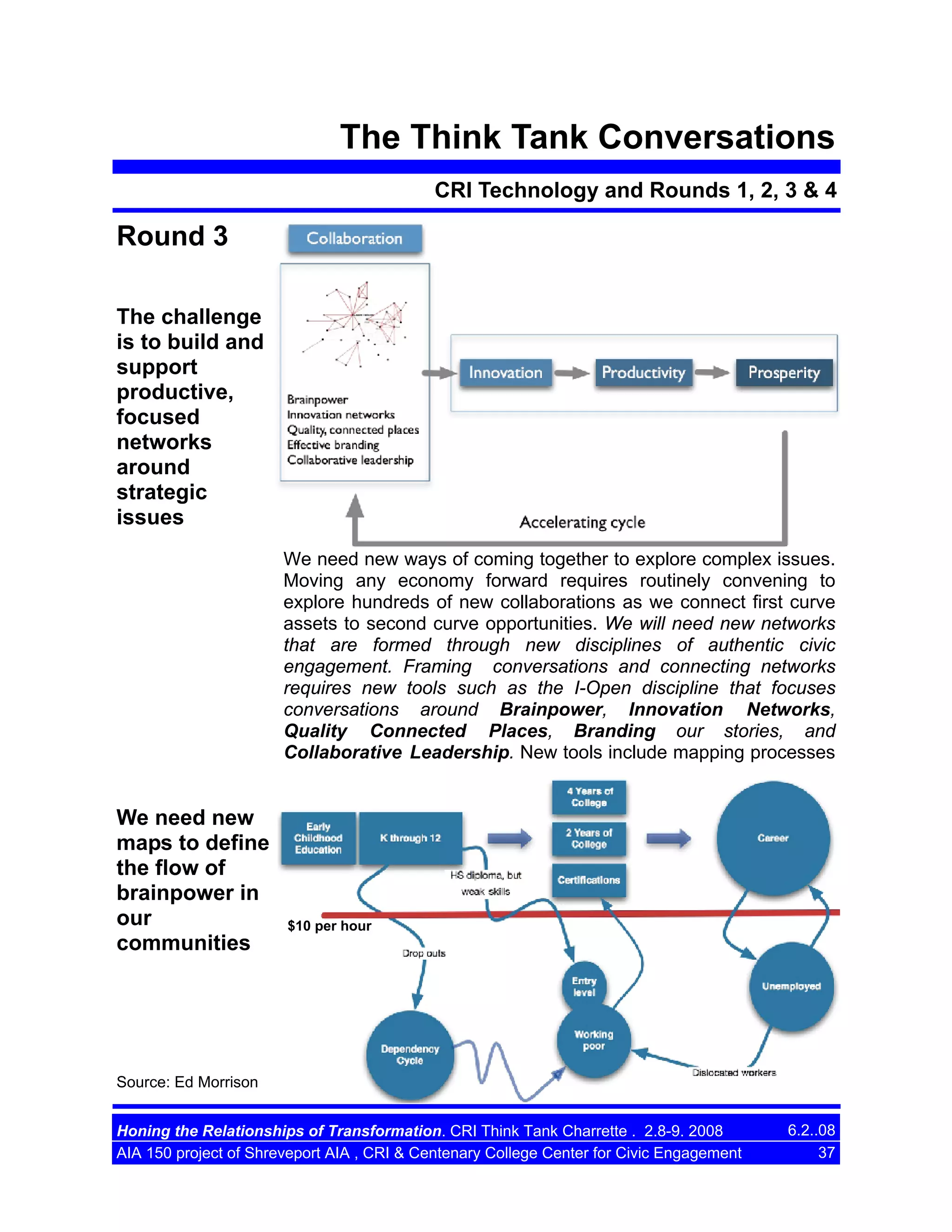
We need new ways of coming together to explore complex issues.
Moving any economy forward requires routinely convening to
explore hundreds of new collaborations as we connect first curve
assets to second curve opportunities. We will need new networks
that are formed through new disciplines of authentic civic
engagement. Framing conversations and connecting networks
requires new tools such as the I-Open discipline that focuses
conversations around Brainpower, Innovation Networks,
Quality Connected Places, Branding our stories, and
Collaborative Leadership. New tools include mapping processes

We need new
maps to define
the flow of
brainpower in
our
communities

$10 per hour

Source: Ed Morrison
Honing the Relationships of Transformation. CRI Think Tank Charrette . 2.8-9. 2008
AIA 150 project of Shreveport AIA , CRI & Centenary College Center for Civic Engagement

6.2..08
37
The Think Tank Conversations
CRI Technology and Rounds 1, 2, 3 & 4

Round 3

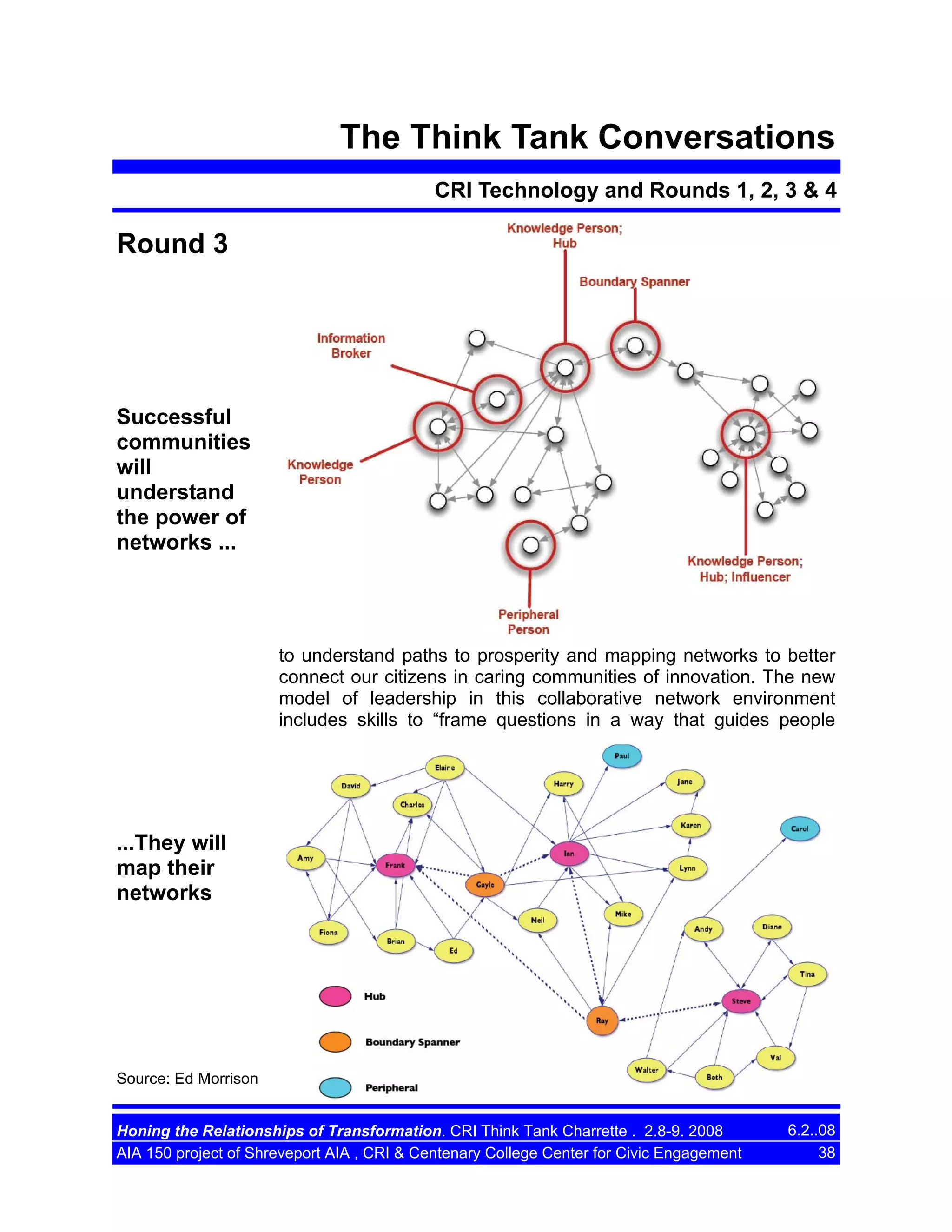
Successful
communities
will
understand
the power of
networks ...

to understand paths to prosperity and mapping networks to better
connect our citizens in caring communities of innovation. The new
model of leadership in this collaborative network environment
includes skills to โ€œframe questions in a way that guides people

...They will
map their
networks

Source: Ed Morrison
Honing the Relationships of Transformation. CRI Think Tank Charrette . 2.8-9. 2008
AIA 150 project of Shreveport AIA , CRI & Centenary College Center for Civic Engagement

6.2..08
38
The Think Tank Conversations
CRI Technology and Rounds 1, 2, 3 & 4

Round 3
The

I-Open Model:
2nd Curve
strategies =
Open Source
Economic
Development
2nd Curve
Strategies involve
linking & leveraging
assets in five
โ€œasset networksโ€:
1.Brainpower
2.Innovation
3.Quality places
4.Branding
5.Civic
Collaboration
Source: Ed Morrison

toward understanding their individual potential to contribute to civic
lifeโ€. These are positive conversations of โ€œAn Appreciative [Civic
Leadership] mindset: focus on what we do want, do have, can do,
whatโ€™s working & why, what we want to move toward, what matters
to us.โ€ Our networks evolve by closing triangles, connecting
people we know. Regular civic forums are a practical way for new
people to meet and explore their connections. These forums, if
guided by โ€˜appreciative leadershipโ€™, can become powerful tools for
building our networks, our social capital. โ€œWe need places [trusted
places] in our communities and neighborhoods where people feel
comfortable to meet and explore issues. The CRI โ€˜Friendship
Houseโ€™ is one of those trusted places at a neighborhood level of
community. On the Second Curve, civic leadership is far more
distributed than in a First Curve economy. Leadership comes from
Honing the Relationships of Transformation. CRI Think Tank Charrette . 2.8-9. 2008
AIA 150 project of Shreveport AIA , CRI & Centenary College Center for Civic Engagement

6.2..08
39
The Think Tank Conversations
CRI Technology and Rounds 1, 2, 3 & 4

Round 3

people who are willing to engage and who are capable of
unleashing the energies of others for our common prosperity.โ€

Find

To provide some guidance as to which type of networks to build IOpen provides a simple model that views economies, local and
regional, as focused networks embedded in other networks.

Evaluations

Insights

Learn
Launch

Action Plans

Focus
Initiatives

โ€œThe theory of change embedded in Open Source Economic
Development is clear and concise. To be globally competitive, any
region needs to cultivate high quality brainpower. Next, the region
needs to be able to convert this brainpower into wealth through
innovation and entrepreneurship networks (โ€œclustersโ€). The region
needs to be able to retain and attract talent by building quality,
connected places. The region needs to tell its story through
effective branding. Most important, the region needs to cultivate
civic habits of collaboration through an organized, disciplined
process of โ€˜strategic doingโ€™.โ€

A View to the
Future...
A dynamic
regional
innovation
economy will
have a range of
different
connected
communities .
Some connected
to each other,
but all connected
to a regional
forum.

Honing the Relationships of Transformation. CRI Think Tank Charrette . 2.8-9. 2008
AIA 150 project of Shreveport AIA , CRI & Centenary College Center for Civic Engagement

6.2..08
40
The Think Tank Conversations
CRI Technology and Rounds 1, 2, 3 & 4
Round 4 Conversations:
A โ€œStrategic Doingโ€ Session to
move in the direction of our positive conversations
Round 4 was a discussion between Ed Morrison and Mack
McCarter facilitated by Kim Mitchell. Ed and Mack encouraged
questions and comments from the charrette teams and other
observers. The focus of this session applies a technique
developed by Ed to explore a working relationship between CRI
and I-Open. This process, โ€œstrategic doingโ€, is used to develop
open networks of action by answering the following questions:
Find

โ€ข

Evaluations

Insights

Learn
Action Plans

Launch

Focus
Initiatives

Where are we now?

โ€ข

What could we do? TOGETHER!

โ€ข

What should we do? TOGETHER!

โ€ข

What will we do? TOGETHER!

Find

The following are notes recorded on flip charts during this
discussion round 4:

Where are we now?
Insights

Focus

โ€ข
โ€ข
โ€ข
โ€ข
โ€ข
โ€ข

There are strong similarities / parallels between the CRI and IOpen models for change.
Both CRI and I-Open are re-inventing civic spaces that have
been vandalized by the direction of society. Civic spaces
(models, tools and processes) need to be re-built.
Edโ€™s belief: โ€œif it is teachable, it is scaleable.โ€
(Applies to I-Open and CRI)
Both CRI and I-Open believe and act on the belief that the old
way does not work.
CRI is working to complete the demonstration of the entire
Shreveport / Bossier communities.
Purdue and University of Oklahoma will initiate certificate
program for I-Open training in May 2008.

Honing the Relationships of Transformation. CRI Think Tank Charrette . 2.8-9. 2008
AIA 150 project of Shreveport AIA , CRI & Centenary College Center for Civic Engagement

6.2..08
41
The Think Tank Conversations
CRI Technology and Rounds 1, 2, 3 & 4
โ€ข
โ€ข

Round 4

Launch

Focus
Initiatives

CRI is working on replication model in a national center.
Both organizations have learned that progress is achieved by
โ€œworking with the willingโ€ in mutual love and respect. It is not
worth the time or effort to convince those that donโ€™t get it and
often will work against transformative work of CRI and I-Open.

What could we do? TOGETHER!
โ€ข
โ€ข
โ€ข
โ€ข

Learn
Launch

Action Plans

โ€ข

The I-Open model answers the fundamental questions of
networking that is part of C.R.I. model (particularly โ€œmeaningful
workโ€)
There is a new energy that will be released from the process of
fusing C.R.I. and I-Open models in a new co-operative working
relationship of the two models (expanding networks)
What are focused outcomes of the two models?
Is C.R.I. model possible without faith?
โ€ข Seeking and Sharing the love of others is an act of faith
โ€ข We can not prove that it is possible without faith
โ€ข It may be possible without religiosity
โ€ข Watching transformation of groups is hard to understand
without faith and spirit
โ€ข There is more here than me, myself and I.
โ€ข There is an energy released when we connect through
transformative experiences.
Community Foundations are an opportunity for funding
transformative work of CRI and I-Open

What should we do? TOGETHER!
โ€ข
โ€ข
โ€ข
โ€ข
โ€ข

Establish agreement on terms and language to more effectively
connect the networks of I-Open and CRI.
Agree on metrics, the roles metrics play and how they plug-in
to both models.
How should the two (2) stories / presentations be integrated?
Purdue, Edward Lowe, I-Open and CRI can work together.
CRI and I-Open can jointly define a process of learning.

Honing the Relationships of Transformation. CRI Think Tank Charrette . 2.8-9. 2008
AIA 150 project of Shreveport AIA , CRI & Centenary College Center for Civic Engagement

6.2..08
42
The Think Tank Conversations
CRI Technology and Rounds 1, 2, 3 & 4
โ€ข

Find

Round 4

Evaluations

Learn

What will we do? TOGETHER!
โ€ข
โ€ข
โ€ข

Facilitator
Kim Mitchell during
the โ€œstrategic doingโ€
session.

I-Open Certificate course that begins in May (Purdue and
University of Oklahoma) can be extended to Centenary.

โ€ข

โ€ข
โ€ข
โ€ข

CRI and I-Open are now part of a โ€œnetwork of the willingโ€ and
agree to explore partnership activities between CRI and
I-Open.
I-Open will conduct a workshop May 4-6, 2008 for CRI staff
and other key people.
Mack requested a presence of I-Open in the National Center
for Community Renewal (NCCR).
Mack asked Ed to be the lead speaker at a CRI Summit of
Foundations that is being planned for later in 2008 or early
2009. The foundations that attend will be asked to fund CRI
going from pilot scale to a full scale demonstration project in
Shreveport / Bossier. A date is not yet established.
Integrate the two (2) stories/presentations.
Purdue and Centenary Center for Civic Engagement should
quickly be formalized to begin collaborative work.
Ed invited Mack to a CRI / I-Open work session at the Lowe
Foundation Retreat in Michigan. The tentative date is in June
2008.

Stories, Convergence and Wisdomโ€”
In the presence of good and encounters with evil
The following are excerpts from Round 4 conversations between
Ed and Mack as they share experiences and answer questions
posed by observers. These conversations give insight into the
beginning convergence of their philosophies and understanding of
similar struggles both have encountered:
Honing the Relationships of Transformation. CRI Think Tank Charrette . 2.8-9. 2008
AIA 150 project of Shreveport AIA , CRI & Centenary College Center for Civic Engagement

6.2..08
43
The Think Tank Conversations
CRI Technology and Rounds 1, 2, 3 & 4

Round 4

Ed: โ€œThe CRI model and I-Open model are the same philosophy,
the same cup seen from different perspectives. We are
participating in the emergence of a collaborationโ€.
โ€œA big market for CRI / I-Open is community foundations struggling
with how they should move into economic development. This is an
opportunity we should focus on for funding.
โ€œOur collaboration is a big opportunity to define a process of
learning. Our partnership should include a university or
universities. How do we become the โ€˜Epicenter of Innovationโ€™?โ€
Steve Shelburne, professor representing the Centenary Center for
Civic Engagement, posed a question to Ed and Mack: โ€œCan the
CRI model happen without faith or a faith based organization?โ€

Professor Steve
Shelburne poses a
question to Mack
and Ed.

Mack: โ€œSelf-giving love and seeking the good of others as we
would our own is the transformative power residual in all of us and
is a faith claim. It [the CRI model] is possible without religion or
religiosity, but not without faith.โ€
Ed: โ€œIt is very hard for me to watch the transformation of groups
within an hour โ€˜Strategic Doingโ€™ session and not feel a spiritual
connection. I do not put spirituality into I-Open model...there is a
spiritual dimension of the I-Open model that I follow. I think people
get transformed, I think people see the connections, not only with
each other, but with their world, in a new and different way. My
objective is not to propagate any kind of spiritual view; I believe
that is what we are doing as spiritual beings. My whole journey
goes back to the beginnings of community in Africa.โ€
Mack: โ€œMy objective is to have the whole transformed by the
โ€˜power of loveโ€™. My definition of spirituality, when I say a competent
person must grow spiritually, is the living sense that the
transcendent is not only around us and among us, but within us;
and there is more here than me, myself and I. That is fundamental.
This is a conscious objective in the CRI model.โ€
Ed: โ€œTim Sanders, Chief Solutions Officer at Yahoo authored a
book, โ€˜Love is the Killer Appโ€™. His basic point is that we are

Honing the Relationships of Transformation. CRI Think Tank Charrette . 2.8-9. 2008
AIA 150 project of Shreveport AIA , CRI & Centenary College Center for Civic Engagement

6.2..08
44
The Think Tank Conversations
CRI Technology and Rounds 1, 2, 3 & 4

Round 4

moving into a network world and love is actually the way in which
you will prosper in this new world. We are shifting the way in
which we are thinking about everything from information to
sharing. In the old industrial world, if Mack had a model and I had
a model, I would show Mack a little bit of my model and he would
show me a little bit of his model, and we would be thinking, โ€˜Is this
going to end up as his model or my model?โ€™ Who is going to grab
the chair first and run off to the funders and get his deal done?
Mack and I see that opportunity comes from sharing, which is
fundamentally different than most organizations operating today;
but this is the world the coming generation will grow up in. They
will grow up in a world where sharing, openness and
collaboration will be important, not because its the nice thing
to do, but because that is how you will create prosperity. Your
personal integrity, your personal abilities, your networks, your
trustworthiness, your ability to practice love and kindness will
determine how successful you are.โ€
Ed: โ€œMy only rule for working together is that we treat each other
with mutual respect in ways that build trust and mutual respect. If
you choose not to behave in this manner, we choose not to work
with you. What Mack and I are saying is there is no faith entrance
requirement, but that you go through this experience and the
emergent reality is a faith experience.โ€
Mack: โ€œI see for the first time a fundamental question answered for
our CRI model, the whole economic system based upon the power
of the network. It is one thing to have a working model on the
ground with all the blood, sweat and tears of trying to move it and
grow it. I have tried a million ways to express the whole idea of
networking through metaphors and analogies; I try to socialize
people to understand that we are bound to one another; and how
the intentionality of relating, generating and sustaining networks
brings a shared power. The fusion that you [Ed] have shown of
true economic reality is not so much the competitive model as it is
a cooperative model. You show us that if we do certain things to
build networks we can project that prosperity will grow.โ€
Mack: โ€œFunders do not see loving as hard economic since. We
are about to assemble a summit of foundations to immerse them in

Honing the Relationships of Transformation. CRI Think Tank Charrette . 2.8-9. 2008
AIA 150 project of Shreveport AIA , CRI & Centenary College Center for Civic Engagement

6.2..08
45
The Think Tank Conversations
CRI Technology and Rounds 1, 2, 3 & 4

Round 4

the CRI model. Bringing these foundations together is an attempt
to get them to make the connection between the CRI model of
caring to the outcome of economic prosperity.
1. We are looking at a 5-year plan to take our pilot in Shreveport /
Bossier to a demonstration projectโ€”to go from 10 Friendship
Houses to 60; and 900 Block Leaders to 5,000; and 37,000
โ€œWe Care Teamโ€ members to 125,000. We will connect an
entire metro area in a network of caring.
2. The part of the replication process that will occur at the
National Center is learning by becoming immersed in the
concepts and practical methodology of training to put the CRI
model on the ground in other communities. Part of the training
will include understanding the overlay, the paradigm, of the IOpen model of open networks.
I would like Ed to be the lead speaker at the foundation
conference and show the conceptual overlay of how networking
brings prosperity. The universal doctrine of doing good. I cannot
ask for a more profound and powerful model to show that caring
makes hard economic since.โ€
Ed: โ€œWe created at CASE Western a reliable Civic Space where
people could come every week to talk, not about what was wrong,
but what their hopes were, what their dreams were, how they
could connect, how they could learn from each other. That is what
we created. What happened when the Dean said, โ€˜Weโ€™re not doing
this anymore?โ€™ The 50 to 60 people gathering weekly said, โ€˜You
canโ€™t take that away, that is our space, its not yours to take.โ€™ The
people came to me [Ed] after my firing and said we must continue.
I took off my CASE Western hat and put on a new hat, I-Open.
The Civic Space that had been constructed moved and spun-out
new places and new forms of building civic space to prosper
through caring networks and trusted places (quality places). Spinouts include โ€˜Lots of Coffee, No Whineโ€™; โ€˜Third Thursday at 3โ€™ in
Youngstown; โ€˜Midtown Brewsโ€™ in Cleveland; โ€˜Evenings at the
Houseโ€™ in Indianapolis; โ€˜Smaller Indianaโ€™โ€”a group of 700 across
the state. This is all growing because more and more people are
understanding that the old way just doesnโ€™t work.โ€

Honing the Relationships of Transformation. CRI Think Tank Charrette . 2.8-9. 2008
AIA 150 project of Shreveport AIA , CRI & Centenary College Center for Civic Engagement

6.2..08
46
The Think Tank Conversations
CRI Technology and Rounds 1, 2, 3 & 4

Round 4

Ed: โ€œI am looking for a scalable model. My current focus is
teaching the I-Open model with a belief that if it is teachable, it is
scaleable. Not scaleable in the vertical industrial philosophy of
creating a huge organization , but in the โ€œopen network modelโ€
where you can spread these practices.โ€
Mack: โ€œCRI has this scalable model that can emanate into a
concrete model of economic development. CRI has an actual
model that can network an entire city on the commonality of
caring.โ€
Mack: โ€œA social technology is a set of practices that illustrate how
to place human relational principles into a systematic process that
can be replicated over and over again. Understanding those
principles (e.g., one of those principles is that we are free to act)
and using them in a practical methodology to structure our inter
relationships allows us to transform our environment (i.e., it
changes us and it changes our entire environment). This is why I
consider the term social technology appropriate for the CRI model.
Is the social technology coming in time to stop the collapse of our
society (the 33rd to follow the path to collapse)?โ€
Ed: โ€œCan we transfer our 1st curve assets to a 2nd curve
economy? If we canโ€™t, those assets will become irrelevant in the
2nd curveโ€ (collapsing of 1st curve economy).
Mack: โ€œClark Maxwell, a brain with toenails, said, โ€˜Any assessment
of history that does not take into account the possibility of miracle
is a false assessment of history.โ€™ He defined miracle as that which
occurs within history, not outside of history, but statistically is so
infinitesimally small that no one notices when it happens. He
described the phenomena in an essay called โ€˜Singular Pointsโ€™.
The more complex the society, the more the possibility for singular
points to occur that will change everything. We may be at one of
those singular points. Who notices this singular event today and
what we are doing with these conversations and staying up all
night to explore these ideas? Who knows? While society is on a
downward cycle, uncovering the power of the network through
converging I-Open and CRI models, could be one of those
singular points, those miracles, that changes the direction
and moves society upward. I heard this today.โ€

Honing the Relationships of Transformation. CRI Think Tank Charrette . 2.8-9. 2008
AIA 150 project of Shreveport AIA , CRI & Centenary College Center for Civic Engagement

6.2..08
47
The Think Tank Conversations
CRI Technology and Rounds 1, 2, 3 & 4

Round 4

Ed: โ€œWe are inventing new language. I tend to think about the
challenge we face as reinventing and redesigning our civic spaces
because all the things we care about take place in our civic
spaces. We have allowed our civic spaces to be vandalized. We
currently think that holding a conversation on critical issues is
yelling at one another on Fox News. That is as far away as you
can get from having a civic conversation in my book. We need to
rebuild these civic spaces, not only the physical spaces, but
we need to build the models, the tools that will enable us to
get where we need to go. I have hope because of the โ€œpower of
the networkโ€. I have seen it happening. The shifting power comes
from opportunities.โ€
Ed: โ€œThe demographic shift is the first generation coming to
adulthood in the internet age. The Internet is our first interactive
mass media; and we still donโ€™t understand itโ€™s potential. It
holds tremendous potential. The Internet enables us to have mass
communication. It changes fundamentally the concept of โ€œnation
stateโ€ toward โ€œregion statesโ€. It changes the role of University in
creating civic spaces, and changes the role of education. The
most important thing it changes is the โ€œway we thinkโ€, changing
from vertical thinking to network thinking. We are talking about
cognitive modelsโ€”the way we think. If you know how you think,
the patterns of thoughtโ€”you can choose how you think. If we can
create powerful experiences where people walk away saying
โ€œWow, I never thought about that! Networks of the willing. I don't
have the time to try to convince people. If I can figure out how to
do this in Shreveport, I can do it anywhere.โ€
Ed: โ€œJohn Quincy Adams quote, โ€˜If you inspire people to do more,
think more, be more, then you are a leader.โ€™ At a Council of
Competitiveness meeting, in Washington D.C., when asked how
to identify regional leaders I responded, โ€˜The regional leaders are
those being followed.โ€™ If they have the integrity, compassion,
trustworthiness to be followed by people, they are the leaders. It
has nothing to do with position. You find these leaders.โ€
Ed tells the Phil Lane Story to explain how creating trusted civic
spaces can identify real leaders and lead to innovation and
prosperity :

Honing the Relationships of Transformation. CRI Think Tank Charrette . 2.8-9. 2008
AIA 150 project of Shreveport AIA , CRI & Centenary College Center for Civic Engagement

6.2..08
48
The Think Tank Conversations
CRI Technology and Rounds 1, 2, 3 & 4

Round 4

Ed: โ€œI got a call expressing interest in one of our โ€˜Case Forumsโ€™ on
Bio-Fuelsโ€”โ€™What would N.E. Ohio look like as a national leader in
Bio-Fuels development?โ€™. The Caller: โ€œI would like to come to the
Forumโ€. Ed: โ€œGreat; come on!โ€ Caller: โ€œWell, I donโ€™t have a coat
and tieโ€. Ed: โ€œThatโ€™s okay; you donโ€™t need a coat and tieโ€. Caller:
โ€œI will be in overallsโ€. Ed: โ€œThatโ€™s okayโ€. Caller: โ€œWell, Iโ€™m coming
from work and they will be dirtyโ€. Ed: โ€œThatโ€™s okayโ€. Caller: โ€œI am a
mechanic in East Clevelandโ€ [the poorest section of Cleveland].
Ed: โ€œDonโ€™t worry about it, just come on downโ€. Caller: โ€œHow will I
get past securityโ€? Ed: โ€œJust come on. I will see that you get past
security. By-the-way, what is your name?โ€ Caller: โ€œPhil Laneโ€.
โ€œPhil came to the meeting. He is a big guy, probably the only white
living in a black neighborhood. He runs an auto repair shop. At
the first meeting he attended, he doesnโ€™t say a word. At the
second of a series of meetings, he asked a simple question about
Bio-Fuels. One of our group responds and answers the question.
The third week he gives the group a lesson about Bio-Fuels. It
turns out Phil is unbelievably knowledgeable about Bio-Fuels. He
builds cars that run on Bio-Diesel and knows all about Bio-Diesel.
Phil is now the Chief Technology Officer of a Bio-Fuel Company.
You have no idea where your leaders will come from. They
are not on any organizational chart. Until you have regular civic
forums, you will not understand what your opportunities are.
The story about Phil Lane comes down to this:
โ€ข
โ€ข

โ€ข

What was Phil doing at the first meeting when he didnโ€™t say
anything? He was watching how people behave.
What do you think he was doing at the 2nd meeting? Did he
know the answer to the simple question he asked? Yes, he
knew. He wanted to know how he would be treated with a
simple question. Would he be ridiculed? Would he be treated
with respect?
It was only at the third meeting that Phil chose to reveal his
gifts to the group. That is why civic forums are important. It is a
process, not a series of events. More and more people will join
the process as you demonstrate the basic values of respect
and trustworthiness. Phil Lane is my poster child for why we
are creating new civic spaces.โ€

Honing the Relationships of Transformation. CRI Think Tank Charrette . 2.8-9. 2008
AIA 150 project of Shreveport AIA , CRI & Centenary College Center for Civic Engagement

6.2..08
49
The Think Tank Conversations
CRI Technology and Rounds 1, 2, 3 & 4

Round 4

Mack: โ€œScott Peckโ€™s book โ€˜The Different Drummer: Community
Making and Peaceโ€™, discusses the building of community. Here
we are on the verge of a worldwide community through the
internet. Connections are important in who we have access to and
how we sustain those connections. We also must have a
geographical connection, because we all live someplace. If we
do not build connection to those around us, the virtual community
is not strong enough to stop the implosion of the civic spaces
around us. Community must include place. Are you hooked to
your neighbors? Both virtual and place communities are very
powerful with the potential for Quality Connected Places.โ€
โ€œBoth I-Open and CRI models are not rigid formulas and can be
modified and shaped to different environments. Both are at pilot
scale and growing.โ€

Resistance Forces,
Navigating the Maze of Good and Evil:
Donโ€™t be naรฏve, forces attempt to block transformational work.
Forces resisting the second curve economy of open networks are
often manifested in organizations created in the first curve
economy. The vertical decision-making structure that created
these businesses and organizations is threatened (e.g., โ€œcommand
and controlโ€ or โ€œbenevolent dictatorshipโ€ are among terms
descriptive of vertical decision-making). Examples of these
organizations include established economic development
organizations such as chambers of commerce and foundations.
Ed and Mack suggested the following two books to assist in
understanding this resistance to positive change and innovation:
โ€ข

Scott Peckโ€™s book, People of the Lie: The Hope of Healing
Human Evil, is an exploration of evil. There are people in
power that have the characteristics Peck describes. If you have
a new paradigm, some people feel threatened and they will try
to destroy you. Ed and Mack have encountered this resistance.
When the light is turned on, there are huge forces that will seek
to turn that light out. If you are involved in a new paradigm you
must recognize evil.

Honing the Relationships of Transformation. CRI Think Tank Charrette . 2.8-9. 2008
AIA 150 project of Shreveport AIA , CRI & Centenary College Center for Civic Engagement

6.2..08
50
The Think Tank Conversations
CRI Technology and Rounds 1, 2, 3 & 4

Round 4

โ€ข

Eric Frommโ€™s Book, The Heart of Man, Itโ€™s Genius for Good
& Evil, talks about Narcissism and Group Narcissism. You
must recognize evil within the system and within human beings
and how to meet that challenge. This evil is beyond
competition; it is people that will actually try to destroy you.

One of the analogies Mack describes occurred in his experience
pastoring when the CRI model came to him. When he attempted to
begin this new paradigm he encountered resistance and physical
threats. This was his suffering and preparation for what he would
encounter in working for change.
Ed described his being fired at Case and an experience in
Shreveport where he encountered evil and personal attacks to
destroy him financially and to run him out of town. He gave an
example of a Fortune 100 Company that asked him to publish a
study they had done to show why they shouldnโ€™t pay more taxes.
They wanted the Case brand on their work. Ed refused. The
Company Foundation then withheld annual funding they had given
for 20 years. This was one of a series of retribution events that led
to Edโ€™s firing for creating new civic spaces. One of the last evil
control measures was when the Dean said, I want to review and
edit every e-mail Ed intends to send.
Ed spread the word through the internet when he got fired for
doing good and his principles. The bloggers called Ed wanting to
know what happened. The bloggers went to work and a business
publication called the Dean, and he lied about the reason for the
firing saying he did not show up for work. Edโ€™s trusted network
allowed him to combat and thrive despite the aggressive threats
and actions. When you do innovate, you do threaten evil people
who will act out against you. Networks can be good or evil.
Mack described the current CRI / I-Open paradigms to an analogy
of the new paradigm represented by the Revolutionary War. โ€œWe
donโ€™t ask anyoneโ€™s permission to serve. We just do it. There are
always those groups and individuals that feel threatened by
turning on the light. The nobility of every community has a means
of withholding resources to turn out the light on new models or
paradigms.โ€
Honing the Relationships of Transformation. CRI Think Tank Charrette . 2.8-9. 2008
AIA 150 project of Shreveport AIA , CRI & Centenary College Center for Civic Engagement

6.2..08
51
The Think Tank Conversations
CRI Technology and Rounds 1, 2, 3 & 4

Round 4

Ed: โ€œPart of the strategy to stop transformative work is the
personal shaming of those involved in new paradigms. This is
extremely hurtful and destructive and causes personal
transformation that first crushes you. Why would anyone do this?
How can anyone be so mean? If you continue, this same
retribution can happen again. There can be times of isolation
where the evil network positions you asโ€”what is wrong with you?
If you can persist despite this loneliness, you can become
dangerous to the evil network.โ€ Edโ€™s persistence of his networks
was demonstrated by the picketing on his behalf at Case and his
refusal to move out of Cleveland. โ€œYou find out who your friends
are when you are under attack.โ€
Ed: โ€œYou become who is in your trusted networks. Connecting
assets is the power of the network.โ€
Networks become a link and leverage strategy. For example,
Purdue Business School and the Indiana State Agriculture
Department connected through โ€œstrategic doingโ€ networks to
create a statewide rural economy resource for no cost. The
innovation in this instance is taking a tremendous knowledge
resource at Purdue and figuring out where the information could
make an impact and how to make the information resource broadly
available by designating a Purdue computer in each Agriculture
Extension Office throughout the state. The innovation is the result
of converging networks that had not been connected. These types
of innovative outcomes are the result of moving in the
direction of our positive conversations in civic space.
โ€œThe โ€œsoft stuffโ€ (caring relationships) is the โ€œhard stuffโ€ (innovation
and prosperity) as we shift from an old economy based on
supplying goods to a new economy based on the integration of
new knowledge with goods and services.โ€

Honing the Relationships of Transformation. CRI Think Tank Charrette . 2.8-9. 2008
AIA 150 project of Shreveport AIA , CRI & Centenary College Center for Civic Engagement

6.2..08
52
The Charrette
Design Principles that support CRI work of making Whole Persons

Quality Place

Village Structure as a Competitive Community
Safety

Meaningful Work

Servant Leadership

Healthcare

Purposeful
Dialogue
&
Branding

Culture of Caring

Brainpower

Innovation

Adequate Housing

Education

Mutually Enhancing Relationships
The Relational Foundation of Community

AIA Livability Principals

1. Mix Land Uses
2. Compact Building Design
3. Housing Opportunities &
Choices
4. Walkable Communities
5. Distinctive, Attractive
Communities with strong sense
of place
6. Preserve open space, farmland,
natural beauty & critical
environmental areas
7. Strengthen & direct development
toward existing communities
8. Variety of transportation choices
9. Predictable, fair & cost effective
development decisions
10. Community & Stakeholder
Collaboration

Le
arn
i
Ne ng +
w K Co
no nve
wle rgi
dg ng =
e

Smart Growth Principals

1. Design on a Human Scale
2. Provide Choices
3. Mixed-Use Development
4. Preserve Urban Centers
5. Transportation Options
6. Build Vibrant Public Spaces
7. Create Neighborhood Identity
8. Protect Environmental Resources
9. Conserve Landscapes
10. Design Matters

Honing the Relationships of Transformation. CRI Think Tank Charrette . 2.8-9. 2008
AIA 150 project of Shreveport AIA , CRI & Centenary College Center for Civic Engagement

6.2..08
53
The Charrette
Design Principles that support CRI work of making Whole Persons
CRI is building human capital by developing a social technology that is increasingly
viewed as the foundation or underpinning for sustainable communities. The CRI
methodology of building community block-by-block and neighborhood-byneighborhood through systematic caring relationships works with remarkable results.
The application of this CRI social technology includes the following physical presence
strategies:
โ€ข

A Haven House on each block of a community (A block is considered to be on
average 20 homes). CRI has estimated that at full implementation 5,000 Haven
Houses will be established in Shreveport / Bossier demonstration of the model.

โ€ข

In high crime and low income neighborhoods place 2 Friendship Houses for each
30 block area (approximately 1,800 people or 600 residential units).
ICU Neighborhood

Community Renewal
Organizational Network
Community
Renewal
Office
โ€ข Assess
โ€ข Organize
โ€ข Recruit and Train
โ€ข Funding
โ€ข Coordinate &
Support Programs
โ€ข Document
โ€ข Research & Development
โ€ข Model Replication

โ€ข Build trust by serving

โ€ข Establish 2 Friendship Houses
Neighborhood 10
โ€ข 1800 people / 600 families
ICU
Neighborhood 9
โ€ข Community Coordinator Families
ICU
are role models
Neighborhood 8
โ€ข Target high crime low income
ICU
Neighborhood 7
neighborhoods
ICU
Neighborhood 6
ICU
Neighborhood 5
ICU
Neighborhood 4
ICU
Neighborhood 3
ICU
Neighborhood 2
ICU
Neighborhood 1
ICU

The Renewal Team
โ€ข Connecting Caring People

โ€ข โ€œWe Careโ€ commitment campaign
โ€ข Commit to Caring Acts
โ€ข Make Caring Acts Visible
โ€ข Image of a Caring Community
โ€ข Target is all Caring People

Haven Houses
โ€ข Trained Volunteer Block Leaders

โ€ข Commit to make Friends on block
โ€ข Encourage Collaboration to make
safe and healthy environments
โ€ข Bi-monthly meetings of all Haven House Leaders
โ€ข Target every block in the Community

Honing the Relationships of Transformation. CRI Think Tank Charrette . 2.8-9. 2008
AIA 150 project of Shreveport AIA , CRI & Centenary College Center for Civic Engagement

6.2..08
54
The Charrette
Design Principles that support CRI work of making Whole Persons
A decision to shift the foundation of a community to an intentional methodology of
mutually enhancing relationships (MER) will impact the environment (natural and built).
What does the I-Open model โ€œquality connected placeโ€ really mean? What is the CRI
model role/philosophy concerning place?โ€
After listening and asking questions through the events of the first day charrette teams
gathered for a facilitated group discussion. The consensus was that each team would
focus on developing design principles that support CRI making โ€œwhole personsโ€.
These principles are organized around sectors of community as defined by the CRI
โ€œvillage structureโ€: housing, safety, meaningful work, education, health, culture of
caring, appreciative leadership and the foundational element that holds community
together, mutually enhancing relationships (MER). The charrette teams were given
a design program statement prior to the Think Tank Charrette (TTC) along with the
participant white papers (Refer to the appendix for this information).
The work of the charrette is a beginning point to develop principles and policies to
guide physical growth patterns (both new development and redevelopment) of
communities making โ€œwhole personsโ€. There are opportunities for both academic and
professional partnerships to further develop and test Think Tank Charrette ideas.
Among these opportunities are:
โ€ข Planning strategies that organize conversations around the CRI โ€œvillage structureโ€
elements. A community planning process that blends the I-Open and CRI models
could lead to a new comprehensive planning paradigm to move communities to the
opportunities of the second curve economy. Such a planning process may lead to
more dynamically sustainable communities with an engaged citizenry that
continually plans, prioritizes and implements connected ideas to enhance unique
values of communities โ€“ socially and economically.
โ€ข Models for community schools / learning centers that are more strongly connected
to people living in the surrounding neighborhood.
โ€ข Housing diversity and mixed income neighborhoods.
โ€ข The role of the front porch on the safety of streets. How can front porches become
a more expressive art form that adds uniqueness to neighborhoods?
โ€ข How can commercial centers in neighborhoods better connect to residential options
and serve as business incubators for neighborhood entrepreneurs? What are size
and character options for these centers?
โ€ข Sidewalk, street and public amenities that support building community. What are
the design principles and concept options for public amenities? What are current
practices that send the wrong message (e.g., fences around schools that say
โ€œneighborhood we fear you so keep outโ€ or โ€œour fence signals that we run a
detention centerโ€).
Honing the Relationships of Transformation. CRI Think Tank Charrette . 2.8-9. 2008
AIA 150 project of Shreveport AIA , CRI & Centenary College Center for Civic Engagement

6.2..08
55
The Charrette
Design Principles that support CRI work of making Whole Persons
Current patterns of growth in Shreveport and Bossier are sprawling with few attempts
toward more compact development. Current policies that encourage these inefficient
development patterns are also separating rich and poor families in a manner that
creates an oppressive environment. These physical development realities reflect poorly
on the entire region. The poor are literally stuck in neighborhoods of high crime and
poverty with little hope of improving their condition. Residents of these neighborhoods
have no confidence in the ability of political and community leaders to effectively
address the problems. As wealth isolates itself behind gated communities farther away
from poverty the problems worsen. Jobs follow migrating wealth and citizens living in
poverty do not have reliable means of affordable transportation to consistently get to
those jobs. The cycle is illogical, expensive and wasteful of human potential and public
dollars. Currently there are approximately 54,000 people out of approximately 300,000
people in Shreveport/Bossier living in poverty.
The CRI methodology represents an approach that provides hope and a replicable
model to bring entire regions together around common foundational principles of caring
relationships. Evaluating our current development patterns based on these
transcendent relational principles can reveal policies that are working against โ€œmaking
whole personsโ€. Conversely, these same principles can be used to validate smarter
patterns of growth and new concepts that emerge through further research and
development of the CRI model. The transformational work of think tank participants
provide valuable knowledge to add to the CRI model in shaping design principles for
physical environments that support making โ€œwhole personsโ€. The TTC process of
learning and โ€œknowledge convergenceโ€ will result in improvements to existing design /
planning disciplines. The process will also likely result in new knowledge and
applications as partners develop ideas uncovered through the TTC process.

The following comments and questions are flip chart notes from think tank participant
conversations during round 1. These comments are directed to qualities of a physical
environment that supports making โ€œwhole personsโ€.
What environment adds to the process of making โ€œWhole Personsโ€?
โ€ข
โ€ข
โ€ข

Where are Social Spaces (3rd places)?
Variety of Housing Typologies
Variety of Scale/Diversity

Honing the Relationships of Transformation. CRI Think Tank Charrette . 2.8-9. 2008
AIA 150 project of Shreveport AIA , CRI & Centenary College Center for Civic Engagement

6.2..08
56
The Charrette
Design Principles that support CRI work of making Whole Persons
Desirable Outcomes
โ€ข
โ€ข
โ€ข
โ€ข
โ€ข
โ€ข
โ€ข
โ€ข

Public Spaces between Activity Centers โ€“ Squares, Plazas, Streets inviting to
pedestrian activities.
Front Porches โ€“ Eyes on the Streets โ€“ design concepts provide a natural means of
safety (community policing)
โ€œResilient Kidsโ€ (Life can be consumed by basic needs โ€“ obstacle to getting out of
poverty)
Adult in Childโ€™s life (Parent, Coach, Teacher)
Skill one can point to โ€“ Knowing how to map out skills in your life.
Optimism/Hope โ€“ Community Expectation and Ambition.
Altruism (I am my brothers keeper) โ€“ Volunteerism/Giving Back
I feel safe

Community Response
โ€ข
โ€ข
โ€ข

Trusted Friend
Think about neighborhood assets (Churches, Parks, Art, Community Garden)
Looking at the surrounding neighborhood through a โ€œNew Lensโ€ โ€“ a Trusted Friend

Work from the Charrette
The following pages illustrate the work of the charrette teams and list principles for
each of the areas explored during the course of the night of February 9, 2008. the work
sets forth a beginning design / planning principles in the areas of safe environment,
education environment, housing / neighborhood environment and meaningful work
environments.

Honing the Relationships of Transformation. CRI Think Tank Charrette . 2.8-9. 2008
AIA 150 project of Shreveport AIA , CRI & Centenary College Center for Civic Engagement

6.2..08
57
The Charrette
Design Principles that support CRI work of making Whole Persons
Safe Environment Principles
โ€ข
โ€ข
โ€ข
โ€ข
โ€ข

Eyes on the Street
โ€ข Front Porches overlooking streets
โ€ข Limited Gaps between buildings
House/Building fronts near street (minimum set back)
Integrate Parks and Neighborhood
โ€ข Permeability (no security fences)
โ€ข Houses facing parks โ€“ eyes on park
Commercial Corridors designed to help define communities and provide social
interaction areas โ€“ sidewalk entries connected to streets โ€“ pay attention to
pedestrian connections from commercial areas to residential areas.
Lighting โ€“ Streets and Sidewalks
โ€ข Pedestrian Scale
โ€ข Porch Lighting

Planning Neighborhoods with
Friendship Houses
1,800 people or 600 residential units

Village Center

Linear

Central
Commons

Honing the Relationships of Transformation. CRI Think Tank Charrette . 2.8-9. 2008
AIA 150 project of Shreveport AIA , CRI & Centenary College Center for Civic Engagement

6.2..08
58
The Charrette
Design Principles that support CRI work of making Whole Persons

Education Environment Principles
โ€ข
โ€ข
โ€ข
โ€ข

โ€ข
โ€ข

Programmatic Design Criteria โ€“ Outreach Connection to Friendship House (F.H.)
for teaching programs from Community College, Vo Tech, that are held in
Friendship Houses.
Pedestrian Preference for walking to school and riding bikes
Temporary buildings send a negative image of self-worth to neighborhood โ€“ Build
quality with long term in mind.
Define neighborhood relationships between Schools, the surrounding community
and Friendship Houses.
โ€ข Adjacency
โ€ข Walking paths to connect civic engagement spaces/parks/schools/friendship
houses
No fences around schools to keep out or separate neighborhood (permeability)
School as an identity for the surrounding neighborhood โ€“ Architectural Quality and
Detail.

Honing the Relationships of Transformation. CRI Think Tank Charrette . 2.8-9. 2008
AIA 150 project of Shreveport AIA , CRI & Centenary College Center for Civic Engagement

6.2..08
59
The Charrette
Design Principles that support CRI work of making Whole Persons
Education Environment Principles (continued)
โ€ข

Small School concepts should be explored with intentional programmatic and
design connections to surrounding neighborhoods
โ€ข How many 1,800 person ICU units are needed to sustain a school
population
โ€ข Explore K-8 concepts with school size around 500
โ€ข Explore Learning Community Concepts (program and design ) and Schools
as centers of community
โ€ข Include shared use and funding strategiesโ€“ parks, libraries, clinicsโ€ฆ

Honing the Relationships of Transformation. CRI Think Tank Charrette . 2.8-9. 2008
AIA 150 project of Shreveport AIA , CRI & Centenary College Center for Civic Engagement

6.2..08
60
The Charrette
Design Principles that support CRI work of making Whole Persons
Housing Environment Principles
Authenticity and uniqueness should be important qualities in the C.R.I. transformation
model.
Mass Customization applied at a community capacity building scale could possibly aid
in affordable unique solutions (this idea deserves further exploration within the context
of sustainable communities). DESIGN IS A HIGH PRIORITY in building quality, unique
Communities โ€“ Good design should not be captive to wealth โ€“ Quality and uniqueness
can become additional symbols of societal collapse if associated with symptoms such
as sprawl, rich/poor divideโ€ฆโ€ฆ..
โ€ข
โ€ข
โ€ข
โ€ข

Variety of sizes and scale
Mix of rent and home owner
Manage Real Estate values to sustain mix of incomes
Will neighborhoods become unaffordable or push existing residents out as they
improve?

โ€œUniqueness to build togetherness. I think this is right." Jack Calhoun:

Honing the Relationships of Transformation. CRI Think Tank Charrette . 2.8-9. 2008
AIA 150 project of Shreveport AIA , CRI & Centenary College Center for Civic Engagement

6.2..08
61
The Charrette
Design Principles that support CRI work of making Whole Persons
Housing Environment Principles (continued)
โ€ข
โ€ข
โ€ข
โ€ข

Encourage Garage Apartments, Granny Flats or other configurations of single
rental units connected to a home
Variety of styles, colors porches
Friendship Houses should be unique to each neighborhood
New strategies for design, development and financing are needed to encourage
scale diversity as part of more comprehensive community vision of mixed income
neighborhoods (plan models that organize conversations around the CRI model or
โ€œvillage structureโ€ โ€“ programs, partners, design)
โ€ข
โ€ข
โ€ข

โ€ข

Current model of a two Friendship House
A Friendship model in a village commercial center
Friendship Houses should fit the environment they are located in

Haven Houses and Friendship Houses in different densities โ€“ Urban & Rural
โ€ข Single Family detached
โ€ข Row Housing
โ€ข Mid and High Rise Housing

Honing the Relationships of Transformation. CRI Think Tank Charrette . 2.8-9. 2008
AIA 150 project of Shreveport AIA , CRI & Centenary College Center for Civic Engagement

6.2..08
62
The Charrette
Design Principles that support CRI work of making Whole Persons
Housing Environment Principles
โ€ข
โ€ข
โ€ข
โ€ข
โ€ข

A healthy community is not an isolated Community
Sidewalks
Parks
Bike paths/linear parks connect neighborhoods throughout entire communities
Friendship House as Community Center โ€“ Playground

Gateways and Pedestrian Preference

Traffic Calming
at intersections

โ€ข
โ€ข
โ€ข
โ€ข
โ€ข
โ€ข

Schools available for recreation
Consider Health Clinics at Schools
โ€œCare Caddyโ€ (mobile health care concept) connection to Friendship House
Bike racks at public places
Live/Work environment โ€“ Pedestrian scale commercial streets
Traffic calming within neighborhoods and neighborhood commercial areas. People
1st and cars 2nd pedestrian preference environments

Honing the Relationships of Transformation. CRI Think Tank Charrette . 2.8-9. 2008
AIA 150 project of Shreveport AIA , CRI & Centenary College Center for Civic Engagement

6.2..08
63
The Charrette
Design Principles that support CRI work of making Whole Persons
Meaningful Work Environment Principles
โ€ข
โ€ข

Fulfilling work in the neighborhood
Volunteerism that improves quality of environment

โ€ข
โ€ข
โ€ข

Residents helping re-build neighborhoods
Training and Nurturing Business formation
Assess talent, skills and create business center/commercial corridor of character
that connects to the surrounding neighborhood as described in the Safe
Environment Principles
Friendship House as part of incubation, workforce programs

โ€ข

Honing the Relationships of Transformation. CRI Think Tank Charrette . 2.8-9. 2008
AIA 150 project of Shreveport AIA , CRI & Centenary College Center for Civic Engagement

6.2..08
64
What We Learned & Next Steps
Conclusion, Agreements & key developments from the 1st CRI TTC

g

The Think Tank
Charrette (TTC) proved
to be a series of
learning conversations.
Among the most
significant
developments was
exploring connections
between the CRI model
and the I-Open model
of Open Economic
Networks. Both
philosophies stress the
strategic importance of
intentional caring
relationships as
fundamental to
prosperous and healthy
communities. Both logic
models demonstrate
practical strategies for
focused systemic
change. The
partnership that is
forming between the
two organizations is a
direct outcome of the
TTC event. Among the
next steps is the
emersion of both
organizations into each
model for the purpose
of combined
presentations and
development of metrics.
The connecting lines on
the diagrams on this
page begin to illustrate
how the two models
overlay on one another.

Safety
Adequate Housing
Meaningful Work
Healthcare

Culture of Caring
Servant Leadership
Education

Mutually Enhancing Relationships
The Relational Foundation of Community

Honing the Relationships of Transformation. CRI Think Tank Charrette . 2.8-9. 2008
AIA 150 project of Shreveport AIA , CRI & Centenary College Center for Civic Engagement

6.2..08
65
What We Learned & Next Steps
Conclusion, Agreements & key developments from the 1st CRI TTC
The Think Tank Charrette (TTC) process appears to be an
effective tool for CRI as a research and development strategy.
Replicating this process can connect knowledge networks to
explore innovations and mutually enhancing relationships between
individuals and organizations working to transform communities as
a means to transform society. The process is a blending of
established processes for think tanks and design charrettes. This
appears to be an innovation not previously been attempted. The
TTC process itself should be further evaluated for improvements
and documentation. Identifying individuals to bring to a think tank
can be an ongoing process for CRI. Documenting the work of
other organizations that can connect to the CRI model is part of
assembling the CRI body of knowledge for training communities
around the world.
One of the significant challenges for CRI discussed throughout the
event was securing funding and convincing funders that
investment in developing the practical tools and replication
methodology for sustainably building caring relationships should
be a top priority. Jack Calhoun, Bruce Daigle and Ed Morrison
cited examples in their work that emphasize the importance of
caring relationships in achieving success in safe communities,
education, leadership and economic development. Although the
importance is accepted as fundamental funders continue to look
for โ€œgadgetsโ€ rather than investing in the relational software for a
sustainable civilization. Documenting the appropriate metrics to
prove the positive outcomes of CRI social technology is important
in convincing funders that there is a significant return on
investment (ROI) by accelerating the ongoing work and
development of CRI. The formational partnership between CRI
and I-Open and I-Open networks holds promise for developing
metrics of an emerging economy. During the conversations of TTC
round 4 Mack McCarter commented, โ€œI see for the first time a
fundamental question answered for our CRI model, the whole
economic system based upon the power of the network.โ€
The think tank participants produced additional ideas for metrics
and developed new strategies that grew from their conversations
during the TTC event. Action has begun on several of these
strategies. As of the writing of this report the following actions
Honing the Relationships of Transformation. CRI Think Tank Charrette . 2.8-9. 2008
AIA 150 project of Shreveport AIA , CRI & Centenary College Center for Civic Engagement

6.2..08
66
What We Learned & Next Steps
Conclusion, Agreements & key developments from the 1st CRI TTC
suggested during the TTC are advancing:
โ€ข
โ€ข
โ€ข
โ€ข
โ€ข

โ€ข
โ€ข
โ€ข
โ€ข

Open house where Teachers come to Friendship House for
relational connection to the families and neighborhood.
Mentor programs for students administered through Friendship
Houses, Haven Houses and We Care Teams in partnership
with school system.
Workforce Development by bringing existing programs or new
variations of existing programs to Friendship Houses for skills
and entrepreneurship training.
Use Friendship House to change expectations of children of
the uneducated. Friendship is a portal for changing lives and
expectations.
Nurture Small Business/Entrepreneurship through Friendship
Houses. Assist in mapping out life strategies (mentoring).
Programs to help residents participate in building / re-building
neighborhoods.
CRI and I-Open are now part of a โ€œnetwork of the willingโ€ and
agree to explore partnership activities between CRI and
I-Open.
I-Open conducted a workshop May 4-6, 2008 for CRI staff and
other key people.
Work has begun to integrate the two (2) stories/presentations
(CRI and I-Open).
CRI and CERT (Consortium for Education Research &
technology) representatives will attend an Edward Lowe
Foundation retreat to continue to explore tools and teaching the
I-Open model June 17-19, 2008.

Additional ideas, strategies and agreements are explored
throughout this document. The importance of building network
partners as a CRI strategy for learning was revealed during the
TTC when Mack requested that I-Open agree to have a presence
in the National Center for Community Renewal so that the training
curricula include teaching the open economic networks model.
Mack also requested that Ed be a featured speaker at a summit of
foundations to be held later this year or early 2009. The purpose of
this summit is to obtain funding for taking the CRI model from its
current pilot scale to a community wide demonstration project. Ed

Honing the Relationships of Transformation. CRI Think Tank Charrette . 2.8-9. 2008
AIA 150 project of Shreveport AIA , CRI & Centenary College Center for Civic Engagement

6.2..08
67
What We Learned & Next Steps
Conclusion, Agreements & key developments from the 1st CRI TTC
has agreed to both of these requests. To demonstrate how the
partnership of CRI and I-Open is emerging Ed posted the following
on May 23,2008 during an online discussion in a new Civic Space
called Brewed Fresh Daily:
โ€œNew models of inner city development are emerging
around open networks. Gentrification rhetoric (โ€œthe right
people living in this townโ€) and โ€˜fixing problemsโ€™ (housing,
education, crime) reflect tired thinking that do not lead
anywhere.
The challenge and opportunity for wealth creation come in
re-imagining communities and economies in our inner city
neighborhoods.
This is the strategy taking place in Shreveport, La. (and 10+
other cities) with Community Renewal International. I-Open
is working with CRI on replicating this network-based model
to build prosperity.โ€
The CRI methodology represents an approach that provides hope
and a replicable model to bring entire regions together around
common foundational principles of caring relationships. Evaluating
our current development patterns based on these transcendent
relational principles can reveal policies that are working against
โ€œmaking whole personsโ€. Conversely, these same principles can
be used to validate smarter patterns of growth and new concepts
that emerge through further research and development of the CRI
model. The transformational work of think tank participants provide
valuable knowledge to add to the CRI model in shaping design
principles for physical environments that support making โ€œwhole
personsโ€. The continued TTC process of learning and โ€œknowledge
convergenceโ€ will result in improvements to existing design /
planning disciplines. The process will also likely result in new
knowledge and applications as partners develop ideas uncovered
through the TTC process.
Among the many likely outcomes from further exploring the CRI
model are new comprehensive planning processes, new physical
models for neighborhoods, schools, and new models of civic
gathering spaces.
Honing the Relationships of Transformation. CRI Think Tank Charrette . 2.8-9. 2008
AIA 150 project of Shreveport AIA , CRI & Centenary College Center for Civic Engagement

6.2..08
68
Appendix (assembled as a separate document with items listed below)
Honing the Relationships of Transformation
Community Renewal International
Think Tank Charrette
February 8-9, 2008

Agenda
Charrette Program
Think Tank Charrette Room Layout
Community Renewal White Paper
Jack Calhoun Information
Bruce Daigle Information
I-Open White Paper on Open Economic Networks
Ed Morrison PowerPoint presentation to Think Tank
Pat Cooper White Paper Information and articles
R.J. Stidham Information

โ€œFor the city should be an organ of love; and
the best economy of cities is the care and culture of men.โ€
Lewis Mumford
from
The City in Historyโ€”Its Origins, Its Transformations and Its Prospects

Honing the Relationships of Transformation. CRI Think Tank Charrette . 2.8-9. 2008
AIA 150 project of Shreveport AIA , CRI & Centenary College Center for Civic Engagement

6.2..08
69

Final report 6.2.08

  • 1.
    Honing the Relationshipsof Transformation Community Renewal International Think Tank Charrette February 8-9, 2008 โ€œFor the city should be an organ of love; and the best economy of cities is the care and culture of men.โ€ Lewis Mumford The City in Historyโ€”Its Origins, Its Transformations and Its Prospects Honing the Relationships of Transformation. CRI Think Tank Charrette . 2.8-9. 2008 Report prepared for Community Renewal International by Shreveport American College Center for Civic Engagement AIA 150 project of Shreveport AIA , CRI & CentenaryInstitute of Architects 6.2..08 1
  • 2.
    Index Acknowledgements 3 Executive Summary โ€”Ideas & Actions 4 The Think Tank Charrette Process & Methodology 9 CRI & Think Tank Conversation Rounds 1, 2, 3 & 4 17 Learning the CRI Model Safety, Education, Culture & the Relational Foundation - Round 1 Comments on the Charrette - Round 2 Meaningful Work, Leadership, Culture & Relational F. - Round 3 Strategic Doing Session - Round 4 Stories, Convergence and Wisdom - Round 4 18 23 32 32 41 43 The Charrette 53 What We Learned & Next Steps 65 Appendix list and reference to a separate document 69 Honing the Relationships of Transformation. CRI Think Tank Charrette . 2.8-9. 2008 AIA 150 project of Shreveport AIA , CRI & Centenary College Center for Civic Engagement 6.2..08 2
  • 3.
    Acknowledgements The first CommunityRenewal International Think Tank and Design Charrette: Honing the Relationships of Transformation The Think Tank Charrette was held February 8-9, 2008 at Bynum Commons on the Centenary College Campus. This report documents the process and outcomes of this project. The event was a National A.I.A. 150 Initiative of Shreveport A.I.A. in partnership with Community Renewal International, hosted and cosponsored by Centenary College and its newly forming Center for Civic Engagement. Partial funding for this event was provided through a competitive grant program of the American Architectural Foundation to celebrate 150 years of the American Institute of Architects. We offer special thanks for additional funding provided by Steve Scrivanos on behalf of Centenary College. Think Tank Participants: Jack Calhoun, Bruce Daigle, Ed Morrison & Mack McCarter Community Renewal International staff assisting with the event: Mack McCarter, Coordinator Mike Leonard, Associate-Coordinator Eve Goins, Assistant Harold Ledford, National Center & Curriculum Development Dianne Loridans, Videographer Lynn Bryan, Tour guide for Friendship House neighborhoods Yul Taylor, Coordinator for all Friendship House Community Coordinators James Melvin, Queensboro Friendship House Community Coordinator Centenary College and The Center for Civic Engagement: Ken Schwab, President Steve Shelburne, Center for Civic Engagement Steve Scrivanos, donor for all meals and refreshments during the think tank charrette Louisiana Tech University Architecture Department: Kevin Singh, professor Third and fourth year students: Jared Boudreaux, Marcus Calhoun, Sereya Yorn, Sean Smith, Mindy Mosley, Brian Wyatt, Melody McNabb, Rhia Kelsick, and Amy Garrett AIA 150 Committee: Kim Mitchell, AIA Champion (chairman, facilitator & report author) Deana Lohnes, Co-chair Jeff Spikes, Chris Dzurik, Chris Elberson, Dawn Banks, Patsy Foster and Carol Grey Honing the Relationships of Transformation. CRI Think Tank Charrette . 2.8-9. 2008 AIA 150 project of Shreveport AIA , CRI & Centenary College Center for Civic Engagement 6.2..08 3
  • 4.
    Executive Summary Ideas andActions The CRI Think Tank is one of the ongoing functions of Community Renewal Internationalโ€™s (CRI) Institute for Community Renewal that will be located in the National Center for Community Renewal (NCCR). The NCCR is a facility planned for downtown Shreveport, Louisiana that will house training facilities necessary for the replication of CRI social technology. This inaugural event began the work of CRIโ€™s Think Tank. The event is a partnership with Shreveport American Institute of Architects through a National AIA 150 grant program, Centenary Collegeโ€™s Center for Civic Engagement and student / faculty volunteers from Louisiana Tech Department of Architecture. Mack McCarter presenting the model Concept of the National Center for Community Renewal โ€” planned as net zero green building The work of CRI transforms people and communities. The focus of the replicable model is an intentional applied technology of Mutually Enhancing Relationships (MER). A current white paper that describes the CRI model and methodology is included in the appendix to this report. The purpose of the think tank process is to continue to add knowledge to the CRI model and connect to transformative work of other individuals and/or organizations. The search for transformative work is organized according to a part of the CRI model referred to as the โ€œVillage Structureโ€ that includes seven (7) basic elements of community: meaningful work, safety, housing, health, education, leadership, common culture. The basic elements are supported by a foundational eighth element โ€“ Mutually Enhancing Relationships (MER). Selection of the first think tank participants was based on two criteria: 1. Involvement in positive transformative work in one of the eight (8) elements of the โ€œvillage structureโ€ as described in the CRI model; and 2. Work that exhibits an understanding of the importance of relationships. Honing the Relationships of Transformation. CRI Think Tank Charrette . 2.8-9. 2008 AIA 150 project of Shreveport AIA , CRI & Centenary College Center for Civic Engagement 6.2..08 4
  • 5.
    Executive Summary Ideas andActions Bruce & Jack during think tank round 1 Eight Elements of the CRI The participants for the initial think tank meet these criteria and are remarkable in their commitment to positively change the world. Two of the invited participants were unable to attend due to last minute family emergencies. Both have expressed a desire to be included in a future think tank or to find an opportunity to tour the work of CRI in Shreveport. The following is a list of invited participants, the area of the CRI model they represent, and a brief description of their transformative work: โ€ข Village Structure: Safety โ€ข โ€ข Adequate Housing Meaningful Work Healthcare โ€ข Education โ€ข A Leadership System โ€ข A Culture of Caring Mutually Enhancing Relationships (The foundational element) Safe Environment โ€“ John A. (Jack) Calhoun, Founding President of the National Crime Prevention Council. Adequate Housing โ€“ R.J. Stidham, Affordable and mixed income housing specialist. Education โ€“ Bruce Daigle, Designer and implementer of a Freshman Academy, โ€œJUMPโ€, that is transforming Shreveport Fair Park High School. This innovative concept is featured in the Southern Regional Education Board in High Schools That Work research program. Education and Health โ€“ Pat Cooper, Former Superintendent of Education in McComb, Mississippi, now heading an Early Childhood and Family Learning Center in New Orleans as a continuation of his transformative work in education. Meaningful Work and Leadership โ€“ Ed Morrison, founder of Institute for Open Economic Networks. Common Culture of Caring and the Relational Foundationโ€“ Mack McCarter, founder of Community Renewal International. White Papers and additional information on the work of each invitee are included in the appendix to this report. The organizing committee reviewed a number of specific thoughts and questions to guide conversation for this think tank / charrette. Honing the Relationships of Transformation. CRI Think Tank Charrette . 2.8-9. 2008 AIA 150 project of Shreveport AIA , CRI & Centenary College Center for Civic Engagement 6.2..08 5
  • 6.
    Executive Summary Ideas andActions Jack & Mack during think tank round 3 The key question is: How does the relational foundation of society (MER) support and connect to the other seven (7) elements of the โ€œVillage Structureโ€ ? Conversations during the think tank cited observations of society relational foundation collapse and examples of the how caring relationships are fundamental for success in education, safety, economic development and in building community. Other questions to be answered through the think tank process include: โ€ข How can relational foundation principals be applied to each of the village structure elements in a manner that will arrest and reverse the collapse of society? โ€ข What are principles for shaping physical environments that support making โ€œwhole persons?โ€ This think tank / charrette included the following objectives planned to benefit CRI, the think tank participants, AIA, Centenaryโ€™s Center for Civic Engagement and architectural students participating in this event: โ€ข โ€ข โ€ข Ed Morrison & Tech architecture students โ€ข โ€ข โ€ข โ€ข Connect the transformational work of CRI to the networks of other transformational programs in the various categories of the โ€œVillage Structureโ€; Inform other leaders in transformational work / models about the CRI social technology and explore potential partnerships / projects for learning and development that enhances the work of both CRI and these new partners in transformation; Identify additional individuals involved in transformational work that promotes caring and relationship building as part of their work; Identify new areas of social technology development for CRI including metrics for the applied CRI model, Uncover questions and explore ideas to develop in future think tanks; Identify design principles to shape a physical environment that enhances the positive outcomes of applying CRI social technology; and Explore a theory: CRI social technology is fundamental Honing the Relationships of Transformation. CRI Think Tank Charrette . 2.8-9. 2008 AIA 150 project of Shreveport AIA , CRI & Centenary College Center for Civic Engagement 6.2..08 6
  • 7.
    Executive Summary Ideas andActions to be a sustainable community and is a principle that should be added to sustainability initiatives (e.g., AIA Livable Community Principles, Smart Growth Principles, Traditional Neighborhood Design, New Urbanism and others). Think Tank round 4 discussion Charette presentations & comments The Think Tank Charrette was an intense session beginning 8 A.M. the morning of February 8 and continuing without stop until 5 P.M. the evening of February 9, 2008. A copy of the agenda is included in the appendix to this report. Outcomes of the event include: โ€ข โ€ข โ€ข โ€ข โ€ข โ€ข Agreement of participants to connect networks of each of the individuals and organizations; Two initiatives to connect Fair Park High School and the CRI Friendship House in the Queensboro Neighborhood of Shreveport โ€“ 1) a mentoring program based at the Friendship House and 2) a teacher open house at the Friendship House to better acquaint teachers and neighborhood residents; Initial work on community design principles that enhance the ability of CRI to nurture the making of โ€œwhole personsโ€ as defined in the CRI white paper; Identifying several initial ideas for new building types and planning processes that incorporate and support the CRI social technology; Initial discussions that may lead to collaboration between Centenaryโ€™s emerging Center for Civic Engagement and researchers with I-Open, Purdue and Case Western Reserve; and Experience for Louisiana Tech architectural students in collaborative work in new working models of change / transformation. The think tank also revealed philosophical parallels in the transformative models of I-Open (Open Networks and strategic doing) and CRI (Mutually Enhancing Relationships and intentional caring acts). The I-Open model includes methodologies for growing and measuring Honing the Relationships of Transformation. CRI Think Tank Charrette . 2.8-9. 2008 AIA 150 project of Shreveport AIA , CRI & Centenary College Center for Civic Engagement 6.2..08 7
  • 8.
    Executive Summary Ideas andActions networks within civic space. These metrics can be useful to CRI measuring outcomes of intentionally nurturing Mutually Enhancing Relationships (MER). The CRI model can serve as a demonstration of I-Open principles and practices at both neighborhood and community wide scales. During the last round of the think tank a number of agreements were reached between Ed Morrison (I-Open) and Mack McCarter (CRI): 1. CRI and I-Open will work to establish agreement on terms and language. 2. Integrate the two (2) stories/presentations in a manner to strengthen both the CRI model & I-Open models. 3. Develop CRI and I-Open agreement on metrics, the roles metrics play and how they plug-in to both models. 4. CRI is working to scale the community renewal model to the entire cities of Shreveport / Bossier as a demonstration of renewing the relational foundation of a metro area. Ed agreed to lead the coming CRI Summit of Foundations to fund CRI going to full scale in Shreveport / Bossier. 5. Purdue, Edward Lowe Foundation, I โ€“ Open and CRI can work together: โ€ข Partnership between CRI & I-Open, Purdue and Centenary Center for Civic Engagement to be quickly formalized to begin collaborative work. โ€ข I-Open will begin offering a certificate course in May, 2008 at Purdue and University of Oklahoma that can be extended to Centenary. โ€ข Ed will conduct an I-Open workshop for CRI staff and leadership soon (Workshop held May 4-6, 2008 at CRI office and included a Commerce Department representative with the WIRED program, Linda Fowler). โ€ข A CRI representative(s) will attend a Shreveport / Bossier I-Open workshop at an Edward Lowe Foundation Retreat in June 2008. 6. CRI and I-Open models act on belief that โ€œthe old way does not workโ€. 7. CRI social technology replication includes a national training center. Mack requested, and Ed agreed to, a connection/presence of I-Open in National Center for Community Renewal (NCCR) The following report provides more detail about the think tank charrette process; the conversations of think tank rounds 1, 2, 3 and 4; the results of the design charrette and next steps. Honing the Relationships of Transformation. CRI Think Tank Charrette . 2.8-9. 2008 AIA 150 project of Shreveport AIA , CRI & Centenary College Center for Civic Engagement 6.2..08 8
  • 9.
    The Think TankCharrette Process & Methodology Photos of the TTC and the tour including the houses in Allendale What is a Charrette? The French word, โ€œcharretteโ€ means โ€œcartโ€ and is often used to describe the final, intense work effort expended by art and architecture students to meet a project deadline. This use of the term originates from the Ecole des Beaux Arts in Paris in the 19th century, where proctors circulated a cart, or โ€œcharretteโ€, to collect final drawings while students frantically put finishing touches on their work. Why a Think Tank? Why include a Design Charrette? The Think Tank is a means of testing and refining the work of Community Renewal International. Bringing together people pursuing transformative work, in a structure of creative conversations, will add value to the CRI social technology model. The Think Tank process, over time, will uncover relational connections to all of the village structure components that will advance positive systemic change in society. It is a means of learning from other organizations and individuals that are involved in transformative work. It is also a means of cultivating new partners and new knowledge that results when transformative philosophies converge. All actions have physical consequences. The environment can either support or hinder the good work of CRI. A design charrette is included as part of the process to capture physical design principles that emerge from think tank conversations. These physical design principals will enhance the work of CRI in making โ€œwhole personsโ€ and in โ€œrestoring the foundation of safe and caring communities by rebuilding the neighborhood system of caring relationshipsโ€. We anticipate that the successful work of CRI and its expanding list of transformational partners will result in new building types, new planning processes and new patterns of development. Teams of architectural students and other student disciplines worked, with guidance from volunteer architects and faculty, in a cooperative format charrette. The Process: Learning + Converging = New Knowledge The Think Tank Charrette (TTC) brings together people making a difference in various fields of work that can be placed in one or more of the eight (8) elements of the CRI โ€œvillage structure.โ€ The process is organized to allow participants to learn about each othersโ€™ work; to explore connections, differences and opportunities. This creative convergence is a means of adding knowledge to the work of CRI and each of the participants. It is an intentional Honing the Relationships of Transformation. CRI Think Tank Charrette . 2.8-9. 2008 AIA 150 project of Shreveport AIA , CRI & Centenary College Center for Civic Engagement 6.2..08 9
  • 10.
    The Think TankCharrette Process & Methodology Eight Elements of the CRI Village Structure: Safety Adequate Housing Meaningful Work forming of โ€œmutually enhancing relationshipsโ€ between the participants, their transformative work and their networks of support. Starting with an extended presentation and tour of the CRIโ€™s work, each participant presented their work followed by a round of facilitated conversation. The conversations of think tank participants were open to the students and other visitors to the event. Comments were recorded on flip charts and posted around the room to visually track the progress of discussions over the 2 days of work. These notes are included in the following chapter of this report. The presentations and conversations were also video recorded. Healthcare Education A Leadership System A Culture of Caring: Mutually Enhancing Relationships (The foundational element) TTC Agenda and Preparation The TTC event was planned primarily to bring together selected participants in a creative environment that allows the work of CRI to connect with the work of other innovators in positive change. Although not promoted as a public event, the TTC was designed to welcome anyone to stop by, any time, day or night to observe the process. Invited participants were treated as special guests and encouraged to arrive the evening before the event began for a social dinner at Columbia Cafe. Accommodations for participants were a local Bed and Breakfast, Fairfield Place, located in a historic district near Centenary College (TTC location). A social dinner was held for the participants at Olive Street Bistro to conclude the event. During their stay CRI staff provided transportation for guests as a means of getting better acquainted and having more time to share experiences of CRI from various perspectives. The location for the TTC was Bynum Commons at the Centenary College Campus in Shreveport, Louisiana. Centenary provided the facilities and obtained a donor to cover all meal and refreshment costs during the event. The student charrette part of the TTC was approximately 34 hours duration and meals were provided on site by the Centenary cafeteria. Honing the Relationships of Transformation. CRI Think Tank Charrette . 2.8-9. 2008 AIA 150 project of Shreveport AIA , CRI & Centenary College Center for Civic Engagement 6.2..08 10
  • 11.
    The Think TankCharrette Process & Methodology In preparation for the TTC, a planning committee of CRI staff and AIA 150 committee members met on several occasions to explore the questions that might be addressed during a think tank and to discuss an agenda. Among the questions suggested to guide conversation were: โ€ข โ€ข โ€ข โ€ข โ€ข What are connections or similarities of participant transformative work? What are differences? Are there relationship potentials to the CRI model? What are physical environment issues / opportunities? What questions need to be answered? Initial discussions were to conduct a series of think tank charrettes with focus on several elements of the โ€œvillage structureโ€ at each event. However, due to budget limitations and scheduling a decision was reached to hold one TTC that would include participants representing all 8 elements. The planning committee identified a list of possible candidates for the think tank and assignments were made to various committee members to determine interest and availability of those on the list. Invitations were accepted by six people and white paper information requested about each participants work. This information along with links to web sites and a working agenda was distributed to each think tank participant prior to arriving in Shreveport. The agenda was developed around the idea that participants first receive a presentation of the CRI model logic from founder Mack McCarter. With that understanding, participants and charrette teams boarded a bus and toured CRI work in 2 neighborhoods including a presentation by a โ€œFriendship Houseโ€ Community Coordinator. This background provided a context for introducing the work of each participant and for facilitated conversations to address the previously listed guiding Honing the Relationships of Transformation. CRI Think Tank Charrette . 2.8-9. 2008 AIA 150 project of Shreveport AIA , CRI & Centenary College Center for Civic Engagement 6.2..08 11
  • 12.
    The Think TankCharrette Process & Methodology questions. During the four rounds of think tank conversations, student teams listened for comments that could lead to design principles or concepts to be developed in charrette sessions during the night. A program statement was given to each student along with the white paper information from each of the participants. This information allowed students to better understand their important role in this TTC. A copy of the agenda and the program statement are included in the appendix. Organizational sub committees for the TTC included: speakers, agenda, room organization, lodging, food and location, charrette supplies, transportation, student liaison, budget and general coordination. Selecting Think Tank Participants Selection of persons to invite to the first think tank was based on two criteria: 1. Involvement in positive transformative work in one or more of the eight elements of the โ€œvillage structureโ€ as described in the CRI model; and 2. Work that exhibits an understanding of the importance of relationships. The speakers and their theory of change are: John A. (Jack) Calhoun founded the National Crime Prevention Council and served as its president for 20 years. He revolutionized crime prevention by shifting its definition to encompass building vital communities that donโ€™t produce crime. Programs he helped design include Community Response to Drug Abuse and Youth as Resources. In 1979, President Carter appointed Jack the Honing the Relationships of Transformation. CRI Think Tank Charrette . 2.8-9. 2008 AIA 150 project of Shreveport AIA , CRI & Centenary College Center for Civic Engagement 6.2..08 12
  • 13.
    The Think TankCharrette Process & Methodology Commissioner of Administration for Children, Youth and Families. He helped write and saw congress enact the landmark Child Welfare and Adoption Act of 1980. Jack has recently completed a book, Hope Matters, that tells the stories of how faith is making a difference in the United States. To find out more about his current work visit his web site, hopematters. Jackโ€™s transformational work connects to the CRI model elements safety and culture of caring. Ed Morrison is an Economic Developer and the founder of I-Open, the Institute for Open Economic Networks. His theory of change is that we are moving from a first curve industrial economy to a second curve innovation economy driven by open networks. He teaches communities about building open civic processes and the role of appreciative leadership in this second curve economy. He is changing strategic planning into โ€œstrategic doingโ€ to move people in the direction of their positive conversations. He organizes those conversations around his model of โ€œBrainpower, Innovation, Quality Connected Places, Branding and Purposeful Dialogue.โ€ Edโ€™s transformational work connects to the CRI model elements meaningful work and leadership. Bruce Daigle is the principal at Fair Park High School in Shreveport. Fair Park is an underperforming school of 900 students, 85% eligible for free or reduced price lunches and 99% African American. Bruce established a ninth grade academy, JUMP (Joining Us Maximizes Potential), to keep ninth graders in school and help them graduate on time. He asked his best teachers to obtain additional certification as โ€œreading specialistsโ€ before teaching the freshman academy. The results are remarkable. Freshmen becoming sophomores increased from 59% in 2005 to 87% in 2007. Bruceโ€™s transformational work connects to the CRI model element education. Honing the Relationships of Transformation. CRI Think Tank Charrette . 2.8-9. 2008 AIA 150 project of Shreveport AIA , CRI & Centenary College Center for Civic Engagement 6.2..08 13
  • 14.
    The Think TankCharrette Process & Methodology Mack McCarter is the founder of Community Renewal International. The theory of change that energizes this organization is restoring the foundation of safe and caring community by rebuilding the neighborhood system of caring relationships. The terms โ€œwhole personsโ€, โ€œvillage structureโ€, โ€œMutually Enhancing Relationshipsโ€, โ€œWe Care Teamsโ€, โ€œHaven Housesโ€ and โ€œFriendship Housesโ€ are part of the language of this renewal movement that can change the world. The primary work of this organization is in building the relational foundation that holds society together. It is the basis for all human transactions. Mackโ€™s role in the TTC will be to represent the foundation of the CRI model, Mutually Enhancing Relationships. Pat Cooper turned the McComb school system around by acting on a theory of change in educationโ€”โ€that students deserve a chance to learn free from as many physical and mental burdens as possible, and that teachers deserve the opportunity to teach as healthy a student as possible.โ€ Patterning a school restructuring plan on Maslowโ€™s Hierarchy of Needs and the methods of the Coordinated School Health Model he implemented school programs to support the โ€œwhole childโ€. His model of change includes Academic Opportunity, Food & Nutrition, Health Education, Health Services, Staff Wellness, Counseling & Therapy, Community Involvement, Safe Schools and Physical Education. Patโ€™s transformational work connects to the CRI model elements: education, health and culture of caring. R.J. Stidham is an affordable and mixed income housing specialist providing technical assistance to federal agencies, state and local governments, public housing authorities, lenders and community based organizations. He has written fair housing statutes and received HUDโ€™s Award for Outstanding Individual Achievement. RJโ€™s transformational work connects to CRI element, housing. Additional information about the think tank participants and their work is located in the appendix. Honing the Relationships of Transformation. CRI Think Tank Charrette . 2.8-9. 2008 AIA 150 project of Shreveport AIA , CRI & Centenary College Center for Civic Engagement 6.2..08 14
  • 15.
    The Think TankCharrette Process & Methodology Student Involvement Students bring fresh perspectives and openness to the think tank process. When people involved in transformational work gather, the issues discussed are often profound. The opportunity for students to engage in and help shape possible outcomes from these conversations adds an exciting dynamic to the think tank. A program statement was given to students prior to the event to assist in their preparation and understanding of the basics of CRI social technology and the work of think tank participants. A copy of the program is included in the appendix. Louisiana Tech Architecture (Ruston, Louisiana) students attended and invitations were extended to Centenary sociology students. The student teams listened to think tank presentations and conversations during the day. They asked questions. When the think tank adjourned for the evening, the charrette came to life in an overnight session of exchanging ideas and critiquing each teamsโ€™ work. The concept of a cooperative charrette is that all the teams work together to develop various parts of an end product. The three student teams worked together as a single group to develop an outline of possible design principles that could be extracted from discussions relative to safety, education, housing, culture of caring, leadership and meaningful work. The teams worked separately to develop illustrations of these principles which were presented to the think tank when it reconvened the morning of February 9. The work of the students laid the ground work for rethinking design principles for planning and building communities based on the work of CRI. Approaching design from this perspective can begin to establish the importance of CRI methodology in the sustainable environment movements such as smart growth, AIA livable communities and new urbanism. Honing the Relationships of Transformation. CRI Think Tank Charrette . 2.8-9. 2008 AIA 150 project of Shreveport AIA , CRI & Centenary College Center for Civic Engagement 6.2..08 15
  • 16.
    The Think TankCharrette Process & Methodology Evaluation of the TTC Process & Methods The TTC is an excellent tool for bringing together people involved in work that has meaning for CRI and the continued development of its social technology. The initial presentation of the CRI model and the tour of work with a presentation by a CRI community coordinator was a very powerful beginning that established the intensity for the 2 day event. The presentations and conversations in each round of the think tank were inspiring and proved that new knowledge and actions will result from converging the conversations of people doing transformative work. The design charrette proved to be a method of focusing on desirable physical outcomes and can play an important role in future think tanks to continue developing design principles that enhance the work of CRI. Future improvements in the process include establishing a longer lead time for the event and contacting participants with more advance notice. Although the TTC was planned to have representatives from all eight elements of the โ€œvillage structureโ€ two of the invitees cancelled the day before the event due to personal matters. That left a void in the planned format for participants representing transformative work in Health and Housing. The reality of conducting the TTC is that dealing with all eight elements in one session will be a challenge as this event was productive and full of intensity. Students requested that future TTCโ€™s include multidiscipline student teams to improve the charrette experience. Honing the Relationships of Transformation. CRI Think Tank Charrette . 2.8-9. 2008 AIA 150 project of Shreveport AIA , CRI & Centenary College Center for Civic Engagement 6.2..08 16
  • 17.
    The Think TankConversations CRI Technology and Rounds 1, 2, 3 & 4 What kind of world does God want? What kind of society makes possible that kind of world? What kind of person makes possible that kind of society? What kind of environment makes possible that kind of person? What do we have to do to make that kind of environment possible? Community Renewal International Paradigm The Challenge: โ€œAll things were created from nothing. We are exploring a new paradigm. What is the energy released from a relationship? How is this energy made productive and sustainable? How do Mutually Enhancing Relationships (MER) affect the economy, healthcare, safety and leadership? How are people on a neighborhood block connected? The relationship of faith and participation is the CRI program. Is being a faith based organization an obstacle to replication? Can โ€œlove your neighborโ€ exist outside a faith movement? What would the alternate strategy be? What are threats to the CRI social technology? Who represents these threats? And how will they attempt to obstruct CRI progress?โ€œ ...statements and questions posed by Mack McCarter... Honing the Relationships of Transformation. CRI Think Tank Charrette . 2.8-9. 2008 AIA 150 project of Shreveport AIA , CRI & Centenary College Center for Civic Engagement 6.2..08 17
  • 18.
    The Think TankConversations CRI Technology and Rounds 1, 2, 3 & 4 Learning the CRI Model Summary of the Mack McCarter presentation that started the TTC ...A more complete overview of the CRI social technology can be found in the appendix and by visiting the CRI web site to view the 20 minutes of news stories shown at the start of the TTC... Questions that shaped the model: A question is a step toward change. CRI has grown from questions and struggles to find answers. Why have civilizations throughout history achieved greatness only to collapse? Through 32 rise and collapse cycles humanity has yet to figure out how to stop the cycle. In each cycle greater levels of technological advance have led to increasing relational disconnectedness, the fuel for collapse. We are in the midst of the 33rd cycle and exhibit symptoms similar to other great societies on their path to collapse. Our dilemma is, according to Lewis Mumford, why do we continue to make the same mistake? CRI addresses this enigma with intentional and replicable building of neighborhood systems of caring relationships. The goals and strategies for this new paradigm are explained by answering a series of questions that are fundamental to the logic of the CRI model: 1. What kind of world does God want? The answer can be simply answered by โ€œlove one another.โ€ 2. What kind of society makes possible that kind of world? A culture of people committing caring acts of kindness and love make possible that kind of society. Lewis Mumford expressed this goal: โ€œfor the city should be an organ of love, and the best economy of cities is the care and culture of men.โ€ 3. What kind of person makes possible that kind of society? A person is able to care for others when they are both competent and compassionate. A competent person has the ability to access and appropriate resources to continually grow โ€” spiritually, socially, skillfully, physically, intellectually and emotionally. A person is compassionate when living a lifestyle devoted to seeking the good of others while seeking their own good. CRI refers to a person who is both competent and compassionate as a โ€œwhole personโ€. Honing the Relationships of Transformation. CRI Think Tank Charrette . 2.8-9. 2008 AIA 150 project of Shreveport AIA , CRI & Centenary College Center for Civic Engagement 6.2..08 18
  • 19.
    The Think TankConversations CRI Technology and Rounds 1, 2, 3 & 4 4. What kind of environment makes possible that kind of person? Throughout history one relational environment, the village, has survived the rise and fall of societies. CRI defines the โ€œvillage structure" with eight (8) connected elements โ€” safety, adequate housing, meaningful work, healthcare, education, a culture of caring, a system of leadership, and the foundational element โ€” mutually enhancing relationships (MER). 5. What do we have to do to make possible that kind of environment? Shaping this nurturing environment that creates โ€œwhole personsโ€ requires a replicable, systematic approach. CRI is developing a Social Technology that focuses on three initiatives: 1. Renewal Team that connects caring people from all neighborhoods in a community to rebuild the relational foundation, 2. Haven Houses that are volunteers trained as a network of block leaders, and 3. The Internal Care Unit / Friendship House that places families in high crime / lowincome neighborhoods to combat isolation and grow โ€œwhole personsโ€. Competent - willingness & ability to access & appropriate resources to continually grow : Spiritually, Socially, Skillfully, Physically, Intellectually & Emotionally Compassionate - lifestyle devoted to seeking the good of others while seeking their own good Whole Person = competent & compassionate Community Renewal International Paradigm Honing the Relationships of Transformation. CRI Think Tank Charrette . 2.8-9. 2008 AIA 150 project of Shreveport AIA , CRI & Centenary College Center for Civic Engagement 6.2..08 19
  • 20.
    The Think TankConversations CRI Technology and Rounds 1, 2, 3 & 4 Village Structure Safety Adequate Housing Culture of Caring Meaningful Work Servant Leadership Healthcare Education Mutually Enhancing Relationships The Relational Foundation of Community Community Renewal International Paradigm Relational Foundation = Social Capital = Mutually connected together SBCR produces MER by doing 3 things: RT, HH & ICU Renewal Team Haven House Caring alone does not stop collapseโ€ฆ We are disconnected / isolated on our streets & in our neighborhoodsโ€ฆ There is the reality of decay & problems of oppression, race & povertyโ€ฆ Connect Caring People: 1. Visible 2. Connected 3. Committed Take city back, systematically: 1. Rebuild relational foundation 2. Build social networks 3. Block leaders form connected nurturing structure Renew whole persons: 1. Build trust by serving 2. Friendship Houses 3. Model the family unit 4. Paid staff Internal Care Unit Social Technology Community Renewal International Paradigm Honing the Relationships of Transformation. CRI Think Tank Charrette . 2.8-9. 2008 AIA 150 project of Shreveport AIA , CRI & Centenary College Center for Civic Engagement 6.2..08 20
  • 21.
    The Think TankConversations CRI Technology and Rounds 1, 2, 3 & 4 A Tour of CRIโ€™s Model at Work Building Community through Friendship Housesโ€”Allendale and Queensboro Neighborhoods After learning the basics of the CRI social technology, both think tank participants and charrette teams boarded a CRI bus at Centenary. The tour, facilitated by Lynn Brian, focused on one aspect of the CRI model, the Friendship House. The group visited two of the five poverty neighborhoods where CRI has placed Friendship Houses (ICU), Allendale and Queensboro. The current strategy is to establish two (2) Friendship Houses to serve an area of approximately 30 blocks or 1,800 people. Allendale is a disinvested neighborhood near the Central Business District of Shreveport. In the past 20 years neighborhood abandonment resulted in population loss from approximately 16,000 to a current population of approximately 5,000. It was an environment of high crime and hopelessness. CRI placed Community Coordinators in two Friendship Houses in this neighborhood and began to apply the CRI social technology. Remarkable positive change is happening for children and adults in Allendale. Lives are improving and hope now fills this neighborhood. CRI began a home building project on blighted land around the 2 Allendale friendship houses, in partnership with Millard Fuller and the Fuller Center for Housing, named โ€œBuilding on Higher Groundโ€. The first block of the target 60 new homes made an attempt to incorporate some traditional neighborhood design principles: rebuilding alleys, houses closer to the street, front porches with Honing the Relationships of Transformation. CRI Think Tank Charrette . 2.8-9. 2008 AIA 150 project of Shreveport AIA , CRI & Centenary College Center for Civic Engagement 6.2..08 21
  • 22.
    The Think TankConversations CRI Technology and Rounds 1, 2, 3 & 4 unique details, scale diversity achieved by combining row housing and single family detached homes, landscaping and a variety of color schemes. The project started with a goal to leverage the new housing investment to achieve a mixed income neighborhood and connect to a comprehensive neighborhood revitalization strategy. Issues related to public improvements and obstacles with land assembly have resulted in recent housing reverting to standard housing models. Comparing outcomes proved the direction of the first homes more conducive to an MER environment. Current strategies include more diversity, adopting green building principles and return to the original neighborhood planning goals. The tour stopped and got out of the bus to view the ongoing improvements before proceeding to the next neighborhood. Queensboro is in the next layer of neighborhoods moving out from the center of Shreveport. While conditions have not deteriorated to the extent of abandonment found in Allendale, the neighborhood is a high crime, high poverty portion of the city with increasing negative trends. The TTC tour stopped at a recently completed Friendship House where the resident Community Coordinator, James Melvin, described his role in the CRI methodology. James retired after 24 years in the military and wanted to make a difference with the rest of his life. After exploring options he met Mack McCarter, learned about Community Renewal, and decided this is where he had the greatest hope of making a lasting positive impact. James joined CRI because he had never heard of a program like this that goes into distressed communities. The following comments were noted from Jamesโ€™ presentation to the TTC group: โ€ข โ€œThe best thing we can do is change society.โ€ James and his family are role models for the neighborhood. Through caring acts he demonstrates a nurturing pattern of leadership and mentors others to become that type of leader. Neighbors begin to volunteer, to help with children and develop as servant leaders. โ€ข CRI Community Coordinators work in a neighborhood 6 months to 2 years before a Friendship House is constructed, building trust by serving . Honing the Relationships of Transformation. CRI Think Tank Charrette . 2.8-9. 2008 AIA 150 project of Shreveport AIA , CRI & Centenary College Center for Civic Engagement 6.2..08 22
  • 23.
    The Think TankConversations CRI Technology and Rounds 1, 2, 3 & 4 Round 1 โ€ข โ€ข โ€ข โ€ข โ€œThe Friendship House is a platform for bringing people togetherโ€ (Lynn Brian) The Friendship House is a community center and trusted place for the neighborhood. The large multiuse room houses a variety of programs for children and adults that are part of the strategy for building whole persons. Students from local elementary, middle and high schools are in after school programs at the Friendship House. Outside resources are brought to the community through the Friendship House. For example, the Friendship House has served as a health clinic with the assistance of the โ€œCare Caddyโ€ program. All of the Friendship House Community Coordinators collaborate and learn from each other. Yul Taylor, the first Community Coordinator, is the CRI staff member responsible for the Community Coordinator program. The challenge CRI faces is to tear down walls and barriers that disconnect people. โ€œWe must always have intentional nurturers to assure that the relational foundation of society does not erode.โ€ Seeing the Friendship House and talking with James provided the TTC group a greater understanding of the positive impact Community Renewal is having in these target neighborhoods (e.g., crime has dropped by approximately 50% in Friendship House areas). Round 1 Conversations: Safety, Education, Culture & the Relational Foundation The conversations in Round 1 of the think tank included Jack Calhoun, Bruce Daigle and Mack McCarter. Jack and Bruce both made comments about their work and began to focus their experiences into ideas and issues relevant to CRI. Safety: Jack Calhounโ€™s transformational work in policies and programs to create safe communities have made positive impacts across the United States beginning in the mid 1970โ€™s and continuing today. Honing the Relationships of Transformation. CRI Think Tank Charrette . 2.8-9. 2008 AIA 150 project of Shreveport AIA , CRI & Centenary College Center for Civic Engagement 6.2..08 23
  • 24.
    The Think TankConversations CRI Technology and Rounds 1, 2, 3 & 4 Round 1 Additional background information on Jack is located in the appendix, on pages 12 and 13 in the process and methodology chapter of this report and at his web site hopematters. The following comments were noted during Jackโ€™s initial remarks: โ€ข โ€œCivic togetherness is a security issue; knowing your neighborhood is a safety issue.โ€ โ€ข โ€œLaw enforcement is only part of the solution, we cannot arrest our way out of the problems of high crime environments.โ€ In his work Jack has searched for policies that have natural enforcement by citizens (e.g., front porches facing streets direct eyes toward the street). He cited Tony Earlโ€™s study of housing in high crime areas of Chicago that found pockets of safety. The characteristics of these safe environments is now referred to as โ€œNeighborhood Efficacy Conceptโ€. โ€ข โ€œA traditional problem is that social service starts with a service and not a person. Service provision is needed but focuses on the wound and does not start with the relationship.โ€ โ€ข โ€œThe issue is not just services, it is who is there. We have an extremely lonely society.โ€ Jack quoted an unnamed youth from his experiences across the country, โ€œIโ€™d rather be wanted for murder than to not be wanted at all.โ€ โ€ข โ€œAlmost 90% of social service funding goes to work, education and health. Almost none goes to what CRI terms "mutually enhancing relationshipsโ€.โ€ โ€ข The following are suggestions for consideration from his work in developing successful โ€œgang work pointsโ€ with crime fighting agencies: โ€ข Get a task force together led by the mayor and chief along with other agencies. โ€ข Develop a clear missionโ€”e.g., crime is to be reduced. โ€ข Transcend law enforcement and social service splitโ€” must be together. โ€ข Key challengeโ€”How do you keep fresh and why are you in business? San Joseโ€™ / Silicon Valley refreshes itself every 2 years by updating its plan. โ€ข Keep the individual in front of us at all times. โ€ข Develop both short and long term goals โ€”Change the community. Change the world. โ€ข Define the impact area. Develop strategies for Honing the Relationships of Transformation. CRI Think Tank Charrette . 2.8-9. 2008 AIA 150 project of Shreveport AIA , CRI & Centenary College Center for Civic Engagement 6.2..08 24
  • 25.
    The Think TankConversations CRI Technology and Rounds 1, 2, 3 & 4 Round 1 โ€ข neighborhood revitalization. โ€œIntimacy is a real problem when crime fighting strategies get to them and to us. We lose with โ€œsweepsโ€. We have to know individuals by name to be effective. There is remarkable power in calling someoneโ€™s name positively. Especially those living in bad conditions.โ€ Education: TTC Facilitator Kim Mitchell next introduced Bruce Daigle, Principal at Fair Park High School. Located in the Queensboro neighborhood in Shreveport, Fair Park is a struggling school. All of the schools in neighborhoods where Community Renewal is working are struggling. Bruceโ€™s transformational work with a freshman academy, JUMP, is working and is among the best practices in โ€œHigh Schools that Workโ€ research by the Southern Regional Education Board. There is additional information about Bruce in the appendix and on page 13 of this report. Bruce described the conditions he faced at this underperforming school: โ€ข 59% of freshmen were not getting to the sophomore grade level. โ€ข Fair Park is a Title One School and 87% of the 900 students are eligible for free breakfast and lunch. โ€ข A significant number of free health services are provided at school due to living conditions of so many of the students. โ€ข Many students come to school to be safe from their life at home and / or neighborhood. โ€ข There are 4 security coordinators and an S.R.O. to deal with behavior problems. โ€ข The community around the school is not safe. โ€ข The school provides gender training to teach social skills that students do not get at home. To address this bleak situation in the 2005-2006 school year Bruce put his best teachers โ€” those that know new techniques that work โ€” at the freshman level. These teachers volunteered to go back to school to have โ€œReading Specialistโ€ added to their Honing the Relationships of Transformation. CRI Think Tank Charrette . 2.8-9. 2008 AIA 150 project of Shreveport AIA , CRI & Centenary College Center for Civic Engagement 6.2..08 25
  • 26.
    The Think TankConversations CRI Technology and Rounds 1, 2, 3 & 4 Round 1 teaching certificates. The freshman academy, JUMP (Joining Us to Maximizes Potential), uses block scheduling with 4 classes per day (100 minutes per class for freshmen only). This allows up to 8 credits per yearโ€”only 5 are required. The results of this innovation are impressive: โ€ข In the first year of JUMP 86% of freshmen graduated to the 10th grade (up from 40% prior to JUMP). 79% of the freshmen earned all 8 credits. โ€ข In the second year 87% of freshmen moved up to the 10th grade and 75% earned 8 credits. โ€ข This year there are 180 Juniors from the first JUMP class. This compares to the non-JUMP senior class of 60. The philosophy of effective teaching expressed by Bruce is: 1. Students need to hear that teachers care; 2. Teach bell to bell; 3. Good planning. Although the innovation at Fair Park is producing results, the system of rating schools works against this innovation in low performing schools. There are several realities of โ€œNo Child Left Behindโ€ that are troubling: โ€ข โ€ข โ€ข The โ€œunacceptable ratingโ€ has a negative impact on student and community self-image. It adversely impacts making โ€œwhole peopleโ€. The system allows good students to leave when a school is branded as unacceptable which contributes to poor school performance. โ€œThe No Child Left Behind rating is crushing the human spirit.โ€ How do we (society) change this rating system before the negative consequences become community wide problems? Honing the Relationships of Transformation. CRI Think Tank Charrette . 2.8-9. 2008 AIA 150 project of Shreveport AIA , CRI & Centenary College Center for Civic Engagement 6.2..08 26
  • 27.
    The Think TankConversations CRI Technology and Rounds 1, 2, 3 & 4 Round 1 Measuring Outcomes and Funding the CRI model: After presentations by Jack and Bruce the conversation was opened to the think tank table and the audience. These discussions focused on connections between CRI, education and safety. Conversations also included exploring possible outcome measures (metrics) of the CRI social technology to better communicate results to potential funding sources. The following are notes from those discussions: Mack provided some additional background on the process that guided the formation of CRI: โ€œIf we are going to change the world we must do 5 things: 1. 2. 3. 4. Analyze a problem (what is the root cause for the problem?) Conceptualize a solution (what is the answer to the problem?) Actualize a model of the solution (build a model) Standardize the model (standardize for replicationโ€” mass customization of a standard model that allows for uniqueness) 5. System of delivery (find a way to deliver across the globe) In response to these 5 steps for changing the world CRI responded with the following: 1. The fundamental problem is what Lewis Mumford referred to as the chief enigmaโ€”โ€Why do civilizations keep collapsing?โ€ How do we solve this enigma? CRI analysis led to an understanding of societal false assumptions in the previous 32 civilizations that have collapsed: a) We have assumed a relational foundation is in place, b) The relational foundation takes care of itself and c) the relational foundation will always be there. These false assumptions are evident in our current civilization. 2. To conceptualize a model CRI explored the answers to 5 questions (described at the beginning of this chapter) that led to โ€œRules of Relationships Connecting Human Beingsโ€ : a) Relationships are dynamicโ€”ever changing, and b) We must give intentional attention to relationshipsโ€”sharing work, sharing joys, sharing problems... Honing the Relationships of Transformation. CRI Think Tank Charrette . 2.8-9. 2008 AIA 150 project of Shreveport AIA , CRI & Centenary College Center for Civic Engagement 6.2..08 27
  • 28.
    The Think TankConversations CRI Technology and Rounds 1, 2, 3 & 4 Round 1 3. Actualizing the model had to answer, how do we connect caring people? The model CRI developed to answer this question includes: a) Renewal Team, b) Haven Houses and c) ICU / Friendship Houses. What unites us as human beings is our capacity for caring. CRI builds trust by serving and โ€œmodels the familyโ€ in the ICU neighborhoods. 4. & 5. CRI is standardizing the model and the system of delivery by current replication projects in other communities around the globe, by curriculum development , by developing a National Center for Community Renewal and with current plans for a demonstration project at a community wide scale in Shreveport / Bossier, Louisiana.โ€ Comments and Questions from Think Tank Round 1: Mack: (quote from Albert Schweitzer) โ€œCivilization will be measured not by gadgetry, but by moralityโ€ (caring). How do we measure producing โ€œwhole personsโ€? Many non-profits can get money to help people survive in poverty. How do we get money to build โ€œwhole personsโ€ capable of acquiring resources for themselves and their families? Bruce: โ€œCaring is number one in effective teaching. Caring and trust creates Mutually Enhancing Relationships (MER). By deepening relationships and understanding of what makes a good community there will be greater improvement in the other 7 elements of the village structure. The common connecting action in all elements of the village structure is โ€˜caringโ€™, that is the bottom line.โ€ Jack: โ€œCaring people are the common link in the elements of the "village structureโ€. Caring is also a relationship and an expectation. How do you show the importance of funding caring? How do you sell funders caring instead of gadgets? What are your outcomes? What do they see?โ€ Jack suggested action models such as the CRI model answer the following questions: โ€ข โ€ข โ€ข Can we show purpose? Can we show programs to accomplish this purpose? Can we enlist persons to perform? Honing the Relationships of Transformation. CRI Think Tank Charrette . 2.8-9. 2008 AIA 150 project of Shreveport AIA , CRI & Centenary College Center for Civic Engagement 6.2..08 28
  • 29.
    The Think TankConversations CRI Technology and Rounds 1, 2, 3 & 4 Round 1 โ€ข โ€ข โ€ข โ€ข โ€ข Can we organize to perform? Can we find funding? Can we sustain this? What are outcomes? How will we measure our outcomes? Mack: โ€œCaring makes economic sense. Community is essential for good health. Poverty is the greatest risk to health. A good relational community will have good health.โ€ โ€œPeople need to be socialized to understand solutions that do not work? There are current trends and systems (e.g., gated communities, sprawl, separating rich/poor, widening gaps between rich/poor) that are symptoms of the decline of our civilization.โ€ CRI is beginning to develop measurement process metrics. How do you measure the outcome of growing the relational foundation? It is a deeper and more lasting impact than gadgetry. How does the corporate mind of making widgets write the check for building relationships? University of Oklahoma is working in partnership with CRI to authenticate the CRI methodology through: โ€ข โ€ข Developing survey tools including a Neighborhood Resiliency Survey G.I.S. mapping of indicator improvements Abilene and Shreveport / Bossier neighborhoods will be test cases. Metrics suggested during Think Tank Round 1: Education measures suggested: โ€ข โ€ข โ€ข Truancy and dropout rates before and after Friendship Houses are located in neighborhoods. Increased Parental involvement โ€“ the CRI trust building method. Improved school performance of students that are a part of the Friendship Houses network. Honing the Relationships of Transformation. CRI Think Tank Charrette . 2.8-9. 2008 AIA 150 project of Shreveport AIA , CRI & Centenary College Center for Civic Engagement 6.2..08 29
  • 30.
    The Think TankConversations CRI Technology and Rounds 1, 2, 3 & 4 Round 1 Civic and leadership measures suggested: โ€ข โ€ข โ€ข โ€ข โ€ข โ€ข โ€ข Number of elderly volunteering, working or otherwise engaged in the community. Measure the โ€œProgression of the Friendship Houseโ€: serving the neighborhoodโ€™s treasured possessionsโ€”children; to attracting parents and other adults; to increasing parental involvement in schools; to becoming role models / mentors. (the system of growing relationships) When neighborhood successes return to their neighborhood to re-invest and live. (e.g., High school student at Fair Park from family in Queensboro gets scholarship to Tulane and a Degree in Molecular Biology) Capacity of community residents to dream of a better future. Quantity of relationships and how often they interact. Number of volunteers from outside the neighborhood assisting at Friendship Houses. How do people feel about their communities? Sample Surveys to determine perceptions (Perception often becomes reality): a) Safety, b) Appearance, c) Hope for the Future Health measures suggested: โ€ข Child obesity improvement as a result of Community Center / Friendship House Safety Measures suggested: โ€ข Crime before and after Friendship Houses Meaningful Work measures suggested: โ€ข โ€ข โ€ข โ€ข โ€œReaching the unreachablesโ€. Helping young men that have dropped out of school get off the porch and into employment (Number of adults getting G.E.D. through Friendship Houses). Job shadowing / mentoring. Workforce from Adult Renewal Academy that brings technical college and other resources to Friendship House communities. Job attendance and keeping a job. Honing the Relationships of Transformation. CRI Think Tank Charrette . 2.8-9. 2008 AIA 150 project of Shreveport AIA , CRI & Centenary College Center for Civic Engagement 6.2..08 30
  • 31.
    The Think TankConversations CRI Technology and Rounds 1, 2, 3 & 4 Round 1 What does a caring community look like? (outward measures) โ€ข โ€ข โ€ข โ€ข โ€ข โ€ข โ€ข โ€ข School connected to surrounding neighborhood. Connection between Schools and Friendship Houses. Business creation by residents of Neighborhoods. Kids playing in the neighborhood and on safe streets in all neighborhoods. Teachers living in neighborhoods surrounding schools. People not moving out of the neighborhood. Taking the fence down around schools. Successful people returning to the neighborhood to live. Strategies from Think Tank Round 1: โ€ข โ€ข โ€ข โ€ข โ€ข โ€ข โ€ข โ€ข Open house where Teachers come to Friendship House for relational connection to the families and neighborhood. Mentor programs for students administered through Friendship Houses, Haven Houses and We Care Teams in partnership with school system. Workforce Development by bringing existing programs or new variations of existing programs to Friendship Houses for skills and entrepreneurship training. Explore concepts for various scales of friendship housesโ€“ Rural and Urban forms Use Friendship House to change expectations of children of the uneducated. Friendship is a portal for changing lives and expectations. Nurture Small Business/Entrepreneurship through Friendship Houses. Assist in mapping out life strategies (mentoring). Programs to help residents participate in building / re-building neighborhoods. Friendship network that intervenes in cyclic problems of poverty. This is a new network formed intentionally to build new caring communities. This new network is critical for the U.S. leadership in humanitarian and economic leadership in the world. Review work of Robert Landry โ€“ Researcher from Houston (Micro Area Improvement is a successful strategy) Honing the Relationships of Transformation. CRI Think Tank Charrette . 2.8-9. 2008 AIA 150 project of Shreveport AIA , CRI & Centenary College Center for Civic Engagement 6.2..08 31
  • 32.
    The Think TankConversations CRI Technology and Rounds 1, 2, 3 & 4 Round 2 Conversations: Comments on Charette Design Principles & Concepts Think Tank participants convened at 8:30 A.M. on the morning of February 9 to review the results from the student charrette teams that collaborated through the night. The charrette work is based on published information from participants (included in the appendix) and conversations from the first day of the TTC. The teams developed initial lists of design principles to shape physical environments that support the CRI model of caring communities. Concepts were also explored to illustrate these principles. The work is presented in the Charrette chapter of this report. Round 3 Conversations: Meaningful Work, Leadership, Culture and the Relational Foundation Round 3 began with a presentation of an animated concept of the National Center for Community Renewal (NCCR) by Mack and Kim. This facility includes a training center and on site accommodations for up to 270 people attending various training programs. The Center will be the location for the Institute of Community Renewal that will document and distribute the CRI social technology and its development. The Institute will also include space for network partners such as I-Open. Regular โ€œThink Tankโ€ events will be hosted in this facility as part of the research and development activities of the Institute. The 250,000 square foot NCCR, located in the heart of the historic central business district of Shreveport, includes renovation of a 144,000 square foot 16 story high rise building recently abated of asbestos. Preliminary planning indicates the building will likely achieve a LEED Platinum rating and the goal is to be a โ€œnet zeroโ€ energy producing facility. The I-Open Model: Ed Morrison is founder of I-Open, Institute for Open Economic Networks. For the past 20 years Ed has worked as an economic development consultant with counties, regions and states. He publishes EDPro Weblog and is the Economic Policy Advisor at Honing the Relationships of Transformation. CRI Think Tank Charrette . 2.8-9. 2008 AIA 150 project of Shreveport AIA , CRI & Centenary College Center for Civic Engagement 6.2..08 32
  • 33.
    The Think TankConversations CRI Technology and Rounds 1, 2, 3 & 4 Round 3 the Purdue Center for Regional Development. For the past six years Ed has developed a new economic development approach based on networks. He calls this approach โ€œOpen Source Economic Developmentโ€ to emphasize the strategic value of collaboration in todayโ€™s global economy. The processes of Open Source software development provide insight into methods that successfully balance open participation and leadership direction. With a few simple rules the collective wisdom and energies of these open communities are able to develop extremely complex projects quickly. Borrowing from these insights, Open Source Economic Development promotes open innovation networks to accelerate regional prosperity. To translate these ideas into action the Open Source model calls for new tools and practices of civic engagement. One of these practices is the discipline of โ€œstrategic doing.โ€ โ€œStrategic Doingโ€ Steps to Build Collaborations Find Develop ideas about what we can do together Evaluations Learn Action Plans Focus Launch Execute & measure results Insights Choose what we will do Initiatives Identify & align resources for specific initiatives Source: Ed Morrison Honing the Relationships of Transformation. CRI Think Tank Charrette . 2.8-9. 2008 AIA 150 project of Shreveport AIA , CRI & Centenary College Center for Civic Engagement 6.2..08 33
  • 34.
    The Think TankConversations CRI Technology and Rounds 1, 2, 3 & 4 Round 3 The following statements from the I-Open home page provide a basic understanding for this transformational work: โ€œStrap on your goggles. Itโ€™s a whole new gameโ€ฆ Look out over the landscape of our national economy. New connections are forming. Remarkable opportunities are embedded in these connections, if we can train ourselves to see โ€” and act on โ€” them. I-Open is focused on the habits we need to innovate in the โ€œcivic spaceโ€. Regions and communities with thick civic networks will be more prosperous. They will learn faster, spot opportunities faster, align their resources faster, and act faster. I-Open helps you understand this new world. We are moving civic leaders from strategic planning to strategic doing.โ€ A white paper is included in the appendix and can be downloaded at I-Open. These new tools are spread by I-Open using a Creative Commons 3.0 attribution license. To demystify the dynamics of economic development Ed suggested the easiest understanding is to divide money flowing through a regional or neighborhood economy into three parts: good, neutral and bad. โ€œGood Moneyโ€ flows into a community from outside through what are referred to as โ€œtraded businessesโ€ vital to introducing new money into an economy. โ€œNeutral Moneyโ€ circulates through local businesses (โ€œmultiplier effectโ€) that make major contributions to our quality of life. โ€œBad Moneyโ€ represents money flowing our of our communities (โ€œleakageโ€) when we make purchases outside our communities or from non-local business. The strategy for economic development is simply: 1. Increase the volume of Good Money. 2. Increase the velocity of Neutral Money. 3. Reduce the flow of Bad Money. Honing the Relationships of Transformation. CRI Think Tank Charrette . 2.8-9. 2008 AIA 150 project of Shreveport AIA , CRI & Centenary College Center for Civic Engagement 6.2..08 34
  • 35.
    The Think TankConversations CRI Technology and Rounds 1, 2, 3 & 4 Round 3 To emphasize the importance of civic space Ed introduced the diagrams below to illustrate the cycle of deterioration that occurs in a hierarchal command and control civic environment and the cycle of prosperity in a trusted collaborative civic environment that is building thick open networks of innovation. The old ways and structures just do not work in our changing world. A downward cycle of economic development accelerates with a deteriorating civic environment. A prosperous cycle of economic development accelerates with a collaborative civic environment. Source: Ed Morrison Honing the Relationships of Transformation. CRI Think Tank Charrette . 2.8-9. 2008 AIA 150 project of Shreveport AIA , CRI & Centenary College Center for Civic Engagement 6.2..08 35
  • 36.
    The Think TankConversations CRI Technology and Rounds 1, 2, 3 & 4 Round 3 Ed explains that โ€œthe shifting dynamics of global competition mean that the old strategies of business recruitment will not be as successful in the future. Our First Curve, industrial, economy is giving way to a Second Curve economy based on knowledge and networks. Wealth increasingly comes form our ability to generate and apply new knowledge.โ€ We are currently operating in a time of transition. Among our challenges is figuring out how to move first curve assets (e.g., schools, libraries, manufacturing, foundations, institutionsโ€ฆ) to the second curve economy before those assets become irrelevant. There are emerging opportunities to โ€œlink and leverageโ€ those first curve assets to new networks. A 2nd Curve economy is emerging with wealth created by networksโ€ฆ Moving from the First Curve to the Second Curve involves โ€œlinking and leveragingโ€ First Curve assets to Second Curve opportunities Source: Ed Morrison Honing the Relationships of Transformation. CRI Think Tank Charrette . 2.8-9. 2008 AIA 150 project of Shreveport AIA , CRI & Centenary College Center for Civic Engagement 6.2..08 36
  • 37.
    The Think TankConversations CRI Technology and Rounds 1, 2, 3 & 4 Round 3 The challenge is to build and support productive, focused networks around strategic issues We need new ways of coming together to explore complex issues. Moving any economy forward requires routinely convening to explore hundreds of new collaborations as we connect first curve assets to second curve opportunities. We will need new networks that are formed through new disciplines of authentic civic engagement. Framing conversations and connecting networks requires new tools such as the I-Open discipline that focuses conversations around Brainpower, Innovation Networks, Quality Connected Places, Branding our stories, and Collaborative Leadership. New tools include mapping processes We need new maps to define the flow of brainpower in our communities $10 per hour Source: Ed Morrison Honing the Relationships of Transformation. CRI Think Tank Charrette . 2.8-9. 2008 AIA 150 project of Shreveport AIA , CRI & Centenary College Center for Civic Engagement 6.2..08 37
  • 38.
    The Think TankConversations CRI Technology and Rounds 1, 2, 3 & 4 Round 3 Successful communities will understand the power of networks ... to understand paths to prosperity and mapping networks to better connect our citizens in caring communities of innovation. The new model of leadership in this collaborative network environment includes skills to โ€œframe questions in a way that guides people ...They will map their networks Source: Ed Morrison Honing the Relationships of Transformation. CRI Think Tank Charrette . 2.8-9. 2008 AIA 150 project of Shreveport AIA , CRI & Centenary College Center for Civic Engagement 6.2..08 38
  • 39.
    The Think TankConversations CRI Technology and Rounds 1, 2, 3 & 4 Round 3 The I-Open Model: 2nd Curve strategies = Open Source Economic Development 2nd Curve Strategies involve linking & leveraging assets in five โ€œasset networksโ€: 1.Brainpower 2.Innovation 3.Quality places 4.Branding 5.Civic Collaboration Source: Ed Morrison toward understanding their individual potential to contribute to civic lifeโ€. These are positive conversations of โ€œAn Appreciative [Civic Leadership] mindset: focus on what we do want, do have, can do, whatโ€™s working & why, what we want to move toward, what matters to us.โ€ Our networks evolve by closing triangles, connecting people we know. Regular civic forums are a practical way for new people to meet and explore their connections. These forums, if guided by โ€˜appreciative leadershipโ€™, can become powerful tools for building our networks, our social capital. โ€œWe need places [trusted places] in our communities and neighborhoods where people feel comfortable to meet and explore issues. The CRI โ€˜Friendship Houseโ€™ is one of those trusted places at a neighborhood level of community. On the Second Curve, civic leadership is far more distributed than in a First Curve economy. Leadership comes from Honing the Relationships of Transformation. CRI Think Tank Charrette . 2.8-9. 2008 AIA 150 project of Shreveport AIA , CRI & Centenary College Center for Civic Engagement 6.2..08 39
  • 40.
    The Think TankConversations CRI Technology and Rounds 1, 2, 3 & 4 Round 3 people who are willing to engage and who are capable of unleashing the energies of others for our common prosperity.โ€ Find To provide some guidance as to which type of networks to build IOpen provides a simple model that views economies, local and regional, as focused networks embedded in other networks. Evaluations Insights Learn Launch Action Plans Focus Initiatives โ€œThe theory of change embedded in Open Source Economic Development is clear and concise. To be globally competitive, any region needs to cultivate high quality brainpower. Next, the region needs to be able to convert this brainpower into wealth through innovation and entrepreneurship networks (โ€œclustersโ€). The region needs to be able to retain and attract talent by building quality, connected places. The region needs to tell its story through effective branding. Most important, the region needs to cultivate civic habits of collaboration through an organized, disciplined process of โ€˜strategic doingโ€™.โ€ A View to the Future... A dynamic regional innovation economy will have a range of different connected communities . Some connected to each other, but all connected to a regional forum. Honing the Relationships of Transformation. CRI Think Tank Charrette . 2.8-9. 2008 AIA 150 project of Shreveport AIA , CRI & Centenary College Center for Civic Engagement 6.2..08 40
  • 41.
    The Think TankConversations CRI Technology and Rounds 1, 2, 3 & 4 Round 4 Conversations: A โ€œStrategic Doingโ€ Session to move in the direction of our positive conversations Round 4 was a discussion between Ed Morrison and Mack McCarter facilitated by Kim Mitchell. Ed and Mack encouraged questions and comments from the charrette teams and other observers. The focus of this session applies a technique developed by Ed to explore a working relationship between CRI and I-Open. This process, โ€œstrategic doingโ€, is used to develop open networks of action by answering the following questions: Find โ€ข Evaluations Insights Learn Action Plans Launch Focus Initiatives Where are we now? โ€ข What could we do? TOGETHER! โ€ข What should we do? TOGETHER! โ€ข What will we do? TOGETHER! Find The following are notes recorded on flip charts during this discussion round 4: Where are we now? Insights Focus โ€ข โ€ข โ€ข โ€ข โ€ข โ€ข There are strong similarities / parallels between the CRI and IOpen models for change. Both CRI and I-Open are re-inventing civic spaces that have been vandalized by the direction of society. Civic spaces (models, tools and processes) need to be re-built. Edโ€™s belief: โ€œif it is teachable, it is scaleable.โ€ (Applies to I-Open and CRI) Both CRI and I-Open believe and act on the belief that the old way does not work. CRI is working to complete the demonstration of the entire Shreveport / Bossier communities. Purdue and University of Oklahoma will initiate certificate program for I-Open training in May 2008. Honing the Relationships of Transformation. CRI Think Tank Charrette . 2.8-9. 2008 AIA 150 project of Shreveport AIA , CRI & Centenary College Center for Civic Engagement 6.2..08 41
  • 42.
    The Think TankConversations CRI Technology and Rounds 1, 2, 3 & 4 โ€ข โ€ข Round 4 Launch Focus Initiatives CRI is working on replication model in a national center. Both organizations have learned that progress is achieved by โ€œworking with the willingโ€ in mutual love and respect. It is not worth the time or effort to convince those that donโ€™t get it and often will work against transformative work of CRI and I-Open. What could we do? TOGETHER! โ€ข โ€ข โ€ข โ€ข Learn Launch Action Plans โ€ข The I-Open model answers the fundamental questions of networking that is part of C.R.I. model (particularly โ€œmeaningful workโ€) There is a new energy that will be released from the process of fusing C.R.I. and I-Open models in a new co-operative working relationship of the two models (expanding networks) What are focused outcomes of the two models? Is C.R.I. model possible without faith? โ€ข Seeking and Sharing the love of others is an act of faith โ€ข We can not prove that it is possible without faith โ€ข It may be possible without religiosity โ€ข Watching transformation of groups is hard to understand without faith and spirit โ€ข There is more here than me, myself and I. โ€ข There is an energy released when we connect through transformative experiences. Community Foundations are an opportunity for funding transformative work of CRI and I-Open What should we do? TOGETHER! โ€ข โ€ข โ€ข โ€ข โ€ข Establish agreement on terms and language to more effectively connect the networks of I-Open and CRI. Agree on metrics, the roles metrics play and how they plug-in to both models. How should the two (2) stories / presentations be integrated? Purdue, Edward Lowe, I-Open and CRI can work together. CRI and I-Open can jointly define a process of learning. Honing the Relationships of Transformation. CRI Think Tank Charrette . 2.8-9. 2008 AIA 150 project of Shreveport AIA , CRI & Centenary College Center for Civic Engagement 6.2..08 42
  • 43.
    The Think TankConversations CRI Technology and Rounds 1, 2, 3 & 4 โ€ข Find Round 4 Evaluations Learn What will we do? TOGETHER! โ€ข โ€ข โ€ข Facilitator Kim Mitchell during the โ€œstrategic doingโ€ session. I-Open Certificate course that begins in May (Purdue and University of Oklahoma) can be extended to Centenary. โ€ข โ€ข โ€ข โ€ข CRI and I-Open are now part of a โ€œnetwork of the willingโ€ and agree to explore partnership activities between CRI and I-Open. I-Open will conduct a workshop May 4-6, 2008 for CRI staff and other key people. Mack requested a presence of I-Open in the National Center for Community Renewal (NCCR). Mack asked Ed to be the lead speaker at a CRI Summit of Foundations that is being planned for later in 2008 or early 2009. The foundations that attend will be asked to fund CRI going from pilot scale to a full scale demonstration project in Shreveport / Bossier. A date is not yet established. Integrate the two (2) stories/presentations. Purdue and Centenary Center for Civic Engagement should quickly be formalized to begin collaborative work. Ed invited Mack to a CRI / I-Open work session at the Lowe Foundation Retreat in Michigan. The tentative date is in June 2008. Stories, Convergence and Wisdomโ€” In the presence of good and encounters with evil The following are excerpts from Round 4 conversations between Ed and Mack as they share experiences and answer questions posed by observers. These conversations give insight into the beginning convergence of their philosophies and understanding of similar struggles both have encountered: Honing the Relationships of Transformation. CRI Think Tank Charrette . 2.8-9. 2008 AIA 150 project of Shreveport AIA , CRI & Centenary College Center for Civic Engagement 6.2..08 43
  • 44.
    The Think TankConversations CRI Technology and Rounds 1, 2, 3 & 4 Round 4 Ed: โ€œThe CRI model and I-Open model are the same philosophy, the same cup seen from different perspectives. We are participating in the emergence of a collaborationโ€. โ€œA big market for CRI / I-Open is community foundations struggling with how they should move into economic development. This is an opportunity we should focus on for funding. โ€œOur collaboration is a big opportunity to define a process of learning. Our partnership should include a university or universities. How do we become the โ€˜Epicenter of Innovationโ€™?โ€ Steve Shelburne, professor representing the Centenary Center for Civic Engagement, posed a question to Ed and Mack: โ€œCan the CRI model happen without faith or a faith based organization?โ€ Professor Steve Shelburne poses a question to Mack and Ed. Mack: โ€œSelf-giving love and seeking the good of others as we would our own is the transformative power residual in all of us and is a faith claim. It [the CRI model] is possible without religion or religiosity, but not without faith.โ€ Ed: โ€œIt is very hard for me to watch the transformation of groups within an hour โ€˜Strategic Doingโ€™ session and not feel a spiritual connection. I do not put spirituality into I-Open model...there is a spiritual dimension of the I-Open model that I follow. I think people get transformed, I think people see the connections, not only with each other, but with their world, in a new and different way. My objective is not to propagate any kind of spiritual view; I believe that is what we are doing as spiritual beings. My whole journey goes back to the beginnings of community in Africa.โ€ Mack: โ€œMy objective is to have the whole transformed by the โ€˜power of loveโ€™. My definition of spirituality, when I say a competent person must grow spiritually, is the living sense that the transcendent is not only around us and among us, but within us; and there is more here than me, myself and I. That is fundamental. This is a conscious objective in the CRI model.โ€ Ed: โ€œTim Sanders, Chief Solutions Officer at Yahoo authored a book, โ€˜Love is the Killer Appโ€™. His basic point is that we are Honing the Relationships of Transformation. CRI Think Tank Charrette . 2.8-9. 2008 AIA 150 project of Shreveport AIA , CRI & Centenary College Center for Civic Engagement 6.2..08 44
  • 45.
    The Think TankConversations CRI Technology and Rounds 1, 2, 3 & 4 Round 4 moving into a network world and love is actually the way in which you will prosper in this new world. We are shifting the way in which we are thinking about everything from information to sharing. In the old industrial world, if Mack had a model and I had a model, I would show Mack a little bit of my model and he would show me a little bit of his model, and we would be thinking, โ€˜Is this going to end up as his model or my model?โ€™ Who is going to grab the chair first and run off to the funders and get his deal done? Mack and I see that opportunity comes from sharing, which is fundamentally different than most organizations operating today; but this is the world the coming generation will grow up in. They will grow up in a world where sharing, openness and collaboration will be important, not because its the nice thing to do, but because that is how you will create prosperity. Your personal integrity, your personal abilities, your networks, your trustworthiness, your ability to practice love and kindness will determine how successful you are.โ€ Ed: โ€œMy only rule for working together is that we treat each other with mutual respect in ways that build trust and mutual respect. If you choose not to behave in this manner, we choose not to work with you. What Mack and I are saying is there is no faith entrance requirement, but that you go through this experience and the emergent reality is a faith experience.โ€ Mack: โ€œI see for the first time a fundamental question answered for our CRI model, the whole economic system based upon the power of the network. It is one thing to have a working model on the ground with all the blood, sweat and tears of trying to move it and grow it. I have tried a million ways to express the whole idea of networking through metaphors and analogies; I try to socialize people to understand that we are bound to one another; and how the intentionality of relating, generating and sustaining networks brings a shared power. The fusion that you [Ed] have shown of true economic reality is not so much the competitive model as it is a cooperative model. You show us that if we do certain things to build networks we can project that prosperity will grow.โ€ Mack: โ€œFunders do not see loving as hard economic since. We are about to assemble a summit of foundations to immerse them in Honing the Relationships of Transformation. CRI Think Tank Charrette . 2.8-9. 2008 AIA 150 project of Shreveport AIA , CRI & Centenary College Center for Civic Engagement 6.2..08 45
  • 46.
    The Think TankConversations CRI Technology and Rounds 1, 2, 3 & 4 Round 4 the CRI model. Bringing these foundations together is an attempt to get them to make the connection between the CRI model of caring to the outcome of economic prosperity. 1. We are looking at a 5-year plan to take our pilot in Shreveport / Bossier to a demonstration projectโ€”to go from 10 Friendship Houses to 60; and 900 Block Leaders to 5,000; and 37,000 โ€œWe Care Teamโ€ members to 125,000. We will connect an entire metro area in a network of caring. 2. The part of the replication process that will occur at the National Center is learning by becoming immersed in the concepts and practical methodology of training to put the CRI model on the ground in other communities. Part of the training will include understanding the overlay, the paradigm, of the IOpen model of open networks. I would like Ed to be the lead speaker at the foundation conference and show the conceptual overlay of how networking brings prosperity. The universal doctrine of doing good. I cannot ask for a more profound and powerful model to show that caring makes hard economic since.โ€ Ed: โ€œWe created at CASE Western a reliable Civic Space where people could come every week to talk, not about what was wrong, but what their hopes were, what their dreams were, how they could connect, how they could learn from each other. That is what we created. What happened when the Dean said, โ€˜Weโ€™re not doing this anymore?โ€™ The 50 to 60 people gathering weekly said, โ€˜You canโ€™t take that away, that is our space, its not yours to take.โ€™ The people came to me [Ed] after my firing and said we must continue. I took off my CASE Western hat and put on a new hat, I-Open. The Civic Space that had been constructed moved and spun-out new places and new forms of building civic space to prosper through caring networks and trusted places (quality places). Spinouts include โ€˜Lots of Coffee, No Whineโ€™; โ€˜Third Thursday at 3โ€™ in Youngstown; โ€˜Midtown Brewsโ€™ in Cleveland; โ€˜Evenings at the Houseโ€™ in Indianapolis; โ€˜Smaller Indianaโ€™โ€”a group of 700 across the state. This is all growing because more and more people are understanding that the old way just doesnโ€™t work.โ€ Honing the Relationships of Transformation. CRI Think Tank Charrette . 2.8-9. 2008 AIA 150 project of Shreveport AIA , CRI & Centenary College Center for Civic Engagement 6.2..08 46
  • 47.
    The Think TankConversations CRI Technology and Rounds 1, 2, 3 & 4 Round 4 Ed: โ€œI am looking for a scalable model. My current focus is teaching the I-Open model with a belief that if it is teachable, it is scaleable. Not scaleable in the vertical industrial philosophy of creating a huge organization , but in the โ€œopen network modelโ€ where you can spread these practices.โ€ Mack: โ€œCRI has this scalable model that can emanate into a concrete model of economic development. CRI has an actual model that can network an entire city on the commonality of caring.โ€ Mack: โ€œA social technology is a set of practices that illustrate how to place human relational principles into a systematic process that can be replicated over and over again. Understanding those principles (e.g., one of those principles is that we are free to act) and using them in a practical methodology to structure our inter relationships allows us to transform our environment (i.e., it changes us and it changes our entire environment). This is why I consider the term social technology appropriate for the CRI model. Is the social technology coming in time to stop the collapse of our society (the 33rd to follow the path to collapse)?โ€ Ed: โ€œCan we transfer our 1st curve assets to a 2nd curve economy? If we canโ€™t, those assets will become irrelevant in the 2nd curveโ€ (collapsing of 1st curve economy). Mack: โ€œClark Maxwell, a brain with toenails, said, โ€˜Any assessment of history that does not take into account the possibility of miracle is a false assessment of history.โ€™ He defined miracle as that which occurs within history, not outside of history, but statistically is so infinitesimally small that no one notices when it happens. He described the phenomena in an essay called โ€˜Singular Pointsโ€™. The more complex the society, the more the possibility for singular points to occur that will change everything. We may be at one of those singular points. Who notices this singular event today and what we are doing with these conversations and staying up all night to explore these ideas? Who knows? While society is on a downward cycle, uncovering the power of the network through converging I-Open and CRI models, could be one of those singular points, those miracles, that changes the direction and moves society upward. I heard this today.โ€ Honing the Relationships of Transformation. CRI Think Tank Charrette . 2.8-9. 2008 AIA 150 project of Shreveport AIA , CRI & Centenary College Center for Civic Engagement 6.2..08 47
  • 48.
    The Think TankConversations CRI Technology and Rounds 1, 2, 3 & 4 Round 4 Ed: โ€œWe are inventing new language. I tend to think about the challenge we face as reinventing and redesigning our civic spaces because all the things we care about take place in our civic spaces. We have allowed our civic spaces to be vandalized. We currently think that holding a conversation on critical issues is yelling at one another on Fox News. That is as far away as you can get from having a civic conversation in my book. We need to rebuild these civic spaces, not only the physical spaces, but we need to build the models, the tools that will enable us to get where we need to go. I have hope because of the โ€œpower of the networkโ€. I have seen it happening. The shifting power comes from opportunities.โ€ Ed: โ€œThe demographic shift is the first generation coming to adulthood in the internet age. The Internet is our first interactive mass media; and we still donโ€™t understand itโ€™s potential. It holds tremendous potential. The Internet enables us to have mass communication. It changes fundamentally the concept of โ€œnation stateโ€ toward โ€œregion statesโ€. It changes the role of University in creating civic spaces, and changes the role of education. The most important thing it changes is the โ€œway we thinkโ€, changing from vertical thinking to network thinking. We are talking about cognitive modelsโ€”the way we think. If you know how you think, the patterns of thoughtโ€”you can choose how you think. If we can create powerful experiences where people walk away saying โ€œWow, I never thought about that! Networks of the willing. I don't have the time to try to convince people. If I can figure out how to do this in Shreveport, I can do it anywhere.โ€ Ed: โ€œJohn Quincy Adams quote, โ€˜If you inspire people to do more, think more, be more, then you are a leader.โ€™ At a Council of Competitiveness meeting, in Washington D.C., when asked how to identify regional leaders I responded, โ€˜The regional leaders are those being followed.โ€™ If they have the integrity, compassion, trustworthiness to be followed by people, they are the leaders. It has nothing to do with position. You find these leaders.โ€ Ed tells the Phil Lane Story to explain how creating trusted civic spaces can identify real leaders and lead to innovation and prosperity : Honing the Relationships of Transformation. CRI Think Tank Charrette . 2.8-9. 2008 AIA 150 project of Shreveport AIA , CRI & Centenary College Center for Civic Engagement 6.2..08 48
  • 49.
    The Think TankConversations CRI Technology and Rounds 1, 2, 3 & 4 Round 4 Ed: โ€œI got a call expressing interest in one of our โ€˜Case Forumsโ€™ on Bio-Fuelsโ€”โ€™What would N.E. Ohio look like as a national leader in Bio-Fuels development?โ€™. The Caller: โ€œI would like to come to the Forumโ€. Ed: โ€œGreat; come on!โ€ Caller: โ€œWell, I donโ€™t have a coat and tieโ€. Ed: โ€œThatโ€™s okay; you donโ€™t need a coat and tieโ€. Caller: โ€œI will be in overallsโ€. Ed: โ€œThatโ€™s okayโ€. Caller: โ€œWell, Iโ€™m coming from work and they will be dirtyโ€. Ed: โ€œThatโ€™s okayโ€. Caller: โ€œI am a mechanic in East Clevelandโ€ [the poorest section of Cleveland]. Ed: โ€œDonโ€™t worry about it, just come on downโ€. Caller: โ€œHow will I get past securityโ€? Ed: โ€œJust come on. I will see that you get past security. By-the-way, what is your name?โ€ Caller: โ€œPhil Laneโ€. โ€œPhil came to the meeting. He is a big guy, probably the only white living in a black neighborhood. He runs an auto repair shop. At the first meeting he attended, he doesnโ€™t say a word. At the second of a series of meetings, he asked a simple question about Bio-Fuels. One of our group responds and answers the question. The third week he gives the group a lesson about Bio-Fuels. It turns out Phil is unbelievably knowledgeable about Bio-Fuels. He builds cars that run on Bio-Diesel and knows all about Bio-Diesel. Phil is now the Chief Technology Officer of a Bio-Fuel Company. You have no idea where your leaders will come from. They are not on any organizational chart. Until you have regular civic forums, you will not understand what your opportunities are. The story about Phil Lane comes down to this: โ€ข โ€ข โ€ข What was Phil doing at the first meeting when he didnโ€™t say anything? He was watching how people behave. What do you think he was doing at the 2nd meeting? Did he know the answer to the simple question he asked? Yes, he knew. He wanted to know how he would be treated with a simple question. Would he be ridiculed? Would he be treated with respect? It was only at the third meeting that Phil chose to reveal his gifts to the group. That is why civic forums are important. It is a process, not a series of events. More and more people will join the process as you demonstrate the basic values of respect and trustworthiness. Phil Lane is my poster child for why we are creating new civic spaces.โ€ Honing the Relationships of Transformation. CRI Think Tank Charrette . 2.8-9. 2008 AIA 150 project of Shreveport AIA , CRI & Centenary College Center for Civic Engagement 6.2..08 49
  • 50.
    The Think TankConversations CRI Technology and Rounds 1, 2, 3 & 4 Round 4 Mack: โ€œScott Peckโ€™s book โ€˜The Different Drummer: Community Making and Peaceโ€™, discusses the building of community. Here we are on the verge of a worldwide community through the internet. Connections are important in who we have access to and how we sustain those connections. We also must have a geographical connection, because we all live someplace. If we do not build connection to those around us, the virtual community is not strong enough to stop the implosion of the civic spaces around us. Community must include place. Are you hooked to your neighbors? Both virtual and place communities are very powerful with the potential for Quality Connected Places.โ€ โ€œBoth I-Open and CRI models are not rigid formulas and can be modified and shaped to different environments. Both are at pilot scale and growing.โ€ Resistance Forces, Navigating the Maze of Good and Evil: Donโ€™t be naรฏve, forces attempt to block transformational work. Forces resisting the second curve economy of open networks are often manifested in organizations created in the first curve economy. The vertical decision-making structure that created these businesses and organizations is threatened (e.g., โ€œcommand and controlโ€ or โ€œbenevolent dictatorshipโ€ are among terms descriptive of vertical decision-making). Examples of these organizations include established economic development organizations such as chambers of commerce and foundations. Ed and Mack suggested the following two books to assist in understanding this resistance to positive change and innovation: โ€ข Scott Peckโ€™s book, People of the Lie: The Hope of Healing Human Evil, is an exploration of evil. There are people in power that have the characteristics Peck describes. If you have a new paradigm, some people feel threatened and they will try to destroy you. Ed and Mack have encountered this resistance. When the light is turned on, there are huge forces that will seek to turn that light out. If you are involved in a new paradigm you must recognize evil. Honing the Relationships of Transformation. CRI Think Tank Charrette . 2.8-9. 2008 AIA 150 project of Shreveport AIA , CRI & Centenary College Center for Civic Engagement 6.2..08 50
  • 51.
    The Think TankConversations CRI Technology and Rounds 1, 2, 3 & 4 Round 4 โ€ข Eric Frommโ€™s Book, The Heart of Man, Itโ€™s Genius for Good & Evil, talks about Narcissism and Group Narcissism. You must recognize evil within the system and within human beings and how to meet that challenge. This evil is beyond competition; it is people that will actually try to destroy you. One of the analogies Mack describes occurred in his experience pastoring when the CRI model came to him. When he attempted to begin this new paradigm he encountered resistance and physical threats. This was his suffering and preparation for what he would encounter in working for change. Ed described his being fired at Case and an experience in Shreveport where he encountered evil and personal attacks to destroy him financially and to run him out of town. He gave an example of a Fortune 100 Company that asked him to publish a study they had done to show why they shouldnโ€™t pay more taxes. They wanted the Case brand on their work. Ed refused. The Company Foundation then withheld annual funding they had given for 20 years. This was one of a series of retribution events that led to Edโ€™s firing for creating new civic spaces. One of the last evil control measures was when the Dean said, I want to review and edit every e-mail Ed intends to send. Ed spread the word through the internet when he got fired for doing good and his principles. The bloggers called Ed wanting to know what happened. The bloggers went to work and a business publication called the Dean, and he lied about the reason for the firing saying he did not show up for work. Edโ€™s trusted network allowed him to combat and thrive despite the aggressive threats and actions. When you do innovate, you do threaten evil people who will act out against you. Networks can be good or evil. Mack described the current CRI / I-Open paradigms to an analogy of the new paradigm represented by the Revolutionary War. โ€œWe donโ€™t ask anyoneโ€™s permission to serve. We just do it. There are always those groups and individuals that feel threatened by turning on the light. The nobility of every community has a means of withholding resources to turn out the light on new models or paradigms.โ€ Honing the Relationships of Transformation. CRI Think Tank Charrette . 2.8-9. 2008 AIA 150 project of Shreveport AIA , CRI & Centenary College Center for Civic Engagement 6.2..08 51
  • 52.
    The Think TankConversations CRI Technology and Rounds 1, 2, 3 & 4 Round 4 Ed: โ€œPart of the strategy to stop transformative work is the personal shaming of those involved in new paradigms. This is extremely hurtful and destructive and causes personal transformation that first crushes you. Why would anyone do this? How can anyone be so mean? If you continue, this same retribution can happen again. There can be times of isolation where the evil network positions you asโ€”what is wrong with you? If you can persist despite this loneliness, you can become dangerous to the evil network.โ€ Edโ€™s persistence of his networks was demonstrated by the picketing on his behalf at Case and his refusal to move out of Cleveland. โ€œYou find out who your friends are when you are under attack.โ€ Ed: โ€œYou become who is in your trusted networks. Connecting assets is the power of the network.โ€ Networks become a link and leverage strategy. For example, Purdue Business School and the Indiana State Agriculture Department connected through โ€œstrategic doingโ€ networks to create a statewide rural economy resource for no cost. The innovation in this instance is taking a tremendous knowledge resource at Purdue and figuring out where the information could make an impact and how to make the information resource broadly available by designating a Purdue computer in each Agriculture Extension Office throughout the state. The innovation is the result of converging networks that had not been connected. These types of innovative outcomes are the result of moving in the direction of our positive conversations in civic space. โ€œThe โ€œsoft stuffโ€ (caring relationships) is the โ€œhard stuffโ€ (innovation and prosperity) as we shift from an old economy based on supplying goods to a new economy based on the integration of new knowledge with goods and services.โ€ Honing the Relationships of Transformation. CRI Think Tank Charrette . 2.8-9. 2008 AIA 150 project of Shreveport AIA , CRI & Centenary College Center for Civic Engagement 6.2..08 52
  • 53.
    The Charrette Design Principlesthat support CRI work of making Whole Persons Quality Place Village Structure as a Competitive Community Safety Meaningful Work Servant Leadership Healthcare Purposeful Dialogue & Branding Culture of Caring Brainpower Innovation Adequate Housing Education Mutually Enhancing Relationships The Relational Foundation of Community AIA Livability Principals 1. Mix Land Uses 2. Compact Building Design 3. Housing Opportunities & Choices 4. Walkable Communities 5. Distinctive, Attractive Communities with strong sense of place 6. Preserve open space, farmland, natural beauty & critical environmental areas 7. Strengthen & direct development toward existing communities 8. Variety of transportation choices 9. Predictable, fair & cost effective development decisions 10. Community & Stakeholder Collaboration Le arn i Ne ng + w K Co no nve wle rgi dg ng = e Smart Growth Principals 1. Design on a Human Scale 2. Provide Choices 3. Mixed-Use Development 4. Preserve Urban Centers 5. Transportation Options 6. Build Vibrant Public Spaces 7. Create Neighborhood Identity 8. Protect Environmental Resources 9. Conserve Landscapes 10. Design Matters Honing the Relationships of Transformation. CRI Think Tank Charrette . 2.8-9. 2008 AIA 150 project of Shreveport AIA , CRI & Centenary College Center for Civic Engagement 6.2..08 53
  • 54.
    The Charrette Design Principlesthat support CRI work of making Whole Persons CRI is building human capital by developing a social technology that is increasingly viewed as the foundation or underpinning for sustainable communities. The CRI methodology of building community block-by-block and neighborhood-byneighborhood through systematic caring relationships works with remarkable results. The application of this CRI social technology includes the following physical presence strategies: โ€ข A Haven House on each block of a community (A block is considered to be on average 20 homes). CRI has estimated that at full implementation 5,000 Haven Houses will be established in Shreveport / Bossier demonstration of the model. โ€ข In high crime and low income neighborhoods place 2 Friendship Houses for each 30 block area (approximately 1,800 people or 600 residential units). ICU Neighborhood Community Renewal Organizational Network Community Renewal Office โ€ข Assess โ€ข Organize โ€ข Recruit and Train โ€ข Funding โ€ข Coordinate & Support Programs โ€ข Document โ€ข Research & Development โ€ข Model Replication โ€ข Build trust by serving โ€ข Establish 2 Friendship Houses Neighborhood 10 โ€ข 1800 people / 600 families ICU Neighborhood 9 โ€ข Community Coordinator Families ICU are role models Neighborhood 8 โ€ข Target high crime low income ICU Neighborhood 7 neighborhoods ICU Neighborhood 6 ICU Neighborhood 5 ICU Neighborhood 4 ICU Neighborhood 3 ICU Neighborhood 2 ICU Neighborhood 1 ICU The Renewal Team โ€ข Connecting Caring People โ€ข โ€œWe Careโ€ commitment campaign โ€ข Commit to Caring Acts โ€ข Make Caring Acts Visible โ€ข Image of a Caring Community โ€ข Target is all Caring People Haven Houses โ€ข Trained Volunteer Block Leaders โ€ข Commit to make Friends on block โ€ข Encourage Collaboration to make safe and healthy environments โ€ข Bi-monthly meetings of all Haven House Leaders โ€ข Target every block in the Community Honing the Relationships of Transformation. CRI Think Tank Charrette . 2.8-9. 2008 AIA 150 project of Shreveport AIA , CRI & Centenary College Center for Civic Engagement 6.2..08 54
  • 55.
    The Charrette Design Principlesthat support CRI work of making Whole Persons A decision to shift the foundation of a community to an intentional methodology of mutually enhancing relationships (MER) will impact the environment (natural and built). What does the I-Open model โ€œquality connected placeโ€ really mean? What is the CRI model role/philosophy concerning place?โ€ After listening and asking questions through the events of the first day charrette teams gathered for a facilitated group discussion. The consensus was that each team would focus on developing design principles that support CRI making โ€œwhole personsโ€. These principles are organized around sectors of community as defined by the CRI โ€œvillage structureโ€: housing, safety, meaningful work, education, health, culture of caring, appreciative leadership and the foundational element that holds community together, mutually enhancing relationships (MER). The charrette teams were given a design program statement prior to the Think Tank Charrette (TTC) along with the participant white papers (Refer to the appendix for this information). The work of the charrette is a beginning point to develop principles and policies to guide physical growth patterns (both new development and redevelopment) of communities making โ€œwhole personsโ€. There are opportunities for both academic and professional partnerships to further develop and test Think Tank Charrette ideas. Among these opportunities are: โ€ข Planning strategies that organize conversations around the CRI โ€œvillage structureโ€ elements. A community planning process that blends the I-Open and CRI models could lead to a new comprehensive planning paradigm to move communities to the opportunities of the second curve economy. Such a planning process may lead to more dynamically sustainable communities with an engaged citizenry that continually plans, prioritizes and implements connected ideas to enhance unique values of communities โ€“ socially and economically. โ€ข Models for community schools / learning centers that are more strongly connected to people living in the surrounding neighborhood. โ€ข Housing diversity and mixed income neighborhoods. โ€ข The role of the front porch on the safety of streets. How can front porches become a more expressive art form that adds uniqueness to neighborhoods? โ€ข How can commercial centers in neighborhoods better connect to residential options and serve as business incubators for neighborhood entrepreneurs? What are size and character options for these centers? โ€ข Sidewalk, street and public amenities that support building community. What are the design principles and concept options for public amenities? What are current practices that send the wrong message (e.g., fences around schools that say โ€œneighborhood we fear you so keep outโ€ or โ€œour fence signals that we run a detention centerโ€). Honing the Relationships of Transformation. CRI Think Tank Charrette . 2.8-9. 2008 AIA 150 project of Shreveport AIA , CRI & Centenary College Center for Civic Engagement 6.2..08 55
  • 56.
    The Charrette Design Principlesthat support CRI work of making Whole Persons Current patterns of growth in Shreveport and Bossier are sprawling with few attempts toward more compact development. Current policies that encourage these inefficient development patterns are also separating rich and poor families in a manner that creates an oppressive environment. These physical development realities reflect poorly on the entire region. The poor are literally stuck in neighborhoods of high crime and poverty with little hope of improving their condition. Residents of these neighborhoods have no confidence in the ability of political and community leaders to effectively address the problems. As wealth isolates itself behind gated communities farther away from poverty the problems worsen. Jobs follow migrating wealth and citizens living in poverty do not have reliable means of affordable transportation to consistently get to those jobs. The cycle is illogical, expensive and wasteful of human potential and public dollars. Currently there are approximately 54,000 people out of approximately 300,000 people in Shreveport/Bossier living in poverty. The CRI methodology represents an approach that provides hope and a replicable model to bring entire regions together around common foundational principles of caring relationships. Evaluating our current development patterns based on these transcendent relational principles can reveal policies that are working against โ€œmaking whole personsโ€. Conversely, these same principles can be used to validate smarter patterns of growth and new concepts that emerge through further research and development of the CRI model. The transformational work of think tank participants provide valuable knowledge to add to the CRI model in shaping design principles for physical environments that support making โ€œwhole personsโ€. The TTC process of learning and โ€œknowledge convergenceโ€ will result in improvements to existing design / planning disciplines. The process will also likely result in new knowledge and applications as partners develop ideas uncovered through the TTC process. The following comments and questions are flip chart notes from think tank participant conversations during round 1. These comments are directed to qualities of a physical environment that supports making โ€œwhole personsโ€. What environment adds to the process of making โ€œWhole Personsโ€? โ€ข โ€ข โ€ข Where are Social Spaces (3rd places)? Variety of Housing Typologies Variety of Scale/Diversity Honing the Relationships of Transformation. CRI Think Tank Charrette . 2.8-9. 2008 AIA 150 project of Shreveport AIA , CRI & Centenary College Center for Civic Engagement 6.2..08 56
  • 57.
    The Charrette Design Principlesthat support CRI work of making Whole Persons Desirable Outcomes โ€ข โ€ข โ€ข โ€ข โ€ข โ€ข โ€ข โ€ข Public Spaces between Activity Centers โ€“ Squares, Plazas, Streets inviting to pedestrian activities. Front Porches โ€“ Eyes on the Streets โ€“ design concepts provide a natural means of safety (community policing) โ€œResilient Kidsโ€ (Life can be consumed by basic needs โ€“ obstacle to getting out of poverty) Adult in Childโ€™s life (Parent, Coach, Teacher) Skill one can point to โ€“ Knowing how to map out skills in your life. Optimism/Hope โ€“ Community Expectation and Ambition. Altruism (I am my brothers keeper) โ€“ Volunteerism/Giving Back I feel safe Community Response โ€ข โ€ข โ€ข Trusted Friend Think about neighborhood assets (Churches, Parks, Art, Community Garden) Looking at the surrounding neighborhood through a โ€œNew Lensโ€ โ€“ a Trusted Friend Work from the Charrette The following pages illustrate the work of the charrette teams and list principles for each of the areas explored during the course of the night of February 9, 2008. the work sets forth a beginning design / planning principles in the areas of safe environment, education environment, housing / neighborhood environment and meaningful work environments. Honing the Relationships of Transformation. CRI Think Tank Charrette . 2.8-9. 2008 AIA 150 project of Shreveport AIA , CRI & Centenary College Center for Civic Engagement 6.2..08 57
  • 58.
    The Charrette Design Principlesthat support CRI work of making Whole Persons Safe Environment Principles โ€ข โ€ข โ€ข โ€ข โ€ข Eyes on the Street โ€ข Front Porches overlooking streets โ€ข Limited Gaps between buildings House/Building fronts near street (minimum set back) Integrate Parks and Neighborhood โ€ข Permeability (no security fences) โ€ข Houses facing parks โ€“ eyes on park Commercial Corridors designed to help define communities and provide social interaction areas โ€“ sidewalk entries connected to streets โ€“ pay attention to pedestrian connections from commercial areas to residential areas. Lighting โ€“ Streets and Sidewalks โ€ข Pedestrian Scale โ€ข Porch Lighting Planning Neighborhoods with Friendship Houses 1,800 people or 600 residential units Village Center Linear Central Commons Honing the Relationships of Transformation. CRI Think Tank Charrette . 2.8-9. 2008 AIA 150 project of Shreveport AIA , CRI & Centenary College Center for Civic Engagement 6.2..08 58
  • 59.
    The Charrette Design Principlesthat support CRI work of making Whole Persons Education Environment Principles โ€ข โ€ข โ€ข โ€ข โ€ข โ€ข Programmatic Design Criteria โ€“ Outreach Connection to Friendship House (F.H.) for teaching programs from Community College, Vo Tech, that are held in Friendship Houses. Pedestrian Preference for walking to school and riding bikes Temporary buildings send a negative image of self-worth to neighborhood โ€“ Build quality with long term in mind. Define neighborhood relationships between Schools, the surrounding community and Friendship Houses. โ€ข Adjacency โ€ข Walking paths to connect civic engagement spaces/parks/schools/friendship houses No fences around schools to keep out or separate neighborhood (permeability) School as an identity for the surrounding neighborhood โ€“ Architectural Quality and Detail. Honing the Relationships of Transformation. CRI Think Tank Charrette . 2.8-9. 2008 AIA 150 project of Shreveport AIA , CRI & Centenary College Center for Civic Engagement 6.2..08 59
  • 60.
    The Charrette Design Principlesthat support CRI work of making Whole Persons Education Environment Principles (continued) โ€ข Small School concepts should be explored with intentional programmatic and design connections to surrounding neighborhoods โ€ข How many 1,800 person ICU units are needed to sustain a school population โ€ข Explore K-8 concepts with school size around 500 โ€ข Explore Learning Community Concepts (program and design ) and Schools as centers of community โ€ข Include shared use and funding strategiesโ€“ parks, libraries, clinicsโ€ฆ Honing the Relationships of Transformation. CRI Think Tank Charrette . 2.8-9. 2008 AIA 150 project of Shreveport AIA , CRI & Centenary College Center for Civic Engagement 6.2..08 60
  • 61.
    The Charrette Design Principlesthat support CRI work of making Whole Persons Housing Environment Principles Authenticity and uniqueness should be important qualities in the C.R.I. transformation model. Mass Customization applied at a community capacity building scale could possibly aid in affordable unique solutions (this idea deserves further exploration within the context of sustainable communities). DESIGN IS A HIGH PRIORITY in building quality, unique Communities โ€“ Good design should not be captive to wealth โ€“ Quality and uniqueness can become additional symbols of societal collapse if associated with symptoms such as sprawl, rich/poor divideโ€ฆโ€ฆ.. โ€ข โ€ข โ€ข โ€ข Variety of sizes and scale Mix of rent and home owner Manage Real Estate values to sustain mix of incomes Will neighborhoods become unaffordable or push existing residents out as they improve? โ€œUniqueness to build togetherness. I think this is right." Jack Calhoun: Honing the Relationships of Transformation. CRI Think Tank Charrette . 2.8-9. 2008 AIA 150 project of Shreveport AIA , CRI & Centenary College Center for Civic Engagement 6.2..08 61
  • 62.
    The Charrette Design Principlesthat support CRI work of making Whole Persons Housing Environment Principles (continued) โ€ข โ€ข โ€ข โ€ข Encourage Garage Apartments, Granny Flats or other configurations of single rental units connected to a home Variety of styles, colors porches Friendship Houses should be unique to each neighborhood New strategies for design, development and financing are needed to encourage scale diversity as part of more comprehensive community vision of mixed income neighborhoods (plan models that organize conversations around the CRI model or โ€œvillage structureโ€ โ€“ programs, partners, design) โ€ข โ€ข โ€ข โ€ข Current model of a two Friendship House A Friendship model in a village commercial center Friendship Houses should fit the environment they are located in Haven Houses and Friendship Houses in different densities โ€“ Urban & Rural โ€ข Single Family detached โ€ข Row Housing โ€ข Mid and High Rise Housing Honing the Relationships of Transformation. CRI Think Tank Charrette . 2.8-9. 2008 AIA 150 project of Shreveport AIA , CRI & Centenary College Center for Civic Engagement 6.2..08 62
  • 63.
    The Charrette Design Principlesthat support CRI work of making Whole Persons Housing Environment Principles โ€ข โ€ข โ€ข โ€ข โ€ข A healthy community is not an isolated Community Sidewalks Parks Bike paths/linear parks connect neighborhoods throughout entire communities Friendship House as Community Center โ€“ Playground Gateways and Pedestrian Preference Traffic Calming at intersections โ€ข โ€ข โ€ข โ€ข โ€ข โ€ข Schools available for recreation Consider Health Clinics at Schools โ€œCare Caddyโ€ (mobile health care concept) connection to Friendship House Bike racks at public places Live/Work environment โ€“ Pedestrian scale commercial streets Traffic calming within neighborhoods and neighborhood commercial areas. People 1st and cars 2nd pedestrian preference environments Honing the Relationships of Transformation. CRI Think Tank Charrette . 2.8-9. 2008 AIA 150 project of Shreveport AIA , CRI & Centenary College Center for Civic Engagement 6.2..08 63
  • 64.
    The Charrette Design Principlesthat support CRI work of making Whole Persons Meaningful Work Environment Principles โ€ข โ€ข Fulfilling work in the neighborhood Volunteerism that improves quality of environment โ€ข โ€ข โ€ข Residents helping re-build neighborhoods Training and Nurturing Business formation Assess talent, skills and create business center/commercial corridor of character that connects to the surrounding neighborhood as described in the Safe Environment Principles Friendship House as part of incubation, workforce programs โ€ข Honing the Relationships of Transformation. CRI Think Tank Charrette . 2.8-9. 2008 AIA 150 project of Shreveport AIA , CRI & Centenary College Center for Civic Engagement 6.2..08 64
  • 65.
    What We Learned& Next Steps Conclusion, Agreements & key developments from the 1st CRI TTC g The Think Tank Charrette (TTC) proved to be a series of learning conversations. Among the most significant developments was exploring connections between the CRI model and the I-Open model of Open Economic Networks. Both philosophies stress the strategic importance of intentional caring relationships as fundamental to prosperous and healthy communities. Both logic models demonstrate practical strategies for focused systemic change. The partnership that is forming between the two organizations is a direct outcome of the TTC event. Among the next steps is the emersion of both organizations into each model for the purpose of combined presentations and development of metrics. The connecting lines on the diagrams on this page begin to illustrate how the two models overlay on one another. Safety Adequate Housing Meaningful Work Healthcare Culture of Caring Servant Leadership Education Mutually Enhancing Relationships The Relational Foundation of Community Honing the Relationships of Transformation. CRI Think Tank Charrette . 2.8-9. 2008 AIA 150 project of Shreveport AIA , CRI & Centenary College Center for Civic Engagement 6.2..08 65
  • 66.
    What We Learned& Next Steps Conclusion, Agreements & key developments from the 1st CRI TTC The Think Tank Charrette (TTC) process appears to be an effective tool for CRI as a research and development strategy. Replicating this process can connect knowledge networks to explore innovations and mutually enhancing relationships between individuals and organizations working to transform communities as a means to transform society. The process is a blending of established processes for think tanks and design charrettes. This appears to be an innovation not previously been attempted. The TTC process itself should be further evaluated for improvements and documentation. Identifying individuals to bring to a think tank can be an ongoing process for CRI. Documenting the work of other organizations that can connect to the CRI model is part of assembling the CRI body of knowledge for training communities around the world. One of the significant challenges for CRI discussed throughout the event was securing funding and convincing funders that investment in developing the practical tools and replication methodology for sustainably building caring relationships should be a top priority. Jack Calhoun, Bruce Daigle and Ed Morrison cited examples in their work that emphasize the importance of caring relationships in achieving success in safe communities, education, leadership and economic development. Although the importance is accepted as fundamental funders continue to look for โ€œgadgetsโ€ rather than investing in the relational software for a sustainable civilization. Documenting the appropriate metrics to prove the positive outcomes of CRI social technology is important in convincing funders that there is a significant return on investment (ROI) by accelerating the ongoing work and development of CRI. The formational partnership between CRI and I-Open and I-Open networks holds promise for developing metrics of an emerging economy. During the conversations of TTC round 4 Mack McCarter commented, โ€œI see for the first time a fundamental question answered for our CRI model, the whole economic system based upon the power of the network.โ€ The think tank participants produced additional ideas for metrics and developed new strategies that grew from their conversations during the TTC event. Action has begun on several of these strategies. As of the writing of this report the following actions Honing the Relationships of Transformation. CRI Think Tank Charrette . 2.8-9. 2008 AIA 150 project of Shreveport AIA , CRI & Centenary College Center for Civic Engagement 6.2..08 66
  • 67.
    What We Learned& Next Steps Conclusion, Agreements & key developments from the 1st CRI TTC suggested during the TTC are advancing: โ€ข โ€ข โ€ข โ€ข โ€ข โ€ข โ€ข โ€ข โ€ข Open house where Teachers come to Friendship House for relational connection to the families and neighborhood. Mentor programs for students administered through Friendship Houses, Haven Houses and We Care Teams in partnership with school system. Workforce Development by bringing existing programs or new variations of existing programs to Friendship Houses for skills and entrepreneurship training. Use Friendship House to change expectations of children of the uneducated. Friendship is a portal for changing lives and expectations. Nurture Small Business/Entrepreneurship through Friendship Houses. Assist in mapping out life strategies (mentoring). Programs to help residents participate in building / re-building neighborhoods. CRI and I-Open are now part of a โ€œnetwork of the willingโ€ and agree to explore partnership activities between CRI and I-Open. I-Open conducted a workshop May 4-6, 2008 for CRI staff and other key people. Work has begun to integrate the two (2) stories/presentations (CRI and I-Open). CRI and CERT (Consortium for Education Research & technology) representatives will attend an Edward Lowe Foundation retreat to continue to explore tools and teaching the I-Open model June 17-19, 2008. Additional ideas, strategies and agreements are explored throughout this document. The importance of building network partners as a CRI strategy for learning was revealed during the TTC when Mack requested that I-Open agree to have a presence in the National Center for Community Renewal so that the training curricula include teaching the open economic networks model. Mack also requested that Ed be a featured speaker at a summit of foundations to be held later this year or early 2009. The purpose of this summit is to obtain funding for taking the CRI model from its current pilot scale to a community wide demonstration project. Ed Honing the Relationships of Transformation. CRI Think Tank Charrette . 2.8-9. 2008 AIA 150 project of Shreveport AIA , CRI & Centenary College Center for Civic Engagement 6.2..08 67
  • 68.
    What We Learned& Next Steps Conclusion, Agreements & key developments from the 1st CRI TTC has agreed to both of these requests. To demonstrate how the partnership of CRI and I-Open is emerging Ed posted the following on May 23,2008 during an online discussion in a new Civic Space called Brewed Fresh Daily: โ€œNew models of inner city development are emerging around open networks. Gentrification rhetoric (โ€œthe right people living in this townโ€) and โ€˜fixing problemsโ€™ (housing, education, crime) reflect tired thinking that do not lead anywhere. The challenge and opportunity for wealth creation come in re-imagining communities and economies in our inner city neighborhoods. This is the strategy taking place in Shreveport, La. (and 10+ other cities) with Community Renewal International. I-Open is working with CRI on replicating this network-based model to build prosperity.โ€ The CRI methodology represents an approach that provides hope and a replicable model to bring entire regions together around common foundational principles of caring relationships. Evaluating our current development patterns based on these transcendent relational principles can reveal policies that are working against โ€œmaking whole personsโ€. Conversely, these same principles can be used to validate smarter patterns of growth and new concepts that emerge through further research and development of the CRI model. The transformational work of think tank participants provide valuable knowledge to add to the CRI model in shaping design principles for physical environments that support making โ€œwhole personsโ€. The continued TTC process of learning and โ€œknowledge convergenceโ€ will result in improvements to existing design / planning disciplines. The process will also likely result in new knowledge and applications as partners develop ideas uncovered through the TTC process. Among the many likely outcomes from further exploring the CRI model are new comprehensive planning processes, new physical models for neighborhoods, schools, and new models of civic gathering spaces. Honing the Relationships of Transformation. CRI Think Tank Charrette . 2.8-9. 2008 AIA 150 project of Shreveport AIA , CRI & Centenary College Center for Civic Engagement 6.2..08 68
  • 69.
    Appendix (assembled asa separate document with items listed below) Honing the Relationships of Transformation Community Renewal International Think Tank Charrette February 8-9, 2008 Agenda Charrette Program Think Tank Charrette Room Layout Community Renewal White Paper Jack Calhoun Information Bruce Daigle Information I-Open White Paper on Open Economic Networks Ed Morrison PowerPoint presentation to Think Tank Pat Cooper White Paper Information and articles R.J. Stidham Information โ€œFor the city should be an organ of love; and the best economy of cities is the care and culture of men.โ€ Lewis Mumford from The City in Historyโ€”Its Origins, Its Transformations and Its Prospects Honing the Relationships of Transformation. CRI Think Tank Charrette . 2.8-9. 2008 AIA 150 project of Shreveport AIA , CRI & Centenary College Center for Civic Engagement 6.2..08 69