Sustainable Closter Initiative Guidance Document and 
DRAFT - April 2008 Action Plan 
1 
Sustainable Closter Initiative 
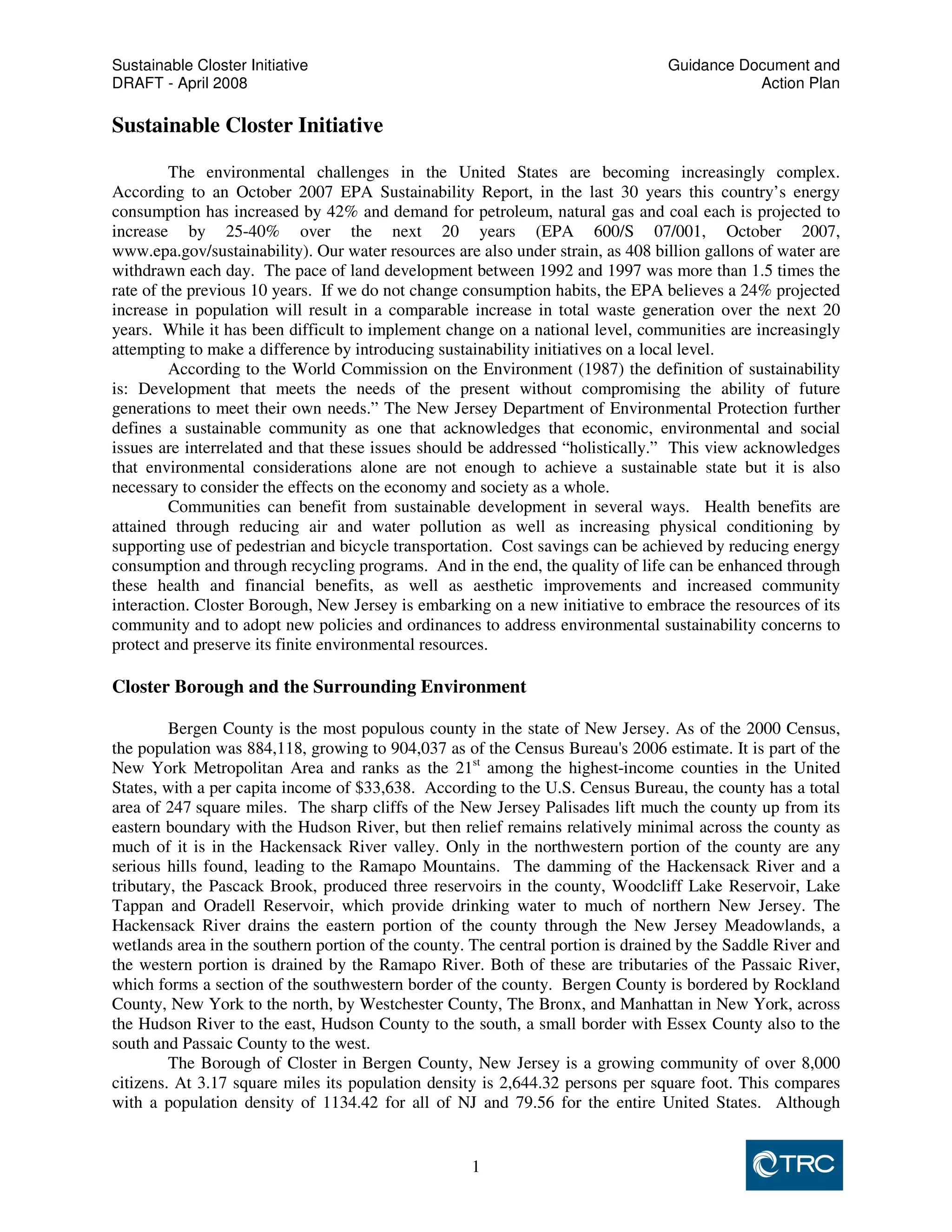
The environmental challenges in the United States are becoming increasingly complex. 
According to an October 2007 EPA Sustainability Report, in the last 30 years this country’s energy 
consumption has increased by 42% and demand for petroleum, natural gas and coal each is projected to 
increase by 25-40% over the next 20 years (EPA 600/S 07/001, October 2007, 
www.epa.gov/sustainability). Our water resources are also under strain, as 408 billion gallons of water are 
withdrawn each day. The pace of land development between 1992 and 1997 was more than 1.5 times the 
rate of the previous 10 years. If we do not change consumption habits, the EPA believes a 24% projected 
increase in population will result in a comparable increase in total waste generation over the next 20 
years. While it has been difficult to implement change on a national level, communities are increasingly 
attempting to make a difference by introducing sustainability initiatives on a local level. 
According to the World Commission on the Environment (1987) the definition of sustainability 
is: Development that meets the needs of the present without compromising the ability of future 
generations to meet their own needs.” The New Jersey Department of Environmental Protection further 
defines a sustainable community as one that acknowledges that economic, environmental and social 
issues are interrelated and that these issues should be addressed “holistically.” This view acknowledges 
that environmental considerations alone are not enough to achieve a sustainable state but it is also 
necessary to consider the effects on the economy and society as a whole. 
Communities can benefit from sustainable development in several ways. Health benefits are 
attained through reducing air and water pollution as well as increasing physical conditioning by 
supporting use of pedestrian and bicycle transportation. Cost savings can be achieved by reducing energy 
consumption and through recycling programs. And in the end, the quality of life can be enhanced through 
these health and financial benefits, as well as aesthetic improvements and increased community 
interaction. Closter Borough, New Jersey is embarking on a new initiative to embrace the resources of its 
community and to adopt new policies and ordinances to address environmental sustainability concerns to 
protect and preserve its finite environmental resources. 
Closter Borough and the Surrounding Environment 
Bergen County is the most populous county in the state of New Jersey. As of the 2000 Census, 
the population was 884,118, growing to 904,037 as of the Census Bureau's 2006 estimate. It is part of the 
New York Metropolitan Area and ranks as the 21st among the highest-income counties in the United 
States, with a per capita income of $33,638. According to the U.S. Census Bureau, the county has a total 
area of 247 square miles. The sharp cliffs of the New Jersey Palisades lift much the county up from its 
eastern boundary with the Hudson River, but then relief remains relatively minimal across the county as 
much of it is in the Hackensack River valley. Only in the northwestern portion of the county are any 
serious hills found, leading to the Ramapo Mountains. The damming of the Hackensack River and a 
tributary, the Pascack Brook, produced three reservoirs in the county, Woodcliff Lake Reservoir, Lake 
Tappan and Oradell Reservoir, which provide drinking water to much of northern New Jersey. The 
Hackensack River drains the eastern portion of the county through the New Jersey Meadowlands, a 
wetlands area in the southern portion of the county. The central portion is drained by the Saddle River and 
the western portion is drained by the Ramapo River. Both of these are tributaries of the Passaic River, 
which forms a section of the southwestern border of the county. Bergen County is bordered by Rockland 
County, New York to the north, by Westchester County, The Bronx, and Manhattan in New York, across 
the Hudson River to the east, Hudson County to the south, a small border with Essex County also to the 
south and Passaic County to the west. 
The Borough of Closter in Bergen County, New Jersey is a growing community of over 8,000 
citizens. At 3.17 square miles its population density is 2,644.32 persons per square foot. This compares 
with a population density of 1134.42 for all of NJ and 79.56 for the entire United States. Although
Sustainable Closter Initiative Guidance Document and 
DRAFT - April 2008 Action Plan 
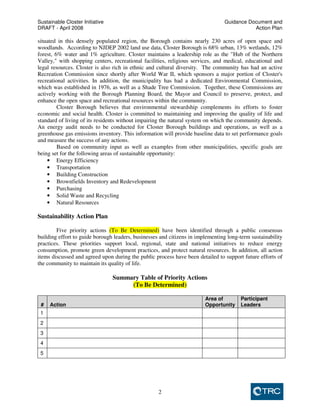
situated in this densely populated region, the Borough contains nearly 230 acres of open space and 
woodlands. According to NJDEP 2002 land use data, Closter Borough is 68% urban, 13% wetlands, 12% 
forest, 6% water and 1% agriculture. Closter maintains a leadership role as the "Hub of the Northern 
Valley," with shopping centers, recreational facilities, religious services, and medical, educational and 
legal resources. Closter is also rich in ethnic and cultural diversity. The community has had an active 
Recreation Commission since shortly after World War II, which sponsors a major portion of Closter's 
recreational activities. In addition, the municipality has had a dedicated Environmental Commission, 
which was established in 1976, as well as a Shade Tree Commission. Together, these Commissions are 
actively working with the Borough Planning Board, the Mayor and Council to preserve, protect, and 
enhance the open space and recreational resources within the community. 
Closter Borough believes that environmental stewardship complements its efforts to foster 
economic and social health. Closter is committed to maintaining and improving the quality of life and 
standard of living of its residents without impairing the natural system on which the community depends. 
An energy audit needs to be conducted for Closter Borough buildings and operations, as well as a 
greenhouse gas emissions inventory. This information will provide baseline data to set performance goals 
and measure the success of any actions. 
Based on community input as well as examples from other municipalities, specific goals are 
being set for the following areas of sustainable opportunity: 
2 
• Energy Efficiency 
• Transportation 
• Building Construction 
• Brownfields Inventory and Redevelopment 
• Purchasing 
• Solid Waste and Recycling 
• Natural Resources 
Sustainability Action Plan 
Five priority actions (To Be Determined) have been identified through a public consensus 
building effort to guide borough leaders, businesses and citizens in implementing long-term sustainability 
practices. These priorities support local, regional, state and national initiatives to reduce energy 
consumption, promote green development practices, and protect natural resources. In addition, all action 
items discussed and agreed upon during the public process have been detailed to support future efforts of 
the community to maintain its quality of life. 
Summary Table of Priority Actions 
(To Be Determined) 
# Action 
Area of 
Opportunity 
Participant 
Leaders 
1 
2 
3 
4 
5
Sustainable Closter Initiative Guidance Document and 
DRAFT - April 2008 Action Plan 
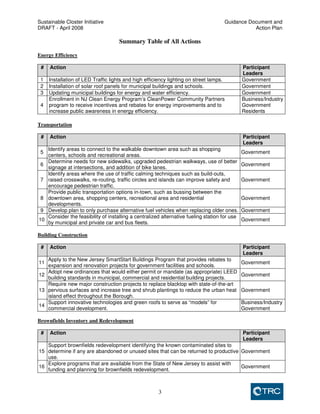
Summary Table of All Actions 
3 
Energy Efficiency 
# Action Participant 
Leaders 
1 Installation of LED Traffic lights and high efficiency lighting on street lamps. Government 
2 Installation of solar roof panels for municipal buildings and schools. Government 
3 Updating municipal buildings for energy and water efficiency. Government 
4 
Enrollment in NJ Clean Energy Program’s CleanPower Community Partners 
program to receive incentives and rebates for energy improvements and to 
increase public awareness in energy efficiency. 
Business/Industry 
Government 
Residents 
Transportation 
# Action Participant 
Leaders 
5 
Identify areas to connect to the walkable downtown area such as shopping 
centers, schools and recreational areas. 
Government 
6 
Determine needs for new sidewalks, upgraded pedestrian walkways, use of better 
signage at intersections, and addition of bike lanes. 
Government 
7 
Identify areas where the use of traffic calming techniques such as build-outs, 
raised crosswalks, re-routing, traffic circles and islands can improve safety and 
encourage pedestrian traffic. 
Government 
8 
Provide public transportation options in-town, such as bussing between the 
downtown area, shopping centers, recreational area and residential 
developments. 
Government 
9 Develop plan to only purchase alternative fuel vehicles when replacing older ones. Government 
10 
Consider the feasibility of installing a centralized alternative fueling station for use 
by municipal and private car and bus fleets. 
Government 
Building Construction 
# Action Participant 
Leaders 
11 
Apply to the New Jersey SmartStart Buildings Program that provides rebates to 
expansion and renovation projects for government facilities and schools. 
Government 
12 
Adopt new ordinances that would either permit or mandate (as appropriate) LEED 
building standards in municipal, commercial and residential building projects. 
Government 
13 
Require new major construction projects to replace blacktop with state-of-the-art 
pervious surfaces and increase tree and shrub plantings to reduce the urban heat 
island effect throughout the Borough. 
Government 
14 
Support innovative technologies and green roofs to serve as “models” for 
commercial development. 
Business/Industry 
Government 
Brownfields Inventory and Redevelopment 
# Action Participant 
Leaders 
15 
Support brownfields redevelopment identifying the known contaminated sites to 
determine if any are abandoned or unused sites that can be returned to productive 
use. 
Government 
16 
Explore programs that are available from the State of New Jersey to assist with 
funding and planning for brownfields redevelopment. 
Government
Sustainable Closter Initiative Guidance Document and 
DRAFT - April 2008 Action Plan 
4 
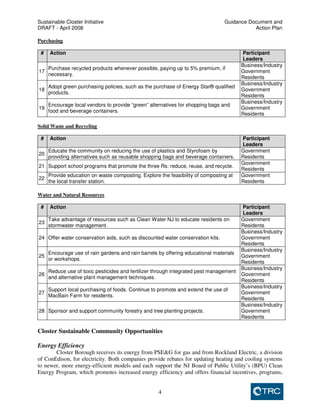
Purchasing 
# Action Participant 
Leaders 
17 
Purchase recycled products whenever possible, paying up to 5% premium, if 
necessary. 
Business/Industry 
Government 
Residents 
18 
Adopt green purchasing policies, such as the purchase of Energy Star® qualified 
products. 
Business/Industry 
Government 
Residents 
19 
Encourage local vendors to provide “green” alternatives for shopping bags and 
food and beverage containers. 
Business/Industry 
Government 
Residents 
Solid Waste and Recycling 
# Action Participant 
Leaders 
20 
Educate the community on reducing the use of plastics and Styrofoam by 
providing alternatives such as reusable shopping bags and beverage containers. 
Government 
Residents 
21 Support school programs that promote the three Rs: reduce, reuse, and recycle. 
Government 
Residents 
22 
Provide education on waste composting. Explore the feasibility of composting at 
the local transfer station. 
Government 
Residents 
Water and Natural Resources 
# Action Participant 
Leaders 
23 
Take advantage of resources such as Clean Water NJ to educate residents on 
stormwater management. 
Government 
Residents 
24 Offer water conservation aids, such as discounted water conservation kits. 
Business/Industry 
Government 
Residents 
25 
Encourage use of rain gardens and rain barrels by offering educational materials 
or workshops. 
Business/Industry 
Government 
Residents 
26 
Reduce use of toxic pesticides and fertilizer through integrated pest management 
and alternative plant management techniques. 
Business/Industry 
Government 
Residents 
27 
Support local purchasing of foods. Continue to promote and extend the use of 
MacBain Farm for residents. 
Business/Industry 
Government 
Residents 
28 Sponsor and support community forestry and tree planting projects. 
Business/Industry 
Government 
Residents 
Closter Sustainable Community Opportunities 
Energy Efficiency 
Closter Borough receives its energy from PSE&G for gas and from Rockland Electric, a division 
of ConEdison, for electricity. Both companies provide rebates for updating heating and cooling systems 
to newer, more energy-efficient models and each support the NJ Board of Public Utility’s (BPU) Clean 
Energy Program, which promotes increased energy efficiency and offers financial incentives, programs,
Sustainable Closter Initiative Guidance Document and 
DRAFT - April 2008 Action Plan 
and services for residential, commercial, and municipal customers to save energy, money, and the 
environment. 
The Borough of Closter can benefit from the Clean Energy Program in many ways. Through the 
Municipal Audit Program, the NJBPU will subsidize the cost of energy audits of government facilities in 
order to identify where efficiency improvements can be made. Closter can reduce the cost of installation 
of renewable energy systems such as solar electric, wind and sustainable biomass through financial 
incentives from The Customer On-Site Renewable Energy (CORE) Incentive Program and by selling 
New Jersey Renewable Energy Certificates to NJ electric suppliers. For instance, Montclair Township 
received an $8,800 rebate from the NJ BPU’s Clean Energy Program by installing LED traffic lights. By 
becoming a CleanPower Community through the NJ Clean Energy Program, Closter can commit to the 
20% by 2020 clean energy goal for NJ, which aims to reduce energy use 20% by 2020, increase the use of 
renewable energy to 20% and reduce greenhouse gases. 
Closter can also take advantage of the Program’s Community Outreach initiatives that promotes 
clean energy programs for the entire community. Residents can participate in the NJ CleanPower Choice 
Program that allows consumers the choice of renewable energy sources. Incentives are available for 
residents and businesses as well. 
Recommendations for energy efficiency improvements: 
• Installation of LED traffic lights and high efficiency lighting on street lamps. 
• Installation of photovoltaic (solar electric) roof panels for municipal buildings and schools. 
• Updating municipal buildings for energy and water efficiency. 
• Enrollment in NJ Clean Energy Program’s CleanPower Community Partners program to 
receive incentives and rebates for energy improvements and to increase public awareness in 
energy efficiency. 
5 
Transportation 
Closter Borough is situated in densely-populated Bergen County. Its proximity to New York City 
and other urban centers in New Jersey make Closter susceptible to high traffic volumes from local 
residents as well as commuter and commercial through-traffic from other towns. Closter has limited 
access to mass transit and no public train service, and like most other townships in New Jersey and across 
the United States, Closter has become dependent on the automobile as its primary mode of transportation. 
Many townships have been addressing this issue by creating more pedestrian- and bicycle-friendly 
communities. Sidewalk improvements and the installation of dedicated bicycle lanes and traffic 
calming techniques are some ways that can encourage residents to reduce automobile use. Closter already 
has a walkable downtown, and by connecting it to other areas of the community the township can take 
advantage of alternate modes of transportation. 
Recommendations for transportation improvements: 
• Identify areas to connect to the walkable downtown area such as shopping centers, schools 
and recreational areas. 
o Determine needs for new sidewalks, upgrading pedestrian walkways, use of better 
signage at intersections and addition of bike lanes. The NJ DOT has created a 
Bike/Pedestrian Action Plan which serves to assist communities in creating a strategy 
for improving bike and pedestrian activity. 
• Identify areas where the use of traffic calming techniques such as build-outs, raised 
crosswalks, re-routing, traffic circles and islands can improve safety and encourage 
pedestrian traffic. 
• Provide public transportation options in-town, such as bussing between the downtown area, 
shopping centers, recreational areas and residential developments.
Sustainable Closter Initiative Guidance Document and 
DRAFT - April 2008 Action Plan 
Closter Borough currently uses 75 municipal vehicles. Closter can take measures to reduce public 
fleet energy use and air emissions via fleet management and alternative technologies. Options to be 
considered include compressed natural gas cars and changing Municipal trucks over to biodiesel fuel. 
Recommendations for Municipal fleet energy reductions: 
• Develop plan to only purchase alternative fuel vehicles when replacing older ones. 
• Consider the feasibility of installing a centralized alternative fueling station for use by 
municipal and private car and bus fleets. 
6 
Building Construction 
Closter is a highly residential community with some light industry and commercial business and a 
strong track record of acquiring open space for preservation. Little land exists for development, and as a 
result, rebuilds are common in the township. Closter Borough can support sustainability by adopting 
green policies for municipal buildings and schools and encouraging green building initiatives through 
ordinances and incentive programs. 
Recommendations for green building construction: 
• Apply to the New Jersey SmartStart Buildings Program that provides rebates to expansion 
and renovation projects for government facilities and schools. 
• Adopt new ordinances that would either permit or mandate (as appropriate) LEED building 
standards in municipal, commercial and residential building projects. 
• Require new major construction projects to replace blacktop with state-of-the-art pervious 
surfaces and increase tree and shrub plantings to reduce the urban heat island effect 
throughout the Borough. The NJ Clean Energy Program provides rebates for planting trees 
on public streets as part of its Cool Cities Program. 
• Support innovative technologies such as rain gardens and green roofs to serve as “models” 
for commercial development. 
Brownfields Inventory and Redevelopment 
“Brownfields” are typically unused or underused properties that have a real or perceived soils 
and/or groundwater pollution. Examples of brownfields include former or current gasoline stations, 
drycleaners, or industrial buildings. There are 27 properties in Closter Borough that are on the New Jersey 
Department of Environmental Protection (NJDEP) “Known Contaminated Sites” listing. Many of these 
sites are being used while others may be ready for redevelopment. 
Recommendations for brownfields redevelopment: 
• The Borough should support brownfields redevelopment identifying the known contaminated 
sites to determine if any are abandoned or unused sites that can be returned to productive use. 
• Various programs are available from the State of New Jersey to assist with funding and 
planning for brownfield redevelopment. More information is available in the Brownfields 
Redevelopment Resource Kit at: 
http://www.nj.gov/dca/osg/docs/brownfieldsresourcekit.pdf. 
Purchasing 
Closter Borough can support green business practices by providing programs and incentives for 
sustainable business and business practices. Residents expressed concern for the use of plastics for 
disposable bottles and shopping bags as well as Styrofoam cup use. The Borough can encourage local 
vendors to provide alternate products for sale, such as reusable shopping bags and coffee cups. The 
Borough can also encourage local vendors to supply and promote energy saving products such as compact 
fluorescent light bulbs.
Sustainable Closter Initiative Guidance Document and 
DRAFT - April 2008 Action Plan 
Recommendations for sustainable purchasing: 
• Purchase recycled products whenever possible, paying up to 5% premium, if necessary. 
• Adopt green purchasing policies, such as the purchase of Energy Star® qualified products for 
7 
all municipal acquisitions. 
• Encourage local vendors to provide “green” alternatives for shopping bags and food and 
beverage containers. 
• Coordinate with Closter Chamber of Commerce to facilitate efforts. 
Solid Waste and Recycling 
In the calendar year 2007 the Closter produced approximately 4000 tons of waste. Closter has a 
very successful mandatory curbside recycling program and a computer recycling program. Residents can 
also drop off select recyclable materials at the transfer station located in Closter, provided they obtain a 
permit from the Recycling Center. The Borough can continue to support the programs through education 
efforts in the schools and community. 
Recommendations for solid waste and recycling efforts: 
• Educate the community on reducing the use of plastics and Styrofoam by providing 
alternatives such as reusable shopping bags and beverage containers. 
• Support school programs that promote the three Rs: reduce, reuse, and recycle. 
• Provide education on waste composting. Explore the feasibility of composting at the local 
waste transfer station. 
Water and Natural Resources 
Closter Borough lies between the Hudson and Hackensack River valleys. The Borough receives 
its water supply from the Oradell Reservoir, the terminal reservoir of a larger water supply system 
associated with the Hackensack River. The watershed drainage basin for the Oradell Reservoir 
encompasses 113 square miles, and serves 60 communities in most of Bergen County and parts of 
Hudson County, NJ. Closter’s location at the base of the palisades is the place for water to go on its way 
to the Reservoir and as area development has increased, there has been a reduction of open space to 
absorb water after storms. Street flooding and land erosion is common in Closter, and the Borough uses 
open space acquisition and town regulations, such as impervious cover restrictions and stormwater 
management, to mitigate flooding and stormwater runoff. Closter Borough can conserve its water and 
natural resources by requiring and promoting water conservation and use efficiency as well as reinforcing 
stormwater management best practices. 
Recommendations for water and natural resource conservation: 
• Take advantage of resources such as Clean Water NJ to educate residents on stormwater 
management. 
• Offer water conservation aids. United Water of NJ in conjunction with Niagara Conservation 
provides water conservation kits at discounted costs, ranging from $5-$15. 
• Encourage use of rain gardens and rain barrels by offering educational materials or 
workshops. 
• Reduce use of toxic pesticides and fertilizer on municipal and school properties though 
integrated pest management and alternative plant management techniques. 
• Support local purchasing of foods (fresh produce for residents: shortens distance from farm to 
table, which reduces energy use). Continue to promote and extend use of the MacBain Farm 
for residents. 
• Sponsor and support community forestry and tree planting projects.

Sustainable closter initative update

  • 1.
    Sustainable Closter InitiativeGuidance Document and DRAFT - April 2008 Action Plan 1 Sustainable Closter Initiative The environmental challenges in the United States are becoming increasingly complex. According to an October 2007 EPA Sustainability Report, in the last 30 years this country’s energy consumption has increased by 42% and demand for petroleum, natural gas and coal each is projected to increase by 25-40% over the next 20 years (EPA 600/S 07/001, October 2007, www.epa.gov/sustainability). Our water resources are also under strain, as 408 billion gallons of water are withdrawn each day. The pace of land development between 1992 and 1997 was more than 1.5 times the rate of the previous 10 years. If we do not change consumption habits, the EPA believes a 24% projected increase in population will result in a comparable increase in total waste generation over the next 20 years. While it has been difficult to implement change on a national level, communities are increasingly attempting to make a difference by introducing sustainability initiatives on a local level. According to the World Commission on the Environment (1987) the definition of sustainability is: Development that meets the needs of the present without compromising the ability of future generations to meet their own needs.” The New Jersey Department of Environmental Protection further defines a sustainable community as one that acknowledges that economic, environmental and social issues are interrelated and that these issues should be addressed “holistically.” This view acknowledges that environmental considerations alone are not enough to achieve a sustainable state but it is also necessary to consider the effects on the economy and society as a whole. Communities can benefit from sustainable development in several ways. Health benefits are attained through reducing air and water pollution as well as increasing physical conditioning by supporting use of pedestrian and bicycle transportation. Cost savings can be achieved by reducing energy consumption and through recycling programs. And in the end, the quality of life can be enhanced through these health and financial benefits, as well as aesthetic improvements and increased community interaction. Closter Borough, New Jersey is embarking on a new initiative to embrace the resources of its community and to adopt new policies and ordinances to address environmental sustainability concerns to protect and preserve its finite environmental resources. Closter Borough and the Surrounding Environment Bergen County is the most populous county in the state of New Jersey. As of the 2000 Census, the population was 884,118, growing to 904,037 as of the Census Bureau's 2006 estimate. It is part of the New York Metropolitan Area and ranks as the 21st among the highest-income counties in the United States, with a per capita income of $33,638. According to the U.S. Census Bureau, the county has a total area of 247 square miles. The sharp cliffs of the New Jersey Palisades lift much the county up from its eastern boundary with the Hudson River, but then relief remains relatively minimal across the county as much of it is in the Hackensack River valley. Only in the northwestern portion of the county are any serious hills found, leading to the Ramapo Mountains. The damming of the Hackensack River and a tributary, the Pascack Brook, produced three reservoirs in the county, Woodcliff Lake Reservoir, Lake Tappan and Oradell Reservoir, which provide drinking water to much of northern New Jersey. The Hackensack River drains the eastern portion of the county through the New Jersey Meadowlands, a wetlands area in the southern portion of the county. The central portion is drained by the Saddle River and the western portion is drained by the Ramapo River. Both of these are tributaries of the Passaic River, which forms a section of the southwestern border of the county. Bergen County is bordered by Rockland County, New York to the north, by Westchester County, The Bronx, and Manhattan in New York, across the Hudson River to the east, Hudson County to the south, a small border with Essex County also to the south and Passaic County to the west. The Borough of Closter in Bergen County, New Jersey is a growing community of over 8,000 citizens. At 3.17 square miles its population density is 2,644.32 persons per square foot. This compares with a population density of 1134.42 for all of NJ and 79.56 for the entire United States. Although
  • 2.
    Sustainable Closter InitiativeGuidance Document and DRAFT - April 2008 Action Plan situated in this densely populated region, the Borough contains nearly 230 acres of open space and woodlands. According to NJDEP 2002 land use data, Closter Borough is 68% urban, 13% wetlands, 12% forest, 6% water and 1% agriculture. Closter maintains a leadership role as the "Hub of the Northern Valley," with shopping centers, recreational facilities, religious services, and medical, educational and legal resources. Closter is also rich in ethnic and cultural diversity. The community has had an active Recreation Commission since shortly after World War II, which sponsors a major portion of Closter's recreational activities. In addition, the municipality has had a dedicated Environmental Commission, which was established in 1976, as well as a Shade Tree Commission. Together, these Commissions are actively working with the Borough Planning Board, the Mayor and Council to preserve, protect, and enhance the open space and recreational resources within the community. Closter Borough believes that environmental stewardship complements its efforts to foster economic and social health. Closter is committed to maintaining and improving the quality of life and standard of living of its residents without impairing the natural system on which the community depends. An energy audit needs to be conducted for Closter Borough buildings and operations, as well as a greenhouse gas emissions inventory. This information will provide baseline data to set performance goals and measure the success of any actions. Based on community input as well as examples from other municipalities, specific goals are being set for the following areas of sustainable opportunity: 2 • Energy Efficiency • Transportation • Building Construction • Brownfields Inventory and Redevelopment • Purchasing • Solid Waste and Recycling • Natural Resources Sustainability Action Plan Five priority actions (To Be Determined) have been identified through a public consensus building effort to guide borough leaders, businesses and citizens in implementing long-term sustainability practices. These priorities support local, regional, state and national initiatives to reduce energy consumption, promote green development practices, and protect natural resources. In addition, all action items discussed and agreed upon during the public process have been detailed to support future efforts of the community to maintain its quality of life. Summary Table of Priority Actions (To Be Determined) # Action Area of Opportunity Participant Leaders 1 2 3 4 5
  • 3.
    Sustainable Closter InitiativeGuidance Document and DRAFT - April 2008 Action Plan Summary Table of All Actions 3 Energy Efficiency # Action Participant Leaders 1 Installation of LED Traffic lights and high efficiency lighting on street lamps. Government 2 Installation of solar roof panels for municipal buildings and schools. Government 3 Updating municipal buildings for energy and water efficiency. Government 4 Enrollment in NJ Clean Energy Program’s CleanPower Community Partners program to receive incentives and rebates for energy improvements and to increase public awareness in energy efficiency. Business/Industry Government Residents Transportation # Action Participant Leaders 5 Identify areas to connect to the walkable downtown area such as shopping centers, schools and recreational areas. Government 6 Determine needs for new sidewalks, upgraded pedestrian walkways, use of better signage at intersections, and addition of bike lanes. Government 7 Identify areas where the use of traffic calming techniques such as build-outs, raised crosswalks, re-routing, traffic circles and islands can improve safety and encourage pedestrian traffic. Government 8 Provide public transportation options in-town, such as bussing between the downtown area, shopping centers, recreational area and residential developments. Government 9 Develop plan to only purchase alternative fuel vehicles when replacing older ones. Government 10 Consider the feasibility of installing a centralized alternative fueling station for use by municipal and private car and bus fleets. Government Building Construction # Action Participant Leaders 11 Apply to the New Jersey SmartStart Buildings Program that provides rebates to expansion and renovation projects for government facilities and schools. Government 12 Adopt new ordinances that would either permit or mandate (as appropriate) LEED building standards in municipal, commercial and residential building projects. Government 13 Require new major construction projects to replace blacktop with state-of-the-art pervious surfaces and increase tree and shrub plantings to reduce the urban heat island effect throughout the Borough. Government 14 Support innovative technologies and green roofs to serve as “models” for commercial development. Business/Industry Government Brownfields Inventory and Redevelopment # Action Participant Leaders 15 Support brownfields redevelopment identifying the known contaminated sites to determine if any are abandoned or unused sites that can be returned to productive use. Government 16 Explore programs that are available from the State of New Jersey to assist with funding and planning for brownfields redevelopment. Government
  • 4.
    Sustainable Closter InitiativeGuidance Document and DRAFT - April 2008 Action Plan 4 Purchasing # Action Participant Leaders 17 Purchase recycled products whenever possible, paying up to 5% premium, if necessary. Business/Industry Government Residents 18 Adopt green purchasing policies, such as the purchase of Energy Star® qualified products. Business/Industry Government Residents 19 Encourage local vendors to provide “green” alternatives for shopping bags and food and beverage containers. Business/Industry Government Residents Solid Waste and Recycling # Action Participant Leaders 20 Educate the community on reducing the use of plastics and Styrofoam by providing alternatives such as reusable shopping bags and beverage containers. Government Residents 21 Support school programs that promote the three Rs: reduce, reuse, and recycle. Government Residents 22 Provide education on waste composting. Explore the feasibility of composting at the local transfer station. Government Residents Water and Natural Resources # Action Participant Leaders 23 Take advantage of resources such as Clean Water NJ to educate residents on stormwater management. Government Residents 24 Offer water conservation aids, such as discounted water conservation kits. Business/Industry Government Residents 25 Encourage use of rain gardens and rain barrels by offering educational materials or workshops. Business/Industry Government Residents 26 Reduce use of toxic pesticides and fertilizer through integrated pest management and alternative plant management techniques. Business/Industry Government Residents 27 Support local purchasing of foods. Continue to promote and extend the use of MacBain Farm for residents. Business/Industry Government Residents 28 Sponsor and support community forestry and tree planting projects. Business/Industry Government Residents Closter Sustainable Community Opportunities Energy Efficiency Closter Borough receives its energy from PSE&G for gas and from Rockland Electric, a division of ConEdison, for electricity. Both companies provide rebates for updating heating and cooling systems to newer, more energy-efficient models and each support the NJ Board of Public Utility’s (BPU) Clean Energy Program, which promotes increased energy efficiency and offers financial incentives, programs,
  • 5.
    Sustainable Closter InitiativeGuidance Document and DRAFT - April 2008 Action Plan and services for residential, commercial, and municipal customers to save energy, money, and the environment. The Borough of Closter can benefit from the Clean Energy Program in many ways. Through the Municipal Audit Program, the NJBPU will subsidize the cost of energy audits of government facilities in order to identify where efficiency improvements can be made. Closter can reduce the cost of installation of renewable energy systems such as solar electric, wind and sustainable biomass through financial incentives from The Customer On-Site Renewable Energy (CORE) Incentive Program and by selling New Jersey Renewable Energy Certificates to NJ electric suppliers. For instance, Montclair Township received an $8,800 rebate from the NJ BPU’s Clean Energy Program by installing LED traffic lights. By becoming a CleanPower Community through the NJ Clean Energy Program, Closter can commit to the 20% by 2020 clean energy goal for NJ, which aims to reduce energy use 20% by 2020, increase the use of renewable energy to 20% and reduce greenhouse gases. Closter can also take advantage of the Program’s Community Outreach initiatives that promotes clean energy programs for the entire community. Residents can participate in the NJ CleanPower Choice Program that allows consumers the choice of renewable energy sources. Incentives are available for residents and businesses as well. Recommendations for energy efficiency improvements: • Installation of LED traffic lights and high efficiency lighting on street lamps. • Installation of photovoltaic (solar electric) roof panels for municipal buildings and schools. • Updating municipal buildings for energy and water efficiency. • Enrollment in NJ Clean Energy Program’s CleanPower Community Partners program to receive incentives and rebates for energy improvements and to increase public awareness in energy efficiency. 5 Transportation Closter Borough is situated in densely-populated Bergen County. Its proximity to New York City and other urban centers in New Jersey make Closter susceptible to high traffic volumes from local residents as well as commuter and commercial through-traffic from other towns. Closter has limited access to mass transit and no public train service, and like most other townships in New Jersey and across the United States, Closter has become dependent on the automobile as its primary mode of transportation. Many townships have been addressing this issue by creating more pedestrian- and bicycle-friendly communities. Sidewalk improvements and the installation of dedicated bicycle lanes and traffic calming techniques are some ways that can encourage residents to reduce automobile use. Closter already has a walkable downtown, and by connecting it to other areas of the community the township can take advantage of alternate modes of transportation. Recommendations for transportation improvements: • Identify areas to connect to the walkable downtown area such as shopping centers, schools and recreational areas. o Determine needs for new sidewalks, upgrading pedestrian walkways, use of better signage at intersections and addition of bike lanes. The NJ DOT has created a Bike/Pedestrian Action Plan which serves to assist communities in creating a strategy for improving bike and pedestrian activity. • Identify areas where the use of traffic calming techniques such as build-outs, raised crosswalks, re-routing, traffic circles and islands can improve safety and encourage pedestrian traffic. • Provide public transportation options in-town, such as bussing between the downtown area, shopping centers, recreational areas and residential developments.
  • 6.
    Sustainable Closter InitiativeGuidance Document and DRAFT - April 2008 Action Plan Closter Borough currently uses 75 municipal vehicles. Closter can take measures to reduce public fleet energy use and air emissions via fleet management and alternative technologies. Options to be considered include compressed natural gas cars and changing Municipal trucks over to biodiesel fuel. Recommendations for Municipal fleet energy reductions: • Develop plan to only purchase alternative fuel vehicles when replacing older ones. • Consider the feasibility of installing a centralized alternative fueling station for use by municipal and private car and bus fleets. 6 Building Construction Closter is a highly residential community with some light industry and commercial business and a strong track record of acquiring open space for preservation. Little land exists for development, and as a result, rebuilds are common in the township. Closter Borough can support sustainability by adopting green policies for municipal buildings and schools and encouraging green building initiatives through ordinances and incentive programs. Recommendations for green building construction: • Apply to the New Jersey SmartStart Buildings Program that provides rebates to expansion and renovation projects for government facilities and schools. • Adopt new ordinances that would either permit or mandate (as appropriate) LEED building standards in municipal, commercial and residential building projects. • Require new major construction projects to replace blacktop with state-of-the-art pervious surfaces and increase tree and shrub plantings to reduce the urban heat island effect throughout the Borough. The NJ Clean Energy Program provides rebates for planting trees on public streets as part of its Cool Cities Program. • Support innovative technologies such as rain gardens and green roofs to serve as “models” for commercial development. Brownfields Inventory and Redevelopment “Brownfields” are typically unused or underused properties that have a real or perceived soils and/or groundwater pollution. Examples of brownfields include former or current gasoline stations, drycleaners, or industrial buildings. There are 27 properties in Closter Borough that are on the New Jersey Department of Environmental Protection (NJDEP) “Known Contaminated Sites” listing. Many of these sites are being used while others may be ready for redevelopment. Recommendations for brownfields redevelopment: • The Borough should support brownfields redevelopment identifying the known contaminated sites to determine if any are abandoned or unused sites that can be returned to productive use. • Various programs are available from the State of New Jersey to assist with funding and planning for brownfield redevelopment. More information is available in the Brownfields Redevelopment Resource Kit at: http://www.nj.gov/dca/osg/docs/brownfieldsresourcekit.pdf. Purchasing Closter Borough can support green business practices by providing programs and incentives for sustainable business and business practices. Residents expressed concern for the use of plastics for disposable bottles and shopping bags as well as Styrofoam cup use. The Borough can encourage local vendors to provide alternate products for sale, such as reusable shopping bags and coffee cups. The Borough can also encourage local vendors to supply and promote energy saving products such as compact fluorescent light bulbs.
  • 7.
    Sustainable Closter InitiativeGuidance Document and DRAFT - April 2008 Action Plan Recommendations for sustainable purchasing: • Purchase recycled products whenever possible, paying up to 5% premium, if necessary. • Adopt green purchasing policies, such as the purchase of Energy Star® qualified products for 7 all municipal acquisitions. • Encourage local vendors to provide “green” alternatives for shopping bags and food and beverage containers. • Coordinate with Closter Chamber of Commerce to facilitate efforts. Solid Waste and Recycling In the calendar year 2007 the Closter produced approximately 4000 tons of waste. Closter has a very successful mandatory curbside recycling program and a computer recycling program. Residents can also drop off select recyclable materials at the transfer station located in Closter, provided they obtain a permit from the Recycling Center. The Borough can continue to support the programs through education efforts in the schools and community. Recommendations for solid waste and recycling efforts: • Educate the community on reducing the use of plastics and Styrofoam by providing alternatives such as reusable shopping bags and beverage containers. • Support school programs that promote the three Rs: reduce, reuse, and recycle. • Provide education on waste composting. Explore the feasibility of composting at the local waste transfer station. Water and Natural Resources Closter Borough lies between the Hudson and Hackensack River valleys. The Borough receives its water supply from the Oradell Reservoir, the terminal reservoir of a larger water supply system associated with the Hackensack River. The watershed drainage basin for the Oradell Reservoir encompasses 113 square miles, and serves 60 communities in most of Bergen County and parts of Hudson County, NJ. Closter’s location at the base of the palisades is the place for water to go on its way to the Reservoir and as area development has increased, there has been a reduction of open space to absorb water after storms. Street flooding and land erosion is common in Closter, and the Borough uses open space acquisition and town regulations, such as impervious cover restrictions and stormwater management, to mitigate flooding and stormwater runoff. Closter Borough can conserve its water and natural resources by requiring and promoting water conservation and use efficiency as well as reinforcing stormwater management best practices. Recommendations for water and natural resource conservation: • Take advantage of resources such as Clean Water NJ to educate residents on stormwater management. • Offer water conservation aids. United Water of NJ in conjunction with Niagara Conservation provides water conservation kits at discounted costs, ranging from $5-$15. • Encourage use of rain gardens and rain barrels by offering educational materials or workshops. • Reduce use of toxic pesticides and fertilizer on municipal and school properties though integrated pest management and alternative plant management techniques. • Support local purchasing of foods (fresh produce for residents: shortens distance from farm to table, which reduces energy use). Continue to promote and extend use of the MacBain Farm for residents. • Sponsor and support community forestry and tree planting projects.