
Ikegami Tsushinki Co., Ltd.
Sept 2016
UHK-430 – The Latest Technology
1
INTRODUCTION
4K native sensors and a 3-chip prism deliver an overwhelming sense of
resolution. Compatible with B4 mount HD lenses, which are widely used by
broadcasters and production houses, the UHK-430 enables high resolution 4K
shooting without wasting existing assets.
This document explains the latest innovative technologies employed in the
UHK-430 including its newly developed 2/3-inch native 4K CMOS sensors and
next generation high speed video processor, AXII.
2
Table of Contents
1. Sensors --------------------------------------------------------------------------------------3
2. Comparison of Imaging Technology-----------------------------------------------5
3. High Speed Video Processor - AXII - ------------------------------------------9
4. Transmission Bandwidth ------------------------------------------------------------ 12
5. Future Expansion----------------------------------------------------------------------- 13
6. Multi Interface---------------------------------------------------------------------------- 14
7. VoIP ----------------------------------------------------------------------------------------- 16
8. HDR ----------------------------------------------------------------------------------------- 20
9. Mechanical Design --------------------------------------------------------------------- 24
10. Focusing advantage-------------------------------------------------------------------- 29
3
1. Sensors
We have developed an image sensor to produce a native 4K camera supporting
the 2/3 - inch bayonet lens mount. Compared with conventional 2K image
sensors, 4K image sensors have 1/2 the pixel-pitch and 1/4 the total pixel area.
To achieve high performance 4K pixels, we needed to develop the sensor with
focus on its sensitivity, S/N and dynamic range.
The UHK-430 employs newly developed 2/3" 4K sensors.
They feature improved sensitivity thanks to an anti-
reflection coating on both sides of the cover glass.
The coating also minimizes the unwanted ghost
effects.
Image of cover glass
= AR coating
= cover glass
For further sensitivity improvement, the sensor has been designed with a
suitable micro-lens. It prevents the loss of sensitivity when the iris is open.
Also thanks to the minimization of parasitic capacitance of the floating diffusion
layer, the light to voltage conversion gain has been improved.
Micro lens
Floating Diffusion
4
Specifications for Image Sensor
5
2. Comparison of Imaging Technology
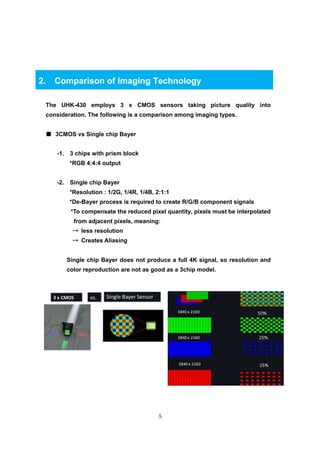
The UHK-430 employs 3 x CMOS sensors taking picture quality into
consideration. The following is a comparison among imaging types.
■ 3CMOS vs Single chip Bayer
-1. 3 chips with prism block
*RGB 4:4:4 output
-2. Single chip Bayer
*Resolution : 1/2G, 1/4R, 1/4B, 2:1:1
*De-Bayer process is required to create R/G/B component signals
*To compensate the reduced pixel quantity, pixels must be interpolated
from adjacent pixels, meaning:
→→→→ less resolution
→→→→ Creates Aliasing
Single chip Bayer does not produce a full 4K signal, so resolution and
color reproduction are not as good as a 3chip model.
6
-3. Advantage of Native 4K 3CMOS against Single Chip Sensor
・・・・Sensitivity
In the case of the Single-Chip Sensor, the wavelength region for each RGB
color channel is created by the On-Chip filter, so, the light in the wavelength
region where it is not intended is not used.
In contrast, in the case of the 3-Chip Sensor block, light is split by a prism,
separating the light by wavelength region for each image sensor of RGB.
All of the light for each color is directed to the corresonding sensor, resulting
in higher light utilization.
So, a camera with better S/N and sensitivity can be achieved with a 3-Chip
Sensor block.
・・・・Resolution
3CMOS achieves full resolution in RGB.
Single chip Bayer achieves 4K resolution by De-Bayer process, but the
resolution for any single color of RGB is equal to 2K.
・Aliasing
Various kinds of Interpolation algorithm are being developed regarding the
De-Bayer process, but, we can say it is difficult to reconcile getting higher
resolution and less aliasing. If the optical low pass filter is specified for 4K
resolution, then spacial frequencies exceeding the Nyquist limit will produce
aliasing in the color channels, especially the R and B channels.
Conversely, if the optical low pass filter is specified to limit aliasing, 4K
resolution in luminance can not be achieved.
7
■ Native 4K sensor vs 2K pixel shift
Pixel shift is a method to increase resolution by shifting the sensor pixels with
half pixel (half pitch) to interpolate the spacial information. There are two
methods, 3 chip pixel shift and 4 chip pixel shift.
-1. Advantage of pixel shift
*Limiting resolution in luminance signal is improved.
-2. Disadvantage of pixel shift
*Sensor size remains unchanged, so R/G/B MTF is the same as that of 2K.
*3 chip pixel shift has significant loss of the effect because of lens
abberation, the limiting resolution does not improve in the corners.
-3. Advantage of Native 4K 3CMOS againest 2K pixel shift
・・・・Resolution
Pixel shift is a method to increase resolution by shifting pixels between 2K
image sensors by half pitch, complementing spatial information. There are
two methods for pixel shift. One is 3-Chip Pixel Shift, shifting the G-ch
image sensor half pitch compared to R/B , and another is 4-Chip Dual G
(R,B,G1,G2),using two G-ch sensors.
Reduction of Aliasing by
the pixel shift or dual Green
2K CMOS Aliasing Response limitation
2K CMOS Aliasing
4K MOS
Aliasing
1000
4K CMOS Resolution
2K CMOS Resolution
2000 4000
Aperture 50%
(TVL)
0
0.5
0
(Response)
1
Sensor Response
8
However, with both methods, it is not possible to get 2 times the resolution
by shifting half pitch due to the following reasons.
Recent image sensors have higher aperture ratio for each pixel for higher
sensitivity, and the signal for spatial direction is output as the integral
value of the pixel area.
So neighboring pixels at intervals of half pitch have some redundent light
reception resulting in only 1.6 times the resolution even if every pixel is
ideally shifted by half pitch.
Especially, in the case of pixel shift with RGB channels, even though there
is increased resolution at the center of the screen, the resolution does not
improve in the corners due to influence of chromatic aberration. And even
if the aberration is corrected in the camera DSP, it is too late to improve the
spacial sampling of the incoming light.
・・・・Sensitivity
In the case of pixel shift with dual G channels and 4-Chip, the light is split
into two G channels by a half mirror, so, the sensitivity is lowered to 1/2.
Moreover, the limiting F-value for most 3-Chip prisms is F1.4, but in the
case of a 4-Chip prism, it is difficult to achieve F1.4 due to the prism
structure.
Therefore, if you use a lens having brighter maximum aperture, there may
be no benefit due to the limitation of the dual G prism.
9
3. High Speed Video Processor - AXII -
Ikegami has developed a processing engine
for its next-generation HD, 4K and 8K
format cameras. This ASIC can perform high speed
processing of HD, 4K (4 x HD) and 8K (16 x HD)
super high-resolution video signals in various
formats and frame rates. The new processor,
called AXII incorporates features and interfaces
for broadcast camera systems. It delivers high
quality,high reliability and lower power consumption.
This AXII processor will be used as a platform AXII processor
to accelerate product development.
■ Features
- High Speed Signal Processing and Added-Value Features
Video processing is the core function of a camera's internal electronics. It
controls each correction circuit and the interface to external units such as lens
and viewfinder. High speed processing is needed to handle standards such as
HD, 4K and 8K.
- Built-in 16-Axis Color Correction
Chroma and hue level can be adjusted within 16-axes individually, for both
normal programme production and to allow color-matching with other cameras.
This high-level correction can be processed in real time.
10
- 3D-LUT Color Gamut Correction
The ITU-R BT.2020
standard for 4K/8K covers
a wider area than BT.709 for
HD. The new Ikegami
processor conforms to ITU-
R BT.2020 and provides
color gamut correction for
varrious video formats with
a 3D-LUT system.
16-axis color matrix Original Color corrected as image
11
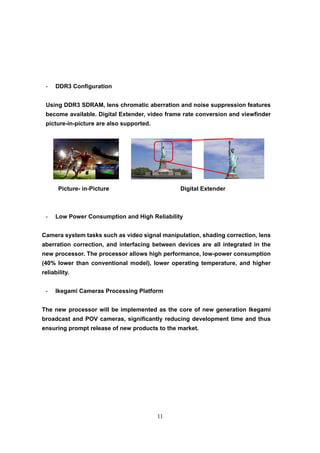
- DDR3 Configuration
Using DDR3 SDRAM, lens chromatic aberration and noise suppression features
become available. Digital Extender, video frame rate conversion and viewfinder
picture-in-picture are also supported.
Picture- in-Picture Digital Extender
- Low Power Consumption and High Reliability
Camera system tasks such as video signal manipulation, shading correction, lens
aberration correction, and interfacing between devices are all integrated in the
new processor. The processor allows high performance, low-power consumption
(40% lower than conventional model), lower operating temperature, and higher
reliability.
- Ikegami Cameras Processing Platform
The new processor will be implemented as the core of new generation Ikegami
broadcast and POV cameras, significantly reducing development time and thus
ensuring prompt release of new products to the market.
12
4. Transmission Bandwidth
4. ssioandwidth
The transmission bandwidth between the UHK-430 camera head and the CCU-430
Camera Control unit is optical 40Gbps. Thanks to this, the video signal from the
Image sensor block is transmitted to the CCU with uncompressed 4:4:4 signal.
The 4K video singal processing is done at the CCU. This means the processing such
as lens abberation correction, DTL and color matrix are processed inside the CCU. It
is ideal to have uncompressed video signals available to these video processing
circuits – this is the reason why we employ 40Gbps bandwidth for the transmission
system..
In case the transmission is made with 4:2:2 bandwidth, it affects the chroma key
performance because the bandwidth of the color difference (Pb/Pr) signals is
restricted. Even when the output from the CCU is 4:2:2, the 4:4:4 uncompressed
transmissiion produces better quality than compressed 4:2:2 transmission. Our
40Gbps transmission system is transmitted as 4 x 10Gbps with WDM (Wavelength
Division Multiplex). It has the advantage of extended bandwidth, and has no
disadvantage such as loss of transmission distance compared to other 10Gbps
transmission systems.
Signal Path between Camera and CCU
13
5. Future Expansion
More complete functionality
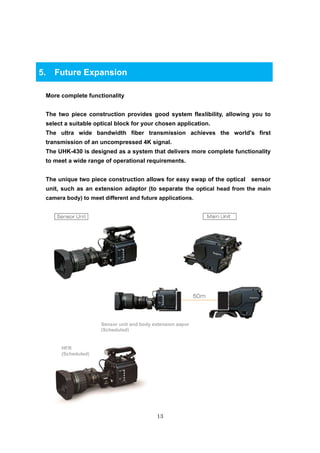
The two piece construction provides good system flexlibility, allowing you to
select a suitable optical block for your chosen application.
The ultra wide bandwidth fiber transmission achieves the world's first
transmission of an uncompressed 4K signal.
The UHK-430 is designed as a system that delivers more complete functionality
to meet a wide range of operational requirements.
The unique two piece construction allows for easy swap of the optical sensor
unit, such as an extension adaptor (to separate the optical head from the main
camera body) to meet different and future applications.
Sensor unit and body extension aapor
(Scheduled)
HFR
(Scheduled)
14
6. Multi Interface
4K output (3G-SDI x4) is available as standard. It is selectable between Quad Link
Square Division and 2 Sample Interleave (Level-A/B).
Also, 4K/2KHD simultaneous output and 2K HD cut-out from the 4K image is
available (Option).
Moreover, the CCU-430 Camera Control Unit has been designed taking into
consideration that it would support 12G-SDI, Simultaneous-Output and VoIP
interface etc. by swapping the rear plug-in module. So it has flexibility to support
future trends for 4K systems.
■ 12G-SDI Option Board
12G-SDI Option Board
It is possible to switch the outputs between 12G-SDI and 3G-SDI Quad Link.
The board is selectable among following three types according to customer’s
application.
1) 12G-SDI x8
2) 12G-SDIx4 + 3G-SDIx4
3) 3G-SDIx4 + 3G-SDI x4
Transmission Length for 12G-SDI Signal: Approx 70m (When using a low loss
coaxial cable)
*The transmission lengthwill change depending on the type and manufacture of
the coaxial cable and the specification of the device receiving the 12G-SDI
signal.
15
■ Simultaneous-Output Option Board
HD_OUT Board
VP_OUT Board (STD)
By mounting HD_VP Board on CCU front side and HD_OUT Board on rear, 4K/2K
simulcast is available.
From VP_OUT Board : 4K Quad Link 2 CH 8 Output (OUT-1/OUT-2)
From HD_OUT Board: HD/3G-SDI 2 CH 8 Output (OUT-3/OUT-4)
From HD/3G-SDI from HD_OUT Board, down-converted signal and HD cut-out signal
from 4K can be output simultaneously.
Option Board Output Chart
4K Quad
Link
Output
4K 12G-
SDI
Output
HD D/C
Output
HD Cut-
Out
Output
HD D/C
+Cut-out
Simul-
4K&2K
simul-
Out
Standard ✓ ✓
With Simul-
Out Option
Board
✓ ✓ ✓ ✓ ✓
12G_Out
Option Board
✓ ✓ ✓
12G_Out Option
Board + Simul-
Out Option
Board
✓ ✓ ✓ ✓ ✓ ✓
■ VoIP Option Board
The VoIP board capsulises the main video and audio signals, transmitting them
as a packet. VoIP transmission is available by an optional board.
16
7. VoIP
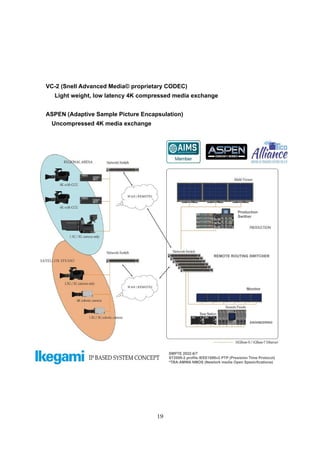
Transporting separate video, audio, and metadata as independent IP multicast
streams is essential in order to realize IP-based broadcast and media facilities
through the integration and interoperability of an open format.
As of April, 2016, Ikegami has joined alliances for IP media solutions such as,
AIMS, ASPEN, and TICO, facilitating transition to IP based systems design.
Flexibility and scalable mechanism in the IP technologies are the key to handle
higher resolutions such as 4K and 8K and higher frame rates such as 50/60P and
even 100/120P. They would also offer the most intelligent solutions in light of
High Dynamic Range and Wider Color Space.
Ikegami products will be compliant to the following formats and standards,
supporting device discovery mechanism such as AMWA NMOS (Networked
Media Open Specifications) and Precision Time Protocol (PTP) timing
mechanism, distributed to endpoints by ST 2059-2 profile IEEE1588v2 PTP.
AIMS (the Alliance for IP Media Solutions)
SMPTE 2022-5/6/7 of IP standards (video)
AES-67 (audio)
VSF (Video Services Forum) TR (Technical Recommendation)-03, -04
ASPEN (Adaptive Sample Picture Encapsulation)
SMPTE 2022 family of IP standards (video)
SMPTE ST 302 (audio over TS)
SMPTE ST 2038 (ancillary data over TS)
17
o
n)
18
* video, audio, and metadata as independent IP multicast streams
Precision Time Protocol (PTP)
SMPTE 2022-7 of IP standards (hitless swithover)
Station timing will be distributed to endpoints by ST 2059-2 profile
IEEE1588v2 PTP
<4K PROCESSING (ASPEN & TICO) >
Ikegami is commited to provide native (rather than through transcoders) device
support for ASPEN for uncompressed 4K media exchange,
and TICO for light weight, low latency compressed media exchange.
TICO (intoPIX© proprietary CODEC)
Light weight, low latency 4K compressed media exchange
19
VC-2 (Snell Advanced Media© proprietary CODEC)
Light weight, low latency 4K compressed media exchange
ASPEN (Adaptive Sample Picture Encapsulation)
Uncompressed 4K media exchange
10GBase-X / 1GBase-T Ethernet
SMPTE 2022-6/7
ST2059-2 profile IEEE1588v2 PTP (Presision Time Protocol)
*TBA:AMWA NMOS (Newtork media Open Spesicfications)
Monitor
ENGINEERING
REMOTE ROUTING SWITCHER
Production
Swither
20
8. HDR
The International Telecommunication Union (ITU) adopted HLG (Hybrid Log
Gamma) and PQ (Perceptual Quantization) as HDR formats in July 2016. The
features of the formats are as follows.
1. Hybrid Log Gamma – recommended for broadcast
The UHK-430 set for HDR matches the 1200% dynamic range of the HLG standard.
It is suitable to minimize the information loss of the camera video signal. The
curve figure after scaling is overwrapped to REC709, and it starts to curve around
10% of voltage level, so it has the advantage to comfortably operate with the VF
and standard monitors by adjusting only contrast.
21
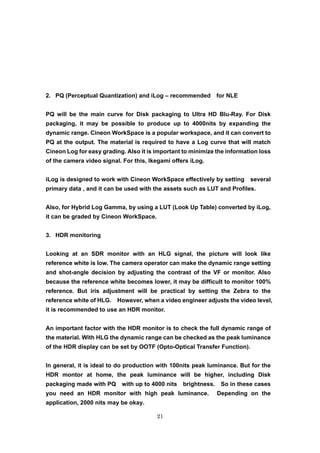
2. PQ (Perceptual Quantization) and iLog – recommended for NLE
PQ will be the main curve for Disk packaging to Ultra HD Blu-Ray. For Disk
packaging, it may be possible to produce up to 4000nits by expanding the
dynamic range. Cineon WorkSpace is a popular workspace, and it can convert to
PQ at the output. The material is required to have a Log curve that will match
Cineon Log for easy grading. Also it is important to minimize the information loss
of the camera video signal. For this, Ikegami offers iLog.
iLog is designed to work with Cineon WorkSpace effectively by setting several
primary data , and it can be used with the assets such as LUT and Profiles.
Also, for Hybrid Log Gamma, by using a LUT (Look Up Table) converted by iLog,
it can be graded by Cineon WorkSpace.
3. HDR monitoring
Looking at an SDR monitor with an HLG signal, the picture will look like
reference white is low. The camera operator can make the dynamic range setting
and shot-angle decision by adjusting the contrast of the VF or monitor. Also
because the reference white becomes lower, it may be difficult to monitor 100%
reference. But iris adjustment will be practical by setting the Zebra to the
reference white of HLG. However, when a video engineer adjusts the video level,
it is recommended to use an HDR monitor.
An important factor with the HDR monitor is to check the full dynamic range of
the material. With HLG the dynamic range can be checked as the peak luminance
of the HDR display can be set by OOTF (Opto-Optical Transfer Function).
In general, it is ideal to do production with 100nits peak luminance. But for the
HDR montor at home, the peak luminance will be higher, including Disk
packaging made with PQ with up to 4000 nits brightness. So in these cases
you need an HDR monitor with high peak luminance. Depending on the
application, 2000 nits may be okay.
22
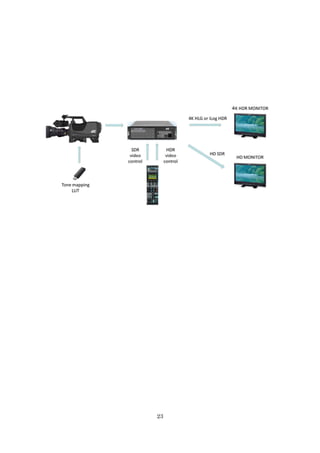
4. HDR Camera System
Two types of HDR production may be made - Only HDR and HDR + SDR.
For HDR only, it needs not only higher luminance but also wider color gamut.
Therefore, HDR Gamma and wide gamut ITU-2020 must be used together.
For HDR + SDR, the video adjustment should be made respectively as they have
different luminance and gamut. But it may be the case that HDR is the main
signal and SDR is tone mapped with basic adjustment. Or SDR may be main and
HDR is only with basic adjustment.
SDR tone mapping will be provided separately.
23
24
9. Mechanical Design
Ergonomic Design
・・・・Light Weight, Low CG (Center of Gravity)
The UHK-430 is a fully new designed Native 4K camera with new technologies
to keep the same weight as the Unicam HD series. The UHK-430 has a very low
CG (Center of Gravity) for stable operation.
Height of CG = 133mm (5.2 inch)
Height of Optics = 94mm (3.7 inch)
・・・・Adjustable Shoulder Pad
The shoulder Pad is newly designed to improve camera operation. Soft
cushion material is covered by a grippy outside surface. 35mm (1.4 inch) slide
mechanism enables good balance with heavy 4K lens.
*Slide range of the HDK-97A : 20mm (0.8 inch)
35mm
25
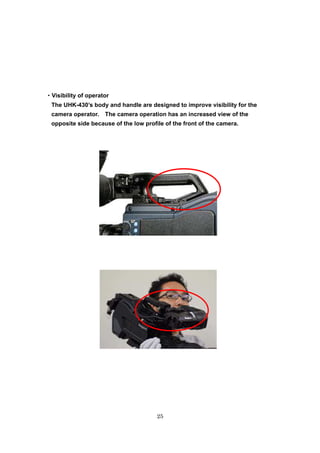
・・・・Visibility of operator
The UHK-430’s body and handle are designed to improve visibility for the
camera operator. The camera operation has an increased view of the
opposite side because of the low profile of the front of the camera.
26
・・・・Cooling System
The internal structure of the camera is designed with thermofluid simulation
for an optimal cooling system. The camera has a large 60mm cooling fan for
the combination of low noise and competent air flow.
Diam:52mm
HDK-97A UHK-430
Diam:60mm
Air Flow Image
27
・・・・New Tripod Adaptor T-430
- Eliminates backlash while maintaining compatibility with prior
Ikegami cameras. (*1)
- Quick mount / release mechanism without clicking noise.
- Long-Life holding mechanism by improved spring.
- Stylish design in the same dimensions as the previous model.
(*1) : New camera feet fits both T-430 and T-
791, but conventional feet do not fit T-430.
28
・・・・SE-U430
- Quick lens mounting or removal with camera in SE-430.
- Toolless adjustment mechanism for perfect optical axis alignment.
29
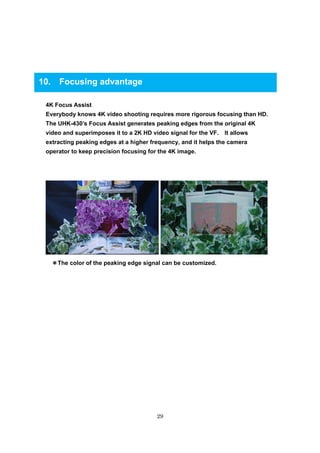
10. Focusing advantage
4K Focus Assist
Everybody knows 4K video shooting requires more rigorous focusing than HD.
The UHK-430’s Focus Assist generates peaking edges from the original 4K
video and superimposes it to a 2K HD video signal for the VF. It allows
extracting peaking edges at a higher frequency, and it helps the camera
operator to keep precision focusing for the 4K image.
****The color of the peaking edge signal can be customized.
30
UHK-430 – The Latest Technology
1st Edition: September 2016
Published in Marketing Department
Ikegami Tsushinki Co., Ltd.
© September 2016 Ikegami Tsushinki Co., Ltd.
- All rights reserved.
Reproduction or duplication, without permission of
Ikegami Tsushinki Co., Ltd. of editorial or pictorial content in whole or
in part, in any manner, is prohibited.
- Specifi cations and design are subject to change without prior notice.
- E & O.E
31

UHK-430 White paper

  • 1.
    Ikegami Tsushinki Co.,Ltd. Sept 2016 UHK-430 – The Latest Technology
  • 2.
    1 INTRODUCTION 4K native sensorsand a 3-chip prism deliver an overwhelming sense of resolution. Compatible with B4 mount HD lenses, which are widely used by broadcasters and production houses, the UHK-430 enables high resolution 4K shooting without wasting existing assets. This document explains the latest innovative technologies employed in the UHK-430 including its newly developed 2/3-inch native 4K CMOS sensors and next generation high speed video processor, AXII.
  • 3.
    2 Table of Contents 1.Sensors --------------------------------------------------------------------------------------3 2. Comparison of Imaging Technology-----------------------------------------------5 3. High Speed Video Processor - AXII - ------------------------------------------9 4. Transmission Bandwidth ------------------------------------------------------------ 12 5. Future Expansion----------------------------------------------------------------------- 13 6. Multi Interface---------------------------------------------------------------------------- 14 7. VoIP ----------------------------------------------------------------------------------------- 16 8. HDR ----------------------------------------------------------------------------------------- 20 9. Mechanical Design --------------------------------------------------------------------- 24 10. Focusing advantage-------------------------------------------------------------------- 29
  • 4.
    3 1. Sensors We havedeveloped an image sensor to produce a native 4K camera supporting the 2/3 - inch bayonet lens mount. Compared with conventional 2K image sensors, 4K image sensors have 1/2 the pixel-pitch and 1/4 the total pixel area. To achieve high performance 4K pixels, we needed to develop the sensor with focus on its sensitivity, S/N and dynamic range. The UHK-430 employs newly developed 2/3" 4K sensors. They feature improved sensitivity thanks to an anti- reflection coating on both sides of the cover glass. The coating also minimizes the unwanted ghost effects. Image of cover glass = AR coating = cover glass For further sensitivity improvement, the sensor has been designed with a suitable micro-lens. It prevents the loss of sensitivity when the iris is open. Also thanks to the minimization of parasitic capacitance of the floating diffusion layer, the light to voltage conversion gain has been improved. Micro lens Floating Diffusion
  • 5.
  • 6.
    5 2. Comparison ofImaging Technology The UHK-430 employs 3 x CMOS sensors taking picture quality into consideration. The following is a comparison among imaging types. ■ 3CMOS vs Single chip Bayer -1. 3 chips with prism block *RGB 4:4:4 output -2. Single chip Bayer *Resolution : 1/2G, 1/4R, 1/4B, 2:1:1 *De-Bayer process is required to create R/G/B component signals *To compensate the reduced pixel quantity, pixels must be interpolated from adjacent pixels, meaning: →→→→ less resolution →→→→ Creates Aliasing Single chip Bayer does not produce a full 4K signal, so resolution and color reproduction are not as good as a 3chip model.
  • 7.
    6 -3. Advantage ofNative 4K 3CMOS against Single Chip Sensor ・・・・Sensitivity In the case of the Single-Chip Sensor, the wavelength region for each RGB color channel is created by the On-Chip filter, so, the light in the wavelength region where it is not intended is not used. In contrast, in the case of the 3-Chip Sensor block, light is split by a prism, separating the light by wavelength region for each image sensor of RGB. All of the light for each color is directed to the corresonding sensor, resulting in higher light utilization. So, a camera with better S/N and sensitivity can be achieved with a 3-Chip Sensor block. ・・・・Resolution 3CMOS achieves full resolution in RGB. Single chip Bayer achieves 4K resolution by De-Bayer process, but the resolution for any single color of RGB is equal to 2K. ・Aliasing Various kinds of Interpolation algorithm are being developed regarding the De-Bayer process, but, we can say it is difficult to reconcile getting higher resolution and less aliasing. If the optical low pass filter is specified for 4K resolution, then spacial frequencies exceeding the Nyquist limit will produce aliasing in the color channels, especially the R and B channels. Conversely, if the optical low pass filter is specified to limit aliasing, 4K resolution in luminance can not be achieved.
  • 8.
    7 ■ Native 4Ksensor vs 2K pixel shift Pixel shift is a method to increase resolution by shifting the sensor pixels with half pixel (half pitch) to interpolate the spacial information. There are two methods, 3 chip pixel shift and 4 chip pixel shift. -1. Advantage of pixel shift *Limiting resolution in luminance signal is improved. -2. Disadvantage of pixel shift *Sensor size remains unchanged, so R/G/B MTF is the same as that of 2K. *3 chip pixel shift has significant loss of the effect because of lens abberation, the limiting resolution does not improve in the corners. -3. Advantage of Native 4K 3CMOS againest 2K pixel shift ・・・・Resolution Pixel shift is a method to increase resolution by shifting pixels between 2K image sensors by half pitch, complementing spatial information. There are two methods for pixel shift. One is 3-Chip Pixel Shift, shifting the G-ch image sensor half pitch compared to R/B , and another is 4-Chip Dual G (R,B,G1,G2),using two G-ch sensors. Reduction of Aliasing by the pixel shift or dual Green 2K CMOS Aliasing Response limitation 2K CMOS Aliasing 4K MOS Aliasing 1000 4K CMOS Resolution 2K CMOS Resolution 2000 4000 Aperture 50% (TVL) 0 0.5 0 (Response) 1 Sensor Response
  • 9.
    8 However, with bothmethods, it is not possible to get 2 times the resolution by shifting half pitch due to the following reasons. Recent image sensors have higher aperture ratio for each pixel for higher sensitivity, and the signal for spatial direction is output as the integral value of the pixel area. So neighboring pixels at intervals of half pitch have some redundent light reception resulting in only 1.6 times the resolution even if every pixel is ideally shifted by half pitch. Especially, in the case of pixel shift with RGB channels, even though there is increased resolution at the center of the screen, the resolution does not improve in the corners due to influence of chromatic aberration. And even if the aberration is corrected in the camera DSP, it is too late to improve the spacial sampling of the incoming light. ・・・・Sensitivity In the case of pixel shift with dual G channels and 4-Chip, the light is split into two G channels by a half mirror, so, the sensitivity is lowered to 1/2. Moreover, the limiting F-value for most 3-Chip prisms is F1.4, but in the case of a 4-Chip prism, it is difficult to achieve F1.4 due to the prism structure. Therefore, if you use a lens having brighter maximum aperture, there may be no benefit due to the limitation of the dual G prism.
  • 10.
    9 3. High SpeedVideo Processor - AXII - Ikegami has developed a processing engine for its next-generation HD, 4K and 8K format cameras. This ASIC can perform high speed processing of HD, 4K (4 x HD) and 8K (16 x HD) super high-resolution video signals in various formats and frame rates. The new processor, called AXII incorporates features and interfaces for broadcast camera systems. It delivers high quality,high reliability and lower power consumption. This AXII processor will be used as a platform AXII processor to accelerate product development. ■ Features - High Speed Signal Processing and Added-Value Features Video processing is the core function of a camera's internal electronics. It controls each correction circuit and the interface to external units such as lens and viewfinder. High speed processing is needed to handle standards such as HD, 4K and 8K. - Built-in 16-Axis Color Correction Chroma and hue level can be adjusted within 16-axes individually, for both normal programme production and to allow color-matching with other cameras. This high-level correction can be processed in real time.
  • 11.
    10 - 3D-LUT ColorGamut Correction The ITU-R BT.2020 standard for 4K/8K covers a wider area than BT.709 for HD. The new Ikegami processor conforms to ITU- R BT.2020 and provides color gamut correction for varrious video formats with a 3D-LUT system. 16-axis color matrix Original Color corrected as image
  • 12.
    11 - DDR3 Configuration UsingDDR3 SDRAM, lens chromatic aberration and noise suppression features become available. Digital Extender, video frame rate conversion and viewfinder picture-in-picture are also supported. Picture- in-Picture Digital Extender - Low Power Consumption and High Reliability Camera system tasks such as video signal manipulation, shading correction, lens aberration correction, and interfacing between devices are all integrated in the new processor. The processor allows high performance, low-power consumption (40% lower than conventional model), lower operating temperature, and higher reliability. - Ikegami Cameras Processing Platform The new processor will be implemented as the core of new generation Ikegami broadcast and POV cameras, significantly reducing development time and thus ensuring prompt release of new products to the market.
  • 13.
    12 4. Transmission Bandwidth 4.ssioandwidth The transmission bandwidth between the UHK-430 camera head and the CCU-430 Camera Control unit is optical 40Gbps. Thanks to this, the video signal from the Image sensor block is transmitted to the CCU with uncompressed 4:4:4 signal. The 4K video singal processing is done at the CCU. This means the processing such as lens abberation correction, DTL and color matrix are processed inside the CCU. It is ideal to have uncompressed video signals available to these video processing circuits – this is the reason why we employ 40Gbps bandwidth for the transmission system.. In case the transmission is made with 4:2:2 bandwidth, it affects the chroma key performance because the bandwidth of the color difference (Pb/Pr) signals is restricted. Even when the output from the CCU is 4:2:2, the 4:4:4 uncompressed transmissiion produces better quality than compressed 4:2:2 transmission. Our 40Gbps transmission system is transmitted as 4 x 10Gbps with WDM (Wavelength Division Multiplex). It has the advantage of extended bandwidth, and has no disadvantage such as loss of transmission distance compared to other 10Gbps transmission systems. Signal Path between Camera and CCU
  • 14.
    13 5. Future Expansion Morecomplete functionality The two piece construction provides good system flexlibility, allowing you to select a suitable optical block for your chosen application. The ultra wide bandwidth fiber transmission achieves the world's first transmission of an uncompressed 4K signal. The UHK-430 is designed as a system that delivers more complete functionality to meet a wide range of operational requirements. The unique two piece construction allows for easy swap of the optical sensor unit, such as an extension adaptor (to separate the optical head from the main camera body) to meet different and future applications. Sensor unit and body extension aapor (Scheduled) HFR (Scheduled)
  • 15.
    14 6. Multi Interface 4Koutput (3G-SDI x4) is available as standard. It is selectable between Quad Link Square Division and 2 Sample Interleave (Level-A/B). Also, 4K/2KHD simultaneous output and 2K HD cut-out from the 4K image is available (Option). Moreover, the CCU-430 Camera Control Unit has been designed taking into consideration that it would support 12G-SDI, Simultaneous-Output and VoIP interface etc. by swapping the rear plug-in module. So it has flexibility to support future trends for 4K systems. ■ 12G-SDI Option Board 12G-SDI Option Board It is possible to switch the outputs between 12G-SDI and 3G-SDI Quad Link. The board is selectable among following three types according to customer’s application. 1) 12G-SDI x8 2) 12G-SDIx4 + 3G-SDIx4 3) 3G-SDIx4 + 3G-SDI x4 Transmission Length for 12G-SDI Signal: Approx 70m (When using a low loss coaxial cable) *The transmission lengthwill change depending on the type and manufacture of the coaxial cable and the specification of the device receiving the 12G-SDI signal.
  • 16.
    15 ■ Simultaneous-Output OptionBoard HD_OUT Board VP_OUT Board (STD) By mounting HD_VP Board on CCU front side and HD_OUT Board on rear, 4K/2K simulcast is available. From VP_OUT Board : 4K Quad Link 2 CH 8 Output (OUT-1/OUT-2) From HD_OUT Board: HD/3G-SDI 2 CH 8 Output (OUT-3/OUT-4) From HD/3G-SDI from HD_OUT Board, down-converted signal and HD cut-out signal from 4K can be output simultaneously. Option Board Output Chart 4K Quad Link Output 4K 12G- SDI Output HD D/C Output HD Cut- Out Output HD D/C +Cut-out Simul- 4K&2K simul- Out Standard ✓ ✓ With Simul- Out Option Board ✓ ✓ ✓ ✓ ✓ 12G_Out Option Board ✓ ✓ ✓ 12G_Out Option Board + Simul- Out Option Board ✓ ✓ ✓ ✓ ✓ ✓ ■ VoIP Option Board The VoIP board capsulises the main video and audio signals, transmitting them as a packet. VoIP transmission is available by an optional board.
  • 17.
    16 7. VoIP Transporting separatevideo, audio, and metadata as independent IP multicast streams is essential in order to realize IP-based broadcast and media facilities through the integration and interoperability of an open format. As of April, 2016, Ikegami has joined alliances for IP media solutions such as, AIMS, ASPEN, and TICO, facilitating transition to IP based systems design. Flexibility and scalable mechanism in the IP technologies are the key to handle higher resolutions such as 4K and 8K and higher frame rates such as 50/60P and even 100/120P. They would also offer the most intelligent solutions in light of High Dynamic Range and Wider Color Space. Ikegami products will be compliant to the following formats and standards, supporting device discovery mechanism such as AMWA NMOS (Networked Media Open Specifications) and Precision Time Protocol (PTP) timing mechanism, distributed to endpoints by ST 2059-2 profile IEEE1588v2 PTP. AIMS (the Alliance for IP Media Solutions) SMPTE 2022-5/6/7 of IP standards (video) AES-67 (audio) VSF (Video Services Forum) TR (Technical Recommendation)-03, -04 ASPEN (Adaptive Sample Picture Encapsulation) SMPTE 2022 family of IP standards (video) SMPTE ST 302 (audio over TS) SMPTE ST 2038 (ancillary data over TS)
  • 18.
  • 19.
    18 * video, audio,and metadata as independent IP multicast streams Precision Time Protocol (PTP) SMPTE 2022-7 of IP standards (hitless swithover) Station timing will be distributed to endpoints by ST 2059-2 profile IEEE1588v2 PTP <4K PROCESSING (ASPEN & TICO) > Ikegami is commited to provide native (rather than through transcoders) device support for ASPEN for uncompressed 4K media exchange, and TICO for light weight, low latency compressed media exchange. TICO (intoPIX© proprietary CODEC) Light weight, low latency 4K compressed media exchange
  • 20.
    19 VC-2 (Snell AdvancedMedia© proprietary CODEC) Light weight, low latency 4K compressed media exchange ASPEN (Adaptive Sample Picture Encapsulation) Uncompressed 4K media exchange 10GBase-X / 1GBase-T Ethernet SMPTE 2022-6/7 ST2059-2 profile IEEE1588v2 PTP (Presision Time Protocol) *TBA:AMWA NMOS (Newtork media Open Spesicfications) Monitor ENGINEERING REMOTE ROUTING SWITCHER Production Swither
  • 21.
    20 8. HDR The InternationalTelecommunication Union (ITU) adopted HLG (Hybrid Log Gamma) and PQ (Perceptual Quantization) as HDR formats in July 2016. The features of the formats are as follows. 1. Hybrid Log Gamma – recommended for broadcast The UHK-430 set for HDR matches the 1200% dynamic range of the HLG standard. It is suitable to minimize the information loss of the camera video signal. The curve figure after scaling is overwrapped to REC709, and it starts to curve around 10% of voltage level, so it has the advantage to comfortably operate with the VF and standard monitors by adjusting only contrast.
  • 22.
    21 2. PQ (PerceptualQuantization) and iLog – recommended for NLE PQ will be the main curve for Disk packaging to Ultra HD Blu-Ray. For Disk packaging, it may be possible to produce up to 4000nits by expanding the dynamic range. Cineon WorkSpace is a popular workspace, and it can convert to PQ at the output. The material is required to have a Log curve that will match Cineon Log for easy grading. Also it is important to minimize the information loss of the camera video signal. For this, Ikegami offers iLog. iLog is designed to work with Cineon WorkSpace effectively by setting several primary data , and it can be used with the assets such as LUT and Profiles. Also, for Hybrid Log Gamma, by using a LUT (Look Up Table) converted by iLog, it can be graded by Cineon WorkSpace. 3. HDR monitoring Looking at an SDR monitor with an HLG signal, the picture will look like reference white is low. The camera operator can make the dynamic range setting and shot-angle decision by adjusting the contrast of the VF or monitor. Also because the reference white becomes lower, it may be difficult to monitor 100% reference. But iris adjustment will be practical by setting the Zebra to the reference white of HLG. However, when a video engineer adjusts the video level, it is recommended to use an HDR monitor. An important factor with the HDR monitor is to check the full dynamic range of the material. With HLG the dynamic range can be checked as the peak luminance of the HDR display can be set by OOTF (Opto-Optical Transfer Function). In general, it is ideal to do production with 100nits peak luminance. But for the HDR montor at home, the peak luminance will be higher, including Disk packaging made with PQ with up to 4000 nits brightness. So in these cases you need an HDR monitor with high peak luminance. Depending on the application, 2000 nits may be okay.
  • 23.
    22 4. HDR CameraSystem Two types of HDR production may be made - Only HDR and HDR + SDR. For HDR only, it needs not only higher luminance but also wider color gamut. Therefore, HDR Gamma and wide gamut ITU-2020 must be used together. For HDR + SDR, the video adjustment should be made respectively as they have different luminance and gamut. But it may be the case that HDR is the main signal and SDR is tone mapped with basic adjustment. Or SDR may be main and HDR is only with basic adjustment. SDR tone mapping will be provided separately.
  • 24.
  • 25.
    24 9. Mechanical Design ErgonomicDesign ・・・・Light Weight, Low CG (Center of Gravity) The UHK-430 is a fully new designed Native 4K camera with new technologies to keep the same weight as the Unicam HD series. The UHK-430 has a very low CG (Center of Gravity) for stable operation. Height of CG = 133mm (5.2 inch) Height of Optics = 94mm (3.7 inch) ・・・・Adjustable Shoulder Pad The shoulder Pad is newly designed to improve camera operation. Soft cushion material is covered by a grippy outside surface. 35mm (1.4 inch) slide mechanism enables good balance with heavy 4K lens. *Slide range of the HDK-97A : 20mm (0.8 inch) 35mm
  • 26.
    25 ・・・・Visibility of operator TheUHK-430’s body and handle are designed to improve visibility for the camera operator. The camera operation has an increased view of the opposite side because of the low profile of the front of the camera.
  • 27.
    26 ・・・・Cooling System The internalstructure of the camera is designed with thermofluid simulation for an optimal cooling system. The camera has a large 60mm cooling fan for the combination of low noise and competent air flow. Diam:52mm HDK-97A UHK-430 Diam:60mm Air Flow Image
  • 28.
    27 ・・・・New Tripod AdaptorT-430 - Eliminates backlash while maintaining compatibility with prior Ikegami cameras. (*1) - Quick mount / release mechanism without clicking noise. - Long-Life holding mechanism by improved spring. - Stylish design in the same dimensions as the previous model. (*1) : New camera feet fits both T-430 and T- 791, but conventional feet do not fit T-430.
  • 29.
    28 ・・・・SE-U430 - Quick lensmounting or removal with camera in SE-430. - Toolless adjustment mechanism for perfect optical axis alignment.
  • 30.
    29 10. Focusing advantage 4KFocus Assist Everybody knows 4K video shooting requires more rigorous focusing than HD. The UHK-430’s Focus Assist generates peaking edges from the original 4K video and superimposes it to a 2K HD video signal for the VF. It allows extracting peaking edges at a higher frequency, and it helps the camera operator to keep precision focusing for the 4K image. ****The color of the peaking edge signal can be customized.
  • 31.
    30 UHK-430 – TheLatest Technology 1st Edition: September 2016 Published in Marketing Department Ikegami Tsushinki Co., Ltd. © September 2016 Ikegami Tsushinki Co., Ltd. - All rights reserved. Reproduction or duplication, without permission of Ikegami Tsushinki Co., Ltd. of editorial or pictorial content in whole or in part, in any manner, is prohibited. - Specifi cations and design are subject to change without prior notice. - E & O.E
  • 32.