https://www.youtube.com/watch?v=z6r-
JNk0fEY&feature=em-share_video_user
Leadership for Universal Health Coverage
World Bank, Washington DC, May 6 2015
Partners in:
Ceren Ozer, World Bank
Economist, Leadership Learning and
Innovation
Brigitta Villaronga, GIZ
Head of Leadership Development
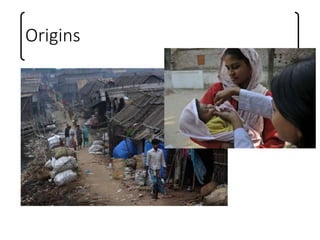
Origins
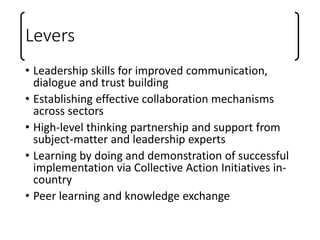
Levers
• Leadership skills for improved communication,
dialogue and trust building
• Establishing effective collaboration mechanisms
across sectors
• High-level thinking partnership and support from
subject-matter and leadership experts
• Learning by doing and demonstration of successful
implementation via Collective Action Initiatives in-
country
• Peer learning and knowledge exchange
Why the “how” matters?
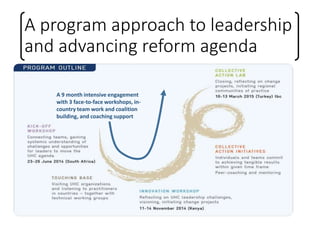
A program approach to leadership
and advancing reform agenda
A 9 month intensive engagement
with 3 face-to-face workshops, in-
country team work and coalition
building, and coaching support
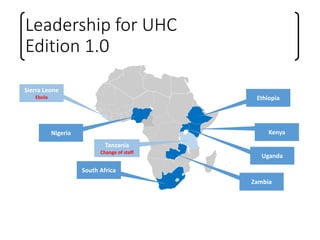
Leadership for UHC
Edition 1.0
Nigeria
Ethiopia
Kenya
Uganda
Zambia
South Africa
Sierra Leone
Ebola
Tanzania
Change of staff
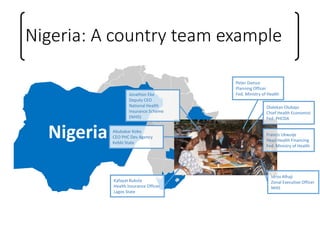
Nigeria: A country team example
Nigeria
Kafayat Bukola
Health Insurance Officer
Lagos State
Abubakar Koko
CEO PHC Dev Agency
Kebbi State
Jonathon Eke
Deputy CEO
National Health
Insurance Scheme
(NHIS)
Peter Damza
Planning Officer
Fed. Ministry of Health
Olalekan Olubajo
Chief Health Economist
Fed. PHCDA
Francis Ukwuije
Head Health Financing
Fed. Ministry of Health
Idriss Alhaji
Zonal Executive Officer
NHIS
Quotes from participants
Our problem was our shared understanding of what UHC is –
what it will take to domesticate a global agenda for [our country] and
run with it; and also the fact that we have unfocused policy dialogue
on UHC. Once we had those two, we were able to strategize
“
”
It actually helps me to listen to them instead of me preaching at
them or giving them the solution [Now I ask the] person who is delivering
the service for our clients, how is it for you? […] How can I give you support,
so that you can deliver that service better.
“
”Yes, when we did the stakeholder mapping, it truly changed
my view about them. […] we do use a lot of the stakeholders
mapping to know within the group we intend to engage.
“
”
Reactions from DPs in country
Change was pronounced in the participant: more
humble approach to colleagues, listens more; [he] is a
person who likes to learn and who likes to apply
learnings – quite possible that changes have been
triggered by program
“
”Change [to more inclusive behavior] not
necessarily observed in the participant, but difficult
in [the country’s] context, which is very hierarchical,
but delegation to others was good.
“
”
The Collective Action Initiative was perfectly
aligned with national work-plan, assured through
participation of the right people in the team
 100% positive responses
“
”
from what observed, it seemed great, could
not have been much better.
 100% positive responses
“
”
On individuals‘ learning results…
On the initiatives‘ alignment…
On info from organizers…
Participant feedback: Overall
usefulness of the Program
Our Learnings and Insights
What are your thoughts?
• How can we deepen this work (we have the next
edition coming up)?
• How is this relevant or useful for our book project?
• What lessons are emerging for institutional
cooperation that may be relevant for system
change work?
Thank you for your attention
Additional slides
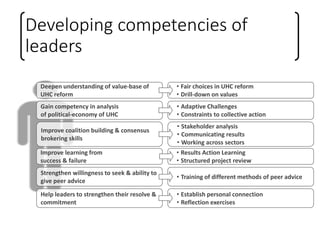
Developing competencies of
leaders
Deepen understanding of value-base of
UHC reform
• Fair choices in UHC reform
• Drill-down on values
Gain competency in analysis
of political-economy of UHC
• Adaptive Challenges
• Constraints to collective action
Improve coalition building & consensus
brokering skills
• Stakeholder analysis
• Communicating results
• Working across sectors
Improve learning from
success & failure
• Results Action Learning
• Structured project review
Strengthen willingness to seek & ability to
give peer advice
• Training of different methods of peer advice
Help leaders to strengthen their resolve &
commitment
• Establish personal connection
• Reflection exercises
Leadership for UHC
Edition 1.0
• World Bank
GHNDR
• GIZ Health &
SP Units
Country
• Country Staff
/ TTLs
• P4H in-
country
Networks
Reform
Area
• Organizations
• Level
• Diversity
Team
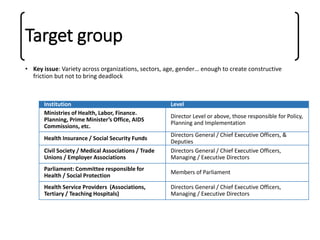
Target group
• Key issue: Variety across organizations, sectors, age, gender… enough to create constructive
friction but not to bring deadlock
Institution Level
Ministries of Health, Labor, Finance.
Planning, Prime Minister’s Office, AIDS
Commissions, etc.
Director Level or above, those responsible for Policy,
Planning and Implementation
Health Insurance / Social Security Funds
Directors General / Chief Executive Officers, &
Deputies
Civil Society / Medical Associations / Trade
Unions / Employer Associations
Directors General / Chief Executive Officers,
Managing / Executive Directors
Parliament: Committee responsible for
Health / Social Protection
Members of Parliament
Health Service Providers (Associations,
Tertiary / Teaching Hospitals)
Directors General / Chief Executive Officers,
Managing / Executive Directors
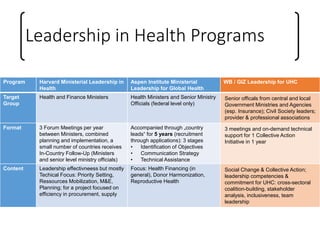
Leadership in Health Programs
Program Harvard Ministerial Leadership in
Health
Aspen Institute Ministerial
Leadership for Global Health
WB / GIZ Leadership for UHC
Target
Group
Health and Finance Ministers Health Ministers and Senior Ministry
Officials (federal level only)
Senior officals from central and local
Government Ministries and Agencies
(esp. Insurance); Civil Society leaders;
provider & professional associations
Format 3 Forum Meetings per year
between Ministers, combined
planning and implementation, a
small number of countries receives
In-Country Follow-Up (Ministers
and senior level ministry officials)
Accompanied through „country
leads“ for 5 years (recruitment
through applications): 3 stages
• Identification of Objectives
• Communication Strategy
• Technical Assistance
3 meetings and on-demand technical
support for 1 Collective Action
Initiative in 1 year
Content Leadership effectivneess but mostly
Techical Focus: Priority Setting,
Ressources Mobilization, M&E,
Planning; for a project focused on
efficiency in procurement, supply
Focus: Health Financing (in
general), Donor Harmonization,
Reproductive Health
Social Change & Collective Action;
leadership competencies &
commitment for UHC: cross-sectoral
coalition-building, stakeholder
analysis, inclusiveness, team
leadership
Approach to Evaluation
Participant in-depth
interviews
Results
To be completed by end June
What Changes
swaddell@networkingaction.
net
21 Steve Waddell ©
Natural Environment
Memes, values, beliefs
Social-Political-Economic
Structures
Technology
Individual
Change Strategies
Name Supporting Change Forcing Change Co-creating Change Paternalistic
Change
Components Generative power Degenerative
power
Generative love Degenerative love
Dynamic Empowering
Raising up
Confronting
Violence
Collaborating
Co-evolving
Minor change
Maintaining status
quo
Requirement Willingness to share
power
Willingness to
ignore harm
Willingness of
everyone to change
Willingness of
disempowered to
settle for minor
improvement
Popular terms Noblesse oblige
Upliftment
Forcing Co-production Paternalism
Being bought off
Archetypal
strategies
Community organizing
Rights legislation
Legal cases
Education
State force
Strikes (capital,
labor)
Demonstrations
Multi-stakeholder
fora
Public engagement
Social labs
Reinforcing legal
cases
Financial pay-offs
Consultation
Opportunity
Identification
Quiet
Convening
Systems
Awareness
Self
Convening
Prototype
Projects
Systemic
Change
Outcomes
Systems
Leadership
Network
Capacity
Building
Program
Peer
Coaching
Action
Learning
Design
Systems
Funding
Action
Research
Communication
Outreach
Potential Backbone
Organization
Systems Mapping
Change Process
Design
Stakeholder
Dialogue &
Facilitation
Investment & Funding
Backbone Organization
Hybrid
Organization
Design
Shared
Measurement
Revenue
Generation
Shared Vision
Reinforcing Activities
R1
Self-convening
R2
Capacity
Building
R4
Systems Funding
Isolated Successes
Relationship
Building
Collaborative
Potentials
Stakeholder
Map & Interview
Champions
Identification
Personal Mastery
U Process
Co-presencing
Sensing the field
Scaling
Collaborative Network
R3
Scaling
Tipping
Point
Learning Journey
Rapid Results Method
After Action Review
Wicked Problem
Critical System
Systems Aspiration
& Stuckness
Leverage Point
Identification
Shared Strategy
Collective
Systems
Mapping
Process CoachingLearning Infrastructure
R0
Quiet Convening
Developmental
Evaluation
Prototyping
Systemic Change Process Map
Version 2013.8.25
© Dr. Joe Hsueh, Academy for Systemic Change

Uhc july 14

  • 1.
  • 2.
    Leadership for UniversalHealth Coverage World Bank, Washington DC, May 6 2015 Partners in: Ceren Ozer, World Bank Economist, Leadership Learning and Innovation Brigitta Villaronga, GIZ Head of Leadership Development
  • 3.
  • 4.
    Levers • Leadership skillsfor improved communication, dialogue and trust building • Establishing effective collaboration mechanisms across sectors • High-level thinking partnership and support from subject-matter and leadership experts • Learning by doing and demonstration of successful implementation via Collective Action Initiatives in- country • Peer learning and knowledge exchange
  • 5.
  • 6.
    A program approachto leadership and advancing reform agenda A 9 month intensive engagement with 3 face-to-face workshops, in- country team work and coalition building, and coaching support
  • 7.
    Leadership for UHC Edition1.0 Nigeria Ethiopia Kenya Uganda Zambia South Africa Sierra Leone Ebola Tanzania Change of staff
  • 8.
    Nigeria: A countryteam example Nigeria Kafayat Bukola Health Insurance Officer Lagos State Abubakar Koko CEO PHC Dev Agency Kebbi State Jonathon Eke Deputy CEO National Health Insurance Scheme (NHIS) Peter Damza Planning Officer Fed. Ministry of Health Olalekan Olubajo Chief Health Economist Fed. PHCDA Francis Ukwuije Head Health Financing Fed. Ministry of Health Idriss Alhaji Zonal Executive Officer NHIS
  • 9.
    Quotes from participants Ourproblem was our shared understanding of what UHC is – what it will take to domesticate a global agenda for [our country] and run with it; and also the fact that we have unfocused policy dialogue on UHC. Once we had those two, we were able to strategize “ ” It actually helps me to listen to them instead of me preaching at them or giving them the solution [Now I ask the] person who is delivering the service for our clients, how is it for you? […] How can I give you support, so that you can deliver that service better. “ ”Yes, when we did the stakeholder mapping, it truly changed my view about them. […] we do use a lot of the stakeholders mapping to know within the group we intend to engage. “ ”
  • 10.
    Reactions from DPsin country Change was pronounced in the participant: more humble approach to colleagues, listens more; [he] is a person who likes to learn and who likes to apply learnings – quite possible that changes have been triggered by program “ ”Change [to more inclusive behavior] not necessarily observed in the participant, but difficult in [the country’s] context, which is very hierarchical, but delegation to others was good. “ ” The Collective Action Initiative was perfectly aligned with national work-plan, assured through participation of the right people in the team  100% positive responses “ ” from what observed, it seemed great, could not have been much better.  100% positive responses “ ” On individuals‘ learning results… On the initiatives‘ alignment… On info from organizers…
  • 11.
  • 12.
  • 13.
    What are yourthoughts? • How can we deepen this work (we have the next edition coming up)? • How is this relevant or useful for our book project? • What lessons are emerging for institutional cooperation that may be relevant for system change work?
  • 14.
    Thank you foryour attention
  • 15.
  • 16.
    Developing competencies of leaders Deepenunderstanding of value-base of UHC reform • Fair choices in UHC reform • Drill-down on values Gain competency in analysis of political-economy of UHC • Adaptive Challenges • Constraints to collective action Improve coalition building & consensus brokering skills • Stakeholder analysis • Communicating results • Working across sectors Improve learning from success & failure • Results Action Learning • Structured project review Strengthen willingness to seek & ability to give peer advice • Training of different methods of peer advice Help leaders to strengthen their resolve & commitment • Establish personal connection • Reflection exercises
  • 17.
    Leadership for UHC Edition1.0 • World Bank GHNDR • GIZ Health & SP Units Country • Country Staff / TTLs • P4H in- country Networks Reform Area • Organizations • Level • Diversity Team
  • 18.
    Target group • Keyissue: Variety across organizations, sectors, age, gender… enough to create constructive friction but not to bring deadlock Institution Level Ministries of Health, Labor, Finance. Planning, Prime Minister’s Office, AIDS Commissions, etc. Director Level or above, those responsible for Policy, Planning and Implementation Health Insurance / Social Security Funds Directors General / Chief Executive Officers, & Deputies Civil Society / Medical Associations / Trade Unions / Employer Associations Directors General / Chief Executive Officers, Managing / Executive Directors Parliament: Committee responsible for Health / Social Protection Members of Parliament Health Service Providers (Associations, Tertiary / Teaching Hospitals) Directors General / Chief Executive Officers, Managing / Executive Directors
  • 19.
    Leadership in HealthPrograms Program Harvard Ministerial Leadership in Health Aspen Institute Ministerial Leadership for Global Health WB / GIZ Leadership for UHC Target Group Health and Finance Ministers Health Ministers and Senior Ministry Officials (federal level only) Senior officals from central and local Government Ministries and Agencies (esp. Insurance); Civil Society leaders; provider & professional associations Format 3 Forum Meetings per year between Ministers, combined planning and implementation, a small number of countries receives In-Country Follow-Up (Ministers and senior level ministry officials) Accompanied through „country leads“ for 5 years (recruitment through applications): 3 stages • Identification of Objectives • Communication Strategy • Technical Assistance 3 meetings and on-demand technical support for 1 Collective Action Initiative in 1 year Content Leadership effectivneess but mostly Techical Focus: Priority Setting, Ressources Mobilization, M&E, Planning; for a project focused on efficiency in procurement, supply Focus: Health Financing (in general), Donor Harmonization, Reproductive Health Social Change & Collective Action; leadership competencies & commitment for UHC: cross-sectoral coalition-building, stakeholder analysis, inclusiveness, team leadership
  • 20.
    Approach to Evaluation Participantin-depth interviews Results To be completed by end June
  • 21.
    What Changes swaddell@networkingaction. net 21 SteveWaddell © Natural Environment Memes, values, beliefs Social-Political-Economic Structures Technology Individual
  • 22.
    Change Strategies Name SupportingChange Forcing Change Co-creating Change Paternalistic Change Components Generative power Degenerative power Generative love Degenerative love Dynamic Empowering Raising up Confronting Violence Collaborating Co-evolving Minor change Maintaining status quo Requirement Willingness to share power Willingness to ignore harm Willingness of everyone to change Willingness of disempowered to settle for minor improvement Popular terms Noblesse oblige Upliftment Forcing Co-production Paternalism Being bought off Archetypal strategies Community organizing Rights legislation Legal cases Education State force Strikes (capital, labor) Demonstrations Multi-stakeholder fora Public engagement Social labs Reinforcing legal cases Financial pay-offs Consultation
  • 23.
    Opportunity Identification Quiet Convening Systems Awareness Self Convening Prototype Projects Systemic Change Outcomes Systems Leadership Network Capacity Building Program Peer Coaching Action Learning Design Systems Funding Action Research Communication Outreach Potential Backbone Organization Systems Mapping ChangeProcess Design Stakeholder Dialogue & Facilitation Investment & Funding Backbone Organization Hybrid Organization Design Shared Measurement Revenue Generation Shared Vision Reinforcing Activities R1 Self-convening R2 Capacity Building R4 Systems Funding Isolated Successes Relationship Building Collaborative Potentials Stakeholder Map & Interview Champions Identification Personal Mastery U Process Co-presencing Sensing the field Scaling Collaborative Network R3 Scaling Tipping Point Learning Journey Rapid Results Method After Action Review Wicked Problem Critical System Systems Aspiration & Stuckness Leverage Point Identification Shared Strategy Collective Systems Mapping Process CoachingLearning Infrastructure R0 Quiet Convening Developmental Evaluation Prototyping Systemic Change Process Map Version 2013.8.25 © Dr. Joe Hsueh, Academy for Systemic Change

Editor's Notes

  • #4 This is the beginning. Olivier starts with a personal connection story—revealing the roots--Bangladesh example. Linking the concrete the case to the fact that UHC 1. complex 2. multi-stakeholder and therefore requires Leadership [add or deepen] Thank you for your presence. Where does all this orgininate from? As garment threads a carpet revealing a pattern in the end, I can see that our product today emerged actually from many many threads in the past weaving together a coherent story and pattern. Let me begin to tell you where for me the issue of leadership and UHC has come into play. Back in 2007 Olivier was working in Bangladesh in the health sector in with the biggest SAWP $5 billion together with WBG was TF manager. we couldn’t bring the government to do what the they were intended to do. Needs were obvious. Poor people couldn t access health services – this was obvious in your day to day life as we commuted between our residential area and the places we worked and interacted with the people around you. It wasn’t only about the poor only. The wife of a Bangladeshi colleague of mine fell in coma during birth delivery and from then onwards started a suffering journey in which the health care costs absorbed all the financial ressources of the rather affluent middle-class family. The issue of reforms also in the Health financing area was addressed as a topic in the health SWAp but ir remained on paper. There was leadership issues behind. Let me open what I mean by leadership here [Shared vision, cooperation to achieve national goals, raising the profile, sustainable coalitions]: there was no real dialogue engage in working togethether let alone collaborating, between DPs and government and within government between MoH and MoF and other stakeholders such as private sector. There was always a reform agenda on engaging private sector but they were always in their tranches. From then onwards, leadership issues became key to me. And I can say, that retrospectively looking: had I had the chance to have such a programme in Bangladesh I am sure it would have helped the sector – not only between the actors in the country but also between development partners and the counterparts. One day a chance to learn more about leadership work. Ed Campos, whom we lost last year who founded the leadership program at the WBG and I talked to Olivier. From other candidate sectors this is where we felt most strongly the pull where leadership and coalition building could truly have transformational impact. Build on Olivier’s example, it’s not only about technical issues. Building coalitions. From “what’s wrong” to “ how question” . Bangladesh was a learning ground for me and Ed Campos. We often wondered 30% disbursement rates during a transitional technocratic government led by a former Bank staff. Money wasn’t spent because of these blockages. Entranchement in sectors and silos. This all merged into a program. Leadership theory of change.
  • #5 Program supports the country teams in their reform process via several levers: - Leadership skills for improved communication, dialogue and trust building—Moving towards UHC requires a varied number of stakeholders to effectively work together across sectors; in particular health, social and finance; and at political and technical levels. Leaders need to introduce sustainable mechanisms to model, cultivate and improve communication, dialogue and trust across sectors. - Establishing effective collaboration mechanisms— Collaboration among relevant ministries (e.g. Health, Finance, Labor) and other groups (in the case of Nigeria for example between central authority and states; and, in the case of Kenya between central and counties) is a key requirement to advance UHC agenda forward; often, there is scope for improving the mutual understanding of goals, roles and relevance of the different government and private sector stakeholders. - High-level thinking partnership and support from subject-matter and leadership experts—While leaders are often experts in the UHC field, mentorship on “how of” coalition building and implementation by experienced UHC practitioners is critical. - Learning by doing and demonstration of successful implementation—Country teams launch 100-day Collective Action Initiatives with clear results. - Peer learning and knowledge exchange—Country teams’ learn from each other’s experience and establish a support network. Also with inclusion of ex-Health Minister of Turkey as thinking partner and field visits in Turkey during workshop 3, there was an element of South-South learning, participants learned from the experience of Turkey and Turkish reformers.
  • #13 In the first place, we have learnt from each others approaches a lot. And participants said they benefitted from the programme. Concerning operational aspects: Country and Participants selection is the key Monitoring the impact, we’re learning Strong connection to operations Bigger transformation “direction” of this prototype and involvement of complex challenge stakeholders: support LSC through a more “systemic” intervention, focusing on all relevant stakeholders and their attitude/mind-set (“heart of the leader”) as well as rules of the game; bringing together different constituencies and broader set of stakeholders/their perspectives Success is when important steps are done towards UHC, triggered by the leadership-program Major challenges: Alignment and collaboration between different constituencies (depending on commitment of project managers who stick to their believes that bringing together approaches adds value to the whole) For the future: Learn from the lessons of 1.0
  • #14 Brigitta’s questions: What was new for you ? Anything that moved you specially? More/less convincing parts of the story? What was missing? Suggestions for the future of this collaboration? What else?
  • #18 This is the slide that does two things: it talks about scoping, and it talks about wpo were the countries and participants. Olivier: Starting from our impressions We had this explatory phase, went back to client countries asked them on the utility of the proposed program on leadership. Francaphone aFrica, the feeback Joy got from flagship course. Connection with Health GP and in each country recognize the involvement of Bank TTLs and country offices. As well as Africa team. For every country please enter all the participants and their designation.