State Transition
RAN12.0
Feature Parameter Description
Issue 02
Date 2010-03-30
HUAWEI TECHNOLOGIES CO., LTD.
Copyright © Huawei Technologies Co., Ltd. 2011. All rights reserved.
No part of this document may be reproduced or transmitted in any form or by any means without prior
written consent of Huawei Technologies Co., Ltd.
Trademarks and Permissions
and other Huawei trademarks are trademarks of Huawei Technologies Co., Ltd.
All other trademarks and trade names mentioned in this document are the property of their respective
holders.
Notice
The purchased products, services and features are stipulated by the contract made between Huawei and
the customer. All or part of the products, services and features described in this document may not be
within the purchase scope or the usage scope. Unless otherwise specified in the contract, all statements,
information, and recommendations in this document are provided "AS IS" without warranties, guarantees or
representations of any kind, either express or implied.
The information in this document is subject to change without notice. Every effort has been made in the
preparation of this document to ensure accuracy of the contents, but all statements, information, and
recommendations in this document do not constitute the warranty of any kind, express or implied.
Huawei Technologies Co., Ltd.
Address: Huawei Industrial Base
Bantian, Longgang
Shenzhen 518129
People's Republic of China
Website: http://www.huawei.com
Email: support@huawei.com
WCDMA RAN
State Transition Contents
Issue 02 (2011-03-30) Huawei Proprietary and Confidential
Copyright © Huawei Technologies Co., Ltd
i
Contents
1 Introduction................................................................................................................................1-1
1.1 Scope ............................................................................................................................................ 1-1
1.2 Intended Audience ........................................................................................................................ 1-1
1.3 Change History.............................................................................................................................. 1-1
2 Overview .....................................................................................................................................2-1
3 Technical Description..............................................................................................................3-1
3.1 UE State Transition Switches........................................................................................................ 3-1
3.2 D2F State Transition...................................................................................................................... 3-1
3.3 Low Activity State .......................................................................................................................... 3-3
3.4 F2P State Transition...................................................................................................................... 3-3
3.5 P2U State Transition ..................................................................................................................... 3-4
3.6 P2F and U2F State Transition....................................................................................................... 3-4
3.7 F2D State Transition...................................................................................................................... 3-4
3.8 D2D State Transition ..................................................................................................................... 3-5
3.9 CPC and EFACH State Transition................................................................................................. 3-6
3.10 Always Online.............................................................................................................................. 3-8
4 Parameters .................................................................................................................................4-1
5 Counters......................................................................................................................................5-1
6 Glossary ......................................................................................................................................6-1
7 Reference Documents .............................................................................................................7-1
WCDMA RAN
State Transition 1 Introduction
02 (2011-03-30) Huawei Proprietary and Confidential
Copyright © Huawei Technologies Co., Ltd
1-1
1 Introduction
1.1 Scope
This document describes the feature of State Transition.
This document requires readers to know the DCCC mechanism. You are advised to read the DCCC
Feature Parameter Description beforehand.
1.2 Intended Audience
This document is intended for:
 Personnel who are familiar with WCDMA basics
 Personnel who need to understand State Transition
 Personnel who work with Huawei products
1.3 Change History
This section provides information on the changes in different document versions.
There are two types of changes, which are defined as follows:
 Feature change: refers to the change in the State Transition feature of a specific product version.
 Editorial change: refers to the change in wording or the addition of the information that was not
described in the earlier version.
Document Issue
The document issue is as follows:
 02 (2011-03-30)
 01 (2010-12-20)
02 (2011-03-30)
Compared with issue 01 (2010-12-20) of RAN12.0, this issue incorporates the changes described in the
following table.
Change Type Change Description Parameter Change
Feature change None. None.
Editorial change Optimizing the description of parameter LittleRateThd.
For detailed information, see section 3.3 "Low Activity
State"
None.
01 (2010-12-20)
This is the document for the first commercial release of RAN12.0.
This is a new document.
WCDMA RAN
State Transition 2 Overview
02 (2011-03-30) Huawei Proprietary and Confidential
Copyright © Huawei Technologies Co., Ltd
2-1
2 Overview
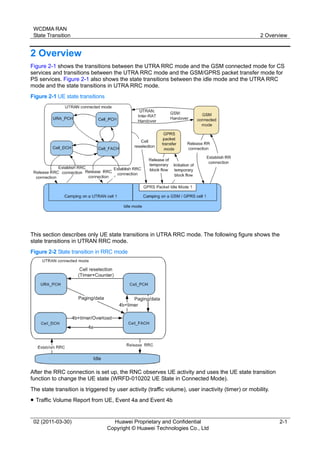
Figure 2-1 shows the transitions between the UTRA RRC mode and the GSM connected mode for CS
services and transitions between the UTRA RRC mode and the GSM/GPRS packet transfer mode for
PS services. Figure 2-1 also shows the state transitions between the idle mode and the UTRA RRC
mode and the state transitions in UTRA RRC mode.
Figure 2-1 UE state transitions
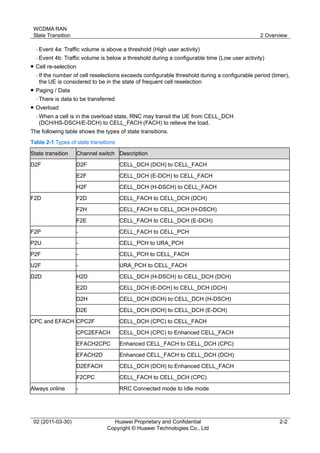
This section describes only UE state transitions in UTRA RRC mode. The following figure shows the
state transitions in UTRAN RRC mode.
Figure 2-2 State transition in RRC mode
After the RRC connection is set up, the RNC observes UE activity and uses the UE state transition
function to change the UE state (WRFD-010202 UE State in Connected Mode).
The state transition is triggered by user activity (traffic volume), user inactivity (timer) or mobility.
 Traffic Volume Report from UE, Event 4a and Event 4b
WCDMA RAN
State Transition 2 Overview
02 (2011-03-30) Huawei Proprietary and Confidential
Copyright © Huawei Technologies Co., Ltd
2-2
− Event 4a: Traffic volume is above a threshold (High user activity)
− Event 4b: Traffic volume is below a threshold during a configurable time (Low user activity)
 Cell re-selection
− If the number of cell reselections exceeds configurable threshold during a configurable period (timer),
the UE is considered to be in the state of frequent cell reselection
 Paging / Data
− There is data to be transferred
 Overload
− When a cell is in the overload state, RNC may transit the UE from CELL_DCH
(DCH/HS-DSCH/E-DCH) to CELL_FACH (FACH) to relieve the load.
The following table shows the types of state transitions.
Table 2-1 Types of state transitions
State transition Channel switch Description
D2F D2F CELL_DCH (DCH) to CELL_FACH
E2F CELL_DCH (E-DCH) to CELL_FACH
H2F CELL_DCH (H-DSCH) to CELL_FACH
F2D F2D CELL_FACH to CELL_DCH (DCH)
F2H CELL_FACH to CELL_DCH (H-DSCH)
F2E CELL_FACH to CELL_DCH (E-DCH)
F2P - CELL_FACH to CELL_PCH
P2U - CELL_PCH to URA_PCH
P2F - CELL_PCH to CELL_FACH
U2F - URA_PCH to CELL_FACH
D2D H2D CELL_DCH (H-DSCH) to CELL_DCH (DCH)
E2D CELL_DCH (E-DCH) to CELL_DCH (DCH)
D2H CELL_DCH (DCH) to CELL_DCH (H-DSCH)
D2E CELL_DCH (DCH) to CELL_DCH (E-DCH)
CPC and EFACH CPC2F CELL_DCH (CPC) to CELL_FACH
CPC2EFACH CELL_DCH (CPC) to Enhanced CELL_FACH
EFACH2CPC Enhanced CELL_FACH to CELL_DCH (CPC)
EFACH2D Enhanced CELL_FACH to CELL_DCH (DCH)
D2EFACH CELL_DCH (DCH) to Enhanced CELL_FACH
F2CPC CELL_FACH to CELL_DCH (CPC)
Always online - RRC Connected mode to Idle mode
WCDMA RAN
State Transition 2 Overview
02 (2011-03-30) Huawei Proprietary and Confidential
Copyright © Huawei Technologies Co., Ltd
2-3
Fast dormancy - New state transition mechanism is designed for fast dormancy.
For details, see the Fast Dormancy Feature Parameter Description.
Low Activity - For best effort (BE) services that are not allowed for state transition,
RNC can instruct the BE service to enter low activity state which is
configured with lower rate.
If a UE has a CS service, the UE stays in CELL_DCH during the call and is not allowed for D2F.
If a UE has a streaming service, the UE is not allowed for F2P.
WCDMA RAN
State Transition 3 Technical Description
02 (2011-03-30) Huawei Proprietary and Confidential
Copyright © Huawei Technologies Co., Ltd
3-1
3 Technical Description
3.1 UE State Transition Switches
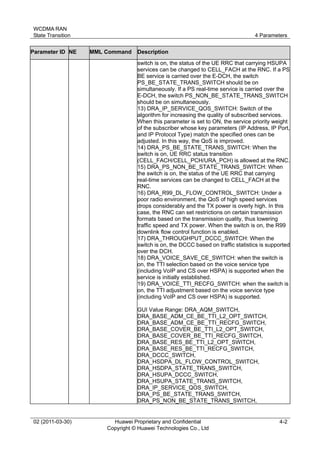
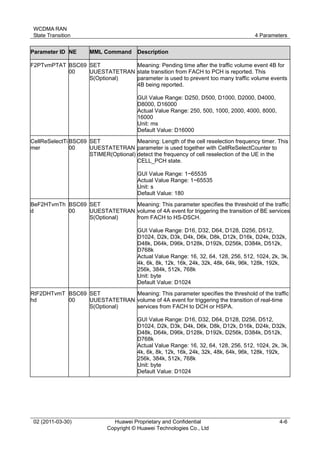
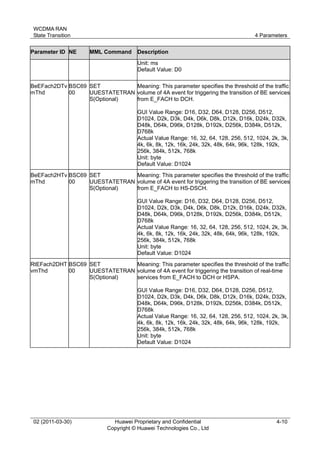
SET CORRMALGOSWITCH (DraSwitch) defines the dynamic resource allocation global parameters
(RNC-level) are as follows:
 DRA_PS_BE_STATE_TRANS_SWITCH enables RRC state transitions for bearers carrying Best
Effort services.
 DRA_PS_NON_BE_STATE_TRANS_SWITCH enables RRC state transitions for bearers carrying
services (PS real-time service) other than Best Effort.
 DRA_HSDPA_STATE_TRANS_SWITCH enables RRC state transition from HS-DSCH to FACH.
Only valid if either DRA_PS_BE_STATE_TRANS_SWITCH or
DRA_PS_NON_BE_STATE_TRANS_SWITCH (or both) are enabled, according to the type of service
being carried on HS-DSCH, that is, Best Effort or not Best Effort, respectively.
 DRA_HSUPA_STATE_TRANS_SWITCH enables RRC state transition from E-DCH to FACH.
Only valid if either DRA_PS_BE_STATE_TRANS_SWITCH or
DRA_PS_NON_BE_STATE_TRANS_SWITCH (or both) are enabled, according to the type of service
being carried on E-DCH, that is, Best Effort or not Best Effort, respectively.
In the case that the previous switches are set to 1:
 If DRA_DCCC_SWITCH is set to 1 and the dynamic channel adjustment strategy (DcccStg) is set to
RATE_UP_AND_DOWN_ON_DCH, the UE state transition function starts to work when the UL/DL
rate is below or equal to the UL/DL rate threshold for DCCC (UlDcccRateThd/DlDcccRateThd).
 If DRA_DCCC_SWITCH is set to 1 and DcccStg is set to RATE_UP_ONLY_ON_DCH, the UE state
transition function always works.
 If DRA_DCCC_SWITCH is set to 0, the UE state transition function always works.
For the PS inactive service, if the timer parameters for online detection, which can be set through the
SET UPSINACTTIMER command, are set to be a small value, the RRC connection may be released
before UE state transition.
SET UESTATETRANS defines the UE RRC state transition parameters (RNC-level)
SET UESTATETRANSTIMER defines the UE RRC state transition timers (RNC-level)
3.2 D2F State Transition
Figure 3-1 shows the state transition D2F.
WCDMA RAN
State Transition 3 Technical Description
02 (2011-03-30) Huawei Proprietary and Confidential
Copyright © Huawei Technologies Co., Ltd
3-2
Figure 3-1 UE state transition D2F
When receiving a report on event 4b, the RNC starts the timer for transition D2F and the counters for UL
and DL event 4b reports. If both the number of UL event 4b reports and the number of DL event 4b
reports are above or equal to the D2F transition threshold before the timer expires, the D2F is performed
when the timer expires.
The D2F transition threshold is the rounded-down value obtained according to the following formula:
D2F transition threshold = [D2F transition time/(Time to trigger + Pending time after trigger) x State
transition traffic redundancy coefficient]
In this equation:
 The D2F transition time, time to trigger, and pending time after trigger are specified by the parameters
listed in Table 3-1.
 The state transition traffic redundancy coefficient is used to prevent false detection that a UE is in a
low-activity state, due to the loss of measurement reports. This coefficient is set to 80%.
Table 3-1 Parameters related to UE state transition D2F
Service
Type
D2F Transition
Timer
Event 4b
Reporting
threshold
Event 4b
Time to Trigger
Event 4b
Pending Time After
Trigger
BE service
on DCH
BeD2FStateTransT
imer
D2F2PTvmThd D2FTvmTimeToTrig D2FTvmPTAT
BE service
on
HS-DSCH
BeH2FStateTransT
imer
BeH2FTvmThd BeH2FTvmTimeToTrig BeH2FTvmPTAT
PS real-time
service
RtDH2FStateTrans
Timer
RtDH2FTvmThd RtDH2FTvmTimeToTrig tDH2FTvmPTAT
WCDMA RAN
State Transition 3 Technical Description
02 (2011-03-30) Huawei Proprietary and Confidential
Copyright © Huawei Technologies Co., Ltd
3-3
BE service
on E-DCH
E2FStateTransTim
er
E2FThrouThd E2FThrouTimeToTrig
x E2FThrouMeasPeriod
E2FThrouPTAT x
E2FThrouMeasPeriod
The parameters of event 4b are set to their respective parameter values for the UL and the DL. The
parameters include the time to trigger, pending time after trigger, and threshold. For example, for BE
services if the UL channel is the DCH and the DL channel is the HS-DSCH, the parameter configurations
for BE service on the DCH as listed in Table 3-1 are used for the UL, and the parameter configurations
for BE service on the HS-DSCH as listed in Table 3-1 are used for the DL.
State transition from E-DCH to FACH is similar to state transition from DCH to FACH. The difference is
that the event 4b measurement for state transition from E-DCH to FACH is based on the throughput. The
throughput measurement period is specified by E2FThrouMeasPeriod. The threshold of event 4b is
also based on the throughput. The threshold is specified by E2FThrouThd.
3.3 Low Activity State
For BE services, if DRA_PS_BE_STATE_TRANS_SWITCH is set to 0 or the UE has other services that
do not allow UE state transition, UE state transition cannot be performed. In this case, if both the number
of UL event 4b reports and the number of DL event 4b reports are above or equal to the D2F transition
threshold before the transition timer expires, the rate can be adjusted to the low activity rate.
For single service:
 For BE service on the DCH (both uplink and downlink), both the uplink rate and downlink rate can be
adjusted to the low-activity rate threshold (LittleRateThd).
 For BE service on the DCH (uplink) and HS-DSCH (downlink), only the uplink rate can be adjusted to
LittleRateThd.
 For BE service on the E-DCH (uplink) and DCH (downlink), only the downlink rate can be adjusted to
LittleRateThd.
Note that if LittleRateThd is above or equal to UlDcccRateThd or DlDcccRateThd, the rate cannot be
adjusted to LittleRateThd.
If LittleRateThd is excessively high, excessive resources are occupied even if the UE does not have
data to transmit for a long time, leading to network congestion. If LittleRateThd is excessively low, the
throughput will be lower than the expected value when the UE starts to transmit data again, though more
radio resources are saved.
For service combination:
 If the service combination has a CS service, the UE stays in CELL_DCH state and is not allowed for
D2F. If the PS service meets the conditions for D2F, the RNC decrease data rate of the PS service to
the low activity rate.
 If the service combination has only PS services and the state transition switches are turned off, the
RNC decreases the data rate of PS services to the low activity rate.
3.4 F2P State Transition
UE state transition F2P is applicable to BE services in the PS domain.
UE state transition F2P is similar to UE state transition D2F.
When receiving a report that event 4b occurs and the traffic volume is zero, the RNC starts the timer for
transition F2P and the counters for UL and DL event 4b reports. If both the number of UL event 4B
WCDMA RAN
State Transition 3 Technical Description
02 (2011-03-30) Huawei Proprietary and Confidential
Copyright © Huawei Technologies Co., Ltd
3-4
reports and the number of DL event 4B reports are above the F2P transition threshold before the timer
expires, the F2P happens when the timer expires.
The F2P transition threshold is the rounded-down value obtained according to the following formula:
F2P transition threshold = [F2P transition time/(Time to trigger + Pending time after trigger) x State
transition traffic redundancy coefficient]
Table 3-2 lists the parameters related to UE state transition F2P.
Table 3-2 Parameters related to UE state transition F2P
Service Type F2P Transition
Timer
Event 4b
Reporting threshold
Event 4b
Time to Trigger
Event 4b
Pending Time After
Trigger
PS BE service BeF2PStateTran
sTimer
D2F2PTvmThd F2PTvmTimeToTrig F2PTvmPTAT
When the cell is in the overload congestion state, the state transition F2D is prohibited.
3.5 P2U State Transition
UE state transition P2U is applicable to BE services in the PS domain.
Before the state transition, the state of the UE is CELL_PCH. During the cell reselection, the UE sends
the CELL UPDATE messages. The RNC starts a timer (CellReSelectTimer) and counts the number of
CELL UPDATE messages with the cause value of cell reselection. When the timer expires, the number
of CELL UPDATE messages may be above the threshold (CellReSelectCounter). In this case, the RNC
initiates a state transition when the UE sends the CELL UPDATE message again.
The state transition P2U involves the transient state CELL_FACH, in which some necessary signaling interaction is
performed.
3.6 P2F and U2F State Transition
P2F and U2F are performed when UTRAN pages the UE or when the UE needs to exchange information
with the UTRAN. There are no configuration parameters.
3.7 F2D State Transition
The F2D state transition happens when the UTRAN receives a 4a report that triggered by the UL or DL
traffic volume. RNC determines the transport channel (DCH, HS-DSCH, E-DCH) and the target rate.
Table 3-3 lists the target rates for UE state transitions F2D.
Table 3-3 Target rates for UE state transitions F2D
Service
Type
Event 4a
threshold
Target Rate
BE on DCH BeF2DTvmThd  UL target rate (DCH) = min (MBR, UL rate threshold for DCCC)
 DL target rate (DCH) = min (MBR, DL rate threshold for DCCC)
WCDMA RAN
State Transition 3 Technical Description
02 (2011-03-30) Huawei Proprietary and Confidential
Copyright © Huawei Technologies Co., Ltd
3-5
BE on
HS-DSCH
BeF2HTvmThd  UL target rate (DCH) = min (MBR, UL rate threshold for DCCC)
 UL target rate (E-DCH) = min (HSUPA rate adjustment set)
 DL target rate (HS-DSCH) = MBR
PS real-time
service
RtF2DHTvmThd  UL target rate (DCH) = MBR
 DL target rate (DCH) = MBR
BE on
E-DCH
BeF2ETvmThd  UL target rate (E-DCH) = min (HSUPA rate adjustment set), If
HSUPA_DCCC_SWITCH is set to 1.
 UL target rate (E-DCH) = MBR, If HSUPA_DCCC_SWITCH is set to 0.
 DL target rate (DCH) = min (MBR, DL rate threshold for DCCC)
 DL target rate (H-DSCH) = MBR.
3.8 D2D State Transition
For HSDPA and HSUPA, there are two more sub-state called CELL_DCH (with HS-DSCH) and
CELL_DCH (with E-DCH).
Principle of state transitions of D2D is shown in the following figure.
Figure 3-2 State transition of D2H/E or H/E2D
Table 3-4 State transition type
Type Trigger
E2D  During RAB setup, RAB should be carried over E-DCH but resources are insufficient
 E-DCH serving cell change (change of best cell)
− New best cell does not support E-DCH
− New best cell does not have enough resources for E-DCH
D2E  In any of the scenarios above (E2D), it is possible to transit DCH to E-DCH
− Periodic attempt to reconfigure to E-DCH (timer)
− Traffic volume (event 4A)
 If a UE reports event 6B2 and event 4A, and the UE services can be carried on the
E-DCH, then the RNC switches the UE from the DCH to the E-DCH during the rate
increase process.
WCDMA RAN
State Transition 3 Technical Description
02 (2011-03-30) Huawei Proprietary and Confidential
Copyright © Huawei Technologies Co., Ltd
3-6
H2D  RAB should be carried over HS-DSCH but resources are insufficient
 HS-DSCH serving cell change (change of best cell)
− New best cell does not support HS-DSCH
− New best cell does not have enough resources for HS-DSCH
D2H  In any of the scenarios above (H2D), it is possible to transit DCH to HS-DSCH later.
− Periodic attempt to reconfigure to HS-DSCH (timer)
− Traffic volume (event 4A)
For details of periodic retry, see the Directed Retry Decision Feature Parameter Description.
3.9 CPC and EFACH State Transition
This section describes the new functions of state transition introduced in HSPA+.
HSPA+ requires two new states: CELL_DCH (CPC) state and enhanced CELL_FACH state. The
CELL_DCH (CPC) state corresponds to the CELL_DCH state with CPC activated, and the enhanced
CELL_FACH state corresponds to the CELL_FACH state with Enhanced CELL_FACH operation
activated.
Figure 3-3 shows the new types of state transitions introduced in HSPA+.
Figure 3-3 New types of state transitions introduced in HSPA+
These state transitions are triggered by the event 4A or event 4B. The corresponding functions are the
same as those for the state transitions between CELL_DCH and CELL_FACH, except that some new
parameters are introduced.
The only impact of the following new state transitions is that new timers to trigger event 4B are
introduced:
Type New timers
CPC2F  BeCpc2FStateTransTimer: BE service state transition timer (CPC_HS-DSCH to
F/RACH)
 RtCpc2FStateTransTimer: real-time service state transition timer (CPC_HSPA to
F/RACH)
WCDMA RAN
State Transition 3 Technical Description
02 (2011-03-30) Huawei Proprietary and Confidential
Copyright © Huawei Technologies Co., Ltd
3-7
D2EFACH  BeD2EFachStateTransTimer: BE service state transition timer (DCH to E_FACH)
 BeH2EFachStateTransTimer: BE service state transition timer (HS-DSCH to E_FACH)
 RtDH2EFachStateTransTimer: real-time service state transition timer (DCH or HSPA to
E_FACH)
CPC2EFACH BeCpc2EFachStateTransTimer: BE service state transition timer (CPC_HS-DSCH to
E_FACH)
 RtCpc2EFachStateTransTimer: real-time service state transition timer (CPC_HSPA to
E_FACH)
The only impact of the following new state transitions is that new timers and thresholds to trigger 4A are
introduced:
Type New timers and new 4a threshold
F2CPC The new thresholds are as follows:
 BeF2CpcHTvmThd: event 4A threshold for BE service state transition (F/RACH to
CPC_HS-DSCH)
 RtF2CpcTvmThd: event 4A threshold for real-time service state transition (F/RACH to
CPC_HSPA)
 BeF2CpcETvmThd: event 4A threshold for BE service state transition (F/RACH to
CPC_E-DCH)
The new timers are as follows:
 BeF2CpcHTvmTimeToTrig: event 4A trigger time for BE service state transition
(F/RACH to CPC_HS-DSCH)
 RtF2CpcTvmTimeToTrig: event 4A trigger time for real-time service state transition
(F/RACH to CPC_HSPA)
 BeF2CpcETvmTimeToTrig: event 4A trigger time for real-time service state transition
(F/RACH to CPC_E-DCH)
EFACH2D The new thresholds are as follows:
 BeEFach2DTvmThd: event 4A threshold for BE service state transition (E_FACH to
DCH)
 BeEFach2HTvmThd: event 4A threshold for BE service state transition (E_FACH to
HS-DSCH)
 RtEFach2DHTvmThd: event 4A threshold for real-time service state transition
(E_FACH to DCH or HSPA)
The new timers are as follows:
 BeEFach2DTvmTimeToTrig: event 4A trigger time for BE service state transition
(E-FACH to DCH)
 BeEFach2HTvmTimeToTrig: event 4A trigger time for BE service state transition
(E_FACH to HS-DSCH)
 RtEFach2DHTvmTimeToTrig: event 4A trigger time for real-time service state
transition (E_FACH to DCH/HSPA)
WCDMA RAN
State Transition 3 Technical Description
02 (2011-03-30) Huawei Proprietary and Confidential
Copyright © Huawei Technologies Co., Ltd
3-8
EFACH2CPCThe new thresholds are as follows:
 BeEFach2CpcTvmThd: event 4A threshold for BE service state transition (E_FACH to
CPC_HS-DSCH)
 RtEFach2CpcTvmThd: event 4A threshold for PS real-time service state transition
(E_FACH to CPC_HSPA)
The new timers are as follows:
 BeEFach2CpcTvmTimeToTrig: event 4A trigger time for BE service state transition
(E_FACH to CPC_HS-DSCH)
 RtEFach2CpcTvmTimeToTrig: event 4A trigger time for real-time service state
transition (E_FACH to CPC_HSPA)
The function of the state transitions between enhanced CELL_FACH and CELL_PCH is the same as
that of the state transitions between CELL_FACH and CELL_PCH.
3.10 Always Online
When the RNC detects that there is no data transmission for a PS service, the RNC sends a request to
the CN for release of the service. The CN initiates the release procedure, requesting the RNC to release
the corresponding radio resources. The CN, however, reserves the PDP context for this PS service of
the UE. When the UE re-initiates the service of this PDP context, it does not need to apply for the PDP
context again. Thus, the UE in the PS domain is always online.
For each PS RAB, two PDCP timers, namely T1 and T2, are available. Service release due to the
absence of data is implemented through these two timers. The values of T1 and T2 for different services
are set by the parameters listed in Table 3-5.
SET PSINACTTIMER defines the PS inactivity timers (RNC-level). If inactivity detection is not desired
for a particular service, just set T1 = T2 = 0.
Table 3-5 Parameters-related T1 and T2
Service type T1 T2
Conversational service PsInactTmrForCon ProtectTmrForCon
Streaming service PsInactTmrForStr ProtectTmrForStr
Interactive service PsInactTmrForInt ProtectTmrForInt
Background service PsInactTmrForBac ProtectTmrForBac
IMS signaling PSInactTmrForImsSig ProtectTmrForImsSig
Figure 3-4 shows the procedure of service release due to the absence of data.
WCDMA RAN
State Transition 3 Technical Description
02 (2011-03-30) Huawei Proprietary and Confidential
Copyright © Huawei Technologies Co., Ltd
3-9
Figure 3-4 Procedure of service release due to the absence of data
WCDMA RAN
State Transition 3 Technical Description
02 (2011-03-30) Huawei Proprietary and Confidential
Copyright © Huawei Technologies Co., Ltd
3-10
The procedure of service release due to the absence of data is as follows:
1. When the PDCP entity of a service is set up, timer T1 is started.
2. If the PDCP entity still detects that there is no UL or DL data packet when T1 expires, the PDCP
entity sends the request to the RRC layer for the service release and starts T2.
3. If the CN does not initiate the service release, the PDCP entity continues to detect data packets. If
the PDCP entity still detects that there is no UL or DL data packet when T2 expires, the PDCP entity
sends the request to the RRC layer for the service release. In this case:
− If there is only one RAB for the UE in the PS domain, the RNC sends an IU RELEASE REQUEST
message to the CN.
− If there is more than one RAB for the UE in the PS domain, the RNC sends an RAB RELEASE
REQUEST message to the CN.
The two messages indicate the release causes in the User Inactivity IE.
4. When the CN receives the message, it initiates the release procedure. At the same time, the CN
reserves the PDP context for the service. When the UE re-initiates the service of this PDP context, it
does not have to apply for the PDP context again.
The service release request from the PDCP entity may not be processed in time. The reason is that the associated
processor in the RNC is busy.
WCDMA RAN
State Transition 4 Parameters
02 (2011-03-30) Huawei Proprietary and Confidential
Copyright © Huawei Technologies Co., Ltd
4-1
4 Parameters
Table 4-1 Parameter Description
Parameter ID NE MML Command Description
DraSwitch BSC69
00
SET
UCORRMALGOS
WITCH(Optional)
Meaning: Dynamic resource allocation switch group.
1) DRA_AQM_SWITCH: When the switch is on, the active
queue management algorithm is used for the RNC.
2) DRA_BASE_ADM_CE_BE_TTI_L2_OPT_SWITCH:
When the switch is on, the TTI dynamic adjustment algorithm
for admission CE-based BE services applies to the UE with
the UL enhanced L2 feature. This parameter is valid when
DRA_BASE_ADM_CE_BE_TTI_RECFG_SWITCH(DraSwitc
h) is set to ON.
3) DRA_BASE_ADM_CE_BE_TTI_RECFG_SWITCH: When
the switch is on, the TTI dynamic adjustment algorithm is
supported for admission CE-based BE services.
4) DRA_BASE_COVER_BE_TTI_L2_OPT_SWITCH: When
the switch is on, the TTI dynamic adjustment algorithm for
coverage-based BE services applies to the UE with the UL
enhanced L2 feature. This parameter is valid when
DRA_BASE_COVER_BE_TTI_RECFG_SWITCH(DraSwitch
) is set to ON.
5) DRA_BASE_COVER_BE_TTI_RECFG_SWITCH: When
the switch is on, the TTI dynamic adjustment algorithm is
supported for coverage-based BE services.
6) DRA_BASE_RES_BE_TTI_L2_OPT_SWITCH: When the
switch is on, the TTI dynamic adjustment algorithm for
differentiation-based BE services applies to the UE with the
UL enhanced L2 feature. This parameter is valid when
DRA_BASE_RES_BE_TTI_RECFG_SWITCH(DraSwitch) is
set to ON.
7) DRA_BASE_RES_BE_TTI_RECFG_SWITCH: When the
switch is on, the TTI dynamic adjustment algorithm is
supported for differentiation-based BE services.
8) DRA_DCCC_SWITCH: When the switch is on, the
dynamic channel reconfiguration control algorithm is used for
the RNC.
9) DRA_HSDPA_DL_FLOW_CONTROL_SWITCH: When
the switch is on, flow control is enabled for HSDPA services
in AM mode.
10) DRA_HSDPA_STATE_TRANS_SWITCH: When the
switch is on, the status of the UE RRC that carrying HSDPA
services can be changed to CELL_FACH at the RNC. If a PS
BE service is carried over the HS-DSCH, the switch
PS_BE_STATE_TRANS_SWITCH should be on
simultaneously. If a PS real-time service is carried over the
HS-DSCH, the switch
PS_NON_BE_STATE_TRANS_SWITCH should be on
simultaneously.
11) DRA_HSUPA_DCCC_SWITCH: When the switch is on,
the DCCC algorithm is used for HSUPA. The DCCC switch
must be also on before this switch takes effect.
12) DRA_HSUPA_STATE_TRANS_SWITCH: When the
WCDMA RAN
State Transition 4 Parameters
02 (2011-03-30) Huawei Proprietary and Confidential
Copyright © Huawei Technologies Co., Ltd
4-2
Parameter ID NE MML Command Description
switch is on, the status of the UE RRC that carrying HSUPA
services can be changed to CELL_FACH at the RNC. If a PS
BE service is carried over the E-DCH, the switch
PS_BE_STATE_TRANS_SWITCH should be on
simultaneously. If a PS real-time service is carried over the
E-DCH, the switch PS_NON_BE_STATE_TRANS_SWITCH
should be on simultaneously.
13) DRA_IP_SERVICE_QOS_SWITCH: Switch of the
algorithm for increasing the quality of subscribed services.
When this parameter is set to ON, the service priority weight
of the subscriber whose key parameters (IP Address, IP Port,
and IP Protocol Type) match the specified ones can be
adjusted. In this way, the QoS is improved.
14) DRA_PS_BE_STATE_TRANS_SWITCH: When the
switch is on, UE RRC status transition
(CELL_FACH/CELL_PCH/URA_PCH) is allowed at the RNC.
15) DRA_PS_NON_BE_STATE_TRANS_SWITCH: When
the switch is on, the status of the UE RRC that carrying
real-time services can be changed to CELL_FACH at the
RNC.
16) DRA_R99_DL_FLOW_CONTROL_SWITCH: Under a
poor radio environment, the QoS of high speed services
drops considerably and the TX power is overly high. In this
case, the RNC can set restrictions on certain transmission
formats based on the transmission quality, thus lowering
traffic speed and TX power. When the switch is on, the R99
downlink flow control function is enabled.
17) DRA_THROUGHPUT_DCCC_SWITCH: When the
switch is on, the DCCC based on traffic statistics is supported
over the DCH.
18) DRA_VOICE_SAVE_CE_SWITCH: when the switch is
on, the TTI selection based on the voice service type
(including VoIP and CS over HSPA) is supported when the
service is initially established.
19) DRA_VOICE_TTI_RECFG_SWITCH: when the switch is
on, the TTI adjustment based on the voice service type
(including VoIP and CS over HSPA) is supported.
GUI Value Range: DRA_AQM_SWITCH,
DRA_BASE_ADM_CE_BE_TTI_L2_OPT_SWITCH,
DRA_BASE_ADM_CE_BE_TTI_RECFG_SWITCH,
DRA_BASE_COVER_BE_TTI_L2_OPT_SWITCH,
DRA_BASE_COVER_BE_TTI_RECFG_SWITCH,
DRA_BASE_RES_BE_TTI_L2_OPT_SWITCH,
DRA_BASE_RES_BE_TTI_RECFG_SWITCH,
DRA_DCCC_SWITCH,
DRA_HSDPA_DL_FLOW_CONTROL_SWITCH,
DRA_HSDPA_STATE_TRANS_SWITCH,
DRA_HSUPA_DCCC_SWITCH,
DRA_HSUPA_STATE_TRANS_SWITCH,
DRA_IP_SERVICE_QOS_SWITCH,
DRA_PS_BE_STATE_TRANS_SWITCH,
DRA_PS_NON_BE_STATE_TRANS_SWITCH,
WCDMA RAN
State Transition 4 Parameters
02 (2011-03-30) Huawei Proprietary and Confidential
Copyright © Huawei Technologies Co., Ltd
4-3
Parameter ID NE MML Command Description
DRA_R99_DL_FLOW_CONTROL_SWITCH,
DRA_THROUGHPUT_DCCC_SWITCH,
DRA_VOICE_SAVE_CE_SWITCH,
DRA_VOICE_TTI_RECFG_SWITCH
Actual Value Range: DRA_AQM_SWITCH,
DRA_BASE_ADM_CE_BE_TTI_L2_OPT_SWITCH,
DRA_BASE_ADM_CE_BE_TTI_RECFG_SWITCH,
DRA_BASE_COVER_BE_TTI_L2_OPT_SWITCH,
DRA_BASE_COVER_BE_TTI_RECFG_SWITCH,
DRA_BASE_RES_BE_TTI_L2_OPT_SWITCH,
DRA_BASE_RES_BE_TTI_RECFG_SWITCH,
DRA_DCCC_SWITCH,
DRA_HSDPA_DL_FLOW_CONTROL_SWITCH,
DRA_HSDPA_STATE_TRANS_SWITCH,
DRA_HSUPA_DCCC_SWITCH,
DRA_HSUPA_STATE_TRANS_SWITCH,
DRA_IP_SERVICE_QOS_SWITCH,
DRA_PS_BE_STATE_TRANS_SWITCH,
DRA_PS_NON_BE_STATE_TRANS_SWITCH,
DRA_R99_DL_FLOW_CONTROL_SWITCH,
DRA_THROUGHPUT_DCCC_SWITCH,
DRA_VOICE_SAVE_CE_SWITCH,
DRA_VOICE_TTI_RECFG_SWITCH
Unit: None
Default Value: None
DcccStg BSC69
00
SET
UDCCC(Optional)
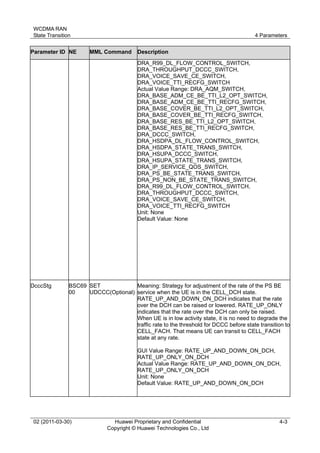
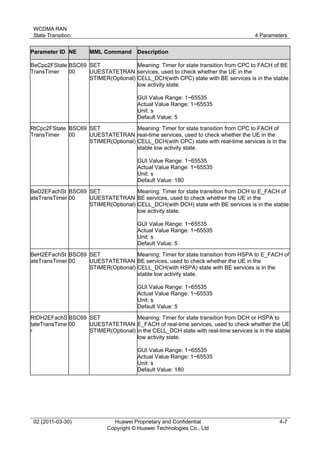
Meaning: Strategy for adjustment of the rate of the PS BE
service when the UE is in the CELL_DCH state.
RATE_UP_AND_DOWN_ON_DCH indicates that the rate
over the DCH can be raised or lowered. RATE_UP_ONLY
indicates that the rate over the DCH can only be raised.
When UE is in low activity state, it is no need to degrade the
traffic rate to the threshold for DCCC before state transition to
CELL_FACH. That means UE can transit to CELL_FACH
state at any rate.
GUI Value Range: RATE_UP_AND_DOWN_ON_DCH,
RATE_UP_ONLY_ON_DCH
Actual Value Range: RATE_UP_AND_DOWN_ON_DCH,
RATE_UP_ONLY_ON_DCH
Unit: None
Default Value: RATE_UP_AND_DOWN_ON_DCH
WCDMA RAN
State Transition 4 Parameters
02 (2011-03-30) Huawei Proprietary and Confidential
Copyright © Huawei Technologies Co., Ltd
4-4
Parameter ID NE MML Command Description
UlDcccRateTh
d
BSC69
00
SET
UDCCC(Optional)
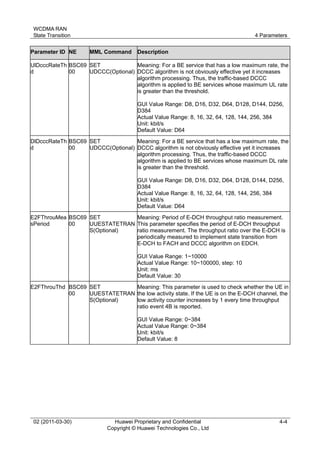
Meaning: For a BE service that has a low maximum rate, the
DCCC algorithm is not obviously effective yet it increases
algorithm processing. Thus, the traffic-based DCCC
algorithm is applied to BE services whose maximum UL rate
is greater than the threshold.
GUI Value Range: D8, D16, D32, D64, D128, D144, D256,
D384
Actual Value Range: 8, 16, 32, 64, 128, 144, 256, 384
Unit: kbit/s
Default Value: D64
DlDcccRateTh
d
BSC69
00
SET
UDCCC(Optional)
Meaning: For a BE service that has a low maximum rate, the
DCCC algorithm is not obviously effective yet it increases
algorithm processing. Thus, the traffic-based DCCC
algorithm is applied to BE services whose maximum DL rate
is greater than the threshold.
GUI Value Range: D8, D16, D32, D64, D128, D144, D256,
D384
Actual Value Range: 8, 16, 32, 64, 128, 144, 256, 384
Unit: kbit/s
Default Value: D64
E2FThrouMea
sPeriod
BSC69
00
SET
UUESTATETRAN
S(Optional)
Meaning: Period of E-DCH throughput ratio measurement.
This parameter specifies the period of E-DCH throughput
ratio measurement. The throughput ratio over the E-DCH is
periodically measured to implement state transition from
E-DCH to FACH and DCCC algorithm on EDCH.
GUI Value Range: 1~10000
Actual Value Range: 10~100000, step: 10
Unit: ms
Default Value: 30
E2FThrouThd BSC69
00
SET
UUESTATETRAN
S(Optional)
Meaning: This parameter is used to check whether the UE in
the low activity state. If the UE is on the E-DCH channel, the
low activity counter increases by 1 every time throughput
ratio event 4B is reported.
GUI Value Range: 0~384
Actual Value Range: 0~384
Unit: kbit/s
Default Value: 8
WCDMA RAN
State Transition 4 Parameters
02 (2011-03-30) Huawei Proprietary and Confidential
Copyright © Huawei Technologies Co., Ltd
4-5
Parameter ID NE MML Command Description
LittleRateThd BSC69
00
SET
UDCCC(Optional)
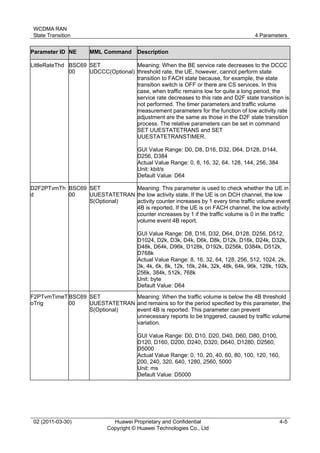
Meaning: When the BE service rate decreases to the DCCC
threshold rate, the UE, however, cannot perform state
transition to FACH state because, for example, the state
transition switch is OFF or there are CS services. In this
case, when traffic remains low for quite a long period, the
service rate decreases to this rate and D2F state transition is
not performed. The timer parameters and traffic volume
measurement parameters for the function of low activity rate
adjustment are the same as those in the D2F state transition
process. The relative parameters can be set in command
SET UUESTATETRANS and SET
UUESTATETRANSTIMER.
GUI Value Range: D0, D8, D16, D32, D64, D128, D144,
D256, D384
Actual Value Range: 0, 8, 16, 32, 64, 128, 144, 256, 384
Unit: kbit/s
Default Value: D64
D2F2PTvmTh
d
BSC69
00
SET
UUESTATETRAN
S(Optional)
Meaning: This parameter is used to check whether the UE in
the low activity state. If the UE is on DCH channel, the low
activity counter increases by 1 every time traffic volume event
4B is reported. If the UE is on FACH channel, the low activity
counter increases by 1 if the traffic volume is 0 in the traffic
volume event 4B report.
GUI Value Range: D8, D16, D32, D64, D128, D256, D512,
D1024, D2k, D3k, D4k, D6k, D8k, D12k, D16k, D24k, D32k,
D48k, D64k, D96k, D128k, D192k, D256k, D384k, D512k,
D768k
Actual Value Range: 8, 16, 32, 64, 128, 256, 512, 1024, 2k,
3k, 4k, 6k, 8k, 12k, 16k, 24k, 32k, 48k, 64k, 96k, 128k, 192k,
256k, 384k, 512k, 768k
Unit: byte
Default Value: D64
F2PTvmTimeT
oTrig
BSC69
00
SET
UUESTATETRAN
S(Optional)
Meaning: When the traffic volume is below the 4B threshold
and remains so for the period specified by this parameter, the
event 4B is reported. This parameter can prevent
unnecessary reports to be triggered, caused by traffic volume
variation.
GUI Value Range: D0, D10, D20, D40, D60, D80, D100,
D120, D160, D200, D240, D320, D640, D1280, D2560,
D5000
Actual Value Range: 0, 10, 20, 40, 60, 80, 100, 120, 160,
200, 240, 320, 640, 1280, 2560, 5000
Unit: ms
Default Value: D5000
WCDMA RAN
State Transition 4 Parameters
02 (2011-03-30) Huawei Proprietary and Confidential
Copyright © Huawei Technologies Co., Ltd
4-6
Parameter ID NE MML Command Description
F2PTvmPTAT BSC69
00
SET
UUESTATETRAN
S(Optional)
Meaning: Pending time after the traffic volume event 4B for
state transition from FACH to PCH is reported. This
parameter is used to prevent too many traffic volume events
4B being reported.
GUI Value Range: D250, D500, D1000, D2000, D4000,
D8000, D16000
Actual Value Range: 250, 500, 1000, 2000, 4000, 8000,
16000
Unit: ms
Default Value: D16000
CellReSelectTi
mer
BSC69
00
SET
UUESTATETRAN
STIMER(Optional)
Meaning: Length of the cell reselection frequency timer. This
parameter is used together with CellReSelectCounter to
detect the frequency of cell reselection of the UE in the
CELL_PCH state.
GUI Value Range: 1~65535
Actual Value Range: 1~65535
Unit: s
Default Value: 180
BeF2HTvmTh
d
BSC69
00
SET
UUESTATETRAN
S(Optional)
Meaning: This parameter specifies the threshold of the traffic
volume of 4A event for triggering the transition of BE services
from FACH to HS-DSCH.
GUI Value Range: D16, D32, D64, D128, D256, D512,
D1024, D2k, D3k, D4k, D6k, D8k, D12k, D16k, D24k, D32k,
D48k, D64k, D96k, D128k, D192k, D256k, D384k, D512k,
D768k
Actual Value Range: 16, 32, 64, 128, 256, 512, 1024, 2k, 3k,
4k, 6k, 8k, 12k, 16k, 24k, 32k, 48k, 64k, 96k, 128k, 192k,
256k, 384k, 512k, 768k
Unit: byte
Default Value: D1024
RtF2DHTvmT
hd
BSC69
00
SET
UUESTATETRAN
S(Optional)
Meaning: This parameter specifies the threshold of the traffic
volume of 4A event for triggering the transition of real-time
services from FACH to DCH or HSPA.
GUI Value Range: D16, D32, D64, D128, D256, D512,
D1024, D2k, D3k, D4k, D6k, D8k, D12k, D16k, D24k, D32k,
D48k, D64k, D96k, D128k, D192k, D256k, D384k, D512k,
D768k
Actual Value Range: 16, 32, 64, 128, 256, 512, 1024, 2k, 3k,
4k, 6k, 8k, 12k, 16k, 24k, 32k, 48k, 64k, 96k, 128k, 192k,
256k, 384k, 512k, 768k
Unit: byte
Default Value: D1024
WCDMA RAN
State Transition 4 Parameters
02 (2011-03-30) Huawei Proprietary and Confidential
Copyright © Huawei Technologies Co., Ltd
4-7
Parameter ID NE MML Command Description
BeCpc2FState
TransTimer
BSC69
00
SET
UUESTATETRAN
STIMER(Optional)
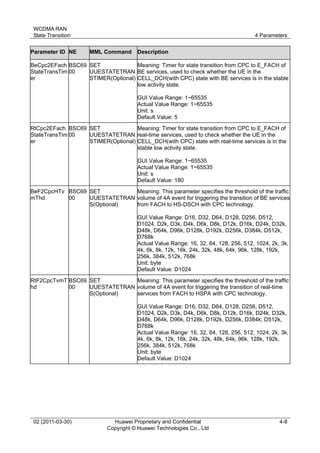
Meaning: Timer for state transition from CPC to FACH of BE
services, used to check whether the UE in the
CELL_DCH(with CPC) state with BE services is in the stable
low activity state.
GUI Value Range: 1~65535
Actual Value Range: 1~65535
Unit: s
Default Value: 5
RtCpc2FState
TransTimer
BSC69
00
SET
UUESTATETRAN
STIMER(Optional)
Meaning: Timer for state transition from CPC to FACH of
real-time services, used to check whether the UE in the
CELL_DCH(with CPC) state with real-time services is in the
stable low activity state.
GUI Value Range: 1~65535
Actual Value Range: 1~65535
Unit: s
Default Value: 180
BeD2EFachSt
ateTransTimer
BSC69
00
SET
UUESTATETRAN
STIMER(Optional)
Meaning: Timer for state transition from DCH to E_FACH of
BE services, used to check whether the UE in the
CELL_DCH(with DCH) state with BE services is in the stable
low activity state.
GUI Value Range: 1~65535
Actual Value Range: 1~65535
Unit: s
Default Value: 5
BeH2EFachSt
ateTransTimer
BSC69
00
SET
UUESTATETRAN
STIMER(Optional)
Meaning: Timer for state transition from HSPA to E_FACH of
BE services, used to check whether the UE in the
CELL_DCH(with HSPA) state with BE services is in the
stable low activity state.
GUI Value Range: 1~65535
Actual Value Range: 1~65535
Unit: s
Default Value: 5
RtDH2EFachS
tateTransTime
r
BSC69
00
SET
UUESTATETRAN
STIMER(Optional)
Meaning: Timer for state transition from DCH or HSPA to
E_FACH of real-time services, used to check whether the UE
in the CELL_DCH state with real-time services is in the stable
low activity state.
GUI Value Range: 1~65535
Actual Value Range: 1~65535
Unit: s
Default Value: 180
WCDMA RAN
State Transition 4 Parameters
02 (2011-03-30) Huawei Proprietary and Confidential
Copyright © Huawei Technologies Co., Ltd
4-8
Parameter ID NE MML Command Description
BeCpc2EFach
StateTransTim
er
BSC69
00
SET
UUESTATETRAN
STIMER(Optional)
Meaning: Timer for state transition from CPC to E_FACH of
BE services, used to check whether the UE in the
CELL_DCH(with CPC) state with BE services is in the stable
low activity state.
GUI Value Range: 1~65535
Actual Value Range: 1~65535
Unit: s
Default Value: 5
RtCpc2EFach
StateTransTim
er
BSC69
00
SET
UUESTATETRAN
STIMER(Optional)
Meaning: Timer for state transition from CPC to E_FACH of
real-time services, used to check whether the UE in the
CELL_DCH(with CPC) state with real-time services is in the
stable low activity state.
GUI Value Range: 1~65535
Actual Value Range: 1~65535
Unit: s
Default Value: 180
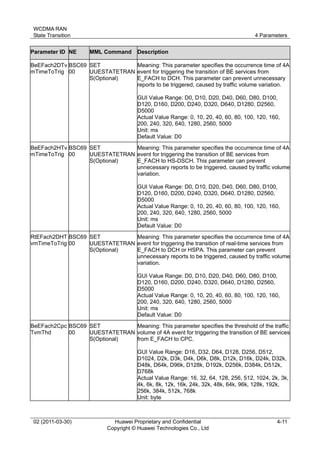
BeF2CpcHTv
mThd
BSC69
00
SET
UUESTATETRAN
S(Optional)
Meaning: This parameter specifies the threshold of the traffic
volume of 4A event for triggering the transition of BE services
from FACH to HS-DSCH with CPC technology.
GUI Value Range: D16, D32, D64, D128, D256, D512,
D1024, D2k, D3k, D4k, D6k, D8k, D12k, D16k, D24k, D32k,
D48k, D64k, D96k, D128k, D192k, D256k, D384k, D512k,
D768k
Actual Value Range: 16, 32, 64, 128, 256, 512, 1024, 2k, 3k,
4k, 6k, 8k, 12k, 16k, 24k, 32k, 48k, 64k, 96k, 128k, 192k,
256k, 384k, 512k, 768k
Unit: byte
Default Value: D1024
RtF2CpcTvmT
hd
BSC69
00
SET
UUESTATETRAN
S(Optional)
Meaning: This parameter specifies the threshold of the traffic
volume of 4A event for triggering the transition of real-time
services from FACH to HSPA with CPC technology.
GUI Value Range: D16, D32, D64, D128, D256, D512,
D1024, D2k, D3k, D4k, D6k, D8k, D12k, D16k, D24k, D32k,
D48k, D64k, D96k, D128k, D192k, D256k, D384k, D512k,
D768k
Actual Value Range: 16, 32, 64, 128, 256, 512, 1024, 2k, 3k,
4k, 6k, 8k, 12k, 16k, 24k, 32k, 48k, 64k, 96k, 128k, 192k,
256k, 384k, 512k, 768k
Unit: byte
Default Value: D1024
WCDMA RAN
State Transition 4 Parameters
02 (2011-03-30) Huawei Proprietary and Confidential
Copyright © Huawei Technologies Co., Ltd
4-9
Parameter ID NE MML Command Description
BeF2CpcETv
mThd
BSC69
00
SET
UUESTATETRAN
S(Optional)
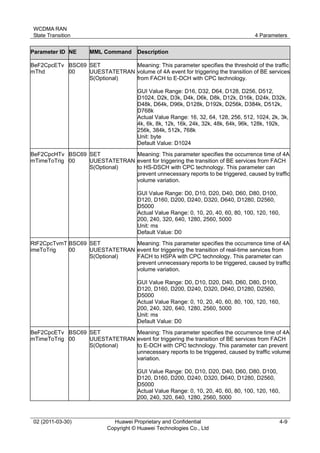
Meaning: This parameter specifies the threshold of the traffic
volume of 4A event for triggering the transition of BE services
from FACH to E-DCH with CPC technology.
GUI Value Range: D16, D32, D64, D128, D256, D512,
D1024, D2k, D3k, D4k, D6k, D8k, D12k, D16k, D24k, D32k,
D48k, D64k, D96k, D128k, D192k, D256k, D384k, D512k,
D768k
Actual Value Range: 16, 32, 64, 128, 256, 512, 1024, 2k, 3k,
4k, 6k, 8k, 12k, 16k, 24k, 32k, 48k, 64k, 96k, 128k, 192k,
256k, 384k, 512k, 768k
Unit: byte
Default Value: D1024
BeF2CpcHTv
mTimeToTrig
BSC69
00
SET
UUESTATETRAN
S(Optional)
Meaning: This parameter specifies the occurrence time of 4A
event for triggering the transition of BE services from FACH
to HS-DSCH with CPC technology. This parameter can
prevent unnecessary reports to be triggered, caused by traffic
volume variation.
GUI Value Range: D0, D10, D20, D40, D60, D80, D100,
D120, D160, D200, D240, D320, D640, D1280, D2560,
D5000
Actual Value Range: 0, 10, 20, 40, 60, 80, 100, 120, 160,
200, 240, 320, 640, 1280, 2560, 5000
Unit: ms
Default Value: D0
RtF2CpcTvmT
imeToTrig
BSC69
00
SET
UUESTATETRAN
S(Optional)
Meaning: This parameter specifies the occurrence time of 4A
event for triggering the transition of real-time services from
FACH to HSPA with CPC technology. This parameter can
prevent unnecessary reports to be triggered, caused by traffic
volume variation.
GUI Value Range: D0, D10, D20, D40, D60, D80, D100,
D120, D160, D200, D240, D320, D640, D1280, D2560,
D5000
Actual Value Range: 0, 10, 20, 40, 60, 80, 100, 120, 160,
200, 240, 320, 640, 1280, 2560, 5000
Unit: ms
Default Value: D0
BeF2CpcETv
mTimeToTrig
BSC69
00
SET
UUESTATETRAN
S(Optional)
Meaning: This parameter specifies the occurrence time of 4A
event for triggering the transition of BE services from FACH
to E-DCH with CPC technology. This parameter can prevent
unnecessary reports to be triggered, caused by traffic volume
variation.
GUI Value Range: D0, D10, D20, D40, D60, D80, D100,
D120, D160, D200, D240, D320, D640, D1280, D2560,
D5000
Actual Value Range: 0, 10, 20, 40, 60, 80, 100, 120, 160,
200, 240, 320, 640, 1280, 2560, 5000
WCDMA RAN
State Transition 4 Parameters
02 (2011-03-30) Huawei Proprietary and Confidential
Copyright © Huawei Technologies Co., Ltd
4-10
Parameter ID NE MML Command Description
Unit: ms
Default Value: D0
BeEFach2DTv
mThd
BSC69
00
SET
UUESTATETRAN
S(Optional)
Meaning: This parameter specifies the threshold of the traffic
volume of 4A event for triggering the transition of BE services
from E_FACH to DCH.
GUI Value Range: D16, D32, D64, D128, D256, D512,
D1024, D2k, D3k, D4k, D6k, D8k, D12k, D16k, D24k, D32k,
D48k, D64k, D96k, D128k, D192k, D256k, D384k, D512k,
D768k
Actual Value Range: 16, 32, 64, 128, 256, 512, 1024, 2k, 3k,
4k, 6k, 8k, 12k, 16k, 24k, 32k, 48k, 64k, 96k, 128k, 192k,
256k, 384k, 512k, 768k
Unit: byte
Default Value: D1024
BeEFach2HTv
mThd
BSC69
00
SET
UUESTATETRAN
S(Optional)
Meaning: This parameter specifies the threshold of the traffic
volume of 4A event for triggering the transition of BE services
from E_FACH to HS-DSCH.
GUI Value Range: D16, D32, D64, D128, D256, D512,
D1024, D2k, D3k, D4k, D6k, D8k, D12k, D16k, D24k, D32k,
D48k, D64k, D96k, D128k, D192k, D256k, D384k, D512k,
D768k
Actual Value Range: 16, 32, 64, 128, 256, 512, 1024, 2k, 3k,
4k, 6k, 8k, 12k, 16k, 24k, 32k, 48k, 64k, 96k, 128k, 192k,
256k, 384k, 512k, 768k
Unit: byte
Default Value: D1024
RtEFach2DHT
vmThd
BSC69
00
SET
UUESTATETRAN
S(Optional)
Meaning: This parameter specifies the threshold of the traffic
volume of 4A event for triggering the transition of real-time
services from E_FACH to DCH or HSPA.
GUI Value Range: D16, D32, D64, D128, D256, D512,
D1024, D2k, D3k, D4k, D6k, D8k, D12k, D16k, D24k, D32k,
D48k, D64k, D96k, D128k, D192k, D256k, D384k, D512k,
D768k
Actual Value Range: 16, 32, 64, 128, 256, 512, 1024, 2k, 3k,
4k, 6k, 8k, 12k, 16k, 24k, 32k, 48k, 64k, 96k, 128k, 192k,
256k, 384k, 512k, 768k
Unit: byte
Default Value: D1024
WCDMA RAN
State Transition 4 Parameters
02 (2011-03-30) Huawei Proprietary and Confidential
Copyright © Huawei Technologies Co., Ltd
4-11
Parameter ID NE MML Command Description
BeEFach2DTv
mTimeToTrig
BSC69
00
SET
UUESTATETRAN
S(Optional)
Meaning: This parameter specifies the occurrence time of 4A
event for triggering the transition of BE services from
E_FACH to DCH. This parameter can prevent unnecessary
reports to be triggered, caused by traffic volume variation.
GUI Value Range: D0, D10, D20, D40, D60, D80, D100,
D120, D160, D200, D240, D320, D640, D1280, D2560,
D5000
Actual Value Range: 0, 10, 20, 40, 60, 80, 100, 120, 160,
200, 240, 320, 640, 1280, 2560, 5000
Unit: ms
Default Value: D0
BeEFach2HTv
mTimeToTrig
BSC69
00
SET
UUESTATETRAN
S(Optional)
Meaning: This parameter specifies the occurrence time of 4A
event for triggering the transition of BE services from
E_FACH to HS-DSCH. This parameter can prevent
unnecessary reports to be triggered, caused by traffic volume
variation.
GUI Value Range: D0, D10, D20, D40, D60, D80, D100,
D120, D160, D200, D240, D320, D640, D1280, D2560,
D5000
Actual Value Range: 0, 10, 20, 40, 60, 80, 100, 120, 160,
200, 240, 320, 640, 1280, 2560, 5000
Unit: ms
Default Value: D0
RtEFach2DHT
vmTimeToTrig
BSC69
00
SET
UUESTATETRAN
S(Optional)
Meaning: This parameter specifies the occurrence time of 4A
event for triggering the transition of real-time services from
E_FACH to DCH or HSPA. This parameter can prevent
unnecessary reports to be triggered, caused by traffic volume
variation.
GUI Value Range: D0, D10, D20, D40, D60, D80, D100,
D120, D160, D200, D240, D320, D640, D1280, D2560,
D5000
Actual Value Range: 0, 10, 20, 40, 60, 80, 100, 120, 160,
200, 240, 320, 640, 1280, 2560, 5000
Unit: ms
Default Value: D0
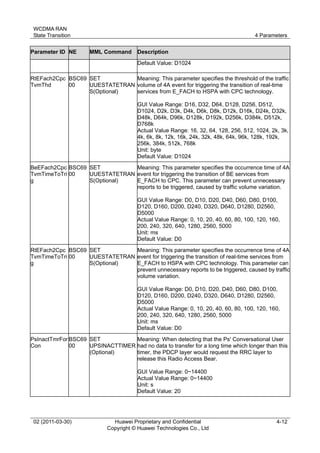
BeEFach2Cpc
TvmThd
BSC69
00
SET
UUESTATETRAN
S(Optional)
Meaning: This parameter specifies the threshold of the traffic
volume of 4A event for triggering the transition of BE services
from E_FACH to CPC.
GUI Value Range: D16, D32, D64, D128, D256, D512,
D1024, D2k, D3k, D4k, D6k, D8k, D12k, D16k, D24k, D32k,
D48k, D64k, D96k, D128k, D192k, D256k, D384k, D512k,
D768k
Actual Value Range: 16, 32, 64, 128, 256, 512, 1024, 2k, 3k,
4k, 6k, 8k, 12k, 16k, 24k, 32k, 48k, 64k, 96k, 128k, 192k,
256k, 384k, 512k, 768k
Unit: byte
WCDMA RAN
State Transition 4 Parameters
02 (2011-03-30) Huawei Proprietary and Confidential
Copyright © Huawei Technologies Co., Ltd
4-12
Parameter ID NE MML Command Description
Default Value: D1024
RtEFach2Cpc
TvmThd
BSC69
00
SET
UUESTATETRAN
S(Optional)
Meaning: This parameter specifies the threshold of the traffic
volume of 4A event for triggering the transition of real-time
services from E_FACH to HSPA with CPC technology.
GUI Value Range: D16, D32, D64, D128, D256, D512,
D1024, D2k, D3k, D4k, D6k, D8k, D12k, D16k, D24k, D32k,
D48k, D64k, D96k, D128k, D192k, D256k, D384k, D512k,
D768k
Actual Value Range: 16, 32, 64, 128, 256, 512, 1024, 2k, 3k,
4k, 6k, 8k, 12k, 16k, 24k, 32k, 48k, 64k, 96k, 128k, 192k,
256k, 384k, 512k, 768k
Unit: byte
Default Value: D1024
BeEFach2Cpc
TvmTimeToTri
g
BSC69
00
SET
UUESTATETRAN
S(Optional)
Meaning: This parameter specifies the occurrence time of 4A
event for triggering the transition of BE services from
E_FACH to CPC. This parameter can prevent unnecessary
reports to be triggered, caused by traffic volume variation.
GUI Value Range: D0, D10, D20, D40, D60, D80, D100,
D120, D160, D200, D240, D320, D640, D1280, D2560,
D5000
Actual Value Range: 0, 10, 20, 40, 60, 80, 100, 120, 160,
200, 240, 320, 640, 1280, 2560, 5000
Unit: ms
Default Value: D0
RtEFach2Cpc
TvmTimeToTri
g
BSC69
00
SET
UUESTATETRAN
S(Optional)
Meaning: This parameter specifies the occurrence time of 4A
event for triggering the transition of real-time services from
E_FACH to HSPA with CPC technology. This parameter can
prevent unnecessary reports to be triggered, caused by traffic
volume variation.
GUI Value Range: D0, D10, D20, D40, D60, D80, D100,
D120, D160, D200, D240, D320, D640, D1280, D2560,
D5000
Actual Value Range: 0, 10, 20, 40, 60, 80, 100, 120, 160,
200, 240, 320, 640, 1280, 2560, 5000
Unit: ms
Default Value: D0
PsInactTmrFor
Con
BSC69
00
SET
UPSINACTTIMER
(Optional)
Meaning: When detecting that the Ps' Conversational User
had no data to transfer for a long time which longer than this
timer, the PDCP layer would request the RRC layer to
release this Radio Access Bear.
GUI Value Range: 0~14400
Actual Value Range: 0~14400
Unit: s
Default Value: 20
WCDMA RAN
State Transition 4 Parameters
02 (2011-03-30) Huawei Proprietary and Confidential
Copyright © Huawei Technologies Co., Ltd
4-13
Parameter ID NE MML Command Description
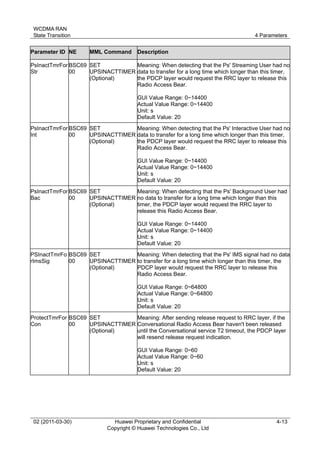
PsInactTmrFor
Str
BSC69
00
SET
UPSINACTTIMER
(Optional)
Meaning: When detecting that the Ps' Streaming User had no
data to transfer for a long time which longer than this timer,
the PDCP layer would request the RRC layer to release this
Radio Access Bear.
GUI Value Range: 0~14400
Actual Value Range: 0~14400
Unit: s
Default Value: 20
PsInactTmrFor
Int
BSC69
00
SET
UPSINACTTIMER
(Optional)
Meaning: When detecting that the Ps' Interactive User had no
data to transfer for a long time which longer than this timer,
the PDCP layer would request the RRC layer to release this
Radio Access Bear.
GUI Value Range: 0~14400
Actual Value Range: 0~14400
Unit: s
Default Value: 20
PsInactTmrFor
Bac
BSC69
00
SET
UPSINACTTIMER
(Optional)
Meaning: When detecting that the Ps' Background User had
no data to transfer for a long time which longer than this
timer, the PDCP layer would request the RRC layer to
release this Radio Access Bear.
GUI Value Range: 0~14400
Actual Value Range: 0~14400
Unit: s
Default Value: 20
PSInactTmrFo
rImsSig
BSC69
00
SET
UPSINACTTIMER
(Optional)
Meaning: When detecting that the Ps' IMS signal had no data
to transfer for a long time which longer than this timer, the
PDCP layer would request the RRC layer to release this
Radio Access Bear.
GUI Value Range: 0~64800
Actual Value Range: 0~64800
Unit: s
Default Value: 20
ProtectTmrFor
Con
BSC69
00
SET
UPSINACTTIMER
(Optional)
Meaning: After sending release request to RRC layer, if the
Conversational Radio Access Bear haven't been released
until the Conversational service T2 timeout, the PDCP layer
will resend release request indication.
GUI Value Range: 0~60
Actual Value Range: 0~60
Unit: s
Default Value: 20
WCDMA RAN
State Transition 4 Parameters
02 (2011-03-30) Huawei Proprietary and Confidential
Copyright © Huawei Technologies Co., Ltd
4-14
Parameter ID NE MML Command Description
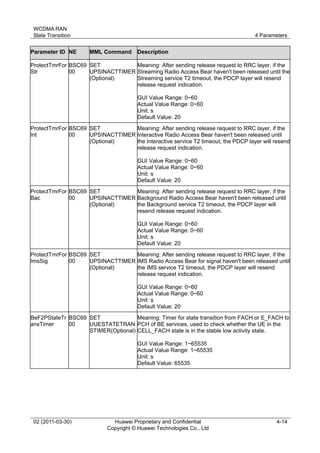
ProtectTmrFor
Str
BSC69
00
SET
UPSINACTTIMER
(Optional)
Meaning: After sending release request to RRC layer, if the
Streaming Radio Access Bear haven't been released until the
Streaming service T2 timeout, the PDCP layer will resend
release request indication.
GUI Value Range: 0~60
Actual Value Range: 0~60
Unit: s
Default Value: 20
ProtectTmrFor
Int
BSC69
00
SET
UPSINACTTIMER
(Optional)
Meaning: After sending release request to RRC layer, if the
Interactive Radio Access Bear haven't been released until
the Interactive service T2 timeout, the PDCP layer will resend
release request indication.
GUI Value Range: 0~60
Actual Value Range: 0~60
Unit: s
Default Value: 20
ProtectTmrFor
Bac
BSC69
00
SET
UPSINACTTIMER
(Optional)
Meaning: After sending release request to RRC layer, if the
Background Radio Access Bear haven't been released until
the Background service T2 timeout, the PDCP layer will
resend release request indication.
GUI Value Range: 0~60
Actual Value Range: 0~60
Unit: s
Default Value: 20
ProtectTmrFor
ImsSig
BSC69
00
SET
UPSINACTTIMER
(Optional)
Meaning: After sending release request to RRC layer, if the
IMS Radio Access Bear for signal haven't been released until
the IMS service T2 timeout, the PDCP layer will resend
release request indication.
GUI Value Range: 0~60
Actual Value Range: 0~60
Unit: s
Default Value: 20
BeF2PStateTr
ansTimer
BSC69
00
SET
UUESTATETRAN
STIMER(Optional)
Meaning: Timer for state transition from FACH or E_FACH to
PCH of BE services, used to check whether the UE in the
CELL_FACH state is in the stable low activity state.
GUI Value Range: 1~65535
Actual Value Range: 1~65535
Unit: s
Default Value: 65535
WCDMA RAN
State Transition 4 Parameters
02 (2011-03-30) Huawei Proprietary and Confidential
Copyright © Huawei Technologies Co., Ltd
4-15
Parameter ID NE MML Command Description
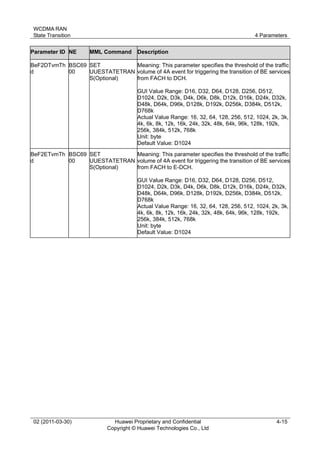
BeF2DTvmTh
d
BSC69
00
SET
UUESTATETRAN
S(Optional)
Meaning: This parameter specifies the threshold of the traffic
volume of 4A event for triggering the transition of BE services
from FACH to DCH.
GUI Value Range: D16, D32, D64, D128, D256, D512,
D1024, D2k, D3k, D4k, D6k, D8k, D12k, D16k, D24k, D32k,
D48k, D64k, D96k, D128k, D192k, D256k, D384k, D512k,
D768k
Actual Value Range: 16, 32, 64, 128, 256, 512, 1024, 2k, 3k,
4k, 6k, 8k, 12k, 16k, 24k, 32k, 48k, 64k, 96k, 128k, 192k,
256k, 384k, 512k, 768k
Unit: byte
Default Value: D1024
BeF2ETvmTh
d
BSC69
00
SET
UUESTATETRAN
S(Optional)
Meaning: This parameter specifies the threshold of the traffic
volume of 4A event for triggering the transition of BE services
from FACH to E-DCH.
GUI Value Range: D16, D32, D64, D128, D256, D512,
D1024, D2k, D3k, D4k, D6k, D8k, D12k, D16k, D24k, D32k,
D48k, D64k, D96k, D128k, D192k, D256k, D384k, D512k,
D768k
Actual Value Range: 16, 32, 64, 128, 256, 512, 1024, 2k, 3k,
4k, 6k, 8k, 12k, 16k, 24k, 32k, 48k, 64k, 96k, 128k, 192k,
256k, 384k, 512k, 768k
Unit: byte
Default Value: D1024
WCDMA RAN
State Transition 5 Counters
02 (2011-03-30) Huawei Proprietary and Confidential
Copyright © Huawei Technologies Co., Ltd
5-1
5 Counters
For details, see the BSC6900 UMTS Performance Counter Reference.
WCDMA RAN
State Transition 6 Glossary
02 (2011-03-30) Huawei Proprietary and Confidential
Copyright © Huawei Technologies Co., Ltd
6-1
6 Glossary
For the acronyms, abbreviations, terms, and definitions, see the Glossary.
WCDMA RAN
State Transition 7 Reference Documents
02 (2011-03-30) Huawei Proprietary and Confidential
Copyright © Huawei Technologies Co., Ltd
7-1
7 Reference Documents
[1] DCCC Feature Parameter Description
[2] 3GPP TS 25.331

Ue state transition-huawei-description

  • 1.
    State Transition RAN12.0 Feature ParameterDescription Issue 02 Date 2010-03-30 HUAWEI TECHNOLOGIES CO., LTD.
  • 2.
    Copyright © HuaweiTechnologies Co., Ltd. 2011. All rights reserved. No part of this document may be reproduced or transmitted in any form or by any means without prior written consent of Huawei Technologies Co., Ltd. Trademarks and Permissions and other Huawei trademarks are trademarks of Huawei Technologies Co., Ltd. All other trademarks and trade names mentioned in this document are the property of their respective holders. Notice The purchased products, services and features are stipulated by the contract made between Huawei and the customer. All or part of the products, services and features described in this document may not be within the purchase scope or the usage scope. Unless otherwise specified in the contract, all statements, information, and recommendations in this document are provided "AS IS" without warranties, guarantees or representations of any kind, either express or implied. The information in this document is subject to change without notice. Every effort has been made in the preparation of this document to ensure accuracy of the contents, but all statements, information, and recommendations in this document do not constitute the warranty of any kind, express or implied. Huawei Technologies Co., Ltd. Address: Huawei Industrial Base Bantian, Longgang Shenzhen 518129 People's Republic of China Website: http://www.huawei.com Email: support@huawei.com
  • 3.
    WCDMA RAN State TransitionContents Issue 02 (2011-03-30) Huawei Proprietary and Confidential Copyright © Huawei Technologies Co., Ltd i Contents 1 Introduction................................................................................................................................1-1 1.1 Scope ............................................................................................................................................ 1-1 1.2 Intended Audience ........................................................................................................................ 1-1 1.3 Change History.............................................................................................................................. 1-1 2 Overview .....................................................................................................................................2-1 3 Technical Description..............................................................................................................3-1 3.1 UE State Transition Switches........................................................................................................ 3-1 3.2 D2F State Transition...................................................................................................................... 3-1 3.3 Low Activity State .......................................................................................................................... 3-3 3.4 F2P State Transition...................................................................................................................... 3-3 3.5 P2U State Transition ..................................................................................................................... 3-4 3.6 P2F and U2F State Transition....................................................................................................... 3-4 3.7 F2D State Transition...................................................................................................................... 3-4 3.8 D2D State Transition ..................................................................................................................... 3-5 3.9 CPC and EFACH State Transition................................................................................................. 3-6 3.10 Always Online.............................................................................................................................. 3-8 4 Parameters .................................................................................................................................4-1 5 Counters......................................................................................................................................5-1 6 Glossary ......................................................................................................................................6-1 7 Reference Documents .............................................................................................................7-1
  • 4.
    WCDMA RAN State Transition1 Introduction 02 (2011-03-30) Huawei Proprietary and Confidential Copyright © Huawei Technologies Co., Ltd 1-1 1 Introduction 1.1 Scope This document describes the feature of State Transition. This document requires readers to know the DCCC mechanism. You are advised to read the DCCC Feature Parameter Description beforehand. 1.2 Intended Audience This document is intended for:  Personnel who are familiar with WCDMA basics  Personnel who need to understand State Transition  Personnel who work with Huawei products 1.3 Change History This section provides information on the changes in different document versions. There are two types of changes, which are defined as follows:  Feature change: refers to the change in the State Transition feature of a specific product version.  Editorial change: refers to the change in wording or the addition of the information that was not described in the earlier version. Document Issue The document issue is as follows:  02 (2011-03-30)  01 (2010-12-20) 02 (2011-03-30) Compared with issue 01 (2010-12-20) of RAN12.0, this issue incorporates the changes described in the following table. Change Type Change Description Parameter Change Feature change None. None. Editorial change Optimizing the description of parameter LittleRateThd. For detailed information, see section 3.3 "Low Activity State" None. 01 (2010-12-20) This is the document for the first commercial release of RAN12.0. This is a new document.
  • 5.
    WCDMA RAN State Transition2 Overview 02 (2011-03-30) Huawei Proprietary and Confidential Copyright © Huawei Technologies Co., Ltd 2-1 2 Overview Figure 2-1 shows the transitions between the UTRA RRC mode and the GSM connected mode for CS services and transitions between the UTRA RRC mode and the GSM/GPRS packet transfer mode for PS services. Figure 2-1 also shows the state transitions between the idle mode and the UTRA RRC mode and the state transitions in UTRA RRC mode. Figure 2-1 UE state transitions This section describes only UE state transitions in UTRA RRC mode. The following figure shows the state transitions in UTRAN RRC mode. Figure 2-2 State transition in RRC mode After the RRC connection is set up, the RNC observes UE activity and uses the UE state transition function to change the UE state (WRFD-010202 UE State in Connected Mode). The state transition is triggered by user activity (traffic volume), user inactivity (timer) or mobility.  Traffic Volume Report from UE, Event 4a and Event 4b
  • 6.
    WCDMA RAN State Transition2 Overview 02 (2011-03-30) Huawei Proprietary and Confidential Copyright © Huawei Technologies Co., Ltd 2-2 − Event 4a: Traffic volume is above a threshold (High user activity) − Event 4b: Traffic volume is below a threshold during a configurable time (Low user activity)  Cell re-selection − If the number of cell reselections exceeds configurable threshold during a configurable period (timer), the UE is considered to be in the state of frequent cell reselection  Paging / Data − There is data to be transferred  Overload − When a cell is in the overload state, RNC may transit the UE from CELL_DCH (DCH/HS-DSCH/E-DCH) to CELL_FACH (FACH) to relieve the load. The following table shows the types of state transitions. Table 2-1 Types of state transitions State transition Channel switch Description D2F D2F CELL_DCH (DCH) to CELL_FACH E2F CELL_DCH (E-DCH) to CELL_FACH H2F CELL_DCH (H-DSCH) to CELL_FACH F2D F2D CELL_FACH to CELL_DCH (DCH) F2H CELL_FACH to CELL_DCH (H-DSCH) F2E CELL_FACH to CELL_DCH (E-DCH) F2P - CELL_FACH to CELL_PCH P2U - CELL_PCH to URA_PCH P2F - CELL_PCH to CELL_FACH U2F - URA_PCH to CELL_FACH D2D H2D CELL_DCH (H-DSCH) to CELL_DCH (DCH) E2D CELL_DCH (E-DCH) to CELL_DCH (DCH) D2H CELL_DCH (DCH) to CELL_DCH (H-DSCH) D2E CELL_DCH (DCH) to CELL_DCH (E-DCH) CPC and EFACH CPC2F CELL_DCH (CPC) to CELL_FACH CPC2EFACH CELL_DCH (CPC) to Enhanced CELL_FACH EFACH2CPC Enhanced CELL_FACH to CELL_DCH (CPC) EFACH2D Enhanced CELL_FACH to CELL_DCH (DCH) D2EFACH CELL_DCH (DCH) to Enhanced CELL_FACH F2CPC CELL_FACH to CELL_DCH (CPC) Always online - RRC Connected mode to Idle mode
  • 7.
    WCDMA RAN State Transition2 Overview 02 (2011-03-30) Huawei Proprietary and Confidential Copyright © Huawei Technologies Co., Ltd 2-3 Fast dormancy - New state transition mechanism is designed for fast dormancy. For details, see the Fast Dormancy Feature Parameter Description. Low Activity - For best effort (BE) services that are not allowed for state transition, RNC can instruct the BE service to enter low activity state which is configured with lower rate. If a UE has a CS service, the UE stays in CELL_DCH during the call and is not allowed for D2F. If a UE has a streaming service, the UE is not allowed for F2P.
  • 8.
    WCDMA RAN State Transition3 Technical Description 02 (2011-03-30) Huawei Proprietary and Confidential Copyright © Huawei Technologies Co., Ltd 3-1 3 Technical Description 3.1 UE State Transition Switches SET CORRMALGOSWITCH (DraSwitch) defines the dynamic resource allocation global parameters (RNC-level) are as follows:  DRA_PS_BE_STATE_TRANS_SWITCH enables RRC state transitions for bearers carrying Best Effort services.  DRA_PS_NON_BE_STATE_TRANS_SWITCH enables RRC state transitions for bearers carrying services (PS real-time service) other than Best Effort.  DRA_HSDPA_STATE_TRANS_SWITCH enables RRC state transition from HS-DSCH to FACH. Only valid if either DRA_PS_BE_STATE_TRANS_SWITCH or DRA_PS_NON_BE_STATE_TRANS_SWITCH (or both) are enabled, according to the type of service being carried on HS-DSCH, that is, Best Effort or not Best Effort, respectively.  DRA_HSUPA_STATE_TRANS_SWITCH enables RRC state transition from E-DCH to FACH. Only valid if either DRA_PS_BE_STATE_TRANS_SWITCH or DRA_PS_NON_BE_STATE_TRANS_SWITCH (or both) are enabled, according to the type of service being carried on E-DCH, that is, Best Effort or not Best Effort, respectively. In the case that the previous switches are set to 1:  If DRA_DCCC_SWITCH is set to 1 and the dynamic channel adjustment strategy (DcccStg) is set to RATE_UP_AND_DOWN_ON_DCH, the UE state transition function starts to work when the UL/DL rate is below or equal to the UL/DL rate threshold for DCCC (UlDcccRateThd/DlDcccRateThd).  If DRA_DCCC_SWITCH is set to 1 and DcccStg is set to RATE_UP_ONLY_ON_DCH, the UE state transition function always works.  If DRA_DCCC_SWITCH is set to 0, the UE state transition function always works. For the PS inactive service, if the timer parameters for online detection, which can be set through the SET UPSINACTTIMER command, are set to be a small value, the RRC connection may be released before UE state transition. SET UESTATETRANS defines the UE RRC state transition parameters (RNC-level) SET UESTATETRANSTIMER defines the UE RRC state transition timers (RNC-level) 3.2 D2F State Transition Figure 3-1 shows the state transition D2F.
  • 9.
    WCDMA RAN State Transition3 Technical Description 02 (2011-03-30) Huawei Proprietary and Confidential Copyright © Huawei Technologies Co., Ltd 3-2 Figure 3-1 UE state transition D2F When receiving a report on event 4b, the RNC starts the timer for transition D2F and the counters for UL and DL event 4b reports. If both the number of UL event 4b reports and the number of DL event 4b reports are above or equal to the D2F transition threshold before the timer expires, the D2F is performed when the timer expires. The D2F transition threshold is the rounded-down value obtained according to the following formula: D2F transition threshold = [D2F transition time/(Time to trigger + Pending time after trigger) x State transition traffic redundancy coefficient] In this equation:  The D2F transition time, time to trigger, and pending time after trigger are specified by the parameters listed in Table 3-1.  The state transition traffic redundancy coefficient is used to prevent false detection that a UE is in a low-activity state, due to the loss of measurement reports. This coefficient is set to 80%. Table 3-1 Parameters related to UE state transition D2F Service Type D2F Transition Timer Event 4b Reporting threshold Event 4b Time to Trigger Event 4b Pending Time After Trigger BE service on DCH BeD2FStateTransT imer D2F2PTvmThd D2FTvmTimeToTrig D2FTvmPTAT BE service on HS-DSCH BeH2FStateTransT imer BeH2FTvmThd BeH2FTvmTimeToTrig BeH2FTvmPTAT PS real-time service RtDH2FStateTrans Timer RtDH2FTvmThd RtDH2FTvmTimeToTrig tDH2FTvmPTAT
  • 10.
    WCDMA RAN State Transition3 Technical Description 02 (2011-03-30) Huawei Proprietary and Confidential Copyright © Huawei Technologies Co., Ltd 3-3 BE service on E-DCH E2FStateTransTim er E2FThrouThd E2FThrouTimeToTrig x E2FThrouMeasPeriod E2FThrouPTAT x E2FThrouMeasPeriod The parameters of event 4b are set to their respective parameter values for the UL and the DL. The parameters include the time to trigger, pending time after trigger, and threshold. For example, for BE services if the UL channel is the DCH and the DL channel is the HS-DSCH, the parameter configurations for BE service on the DCH as listed in Table 3-1 are used for the UL, and the parameter configurations for BE service on the HS-DSCH as listed in Table 3-1 are used for the DL. State transition from E-DCH to FACH is similar to state transition from DCH to FACH. The difference is that the event 4b measurement for state transition from E-DCH to FACH is based on the throughput. The throughput measurement period is specified by E2FThrouMeasPeriod. The threshold of event 4b is also based on the throughput. The threshold is specified by E2FThrouThd. 3.3 Low Activity State For BE services, if DRA_PS_BE_STATE_TRANS_SWITCH is set to 0 or the UE has other services that do not allow UE state transition, UE state transition cannot be performed. In this case, if both the number of UL event 4b reports and the number of DL event 4b reports are above or equal to the D2F transition threshold before the transition timer expires, the rate can be adjusted to the low activity rate. For single service:  For BE service on the DCH (both uplink and downlink), both the uplink rate and downlink rate can be adjusted to the low-activity rate threshold (LittleRateThd).  For BE service on the DCH (uplink) and HS-DSCH (downlink), only the uplink rate can be adjusted to LittleRateThd.  For BE service on the E-DCH (uplink) and DCH (downlink), only the downlink rate can be adjusted to LittleRateThd. Note that if LittleRateThd is above or equal to UlDcccRateThd or DlDcccRateThd, the rate cannot be adjusted to LittleRateThd. If LittleRateThd is excessively high, excessive resources are occupied even if the UE does not have data to transmit for a long time, leading to network congestion. If LittleRateThd is excessively low, the throughput will be lower than the expected value when the UE starts to transmit data again, though more radio resources are saved. For service combination:  If the service combination has a CS service, the UE stays in CELL_DCH state and is not allowed for D2F. If the PS service meets the conditions for D2F, the RNC decrease data rate of the PS service to the low activity rate.  If the service combination has only PS services and the state transition switches are turned off, the RNC decreases the data rate of PS services to the low activity rate. 3.4 F2P State Transition UE state transition F2P is applicable to BE services in the PS domain. UE state transition F2P is similar to UE state transition D2F. When receiving a report that event 4b occurs and the traffic volume is zero, the RNC starts the timer for transition F2P and the counters for UL and DL event 4b reports. If both the number of UL event 4B
  • 11.
    WCDMA RAN State Transition3 Technical Description 02 (2011-03-30) Huawei Proprietary and Confidential Copyright © Huawei Technologies Co., Ltd 3-4 reports and the number of DL event 4B reports are above the F2P transition threshold before the timer expires, the F2P happens when the timer expires. The F2P transition threshold is the rounded-down value obtained according to the following formula: F2P transition threshold = [F2P transition time/(Time to trigger + Pending time after trigger) x State transition traffic redundancy coefficient] Table 3-2 lists the parameters related to UE state transition F2P. Table 3-2 Parameters related to UE state transition F2P Service Type F2P Transition Timer Event 4b Reporting threshold Event 4b Time to Trigger Event 4b Pending Time After Trigger PS BE service BeF2PStateTran sTimer D2F2PTvmThd F2PTvmTimeToTrig F2PTvmPTAT When the cell is in the overload congestion state, the state transition F2D is prohibited. 3.5 P2U State Transition UE state transition P2U is applicable to BE services in the PS domain. Before the state transition, the state of the UE is CELL_PCH. During the cell reselection, the UE sends the CELL UPDATE messages. The RNC starts a timer (CellReSelectTimer) and counts the number of CELL UPDATE messages with the cause value of cell reselection. When the timer expires, the number of CELL UPDATE messages may be above the threshold (CellReSelectCounter). In this case, the RNC initiates a state transition when the UE sends the CELL UPDATE message again. The state transition P2U involves the transient state CELL_FACH, in which some necessary signaling interaction is performed. 3.6 P2F and U2F State Transition P2F and U2F are performed when UTRAN pages the UE or when the UE needs to exchange information with the UTRAN. There are no configuration parameters. 3.7 F2D State Transition The F2D state transition happens when the UTRAN receives a 4a report that triggered by the UL or DL traffic volume. RNC determines the transport channel (DCH, HS-DSCH, E-DCH) and the target rate. Table 3-3 lists the target rates for UE state transitions F2D. Table 3-3 Target rates for UE state transitions F2D Service Type Event 4a threshold Target Rate BE on DCH BeF2DTvmThd  UL target rate (DCH) = min (MBR, UL rate threshold for DCCC)  DL target rate (DCH) = min (MBR, DL rate threshold for DCCC)
  • 12.
    WCDMA RAN State Transition3 Technical Description 02 (2011-03-30) Huawei Proprietary and Confidential Copyright © Huawei Technologies Co., Ltd 3-5 BE on HS-DSCH BeF2HTvmThd  UL target rate (DCH) = min (MBR, UL rate threshold for DCCC)  UL target rate (E-DCH) = min (HSUPA rate adjustment set)  DL target rate (HS-DSCH) = MBR PS real-time service RtF2DHTvmThd  UL target rate (DCH) = MBR  DL target rate (DCH) = MBR BE on E-DCH BeF2ETvmThd  UL target rate (E-DCH) = min (HSUPA rate adjustment set), If HSUPA_DCCC_SWITCH is set to 1.  UL target rate (E-DCH) = MBR, If HSUPA_DCCC_SWITCH is set to 0.  DL target rate (DCH) = min (MBR, DL rate threshold for DCCC)  DL target rate (H-DSCH) = MBR. 3.8 D2D State Transition For HSDPA and HSUPA, there are two more sub-state called CELL_DCH (with HS-DSCH) and CELL_DCH (with E-DCH). Principle of state transitions of D2D is shown in the following figure. Figure 3-2 State transition of D2H/E or H/E2D Table 3-4 State transition type Type Trigger E2D  During RAB setup, RAB should be carried over E-DCH but resources are insufficient  E-DCH serving cell change (change of best cell) − New best cell does not support E-DCH − New best cell does not have enough resources for E-DCH D2E  In any of the scenarios above (E2D), it is possible to transit DCH to E-DCH − Periodic attempt to reconfigure to E-DCH (timer) − Traffic volume (event 4A)  If a UE reports event 6B2 and event 4A, and the UE services can be carried on the E-DCH, then the RNC switches the UE from the DCH to the E-DCH during the rate increase process.
  • 13.
    WCDMA RAN State Transition3 Technical Description 02 (2011-03-30) Huawei Proprietary and Confidential Copyright © Huawei Technologies Co., Ltd 3-6 H2D  RAB should be carried over HS-DSCH but resources are insufficient  HS-DSCH serving cell change (change of best cell) − New best cell does not support HS-DSCH − New best cell does not have enough resources for HS-DSCH D2H  In any of the scenarios above (H2D), it is possible to transit DCH to HS-DSCH later. − Periodic attempt to reconfigure to HS-DSCH (timer) − Traffic volume (event 4A) For details of periodic retry, see the Directed Retry Decision Feature Parameter Description. 3.9 CPC and EFACH State Transition This section describes the new functions of state transition introduced in HSPA+. HSPA+ requires two new states: CELL_DCH (CPC) state and enhanced CELL_FACH state. The CELL_DCH (CPC) state corresponds to the CELL_DCH state with CPC activated, and the enhanced CELL_FACH state corresponds to the CELL_FACH state with Enhanced CELL_FACH operation activated. Figure 3-3 shows the new types of state transitions introduced in HSPA+. Figure 3-3 New types of state transitions introduced in HSPA+ These state transitions are triggered by the event 4A or event 4B. The corresponding functions are the same as those for the state transitions between CELL_DCH and CELL_FACH, except that some new parameters are introduced. The only impact of the following new state transitions is that new timers to trigger event 4B are introduced: Type New timers CPC2F  BeCpc2FStateTransTimer: BE service state transition timer (CPC_HS-DSCH to F/RACH)  RtCpc2FStateTransTimer: real-time service state transition timer (CPC_HSPA to F/RACH)
  • 14.
    WCDMA RAN State Transition3 Technical Description 02 (2011-03-30) Huawei Proprietary and Confidential Copyright © Huawei Technologies Co., Ltd 3-7 D2EFACH  BeD2EFachStateTransTimer: BE service state transition timer (DCH to E_FACH)  BeH2EFachStateTransTimer: BE service state transition timer (HS-DSCH to E_FACH)  RtDH2EFachStateTransTimer: real-time service state transition timer (DCH or HSPA to E_FACH) CPC2EFACH BeCpc2EFachStateTransTimer: BE service state transition timer (CPC_HS-DSCH to E_FACH)  RtCpc2EFachStateTransTimer: real-time service state transition timer (CPC_HSPA to E_FACH) The only impact of the following new state transitions is that new timers and thresholds to trigger 4A are introduced: Type New timers and new 4a threshold F2CPC The new thresholds are as follows:  BeF2CpcHTvmThd: event 4A threshold for BE service state transition (F/RACH to CPC_HS-DSCH)  RtF2CpcTvmThd: event 4A threshold for real-time service state transition (F/RACH to CPC_HSPA)  BeF2CpcETvmThd: event 4A threshold for BE service state transition (F/RACH to CPC_E-DCH) The new timers are as follows:  BeF2CpcHTvmTimeToTrig: event 4A trigger time for BE service state transition (F/RACH to CPC_HS-DSCH)  RtF2CpcTvmTimeToTrig: event 4A trigger time for real-time service state transition (F/RACH to CPC_HSPA)  BeF2CpcETvmTimeToTrig: event 4A trigger time for real-time service state transition (F/RACH to CPC_E-DCH) EFACH2D The new thresholds are as follows:  BeEFach2DTvmThd: event 4A threshold for BE service state transition (E_FACH to DCH)  BeEFach2HTvmThd: event 4A threshold for BE service state transition (E_FACH to HS-DSCH)  RtEFach2DHTvmThd: event 4A threshold for real-time service state transition (E_FACH to DCH or HSPA) The new timers are as follows:  BeEFach2DTvmTimeToTrig: event 4A trigger time for BE service state transition (E-FACH to DCH)  BeEFach2HTvmTimeToTrig: event 4A trigger time for BE service state transition (E_FACH to HS-DSCH)  RtEFach2DHTvmTimeToTrig: event 4A trigger time for real-time service state transition (E_FACH to DCH/HSPA)
  • 15.
    WCDMA RAN State Transition3 Technical Description 02 (2011-03-30) Huawei Proprietary and Confidential Copyright © Huawei Technologies Co., Ltd 3-8 EFACH2CPCThe new thresholds are as follows:  BeEFach2CpcTvmThd: event 4A threshold for BE service state transition (E_FACH to CPC_HS-DSCH)  RtEFach2CpcTvmThd: event 4A threshold for PS real-time service state transition (E_FACH to CPC_HSPA) The new timers are as follows:  BeEFach2CpcTvmTimeToTrig: event 4A trigger time for BE service state transition (E_FACH to CPC_HS-DSCH)  RtEFach2CpcTvmTimeToTrig: event 4A trigger time for real-time service state transition (E_FACH to CPC_HSPA) The function of the state transitions between enhanced CELL_FACH and CELL_PCH is the same as that of the state transitions between CELL_FACH and CELL_PCH. 3.10 Always Online When the RNC detects that there is no data transmission for a PS service, the RNC sends a request to the CN for release of the service. The CN initiates the release procedure, requesting the RNC to release the corresponding radio resources. The CN, however, reserves the PDP context for this PS service of the UE. When the UE re-initiates the service of this PDP context, it does not need to apply for the PDP context again. Thus, the UE in the PS domain is always online. For each PS RAB, two PDCP timers, namely T1 and T2, are available. Service release due to the absence of data is implemented through these two timers. The values of T1 and T2 for different services are set by the parameters listed in Table 3-5. SET PSINACTTIMER defines the PS inactivity timers (RNC-level). If inactivity detection is not desired for a particular service, just set T1 = T2 = 0. Table 3-5 Parameters-related T1 and T2 Service type T1 T2 Conversational service PsInactTmrForCon ProtectTmrForCon Streaming service PsInactTmrForStr ProtectTmrForStr Interactive service PsInactTmrForInt ProtectTmrForInt Background service PsInactTmrForBac ProtectTmrForBac IMS signaling PSInactTmrForImsSig ProtectTmrForImsSig Figure 3-4 shows the procedure of service release due to the absence of data.
  • 16.
    WCDMA RAN State Transition3 Technical Description 02 (2011-03-30) Huawei Proprietary and Confidential Copyright © Huawei Technologies Co., Ltd 3-9 Figure 3-4 Procedure of service release due to the absence of data
  • 17.
    WCDMA RAN State Transition3 Technical Description 02 (2011-03-30) Huawei Proprietary and Confidential Copyright © Huawei Technologies Co., Ltd 3-10 The procedure of service release due to the absence of data is as follows: 1. When the PDCP entity of a service is set up, timer T1 is started. 2. If the PDCP entity still detects that there is no UL or DL data packet when T1 expires, the PDCP entity sends the request to the RRC layer for the service release and starts T2. 3. If the CN does not initiate the service release, the PDCP entity continues to detect data packets. If the PDCP entity still detects that there is no UL or DL data packet when T2 expires, the PDCP entity sends the request to the RRC layer for the service release. In this case: − If there is only one RAB for the UE in the PS domain, the RNC sends an IU RELEASE REQUEST message to the CN. − If there is more than one RAB for the UE in the PS domain, the RNC sends an RAB RELEASE REQUEST message to the CN. The two messages indicate the release causes in the User Inactivity IE. 4. When the CN receives the message, it initiates the release procedure. At the same time, the CN reserves the PDP context for the service. When the UE re-initiates the service of this PDP context, it does not have to apply for the PDP context again. The service release request from the PDCP entity may not be processed in time. The reason is that the associated processor in the RNC is busy.
  • 18.
    WCDMA RAN State Transition4 Parameters 02 (2011-03-30) Huawei Proprietary and Confidential Copyright © Huawei Technologies Co., Ltd 4-1 4 Parameters Table 4-1 Parameter Description Parameter ID NE MML Command Description DraSwitch BSC69 00 SET UCORRMALGOS WITCH(Optional) Meaning: Dynamic resource allocation switch group. 1) DRA_AQM_SWITCH: When the switch is on, the active queue management algorithm is used for the RNC. 2) DRA_BASE_ADM_CE_BE_TTI_L2_OPT_SWITCH: When the switch is on, the TTI dynamic adjustment algorithm for admission CE-based BE services applies to the UE with the UL enhanced L2 feature. This parameter is valid when DRA_BASE_ADM_CE_BE_TTI_RECFG_SWITCH(DraSwitc h) is set to ON. 3) DRA_BASE_ADM_CE_BE_TTI_RECFG_SWITCH: When the switch is on, the TTI dynamic adjustment algorithm is supported for admission CE-based BE services. 4) DRA_BASE_COVER_BE_TTI_L2_OPT_SWITCH: When the switch is on, the TTI dynamic adjustment algorithm for coverage-based BE services applies to the UE with the UL enhanced L2 feature. This parameter is valid when DRA_BASE_COVER_BE_TTI_RECFG_SWITCH(DraSwitch ) is set to ON. 5) DRA_BASE_COVER_BE_TTI_RECFG_SWITCH: When the switch is on, the TTI dynamic adjustment algorithm is supported for coverage-based BE services. 6) DRA_BASE_RES_BE_TTI_L2_OPT_SWITCH: When the switch is on, the TTI dynamic adjustment algorithm for differentiation-based BE services applies to the UE with the UL enhanced L2 feature. This parameter is valid when DRA_BASE_RES_BE_TTI_RECFG_SWITCH(DraSwitch) is set to ON. 7) DRA_BASE_RES_BE_TTI_RECFG_SWITCH: When the switch is on, the TTI dynamic adjustment algorithm is supported for differentiation-based BE services. 8) DRA_DCCC_SWITCH: When the switch is on, the dynamic channel reconfiguration control algorithm is used for the RNC. 9) DRA_HSDPA_DL_FLOW_CONTROL_SWITCH: When the switch is on, flow control is enabled for HSDPA services in AM mode. 10) DRA_HSDPA_STATE_TRANS_SWITCH: When the switch is on, the status of the UE RRC that carrying HSDPA services can be changed to CELL_FACH at the RNC. If a PS BE service is carried over the HS-DSCH, the switch PS_BE_STATE_TRANS_SWITCH should be on simultaneously. If a PS real-time service is carried over the HS-DSCH, the switch PS_NON_BE_STATE_TRANS_SWITCH should be on simultaneously. 11) DRA_HSUPA_DCCC_SWITCH: When the switch is on, the DCCC algorithm is used for HSUPA. The DCCC switch must be also on before this switch takes effect. 12) DRA_HSUPA_STATE_TRANS_SWITCH: When the
  • 19.
    WCDMA RAN State Transition4 Parameters 02 (2011-03-30) Huawei Proprietary and Confidential Copyright © Huawei Technologies Co., Ltd 4-2 Parameter ID NE MML Command Description switch is on, the status of the UE RRC that carrying HSUPA services can be changed to CELL_FACH at the RNC. If a PS BE service is carried over the E-DCH, the switch PS_BE_STATE_TRANS_SWITCH should be on simultaneously. If a PS real-time service is carried over the E-DCH, the switch PS_NON_BE_STATE_TRANS_SWITCH should be on simultaneously. 13) DRA_IP_SERVICE_QOS_SWITCH: Switch of the algorithm for increasing the quality of subscribed services. When this parameter is set to ON, the service priority weight of the subscriber whose key parameters (IP Address, IP Port, and IP Protocol Type) match the specified ones can be adjusted. In this way, the QoS is improved. 14) DRA_PS_BE_STATE_TRANS_SWITCH: When the switch is on, UE RRC status transition (CELL_FACH/CELL_PCH/URA_PCH) is allowed at the RNC. 15) DRA_PS_NON_BE_STATE_TRANS_SWITCH: When the switch is on, the status of the UE RRC that carrying real-time services can be changed to CELL_FACH at the RNC. 16) DRA_R99_DL_FLOW_CONTROL_SWITCH: Under a poor radio environment, the QoS of high speed services drops considerably and the TX power is overly high. In this case, the RNC can set restrictions on certain transmission formats based on the transmission quality, thus lowering traffic speed and TX power. When the switch is on, the R99 downlink flow control function is enabled. 17) DRA_THROUGHPUT_DCCC_SWITCH: When the switch is on, the DCCC based on traffic statistics is supported over the DCH. 18) DRA_VOICE_SAVE_CE_SWITCH: when the switch is on, the TTI selection based on the voice service type (including VoIP and CS over HSPA) is supported when the service is initially established. 19) DRA_VOICE_TTI_RECFG_SWITCH: when the switch is on, the TTI adjustment based on the voice service type (including VoIP and CS over HSPA) is supported. GUI Value Range: DRA_AQM_SWITCH, DRA_BASE_ADM_CE_BE_TTI_L2_OPT_SWITCH, DRA_BASE_ADM_CE_BE_TTI_RECFG_SWITCH, DRA_BASE_COVER_BE_TTI_L2_OPT_SWITCH, DRA_BASE_COVER_BE_TTI_RECFG_SWITCH, DRA_BASE_RES_BE_TTI_L2_OPT_SWITCH, DRA_BASE_RES_BE_TTI_RECFG_SWITCH, DRA_DCCC_SWITCH, DRA_HSDPA_DL_FLOW_CONTROL_SWITCH, DRA_HSDPA_STATE_TRANS_SWITCH, DRA_HSUPA_DCCC_SWITCH, DRA_HSUPA_STATE_TRANS_SWITCH, DRA_IP_SERVICE_QOS_SWITCH, DRA_PS_BE_STATE_TRANS_SWITCH, DRA_PS_NON_BE_STATE_TRANS_SWITCH,
  • 20.
    WCDMA RAN State Transition4 Parameters 02 (2011-03-30) Huawei Proprietary and Confidential Copyright © Huawei Technologies Co., Ltd 4-3 Parameter ID NE MML Command Description DRA_R99_DL_FLOW_CONTROL_SWITCH, DRA_THROUGHPUT_DCCC_SWITCH, DRA_VOICE_SAVE_CE_SWITCH, DRA_VOICE_TTI_RECFG_SWITCH Actual Value Range: DRA_AQM_SWITCH, DRA_BASE_ADM_CE_BE_TTI_L2_OPT_SWITCH, DRA_BASE_ADM_CE_BE_TTI_RECFG_SWITCH, DRA_BASE_COVER_BE_TTI_L2_OPT_SWITCH, DRA_BASE_COVER_BE_TTI_RECFG_SWITCH, DRA_BASE_RES_BE_TTI_L2_OPT_SWITCH, DRA_BASE_RES_BE_TTI_RECFG_SWITCH, DRA_DCCC_SWITCH, DRA_HSDPA_DL_FLOW_CONTROL_SWITCH, DRA_HSDPA_STATE_TRANS_SWITCH, DRA_HSUPA_DCCC_SWITCH, DRA_HSUPA_STATE_TRANS_SWITCH, DRA_IP_SERVICE_QOS_SWITCH, DRA_PS_BE_STATE_TRANS_SWITCH, DRA_PS_NON_BE_STATE_TRANS_SWITCH, DRA_R99_DL_FLOW_CONTROL_SWITCH, DRA_THROUGHPUT_DCCC_SWITCH, DRA_VOICE_SAVE_CE_SWITCH, DRA_VOICE_TTI_RECFG_SWITCH Unit: None Default Value: None DcccStg BSC69 00 SET UDCCC(Optional) Meaning: Strategy for adjustment of the rate of the PS BE service when the UE is in the CELL_DCH state. RATE_UP_AND_DOWN_ON_DCH indicates that the rate over the DCH can be raised or lowered. RATE_UP_ONLY indicates that the rate over the DCH can only be raised. When UE is in low activity state, it is no need to degrade the traffic rate to the threshold for DCCC before state transition to CELL_FACH. That means UE can transit to CELL_FACH state at any rate. GUI Value Range: RATE_UP_AND_DOWN_ON_DCH, RATE_UP_ONLY_ON_DCH Actual Value Range: RATE_UP_AND_DOWN_ON_DCH, RATE_UP_ONLY_ON_DCH Unit: None Default Value: RATE_UP_AND_DOWN_ON_DCH
  • 21.
    WCDMA RAN State Transition4 Parameters 02 (2011-03-30) Huawei Proprietary and Confidential Copyright © Huawei Technologies Co., Ltd 4-4 Parameter ID NE MML Command Description UlDcccRateTh d BSC69 00 SET UDCCC(Optional) Meaning: For a BE service that has a low maximum rate, the DCCC algorithm is not obviously effective yet it increases algorithm processing. Thus, the traffic-based DCCC algorithm is applied to BE services whose maximum UL rate is greater than the threshold. GUI Value Range: D8, D16, D32, D64, D128, D144, D256, D384 Actual Value Range: 8, 16, 32, 64, 128, 144, 256, 384 Unit: kbit/s Default Value: D64 DlDcccRateTh d BSC69 00 SET UDCCC(Optional) Meaning: For a BE service that has a low maximum rate, the DCCC algorithm is not obviously effective yet it increases algorithm processing. Thus, the traffic-based DCCC algorithm is applied to BE services whose maximum DL rate is greater than the threshold. GUI Value Range: D8, D16, D32, D64, D128, D144, D256, D384 Actual Value Range: 8, 16, 32, 64, 128, 144, 256, 384 Unit: kbit/s Default Value: D64 E2FThrouMea sPeriod BSC69 00 SET UUESTATETRAN S(Optional) Meaning: Period of E-DCH throughput ratio measurement. This parameter specifies the period of E-DCH throughput ratio measurement. The throughput ratio over the E-DCH is periodically measured to implement state transition from E-DCH to FACH and DCCC algorithm on EDCH. GUI Value Range: 1~10000 Actual Value Range: 10~100000, step: 10 Unit: ms Default Value: 30 E2FThrouThd BSC69 00 SET UUESTATETRAN S(Optional) Meaning: This parameter is used to check whether the UE in the low activity state. If the UE is on the E-DCH channel, the low activity counter increases by 1 every time throughput ratio event 4B is reported. GUI Value Range: 0~384 Actual Value Range: 0~384 Unit: kbit/s Default Value: 8
  • 22.
    WCDMA RAN State Transition4 Parameters 02 (2011-03-30) Huawei Proprietary and Confidential Copyright © Huawei Technologies Co., Ltd 4-5 Parameter ID NE MML Command Description LittleRateThd BSC69 00 SET UDCCC(Optional) Meaning: When the BE service rate decreases to the DCCC threshold rate, the UE, however, cannot perform state transition to FACH state because, for example, the state transition switch is OFF or there are CS services. In this case, when traffic remains low for quite a long period, the service rate decreases to this rate and D2F state transition is not performed. The timer parameters and traffic volume measurement parameters for the function of low activity rate adjustment are the same as those in the D2F state transition process. The relative parameters can be set in command SET UUESTATETRANS and SET UUESTATETRANSTIMER. GUI Value Range: D0, D8, D16, D32, D64, D128, D144, D256, D384 Actual Value Range: 0, 8, 16, 32, 64, 128, 144, 256, 384 Unit: kbit/s Default Value: D64 D2F2PTvmTh d BSC69 00 SET UUESTATETRAN S(Optional) Meaning: This parameter is used to check whether the UE in the low activity state. If the UE is on DCH channel, the low activity counter increases by 1 every time traffic volume event 4B is reported. If the UE is on FACH channel, the low activity counter increases by 1 if the traffic volume is 0 in the traffic volume event 4B report. GUI Value Range: D8, D16, D32, D64, D128, D256, D512, D1024, D2k, D3k, D4k, D6k, D8k, D12k, D16k, D24k, D32k, D48k, D64k, D96k, D128k, D192k, D256k, D384k, D512k, D768k Actual Value Range: 8, 16, 32, 64, 128, 256, 512, 1024, 2k, 3k, 4k, 6k, 8k, 12k, 16k, 24k, 32k, 48k, 64k, 96k, 128k, 192k, 256k, 384k, 512k, 768k Unit: byte Default Value: D64 F2PTvmTimeT oTrig BSC69 00 SET UUESTATETRAN S(Optional) Meaning: When the traffic volume is below the 4B threshold and remains so for the period specified by this parameter, the event 4B is reported. This parameter can prevent unnecessary reports to be triggered, caused by traffic volume variation. GUI Value Range: D0, D10, D20, D40, D60, D80, D100, D120, D160, D200, D240, D320, D640, D1280, D2560, D5000 Actual Value Range: 0, 10, 20, 40, 60, 80, 100, 120, 160, 200, 240, 320, 640, 1280, 2560, 5000 Unit: ms Default Value: D5000
  • 23.
    WCDMA RAN State Transition4 Parameters 02 (2011-03-30) Huawei Proprietary and Confidential Copyright © Huawei Technologies Co., Ltd 4-6 Parameter ID NE MML Command Description F2PTvmPTAT BSC69 00 SET UUESTATETRAN S(Optional) Meaning: Pending time after the traffic volume event 4B for state transition from FACH to PCH is reported. This parameter is used to prevent too many traffic volume events 4B being reported. GUI Value Range: D250, D500, D1000, D2000, D4000, D8000, D16000 Actual Value Range: 250, 500, 1000, 2000, 4000, 8000, 16000 Unit: ms Default Value: D16000 CellReSelectTi mer BSC69 00 SET UUESTATETRAN STIMER(Optional) Meaning: Length of the cell reselection frequency timer. This parameter is used together with CellReSelectCounter to detect the frequency of cell reselection of the UE in the CELL_PCH state. GUI Value Range: 1~65535 Actual Value Range: 1~65535 Unit: s Default Value: 180 BeF2HTvmTh d BSC69 00 SET UUESTATETRAN S(Optional) Meaning: This parameter specifies the threshold of the traffic volume of 4A event for triggering the transition of BE services from FACH to HS-DSCH. GUI Value Range: D16, D32, D64, D128, D256, D512, D1024, D2k, D3k, D4k, D6k, D8k, D12k, D16k, D24k, D32k, D48k, D64k, D96k, D128k, D192k, D256k, D384k, D512k, D768k Actual Value Range: 16, 32, 64, 128, 256, 512, 1024, 2k, 3k, 4k, 6k, 8k, 12k, 16k, 24k, 32k, 48k, 64k, 96k, 128k, 192k, 256k, 384k, 512k, 768k Unit: byte Default Value: D1024 RtF2DHTvmT hd BSC69 00 SET UUESTATETRAN S(Optional) Meaning: This parameter specifies the threshold of the traffic volume of 4A event for triggering the transition of real-time services from FACH to DCH or HSPA. GUI Value Range: D16, D32, D64, D128, D256, D512, D1024, D2k, D3k, D4k, D6k, D8k, D12k, D16k, D24k, D32k, D48k, D64k, D96k, D128k, D192k, D256k, D384k, D512k, D768k Actual Value Range: 16, 32, 64, 128, 256, 512, 1024, 2k, 3k, 4k, 6k, 8k, 12k, 16k, 24k, 32k, 48k, 64k, 96k, 128k, 192k, 256k, 384k, 512k, 768k Unit: byte Default Value: D1024
  • 24.
    WCDMA RAN State Transition4 Parameters 02 (2011-03-30) Huawei Proprietary and Confidential Copyright © Huawei Technologies Co., Ltd 4-7 Parameter ID NE MML Command Description BeCpc2FState TransTimer BSC69 00 SET UUESTATETRAN STIMER(Optional) Meaning: Timer for state transition from CPC to FACH of BE services, used to check whether the UE in the CELL_DCH(with CPC) state with BE services is in the stable low activity state. GUI Value Range: 1~65535 Actual Value Range: 1~65535 Unit: s Default Value: 5 RtCpc2FState TransTimer BSC69 00 SET UUESTATETRAN STIMER(Optional) Meaning: Timer for state transition from CPC to FACH of real-time services, used to check whether the UE in the CELL_DCH(with CPC) state with real-time services is in the stable low activity state. GUI Value Range: 1~65535 Actual Value Range: 1~65535 Unit: s Default Value: 180 BeD2EFachSt ateTransTimer BSC69 00 SET UUESTATETRAN STIMER(Optional) Meaning: Timer for state transition from DCH to E_FACH of BE services, used to check whether the UE in the CELL_DCH(with DCH) state with BE services is in the stable low activity state. GUI Value Range: 1~65535 Actual Value Range: 1~65535 Unit: s Default Value: 5 BeH2EFachSt ateTransTimer BSC69 00 SET UUESTATETRAN STIMER(Optional) Meaning: Timer for state transition from HSPA to E_FACH of BE services, used to check whether the UE in the CELL_DCH(with HSPA) state with BE services is in the stable low activity state. GUI Value Range: 1~65535 Actual Value Range: 1~65535 Unit: s Default Value: 5 RtDH2EFachS tateTransTime r BSC69 00 SET UUESTATETRAN STIMER(Optional) Meaning: Timer for state transition from DCH or HSPA to E_FACH of real-time services, used to check whether the UE in the CELL_DCH state with real-time services is in the stable low activity state. GUI Value Range: 1~65535 Actual Value Range: 1~65535 Unit: s Default Value: 180
  • 25.
    WCDMA RAN State Transition4 Parameters 02 (2011-03-30) Huawei Proprietary and Confidential Copyright © Huawei Technologies Co., Ltd 4-8 Parameter ID NE MML Command Description BeCpc2EFach StateTransTim er BSC69 00 SET UUESTATETRAN STIMER(Optional) Meaning: Timer for state transition from CPC to E_FACH of BE services, used to check whether the UE in the CELL_DCH(with CPC) state with BE services is in the stable low activity state. GUI Value Range: 1~65535 Actual Value Range: 1~65535 Unit: s Default Value: 5 RtCpc2EFach StateTransTim er BSC69 00 SET UUESTATETRAN STIMER(Optional) Meaning: Timer for state transition from CPC to E_FACH of real-time services, used to check whether the UE in the CELL_DCH(with CPC) state with real-time services is in the stable low activity state. GUI Value Range: 1~65535 Actual Value Range: 1~65535 Unit: s Default Value: 180 BeF2CpcHTv mThd BSC69 00 SET UUESTATETRAN S(Optional) Meaning: This parameter specifies the threshold of the traffic volume of 4A event for triggering the transition of BE services from FACH to HS-DSCH with CPC technology. GUI Value Range: D16, D32, D64, D128, D256, D512, D1024, D2k, D3k, D4k, D6k, D8k, D12k, D16k, D24k, D32k, D48k, D64k, D96k, D128k, D192k, D256k, D384k, D512k, D768k Actual Value Range: 16, 32, 64, 128, 256, 512, 1024, 2k, 3k, 4k, 6k, 8k, 12k, 16k, 24k, 32k, 48k, 64k, 96k, 128k, 192k, 256k, 384k, 512k, 768k Unit: byte Default Value: D1024 RtF2CpcTvmT hd BSC69 00 SET UUESTATETRAN S(Optional) Meaning: This parameter specifies the threshold of the traffic volume of 4A event for triggering the transition of real-time services from FACH to HSPA with CPC technology. GUI Value Range: D16, D32, D64, D128, D256, D512, D1024, D2k, D3k, D4k, D6k, D8k, D12k, D16k, D24k, D32k, D48k, D64k, D96k, D128k, D192k, D256k, D384k, D512k, D768k Actual Value Range: 16, 32, 64, 128, 256, 512, 1024, 2k, 3k, 4k, 6k, 8k, 12k, 16k, 24k, 32k, 48k, 64k, 96k, 128k, 192k, 256k, 384k, 512k, 768k Unit: byte Default Value: D1024
  • 26.
    WCDMA RAN State Transition4 Parameters 02 (2011-03-30) Huawei Proprietary and Confidential Copyright © Huawei Technologies Co., Ltd 4-9 Parameter ID NE MML Command Description BeF2CpcETv mThd BSC69 00 SET UUESTATETRAN S(Optional) Meaning: This parameter specifies the threshold of the traffic volume of 4A event for triggering the transition of BE services from FACH to E-DCH with CPC technology. GUI Value Range: D16, D32, D64, D128, D256, D512, D1024, D2k, D3k, D4k, D6k, D8k, D12k, D16k, D24k, D32k, D48k, D64k, D96k, D128k, D192k, D256k, D384k, D512k, D768k Actual Value Range: 16, 32, 64, 128, 256, 512, 1024, 2k, 3k, 4k, 6k, 8k, 12k, 16k, 24k, 32k, 48k, 64k, 96k, 128k, 192k, 256k, 384k, 512k, 768k Unit: byte Default Value: D1024 BeF2CpcHTv mTimeToTrig BSC69 00 SET UUESTATETRAN S(Optional) Meaning: This parameter specifies the occurrence time of 4A event for triggering the transition of BE services from FACH to HS-DSCH with CPC technology. This parameter can prevent unnecessary reports to be triggered, caused by traffic volume variation. GUI Value Range: D0, D10, D20, D40, D60, D80, D100, D120, D160, D200, D240, D320, D640, D1280, D2560, D5000 Actual Value Range: 0, 10, 20, 40, 60, 80, 100, 120, 160, 200, 240, 320, 640, 1280, 2560, 5000 Unit: ms Default Value: D0 RtF2CpcTvmT imeToTrig BSC69 00 SET UUESTATETRAN S(Optional) Meaning: This parameter specifies the occurrence time of 4A event for triggering the transition of real-time services from FACH to HSPA with CPC technology. This parameter can prevent unnecessary reports to be triggered, caused by traffic volume variation. GUI Value Range: D0, D10, D20, D40, D60, D80, D100, D120, D160, D200, D240, D320, D640, D1280, D2560, D5000 Actual Value Range: 0, 10, 20, 40, 60, 80, 100, 120, 160, 200, 240, 320, 640, 1280, 2560, 5000 Unit: ms Default Value: D0 BeF2CpcETv mTimeToTrig BSC69 00 SET UUESTATETRAN S(Optional) Meaning: This parameter specifies the occurrence time of 4A event for triggering the transition of BE services from FACH to E-DCH with CPC technology. This parameter can prevent unnecessary reports to be triggered, caused by traffic volume variation. GUI Value Range: D0, D10, D20, D40, D60, D80, D100, D120, D160, D200, D240, D320, D640, D1280, D2560, D5000 Actual Value Range: 0, 10, 20, 40, 60, 80, 100, 120, 160, 200, 240, 320, 640, 1280, 2560, 5000
  • 27.
    WCDMA RAN State Transition4 Parameters 02 (2011-03-30) Huawei Proprietary and Confidential Copyright © Huawei Technologies Co., Ltd 4-10 Parameter ID NE MML Command Description Unit: ms Default Value: D0 BeEFach2DTv mThd BSC69 00 SET UUESTATETRAN S(Optional) Meaning: This parameter specifies the threshold of the traffic volume of 4A event for triggering the transition of BE services from E_FACH to DCH. GUI Value Range: D16, D32, D64, D128, D256, D512, D1024, D2k, D3k, D4k, D6k, D8k, D12k, D16k, D24k, D32k, D48k, D64k, D96k, D128k, D192k, D256k, D384k, D512k, D768k Actual Value Range: 16, 32, 64, 128, 256, 512, 1024, 2k, 3k, 4k, 6k, 8k, 12k, 16k, 24k, 32k, 48k, 64k, 96k, 128k, 192k, 256k, 384k, 512k, 768k Unit: byte Default Value: D1024 BeEFach2HTv mThd BSC69 00 SET UUESTATETRAN S(Optional) Meaning: This parameter specifies the threshold of the traffic volume of 4A event for triggering the transition of BE services from E_FACH to HS-DSCH. GUI Value Range: D16, D32, D64, D128, D256, D512, D1024, D2k, D3k, D4k, D6k, D8k, D12k, D16k, D24k, D32k, D48k, D64k, D96k, D128k, D192k, D256k, D384k, D512k, D768k Actual Value Range: 16, 32, 64, 128, 256, 512, 1024, 2k, 3k, 4k, 6k, 8k, 12k, 16k, 24k, 32k, 48k, 64k, 96k, 128k, 192k, 256k, 384k, 512k, 768k Unit: byte Default Value: D1024 RtEFach2DHT vmThd BSC69 00 SET UUESTATETRAN S(Optional) Meaning: This parameter specifies the threshold of the traffic volume of 4A event for triggering the transition of real-time services from E_FACH to DCH or HSPA. GUI Value Range: D16, D32, D64, D128, D256, D512, D1024, D2k, D3k, D4k, D6k, D8k, D12k, D16k, D24k, D32k, D48k, D64k, D96k, D128k, D192k, D256k, D384k, D512k, D768k Actual Value Range: 16, 32, 64, 128, 256, 512, 1024, 2k, 3k, 4k, 6k, 8k, 12k, 16k, 24k, 32k, 48k, 64k, 96k, 128k, 192k, 256k, 384k, 512k, 768k Unit: byte Default Value: D1024
  • 28.
    WCDMA RAN State Transition4 Parameters 02 (2011-03-30) Huawei Proprietary and Confidential Copyright © Huawei Technologies Co., Ltd 4-11 Parameter ID NE MML Command Description BeEFach2DTv mTimeToTrig BSC69 00 SET UUESTATETRAN S(Optional) Meaning: This parameter specifies the occurrence time of 4A event for triggering the transition of BE services from E_FACH to DCH. This parameter can prevent unnecessary reports to be triggered, caused by traffic volume variation. GUI Value Range: D0, D10, D20, D40, D60, D80, D100, D120, D160, D200, D240, D320, D640, D1280, D2560, D5000 Actual Value Range: 0, 10, 20, 40, 60, 80, 100, 120, 160, 200, 240, 320, 640, 1280, 2560, 5000 Unit: ms Default Value: D0 BeEFach2HTv mTimeToTrig BSC69 00 SET UUESTATETRAN S(Optional) Meaning: This parameter specifies the occurrence time of 4A event for triggering the transition of BE services from E_FACH to HS-DSCH. This parameter can prevent unnecessary reports to be triggered, caused by traffic volume variation. GUI Value Range: D0, D10, D20, D40, D60, D80, D100, D120, D160, D200, D240, D320, D640, D1280, D2560, D5000 Actual Value Range: 0, 10, 20, 40, 60, 80, 100, 120, 160, 200, 240, 320, 640, 1280, 2560, 5000 Unit: ms Default Value: D0 RtEFach2DHT vmTimeToTrig BSC69 00 SET UUESTATETRAN S(Optional) Meaning: This parameter specifies the occurrence time of 4A event for triggering the transition of real-time services from E_FACH to DCH or HSPA. This parameter can prevent unnecessary reports to be triggered, caused by traffic volume variation. GUI Value Range: D0, D10, D20, D40, D60, D80, D100, D120, D160, D200, D240, D320, D640, D1280, D2560, D5000 Actual Value Range: 0, 10, 20, 40, 60, 80, 100, 120, 160, 200, 240, 320, 640, 1280, 2560, 5000 Unit: ms Default Value: D0 BeEFach2Cpc TvmThd BSC69 00 SET UUESTATETRAN S(Optional) Meaning: This parameter specifies the threshold of the traffic volume of 4A event for triggering the transition of BE services from E_FACH to CPC. GUI Value Range: D16, D32, D64, D128, D256, D512, D1024, D2k, D3k, D4k, D6k, D8k, D12k, D16k, D24k, D32k, D48k, D64k, D96k, D128k, D192k, D256k, D384k, D512k, D768k Actual Value Range: 16, 32, 64, 128, 256, 512, 1024, 2k, 3k, 4k, 6k, 8k, 12k, 16k, 24k, 32k, 48k, 64k, 96k, 128k, 192k, 256k, 384k, 512k, 768k Unit: byte
  • 29.
    WCDMA RAN State Transition4 Parameters 02 (2011-03-30) Huawei Proprietary and Confidential Copyright © Huawei Technologies Co., Ltd 4-12 Parameter ID NE MML Command Description Default Value: D1024 RtEFach2Cpc TvmThd BSC69 00 SET UUESTATETRAN S(Optional) Meaning: This parameter specifies the threshold of the traffic volume of 4A event for triggering the transition of real-time services from E_FACH to HSPA with CPC technology. GUI Value Range: D16, D32, D64, D128, D256, D512, D1024, D2k, D3k, D4k, D6k, D8k, D12k, D16k, D24k, D32k, D48k, D64k, D96k, D128k, D192k, D256k, D384k, D512k, D768k Actual Value Range: 16, 32, 64, 128, 256, 512, 1024, 2k, 3k, 4k, 6k, 8k, 12k, 16k, 24k, 32k, 48k, 64k, 96k, 128k, 192k, 256k, 384k, 512k, 768k Unit: byte Default Value: D1024 BeEFach2Cpc TvmTimeToTri g BSC69 00 SET UUESTATETRAN S(Optional) Meaning: This parameter specifies the occurrence time of 4A event for triggering the transition of BE services from E_FACH to CPC. This parameter can prevent unnecessary reports to be triggered, caused by traffic volume variation. GUI Value Range: D0, D10, D20, D40, D60, D80, D100, D120, D160, D200, D240, D320, D640, D1280, D2560, D5000 Actual Value Range: 0, 10, 20, 40, 60, 80, 100, 120, 160, 200, 240, 320, 640, 1280, 2560, 5000 Unit: ms Default Value: D0 RtEFach2Cpc TvmTimeToTri g BSC69 00 SET UUESTATETRAN S(Optional) Meaning: This parameter specifies the occurrence time of 4A event for triggering the transition of real-time services from E_FACH to HSPA with CPC technology. This parameter can prevent unnecessary reports to be triggered, caused by traffic volume variation. GUI Value Range: D0, D10, D20, D40, D60, D80, D100, D120, D160, D200, D240, D320, D640, D1280, D2560, D5000 Actual Value Range: 0, 10, 20, 40, 60, 80, 100, 120, 160, 200, 240, 320, 640, 1280, 2560, 5000 Unit: ms Default Value: D0 PsInactTmrFor Con BSC69 00 SET UPSINACTTIMER (Optional) Meaning: When detecting that the Ps' Conversational User had no data to transfer for a long time which longer than this timer, the PDCP layer would request the RRC layer to release this Radio Access Bear. GUI Value Range: 0~14400 Actual Value Range: 0~14400 Unit: s Default Value: 20
  • 30.
    WCDMA RAN State Transition4 Parameters 02 (2011-03-30) Huawei Proprietary and Confidential Copyright © Huawei Technologies Co., Ltd 4-13 Parameter ID NE MML Command Description PsInactTmrFor Str BSC69 00 SET UPSINACTTIMER (Optional) Meaning: When detecting that the Ps' Streaming User had no data to transfer for a long time which longer than this timer, the PDCP layer would request the RRC layer to release this Radio Access Bear. GUI Value Range: 0~14400 Actual Value Range: 0~14400 Unit: s Default Value: 20 PsInactTmrFor Int BSC69 00 SET UPSINACTTIMER (Optional) Meaning: When detecting that the Ps' Interactive User had no data to transfer for a long time which longer than this timer, the PDCP layer would request the RRC layer to release this Radio Access Bear. GUI Value Range: 0~14400 Actual Value Range: 0~14400 Unit: s Default Value: 20 PsInactTmrFor Bac BSC69 00 SET UPSINACTTIMER (Optional) Meaning: When detecting that the Ps' Background User had no data to transfer for a long time which longer than this timer, the PDCP layer would request the RRC layer to release this Radio Access Bear. GUI Value Range: 0~14400 Actual Value Range: 0~14400 Unit: s Default Value: 20 PSInactTmrFo rImsSig BSC69 00 SET UPSINACTTIMER (Optional) Meaning: When detecting that the Ps' IMS signal had no data to transfer for a long time which longer than this timer, the PDCP layer would request the RRC layer to release this Radio Access Bear. GUI Value Range: 0~64800 Actual Value Range: 0~64800 Unit: s Default Value: 20 ProtectTmrFor Con BSC69 00 SET UPSINACTTIMER (Optional) Meaning: After sending release request to RRC layer, if the Conversational Radio Access Bear haven't been released until the Conversational service T2 timeout, the PDCP layer will resend release request indication. GUI Value Range: 0~60 Actual Value Range: 0~60 Unit: s Default Value: 20
  • 31.
    WCDMA RAN State Transition4 Parameters 02 (2011-03-30) Huawei Proprietary and Confidential Copyright © Huawei Technologies Co., Ltd 4-14 Parameter ID NE MML Command Description ProtectTmrFor Str BSC69 00 SET UPSINACTTIMER (Optional) Meaning: After sending release request to RRC layer, if the Streaming Radio Access Bear haven't been released until the Streaming service T2 timeout, the PDCP layer will resend release request indication. GUI Value Range: 0~60 Actual Value Range: 0~60 Unit: s Default Value: 20 ProtectTmrFor Int BSC69 00 SET UPSINACTTIMER (Optional) Meaning: After sending release request to RRC layer, if the Interactive Radio Access Bear haven't been released until the Interactive service T2 timeout, the PDCP layer will resend release request indication. GUI Value Range: 0~60 Actual Value Range: 0~60 Unit: s Default Value: 20 ProtectTmrFor Bac BSC69 00 SET UPSINACTTIMER (Optional) Meaning: After sending release request to RRC layer, if the Background Radio Access Bear haven't been released until the Background service T2 timeout, the PDCP layer will resend release request indication. GUI Value Range: 0~60 Actual Value Range: 0~60 Unit: s Default Value: 20 ProtectTmrFor ImsSig BSC69 00 SET UPSINACTTIMER (Optional) Meaning: After sending release request to RRC layer, if the IMS Radio Access Bear for signal haven't been released until the IMS service T2 timeout, the PDCP layer will resend release request indication. GUI Value Range: 0~60 Actual Value Range: 0~60 Unit: s Default Value: 20 BeF2PStateTr ansTimer BSC69 00 SET UUESTATETRAN STIMER(Optional) Meaning: Timer for state transition from FACH or E_FACH to PCH of BE services, used to check whether the UE in the CELL_FACH state is in the stable low activity state. GUI Value Range: 1~65535 Actual Value Range: 1~65535 Unit: s Default Value: 65535
  • 32.
    WCDMA RAN State Transition4 Parameters 02 (2011-03-30) Huawei Proprietary and Confidential Copyright © Huawei Technologies Co., Ltd 4-15 Parameter ID NE MML Command Description BeF2DTvmTh d BSC69 00 SET UUESTATETRAN S(Optional) Meaning: This parameter specifies the threshold of the traffic volume of 4A event for triggering the transition of BE services from FACH to DCH. GUI Value Range: D16, D32, D64, D128, D256, D512, D1024, D2k, D3k, D4k, D6k, D8k, D12k, D16k, D24k, D32k, D48k, D64k, D96k, D128k, D192k, D256k, D384k, D512k, D768k Actual Value Range: 16, 32, 64, 128, 256, 512, 1024, 2k, 3k, 4k, 6k, 8k, 12k, 16k, 24k, 32k, 48k, 64k, 96k, 128k, 192k, 256k, 384k, 512k, 768k Unit: byte Default Value: D1024 BeF2ETvmTh d BSC69 00 SET UUESTATETRAN S(Optional) Meaning: This parameter specifies the threshold of the traffic volume of 4A event for triggering the transition of BE services from FACH to E-DCH. GUI Value Range: D16, D32, D64, D128, D256, D512, D1024, D2k, D3k, D4k, D6k, D8k, D12k, D16k, D24k, D32k, D48k, D64k, D96k, D128k, D192k, D256k, D384k, D512k, D768k Actual Value Range: 16, 32, 64, 128, 256, 512, 1024, 2k, 3k, 4k, 6k, 8k, 12k, 16k, 24k, 32k, 48k, 64k, 96k, 128k, 192k, 256k, 384k, 512k, 768k Unit: byte Default Value: D1024
  • 33.
    WCDMA RAN State Transition5 Counters 02 (2011-03-30) Huawei Proprietary and Confidential Copyright © Huawei Technologies Co., Ltd 5-1 5 Counters For details, see the BSC6900 UMTS Performance Counter Reference.
  • 34.
    WCDMA RAN State Transition6 Glossary 02 (2011-03-30) Huawei Proprietary and Confidential Copyright © Huawei Technologies Co., Ltd 6-1 6 Glossary For the acronyms, abbreviations, terms, and definitions, see the Glossary.
  • 35.
    WCDMA RAN State Transition7 Reference Documents 02 (2011-03-30) Huawei Proprietary and Confidential Copyright © Huawei Technologies Co., Ltd 7-1 7 Reference Documents [1] DCCC Feature Parameter Description [2] 3GPP TS 25.331