CS & HS DROP ANALYSIS AND OPTIMIZATION
 NETWORK CLEANUP AND INCONSISTENCIES
 HEALTH CHECKS & ALARMS RESOLUTION
 NEIGHBOUR OPTIMIZATION
 DROP CALL BREAK DOWN
 CAPACITY OPTIMIZATION
 BASIC PARAMETERS
 FEATURE ACTIVATION & OPTIMIZATION
 PHYSICAL OPTIMIZATION
 Align Basic Parameters to the Recommended; except
those ones that have purposely been tuned.
NETWORK AUDIT, CLEANUP AND INCONSISTENCIES
 Run Alarm logs and escalate all Service Impacting Major and Critical
Alarms on RNC and NodeBs. Eg: alt
 Escalate all NodeBs with High Temperature, High VSWR, Sctp Packet
Lost and Very High Rx Path Imbalance. Eg: cabx
HEALTH CHECK & ALARM RESOLUTION
 Neighbor Plan serves as the bedrock for good radio environment.
 Poorly Planned Neighbors due to Missing Neighbors can cause UE to
be Island Sites which can lead to rise in the Noise level causing
Interference on other UE’s in the Cell.
 Missing Neighbors can also cause Dropped Calls due to
ReleaseConnOffset is reached.
 Good Neighbor Plan ensures a more uniform resource/capacity
utilization.
 Neighbor Plan and Optimization can be done either by:
 Manually Selecting Neighbors
 Using WNCS: Ensure that the Utrancell coordinates (Agps
Positioning) are properly updated in the in the RNC. Limit
the Re-Use of Co-PSC within short distance (3Km).
NEIGHBOUR OPTIMIZATION
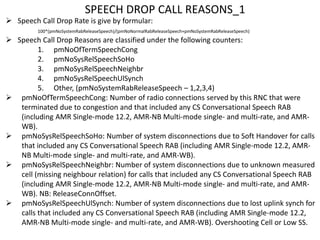
 Speech Call Drop Rate is give by formular:
100*(pmNoSystemRabReleaseSpeech)/(pmNoNormalRabReleaseSpeech+pmNoSystemRabReleaseSpeech)
 Speech Call Drop Reasons are classified under the following counters:
1. pmNoOfTermSpeechCong
2. pmNoSysRelSpeechSoHo
3. pmNoSysRelSpeechNeighbr
4. pmNoSysRelSpeechUlSynch
5. Other, (pmNoSystemRabReleaseSpeech – 1,2,3,4)
 pmNoOfTermSpeechCong: Number of radio connections served by this RNC that were
terminated due to congestion and that included any CS Conversational Speech RAB
(including AMR Single-mode 12.2, AMR-NB Multi-mode single- and multi-rate, and AMR-
WB).
 pmNoSysRelSpeechSoHo: Number of system disconnections due to Soft Handover for calls
that included any CS Conversational Speech RAB (including AMR Single-mode 12.2, AMR-
NB Multi-mode single- and multi-rate, and AMR-WB).
 pmNoSysRelSpeechNeighbr: Number of system disconnections due to unknown measured
cell (missing neighbour relation) for calls that included any CS Conversational Speech RAB
(including AMR Single-mode 12.2, AMR-NB Multi-mode single- and multi-rate, and AMR-
WB). NB: ReleaseConnOffset.
 pmNoSysRelSpeechUlSynch: Number of system disconnections due to lost uplink synch for
calls that included any CS Conversational Speech RAB (including AMR Single-mode 12.2,
AMR-NB Multi-mode single- and multi-rate, and AMR-WB). Overshooting Cell or Low SS.
SPEECH DROP CALL REASONS_1
 Other: Mainly Non RF Related Causes.
 Failed IRAT which couldn’t return to 3G
 Sctp Packet Lost
 Crashing Node B
 Major & Critical Service Impact Alarms
 Very High VSWR & Rx Path Imbalance
 Very Strong External Interference
 Extremely High Temperature
 Incompatible Software Upgrade/Release
 High Iub Congestion on Last Mile, Aggregation Point, Routes
 Wrong or Inconsistent Route/SIU Configuration
 Wrong MSC/MSS Definitions
 Issues with MGw and Other Core Nodes like Signalling Congestion or
HighUtilization
 Etc…
SPEECH DROP CALL REASONS_2
 pmNoOfTermSpeechCong: Number of radio connections served by this RNC that were
terminated due to congestion and that included any CS Conversational Speech RAB
(including AMR Single-mode 12.2, AMR-NB Multi-mode single- and multi-rate, and AMR-
WB).
 Resource Congestion could be in terms of
 High Power Utilization
 High DL Codes Utilization
 High UL/DL Channel Elements Utilization
 High ASE, High UL RSSI, High RTWP (Received Total Wideband Power)
 High Number of Users (eg. SF Failures)
 High Iub (DL/UL) Utilization
 BO Reports can be run to check the Utilization of these Resources
SPEECH DROP CALL REASONS_3
 pmNoSysRelSpeechSoHo: Number of system disconnections due to Soft Handover for calls
that included any CS Conversational Speech RAB (including AMR Single-mode 12.2, AMR-NB
Multi-mode single- and multi-rate, and AMR-WB).
 pmNoSysRelSpeechSoHo could be due to Poor SHO Success Rate between to Cells involved
in SHO.
 Poor SHO could be as a result of:
 Service Impacting Alarms on both Source and Target NodeBs,
 Transmission Instability, Node Synchronization Problems,
 Unstable Availability
 Co PSC
 Pilot Pollution
 High UL RSSI
 Swap Sectors and Cross Feeders.
 Faulty Hardware such as RU, FU, RaxB, TxB, DUW etc.
 Overshooting Cells
 Extremely High Temperature
 Ue Related
 SHO could also be poor due to Resource Congestion.
SPEECH DROP CALL REASONS_4
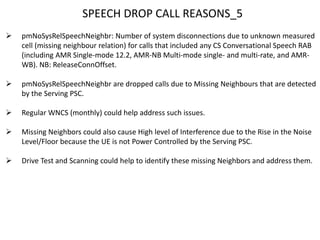
 pmNoSysRelSpeechNeighbr: Number of system disconnections due to unknown measured
cell (missing neighbour relation) for calls that included any CS Conversational Speech RAB
(including AMR Single-mode 12.2, AMR-NB Multi-mode single- and multi-rate, and AMR-
WB). NB: ReleaseConnOffset.
 pmNoSysRelSpeechNeighbr are dropped calls due to Missing Neighbours that are detected
by the Serving PSC.
 Regular WNCS (monthly) could help address such issues.
 Missing Neighbors could also cause High level of Interference due to the Rise in the Noise
Level/Floor because the UE is not Power Controlled by the Serving PSC.
 Drive Test and Scanning could help to identify these missing Neighbors and address them.
SPEECH DROP CALL REASONS_5
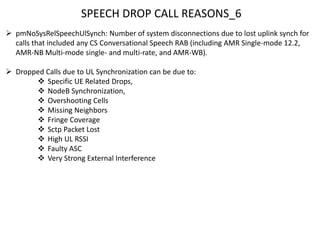
 pmNoSysRelSpeechUlSynch: Number of system disconnections due to lost uplink synch for
calls that included any CS Conversational Speech RAB (including AMR Single-mode 12.2,
AMR-NB Multi-mode single- and multi-rate, and AMR-WB).
 Dropped Calls due to UL Synchronization can be due to:
 Specific UE Related Drops,
 NodeB Synchronization,
 Overshooting Cells
 Missing Neighbors
 Fringe Coverage
 Sctp Packet Lost
 High UL RSSI
 Faulty ASC
 Very Strong External Interference
SPEECH DROP CALL REASONS_6
 Most of the Issues that cause Speech drops could also cause HS Drop. Hence a breakdown of
the Speech drop causes can help analyze HS Drop as well.
 HS Drop Rate (Ura PCH Activated) is given by formular:
 PS Drop Rate (Ura PCH Activated) is given by formular:
 Strategy to improve Hs Drop Rate targets improving pmNoSuccRbReconfPsIntDch &
pmPsIntHsToFachSucc, pmChSwitchAttemptHsUra as much as needed.
HS DROP RATE
 Features and Parameters to consider:
 HS Mobility phase 2 Enabled: Reconfigure to PS on DCH.
 Rab Combination:
 FACH Optimization
 Ura PCH Activation: Ura on Site Level
 InactivityTimer: Fach to Ura Pch 8s
 hsdschInactivityTimer: 2s
 Channel Switching Buffers & Timers:
 R99 Resource Optimization: Retune Higher RABs 384, 128, 64, 32
 Interference Reduction Features: Interference Suppression for EUL 10 ms, Interference
Suppression for All Bearers, Uplink fast congestion control.
 Fast Dormancy Features: Fast Dormancy Handling, Device Optimized Fast Dormancy, Fast
Dormancy for pre-rel-8 Ues, Differentiated UE Handling feature, Device Optimized HS-
FACH/EUL-FACH,
 hsDschRcLostT & dchRcLostT
 DL Power Curve Optimization
 rlFailureT
 CallReEstablishment Feature
 CallReEstablishmentIur Feature
 HstoDchTrigger: PoorQualityDetected Hs Thput vs. Hs Drop. In general, the recommendation
for the multi-valued parameter hsToDchTrigger is: poorQualityDetected = OFF, except when
HSDPA is deployed, for example, on both the first and the second carrier as described above.
 Load Balancing between Carriers to ensure equity users in Coverage Related Carriers
HS DROP RATE
 FACH Load Optimization & Channel Switching:
 SF Retune:
HS DROP RATE
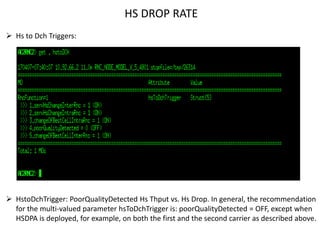
 Hs to Dch Triggers:
 HstoDchTrigger: PoorQualityDetected Hs Thput vs. Hs Drop. In general, the recommendation
for the multi-valued parameter hsToDchTrigger is: poorQualityDetected = OFF, except when
HSDPA is deployed, for example, on both the first and the second carrier as described above.
HS DROP RATE
 hsDschRcLostT & dchRcLostT Tuning Guidelines:
 Note:
dchRcLostT > T313
hsDschRcLostT > T313
T313 > n315
HS DROP RATE
 rlFailureT:
 Unit = 0.1s
HS DROP RATE
 Load Balancing between Carriers to ensure equity users in Coverage Related Carriers
 Reduce Source Cell HsIfls Parameters like hsIflsThreshUsers, hsPathlossThreshold,
pathlossThresholdEulTti2, pathlossThreshold and Increase hsIflsMarginUsers
HS DROP RATE
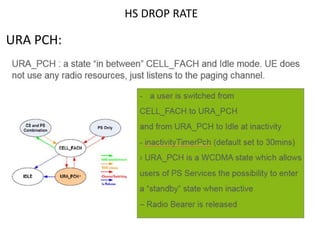
URA PCH:
HS DROP RATE
URA PCH:
HS DROP RATE
URA PCH: TRADITIONAL/OLD WAY TO RUN SMART MS
HS DROP RATE
URA PCH: NEW WAY TO RUN SMART MS
HS DROP RATE
URA PCH: NEW WAY TO RUN SMART MS WITH DIRECT UPSWITCH
HS DROP RATE
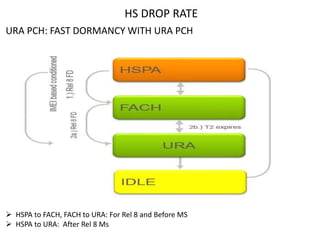
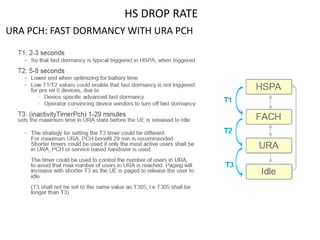
URA PCH: FAST DORMANCY WITH URA PCH
 HSPA to FACH, FACH to URA: For Rel 8 and Before MS
 HSPA to URA: After Rel 8 Ms
HS DROP RATE
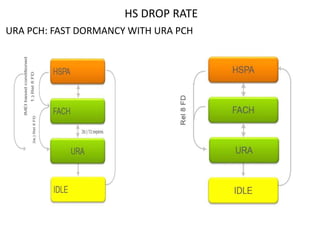
URA PCH: FAST DORMANCY WITH URA PCH
HS DROP RATE
URA PCH: FAST DORMANCY WITH URA PCH
HS DROP RATE
For more Information, search for “Accessibility and Retainability” in ALEX
THANK YOU

Cs hs drop analysis and optimization presentation

  • 1.
    CS & HSDROP ANALYSIS AND OPTIMIZATION
  • 2.
     NETWORK CLEANUPAND INCONSISTENCIES  HEALTH CHECKS & ALARMS RESOLUTION  NEIGHBOUR OPTIMIZATION  DROP CALL BREAK DOWN  CAPACITY OPTIMIZATION  BASIC PARAMETERS  FEATURE ACTIVATION & OPTIMIZATION  PHYSICAL OPTIMIZATION
  • 3.
     Align BasicParameters to the Recommended; except those ones that have purposely been tuned. NETWORK AUDIT, CLEANUP AND INCONSISTENCIES
  • 4.
     Run Alarmlogs and escalate all Service Impacting Major and Critical Alarms on RNC and NodeBs. Eg: alt  Escalate all NodeBs with High Temperature, High VSWR, Sctp Packet Lost and Very High Rx Path Imbalance. Eg: cabx HEALTH CHECK & ALARM RESOLUTION
  • 5.
     Neighbor Planserves as the bedrock for good radio environment.  Poorly Planned Neighbors due to Missing Neighbors can cause UE to be Island Sites which can lead to rise in the Noise level causing Interference on other UE’s in the Cell.  Missing Neighbors can also cause Dropped Calls due to ReleaseConnOffset is reached.  Good Neighbor Plan ensures a more uniform resource/capacity utilization.  Neighbor Plan and Optimization can be done either by:  Manually Selecting Neighbors  Using WNCS: Ensure that the Utrancell coordinates (Agps Positioning) are properly updated in the in the RNC. Limit the Re-Use of Co-PSC within short distance (3Km). NEIGHBOUR OPTIMIZATION
  • 6.
     Speech CallDrop Rate is give by formular: 100*(pmNoSystemRabReleaseSpeech)/(pmNoNormalRabReleaseSpeech+pmNoSystemRabReleaseSpeech)  Speech Call Drop Reasons are classified under the following counters: 1. pmNoOfTermSpeechCong 2. pmNoSysRelSpeechSoHo 3. pmNoSysRelSpeechNeighbr 4. pmNoSysRelSpeechUlSynch 5. Other, (pmNoSystemRabReleaseSpeech – 1,2,3,4)  pmNoOfTermSpeechCong: Number of radio connections served by this RNC that were terminated due to congestion and that included any CS Conversational Speech RAB (including AMR Single-mode 12.2, AMR-NB Multi-mode single- and multi-rate, and AMR- WB).  pmNoSysRelSpeechSoHo: Number of system disconnections due to Soft Handover for calls that included any CS Conversational Speech RAB (including AMR Single-mode 12.2, AMR- NB Multi-mode single- and multi-rate, and AMR-WB).  pmNoSysRelSpeechNeighbr: Number of system disconnections due to unknown measured cell (missing neighbour relation) for calls that included any CS Conversational Speech RAB (including AMR Single-mode 12.2, AMR-NB Multi-mode single- and multi-rate, and AMR- WB). NB: ReleaseConnOffset.  pmNoSysRelSpeechUlSynch: Number of system disconnections due to lost uplink synch for calls that included any CS Conversational Speech RAB (including AMR Single-mode 12.2, AMR-NB Multi-mode single- and multi-rate, and AMR-WB). Overshooting Cell or Low SS. SPEECH DROP CALL REASONS_1
  • 7.
     Other: MainlyNon RF Related Causes.  Failed IRAT which couldn’t return to 3G  Sctp Packet Lost  Crashing Node B  Major & Critical Service Impact Alarms  Very High VSWR & Rx Path Imbalance  Very Strong External Interference  Extremely High Temperature  Incompatible Software Upgrade/Release  High Iub Congestion on Last Mile, Aggregation Point, Routes  Wrong or Inconsistent Route/SIU Configuration  Wrong MSC/MSS Definitions  Issues with MGw and Other Core Nodes like Signalling Congestion or HighUtilization  Etc… SPEECH DROP CALL REASONS_2
  • 8.
     pmNoOfTermSpeechCong: Numberof radio connections served by this RNC that were terminated due to congestion and that included any CS Conversational Speech RAB (including AMR Single-mode 12.2, AMR-NB Multi-mode single- and multi-rate, and AMR- WB).  Resource Congestion could be in terms of  High Power Utilization  High DL Codes Utilization  High UL/DL Channel Elements Utilization  High ASE, High UL RSSI, High RTWP (Received Total Wideband Power)  High Number of Users (eg. SF Failures)  High Iub (DL/UL) Utilization  BO Reports can be run to check the Utilization of these Resources SPEECH DROP CALL REASONS_3
  • 9.
     pmNoSysRelSpeechSoHo: Numberof system disconnections due to Soft Handover for calls that included any CS Conversational Speech RAB (including AMR Single-mode 12.2, AMR-NB Multi-mode single- and multi-rate, and AMR-WB).  pmNoSysRelSpeechSoHo could be due to Poor SHO Success Rate between to Cells involved in SHO.  Poor SHO could be as a result of:  Service Impacting Alarms on both Source and Target NodeBs,  Transmission Instability, Node Synchronization Problems,  Unstable Availability  Co PSC  Pilot Pollution  High UL RSSI  Swap Sectors and Cross Feeders.  Faulty Hardware such as RU, FU, RaxB, TxB, DUW etc.  Overshooting Cells  Extremely High Temperature  Ue Related  SHO could also be poor due to Resource Congestion. SPEECH DROP CALL REASONS_4
  • 10.
     pmNoSysRelSpeechNeighbr: Numberof system disconnections due to unknown measured cell (missing neighbour relation) for calls that included any CS Conversational Speech RAB (including AMR Single-mode 12.2, AMR-NB Multi-mode single- and multi-rate, and AMR- WB). NB: ReleaseConnOffset.  pmNoSysRelSpeechNeighbr are dropped calls due to Missing Neighbours that are detected by the Serving PSC.  Regular WNCS (monthly) could help address such issues.  Missing Neighbors could also cause High level of Interference due to the Rise in the Noise Level/Floor because the UE is not Power Controlled by the Serving PSC.  Drive Test and Scanning could help to identify these missing Neighbors and address them. SPEECH DROP CALL REASONS_5
  • 11.
     pmNoSysRelSpeechUlSynch: Numberof system disconnections due to lost uplink synch for calls that included any CS Conversational Speech RAB (including AMR Single-mode 12.2, AMR-NB Multi-mode single- and multi-rate, and AMR-WB).  Dropped Calls due to UL Synchronization can be due to:  Specific UE Related Drops,  NodeB Synchronization,  Overshooting Cells  Missing Neighbors  Fringe Coverage  Sctp Packet Lost  High UL RSSI  Faulty ASC  Very Strong External Interference SPEECH DROP CALL REASONS_6
  • 12.
     Most ofthe Issues that cause Speech drops could also cause HS Drop. Hence a breakdown of the Speech drop causes can help analyze HS Drop as well.  HS Drop Rate (Ura PCH Activated) is given by formular:  PS Drop Rate (Ura PCH Activated) is given by formular:  Strategy to improve Hs Drop Rate targets improving pmNoSuccRbReconfPsIntDch & pmPsIntHsToFachSucc, pmChSwitchAttemptHsUra as much as needed. HS DROP RATE
  • 13.
     Features andParameters to consider:  HS Mobility phase 2 Enabled: Reconfigure to PS on DCH.  Rab Combination:  FACH Optimization  Ura PCH Activation: Ura on Site Level  InactivityTimer: Fach to Ura Pch 8s  hsdschInactivityTimer: 2s  Channel Switching Buffers & Timers:  R99 Resource Optimization: Retune Higher RABs 384, 128, 64, 32  Interference Reduction Features: Interference Suppression for EUL 10 ms, Interference Suppression for All Bearers, Uplink fast congestion control.  Fast Dormancy Features: Fast Dormancy Handling, Device Optimized Fast Dormancy, Fast Dormancy for pre-rel-8 Ues, Differentiated UE Handling feature, Device Optimized HS- FACH/EUL-FACH,  hsDschRcLostT & dchRcLostT  DL Power Curve Optimization  rlFailureT  CallReEstablishment Feature  CallReEstablishmentIur Feature  HstoDchTrigger: PoorQualityDetected Hs Thput vs. Hs Drop. In general, the recommendation for the multi-valued parameter hsToDchTrigger is: poorQualityDetected = OFF, except when HSDPA is deployed, for example, on both the first and the second carrier as described above.  Load Balancing between Carriers to ensure equity users in Coverage Related Carriers HS DROP RATE
  • 14.
     FACH LoadOptimization & Channel Switching:  SF Retune: HS DROP RATE
  • 15.
     Hs toDch Triggers:  HstoDchTrigger: PoorQualityDetected Hs Thput vs. Hs Drop. In general, the recommendation for the multi-valued parameter hsToDchTrigger is: poorQualityDetected = OFF, except when HSDPA is deployed, for example, on both the first and the second carrier as described above. HS DROP RATE
  • 16.
     hsDschRcLostT &dchRcLostT Tuning Guidelines:  Note: dchRcLostT > T313 hsDschRcLostT > T313 T313 > n315 HS DROP RATE
  • 17.
     rlFailureT:  Unit= 0.1s HS DROP RATE
  • 18.
     Load Balancingbetween Carriers to ensure equity users in Coverage Related Carriers  Reduce Source Cell HsIfls Parameters like hsIflsThreshUsers, hsPathlossThreshold, pathlossThresholdEulTti2, pathlossThreshold and Increase hsIflsMarginUsers HS DROP RATE
  • 19.
  • 20.
  • 21.
    URA PCH: TRADITIONAL/OLDWAY TO RUN SMART MS HS DROP RATE
  • 22.
    URA PCH: NEWWAY TO RUN SMART MS HS DROP RATE
  • 23.
    URA PCH: NEWWAY TO RUN SMART MS WITH DIRECT UPSWITCH HS DROP RATE
  • 24.
    URA PCH: FASTDORMANCY WITH URA PCH  HSPA to FACH, FACH to URA: For Rel 8 and Before MS  HSPA to URA: After Rel 8 Ms HS DROP RATE
  • 25.
    URA PCH: FASTDORMANCY WITH URA PCH HS DROP RATE
  • 26.
    URA PCH: FASTDORMANCY WITH URA PCH HS DROP RATE
  • 27.
    For more Information,search for “Accessibility and Retainability” in ALEX THANK YOU