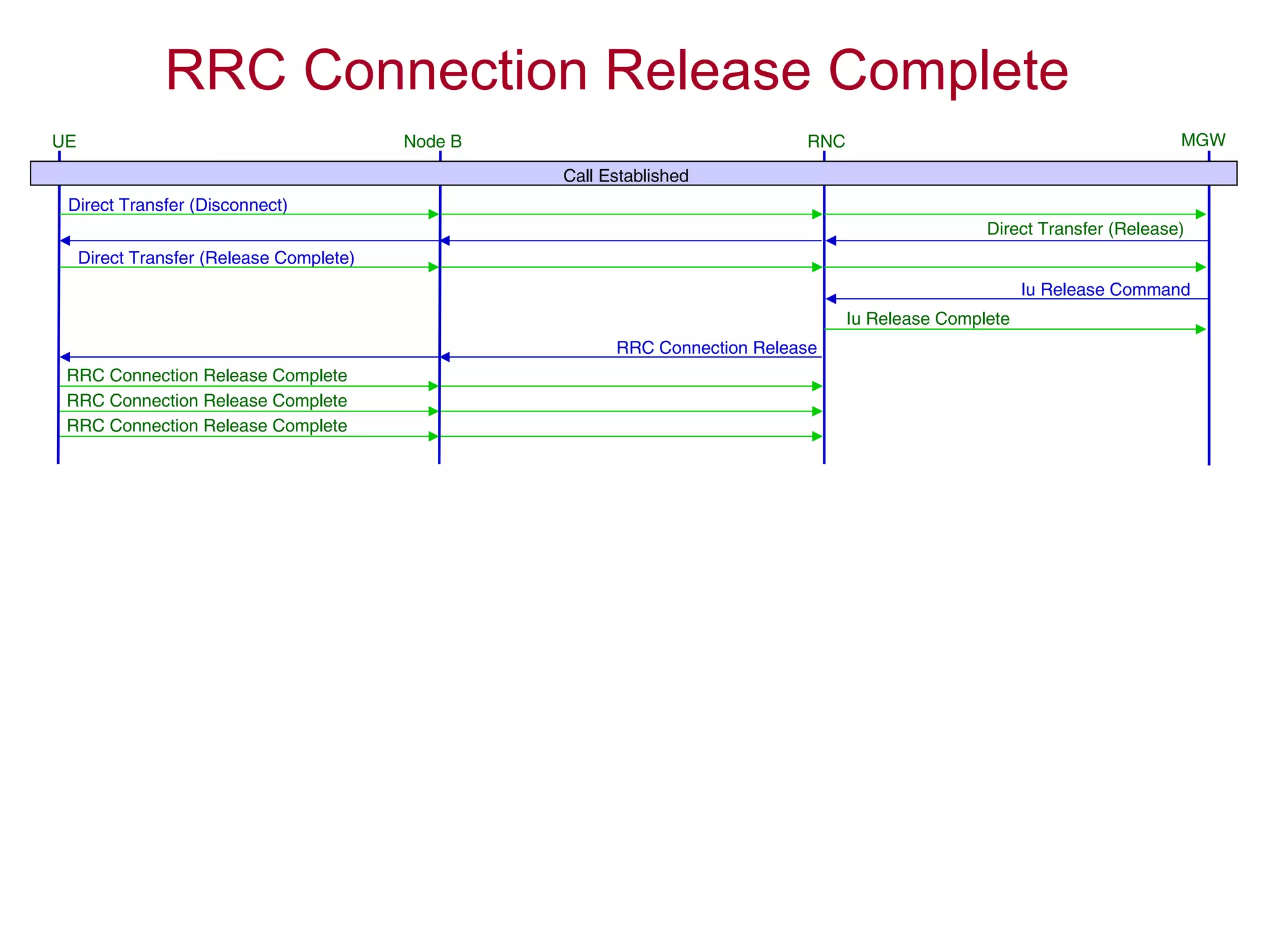
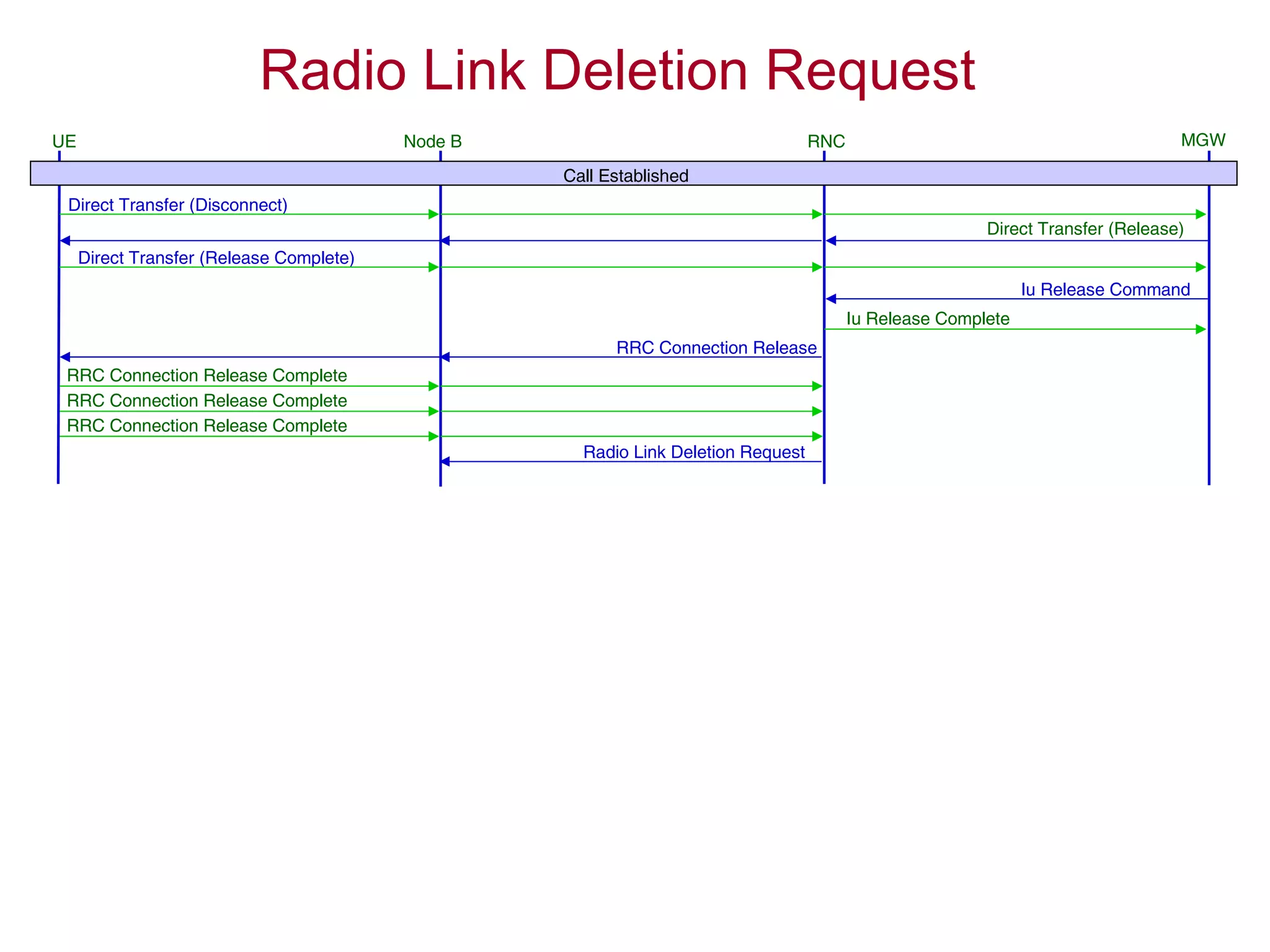
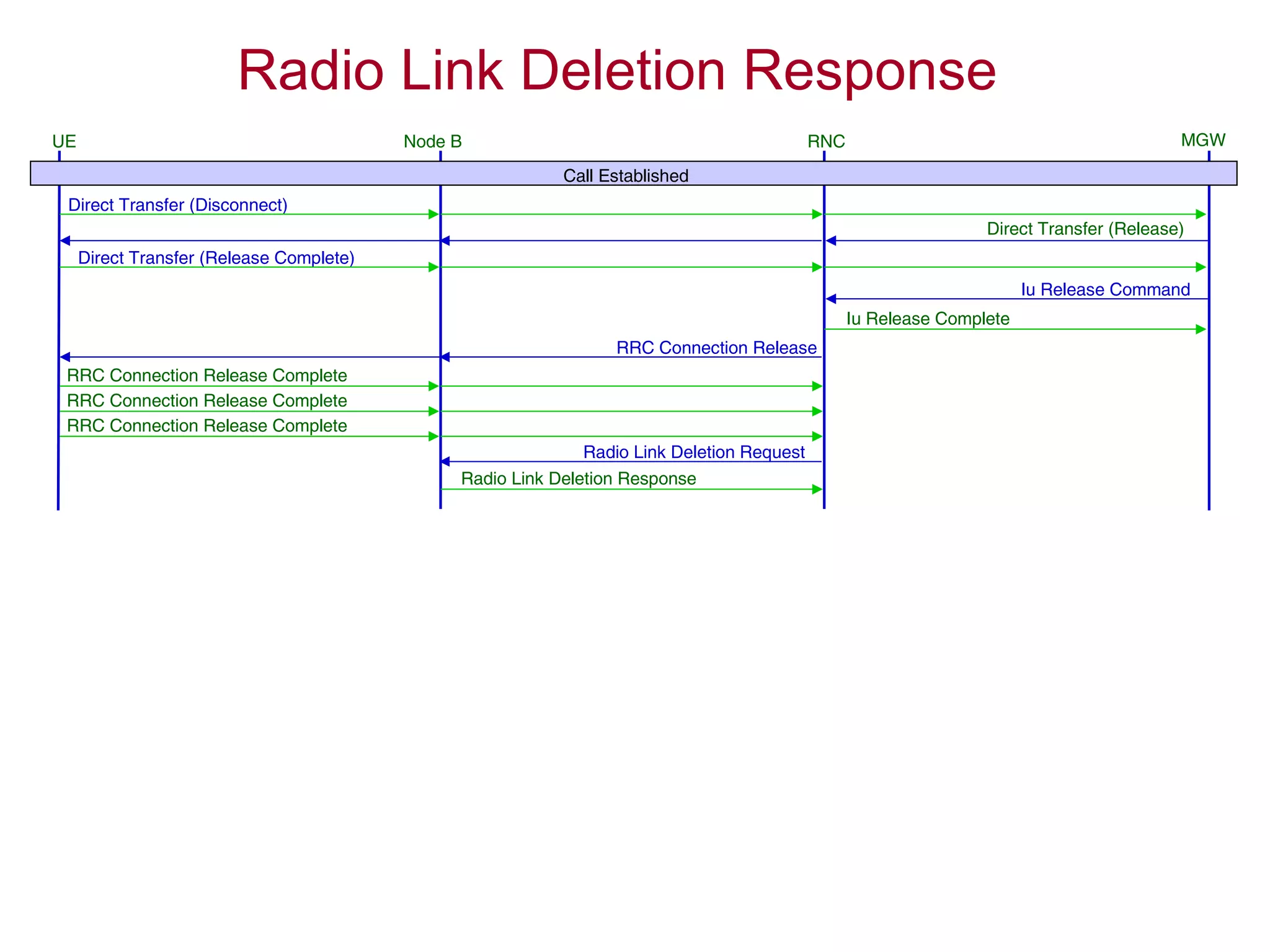
Signalling Flow:
AMR Call
Establishment
Summary of AMR Call Establishment
• The UE starts by searching for candidate cells by
correlating the RSSI with the code defining the
primary SCH
• The UE then achieves radio frame synchronisation
and reads the BCCH logical channel
• The BCCH provides system information including the
cell selection criteria
• If the cell passes the cell selection criteria then the UE
establishes an RRC connection and registers with the
core network
• Having registered with the core network the UE
returns to the RRC idle mode state and is ready to
originate an AMR speech call
• An originating AMR speech call is made and
handovers are completed as and when required
• Finally the AMR speech call is released and the UE
returns to the RRC idle mode state
UE is
powered up
Read BCCH
Cell selection
Register with
core network
Originating AMR
speech call
Handovers
Release of AMR
speech call
Radio frame
synchronisation
Cell search
Protocol Stacks
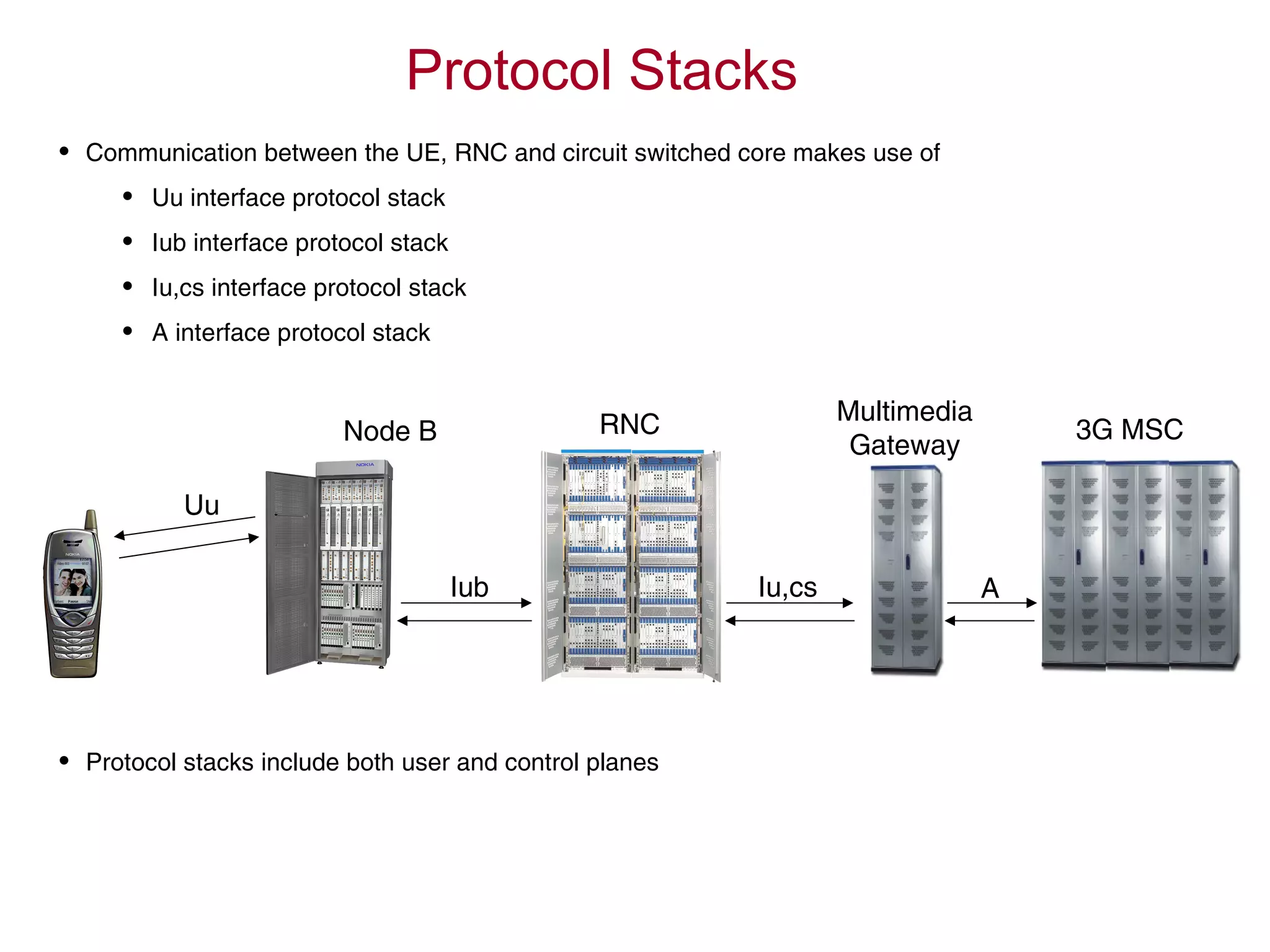
• Communication between the UE, RNC and circuit switched core makes use of
• Uu interface protocol stack
• Iub interface protocol stack
• Iu,cs interface protocol stack
• A interface protocol stack
Iub Iu,cs
Uu
Node B RNC Multimedia
Gateway
3G MSC
A
• Protocol stacks include both user and control planes
Cell Search UE is
powered up
Read BCCH
Cell selection
Register with
core network
Originating AMR
speech call
Handovers
Release of AMR
speech call
Radio frame
synchronisation
Cell search• The UE keeps a record of the previously used carrier. The cell search
procedure starts by scanning this carrier
• The cell search procedure is completed by correlating RSSI against the
known Primary SCH code
• Peaks in the correlation result indicate the presence of a cell
Correlation
Peaks
time
Correlation
result
• Once the UE has identified a cell the UE attempts to synchronise with that
cell
Radio Frame Synchronisation
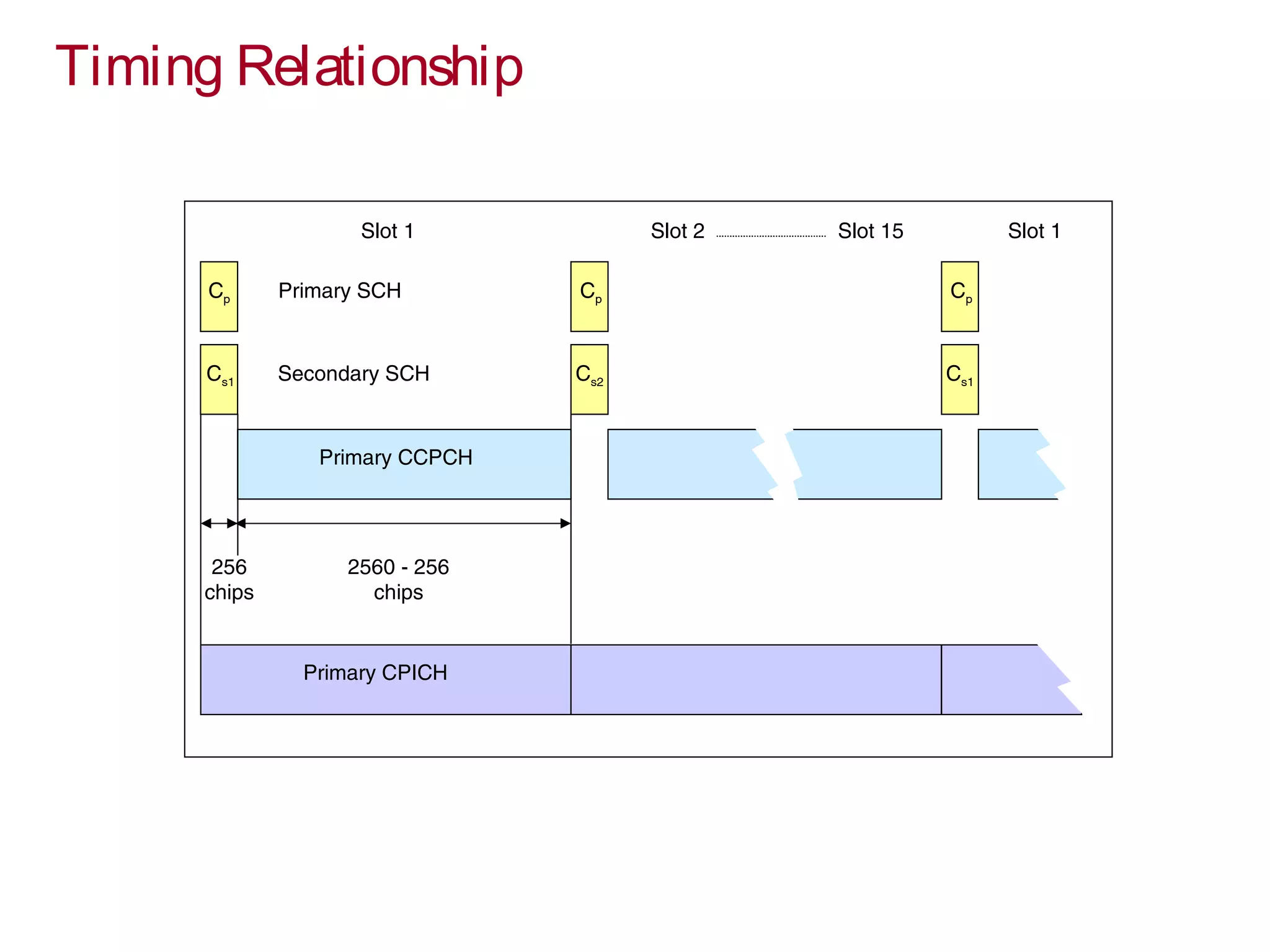
Cp Cp Cp
Cs1 Cs1Cs2
Primary SCH
Secondary SCH
Primary CCPCH
256
chips
2560 - 256
chips
Slot 1 Slot 2 Slot 15 Slot 1
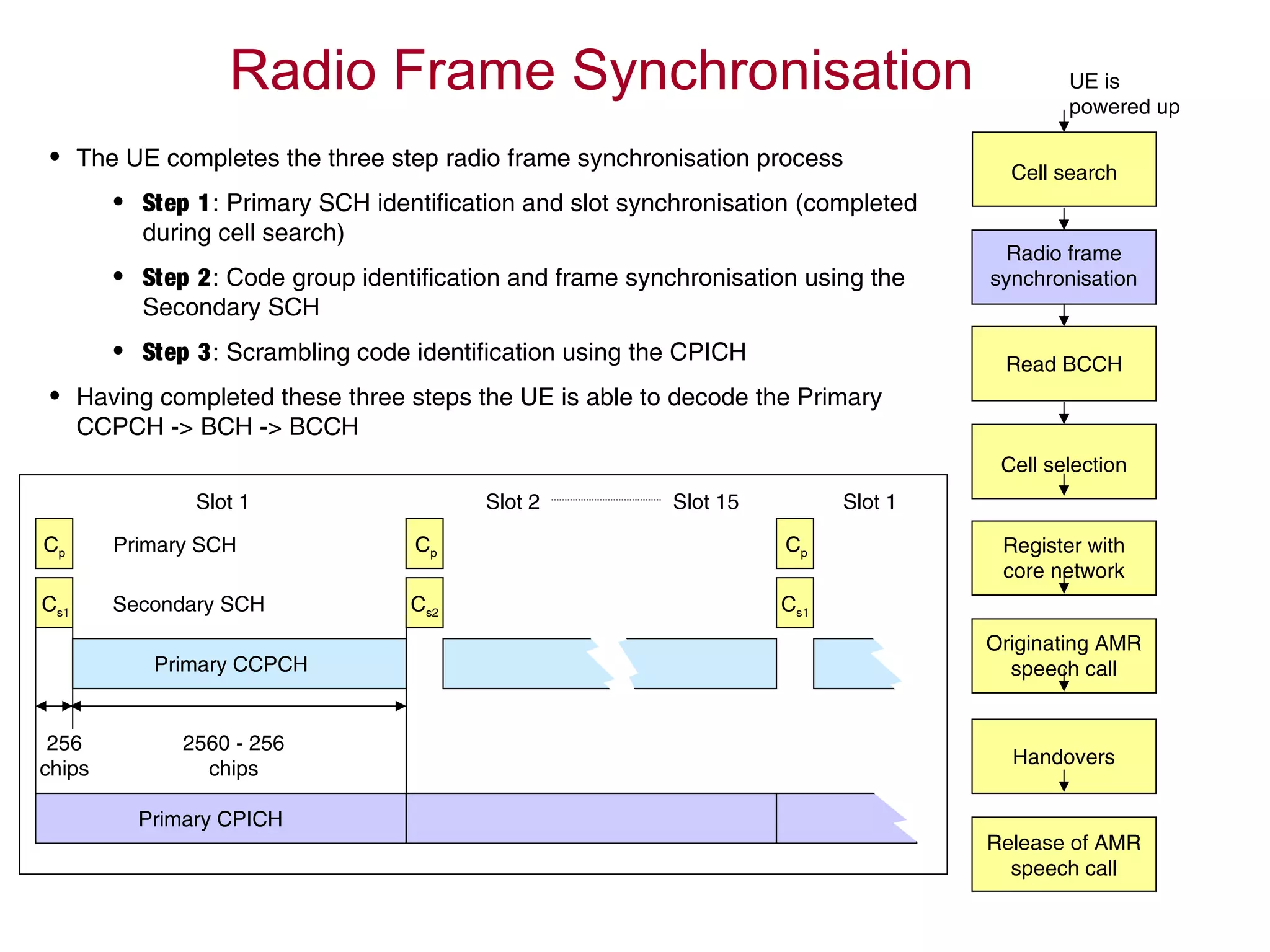
• The UE completes the three step radio frame synchronisation process
• Step 1: Primary SCH identification and slot synchronisation (completed
during cell search)
• Step 2: Code group identification and frame synchronisation using the
Secondary SCH
• Step 3: Scrambling code identification using the CPICH
• Having completed these three steps the UE is able to decode the Primary
CCPCH -> BCH -> BCCH
UE is
powered up
Read BCCH
Cell selection
Register with
core network
Originating AMR
speech call
Handovers
Release of AMR
speech call
Radio frame
synchronisation
Cell search
Primary CPICH
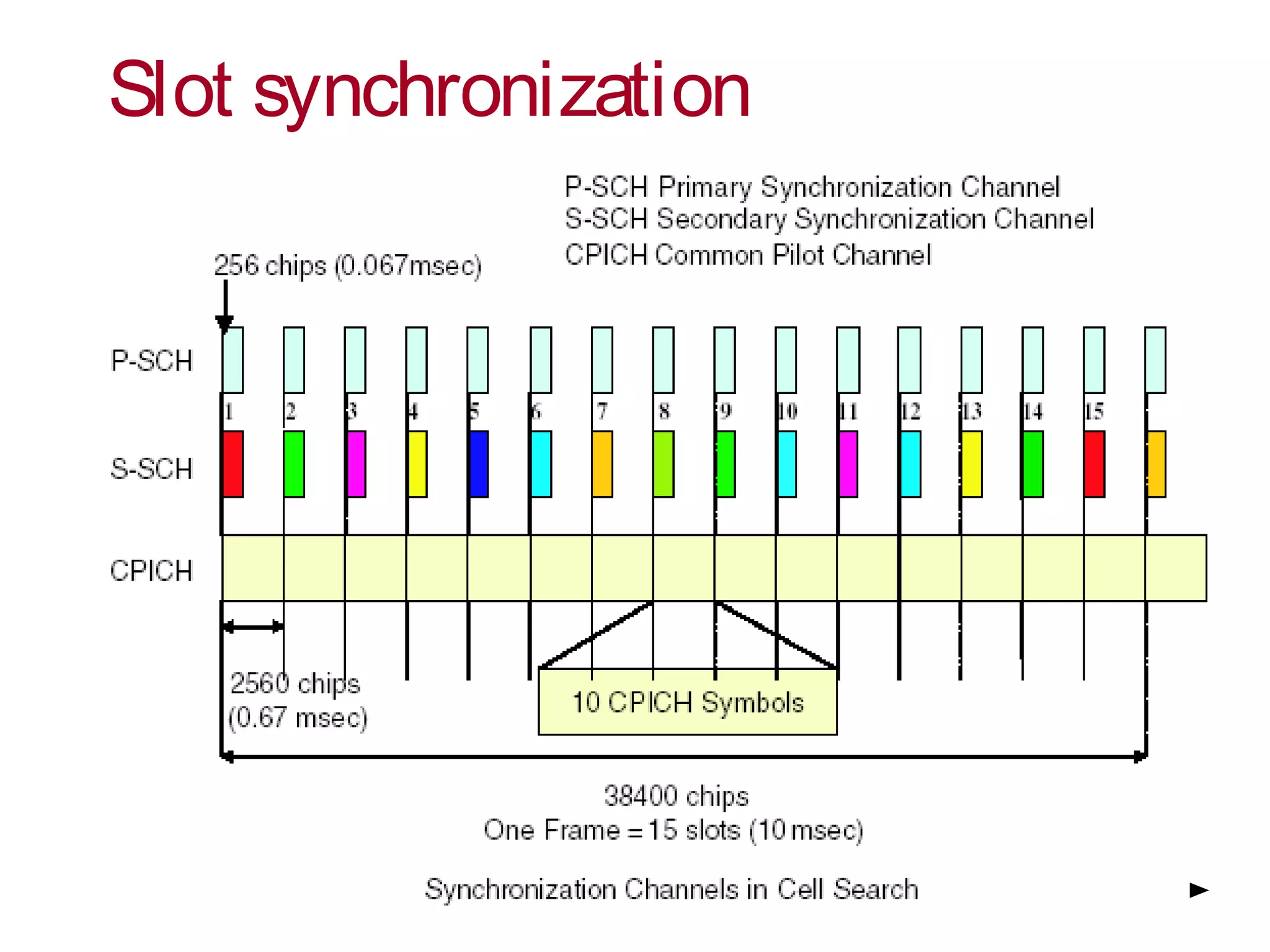
Radio Frame Synchronization ..
Three Steps
1. Slot Synchronization
2.Frame Synchronization
3. Primary Scrambling code Identification
Channels used for Synchronization
– Primary synchronization channel (PSCH)
– Secondary synchronization channel (SSCH)
– Common Pilot Channel (CPICH)
Slot synchronization
►
Slot Synchronization
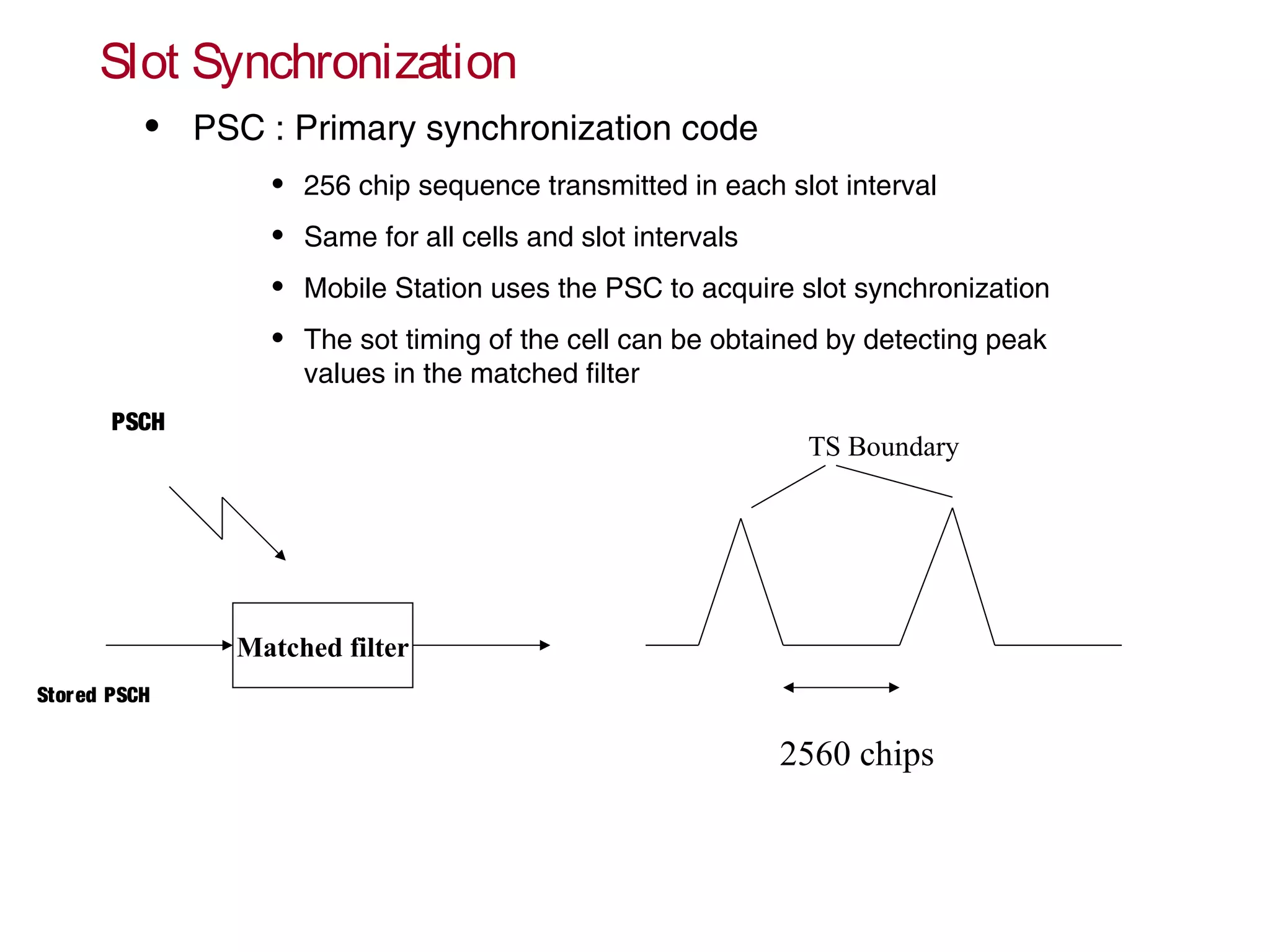
• PSC : Primary synchronization code
• 256 chip sequence transmitted in each slot interval
• Same for all cells and slot intervals
• Mobile Station uses the PSC to acquire slot synchronization
• The sot timing of the cell can be obtained by detecting peak
values in the matched filter
Matched filter
TS Boundary
2560 chips
PSCH
Stored PSCH
FrameSynchronization
• SSC: Secondary synchronization code
• 256 chip sequence transmitted in parallel with PSC.
• In general different for different cells and slot intervals
• 16 different ‘256 chip’ sequence ( 16 secondary synch code)
• Code word of 15 consecutive SSC indicates ‘cell scrambling code group’
• There are 64 such code groups
• UE checks in each slot 16 possible SSC sequences and select which gives
the highest correlation value => 15 codes are selected
• The cyclic shift is unique and gives the frame synchronization and the
scrambling code group
Slot No. 0 1 2 14
Group1 SSC1 SSC1 SSC2 ….. SSC16
Group2 SSC1 SSC1 SSC5 ….. SSC10
Group3 SSC1 SSC2 SSC1 …… SSC12
…..
…..
Group64 SSC9 SSC12 SSC10 …… SSC10
◄
15
15
SSC Allocation for S-SCH
scrambling
code group
group 00
group 01
group 02
group 03
group 05
group 04
group 62
group 63
1 1 2 8 9 10 15 8 10 16 2 7 15 7 16
1 1 5 16 7 3 14 16 3 10 5 12 14 12 10
1 2 1 15 5 5 12 16 6 11 2 16 11 12
1 2 3 1 8 6 5 2 5 8 4 4 6 3 7
1 2 16 6 6 11 5 12 1 15 12 16 11 2
1 3 4 7 4 1 5 5 3 6 2 8 7 6 8
9 11 12 15 12 9 13 13 11 14 10 16 15 14 16
9 12 10 15 13 14 9 14 15 11 11 13 12 16 10
slot number
0 1 2 3 4 5 6 7 8 9 10 11 12 13 14
11
11 11
11 11
11 11
11 11
15
15
15
15 15
15
15
15 15
15 15
5
5
I monitor
the S-SCH
Scrambling codes summary
1) Long Scrambling code :262143 Codes
2) To speed up the cell search => only 8192 codes
3) 8192 code grouping: 512 groups of 16 codes each (512*16 = 8192)
4) 16 codes in each group => first code is Primary scrambling code and 15
codes are Secondary scrambling codes
5) Again 512 codes are further divided into 64 groups of 8 codes
6) These 64 groups map to the 64 scrambling code group used at stage 2
during frame synchronization
– That way UE limits its Primary Scrambling code search to just 8 codes
– At this stage max 8 attempts to find out the Primary Scrambling code of the cell
7) Each cell is allocated one Primary scrambling code ( Carrying P-CPICH,
PCCPCH, PICH, AICH and S-CCPCH)
8) Other channels can use Primary scrambling code or secondary scrambling
codes from the same group
Timing Relationship
Cp Cp Cp
Cs1 Cs1Cs2
Primary SCH
Secondary SCH
Primary CCPCH
256
chips
2560 - 256
chips
Slot 1 Slot 2 Slot 15 Slot 1
Primary CPICH
Cell Search Procedure Summary
Read BCCH
• The BCCH encapsulates the Syste m Info rm atio n message which includes the
Master Information Block (MIB), Scheduling Blocks (SB) and System
Information Blocks (SIB)
• SIB1, SIB2 ….SIB18
UE is
powered up
Read BCCH
Cell selection
Register with
core network
Originating AMR
speech call
Handovers
Release of AMR
speech call
Radio frame
synchronisation
Cell search
MIB
SB SIBs
SIBs
System Information
Node B
UTRAN
System Information ( )
UE RNC
NBAP: BCCH Information
MIB
value tag M
SB1 SIB 1 SIB 2
SIB 11
Cell Selection
• Cell selection is standardised process ( 25.304)
• Cell selection is based upon the S-criteria
• Srxlev > 0
• Squal > 0
• UE extracts the S-criteria parameters from SIB 3
• QqualMin
• Qrxle vMin
• UE_ TXPWR_ MAX_ RACH
UE is
powered up
Read BCCH
Cell selection
Register with
core network
Originating AMR
speech call
Handovers
Release of AMR
speech call
Radio frame
synchronisation
Cell search
Cell Selection (II)
• Both Squal and Srxlev must be positive for the UE to camp upon the
cell
UE is
powered up
Read BCCH
Cell selection
Register with
core network
Originating AMR
speech call
Handovers
Release of AMR
speech call
Radio frame
synchronisation
Cell search
Squal
= Qqualmeas
– QqualMin
Srxlev
= Qrxlevmeas
– Qrxle vMin – Pcompensation
where, Pcompensation
=
Max(UE_ TXPWR_ MAX_ RACH – P_MAX, 0)
Default values:
QqualMin is –20 dB CPICH Ec/Io
Qrxle vMin is –115 dBm CPICH RSCP
UE_ TXPWR_ MAX_ RACH is 21 dBm
Register with the Core Network UE is
powered up
Read BCCH
Cell selection
Register with
core network
Originating AMR
speech call
Handovers
Release of AMR
speech call
Radio frame
synchronisation
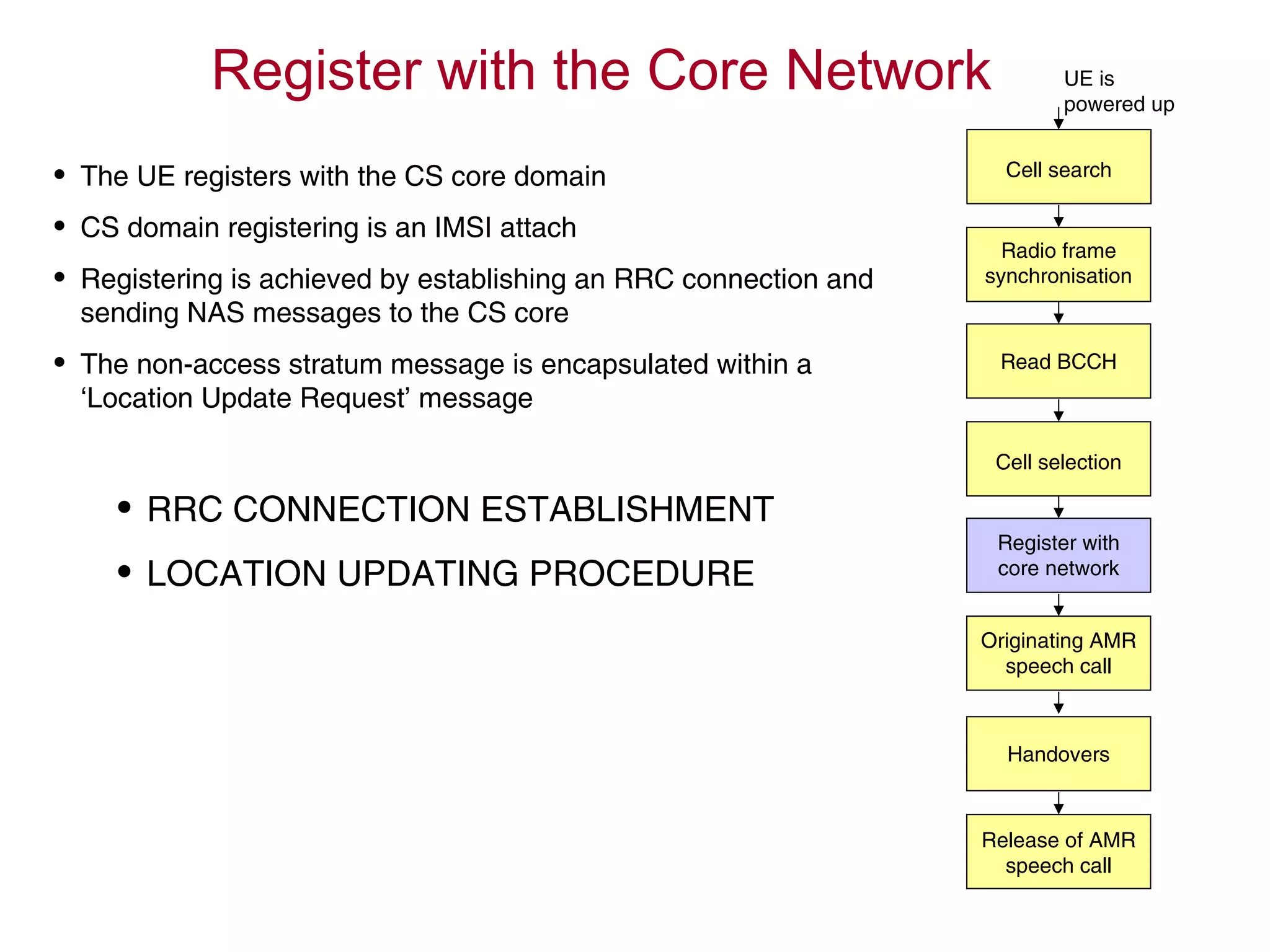
Cell search• The UE registers with the CS core domain
• CS domain registering is an IMSI attach
• Registering is achieved by establishing an RRC connection and
sending NAS messages to the CS core
• The non-access stratum message is encapsulated within a
‘Location Update Request’ message
• RRC CONNECTION ESTABLISHMENT
• LOCATION UPDATING PROCEDURE
RRC Modes
Release RRC
Connection
Release RRC
Connection
Establish RRC
Connection
URA_PCH
CELL_DCH CELL_FACH
CELL_PCH
Establish RRC
Connection
UTRA RRC Connected Mode
Idle Mode
GSM
Connected
Mode
GPRS Packet
Transfer
Mode
(UE camps on UTRAN cell)
Release RR
Connection
Establish RR
Connection
GSM-UMTS Handover
UTRA: Inter-RAT Handover
(MS in GPRS
Packet Idle Mode)
Cell
Resele-
ction
Initiation
of a TBF
Release
of a
TBF
(MS camps on a GERAN cell)
(adopted from TS 25.331 V3.12.0
CELL_DCH State
active set
cell
active set
cell
• DCCH and – if configured –
DTCH
• Dedicate physical channel in use
• UE location known on active set
cell level
• UE responsible for measurement
reporting
• Cell system information on
BCCH
• RRC messages on DCCH
CELL_FACH State
serving
cell
• DCCH and – if configured – DTCH
• FACH used for higher layer data
transfer,
• UE monitors FACH permanently
• Uplink transmission on RACH
• UE location known on serving cell
level
• UE performs cell re-selection
• UE responsible for measurement
reporting
• Cell system information on BCCH
• RRC messages on BCCH, CCCH
and DCCH
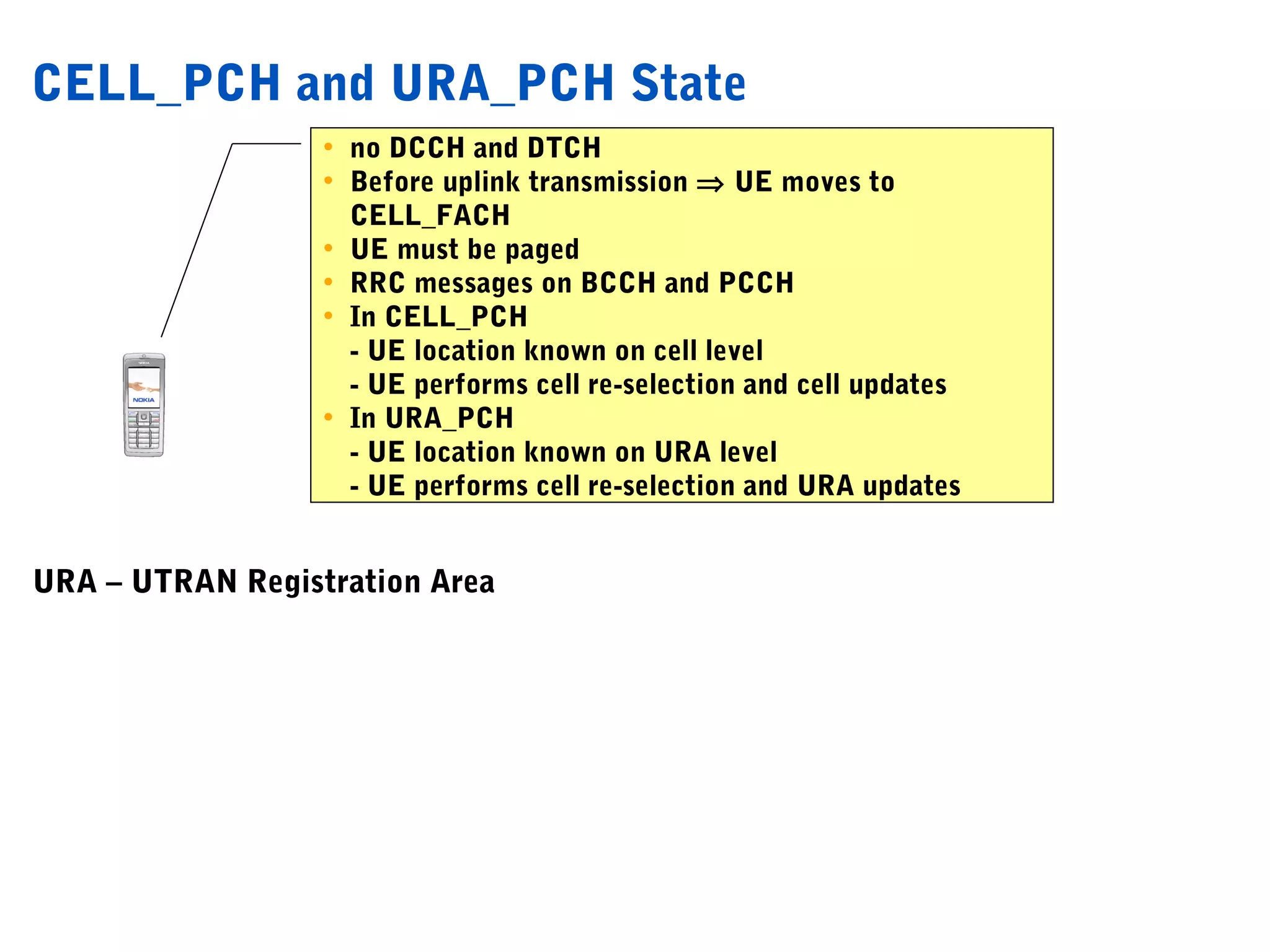
CELL_PCH and URA_PCH State
URA – UTRAN Registration Area
• no DCCH and DTCH
• Before uplink transmission ⇒ UE moves to
CELL_FACH
• UE must be paged
• RRC messages on BCCH and PCCH
• In CELL_PCH
- UE location known on cell level
- UE performs cell re-selection and cell updates
• In URA_PCH
- UE location known on URA level
- UE performs cell re-selection and URA updates
UTRAN Specific Signalling Protocols
3G-MSC/VLR
3G-SGSN
UE Node B
RNC
RNC
RNS
RNS
RRC
Iur: RNSAP
Iu-PS: RANAP
Iu-CS: RANAP
Iub: NBAP
Register with the Core Network UE is
powered up
Read BCCH
Cell selection
Register with
core network
Originating AMR
speech call
Handovers
Release of AMR
speech call
Radio frame
synchronisation
Cell search• The UE registers with the CS core domain
• CS domain registering is an IMSI attach
• Registering is achieved by establishing an RRC connection and
sending NAS messages to the CS core
• The non-access stratum message is encapsulated within a
‘Location Update Request’ message
• RRC CONNECTION ESTABLISHMENT
• LOCATION UPDATING PROCEDURE
RRC Connection Establishment
Node BUE RNC
[RACH] RRC Connection Request
[DCH] RRC Connection Setup Complete
[FACH] RRC Connection Setup
Radio Link Setup
L1 Synchronisation
accept
ed
[RACH] RRC Connection Request
[FACH] RRC Connection Reject
UE RNC
rejecte
d
• If the cell from which the BCCH has been read is suitable to camp upon then the UE follows the instructions in
SIB1 to complete an IMSI attach with the CS core network
• To complete an IMSI attach the UE must first establish an RRC connection
• The RRC Co nne ctio n Re que st message is sent to the RNC on RACH
RRC Connection Establishment
UE Node B RNC
RRC CONNECTION REQUEST
RRC CONNECTION SETUP
RRC CONNECTION SETUP COMPLETE
LCH:CCCH
TCH:RACH
PCH:PRACH
LCH:CCCH
TCH: FACH
PCH: S-CCPH
LCH: DCCH
TCH:DCH
PCH: DPCH
RRC Connection Request
RRC: RRC Connection Request (RACH)
UE RNCNode B
•RRC CONNECTION REQUES: When UE wants to make a call or
register to the network after power on, the first thing it should do is
establish an RRC connection.
•Applicable UE State(s)
•Idle mode
•Logical Channel Used : CCH
•Transport Channel Used: RACH
•Physical Channel Used: PRACH
•Msg contains:
• UE Identity, Establishment cause etc.
• The RRC Co nne ctio n Re que st message is sent to the RNC on RACH
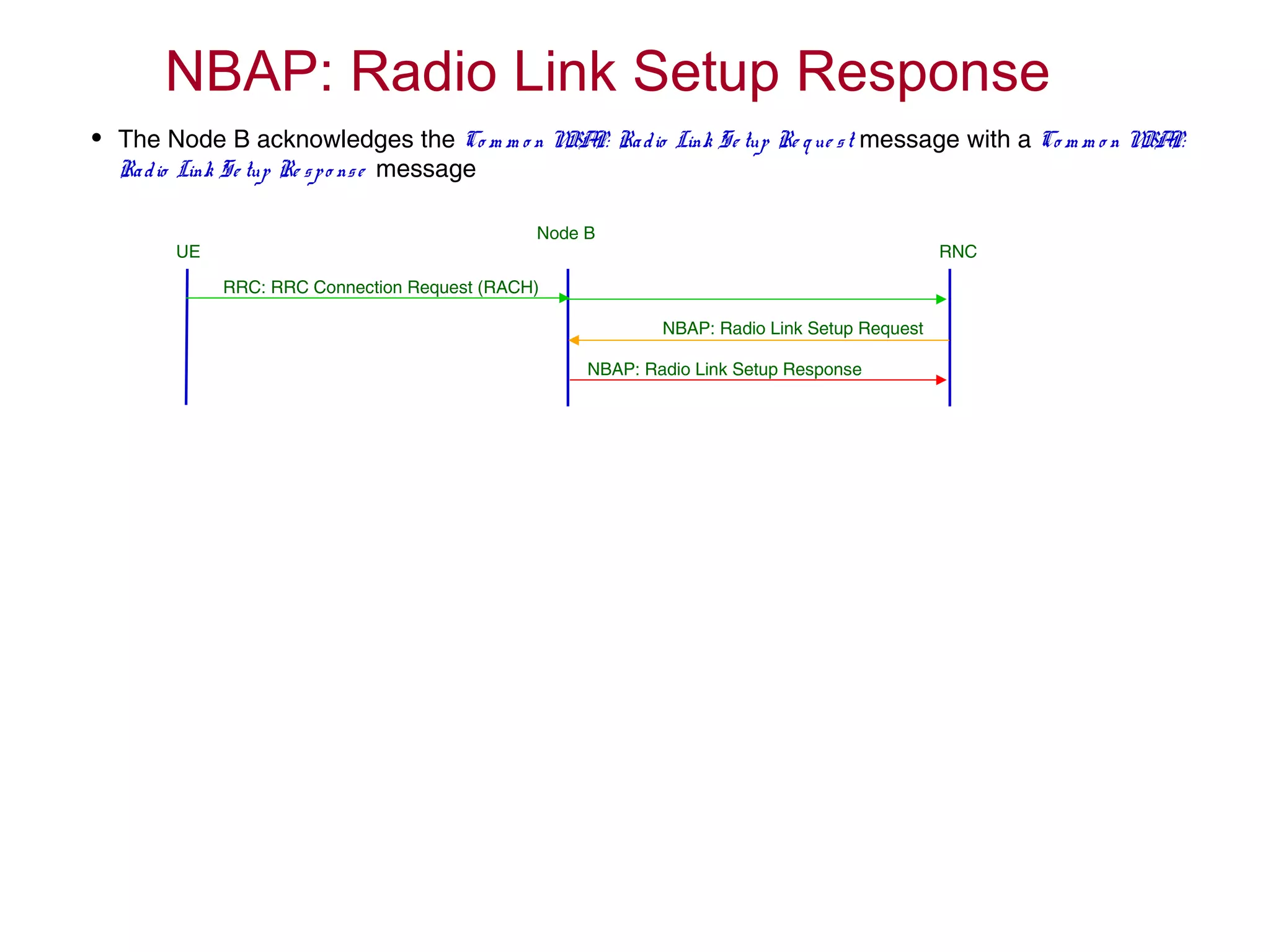
NBAP: Radio Link Setup Request
• Once the RNC has received the RRC Co nne ctio n Re que st message it sends a Co m m o n NBAP: Radio Link
Se tup Re que st to the Node B
• The Co m m o n NBAP: Radio Link Se tup Re que st includes uplink and downlink configuration data for the
radio link that the Node B is being requested to support
• The radio link refers only to the communication link between the Node B and UE. It does not
include Iub communication
RRC: RRC Connection Request
(RACH)
UE RNCNode B
NBAP: Radio Link Setup Request
NBAP: Radio Link Setup Response
RRC: RRC Connection Request (RACH)
UE RNC
Node B
NBAP: Radio Link Setup Request
NBAP: Radio Link Setup Response
• The Node B acknowledges the Co m m o n NBAP: Radio Link Se tup Re que st message with a Co m m o n NBAP:
Radio Link Se tup Re spo nse message
ALCAPand FPSignalling forIub Connection
RRC: RRC Connection Request (RACH)UE RNC
Node B
NBAP: Radio Link Setup Request
NBAP: Radio Link Setup Response
ALCAP and FP Signalling
• The RNC replies to the UE’s original RRC Co nne ctio n Re que st message with an RRC Co nne ctio n Se tup
message
• The RRC Co nne ctio n Se tup message is sent to the UE on the FACH using unacknowledged mode
RLC
RRC Connection Setup (I)
RRC: RRC Connection Request (RACH)
UE RNC
Node B
NBAP: Radio Link Setup Request
NBAP: Radio Link Setup Response
RRC: RRC Connection Setup (FACH)
ALCAP and FP Signalling
Signalling Radio Bearers
RNC
Radio Bearer
LogCH
NAS Signalling
RRC layer
MAC
RLC
UL: TrM
DL: UM
RB1
CCCH
RLC
UL & DL:
UM
RB2
DCCH
RLC
UL & DL
AM
RB3
DCCH
RLC
UL & DL
AM
RB4
DCCH
RB0
RLC
UL & DL
AM
DCCH
optional
UE
RRC Connection Setup ( )
RRC Signalling
RRC Connection Setup message
UE
RNC
RRC Connection Setup ( )
RRC layer
PHY
MAC
RLC
PDCP BMC
Radio Bearer
LogCH
TrCH
PhyCH
NAS Signalling user plane
PhyCh
configurati
on
TrCH
configurati
on
RB
configurati
on
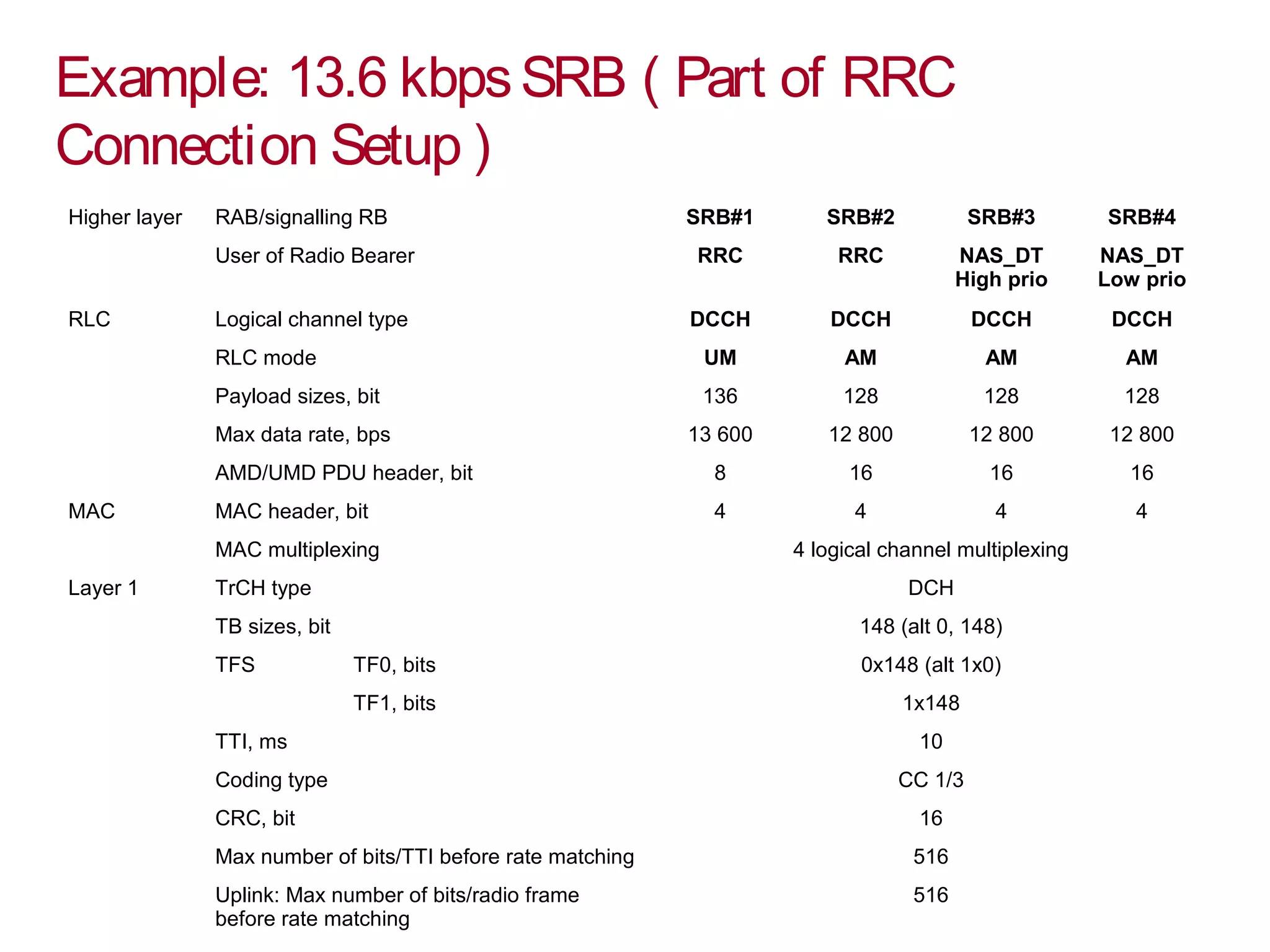
Example: 13.6 kbpsSRB ( Part of RRC
Connection Setup )
Higher layer RAB/signalling RB SRB#1 SRB#2 SRB#3 SRB#4
User of Radio Bearer RRC RRC NAS_DT
High prio
NAS_DT
Low prio
RLC Logical channel type DCCH DCCH DCCH DCCH
RLC mode UM AM AM AM
Payload sizes, bit 136 128 128 128
Max data rate, bps 13 600 12 800 12 800 12 800
AMD/UMD PDU header, bit 8 16 16 16
MAC MAC header, bit 4 4 4 4
MAC multiplexing 4 logical channel multiplexing
Layer 1 TrCH type DCH
TB sizes, bit 148 (alt 0, 148)
TFS TF0, bits 0x148 (alt 1x0)
TF1, bits 1x148
TTI, ms 10
Coding type CC 1/3
CRC, bit 16
Max number of bits/TTI before rate matching 516
Uplink: Max number of bits/radio frame
before rate matching
516
srb-InformationSetupList {
{
rb-Identity 1,
rlc-InfoChoice rlc-Info : {
ul-RLC-Mode ul-UM-RLC-Mode : {
},
dl-RLC-Mode dl-UM-RLC-Mode : NULL
},
rb-MappingInfo {{
ul-LogicalChannelMappings
oneLogicalChannel : {
ul-TransportChannelType dch : 24,
logicalChannelIdentity 1,
rlc-SizeList configured : NULL,
mac-LogicalChannelPriority 1
},
dl-LogicalChannelMappingList {
{
dl-TransportChannelType dch:24,
logicalChannelIdentity 1
}
}
}
}
},
{
RRC Connection Setup (III)
• SRB 1 is:
• established with rb identity 1
• configured with unacknowledged mode RLC
• mapped to transport channel 24
• assigned a logical channel identity 1
• SRB 1 is established for control plane communication
with UTRAN when unacknowledged mode RLC is used
• Signalling RRC messages
RRC Connection Setup (1V)
rb-Identity 2,
rlc-InfoChoice rlc-Info : {
}
}, dl-RLC-Mode dl-AM-RLC-Mode : {
inSequenceDelivery TRUE,
receivingWindowSize rw64,
dl-RLC-StatusInfo {
missingPDU-Indicator FALSE
}
}
},
rb-MappingInfo {
{
ul-LogicalChannelMappings
oneLogicalChannel : {
ul-TransportChannelType dch : 24,
logicalChannelIdentity 2,
rlc-SizeList configured : NULL,
mac-LogicalChannelPriority 1
},
dl-LogicalChannelMappingList {
{
dl-TransportChannelType dch : 24,
logicalChannelIdentity 2
}
• SRB 2 is:
• established with rb identity 2
• configured with acknowledged mode RLC
• mapped to transport channel 24
• assigned a logical channel identity 2
• SRB 2 is established for control plane communication
with UTRAN when acknowledged mode RLC is used
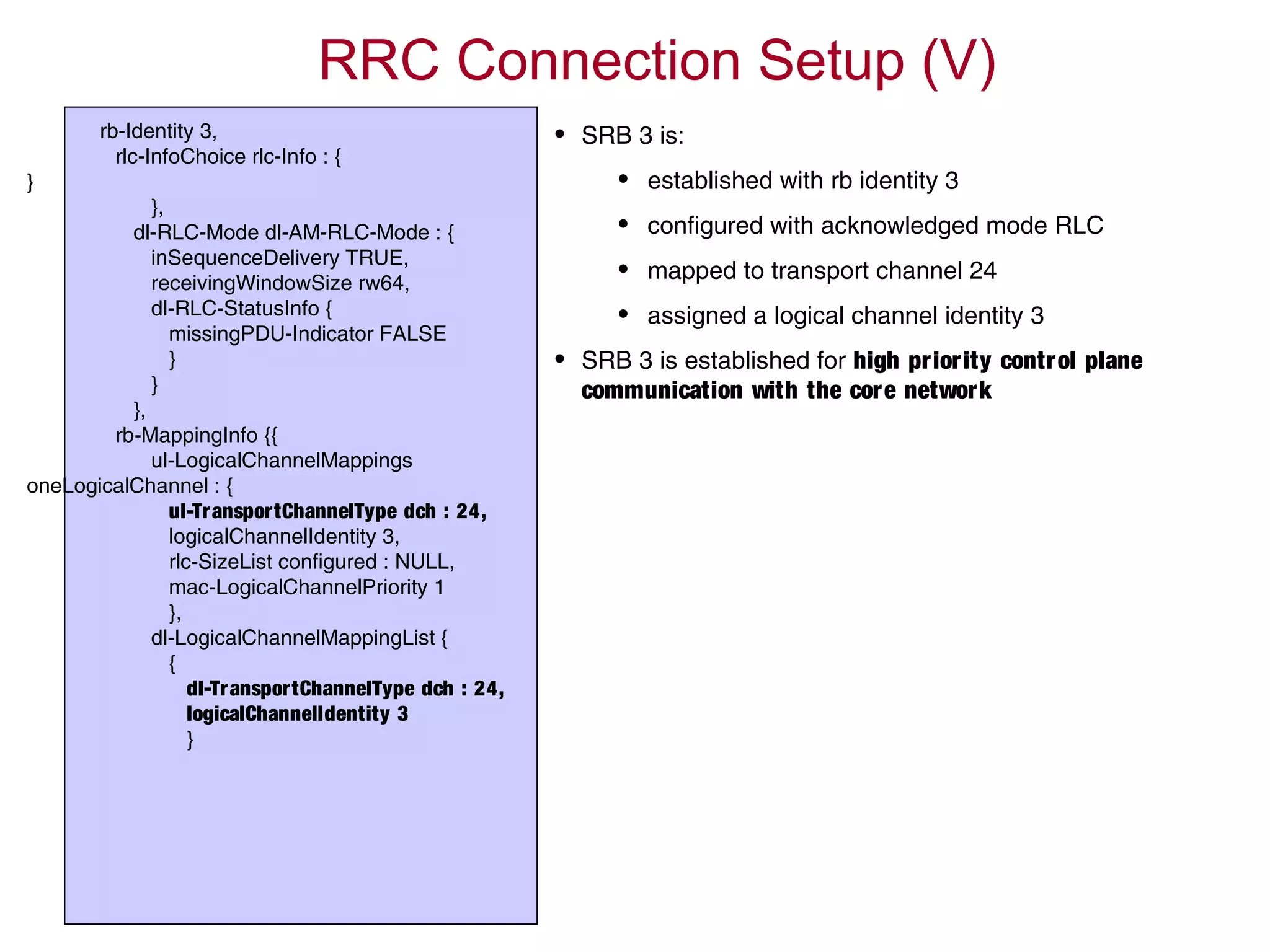
rb-Identity 3,
rlc-InfoChoice rlc-Info : {
}
},
dl-RLC-Mode dl-AM-RLC-Mode : {
inSequenceDelivery TRUE,
receivingWindowSize rw64,
dl-RLC-StatusInfo {
missingPDU-Indicator FALSE
}
}
},
rb-MappingInfo {{
ul-LogicalChannelMappings
oneLogicalChannel : {
ul-TransportChannelType dch : 24,
logicalChannelIdentity 3,
rlc-SizeList configured : NULL,
mac-LogicalChannelPriority 1
},
dl-LogicalChannelMappingList {
{
dl-TransportChannelType dch : 24,
logicalChannelIdentity 3
}
RRC Connection Setup (V)
• SRB 3 is:
• established with rb identity 3
• configured with acknowledged mode RLC
• mapped to transport channel 24
• assigned a logical channel identity 3
• SRB 3 is established for high priority control plane
communication with the core network
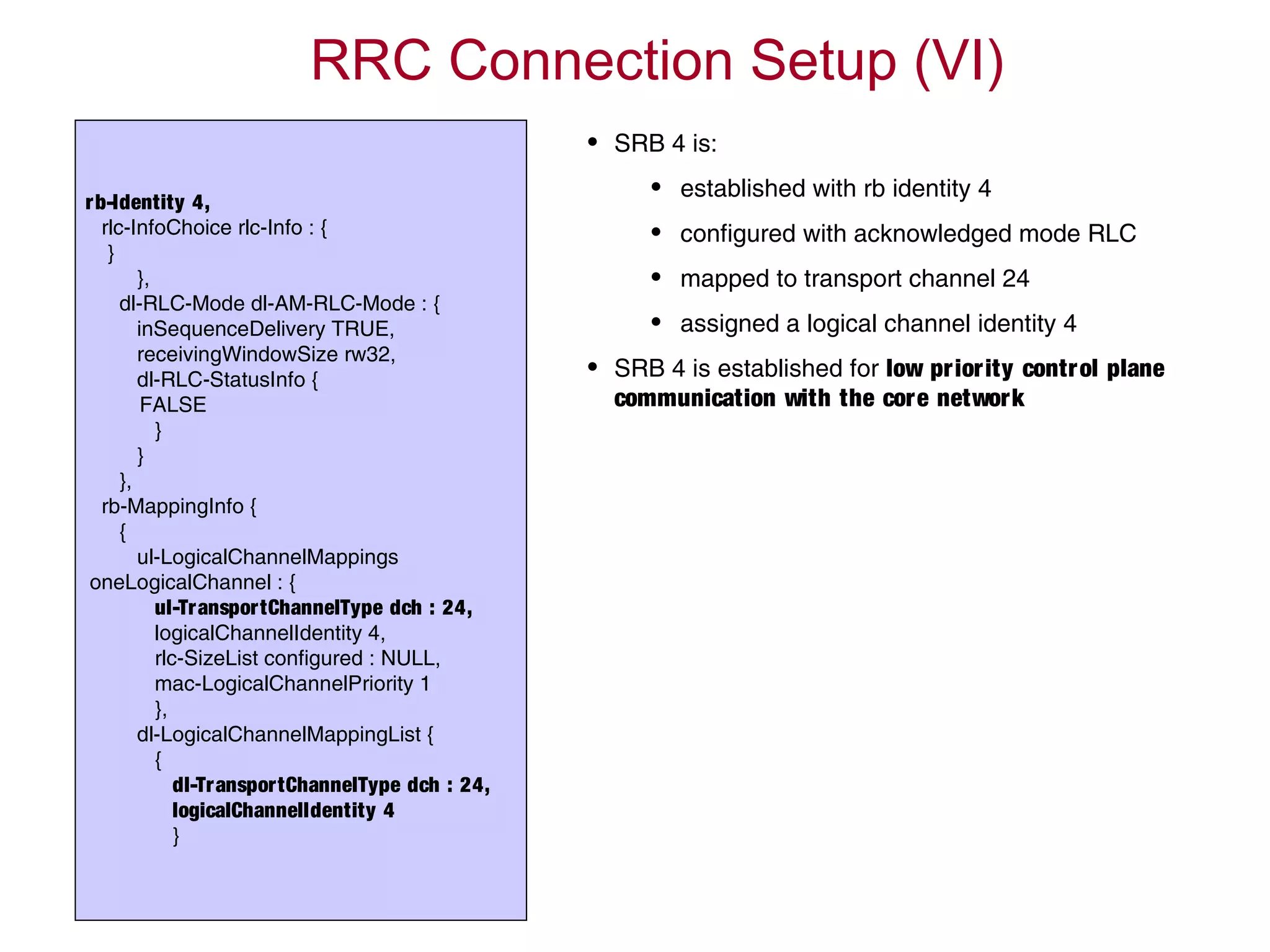
RRC Connection Setup (VI)
rb-Identity 4,
rlc-InfoChoice rlc-Info : {
}
},
dl-RLC-Mode dl-AM-RLC-Mode : {
inSequenceDelivery TRUE,
receivingWindowSize rw32,
dl-RLC-StatusInfo {
FALSE
}
}
},
rb-MappingInfo {
{
ul-LogicalChannelMappings
oneLogicalChannel : {
ul-TransportChannelType dch : 24,
logicalChannelIdentity 4,
rlc-SizeList configured : NULL,
mac-LogicalChannelPriority 1
},
dl-LogicalChannelMappingList {
{
dl-TransportChannelType dch : 24,
logicalChannelIdentity 4
}
• SRB 4 is:
• established with rb identity 4
• configured with acknowledged mode RLC
• mapped to transport channel 24
• assigned a logical channel identity 4
• SRB 4 is established for low priority control plane
communication with the core network
RRC Connection Setup message
UE
RNC
RRC Connection Setup ( )
RRC layer
PHY
MAC
RLC
PDCP BMC
Radio Bearer
LogCH
TrCH
PhyCH
NAS Signalling user plane
PhyCh
configurati
on
TrCH
configurati
on
RB
configurati
on
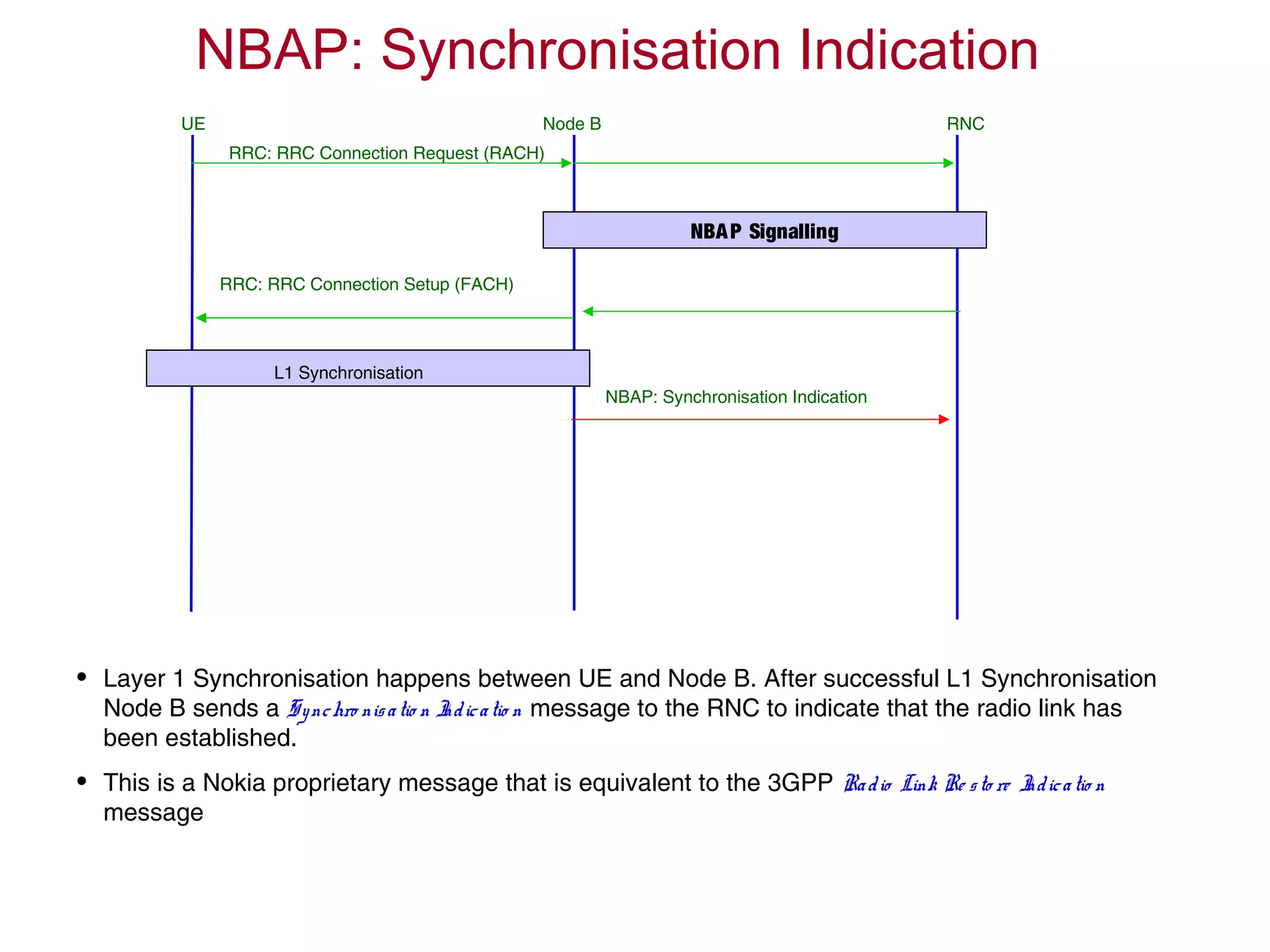
• Layer 1 Synchronisation happens between UE and Node B. After successful L1 Synchronisation
Node B sends a Synchro nisatio n Indicatio n message to the RNC to indicate that the radio link has
been established.
• This is a Nokia proprietary message that is equivalent to the 3GPP Radio Link Re sto re Indicatio n
message
NBAP: Synchronisation Indication
RRC: RRC Connection Request (RACH)
UE RNCNode B
NBAP: Synchronisation Indication
RRC: RRC Connection Setup (FACH)
L1 Synchronisation
NBAP Signalling
RRC: RRC Connection Request (RACH)
UE RNC
Node B
NBAP: Radio Link Setup Request
NBAP: Radio Link Setup Response
ALCAP: Establish Request
RRC Connection Setup Complete
ALCAP: Establish Confirm
FP: Downlink Sync
FP: Uplink Sync
NBAP: Synchronisation Indication
RRC: RRC Connection Setup (FACH)
L1 Synchronisation
RRC: RRC Connection Setup Complete (DCH)
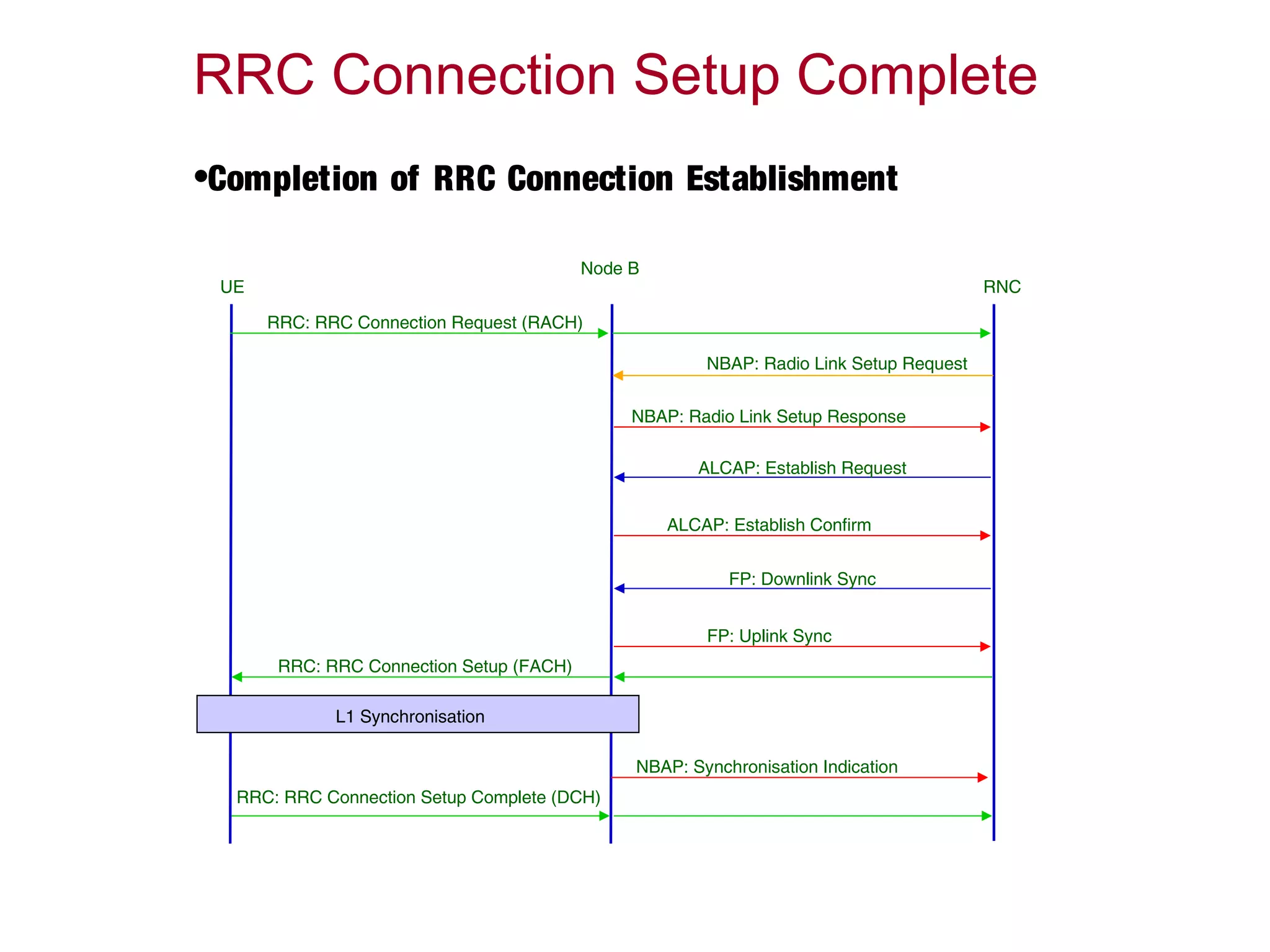
•Completion of RRC Connection Establishment
Location Updating Request
RRC Connection Request (RACH)
RRC Connection Setup (FACH)
RRC Connection Setup Complete (DCH)
Location Updating Request (DCH)
UE RNC MGWNode B
• The UE has now established a dedicated communication link with UTRAN and is in a position to
send a message to the core network (CS core in this case)
• The UE uses an uplink RRC: InitialDire ct Transfe r message to encapsulate and send a Lo catio n Updating
Re que st message to the RNC
• The Node B extracts the RRC: InitialDire ct Transfe r message and encapsulates it within a DCH Frame
Protocol frame
• The RNC extracts the Lo catio n Updating Re que st message and encapsulates it within a RANAP: InitialUE
Me ssag e message prior to forwarding it to the multimedia gateway
• This NAS message is transparent to RNC
• The RANAP: InitialUE Me ssage message is
accompanied with a SCCP: Co nne ctio n Re que st
message which is used to establish the Iu-cs
connection orientated link
SCCP: Connection Request
•Initial UE message : Location Updating Request
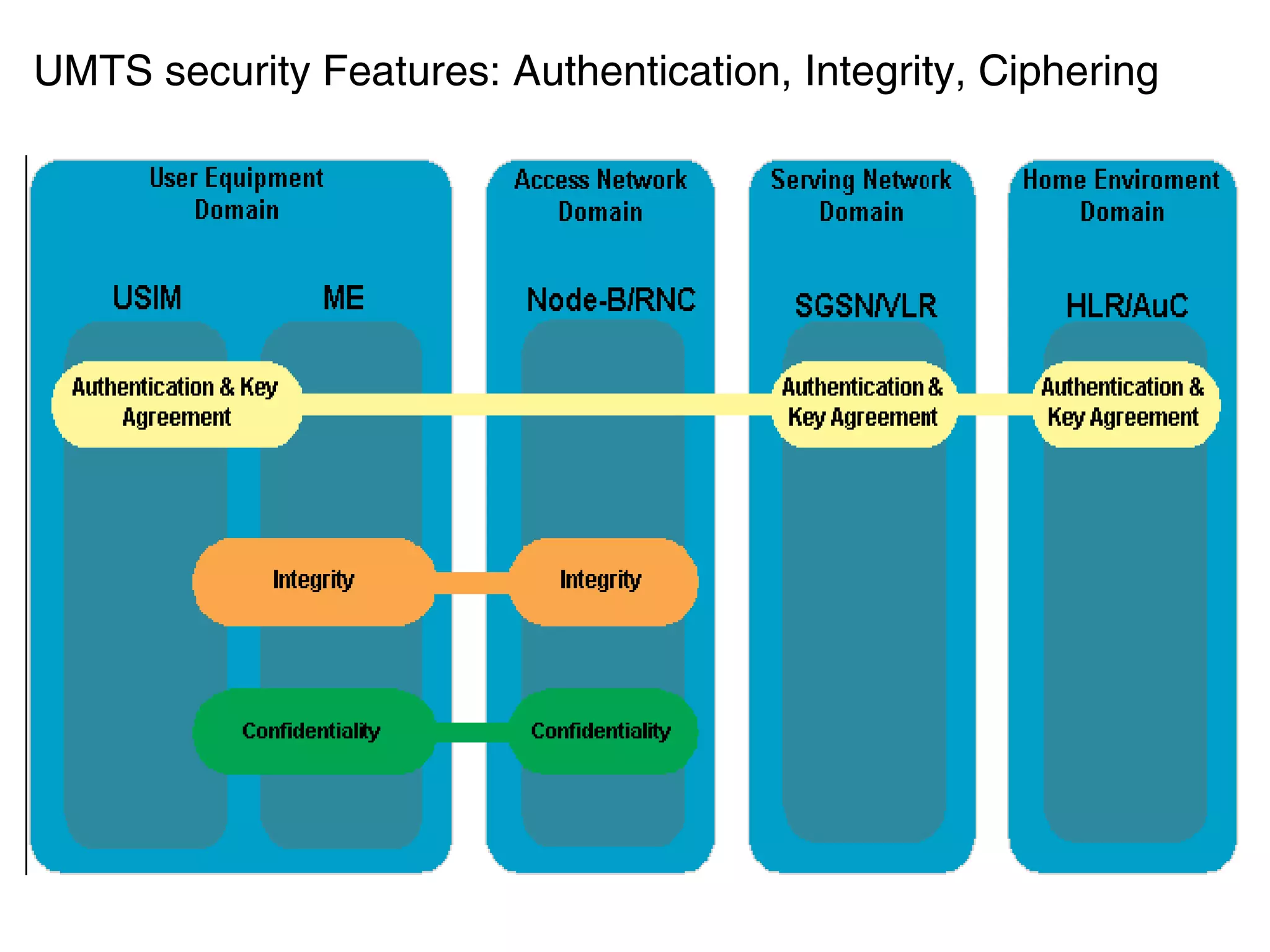
UMTS security Features: Authentication, Integrity, Ciphering
Authentication Request
RRC Connection Request (RACH)
RRC Connection Setup (FACH)
RRC Connection Setup Complete (DCH)
Location Updating Request (DCH)
UE RNC MGWNode B
• Having received the Lo catio n Updating Re que st message the CS core responds with an Authe nticatio n Re que st
message
• The Authe nticatio n Re que st message is sent to the RNC encapsulated within a RANAP Dire ct Transfe r
message
• The RNC extracts the Authe nticatio n Re que st message and encapsulates it within an RRC Do wnlink Dire ct
Transfe r message
• The RNC then encapsulates the RRC Do wnlink Dire ct Transfe r message within a downlink Frame Protocol
data frame prior to forwarding it to the Node B
• The Node B extracts the RRC Do wnlink Dire ct Transfe r message and forwards it to the UE
SCCP: Connection Request
SCCP: Connection Confirm
(DCH)
Authentication Response
RRC Connection Request (RACH)
RRC Connection Setup (FACH)
RRC Connection Setup Complete (DCH)
Location Updating Request (DCH)
UE RNC MGWNode B
Authenication Response (DCH)
• Having received the Authe nicatio n Re que st message the UE responds with an Authe nticatio n Re spo nse
message
• The Authe nticatio n Re spo nse message is sent to the Node B encapsulated within an RRC Uplink Dire ct
Transfe r message
• The Node B encapsulates the RRC Uplink Dire ct Transfe r message within an uplink Frame Protocol data
frame prior to forwarding it to the RNC
• The RNC extracts the Authe nticatio n Re spo nse message and encapsulates it within a RANAP Dire ct Transfe r
message prior to forwarding it to the CS core
Authentication Request
SCCP: Connection Request
SCCP: Connection Confirm
(DCH)
Security Mode Command: Integrity, Ciphering
RRC Connection Request (RACH)
RRC Connection Setup (FACH)
RRC Connection Setup Complete (DCH)
Location Updating Request (DCH)
UE RNC MGWNode B
Authenication Response (DCH)
Security Mode Command
• The CS core sends a Se curity Mo de Co m m and message to the UE
• The purpose of this procedure is to trigger the start ciphering (Optional)
• It is also used to start integrity protection all signalling radio bearers (Mandatory)
Authentication Request
SCCP: Connection Request
SCCP: Connection Confirm
(DCH)
(DCH)
Security Mode Complete
RRC Connection Request (RACH)
RRC Connection Setup (FACH)
RRC Connection Setup Complete (DCH)
Location Updating Request (DCH)
UE RNC MGWNode B
Authenication Response (DCH)
Secuirty Mode Complete (DCH)
• The UE responds to the Se curity Mo de Co m m and message with a Se curity Mo de Co m ple te message
Security Mode Command
Authentication Request
SCCP: Connection Request
SCCP: Connection Confirm
(DCH)
(DCH)
Identity Request
RRC Connection Request (RACH)
RRC Connection Setup (FACH)
RRC Connection Setup Complete (DCH)
Location Updating Request (DCH)
UE RNC MGWNode B
Authenication Response (DCH)
Secuirty Mode Complete (DCH)
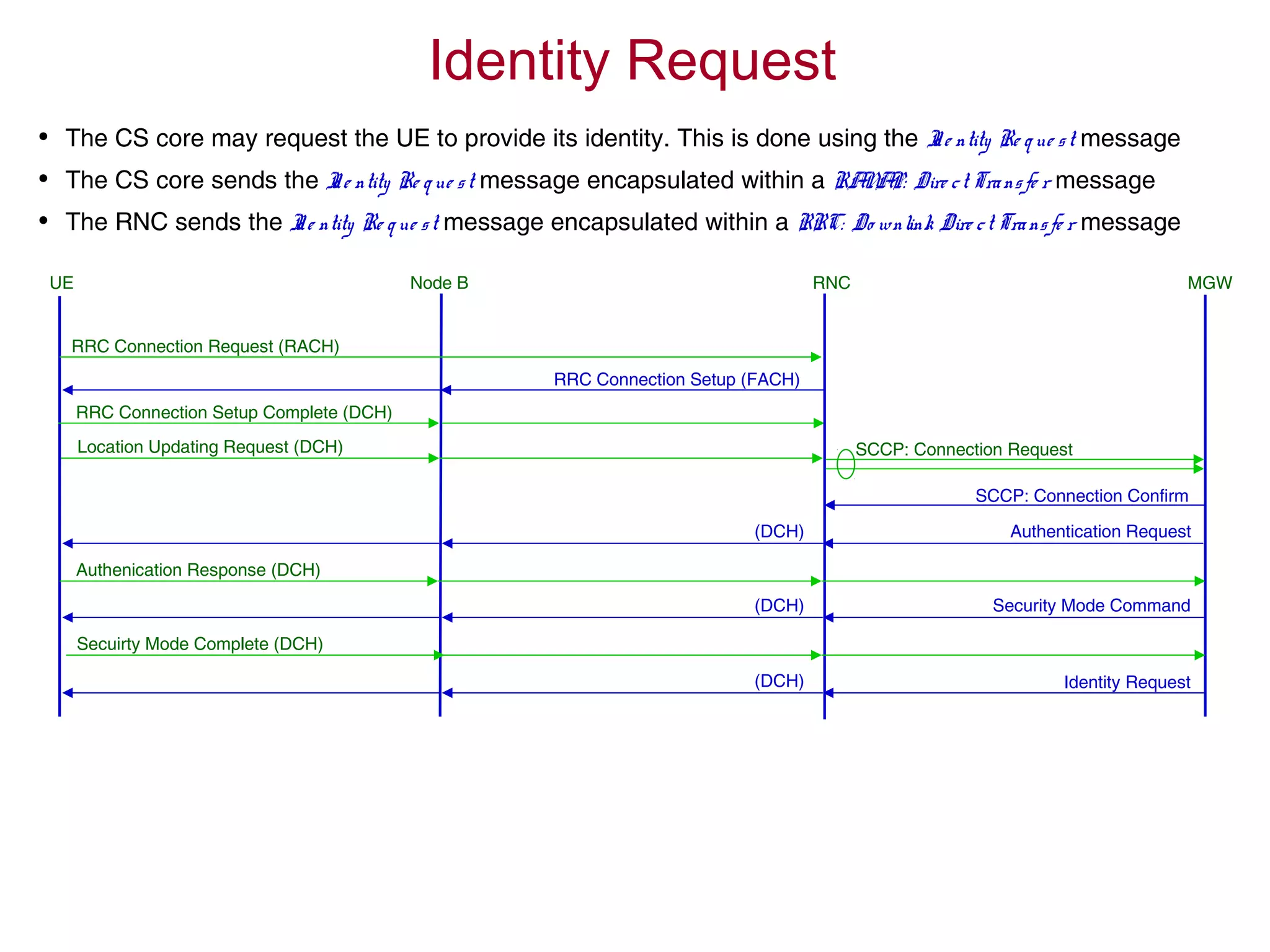
• The CS core may request the UE to provide its identity. This is done using the Ide ntity Re que st message
• The CS core sends the Ide ntity Re que st message encapsulated within a RANAP: Dire ct Transfe r message
• The RNC sends the Ide ntity Re que st message encapsulated within a RRC: Do wnlink Dire ct Transfe r message
Security Mode Command
Authentication Request
SCCP: Connection Request
SCCP: Connection Confirm
(DCH)
(DCH)
Identity Request(DCH)
Identity Response
RRC Connection Request (RACH)
RRC Connection Setup (FACH)
RRC Connection Setup Complete (DCH)
Location Updating Request (DCH)
UE RNC MGWNode B
Authenication Response (DCH)
Secuirty Mode Complete (DCH)
Security Mode Command
Authentication Request
SCCP: Connection Request
SCCP: Connection Confirm
(DCH)
(DCH)
Identity Request(DCH)
Identity Response (DCH)
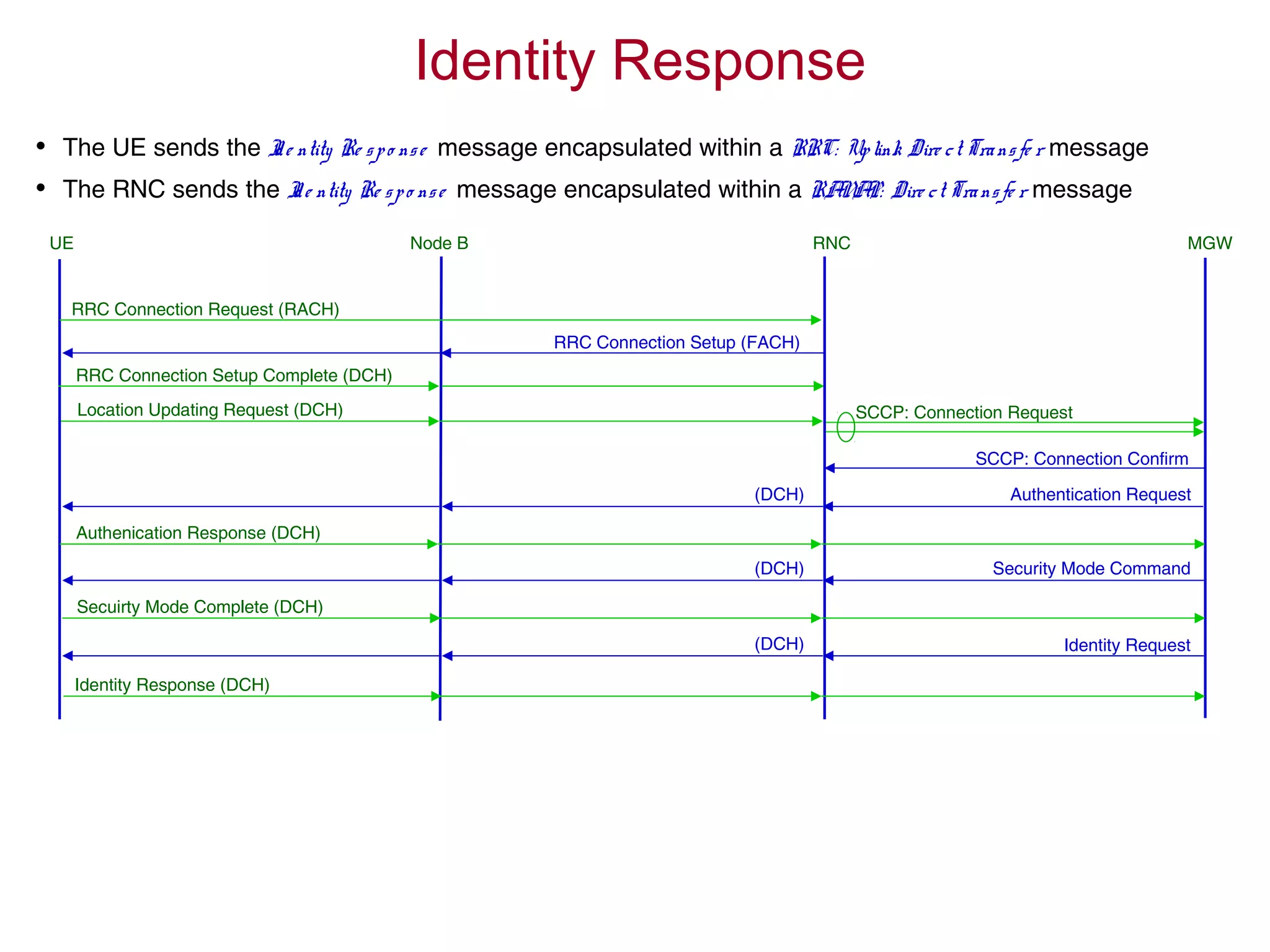
• The UE sends the Ide ntity Re spo nse message encapsulated within a RRC: Uplink Dire ct Transfe r message
• The RNC sends the Ide ntity Re spo nse message encapsulated within a RANAP: Dire ct Transfe r message
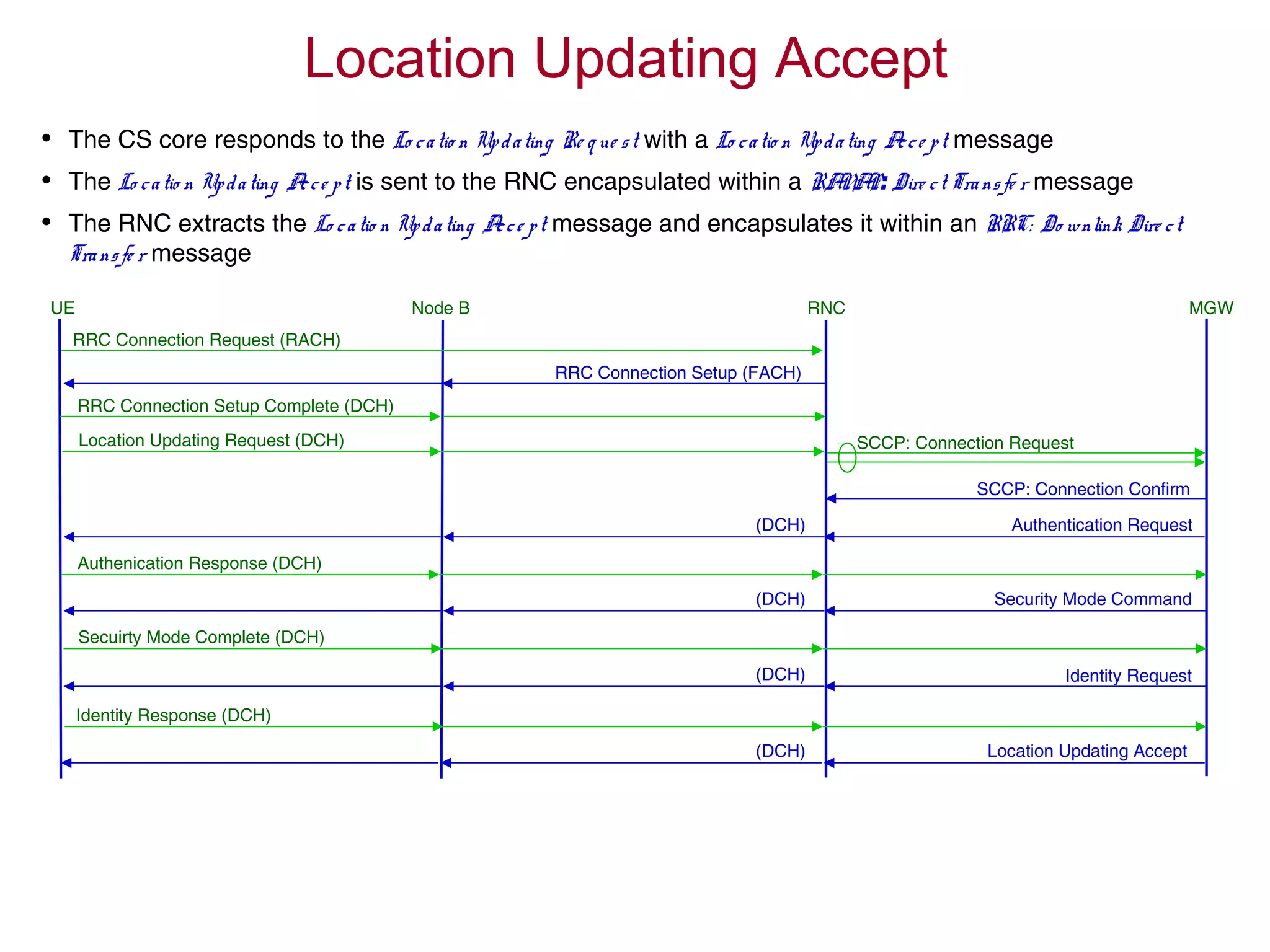
Location Updating Accept
• The CS core responds to the Lo catio n Updating Re que st with a Lo catio n Updating Acce pt message
• The Lo catio n Updating Acce pt is sent to the RNC encapsulated within a RANAP: Dire ct Transfe r message
• The RNC extracts the Lo catio n Updating Acce pt message and encapsulates it within an RRC: Do wnlink Dire ct
Transfe r message
RRC Connection Request (RACH)
RRC Connection Setup (FACH)
RRC Connection Setup Complete (DCH)
Location Updating Request (DCH)
UE RNC MGWNode B
Authenication Response (DCH)
Secuirty Mode Complete (DCH)
Security Mode Command
Authentication Request
SCCP: Connection Request
SCCP: Connection Confirm
(DCH)
(DCH)
Identity Request(DCH)
Identity Response (DCH)
Location Updating Accept(DCH)
Iu Release Command
• Having sent the Lo catio n Updating Acce pt message the CS core initiates the release of the Iu-cs
connection by sending a RANAP: Iu Re le ase Co m m and message to the RNC
RRC Connection Request (RACH)
RRC Connection Setup (FACH)
RRC Connection Setup Complete (DCH)
Location Updating Request (DCH)
UE RNC MGWNode B
Authenication Response (DCH)
Secuirty Mode Complete (DCH)
Security Mode Command
Authentication Request
SCCP: Connection Request
SCCP: Connection Confirm
(DCH)
(DCH)
Identity Request(DCH)
Identity Response (DCH)
Location Updating Accept(DCH)
Iu Release Command
Iu Release Complete
RRC Connection Request (RACH)
RRC Connection Setup (FACH)
RRC Connection Setup Complete (DCH)
Location Updating Request (DCH)
UE RNC MGWNode B
Authenication Response (DCH)
Secuirty Mode Complete (DCH)
Security Mode Command
Authentication Request
SCCP: Connection Request
SCCP: Connection Confirm
(DCH)
(DCH)
Identity Request(DCH)
Identity Response (DCH)
Location Updating Accept(DCH)
Iu Release Command
Iu Release Complete
• The RNC replies to the RANAP: Iu Re le ase Co m m and message with a RANAP: Iu Re le ase Co m ple te
message
Released
• Having released the Iu-cs connection at the RANAP layer, the SCCP layer releases the underlying
connection orientated link
RRC Connection Request (RACH)
RRC Connection Setup (FACH)
RRC Connection Setup Complete (DCH)
Location Updating Request (DCH)
UE RNC MGWNode B
Authenication Response (DCH)
Secuirty Mode Complete (DCH)
Security Mode Command
Authentication Request
SCCP: Connection Request
SCCP: Connection Confirm
(DCH)
(DCH)
Identity Request(DCH)
Identity Response (DCH)
Location Updating Accept(DCH)
Iu Release Command
Iu Release Complete
SCCP: Released
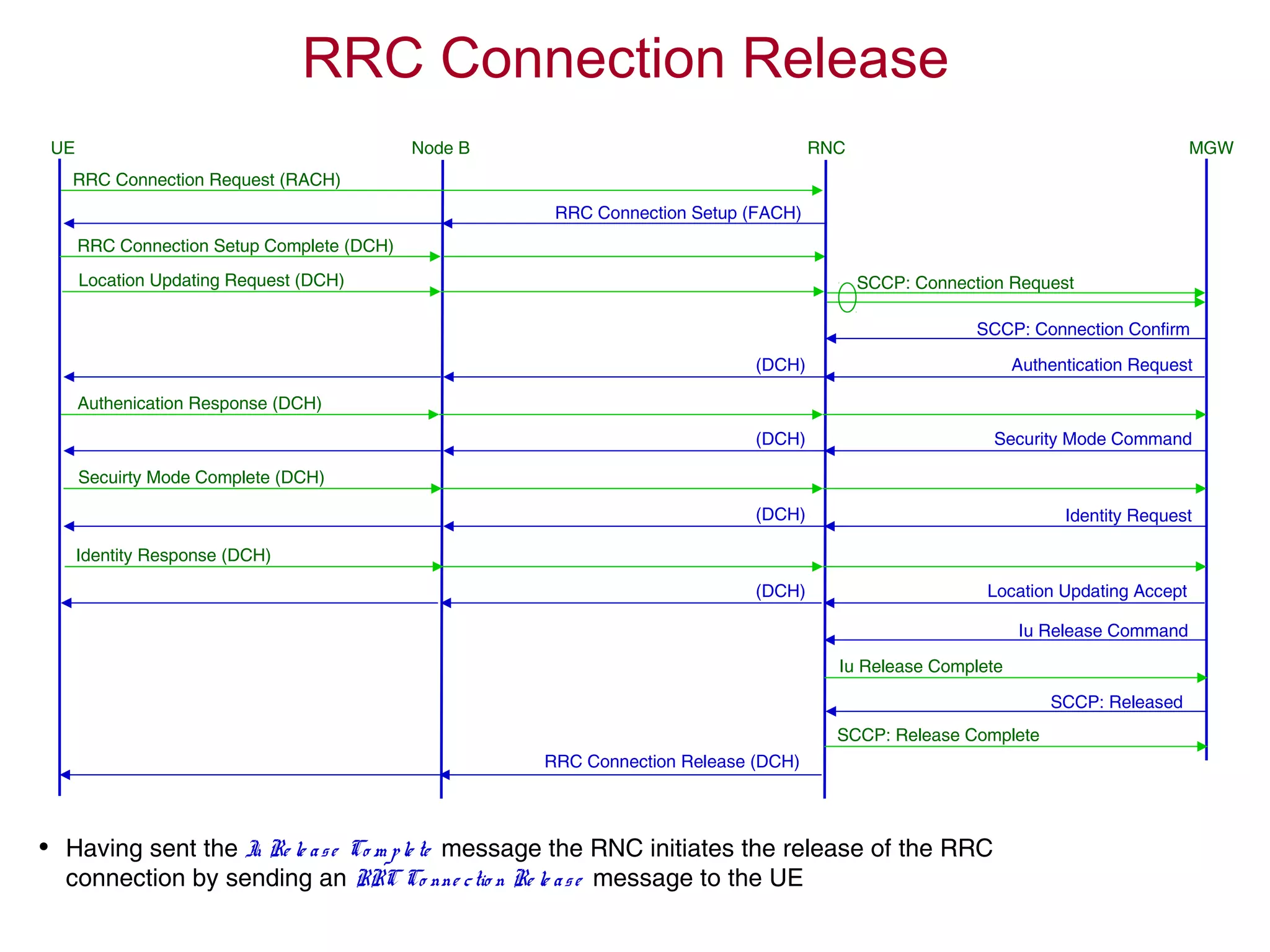
RRC Connection Release
• Having sent the Iu Re le ase Co m ple te message the RNC initiates the release of the RRC
connection by sending an RRC Co nne ctio n Re le ase message to the UE
RRC Connection Request (RACH)
RRC Connection Setup (FACH)
RRC Connection Setup Complete (DCH)
Location Updating Request (DCH)
UE RNC MGWNode B
Authenication Response (DCH)
Secuirty Mode Complete (DCH)
Security Mode Command
Authentication Request
SCCP: Connection Request
SCCP: Connection Confirm
(DCH)
(DCH)
Identity Request(DCH)
Identity Response (DCH)
Location Updating Accept(DCH)
Iu Release Command
Iu Release Complete
SCCP: Released
SCCP: Release Complete
RRC Connection Release (DCH)
RRC Connection Release Complete
RRC Connection Release Complete (DCH)
• The UE responds by sending (n308+1) RRC Co nne ctio n Re le ase Co m ple te messages to the RNC
RRC Connection Request (RACH)
RRC Connection Setup (FACH)
RRC Connection Setup Complete (DCH)
Location Updating Request (DCH)
UE RNC MGWNode B
Authentication Response (DCH)
Secuirty Mode Complete (DCH)
Security Mode Command
Authentication Request
SCCP: Connection Request
SCCP: Connection Confirm
(DCH)
(DCH)
Identity Request(DCH)
Identity Response (DCH)
Location Updating Accept(DCH)
Iu Release Command
Iu Release Complete
SCCP: Released
SCCP: Release Complete
RRC Connection Release (DCH)
Radio Link Deletion Request
NBAP: Radio Link Deletion Request
RRC Connection Release Complete (DCH)
RRC Connection Request (RACH)
RRC Connection Setup (FACH)
RRC Connection Setup Complete (DCH)
Location Updating Request (DCH)
UE RNC MGWNode B
Authenication Response (DCH)
Secuirty Mode Complete (DCH)
Security Mode Command
Authentication Request
SCCP: Connection Request
SCCP: Connection Confirm
(DCH)
(DCH)
Identity Request(DCH)
Identity Response (DCH)
Location Updating Accept(DCH)
Iu Release Command
Iu Release Complete
SCCP: Released
SCCP: Release Complete
RRC Connection Release (DCH)
Radio Link Deletion Response
NBAP: Radio Link Deletion Response
NBAP: Radio Link Deletion Request
RRC Connection Release Complete (DCH)
RRC Connection Request (RACH)
RRC Connection Setup (FACH)
RRC Connection Setup Complete (DCH)
Location Updating Request (DCH)
UE RNC MGWNode B
Authenication Response (DCH)
Secuirty Mode Complete (DCH)
Security Mode Command
Authentication Request
SCCP: Connection Request
SCCP: Connection Confirm
(DCH)
(DCH)
Identity Request(DCH)
Identity Response (DCH)
Location Updating Accept(DCH)
Iu Release Command
Iu Release Complete
SCCP: Released
SCCP: Release Complete
RRC Connection Release (DCH)
Summary of IMSI Attach
ALCAP: Release Confirm
ALCAP: Release Request
NBAP: Radio Link Deletion Response
NBAP: Radio Link Deletion Request
RRC Connection Release Complete (DCH)
RRC Connection Setup Complete (DCH)
Location Updating Request (DCH)
UE RNC
MGW
Node B
Authenication Response (DCH)
Secuirty Mode Complete (DCH)
Security Mode Command
Authentication Request
SCCP: Connection Request
SCCP: Connection Confirm
(DCH)
(DCH)
Identity Request(DCH)
Identity Response (DCH)
Location Updating Accept(DCH)
Iu Release Command
Iu Release Complete
SCCP: Released
SCCP: Release Complete
RRC Connection Release (DCH)
FP: Downlink Sync
FP: Uplink Sync
NBAP: Synchronisation Indication
RRC: RRC Connection Setup (FACH)
L1 Synchronisation
NBAP: Radio Link Setup Request
NBAP: Radio Link Setup Response
ALCAP: Establish Request
ALCAP: Establish Confirm
AMR Speech Call
UE is powered up
Read BCCH
Cell selection
Register with
core network
AMR speech call
Handovers
Release of AMR
speech call
Radio frame
synchronisation
Cell search
Cell re-selections
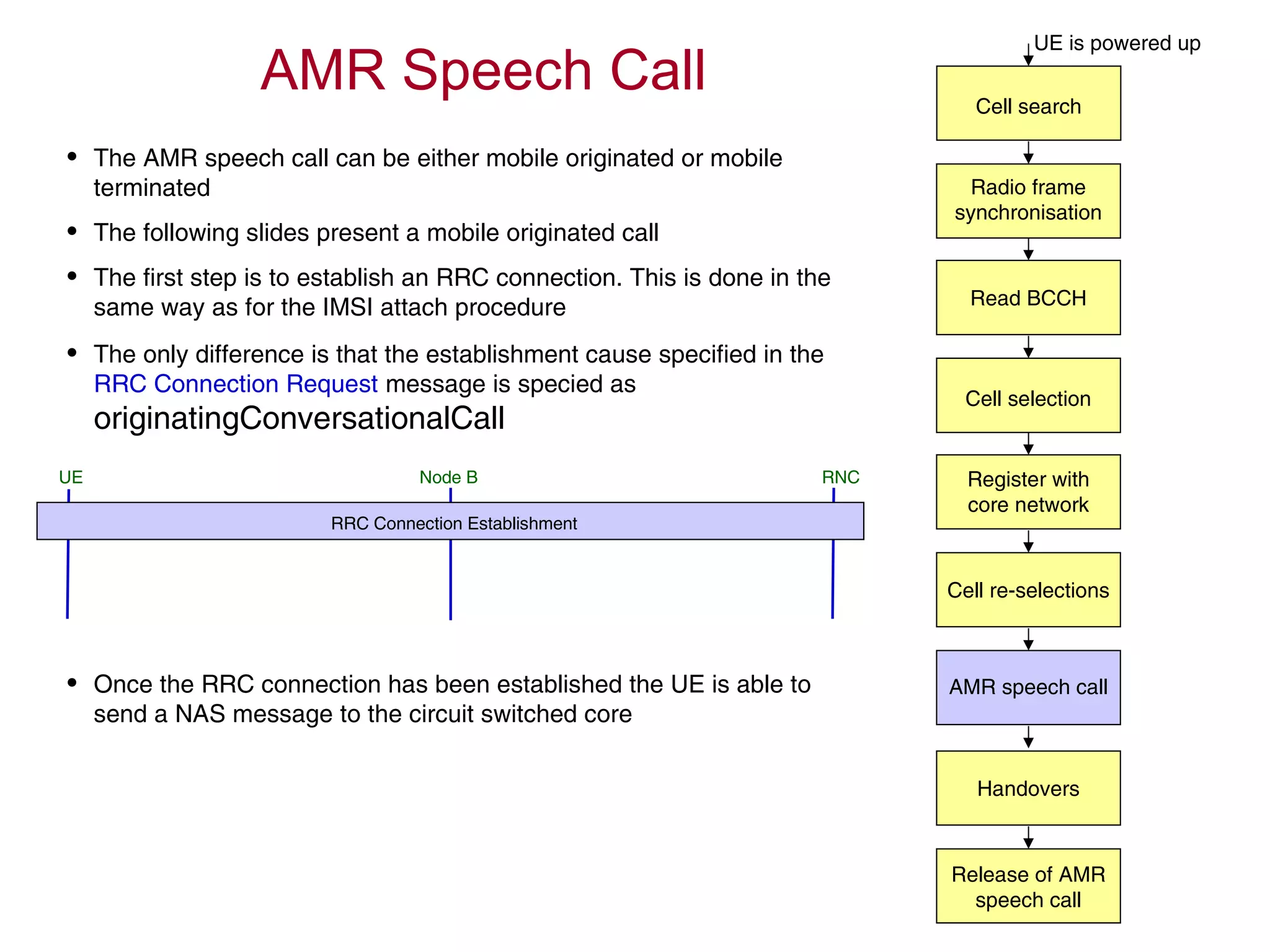
• The AMR speech call can be either mobile originated or mobile
terminated
• The following slides present a mobile originated call
• The first step is to establish an RRC connection. This is done in the
same way as for the IMSI attach procedure
• The only difference is that the establishment cause specified in the
RRC Connection Request message is specied as
originatingConversationalCall
UE RNCNode B
RRC Connection Establishment
• Once the RRC connection has been established the UE is able to
send a NAS message to the circuit switched core
CM Service Request
UE RNC MGWNode B
RRC Connection Establishment
Initial Direct Transfer (CM Service Request)
• By sending this message UE requests a service for
the circuit switched connection establishment
• DCCH ->DCH -> DPCH
• DCCH contains the RRC: InitialDire ct Transfe r message
• Message is sent using acknowledged mode RLC
• The message is sent to the CS core domain
• The NAS message is not read by the RNC but is forwarded to the multimedia gateway
SCCP: Connection Request
Security Mode Command
Common ID
UE RNC MGWNode B
RRC Connection Establishment
Initial Direct Transfer (CM Service Request) SCCP: Connection Request
SCCP: Connection Confirm
Location Reporting Control
• The CS core sends a Se curity Mo de Co m m and message to the UE
• The purpose of this procedure is to trigger the start or stop of ciphering or to command the restart of
the ciphering with a new ciphering configuration, for the radio bearers of one core network domain
and for all signalling bearers
• It is also used to start integrity protection or to modify the integrity protection configuration for all
signalling radio bearers
Security Mode Complete
Security Mode Command
Common ID
UE RNC MGWNode B
RRC Connection Establishment
Initial Direct Transfer (CM Service Request) SCCP: Connection Request
SCCP: Connection Confirm
Location Reporting Control
• The UE responds to the Se curity Mo de Co m m and message with a Se curity Mo de Co m ple te message
CM Service Accept
• The CMSe rvice Acce pt message is only sent if the security mode procedure is not used
• If the security mode procedure is used then completion of that procedure is used as an
alternative indication of CM service acceptance.
• Extract from 24.008:
• In UMTS, an indication from the RR sublayer that the security mode control procedure is completed, or
reception of a CM SERVICE ACCEPT message, shall be treated as a service acceptance indication by
the mobile station
• The CMSe rvice Acce pt message serves only as an acknowledgement and contains no additional
information
CM Service Accept
Security Mode Complete
Security Mode Command
Common ID
UE RNC MGWNode B
RRC Connection Establishment
Initial Direct Transfer (CM Service Request) SCCP: Connection Request
SCCP: Connection Confirm
Location Reporting Control
OR
Setup
Setup
Security Mode Complete
Security Mode Command
Common ID
UE RNC MGWNode B
RRC Connection Establishment
Initial Direct Transfer (CM Service Request) SCCP: Connection Request
SCCP: Connection Confirm
Location Reporting Control
• The UE then sends a NAS Se tup message to the CS core using an RRC: Uplink Dire ct Transfe r message
• The NAS message is included and directed towards the CS core domain
• The NAS message includes the number being dialled by the UE
Call Proceeding
Call Proceeding
Setup
Security Mode Complete
Security Mode Command
Common ID
UE RNC MGWNode B
RRC Connection Establishment
Initial Direct Transfer (CM Service Request) SCCP: Connection Request
SCCP: Connection Confirm
Location Reporting Control
• Having received the NAS Se tup message the CS core sends the NAS CallPro ce e ding message
• This message indicates to UE that Call Setup Procedure is started at the NW side
RAB Assignment Request
Facility
Call Proceeding
Setup
Security Mode Complete
Security Mode Command
Common ID
UE RNC MGWNode B
RRC Connection Establishment
Initial Direct Transfer (CM Service Request) SCCP: Connection Request
SCCP: Connection Confirm
Location Reporting Control
• CS core sends the RANAP: RABAssig nm e nt Re sue st message to the RNC
• The RANAP: RABAssig nm e nt Re sue st message requests the RNC to establish a RAB with a
specified set of QoS parameters
• The CS core requests these QoS parameters based upon the UE subscription and the service
being requested
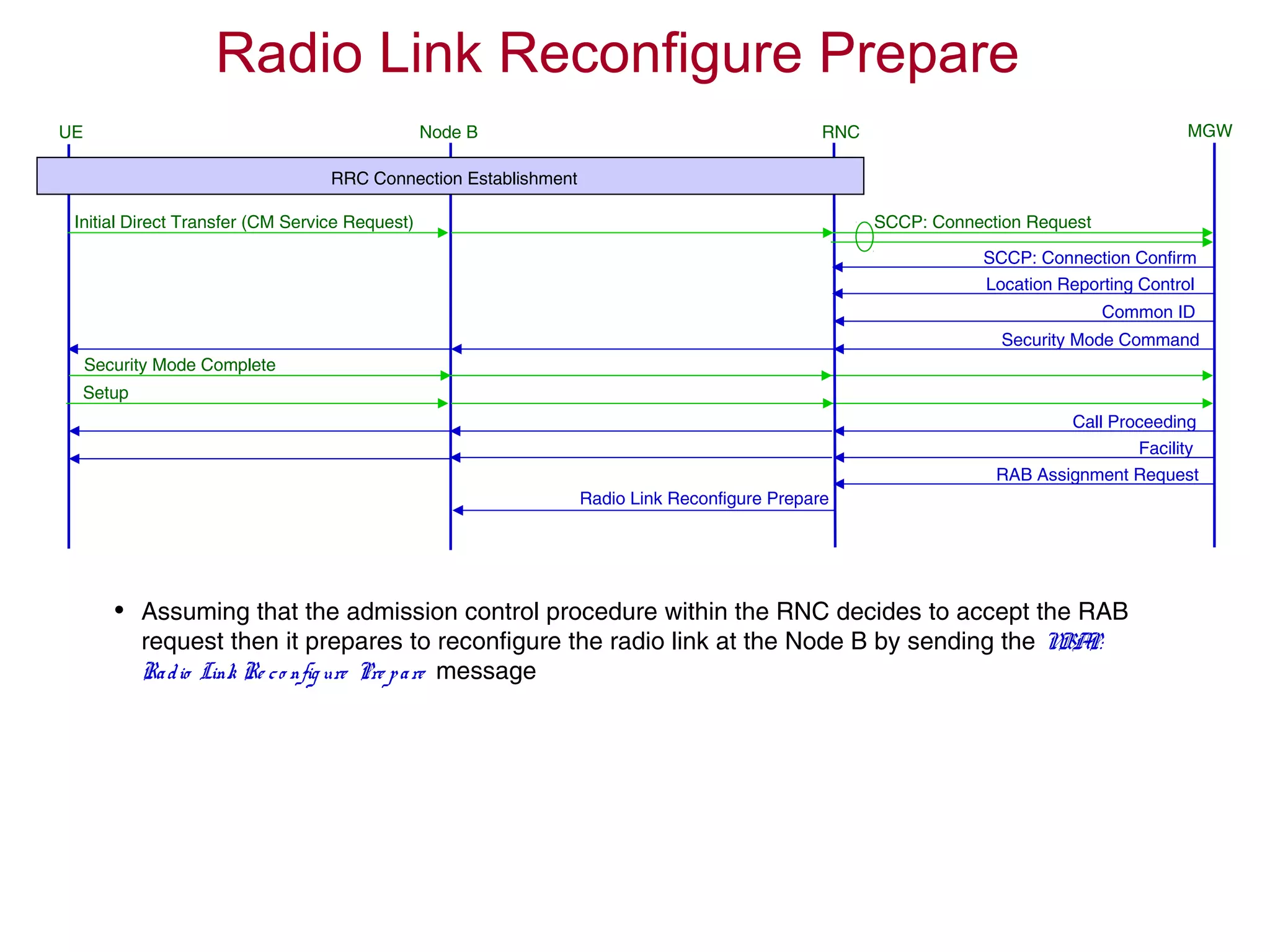
Radio Link Reconfigure Prepare
RAB Assignment Request
Facility
Call Proceeding
Setup
Security Mode Complete
Security Mode Command
Common ID
UE RNC MGWNode B
RRC Connection Establishment
Initial Direct Transfer (CM Service Request) SCCP: Connection Request
SCCP: Connection Confirm
Location Reporting Control
• Assuming that the admission control procedure within the RNC decides to accept the RAB
request then it prepares to reconfigure the radio link at the Node B by sending the NBAP:
Radio Link Re co nfig ure Pre pare message
Radio Link Reconfigure Prepare
Radio Link Reconfigure Ready
RAB Assignment Request
Facility
Call Proceeding
Setup
Security Mode Complete
Security Mode Command
Common ID
UE RNC MGWNode B
RRC Connection Establishment
Initial Direct Transfer (CM Service Request) SCCP: Connection Request
SCCP: Connection Confirm
Location Reporting Control
Radio Link Reconfigure Prepare
Radio Link Reconfigure Ready
• The Node B responds to the NBAP: Radio Link Re co nfig ure Pre pare message with a NBAP: Radio
Link Re co nfig ure Re ady message
Radio Link Reconfiguration Commit
• Once the transmission resouce allocations have been configured the RNC sends a
NBAP: Radio Link Re co nfiguratio n Co m m it message to the Node B
Radio Link Reconfiguration Commit
AAL2SIG:ERQ
RAB Assignment Request
Facility
Call Proceeding
Setup
Security Mode Complete
Security Mode Command
Common ID
UE RNC MGWNode B
RRC Connection Establishment
Initial Direct Transfer (CM Service Request) SCCP: Connection Request
SCCP: Connection Confirm
Location Reporting Control
Radio Link Reconfigure Prepare
Radio Link Reconfigure Ready
AAL2SIG:ERQ
AAL2SIG:ECF
FP: Downlink Sync
FP: Uplink Sync
AAL2SIG:ECF
Radio Bearer Setup
• Once the NBAP: Radio Link Re co nfiguratio n Co m m it message has been sent to the Node B
the RNC sends a RRC: Radio Be are r Se tup message to the UE
Radio Link Reconfiguration Commit
AAL2SIG:ERQ
RAB Assignment Request
Facility
Call Proceeding
Setup
Security Mode Complete
Security Mode Command
Common ID
UE RNC MGWNode B
RRC Connection Establishment
Initial Direct Transfer (CM Service Request) SCCP: Connection Request
SCCP: Connection Confirm
Location Reporting Control
Radio Link Reconfigure Prepare
Radio Link Reconfigure Ready
AAL2SIG:ERQ
AAL2SIG:ECF
FP: Downlink Sync
FP: Uplink Sync
AAL2SIG:ECF
Radio Bearer Setup
Radio Bearer Setup (II)
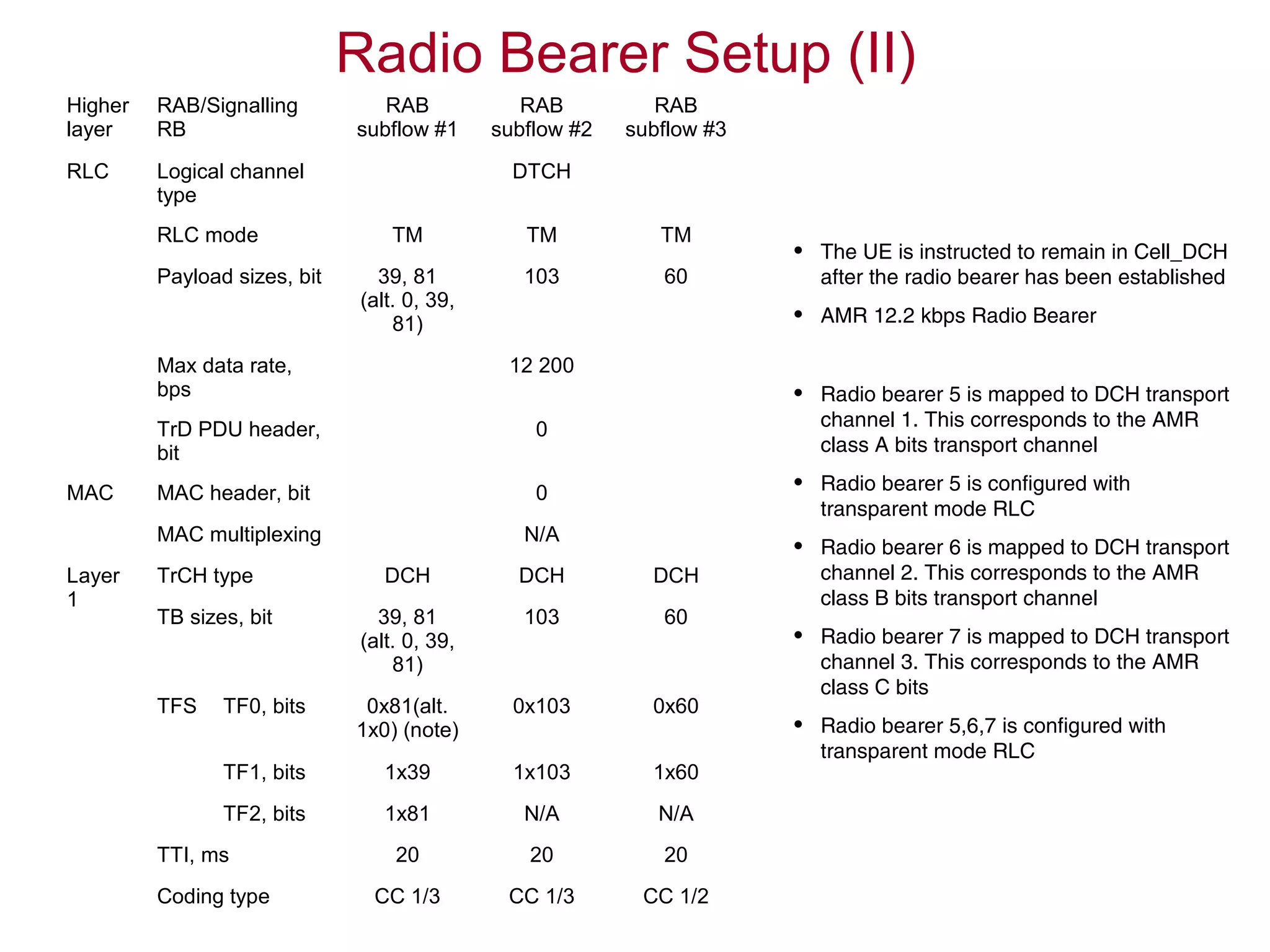
• The UE is instructed to remain in Cell_DCH
after the radio bearer has been established
• AMR 12.2 kbps Radio Bearer
• Radio bearer 5 is mapped to DCH transport
channel 1. This corresponds to the AMR
class A bits transport channel
• Radio bearer 5 is configured with
transparent mode RLC
• Radio bearer 6 is mapped to DCH transport
channel 2. This corresponds to the AMR
class B bits transport channel
• Radio bearer 7 is mapped to DCH transport
channel 3. This corresponds to the AMR
class C bits
• Radio bearer 5,6,7 is configured with
transparent mode RLC
Higher
layer
RAB/Signalling
RB
RAB
subflow #1
RAB
subflow #2
RAB
subflow #3
RLC Logical channel
type
DTCH
RLC mode TM TM TM
Payload sizes, bit 39, 81
(alt. 0, 39,
81)
103 60
Max data rate,
bps
12 200
TrD PDU header,
bit
0
MAC MAC header, bit 0
MAC multiplexing N/A
Layer
1
TrCH type DCH DCH DCH
TB sizes, bit 39, 81
(alt. 0, 39,
81)
103 60
TFS TF0, bits 0x81(alt.
1x0) (note)
0x103 0x60
TF1, bits 1x39 1x10³ 1x60
TF2, bits 1x81 N/A N/A
TTI, ms 20 20 20
Coding type CC 1/3 CC 1/3 CC 1/2
Radio Bearer Setup Complete
• The UE acknowledges the RRC: Radio Be are r Se tup message with a RRC: Radio Be are r
Se tup Co m ple te message
Radio Link Reconfiguration Commit
AAL2SIG:ERQ
RAB Assignment Request
Facility
Call Proceeding
Setup
Security Mode Complete
Security Mode Command
Common ID
UE RNC MGWNode B
RRC Connection Establishment
Initial Direct Transfer (CM Service Request) SCCP: Connection Request
SCCP: Connection Confirm
Location Reporting Control
Radio Link Reconfigure Prepare
Radio Link Reconfigure Ready
AAL2SIG:ERQ
AAL2SIG:ECF
FP: Downlink Sync
FP: Uplink Sync
AAL2SIG:ECF
Radio Bearer Setup
Radio Bearer Setup Complete
RAB Assignment Response
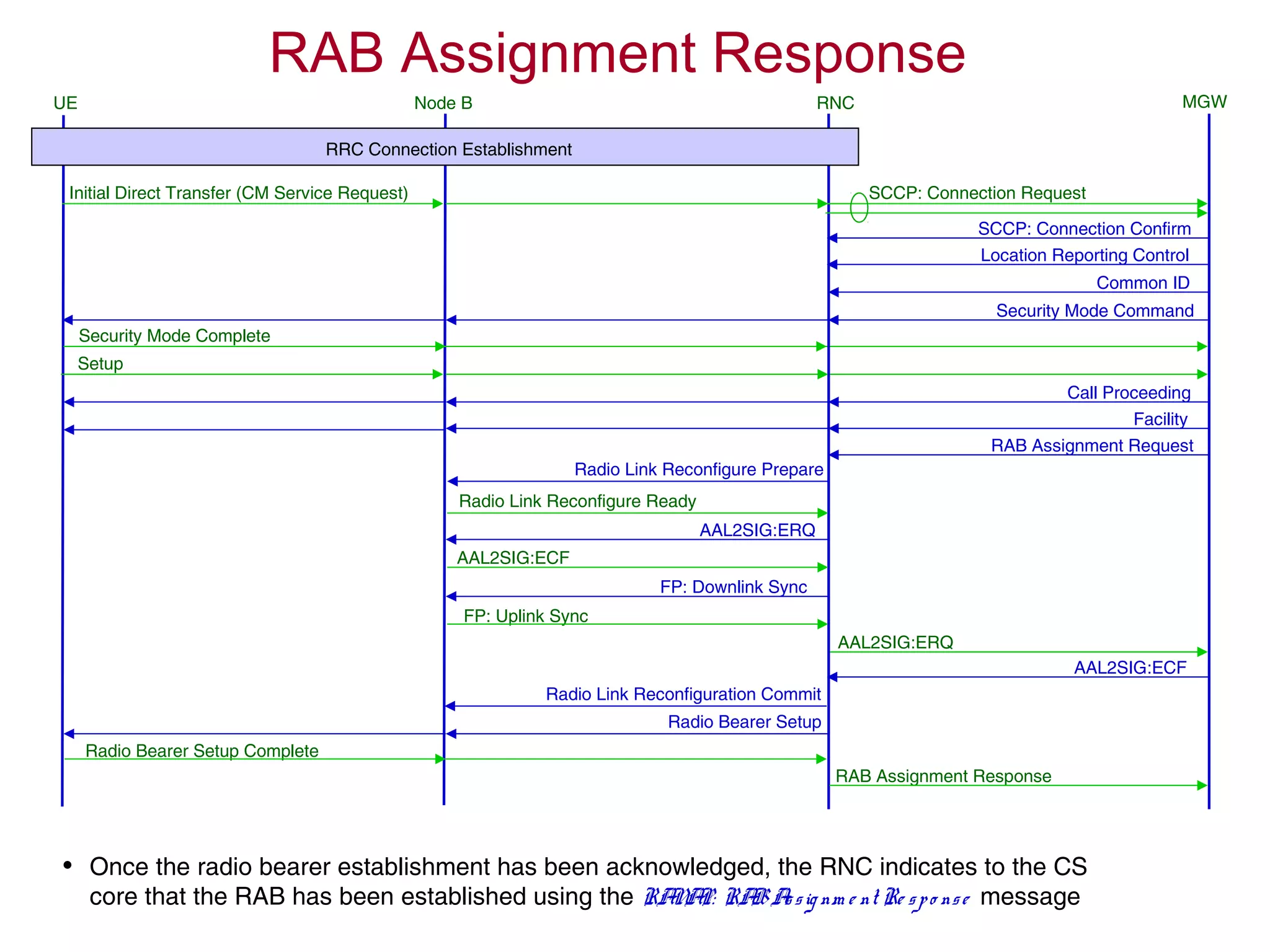
• Once the radio bearer establishment has been acknowledged, the RNC indicates to the CS
core that the RAB has been established using the RANAP: RABAssignm e nt Re spo nse message
Radio Link Reconfiguration Commit
AAL2SIG:ERQ
RAB Assignment Request
Facility
Call Proceeding
Setup
Security Mode Complete
Security Mode Command
Common ID
UE RNC MGWNode B
RRC Connection Establishment
Initial Direct Transfer (CM Service Request) SCCP: Connection Request
SCCP: Connection Confirm
Location Reporting Control
Radio Link Reconfigure Prepare
Radio Link Reconfigure Ready
AAL2SIG:ERQ
AAL2SIG:ECF
FP: Downlink Sync
FP: Uplink Sync
AAL2SIG:ECF
Radio Bearer Setup
Radio Bearer Setup Complete
RAB Assignment Response
Alerting
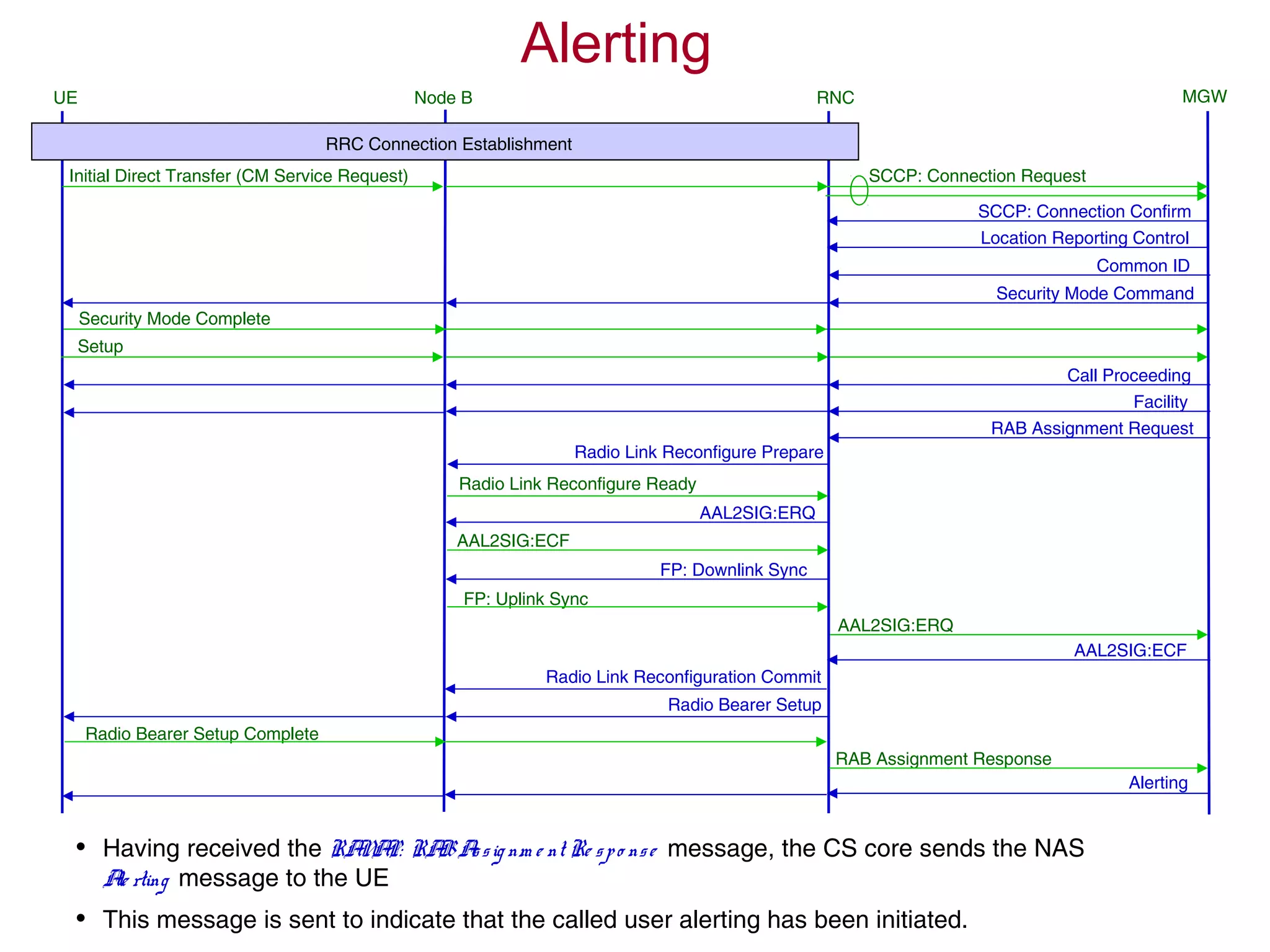
• Having received the RANAP: RABAssignm e nt Re spo nse message, the CS core sends the NAS
Ale rting message to the UE
• This message is sent to indicate that the called user alerting has been initiated.
Radio Link Reconfiguration Commit
AAL2SIG:ERQ
RAB Assignment Request
Facility
Call Proceeding
Setup
Security Mode Complete
Security Mode Command
Common ID
UE RNC MGWNode B
RRC Connection Establishment
Initial Direct Transfer (CM Service Request) SCCP: Connection Request
SCCP: Connection Confirm
Location Reporting Control
Radio Link Reconfigure Prepare
Radio Link Reconfigure Ready
AAL2SIG:ERQ
AAL2SIG:ECF
FP: Downlink Sync
FP: Uplink Sync
AAL2SIG:ECF
Radio Bearer Setup
Radio Bearer Setup Complete
RAB Assignment Response
Alerting
Connect
• Having received the RANAP: RABAssignm e nt Re spo nse message, the CS core sends the NAS
Ale rting message to the UE
• This message is sent to indicate call acceptance by the called user
Radio Link Reconfiguration Commit
AAL2SIG:ERQ
RAB Assignment Request
Facility
Call Proceeding
Setup
Security Mode Complete
Security Mode Command
Common ID
UE RNC MGWNode B
RRC Connection Establishment
Initial Direct Transfer (CM Service Request) SCCP: Connection Request
SCCP: Connection Confirm
Location Reporting Control
Radio Link Reconfigure Prepare
Radio Link Reconfigure Ready
AAL2SIG:ERQ
AAL2SIG:ECF
FP: Downlink Sync
FP: Uplink Sync
AAL2SIG:ECF
Radio Bearer Setup
Radio Bearer Setup Complete
RAB Assignment Response
Alerting
Connect
Connect Acknowledge
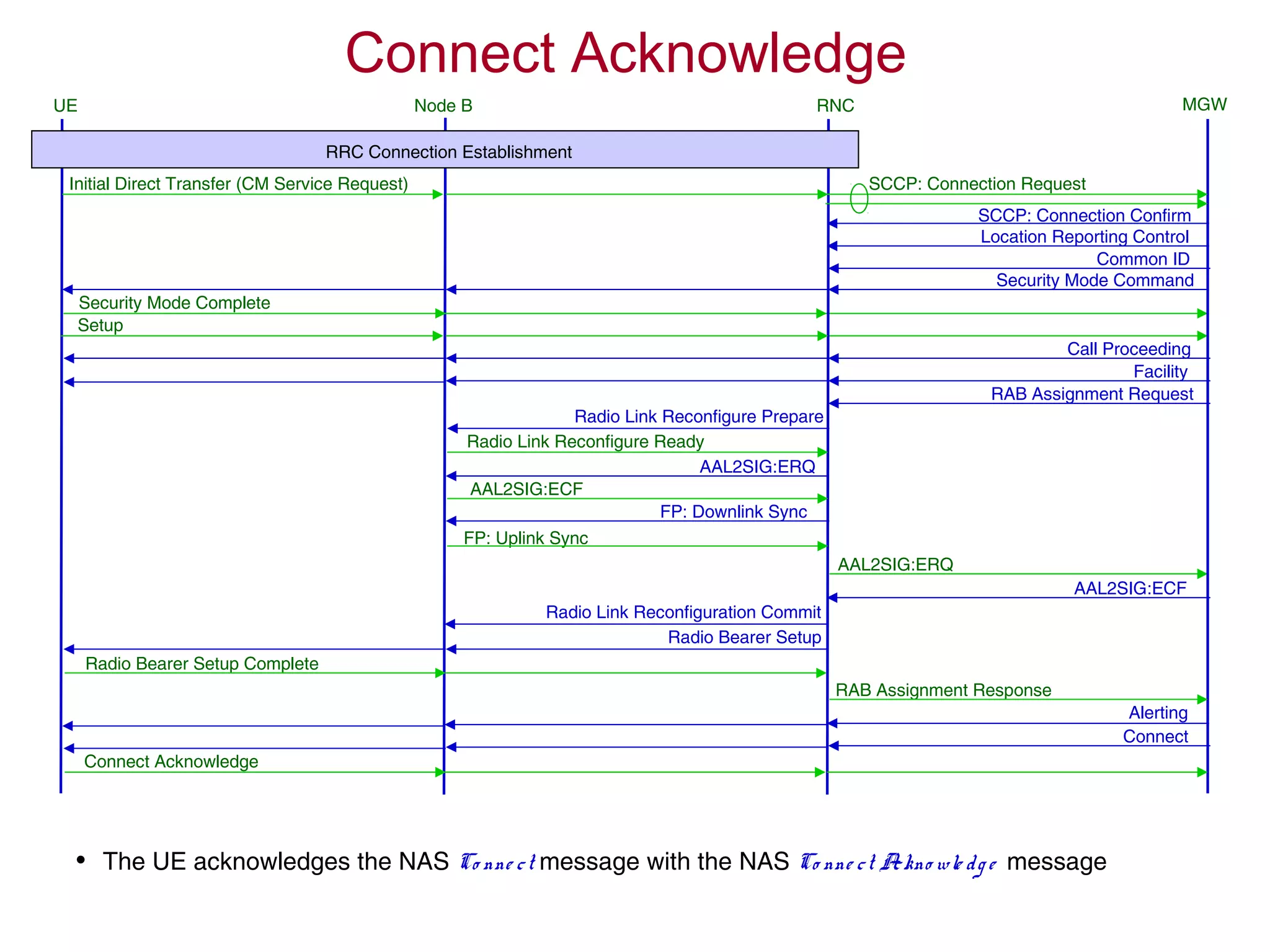
• The UE acknowledges the NAS Co nne ct message with the NAS Co nne ct Ackno wle dge message
Radio Link Reconfiguration Commit
AAL2SIG:ERQ
RAB Assignment Request
Facility
Call Proceeding
Setup
Security Mode Complete
Security Mode Command
Common ID
UE RNC MGWNode B
RRC Connection Establishment
Initial Direct Transfer (CM Service Request) SCCP: Connection Request
SCCP: Connection Confirm
Location Reporting Control
Radio Link Reconfigure Prepare
Radio Link Reconfigure Ready
AAL2SIG:ERQ
AAL2SIG:ECF
FP: Downlink Sync
FP: Uplink Sync
AAL2SIG:ECF
Radio Bearer Setup
Radio Bearer Setup Complete
RAB Assignment Response
Alerting
Connect
Connect Acknowledge
Call Established
Radio Link Reconfiguration Commit
AAL2SIG:ERQ
RAB Assignment Request
Facility
Call Proceeding
Setup
Security Mode Complete
Security Mode Command
Common ID
UE RNC MGWNode B
RRC Connection Establishment
Initial Direct Transfer (CM Service Request) SCCP: Connection Request
SCCP: Connection Confirm
Location Reporting Control
Radio Link Reconfigure Prepare
Radio Link Reconfigure Ready
AAL2SIG:ERQ
AAL2SIG:ECF
FP: Downlink Sync
FP: Uplink Sync
AAL2SIG:ECF
Radio Bearer Setup
Radio Bearer Setup Complete
RAB Assignment Response
Alerting
Connect
Connect Acknowledge
Call Established
• The call is established at this point
Release of AMR Speech Call
UE is powered up
Read BCCH
Cell selection
Register with
core network
AMR speech call
Release of AMR
speech call
Radio frame
synchronisation
Cell search
• The call is released in a controlled manner when either the
originating or terminating terminal hangs-up
• The RRC connection is released and the UE returns to RRC Idle
mode
Uplink Disconnect
UE RNC MGWNode B
Call Established
Direct Transfer (Disconnect)
• In this example the UE initiates the call
release by sending the Disco nne ct
message to the CS core
Downlink Release (I)
UE RNC MGWNode B
Call Established
Direct Transfer (Disconnect)
Direct Transfer (Release)
• The network acknowledges the
Disco nne ct message with a Re le ase
message
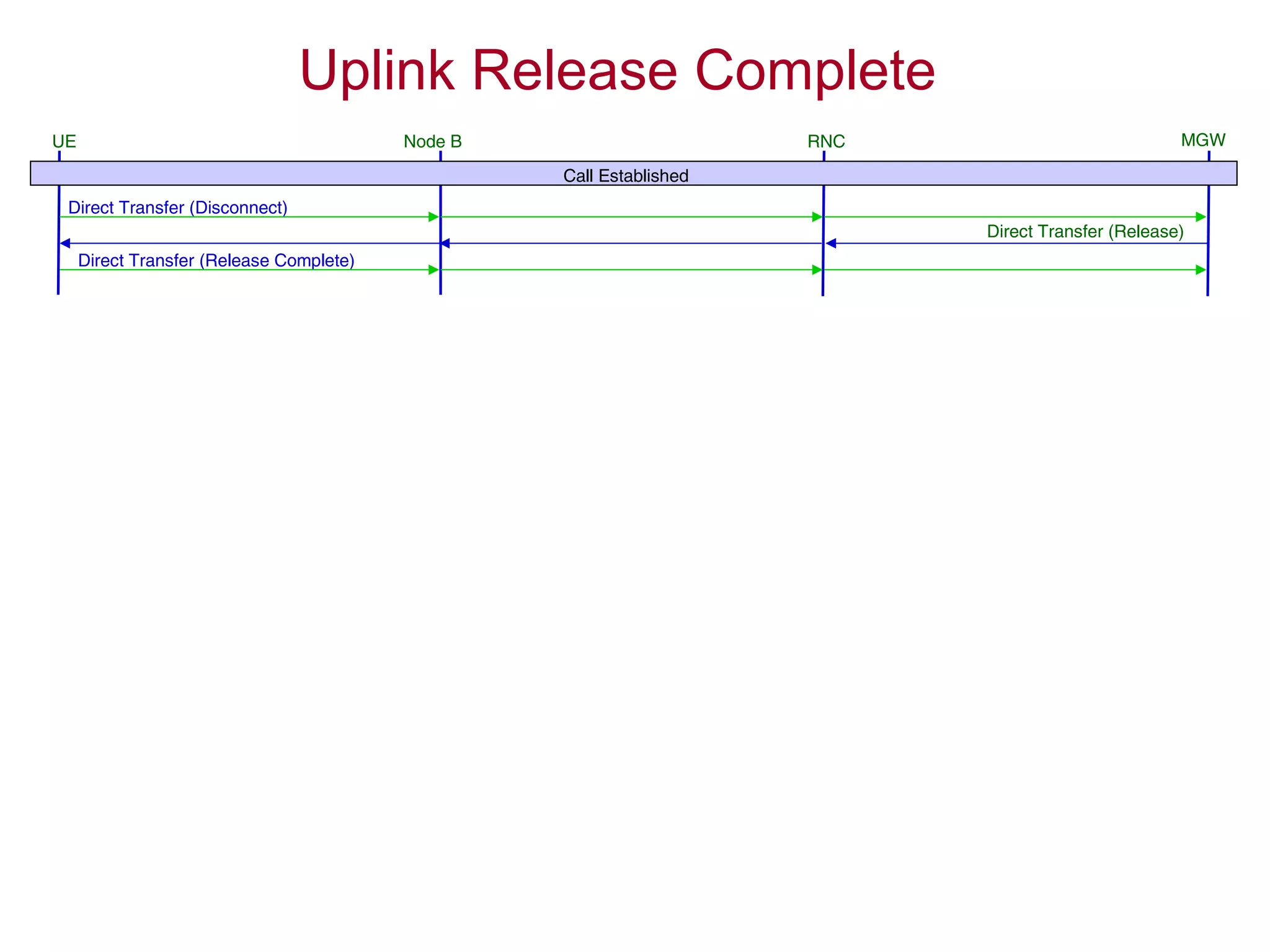
Uplink Release Complete
UE RNC MGWNode B
Call Established
Direct Transfer (Disconnect)
Direct Transfer (Release)
Direct Transfer (Release Complete)
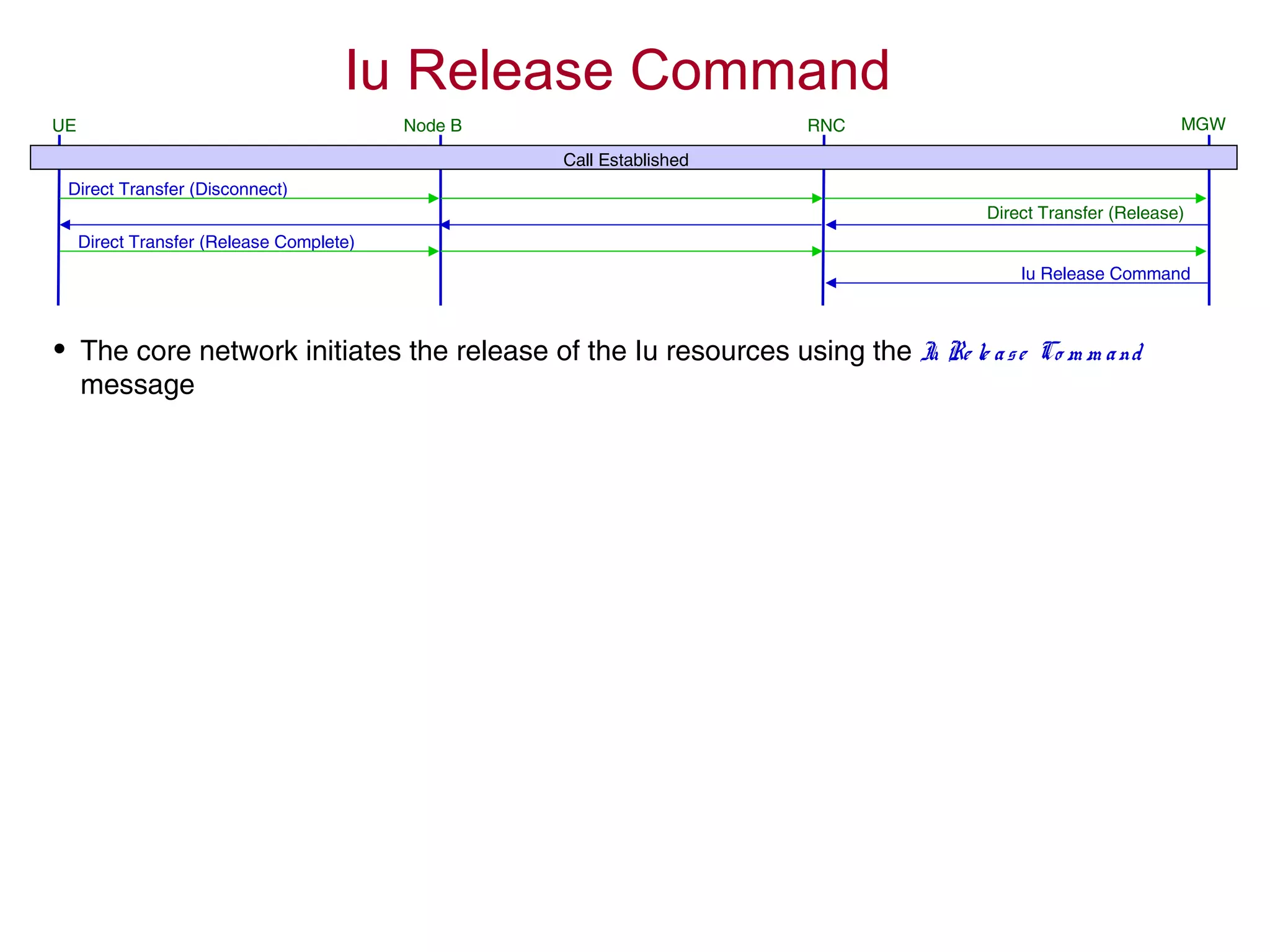
Iu Release Command
UE RNC MGWNode B
Call Established
Iu Release Command
Direct Transfer (Disconnect)
Direct Transfer (Release)
Direct Transfer (Release Complete)
• The core network initiates the release of the Iu resources using the Iu Re le ase Co m m and
message
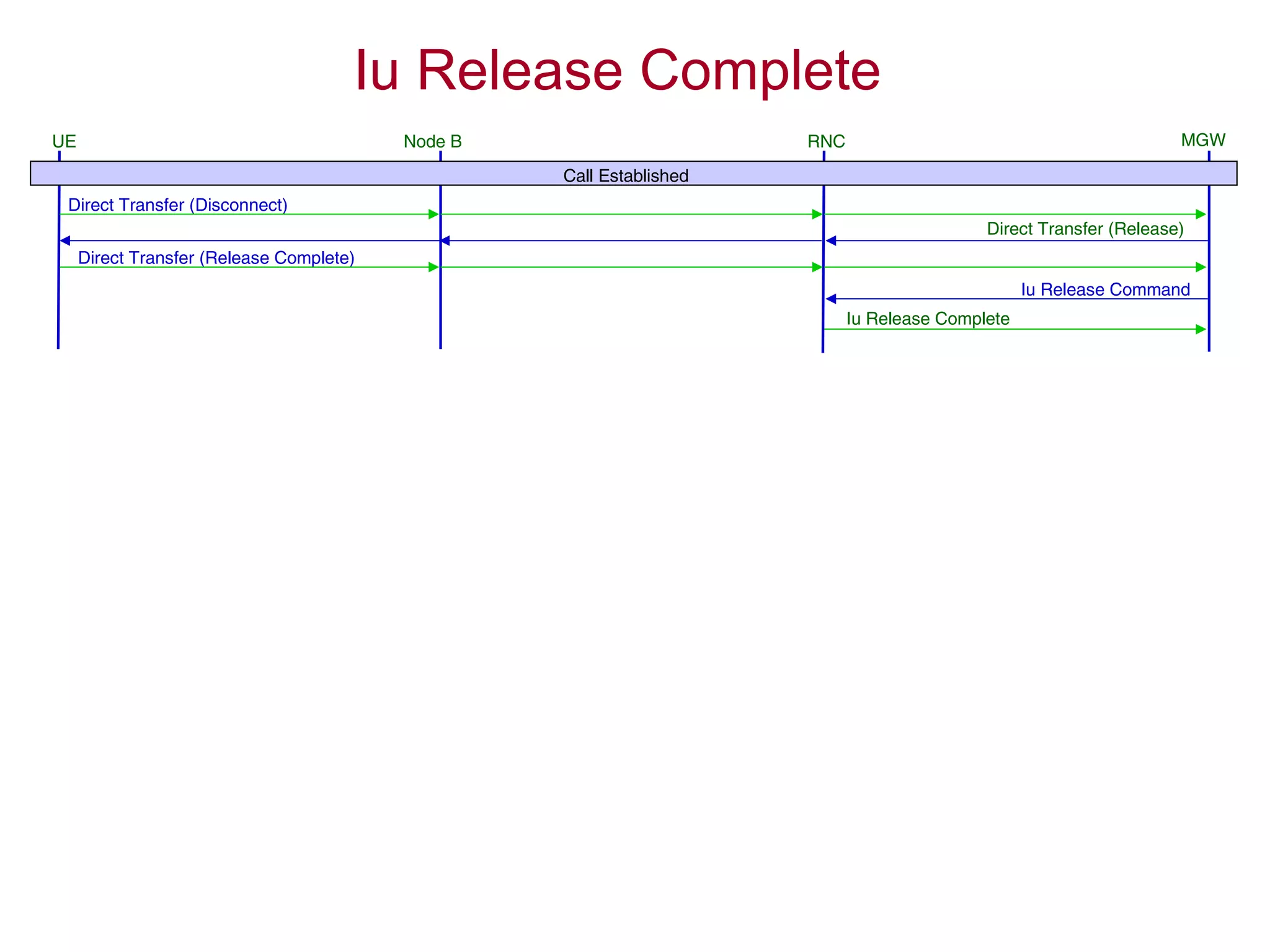
Iu Release Complete
UE RNC MGWNode B
Call Established
Iu Release Command
Iu Release Complete
Direct Transfer (Disconnect)
Direct Transfer (Release)
Direct Transfer (Release Complete)
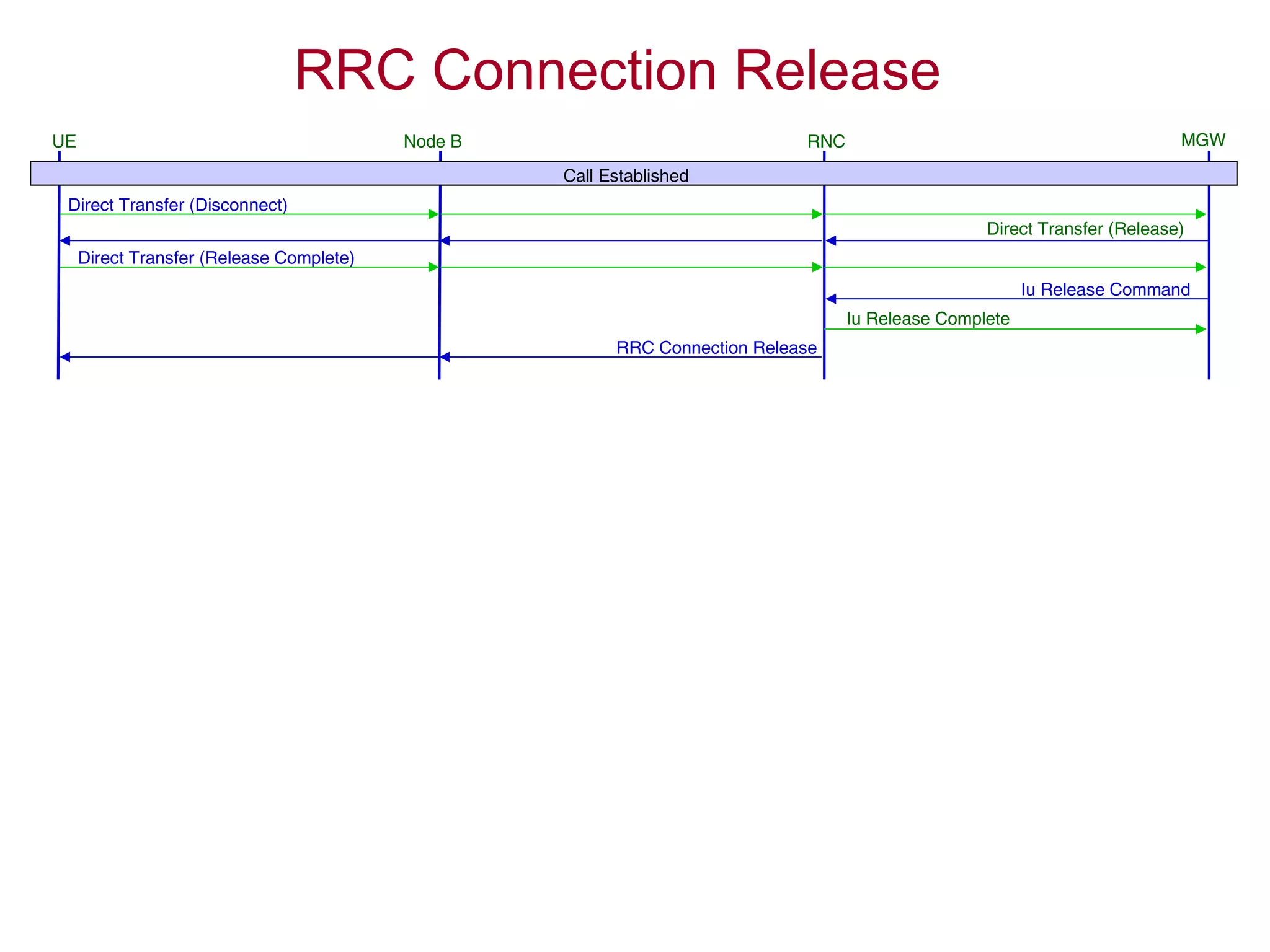
RRC Connection Release
UE RNC MGWNode B
Call Established
Iu Release Command
Iu Release Complete
RRC Connection Release
Direct Transfer (Disconnect)
Direct Transfer (Release)
Direct Transfer (Release Complete)
RRC Connection Release Complete
UE RNC MGWNode B
Call Established
Iu Release Command
Iu Release Complete
RRC Connection Release
RRC Connection Release Complete
Direct Transfer (Disconnect)
Direct Transfer (Release)
Direct Transfer (Release Complete)
Radio Link Deletion Request
UE RNC MGWNode B
Call Established
Iu Release Command
Iu Release Complete
RRC Connection Release
RRC Connection Release Complete
Radio Link Deletion Request
Direct Transfer (Disconnect)
Direct Transfer (Release)
Direct Transfer (Release Complete)
Radio Link Deletion Response
UE RNC MGWNode B
Call Established
Iu Release Command
Iu Release Complete
RRC Connection Release
RRC Connection Release Complete
Radio Link Deletion Request
Radio Link Deletion Response
Direct Transfer (Disconnect)
Direct Transfer (Release)
Direct Transfer (Release Complete)
Release of AMR Speech Call
UE RNC MGWNode B
Call Established
Iu Release Command
Iu Release Complete
RRC Connection Release
RRC Connection Release Complete
Radio Link Deletion Request
Radio Link Deletion Response
ALCAP: Release Request
ALCAP: Release Response
ALCAP: Release Request
ALCAP: Release Response
Call Released
Direct Transfer (Disconnect)
Direct Transfer (Release)
Direct Transfer (Release Complete)
•UE returns to Idle Mode

Mo cs call_flow

  • 1.
  • 2.
    Summary of AMRCall Establishment • The UE starts by searching for candidate cells by correlating the RSSI with the code defining the primary SCH • The UE then achieves radio frame synchronisation and reads the BCCH logical channel • The BCCH provides system information including the cell selection criteria • If the cell passes the cell selection criteria then the UE establishes an RRC connection and registers with the core network • Having registered with the core network the UE returns to the RRC idle mode state and is ready to originate an AMR speech call • An originating AMR speech call is made and handovers are completed as and when required • Finally the AMR speech call is released and the UE returns to the RRC idle mode state UE is powered up Read BCCH Cell selection Register with core network Originating AMR speech call Handovers Release of AMR speech call Radio frame synchronisation Cell search
  • 3.
    Protocol Stacks • Communicationbetween the UE, RNC and circuit switched core makes use of • Uu interface protocol stack • Iub interface protocol stack • Iu,cs interface protocol stack • A interface protocol stack Iub Iu,cs Uu Node B RNC Multimedia Gateway 3G MSC A • Protocol stacks include both user and control planes
  • 4.
    Cell Search UEis powered up Read BCCH Cell selection Register with core network Originating AMR speech call Handovers Release of AMR speech call Radio frame synchronisation Cell search• The UE keeps a record of the previously used carrier. The cell search procedure starts by scanning this carrier • The cell search procedure is completed by correlating RSSI against the known Primary SCH code • Peaks in the correlation result indicate the presence of a cell Correlation Peaks time Correlation result • Once the UE has identified a cell the UE attempts to synchronise with that cell
  • 5.
    Radio Frame Synchronisation CpCp Cp Cs1 Cs1Cs2 Primary SCH Secondary SCH Primary CCPCH 256 chips 2560 - 256 chips Slot 1 Slot 2 Slot 15 Slot 1 • The UE completes the three step radio frame synchronisation process • Step 1: Primary SCH identification and slot synchronisation (completed during cell search) • Step 2: Code group identification and frame synchronisation using the Secondary SCH • Step 3: Scrambling code identification using the CPICH • Having completed these three steps the UE is able to decode the Primary CCPCH -> BCH -> BCCH UE is powered up Read BCCH Cell selection Register with core network Originating AMR speech call Handovers Release of AMR speech call Radio frame synchronisation Cell search Primary CPICH
  • 6.
    Radio Frame Synchronization.. Three Steps 1. Slot Synchronization 2.Frame Synchronization 3. Primary Scrambling code Identification Channels used for Synchronization – Primary synchronization channel (PSCH) – Secondary synchronization channel (SSCH) – Common Pilot Channel (CPICH)
  • 7.
  • 8.
    Slot Synchronization • PSC: Primary synchronization code • 256 chip sequence transmitted in each slot interval • Same for all cells and slot intervals • Mobile Station uses the PSC to acquire slot synchronization • The sot timing of the cell can be obtained by detecting peak values in the matched filter Matched filter TS Boundary 2560 chips PSCH Stored PSCH
  • 9.
    FrameSynchronization • SSC: Secondarysynchronization code • 256 chip sequence transmitted in parallel with PSC. • In general different for different cells and slot intervals • 16 different ‘256 chip’ sequence ( 16 secondary synch code) • Code word of 15 consecutive SSC indicates ‘cell scrambling code group’ • There are 64 such code groups • UE checks in each slot 16 possible SSC sequences and select which gives the highest correlation value => 15 codes are selected • The cyclic shift is unique and gives the frame synchronization and the scrambling code group Slot No. 0 1 2 14 Group1 SSC1 SSC1 SSC2 ….. SSC16 Group2 SSC1 SSC1 SSC5 ….. SSC10 Group3 SSC1 SSC2 SSC1 …… SSC12 ….. ….. Group64 SSC9 SSC12 SSC10 …… SSC10 ◄
  • 10.
    15 15 SSC Allocation forS-SCH scrambling code group group 00 group 01 group 02 group 03 group 05 group 04 group 62 group 63 1 1 2 8 9 10 15 8 10 16 2 7 15 7 16 1 1 5 16 7 3 14 16 3 10 5 12 14 12 10 1 2 1 15 5 5 12 16 6 11 2 16 11 12 1 2 3 1 8 6 5 2 5 8 4 4 6 3 7 1 2 16 6 6 11 5 12 1 15 12 16 11 2 1 3 4 7 4 1 5 5 3 6 2 8 7 6 8 9 11 12 15 12 9 13 13 11 14 10 16 15 14 16 9 12 10 15 13 14 9 14 15 11 11 13 12 16 10 slot number 0 1 2 3 4 5 6 7 8 9 10 11 12 13 14 11 11 11 11 11 11 11 11 11 15 15 15 15 15 15 15 15 15 15 15 5 5 I monitor the S-SCH
  • 11.
    Scrambling codes summary 1)Long Scrambling code :262143 Codes 2) To speed up the cell search => only 8192 codes 3) 8192 code grouping: 512 groups of 16 codes each (512*16 = 8192) 4) 16 codes in each group => first code is Primary scrambling code and 15 codes are Secondary scrambling codes 5) Again 512 codes are further divided into 64 groups of 8 codes 6) These 64 groups map to the 64 scrambling code group used at stage 2 during frame synchronization – That way UE limits its Primary Scrambling code search to just 8 codes – At this stage max 8 attempts to find out the Primary Scrambling code of the cell 7) Each cell is allocated one Primary scrambling code ( Carrying P-CPICH, PCCPCH, PICH, AICH and S-CCPCH) 8) Other channels can use Primary scrambling code or secondary scrambling codes from the same group
  • 12.
    Timing Relationship Cp CpCp Cs1 Cs1Cs2 Primary SCH Secondary SCH Primary CCPCH 256 chips 2560 - 256 chips Slot 1 Slot 2 Slot 15 Slot 1 Primary CPICH
  • 13.
  • 14.
    Read BCCH • TheBCCH encapsulates the Syste m Info rm atio n message which includes the Master Information Block (MIB), Scheduling Blocks (SB) and System Information Blocks (SIB) • SIB1, SIB2 ….SIB18 UE is powered up Read BCCH Cell selection Register with core network Originating AMR speech call Handovers Release of AMR speech call Radio frame synchronisation Cell search MIB SB SIBs SIBs
  • 15.
    System Information Node B UTRAN SystemInformation ( ) UE RNC NBAP: BCCH Information MIB value tag M SB1 SIB 1 SIB 2 SIB 11
  • 16.
    Cell Selection • Cellselection is standardised process ( 25.304) • Cell selection is based upon the S-criteria • Srxlev > 0 • Squal > 0 • UE extracts the S-criteria parameters from SIB 3 • QqualMin • Qrxle vMin • UE_ TXPWR_ MAX_ RACH UE is powered up Read BCCH Cell selection Register with core network Originating AMR speech call Handovers Release of AMR speech call Radio frame synchronisation Cell search
  • 17.
    Cell Selection (II) •Both Squal and Srxlev must be positive for the UE to camp upon the cell UE is powered up Read BCCH Cell selection Register with core network Originating AMR speech call Handovers Release of AMR speech call Radio frame synchronisation Cell search Squal = Qqualmeas – QqualMin Srxlev = Qrxlevmeas – Qrxle vMin – Pcompensation where, Pcompensation = Max(UE_ TXPWR_ MAX_ RACH – P_MAX, 0) Default values: QqualMin is –20 dB CPICH Ec/Io Qrxle vMin is –115 dBm CPICH RSCP UE_ TXPWR_ MAX_ RACH is 21 dBm
  • 18.
    Register with theCore Network UE is powered up Read BCCH Cell selection Register with core network Originating AMR speech call Handovers Release of AMR speech call Radio frame synchronisation Cell search• The UE registers with the CS core domain • CS domain registering is an IMSI attach • Registering is achieved by establishing an RRC connection and sending NAS messages to the CS core • The non-access stratum message is encapsulated within a ‘Location Update Request’ message • RRC CONNECTION ESTABLISHMENT • LOCATION UPDATING PROCEDURE
  • 19.
    RRC Modes Release RRC Connection ReleaseRRC Connection Establish RRC Connection URA_PCH CELL_DCH CELL_FACH CELL_PCH Establish RRC Connection UTRA RRC Connected Mode Idle Mode GSM Connected Mode GPRS Packet Transfer Mode (UE camps on UTRAN cell) Release RR Connection Establish RR Connection GSM-UMTS Handover UTRA: Inter-RAT Handover (MS in GPRS Packet Idle Mode) Cell Resele- ction Initiation of a TBF Release of a TBF (MS camps on a GERAN cell) (adopted from TS 25.331 V3.12.0
  • 20.
    CELL_DCH State active set cell activeset cell • DCCH and – if configured – DTCH • Dedicate physical channel in use • UE location known on active set cell level • UE responsible for measurement reporting • Cell system information on BCCH • RRC messages on DCCH
  • 21.
    CELL_FACH State serving cell • DCCHand – if configured – DTCH • FACH used for higher layer data transfer, • UE monitors FACH permanently • Uplink transmission on RACH • UE location known on serving cell level • UE performs cell re-selection • UE responsible for measurement reporting • Cell system information on BCCH • RRC messages on BCCH, CCCH and DCCH
  • 22.
    CELL_PCH and URA_PCHState URA – UTRAN Registration Area • no DCCH and DTCH • Before uplink transmission ⇒ UE moves to CELL_FACH • UE must be paged • RRC messages on BCCH and PCCH • In CELL_PCH - UE location known on cell level - UE performs cell re-selection and cell updates • In URA_PCH - UE location known on URA level - UE performs cell re-selection and URA updates
  • 23.
    UTRAN Specific SignallingProtocols 3G-MSC/VLR 3G-SGSN UE Node B RNC RNC RNS RNS RRC Iur: RNSAP Iu-PS: RANAP Iu-CS: RANAP Iub: NBAP
  • 24.
    Register with theCore Network UE is powered up Read BCCH Cell selection Register with core network Originating AMR speech call Handovers Release of AMR speech call Radio frame synchronisation Cell search• The UE registers with the CS core domain • CS domain registering is an IMSI attach • Registering is achieved by establishing an RRC connection and sending NAS messages to the CS core • The non-access stratum message is encapsulated within a ‘Location Update Request’ message • RRC CONNECTION ESTABLISHMENT • LOCATION UPDATING PROCEDURE
  • 25.
    RRC Connection Establishment NodeBUE RNC [RACH] RRC Connection Request [DCH] RRC Connection Setup Complete [FACH] RRC Connection Setup Radio Link Setup L1 Synchronisation accept ed [RACH] RRC Connection Request [FACH] RRC Connection Reject UE RNC rejecte d
  • 26.
    • If thecell from which the BCCH has been read is suitable to camp upon then the UE follows the instructions in SIB1 to complete an IMSI attach with the CS core network • To complete an IMSI attach the UE must first establish an RRC connection • The RRC Co nne ctio n Re que st message is sent to the RNC on RACH RRC Connection Establishment UE Node B RNC RRC CONNECTION REQUEST RRC CONNECTION SETUP RRC CONNECTION SETUP COMPLETE LCH:CCCH TCH:RACH PCH:PRACH LCH:CCCH TCH: FACH PCH: S-CCPH LCH: DCCH TCH:DCH PCH: DPCH
  • 27.
    RRC Connection Request RRC:RRC Connection Request (RACH) UE RNCNode B •RRC CONNECTION REQUES: When UE wants to make a call or register to the network after power on, the first thing it should do is establish an RRC connection. •Applicable UE State(s) •Idle mode •Logical Channel Used : CCH •Transport Channel Used: RACH •Physical Channel Used: PRACH •Msg contains: • UE Identity, Establishment cause etc. • The RRC Co nne ctio n Re que st message is sent to the RNC on RACH
  • 28.
    NBAP: Radio LinkSetup Request • Once the RNC has received the RRC Co nne ctio n Re que st message it sends a Co m m o n NBAP: Radio Link Se tup Re que st to the Node B • The Co m m o n NBAP: Radio Link Se tup Re que st includes uplink and downlink configuration data for the radio link that the Node B is being requested to support • The radio link refers only to the communication link between the Node B and UE. It does not include Iub communication RRC: RRC Connection Request (RACH) UE RNCNode B NBAP: Radio Link Setup Request
  • 29.
    NBAP: Radio LinkSetup Response RRC: RRC Connection Request (RACH) UE RNC Node B NBAP: Radio Link Setup Request NBAP: Radio Link Setup Response • The Node B acknowledges the Co m m o n NBAP: Radio Link Se tup Re que st message with a Co m m o n NBAP: Radio Link Se tup Re spo nse message
  • 30.
    ALCAPand FPSignalling forIubConnection RRC: RRC Connection Request (RACH)UE RNC Node B NBAP: Radio Link Setup Request NBAP: Radio Link Setup Response ALCAP and FP Signalling
  • 31.
    • The RNCreplies to the UE’s original RRC Co nne ctio n Re que st message with an RRC Co nne ctio n Se tup message • The RRC Co nne ctio n Se tup message is sent to the UE on the FACH using unacknowledged mode RLC RRC Connection Setup (I) RRC: RRC Connection Request (RACH) UE RNC Node B NBAP: Radio Link Setup Request NBAP: Radio Link Setup Response RRC: RRC Connection Setup (FACH) ALCAP and FP Signalling
  • 32.
    Signalling Radio Bearers RNC RadioBearer LogCH NAS Signalling RRC layer MAC RLC UL: TrM DL: UM RB1 CCCH RLC UL & DL: UM RB2 DCCH RLC UL & DL AM RB3 DCCH RLC UL & DL AM RB4 DCCH RB0 RLC UL & DL AM DCCH optional UE RRC Connection Setup ( ) RRC Signalling
  • 33.
    RRC Connection Setupmessage UE RNC RRC Connection Setup ( ) RRC layer PHY MAC RLC PDCP BMC Radio Bearer LogCH TrCH PhyCH NAS Signalling user plane PhyCh configurati on TrCH configurati on RB configurati on
  • 34.
    Example: 13.6 kbpsSRB( Part of RRC Connection Setup ) Higher layer RAB/signalling RB SRB#1 SRB#2 SRB#3 SRB#4 User of Radio Bearer RRC RRC NAS_DT High prio NAS_DT Low prio RLC Logical channel type DCCH DCCH DCCH DCCH RLC mode UM AM AM AM Payload sizes, bit 136 128 128 128 Max data rate, bps 13 600 12 800 12 800 12 800 AMD/UMD PDU header, bit 8 16 16 16 MAC MAC header, bit 4 4 4 4 MAC multiplexing 4 logical channel multiplexing Layer 1 TrCH type DCH TB sizes, bit 148 (alt 0, 148) TFS TF0, bits 0x148 (alt 1x0) TF1, bits 1x148 TTI, ms 10 Coding type CC 1/3 CRC, bit 16 Max number of bits/TTI before rate matching 516 Uplink: Max number of bits/radio frame before rate matching 516
  • 35.
    srb-InformationSetupList { { rb-Identity 1, rlc-InfoChoicerlc-Info : { ul-RLC-Mode ul-UM-RLC-Mode : { }, dl-RLC-Mode dl-UM-RLC-Mode : NULL }, rb-MappingInfo {{ ul-LogicalChannelMappings oneLogicalChannel : { ul-TransportChannelType dch : 24, logicalChannelIdentity 1, rlc-SizeList configured : NULL, mac-LogicalChannelPriority 1 }, dl-LogicalChannelMappingList { { dl-TransportChannelType dch:24, logicalChannelIdentity 1 } } } } }, { RRC Connection Setup (III) • SRB 1 is: • established with rb identity 1 • configured with unacknowledged mode RLC • mapped to transport channel 24 • assigned a logical channel identity 1 • SRB 1 is established for control plane communication with UTRAN when unacknowledged mode RLC is used • Signalling RRC messages
  • 36.
    RRC Connection Setup(1V) rb-Identity 2, rlc-InfoChoice rlc-Info : { } }, dl-RLC-Mode dl-AM-RLC-Mode : { inSequenceDelivery TRUE, receivingWindowSize rw64, dl-RLC-StatusInfo { missingPDU-Indicator FALSE } } }, rb-MappingInfo { { ul-LogicalChannelMappings oneLogicalChannel : { ul-TransportChannelType dch : 24, logicalChannelIdentity 2, rlc-SizeList configured : NULL, mac-LogicalChannelPriority 1 }, dl-LogicalChannelMappingList { { dl-TransportChannelType dch : 24, logicalChannelIdentity 2 } • SRB 2 is: • established with rb identity 2 • configured with acknowledged mode RLC • mapped to transport channel 24 • assigned a logical channel identity 2 • SRB 2 is established for control plane communication with UTRAN when acknowledged mode RLC is used
  • 37.
    rb-Identity 3, rlc-InfoChoice rlc-Info: { } }, dl-RLC-Mode dl-AM-RLC-Mode : { inSequenceDelivery TRUE, receivingWindowSize rw64, dl-RLC-StatusInfo { missingPDU-Indicator FALSE } } }, rb-MappingInfo {{ ul-LogicalChannelMappings oneLogicalChannel : { ul-TransportChannelType dch : 24, logicalChannelIdentity 3, rlc-SizeList configured : NULL, mac-LogicalChannelPriority 1 }, dl-LogicalChannelMappingList { { dl-TransportChannelType dch : 24, logicalChannelIdentity 3 } RRC Connection Setup (V) • SRB 3 is: • established with rb identity 3 • configured with acknowledged mode RLC • mapped to transport channel 24 • assigned a logical channel identity 3 • SRB 3 is established for high priority control plane communication with the core network
  • 38.
    RRC Connection Setup(VI) rb-Identity 4, rlc-InfoChoice rlc-Info : { } }, dl-RLC-Mode dl-AM-RLC-Mode : { inSequenceDelivery TRUE, receivingWindowSize rw32, dl-RLC-StatusInfo { FALSE } } }, rb-MappingInfo { { ul-LogicalChannelMappings oneLogicalChannel : { ul-TransportChannelType dch : 24, logicalChannelIdentity 4, rlc-SizeList configured : NULL, mac-LogicalChannelPriority 1 }, dl-LogicalChannelMappingList { { dl-TransportChannelType dch : 24, logicalChannelIdentity 4 } • SRB 4 is: • established with rb identity 4 • configured with acknowledged mode RLC • mapped to transport channel 24 • assigned a logical channel identity 4 • SRB 4 is established for low priority control plane communication with the core network
  • 39.
    RRC Connection Setupmessage UE RNC RRC Connection Setup ( ) RRC layer PHY MAC RLC PDCP BMC Radio Bearer LogCH TrCH PhyCH NAS Signalling user plane PhyCh configurati on TrCH configurati on RB configurati on
  • 40.
    • Layer 1Synchronisation happens between UE and Node B. After successful L1 Synchronisation Node B sends a Synchro nisatio n Indicatio n message to the RNC to indicate that the radio link has been established. • This is a Nokia proprietary message that is equivalent to the 3GPP Radio Link Re sto re Indicatio n message NBAP: Synchronisation Indication RRC: RRC Connection Request (RACH) UE RNCNode B NBAP: Synchronisation Indication RRC: RRC Connection Setup (FACH) L1 Synchronisation NBAP Signalling
  • 41.
    RRC: RRC ConnectionRequest (RACH) UE RNC Node B NBAP: Radio Link Setup Request NBAP: Radio Link Setup Response ALCAP: Establish Request RRC Connection Setup Complete ALCAP: Establish Confirm FP: Downlink Sync FP: Uplink Sync NBAP: Synchronisation Indication RRC: RRC Connection Setup (FACH) L1 Synchronisation RRC: RRC Connection Setup Complete (DCH) •Completion of RRC Connection Establishment
  • 42.
    Location Updating Request RRCConnection Request (RACH) RRC Connection Setup (FACH) RRC Connection Setup Complete (DCH) Location Updating Request (DCH) UE RNC MGWNode B • The UE has now established a dedicated communication link with UTRAN and is in a position to send a message to the core network (CS core in this case) • The UE uses an uplink RRC: InitialDire ct Transfe r message to encapsulate and send a Lo catio n Updating Re que st message to the RNC • The Node B extracts the RRC: InitialDire ct Transfe r message and encapsulates it within a DCH Frame Protocol frame • The RNC extracts the Lo catio n Updating Re que st message and encapsulates it within a RANAP: InitialUE Me ssag e message prior to forwarding it to the multimedia gateway • This NAS message is transparent to RNC • The RANAP: InitialUE Me ssage message is accompanied with a SCCP: Co nne ctio n Re que st message which is used to establish the Iu-cs connection orientated link SCCP: Connection Request •Initial UE message : Location Updating Request
  • 43.
    UMTS security Features:Authentication, Integrity, Ciphering
  • 44.
    Authentication Request Authentication Request RRCConnection Request (RACH) RRC Connection Setup (FACH) RRC Connection Setup Complete (DCH) Location Updating Request (DCH) UE RNC MGWNode B • Having received the Lo catio n Updating Re que st message the CS core responds with an Authe nticatio n Re que st message • The Authe nticatio n Re que st message is sent to the RNC encapsulated within a RANAP Dire ct Transfe r message • The RNC extracts the Authe nticatio n Re que st message and encapsulates it within an RRC Do wnlink Dire ct Transfe r message • The RNC then encapsulates the RRC Do wnlink Dire ct Transfe r message within a downlink Frame Protocol data frame prior to forwarding it to the Node B • The Node B extracts the RRC Do wnlink Dire ct Transfe r message and forwards it to the UE SCCP: Connection Request SCCP: Connection Confirm (DCH)
  • 45.
    Authentication Response RRC ConnectionRequest (RACH) RRC Connection Setup (FACH) RRC Connection Setup Complete (DCH) Location Updating Request (DCH) UE RNC MGWNode B Authenication Response (DCH) • Having received the Authe nicatio n Re que st message the UE responds with an Authe nticatio n Re spo nse message • The Authe nticatio n Re spo nse message is sent to the Node B encapsulated within an RRC Uplink Dire ct Transfe r message • The Node B encapsulates the RRC Uplink Dire ct Transfe r message within an uplink Frame Protocol data frame prior to forwarding it to the RNC • The RNC extracts the Authe nticatio n Re spo nse message and encapsulates it within a RANAP Dire ct Transfe r message prior to forwarding it to the CS core Authentication Request SCCP: Connection Request SCCP: Connection Confirm (DCH)
  • 46.
    Security Mode Command:Integrity, Ciphering RRC Connection Request (RACH) RRC Connection Setup (FACH) RRC Connection Setup Complete (DCH) Location Updating Request (DCH) UE RNC MGWNode B Authenication Response (DCH) Security Mode Command • The CS core sends a Se curity Mo de Co m m and message to the UE • The purpose of this procedure is to trigger the start ciphering (Optional) • It is also used to start integrity protection all signalling radio bearers (Mandatory) Authentication Request SCCP: Connection Request SCCP: Connection Confirm (DCH) (DCH)
  • 47.
    Security Mode Complete RRCConnection Request (RACH) RRC Connection Setup (FACH) RRC Connection Setup Complete (DCH) Location Updating Request (DCH) UE RNC MGWNode B Authenication Response (DCH) Secuirty Mode Complete (DCH) • The UE responds to the Se curity Mo de Co m m and message with a Se curity Mo de Co m ple te message Security Mode Command Authentication Request SCCP: Connection Request SCCP: Connection Confirm (DCH) (DCH)
  • 48.
    Identity Request RRC ConnectionRequest (RACH) RRC Connection Setup (FACH) RRC Connection Setup Complete (DCH) Location Updating Request (DCH) UE RNC MGWNode B Authenication Response (DCH) Secuirty Mode Complete (DCH) • The CS core may request the UE to provide its identity. This is done using the Ide ntity Re que st message • The CS core sends the Ide ntity Re que st message encapsulated within a RANAP: Dire ct Transfe r message • The RNC sends the Ide ntity Re que st message encapsulated within a RRC: Do wnlink Dire ct Transfe r message Security Mode Command Authentication Request SCCP: Connection Request SCCP: Connection Confirm (DCH) (DCH) Identity Request(DCH)
  • 49.
    Identity Response RRC ConnectionRequest (RACH) RRC Connection Setup (FACH) RRC Connection Setup Complete (DCH) Location Updating Request (DCH) UE RNC MGWNode B Authenication Response (DCH) Secuirty Mode Complete (DCH) Security Mode Command Authentication Request SCCP: Connection Request SCCP: Connection Confirm (DCH) (DCH) Identity Request(DCH) Identity Response (DCH) • The UE sends the Ide ntity Re spo nse message encapsulated within a RRC: Uplink Dire ct Transfe r message • The RNC sends the Ide ntity Re spo nse message encapsulated within a RANAP: Dire ct Transfe r message
  • 50.
    Location Updating Accept •The CS core responds to the Lo catio n Updating Re que st with a Lo catio n Updating Acce pt message • The Lo catio n Updating Acce pt is sent to the RNC encapsulated within a RANAP: Dire ct Transfe r message • The RNC extracts the Lo catio n Updating Acce pt message and encapsulates it within an RRC: Do wnlink Dire ct Transfe r message RRC Connection Request (RACH) RRC Connection Setup (FACH) RRC Connection Setup Complete (DCH) Location Updating Request (DCH) UE RNC MGWNode B Authenication Response (DCH) Secuirty Mode Complete (DCH) Security Mode Command Authentication Request SCCP: Connection Request SCCP: Connection Confirm (DCH) (DCH) Identity Request(DCH) Identity Response (DCH) Location Updating Accept(DCH)
  • 51.
    Iu Release Command •Having sent the Lo catio n Updating Acce pt message the CS core initiates the release of the Iu-cs connection by sending a RANAP: Iu Re le ase Co m m and message to the RNC RRC Connection Request (RACH) RRC Connection Setup (FACH) RRC Connection Setup Complete (DCH) Location Updating Request (DCH) UE RNC MGWNode B Authenication Response (DCH) Secuirty Mode Complete (DCH) Security Mode Command Authentication Request SCCP: Connection Request SCCP: Connection Confirm (DCH) (DCH) Identity Request(DCH) Identity Response (DCH) Location Updating Accept(DCH) Iu Release Command
  • 52.
    Iu Release Complete RRCConnection Request (RACH) RRC Connection Setup (FACH) RRC Connection Setup Complete (DCH) Location Updating Request (DCH) UE RNC MGWNode B Authenication Response (DCH) Secuirty Mode Complete (DCH) Security Mode Command Authentication Request SCCP: Connection Request SCCP: Connection Confirm (DCH) (DCH) Identity Request(DCH) Identity Response (DCH) Location Updating Accept(DCH) Iu Release Command Iu Release Complete • The RNC replies to the RANAP: Iu Re le ase Co m m and message with a RANAP: Iu Re le ase Co m ple te message
  • 53.
    Released • Having releasedthe Iu-cs connection at the RANAP layer, the SCCP layer releases the underlying connection orientated link RRC Connection Request (RACH) RRC Connection Setup (FACH) RRC Connection Setup Complete (DCH) Location Updating Request (DCH) UE RNC MGWNode B Authenication Response (DCH) Secuirty Mode Complete (DCH) Security Mode Command Authentication Request SCCP: Connection Request SCCP: Connection Confirm (DCH) (DCH) Identity Request(DCH) Identity Response (DCH) Location Updating Accept(DCH) Iu Release Command Iu Release Complete SCCP: Released
  • 54.
    RRC Connection Release •Having sent the Iu Re le ase Co m ple te message the RNC initiates the release of the RRC connection by sending an RRC Co nne ctio n Re le ase message to the UE RRC Connection Request (RACH) RRC Connection Setup (FACH) RRC Connection Setup Complete (DCH) Location Updating Request (DCH) UE RNC MGWNode B Authenication Response (DCH) Secuirty Mode Complete (DCH) Security Mode Command Authentication Request SCCP: Connection Request SCCP: Connection Confirm (DCH) (DCH) Identity Request(DCH) Identity Response (DCH) Location Updating Accept(DCH) Iu Release Command Iu Release Complete SCCP: Released SCCP: Release Complete RRC Connection Release (DCH)
  • 55.
    RRC Connection ReleaseComplete RRC Connection Release Complete (DCH) RRC Connection Release Complete (DCH) RRC Connection Release Complete (DCH) • The UE responds by sending (n308+1) RRC Co nne ctio n Re le ase Co m ple te messages to the RNC RRC Connection Request (RACH) RRC Connection Setup (FACH) RRC Connection Setup Complete (DCH) Location Updating Request (DCH) UE RNC MGWNode B Authentication Response (DCH) Secuirty Mode Complete (DCH) Security Mode Command Authentication Request SCCP: Connection Request SCCP: Connection Confirm (DCH) (DCH) Identity Request(DCH) Identity Response (DCH) Location Updating Accept(DCH) Iu Release Command Iu Release Complete SCCP: Released SCCP: Release Complete RRC Connection Release (DCH)
  • 56.
    Radio Link DeletionRequest NBAP: Radio Link Deletion Request RRC Connection Release Complete (DCH) RRC Connection Release Complete (DCH) RRC Connection Release Complete (DCH) RRC Connection Request (RACH) RRC Connection Setup (FACH) RRC Connection Setup Complete (DCH) Location Updating Request (DCH) UE RNC MGWNode B Authenication Response (DCH) Secuirty Mode Complete (DCH) Security Mode Command Authentication Request SCCP: Connection Request SCCP: Connection Confirm (DCH) (DCH) Identity Request(DCH) Identity Response (DCH) Location Updating Accept(DCH) Iu Release Command Iu Release Complete SCCP: Released SCCP: Release Complete RRC Connection Release (DCH)
  • 57.
    Radio Link DeletionResponse NBAP: Radio Link Deletion Response NBAP: Radio Link Deletion Request RRC Connection Release Complete (DCH) RRC Connection Release Complete (DCH) RRC Connection Release Complete (DCH) RRC Connection Request (RACH) RRC Connection Setup (FACH) RRC Connection Setup Complete (DCH) Location Updating Request (DCH) UE RNC MGWNode B Authenication Response (DCH) Secuirty Mode Complete (DCH) Security Mode Command Authentication Request SCCP: Connection Request SCCP: Connection Confirm (DCH) (DCH) Identity Request(DCH) Identity Response (DCH) Location Updating Accept(DCH) Iu Release Command Iu Release Complete SCCP: Released SCCP: Release Complete RRC Connection Release (DCH)
  • 58.
    Summary of IMSIAttach ALCAP: Release Confirm ALCAP: Release Request NBAP: Radio Link Deletion Response NBAP: Radio Link Deletion Request RRC Connection Release Complete (DCH) RRC Connection Release Complete (DCH) RRC Connection Release Complete (DCH) RRC Connection Setup Complete (DCH) Location Updating Request (DCH) UE RNC MGW Node B Authenication Response (DCH) Secuirty Mode Complete (DCH) Security Mode Command Authentication Request SCCP: Connection Request SCCP: Connection Confirm (DCH) (DCH) Identity Request(DCH) Identity Response (DCH) Location Updating Accept(DCH) Iu Release Command Iu Release Complete SCCP: Released SCCP: Release Complete RRC Connection Release (DCH) FP: Downlink Sync FP: Uplink Sync NBAP: Synchronisation Indication RRC: RRC Connection Setup (FACH) L1 Synchronisation NBAP: Radio Link Setup Request NBAP: Radio Link Setup Response ALCAP: Establish Request ALCAP: Establish Confirm
  • 59.
    AMR Speech Call UEis powered up Read BCCH Cell selection Register with core network AMR speech call Handovers Release of AMR speech call Radio frame synchronisation Cell search Cell re-selections • The AMR speech call can be either mobile originated or mobile terminated • The following slides present a mobile originated call • The first step is to establish an RRC connection. This is done in the same way as for the IMSI attach procedure • The only difference is that the establishment cause specified in the RRC Connection Request message is specied as originatingConversationalCall UE RNCNode B RRC Connection Establishment • Once the RRC connection has been established the UE is able to send a NAS message to the circuit switched core
  • 60.
    CM Service Request UERNC MGWNode B RRC Connection Establishment Initial Direct Transfer (CM Service Request) • By sending this message UE requests a service for the circuit switched connection establishment • DCCH ->DCH -> DPCH • DCCH contains the RRC: InitialDire ct Transfe r message • Message is sent using acknowledged mode RLC • The message is sent to the CS core domain • The NAS message is not read by the RNC but is forwarded to the multimedia gateway SCCP: Connection Request
  • 61.
    Security Mode Command SecurityMode Command Common ID UE RNC MGWNode B RRC Connection Establishment Initial Direct Transfer (CM Service Request) SCCP: Connection Request SCCP: Connection Confirm Location Reporting Control • The CS core sends a Se curity Mo de Co m m and message to the UE • The purpose of this procedure is to trigger the start or stop of ciphering or to command the restart of the ciphering with a new ciphering configuration, for the radio bearers of one core network domain and for all signalling bearers • It is also used to start integrity protection or to modify the integrity protection configuration for all signalling radio bearers
  • 62.
    Security Mode Complete SecurityMode Complete Security Mode Command Common ID UE RNC MGWNode B RRC Connection Establishment Initial Direct Transfer (CM Service Request) SCCP: Connection Request SCCP: Connection Confirm Location Reporting Control • The UE responds to the Se curity Mo de Co m m and message with a Se curity Mo de Co m ple te message
  • 63.
    CM Service Accept •The CMSe rvice Acce pt message is only sent if the security mode procedure is not used • If the security mode procedure is used then completion of that procedure is used as an alternative indication of CM service acceptance. • Extract from 24.008: • In UMTS, an indication from the RR sublayer that the security mode control procedure is completed, or reception of a CM SERVICE ACCEPT message, shall be treated as a service acceptance indication by the mobile station • The CMSe rvice Acce pt message serves only as an acknowledgement and contains no additional information CM Service Accept Security Mode Complete Security Mode Command Common ID UE RNC MGWNode B RRC Connection Establishment Initial Direct Transfer (CM Service Request) SCCP: Connection Request SCCP: Connection Confirm Location Reporting Control OR
  • 64.
    Setup Setup Security Mode Complete SecurityMode Command Common ID UE RNC MGWNode B RRC Connection Establishment Initial Direct Transfer (CM Service Request) SCCP: Connection Request SCCP: Connection Confirm Location Reporting Control • The UE then sends a NAS Se tup message to the CS core using an RRC: Uplink Dire ct Transfe r message • The NAS message is included and directed towards the CS core domain • The NAS message includes the number being dialled by the UE
  • 65.
    Call Proceeding Call Proceeding Setup SecurityMode Complete Security Mode Command Common ID UE RNC MGWNode B RRC Connection Establishment Initial Direct Transfer (CM Service Request) SCCP: Connection Request SCCP: Connection Confirm Location Reporting Control • Having received the NAS Se tup message the CS core sends the NAS CallPro ce e ding message • This message indicates to UE that Call Setup Procedure is started at the NW side
  • 66.
    RAB Assignment Request RABAssignment Request Facility Call Proceeding Setup Security Mode Complete Security Mode Command Common ID UE RNC MGWNode B RRC Connection Establishment Initial Direct Transfer (CM Service Request) SCCP: Connection Request SCCP: Connection Confirm Location Reporting Control • CS core sends the RANAP: RABAssig nm e nt Re sue st message to the RNC • The RANAP: RABAssig nm e nt Re sue st message requests the RNC to establish a RAB with a specified set of QoS parameters • The CS core requests these QoS parameters based upon the UE subscription and the service being requested
  • 67.
    Radio Link ReconfigurePrepare RAB Assignment Request Facility Call Proceeding Setup Security Mode Complete Security Mode Command Common ID UE RNC MGWNode B RRC Connection Establishment Initial Direct Transfer (CM Service Request) SCCP: Connection Request SCCP: Connection Confirm Location Reporting Control • Assuming that the admission control procedure within the RNC decides to accept the RAB request then it prepares to reconfigure the radio link at the Node B by sending the NBAP: Radio Link Re co nfig ure Pre pare message Radio Link Reconfigure Prepare
  • 68.
    Radio Link ReconfigureReady RAB Assignment Request Facility Call Proceeding Setup Security Mode Complete Security Mode Command Common ID UE RNC MGWNode B RRC Connection Establishment Initial Direct Transfer (CM Service Request) SCCP: Connection Request SCCP: Connection Confirm Location Reporting Control Radio Link Reconfigure Prepare Radio Link Reconfigure Ready • The Node B responds to the NBAP: Radio Link Re co nfig ure Pre pare message with a NBAP: Radio Link Re co nfig ure Re ady message
  • 69.
    Radio Link ReconfigurationCommit • Once the transmission resouce allocations have been configured the RNC sends a NBAP: Radio Link Re co nfiguratio n Co m m it message to the Node B Radio Link Reconfiguration Commit AAL2SIG:ERQ RAB Assignment Request Facility Call Proceeding Setup Security Mode Complete Security Mode Command Common ID UE RNC MGWNode B RRC Connection Establishment Initial Direct Transfer (CM Service Request) SCCP: Connection Request SCCP: Connection Confirm Location Reporting Control Radio Link Reconfigure Prepare Radio Link Reconfigure Ready AAL2SIG:ERQ AAL2SIG:ECF FP: Downlink Sync FP: Uplink Sync AAL2SIG:ECF
  • 70.
    Radio Bearer Setup •Once the NBAP: Radio Link Re co nfiguratio n Co m m it message has been sent to the Node B the RNC sends a RRC: Radio Be are r Se tup message to the UE Radio Link Reconfiguration Commit AAL2SIG:ERQ RAB Assignment Request Facility Call Proceeding Setup Security Mode Complete Security Mode Command Common ID UE RNC MGWNode B RRC Connection Establishment Initial Direct Transfer (CM Service Request) SCCP: Connection Request SCCP: Connection Confirm Location Reporting Control Radio Link Reconfigure Prepare Radio Link Reconfigure Ready AAL2SIG:ERQ AAL2SIG:ECF FP: Downlink Sync FP: Uplink Sync AAL2SIG:ECF Radio Bearer Setup
  • 71.
    Radio Bearer Setup(II) • The UE is instructed to remain in Cell_DCH after the radio bearer has been established • AMR 12.2 kbps Radio Bearer • Radio bearer 5 is mapped to DCH transport channel 1. This corresponds to the AMR class A bits transport channel • Radio bearer 5 is configured with transparent mode RLC • Radio bearer 6 is mapped to DCH transport channel 2. This corresponds to the AMR class B bits transport channel • Radio bearer 7 is mapped to DCH transport channel 3. This corresponds to the AMR class C bits • Radio bearer 5,6,7 is configured with transparent mode RLC Higher layer RAB/Signalling RB RAB subflow #1 RAB subflow #2 RAB subflow #3 RLC Logical channel type DTCH RLC mode TM TM TM Payload sizes, bit 39, 81 (alt. 0, 39, 81) 103 60 Max data rate, bps 12 200 TrD PDU header, bit 0 MAC MAC header, bit 0 MAC multiplexing N/A Layer 1 TrCH type DCH DCH DCH TB sizes, bit 39, 81 (alt. 0, 39, 81) 103 60 TFS TF0, bits 0x81(alt. 1x0) (note) 0x103 0x60 TF1, bits 1x39 1x10³ 1x60 TF2, bits 1x81 N/A N/A TTI, ms 20 20 20 Coding type CC 1/3 CC 1/3 CC 1/2
  • 72.
    Radio Bearer SetupComplete • The UE acknowledges the RRC: Radio Be are r Se tup message with a RRC: Radio Be are r Se tup Co m ple te message Radio Link Reconfiguration Commit AAL2SIG:ERQ RAB Assignment Request Facility Call Proceeding Setup Security Mode Complete Security Mode Command Common ID UE RNC MGWNode B RRC Connection Establishment Initial Direct Transfer (CM Service Request) SCCP: Connection Request SCCP: Connection Confirm Location Reporting Control Radio Link Reconfigure Prepare Radio Link Reconfigure Ready AAL2SIG:ERQ AAL2SIG:ECF FP: Downlink Sync FP: Uplink Sync AAL2SIG:ECF Radio Bearer Setup Radio Bearer Setup Complete
  • 73.
    RAB Assignment Response •Once the radio bearer establishment has been acknowledged, the RNC indicates to the CS core that the RAB has been established using the RANAP: RABAssignm e nt Re spo nse message Radio Link Reconfiguration Commit AAL2SIG:ERQ RAB Assignment Request Facility Call Proceeding Setup Security Mode Complete Security Mode Command Common ID UE RNC MGWNode B RRC Connection Establishment Initial Direct Transfer (CM Service Request) SCCP: Connection Request SCCP: Connection Confirm Location Reporting Control Radio Link Reconfigure Prepare Radio Link Reconfigure Ready AAL2SIG:ERQ AAL2SIG:ECF FP: Downlink Sync FP: Uplink Sync AAL2SIG:ECF Radio Bearer Setup Radio Bearer Setup Complete RAB Assignment Response
  • 74.
    Alerting • Having receivedthe RANAP: RABAssignm e nt Re spo nse message, the CS core sends the NAS Ale rting message to the UE • This message is sent to indicate that the called user alerting has been initiated. Radio Link Reconfiguration Commit AAL2SIG:ERQ RAB Assignment Request Facility Call Proceeding Setup Security Mode Complete Security Mode Command Common ID UE RNC MGWNode B RRC Connection Establishment Initial Direct Transfer (CM Service Request) SCCP: Connection Request SCCP: Connection Confirm Location Reporting Control Radio Link Reconfigure Prepare Radio Link Reconfigure Ready AAL2SIG:ERQ AAL2SIG:ECF FP: Downlink Sync FP: Uplink Sync AAL2SIG:ECF Radio Bearer Setup Radio Bearer Setup Complete RAB Assignment Response Alerting
  • 75.
    Connect • Having receivedthe RANAP: RABAssignm e nt Re spo nse message, the CS core sends the NAS Ale rting message to the UE • This message is sent to indicate call acceptance by the called user Radio Link Reconfiguration Commit AAL2SIG:ERQ RAB Assignment Request Facility Call Proceeding Setup Security Mode Complete Security Mode Command Common ID UE RNC MGWNode B RRC Connection Establishment Initial Direct Transfer (CM Service Request) SCCP: Connection Request SCCP: Connection Confirm Location Reporting Control Radio Link Reconfigure Prepare Radio Link Reconfigure Ready AAL2SIG:ERQ AAL2SIG:ECF FP: Downlink Sync FP: Uplink Sync AAL2SIG:ECF Radio Bearer Setup Radio Bearer Setup Complete RAB Assignment Response Alerting Connect
  • 76.
    Connect Acknowledge • TheUE acknowledges the NAS Co nne ct message with the NAS Co nne ct Ackno wle dge message Radio Link Reconfiguration Commit AAL2SIG:ERQ RAB Assignment Request Facility Call Proceeding Setup Security Mode Complete Security Mode Command Common ID UE RNC MGWNode B RRC Connection Establishment Initial Direct Transfer (CM Service Request) SCCP: Connection Request SCCP: Connection Confirm Location Reporting Control Radio Link Reconfigure Prepare Radio Link Reconfigure Ready AAL2SIG:ERQ AAL2SIG:ECF FP: Downlink Sync FP: Uplink Sync AAL2SIG:ECF Radio Bearer Setup Radio Bearer Setup Complete RAB Assignment Response Alerting Connect Connect Acknowledge
  • 77.
    Call Established Radio LinkReconfiguration Commit AAL2SIG:ERQ RAB Assignment Request Facility Call Proceeding Setup Security Mode Complete Security Mode Command Common ID UE RNC MGWNode B RRC Connection Establishment Initial Direct Transfer (CM Service Request) SCCP: Connection Request SCCP: Connection Confirm Location Reporting Control Radio Link Reconfigure Prepare Radio Link Reconfigure Ready AAL2SIG:ERQ AAL2SIG:ECF FP: Downlink Sync FP: Uplink Sync AAL2SIG:ECF Radio Bearer Setup Radio Bearer Setup Complete RAB Assignment Response Alerting Connect Connect Acknowledge Call Established • The call is established at this point
  • 78.
    Release of AMRSpeech Call UE is powered up Read BCCH Cell selection Register with core network AMR speech call Release of AMR speech call Radio frame synchronisation Cell search • The call is released in a controlled manner when either the originating or terminating terminal hangs-up • The RRC connection is released and the UE returns to RRC Idle mode
  • 79.
    Uplink Disconnect UE RNCMGWNode B Call Established Direct Transfer (Disconnect) • In this example the UE initiates the call release by sending the Disco nne ct message to the CS core
  • 80.
    Downlink Release (I) UERNC MGWNode B Call Established Direct Transfer (Disconnect) Direct Transfer (Release) • The network acknowledges the Disco nne ct message with a Re le ase message
  • 81.
    Uplink Release Complete UERNC MGWNode B Call Established Direct Transfer (Disconnect) Direct Transfer (Release) Direct Transfer (Release Complete)
  • 82.
    Iu Release Command UERNC MGWNode B Call Established Iu Release Command Direct Transfer (Disconnect) Direct Transfer (Release) Direct Transfer (Release Complete) • The core network initiates the release of the Iu resources using the Iu Re le ase Co m m and message
  • 83.
    Iu Release Complete UERNC MGWNode B Call Established Iu Release Command Iu Release Complete Direct Transfer (Disconnect) Direct Transfer (Release) Direct Transfer (Release Complete)
  • 84.
    RRC Connection Release UERNC MGWNode B Call Established Iu Release Command Iu Release Complete RRC Connection Release Direct Transfer (Disconnect) Direct Transfer (Release) Direct Transfer (Release Complete)
  • 85.
    RRC Connection ReleaseComplete UE RNC MGWNode B Call Established Iu Release Command Iu Release Complete RRC Connection Release RRC Connection Release Complete RRC Connection Release Complete RRC Connection Release Complete Direct Transfer (Disconnect) Direct Transfer (Release) Direct Transfer (Release Complete)
  • 86.
    Radio Link DeletionRequest UE RNC MGWNode B Call Established Iu Release Command Iu Release Complete RRC Connection Release RRC Connection Release Complete RRC Connection Release Complete RRC Connection Release Complete Radio Link Deletion Request Direct Transfer (Disconnect) Direct Transfer (Release) Direct Transfer (Release Complete)
  • 87.
    Radio Link DeletionResponse UE RNC MGWNode B Call Established Iu Release Command Iu Release Complete RRC Connection Release RRC Connection Release Complete RRC Connection Release Complete RRC Connection Release Complete Radio Link Deletion Request Radio Link Deletion Response Direct Transfer (Disconnect) Direct Transfer (Release) Direct Transfer (Release Complete)
  • 88.
    Release of AMRSpeech Call UE RNC MGWNode B Call Established Iu Release Command Iu Release Complete RRC Connection Release RRC Connection Release Complete RRC Connection Release Complete RRC Connection Release Complete Radio Link Deletion Request Radio Link Deletion Response ALCAP: Release Request ALCAP: Release Response ALCAP: Release Request ALCAP: Release Response Call Released Direct Transfer (Disconnect) Direct Transfer (Release) Direct Transfer (Release Complete) •UE returns to Idle Mode

Editor's Notes

  • #11 <number> Secondary Synchronisation Channel (S-SCH)The S-SCH also uses only the first 10% of a timeslot; Secondary Synchronisation Codes (SSC) are transmitted. There are 16 different SSCs, which are organised in a 10 ms frame (15 timeslots) in such a way, that the beginning of a 10 ms frame can be determined, and 64 different SSC combinations within a 10 ms frame are identified. There is a total of 512 primary scrambling codes, which are grouped in 64 scrambling code families, each family holding 8 scrambling code members. The 15 SSCs in one 10 ms frame identify the scrambling code family of the cell‘s downlink scrambling code.
  • #16 <number> Within UTRAN system information is broadcasted with the help of the RRC messages System Information, Paging Type I, and System Information Change Indication. Most system information parameters are determined by the RNC. The Node B is informed about the parameters via the NBAP message BCCH Information. Some system parameters can be made available by the Node B, such as interference values, which change fast. Given the system information, the UE is capable to decide, whether or how to access the PLMN via the existing cell. System information is organised in System Information Blocks (SIBs). System information is grouped into SIB 1 to SIB 18. Each SIB is responsible to carry a specific content. For instance, SIB 12 holds measurement control information and parameters. Depending on the UE‘s RRC state, is reads specific SIBs, and uses the transmitted parameters. There is a huge amount of SIBs, which have to be read by the UE. This requires a lot of battery power. Therefore, a Master Information Block (MIB) was introduced, which gives references and scheduling information about the SIBs. The MIB is transmitted in every 8th radio frame on the P-CCPCH (on position SFN mod 8 = 0, and with a TTI of 20 ms). For most of the SIBs used within the system, the MIB may carry a value tag. The only exceptions are SIB 15.2, SIB 15.3 and SIB 16. If a value tag is unchanged, the corresponding system information has not been modified. Thus, there is no need for the UE to read the SIB. SIB 7 has no value tag. It changes with each occurrence. Scheduling information is used to inform the UE, where and when a specific system information is transmitted.
  • #20 <number> When a UE is switched on, it enters the RRC idle mode. In the RRC idle mode, there is no connection on the access stratum level between the UE and UTRAN. UTRAN has no information about UEs in the RRC idle mode. If UTRAN wants to address the UE, it must use non-access stratum identifiers, such as IMSI or TMSI and LAI. In the RRC idle mode, the UE monitors the BCCH, and when it is registered to the CN, it also listens to paging occasions on its PICH. The UE is in the RRC idle mode, when it is powered on. Is it possible, that in this state, the UE has an active connection? The answer is yes – after a PDP context activation, the UE has an active connection an SGSN. There are to packet switched mobility management states: ps idle and ps dedicated state. In the ps idle state, there are no transmission resources allocated to the active PDP context between the UE and the SGSN. A higher layer connection exists, but UTRAN has no information about the UE‘s location. The UE is in the RRC idle mode. The transition from the RRC idle mode to the RRC connected mode can only be initiated by the UE by sending the RRC Connection Request message to UTRAN. If common transport channels used to exchange messages and data between the UE and UTRAN, the UE is identified by a Radio Network Temporary Identity (RNTI). As can be seen in the figure on the right hand side, the UE can be in one of four sub-states, when it is in the RRC connected mode. The sub-states depend on the connectivity level between the UE and UTRAN. The set of usable transport channels depend also on the sub-states. For instance, the DCHs are not available in the sub-states CELL_PCH and CELL_URA. The UE leaves the RRC idle mode when sending the RRC Connection Request message to UTRAN. When UTRAN accepts the UE‘s request, the UE enters either the sub-state CELL_DCH or CELL_FACH.
  • #21 <number> What are the characteristics of the individual sub-states, when the UE is in the RRC connected mode? CELL_DCHIn this sub-state, dedicated physical channels are allocated to the UE. DCCH and – if configured – DTCH information can be transmitted. There no need to identify the UE on a dedicated channel, because the physical channels are exclusively allocated to this UE. UTRAN knows the active set cells for the radio links and thus the location of the the UE. Also downlink shared channels can be allocated to the UE. In this state, the UE is capable to receive RRC messages on the DCCH (and BCCH, if it owns specific capabilities). The cell system information is broadcasted on the FACH. The UE reads the cell system information and acts accordingly. For instance, it determines the measurement quality and the reporting events from the cell system information.
  • #22 <number> CELL_FACHThis state was introduced for traffic situations, where only small amounts of data have to be transmitted. This is the case when only higher layer signalling information (NAS signalling) or small amount of user data (e.g. SMS messages) have to be transmitted. In this case, an exclusive allocation of one physical channel to the UE would result in a waste of resources. The UE is capable to receive and transmit DCCH and – if configured – DTCH information. Only common transport channel FACH can be used by the UE to transmit higher layer data, which it has to share with other UEs. Each UE must be explicitly addressed, for instance by the RNTI. It has to monitor the FACH permanently in the downlink, not to miss user data for it. The UE‘s FACH is mapped on one S-CCPCH. In the uplink, it uses the shared transport channels for user data transfer, such as the RACH. The UE is only connected to one cell, and this is the location information, known within UTRAN. No soft handover takes place in this sub-state. The UE is responsible for cell re-selection. By listening to the cell system information from the BCCH, it gains all relevant measurement qualities, threshold values, neighbourhood lists to perform the cell re-selection process. Other relevant information is also learned from the BCCH. The UE receives RRC messages on the BCCH, CCCH and DCCH channels. Due to the discontinuous type of traffic, UTRAN can command the UE to perform periodic cell updates.
  • #23 <number> The remaining two sub-states – CELL_PCH and URA_PCH – were introduced to cope with inactive data users. Just think about users, who surf in the Internet. After downloading some files, they work with the data, and for a longer time, no transmission takes place. If this is the case, access stratum resources can be released when moving in one of the two states. In both states, no DCCH nor DTCH is allocated to the UE. No exchange of data is possible between the UE and UTRAN. If the UE wants to transmit something, it must move first internally to the sub-state CELL_FACH. The UE listens to the cell system information, broadcasted on the BCCH. It performs measurements accordingly, and is responsible for cell-reselection. In addition to that, it periodically looks for a PLMN with a higher priority. When UTRAN wants to transmit data to the UE, it must be paged first. Therefore, the UE has to monitor paging occasions on its PICH, i.e. it receives RRC messages both on the BCCH and the PCCH. CELL_PCHIn this sub-state, the UE‘s current cell is known to the RNC. If the RNC wants to exchange data with the UE, it only needs to page the UE there. If the UE changes the cell, it must perform a cell update. Also periodical cell updates can be requested by UTRAN. To perform updates, the UE must change to the CELL_FACH sub-state. (Please note, that no uplink transmission is allowed in CELL_PCH/URA_PCH.) URA_PCHURA stands for UTRAN Registration Area. If the UE is in the CELL_PCH and moving fast, a lot of cell updates have to be performed. URAs are a combination of one or several cells under one C-RNC. URAs may overlap, i.e. a cell may belong to several URAs. If UTRAN wants to transmit something to the UE, it must page the UE within the URA. The UE is responsible for URA updates – when it changes the URA – and periodic URA updates – when required by UTRAN.
  • #26 <number> In this course module, we focus our interest on the RRC Connection Establishment procedure, which is part of the RRC Connection Management procedures. The purpose of the RRC Connection Establishment procedure is to create a RRC connection between the UE and UTRAN. To do so, the UE sends the RRC Connection Request message to the RNC. The UE was in the RRC idle mode, and higher layer protocols in the UE request a signalling connection to UTRAN.Please note, that an RRC connection establishment is always initiated by the UE. It is transmitted via the logical channel CCCH. UTRAN returns a response. If UTRAN accepts the UE‘s RRC Connection Request, it returns the message RRC Connection Setup message. The UE gets all relevant parameters regarding the signalling bearers, transport channels, and physical channels. From the RNC point of view, it is not just sufficient to inform the UE about the signalling resources. The Node B must also get all relevant parameters to serve the UE on the radio interface adequately, and to relay data between the Iub-interface and Uu-interface. Before the RNC returns the RRC Connection Setup message to the UE, it uses the UTRAN specific signalling protocol NBAP to send these parameters to the Node B. If UTRAN denies access to the UE, it returns the message RRC Connection Reject. Both messages are returned to the UE via a FACH. If the UE has received the message RRC Connection Setup, it returns the RRC Connection Setup Complete message to the RNC, using the transport channel DCH. Beforehand it performed a L1 synchronisation.
  • #33 <number>
  • #34 <number> The RRC Connection Setup message is used to specify the (signalling) radio bearer, the transport channel and the physical channel characteristics both in the UL and downlink directions. The RRC Connection Setup message is sent from the RRC layer in the RNC to the RRC layer in the UE. The UE‘s RRC uses management interfaces to the configure the „lower“ layers accordingly. If only the physical layer characteristics are modified, then the RRC layer only has to interact with the PHY layer. A modification may affect scrambling and modulation. A new channelisation code may be deployed for the connection, which has no impact to the higher layers. The PHY layer is for instance responsible for radio measurements, and the RNC can change measurement quantities or threshold values. Again, this has no impact on the higher layers. If the transport channels are modified, then this has an effect both on the MAC (Medium Access Control) layer and the PHY layer. The MAC layer is responsible for Transport Format selection, identification of UEs on the common and shared resources, ciphering and de-ciphering, random access control, etc.
  • #40 <number> The RRC Connection Setup message is used to specify the (signalling) radio bearer, the transport channel and the physical channel characteristics both in the UL and downlink directions. The RRC Connection Setup message is sent from the RRC layer in the RNC to the RRC layer in the UE. The UE‘s RRC uses management interfaces to the configure the „lower“ layers accordingly. If only the physical layer characteristics are modified, then the RRC layer only has to interact with the PHY layer. A modification may affect scrambling and modulation. A new channelisation code may be deployed for the connection, which has no impact to the higher layers. The PHY layer is for instance responsible for radio measurements, and the RNC can change measurement quantities or threshold values. Again, this has no impact on the higher layers. If the transport channels are modified, then this has an effect both on the MAC (Medium Access Control) layer and the PHY layer. The MAC layer is responsible for Transport Format selection, identification of UEs on the common and shared resources, ciphering and de-ciphering, random access control, etc.