User-managed access
The solution to sharing data for research and innovation?
Ananda Plate
Executive Director, Patvocates Research​
Board Member, Myeloma Patients Europe​
Former Chair, WECAN
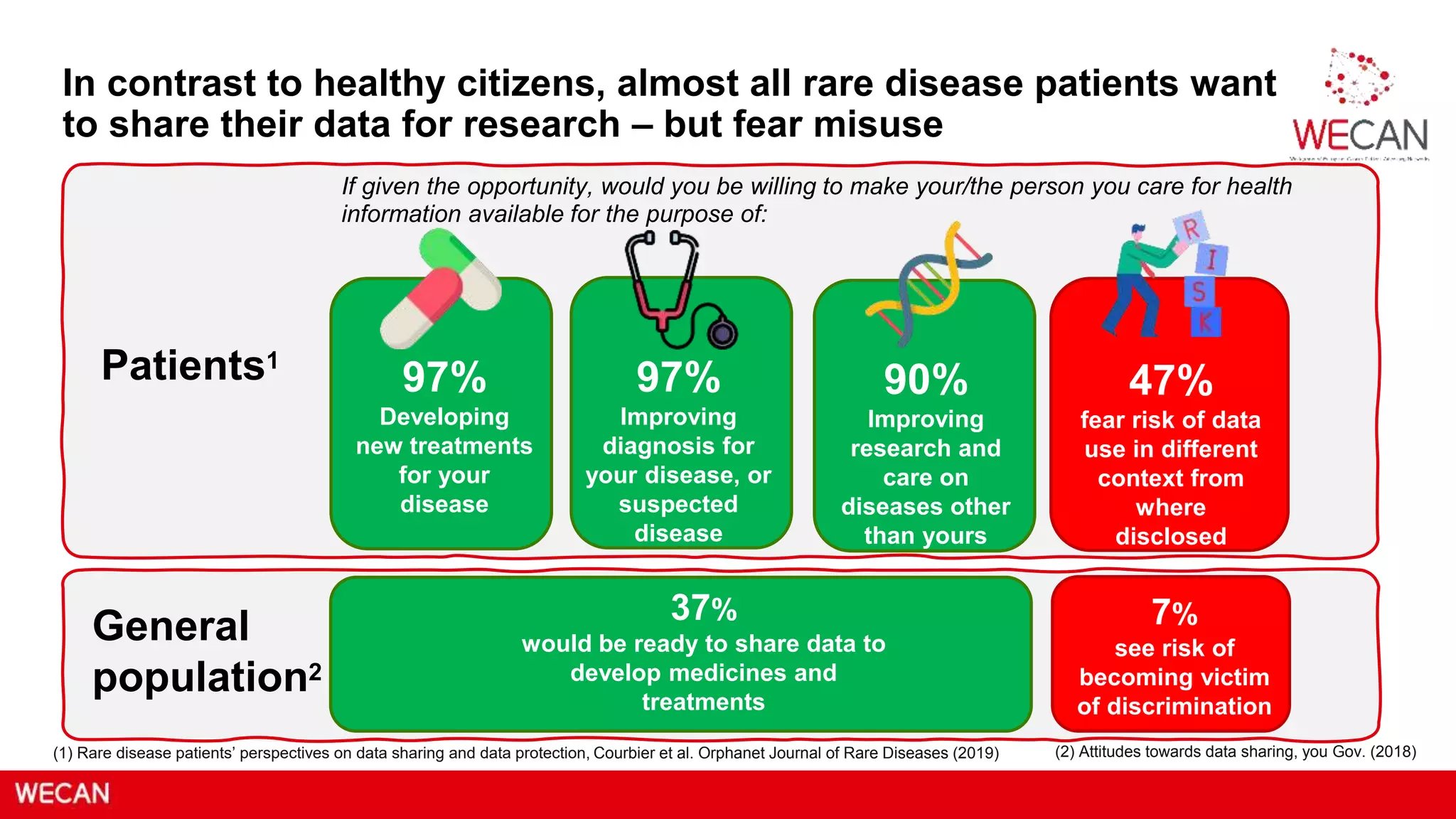
In contrast to healthy citizens, almost all rare disease patients want
to share their data for research – but fear misuse
If given the opportunity, would you be willing to make your/the person you care for health
information available for the purpose of:
97%
Developing
new treatments
for your
disease
97%
Improving
diagnosis for
your disease, or
suspected
disease
90%
Improving
research and
care on
diseases other
than yours
47%
fear risk of data
use in different
context from
where
disclosed
7%
see risk of
becoming victim
of discrimination
37%
would be ready to share data to
develop medicines and
treatments
Patients1
General
population2
(1) Rare disease patients’ perspectives on data sharing and data protection, Courbier et al. Orphanet Journal of Rare Diseases (2019) (2) Attitudes towards data sharing, you Gov. (2018)
The GDPR opportunity: (Health) data to the people
 Explicit consent for health data: Well-defined purpose, what
data is collected, who collects and processes it
 Right to refuse: without detrimental consequence
 Right to be forgotten: withdrawal of consent, deletion of data
 Right of citizens to access and data portability: obtain
machine readable copies of all their personal data (personal,
shopping, medical, education, etc)
 Right to rectification: correction of inaccurate data
 Right to object: e.g. to direct marketing
Does the way we usually obtain consent
solve the issue?
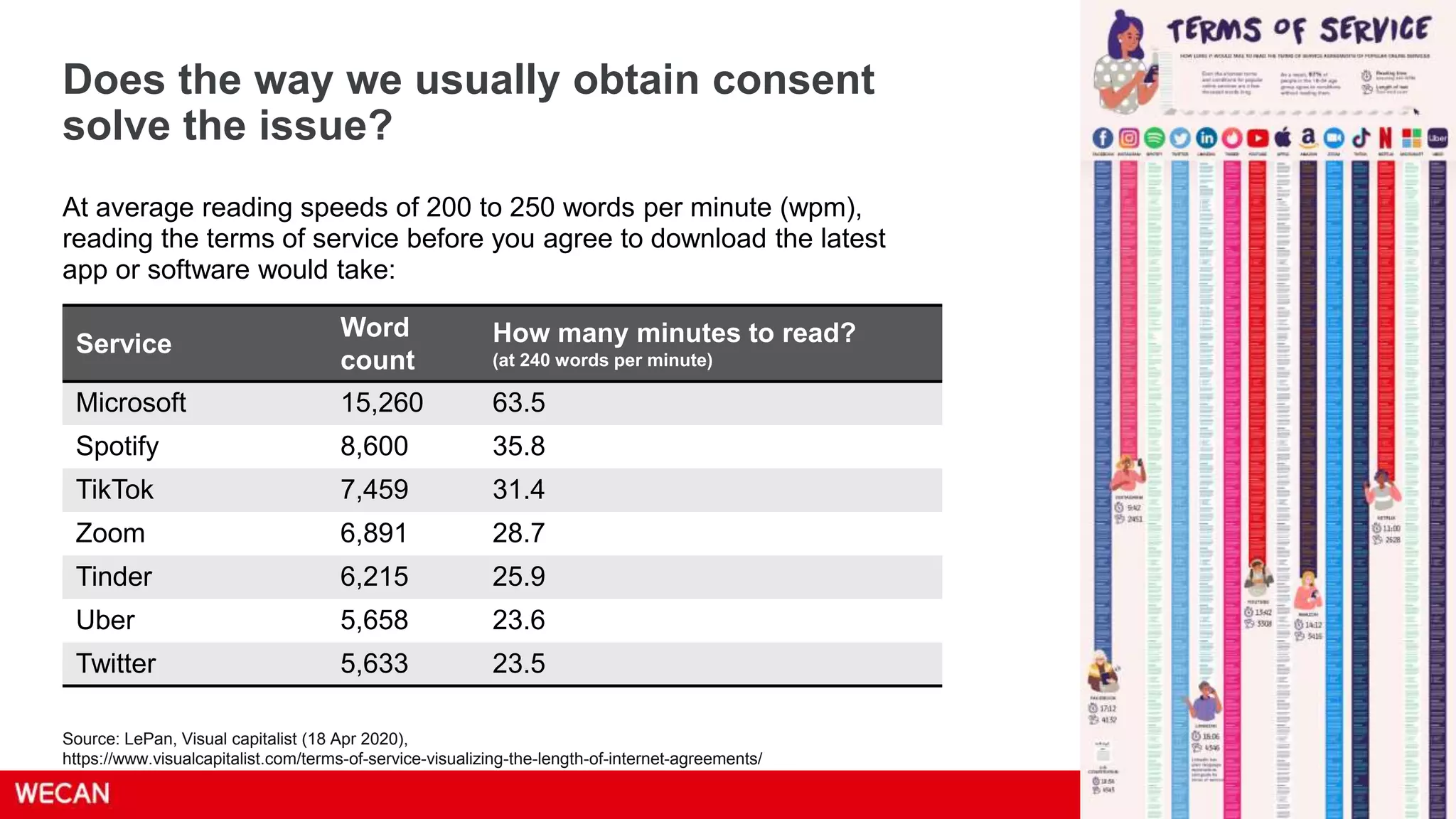
At average reading speeds of 200 to 250 words per minute (wpm),
reading the terms of service before you agree to download the latest
app or software would take:
Service
Word
count
How many minutes to read?
(at 240 words per minute)
Microsoft 15,260 63.5
Spotify 8,600 35.8
TikTok 7,459 31.4
Zoom 6,891 28.7
Tinder 6,215 25.9
Uber 5,658 23.6
Twitter 5,633 23.5
Source: LePan, Visual capitalist (18 Apr 2020),
https://www.visualcapitalist.com/terms-of-service-visualizing-the-length-of-internet-agreements/
Patient organisations are ideal honest brokers
and custodians in data governance
Patient organisations…
 are the ideal custodians on data governance (consent management, collection, data management, ownership,
security)
 can enable all stakeholders on purposeful research without compromising patients’ privacy, preventing misuse
 can ensure that research results are published irrespective of whether results are positive or negative
 may even act as a cooperative or patient-led data commons to collect personal data, and agree that their
pseudonymized personal data is shared as a fiduciary with patient advocacy, academic, pharma or healthcare
system research
MIDATA.coop, POSMO.coop and similar data cooperatives as pilots and a model? Adapted from Prof. Ernst Hafen, ETH Zürich (2021)
Data Commons
[Pseudonymized data
of community members]
clinical medical genomic
PRO
sensors geolocation microbiome
preferences
Patient organisation
Clinical
researchers
Healthcare
providers
Industry
Regulators
Payers
Policy
makers
Patient-led mobile “registry”:
The “Know your CML” QoL app
 Patient experience app, based on self-reported
data
 Personal health record, including test results,
quality of life and side effect experience
 QoL tracker based on validated EORTC QoL
PROM as well as PRO-CTCAE
 Patient can report to physician about observed
toxicity and QoL at next visit
 Patient can compare individual experience with
aggregate data of all other app users:
is my side effect rare? How are others doing?
 Data can be used for research on real-world QoL
and toxicities
Source: CML Advocates Network, https://www.cmladvocates.net/know-your-cml/
Conclusions
 In contrast to healthy citizens, almost all patients want to share their data for research – but fear
misuse and discrimination
 Managing data and consent is not a purpose or value on its own for individual patients:
There needs to be a direct and personal „return on engagement“ (for their lifetime)
 Patient organisations are ideal honest brokers and custodians in data governance and data
management to enable purposeful research, lawful and ethical data use, and publication of
results
 Patient organisations can generate robust evidence that benefits individual patients
AND research
Ananda Plate
ananda@patvocates.net

Health data sharing from patients' perspective

  • 1.
    User-managed access The solutionto sharing data for research and innovation? Ananda Plate Executive Director, Patvocates Research​ Board Member, Myeloma Patients Europe​ Former Chair, WECAN
  • 2.
    In contrast tohealthy citizens, almost all rare disease patients want to share their data for research – but fear misuse If given the opportunity, would you be willing to make your/the person you care for health information available for the purpose of: 97% Developing new treatments for your disease 97% Improving diagnosis for your disease, or suspected disease 90% Improving research and care on diseases other than yours 47% fear risk of data use in different context from where disclosed 7% see risk of becoming victim of discrimination 37% would be ready to share data to develop medicines and treatments Patients1 General population2 (1) Rare disease patients’ perspectives on data sharing and data protection, Courbier et al. Orphanet Journal of Rare Diseases (2019) (2) Attitudes towards data sharing, you Gov. (2018)
  • 3.
    The GDPR opportunity:(Health) data to the people  Explicit consent for health data: Well-defined purpose, what data is collected, who collects and processes it  Right to refuse: without detrimental consequence  Right to be forgotten: withdrawal of consent, deletion of data  Right of citizens to access and data portability: obtain machine readable copies of all their personal data (personal, shopping, medical, education, etc)  Right to rectification: correction of inaccurate data  Right to object: e.g. to direct marketing
  • 4.
    Does the waywe usually obtain consent solve the issue? At average reading speeds of 200 to 250 words per minute (wpm), reading the terms of service before you agree to download the latest app or software would take: Service Word count How many minutes to read? (at 240 words per minute) Microsoft 15,260 63.5 Spotify 8,600 35.8 TikTok 7,459 31.4 Zoom 6,891 28.7 Tinder 6,215 25.9 Uber 5,658 23.6 Twitter 5,633 23.5 Source: LePan, Visual capitalist (18 Apr 2020), https://www.visualcapitalist.com/terms-of-service-visualizing-the-length-of-internet-agreements/
  • 5.
    Patient organisations areideal honest brokers and custodians in data governance Patient organisations…  are the ideal custodians on data governance (consent management, collection, data management, ownership, security)  can enable all stakeholders on purposeful research without compromising patients’ privacy, preventing misuse  can ensure that research results are published irrespective of whether results are positive or negative  may even act as a cooperative or patient-led data commons to collect personal data, and agree that their pseudonymized personal data is shared as a fiduciary with patient advocacy, academic, pharma or healthcare system research MIDATA.coop, POSMO.coop and similar data cooperatives as pilots and a model? Adapted from Prof. Ernst Hafen, ETH Zürich (2021) Data Commons [Pseudonymized data of community members] clinical medical genomic PRO sensors geolocation microbiome preferences Patient organisation Clinical researchers Healthcare providers Industry Regulators Payers Policy makers
  • 6.
    Patient-led mobile “registry”: The“Know your CML” QoL app  Patient experience app, based on self-reported data  Personal health record, including test results, quality of life and side effect experience  QoL tracker based on validated EORTC QoL PROM as well as PRO-CTCAE  Patient can report to physician about observed toxicity and QoL at next visit  Patient can compare individual experience with aggregate data of all other app users: is my side effect rare? How are others doing?  Data can be used for research on real-world QoL and toxicities Source: CML Advocates Network, https://www.cmladvocates.net/know-your-cml/
  • 7.
    Conclusions  In contrastto healthy citizens, almost all patients want to share their data for research – but fear misuse and discrimination  Managing data and consent is not a purpose or value on its own for individual patients: There needs to be a direct and personal „return on engagement“ (for their lifetime)  Patient organisations are ideal honest brokers and custodians in data governance and data management to enable purposeful research, lawful and ethical data use, and publication of results  Patient organisations can generate robust evidence that benefits individual patients AND research Ananda Plate ananda@patvocates.net