Introduction to Distributed
Database system
Lecture-01
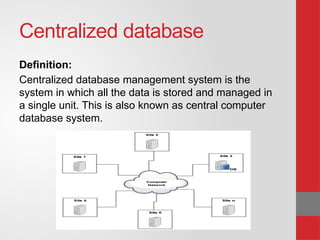
Centralized database
Definition:
Centralized database management system is the
system in which all the data is stored and managed in
a single unit. This is also known as central computer
database system.
Usage of centralized DBMS
1. Organization
2. Business Company or in institution
3. Data can be accessed through a network
Local Area Network (LAN) or Wide Area
Network (WAN).
advantage
1-Data integrity
Data is more unified as it stored in single computer system
and managed. It is easier to communicate and coordinate to
get more reliable and meaningful data.
2-Data redundancy
Data is centralized and stored in one location only. There is
no duplication of data and irrelevancy in data.
3-Data security
Due to storage of data in centralized computer system, the
security of data needs to be stronger. Centralized database
management system is more secure and more efficient.
Disadvantage
Slow processing
In centralized database management system, data is
stored in one location and it access and processing
speed is lesser than other management system. It
requires more time to access the data from one
location.
Loss of data
In centralized database management system, if any
system failure occurs or any data is lost, then it is
not recovered.
Distributed database
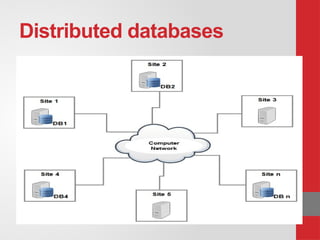
1. A distributed database is a collection of multiple
interconnected databases, which are spread
physically across various locations that
communicate via a computer network.
2. there are a number of databases that may be
geographically distributed all over the world. A
distributed DBMS manages the distributed
database in a manner so that it appears as one
single database to users.
Distributed databases
Features
1. Databases in the collection are logically
interrelated with each other. Often they represent a
single logical database.
2. Data is physically stored across multiple sites.
Data in each site can be managed by a DBMS
independent of the other sites.
Type of distributed database
There are two types of distributed database system with respect to
data and its storage.
1. Homogeneous
2. Heterogeneous
Homogeneous
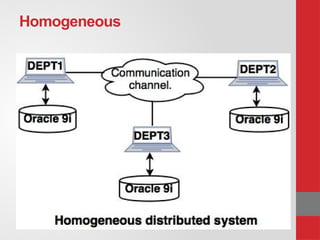
The homogeneous database system is the network in
which all site/systems are homogeneous. The
operating system, database management system and
data structure used in all these sites are installed in
the same vendor. All the data and information is
accessed and modified simultaneously. Homogeneous
database system is very easy to access and handle.
Homogeneous
Heterogeneous
Heterogeneous
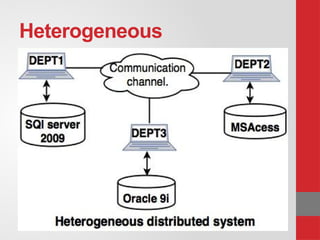
The heterogeneous distributed database
management system is the network of two or more
databases which has different type of database
management systems. These systems can store
data in different storage machines.
These systems can use different
1. Operating systems
2. Different database management systems like
relational, network or hierarchical.
3. Query processing is more complex.
Heterogeneous
Advantages of Distributed database system
Reliable
In distributed database management system, if
any connected system fails to do work then there
is no effect on the performance of the system. It
continues functioning and it is more reliable than
other simple database management system.
Low communication cost
Data and information is stored locally in distributed
database management system. Its communication
cost and data manipulation become easy and less
costly.
Advantages of Distributed database
system
1. Modular development
Modulation in distributed database management system is so
easy. More systems can be manipulated and installed by just
installing and connecting with the distributed database system
with no interruption and failure.
2. Better response
All the computer system are installed centrally and can
process any query with in shortest possible time. It provides
faster response due to centralized processing of database
management systems.
3. Data recovery
Data can be easily recovered in distributed database
management systems.
Disadvantages of Distributed database system
1. Data integrity
Data is updated on multiple sites can cause
problems. Data integrity is more complex and very
hard to handle.
2. Duplication of data
Same type of data is stored in different systems
make duplication of data. It takes much space to
store the same data in different computer systems
in distributed database management systems.
Disadvantages of Distributed
database system
1. Improper data distribution
Improper data distribution can lead to slow response in
processing of query. Same data is stored in different
computers can create more problems in distributed
database management systems.
2. Less processing speed
Much communication is needed to a simple query to
perform. In this reason ample time period is required to
solve a specific problem.

Lect-1 database management system 1 class

  • 1.
  • 2.
    Centralized database Definition: Centralized databasemanagement system is the system in which all the data is stored and managed in a single unit. This is also known as central computer database system.
  • 3.
    Usage of centralizedDBMS 1. Organization 2. Business Company or in institution 3. Data can be accessed through a network Local Area Network (LAN) or Wide Area Network (WAN).
  • 4.
    advantage 1-Data integrity Data ismore unified as it stored in single computer system and managed. It is easier to communicate and coordinate to get more reliable and meaningful data. 2-Data redundancy Data is centralized and stored in one location only. There is no duplication of data and irrelevancy in data. 3-Data security Due to storage of data in centralized computer system, the security of data needs to be stronger. Centralized database management system is more secure and more efficient.
  • 5.
    Disadvantage Slow processing In centralizeddatabase management system, data is stored in one location and it access and processing speed is lesser than other management system. It requires more time to access the data from one location. Loss of data In centralized database management system, if any system failure occurs or any data is lost, then it is not recovered.
  • 6.
    Distributed database 1. Adistributed database is a collection of multiple interconnected databases, which are spread physically across various locations that communicate via a computer network. 2. there are a number of databases that may be geographically distributed all over the world. A distributed DBMS manages the distributed database in a manner so that it appears as one single database to users.
  • 7.
  • 8.
    Features 1. Databases inthe collection are logically interrelated with each other. Often they represent a single logical database. 2. Data is physically stored across multiple sites. Data in each site can be managed by a DBMS independent of the other sites.
  • 9.
    Type of distributeddatabase There are two types of distributed database system with respect to data and its storage. 1. Homogeneous 2. Heterogeneous Homogeneous The homogeneous database system is the network in which all site/systems are homogeneous. The operating system, database management system and data structure used in all these sites are installed in the same vendor. All the data and information is accessed and modified simultaneously. Homogeneous database system is very easy to access and handle.
  • 10.
  • 11.
    Heterogeneous Heterogeneous The heterogeneous distributeddatabase management system is the network of two or more databases which has different type of database management systems. These systems can store data in different storage machines. These systems can use different 1. Operating systems 2. Different database management systems like relational, network or hierarchical. 3. Query processing is more complex.
  • 12.
  • 13.
    Advantages of Distributeddatabase system Reliable In distributed database management system, if any connected system fails to do work then there is no effect on the performance of the system. It continues functioning and it is more reliable than other simple database management system. Low communication cost Data and information is stored locally in distributed database management system. Its communication cost and data manipulation become easy and less costly.
  • 14.
    Advantages of Distributeddatabase system 1. Modular development Modulation in distributed database management system is so easy. More systems can be manipulated and installed by just installing and connecting with the distributed database system with no interruption and failure. 2. Better response All the computer system are installed centrally and can process any query with in shortest possible time. It provides faster response due to centralized processing of database management systems. 3. Data recovery Data can be easily recovered in distributed database management systems.
  • 15.
    Disadvantages of Distributeddatabase system 1. Data integrity Data is updated on multiple sites can cause problems. Data integrity is more complex and very hard to handle. 2. Duplication of data Same type of data is stored in different systems make duplication of data. It takes much space to store the same data in different computer systems in distributed database management systems.
  • 16.
    Disadvantages of Distributed databasesystem 1. Improper data distribution Improper data distribution can lead to slow response in processing of query. Same data is stored in different computers can create more problems in distributed database management systems. 2. Less processing speed Much communication is needed to a simple query to perform. In this reason ample time period is required to solve a specific problem.