Unit 4: Programming
Computational thinking
skills (2)
Unit 4: Programming
Pearson BTEC Nationals in IT
Unit 4: Programming
Pattern recognition
 What is it?
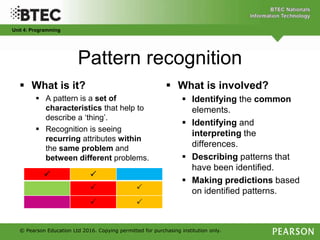
 A pattern is a set of
characteristics that help to
describe a ‘thing’.
 Recognition is seeing
recurring attributes within
the same problem and
between different problems.
 What is involved?
 Identifying the common
elements.
 Identifying and
interpreting the
differences.
 Describing patterns that
have been identified.
 Making predictions based
on identified patterns.
© Pearson Education Ltd 2016. Copying permitted for purchasing institution only.
 
 
 
Unit 4: Programming
Pattern generalisation and abstraction
 What is it?
 Abstraction is the
simplification of a more
complex process or feature.
 Generalisation is the process
of ignoring the confusing
detail.
 Why use it?
 Complex mechanisms are
ignored, allowing us to see
‘the wood for the trees’.
 Provides ‘thinking distance’
for the programmer.
 Less worry about how
something actually works …
 … helps to identify the
repeating patterns that
actually exist.
 Decide what to include and
what to ignore.
© Pearson Education Ltd 2016. Copying permitted for purchasing institution only.
Unit 4: Programming
Representing parts of a problem or system
 What is it?
 Identifying what is needed to
solve a problem or build a
system and how these pieces
fit together.
 Why is this important?
 You are starting to consider
how to solve the problem.
 What does this include?
 Variables – values that
change.
 Constants – values that
remain fixed.
 Key processes.
 Repeated processes.
 Inputs needed.
 Outputs required.
© Pearson Education Ltd 2016. Copying permitted for purchasing institution only.

U4 LA A ppt 2

  • 1.
    Unit 4: Programming Computationalthinking skills (2) Unit 4: Programming Pearson BTEC Nationals in IT
  • 2.
    Unit 4: Programming Patternrecognition  What is it?  A pattern is a set of characteristics that help to describe a ‘thing’.  Recognition is seeing recurring attributes within the same problem and between different problems.  What is involved?  Identifying the common elements.  Identifying and interpreting the differences.  Describing patterns that have been identified.  Making predictions based on identified patterns. © Pearson Education Ltd 2016. Copying permitted for purchasing institution only.      
  • 3.
    Unit 4: Programming Patterngeneralisation and abstraction  What is it?  Abstraction is the simplification of a more complex process or feature.  Generalisation is the process of ignoring the confusing detail.  Why use it?  Complex mechanisms are ignored, allowing us to see ‘the wood for the trees’.  Provides ‘thinking distance’ for the programmer.  Less worry about how something actually works …  … helps to identify the repeating patterns that actually exist.  Decide what to include and what to ignore. © Pearson Education Ltd 2016. Copying permitted for purchasing institution only.
  • 4.
    Unit 4: Programming Representingparts of a problem or system  What is it?  Identifying what is needed to solve a problem or build a system and how these pieces fit together.  Why is this important?  You are starting to consider how to solve the problem.  What does this include?  Variables – values that change.  Constants – values that remain fixed.  Key processes.  Repeated processes.  Inputs needed.  Outputs required. © Pearson Education Ltd 2016. Copying permitted for purchasing institution only.