livinglabs.regione.puglia.it
Integrated platform for SUAP electronic management
Cloud Computing
The project goal is to create an integrated platform for SUAP digital
management in compliance with the current legislation, including the D.P.R.
n.160 Of 7 September 2010.
It has to be usable by both the back office user and the citizen/company/free
lance who needs to open, close or modify productive activities.
The work has been commissioned by the Murgian area’s SUAP (Murgia
Sviluppo S.C.A.R.L.), a government agency responsible for the territorial pact
of 18 Murgia’s cities.
The platform has to provide a complete online version of SUAP services in
order to be more efficient and transparent than now for both the citizens and
Institutions, allowing to do all administrative procedures in self-service mode,
while maintaining full control of their evolution.
Project goal
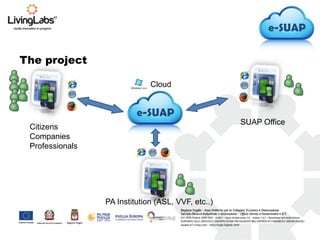
The project
Citizens
Companies
Professionals
SUAP Office
PA Institution (ASL, VVF, etc..)
Cloud
Why cloud computing?
Cloud computing patterns
t
Compute
Inactivity
Period
t
t
t
On and Off
On & off workloads (e.g. batch job)
Over provisioned capacity is wasted
Time to market can be cumbersome
Unpredictable Bursting
Unexpected/unplanned peak in demand
Sudden spike impacts performance
Can’t over provision for extreme cases
Compute
Growing Fast
Successful services needs to grow/scale
Keeping up w/ growth is big IT challenge
Cannot provision hardware fast enough
Compute
Predictable Bursting
Services with micro seasonality trends
Peaks due to periodic increased demand
IT complexity and wasted capacity
Compute
Cloud computing - Definitions
“Cloud-Computing” indicates a collection of
technologies that allows to store and process data
by using distributed and virtualized hardware and
software resources.
Typically it is a service offered by a provider, with a
classical client-server architecture.
Cloud computing - definitions
Cloud Computing is a style of computing paradigm
in which typically real-time scalable resources such
as files, data, programs, hardware, and third party
services can be accessible from a Web browser via
Internet to users.
Cloud computing - definitions
Resources are released by a service provider in the simplest way and
with the lowest possible interaction with users.
Cloud Computing benefits
It achieves economies of scale increasing volume
output or productivity with fewer people. Cost per
unit, project or product plummets.
Cloud Computing benefits
Cloud computing is probably the most cost efficient method to use,
maintain and upgrade. Traditional desktop software costs companies a
lot in terms of finance. Adding up the licensing fees for multiple users
can prove to be very expensive for the establishment concerned. The
cloud, on the other hand, is available at much cheaper rates and hence,
can significantly lower the company’s IT expenses.
Storing information in the cloud gives you almost unlimited storage
capacity. Hence, companies no more need to worry about running out of
storage space or increasing their current storage space availability.
Basic Features
On-demand self-service
• A consumer can unilaterally provision computing capabilities, such as server
time and network storage, as needed automatically without requiring human
interaction with each service’s provider.Broad network access
Broad network access
• Capabilities are available over the network and accessed through standard
mechanisms that promote use by heterogeneous thin or thick client
platforms (e. g. mobile phones, laptops, and PDAs).
Resource pooling
The provider’s computing resources are pooled to serve all consumers using a
multi-tenant model, with different physical and virtual resources dynamically
assigned and reassigned according to consumer demand.
Basic features
Rapid elasticity
• Capabilities can be rapidly and elastically provisioned, in some cases
automatically, to quickly scale out and rapidly released to quickly scale in.
To the consumer, the capabilities available for rent often appear to be
infinite and can be purchased in any quantity at any time.
Measured Service
• Cloud systems automatically control and optimize resource use by
leveraging a metering capability at some level of abstraction appropriate to
the type of service (e.g. storage, processing, bandwidth, and active user
accounts). Resource usage can be monitored, controlled, and reported,
providing transparency for both the provider and consumer of the utilized
service.
Cloud Computing: Virtualization
The main enabling technology for cloud computing is virtualization.
Virtualization software allows a physical computing device to be
electronically separated into one or more "virtual" devices, each of
which can be easily used and managed to perform computing tasks.
With operating system–level virtualization essentially creating a scalable
system of multiple independent computing devices, idle computing
resources can be allocated and used more efficiently. Virtualization
provides the agility required to speed up IT operations, and reduces cost
by increasing infrastructure utilization.
Cloud Computing: SOA, metrics e grid computing
Cloud computing adopts concepts from Service-oriented Architecture (SOA) that
can help the user break these problems into services that can be integrated to
provide a solution (Cloud computing provides all of its resources as services).
It provides metrics for the used services allowing them to scale on-demand and
to perform automatic failure recovery.
Cloud computing is a kind of grid computing; it has evolved by addressing the
QoS (quality of service) and reliability problems. Cloud computing provides the
tools and technologies to build data/compute intensive parallel applications with
much more affordable prices compared to traditional parallel computing
techniques.
Cloud computing: architectures
Client-server: there is a partition of tasks or workloads between the
providers of a resource or service, called servers, and service
requesters, called clients.
Grid computing: A form of distributed and parallel computing, whereby
a 'super and virtual computer' is composed of a cluster of networked,
loosely coupled computers acting in concert to perform very large tasks
Utility computing: The packaging of computing resources, such as
computation and storage, as a metered service similar to a traditional
public utility, such as electricity
Peer-to-peer: A distributed architecture without the need for central
coordination. Participants are both suppliers and consumers of
resources (in contrast to the traditional client–server model).
How is Cloud-Computing used?
“Cloud-Computing” often indicates the services sale, in the sense of
providing application services remotely through a client/server system.
Consumers access resources by using web-browsers, or a (thin) client or
a mobile app, that act as interfaces. Instead, the processing software and
data are on remote servers.
Service models
Cloud computing providers offer their services according to several
fundamental models:
◦ SaaS, Software as a Service
◦ DaaS, Data as a Service
◦ Haas, Hardware as a Service
◦ PaaS, Platform as a Service
◦ IaaS, Infrastructure as a Service
◦ SECaaS, Security as a Service
◦ EaaS, Everything as a Service
IaaS: Infrastructure as a Service
The «infrastructure as a service» provides servers and storage space:
cloud users install operating-system images and their application
software (i.e. ERP or CRM suite) on the cloud infrastructure.
Users hadn’t to manage cloud infrastructure, but they control operative
systems, storage space and distributed applications.
PaaS: Platform as a Service
In the PaaS models, cloud providers deliver a computing platform,
typically including operating system, programming language execution
environment, database, and web server.
Application developers can develop and run their software solutions on a
cloud platform without the cost and complexity of buying and managing
the underlying hardware and software layers.
Users hadn’t to manage cloud infrastructure, but they can control
distributed application and hosting configurations.
SaaS: Software as a Service
In a «Software as a service>, also known as «on-demand software»
users are provided access to application software and databases. Cloud
providers manage the infrastructure and platforms that run the
applications.
Cloud providers install and operate application software in the cloud
and cloud users access the software from cloud clients (web browsers,
mobile apps).
Cloud users do not manage the cloud infrastructure and platform where
the application runs. This eliminates the need to install and run the
application on the cloud user's own computers, which simplifies
maintenance and support.
Service Models
Distribution models
Private cloud
◦ It defines a cloud infrastructure operated solely for a single organization (company or institution).
◦ It can be managed internally or by a third-party company, and hosted either internally or
externally.
Community cloud
◦ The infrastructure is shared between several organizations from a specific community with
common concerns (security, compliance, jurisdiction, etc.), whether managed internally or by a
third-party, and either hosted internally or externally.
◦ It can be in on premise or off premise form.
Public cloud
◦ A public cloud is one based on the standard cloud computing model, in which a service provider
makes resources, such as applications and storage, available to the general public over the
Internet. Public cloud services may be free or offered on a pay-per-usage model.
Hybrid cloud
◦ Hybrid cloud is a composition of two or more clouds (private, community or public) that remain
distinct entities but are bound together, offering the benefits of multiple deployment models.
Hybrid cloud can also mean the ability to connect collocation, managed and/or dedicated services
with cloud resources.
Providers
• Google
• Amazon
• IBM
• Oracle Cloud
• Rackspace
• Salesforce
• Zoho
• Microsoft
Ing. Luca Barbi – lbarbi@codearchitects.com
Code Architects s.r.l.
Via Jazzitiello 15 C/D Santeramo in Colle (Bari)
www.codearchitects.com

e-suap cloud computing- English version

  • 1.
    livinglabs.regione.puglia.it Integrated platform forSUAP electronic management Cloud Computing
  • 2.
    The project goalis to create an integrated platform for SUAP digital management in compliance with the current legislation, including the D.P.R. n.160 Of 7 September 2010. It has to be usable by both the back office user and the citizen/company/free lance who needs to open, close or modify productive activities. The work has been commissioned by the Murgian area’s SUAP (Murgia Sviluppo S.C.A.R.L.), a government agency responsible for the territorial pact of 18 Murgia’s cities. The platform has to provide a complete online version of SUAP services in order to be more efficient and transparent than now for both the citizens and Institutions, allowing to do all administrative procedures in self-service mode, while maintaining full control of their evolution. Project goal
  • 3.
  • 4.
  • 5.
    Cloud computing patterns t Compute Inactivity Period t t t Onand Off On & off workloads (e.g. batch job) Over provisioned capacity is wasted Time to market can be cumbersome Unpredictable Bursting Unexpected/unplanned peak in demand Sudden spike impacts performance Can’t over provision for extreme cases Compute Growing Fast Successful services needs to grow/scale Keeping up w/ growth is big IT challenge Cannot provision hardware fast enough Compute Predictable Bursting Services with micro seasonality trends Peaks due to periodic increased demand IT complexity and wasted capacity Compute
  • 6.
    Cloud computing -Definitions “Cloud-Computing” indicates a collection of technologies that allows to store and process data by using distributed and virtualized hardware and software resources. Typically it is a service offered by a provider, with a classical client-server architecture.
  • 7.
    Cloud computing -definitions Cloud Computing is a style of computing paradigm in which typically real-time scalable resources such as files, data, programs, hardware, and third party services can be accessible from a Web browser via Internet to users.
  • 8.
    Cloud computing -definitions Resources are released by a service provider in the simplest way and with the lowest possible interaction with users.
  • 9.
    Cloud Computing benefits Itachieves economies of scale increasing volume output or productivity with fewer people. Cost per unit, project or product plummets.
  • 10.
    Cloud Computing benefits Cloudcomputing is probably the most cost efficient method to use, maintain and upgrade. Traditional desktop software costs companies a lot in terms of finance. Adding up the licensing fees for multiple users can prove to be very expensive for the establishment concerned. The cloud, on the other hand, is available at much cheaper rates and hence, can significantly lower the company’s IT expenses. Storing information in the cloud gives you almost unlimited storage capacity. Hence, companies no more need to worry about running out of storage space or increasing their current storage space availability.
  • 11.
    Basic Features On-demand self-service •A consumer can unilaterally provision computing capabilities, such as server time and network storage, as needed automatically without requiring human interaction with each service’s provider.Broad network access Broad network access • Capabilities are available over the network and accessed through standard mechanisms that promote use by heterogeneous thin or thick client platforms (e. g. mobile phones, laptops, and PDAs). Resource pooling The provider’s computing resources are pooled to serve all consumers using a multi-tenant model, with different physical and virtual resources dynamically assigned and reassigned according to consumer demand.
  • 12.
    Basic features Rapid elasticity •Capabilities can be rapidly and elastically provisioned, in some cases automatically, to quickly scale out and rapidly released to quickly scale in. To the consumer, the capabilities available for rent often appear to be infinite and can be purchased in any quantity at any time. Measured Service • Cloud systems automatically control and optimize resource use by leveraging a metering capability at some level of abstraction appropriate to the type of service (e.g. storage, processing, bandwidth, and active user accounts). Resource usage can be monitored, controlled, and reported, providing transparency for both the provider and consumer of the utilized service.
  • 13.
    Cloud Computing: Virtualization Themain enabling technology for cloud computing is virtualization. Virtualization software allows a physical computing device to be electronically separated into one or more "virtual" devices, each of which can be easily used and managed to perform computing tasks. With operating system–level virtualization essentially creating a scalable system of multiple independent computing devices, idle computing resources can be allocated and used more efficiently. Virtualization provides the agility required to speed up IT operations, and reduces cost by increasing infrastructure utilization.
  • 14.
    Cloud Computing: SOA,metrics e grid computing Cloud computing adopts concepts from Service-oriented Architecture (SOA) that can help the user break these problems into services that can be integrated to provide a solution (Cloud computing provides all of its resources as services). It provides metrics for the used services allowing them to scale on-demand and to perform automatic failure recovery. Cloud computing is a kind of grid computing; it has evolved by addressing the QoS (quality of service) and reliability problems. Cloud computing provides the tools and technologies to build data/compute intensive parallel applications with much more affordable prices compared to traditional parallel computing techniques.
  • 15.
    Cloud computing: architectures Client-server:there is a partition of tasks or workloads between the providers of a resource or service, called servers, and service requesters, called clients. Grid computing: A form of distributed and parallel computing, whereby a 'super and virtual computer' is composed of a cluster of networked, loosely coupled computers acting in concert to perform very large tasks Utility computing: The packaging of computing resources, such as computation and storage, as a metered service similar to a traditional public utility, such as electricity Peer-to-peer: A distributed architecture without the need for central coordination. Participants are both suppliers and consumers of resources (in contrast to the traditional client–server model).
  • 16.
    How is Cloud-Computingused? “Cloud-Computing” often indicates the services sale, in the sense of providing application services remotely through a client/server system. Consumers access resources by using web-browsers, or a (thin) client or a mobile app, that act as interfaces. Instead, the processing software and data are on remote servers.
  • 17.
    Service models Cloud computingproviders offer their services according to several fundamental models: ◦ SaaS, Software as a Service ◦ DaaS, Data as a Service ◦ Haas, Hardware as a Service ◦ PaaS, Platform as a Service ◦ IaaS, Infrastructure as a Service ◦ SECaaS, Security as a Service ◦ EaaS, Everything as a Service
  • 18.
    IaaS: Infrastructure asa Service The «infrastructure as a service» provides servers and storage space: cloud users install operating-system images and their application software (i.e. ERP or CRM suite) on the cloud infrastructure. Users hadn’t to manage cloud infrastructure, but they control operative systems, storage space and distributed applications.
  • 19.
    PaaS: Platform asa Service In the PaaS models, cloud providers deliver a computing platform, typically including operating system, programming language execution environment, database, and web server. Application developers can develop and run their software solutions on a cloud platform without the cost and complexity of buying and managing the underlying hardware and software layers. Users hadn’t to manage cloud infrastructure, but they can control distributed application and hosting configurations.
  • 20.
    SaaS: Software asa Service In a «Software as a service>, also known as «on-demand software» users are provided access to application software and databases. Cloud providers manage the infrastructure and platforms that run the applications. Cloud providers install and operate application software in the cloud and cloud users access the software from cloud clients (web browsers, mobile apps). Cloud users do not manage the cloud infrastructure and platform where the application runs. This eliminates the need to install and run the application on the cloud user's own computers, which simplifies maintenance and support.
  • 21.
  • 22.
    Distribution models Private cloud ◦It defines a cloud infrastructure operated solely for a single organization (company or institution). ◦ It can be managed internally or by a third-party company, and hosted either internally or externally. Community cloud ◦ The infrastructure is shared between several organizations from a specific community with common concerns (security, compliance, jurisdiction, etc.), whether managed internally or by a third-party, and either hosted internally or externally. ◦ It can be in on premise or off premise form. Public cloud ◦ A public cloud is one based on the standard cloud computing model, in which a service provider makes resources, such as applications and storage, available to the general public over the Internet. Public cloud services may be free or offered on a pay-per-usage model. Hybrid cloud ◦ Hybrid cloud is a composition of two or more clouds (private, community or public) that remain distinct entities but are bound together, offering the benefits of multiple deployment models. Hybrid cloud can also mean the ability to connect collocation, managed and/or dedicated services with cloud resources.
  • 23.
    Providers • Google • Amazon •IBM • Oracle Cloud • Rackspace • Salesforce • Zoho • Microsoft
  • 24.
    Ing. Luca Barbi– lbarbi@codearchitects.com Code Architects s.r.l. Via Jazzitiello 15 C/D Santeramo in Colle (Bari) www.codearchitects.com