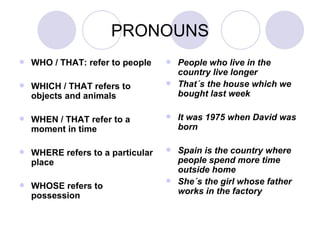
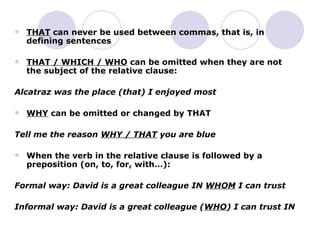
This document discusses different types of relative clauses and relative pronouns in English grammar. It defines defining and non-defining relative clauses and provides examples of relative pronouns like who, which, that, when, where, whose, and why and their proper uses in relative clauses.
![Defining : They provide essential information about the subject. If we took out this data the sentence would be incomplete Non-Defining : They add extra information about their antecedent, that is why it goes between commas RELATIVE CLAUSES C/ San Rafael, 25 46701-Gandia Tfno. 962 965 096 [email_address] www.escolapiasgandia.es COLEGIO ESCOLAPIAS GANDIA](https://image.slidesharecdn.com/u1relativeclauses-100214070313-phpapp02/85/U1-Relative-Clauses-1-320.jpg)
![Defining : They provide essential information about the subject. If we took out this data the sentence would be incomplete Non-Defining : They add extra information about their antecedent, that is why it goes between commas RELATIVE CLAUSES C/ San Rafael, 25 46701-Gandia Tfno. 962 965 096 [email_address] www.escolapiasgandia.es COLEGIO ESCOLAPIAS GANDIA](https://image.slidesharecdn.com/u1relativeclauses-100214070313-phpapp02/75/U1-Relative-Clauses-1-2048.jpg)


![# Flávio boleiz jr. - a psicofonia - [ espiritismo]](https://cdn.slidesharecdn.com/ss_thumbnails/flvioboleizjr-140504181702-phpapp02-thumbnail.jpg?width=640&height=640&fit=bounds)


