
Contact C.Ed. Overseas Education 
Your Guide to Overseas Education
Education System in Canada 
Education system in Canada is Internationally 
Recognized 
Canada has developed a first-rate education system with 
high standards. A Canadian degree, diploma or 
certificate is recognized globally as being equivalent to 
those from the United States and Commonwealth 
countries.
Student visa in Canada 
Step 1. Attend a counseling session at C.Ed. Overseas 
Education to find out your options relating to study 
destination, courses available and recommended institutions. 
Step2. Register with C.Ed. Overseas 
Step3. Apply to Desired Institution 
Step4. Undertake Medicals 
Step 5. Arrange Funds 
Step 6. Pay Tuition fee 
Step 7. Lodge Visa 
Step 8. Visa Outcome 
Step 9. Travel Forex & Accommodation
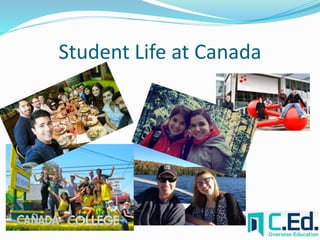
Student Life at Canada
SPP Colleges in Canada 
 Algonquin CollegeAlgonquin College of Applied Arts and Technology is a publicly 
funded English-language college and member of Polytechnics Canada located in 
Ottawa, Ontario, Canada. 
 George Brown CollegeGeorge Brown College in Toronto, Ontario provides 
students with the skills, experience and credentials to get the job they want. The 
college offers 135 full-time.. 
 Niagara CollegeNiagara College is a College of Applied Arts and Technology within 
the Niagara Region of Southern Ontario, Canada 
 Conestoga CollegeThe Conestoga College Institute of Technology and Advanced 
Learning is a public college based in Kitchener, Ontario, Canada. 
 Fanshwe CollegeFanshawe College is one of the largest colleges in Ontario, 
Canada. The main campus is in London, Ontario, with additional campuses in 
Simcoe, St. Thomas, Woodstock, and Tillsonburg 
 Douglas CollegeeDouglas College is one of the largest public colleges in British 
Columbia, Canada. Founded in 1970, the college serves some 14,000 credit students, 
9,000 continuing education students and 1,000 international students each year.
SPP Colleges in Canada 
 Fleming CollegeFleming College, also known as Sir Sandford Fleming College, is a 
College of Applied Arts and Technology in Peterborough, Ontario, Canada. 
 Seneca CollegeSeneca College of Applied Arts and Technology is a post-secondary 
community college and educational institution in Toronto. 
 Concordia UniversityConcordia University College of Alberta is a Canadian 
independent university in Edmonton, Alberta. 
 Mohawk CollegeMohawk College of Applied Arts and Technology is a public College of 
Applied Arts and Technology located in the Golden Horseshoe of Ontario, Canada. 
 Cambrian CollegeCambrian College is a college of applied arts and technology in 
Greater Sudbury, Ontario, Canada. Established in 1967, and funded by the province of 
Ontario... 
 Confederation CollegeConfederation College is a provincially funded college of applied 
arts and technology located in Thunder Bay, Ontario, Canada.
SPP Colleges in Canada 
 Centennial CollegeCentennial College is the oldest publicly funded college in Ontario. It is located 
in Toronto, Ontario, Canada; its four campuses are situated to serve the eastern portion of the Greater 
Toronto Area. 
 Durhan CollegeDurham College of Applied Arts and Technology is located in the Durham Region of 
Canada with campuses in Oshawa, Ontario, and Whitby, a Learning Site in Pickering and Community 
Employment Services in ... 
 Georgian CollegeGeorgian College is a college of applied arts and technology in Ontario, Canada, 
with three main campuses in Barrie, Orillia and Owen Sound and four additional campuses in 
Midland, Muskoka, Orangeville and South Georgian Bay. 
 Humber CollegeHumber College Institute of Technology and Advanced Learning is a polytechnic 
college in Toronto, Ontario, Canada. 
 Kwantlen Polytechnic UniversityKwantlen Polytechnic University offers educational programs and 
services in Greater Vancouver, British Columbia, Canada, campuses located in Surrey, 
 Lambton CollegeLambton College is located in Sarnia, Ontario and has a student population of 
about 3500 students.
Post Study Work Permit in Canada 
 Get a post-graduation work permit 
 The PGWPP allows students who have graduated from a participating 
Canadian post-secondary institution to gain valuable Canadian work 
experience. Skilled Canadian work experience gained through 
the PGWPP helps graduates qualify for permanent residence in Canada 
through the Canadian Experience Class (CEC). 
 A work permit under the PGWPP may be issued for the length of the 
study program, up to a maximum of three years. A post-graduation 
work permit cannot be valid for longer than the student’s study 
program, and the study program must be a minimum of eight months 
in length. For example, if you graduate from a four-year degree 
program, you could be eligible for a three-year work permit if you meet 
the criteria. If you graduate from an eight-month certificate program, 
you would be eligible for a work permit that is valid for no more than 
eight months. 
Source : http://www.cic.gc.ca/english/study/work-postgrad.asp
Post Study Work Permit in Canada 
Work on campus 
 You may work on campus at the institution where you study without a 
work permit if: 
 you are a full-time student at: 
 a public post-secondary institution, such as a college or university, or 
a collège d’enseignement général et professionnel (CEGEP) in Quebec 
 a private post-secondary institution that operates under the same rules 
and regulations as a public institution, and receives at least 50 percent 
of its financing for its overall operations from government grants 
(currently only private college-level educational institutions in Quebec 
qualify) or 
 a Canadian private institution authorized by provincial statute to 
confer degrees and 
 you have a valid study permit. 
Source : http://www.cic.gc.ca/english/study/work-oncampus.asp
Post Study Work Permit in Canada 
Work off campus 
 Study permit holders in Canada may gain work experience by working off 
campus while completing their studies. 
 As of June 1, 2014, you may qualify to work off campus without a work permit. If 
you qualify, your study permit will allow you to work up to 20 hours per week: 
 during regular academic sessions and 
 full-time during scheduled breaks, such as the winter and summer holidays or 
spring break. 
 To qualify, you must: 
 have a valid study permit, 
 be a full-time student, 
 be enrolled at a designated learning institution at the post-secondary level or, 
in Quebec, a vocational program at the secondary level, and 
 be studying in an academic, vocational or professional training program that 
leads to a degree, diploma or certificate that is at least six months in duration. 
Source : http://www.cic.gc.ca/english/study/work-offcampus.asp
SPP Colleges in Canada 
 North Island CollegeNorth Island College { WikiMapia: } is a community 
college located primarily on Vancouver Island, British Columbia, Canada. 
 Red River CollegeA technical college based in Winnipeg. Its focus is on 
practical experience courses in Business Administration, Computer Analyst 
Programming, and trade ... 
 Thompson River UniversityA degree granting University with main campus 
in Kamloops and regional centres in Williams Lake and Burnaby, offering a 
wide range of program options. 
 St. Clair College CollegeSt. Clair College, in Windsor and Chatham-Kent, 
offers programs in Business & Information Technology, Community Studies, 
Engineering, Health Sciences, ... 
 Sheridan CollegeWith over 130 career-focused programs at a school where 
your success is our priority, discover what Sheridan College has to offer today!
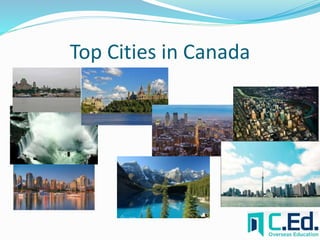
Top Cities in Canada
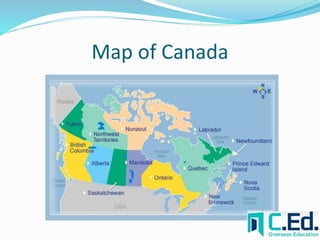
Map of Canada
About Canadian Education 
Canada has both a public and private education system. From kindergarten 
through to university, the Canadian Government subsidizes a great portion of the 
financial burden of educating its young minds. 
Canada has one of the highest educational standards when compared to other 
industrialized nations. The school year normally runs from September through to 
the following June. Secondary studies go up to Grades 11, 12 or 13, depending on 
the province. After which, students may choose to attend university, college, or 
Cegep (in Quebec) ofr post-secondary studies. 
Canada has many internationally recognized university programs located in both 
urban and rural regions throughout the nation. Degrees awarded from Canadian 
universities are recognized as equivalent to those from American and other 
Commonwealth universities. The university year usually runs from September to 
May. 
International students may choose to study in either one of Canada's two official 
languages. Some universities even offer instruction in both, though students need 
not be fluent in both languages to attend school in Canada.
About Canadian Education 
Canada has both a public and private education system. From kindergarten 
through to university, the Canadian Government subsidizes a great portion of the 
financial burden of educating its young minds. 
Canada has one of the highest educational standards when compared to other 
industrialized nations. The school year normally runs from September through to 
the following June. Secondary studies go up to Grades 11, 12 or 13, depending on 
the province. After which, students may choose to attend university, college, or 
Cegep (in Quebec) ofr post-secondary studies. 
Canada has many internationally recognized university programs located in both 
urban and rural regions throughout the nation. Degrees awarded from Canadian 
universities are recognized as equivalent to those from American and other 
Commonwealth universities. The university year usually runs from September to 
May. 
International students may choose to study in either one of Canada's two official 
languages. Some universities even offer instruction in both, though students need 
not be fluent in both languages to attend school in Canada.
Why Study in Canada 
 Canada is one of the Best Places in the World to Live 
 From safe neighborhoods in some of North America's most cosmopolitan cities to top-notch health care and public 
transportation, excellence permeates every aspect of Canadian life - including a world class higher education system. 
The United Nations has consistently ranked Canada as one of the top three places in the world to live. Canada earned 
high marks for its access to education, high life expectancy, and low crime rates. 
Multicultural and Welcoming 
 Canada has traditionally been a country of immigrants and has a policy of encouraging multicultural diversity. In fact, 
one out of three Canadians has an ethnic background other than English, French or Aboriginal. 
Excellent health care 
 Compared to other countries, medical insurance is inexpensive in Canada yet the services that Canadian hospitals 
provide are among some of the most advanced and accessible in the world. 
A Safe Place to Study 
 Canada is considered to be a relatively peaceful, safe and orderly country. Since the beginning of 1990's, there has been 
a consistent drop in crime rates in Canada. 
Work Opportunities in Canada 
 International students who have graduated from a Canadian university or college have the opportunity to work in 
Canada for up to one year after they receive their degree or diploma. International students in Canada can work off-campus 
with a work permit.
Why C.Ed. Overseas Education 
 C.Ed. Overseas Education is a professionally run education consulting firm with over 5 
years of experience in career counseling and providing strategic advice to Indian students 
considering to study abroad in Canada, USA, Ireland, UK, Germany, Singapore, Australia 
& New Zealand. 
Operating from a prominent location in New Delhi (South Campus), C.Ed. provides 
complete end-to-end education consultancy services including counseling for choosing 
the right country of education, universities/colleges and courses; preparing the student 
for visa interviews; conducting extensive pre-departure briefings to cover details like 
accommodation, part time jobs and many other integrities. 
C.Ed.'s personalized services help the students identify the educational institution that 
best fits their profile and areas of interest. We take care of the complete application 
process, freeing the students from all the hassles. 
C.Ed. Overseas experienced counselors guide the students and their parents on the 
entire process of studying abroad right from selecting a course, institution to ensuring 
the students reaches their chosen destination safely.
Our Services 
 CAREER PLANNING 
 We guide students through a maze of questions to find solutions best suited to their profile and / or constraints, ensuring that the best 
Career Pathway is selected. We look at their career choices and then their background and aspiration levels and advice on core issues. 
COURSE SELECTION 
 Personal guidance to help students choose courses that match their Career and Personal Goals. 
UNIVERSITY SELECTION 
 Assistance to zero onto those universities that would best suit a student's Personal, Academic and Financial Profile/Constraints. The advice 
provided is non-commercial and is not limited to the Universities represented by us. 
VISA ASSISTANCE 
 Our competent staff assists students with the Visa applications, provide guidelines for financial statements and help them prepare the file to 
meet the requirements of various High Commissions to ensure Visa success. 
ACCOMODATION 
 Our counselors will give you valuable advice on the accommodation types' to suit your needs and budget and help you with all related 
formalities. 
PRE-DEPARTURE 
 Training for settling into the new host country. The Pre-Departures are hosted by "C.Ed. " for each country and are well attended. This also 
provides an opportunity to meet other students (and their parents) who are heading abroad and possibly to the same university.
Contact C.Ed. Overseas 
C.Ed. Overseas Education 
284, First Floor, Satya Niketan, Opp. Sri Venkateswara College, South Campus 
Road, Dhaula Kuan, New Delhi - 110021 
Ph: +91 11 4941 5471, +91 90137 80243 
Website : www.cedoverseas.com Email ID : info@cedoverseas.com 
Thank You!

Want to study in canada

  • 1.
    Contact C.Ed. OverseasEducation Your Guide to Overseas Education
  • 2.
    Education System inCanada Education system in Canada is Internationally Recognized Canada has developed a first-rate education system with high standards. A Canadian degree, diploma or certificate is recognized globally as being equivalent to those from the United States and Commonwealth countries.
  • 3.
    Student visa inCanada Step 1. Attend a counseling session at C.Ed. Overseas Education to find out your options relating to study destination, courses available and recommended institutions. Step2. Register with C.Ed. Overseas Step3. Apply to Desired Institution Step4. Undertake Medicals Step 5. Arrange Funds Step 6. Pay Tuition fee Step 7. Lodge Visa Step 8. Visa Outcome Step 9. Travel Forex & Accommodation
  • 4.
  • 5.
    SPP Colleges inCanada  Algonquin CollegeAlgonquin College of Applied Arts and Technology is a publicly funded English-language college and member of Polytechnics Canada located in Ottawa, Ontario, Canada.  George Brown CollegeGeorge Brown College in Toronto, Ontario provides students with the skills, experience and credentials to get the job they want. The college offers 135 full-time..  Niagara CollegeNiagara College is a College of Applied Arts and Technology within the Niagara Region of Southern Ontario, Canada  Conestoga CollegeThe Conestoga College Institute of Technology and Advanced Learning is a public college based in Kitchener, Ontario, Canada.  Fanshwe CollegeFanshawe College is one of the largest colleges in Ontario, Canada. The main campus is in London, Ontario, with additional campuses in Simcoe, St. Thomas, Woodstock, and Tillsonburg  Douglas CollegeeDouglas College is one of the largest public colleges in British Columbia, Canada. Founded in 1970, the college serves some 14,000 credit students, 9,000 continuing education students and 1,000 international students each year.
  • 6.
    SPP Colleges inCanada  Fleming CollegeFleming College, also known as Sir Sandford Fleming College, is a College of Applied Arts and Technology in Peterborough, Ontario, Canada.  Seneca CollegeSeneca College of Applied Arts and Technology is a post-secondary community college and educational institution in Toronto.  Concordia UniversityConcordia University College of Alberta is a Canadian independent university in Edmonton, Alberta.  Mohawk CollegeMohawk College of Applied Arts and Technology is a public College of Applied Arts and Technology located in the Golden Horseshoe of Ontario, Canada.  Cambrian CollegeCambrian College is a college of applied arts and technology in Greater Sudbury, Ontario, Canada. Established in 1967, and funded by the province of Ontario...  Confederation CollegeConfederation College is a provincially funded college of applied arts and technology located in Thunder Bay, Ontario, Canada.
  • 7.
    SPP Colleges inCanada  Centennial CollegeCentennial College is the oldest publicly funded college in Ontario. It is located in Toronto, Ontario, Canada; its four campuses are situated to serve the eastern portion of the Greater Toronto Area.  Durhan CollegeDurham College of Applied Arts and Technology is located in the Durham Region of Canada with campuses in Oshawa, Ontario, and Whitby, a Learning Site in Pickering and Community Employment Services in ...  Georgian CollegeGeorgian College is a college of applied arts and technology in Ontario, Canada, with three main campuses in Barrie, Orillia and Owen Sound and four additional campuses in Midland, Muskoka, Orangeville and South Georgian Bay.  Humber CollegeHumber College Institute of Technology and Advanced Learning is a polytechnic college in Toronto, Ontario, Canada.  Kwantlen Polytechnic UniversityKwantlen Polytechnic University offers educational programs and services in Greater Vancouver, British Columbia, Canada, campuses located in Surrey,  Lambton CollegeLambton College is located in Sarnia, Ontario and has a student population of about 3500 students.
  • 8.
    Post Study WorkPermit in Canada  Get a post-graduation work permit  The PGWPP allows students who have graduated from a participating Canadian post-secondary institution to gain valuable Canadian work experience. Skilled Canadian work experience gained through the PGWPP helps graduates qualify for permanent residence in Canada through the Canadian Experience Class (CEC).  A work permit under the PGWPP may be issued for the length of the study program, up to a maximum of three years. A post-graduation work permit cannot be valid for longer than the student’s study program, and the study program must be a minimum of eight months in length. For example, if you graduate from a four-year degree program, you could be eligible for a three-year work permit if you meet the criteria. If you graduate from an eight-month certificate program, you would be eligible for a work permit that is valid for no more than eight months. Source : http://www.cic.gc.ca/english/study/work-postgrad.asp
  • 9.
    Post Study WorkPermit in Canada Work on campus  You may work on campus at the institution where you study without a work permit if:  you are a full-time student at:  a public post-secondary institution, such as a college or university, or a collège d’enseignement général et professionnel (CEGEP) in Quebec  a private post-secondary institution that operates under the same rules and regulations as a public institution, and receives at least 50 percent of its financing for its overall operations from government grants (currently only private college-level educational institutions in Quebec qualify) or  a Canadian private institution authorized by provincial statute to confer degrees and  you have a valid study permit. Source : http://www.cic.gc.ca/english/study/work-oncampus.asp
  • 10.
    Post Study WorkPermit in Canada Work off campus  Study permit holders in Canada may gain work experience by working off campus while completing their studies.  As of June 1, 2014, you may qualify to work off campus without a work permit. If you qualify, your study permit will allow you to work up to 20 hours per week:  during regular academic sessions and  full-time during scheduled breaks, such as the winter and summer holidays or spring break.  To qualify, you must:  have a valid study permit,  be a full-time student,  be enrolled at a designated learning institution at the post-secondary level or, in Quebec, a vocational program at the secondary level, and  be studying in an academic, vocational or professional training program that leads to a degree, diploma or certificate that is at least six months in duration. Source : http://www.cic.gc.ca/english/study/work-offcampus.asp
  • 11.
    SPP Colleges inCanada  North Island CollegeNorth Island College { WikiMapia: } is a community college located primarily on Vancouver Island, British Columbia, Canada.  Red River CollegeA technical college based in Winnipeg. Its focus is on practical experience courses in Business Administration, Computer Analyst Programming, and trade ...  Thompson River UniversityA degree granting University with main campus in Kamloops and regional centres in Williams Lake and Burnaby, offering a wide range of program options.  St. Clair College CollegeSt. Clair College, in Windsor and Chatham-Kent, offers programs in Business & Information Technology, Community Studies, Engineering, Health Sciences, ...  Sheridan CollegeWith over 130 career-focused programs at a school where your success is our priority, discover what Sheridan College has to offer today!
  • 12.
  • 13.
  • 14.
    About Canadian Education Canada has both a public and private education system. From kindergarten through to university, the Canadian Government subsidizes a great portion of the financial burden of educating its young minds. Canada has one of the highest educational standards when compared to other industrialized nations. The school year normally runs from September through to the following June. Secondary studies go up to Grades 11, 12 or 13, depending on the province. After which, students may choose to attend university, college, or Cegep (in Quebec) ofr post-secondary studies. Canada has many internationally recognized university programs located in both urban and rural regions throughout the nation. Degrees awarded from Canadian universities are recognized as equivalent to those from American and other Commonwealth universities. The university year usually runs from September to May. International students may choose to study in either one of Canada's two official languages. Some universities even offer instruction in both, though students need not be fluent in both languages to attend school in Canada.
  • 15.
    About Canadian Education Canada has both a public and private education system. From kindergarten through to university, the Canadian Government subsidizes a great portion of the financial burden of educating its young minds. Canada has one of the highest educational standards when compared to other industrialized nations. The school year normally runs from September through to the following June. Secondary studies go up to Grades 11, 12 or 13, depending on the province. After which, students may choose to attend university, college, or Cegep (in Quebec) ofr post-secondary studies. Canada has many internationally recognized university programs located in both urban and rural regions throughout the nation. Degrees awarded from Canadian universities are recognized as equivalent to those from American and other Commonwealth universities. The university year usually runs from September to May. International students may choose to study in either one of Canada's two official languages. Some universities even offer instruction in both, though students need not be fluent in both languages to attend school in Canada.
  • 16.
    Why Study inCanada  Canada is one of the Best Places in the World to Live  From safe neighborhoods in some of North America's most cosmopolitan cities to top-notch health care and public transportation, excellence permeates every aspect of Canadian life - including a world class higher education system. The United Nations has consistently ranked Canada as one of the top three places in the world to live. Canada earned high marks for its access to education, high life expectancy, and low crime rates. Multicultural and Welcoming  Canada has traditionally been a country of immigrants and has a policy of encouraging multicultural diversity. In fact, one out of three Canadians has an ethnic background other than English, French or Aboriginal. Excellent health care  Compared to other countries, medical insurance is inexpensive in Canada yet the services that Canadian hospitals provide are among some of the most advanced and accessible in the world. A Safe Place to Study  Canada is considered to be a relatively peaceful, safe and orderly country. Since the beginning of 1990's, there has been a consistent drop in crime rates in Canada. Work Opportunities in Canada  International students who have graduated from a Canadian university or college have the opportunity to work in Canada for up to one year after they receive their degree or diploma. International students in Canada can work off-campus with a work permit.
  • 17.
    Why C.Ed. OverseasEducation  C.Ed. Overseas Education is a professionally run education consulting firm with over 5 years of experience in career counseling and providing strategic advice to Indian students considering to study abroad in Canada, USA, Ireland, UK, Germany, Singapore, Australia & New Zealand. Operating from a prominent location in New Delhi (South Campus), C.Ed. provides complete end-to-end education consultancy services including counseling for choosing the right country of education, universities/colleges and courses; preparing the student for visa interviews; conducting extensive pre-departure briefings to cover details like accommodation, part time jobs and many other integrities. C.Ed.'s personalized services help the students identify the educational institution that best fits their profile and areas of interest. We take care of the complete application process, freeing the students from all the hassles. C.Ed. Overseas experienced counselors guide the students and their parents on the entire process of studying abroad right from selecting a course, institution to ensuring the students reaches their chosen destination safely.
  • 18.
    Our Services CAREER PLANNING  We guide students through a maze of questions to find solutions best suited to their profile and / or constraints, ensuring that the best Career Pathway is selected. We look at their career choices and then their background and aspiration levels and advice on core issues. COURSE SELECTION  Personal guidance to help students choose courses that match their Career and Personal Goals. UNIVERSITY SELECTION  Assistance to zero onto those universities that would best suit a student's Personal, Academic and Financial Profile/Constraints. The advice provided is non-commercial and is not limited to the Universities represented by us. VISA ASSISTANCE  Our competent staff assists students with the Visa applications, provide guidelines for financial statements and help them prepare the file to meet the requirements of various High Commissions to ensure Visa success. ACCOMODATION  Our counselors will give you valuable advice on the accommodation types' to suit your needs and budget and help you with all related formalities. PRE-DEPARTURE  Training for settling into the new host country. The Pre-Departures are hosted by "C.Ed. " for each country and are well attended. This also provides an opportunity to meet other students (and their parents) who are heading abroad and possibly to the same university.
  • 19.
    Contact C.Ed. Overseas C.Ed. Overseas Education 284, First Floor, Satya Niketan, Opp. Sri Venkateswara College, South Campus Road, Dhaula Kuan, New Delhi - 110021 Ph: +91 11 4941 5471, +91 90137 80243 Website : www.cedoverseas.com Email ID : info@cedoverseas.com Thank You!