1
THE STRUCTURE OF ENGLISH Berg
1. Orthography
1.1. The status of orthography in linguistics
1.2. The relationship between speech and writing
1.2.1. Dependence hypothesis
1.2.2. Independence hypothesis
1.2.3. The interdependence hypothesis
1.2.4. The impoverished nature of writing
1.3. Shallow versus deep orthography
1.4. English as a deep orthographic language
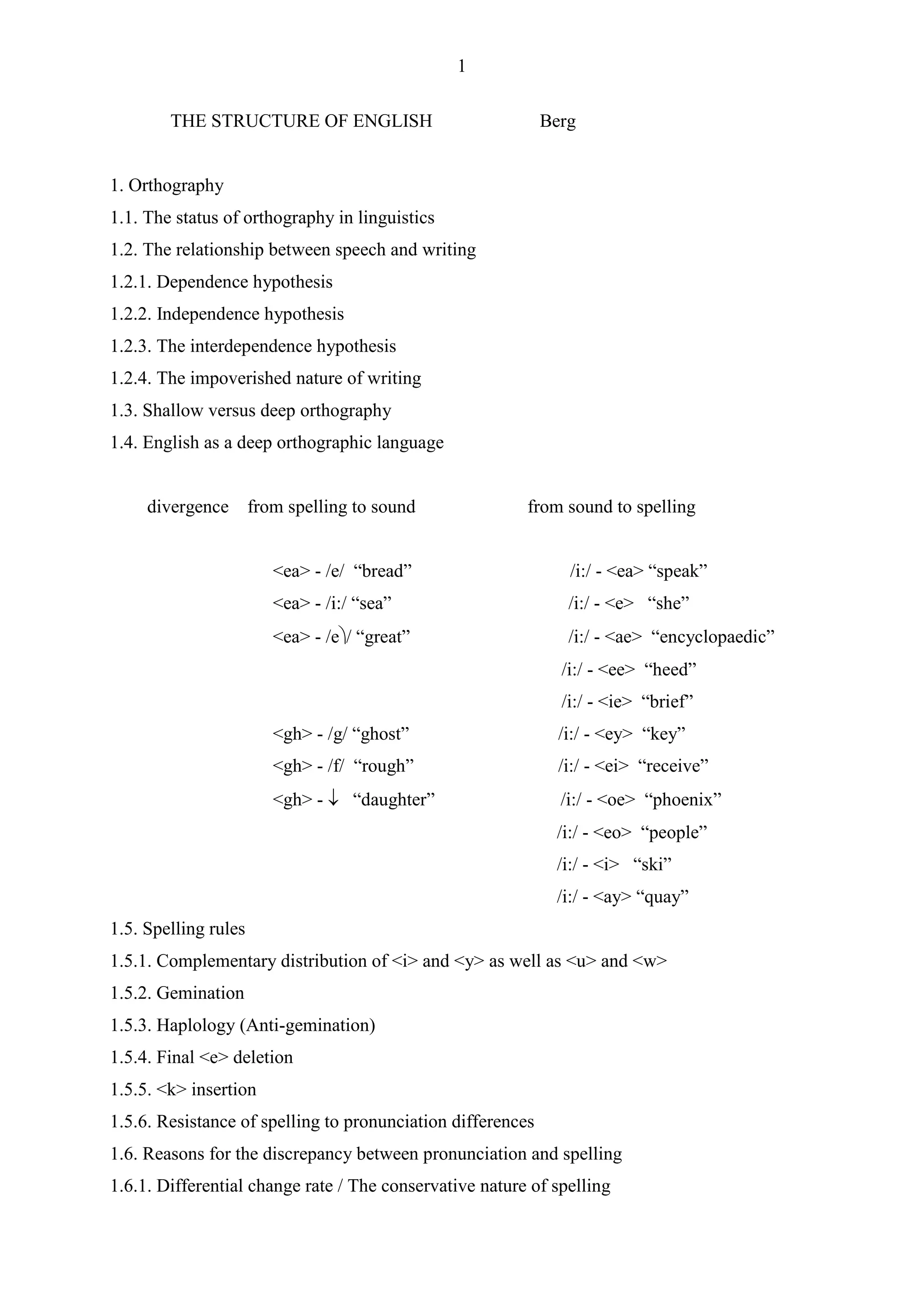
divergence from spelling to sound from sound to spelling
<ea> - /e/ “bread” /i:/ - <ea> “speak”
<ea> - /i:/ “sea” /i:/ - <e> “she”
<ea> - /e/ “great” /i:/ - <ae> “encyclopaedic”
/i:/ - <ee> “heed”
/i:/ - <ie> “brief”
<gh> - /g/ “ghost” /i:/ - <ey> “key”
<gh> - /f/ “rough” /i:/ - <ei> “receive”
<gh> - ↓ “daughter” /i:/ - <oe> “phoenix”
/i:/ - <eo> “people”
/i:/ - <i> “ski”
/i:/ - <ay> “quay”
1.5. Spelling rules
1.5.1. Complementary distribution of <i> and <y> as well as <u> and <w>
1.5.2. Gemination
1.5.3. Haplology (Anti-gemination)
1.5.4. Final <e> deletion
1.5.5. <k> insertion
1.5.6. Resistance of spelling to pronunciation differences
1.6. Reasons for the discrepancy between pronunciation and spelling
1.6.1. Differential change rate / The conservative nature of spelling
2
Example Chaucer (1380) Shakespeare (1600) nowadays
name [na:m(∴) n↔:m nem]
sweet [swe:t swi:t swi:t]
time [ti:m(∴) t∴m tam]
moon [mo:n mu:n mu:n]
1.6.2. Language contact
<g> - /g/ ”get“ (North Germanic) <h> “hill” (native word stock)
<g> - /d/ “gem” (French “la gemme” []) <h> “hour” (Latin)
(<g> - /j/ (native word stock, Old English “gifan”)
1.6.3. Susceptibility of spelling to non-phonological influences
1.6.4. Variable codification (or no codification)
1.7. Spelling Reforms
1.8. Spelling pronunciation (SP) / Phonetic spelling (PS)
SP: forehead [f rd] ~ [f↵:hed]
language [lægd] -> [læg←d]
corpse [k↵:s] -> [k↵:ps]
PS: through ~ thru
five (of the clock) -> five o’ clock
M.E. son -> sound
1.9. Quantitative analyses of the relationship between spelling and sound
1.9.1.From letter to sound: consistency of body, rime, and shell pronunciation
vowel (isolated: 0.72) preceded by onset: 0.81 (n.s.)
followed by coda: 0.92 (s.)
onset (isolated: 0.98) followed by vowel: 0.99 (n.s.)
followed by coda: 0.99 (n.s.)
coda (isolated: 0.98) preceded by vowel: 0.99 (n.s.)
preceded by onset: 0.99 (n.s.)
1.9.2. From sound to letter: consistency of body, rime, and shell spelling
vowel (isolated: 0.53) preceded by onset: 0.65 (s.)
followed by coda: 0.74 (s.)
onset (isolated: 0.91) followed by vowel: 0.94 (s.)
followed by coda: 0.94 (n.s.)
coda (isolated: 0.82) preceded by onset: 0.88 (n.s.)
3
preceded by vowel: 0.92 (s.)
2. Phonology
2.1. Segmental phonology
2.1.1. Consonant system
2.1.2. Vowel system
2.1.3. A quantitative analysis
2.1.4. Functional load
2.1.5. Clusters
2.1.6. Sonority
2.1.6.1. Sonority sequencing principle
2.1.6.2. Sonority contour principle
2.1.6.3. Sonority reversal
2.1.7. Case study: The problem of /r/
2.1.8. Suprasegmental phonology
2.2.1. Syllable structure
2.2.2. Syllabification
2.2.2.1. Criteria
2.2.2.1.1. Phonotactics
2.2.2.1.2. Morphology
2.2.2.1.3. Stress
2.2.2.1.4. Vowel length
2.2.2.1.5. Sonority
2.2.2.1.6. Onset maximization
2.2.2.2. Syllabification of single intervocalic consonants
2.2.2.3. Syllabification of intervocalic consonant clusters
2.2.2.4. Resyllabification
2.2.2.5. Why syllabification?
2.2.3. Stress
2.2.3.1. Fixed vs. free stress
2.2.3.2. Distinctiveness of stress
2.2.3.3. Quantity-sensitivity
The sensitivity of stress to phonological weight
4
Sensitivity + - 0 Total
Length
Disyllabic words 121 (27.4%) 63 (14.3%) 257 (58.3%) 441
Trisyllabic words 24 (8.9%) 79 (29.2%) 168 (62.0%) 271
2.2.3.4. Stress rules
2.2.3.5. Stress clash
2.2.4. Rhythm
2.2.4.1. Principle of rhythmic alternation
2.2.4.2 Syllable timing
2.2.4.3. Stress timing
2.2.5. Connected speech
2.2.5.1. Strong vs. weak forms
3. Morphophonology
3.1. The phenomenon: Allomorphy
3.2. Stem-induced affix allomorphy vs. affix-induced stem allomorphy
3.3. Prefix vs. suffix allomorphy
3.4. Directionality
3.5. Allomorphy in inflection
3.6. Allomorphy in derivation
3.7. Comparison of allomorphy in inflection and derivation
3.8. Why allomorphy?
3.9. Advantages and one disadvantage of allomorphy
4. Morphology
4.1. Introduction
4.1.1. English as an isolating language
4.1.2. Word-based morphology
4.1.3. The suffixing preference
4.1.4. Weak fusionality
4.2. Inflection
4.2.1. Inflectional morphemes
possessive –s
third person singular –s
5
plural –s
comparative/superlative –er/-est
past tense –ed
past participle –ed
present participle –ing
progressive –ing
gerund –ing (in some cases)
adverbial -ly
4.2.2. Grammatical categories coded by inflectional suffixes
person on verbs
tense on verbs
aspect on verbs
number on nouns
possessive on nouns
case on pronouns
number on pronouns
gender on pronouns
4.2.3. Status of possessive marker
4.3. Derivation
4.3.1. Modifier-head structure
4.4. Compounding
4.5. Productivity
4.6. Branching direction
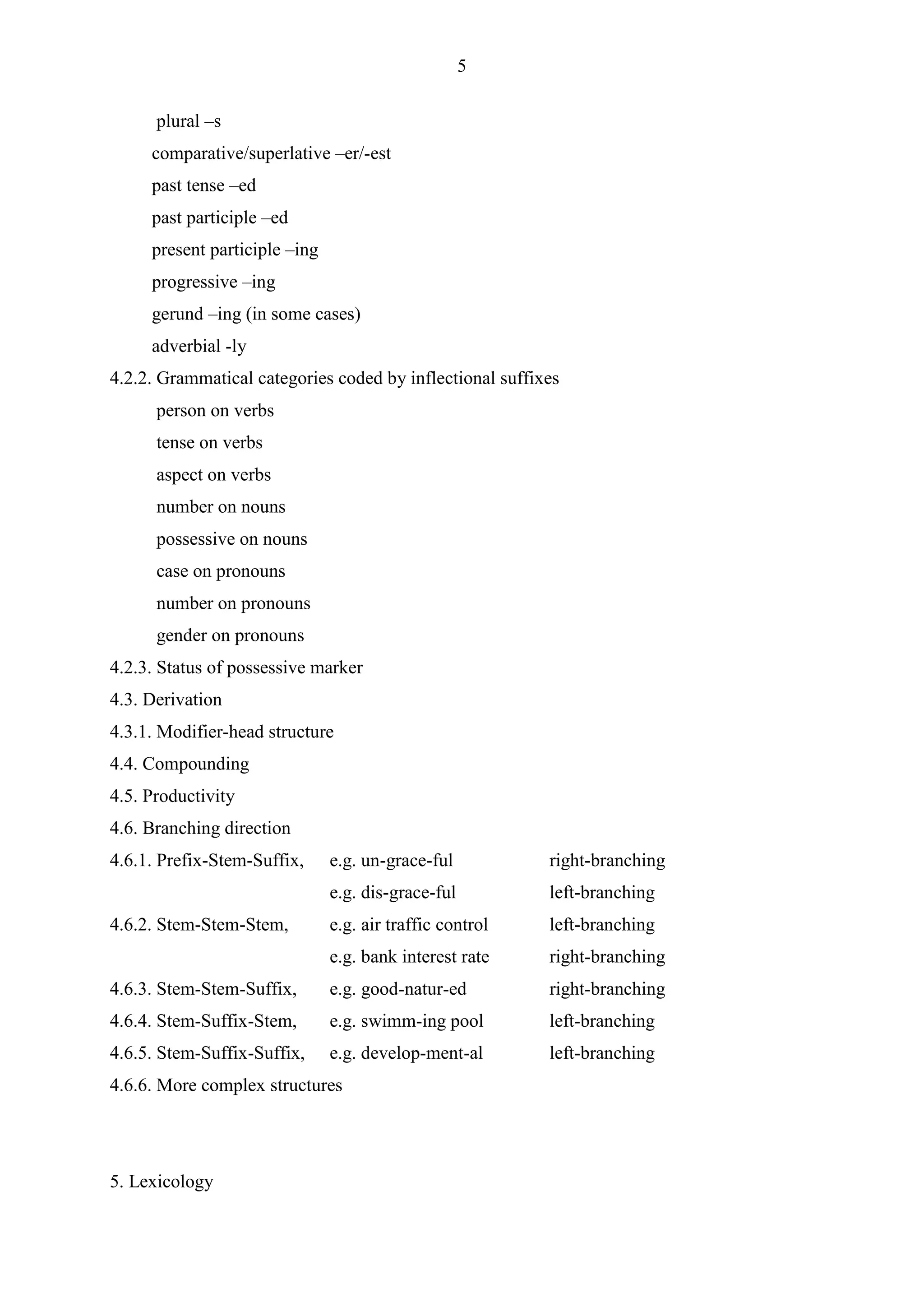
4.6.1. Prefix-Stem-Suffix, e.g. un-grace-ful right-branching
e.g. dis-grace-ful left-branching
4.6.2. Stem-Stem-Stem, e.g. air traffic control left-branching
e.g. bank interest rate right-branching
4.6.3. Stem-Stem-Suffix, e.g. good-natur-ed right-branching
4.6.4. Stem-Suffix-Stem, e.g. swimm-ing pool left-branching
4.6.5. Stem-Suffix-Suffix, e.g. develop-ment-al left-branching
4.6.6. More complex structures
5. Lexicology
6
5.1. The mixed nature of the lexicon
to think – to reflect – to meditate
to rise – to ascend
great – large – big
short – brief
beam – ray
snake – serpent
breast – pectoral
Is English a Romance language?
5.2. Structural differences between the Germanic and the Latinate vocabulary
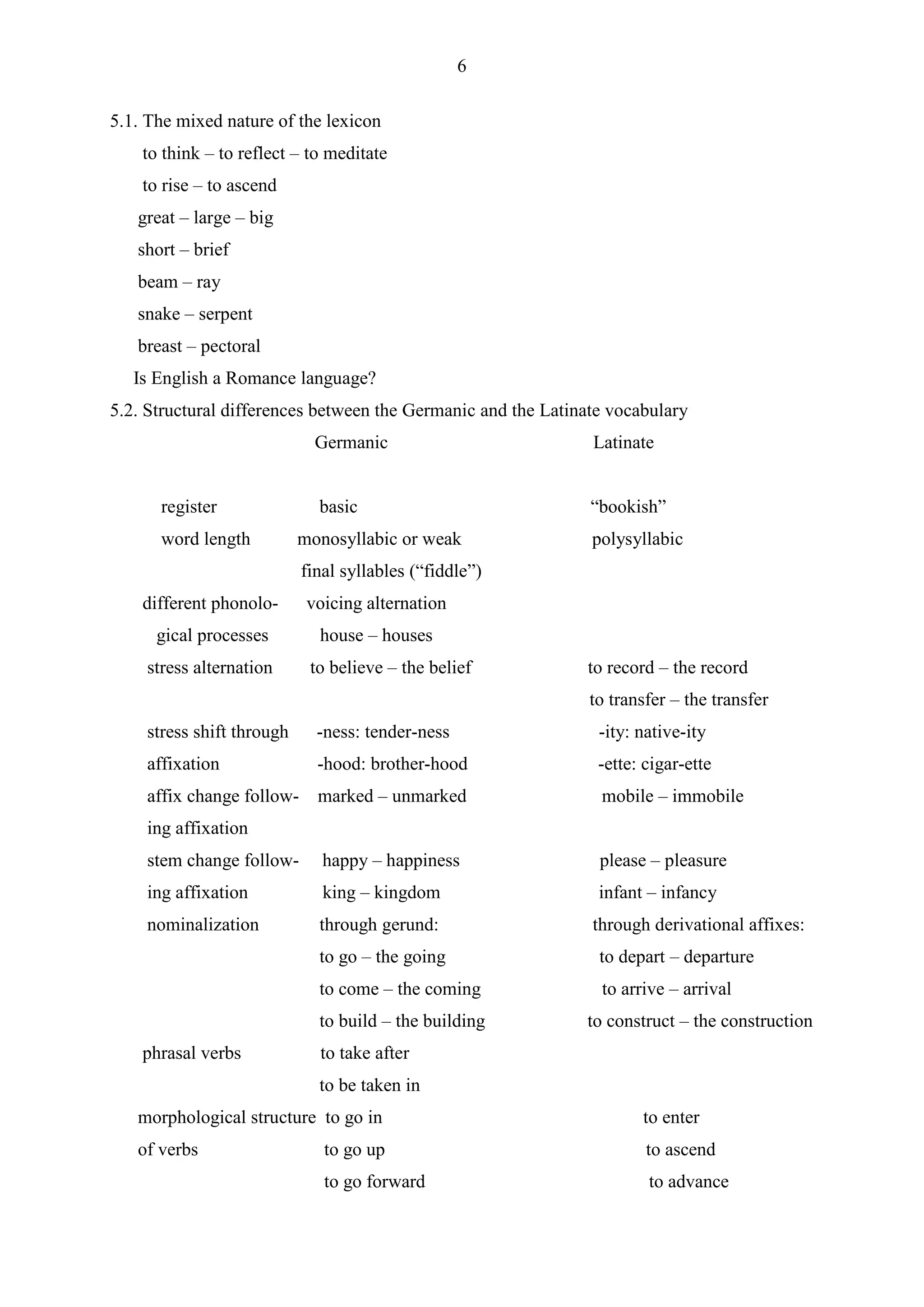
Germanic Latinate
register basic “bookish”
word length monosyllabic or weak polysyllabic
final syllables (“fiddle”)
different phonolo- voicing alternation
gical processes house – houses
stress alternation to believe – the belief to record – the record
to transfer – the transfer
stress shift through -ness: tender-ness -ity: native-ity
affixation -hood: brother-hood -ette: cigar-ette
affix change follow- marked – unmarked mobile – immobile
ing affixation
stem change follow- happy – happiness please – pleasure
ing affixation king – kingdom infant – infancy
nominalization through gerund: through derivational affixes:
to go – the going to depart – departure
to come – the coming to arrive – arrival
to build – the building to construct – the construction
phrasal verbs to take after
to be taken in
morphological structure to go in to enter
of verbs to go up to ascend
to go forward to advance
7
“pseudomorphemes” unworthy attend – pretend
compose – expose
prefer – refer
Dative shift He built her a house *He constructed her a house.
He sent her a letter. *He conveyed her a letter.
He gave her much money. *He donated her much money.
5.3. Word length
number of phonemes number of syllables
1 0% 1 31.1%
2 0.3% 2 36.3%
3 9.3% 3 20.3%
4 16.2% 4 9.5%
5 18.4% 5 2.5%
6 14.9% 6 0.3%
7 13.3%
8 9.7% average: 2,17 syllables
9 7.6%
10 4.6%
11 2.6%
12 1.9%
13 1.0%
14 0.1%
15 0.1%
average 6.27 phonemes
5.4. Frequency stratification (Denes 1963)
13 words make up 25%,
67 words make up 50%
331 words make up 75% of the words in the sample
5.5. Word classes
5.6. Verb + particle combinations (complex verbs)
5.6.1. Intransitive phrasal verbs: to wake up, to wise up, to eat out
5.6.2. Transitive phrasal verbs: to mess s.th. up, to take s.th. up, to take s.o. out
8
5.6.3. Prepositional verb: to insist on, to deal with, to take after s.o.
5.6.4. Phrasal-prepositional verb: to put up with s.th., to take s.th. out on s.b., to get s.th. over
with, to get away with s.th.
5.6.5. Phrasal vs. prepositional verbs
Phrasal Verb Prepositional Verb
He slipped on the jacket. She slipped on a banana peel.
5.6.6. Degrees of metaphoricity
basic: to look at, to look around
slightly metaphorical: to look ahead, to look back
strongly metaphorical: to look after, to look forward to, to look down on, to look for,
to look up to.
5.7. Lexical features: Count vs. mass nouns
- the furniture - *a furniture/*the furnitures
- the information - *an information/*the informations
- snow – snows
- water – waters
- rain – rains
Totally uncountable In-between Fully countable
information knowledge cake
outskirts cattle dog
furniture people (“persons”) car
Conversion from mass to count: He ordered three coffees.
Conversion from count to mass: A cattle lorry crashed. There was cow all over the place.
It was disgusting.
6. Morphosyntax
7. Syntax
7.1. Survey of major characteristics
7.1.1. English as a fixed word order language
Basic constituent order: SVO = 89,8% ‘I cleaned the carpet.’
OSV = 10,2% ‘What did you clean?’
7.1.2. English as a typical SVO language
9
7.1.2.1. Prepositions rather than postpositions
7.1.2.2. Phrasal and clausal proforms (“so”)
7.1.2.3. Frequent use of passive
7.1.2.4. Frequent use of (modal) auxiliaries
7.1.2.5. Middle (between active and passive voice) expressed through pronouns
7.1.2.6. Sentence adverbials
7.1.2.7. Coordination is often accompanied by ellipsis
7.1.2.8. Frequent use of hypotaxis
7.1.2.9. Phonology: Closed syllables rather than open syllables
7.1.2.10. Morphophonology: Umlaut rather than vowel harmony
7.1.3. English as a strongly configurational language
7.1.3.1. Rigidity of SVO order
7.1.3.2. No discontinuity within VPs
7.1.3.3. No discontinuity within NPs
7.1.3.4. No discontinuity within PPs
7.1.3.5. Few deviations from SVO
7.1.3.6. Pro-VP
7.1.3.7. Main vs. subordinate clauses: Distinction between conjunctions and adverbs
7.1.4. English as a predominantly right-branching language
SVO, Preposition – NP, Determiner – Adjective - Noun
7.1.5. English as an inconsistent head-modifier order language
7.1.5.1. Modifier – Head
- Article – Noun: the toy
- Adjective – Noun: high heels
- Adverb – Adjective: deeply impressed
- Adverb – Adverb: very much
- Possessive Determiner – Noun: my shoes
7.1.5.2. Head – Modifier
- Antecedent – Relative Clause: the time I spent with them
- Verb – Object: He saw the doctor.
- Preposition – NP: behind the curtain
- Question word – Clause: What is it about?
- Comparison adjective – Comparison clause or NP: older than Mary (was)
7.1.6. English as an obligatory-subject language
10
7.1.6.1. No PRO-drop
7.1.6.2. Semantically empty subjects: It is raining.
7.1.6.3. Verbs of cognition, liking and experiencing require subject case
7.1.7. English as a functionally flexible language (“a soft-boundary language”)
7.1.7.1. Word class ADJ: a round table
N: a new round of peace talks
V: They rounded a bend.
P: round the corner
ADV: People were standing round.
7.1.7.2. Transitive vs. intransitive
- Intransitive verbs used transitively
The trees haven’t grown much. – She grows potatoes.
You must run hard. – He runs a business.
She walked home. – She walked the dog.
- Transitive verbs used intransitively
Ed was writing a letter. – Ed was writing.
Pat was eating breakfast. – Pat was eating.
Florian studied the article. – Florian studied.
7.1.7.3. Thematic roles of subject
Prototypical case: Agent: Peter left the church.
Non-prototypical cases: Location: The villa sleeps ten.
Time: Tomorrow will be closed in most places.
Instrument: This ad will sell us a lot of dog food.
Possessor: The car burst a tyre.
Source: The dead bird was dripping blood.
7.1.7.4. Voice He beat his wife. – He was beaten by his wife.
7.1.7.4.1. Possessive NPs the victory of the army – the defeat of the army
the shooting of the prisoners
7.1.7.4.2. Verbs This report aims / is aimed at demonstrating the increasing incidence of
cancer.
Each of these claims has met / has been met with some criticism.
Dialectal differences: They were heading (BE) / headed (AE) for disaster.
7.1.7.4.3. Participial adjectives: a slanting line – a slanted line
a well-behaved child
11
7.1.7.4.4. Compounding: honey bee – chocolate bar
7.1.7.4.5. Derivation: employer – employee
trainer – trainee
but: escapee, returnee, absentee
believable, likeable. but: suitable, perishable
7.1.7.4.6. Middle Verbs: The book sells well.
This word translates easily into German.
The door opened slowly.
7.1.8. English as a continuous language
Exceptions:
7.1.8.1. Progressive aspect, Passive Voice, Complex Tenses
7.1.8.2. Phrasal Verbs with transitive objects
He looked the word up in the dictionary.
He looked it up in the dictionary.
7.1.8.3. Comparison
Such communities are likely to be more linguistically conservative.
7.2. Word order other than basic
7.2.1. Premodifying adjectives: evaluative adjectives: fantastic, nice, awful
nominal adjectives: electrical engineer, marginal note
age/colour: a new/green painting
colour/participle: a grey/crumbling tower
participle/provenance: a crumbling/Chinese tower
general adjective/participle: a small/carved statue
Rule: general adjective – age – colour – participle – provenance N
e.g. an intricate old purple interlocking Chinese design
7.2.2. Complex Verb groups: He may have been being killed.
Modal tense voice aspect verb
7.3. Special constructions
7.3.1. Raising
7.3.1.1. Negation raising: I think John is not honest. – I don’t think John is honest.
7.3.1.2. Subject-to-subject raising: John seems to be ill. – It seems that John is ill.
7.3.1.3. Subject-to-object raising: I believe John to be ill. - I believe that John is ill.
7.3.1.4. Object-to-subject raising: Linguistics is boring to study. – It is boring to study
linguistics.
12
7.3.2. Clefting
7.3.2.1. Cleft sentences: It is his callousness that I will ignore.
It’s Vicki who made the announcement.
It was yesterday that Pete flunked his orals.
7.3.2.2. Pseudoclefts: What I will ignore is his callousness.
What Robbie needs most is someone to talk to.
Here is where the accident took place.
7.3.3. Extraposition: To hear him curse shocked me. -> It shocked me to hear him curse.
You must find working here exciting. -> You must find it exciting
working here.
7.3.4. Dislocation
7.3.4.1. Left-dislocation: Steve, he likes beans.
7.3.4.2. Right-dislocation: He nearly ran over me, that crazy bum.
7.4. Clause types
7.4.1. Survey
7.4.1.1. Declarative: I love her.
7.4.1.2. Imperative: Open the door. Be careful. Everybody stand still. You be careful.
7.4.1.3. Interrogative: Two types: wh-interrogative vs. yes/no interrogative
7.4.1.4. Exclamative: How well she sings!
Ambiguous: How much remains to be done? Or: How much remains to be done!
7.4.2. The relationship between clause types and discourse function
7.4.2.1. Interrogative functioning as imperative: Can you tell me what time it is.
7.4.2.2. Interrogative functioning as exclamative: Wasn’t it a marvellous concert!
Would you believe it!
7.4.2.3. Interrogative functioning as declarative: rhetorical questions: Would anyone be so
stupid as to believe it!
7.4.2.4. Declarative functioning as imperative: It needs to be done. I want you to do it. You
open the door.
7.4.2.5. Declarative functioning as interrogative: You’ve got the tickets?
7.5. Inversion and do-support
7.5.1. Do-support - in questions: Does he like squid?
- in negatives: I don’t like squid.
- in inversion: At no time did I leave the front door unlocked.
7.5.2. Inversion - in questions: Is he a good swimmer?
13
- in negatives (negated element fronted): At no time must the front door be
left unlocked.
- in conditional clauses: Were we to withdraw our support, they would be
indignant.
7.6. Verb complementation
Three options: a) finite subordinate clause: Tests have proved that the system works.
b) infinitival clause: She ordered her guests to leave.
c) gerund clause (with or without preposition): She stopped him (from)
leaving. She thanked her mother for staying.
Choice of complementation is partly semantically motivated.
- Different options create different meanings: He stopped smoking. - He stopped to light
a cigarette.
- Different options but no meaning difference: I believe that he is an honest man. –
I believe him to be an honest man.
Choice of complementation depends on verb type: Cognitive verbs: I think that it’s true.
7.7. Control: Subject vs. object control
a) I promised Cathy to be there on time/to help her out.
b) The traveller asked the innkeeper to wake him up at 5 o’ clock.
c) The coach promised the goalkeeper to be allowed to play the second halftime.
d) The traveller asked the innkeeper to be awaked at 5 o’ clock.
e) Johnny asked the teacher to go to the bathroom.
8. Semantics
8.1. No internal structure of semantic content of words
Bachelor: + human, + male, - married, (+ young)
Widower: + human, + male, wife deceased
Bachelor
+ human + male - married
Hierarchical approach fails: “to kill”: to cause somebody to become not alive
Kill
14
cause become not alive
Three problems: a) “kill” is not synonymous with “cause to be dead”
b) the semantic components are not really semantic but lexical
c) the structure is syntactic (like sentence structure) rather than semantic.
8.2. Categories and their internal structure
A robin is a bird.
A penguin is a bird.
A sparrow is a bird.
A turkey is a bird.
An ostrich is a bird.
The prototype structure of a lexical category: a structure of concentric circles
periphery
core
Applying this approach to the example at hand gives us:
ostrich
sparrow
robin
This structure is valid for all linguistic categories, e.g. the category /t/ in phonology
/t/: a voiceless aspirated alveolar stop.
- voiceless -> voiced, e.g. writer -> rider
- aspirated -> unaspirated, e.g. in clusters with initial /s/, [t=] “still”
- alveolar -> dental, e.g. “eighth” [t°]
- stop -> affricate, e.g. utterance-finally „What“ [ts], as an ejective
8.3. The network structure of categories: Between-category structure
Organization on the horizontal and vertical axes
Horizontal axis: how are different categories on the same level related to one another?
Vertical axis: how are different categories on different levels related to one another?
Horizontal organization: categories shade into each other
tree bush
15
Vertical organization: categories exist at different levels of abstraction
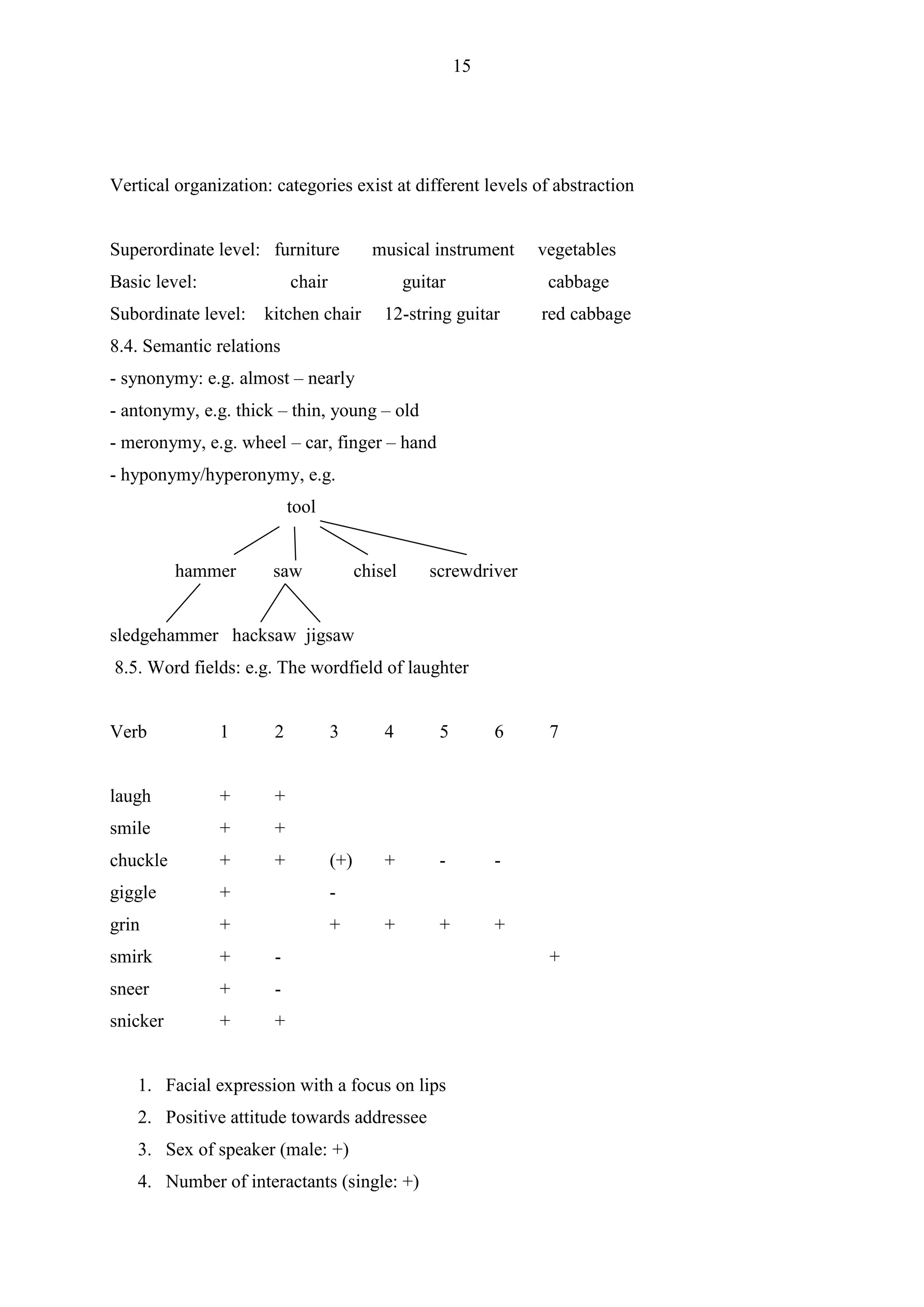
Superordinate level: furniture musical instrument vegetables
Basic level: chair guitar cabbage
Subordinate level: kitchen chair 12-string guitar red cabbage
8.4. Semantic relations
- synonymy: e.g. almost – nearly
- antonymy, e.g. thick – thin, young – old
- meronymy, e.g. wheel – car, finger – hand
- hyponymy/hyperonymy, e.g.
tool
hammer saw chisel screwdriver
sledgehammer hacksaw jigsaw
8.5. Word fields: e.g. The wordfield of laughter
Verb 1 2 3 4 5 6 7
laugh + +
smile + +
chuckle + + (+) + - -
giggle + -
grin + + + + +
smirk + - +
sneer + -
snicker + +
1. Facial expression with a focus on lips
2. Positive attitude towards addressee
3. Sex of speaker (male: +)
4. Number of interactants (single: +)
16
5. Directionality (teleological: +, causal: -)
6. Intensity of contact (autistic: -)
7. Social rank of producer (superior: +)
17
Selective List of References
Bar-Ilan, Laly & Ruth A. Berman (2007): Developing register differentiation: The Latinate-
Germanic divide in English. In: Linguistics 45, 1-35.
Berndt, Rita Sloan, James A. Reggia & Charlotte C. Mitchum (1987): Empirically derived
probabilities for grapheme-to-phoneme correspondences in English. In: Behavior Research
Methods, Instruments, and Computers 19, 1-9.
Brinton, Laurel (2000): The structure of Modern English: A linguistic introduction.
Amsterdam: Benjamins.
Carney, Edward (1994): A survey of English spelling. London: Routledge.
Crystal, David (1987): The Cambridge encyclopedia of language. Cambridge: Cambridge
University Press.
Crystal, David, (1988): The English language. London: Penguin.
Denes, Peter B. (1963): On the statistics of spoken English. In: Journal of the Acoustical
Society of America 35, 892-904.
Harris, John (1994): English sound structure. Oxford: Blackwell.
Kessler, Brett & Rebecca Treiman (2001): Relationships between sounds and letters in
English monosyllables. In: Journal of Memory and Language 44, 592-617.
König, Ekkehard (1994): English. In: Ekkehard König & Johan van der Auwera (eds.): The
Germanic languages (pp. 532-565). London: Routledge.
Lehmann, Winfried P. (1978): English: a characteristic SVO language. In: Winfried P.
Lehmann (ed.): Syntactic typology (pp. 169-222). Austin: University of Texas Press.
Leisi, Ernst (1974): Das heutige Englisch. Heidelberg: Winter.
Marchand, Hans (1969): The categories and types of present-day English word-formation.
Munich: Beck.
Moessner, Lilo (1978): Morphophonologie. Tübingen: Niemeyer.
Plank, Frans (1983): Transparent versus functional encoding of grammatical relations: a
parameter for syntactic change and typology. In: Linguistische Berichte 86, 1-13.
Roberts, A. Hood (1965): A statistical linguistic analysis of American English. The Hague:
Mouton.
Scheler, Manfred (177): Der englische Wortschatz. Berlin: Schmidt.
Spencer, Andrew (1996): Phonology. Oxford: Blackwell.
Thompson, Sandra A. (1978): Modern English from a typological point of view: some
implications of the function of word order. In: Linguistische Berichte 54, 19-35.
Venetzky, Richard L. (1979): The structure of English orthography. The Hague: Mouton.

structure-of-english.pdf

  • 1.
    1 THE STRUCTURE OFENGLISH Berg 1. Orthography 1.1. The status of orthography in linguistics 1.2. The relationship between speech and writing 1.2.1. Dependence hypothesis 1.2.2. Independence hypothesis 1.2.3. The interdependence hypothesis 1.2.4. The impoverished nature of writing 1.3. Shallow versus deep orthography 1.4. English as a deep orthographic language divergence from spelling to sound from sound to spelling <ea> - /e/ “bread” /i:/ - <ea> “speak” <ea> - /i:/ “sea” /i:/ - <e> “she” <ea> - /e/ “great” /i:/ - <ae> “encyclopaedic” /i:/ - <ee> “heed” /i:/ - <ie> “brief” <gh> - /g/ “ghost” /i:/ - <ey> “key” <gh> - /f/ “rough” /i:/ - <ei> “receive” <gh> - ↓ “daughter” /i:/ - <oe> “phoenix” /i:/ - <eo> “people” /i:/ - <i> “ski” /i:/ - <ay> “quay” 1.5. Spelling rules 1.5.1. Complementary distribution of <i> and <y> as well as <u> and <w> 1.5.2. Gemination 1.5.3. Haplology (Anti-gemination) 1.5.4. Final <e> deletion 1.5.5. <k> insertion 1.5.6. Resistance of spelling to pronunciation differences 1.6. Reasons for the discrepancy between pronunciation and spelling 1.6.1. Differential change rate / The conservative nature of spelling
  • 2.
    2 Example Chaucer (1380)Shakespeare (1600) nowadays name [na:m(∴) n↔:m nem] sweet [swe:t swi:t swi:t] time [ti:m(∴) t∴m tam] moon [mo:n mu:n mu:n] 1.6.2. Language contact <g> - /g/ ”get“ (North Germanic) <h> “hill” (native word stock) <g> - /d/ “gem” (French “la gemme” []) <h> “hour” (Latin) (<g> - /j/ (native word stock, Old English “gifan”) 1.6.3. Susceptibility of spelling to non-phonological influences 1.6.4. Variable codification (or no codification) 1.7. Spelling Reforms 1.8. Spelling pronunciation (SP) / Phonetic spelling (PS) SP: forehead [f rd] ~ [f↵:hed] language [lægd] -> [læg←d] corpse [k↵:s] -> [k↵:ps] PS: through ~ thru five (of the clock) -> five o’ clock M.E. son -> sound 1.9. Quantitative analyses of the relationship between spelling and sound 1.9.1.From letter to sound: consistency of body, rime, and shell pronunciation vowel (isolated: 0.72) preceded by onset: 0.81 (n.s.) followed by coda: 0.92 (s.) onset (isolated: 0.98) followed by vowel: 0.99 (n.s.) followed by coda: 0.99 (n.s.) coda (isolated: 0.98) preceded by vowel: 0.99 (n.s.) preceded by onset: 0.99 (n.s.) 1.9.2. From sound to letter: consistency of body, rime, and shell spelling vowel (isolated: 0.53) preceded by onset: 0.65 (s.) followed by coda: 0.74 (s.) onset (isolated: 0.91) followed by vowel: 0.94 (s.) followed by coda: 0.94 (n.s.) coda (isolated: 0.82) preceded by onset: 0.88 (n.s.)
  • 3.
    3 preceded by vowel:0.92 (s.) 2. Phonology 2.1. Segmental phonology 2.1.1. Consonant system 2.1.2. Vowel system 2.1.3. A quantitative analysis 2.1.4. Functional load 2.1.5. Clusters 2.1.6. Sonority 2.1.6.1. Sonority sequencing principle 2.1.6.2. Sonority contour principle 2.1.6.3. Sonority reversal 2.1.7. Case study: The problem of /r/ 2.1.8. Suprasegmental phonology 2.2.1. Syllable structure 2.2.2. Syllabification 2.2.2.1. Criteria 2.2.2.1.1. Phonotactics 2.2.2.1.2. Morphology 2.2.2.1.3. Stress 2.2.2.1.4. Vowel length 2.2.2.1.5. Sonority 2.2.2.1.6. Onset maximization 2.2.2.2. Syllabification of single intervocalic consonants 2.2.2.3. Syllabification of intervocalic consonant clusters 2.2.2.4. Resyllabification 2.2.2.5. Why syllabification? 2.2.3. Stress 2.2.3.1. Fixed vs. free stress 2.2.3.2. Distinctiveness of stress 2.2.3.3. Quantity-sensitivity The sensitivity of stress to phonological weight
  • 4.
    4 Sensitivity + -0 Total Length Disyllabic words 121 (27.4%) 63 (14.3%) 257 (58.3%) 441 Trisyllabic words 24 (8.9%) 79 (29.2%) 168 (62.0%) 271 2.2.3.4. Stress rules 2.2.3.5. Stress clash 2.2.4. Rhythm 2.2.4.1. Principle of rhythmic alternation 2.2.4.2 Syllable timing 2.2.4.3. Stress timing 2.2.5. Connected speech 2.2.5.1. Strong vs. weak forms 3. Morphophonology 3.1. The phenomenon: Allomorphy 3.2. Stem-induced affix allomorphy vs. affix-induced stem allomorphy 3.3. Prefix vs. suffix allomorphy 3.4. Directionality 3.5. Allomorphy in inflection 3.6. Allomorphy in derivation 3.7. Comparison of allomorphy in inflection and derivation 3.8. Why allomorphy? 3.9. Advantages and one disadvantage of allomorphy 4. Morphology 4.1. Introduction 4.1.1. English as an isolating language 4.1.2. Word-based morphology 4.1.3. The suffixing preference 4.1.4. Weak fusionality 4.2. Inflection 4.2.1. Inflectional morphemes possessive –s third person singular –s
  • 5.
    5 plural –s comparative/superlative –er/-est pasttense –ed past participle –ed present participle –ing progressive –ing gerund –ing (in some cases) adverbial -ly 4.2.2. Grammatical categories coded by inflectional suffixes person on verbs tense on verbs aspect on verbs number on nouns possessive on nouns case on pronouns number on pronouns gender on pronouns 4.2.3. Status of possessive marker 4.3. Derivation 4.3.1. Modifier-head structure 4.4. Compounding 4.5. Productivity 4.6. Branching direction 4.6.1. Prefix-Stem-Suffix, e.g. un-grace-ful right-branching e.g. dis-grace-ful left-branching 4.6.2. Stem-Stem-Stem, e.g. air traffic control left-branching e.g. bank interest rate right-branching 4.6.3. Stem-Stem-Suffix, e.g. good-natur-ed right-branching 4.6.4. Stem-Suffix-Stem, e.g. swimm-ing pool left-branching 4.6.5. Stem-Suffix-Suffix, e.g. develop-ment-al left-branching 4.6.6. More complex structures 5. Lexicology
  • 6.
    6 5.1. The mixednature of the lexicon to think – to reflect – to meditate to rise – to ascend great – large – big short – brief beam – ray snake – serpent breast – pectoral Is English a Romance language? 5.2. Structural differences between the Germanic and the Latinate vocabulary Germanic Latinate register basic “bookish” word length monosyllabic or weak polysyllabic final syllables (“fiddle”) different phonolo- voicing alternation gical processes house – houses stress alternation to believe – the belief to record – the record to transfer – the transfer stress shift through -ness: tender-ness -ity: native-ity affixation -hood: brother-hood -ette: cigar-ette affix change follow- marked – unmarked mobile – immobile ing affixation stem change follow- happy – happiness please – pleasure ing affixation king – kingdom infant – infancy nominalization through gerund: through derivational affixes: to go – the going to depart – departure to come – the coming to arrive – arrival to build – the building to construct – the construction phrasal verbs to take after to be taken in morphological structure to go in to enter of verbs to go up to ascend to go forward to advance
  • 7.
    7 “pseudomorphemes” unworthy attend– pretend compose – expose prefer – refer Dative shift He built her a house *He constructed her a house. He sent her a letter. *He conveyed her a letter. He gave her much money. *He donated her much money. 5.3. Word length number of phonemes number of syllables 1 0% 1 31.1% 2 0.3% 2 36.3% 3 9.3% 3 20.3% 4 16.2% 4 9.5% 5 18.4% 5 2.5% 6 14.9% 6 0.3% 7 13.3% 8 9.7% average: 2,17 syllables 9 7.6% 10 4.6% 11 2.6% 12 1.9% 13 1.0% 14 0.1% 15 0.1% average 6.27 phonemes 5.4. Frequency stratification (Denes 1963) 13 words make up 25%, 67 words make up 50% 331 words make up 75% of the words in the sample 5.5. Word classes 5.6. Verb + particle combinations (complex verbs) 5.6.1. Intransitive phrasal verbs: to wake up, to wise up, to eat out 5.6.2. Transitive phrasal verbs: to mess s.th. up, to take s.th. up, to take s.o. out
  • 8.
    8 5.6.3. Prepositional verb:to insist on, to deal with, to take after s.o. 5.6.4. Phrasal-prepositional verb: to put up with s.th., to take s.th. out on s.b., to get s.th. over with, to get away with s.th. 5.6.5. Phrasal vs. prepositional verbs Phrasal Verb Prepositional Verb He slipped on the jacket. She slipped on a banana peel. 5.6.6. Degrees of metaphoricity basic: to look at, to look around slightly metaphorical: to look ahead, to look back strongly metaphorical: to look after, to look forward to, to look down on, to look for, to look up to. 5.7. Lexical features: Count vs. mass nouns - the furniture - *a furniture/*the furnitures - the information - *an information/*the informations - snow – snows - water – waters - rain – rains Totally uncountable In-between Fully countable information knowledge cake outskirts cattle dog furniture people (“persons”) car Conversion from mass to count: He ordered three coffees. Conversion from count to mass: A cattle lorry crashed. There was cow all over the place. It was disgusting. 6. Morphosyntax 7. Syntax 7.1. Survey of major characteristics 7.1.1. English as a fixed word order language Basic constituent order: SVO = 89,8% ‘I cleaned the carpet.’ OSV = 10,2% ‘What did you clean?’ 7.1.2. English as a typical SVO language
  • 9.
    9 7.1.2.1. Prepositions ratherthan postpositions 7.1.2.2. Phrasal and clausal proforms (“so”) 7.1.2.3. Frequent use of passive 7.1.2.4. Frequent use of (modal) auxiliaries 7.1.2.5. Middle (between active and passive voice) expressed through pronouns 7.1.2.6. Sentence adverbials 7.1.2.7. Coordination is often accompanied by ellipsis 7.1.2.8. Frequent use of hypotaxis 7.1.2.9. Phonology: Closed syllables rather than open syllables 7.1.2.10. Morphophonology: Umlaut rather than vowel harmony 7.1.3. English as a strongly configurational language 7.1.3.1. Rigidity of SVO order 7.1.3.2. No discontinuity within VPs 7.1.3.3. No discontinuity within NPs 7.1.3.4. No discontinuity within PPs 7.1.3.5. Few deviations from SVO 7.1.3.6. Pro-VP 7.1.3.7. Main vs. subordinate clauses: Distinction between conjunctions and adverbs 7.1.4. English as a predominantly right-branching language SVO, Preposition – NP, Determiner – Adjective - Noun 7.1.5. English as an inconsistent head-modifier order language 7.1.5.1. Modifier – Head - Article – Noun: the toy - Adjective – Noun: high heels - Adverb – Adjective: deeply impressed - Adverb – Adverb: very much - Possessive Determiner – Noun: my shoes 7.1.5.2. Head – Modifier - Antecedent – Relative Clause: the time I spent with them - Verb – Object: He saw the doctor. - Preposition – NP: behind the curtain - Question word – Clause: What is it about? - Comparison adjective – Comparison clause or NP: older than Mary (was) 7.1.6. English as an obligatory-subject language
  • 10.
    10 7.1.6.1. No PRO-drop 7.1.6.2.Semantically empty subjects: It is raining. 7.1.6.3. Verbs of cognition, liking and experiencing require subject case 7.1.7. English as a functionally flexible language (“a soft-boundary language”) 7.1.7.1. Word class ADJ: a round table N: a new round of peace talks V: They rounded a bend. P: round the corner ADV: People were standing round. 7.1.7.2. Transitive vs. intransitive - Intransitive verbs used transitively The trees haven’t grown much. – She grows potatoes. You must run hard. – He runs a business. She walked home. – She walked the dog. - Transitive verbs used intransitively Ed was writing a letter. – Ed was writing. Pat was eating breakfast. – Pat was eating. Florian studied the article. – Florian studied. 7.1.7.3. Thematic roles of subject Prototypical case: Agent: Peter left the church. Non-prototypical cases: Location: The villa sleeps ten. Time: Tomorrow will be closed in most places. Instrument: This ad will sell us a lot of dog food. Possessor: The car burst a tyre. Source: The dead bird was dripping blood. 7.1.7.4. Voice He beat his wife. – He was beaten by his wife. 7.1.7.4.1. Possessive NPs the victory of the army – the defeat of the army the shooting of the prisoners 7.1.7.4.2. Verbs This report aims / is aimed at demonstrating the increasing incidence of cancer. Each of these claims has met / has been met with some criticism. Dialectal differences: They were heading (BE) / headed (AE) for disaster. 7.1.7.4.3. Participial adjectives: a slanting line – a slanted line a well-behaved child
  • 11.
    11 7.1.7.4.4. Compounding: honeybee – chocolate bar 7.1.7.4.5. Derivation: employer – employee trainer – trainee but: escapee, returnee, absentee believable, likeable. but: suitable, perishable 7.1.7.4.6. Middle Verbs: The book sells well. This word translates easily into German. The door opened slowly. 7.1.8. English as a continuous language Exceptions: 7.1.8.1. Progressive aspect, Passive Voice, Complex Tenses 7.1.8.2. Phrasal Verbs with transitive objects He looked the word up in the dictionary. He looked it up in the dictionary. 7.1.8.3. Comparison Such communities are likely to be more linguistically conservative. 7.2. Word order other than basic 7.2.1. Premodifying adjectives: evaluative adjectives: fantastic, nice, awful nominal adjectives: electrical engineer, marginal note age/colour: a new/green painting colour/participle: a grey/crumbling tower participle/provenance: a crumbling/Chinese tower general adjective/participle: a small/carved statue Rule: general adjective – age – colour – participle – provenance N e.g. an intricate old purple interlocking Chinese design 7.2.2. Complex Verb groups: He may have been being killed. Modal tense voice aspect verb 7.3. Special constructions 7.3.1. Raising 7.3.1.1. Negation raising: I think John is not honest. – I don’t think John is honest. 7.3.1.2. Subject-to-subject raising: John seems to be ill. – It seems that John is ill. 7.3.1.3. Subject-to-object raising: I believe John to be ill. - I believe that John is ill. 7.3.1.4. Object-to-subject raising: Linguistics is boring to study. – It is boring to study linguistics.
  • 12.
    12 7.3.2. Clefting 7.3.2.1. Cleftsentences: It is his callousness that I will ignore. It’s Vicki who made the announcement. It was yesterday that Pete flunked his orals. 7.3.2.2. Pseudoclefts: What I will ignore is his callousness. What Robbie needs most is someone to talk to. Here is where the accident took place. 7.3.3. Extraposition: To hear him curse shocked me. -> It shocked me to hear him curse. You must find working here exciting. -> You must find it exciting working here. 7.3.4. Dislocation 7.3.4.1. Left-dislocation: Steve, he likes beans. 7.3.4.2. Right-dislocation: He nearly ran over me, that crazy bum. 7.4. Clause types 7.4.1. Survey 7.4.1.1. Declarative: I love her. 7.4.1.2. Imperative: Open the door. Be careful. Everybody stand still. You be careful. 7.4.1.3. Interrogative: Two types: wh-interrogative vs. yes/no interrogative 7.4.1.4. Exclamative: How well she sings! Ambiguous: How much remains to be done? Or: How much remains to be done! 7.4.2. The relationship between clause types and discourse function 7.4.2.1. Interrogative functioning as imperative: Can you tell me what time it is. 7.4.2.2. Interrogative functioning as exclamative: Wasn’t it a marvellous concert! Would you believe it! 7.4.2.3. Interrogative functioning as declarative: rhetorical questions: Would anyone be so stupid as to believe it! 7.4.2.4. Declarative functioning as imperative: It needs to be done. I want you to do it. You open the door. 7.4.2.5. Declarative functioning as interrogative: You’ve got the tickets? 7.5. Inversion and do-support 7.5.1. Do-support - in questions: Does he like squid? - in negatives: I don’t like squid. - in inversion: At no time did I leave the front door unlocked. 7.5.2. Inversion - in questions: Is he a good swimmer?
  • 13.
    13 - in negatives(negated element fronted): At no time must the front door be left unlocked. - in conditional clauses: Were we to withdraw our support, they would be indignant. 7.6. Verb complementation Three options: a) finite subordinate clause: Tests have proved that the system works. b) infinitival clause: She ordered her guests to leave. c) gerund clause (with or without preposition): She stopped him (from) leaving. She thanked her mother for staying. Choice of complementation is partly semantically motivated. - Different options create different meanings: He stopped smoking. - He stopped to light a cigarette. - Different options but no meaning difference: I believe that he is an honest man. – I believe him to be an honest man. Choice of complementation depends on verb type: Cognitive verbs: I think that it’s true. 7.7. Control: Subject vs. object control a) I promised Cathy to be there on time/to help her out. b) The traveller asked the innkeeper to wake him up at 5 o’ clock. c) The coach promised the goalkeeper to be allowed to play the second halftime. d) The traveller asked the innkeeper to be awaked at 5 o’ clock. e) Johnny asked the teacher to go to the bathroom. 8. Semantics 8.1. No internal structure of semantic content of words Bachelor: + human, + male, - married, (+ young) Widower: + human, + male, wife deceased Bachelor + human + male - married Hierarchical approach fails: “to kill”: to cause somebody to become not alive Kill
  • 14.
    14 cause become notalive Three problems: a) “kill” is not synonymous with “cause to be dead” b) the semantic components are not really semantic but lexical c) the structure is syntactic (like sentence structure) rather than semantic. 8.2. Categories and their internal structure A robin is a bird. A penguin is a bird. A sparrow is a bird. A turkey is a bird. An ostrich is a bird. The prototype structure of a lexical category: a structure of concentric circles periphery core Applying this approach to the example at hand gives us: ostrich sparrow robin This structure is valid for all linguistic categories, e.g. the category /t/ in phonology /t/: a voiceless aspirated alveolar stop. - voiceless -> voiced, e.g. writer -> rider - aspirated -> unaspirated, e.g. in clusters with initial /s/, [t=] “still” - alveolar -> dental, e.g. “eighth” [t°] - stop -> affricate, e.g. utterance-finally „What“ [ts], as an ejective 8.3. The network structure of categories: Between-category structure Organization on the horizontal and vertical axes Horizontal axis: how are different categories on the same level related to one another? Vertical axis: how are different categories on different levels related to one another? Horizontal organization: categories shade into each other tree bush
  • 15.
    15 Vertical organization: categoriesexist at different levels of abstraction Superordinate level: furniture musical instrument vegetables Basic level: chair guitar cabbage Subordinate level: kitchen chair 12-string guitar red cabbage 8.4. Semantic relations - synonymy: e.g. almost – nearly - antonymy, e.g. thick – thin, young – old - meronymy, e.g. wheel – car, finger – hand - hyponymy/hyperonymy, e.g. tool hammer saw chisel screwdriver sledgehammer hacksaw jigsaw 8.5. Word fields: e.g. The wordfield of laughter Verb 1 2 3 4 5 6 7 laugh + + smile + + chuckle + + (+) + - - giggle + - grin + + + + + smirk + - + sneer + - snicker + + 1. Facial expression with a focus on lips 2. Positive attitude towards addressee 3. Sex of speaker (male: +) 4. Number of interactants (single: +)
  • 16.
    16 5. Directionality (teleological:+, causal: -) 6. Intensity of contact (autistic: -) 7. Social rank of producer (superior: +)
  • 17.
    17 Selective List ofReferences Bar-Ilan, Laly & Ruth A. Berman (2007): Developing register differentiation: The Latinate- Germanic divide in English. In: Linguistics 45, 1-35. Berndt, Rita Sloan, James A. Reggia & Charlotte C. Mitchum (1987): Empirically derived probabilities for grapheme-to-phoneme correspondences in English. In: Behavior Research Methods, Instruments, and Computers 19, 1-9. Brinton, Laurel (2000): The structure of Modern English: A linguistic introduction. Amsterdam: Benjamins. Carney, Edward (1994): A survey of English spelling. London: Routledge. Crystal, David (1987): The Cambridge encyclopedia of language. Cambridge: Cambridge University Press. Crystal, David, (1988): The English language. London: Penguin. Denes, Peter B. (1963): On the statistics of spoken English. In: Journal of the Acoustical Society of America 35, 892-904. Harris, John (1994): English sound structure. Oxford: Blackwell. Kessler, Brett & Rebecca Treiman (2001): Relationships between sounds and letters in English monosyllables. In: Journal of Memory and Language 44, 592-617. König, Ekkehard (1994): English. In: Ekkehard König & Johan van der Auwera (eds.): The Germanic languages (pp. 532-565). London: Routledge. Lehmann, Winfried P. (1978): English: a characteristic SVO language. In: Winfried P. Lehmann (ed.): Syntactic typology (pp. 169-222). Austin: University of Texas Press. Leisi, Ernst (1974): Das heutige Englisch. Heidelberg: Winter. Marchand, Hans (1969): The categories and types of present-day English word-formation. Munich: Beck. Moessner, Lilo (1978): Morphophonologie. Tübingen: Niemeyer. Plank, Frans (1983): Transparent versus functional encoding of grammatical relations: a parameter for syntactic change and typology. In: Linguistische Berichte 86, 1-13. Roberts, A. Hood (1965): A statistical linguistic analysis of American English. The Hague: Mouton. Scheler, Manfred (177): Der englische Wortschatz. Berlin: Schmidt. Spencer, Andrew (1996): Phonology. Oxford: Blackwell. Thompson, Sandra A. (1978): Modern English from a typological point of view: some implications of the function of word order. In: Linguistische Berichte 54, 19-35. Venetzky, Richard L. (1979): The structure of English orthography. The Hague: Mouton.