Vowel Patterns In Language First Paperback Edition Walker Rachel
Vowel Patterns In Language First Paperback Edition Walker Rachel
Vowel Patterns In Language First Paperback Edition Walker Rachel
Vowel Patterns In Language First Paperback Edition Walker Rachel
Vowel Patterns In Language First Paperback Edition Walker Rachel
1.
Vowel Patterns InLanguage First Paperback
Edition Walker Rachel download
https://ebookbell.com/product/vowel-patterns-in-language-first-
paperback-edition-walker-rachel-10539900
Explore and download more ebooks at ebookbell.com
2.
Here are somerecommended products that we believe you will be
interested in. You can click the link to download.
The Arabic Verb Form And Meaning In The Vowellengthening Patterns
Bilingual Warwick Danks
https://ebookbell.com/product/the-arabic-verb-form-and-meaning-in-the-
vowellengthening-patterns-bilingual-warwick-danks-5218104
Vowelshifting In The English Language An Evolutionary Account Kamil
Kamierski
https://ebookbell.com/product/vowelshifting-in-the-english-language-
an-evolutionary-account-kamil-kamierski-50981014
Vowel Harmony And Correspondence Theory Reprint 2012 Martin Krmer
https://ebookbell.com/product/vowel-harmony-and-correspondence-theory-
reprint-2012-martin-krmer-51107832
Vowel Epenthesis In Loanword Adaptation 1st Edition Christian Uffmann
https://ebookbell.com/product/vowel-epenthesis-in-loanword-
adaptation-1st-edition-christian-uffmann-38561536
3.
Vowel Quantity AndThe Fortislenis Distinction In North Low Saxon
Maike Prehn
https://ebookbell.com/product/vowel-quantity-and-the-fortislenis-
distinction-in-north-low-saxon-maike-prehn-4082254
Vowel Inherent Spectral Change Geoffrey Stewart Morrison Peter F
Assmann
https://ebookbell.com/product/vowel-inherent-spectral-change-geoffrey-
stewart-morrison-peter-f-assmann-4084862
Vowel Length From Latin To Romance First Edition Loporcaro Michele
https://ebookbell.com/product/vowel-length-from-latin-to-romance-
first-edition-loporcaro-michele-10532148
Vowel Harmony And Correspondence Theory Martin Kramer
https://ebookbell.com/product/vowel-harmony-and-correspondence-theory-
martin-kramer-1838344
Vowelshifting In The English Language An Evolutionary Account Kamil
Kazmierski
https://ebookbell.com/product/vowelshifting-in-the-english-language-
an-evolutionary-account-kamil-kazmierski-5099294
Vowel Patterns inLanguage
Linguists researching the sounds of languages do not just study lists of
sounds but seek to discover generalizations about sound patterns by grouping
them into categories. They study the common properties of each category
and identify what distinguishes one category from another. Vowel patterns,
for instance, are analyzed and compared across languages to identify pho-
nological similarities and differences. This original account of vowel pat-
terns in language brings a wealth of cross-linguistic material to the study
of vowel systems and offers new theoretical insights. Informed by research
in speech perception and production, it addresses the fundamental question
of how the relative prominence of word position influences vowel processes
and
distributions. The book combines a cross-linguistic focus with detailed
case studies. Descriptions and analyses are provided for vowel patterns in
over twenty-five
languages from around the world, with particular empha-
sis on minor Romance languages and on the diachronic development of the
German umlaut.
rachel walker is an associate professor in the Department of Linguis-
tics at the University of Southern California. She is the author of Nasali-
zation, Neutral Segments and Opacity Effects (2000), and has contributed
numerous articles to journals and books.
8.
In this series
85.john coleman: Phonological representations: their names, forms and
powers
86. christina y. bethin: Slavic prosody: language change and phonological
theory
87. barbara dancygier: Conditionals and prediction
88. claire lefebvre: Creole genesis and the acquisition of grammar: the case
of Haitian creole
89. heinz giegerich: Lexical strata in English
90. keren rice: Morpheme order and semantic scope
91. april mcmahon: Lexical phonology and the history of English
92. matthew y. chen: Tone Sandhi: patterns across Chinese dialects
93. gregory t. stump: Inflectional morphology: a theory of paradigm
structure
94. joan bybee: Phonology and language use
95. laurie bauer: Morphological productivity
96. thomas ernst: The syntax of adjuncts
97. elizabeth closs traugott and richard b. dasher: Regularity
in semantic change
98. maya hickmann: Children’s discourse: person, space and time across
languages
99. diane blakemore: Relevance and linguistic meaning: the semantics and
pragmatics of discourse markers
100. ian roberts and anna roussou: Syntactic change: a minimalist
approach to grammaticalization
101. donka minkova: Alliteration and sound change in early English
102. mark c. baker: Lexical categories: verbs, nouns and adjectives
103. carlota s. smith: Modes of discourse: the local structure of texts
104. rochelle lieber: Morphology and lexical semantics
105. holger diessel: The acquisition of complex sentences
106. sharon inkelas and cheryl zoll: Reduplication: doubling in
morphology
107. susan edwards: Fluent aphasia
108. barbara dancygier and eve sweetser: Mental spaces in
grammar: conditional constructions
109. hew baerman, dunstan brown and greville g. corbett: The
syntax–morphology interface: a study of syncretism
110. marcus tomalin: Linguistics and the formal sciences: the origins of
generative grammar
111. samuel d. epstein and t. daniel seely: Derivations in minimalism
112. paul de lacy: Markedness: reduction and preservation in phonology
113. yehuda n. falk: Subjects and their properties
114. p. h. matthews: Syntactic relations: a critical survey
115. mark c. baker: The syntax of agreement and concord
116. gillian catriona ramchand: Verb meaning and the lexicon: a first
phase syntax
117. pieter muysken: Functional categories
118. juan uriagereka: Syntactic anchors: on semantic structuring
119. d. robert ladd: Intonational phonology, second edition
9.
120. leonard h.babby: The syntax of argument structure
121. b. elan dresher: The contrastive hierarchy in phonology
122. david adger, daniel harbour and laurel j. watkins: Mirrors
and microparameters: phrase structure beyond free word order
123. niina ning zhang: Coordination in syntax
124. neil smith: Acquiring phonology
125. nina topintzi: Onsets: suprasegmental and prosodic behaviour
126. cedric boeckx, norbert hornstein and jairo nunes: Control
as movement
127. michael israel: The grammar of polarity: pragmatics, sensitivity, and the
logic of scales
128. m. rita manzini and leonardo m. savoia: Grammatical
categories: variation in Romance languages
129. barbara citko: Symmetry in syntax: merge, move and labels
130. rachel walker: Vowel patterns in language
Earlier issues not listed are also available
10.
cambridge studies inlinguistics
General Editors: p. austin, j. bresnan, b. comrie,
s. crain, w. dressler, c. j. ewen, r. lass,
d. lightfoot, k. rice, i. roberts, s. romaine,
n. v. smith
Vowel Patterns in Language
vii
Contents
Acknowledgments page ix
1Introduction 1
2 Preliminaries: functional grounding 12
2.1 Introduction 12
2.2 Stressed and unstressed syllables 14
2.3 Initial syllables 18
2.4 Final syllables 22
2.5 Morphological roots and stems 24
2.6 Specific vowel qualities 26
2.7 Summary and predictions 32
3 Generalized licensing 36
3.1 Introduction 36
3.2 The concept of licensing 36
3.3 Prominence-based licensing configurations 40
3.4 Formalism 44
3.5 Achieving the licensing configurations 53
3.6 Morpheme-specific licensing 59
3.7 Summary 63
4 Typological predictions 64
4.1 Introduction 64
4.2 Disyllables 66
4.3 Trisyllables 70
4.4 Non-local effects 75
4.5 Interactions with other faithfulness constraints 77
4.6 Summary 80
4.7 Appendix 80
5 Indirect licensing 89
5.1 Introduction 89
14.
viii Contents
5.2 Controlby the licensing position 91
5.3 Assimilation within the licensing position 110
5.4 Sources of trigger control 135
5.5 Alternatives 140
5.6 Conclusion 143
6 Identity licensing 145
6.1 Introduction 145
6.2 Preservation of vowel properties in the licensing position 147
6.3
Preservation of vowel properties in the licensing position
and non-licensing position 158
6.4 Assimilation at a distance in the licensing position 166
6.5 Non-local effects in review 182
6.6 Alternatives 185
6.7 Conclusion 191
7 Direct licensing 193
7.1 Introduction 193
7.2 Effacement or deficiency of vowel properties
in a non-licensing position 194
7.3
Preservation of vowel properties originating in
licensing and non-licensing positions 212
7.4 Alternating vowel properties in the licensing position 216
7.5 Direct licensing phenomena in review 230
7.6 Alternatives 234
7.7 Conclusion 235
8 Maximal licensing 238
8.1 Introduction 238
8.2 Maximal licensing harmony from a strong position 240
8.3 Case study: Servigliano 256
8.4 Conclusion 293
9 Conclusion and final issues 297
9.1 Licensing and vowel patterns 297
9.2 Vowel patterns and prominence in the future 300
9.3 Final remarks 313
Notes 314
References 329
Language Index 351
Subject Index 353
15.
ix
Acknowledgments
The material inthis book has taken shape over the course of several years, and
many colleagues and students have provided valuable input and assistance dur-
ing that time.
First, I am grateful to Keren Rice for the many useful comments she pro-
vided in a review of this work.
I wish to acknowledge the students who made contributions to this research.
I am grateful to Erika Varis for her extensive research assistance and comments
on the manuscript, Ben Parrell for his research assistance with Servigliano, and
Michal Temkin Martinez for her assistance with OTSoft. I would also like to
thank those students for feedback during presentations at USC while this work
was being developed, as well as Rebeka Campos-Astorkiza, Alvaro Cerrón-
Palomino López, Fang-Ying Hsieh, Cristian Iscrulescu, Henry Nandelenga,
Magdalena Pire-Schmidt, Daylen Riggs, Sergio Robles-Puente, Meghan
Sensenbach, Laura Tejada, and Sasa Tomomasa. Several colleagues at USC
have influenced my thinking about aspects of this research: Dani Byrd, Louis
Goldstein,Abigail Kaun, and Ania Łubowicz; Mario Saltarelli offered valuable
help with Romance data and patterns, and Elena Guerzoni provided generous
assistance with translations and suggestions about the formalism.
I would like to thank a number of other people for their help with data and
questions about languages studied in this work: Michele Brunelli (central
Veneto), Daniel Büring (Modern German, and for suggestions about formal-
ism), Stefano Canalis (dialects of Italy), Rodolfo Cerrón-Palomino (Jaqaru),
Brad Koenig (Esimbi), and Joe Salmons (Germanic umlaut, and for sugges-
tions about its relation to the theoretical approach). I had the opportunity to
present some of this work at PhonologyFest at Indiana University. I would
like to thank the host, Stuart Davis, and the course and workshop participants
for useful comments. Other venues at which parts of this research were pre-
sented include the UC Santa Cruz Linguistics Ph.D. Alumni Conference, the
Southern California Workshop on Phonetics/Phonology at Pomona College,
the 45th meeting of the Chicago Linguistic Society, and the annual meeting
16.
x Acknowledgments
of theLinguistic Society of America in Baltimore. I am grateful to the organ-
izers of those events and to audience members for valuable questions and feed-
back. I have also benefitted from discussions on topics related to this research
with Jill Beckman, Bruce Hayes, Jaye Padgett, Joe Pater, Cathie Ringen, and
Sharon Rose. Of course, any errors in this work are my own.
I am grateful to my editor at Cambridge University Press, Andrew Winnard,
for his guidance and his support for this project.
The seeds of my interest in this area were planted when I was a student at the
University of Toronto. I owe special thanks to Keren Rice for many stimulating
discussions over the years and for her mentorship. Elan Dresher, Carrie Dyck,
and Tom Wilson provided important early sources of inspiration for me on the
topic of vowel patterns.
For financial support of this research I wish to express thanks to the USC
College of Letters, Arts and Sciences, and to the USC Provost’s Office for an
award from the Advancing Scholarship in the Humanities and Social Sciences
Initiative.
Finally, thanks to my family, especially my husband Geoff Duke, for their
unflagging support. It is to my family that I dedicate this book.
17.
1
1 Introduction
This bookinvestigates phonological vowel patterns, that is, restrictions on
which vowel sounds can occur where in a language. Such patterns intersect
with two main themes of this work, characterized in (1).
(1) a. How word position affects the way in which vowels function in a pattern.
b.
How aspects of the perception and production of speech affect vowel
patterns.
Vowel patterns that interact with word position are pervasive in language.
For example, many languages show some form of systematic reduction in the
range of distinctive vowel qualities in unstressed syllables. This type of pat-
tern occurs in languages such as Russian, Italian, and English. Instances of
vowel reduction processes are witnessed when stress shifts under affixation. In
Standard American English, primary stress (signified by an accent) is assigned
to the first syllable in phótograph, where the vowel is pronounced as []. In
the related word, photógraphy, where stress is assigned to the second syllable,
the pronunciation of the vowel in the first syllable is reduced to [], designating
a mid-central quality that often occurs in unstressed syllables in all forms of
English (Ladefoged 1993: 84f.). Other vowel qualities can reduce to [] in an
unstressed syllable, as in expláin [] versus explanátion [] or emphátic []
versus émphasis [], causing a number of vowel distinctions to be merged in
some unstressed contexts.
Instances of vowel quality reduction in unstressed syllables are illustra-
tive of a relation between vowels and positional prominence. Positions in the
word that display a prominence maximum or minimum (e.g. stress peak/stress
trough) are often focal in patterns that affect vowel properties. Reduction of
vowel quality is not the only type of systematic process that is sensitive to pos-
itional prominence. As will be illustrated below, several other kinds of vowel
patterns are attested in the world’s languages that are conditioned by the rela-
tive prominence of the position in which the vowel occurs. Investigating the
breadth of these systems is essential to test and advance phonological theory.
18.
2 Introduction
This givesrise to the primary investigatory questions that guide this research,
given in (2).
(2) a.
Why are only certain kinds of interactions between vowels and positional
prominence attested in spoken language?
b.
What is the range of systematic vowel patterns in spoken language that are
sensitive to positional prominence?
c.
What do these patterns reveal about the theoretical mental constructs that
form the basis for the phonological system that governs speech sounds in
a language?
Bearing on the question in (2a), prior preliminary investigation has identi-
fied a set of patterns that share a common result, namely, they avert distinctive
vowel qualities that are only expressed in non-prominent syllables (Walker
2004, 2005). These fall here under the rubric of prominence-based licensing
phenomena, and investigating their extent in language and their properties
is a focus of this book. Growing out from the preliminary investigation is a
hypothesis that the vowel patterns under study are in large part perceptually
driven: prominence-based licensing patterns serve to reduce perceptual diffi-
culty in language. Vowels that occur in a non-prominent syllable supply fewer
cues or less salient cues for listeners to perceive the properties that distinguish
them from other vowels; for instance, unstressed syllables tend to be shorter
in duration and lower in amplitude than stressed syllables. Foundation for this
hypothesis also stems from other studies of vowel patterns with different typo-
logical focus (Suomi 1983; Kaun 1995, 2004; Majors 1998; Crosswhite 2001,
2004) and from wide-scope studies on position-sensitive neutralization of
speech sounds (e.g. Steriade 1995a, 1999a,b).
The hypothesis that vowel patterns can be influenced by perception predicts
that a prominence-based licensing pattern could efface vowel qualities in a
non-prominent position, with the result that the communication of particular
distinctive properties in a non-prominent syllable would be sacrificed. It also
predicts the possibility that a pattern could augment the perceptibility of a dis-
tinctive vowel quality by causing it to be produced in a prominent syllable,
possibly as well as in a non-prominent syllable. A pattern that singles out vow-
els in prominent syllables for effacement – in the absence of augmenting a
non-prominent vowel quality – is not predicted to occur. Also not predicted is
a pattern that singles out only the most perceptible vowel qualities for augmen-
tation or loss. For example, because of its open jaw position, the low vowel [a]
tends to be longer and greater in amplitude than non-low vowels, so it is not
expected to be singled out in this way.An exception could be expected in word-
final position, where contextual laryngeal and aerodynamic weakening effects
19.
Introduction 3
can interferewith the perception of low vowels (Barnes 2006). In conformity
with these predictions, prominence-based licensing patterns that selectively
augment or efface [a] are not found, except when it occurs in word-final pos-
ition. In contrast, because the high vowels [i] and [u] tend to be shorter than
non-high vowels and have a lower amplitude, the perception-driven hypothesis
predicts that certain prominence-based licensing patterns could be specific to
them, as is indeed attested. However, as will be taken up in chapter 2, it is not
always an easy task to determine the relative perceptual difficulty of vowel
qualities. Sometimes the vowel qualities involved in a given contrast each have
some different advantages and disadvantages, which could lead to variability
across languages in which quality is singled out in prominence-based licensing
phenomena.
Improved perceptual cues are not the only enhancements that a prominent
position affords. Articulations may be stronger and longer, for instance, in
stressed syllables and in initial and final positions. However, the nature of these
effects varies across languages and sometimes even across speakers of the same
language. This could suggest either that certain prominent positions facilitate
production or that the occurrence of stronger and longer articulations causes
a position to function as prominent. Articulatory enhancements are likely to
lead to certain improved perceptual cues, so these effects can be interactive.
Moreover, particular prominent positions are suggested to be psycholinguisti-
cally prominent, that is, they play an important role in processing of speech
for purposes of recognition or production. For example, word-initial positions
show increased salience or facilitation in word recognition and retrieval, and
they display evidence of a special status in the phonological encoding of sounds
for speech production. Again, these effects may be interactive such that certain
types of heightened psycholinguistic salience could facilitate or be facilitated
by enhanced perceptual cues and articulation.
All of these factors, perception, articulation, and processing, can contribute
to the relative markedness of a vowel, and possibly other factors can contribute
as well. A guiding idea pursued in this work is that the positions that func-
tion as prominent in vowel patterns are ones that tend to facilitate the percep-
tion, production, and processing of speech (Steriade 1995a, 1999a,b; Beckman
1997, 1999; Crosswhite 2001, 2004; Smith 2005). The emphasis here will be
chiefly on perception, although, as just described, this interacts with articula-
tion and processing. Given the hypothesis that the patterns under study largely
serve to reduce perceptual difficulty, it is expected that distinctive qualities in
marked vowels will be likely to occur in prominent positions or come to occur
in them, and they will otherwise be prone to effacement. Prominent positions
20.
4 Introduction
that recurin vowel patterns across languages include stressed syllables, initial
syllables, morphological roots and stems, and, with some mixed effects, final
syllables. Although positional prominence is postulated to be grounded in con-
crete properties, the positions in question typically function as prominent in
phonology in an abstract and categorical manner. For example, a stressed syl-
lable is generally singled out in a prominence-sensitive phonological pattern
without regard to fluctuations in its physical or psycholinguistic prominence
due to variation in speaker or occasion. Furthermore, while all of the sylla-
bles in question may be potentially eligible to function as prominent in some
respect, which particular position is selected to serve as prominent can vary
from language to language, and sometimes even varies from pattern to pattern
within a language. In characterizing prominence-based licensing phenomena,
the prominent or licensing syllable is the one that serves as prominent for that
pattern and non-prominent or non-licensing syllables are syllables that form
the complement to the prominent syllable, even if they include syllables that
may function as prominent in other respects or in other languages. Thus, for
instance, the stressed syllable may serve as prominent for a given prominence-
based licensing pattern, in which case all unstressed syllables will function as
non-prominent for licensing in that pattern, including, if unstressed, initial,
final, and root/stem syllables.
In order to shed light on the question in (2b), this work undertakes a typo-
logical investigation of prominence-based licensing vowel patterns across lan-
guages. Over 25 distinct patterns are studied, providing a broad empirical basis
for developing and testing the theory. The aim is to investigate a range of pat-
terns in the form of case studies, with varying degrees of depth.
It is significant that distinctive vowel qualities that are expressed solely in
non-prominent syllables are prevented through diverse processes. A sampling
of different types of vowel patterns that are sensitive to prominence is provided
in (3). They include deletion (where a vowel is dropped), reduction (where a
distinction in vowel quality is lost), metathesis (where a vowel and consonant
change order), and assimilation (where a vowel becomes more like another in
the word; also known as a harmony pattern). In transcriptions in this book I
generally follow IPA conventions, although I indicate stress with accent marks
rather than the diacritic []. Tones are indicated by numbers following the syl-
lable: ‘1’ low, ‘5’ high, ‘51’ falling, and ‘15’ rising.
(3) a. Vowel deletion:
In northern dialects of Modern Greek, [i] and [u] are deleted when they
are unstressed in certain contexts. For example, the high vowel in the first
syllable of [pín-a-mi] ‘we were drinking’ is deleted when unstressed in
[é-pn-a] ‘I was drinking’ (Joseph 1990).
21.
Introduction 5
b. Vowelreduction:
In Belarusian, a Slavic language, the vowels /e/ and /o/ lower to [a] in an
unstressed syllable, as evidenced in the following word pairs [réki] /[raká]
‘rivers/river,’ [nó]/[á] ‘legs/leg’ (Krivitskii and Podluzhnyi 1994;
Crosswhite 2001).
c. Vowel–consonant metathesis:
In certain Romance dialects of northern Italy, [i] in a final unstressed
syllable shows an apparent metathesis with a preceding consonant to create
a diphthong in the stressed syllable. Examples from old Piedmontese are
given alongside their forms in Standard Italian (SI): [káin] (SI [káni])
‘dog (m pl),’ [dráip] (SI [dráppi]) ‘cloth (m pl)’ (Rohlfs 1966). Since the
vowel that undergoes metathesis here is a suffix, this could be considered
a process of infixation.
d.
Assimilation of a vowel in a non-prominent position to one in a prominent
position:
In Macuxi, a Carib language, the central vowel [] undergoes assimilation
for backness and rounding with a stem vowel in casual speech. The
prefix
/p-/ ‘noun class A marker’ is produced with the vowel [] in [p-rw5]
‘arrow (of someone),’ but it displays assimilation in [pu-moi5] ‘egg (of
someone)’ and [pi-si5] ‘leg (of someone)’ (Carson 1982). (Numbers
indicate lexical pitch accents here.)
e.
Assimilation of a vowel in a prominent position to one in a non-prominent
position:
i.
In the Romance dialect of central Veneto, a high vowel in an unstressed
syllable causes mid vowels [e] and [o] to raise to [i] and [u], respect-
ively, when they occur in a preceding stressed syllable. This is evi-
denced by the word pairs [kantése]/[kantísimo] ‘sing (1sg/1pl impf.
subj.),’ [kantór]/[kantúri] ‘choir singer (m sg/pl)’ (Belloni 1991;
Brunelli 2000a; Walker 2005).
ii.
Lango, a Nilotic language, presents a case involving the morphological
root. A vowel in the final syllable of the root assimilates in its tongue
root advancement to a suffix vowel with an advanced tongue root, as
seen in the pair [11]/[11-i5] ‘beer/your (sg) beer’ (Woock
and Noonan 1979; Kaplan 2008a).
Observe that the patterns in (3a), (3b) and (3d) cause effacement of a vowel
quality in a non-prominent position, and patterns (3c) and (3e) cause augmen-
tation of a vowel quality that originated in a non-prominent position.
In addition to phonological processes that can produce vowel alternations in
related forms, prominence-based licensing patterns involving vowels can exist
as static distributions over the lexicon. These include position-sensitive pat-
terns that show a static lack of contrast, where certain vowel qualities are absent
in non-prominent positions, and static sequential dependencies, where certain
qualities can occur in a vowel in a non-prominent position only when those
qualities are also present in a vowel in a proximate prominent position. Some
22.
6 Introduction
examples ofstatic patterns are given in (4). Both of these examples involve the
word-initial syllable as the prominent position and they are drawn from Altaic
languages, which are suffixing. The word-initial syllable thus remains constant
across words with the same stem.
(4) a. Static lack of contrast
In Ola Lamut, non-high round vowels [o], [o], [], and [] occur only in
word-initial syllables. Words like the following are attested: [] ‘lie,
deception,’ [] ‘reindeer,’ [-] ‘to become weak,’ [] ‘sea wave,’
whereas words with non-high round vowels in a non-initial syllables are
absent (Li 1996).
b. Static sequential dependencies
In Classical Mongolian, non-high round vowels [] and [] occur in non-
initial syllables of the root only when all preceding syllables contain non-
high round vowels, as in [] ‘eyebrow(s),’ [] ‘to tame.’
In addition, non-high unround vowels can follow round ones, as in the
final syllable of the preceding examples and in [] ‘blue’, [] ‘far,
distant’ (Svantesson 1985; Walker 2001b).
I will refer later to sequential dependencies, like the one exemplified in (4b),
as ‘passive licensing.’ Not all sequential dependencies are static. The one in
Classical Mongolian happens to be static, because the initial syllable does not
change under the attachment of affixes (which are suffixes in this language), and
non-high round vowels never occur in suffixes. However, there are languages
that show passive licensing patterns with alternations. In C’Lela, a Benue-Congo
language, high vowels occur in certain suffixes when word final only if they fol-
low a root with a high vowel, and this restriction causes alternations in the suffix
vowel. What distinguishes these patterns from ones with active assimilation is
that when the conditions for the sequential dependency are not met, the vowel in
the non-prominent position is neutralized to another quality rather than under-
going assimilation with the vowel in the prominent position.
Relevant to question (2c), which asks what these patterns reveal about the
theoretical mental constructs, a goal of this work is to develop a formal account
that captures the commonalities among prominence-based licensing systems.
The proposal is that the patterns share an imperative modeled in the form of a
family of prominence-based licensing constraints, a construct that elaborates
on prior concepts of segmental and subsegmental licensing constraints, condi-
tions, or properties in language (e.g. Itô 1988, 1989; Goldsmith 1989, 1990;
Lombardi 1994, 1995). The constraints are united under a generalized prom-
inence-based licensing constraint schema. They bar certain types of phono-
logical structure – such as certain vowel properties – that occur solely in a
weak position, a type of positional markedness requirement (Zoll 1998a). In
23.
Introduction 7
line withthe foregoing discussion, the phonological structure in question is
prone to be marked in some way.
With respect to subsegmental features – which characterize different vowel
qualities – an important component of this proposal is the claim that features are
licensed provided that some member of the chain to which the feature belongs
is affiliated with a given licensing position. A chain for a feature consists of
the feature and any duplicated coindexed occurrences of it in a structure. This
allows the possibility of identity licensing, where licensing for a feature in
a non-prominent position is achieved by a duplicated feature in a prominent
position, as represented schematically for a feature specification [αF] in (5a).
(‘α’ is a variable over values {+, -} for [F].) Identity licensing has the potential
to operate at a distance over unaffected intervening material. Other possible
licensing configurations are indirect licensing, in (5b), where a feature has
associations with a prominent position and a non-prominent position, and dir-
ect licensing, in (5c), where a feature is contained wholly within a prominent
position. (The labels ‘direct’ and ‘indirect’ follow Steriade 1995b).
(5)
The licensing constraints are situated within the set of assumptions that con-
stitute Optimality Theory (OT; Prince and Smolensky 2004). A basic principle
of this outcome-centered framework is that systematic properties of a language
are represented in terms of constraints that are imposed over the phonological
output. Licensing constraints can block phonological structures that violate
them or they can drive patterns where changes occur that prevent a violation.
They thus are well suited to address both prominence-based licensing phenom-
ena that involve active processes, as well as ones that exist as static distribu-
tions in a language. Further, because constraints in OT are ranked and violable,
prominence-based licensing constraints may be violated within a language in
order to satisfy competing constraints with which they conflict.
The OT model differs from process-centered frameworks in which gram-
mars are organized around the individual processes that manipulate phono-
logical forms, such as vowel deletion or vowel reduction, rather than being
organized around the well-formedness of outputs of the grammar. A core result
of this study is that the reduction of perceptual difficulty in prominence-based
a. Identity licensing b. Indirect licensing c. Direct licensing
Prominent
position
Non-prominent
position
Prominent
position
Non-prominent
position
Prominent
position
Non-prominent
position
αFi αFi αF αF
24.
8 Introduction
licensing patternsis accomplished by various processes across languages.
This is consistent with the emphasis of OT on common outcomes achieved by
diverse means (McCarthy 2002; Prince and Smolensky 2004). Alternative for-
mal perspectives on these phenomena that concentrate on the means (process)
and not the end (outcome) miss the insight that they are linked by a common
factor with a shared form of linguistic knowledge.
Whereas the function of prominence-based licensing constraints constitutes
the formal pivot that unites the vowel patterns under focus in this work, pos-
itional prominence also figures in the analysis in the context of positional faith-
fulness constraints (e.g. Casali 1997, 1998; Beckman 1997, 1999; Lombardi
1999, 2001). Positional faithfulness constraints bar changes in the properties
of segments or other phonological constituents when they occur in a specific
privileged position, such as a stressed syllable. These constraints play a role
in the treatment of position-sensitive trigger control for assimilation and in
position-sensitive resistance to neutralization. To be clear about the termin-
ology used here, a trigger refers to a segment to which another assimilates,
and a target refers to a segment that undergoes an assimilation. In many (but
not all) assimilations driven by prominence-based licensing, a vowel in a privi-
leged position is the trigger and a vowel in a non-prominent position is a target.
This intersects with the theme concerning how word position affects the way
vowels function in a pattern.
Pushing beyond vowel patterns that are driven by prominence-based licens-
ing, the scope of the investigation is extended to vowel patterns that involve what
is characterized in this work as maximal licensing. In maximal licensing patterns,
certain vowel properties are driven to be expressed in every vowel in a word, not
just in a prominent position. Maximal licensing constraints are proposed that
can drive vowel harmony that is potentially unbounded in its extent of operation
within a word. Like prominence-based licensing phenomena, maximal licensing
tends to restrict marked structure, such as vowel qualities that show comparative
perceptual difficulty or that occur in a weak context. The themes that underscore
prominence-based licensing are thus more widely applicable.
This book is organized as follows. Chapter 2 explores possible functional
grounding for asymmetries in positional prominence and vowel markedness
with basis in the way that speech is perceived, produced, and processed. The
discussion pulls together an overview of prior research on these topics. The
positions under focus that can serve as prominent for some phonological pur-
pose are stressed syllables, initial syllables, final syllables, and morphological
roots and stems. In counterpoint, contexts that can serve as weak are unstressed
25.
Introduction 9
syllables, finalsyllables, and affixes. Final syllables thus show a dual behavior
across languages, and even within them. The relative markedness of specific
vowel qualities, especially in weak position, draws discussion, with particular
focus on contrasts for vowel height. Predictions for prominence-based licens-
ing phenomena are delineated.
Chapter 3 introduces the formal framework for the analysis of prominence-
based licensing patterns involving vowels. The chapter opens with background
on the concept of licensing of segmental properties in phonological theory. A
schema for generalized prominence-based licensing constraints is introduced
that has the capacity to promote each of the three proposed licensing con-
figurations: direct, indirect, and identity. Formal and substantive restrictions
on the arguments within a licensing constraint are considered. A limited set
of additional constraints that interact with prominence-based licensing con-
straints is presented, and demonstrations are provided to show how different
constraint interactions, corresponding to different constraint rankings, can
play out to obtain the three licensing configurations. The chapter closes with
discussion of a means to obtain morpheme-specific effects in prominence-
based licensing.
Chapter 4 examines typological predictions that are made by prominence-
based licensing constraints in conjunction with a set of other constraints that
are relevant to a typology that includes licensing-driven assimilation. In OT,
the predicted typology of patterns is derived from all possible rankings of
the constraint set, known as a ‘factorial typology.’ Typological properties are
explored using factorial typologies that were algorithmically generated using
OTSoft, Version 2.1 (Hayes et al. 2003). The generalizations that are discov-
ered as properties of the formal system are identified. Primary interactions
of a prominence-based licensing constraint with some additional constraints,
besides those applicable to assimilation patterns, are also considered. Sample
licensing patterns in languages discussed in later chapters are listed to illustrate
particular predictions.
Chapters 5, 6, and 7 focus on the description and analysis of vowel patterns
that involve prominence-based licensing. Chapter 5 addresses vowel patterns
that are characterized by indirect licensing, chapter 6 deals with patterns that
include identity licensing configurations, and chapter 7 deals with vowel pat-
terns that show only direct licensing. Each of these chapters introduces a core
constraint ranking structure for the patterns under focus. Following that, a ser-
ies of case studies is presented, comprised language data to illustrate the pat-
terns, discussion of relations to the overarching themes, and formal analyses.
26.
10 Introduction
A numberof related topics cross-cut these chapters, including sources of
strength, weakness, and control, local and non-local interactions, markedness-
driven blocking, interactions with the lexical status of material, and morpheme-
specific triggering and blocking, among others.
Romance dialects spoken in Italy and Spain form an area of concentration
in chapters 5, 6, and 7, although they are by no means the only languages
under study. The Romance ‘dialects’ in question are in fact minor Romance
languages; they are descended from Latin and not varieties of Standard
Italian or Spanish. Romance dialects were selected for study because they
cast light on how satisfaction of prominence-based licensing constraints
can play out in different ways within related languages. An important type
of vowel pattern that a number of Romance dialects display is known as
metaphony, where a post-tonic high vowel causes raising of a preceding
stressed
vowel.1
(A post-tonic vowel is one that occurs following a stressed
vowel.) An example is the raising harmony in the central Veneto dialect,
introduced in (3e). Metaphony is significant for the typology of prominence-
based licensing patterns, because it involves a vowel in a prominent position
undergoing assimilation to a vowel in a non-prominent position, sometimes
at a distance. Metaphonic patterns can therefore serve to discriminate the
different roles of positional markedness and positional faithfulness con-
straints and facilitate investigation of locality.
Another topic that spans these chapters is the evolution of umlaut in German.
Like Romance metaphony, umlaut in Old High German began as an assimila-
tion that was triggered by a post-tonic vowel and affected a stressed vowel;
in umlaut the assimilation chiefly involves fronting. In the progress from Old
High German to Modern Standard German, umlaut traversed through each of
the three proposed licensing configurations, starting with indirect licensing,
followed by identity licensing, and ending with direct licensing in the language
spoken today. This provides a lens on a scenario of diachronic evolution in a
prominence-based licensing pattern.
Chapter 8 turns to maximal licensing patterns where a weak vowel trigger
causes harmony that propagates in an unbounded fashion rather than targeting
a vowel in a prominent position. Maximal licensing harmony can be triggered
by a vowel in a weak position and/or by a vowel that displays some weak
property or combination of properties. First, two patterns are examined where
the trigger resides in a strong position, which is the locus of contrast for a
particular weak property. A comprehensive case study is then developed for
the Servigliano dialect, which includes two maximal licensing patterns with
triggers that are weak by virtue of their properties and/or their position. In all,
27.
Introduction 11
Servigliano displaysfour distinct vowel patterns that each show some sensitiv-
ity to relative weakness and/or positional prominence. As such, it provides an
excellent testing ground for constraints that drive prominence-based licensing
and maximal licensing.
Chapter 9 assesses results of this work and highlights some topics that merit
attention in future research.
28.
12
2 Preliminaries: functional
grounding
2.1Introduction
This chapter provides background on possible phonetic and psycholinguistic
bases for positional licensing effects and vowel markedness. As introduced in
chapter 1, this discussion ties into a hypothesis that positions or contexts that
show the capacity to asymmetrically license distinctive phonological properties
are liable to be ones that facilitate perception or production. Thus, restrictions
on marked or perceptually difficult properties in vowels and other phonological
elements are predicted to be more likely in positions where they suffer some
functionally based disadvantage, and positions that show a capacity for licens-
ing are predicted to present some advantage.1
Quite generally, this discourse builds upon research in which certain phono-
logical constraints are proposed to have a basis in what Kingston and Diehl
(1994) call ‘phonetic knowledge,’ that is, “the speakers’ partial understanding of
the physical conditions under which speech is produced and perceived” (Hayes
and Steriade 2004: 1). Interpreting the basis for phonological constraints’ func-
tional underpinnings more broadly with respect to the human speech processing
system renders also relevant levels such as speech planning and lexical access
in production and perception. Related research that explores versions of phon-
ology that are phonetically and/or psycholinguistically based includes work by
Archangeli and Pulleyblank (1994), Steriade (1995a, 1999a,b, 2001, 2009),
Boersma (1998), Hayes (1999), and Smith (2005), among many others.2
There is theoretical debate about the way in which phonetics can influence
phonology. For example, Evolutionary Phonology offers a different perspective
from the teleological approach of phonetically based phonology just described
(Blevins and Garrett 1998, 2004; Blevins 2004). Evolutionary Phonology pos-
tulates that phonetic optimization need not play a role in a phonological gram-
mar or in phonological typology – the influence of phonetics on phonology in
diachronic evolution is given priority as a source of explanation. See Hansson
(2008) for a recent overview of the issues.3
29.
Introduction 13
Discriminating empiricallybetween a theory that permits phonetic know-
ledge to have an active role in shaping constraints and one that postulates that
the role of phonetics in phonology is wholly diachronic requires careful and
focused study. Some empirical evidence that poses problems for the latter per-
spective is discussed by Hayes and Steriade (2004) and Zuraw (2007). This
involves such diverse phenomena as characteristics of child phonology, misper-
ceptions of place in preconsonantal nasals, characteristics of certain patterns of
metathesis, and infixation patterns in loanwords. Given this kind of evidence,
I adopt the position that constraints are possible that are induced making use
of a speaker’s phonetic knowledge. This does not exclude the possibility that
phonetics could play a role in language change; indeed, I assume that phono-
logical patterns with phonetic origin could evolve diachronically. Many of the
phonological patterns under consideration in this work are compatible with
either theoretical standpoint. Although testing the distinct predictions of these
particular theories is not the emphasis of this study, further investigation of
these issues would be valuable.
A theory that assumes the existence of phonetically driven phonological
constraints must reckon with the means by which phonetics and phonology
are related. Models or scenarios by which to implement synchronic functional
grounding in the set of constraints whose ranking forms the phonological
grammar have been discussed by Boersma (1998), Hayes (1999), Steriade
(1999b, 2001), Smith (2005), and Flack (2007a, c). In agreement with Hayes,
I take constraints justified on the grounds of phonetic functionalism to be
ones that reflect principles of good design in that they optimize speech so that
it is easier to articulate or easier to perceive contrasts. Likewise, constraints
with a psycholinguistic grounding would be ones that render speech easier to
process in some respect. An important question is whether the influence of
phonetics on phonology is direct or indirect. Following Hayes, I assume that
the relationship is not direct; rather, grammar design is mediated by structural
constraints that can produce effects of formal symmetry in the phonological
system (see also Gordon 2004, 2006). Thus, while many phonological con-
textual restrictions show functional underpinnings, for instance, in that they
facilitate ease of articulation and distinctness of contrastive elements, there is
a gap between what Hayes characterizes as ‘raw phonetics’ and phonological
constraints.4
This is tied to observations that phonological phenomena show
more categorical effects and are characteristically less variable than phonetic
phenomena.
To be clear, I do not hypothesize that every phonological constraint or syn-
chronic phonological pattern is functionally grounded. See Hayes (1999) for
30.
14 Preliminaries: functionalgrounding
discussion of ungrounded constraints, which may arise under various circum-
stances, such as through a sequence of historical changes, or under historical
circumstances of language contact. A hypothesis that I pursue in this book is
that prominence-based licensing phenomena show functional grounding at the
stage when they originate as phonological patterns. In some cases, later histor-
ical changes could have obscured the grounding in the present-day pattern, so
that it might no longer be induced on the basis of functional principles. The
patterns on which I focus in this work are chiefly ones for which the synchronic
functional grounding is evident. Nevertheless, certain morpheme-specific
phonological patterns are considered for which the pattern can be considered
to have functional grounding, but it is restricted to a subset of the morphemes
of the language (§3.6).
In what follows I consider specifics that may be connected to the increased
prominence of four positions: stressed syllables, initial syllables, final sylla-
bles, and morphological roots or stems. I also consider particulars that bear
on the comparative weakness of unstressed syllables and final syllables.
Interestingly, final syllables show mixed effects of strength. I then turn to the
relative markedness of specific vowel properties, especially in a weak position.
Particular attention is paid to the topic of vowel height in a weak position. For
certain contrasts, phonological patterns and their possible phonetic bases point
to some variation for which quality serves as marked. I close with predictions
concerning prominence-based licensing systems.
2.2 Stressed and unstressed syllables
In addition to their function in metrical systems, stressed and unstressed syl-
lables often show asymmetries in other types of phonological phenomena.
Because the strength of stressed syllables and the weakness of unstressed syl-
lables will both be relevant in patterns studied in this work, I consider matters
relating to each here.
Phonological processes or distributions often show some sort of privilege
for the stressed syllable, often displayed in the form of retention of structure or
resistance to phonological change. Likewise, the content of stressed syllables
is often preserved in child language and in the formation of prosodic mor-
phemes, such as truncations or reduplicants. Stressed syllables can also exhibit
privilege such that the stressed position is the target of change, for instance it
can be the target of augmentative processes that operate within the stressed
syllable or of processes that augment weak material by causing it to shift to the
stressed syllable or overlap with it. Further, stressed syllables can serve as the
31.
Stressed and unstressedsyllables 15
point of prominence for infixation phenomena. A sampling of the phenomena
in question are listed in (1).
(1)
Examples of phonological patterns that display privilege for the stressed
syllable
a.
Deletion: Vowels in stressed syllables resist synchronic deletion (e.g.
Miglio 2005) and they resist deletion in language change (e.g. Grandgent
2002).
b.
Contrast: Certain segmental contrasts are displayed or preserved in stressed
syllables (e.g. Trubetzkoy 1969; Beckman 1999; Crosswhite 2001, 2004;
Barnes 2006).
c.
Fortition/lenition: Segments resist lenition or show fortition in a stressed
syllable (Kirchner 2001; Lavoie 2001; González 2003).
d.
Augmentation: Stressed syllables are heavy or become heavy; stressed syl-
lables display a high tone; stressed syllables display a preference for high
sonority nuclei; stressed syllables that lack an onset or have a high sonor-
ity onset are avoided (Smith 2005).
e.
Harmony: Segments in a stressed syllable control vowel harmony or
nasal harmony (e.g. Majors 1998; Beckman 1999); segments in a stressed
syllable are the target of vowel harmony (e.g. Calabrese 1988; Walker
2005).
f.
Metathesis: Unstressed vowels at a word boundary undergo consonant–
vowel metathesis to become aligned with the stressed syllable (Blevins
and Garrett 1998, 2004); metathesis of certain consonants occurs follow-
ing a stressed vowel (Hume and Seo 2004).
g. Infixation: Stressed syllables are the destination for infixation (Yu 2007).
h.
Prosodically based morphemes: Stressed syllables are singled out in
reduplication or truncation (Nelson 2003).
i.
Truncations in child language: Stressed syllables are preserved in trun-
cations produced in children’s developing language (Kehoe and Stoel-
Gammon 1997; Curtin 2002).
In addition to phenomena that privilege the stressed syllable, the compara-
tive weakness of the unstressed syllable can give rise to phenomena that restrict
or efface content in unstressed contexts, such as vowel reduction processes. In
some cases, vowels in an unstressed syllable can serve as the trigger for assimi-
lation with the result that particular distinctive properties become extended
over multiple syllables in a word, sometimes specifically overlapping with the
stressed syllable.
The asymmetry between the strength of stressed syllables in comparison
to unstressed syllables in phonology correlates with phonetic differences in
the strength of these positions. Fougeron (1999) surveys research on varia-
tions in articulations in relation to the presence of stress in some languages,
including French and English. She finds that consonants in a stressed position
32.
16 Preliminaries: functionalgrounding
may display a longer closure, higher jaw position,5
higher tongue position, and
higher velum position. Further, a laryngeal gesture may be longer in a stressed
syllable than in an unstressed syllable, as Goldstein (1992) finds for /h/ in
English. Stressed vowels show a lower jaw position, and effects on the tongue
position are such that they tend to make vowels more peripheral. Also, muscu-
lar activity in the lips is increased. Fougeron notes, however, that these effects
can show some speaker-specific variation.
In terms of their acoustic properties, unstressed syllables tend to be shorter
in duration and lower in amplitude than stressed syllables, and they tend to lack
a salient pitch contour, although with some language-dependent differences
(e.g. Lehiste 1970). Stressed syllables thereby supply richer cues for the per-
ception of segments and suprasegmental characteristics (e.g. Steriade 1999a;
Crosswhite 2001, 2004; Walker 2005). This is in line with patterns in which
a greater range of contrasts is found in stressed syllables than in unstressed
ones.
In contrast to stressed syllables, in durationally impoverished unstressed syl-
lables, articulatory targets might not be reached, causing a compression of the
articulatory and acoustic space. For example, the shorter durations that tend
to occur in unstressed syllables may cause undershoot of a height target for
non-high vowels (Flemming 2004, 2005; Barnes 2006). The result could be a
lowering of F1 in an unstressed non-high vowel, or a raising of the floor of the
vowel space, reducing dispersion of vowel height contrasts. This is supported
by experimental studies of Swedish (Lindblom 1963), Catalan (Herrick 2003),
and Russian (Padgett and Tabain 2005). For Russian, it was found that not
only did the floor of the vowel space raise in unstressed syllables, but the ceil-
ing also lowered in non-palatalized vowels, causing further compression. The
reduced space for realization of contrasts may be connected to the occurrence
of fewer contrasts in unstressed syllables. Nevertheless, whether undershoot
drives phonological reduction patterns in vowels is the subject of debate.6
Coarticulation is another area of asymmetry between stressed and unstressed
syllables. Studies on English and Dutch have shown that unstressed vowels
are more vulnerable to vowel-to-vowel coarticulation than stressed ones (e.g.
Fowler 1981; van Bergem 1994; Majors 1998); however, the effects show some
variation across speakers and they vary with the vowel quality involved. The
tendency for primacy of stressed vowels in coarticulation is consistent with
vowel harmony patterns in which an unstressed vowel assimilates to a stressed
one (Majors 1998).7
From the angle of perception, in harmony patterns that
involve assimilation between a stressed syllable and an unstressed syllable,
the harmonizing property will have greater duration than if it were in either
33.
Stressed and unstressedsyllables 17
syllable alone, providing more opportunity for its accurate perception (see
Cole 1998 for related discussion). Harmony of a distinctive property from an
unstressed syllable stands to gain more by extending its duration. On the other
hand, all else being equal, harmony from a stressed vowel to an unstressed one
could be expected if coarticulation were the motivating source. Both types of
harmony patterns are actually attested, suggesting that perception and produc-
tion could both be important.
In addition to the copious evidence that supports the phonetic prominence of
stressed syllables in comparison to unstressed ones, there is some evidence from
psycholinguistic studies to support the salience of stressed syllables, although
there are perhaps some bounds on its role in processing. One study concerns
tip-of-the-tongue (TOT) states. Browman (1978) found that segments near the
beginning of the stressed syllable show better recall than content later in the syl-
lable and than syllable-initial clusters in unstressed syllables. In the area of lexical
access, a variety of studies suggest that stressed syllables play a role in locating
word boundaries or in triggering lexical access attempts; see Smith (2005: 220f.)
for an overview. Goldstein’s (1977) study of experimentally generated misper-
ceptions in words and short phrases found a higher incidence of misperceptions
in unstressed syllables than in stressed ones. Further, in a study where partici-
pants were tasked with detecting mispronunciations, these were detected more
often in stressed syllables than in unstressed syllables (Cole and Jakimik 1980).
Cole and Jakimik attribute this result to the increased salience of segmental dis-
tinctions in stressed syllables (p. 968). Goldstein reaches a similar conclusion
and suggests that the effect is at least partly due to the greater phonetic ambi-
guity in unstressed syllables (p. 53). On the whole, the role of stressed syllables
in word recognition appears to be somewhat limited. In particular, Smith argues
that stressed syllables do not play a fundamental role in early-stage word recog-
nition, unlike the initial syllable and root material, discussed below.
Other studies have investigated the role of stress in phonological encoding.
Research by Shattuck-Hufnagel (1986, 1992) has investigated the role of stress
in segmental speech errors in English. She found that vowels that occur in a
position of primary lexical stress are more likely to interact in errors than vow-
els that do not share stress, and likewise consonants occurring before a stressed
vowel show more interaction than consonants occurring in different positions.
Shattuck-Hufnagel observes that the effect of stressed position seemed to be
stronger for vowels than for consonants. This difference was demonstrated for
German by Berg (1990). The interaction between stress and incidence of speech
errors seems to vary across languages. Whereas there are more speech errors
involving stressed syllables in English and German, errors occur equally often
34.
18 Preliminaries: functionalgrounding
in stressed and unstressed syllables in Spanish (Berg 1991, 1998). Further, the
data discussed by Shattuck-Hufnagel are equivocal about whether errors support
prominence for stressed syllables in processing or just information about whether
they are stressed. Patterns of errors in English involving syllabic sonorants and
non-main-stress vowels suggest that it is stress similarity that affects the likeli-
hood of participation in an error (i.e. likelihood increases if both segments are in
a stressed syllable or both are unstressed), rather than main stress alone condi-
tioning a greater incidence of errors. However, more study of the issue is needed.
At a minimum, this supports the need for sensitivity to stress in the processing
representations used for phonological planning in some languages.
Of course, there is not necessarily just a two-way distinction of prominence
for the dimension of stress. Beyond metrical systems, primary stressed sylla-
bles could show more prominence than ones with secondary stress in phono-
logical or phonetic patterns. Magen (1997) found evidence in English that
primary stress can cause more coarticulation in a non-adjacent syllable with
secondary stress than the reverse. In addition, unstressed syllables might show
differences in strength according to their position in the word. Unstressed syl-
lables at word boundaries could show strength associated with those positions.
Also, some languages show phonological asymmetries in strength in pretonic
syllables versus post-tonic syllables, sometimes specifically associated with
immediate pretonic or immediate post-tonic position. A number of Slavic and
Romance languages show greater strength in pretonic syllables (e.g. Maiden
1995; Crosswhite 2001; Bethin 2006); however, this is not a universal prop-
erty of language (Kaplan 2008a). Phonological patterns connected with these
asymmetries in Romance are taken up in chapter 8. Whether they correlate
with asymmetries in phonetic strength or psycholinguistic salience remains to
be explored for many languages, although some experimental work in this dir-
ection has been undertaken (see chapter 8).
2.3 Initial syllables
Numerous phonological patterns support the special status of the initial syl-
lable or initial segments. A sampling of such phenomena is outlined in (2).
(2) Examples of phonological patterns that display privilege for initial material
a.
Deletion:Vowels in the first syllable of words or morphemes resist deletion
in vowel hiatus environments (Casali 1997, 1998); in language change,
unstressed vowels in an initial syllable resist deletion in contrast with
unstressed vowels in certain other positions in the word (e.g. Grandgent
2002).
35.
Initial syllables 19
b.
Contrast:Certain segmental contrasts are displayed or preserved in
initial
position or in an initial syllable (Trubetzkoy 1969; Steriade 1995a, 1999a;
Beckman 1999; Fougeron 1999).
c.
Fortition/lenition: Segments resist lenition or show fortition in initial
position (Fougeron 1999; Kirchner 2001; Lavoie 2001).
d.
Augmentation: Onsetless syllables are avoided in initial position; high
sonority onsets are avoided in initial syllables (Smith 2005).
e.
Local consonant assimilation: Assimilation among adjacent consonants is
controlled by a segment in the initial syllable (Beckman 1999).
f.
Consonant cooccurrence restrictions: Restrictions on the cooccurrence of
homorganic consonants are enforced more strongly for consonant pairs
that include a root-initial consonant (Frisch 1996, 2000).
g.
Harmony: Vowels in a word-initial syllable or root-initial syllable con-
trol harmony (e.g. Suomi 1983; Kaun 1995; Beckman 1997, 1999; Walker
2001b; Krämer 2003; Barnes 2006).
h.
Metathesis: Word-initial segments resist metathesis (Hume 1998); metath-
esis shifts particular consonants to the initial position of a vowel-initial
root (Alber 2001).
i.
Infixation: First consonant or first vowel is the destination for infixation
(Yu 2007).
j.
Prosodically based morphemes: Initial material is singled out in reduplica-
tion or truncation (Nelson 2003).
The privileged status of initial syllables, or in some cases specifically word-
initial consonants or vowels, has been variously argued to have a basis in the
psycholinguistic salience and phonetic strength of this context.
The claim that word-initial phonological units are privileged or prominent
in phonology with at least partial basis in the psycholinguistic prominence of
this position is discussed by Beckman (1997, 1999), Casali (1997), Fougeron
(1999), Alber (2001), Nelson (2003), and Smith (2005).8
Psycholinguistic evi-
dence for the increased salience of initial material is discussed by Nooteboom
(1981), Hall (1988), and Hawkins and Cutler (1988). Numerous studies have
shown that word beginnings are important for word recognition and lexical
retrieval. For example, using fragments of one or two syllables in length,
Nooteboom found that initial fragments make better cues for word recognition
than final fragments. In research on TOT states, Brown and McNeill (1966)
demonstrated that word-initial letters were most likely to be matched in words
of similar sound that were provided by experiment participants. In another
TOT study, Browman (1978) reported better recall of units at the beginning
and end of the item than internal material. Cole and Jakimik (1980) found that
listeners detect a mispronunciation in the second syllable more rapidly than in
an initial syllable. They interpret this as supporting a hypothesis that words are
accessed from the sounds that begin a word. Under this view, reaction times
36.
20 Preliminaries: functionalgrounding
are faster for errors in second syllables, because the set of word candidates
has already been narrowed based on information in the first syllable. On the
other hand, an error in the first syllable provides misleading information so
that the error cannot be detected until information from a subsequent syllable
is obtained. In research involving speech shadowing tasks, Marslen-Wilson
(1975) and Marslen-Wilson and Welsh (1978) found that mispronunciations
are less likely to be replaced in initial portions of words, which suggests that
mispronunciations are better perceived at word beginnings.
Initial syllables can also play a special role in language production. In research
on certain kinds of speech errors, Fay and Cutler (1977: 514–16, n. 15) found
that vowels in the first syllables of target and error words were more likely to be
identical than vowels in the stressed syllables of target and error words in forms
where the first syllable and stressed syllable do not coincide. A series of experi-
ments by Shattuck-Hufnagel (1992) using tongue-twisters with speakers of
English to elicit speech errors demonstrated that consonants that share the status
of being in word onset position are more likely to participate in a speech error
than consonants in two different word positions. Also, Berg (1998) notes that
word onsets are most often affected in slips of the tongue in the Germanic lan-
guages. Shattuck-Hufnagel argues that this tendency supports making available
reference to the word onset in the model for phonological planning. Research
by Frisch (1996, 2000) on consonant errors in English found that word onsets
are more prone to errors when the consonants are similar, but not when they
are dissimilar. He also found a trend for more errors to occur between similar
stressed word onsets than between similar stressed onsets in the second syl-
lable, suggesting that the effect of similarity is stronger in word onset context,
at least for speech errors. He interprets this as an effect of sequential encoding
(Sevald and Dell 1994), where word onsets have a special status because they
have no preceding context in the word to produce interference. Another study
by Meijer (1996) with speakers of English found results suggesting that word
onset consonants are the most prone to participating in errors in general. Based
on those results, Meijer postulates that word onsets receive a higher level of
activation in phonological encoding. As with stressed positions, however, these
effects seem to vary across languages: Berg (1991) found that in Spanish, word
onset consonants are less prone to participate in slips of the tongue than word-
medial onsets.
Smith (2005) attributes the phonological strength of the initial syllable spe-
cifically to its importance for early-stage word recognition, that is, “the stage
of speech processing in which a set of lexical entries that are similar to the
incoming acoustic signal is initially activated” (p. 86, n. 38). She argues that
37.
Initial syllables 21
positionsof this kind tend to resist neutralization of contrasts in augmentation
phenomena, except for neutralizations that serve to facilitate word segmenta-
tion by marking word beginnings in the speech stream. In this respect, Smith
distinguishes psycholinguistically strong positions from ones that show phon-
etic strength. In the latter positions, phonetic strengthening effects can cause
resistance to neutralization, such as reduction, but they can also be the source of
neutralization, for example, by lengthening. In a departure from this viewpoint,
Barnes (2006) argues that initial syllables show effects of phonetic prominence
enhancement. He further takes the position that the strength-based asymmet-
ries shown by initial syllables are due to their phonetic characteristics.
In his discussion of phonetic evidence for the prominence of segments
belonging to the initial syllable, Barnes points out that many cases of initial
syllable strength can be attributed to fixed initial stress. Apart from stress,
phonetic strengthening of segments at the beginning of prosodic constituents
has been documented, but the particulars of the phenomenon are language spe-
cific and effects tend to be stronger at higher prosodic levels. Strengthening in
domain-initial consonants has been observed for languages such as English,
French, Korean, and Taiwanese. Depending on the language, these effects
include an increase in the magnitude of the supralaryngeal gestures and glottal
opening gestures, lengthening, greater amplitude, and effects involving VOT
and airflow, among other enhancements (e.g. Goldstein 1992; Pierrehumbert
and Talkin 1992; Fougeron and Keating 1996; Fougeron 1999; Keating et al.
1999; Cho and Jun 2000). In addition, in research reviewed by Fougeron (1999),
vowels in absolute word-initial position show some strengthening in compari-
son to word-internal vowels in Finnish and English. Finnish vowels were found
to be longer and more peripheral. Some languages, such as English, German,
Finnish, and Czech, enhance initial vowels with glottal articulation.
In many languages, domain-initial strengthening effects appear to be lim-
ited to the first segment of the word in domain-initial position (Cho and Jun
2000), and in this respect, they are weaker than domain-final strengthening
effects, which often shows effects further into the word. For example, in
English, vowels in word-initial syllables with onsets did not show significant
lengthening or strengthening effects (Fougeron and Keating 1996; Byrd 2000;
Barnes 2006). In conformity with this finding, Barnes points out that a num-
ber of phonological patterns tied to the strength of the initial position single
out just initial consonants or absolute word-initial vowels. On the other hand,
a study of Turkish by Barnes found evidence of domain-initial strengthening
of vowels in initial syllables with onsets. Specifically, vowels in initial sylla-
bles show greater duration than ones in the second syllable. Perhaps somewhat
38.
22 Preliminaries: functionalgrounding
surprisingly, Barnes found the greatest effect in word-initial context, in con-
trast to higher order prosodic constituents. Barnes also notes that in Turkmen,
a related language, vowels in word-initial syllables are realized with a longer
duration than in comparable word-internal syllables, regardless of the location
of stress. On the basis of his study and others in this area, Barnes concludes
that domain-initial phonetic strengthening effects vary in their extent across
languages.
Apart from the debate about the psycholinguistic or phonetic origins of
the special status of initial material, perspectives differ on the particular units
in phonological theory to which the privileged initial material is relativized.
Beckman (1997, 1999) proposes that root-initial syllables show privilege in
phonology with respect to faithfulness effects.9
On the basis of phonological
patterns of positional augmentation, Smith (2005) argues that the initial syl-
lable of the morphological word serves as a strong position. Research by Casali
(1997, 1998) on vowel elision in hiatus contexts leads him to postulate a spe-
cial status for word-initial and morpheme-initial segments. For the purposes of
the vowel patterns studied in this book, initial prominence effects will gener-
ally concern material in the first syllable of words. Morphological categories
will be noted where they are relevant to the pattern.
2.4 Final syllables
Final syllables are another position that can display evidence of prominence.
Some examples of relevant phonological patterns are listed in (3).
(3) Examples of phonological patterns that display privilege for final material
a.
Deletion: Vowels in final syllables resist deletion in language change
(Grandgent 1927).
b.
Contrast: Certain segmental contrasts are displayed or preserved in the
final syllable or in final position (Steriade 1999a; Barnes 2006).
c.
Tones: Contour tones preferentially occur in final syllables (Zoll 1998a;
Zhang 2002, 2004; Gordon 2006).
d.
Local consonant assimilation: Word-final consonants control laryngeal
assimilation in a final cluster (Petrova et al. 2006).
e.
Harmony: Vowels in a final syllable control harmony (Hyman 1998;
Cerrón-Palomino López 2003; Krämer 2003; Sasa 2009).
f.
Infixation: Final syllables or final vowels are the destination for infixation
(Yu 2007).
g.
Truncations in child language: Final syllables are preserved in truncations
produced in children’s developing language (Kehoe and Stoel-Gammon
1997; Curtin 2002).
39.
Final syllables 23
Phenomenasuch as these have led some researchers to postulate the exist-
ence of phonological positional privilege for a word-final segment (Petrova et
al. 2006) or a word-final syllable (e.g. Curtin 2002).
As with word beginnings, there is evidence from psycholinguistic studies
to support the salience of word endings. Evidence from studies on word rec-
ognition is discussed by Petrova et al. They point out that word beginnings
and word endings were found to be equally good for cuing recognition of a
word when the rest of the word is masked by noise (Nooteboom and van der
Vlugt 1988), and rhyming items were demonstrated to facilitate identification
of spoken words (Milberg et al. 1988). The importance of word-final material
has also been demonstrated in TOT studies. As mentioned in §2.3, Browman
(1978) reported that units at the boundaries of items were better recalled in
TOT states than internal material. Similar findings with respect to letters at the
beginnings and ends of words were reported by Brown and McNeill (1966) and
Koriat and Lieblich (1974).
Final syllables also show prominence in first language acquisition. In trun-
cated productions of polysyllabic words by children, a preference was observed
for retention of final syllables over non-final unstressed syllables for English,
Dutch, and Polish (Kehoe and Stoel-Gammon 1997; Curtin 2002). In addition
to suggesting that this pattern could have an origin in phonetic strengthening in
final syllables, some of which is greater in infant-directed speech than in adult-
directed speech, Curtin hypothesizes that final syllable prominence could have
a basis in a recency effect for syllables in phrase-final or sentence-final pos-
ition. She suggests this could increase the likelihood that final syllables would
be extracted and stored in first language acquisition compared to syllables in
non-final positions. Barnes (2006: 78) speculates that the special psycholin-
guistic status of final syllables evidenced in children’s early speech could lead
to analogous prominence effects in the phonological systems of adults.
In some languages, final syllables show increased phonetic prominence. As
Barnes discusses, a phonetic basis for final syllable strength lies in domain-
final lengthening and strengthening (see also Zhang 2002). Experimental stud-
ies have established the occurrence of final lengthening in many languages.
Barnes speculates that it might be a universal characteristic displayed by lan-
guages, and it might be a general property of motor performance (Johnson
and Martin 2001). However, lengthening effects tend to be more robust at the
boundaries of higher level phrases, and implementation differs across lan-
guages. For example, Barnes points to a study by Delattre (1966), which shows
that English, French, German, and Spanish differ in the magnitude of final
lengthening in comparable constituents.
40.
24 Preliminaries: functionalgrounding
In contrast to their above-mentioned strength, final syllables also show
weakness. For a review of phonological phenomena that are associated with
final weakness, see Barnes (2006). Barnes reconciles this by pointing out that
alongside their potential for certain properties of phonetic strength, final posi-
tions tend to show certain phonetic properties that reduce perceptual robust-
ness. These include drops in pitch and intensity, and total or partial loss of
voicing or the occurrence of breathy or creaky voice. These characteristics
have the potential to obscure perception of vowel quality, which can cause final
syllables to pattern as weak. Barnes observes that final weakening effects could
be specific to vowels in final open syllables, since vowels in a final closed
syllable could be protected to some extent by their increased distance from
the phrase boundary. The mixed strength and weakness of final positions cor-
relates with their variable display of strength across and within languages, and
it can produce conflicting or variable markedness effects.
2.5 Morphological roots and stems
An abundance of research supports the primacy of root or stem material in
phonological patterns. An assortment of the types of patterns that show such
effects is listed in (4).
(4)
Examples of phonological processes that display privilege for root or stem
material
a.
Deletion: Lexical stem vowels resist deletion in vowel hiatus environments
(Casali 1997, 1998).
b.
Contrast: Roots display or preserve more phonological contrasts or
marked structure than non-root morphemes (e.g. McCarthy and Prince
1994a, 1995; Dyck 1995; Steriade 1995b; Beckman 1999, Walker 2001a;
Urbanczyk 2001, 2006; Ussishkin and Wedel 2002; Smith 2005; Barnes
2006; Campos-Astorkiza 2009).
c.
Accent: Lexical stresses or accents affiliated with the root are preserved
(Revithiadou 1999; Alderete 2001a, b).
d.
Fusion: Preservation of root material is prioritized in segmental fusion
(Kawahara 2003).
e.
Local consonant assimilation: Root consonants control nasal place assimi-
lation (Hyman 2001, 2008).
f.
Harmony: Material affiliated with the root or stem controls vowel harmony
or consonant harmony in non-root segments (Clements 1980; Ringen and
Vago 1998; Baković 2000; Hansson 2001; Walker 2001a; Krämer 2003;
Rose and Walker 2004); a segment in the root is the target of harmony
(Kaplan 2008a, b).
g.
Prosodically based morphemes: Root material is singled out in reduplica-
tion (McCarthy and Prince 1993a; Spaelti 1997; Urbanczyk 2001, 2007).
41.
Morphological roots andstems 25
A body of research on cyclic effects and lexical phonology also lends support
to stem prioritization in various capacities. See Cole (1995) for an overview.
Psycholinguistic evidence supports the prominence of roots. Smith (2005)
provides a comprehensive review of the psycholinguistic literature on this
topic in the context of its relation to phonological patterns (see also Beckman
1999 and Kaplan 2008a). A main finding that emerges is support for the
claim that the root forms the primary base for lexical storage and access. For
example, various experimental studies have shown that for frequency-sensi-
tive aspects of language processing, the frequency of a given item is affected
by other forms containing the same root. A word recall study for English−ly
adverbs formed from high frequency and low frequency adjectives showed
that ease of recall of low frequency adverbs is influenced by the frequency
of the adjective root (Rosenberg et al. 1966). In their interpretation of results
of a priming experiment for English, Kempley and Morton (1982) likewise
find that frequency of root morphemes influences recognition of inflected
words. Smith discusses other studies on related topics for Dutch and Italian
(2005: 212).
Other types of study also suggest that lexical storage is organized around
the root. For instance, experimental research on Dutch by Jarvella and Meijers
(1983) measured the response time for judgments of whether certain verb
forms were the same or different in either the stem or the inflectional form
(e.g. past tense or past participle) of a cuing verb. Judgments were faster for
stem decisions than for form decisions. Their results suggest that verb roots are
accessed more easily than inflectional affixes, and they are compatible with a
lexical processing system that is root centered. Other studies have shown that
inflected words that contain a given root can prime the bare root as effectively
as the bare root can prime itself in English (e.g. Stanners et al. 1979; Fowler
et al. 1985). Feldman and Moskovljević (1987) find related results for Serbo-
Croatian.
Smith’s (2005) review of research relating to words with derivational affixes
yields a somewhat more complex picture for their relation to roots. While
Smith notes that the available experimental evidence is not entirely conclusive,
she nevertheless finds that evidence points towards a privileged role for the
root in processing of words with derivational morphology. Specifically, lexical
access seems to involve identifying roots within affixed forms. At the same
time, Smith also discusses experimental results suggesting that forms with der-
ivational morphology could have their own lexical entry independent of the
lexical entry for the root. The possibly different status of derivational affixes
from inflectional affixes in language processing could perhaps be connected to
42.
26 Preliminaries: functionalgrounding
the potential for stems with derivational morphology to function as a ‘base’ for
certain phonological processes or formations, but more research on this topic
is needed before firm conclusions can be reached.
Alongside reported effects of root strength and the comparative weakness
of affixes, cases exist where affixes show evidence of phonological strength,
apparently separate from phonetically based word-edge strength effects. Such
patterns have not generally been interpreted as signaling affix prominence;
rather they have engendered proposals that certain patterns could arise from
a need to avoid neutralization of a morphological contrast involving the affix
or a need to improve its perceptibility. For discussion of possible cases of this
kind involving vowel patterns, see Majors (1998), Crosswhite (2001), Kurisu
(2001), Dillon (2004), Miglio (2005), and Barnes (2006).
2.6 Specific vowel qualities
I turn now to markedness of specific vowel properties, especially in weak pos-
ition, and their possible phonetic basis. This issue is relevant because although
some licensing-based vowel patterns take scope over all distinctive vowel
properties in the language, the majority either efface or augment specific vowel
properties in a weak position. I consider marked vowel properties to be dir-
ectly related to typological patterns obtained through the action of markedness
constraints that penalize certain vowel properties, either in particular contexts
or without contextual restrictions. Such patterns typically reflect vowel prop-
erties that are relatively less frequent within and across languages. Marked
vowel properties could be eliminated in the course of a derivation, for example
through being the target of deletion or neutralization. On the other hand, a
contextually marked vowel property could trigger assimilation if that caused
it to shed the contextual characteristics that render it marked. Vowel proper-
ties that are relatively less marked tend to be associated with epenthesis. For
general discussion of aspects of segmental markedness and its diagnostics, see
Rice (1999, 2007) and de Lacy (2002, 2006). A few examples of some marked
vowel properties, couched in terms of feature specifications, are given in (5).
These are cases of contextual markedness in that they either involve a vowel
property in a particular position or one in combination with another vowel
property.
(5) Examples of contextually marked vowel feature specifications
a. [round]:
[+round] is more marked in a non-high vowel than in a high vowel
(Kirchner 1993; Kaun 1995, 2004).
43.
Specific vowel qualities27
b. [ATR]:
[−ATR] is more marked in a high vowel than in a non-high vowel; [+ATR]
is more marked in a low vowel than in a non-low vowel (e.g. Calabrese
1988; Archangeli and Pulleyblank 1994; Baković 2000).
c. [high]:
[+high] can be more marked than [−high] in an unstressed syllable (Walker
2005); [−high] can be more marked than [+high] in an unstressed syllable
(Crosswhite 2001, 2004).
Some cases of markedness involving a vowel property in combination with
another are straightforward, such as those in (5a–b), whose markedness pat-
terning is generally consistent across different phonological phenomena and
across languages. Prior research has considered the phonetic basis for these
examples. As concerns (5a), Kaun has argued on the basis of experimental
research that lip rounding is more perceptually subtle in vowels with a lower
jaw height than in higher vowels. Thus, rounding in a non-high vowel could be
considered marked. A physical basis for the markedness asymmetries in (5b)
has been discussed by Archangeli and Pulleyblank. They observe that because
the tongue is incompressible, a gesture in one dimension often results in a com-
pensatory gesture in another dimension. This plays out in interactions between
height and tongue root advancement such that in advancing the tongue root, the
tongue body tends to raise, and in retracting the tongue root, the tongue body
tends to lower.
Unlike the ubiquitous cases in (5a–b), not every pairing of vowel proper-
ties shows a clear markedness asymmetry. For example, different studies come
to different conclusions about whether [+ATR] or [−ATR] mid vowels are
more marked (Archangeli and Pulleyblank 1994; Miglio 2005). Some context-
sensitive cases seem to show variable markedness. As listed in (5c), there
appears to be variation as to whether [+high] or [−high] is more marked in the
context of an unstressed syllable. Further, the relative markedness of features
considered independent of context can be a vexed matter. Rice’s (1999) wide-
ranging review of diagnostics for featural markedness finds that they do not
regularly produce the same results across languages, even when the languages
share the same inventory. Her survey points to the existence of some variation
for which features may be unmarked within a class. For instance, for a con-
trast between front and back vowels, languages can differ in whether front
vowels or back ones serve as unmarked with respect to asymmetric assimila-
tion.10
Independent of context, the relative markedness of vowels that have an
advanced versus retracted tongue root also seems to be variable. Nevertheless,
Rice finds that cross-linguistic generalizations exist in that not all feature
44.
28 Preliminaries: functionalgrounding
specifications can serve as unmarked. For example, she observes that [labial]
does not serve as the least marked place of articulation for consonants in an
inventory that shows a labial/coronal/velar opposition.
In what follows, I focus on the issue of the markedness of different vowel
heights in an unstressed syllable or other weak position, which will be espe-
cially relevant to many of the licensing patterns considered in this work. I will
consider markedness predictions both on the basis of phonetic grounding and
phonological patterning.
With respect to perception, there is reason to suppose that either unstressed
high vowels or mid vowels could present difficulty. All else being equal,
high vowels are expected to be lower in amplitude and shorter in duration
than non-high vowels, because of their narrower aperture and lesser jaw
lowering. Lehiste (1970) reports that the intrinsic intensity of high vow-
els in English is less than that of non-high monophthongs with the same
backness (after Lehiste and Peterson 1959). The same is true of Hungarian
for vowels compared with others of the same length (Fónagy 1966; Lehiste
1970). In addition, Lehiste points out that a correlation has been confirmed
in numerous languages between intrinsic duration and tongue height such
that high vowels are shorter (in English, German, Spanish, Swedish, and
Thai, among others). These effects could cause high vowels to be less per-
ceptible or salient than non-high vowels (Majors 1998; Smith 2005; Walker
2005). On the other hand, high vowels could be more perceptible because
they tend to improve dispersion (e.g. Lindblom 1986, 1990) and because
of their focalization of acoustic energy, which could enhance their sali-
ence11
(Schwartz et al. 1997; see also Stevens 1989 on quantal effects).12
Nevertheless, the extent to which focalization produces an effect in weak
positions, such as unstressed syllables, deserves more study. As for low
vowels, in cross-linguistically common inventories with three, five, or seven
vowels that include a single low vowel /a/, the diagnostics of intrinsic ampli-
tude and duration, dispersion, and focalization converge on a categorization
of /a/ as not perceptually difficult in comparison to vowels of other heights.
However, in word-final position this situation can change, as I discuss later
in this section.
Other phenomena point to the possibility that either high or mid vowels could
serve as marked in a weak position. One criterion for a marked vowel qual-
ity is that it is unlikely to be epenthetic. Rice observes that high vowels are
often epenthetic (e.g. Navajo) but in some languages epenthetic vowels are mid
(e.g. Spanish). Epenthetic vowels do not have a contrastive function, and they
often occur in phonologically weak positions. These patterns suggest that when
45.
Specific vowel qualities29
perception of a height contrast is not at stake, high vowels may be unmarked in
a weak position, but this is not a universal generalization.
Patterns of vowel deletion provide another diagnostic. It can be supposed
that deletion that asymmetrically affects vowels with particular qualities elimi-
nates marked vowels (de Lacy 2002, 2006).13
In patterns that delete unstressed
vowels, often high vowels or all non-low vowels are prone to deletion. In the
history of Latin, unstressed high and mid vowels were frequently deleted, but
[a] was generally retained (Grandgent 2002; note also Hermann 1997), e.g.
frigdária for frìgidária, cornáre for coronáre, but mìrabília. Further examples
where elision occurred include cóm(i)tem, dèl(i)cátus, fráx(i)nus, pérs(i)ca,
fíb(u)la, póp(u)lus, séd(e)cim, còll(o)cáre. In many present-day dialects of
northern Italy, unstressed vowels except [a] are extensively deleted where
syllable structure allows (Maiden 1997), e.g. Bolognese [á] ‘Sunday’
*[é], [] ‘hospital’ *[á]. These patterns point to non-
low vowels, especially high ones, being disfavored in unstressed syllables of
Latin and certain of its descendents. In late Latin the vowels [i]/[e] and [u]/
[o] were often used indiscriminately in post-tonic syllables (Grandgent 2002).
This suggests that the contrast between high and mid vowels in post-tonic syl-
lables was perceptually difficult, and these same vowels were susceptible to
deletion. The cause for the perceptual difficulty could be tied to compression
of the height dimension in the absence of stress (see §2.2). The low vowel /a/
could be less vulnerable to deletion or confusion with other vowels because it
has the lowest height, and hence tends to have the greatest intrinsic amplitude
and duration. Also, as the only low vowel and the only central vowel in Latin, it
lacks a minimally contrastive vowel paired for backness/rounding or height.
While Latin unstressed vowel patterns point to a weak contrast between high
and mid vowels in this context, which could be construed as a basis for clas-
sifying them as marked, diagnostics do not uniformly designate one of these
heights as more marked. The fact that many Romance dialects show partial or
full raising of mid vowels in unstressed vowel neutralization (e.g. Maiden 1997;
Crosswhite 2001) could indicate that unstressed high vowels are less marked,
either with respect to prominence (Crosswhite 2001, 2004) or articulatory effort
(Flemming 2004). This is in keeping with a viewpoint that
peripheral vowels
(e.g. /i a u/) are less marked than non-peripheral vowels, (e.g. /e o/) (Steriade
1995b; Crosswhite 2001, 2004). However, in many Romance dialects, high
vowels trigger height assimilation in the stressed syllable, and sometimes the
triggers are restricted to high vowels that are in contrast with mid vowels (Dyck
1995; Rice 1999; Campos-Astorkiza 2009). Rice and de Lacy identify trigger-
ing of assimilation as a characteristic of marked elements. These triggering
46.
30 Preliminaries: functionalgrounding
effects are therefore suggestive of an opposite conclusion, namely, that the
high unstressed vowels are more marked. As interpreted here, these patterns
can be construed as avoidance of a high vowel whose contrastive height prop-
erty is expressed solely in an unstressed position.
It is worth considering whether asymmetries in triggers of vowel assimi-
lation could have a basis in coarticulatory patterns that are sensitive to vowel
quality. For example, [i] has been found to have the strongest coarticulatory
influence in German and Italian (Butcher and Weiher 1976; Farnetani et al.
1985). Also, cross-linguistically [i] tends to show the weakest coarticulatory
effects from other vowels (Beddor et al. 2001, 2002). Iverson and Salmons
(2003) suggest that umlaut in Old High German, which is triggered by high
front [i j], has a source in the coarticulatory properties of these vocoids (see
§5.3). In Walker 2005, I speculate that the coarticulatory characteristics of [i]
could contribute to this vowel’s function as a trigger of metaphony in Romance
dialects of Italy and Spain, although most likely as an ancillary factor. In
metaphony patterns, a high vowel causes height assimilation in a preceding
stressed vowel. However, the occurrence of harmony from unstressed [i] but
not stressed [i] seems to require explanation apart from coarticulation.14
Indeed
the opposite could be expected if coarticulation were the only motivating force
(see §2.2). Experimental research by Majors (1998) found that unstressed /i/
was more prone to coarticulatory influence from an adjacent stressed vowel
than vice versa for some speakers of English. Also, the strong coarticulatory
influence of [i] cannot be the only basis for high vowel triggers given that [u]
can trigger metaphony; indeed, in some languages [u] serves as the only trigger
(e.g. in the dialect of Lena). These characteristics support the conclusion that
high unstressed vowels serve as marked in metaphonic-type patterns, and that
prominence-based licensing plays a driving role in such systems.
As mentioned above, low vowels do not typically present greater perceptual
difficulty than higher vowels. As we might expect, this generalization is prin-
cipally tied to inventories in which /a/ is the only low vowel. When it comes to
contrasts involving backness and rounding, both of which affect F2, high vow-
els tend to exhibit greater perceptual distance than lower ones (Sands 2004).
Not surprisingly, then, in Esimbi, a language that displays three low vowels, as
well as front and back mid vowels and three high vowels, a prominence-based
licensing pattern that realizes vowel height contrasts in the initial syllable sin-
gles out non-high vowels as a class. Here, the crowding of the low vowels
presents a greater challenge for the perception of contrasts among non-high
vowels than in a language whose only low vowel is /a/. That the markedness
of /a/ is sensitive to the presence or absence of other contrastive low vowels
47.
Specific vowel qualities31
is consistent with the claim of Flemming (2002, 2004) that markedness as it
pertains to perception is a property of contrasts and cannot be determined by
assessment of individual sounds independent of the contrastive inventory.
Furthermore, the feature [+low] could serve as perceptually marked in the
context of a final unstressed open syllable. Barnes (2006: 144f.) discusses a
number of languages in which word-final /a/ undergoes reduction. In several
cases, he lists /a/ as the only vowel to undergo reduction in this position. For
example in Kullo (Omotic), word-final /a/ raises to [], in Muinane (Witotoan)
and Goajiro (Arawakan) word-final /a/ undergoes variable raising to [].
Jiménez (1998) discusses Valencian varieties where word-final unstressed /a/
undergoes neutralization to [], [], or []. Barnes notes an asymmetry between
word-final open and closed syllables in Standard Malay. Neutralization in the
final syllable results in the vowels [i u] in an open syllable but [e a o] in a
closed syllable. He suggests that the vowels in a final open syllable may be
more susceptible to certain types of phonetic attrition than vowels in a closed
syllable by virtue of their closer proximity to the boundary (see §2.4).
We may wonder why lower vowels in particular could be disadvantaged in
a word-final open syllable. Barnes identifies two possible reasons for vowel
raising in word-final context. One is that breathy phonation – which can occur
as an effect in final position – has been linked to raising in some languages
(Gordon and Ladefoged 2001). Another has to do with the phasing of laryngeal
and aerodynamic weakening in a final vowel and the target of its supralaryn-
geal gesture. Barnes examines Russian /a/ and /o/ in an unstressed syllable,
which are realized anywhere between [] and [] in phrase-final position. He
finds that amplitude in the final vowel decreases over the course of its pro-
duction, becoming extremely weak towards the end. At the same time, Barnes
observes that the peak F1 for the vowel seems to be delayed, coming later
relative to the onset of the vowel. Assuming that gestures undergo slowing
approaching the boundary, Barnes suggests that the combination of gestural
slowing and amplitude decay cause the F1 peak to be attained during a portion
of the vowel where perceptibility is significantly decreased. Thus, despite final
lengthening, perception of the peak F1 is more difficult. During the earlier
portion of the vowel, where perceptibility is stronger, the vowel has not yet
reached its F1 target. Barnes speculates that this could cause listeners to mis-
perceive the vowel as higher, leading to raising. This effect is specific to final
position. Barnes found that pretonic /a/ showed a robust amplitude throughout,
including at its F1 peak.
To summarize, with respect to vowel height, it seems that in weak positions,
especially ones with reduced duration, high and mid vowels can be confusable
48.
32 Preliminaries: functionalgrounding
and each have intrinsic aspects that could reduce their perceptibility. Properties
of the word-final position can also interfere with the perception of low vowels.
In this book I will interpret this as opening the possibility that there may be
variation across languages in which quality is the focus of a pattern that reduces
markedness. As we will see, this is consistent with the variable avoidance of
these vowel qualities expressed solely in weak position across prominence-
based licensing patterns. Nevertheless, much remains to be explored in issues
surrounding markedness of specific vowel qualities in weak contexts, and its
relation to the phonological aspect under focus, such as perception of a con-
trastive property, ease of articulation, metrical prominence, and so on. These
remain matters on which more research is needed.
2.7 Summary and predictions
As introduced in chapter 1, factors of perception, production, and process-
ing could all contribute to determining positions that function as promin-
ent and segmental markedness. While the emphasis in this work is chiefly
on the perceptual basis for position-sensitive vowel patterns, there is inter-
action with effects of production and processing. In view of that, this chapter
has reviewed phonetic and psycholinguistic evidence that is hypothesized
to be related to or give rise to certain types of prominence and markedness
asymmetries in phonology. Four types of prominent positions were consid-
ered: stressed syllables, initial syllables, final syllables, and morphological
roots or stems. Overall, stressed syllables show especially robust phonetic
strength, whereas for initial positions and roots there is an abundance of evi-
dence for psycholinguistic strength. However, some of the psycholinguis-
tic evidence concerning initial content is for word onsets rather than initial
syllables. Initial material also shows some phonetic strengthening effects,
although this is variable across languages. There is some psycholinguistic
evidence for the prominence of stressed syllables, but it is less substantial
than for initial material and roots, possibly signaling a fundamentally differ-
ent status for stressed syllables in processing. Final syllables show effects of
phonetic strengthening in the form of final lengthening, although the imple-
mentation of such effects differs from language to language. There is also
some evidence that final material is psycholinguistically prominent, although
on the whole the effects are not as robust as for word beginnings. The strength
of final syllables may be counteracted by phonetic final weakening effects,
with the result that final syllables could be expected to show mixed effects
with respect to strength and weakness.
49.
Summary and predictions33
The relative markedness of specific vowel qualities was also considered,
especially in a weak position. For some characteristics, the assessment of rela-
tive markedness is consistent across languages and phenomena, and it falls in
line with expectations that arise from what we know about the articulation or
perception of the sounds involved. However, for other comparisons the predic-
tions based on phonetic properties or from diagnostics based on phonological
patterns do not point in a uniform direction. Here, it seems that languages can
show some variation.
Asymmetries in positional prominence and vowel quality markedness lead
to predictions about types of prominence-based licensing patterns that are
expected and those that are not, outlined in what follows. These predictions
bear on fundamental guiding questions of this work concerning the nature of
phonological interactions between vowels and positional prominence and their
functional grounding.
Given the evidence for the increased prominence of stressed syllables, initial
positions, and roots/stems, we could expect each of them to show the poten-
tial to serve as licensors in prominence-based licensing phenomena. As we
will see in later chapters, this is borne out. The prediction for final syllables is
less clear-cut. Given their mixed strength, they might be expected to serve as
a licensor or as prominent in other positional prominence constraints, but the
expectation here is weaker. Indeed, Barnes observes that final syllables rarely
if ever serve as the only prominent syllable within the word domain, as, for
instance, stressed syllables sometimes do. For the vowel patterns studied in
this book, a system was not found in which final syllables serve as a promin-
ent position for purposes of prominence-based licensing, although patterns in
which final syllables serve as prominent for positional faithfulness are iden-
tified. Whether the lack of prominence-based licensing patterns in which the
final syllable serves as the licensing position is a systematic generalization
about language or just results from the rarity of final syllables as a uniquely
prominent position, remains to be seen, but the typological trend is consistent
with Barnes’ observations.
Positions that are relatively weak are also expected to figure in certain ways
in prominence-based licensing phenomena. Phonological content in contexts
that show comparative weakness could be expected to be singled out as the
subject of licensing-based restrictions. Such contexts include unstressed syl-
lables (possibly particular ones), final syllables (again, possibly with mixed
effects), and affixes, especially those that are inflectional. Given the potential
for action-at-a-distance in an identity-licensing configuration, we could expect
licensing patterns where a particular weak position, such as a final syllable,
50.
34 Preliminaries: functionalgrounding
interacts with a prominent position, such as a stressed syllable, across interven-
ing material. We will see that these predictions too are borne out.
Certain types of systems are also unexpected with respect to positional
asymmetries. Positions that are non-prominent are not expected to be singled
out as licensors in positional licensing phenomena. This holds of contexts
defined as the complement to a prominent position or that are especially weak,
such as non-initial syllables, unstressed syllables, affixes, and inflectional mor-
phemes. Likewise, material contained within a prominent position, such as a
stressed syllable, initial syllable, or root/stem, are not expected to be singled
out as the subject of a prominence-based licensing restriction, as is consistent
with the patterns studied here.
The markedness of specific vowel properties results in quality-sensitive pre-
dictions for prominence-based licensing phenomena. It is expected that vowel
properties that are marked (in some context) could be the subject of a promi-
nence-based licensing restriction, especially if they are perceptually difficult.
For example, lip rounding is considered to be more perceptually subtle in a
non-high vowel than a high one. Consistent with this asymmetry, certain prom-
inence-based patterns studied in this work prevent forms in which rounding
in a non-high vowel is expressed solely in a weak position. No patterns were
found where round high vowels alone were prevented by a licensing restric-
tion, nor are they expected.
Another type of quality-sensitive prediction is that there could be exceptions
to a prominence-based licensing process (i.e. blocking or a different solution)
specifically when the result would otherwise have been a marked vowel. For
example, there is wide consensus that [−ATR] is more marked in a high vowel
than in a non-high one, and we could expect licensing-driven raising phenom-
ena to be prevented or altered when they would generate a [−ATR] high vowel.
Such patterns are indeed attested. Exceptions are not predicted when the result
would otherwise have been a comparatively unmarked vowel.
Where the relative markedness for the qualities involved in a given vowel
contrast is variable, we could expect variation across languages or perhaps
even within them as to which vowel quality serves as marked (i.e. restricted)
in licensing-based patterns. One such example is high versus mid vowels in
a weak position, each of which has been suggested to present some percep-
tual difficulty. In the prominence-based licensing patterns studied in this book
that involve height contrasts, high vowels in weak position are often the ones
involved. We might perhaps expect high vowels to show more frequent activ-
ity than mid vowels in these phenomena based on the overall frequency with
which this class of segments is active in phonology. Mielke’s (2008) survey of
51.
Summary and predictions35
phonologically active classes, which includes segments that undergo or trigger
a phonological process or that display a static distributional restriction, ranks
high vowels as the third most common natural class, whereas mid vowels rank
nineteenth.
Low vowels in a weak position do not show asymmetric perceptual weak-
ness, except in word-final open unstressed syllables. This is consistent with an
apparent cross-linguistic generalization that prominence-based licensing pat-
terns do not single out height in low vowels apart from in final position. The
patterns investigated in this book find that low vowels are usually included only
when all vowels in the system in weak position are involved. Barnes’ research
suggests that a low vowel could be perceptually disfavored in a word-final con-
text. Consistent with his observations, prominence-based licensing patterns are
observed that work to prevent distinctive properties of a low vowel from being
expressed in this context alone. In addition to raising that occurs in word-final
low vowels, vowel harmony is attested that targets these vowels in particular.
What we do not expect to find is patterns that restrict low vowels in positions
other than word-final to the exclusion of vowels at other heights, particularly
when back/round contrasts are absent among low vowels.
Summing up on comparatively marked content, a general prediction is that
material that is unambiguously more marked (e.g. more perceptually difficult)
could be singled out for restriction in prominence-based licensing phenom-
ena. If content that is less marked (e.g. more perceptually robust) is subject
to a licensing restriction, its more marked counterpart is expected to also be
restricted. For properties where markedness is variable across languages, the
possibility is open for variation in the value restricted in prominence-based
licensing patterns.
52.
36
3 Generalized licensing
3.1Introduction
This chapter centers on the formal framework for prominence-based licensing
patterns. It contains the chief theoretical claims of this book. Three representa-
tions for prominence-based licensing of vowel properties are advocated: direct
licensing, indirect licensing, and identity licensing. The generalized licensing
constraint schema that is advanced has the capacity to drive each of these con-
figurations. The analysis of licensing effects within and across languages is
developed within Optimality Theory. Which particular licensing representation
occurs in a language is determined by the interaction of licensing constraints
with other constraints in the grammar. Generalized licensing constraints thereby
capture a common factor that is active across prominence-based licensing pat-
terns, despite differences in the specifics that the patterns display.
This chapter is organized as follows. §3.2 provides background on the con-
cept of licensing in phonology. The three licensing configurations advanced
in this work are introduced in §3.3. In §3.4 the licensing constraint schema is
presented. §3.5 demonstrates primary interactions of licensing constraints with
other constraints, with emphasis on assimilation scenarios. Morpheme-specific
licensing effects are addressed in §3.6. A summary is provided in §3.7.
3.2 The concept of licensing
Prominence-based licensing of segmental properties, as pursued in this work,
involves formal restrictions in which the well-formed occurrence of some seg-
mental property is contingent upon its expression – in part or in full – in some
particular prominent position. This approach builds on a long-standing basis of
research where segments or segmental properties that are subject to licensing
effects are required to be structurally affiliated or bound in some way with a
licensing unit, such as a prominent position, a particular prosodic constituent
or configuration, etc. (Itô 1988, 1989; Goldsmith 1989, 1990; Lombardi 1994,
53.
The concept oflicensing 37
1995, 2001; Steriade 1995b; Zoll 1997, 1998a, among others).1
Licensing con-
straints or conditions have variously been formulated as negative statements
that serve to bar unlicensed structure, or as positive statements that call for the
presence of a relation between a licensor and licensee. The means by which
the licensee is affiliated with the licensor are often established by some path
of association that connects elements of structure. For example, the affiliation
could be considered accomplished if the licensor dominates the licensee, or
vice versa (Zoll 1998a).
A classic pattern to which this model of licensing has been applied involves
neutralization asymmetries in syllable margins. Many languages display more
consonantal contrasts in onsets than in codas. Taking the case of coda neutral-
ization of consonant place features, Itô and Mester (1993) employ a negatively
formulated condition along the lines in (1).
(1) Coda place condition
*µ
|
[Placecons]
This condition is interpreted as prohibiting consonant place features that
exhaustively trace to a mora node in the prosodic structure, but it does not
bar these features in a mora-dominated segment if they are also affiliated with
a segment that lacks a mora (i.e. an onset). Expressed in terms of licensing,
onsets license consonant place features but codas do not. Itô and Mester apply
this to the case of Japanese. Apart from a placeless moraic nasal coda, the only
consonants that can close a syllable in Japanese are geminates or nasals that are
place-assimilated with a following onset consonant. The permissible structures
where a consonant place feature occurs in a coda are illustrated in (2a–b); (2c)
shows a structure that will be prevented by the coda place condition.
(2)
a. [kippu] ‘ticket’ b. [sampo] ‘stroll’ c. *[kam]
µ µ µ
σ σ σ σ σ
µ µ µ µ µ
(k i p u) (s a m p o) (k a m)
Rt Rt Rt Rt
[labial] [labial] [labial]
54.
38 Generalized licensing
Thefigures in (2) depict syllable and mora nodes, plus the root and con-
sonant place feature structure relevant for the coda consonants. The phonetic
value of the segments is provided in parentheses, but this does not represent an
actual layer of structure. In (2a), the place feature for the geminate is contained
within a root that reports to the final µ node in the first syllable as well as to
the σ node of the second syllable. Because the segment that contains the place
feature is not contained wholly within a mora, the place feature escapes violat-
ing the coda place condition. In licensing terms, the affiliation of the geminate
consonant with a non-moraic position in the second syllable causes its con-
sonant place feature to be licensed. In (2b), a place feature is shared across a
coda nasal and an onset stop. Here, again, the place feature is licensed, because
one of the segments to which it belongs traces up to a syllable node without an
intervening mora. The figure in (2c) shows an ill-formed structure in Japanese
with a word-final labial nasal coda. This structure does not obey the coda place
condition, because the place feature exhaustively traces up to a mora. Although
not depicted, it should be clear that consonant place features occurring entirely
within an onset consonant will be licensed.
The present work focuses largely on position-sensitive licensing of vowel
properties. As discussed in chapter 2, the positions or contexts in which dis-
tinctive segmental properties are licensed tend to facilitate their perception or
production. Most often, the primary cues for perception of vowel contrasts are
internal, that is, they occur during the vowel, not in the transitions to neigh-
boring segments. Likewise, contexts that facilitate vowel production tend to
refer to positions in which the vowel occurs, not a neighboring context. The
licensors thus tend to be prominent positions with which the vowel coincides,
namely the salient positions discussed in chapter 2, such as stressed syllables,
among others.
An important aspect of the interpretation of licensing demonstrated in (2),
which is adopted in this work, is that licensing is accomplished if the licensee
is wholly contained in the licensing position, or if it only partially overlaps with
the licensing position. Thus, licensing of a vowel property by a stressed syllable
will be satisfied when that property occurs solely within the stressed syllable
and also when it is shared across a stressed syllable and one or more unstressed
syllables. In an extension elaborated in the following sections, licensing for
a property can further be satisfied if a coindexed occurrence of it is affiliated
with the licensor. A second important aspect of licensing as instantiated in this
work is that it is characterized as a positional markedness constraint (e.g. Zoll
1997, 1998a). A licensing constraint thus simply assesses whether there are
elements in a form that are not licensed by a specific position. It does not make
This ebook isfor the use of anyone anywhere in the United States
and most other parts of the world at no cost and with almost no
restrictions whatsoever. You may copy it, give it away or re-use it
under the terms of the Project Gutenberg License included with this
ebook or online at www.gutenberg.org. If you are not located in the
United States, you will have to check the laws of the country where
you are located before using this eBook.
Title: The Strand Magazine, Vol. 01, Issue 02, February 1891
Author: Various
Editor: George Newnes
Release date: May 3, 2013 [eBook #42633]
Most recently updated: October 23, 2024
Language: English
Credits: Produced by Dianna Adair, Jonathan Ingram and the Online
Distributed Proofreading Team at http://www.pgdp.net
*** START OF THE PROJECT GUTENBERG EBOOK THE STRAND
MAGAZINE, VOL. 01, ISSUE 02, FEBRUARY 1891 ***
61.
Transcriber's Note: Thisdocument contains a hyperlink to a page from a prior issue;
the link is not guaranteed to work under all circumstances.
THE
STRAND MAGAZINE.
FEBRUARY, 1891.
62.
CONTENTS
The Pistol Shot.
ANight with the Thames Police.
The Maid of Treppi.
Our Money Manufactory.
Slap-Bang.
Portraits of Celebrities at different times of their Lives.
Letters from Artists on Ladies' Dress.
How the Redoubt was Taken.
Actors' Dressing Rooms.
The Minister's Crime.
At the Children's Hospital.
Fac-simile of the Notes of a Speech by John Bright.
A Passion in the Desert.
Barak Hageb and His Wives
The Pistol Shot.
Fromthe Russian of Alexander Pushkin.
E were stationed at the little village of Z. The life of an
officer in the army is well known. Drill and the riding
school in the morning; dinner with the colonel or at the
Jewish restaurant; and in the evening punch and cards.
At Z. nobody kept open house, and there was no girl that anyone
could think of marrying. We used to meet at each other's rooms,
where we never saw anything but one another's uniforms. There
was only one man among us who did not belong to the regiment. He
was about thirty-five, and, of course, we looked upon him as an old
fellow. He had the advantage of experience, and his habitual gloom,
stern features, and his sharp tongue gave him great influence over
his juniors. He was surrounded by a certain mystery. His looks were
Russian, but his name was foreign. He had served in the Hussars,
and with credit. No one knew what had induced him to retire and
settle in this out of the way little village, where he lived in mingled
poverty and extravagance. He always went on foot, and wore a
shabby black coat. But he was always ready to receive any of our
officers; and, though his dinners, cooked by a retired soldier, never
consisted of more than two or three dishes, champagne flowed at
them like water. His income or how he got it no one knew; and no
one ventured to ask. He had a few books on military subjects and a
few novels, which he willingly lent and never asked to have
returned. But, on the other hand, he never returned the books he
himself borrowed.
His principal recreation was pistol-shooting. The walls of his room
were riddled with bullets—a perfect honeycomb. A rich collection of
pistols was the only thing luxurious in his modestly furnished villa.
His skill as a shot was quite prodigious. If he had undertaken to
65.
THE OFFICER SEIZEDA BRASS
CANDLESTICK.
shoot a pear off some one's cap, not a man in our regiment would
have hesitated to act as target. Our conversation often turned on
duelling. Silvio—so I will call him—never joined in it. When asked if
he had ever fought, he answered curtly, Yes. But he gave no
particulars, and it was evident that he disliked such questions. We
concluded that the memory of some unhappy victim of his terrible
skill preyed heavily upon his conscience. None of us could ever have
suspected him of cowardice. There are men whose look alone is
enough to repel such a suspicion.
An unexpected
incident fairly
astonished us. One
afternoon about ten
officers were dining
with Silvio. They
drank as usual; that
is to say, a great
deal. After dinner we
asked our host to
make a pool. For a
long time he refused
on the ground that
he seldom played. At
last he ordered cards
to be brought in.
With half a hundred
gold pieces on the
table we sat round
him, and the game
began. It was Silvio's habit not to speak when playing. He never
disputed or explained. If an adversary made a mistake Silvio without
a word chalked it down against him. Knowing his way, we always let
him have it.
But among us on this occasion was an officer who had but lately
joined. While playing he absent-mindedly scored a point too much.
66.
Silvio took thechalk and corrected the score in his own fashion. The
officer, supposing him to have made a mistake, began to explain.
Silvio went on dealing in silence. The officer, losing patience, took
the brush and rubbed out what he thought was wrong. Silvio took
the chalk and recorrected it. The officer, heated with wine and play,
and irritated by the laughter of the company, thought himself
aggrieved, and, in a fit of passion, seized a brass candlestick and
threw it at Silvio, who only just managed to avoid the missile. Great
was our confusion. Silvio got up, white with rage, and said, with
sparkling eyes—
Sir! have the goodness to withdraw, and you may thank God that
this has happened in my own house.
We could have no doubt as to the consequences, and we already
looked upon our new comrade as a dead man. He withdrew saying
that he was ready to give satisfaction for his offence in any way
desired.
The game went on for a few minutes. But feeling that our host was
upset we gradually left off playing and dispersed, each to his own
quarters. At the riding school next day, we were already asking one
another whether the young lieutenant was still alive, when he
appeared among us. We asked him the same question, and were
told that he had not yet heard from Silvio. We were astonished. We
went to Silvio's and found him in the court-yard popping bullet after
bullet into an ace which he had gummed to the gate. He received us
as usual, but made no allusion to what had happened on the
previous evening.
Three days passed, and the lieutenant was still alive. Can it be
possible, we asked one another in astonishment, that Silvio will not
fight?
Silvio did not fight. He accepted a flimsy apology, and became
reconciled to the man who had insulted him. This lowered him
greatly in the opinion of the young men, who, placing bravery above
all the other human virtues and regarding it as an excuse for every
67.
imaginable vice, wereready to overlook anything sooner than a lack
of courage. However, little by little all was forgotten, and Silvio
regained his former influence. I alone could not renew my friendship
with him. Being naturally romantic I had surpassed the rest in my
attachment to the man whose life was an enigma, and who seemed
to me a hero of some mysterious story. He liked me; and with me
alone did he drop his sarcastic tone and converse simply and most
agreeably on many subjects. But after this unlucky evening the
thought that his honour was tarnished, and that it remained so by
his own choice, never left me; and this prevented any renewal of our
former intimacy. I was ashamed to look at him. Silvio was too sharp
and experienced not to notice this and guess the reason. It seemed
to vex him, for I observed that once or twice he hinted at an
explanation. But I wanted none; and Silvio gave me up. Thenceforth
I only met him in the presence of other friends, and our confidential
talks were at an end.
The busy occupants of the capital have no idea of the emotions so
frequently experienced by residents in the country and in country
towns; as, for instance, in awaiting the arrival of the post. On
Tuesdays and Fridays the bureau of the regimental staff was
crammed with officers. Some were expecting money, others letters
or newspapers. The letters were mostly opened on the spot, and the
news freely interchanged, the office meanwhile presenting a most
lively appearance.
Silvio's letters used to be addressed to our regiment, and he usually
called for them himself. On one occasion, a letter having been
handed to him, I saw him break the seal and, with a look of great
impatience, read the contents. His eyes sparkled. The other officers,
each engaged with his own letters, did not notice anything.
Gentlemen, said Silvio, circumstances demand my immediate
departure. I leave to-night, and I hope you will not refuse to dine
with me for the last time. I shall expect you, too, he added, turning
towards me, without fail. With these words he hurriedly left, and
we agreed to meet at Silvio's.
68.
I went toSilvio's at the appointed time, and found nearly the whole
regiment with him. His things were already packed. Nothing
remained but the bare shot-marked walls. We sat down to table. The
host was in excellent spirits, and his liveliness communicated itself to
the rest of the company. Corks popped every moment. Bottles
fizzed, and tumblers foamed incessantly, and we, with much
warmth, wished our departing friend a pleasant journey and every
happiness. The evening was far advanced when we rose from table.
During the search for hats, Silvio wished everybody good-bye. Then,
taking me by the hand, as I was on the point of leaving, he said in a
low voice,
I want to speak to you.
I stopped behind.
The guests had gone and we were left alone.
Sitting down opposite one another, we lighted our pipes. Silvio was
much agitated; no traces of his former gaiety remained. Deadly pale,
with sparkling eyes, and a thick smoke issuing from his mouth, he
looked like a demon. Several minutes passed before he broke
silence.
Perhaps we shall never meet again, he said. Before saying good-
bye I want to have a few words with you. You may have remarked
that I care little for the opinions of others. But I like you, and should
be sorry to leave you under a wrong impression.
He paused, and began refilling his pipe. I looked down and was
silent.
You thought it odd, he continued, that I did not require
satisfaction from that drunken maniac. You will grant, however, that
being entitled to the choice of weapons I had his life more or less in
my hands. I might attribute my tolerance to generosity, but I will not
deceive you. If I could have chastised him without the least risk to
myself, without the slightest danger to my own life, then I would on
no account have forgiven him.
69.
I looked atSilvio with surprise. Such a confession completely upset
me. Silvio continued:—
Precisely so: I had no right to endanger my life. Six years ago I
received a slap in the face, and my enemy still lives.
My curiosity was greatly excited.
Did you not fight him? I inquired. Circumstances probably
separated you?
I did fight him, replied Silvio, and here is a memento of our duel.
HERE IS A MEMENTO OF OUR DUEL.
He rose and took from a cardboard box a red cap with a gold tassel
and gold braid.
70.
My disposition iswell known to you. I have been accustomed to be
first in everything. From my youth this has been my passion. In my
time dissipation was the fashion, and I was the most dissipated man
in the army. We used to boast of our drunkenness. I beat at drinking
the celebrated Bourtsoff, of whom Davidoff has sung in his poems.
Duels in our regiment were of daily occurrence. I took part in all of
them, either as second or as principal. My comrades adored me,
while the commanders of the regiment, who were constantly being
changed, looked upon me as an incurable evil.
I was calmly, or rather boisterously, enjoying my reputation, when a
certain young man joined our regiment. He was rich, and came of a
distinguished family—I will not name him. Never in my life did I
meet with so brilliant, so fortunate a fellow!—young, clever,
handsome, with the wildest spirits, the most reckless bravery,
bearing a celebrated name, possessing funds of which he did not
know the amount, but which were inexhaustible. You may imagine
the effect he was sure to produce among us. My leadership was
shaken. Dazzled by my reputation, he began by seeking my
friendship. But I received him coldly; at which, without the least sign
of regret, he kept aloof from me.
I took a dislike to him. His success in the regiment and in the
society of women brought me to despair. I tried to pick a quarrel
with him. To my epigrams he replied with epigrams which always
seemed to me more pointed and more piercing than my own, and
which were certainly much livelier; for while he joked, I was raving.
Finally, at a ball at the house of a Polish landed proprietor, seeing
him receive marked attention from all the ladies, and especially from
the lady of the house, who had formerly been on very friendly terms
with me, I whispered some low insult in his ear. He flew into a
passion, and gave me a slap on the cheek. We clutched our swords;
the ladies fainted; we were separated; and the same night we drove
out to fight.
It was nearly daybreak. I was standing at the appointed spot with
my three seconds. How impatiently I awaited my opponent! The
71.
spring sun hadrisen, and it was growing hot. At last I saw him in
the distance. He was on foot, accompanied by only one second. We
advanced to meet him. He approached, holding in his hand his
regimental cap, filled full of black cherries.
The seconds measured twelve paces. It was for me to fire first. But
my excitement was so great that I could not depend upon the
certainty of my hand; and, in order to give myself time to get calm, I
ceded the first shot to my adversary. He would not accept it, and we
decided to cast lots.
The number fell to him; constant favourite of fortune that he was!
He aimed, and put a bullet through my cap.
It was now my turn. His life at last was in my hands; I looked at
him eagerly, trying to detect if only some faint shadow of
uneasiness. But he stood beneath my pistol, picking out ripe cherries
from his cap and spitting out the stones, some of which fell near me.
His indifference enraged me. 'What is the use,' thought I, 'of
depriving him of life, when he sets no value upon it.' As this savage
thought flitted through my brain I lowered the pistol.
'You don't seem to be ready for death,' I said; 'you are eating your
breakfast, and I don't want to interfere with you.'
'You don't interfere with me in the least,' he replied. 'Be good
enough to fire. Or don't fire if you prefer it; the shot remains with
you, and I shall be at your service at any moment.'
72.
WE CLUTCHED OURSWORDS.
I turned to the seconds, informing them that I had no intention of
firing that day; and with this the duel ended. I resigned my
commission and retired to this little place. Since then not a single
day has passed that I have not thought of my revenge; and now the
hour has arrived.
Silvio took from his pocket the letter he had received that morning,
and handed it to me to read. Someone (it seemed to be his business
agent) wrote to him from Moscow, that a certain individual was soon
to be married to a young and beautiful girl.
You guess, said Silvio, who the certain individual is. I am starting
for Moscow. We shall see whether he will be as indifferent now as he
73.
was some timeago, when in presence of death he ate cherries!
HIS LIFE AT LAST WAS IN MY
HANDS.
With these words Silvio rose, threw his cap upon the floor, and
began pacing up and down the room like a tiger in his cage. I
remained silent. Strange contending feelings agitated me.
The servant entered and announced that the horses were ready.
Silvio grasped my hand tightly. He got into the telega, in which lay
two trunks—one containing his pistols, the other some personal
effects. We wished good-bye a second time, and the horses galloped
off.
II.
Many years passed, and family circumstances obliged me to settle in
the poor little village of N. Engaged in farming, I sighed in secret for
my former merry, careless existence. Most difficult of all I found it to
pass in solitude the spring and winter evenings. Until the dinner hour
I somehow occupied the time, talking to the starosta, driving round
to see how the work went on, or visiting the new buildings. But as
74.
soon as eveningbegan to draw in, I was at a loss what to do with
myself. My books in various bookcases, cupboards, and storerooms I
knew by heart. The housekeeper, Kurilovna, related to me all the
stories she could remember. The songs of the peasant women made
me melancholy. I tried cherry brandy, but that gave me the
headache. I must confess, however, that I had some fear of
becoming a drunkard from ennui, the saddest kind of drunkenness
imaginable, of which I had seen many examples in our district.
I had no near neighbours with the exception of two or three
melancholy ones, whose conversation consisted mostly of hiccups
and sighs. Solitude was preferable to that. Finally I decided to go to
bed as early as possible, and to dine as late as possible, thus
shortening the evening and lengthening the day; and I found this
plan a good one.
Four versts from my place was a large estate belonging to Count B.;
but the steward alone lived there. The Countess had visited her
domain once only, just after her marriage; and she then only lived
there about a month. However, in the second spring of my
retirement, there was a report that the Countess, with her husband,
would come to spend the summer on her estate; and they arrived at
the beginning of June.
The advent of a rich neighbour is an important event for residents in
the country. The landowners and the people of their household talk
of it for a couple of months beforehand, and for three years
afterwards. As far as I was concerned, I must confess, the expected
arrival of a young and beautiful neighbour affected me strongly. I
burned with impatience to see her; and the first Sunday after her
arrival I started for the village, in order to present myself to the
Count and Countess as their near neighbour and humble servant.
The footman showed me into the Count's study, while he went to
inform him of my arrival. The spacious room was furnished in a most
luxurious manner. Against the walls stood enclosed bookshelves well
furnished with books, and surmounted by bronze busts. Over the
75.
marble mantelpiece wasa large mirror. The floor was covered with
green cloth, over which were spread rugs and carpets.
Having got unaccustomed to luxury in my own poor little corner, and
not having beheld the wealth of other people for a long while, I was
awed; and I awaited the Count with a sort of fear, just as a
petitioner from the provinces awaits in an ante-room the arrival of
the minister. The doors opened, and a man, about thirty-two, and
very handsome, entered the apartment. The Count approached me
with a frank and friendly look. I tried to be self-possessed, and
began to introduce myself, but he forestalled me.
We sat down. His easy and agreeable conversation soon dissipated
my nervous timidity. I was already passing into my usual manner,
when suddenly the Countess entered, and I became more confused
than ever. She was, indeed, beautiful. The Count presented me. I
was anxious to appear at ease, but the more I tried to assume an air
of unrestraint, the more awkward I felt myself becoming. They, in
order to give me time to recover myself and get accustomed to my
new acquaintances, conversed with one another, treating me in good
neighbourly fashion without ceremony. Meanwhile, I walked about
the room, examining the books and pictures. In pictures I am no
connaisseur; but one of the Count's attracted my particular notice. It
represented a view in Switzerland. I was not, however, struck by the
painting, but by the fact that it was shot through by two bullets, one
planted just on the top of the other.
A good shot, I remarked, turning to the Count.
Yes, he replied, a very remarkable shot.
Do you shoot well? he added.
Tolerably, I answered, rejoicing that the conversation had turned at
last on a subject which interested me. At a distance of thirty paces I
do not miss a card; I mean, of course, with a pistol that I am
accustomed to.
Really? said the Countess, with a look of great interest. And you,
my dear, could you hit a card at thirty paces?
76.
Some day, repliedthe Count, we will try. In my own time I did not
shoot badly. But it is four years now since I held a pistol in my
hand.
Oh, I replied, in that case, I bet, Count, that you will not hit a
card even at twenty paces. The pistol demands daily practice. I
know that from experience. In our regiment I was reckoned one of
the best shots. Once I happened not to take a pistol in hand for a
whole month: I had sent my own to the gunsmith's. Well, what do
you think, Count? The first time I began again to shoot I four times
running missed a bottle at twenty paces. The captain of our
company, who was a wit, happened to be present, and he said to
me: 'Your hand, my friend, refuses to raise itself against the bottle!'
No, Count, you must not neglect to practise, or you will soon lose all
skill. The best shot I ever knew used to shoot every day, and at least
three times every day before dinner. This was as much his habit as
the preliminary glass of vodka.
The Count and Countess seemed pleased that I had begun to talk.
And what sort of a shot was he? asked the Count.
This sort, Count: if he saw a fly settle on the wall——You smile,
Countess, but I assure you it is a fact. When he saw the fly, he
would call out, 'Kouska, my pistol!' Kouska brought him the loaded
pistol. A crack, and the fly was crushed into the wall!
That is astonishing! said the Count. And what was his name?
Silvio was his name.
Silvio! exclaimed the Count, starting from his seat. You knew
Silvio?
How could I fail to know him?—we were comrades; he was received
at our mess like a brother-officer. It is now about five years since I
last had tidings of him. Then you, Count, also knew him?
I knew him very well. Did he never tell you of one very
extraordinary incident in his life?
77.
Do you meanthe slap in the face, Count, that he received from a
blackguard at a ball?
He did not tell you the name of this blackguard?
No, Count, he did not. Forgive me, I added, guessing the truth,
forgive me—I did not—could it really have been you?
It was myself, replied the Count, greatly agitated; and the shots
in the picture are a memento of our last meeting.
I FIRED AND HIT THAT PICTURE.
Oh, my dear, said the Countess, for God's sake, do not relate it! It
frightens me to think of it.
No, replied the Count; I must tell him all. He knows how I insulted
his friend. He shall also know how Silvio revenged himself. The
Count pushed a chair towards me, and with the liveliest interest I
listened to the following story:—
Five years ago, began the Count, I got married. The honeymoon I
spent here, in this village. To this house I am indebted for the
happiest moments of my life, and for one of its saddest
remembrances.
One afternoon we went out riding together. My wife's horse became
restive. She was frightened, got off the horse, handed the reins over
78.
MASHA THREW HERSELFAT HIS
to me, and walked home. I rode on before her. In the yard I saw a
travelling carriage, and I was told that in my study sat a man who
would not give his name, but simply said that he wanted to see me
on business. I entered the study, and saw in the darkness a man,
dusty and unshaven. He stood there, by the fireplace. I approached
him trying to recollect his face.
'You don't remember me, Count?' he said, in a tremulous voice.
'Silvio!' I cried, and I confess, I felt that my hair was standing on
end.
'Exactly so,' he added. 'You owe me a shot; I have come to claim it.
Are you ready?' A pistol protruded from his side pocket.
I measured twelve
paces, and stood
there in that corner,
begging him to fire
quickly, before my
wife came in.
He hesitated, and
asked for a light.
Candles were
brought in. I locked
the doors, gave
orders that no one
should enter, and
again called upon
him to fire. He took
out his pistol and
aimed.
I counted the
seconds.... I thought
of her.... A terrible
moment passed!
79.
FEET. Then Silviolowered
his hand.
'I only regret,' he said, 'that the pistol is not loaded with cherry-
stones. My bullet is heavy; and it always seems to me that an affair
of this kind is not a duel, but a murder. I am not accustomed to aim
at unarmed men. Let us begin again from the beginning. Let us cast
lots as to who shall fire first.'
My head went round. I think I objected. Finally, however, we loaded
another pistol and rolled up two pieces of paper. These he placed
inside his cap; the one through which, at our first meeting, I had put
the bullet. I again drew the lucky number.
'Count, you have the devil's luck,' he said, with a smile which I shall
never forget.
I don't know what I was about, or how it happened that he
succeeded in inducing me. But I fired and hit that picture.
The Count pointed with his finger to the picture with the shot-marks.
His face had become red with agitation. The Countess was whiter
than her own handkerchief: and I could not restrain an exclamation.
I fired, continued the Count, and, thank heaven, missed. Then
Silvio—at this moment he was really terrible—then Silvio raised his
pistol to take aim at me.
Suddenly the door flew open, Masha rushed into the room. She
threw herself upon my neck with a loud shriek. Her presence
restored to me all my courage.
'My dear,' I said to her, 'don't you see that we are only joking? How
frightened you look! Go and drink a glass of water and then come
back; I will introduce you to an old friend and comrade.'
Masha was still in doubt.
'Tell me, is my husband speaking the truth?' she asked, turning to
the terrible Silvio; 'is it true that you are only joking?'
80.
'He is alwaysjoking, Countess,' Silvio replied. 'He once in a joke
gave me a slap in the face; in joke he put a bullet through this cap
while I was wearing it; and in joke, too, he missed me when he fired
just now. And now I have a fancy for a joke.' With these words he
raised his pistol as if to shoot me down before her eyes!
Masha threw herself at his feet.
'Rise, Masha! For shame!' I cried in my passion; 'and you, sir, cease
to amuse yourself at the expense of an unhappy woman. Will you
fire or not?'
'I will not,' replied Silvio. 'I am satisfied. I have witnessed your
agitation; your terror. I forced you to fire at me. That is enough; you
will remember me. I leave you to your conscience.'
He was now about to go. But he stopped at the door, looked round
at the picture which my shot had passed through, fired at it almost
without taking aim, and disappeared.
My wife had sunk down fainting. The servants had not ventured to
stop Silvio, whom they looked upon with terror. He passed out to the
steps, called his coachman, and before I could collect myself drove
off.
The Count was silent. I had now heard the end of the story of which
the beginning had long before surprised me. The hero of it I never
saw again. I heard, however, that Silvio, during the rising of
Alexander Ipsilanti, commanded a detachment of insurgents and
was killed in action.
82.
A Night withthe Thames Police.
HEADQUARTERS AT WAPPING.
HERE was a time when the owners of craft on the
Thames practically left their back-doors open and invited
the river-thieves to enter, help themselves, and leave
unmolested and content. The barges lay in the river
holding everything most coveted, from precious cargoes of silk to
comfortable-looking bales of tobacco, protected only from wind,
weather, and wicked fingers by a layer of tarpaulin—everything
83.
ready and invitingto those who devoted their peculiar talents and
irrepressible instincts to the water. Goods to the value of a million
sterling were being neatly appropriated every year. The City
merchants were at their wits' end. Some of the more courageous
and determined of them ventured out themselves at night; but the
thieves—never at a loss in conceiving an ingenious and ready means
of escape—slipped, so to speak, out of their would-be captors' hands
by going semi-clothed about their work, greasing their flesh and
garments until they were as difficult to catch as eels.
So the merchants held solemn conclave, the result of which was the
formation, in 1792, of The Preventative Service, a title which clung
to the members thereof until 1839, when they were embodied with
the Metropolitan Police with the special privilege of posing as City
constables. Now they are a body of two hundred and two strong,
possessing twenty-eight police galleys and a trio of steam launches.
From a million pounds' worth of property stolen yearly a hundred
years ago, they have, by a persistent traversing of a watery beat,
reduced it to one hundred pounds. Smuggling is in reality played
out, though foggy nights are still fascinating to those so inclined; but
now they have to be content with a coil or two of old rope, an ingot
of lead, or a few fish. Still the river-policeman's eye and the light of
his lantern are always searching for suspicious characters and guilty-
looking craft.
84.
IN THE CELLS.
InHigh-street, Wapping, famous for its river romances, and within
five hundred yards of the Old Stairs, the principal station of the
Thames Police is to be found. The traditional blue lamp projects over
a somewhat gloomy passage leading down to the river-side landing
stage. To us, on the night appointed for our expedition, it is a
welcome beacon as to the whereabouts of law and order, for only a
few minutes previously half a dozen worthy gentlemen standing at
the top of some neighbouring steps, wearing slouched hats and
anything but a comforting expression on their faces gruffly
demanded, Do you want a boat? Fortunately we did not. These
estimable individuals had only just left the dock of the police station,
85.
where they hadbeen charged on suspicion, but eventually
discharged.
INSPECTOR FLETCHER.
It is a quarter to six o'clock. At six we are to start for our journey up
the river as far as Waterloo and back again to Greenwich; but there
is time to take a hasty survey of the interior of the station, where
accommodation is provided for sixteen single men, with a library,
reading-room, and billiard-room at their disposal.
86.
Fine night, sir;rather cold, though, says a hardy-looking fellow
dressed in a reefer and a brightly glazed old-time man-o'-war's hat.
He is one of the two oldest men in the force, and could tell how he
lost his wife and all his family, save one lad, when the Princess Alice
went down in 1878. He searched for ten days and ten nights, but
they were lost to him. Another of these river guardians has a never-
to-be-forgotten reminiscence of that terrible disaster, when the men
of the Thames police were on duty for four or five nights at a
stretch. He was just too late to catch the ill-fated vessel! He was left
behind on the pier at Sheerness, and with regret watched it leave,
full of merrymakers. What must have been his thoughts when he
heard the news?
A NIGHT CHARGE.
You may pick out any of these thick-set fellows standing about. They
have one and all roamed the seas over. Many are old colonials,
others middle-aged veterans from the navy and merchant service—
87.
every one ofthem as hard as a rock, capable of rowing for six or
eight hours at a stretch without resting on the oar.
Don't be long inside, sir, shouts a strapping fellow, buttoning up his
coat to his neck.
Aye, aye, skipper, we shout, becoming for the moment quite
nautical.
Inside the station-house you turn sharply to the right, and there is
the charge-room. Portraits of Sir Charles Warren and other police
authorities are picturesquely arranged on the walls. In front of the
desk, with its innumerable little wooden rails, where sits the
inspector in charge, is the prisoners' dock, from the ground of which
rises the military measurement in inches against which the culprit
testifies as to his height. The hands of the clock above are slowly
going their rounds. In a corner, near the stout steel rails of the dock,
lie a couple of bargemen's peak caps. They are labelled with a half-
sheet of notepaper. Their history? They have been picked up in the
river, but the poor fellows who owned them are—missing! It will be
part of our duties to assist in the search for them to-night.
Just in a crevice by the window are the telegraph instruments. A
clicking noise is heard, and the inspector hurriedly takes down on a
slate a strange but suggestive message.
Information received of a prize-fight for £2 a side, supposed to take
place between Highgate and Hampstead.
What has Highgate or Hampstead to do with the neighbourhood of
Wapping, or how does a prize-fight affect the members of the
Thames police, who are anything but pugilistically inclined? In our
innocence we learn that it is customary to telegraph such
information to all the principal stations throughout London. The
steady routine of the force is to be admired.
88.
GOING ON DUTY.
Thereare countless coats, capes, and caps hanging in a room
through which we pass on our way to the cells—cosy, clean, and
convenient apartments, and decidedly cheap to the temporary
tenant. There are two of them, one being specially retained for
women. They are painted yellow, provided with a wash-basin, towel,
a supply of soap, and a drinking cup. Heat is supplied through hot-
water pipes; a pillow and rug are provided for the women; and, like
desirable villa residences, the apartments are fitted with electric
bells.
Here the occupier is lodged for the time being, allowed food at each
meal to the value of fourpence, and eventually tried at the Thames
Police-court. Look at the doors. They bear countless dents from the
boot-tips of young men endeavouring to perform the clever acrobatic
feat of kicking out the iron grating over the door through which the
gas-jet gives them light. Those of a musical nature ring the electric
bell for half an hour at a time, imagining that they are disturbing the
peace of the officer in a distant room. But our smart constable, after
satisfying himself that all is well, disconnects the current, and sits
smiling at his ease. Some of the inmates, too, amuse themselves by
manufacturing streamers out of the blankets. They never do it a
second time.
89.
Welcome to ourwebsite – the perfect destination for book lovers and
knowledge seekers. We believe that every book holds a new world,
offering opportunities for learning, discovery, and personal growth.
That’s why we are dedicated to bringing you a diverse collection of
books, ranging from classic literature and specialized publications to
self-development guides and children's books.
More than just a book-buying platform, we strive to be a bridge
connecting you with timeless cultural and intellectual values. With an
elegant, user-friendly interface and a smart search system, you can
quickly find the books that best suit your interests. Additionally,
our special promotions and home delivery services help you save time
and fully enjoy the joy of reading.
Join us on a journey of knowledge exploration, passion nurturing, and
personal growth every day!
ebookbell.com





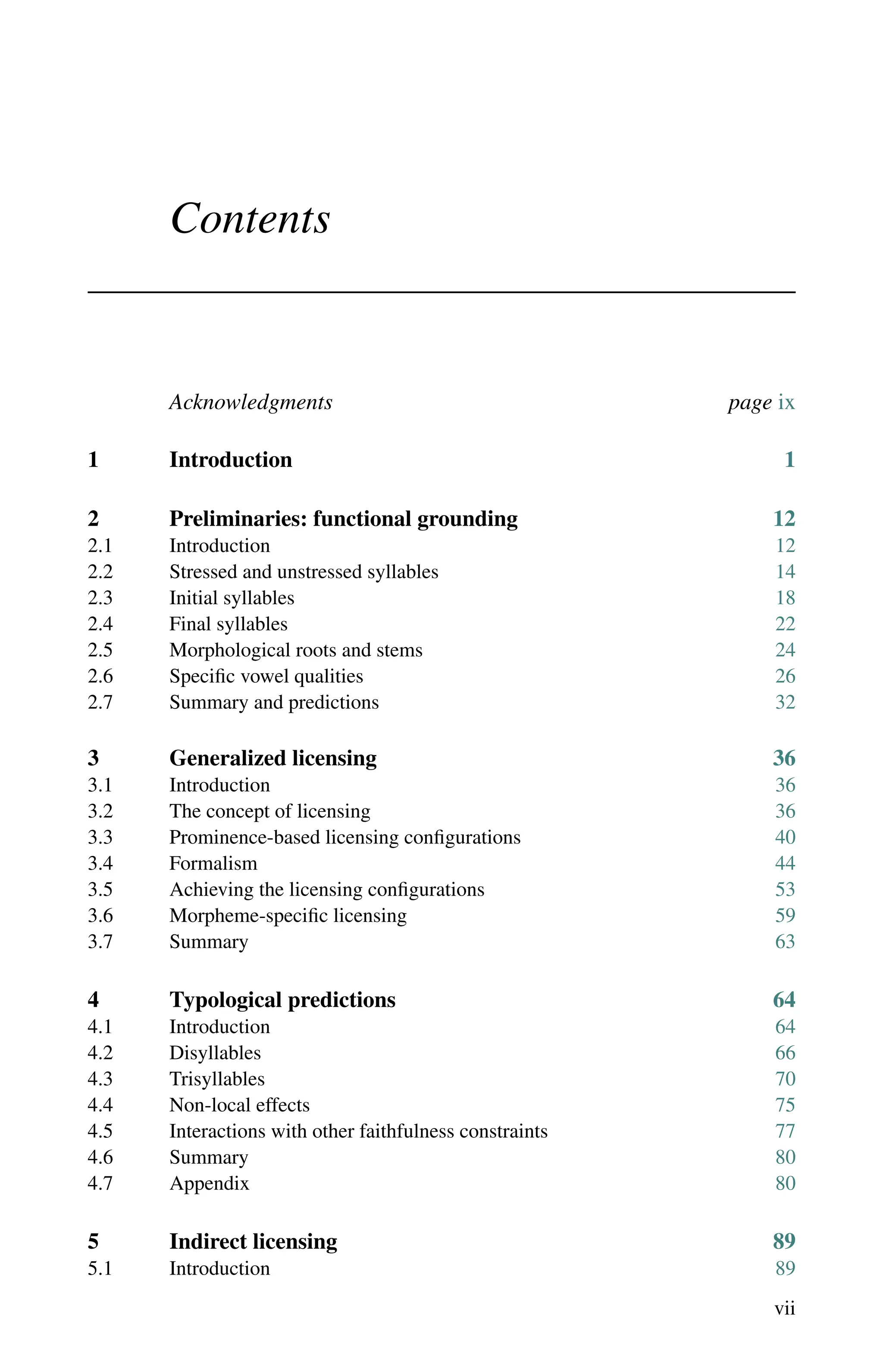
![1
1 Introduction
This book investigates phonological vowel patterns, that is, restrictions on
which vowel sounds can occur where in a language. Such patterns intersect
with two main themes of this work, characterized in (1).
(1) a. How word position affects the way in which vowels function in a pattern.
b.
How aspects of the perception and production of speech affect vowel
patterns.
Vowel patterns that interact with word position are pervasive in language.
For example, many languages show some form of systematic reduction in the
range of distinctive vowel qualities in unstressed syllables. This type of pat-
tern occurs in languages such as Russian, Italian, and English. Instances of
vowel reduction processes are witnessed when stress shifts under affixation. In
Standard American English, primary stress (signified by an accent) is assigned
to the first syllable in phótograph, where the vowel is pronounced as []. In
the related word, photógraphy, where stress is assigned to the second syllable,
the pronunciation of the vowel in the first syllable is reduced to [], designating
a mid-central quality that often occurs in unstressed syllables in all forms of
English (Ladefoged 1993: 84f.). Other vowel qualities can reduce to [] in an
unstressed syllable, as in expláin [] versus explanátion [] or emphátic []
versus émphasis [], causing a number of vowel distinctions to be merged in
some unstressed contexts.
Instances of vowel quality reduction in unstressed syllables are illustra-
tive of a relation between vowels and positional prominence. Positions in the
word that display a prominence maximum or minimum (e.g. stress peak/stress
trough) are often focal in patterns that affect vowel properties. Reduction of
vowel quality is not the only type of systematic process that is sensitive to pos-
itional prominence. As will be illustrated below, several other kinds of vowel
patterns are attested in the world’s languages that are conditioned by the rela-
tive prominence of the position in which the vowel occurs. Investigating the
breadth of these systems is essential to test and advance phonological theory.](https://image.slidesharecdn.com/5269950-250621031224-92839f24/75/Vowel-Patterns-In-Language-First-Paperback-Edition-Walker-Rachel-17-2048.jpg)
![2 Introduction
This gives rise to the primary investigatory questions that guide this research,
given in (2).
(2) a.
Why are only certain kinds of interactions between vowels and positional
prominence attested in spoken language?
b.
What is the range of systematic vowel patterns in spoken language that are
sensitive to positional prominence?
c.
What do these patterns reveal about the theoretical mental constructs that
form the basis for the phonological system that governs speech sounds in
a language?
Bearing on the question in (2a), prior preliminary investigation has identi-
fied a set of patterns that share a common result, namely, they avert distinctive
vowel qualities that are only expressed in non-prominent syllables (Walker
2004, 2005). These fall here under the rubric of prominence-based licensing
phenomena, and investigating their extent in language and their properties
is a focus of this book. Growing out from the preliminary investigation is a
hypothesis that the vowel patterns under study are in large part perceptually
driven: prominence-based licensing patterns serve to reduce perceptual diffi-
culty in language. Vowels that occur in a non-prominent syllable supply fewer
cues or less salient cues for listeners to perceive the properties that distinguish
them from other vowels; for instance, unstressed syllables tend to be shorter
in duration and lower in amplitude than stressed syllables. Foundation for this
hypothesis also stems from other studies of vowel patterns with different typo-
logical focus (Suomi 1983; Kaun 1995, 2004; Majors 1998; Crosswhite 2001,
2004) and from wide-scope studies on position-sensitive neutralization of
speech sounds (e.g. Steriade 1995a, 1999a,b).
The hypothesis that vowel patterns can be influenced by perception predicts
that a prominence-based licensing pattern could efface vowel qualities in a
non-prominent position, with the result that the communication of particular
distinctive properties in a non-prominent syllable would be sacrificed. It also
predicts the possibility that a pattern could augment the perceptibility of a dis-
tinctive vowel quality by causing it to be produced in a prominent syllable,
possibly as well as in a non-prominent syllable. A pattern that singles out vow-
els in prominent syllables for effacement – in the absence of augmenting a
non-prominent vowel quality – is not predicted to occur. Also not predicted is
a pattern that singles out only the most perceptible vowel qualities for augmen-
tation or loss. For example, because of its open jaw position, the low vowel [a]
tends to be longer and greater in amplitude than non-low vowels, so it is not
expected to be singled out in this way.An exception could be expected in word-
final position, where contextual laryngeal and aerodynamic weakening effects](https://image.slidesharecdn.com/5269950-250621031224-92839f24/75/Vowel-Patterns-In-Language-First-Paperback-Edition-Walker-Rachel-18-2048.jpg)
![Introduction 3
can interfere with the perception of low vowels (Barnes 2006). In conformity
with these predictions, prominence-based licensing patterns that selectively
augment or efface [a] are not found, except when it occurs in word-final pos-
ition. In contrast, because the high vowels [i] and [u] tend to be shorter than
non-high vowels and have a lower amplitude, the perception-driven hypothesis
predicts that certain prominence-based licensing patterns could be specific to
them, as is indeed attested. However, as will be taken up in chapter 2, it is not
always an easy task to determine the relative perceptual difficulty of vowel
qualities. Sometimes the vowel qualities involved in a given contrast each have
some different advantages and disadvantages, which could lead to variability
across languages in which quality is singled out in prominence-based licensing
phenomena.
Improved perceptual cues are not the only enhancements that a prominent
position affords. Articulations may be stronger and longer, for instance, in
stressed syllables and in initial and final positions. However, the nature of these
effects varies across languages and sometimes even across speakers of the same
language. This could suggest either that certain prominent positions facilitate
production or that the occurrence of stronger and longer articulations causes
a position to function as prominent. Articulatory enhancements are likely to
lead to certain improved perceptual cues, so these effects can be interactive.
Moreover, particular prominent positions are suggested to be psycholinguisti-
cally prominent, that is, they play an important role in processing of speech
for purposes of recognition or production. For example, word-initial positions
show increased salience or facilitation in word recognition and retrieval, and
they display evidence of a special status in the phonological encoding of sounds
for speech production. Again, these effects may be interactive such that certain
types of heightened psycholinguistic salience could facilitate or be facilitated
by enhanced perceptual cues and articulation.
All of these factors, perception, articulation, and processing, can contribute
to the relative markedness of a vowel, and possibly other factors can contribute
as well. A guiding idea pursued in this work is that the positions that func-
tion as prominent in vowel patterns are ones that tend to facilitate the percep-
tion, production, and processing of speech (Steriade 1995a, 1999a,b; Beckman
1997, 1999; Crosswhite 2001, 2004; Smith 2005). The emphasis here will be
chiefly on perception, although, as just described, this interacts with articula-
tion and processing. Given the hypothesis that the patterns under study largely
serve to reduce perceptual difficulty, it is expected that distinctive qualities in
marked vowels will be likely to occur in prominent positions or come to occur
in them, and they will otherwise be prone to effacement. Prominent positions](https://image.slidesharecdn.com/5269950-250621031224-92839f24/75/Vowel-Patterns-In-Language-First-Paperback-Edition-Walker-Rachel-19-2048.jpg)
![4 Introduction
that recur in vowel patterns across languages include stressed syllables, initial
syllables, morphological roots and stems, and, with some mixed effects, final
syllables. Although positional prominence is postulated to be grounded in con-
crete properties, the positions in question typically function as prominent in
phonology in an abstract and categorical manner. For example, a stressed syl-
lable is generally singled out in a prominence-sensitive phonological pattern
without regard to fluctuations in its physical or psycholinguistic prominence
due to variation in speaker or occasion. Furthermore, while all of the sylla-
bles in question may be potentially eligible to function as prominent in some
respect, which particular position is selected to serve as prominent can vary
from language to language, and sometimes even varies from pattern to pattern
within a language. In characterizing prominence-based licensing phenomena,
the prominent or licensing syllable is the one that serves as prominent for that
pattern and non-prominent or non-licensing syllables are syllables that form
the complement to the prominent syllable, even if they include syllables that
may function as prominent in other respects or in other languages. Thus, for
instance, the stressed syllable may serve as prominent for a given prominence-
based licensing pattern, in which case all unstressed syllables will function as
non-prominent for licensing in that pattern, including, if unstressed, initial,
final, and root/stem syllables.
In order to shed light on the question in (2b), this work undertakes a typo-
logical investigation of prominence-based licensing vowel patterns across lan-
guages. Over 25 distinct patterns are studied, providing a broad empirical basis
for developing and testing the theory. The aim is to investigate a range of pat-
terns in the form of case studies, with varying degrees of depth.
It is significant that distinctive vowel qualities that are expressed solely in
non-prominent syllables are prevented through diverse processes. A sampling
of different types of vowel patterns that are sensitive to prominence is provided
in (3). They include deletion (where a vowel is dropped), reduction (where a
distinction in vowel quality is lost), metathesis (where a vowel and consonant
change order), and assimilation (where a vowel becomes more like another in
the word; also known as a harmony pattern). In transcriptions in this book I
generally follow IPA conventions, although I indicate stress with accent marks
rather than the diacritic []. Tones are indicated by numbers following the syl-
lable: ‘1’ low, ‘5’ high, ‘51’ falling, and ‘15’ rising.
(3) a. Vowel deletion:
In northern dialects of Modern Greek, [i] and [u] are deleted when they
are unstressed in certain contexts. For example, the high vowel in the first
syllable of [pín-a-mi] ‘we were drinking’ is deleted when unstressed in
[é-pn-a] ‘I was drinking’ (Joseph 1990).](https://image.slidesharecdn.com/5269950-250621031224-92839f24/75/Vowel-Patterns-In-Language-First-Paperback-Edition-Walker-Rachel-20-2048.jpg)
![Introduction 5
b. Vowel reduction:
In Belarusian, a Slavic language, the vowels /e/ and /o/ lower to [a] in an
unstressed syllable, as evidenced in the following word pairs [réki] /[raká]
‘rivers/river,’ [nó]/[á] ‘legs/leg’ (Krivitskii and Podluzhnyi 1994;
Crosswhite 2001).
c. Vowel–consonant metathesis:
In certain Romance dialects of northern Italy, [i] in a final unstressed
syllable shows an apparent metathesis with a preceding consonant to create
a diphthong in the stressed syllable. Examples from old Piedmontese are
given alongside their forms in Standard Italian (SI): [káin] (SI [káni])
‘dog (m pl),’ [dráip] (SI [dráppi]) ‘cloth (m pl)’ (Rohlfs 1966). Since the
vowel that undergoes metathesis here is a suffix, this could be considered
a process of infixation.
d.
Assimilation of a vowel in a non-prominent position to one in a prominent
position:
In Macuxi, a Carib language, the central vowel [] undergoes assimilation
for backness and rounding with a stem vowel in casual speech. The
prefix
/p-/ ‘noun class A marker’ is produced with the vowel [] in [p-rw5]
‘arrow (of someone),’ but it displays assimilation in [pu-moi5] ‘egg (of
someone)’ and [pi-si5] ‘leg (of someone)’ (Carson 1982). (Numbers
indicate lexical pitch accents here.)
e.
Assimilation of a vowel in a prominent position to one in a non-prominent
position:
i.
In the Romance dialect of central Veneto, a high vowel in an unstressed
syllable causes mid vowels [e] and [o] to raise to [i] and [u], respect-
ively, when they occur in a preceding stressed syllable. This is evi-
denced by the word pairs [kantése]/[kantísimo] ‘sing (1sg/1pl impf.
subj.),’ [kantór]/[kantúri] ‘choir singer (m sg/pl)’ (Belloni 1991;
Brunelli 2000a; Walker 2005).
ii.
Lango, a Nilotic language, presents a case involving the morphological
root. A vowel in the final syllable of the root assimilates in its tongue
root advancement to a suffix vowel with an advanced tongue root, as
seen in the pair [11]/[11-i5] ‘beer/your (sg) beer’ (Woock
and Noonan 1979; Kaplan 2008a).
Observe that the patterns in (3a), (3b) and (3d) cause effacement of a vowel
quality in a non-prominent position, and patterns (3c) and (3e) cause augmen-
tation of a vowel quality that originated in a non-prominent position.
In addition to phonological processes that can produce vowel alternations in
related forms, prominence-based licensing patterns involving vowels can exist
as static distributions over the lexicon. These include position-sensitive pat-
terns that show a static lack of contrast, where certain vowel qualities are absent
in non-prominent positions, and static sequential dependencies, where certain
qualities can occur in a vowel in a non-prominent position only when those
qualities are also present in a vowel in a proximate prominent position. Some](https://image.slidesharecdn.com/5269950-250621031224-92839f24/75/Vowel-Patterns-In-Language-First-Paperback-Edition-Walker-Rachel-21-2048.jpg)
![6 Introduction
examples of static patterns are given in (4). Both of these examples involve the
word-initial syllable as the prominent position and they are drawn from Altaic
languages, which are suffixing. The word-initial syllable thus remains constant
across words with the same stem.
(4) a. Static lack of contrast
In Ola Lamut, non-high round vowels [o], [o], [], and [] occur only in
word-initial syllables. Words like the following are attested: [] ‘lie,
deception,’ [] ‘reindeer,’ [-] ‘to become weak,’ [] ‘sea wave,’
whereas words with non-high round vowels in a non-initial syllables are
absent (Li 1996).
b. Static sequential dependencies
In Classical Mongolian, non-high round vowels [] and [] occur in non-
initial syllables of the root only when all preceding syllables contain non-
high round vowels, as in [] ‘eyebrow(s),’ [] ‘to tame.’
In addition, non-high unround vowels can follow round ones, as in the
final syllable of the preceding examples and in [] ‘blue’, [] ‘far,
distant’ (Svantesson 1985; Walker 2001b).
I will refer later to sequential dependencies, like the one exemplified in (4b),
as ‘passive licensing.’ Not all sequential dependencies are static. The one in
Classical Mongolian happens to be static, because the initial syllable does not
change under the attachment of affixes (which are suffixes in this language), and
non-high round vowels never occur in suffixes. However, there are languages
that show passive licensing patterns with alternations. In C’Lela, a Benue-Congo
language, high vowels occur in certain suffixes when word final only if they fol-
low a root with a high vowel, and this restriction causes alternations in the suffix
vowel. What distinguishes these patterns from ones with active assimilation is
that when the conditions for the sequential dependency are not met, the vowel in
the non-prominent position is neutralized to another quality rather than under-
going assimilation with the vowel in the prominent position.
Relevant to question (2c), which asks what these patterns reveal about the
theoretical mental constructs, a goal of this work is to develop a formal account
that captures the commonalities among prominence-based licensing systems.
The proposal is that the patterns share an imperative modeled in the form of a
family of prominence-based licensing constraints, a construct that elaborates
on prior concepts of segmental and subsegmental licensing constraints, condi-
tions, or properties in language (e.g. Itô 1988, 1989; Goldsmith 1989, 1990;
Lombardi 1994, 1995). The constraints are united under a generalized prom-
inence-based licensing constraint schema. They bar certain types of phono-
logical structure – such as certain vowel properties – that occur solely in a
weak position, a type of positional markedness requirement (Zoll 1998a). In](https://image.slidesharecdn.com/5269950-250621031224-92839f24/75/Vowel-Patterns-In-Language-First-Paperback-Edition-Walker-Rachel-22-2048.jpg)
![Introduction 7
line with the foregoing discussion, the phonological structure in question is
prone to be marked in some way.
With respect to subsegmental features – which characterize different vowel
qualities – an important component of this proposal is the claim that features are
licensed provided that some member of the chain to which the feature belongs
is affiliated with a given licensing position. A chain for a feature consists of
the feature and any duplicated coindexed occurrences of it in a structure. This
allows the possibility of identity licensing, where licensing for a feature in
a non-prominent position is achieved by a duplicated feature in a prominent
position, as represented schematically for a feature specification [αF] in (5a).
(‘α’ is a variable over values {+, -} for [F].) Identity licensing has the potential
to operate at a distance over unaffected intervening material. Other possible
licensing configurations are indirect licensing, in (5b), where a feature has
associations with a prominent position and a non-prominent position, and dir-
ect licensing, in (5c), where a feature is contained wholly within a prominent
position. (The labels ‘direct’ and ‘indirect’ follow Steriade 1995b).
(5)
The licensing constraints are situated within the set of assumptions that con-
stitute Optimality Theory (OT; Prince and Smolensky 2004). A basic principle
of this outcome-centered framework is that systematic properties of a language
are represented in terms of constraints that are imposed over the phonological
output. Licensing constraints can block phonological structures that violate
them or they can drive patterns where changes occur that prevent a violation.
They thus are well suited to address both prominence-based licensing phenom-
ena that involve active processes, as well as ones that exist as static distribu-
tions in a language. Further, because constraints in OT are ranked and violable,
prominence-based licensing constraints may be violated within a language in
order to satisfy competing constraints with which they conflict.
The OT model differs from process-centered frameworks in which gram-
mars are organized around the individual processes that manipulate phono-
logical forms, such as vowel deletion or vowel reduction, rather than being
organized around the well-formedness of outputs of the grammar. A core result
of this study is that the reduction of perceptual difficulty in prominence-based
a. Identity licensing b. Indirect licensing c. Direct licensing
Prominent
position
Non-prominent
position
Prominent
position
Non-prominent
position
Prominent
position
Non-prominent
position
αFi αFi αF αF](https://image.slidesharecdn.com/5269950-250621031224-92839f24/75/Vowel-Patterns-In-Language-First-Paperback-Edition-Walker-Rachel-23-2048.jpg)
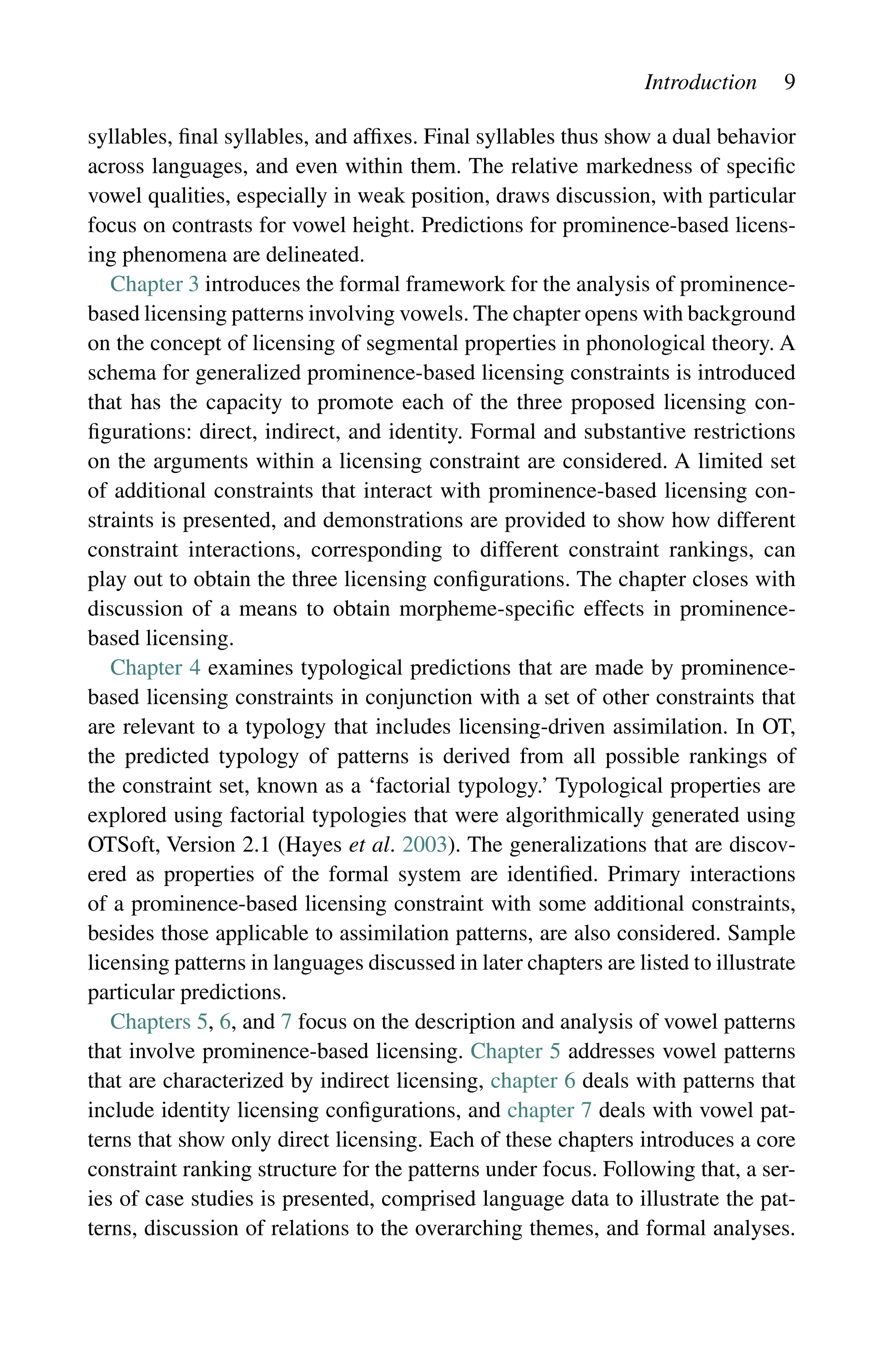
![26 Preliminaries: functional grounding
the potential for stems with derivational morphology to function as a ‘base’ for
certain phonological processes or formations, but more research on this topic
is needed before firm conclusions can be reached.
Alongside reported effects of root strength and the comparative weakness
of affixes, cases exist where affixes show evidence of phonological strength,
apparently separate from phonetically based word-edge strength effects. Such
patterns have not generally been interpreted as signaling affix prominence;
rather they have engendered proposals that certain patterns could arise from
a need to avoid neutralization of a morphological contrast involving the affix
or a need to improve its perceptibility. For discussion of possible cases of this
kind involving vowel patterns, see Majors (1998), Crosswhite (2001), Kurisu
(2001), Dillon (2004), Miglio (2005), and Barnes (2006).
2.6 Specific vowel qualities
I turn now to markedness of specific vowel properties, especially in weak pos-
ition, and their possible phonetic basis. This issue is relevant because although
some licensing-based vowel patterns take scope over all distinctive vowel
properties in the language, the majority either efface or augment specific vowel
properties in a weak position. I consider marked vowel properties to be dir-
ectly related to typological patterns obtained through the action of markedness
constraints that penalize certain vowel properties, either in particular contexts
or without contextual restrictions. Such patterns typically reflect vowel prop-
erties that are relatively less frequent within and across languages. Marked
vowel properties could be eliminated in the course of a derivation, for example
through being the target of deletion or neutralization. On the other hand, a
contextually marked vowel property could trigger assimilation if that caused
it to shed the contextual characteristics that render it marked. Vowel proper-
ties that are relatively less marked tend to be associated with epenthesis. For
general discussion of aspects of segmental markedness and its diagnostics, see
Rice (1999, 2007) and de Lacy (2002, 2006). A few examples of some marked
vowel properties, couched in terms of feature specifications, are given in (5).
These are cases of contextual markedness in that they either involve a vowel
property in a particular position or one in combination with another vowel
property.
(5) Examples of contextually marked vowel feature specifications
a. [round]:
[+round] is more marked in a non-high vowel than in a high vowel
(Kirchner 1993; Kaun 1995, 2004).](https://image.slidesharecdn.com/5269950-250621031224-92839f24/75/Vowel-Patterns-In-Language-First-Paperback-Edition-Walker-Rachel-42-2048.jpg)
![Specific vowel qualities 27
b. [ATR]:
[−ATR] is more marked in a high vowel than in a non-high vowel; [+ATR]
is more marked in a low vowel than in a non-low vowel (e.g. Calabrese
1988; Archangeli and Pulleyblank 1994; Baković 2000).
c. [high]:
[+high] can be more marked than [−high] in an unstressed syllable (Walker
2005); [−high] can be more marked than [+high] in an unstressed syllable
(Crosswhite 2001, 2004).
Some cases of markedness involving a vowel property in combination with
another are straightforward, such as those in (5a–b), whose markedness pat-
terning is generally consistent across different phonological phenomena and
across languages. Prior research has considered the phonetic basis for these
examples. As concerns (5a), Kaun has argued on the basis of experimental
research that lip rounding is more perceptually subtle in vowels with a lower
jaw height than in higher vowels. Thus, rounding in a non-high vowel could be
considered marked. A physical basis for the markedness asymmetries in (5b)
has been discussed by Archangeli and Pulleyblank. They observe that because
the tongue is incompressible, a gesture in one dimension often results in a com-
pensatory gesture in another dimension. This plays out in interactions between
height and tongue root advancement such that in advancing the tongue root, the
tongue body tends to raise, and in retracting the tongue root, the tongue body
tends to lower.
Unlike the ubiquitous cases in (5a–b), not every pairing of vowel proper-
ties shows a clear markedness asymmetry. For example, different studies come
to different conclusions about whether [+ATR] or [−ATR] mid vowels are
more marked (Archangeli and Pulleyblank 1994; Miglio 2005). Some context-
sensitive cases seem to show variable markedness. As listed in (5c), there
appears to be variation as to whether [+high] or [−high] is more marked in the
context of an unstressed syllable. Further, the relative markedness of features
considered independent of context can be a vexed matter. Rice’s (1999) wide-
ranging review of diagnostics for featural markedness finds that they do not
regularly produce the same results across languages, even when the languages
share the same inventory. Her survey points to the existence of some variation
for which features may be unmarked within a class. For instance, for a con-
trast between front and back vowels, languages can differ in whether front
vowels or back ones serve as unmarked with respect to asymmetric assimila-
tion.10
Independent of context, the relative markedness of vowels that have an
advanced versus retracted tongue root also seems to be variable. Nevertheless,
Rice finds that cross-linguistic generalizations exist in that not all feature](https://image.slidesharecdn.com/5269950-250621031224-92839f24/75/Vowel-Patterns-In-Language-First-Paperback-Edition-Walker-Rachel-43-2048.jpg)
![28 Preliminaries: functional grounding
specifications can serve as unmarked. For example, she observes that [labial]
does not serve as the least marked place of articulation for consonants in an
inventory that shows a labial/coronal/velar opposition.
In what follows, I focus on the issue of the markedness of different vowel
heights in an unstressed syllable or other weak position, which will be espe-
cially relevant to many of the licensing patterns considered in this work. I will
consider markedness predictions both on the basis of phonetic grounding and
phonological patterning.
With respect to perception, there is reason to suppose that either unstressed
high vowels or mid vowels could present difficulty. All else being equal,
high vowels are expected to be lower in amplitude and shorter in duration
than non-high vowels, because of their narrower aperture and lesser jaw
lowering. Lehiste (1970) reports that the intrinsic intensity of high vow-
els in English is less than that of non-high monophthongs with the same
backness (after Lehiste and Peterson 1959). The same is true of Hungarian
for vowels compared with others of the same length (Fónagy 1966; Lehiste
1970). In addition, Lehiste points out that a correlation has been confirmed
in numerous languages between intrinsic duration and tongue height such
that high vowels are shorter (in English, German, Spanish, Swedish, and
Thai, among others). These effects could cause high vowels to be less per-
ceptible or salient than non-high vowels (Majors 1998; Smith 2005; Walker
2005). On the other hand, high vowels could be more perceptible because
they tend to improve dispersion (e.g. Lindblom 1986, 1990) and because
of their focalization of acoustic energy, which could enhance their sali-
ence11
(Schwartz et al. 1997; see also Stevens 1989 on quantal effects).12
Nevertheless, the extent to which focalization produces an effect in weak
positions, such as unstressed syllables, deserves more study. As for low
vowels, in cross-linguistically common inventories with three, five, or seven
vowels that include a single low vowel /a/, the diagnostics of intrinsic ampli-
tude and duration, dispersion, and focalization converge on a categorization
of /a/ as not perceptually difficult in comparison to vowels of other heights.
However, in word-final position this situation can change, as I discuss later
in this section.
Other phenomena point to the possibility that either high or mid vowels could
serve as marked in a weak position. One criterion for a marked vowel qual-
ity is that it is unlikely to be epenthetic. Rice observes that high vowels are
often epenthetic (e.g. Navajo) but in some languages epenthetic vowels are mid
(e.g. Spanish). Epenthetic vowels do not have a contrastive function, and they
often occur in phonologically weak positions. These patterns suggest that when](https://image.slidesharecdn.com/5269950-250621031224-92839f24/75/Vowel-Patterns-In-Language-First-Paperback-Edition-Walker-Rachel-44-2048.jpg)
![Specific vowel qualities 29
perception of a height contrast is not at stake, high vowels may be unmarked in
a weak position, but this is not a universal generalization.
Patterns of vowel deletion provide another diagnostic. It can be supposed
that deletion that asymmetrically affects vowels with particular qualities elimi-
nates marked vowels (de Lacy 2002, 2006).13
In patterns that delete unstressed
vowels, often high vowels or all non-low vowels are prone to deletion. In the
history of Latin, unstressed high and mid vowels were frequently deleted, but
[a] was generally retained (Grandgent 2002; note also Hermann 1997), e.g.
frigdária for frìgidária, cornáre for coronáre, but mìrabília. Further examples
where elision occurred include cóm(i)tem, dèl(i)cátus, fráx(i)nus, pérs(i)ca,
fíb(u)la, póp(u)lus, séd(e)cim, còll(o)cáre. In many present-day dialects of
northern Italy, unstressed vowels except [a] are extensively deleted where
syllable structure allows (Maiden 1997), e.g. Bolognese [á] ‘Sunday’
*[é], [] ‘hospital’ *[á]. These patterns point to non-
low vowels, especially high ones, being disfavored in unstressed syllables of
Latin and certain of its descendents. In late Latin the vowels [i]/[e] and [u]/
[o] were often used indiscriminately in post-tonic syllables (Grandgent 2002).
This suggests that the contrast between high and mid vowels in post-tonic syl-
lables was perceptually difficult, and these same vowels were susceptible to
deletion. The cause for the perceptual difficulty could be tied to compression
of the height dimension in the absence of stress (see §2.2). The low vowel /a/
could be less vulnerable to deletion or confusion with other vowels because it
has the lowest height, and hence tends to have the greatest intrinsic amplitude
and duration. Also, as the only low vowel and the only central vowel in Latin, it
lacks a minimally contrastive vowel paired for backness/rounding or height.
While Latin unstressed vowel patterns point to a weak contrast between high
and mid vowels in this context, which could be construed as a basis for clas-
sifying them as marked, diagnostics do not uniformly designate one of these
heights as more marked. The fact that many Romance dialects show partial or
full raising of mid vowels in unstressed vowel neutralization (e.g. Maiden 1997;
Crosswhite 2001) could indicate that unstressed high vowels are less marked,
either with respect to prominence (Crosswhite 2001, 2004) or articulatory effort
(Flemming 2004). This is in keeping with a viewpoint that
peripheral vowels
(e.g. /i a u/) are less marked than non-peripheral vowels, (e.g. /e o/) (Steriade
1995b; Crosswhite 2001, 2004). However, in many Romance dialects, high
vowels trigger height assimilation in the stressed syllable, and sometimes the
triggers are restricted to high vowels that are in contrast with mid vowels (Dyck
1995; Rice 1999; Campos-Astorkiza 2009). Rice and de Lacy identify trigger-
ing of assimilation as a characteristic of marked elements. These triggering](https://image.slidesharecdn.com/5269950-250621031224-92839f24/75/Vowel-Patterns-In-Language-First-Paperback-Edition-Walker-Rachel-45-2048.jpg)
![30 Preliminaries: functional grounding
effects are therefore suggestive of an opposite conclusion, namely, that the
high unstressed vowels are more marked. As interpreted here, these patterns
can be construed as avoidance of a high vowel whose contrastive height prop-
erty is expressed solely in an unstressed position.
It is worth considering whether asymmetries in triggers of vowel assimi-
lation could have a basis in coarticulatory patterns that are sensitive to vowel
quality. For example, [i] has been found to have the strongest coarticulatory
influence in German and Italian (Butcher and Weiher 1976; Farnetani et al.
1985). Also, cross-linguistically [i] tends to show the weakest coarticulatory
effects from other vowels (Beddor et al. 2001, 2002). Iverson and Salmons
(2003) suggest that umlaut in Old High German, which is triggered by high
front [i j], has a source in the coarticulatory properties of these vocoids (see
§5.3). In Walker 2005, I speculate that the coarticulatory characteristics of [i]
could contribute to this vowel’s function as a trigger of metaphony in Romance
dialects of Italy and Spain, although most likely as an ancillary factor. In
metaphony patterns, a high vowel causes height assimilation in a preceding
stressed vowel. However, the occurrence of harmony from unstressed [i] but
not stressed [i] seems to require explanation apart from coarticulation.14
Indeed
the opposite could be expected if coarticulation were the only motivating force
(see §2.2). Experimental research by Majors (1998) found that unstressed /i/
was more prone to coarticulatory influence from an adjacent stressed vowel
than vice versa for some speakers of English. Also, the strong coarticulatory
influence of [i] cannot be the only basis for high vowel triggers given that [u]
can trigger metaphony; indeed, in some languages [u] serves as the only trigger
(e.g. in the dialect of Lena). These characteristics support the conclusion that
high unstressed vowels serve as marked in metaphonic-type patterns, and that
prominence-based licensing plays a driving role in such systems.
As mentioned above, low vowels do not typically present greater perceptual
difficulty than higher vowels. As we might expect, this generalization is prin-
cipally tied to inventories in which /a/ is the only low vowel. When it comes to
contrasts involving backness and rounding, both of which affect F2, high vow-
els tend to exhibit greater perceptual distance than lower ones (Sands 2004).
Not surprisingly, then, in Esimbi, a language that displays three low vowels, as
well as front and back mid vowels and three high vowels, a prominence-based
licensing pattern that realizes vowel height contrasts in the initial syllable sin-
gles out non-high vowels as a class. Here, the crowding of the low vowels
presents a greater challenge for the perception of contrasts among non-high
vowels than in a language whose only low vowel is /a/. That the markedness
of /a/ is sensitive to the presence or absence of other contrastive low vowels](https://image.slidesharecdn.com/5269950-250621031224-92839f24/75/Vowel-Patterns-In-Language-First-Paperback-Edition-Walker-Rachel-46-2048.jpg)
![Specific vowel qualities 31
is consistent with the claim of Flemming (2002, 2004) that markedness as it
pertains to perception is a property of contrasts and cannot be determined by
assessment of individual sounds independent of the contrastive inventory.
Furthermore, the feature [+low] could serve as perceptually marked in the
context of a final unstressed open syllable. Barnes (2006: 144f.) discusses a
number of languages in which word-final /a/ undergoes reduction. In several
cases, he lists /a/ as the only vowel to undergo reduction in this position. For
example in Kullo (Omotic), word-final /a/ raises to [], in Muinane (Witotoan)
and Goajiro (Arawakan) word-final /a/ undergoes variable raising to [].
Jiménez (1998) discusses Valencian varieties where word-final unstressed /a/
undergoes neutralization to [], [], or []. Barnes notes an asymmetry between
word-final open and closed syllables in Standard Malay. Neutralization in the
final syllable results in the vowels [i u] in an open syllable but [e a o] in a
closed syllable. He suggests that the vowels in a final open syllable may be
more susceptible to certain types of phonetic attrition than vowels in a closed
syllable by virtue of their closer proximity to the boundary (see §2.4).
We may wonder why lower vowels in particular could be disadvantaged in
a word-final open syllable. Barnes identifies two possible reasons for vowel
raising in word-final context. One is that breathy phonation – which can occur
as an effect in final position – has been linked to raising in some languages
(Gordon and Ladefoged 2001). Another has to do with the phasing of laryngeal
and aerodynamic weakening in a final vowel and the target of its supralaryn-
geal gesture. Barnes examines Russian /a/ and /o/ in an unstressed syllable,
which are realized anywhere between [] and [] in phrase-final position. He
finds that amplitude in the final vowel decreases over the course of its pro-
duction, becoming extremely weak towards the end. At the same time, Barnes
observes that the peak F1 for the vowel seems to be delayed, coming later
relative to the onset of the vowel. Assuming that gestures undergo slowing
approaching the boundary, Barnes suggests that the combination of gestural
slowing and amplitude decay cause the F1 peak to be attained during a portion
of the vowel where perceptibility is significantly decreased. Thus, despite final
lengthening, perception of the peak F1 is more difficult. During the earlier
portion of the vowel, where perceptibility is stronger, the vowel has not yet
reached its F1 target. Barnes speculates that this could cause listeners to mis-
perceive the vowel as higher, leading to raising. This effect is specific to final
position. Barnes found that pretonic /a/ showed a robust amplitude throughout,
including at its F1 peak.
To summarize, with respect to vowel height, it seems that in weak positions,
especially ones with reduced duration, high and mid vowels can be confusable](https://image.slidesharecdn.com/5269950-250621031224-92839f24/75/Vowel-Patterns-In-Language-First-Paperback-Edition-Walker-Rachel-47-2048.jpg)
![34 Preliminaries: functional grounding
interacts with a prominent position, such as a stressed syllable, across interven-
ing material. We will see that these predictions too are borne out.
Certain types of systems are also unexpected with respect to positional
asymmetries. Positions that are non-prominent are not expected to be singled
out as licensors in positional licensing phenomena. This holds of contexts
defined as the complement to a prominent position or that are especially weak,
such as non-initial syllables, unstressed syllables, affixes, and inflectional mor-
phemes. Likewise, material contained within a prominent position, such as a
stressed syllable, initial syllable, or root/stem, are not expected to be singled
out as the subject of a prominence-based licensing restriction, as is consistent
with the patterns studied here.
The markedness of specific vowel properties results in quality-sensitive pre-
dictions for prominence-based licensing phenomena. It is expected that vowel
properties that are marked (in some context) could be the subject of a promi-
nence-based licensing restriction, especially if they are perceptually difficult.
For example, lip rounding is considered to be more perceptually subtle in a
non-high vowel than a high one. Consistent with this asymmetry, certain prom-
inence-based patterns studied in this work prevent forms in which rounding
in a non-high vowel is expressed solely in a weak position. No patterns were
found where round high vowels alone were prevented by a licensing restric-
tion, nor are they expected.
Another type of quality-sensitive prediction is that there could be exceptions
to a prominence-based licensing process (i.e. blocking or a different solution)
specifically when the result would otherwise have been a marked vowel. For
example, there is wide consensus that [−ATR] is more marked in a high vowel
than in a non-high one, and we could expect licensing-driven raising phenom-
ena to be prevented or altered when they would generate a [−ATR] high vowel.
Such patterns are indeed attested. Exceptions are not predicted when the result
would otherwise have been a comparatively unmarked vowel.
Where the relative markedness for the qualities involved in a given vowel
contrast is variable, we could expect variation across languages or perhaps
even within them as to which vowel quality serves as marked (i.e. restricted)
in licensing-based patterns. One such example is high versus mid vowels in
a weak position, each of which has been suggested to present some percep-
tual difficulty. In the prominence-based licensing patterns studied in this book
that involve height contrasts, high vowels in weak position are often the ones
involved. We might perhaps expect high vowels to show more frequent activ-
ity than mid vowels in these phenomena based on the overall frequency with
which this class of segments is active in phonology. Mielke’s (2008) survey of](https://image.slidesharecdn.com/5269950-250621031224-92839f24/75/Vowel-Patterns-In-Language-First-Paperback-Edition-Walker-Rachel-50-2048.jpg)
![The concept of licensing 37
1995, 2001; Steriade 1995b; Zoll 1997, 1998a, among others).1
Licensing con-
straints or conditions have variously been formulated as negative statements
that serve to bar unlicensed structure, or as positive statements that call for the
presence of a relation between a licensor and licensee. The means by which
the licensee is affiliated with the licensor are often established by some path
of association that connects elements of structure. For example, the affiliation
could be considered accomplished if the licensor dominates the licensee, or
vice versa (Zoll 1998a).
A classic pattern to which this model of licensing has been applied involves
neutralization asymmetries in syllable margins. Many languages display more
consonantal contrasts in onsets than in codas. Taking the case of coda neutral-
ization of consonant place features, Itô and Mester (1993) employ a negatively
formulated condition along the lines in (1).
(1) Coda place condition
*µ
|
[Placecons]
This condition is interpreted as prohibiting consonant place features that
exhaustively trace to a mora node in the prosodic structure, but it does not
bar these features in a mora-dominated segment if they are also affiliated with
a segment that lacks a mora (i.e. an onset). Expressed in terms of licensing,
onsets license consonant place features but codas do not. Itô and Mester apply
this to the case of Japanese. Apart from a placeless moraic nasal coda, the only
consonants that can close a syllable in Japanese are geminates or nasals that are
place-assimilated with a following onset consonant. The permissible structures
where a consonant place feature occurs in a coda are illustrated in (2a–b); (2c)
shows a structure that will be prevented by the coda place condition.
(2)
a. [kippu] ‘ticket’ b. [sampo] ‘stroll’ c. *[kam]
µ µ µ
σ σ σ σ σ
µ µ µ µ µ
(k i p u) (s a m p o) (k a m)
Rt Rt Rt Rt
[labial] [labial] [labial]](https://image.slidesharecdn.com/5269950-250621031224-92839f24/75/Vowel-Patterns-In-Language-First-Paperback-Edition-Walker-Rachel-53-2048.jpg)



![This ebook is for the use of anyone anywhere in the United States
and most other parts of the world at no cost and with almost no
restrictions whatsoever. You may copy it, give it away or re-use it
under the terms of the Project Gutenberg License included with this
ebook or online at www.gutenberg.org. If you are not located in the
United States, you will have to check the laws of the country where
you are located before using this eBook.
Title: The Strand Magazine, Vol. 01, Issue 02, February 1891
Author: Various
Editor: George Newnes
Release date: May 3, 2013 [eBook #42633]
Most recently updated: October 23, 2024
Language: English
Credits: Produced by Dianna Adair, Jonathan Ingram and the Online
Distributed Proofreading Team at http://www.pgdp.net
*** START OF THE PROJECT GUTENBERG EBOOK THE STRAND
MAGAZINE, VOL. 01, ISSUE 02, FEBRUARY 1891 ***](https://image.slidesharecdn.com/5269950-250621031224-92839f24/75/Vowel-Patterns-In-Language-First-Paperback-Edition-Walker-Rachel-60-2048.jpg)







![[Andrew spencer] morphological_theory(book_fi.org) for taha](https://cdn.slidesharecdn.com/ss_thumbnails/andrewspencermorphologicaltheorybookfi-140419093949-phpapp01-thumbnail.jpg?width=640&height=640&fit=bounds)


