PROJECTION OF SOLIDS
INTRODUCTION
A solid has three dimensions, viz. length, breadth and
thickness. To represent a solid on a flat surface having
only length and breadth, at least two orthographic views
are necessary.
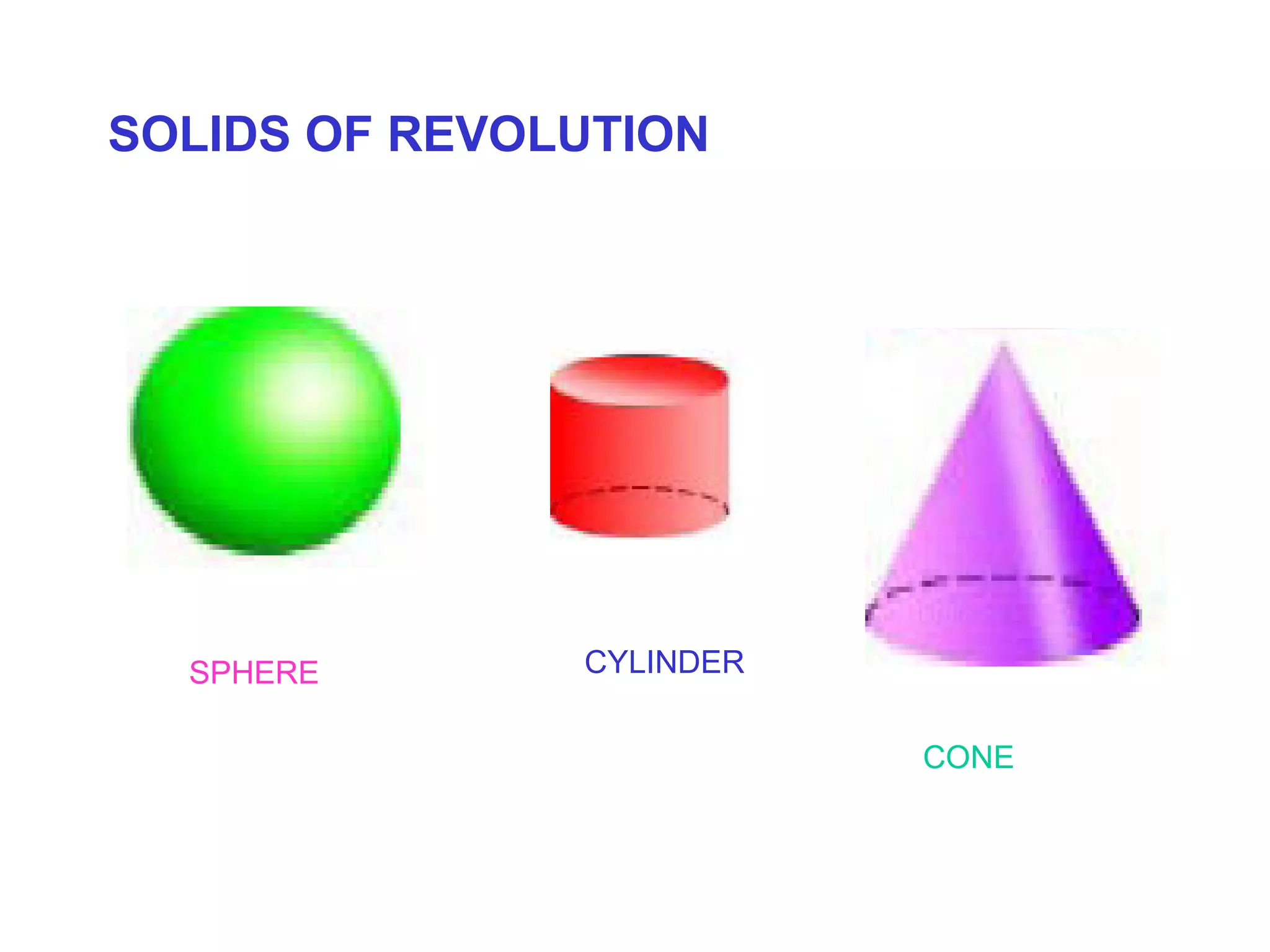
SPHERE CYLINDER
CONE
SOLIDS OF REVOLUTION
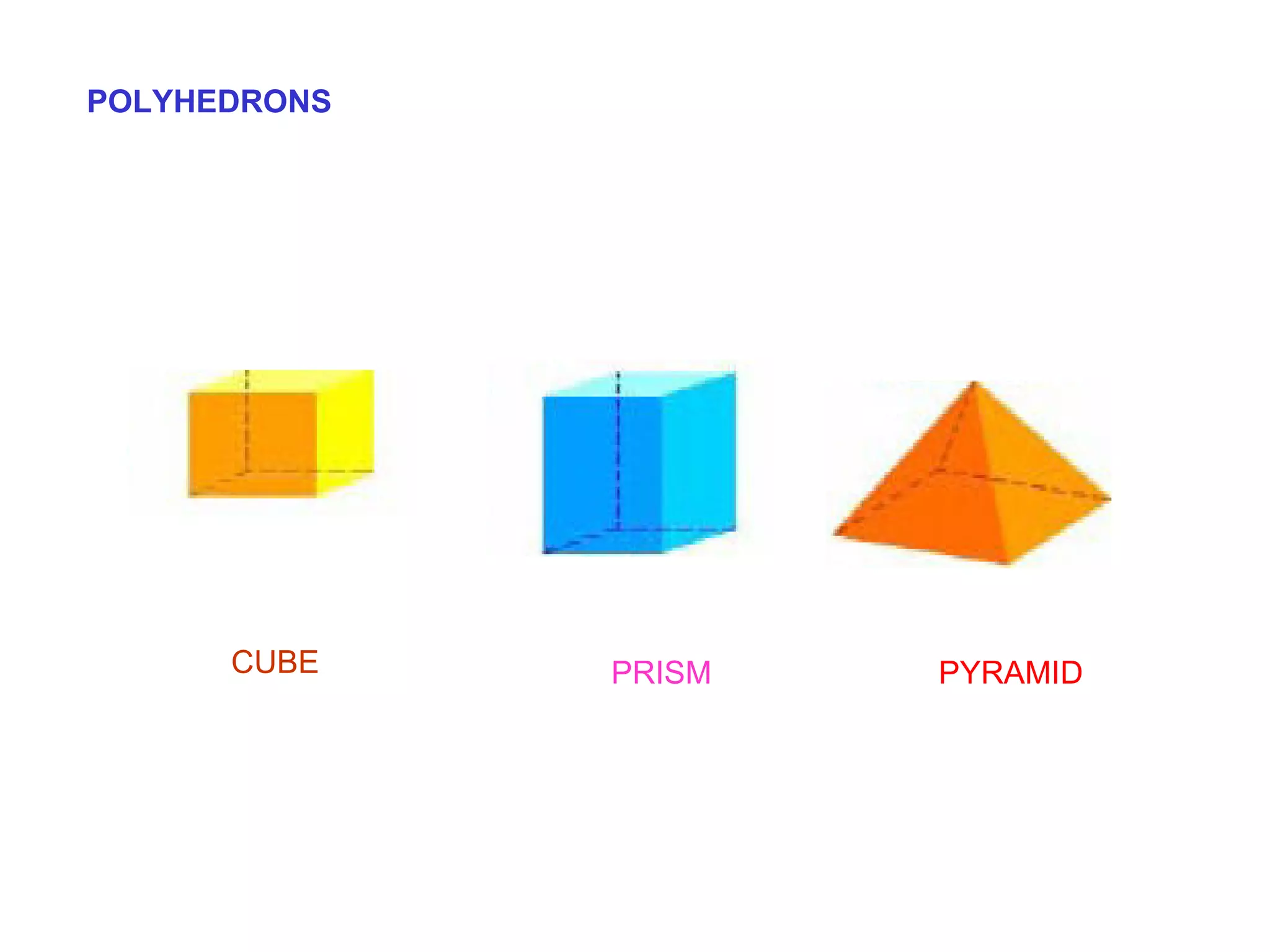
CUBE PRISM PYRAMID
POLYHEDRONS
Overview
1. Types of solids.
2. Projections of solids in simple positions.
a. Axis perpendicular to the H.P.
b. Axis perpendicular to the V.P.
c. Axis parallel to both the H.P. and the V.P
3. Projections of solids with axes inclined to one of the
reference planes and parallel to the other.
a. Axis inclined to the V.P. and parallel to the H.P.
b. Axis inclined to the H.P. and parallel to the V.P.
4. Projections of solids with axes inclined to both the H.P.
and the V.P.
5. Projections of spheres.
Types of Solids
Solids may be divided into two main groups:
i. Polyhedron ii. Solids of revolution.
i. Polyhedron: A polyhedron is defined as a solid bounded
by planes called faces. When all the faces are equal and
regular, the polyhedron is said to be regular.
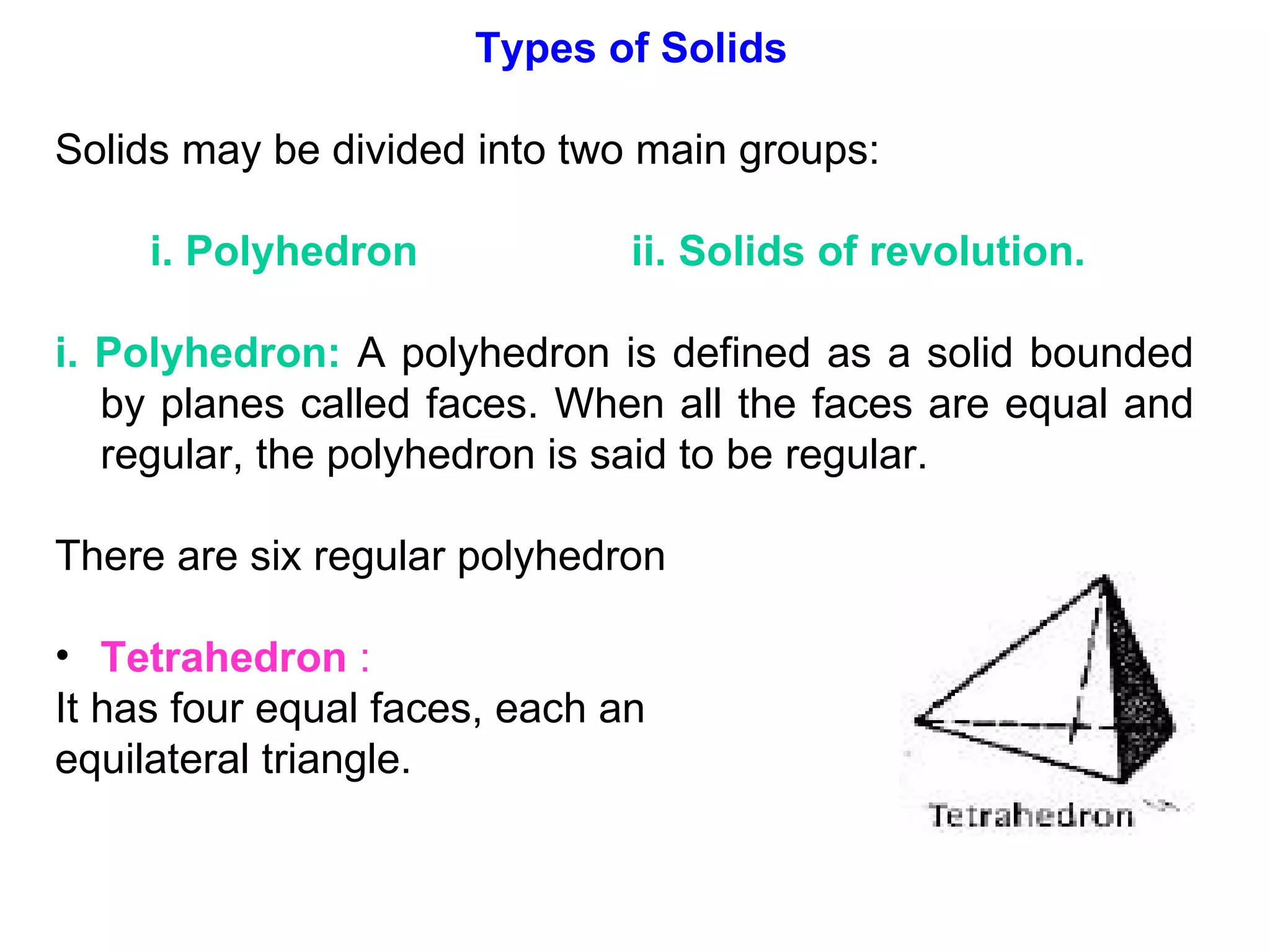
There are six regular polyhedron
• Tetrahedron :
It has four equal faces, each an
equilateral triangle.
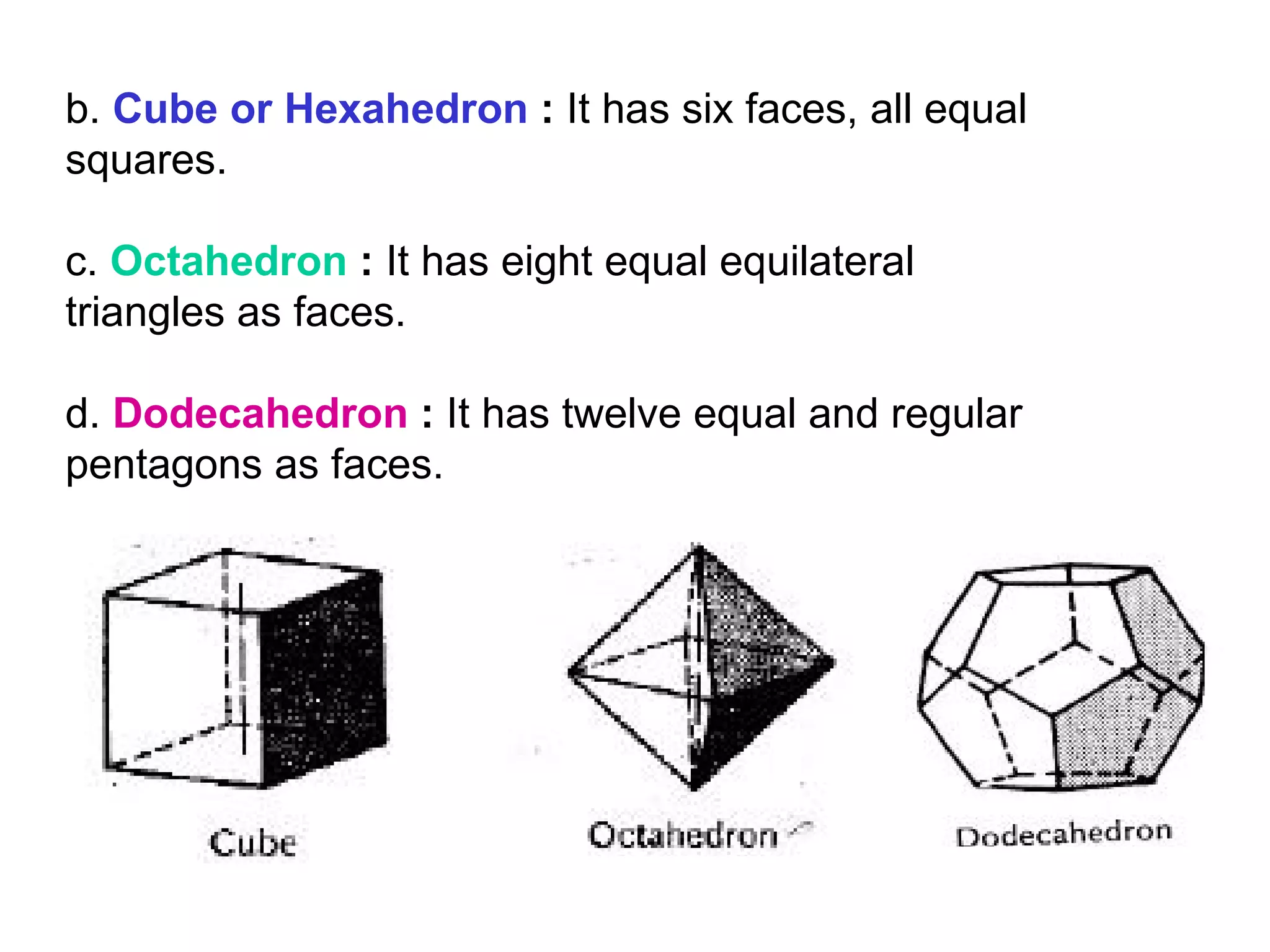
b. Cube or Hexahedron : It has six faces, all equal
squares.
c. Octahedron : It has eight equal equilateral
triangles as faces.
d. Dodecahedron : It has twelve equal and regular
pentagons as faces.
Prism: This is a polyhedron having two equal and similar faces
called its ends or bases, parallel to each other and joined by
other faces, which are parallelograms. The imaginary line
joining the centers of the bases is called the axis.
A right and regular prism has its axis perpendicular to the
bases. All its faces are equal rectangles.
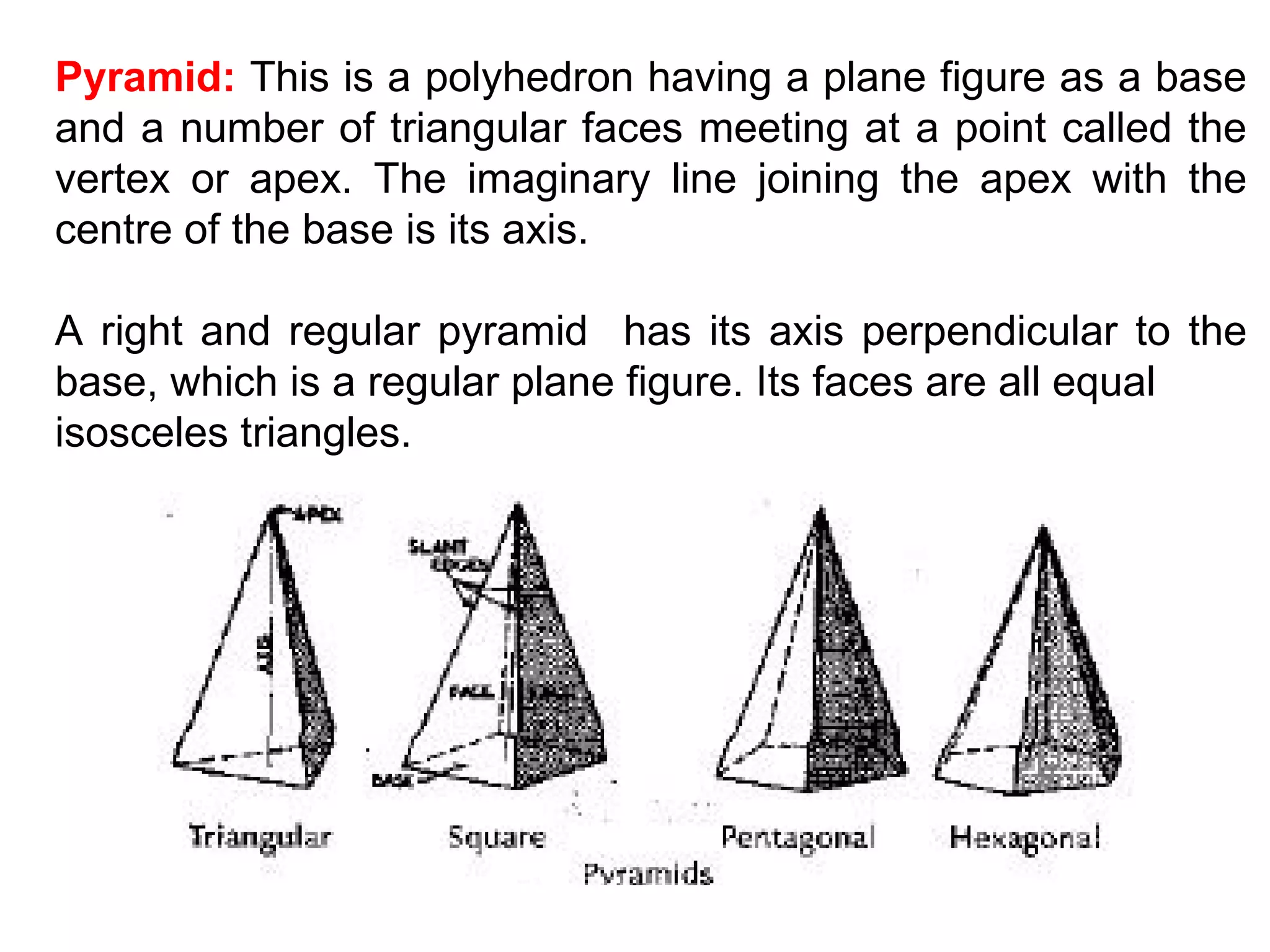
Pyramid: This is a polyhedron having a plane figure as a base
and a number of triangular faces meeting at a point called the
vertex or apex. The imaginary line joining the apex with the
centre of the base is its axis.
A right and regular pyramid has its axis perpendicular to the
base, which is a regular plane figure. Its faces are all equal
isosceles triangles.
Solids of Revolution
Definition:
Solids which are generated by rotating a plane surface
about one of its sides
Three Types
Cylinder Cone Sphere
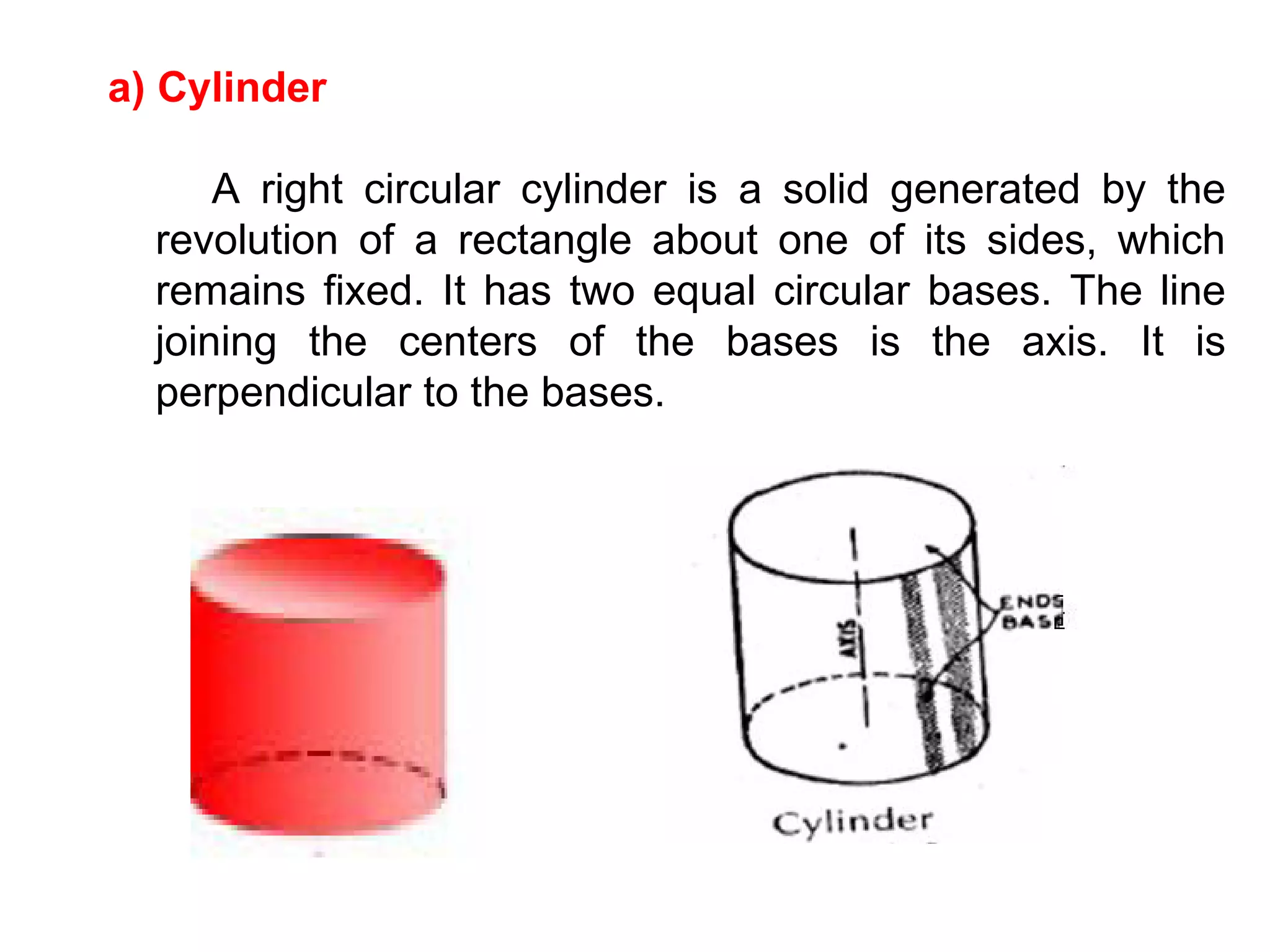
a) Cylinder
A right circular cylinder is a solid generated by the
revolution of a rectangle about one of its sides, which
remains fixed. It has two equal circular bases. The line
joining the centers of the bases is the axis. It is
perpendicular to the bases.
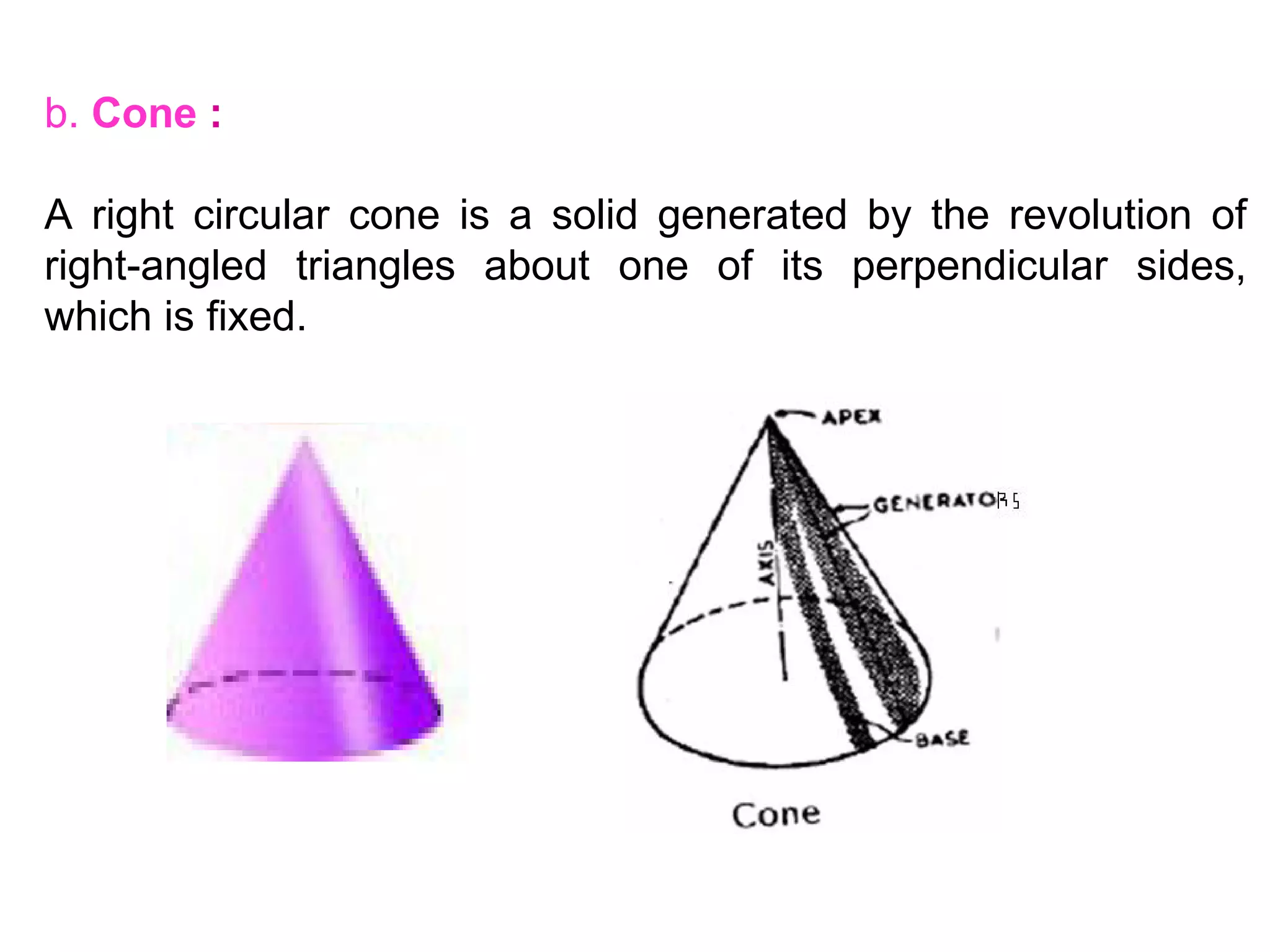
b. Cone :
A right circular cone is a solid generated by the revolution of
right-angled triangles about one of its perpendicular sides,
which is fixed.
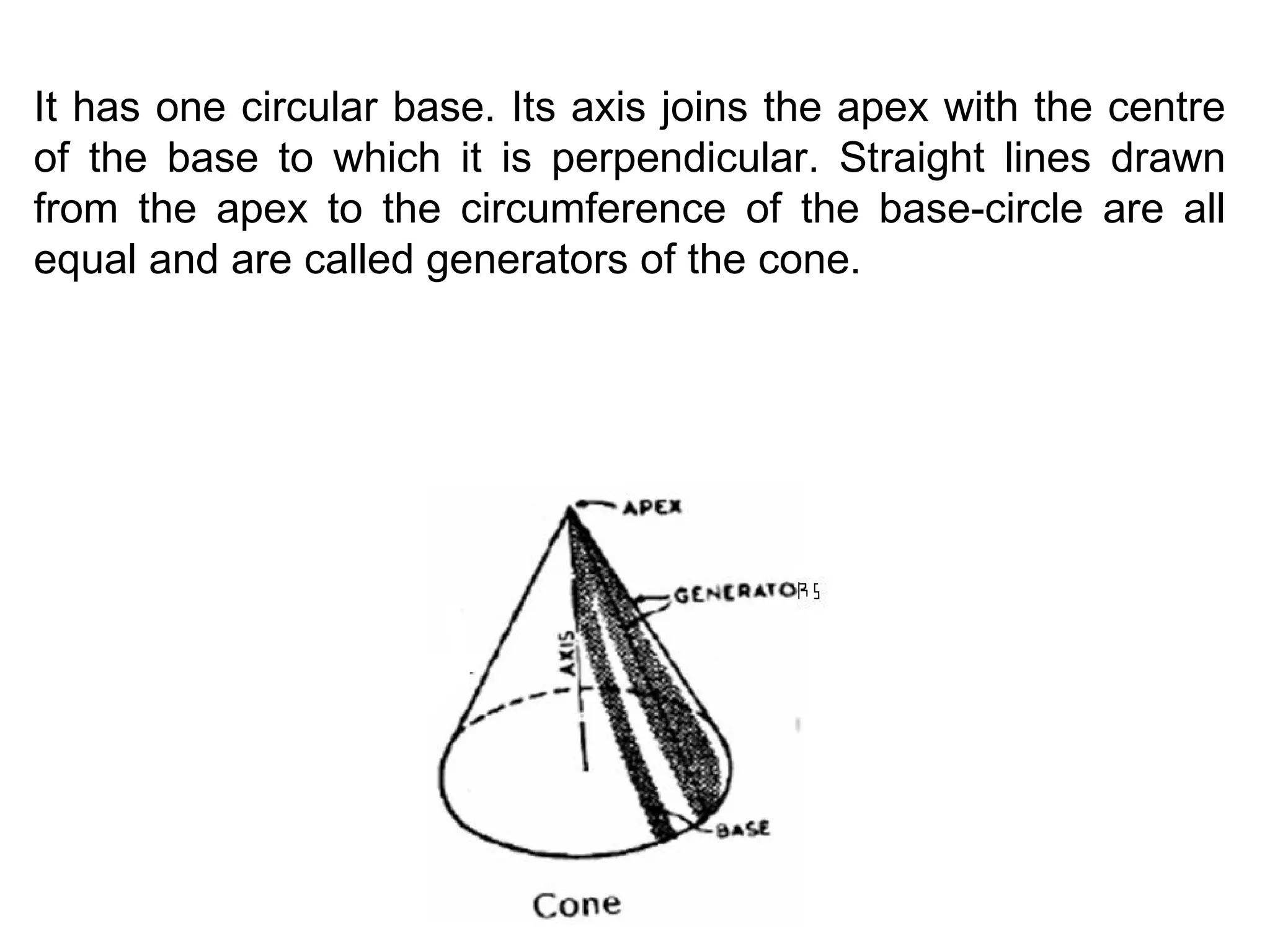
It has one circular base. Its axis joins the apex with the centre
of the base to which it is perpendicular. Straight lines drawn
from the apex to the circumference of the base-circle are all
equal and are called generators of the cone.
c. Sphere :
A sphere is a solid generated by the revolution of a semi-circle
about its diameter as the axis. The mid-point of the diameter is
the centre of the sphere. All points on the surface of the sphere
are equidistant from its centre.
d. Frustum: When a pyramid or a cone is cut by a plane
parallel to its base, thus removing the top portion, the
remaining portion is called its frustum.
e. Truncated: When a solid is cut by a plane inclined to base it
is said to be truncated.
Unless and otherwise stated, the given solid should be
understood as right and regular.

Types of solids

  • 1.
  • 2.
    INTRODUCTION A solid hasthree dimensions, viz. length, breadth and thickness. To represent a solid on a flat surface having only length and breadth, at least two orthographic views are necessary.
  • 3.
  • 4.
  • 5.
    Overview 1. Types ofsolids. 2. Projections of solids in simple positions. a. Axis perpendicular to the H.P. b. Axis perpendicular to the V.P. c. Axis parallel to both the H.P. and the V.P 3. Projections of solids with axes inclined to one of the reference planes and parallel to the other. a. Axis inclined to the V.P. and parallel to the H.P. b. Axis inclined to the H.P. and parallel to the V.P. 4. Projections of solids with axes inclined to both the H.P. and the V.P. 5. Projections of spheres.
  • 6.
    Types of Solids Solidsmay be divided into two main groups: i. Polyhedron ii. Solids of revolution. i. Polyhedron: A polyhedron is defined as a solid bounded by planes called faces. When all the faces are equal and regular, the polyhedron is said to be regular. There are six regular polyhedron • Tetrahedron : It has four equal faces, each an equilateral triangle.
  • 7.
    b. Cube orHexahedron : It has six faces, all equal squares. c. Octahedron : It has eight equal equilateral triangles as faces. d. Dodecahedron : It has twelve equal and regular pentagons as faces.
  • 8.
    Prism: This isa polyhedron having two equal and similar faces called its ends or bases, parallel to each other and joined by other faces, which are parallelograms. The imaginary line joining the centers of the bases is called the axis. A right and regular prism has its axis perpendicular to the bases. All its faces are equal rectangles.
  • 9.
    Pyramid: This isa polyhedron having a plane figure as a base and a number of triangular faces meeting at a point called the vertex or apex. The imaginary line joining the apex with the centre of the base is its axis. A right and regular pyramid has its axis perpendicular to the base, which is a regular plane figure. Its faces are all equal isosceles triangles.
  • 10.
    Solids of Revolution Definition: Solidswhich are generated by rotating a plane surface about one of its sides Three Types Cylinder Cone Sphere
  • 11.
    a) Cylinder A rightcircular cylinder is a solid generated by the revolution of a rectangle about one of its sides, which remains fixed. It has two equal circular bases. The line joining the centers of the bases is the axis. It is perpendicular to the bases.
  • 12.
    b. Cone : Aright circular cone is a solid generated by the revolution of right-angled triangles about one of its perpendicular sides, which is fixed.
  • 13.
    It has onecircular base. Its axis joins the apex with the centre of the base to which it is perpendicular. Straight lines drawn from the apex to the circumference of the base-circle are all equal and are called generators of the cone.
  • 14.
    c. Sphere : Asphere is a solid generated by the revolution of a semi-circle about its diameter as the axis. The mid-point of the diameter is the centre of the sphere. All points on the surface of the sphere are equidistant from its centre.
  • 15.
    d. Frustum: Whena pyramid or a cone is cut by a plane parallel to its base, thus removing the top portion, the remaining portion is called its frustum. e. Truncated: When a solid is cut by a plane inclined to base it is said to be truncated. Unless and otherwise stated, the given solid should be understood as right and regular.