WELCOME
ST. Peter’s College
of Education
Presented by,
FARZANA BEGUM
Roll No. 17
Line
s &Angle
s
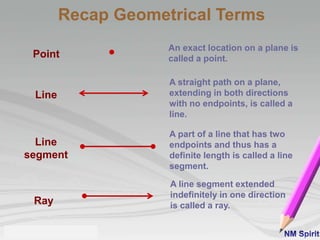
Point
An exact location on a plane is
called a point.
Line
Line
segment
Ray
A straight path on a plane,
extending in both directions
with no endpoints, is called a
line.
A part of a line that has two
endpoints and thus has a
definite length is called a line
segment.
A line segment extended
indefinitely in one direction
is called a ray.
Recap Geometrical Terms
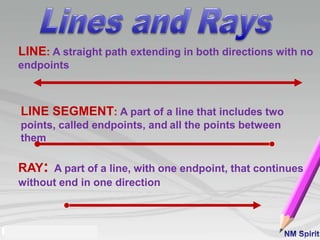
RAY: A part of a line, with one endpoint, that continues
without end in one direction
LINE: A straight path extending in both directions with no
endpoints
LINE SEGMENT: A part of a line that includes two
points, called endpoints, and all the points between
them
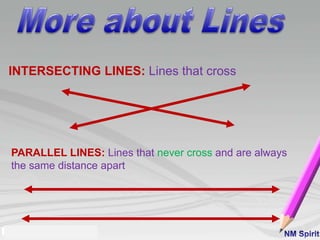
INTERSECTING LINES: Lines that cross
PARALLEL LINES: Lines that never cross and are always
the same distance apart
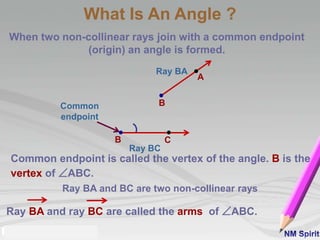
Common
endpoint
B C
B
A
Ray BC
Ray BA
Ray BA and BC are two non-collinear rays
When two non-collinear rays join with a common endpoint
(origin) an angle is formed.
What Is An Angle ?
Common endpoint is called the vertex of the angle. B is the
vertex of ABC.
Ray BA and ray BC are called the arms of ABC.
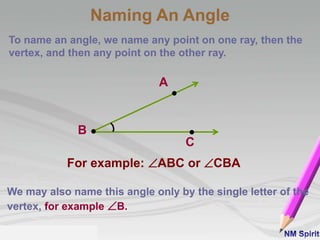
To name an angle, we name any point on one ray, then the
vertex, and then any point on the other ray.
For example: ABC or CBA
We may also name this angle only by the single letter of the
vertex, for example B.
A
B
C
Naming An Angle
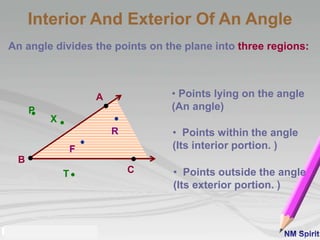
An angle divides the points on the plane into three regions:
A
B
C
F
R
P
T
X
Interior And Exterior Of An Angle
• Points lying on the angle
(An angle)
• Points within the angle
(Its interior portion. )
• Points outside the angle
(Its exterior portion. )
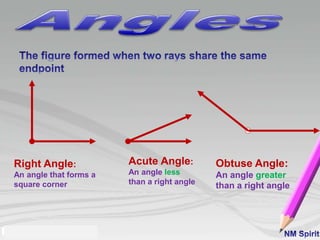
Right Angle:
An angle that forms a
square corner
Acute Angle:
An angle less
than a right angle
Obtuse Angle:
An angle greater
than a right angle
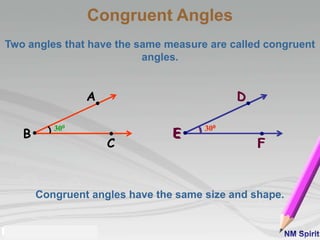
Two angles that have the same measure are called congruent
angles.
Congruent angles have the same size and shape.
A
B
C
300
D
E
F
300
D
E
F
300
Congruent Angles
Pairs Of Angles : Types
• Adjacent angles
• Vertically opposite angles
• Complimentary angles
• Supplementary angles
• Linear pairs of angles
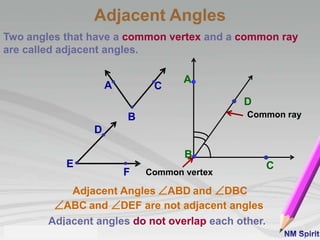
Adjacent Angles
Two angles that have a common vertex and a common ray
are called adjacent angles.
C
D
B
A
Common ray
Common vertex
Adjacent Angles ABD and DBC
Adjacent angles do not overlap each other.
D
E
F
A
B
C
ABC and DEF are not adjacent angles
Vertically Opposite Angles
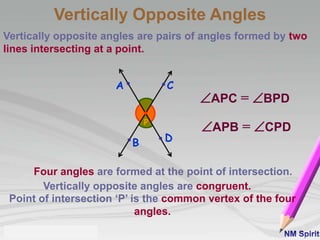
Vertically opposite angles are pairs of angles formed by two
lines intersecting at a point.
APC = BPD
APB = CPD
A
DB
C
P
Four angles are formed at the point of intersection.
Point of intersection ‘P’ is the common vertex of the four
angles.
Vertically opposite angles are congruent.
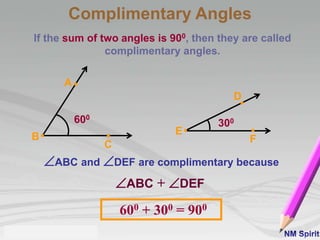
If the sum of two angles is 900, then they are called
complimentary angles.
600
A
B
C
300
D
E
F
ABC and DEF are complimentary because
600 + 300 = 900
ABC + DEF
Complimentary Angles
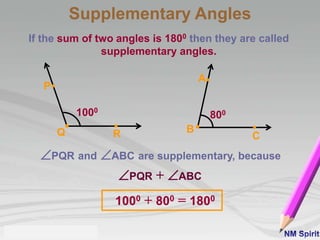
If the sum of two angles is 1800 then they are called
supplementary angles.
PQR and ABC are supplementary, because
1000 + 800 = 1800
RQ
P
A
B
C
1000
800
PQR + ABC
Supplementary Angles
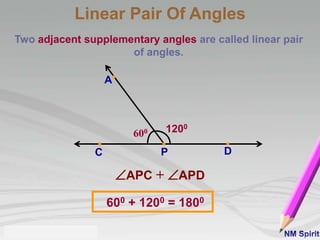
Two adjacent supplementary angles are called linear pair
of angles.
A
600 1200
PC D
600 + 1200 = 1800
APC + APD
Linear Pair Of Angles
Linesandangles ppt

Linesandangles ppt

  • 1.
    WELCOME ST. Peter’s College ofEducation Presented by, FARZANA BEGUM Roll No. 17
  • 2.
  • 3.
    Point An exact locationon a plane is called a point. Line Line segment Ray A straight path on a plane, extending in both directions with no endpoints, is called a line. A part of a line that has two endpoints and thus has a definite length is called a line segment. A line segment extended indefinitely in one direction is called a ray. Recap Geometrical Terms
  • 5.
    RAY: A partof a line, with one endpoint, that continues without end in one direction LINE: A straight path extending in both directions with no endpoints LINE SEGMENT: A part of a line that includes two points, called endpoints, and all the points between them
  • 6.
    INTERSECTING LINES: Linesthat cross PARALLEL LINES: Lines that never cross and are always the same distance apart
  • 7.
    Common endpoint B C B A Ray BC RayBA Ray BA and BC are two non-collinear rays When two non-collinear rays join with a common endpoint (origin) an angle is formed. What Is An Angle ? Common endpoint is called the vertex of the angle. B is the vertex of ABC. Ray BA and ray BC are called the arms of ABC.
  • 8.
    To name anangle, we name any point on one ray, then the vertex, and then any point on the other ray. For example: ABC or CBA We may also name this angle only by the single letter of the vertex, for example B. A B C Naming An Angle
  • 9.
    An angle dividesthe points on the plane into three regions: A B C F R P T X Interior And Exterior Of An Angle • Points lying on the angle (An angle) • Points within the angle (Its interior portion. ) • Points outside the angle (Its exterior portion. )
  • 10.
    Right Angle: An anglethat forms a square corner Acute Angle: An angle less than a right angle Obtuse Angle: An angle greater than a right angle
  • 11.
    Two angles thathave the same measure are called congruent angles. Congruent angles have the same size and shape. A B C 300 D E F 300 D E F 300 Congruent Angles
  • 12.
    Pairs Of Angles: Types • Adjacent angles • Vertically opposite angles • Complimentary angles • Supplementary angles • Linear pairs of angles
  • 13.
    Adjacent Angles Two anglesthat have a common vertex and a common ray are called adjacent angles. C D B A Common ray Common vertex Adjacent Angles ABD and DBC Adjacent angles do not overlap each other. D E F A B C ABC and DEF are not adjacent angles
  • 14.
    Vertically Opposite Angles Verticallyopposite angles are pairs of angles formed by two lines intersecting at a point. APC = BPD APB = CPD A DB C P Four angles are formed at the point of intersection. Point of intersection ‘P’ is the common vertex of the four angles. Vertically opposite angles are congruent.
  • 15.
    If the sumof two angles is 900, then they are called complimentary angles. 600 A B C 300 D E F ABC and DEF are complimentary because 600 + 300 = 900 ABC + DEF Complimentary Angles
  • 16.
    If the sumof two angles is 1800 then they are called supplementary angles. PQR and ABC are supplementary, because 1000 + 800 = 1800 RQ P A B C 1000 800 PQR + ABC Supplementary Angles
  • 17.
    Two adjacent supplementaryangles are called linear pair of angles. A 600 1200 PC D 600 + 1200 = 1800 APC + APD Linear Pair Of Angles