GRID AND CLOUD COMPUTING
Grid Architecture and Tools Courtesy:
Dr Gnanasekaran
Thangavel
https://web.uettaxila.edu.pk/CMS/2022/SPR2022/teGNCCms/index.asp
UNIT 2 OVERVIEW
Grid Architecture and Tools:
– The Hourglass model
– Layered Architecture
– Simulation Tools
– Clouds and Grids
– Service Oriented Architecture
2
3/28/2024
Grid Architecture
3/28/2024 3
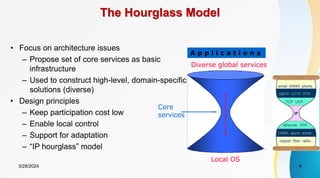
The Hourglass Model
• Focus on architecture issues
– Propose set of core services as basic
infrastructure
– Used to construct high-level, domain-specific
solutions (diverse)
• Design principles
– Keep participation cost low
– Enable local control
– Support for adaptation
– “IP hourglass” model
Diverse global services
Core
services
Local OS
A p p l i c a t i o n s
3/28/2024 4
3/28/2024 5
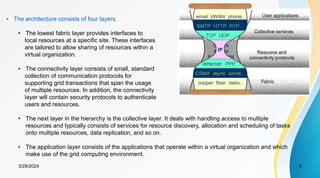
• The architecture consists of four layers.
• The lowest fabric layer provides interfaces to
local resources at a specific site. These interfaces
are tailored to allow sharing of resources within a
virtual organization.
• The connectivity layer consists of small, standard
collection of communication protocols for
supporting grid transactions that span the usage
of multiple resources. In addition, the connectivity
layer will contain security protocols to authenticate
users and resources.
• The next layer in the hierarchy is the collective layer. It deals with handling access to multiple
resources and typically consists of services for resource discovery, allocation and scheduling of tasks
onto multiple resources, data replication, and so on.
• The application layer consists of the applications that operate within a virtual organization and which
make use of the grid computing environment.
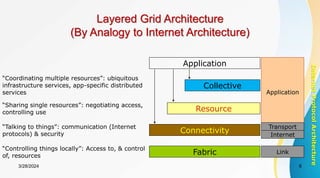
Layered Grid Architecture
(By Analogy to Internet Architecture)
Application
Fabric
“Controlling things locally”: Access to, & control
of, resources
Connectivity
“Talking to things”: communication (Internet
protocols) & security
Resource
“Sharing single resources”: negotiating access,
controlling use
Collective
“Coordinating multiple resources”: ubiquitous
infrastructure services, app-specific distributed
services Application
Link
Internet
Protocol
Architecture
Internet
Transport
3/28/2024 6
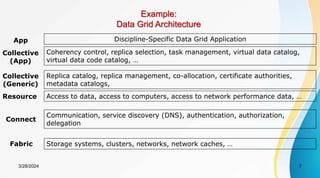
Example:
Data Grid Architecture
Discipline-Specific Data Grid Application
Coherency control, replica selection, task management, virtual data catalog,
virtual data code catalog, …
Replica catalog, replica management, co-allocation, certificate authorities,
metadata catalogs,
Access to data, access to computers, access to network performance data, …
Communication, service discovery (DNS), authentication, authorization,
delegation
Storage systems, clusters, networks, network caches, …
Collective
(App)
App
Collective
(Generic)
Resource
Connect
Fabric
3/28/2024 7
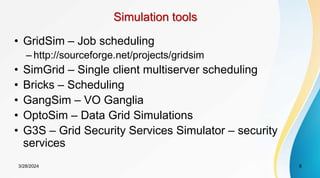
Simulation tools
• GridSim – Job scheduling
– http://sourceforge.net/projects/gridsim
• SimGrid – Single client multiserver scheduling
• Bricks – Scheduling
• GangSim – VO Ganglia
• OptoSim – Data Grid Simulations
• G3S – Grid Security Services Simulator – security
services
8
3/28/2024
Simulation tools
• GridSim is a Java-based toolkit for modeling, and
simulation of distributed resource management and
scheduling for conventional Grid environment.
• GridSim is based on SimJava, a general purpose discrete-
event simulation package implemented in Java.
• All components in GridSim communicate with each other
through message passing operations defined by SimJava.
9
3/28/2024
http://www.buyya.com/gridsim/
http://www.gridbus.org/gridsim
Salient features of the GridSim
• It allows modeling of heterogeneous types of resources.
• Resources can be modeled operating under space- or time-
shared mode.
• Resource capability can be defined (in the form of MIPS
(Million Instructions Per Second) benchmark.
• Resources can be located in any time zone.
• Weekends and holidays can be mapped depending on
resource’s local time to model non-Grid (local) workload.
• Resources can be booked for advance reservation.
• Applications with different parallel application models can be
simulated.
10
3/28/2024
Salient features of the GridSim
• Application tasks can be heterogeneous and they can be CPU
or I/O intensive.
• There is no limit on the number of application jobs that can be
submitted to a resource.
• Multiple user entities can submit tasks for execution
simultaneously in the same resource, which may be time-
shared or space-shared. This feature helps in building
schedulers that can use different market-driven economic
models for selecting services competitively.
• Network speed between resources can be specified.
• It supports simulation of both static and dynamic schedulers.
• Statistics of all or selected operations can be recorded and
they can be analyzed using GridSim statistics analysis
methods.
11
3/28/2024
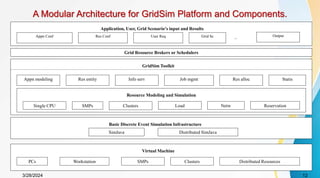
A Modular Architecture for GridSim Platform and Components.
Appn Conf Res Conf User Req Grid Sc Output
Application, User, Grid Scenario’s input and Results
Grid Resource Brokers or Schedulers
…
Appn modeling Res entity Info serv Job mgmt Res alloc Statis
GridSim Toolkit
Single CPU SMPs Clusters Load Netw Reservation
Resource Modeling and Simulation
SimJava Distributed SimJava
Basic Discrete Event Simulation Infrastructure
PCs Workstation Clusters
SMPs Distributed Resources
Virtual Machine
12
3/28/2024
13
Cloud: Definition
“A large-scale distributed computing paradigm that is driven by
economies of scale, in which a pool of abstracted, virtualized,
dynamically-scalable, managed computing power, storage,
platforms, and services are delivered on demand to external
customers over the Internet.”
(According to Foster, Zhao, Raicu and Lu, Cloud Computing and Grid
Computing 360-Degree Compared, 2008)
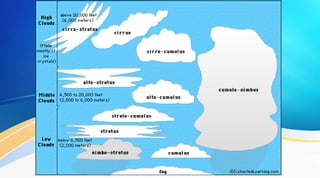
CLOUDS
15
Cloud Computing
• Just a new name for Grid?
– Yes…
– …No….
– Nevertheless Yes!!!
16
Cloud: just a new name for Grid?
• YES:
– Reduce the cost of computing
– Increase reliability
– Increase flexibility (third party)
17
Cloud: just a new name for Grid?
• NO:
– Great increase in demand for computing
(clusters, high speed networks)
– Billions of dollars being spent by Amazon,
Google, Microsoft to create real commercial
large-scale systems with hundreds of thousands
of computers
– www.top500.org shows supercomputers with
100,000+ computers
– Analysis of massive data
18
Cloud: just a new name for Grid?
• Nevertheless YES:
– Problems are the same in clouds and grids
– Common need to manage large facilities
– Define methods to discover, request and use
resources
– Implement highly parallel computations
19
Clouds: key points of the definition
• Differences related to traditional
distributed paradigms:
– Massively scalable
– Can be encapsulated as an abstract entity
that delivers different levels of service
– Services can be dynamically configured (via
virtualization or other approaches) and
delivered on demand
20
Clouds: reasons for interest
• Rapid decrease in hardware cost, increase
in computing power (multi-cores etc.) and
storage capacity
• Exponentially growing data size
• Widespread adoption of Services
Computing and Web 2.0 apps
21
Clouds: yet about definition…
“The interesting thing about Cloud Computing is that
we’ve redefined Cloud Computing to include
everything that we already do. . . .
I don’t understand what we would do differently in
the light of Cloud Computing other than change the
wording of some of our ads.”
Larry Ellison (Oracle CEO), quoted in the Wall Street
Journal, September 26, 2008
22
Clouds: yet about definition…
“A lot of people are jumping on the [cloud]
bandwagon, but I have not heard two people say
the same thing about it. There are multiple
definitions out there of “the cloud.” ”
Andy Isherwood (HP VP of sales), quoted in ZDnet
News, December 11, 2008
23
Clouds: yet about definition…
“It’s stupidity. It’s worse than stupidity: it’s a marketing
hype campaign. Somebody is saying this is inevitable
— and whenever you hear somebody saying that,
it’s very likely to be a set of businesses campaigning to
make it true.”
Richard Stallman (known for his advocacy of free
software), quoted in The Guardian, September 29, 2008
24
Clouds: yet about definition…
• From a hardware point of view, three aspects are new in
Cloud Computing:
1. The illusion of infinite computing resources available on
demand, thereby eliminating the need for Cloud Computing
users to plan far ahead for provisioning;
2. The elimination of an up-front commitment by Cloud users,
thereby allowing companies to start small and increase
hardware resources only when there is an increase in their
needs; and
3. The ability to pay for use of computing resources on a short-
term basis as needed (e.g., processors by the hour and storage
by the day) and release them as needed, thereby rewarding
conservation by letting machines and storage go when they are
no longer useful.
25
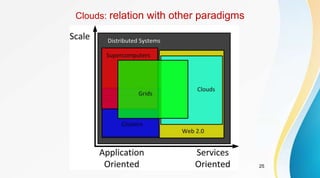
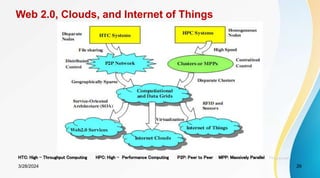
Clouds: relation with other paradigms
Web 2.0, Clouds, and Internet of Things
HTC: High - Throughput Computing HPC: High - Performance Computing P2P: Peer to Peer MPP: Massively Parallel Processors
26
3/28/2024
27
What is a Service Oriented Architecture?
28
What is a Service Oriented Architecture (SOA)?
• A method of design, deployment, and management of
both applications and the software infrastructure
where:
–All software is organized into business services that
are network accessible and executable.
–Service interfaces are based on public standards for
interoperability.
29
Key Characteristics of SOA
• Quality of service, security and performance are specified.
• Software infrastructure is responsible for managing.
• Services are cataloged and discoverable.
• Data are cataloged and discoverable.
• Protocols use only industry standards.
30
What is a “Service”?
• A Service is a reusable component.
• A Service changes business data from one state to
another.
• A Service is the only way how data is accessed.
• If you can describe a component in WSDL, it is a
Service.
31
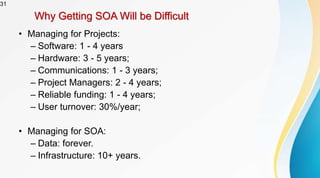
Why Getting SOA Will be Difficult
• Managing for Projects:
– Software: 1 - 4 years
– Hardware: 3 - 5 years;
– Communications: 1 - 3 years;
– Project Managers: 2 - 4 years;
– Reliable funding: 1 - 4 years;
– User turnover: 30%/year;
• Managing for SOA:
– Data: forever.
– Infrastructure: 10+ years.
32
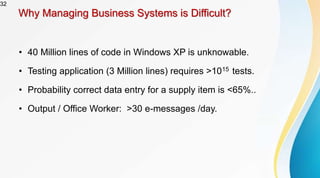
Why Managing Business Systems is Difficult?
• 40 Million lines of code in Windows XP is unknowable.
• Testing application (3 Million lines) requires >1015 tests.
• Probability correct data entry for a supply item is <65%..
• Output / Office Worker: >30 e-messages /day.
33
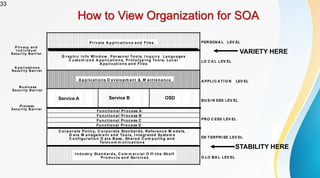
How to View Organization for SOA
STABILITY HERE
VARIETY HERE
C orp o rate Po licy, C o rp o rate Stan d ard s, Referen ce M o d els,
D ata M anagem en t and To o ls, I n tegrated System s
C o nfigu ratio n D ata Base, Shared C o m p utin g an d
Telecom m un icatio n s
A p p licatio ns D evelo p m en t & M ainten ance
EN T ERPRI SE LEV EL
PRO C ESS LEV EL
BU S I N ESS LEV EL
A PPLI C AT I O N LEV EL
LO C A L LEV EL
G rap h ic I n fo Win d o w , Perso nal To o ls, I n q u iry Lan gu ages
C u sto m iz ed A p plicatio n s, Pro to typ in g To ols, Lo cal
A pp licatio n s and Files
A p p l icati on s
Secu rity Barri er
Bu si n ess
Secu ri ty Barrier
Process
Secu ri ty B arrier
Priv acy an d
I n d i v i d u al
Secu rity Barri er
G LO BA L LEV EL
I n d ustry Stan d ard s, C o m m ercial O ff-the-Sh elf
Pro du cts an d Services
PERSONA L LEV EL
Private A p plication s and Files
Fu n ctio n al Pro cess A
Fu n ction al Pro cess B
Fu n ction al Pro cess C
Fun ction al Pro cess D
OSD
Service A Service B
34
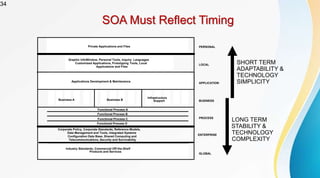
SOA Must Reflect Timing
Corporate Policy, Corporate Standards, Reference Models,
Data Management and Tools, Integrated Systems
Configuration Data Base, Shared Computing and
Telecommunications, Security and Survivability
Business A Business B
Infrastructure
Support
Applications Development & Maintenance
ENTERPRISE
PROCESS
BUSINESS
APPLICATION
LOCAL
Graphic InfoWindow, Personal Tools, Inquiry Languages
Customized Applications, Prototyping Tools, Local
Applications and Files
GLOBAL
Industry Standards, Commercial Off-the-Shelf
Products and Services
PERSONAL
Private Applications and Files
Functional Process A
Functional Process B
Functional Process C
Functional Process D
LONG TERM
STABILITY &
TECHNOLOGY
COMPLEXITY
SHORT TERM
ADAPTABILITY &
TECHNOLOGY
SIMPLICITY
35
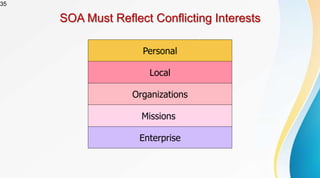
SOA Must Reflect Conflicting Interests
Enterprise
Missions
Organizations
Local
Personal
36
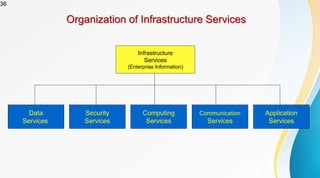
Organization of Infrastructure Services
Infrastructure
Services
(Enterprise Information)
Data
Services
Security
Services
Computing
Services
Communication
Services
Application
Services
37
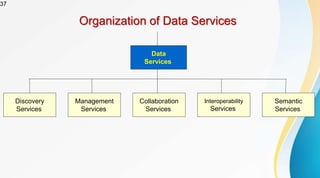
Organization of Data Services
Data
Services
Discovery
Services
Management
Services
Collaboration
Services
Interoperability
Services
Semantic
Services
38
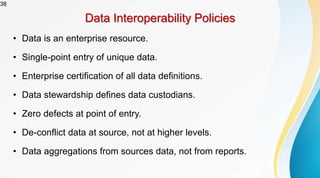
Data Interoperability Policies
• Data is an enterprise resource.
• Single-point entry of unique data.
• Enterprise certification of all data definitions.
• Data stewardship defines data custodians.
• Zero defects at point of entry.
• De-conflict data at source, not at higher levels.
• Data aggregations from sources data, not from reports.
39
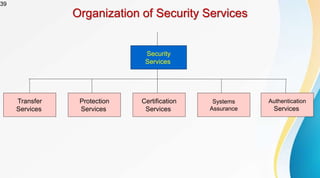
Organization of Security Services
Security
Services
Transfer
Services
Protection
Services
Certification
Services
Systems
Assurance
Authentication
Services
40
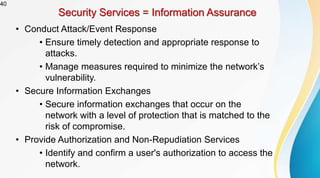
Security Services = Information Assurance
• Conduct Attack/Event Response
• Ensure timely detection and appropriate response to
attacks.
• Manage measures required to minimize the network’s
vulnerability.
• Secure Information Exchanges
• Secure information exchanges that occur on the
network with a level of protection that is matched to the
risk of compromise.
• Provide Authorization and Non-Repudiation Services
• Identify and confirm a user's authorization to access the
network.
41
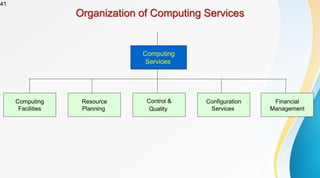
Organization of Computing Services
Computing
Services
Computing
Facilities
Resource
Planning
Control &
Quality
Configuration
Services
Financial
Management
42
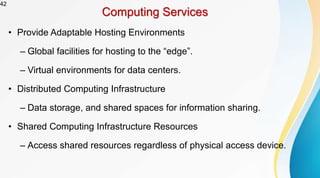
Computing Services
• Provide Adaptable Hosting Environments
– Global facilities for hosting to the “edge”.
– Virtual environments for data centers.
• Distributed Computing Infrastructure
– Data storage, and shared spaces for information sharing.
• Shared Computing Infrastructure Resources
– Access shared resources regardless of physical access device.
43
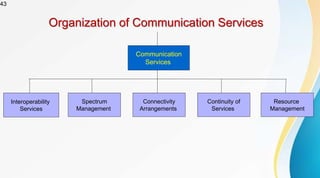
Organization of Communication Services
Communication
Services
Interoperability
Services
Spectrum
Management
Connectivity
Arrangements
Continuity of
Services
Resource
Management
44
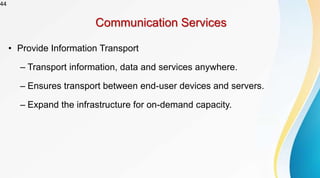
Communication Services
• Provide Information Transport
– Transport information, data and services anywhere.
– Ensures transport between end-user devices and servers.
– Expand the infrastructure for on-demand capacity.
45
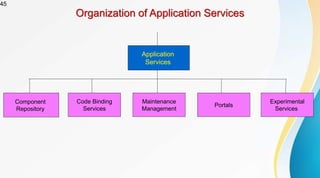
Organization of Application Services
Application
Services
Component
Repository
Code Binding
Services
Maintenance
Management
Portals
Experimental
Services
46
Application Services and Tools
• Provide Common End User Interface Tools
– Application generators, test suites, error identification,
application components and standard utilities.
• Common end-user Interface Tools.
– E-mail, collaboration tools, information dashboards, Intranet
portals, etc.
47
A Few Key SOA Protocols
• Universal Description, Discovery, and Integration, UDDI defines the
publication and discovery of web service implementations.
• The Web Services Description Language, WSDL, is an XML-based
language that defines Web Services.
• SOAP is the Service Oriented Architecture Protocol. It is a key SOA in
which a network node (the client) sends a request to another node (the
server).
• The Lightweight Directory Access Protocol, or LDAP is protocol for
querying and modifying directory services.
• Extract, Transform, and Load, ETL, is a process of moving data from a
legacy system and loading it into a SOA application.
References
1. Kai Hwang, Geoffery C. Fox and Jack J. Dongarra, “Distributed and
Cloud Computing: Clusters, Grids, Clouds and the Future of Internet”,
First Edition, Morgan Kaufman Publisher, an Imprint of Elsevier, 2012.
2. Distributed Computing. http://distributedcomputing.info/index.html
3. Jie Wu, Distributed System Design, CRC Press, 1999.
4. Distributed Computing, Wikipedia
http://en.wikipedia.org/wiki/Distributed_computing
5. www.psgtech.edu/yrgcc/attach/GridComputing-an%20introduction.ppt
6. www.cse.unr.edu/~mgunes/cpe401/cpe401sp12/lect15_cloud.ppt
7. csnotes.upm.edu.my/kelasmaya/web.nsf/.../$FILE/Distributed%20Com
puting.ppt
8. www.strassmann.com/pubs/gmu/2007-11-slides.ppt
48
3/28/2024
Assignment #1
• Visit the links for GridSim information on slide 9 to:
• Write a report on GridSim, its main features
• Select any of the related publications about GridSim and
summarise in your report.
3/28/2024 49
50
Thank You
Questions and Comments?
adeel.akram@uettaxila.edu.pk
3/28/2024

Grid and Cloud Computing Lecture-2a.pptx

  • 1.
    GRID AND CLOUDCOMPUTING Grid Architecture and Tools Courtesy: Dr Gnanasekaran Thangavel https://web.uettaxila.edu.pk/CMS/2022/SPR2022/teGNCCms/index.asp
  • 2.
    UNIT 2 OVERVIEW GridArchitecture and Tools: – The Hourglass model – Layered Architecture – Simulation Tools – Clouds and Grids – Service Oriented Architecture 2 3/28/2024
  • 3.
  • 4.
    The Hourglass Model •Focus on architecture issues – Propose set of core services as basic infrastructure – Used to construct high-level, domain-specific solutions (diverse) • Design principles – Keep participation cost low – Enable local control – Support for adaptation – “IP hourglass” model Diverse global services Core services Local OS A p p l i c a t i o n s 3/28/2024 4
  • 5.
    3/28/2024 5 • Thearchitecture consists of four layers. • The lowest fabric layer provides interfaces to local resources at a specific site. These interfaces are tailored to allow sharing of resources within a virtual organization. • The connectivity layer consists of small, standard collection of communication protocols for supporting grid transactions that span the usage of multiple resources. In addition, the connectivity layer will contain security protocols to authenticate users and resources. • The next layer in the hierarchy is the collective layer. It deals with handling access to multiple resources and typically consists of services for resource discovery, allocation and scheduling of tasks onto multiple resources, data replication, and so on. • The application layer consists of the applications that operate within a virtual organization and which make use of the grid computing environment.
  • 6.
    Layered Grid Architecture (ByAnalogy to Internet Architecture) Application Fabric “Controlling things locally”: Access to, & control of, resources Connectivity “Talking to things”: communication (Internet protocols) & security Resource “Sharing single resources”: negotiating access, controlling use Collective “Coordinating multiple resources”: ubiquitous infrastructure services, app-specific distributed services Application Link Internet Protocol Architecture Internet Transport 3/28/2024 6
  • 7.
    Example: Data Grid Architecture Discipline-SpecificData Grid Application Coherency control, replica selection, task management, virtual data catalog, virtual data code catalog, … Replica catalog, replica management, co-allocation, certificate authorities, metadata catalogs, Access to data, access to computers, access to network performance data, … Communication, service discovery (DNS), authentication, authorization, delegation Storage systems, clusters, networks, network caches, … Collective (App) App Collective (Generic) Resource Connect Fabric 3/28/2024 7
  • 8.
    Simulation tools • GridSim– Job scheduling – http://sourceforge.net/projects/gridsim • SimGrid – Single client multiserver scheduling • Bricks – Scheduling • GangSim – VO Ganglia • OptoSim – Data Grid Simulations • G3S – Grid Security Services Simulator – security services 8 3/28/2024
  • 9.
    Simulation tools • GridSimis a Java-based toolkit for modeling, and simulation of distributed resource management and scheduling for conventional Grid environment. • GridSim is based on SimJava, a general purpose discrete- event simulation package implemented in Java. • All components in GridSim communicate with each other through message passing operations defined by SimJava. 9 3/28/2024 http://www.buyya.com/gridsim/ http://www.gridbus.org/gridsim
  • 10.
    Salient features ofthe GridSim • It allows modeling of heterogeneous types of resources. • Resources can be modeled operating under space- or time- shared mode. • Resource capability can be defined (in the form of MIPS (Million Instructions Per Second) benchmark. • Resources can be located in any time zone. • Weekends and holidays can be mapped depending on resource’s local time to model non-Grid (local) workload. • Resources can be booked for advance reservation. • Applications with different parallel application models can be simulated. 10 3/28/2024
  • 11.
    Salient features ofthe GridSim • Application tasks can be heterogeneous and they can be CPU or I/O intensive. • There is no limit on the number of application jobs that can be submitted to a resource. • Multiple user entities can submit tasks for execution simultaneously in the same resource, which may be time- shared or space-shared. This feature helps in building schedulers that can use different market-driven economic models for selecting services competitively. • Network speed between resources can be specified. • It supports simulation of both static and dynamic schedulers. • Statistics of all or selected operations can be recorded and they can be analyzed using GridSim statistics analysis methods. 11 3/28/2024
  • 12.
    A Modular Architecturefor GridSim Platform and Components. Appn Conf Res Conf User Req Grid Sc Output Application, User, Grid Scenario’s input and Results Grid Resource Brokers or Schedulers … Appn modeling Res entity Info serv Job mgmt Res alloc Statis GridSim Toolkit Single CPU SMPs Clusters Load Netw Reservation Resource Modeling and Simulation SimJava Distributed SimJava Basic Discrete Event Simulation Infrastructure PCs Workstation Clusters SMPs Distributed Resources Virtual Machine 12 3/28/2024
  • 13.
    13 Cloud: Definition “A large-scaledistributed computing paradigm that is driven by economies of scale, in which a pool of abstracted, virtualized, dynamically-scalable, managed computing power, storage, platforms, and services are delivered on demand to external customers over the Internet.” (According to Foster, Zhao, Raicu and Lu, Cloud Computing and Grid Computing 360-Degree Compared, 2008)
  • 14.
  • 15.
    15 Cloud Computing • Justa new name for Grid? – Yes… – …No…. – Nevertheless Yes!!!
  • 16.
    16 Cloud: just anew name for Grid? • YES: – Reduce the cost of computing – Increase reliability – Increase flexibility (third party)
  • 17.
    17 Cloud: just anew name for Grid? • NO: – Great increase in demand for computing (clusters, high speed networks) – Billions of dollars being spent by Amazon, Google, Microsoft to create real commercial large-scale systems with hundreds of thousands of computers – www.top500.org shows supercomputers with 100,000+ computers – Analysis of massive data
  • 18.
    18 Cloud: just anew name for Grid? • Nevertheless YES: – Problems are the same in clouds and grids – Common need to manage large facilities – Define methods to discover, request and use resources – Implement highly parallel computations
  • 19.
    19 Clouds: key pointsof the definition • Differences related to traditional distributed paradigms: – Massively scalable – Can be encapsulated as an abstract entity that delivers different levels of service – Services can be dynamically configured (via virtualization or other approaches) and delivered on demand
  • 20.
    20 Clouds: reasons forinterest • Rapid decrease in hardware cost, increase in computing power (multi-cores etc.) and storage capacity • Exponentially growing data size • Widespread adoption of Services Computing and Web 2.0 apps
  • 21.
    21 Clouds: yet aboutdefinition… “The interesting thing about Cloud Computing is that we’ve redefined Cloud Computing to include everything that we already do. . . . I don’t understand what we would do differently in the light of Cloud Computing other than change the wording of some of our ads.” Larry Ellison (Oracle CEO), quoted in the Wall Street Journal, September 26, 2008
  • 22.
    22 Clouds: yet aboutdefinition… “A lot of people are jumping on the [cloud] bandwagon, but I have not heard two people say the same thing about it. There are multiple definitions out there of “the cloud.” ” Andy Isherwood (HP VP of sales), quoted in ZDnet News, December 11, 2008
  • 23.
    23 Clouds: yet aboutdefinition… “It’s stupidity. It’s worse than stupidity: it’s a marketing hype campaign. Somebody is saying this is inevitable — and whenever you hear somebody saying that, it’s very likely to be a set of businesses campaigning to make it true.” Richard Stallman (known for his advocacy of free software), quoted in The Guardian, September 29, 2008
  • 24.
    24 Clouds: yet aboutdefinition… • From a hardware point of view, three aspects are new in Cloud Computing: 1. The illusion of infinite computing resources available on demand, thereby eliminating the need for Cloud Computing users to plan far ahead for provisioning; 2. The elimination of an up-front commitment by Cloud users, thereby allowing companies to start small and increase hardware resources only when there is an increase in their needs; and 3. The ability to pay for use of computing resources on a short- term basis as needed (e.g., processors by the hour and storage by the day) and release them as needed, thereby rewarding conservation by letting machines and storage go when they are no longer useful.
  • 25.
    25 Clouds: relation withother paradigms
  • 26.
    Web 2.0, Clouds,and Internet of Things HTC: High - Throughput Computing HPC: High - Performance Computing P2P: Peer to Peer MPP: Massively Parallel Processors 26 3/28/2024
  • 27.
    27 What is aService Oriented Architecture?
  • 28.
    28 What is aService Oriented Architecture (SOA)? • A method of design, deployment, and management of both applications and the software infrastructure where: –All software is organized into business services that are network accessible and executable. –Service interfaces are based on public standards for interoperability.
  • 29.
    29 Key Characteristics ofSOA • Quality of service, security and performance are specified. • Software infrastructure is responsible for managing. • Services are cataloged and discoverable. • Data are cataloged and discoverable. • Protocols use only industry standards.
  • 30.
    30 What is a“Service”? • A Service is a reusable component. • A Service changes business data from one state to another. • A Service is the only way how data is accessed. • If you can describe a component in WSDL, it is a Service.
  • 31.
    31 Why Getting SOAWill be Difficult • Managing for Projects: – Software: 1 - 4 years – Hardware: 3 - 5 years; – Communications: 1 - 3 years; – Project Managers: 2 - 4 years; – Reliable funding: 1 - 4 years; – User turnover: 30%/year; • Managing for SOA: – Data: forever. – Infrastructure: 10+ years.
  • 32.
    32 Why Managing BusinessSystems is Difficult? • 40 Million lines of code in Windows XP is unknowable. • Testing application (3 Million lines) requires >1015 tests. • Probability correct data entry for a supply item is <65%.. • Output / Office Worker: >30 e-messages /day.
  • 33.
    33 How to ViewOrganization for SOA STABILITY HERE VARIETY HERE C orp o rate Po licy, C o rp o rate Stan d ard s, Referen ce M o d els, D ata M anagem en t and To o ls, I n tegrated System s C o nfigu ratio n D ata Base, Shared C o m p utin g an d Telecom m un icatio n s A p p licatio ns D evelo p m en t & M ainten ance EN T ERPRI SE LEV EL PRO C ESS LEV EL BU S I N ESS LEV EL A PPLI C AT I O N LEV EL LO C A L LEV EL G rap h ic I n fo Win d o w , Perso nal To o ls, I n q u iry Lan gu ages C u sto m iz ed A p plicatio n s, Pro to typ in g To ols, Lo cal A pp licatio n s and Files A p p l icati on s Secu rity Barri er Bu si n ess Secu ri ty Barrier Process Secu ri ty B arrier Priv acy an d I n d i v i d u al Secu rity Barri er G LO BA L LEV EL I n d ustry Stan d ard s, C o m m ercial O ff-the-Sh elf Pro du cts an d Services PERSONA L LEV EL Private A p plication s and Files Fu n ctio n al Pro cess A Fu n ction al Pro cess B Fu n ction al Pro cess C Fun ction al Pro cess D OSD Service A Service B
  • 34.
    34 SOA Must ReflectTiming Corporate Policy, Corporate Standards, Reference Models, Data Management and Tools, Integrated Systems Configuration Data Base, Shared Computing and Telecommunications, Security and Survivability Business A Business B Infrastructure Support Applications Development & Maintenance ENTERPRISE PROCESS BUSINESS APPLICATION LOCAL Graphic InfoWindow, Personal Tools, Inquiry Languages Customized Applications, Prototyping Tools, Local Applications and Files GLOBAL Industry Standards, Commercial Off-the-Shelf Products and Services PERSONAL Private Applications and Files Functional Process A Functional Process B Functional Process C Functional Process D LONG TERM STABILITY & TECHNOLOGY COMPLEXITY SHORT TERM ADAPTABILITY & TECHNOLOGY SIMPLICITY
  • 35.
    35 SOA Must ReflectConflicting Interests Enterprise Missions Organizations Local Personal
  • 36.
    36 Organization of InfrastructureServices Infrastructure Services (Enterprise Information) Data Services Security Services Computing Services Communication Services Application Services
  • 37.
    37 Organization of DataServices Data Services Discovery Services Management Services Collaboration Services Interoperability Services Semantic Services
  • 38.
    38 Data Interoperability Policies •Data is an enterprise resource. • Single-point entry of unique data. • Enterprise certification of all data definitions. • Data stewardship defines data custodians. • Zero defects at point of entry. • De-conflict data at source, not at higher levels. • Data aggregations from sources data, not from reports.
  • 39.
    39 Organization of SecurityServices Security Services Transfer Services Protection Services Certification Services Systems Assurance Authentication Services
  • 40.
    40 Security Services =Information Assurance • Conduct Attack/Event Response • Ensure timely detection and appropriate response to attacks. • Manage measures required to minimize the network’s vulnerability. • Secure Information Exchanges • Secure information exchanges that occur on the network with a level of protection that is matched to the risk of compromise. • Provide Authorization and Non-Repudiation Services • Identify and confirm a user's authorization to access the network.
  • 41.
    41 Organization of ComputingServices Computing Services Computing Facilities Resource Planning Control & Quality Configuration Services Financial Management
  • 42.
    42 Computing Services • ProvideAdaptable Hosting Environments – Global facilities for hosting to the “edge”. – Virtual environments for data centers. • Distributed Computing Infrastructure – Data storage, and shared spaces for information sharing. • Shared Computing Infrastructure Resources – Access shared resources regardless of physical access device.
  • 43.
    43 Organization of CommunicationServices Communication Services Interoperability Services Spectrum Management Connectivity Arrangements Continuity of Services Resource Management
  • 44.
    44 Communication Services • ProvideInformation Transport – Transport information, data and services anywhere. – Ensures transport between end-user devices and servers. – Expand the infrastructure for on-demand capacity.
  • 45.
    45 Organization of ApplicationServices Application Services Component Repository Code Binding Services Maintenance Management Portals Experimental Services
  • 46.
    46 Application Services andTools • Provide Common End User Interface Tools – Application generators, test suites, error identification, application components and standard utilities. • Common end-user Interface Tools. – E-mail, collaboration tools, information dashboards, Intranet portals, etc.
  • 47.
    47 A Few KeySOA Protocols • Universal Description, Discovery, and Integration, UDDI defines the publication and discovery of web service implementations. • The Web Services Description Language, WSDL, is an XML-based language that defines Web Services. • SOAP is the Service Oriented Architecture Protocol. It is a key SOA in which a network node (the client) sends a request to another node (the server). • The Lightweight Directory Access Protocol, or LDAP is protocol for querying and modifying directory services. • Extract, Transform, and Load, ETL, is a process of moving data from a legacy system and loading it into a SOA application.
  • 48.
    References 1. Kai Hwang,Geoffery C. Fox and Jack J. Dongarra, “Distributed and Cloud Computing: Clusters, Grids, Clouds and the Future of Internet”, First Edition, Morgan Kaufman Publisher, an Imprint of Elsevier, 2012. 2. Distributed Computing. http://distributedcomputing.info/index.html 3. Jie Wu, Distributed System Design, CRC Press, 1999. 4. Distributed Computing, Wikipedia http://en.wikipedia.org/wiki/Distributed_computing 5. www.psgtech.edu/yrgcc/attach/GridComputing-an%20introduction.ppt 6. www.cse.unr.edu/~mgunes/cpe401/cpe401sp12/lect15_cloud.ppt 7. csnotes.upm.edu.my/kelasmaya/web.nsf/.../$FILE/Distributed%20Com puting.ppt 8. www.strassmann.com/pubs/gmu/2007-11-slides.ppt 48 3/28/2024
  • 49.
    Assignment #1 • Visitthe links for GridSim information on slide 9 to: • Write a report on GridSim, its main features • Select any of the related publications about GridSim and summarise in your report. 3/28/2024 49
  • 50.
    50 Thank You Questions andComments? adeel.akram@uettaxila.edu.pk 3/28/2024