NAME:Rudradeep Hazra
Stream-Bachelor of pharmacy (2nd sem)
Roll no -19301918060
Database
 Database is an organized collection of data, generally
stored and accessed electronically from a computer system.
Where databases are more complex they are often
developed using formal design and modeling techniques.
 The sizes, capabilities, and performance of databases and
their respective DBMSs have grown in orders of magnitude.
These performance increases were enabled by the
technology progress in the areas of processors, computer
memory, computer storage, and computer networks. The
development of database technology can be divided into
three eras based on data model or
structure: navigational, SQL/relational, and post-
relational.
Database management system
 The database management system (DBMS) is
the software that interacts with end users,
applications, and the database itself to capture and
analyze the data. The DBMS software additionally
encompasses the core facilities provided to administer
the database. The sum total of the database, the DBMS
and the associated applications can be referred to as a
"database system".
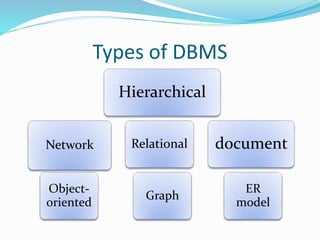
Types of DBMS
Hierarchical
Network
Object-
oriented
Graph
Relational
ER
model
document
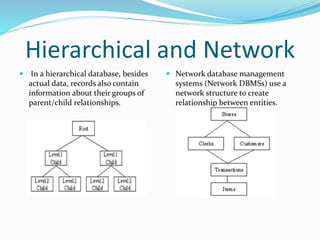
Hierarchical and Network
 In a hierarchical database, besides
actual data, records also contain
information about their groups of
parent/child relationships.
 Network database management
systems (Network DBMSs) use a
network structure to create
relationship between entities.
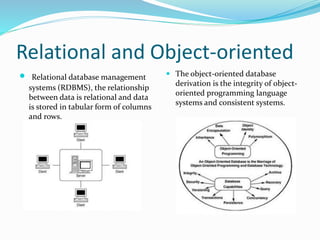
Relational and Object-oriented
 Relational database management
systems (RDBMS), the relationship
between data is relational and data
is stored in tabular form of columns
and rows.
 The object-oriented database
derivation is the integrity of object-
oriented programming language
systems and consistent systems.
Graph and ER model
 Graph Databases are
NoSQL databases and use
a graph structure for
sematic queries. The data
is stored in form of nodes,
edges, and properties. An
Edge in a graph database
represents a relationship
that connects nodes.
Properties are additional
information added to the
nodes.
 An ER model is typically
implemented as a
database. In a simple
relational database
implementation, each
row of a table represents
one instance of an entity
type, and each field in a
table represents an
attribute type.
Document databases
 Document databases are also NoSQL database that
store data in form of documents. Each document
represents the data, its relationship between other
data elements, and attributes of data. Document
database store data in a key value form.
 Document DB has become popular recently due to
their document storage and NoSQL properties. NoSQL
data storage provide faster mechanism to store and
search documents.
Classification(1) of database
 An in-memory database is a database that primarily
resides in main memory, but is typically backed-up by
non-volatile computer data storage. Main memory
databases are faster than disk databases.
 An active database includes an event-driven
architecture which can respond to conditions both
inside and outside the database. Possible uses include
security monitoring, alerting, statistics gathering and
authorization. Many databases provide active database
features in the form of database triggers.
Classification(2)
 A cloud database relies on cloud technology. Both the
database and most of its DBMS reside remotely, "in the
cloud", while its applications are both developed by
programmers and later maintained and used by end-users
through a web browser and Open APIs.
 A deductive database combines logic programming with
a relational database.
 A distributed database is one in which both the data and
the DBMS span multiple computers.
 A document-oriented database is designed for storing,
retrieving, and managing document-oriented, or semi
structured, information. Document-oriented databases are
one of the main categories of NoSQL databases.
Classification(3)
 An Embedded database system is a DBMS which is
tightly integrated with an application software that
requires access to stored data in such a way that the DBMS
is hidden from the application's end-users and requires
little or no ongoing maintenance.
 Federated database system comprises several distinct
databases, each with its own DBMS. It is handled as a
single database by a federated database management
system (FDBMS), which transparently integrates multiple
autonomous DBMSs, possibly of different types and
provides them with an integrated conceptual view.
Classification(4)
 A mobile database can be carried on or synchronized
from a mobile computing device.
 Operational databases store detailed data about the
operations of an organization. They typically process
relatively high volumes of updates using transactions.
 A parallel database seeks to improve performance
through parallelization for tasks such as loading data,
building indexes and evaluating queries.
 In a hypertext database, any word or a piece of text
representing an object, e.g., another piece of text, an
article, a picture, or a film, can be hyperlinked to that
object. Hypertext databases are particularly useful for
organizing large amounts of disparate information.
Conclusion
 The most popular database in the world is Oracle
according to DB-Engine ranking. Oracle is followed by
MySQL, SQL Server, PostgreSQL, and MongoDB in the
ranking.
 The current version of Oracle Database is 18c.
 Oracle database is a relational database (RDBMS).
Relational databases store data in a tabular form of
rows and columns. Column of a database table
represents the attributes of an entity and rows of a
table stores records.
 MySQL is world’s most popular database that is open
source and free.
Bibliography
 I am very much thankful to my professor to give me such a wonderful
topic to work on.
 Reference
 www.c-sharpcorner.com/types-of-database-management-systems
 en.wikipedia.org/wiki/Database#Classification.

Types of Databases.pptx

  • 1.
    NAME:Rudradeep Hazra Stream-Bachelor ofpharmacy (2nd sem) Roll no -19301918060
  • 2.
    Database  Database isan organized collection of data, generally stored and accessed electronically from a computer system. Where databases are more complex they are often developed using formal design and modeling techniques.  The sizes, capabilities, and performance of databases and their respective DBMSs have grown in orders of magnitude. These performance increases were enabled by the technology progress in the areas of processors, computer memory, computer storage, and computer networks. The development of database technology can be divided into three eras based on data model or structure: navigational, SQL/relational, and post- relational.
  • 3.
    Database management system The database management system (DBMS) is the software that interacts with end users, applications, and the database itself to capture and analyze the data. The DBMS software additionally encompasses the core facilities provided to administer the database. The sum total of the database, the DBMS and the associated applications can be referred to as a "database system".
  • 4.
  • 5.
    Hierarchical and Network In a hierarchical database, besides actual data, records also contain information about their groups of parent/child relationships.  Network database management systems (Network DBMSs) use a network structure to create relationship between entities.
  • 6.
    Relational and Object-oriented Relational database management systems (RDBMS), the relationship between data is relational and data is stored in tabular form of columns and rows.  The object-oriented database derivation is the integrity of object- oriented programming language systems and consistent systems.
  • 7.
    Graph and ERmodel  Graph Databases are NoSQL databases and use a graph structure for sematic queries. The data is stored in form of nodes, edges, and properties. An Edge in a graph database represents a relationship that connects nodes. Properties are additional information added to the nodes.  An ER model is typically implemented as a database. In a simple relational database implementation, each row of a table represents one instance of an entity type, and each field in a table represents an attribute type.
  • 8.
    Document databases  Documentdatabases are also NoSQL database that store data in form of documents. Each document represents the data, its relationship between other data elements, and attributes of data. Document database store data in a key value form.  Document DB has become popular recently due to their document storage and NoSQL properties. NoSQL data storage provide faster mechanism to store and search documents.
  • 9.
    Classification(1) of database An in-memory database is a database that primarily resides in main memory, but is typically backed-up by non-volatile computer data storage. Main memory databases are faster than disk databases.  An active database includes an event-driven architecture which can respond to conditions both inside and outside the database. Possible uses include security monitoring, alerting, statistics gathering and authorization. Many databases provide active database features in the form of database triggers.
  • 10.
    Classification(2)  A clouddatabase relies on cloud technology. Both the database and most of its DBMS reside remotely, "in the cloud", while its applications are both developed by programmers and later maintained and used by end-users through a web browser and Open APIs.  A deductive database combines logic programming with a relational database.  A distributed database is one in which both the data and the DBMS span multiple computers.  A document-oriented database is designed for storing, retrieving, and managing document-oriented, or semi structured, information. Document-oriented databases are one of the main categories of NoSQL databases.
  • 11.
    Classification(3)  An Embeddeddatabase system is a DBMS which is tightly integrated with an application software that requires access to stored data in such a way that the DBMS is hidden from the application's end-users and requires little or no ongoing maintenance.  Federated database system comprises several distinct databases, each with its own DBMS. It is handled as a single database by a federated database management system (FDBMS), which transparently integrates multiple autonomous DBMSs, possibly of different types and provides them with an integrated conceptual view.
  • 12.
    Classification(4)  A mobiledatabase can be carried on or synchronized from a mobile computing device.  Operational databases store detailed data about the operations of an organization. They typically process relatively high volumes of updates using transactions.  A parallel database seeks to improve performance through parallelization for tasks such as loading data, building indexes and evaluating queries.  In a hypertext database, any word or a piece of text representing an object, e.g., another piece of text, an article, a picture, or a film, can be hyperlinked to that object. Hypertext databases are particularly useful for organizing large amounts of disparate information.
  • 13.
    Conclusion  The mostpopular database in the world is Oracle according to DB-Engine ranking. Oracle is followed by MySQL, SQL Server, PostgreSQL, and MongoDB in the ranking.  The current version of Oracle Database is 18c.  Oracle database is a relational database (RDBMS). Relational databases store data in a tabular form of rows and columns. Column of a database table represents the attributes of an entity and rows of a table stores records.  MySQL is world’s most popular database that is open source and free.
  • 14.
    Bibliography  I amvery much thankful to my professor to give me such a wonderful topic to work on.  Reference  www.c-sharpcorner.com/types-of-database-management-systems  en.wikipedia.org/wiki/Database#Classification.