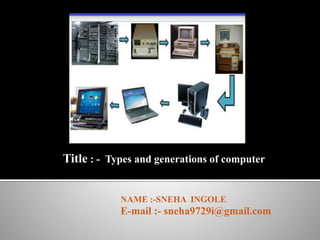
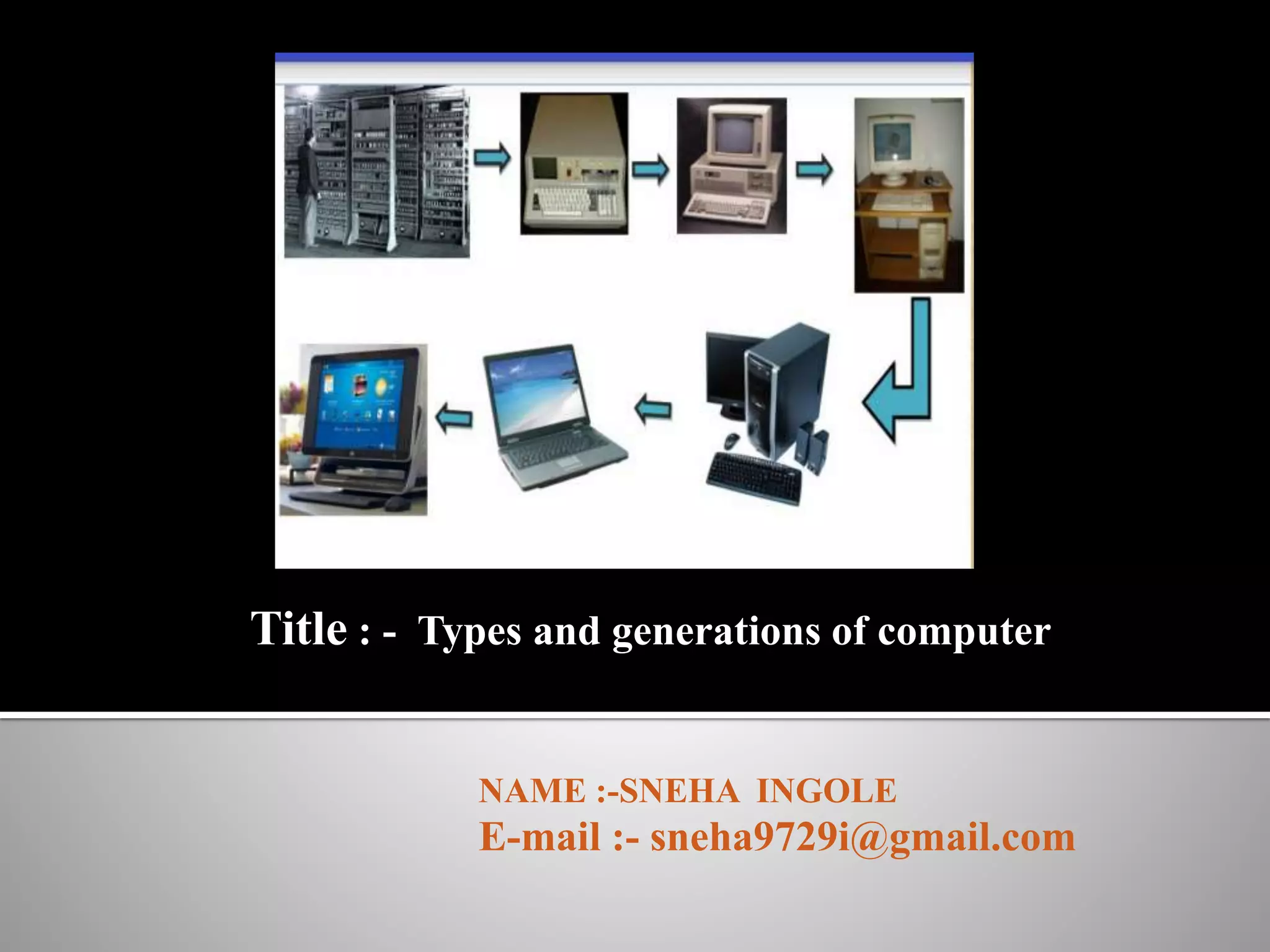
Title : - Types and generations of computer
NAME :-SNEHA INGOLE
E-mail :- sneha9729i@gmail.com
 Types of computer
 Generations of computer
 There are basically four types of computer as
follows:-
1. Micro-computer
2. Mini-computer
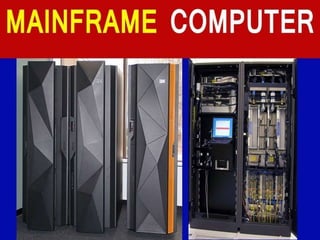
3. Mainframe-computer
4. Super-computer
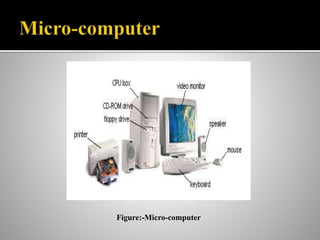
Figure:-Micro-computer
 Most familiar type of computer.
 Two types:- personal computer & workstation.
1. Personal computer:-
 Personal computer whereas desktop or portable machine .
 Easy to use .
 Most affect able than both workstation.
 Micro-computer didn’t have processing power than workstation.
2. Workstation:-
 More powerful and expensive.
 Used by engineers, scientists and other professionals who proceed lots of data.
 People who needs to run complex program and display both work in program
and result gives the best when we have workstations.
 Operating system is unique that permitted that multi-tasking workstations also
used powerful networking to other computers.
 Powerful workstation - super micros
 Well known workstations are those made by SUN, OPOLO,NEXT & IBM.
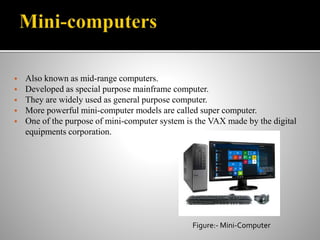
 Also known as mid-range computers.
 Developed as special purpose mainframe computer.
 They are widely used as general purpose computer.
 More powerful mini-computer models are called super computer.
 One of the purpose of mini-computer system is the VAX made by the digital
equipments corporation.
Figure:- Mini-Computer
 Faster calculating device even invented a desktop micro-computer process
data and instruction in million of second.
 It is 1000 -1 million times as faster micro-computer.
 Most super computer are used by government agencies.
 Most powerful super-computer used the technology called massively in
parallel processing.
 This super –computer consists of 1000 of integrated micro processor .
 One massive parallel computer made by Intel corporation is capable of
perform 8.6 millions mathematical calculation per second.
Super-computer
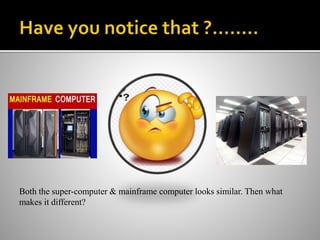
Both the super-computer & mainframe computer looks similar. Then what
makes it different?
The difference is…….………
Super computers are used for large and complex mathematical
computations.
Mainframe are used as storage for large database and serve a maximum
number of users at a time.
Some of the fastest super computers operate at hundred of quadrillions of
floating point operation per second(FLOPS).
 There are basically five generations of computer as
follows
 First generation of computer
 Second generation of computer
 Third generation of computer
 Fourth generation of computer
 Fifth generation of computer
Lets have a look……………..
 Discovered in university of PENSYLAMIA – by John Presper &
John M. Mauchly.
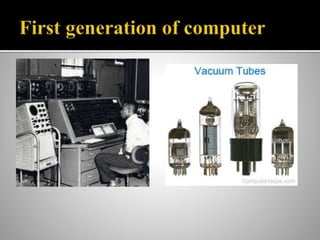
 Digital computer using parts – named ENIAC (Electronic
Numerical Integrator And Computer).
 It required –
 18000 Vacuum tubes.
 17000 registers
 Five million shoulder joined
 Each computer has different binary coded program called machine
language.
 Consumes 160kv of electric power.
 Transistors were replaced by vacuum tubes.
 Transistors invented in 1947- used in 1950’s
 Replaced machine allowed language with the assembly language which
program to specify instruction in words.
 Used in business universities and government companies.
 Contain printer, disk storage, operating system, etc.
 1 Transistor = 40 vacuum tubes.
 Heat generating problem.
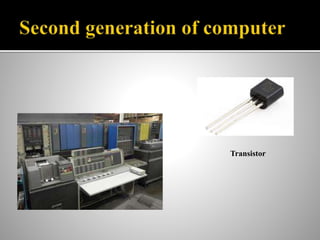
Transistor
 Transistor are tiny electrical devices that can be found
in everything from radio to robots.
 They have two key properties:
 They can amplify an electrical signal .
 They can switch on and off, letting current through or
blocking it as necessary.
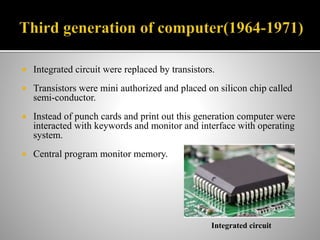
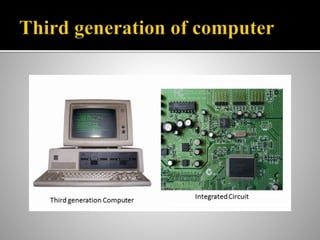
 Integrated circuit were replaced by transistors.
 Transistors were mini authorized and placed on silicon chip called
semi-conductor.
 Instead of punch cards and print out this generation computer were
interacted with keywords and monitor and interface with operating
system.
 Central program monitor memory.
Integrated circuit
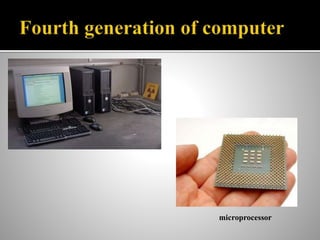
 Microprocessor bought the fourth generation of computer.
 1000 of integrated circuit were build onto a single silicon chip because of
that computers are very small.
 1982 IBM introduced its first computer for home used of 1984.
 APPLE introduce MASIGTUS.
 Use of personal computer jump for :
2 million in 1981,
1982- 55 million.
 Should be linked and communicate with the local area network(LAN).
 Fourth generation – leads to the development of Internet.
microprocessor
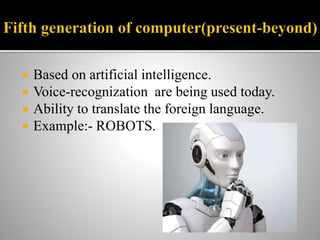
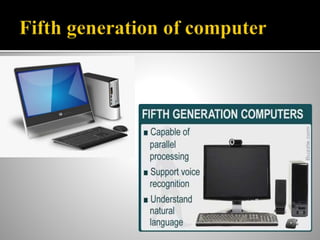
 Based on artificial intelligence.
 Voice-recognization are being used today.
 Ability to translate the foreign language.
 Example:- ROBOTS.
Types and generations of computer

Types and generations of computer

  • 1.
    Title : -Types and generations of computer NAME :-SNEHA INGOLE E-mail :- sneha9729i@gmail.com
  • 2.
     Types ofcomputer  Generations of computer
  • 3.
     There arebasically four types of computer as follows:- 1. Micro-computer 2. Mini-computer 3. Mainframe-computer 4. Super-computer
  • 4.
  • 5.
     Most familiartype of computer.  Two types:- personal computer & workstation. 1. Personal computer:-  Personal computer whereas desktop or portable machine .  Easy to use .  Most affect able than both workstation.  Micro-computer didn’t have processing power than workstation. 2. Workstation:-  More powerful and expensive.  Used by engineers, scientists and other professionals who proceed lots of data.  People who needs to run complex program and display both work in program and result gives the best when we have workstations.  Operating system is unique that permitted that multi-tasking workstations also used powerful networking to other computers.  Powerful workstation - super micros  Well known workstations are those made by SUN, OPOLO,NEXT & IBM.
  • 6.
     Also knownas mid-range computers.  Developed as special purpose mainframe computer.  They are widely used as general purpose computer.  More powerful mini-computer models are called super computer.  One of the purpose of mini-computer system is the VAX made by the digital equipments corporation. Figure:- Mini-Computer
  • 9.
     Faster calculatingdevice even invented a desktop micro-computer process data and instruction in million of second.  It is 1000 -1 million times as faster micro-computer.  Most super computer are used by government agencies.  Most powerful super-computer used the technology called massively in parallel processing.  This super –computer consists of 1000 of integrated micro processor .  One massive parallel computer made by Intel corporation is capable of perform 8.6 millions mathematical calculation per second. Super-computer
  • 10.
    Both the super-computer& mainframe computer looks similar. Then what makes it different?
  • 11.
    The difference is…….……… Supercomputers are used for large and complex mathematical computations. Mainframe are used as storage for large database and serve a maximum number of users at a time. Some of the fastest super computers operate at hundred of quadrillions of floating point operation per second(FLOPS).
  • 12.
     There arebasically five generations of computer as follows  First generation of computer  Second generation of computer  Third generation of computer  Fourth generation of computer  Fifth generation of computer Lets have a look……………..
  • 13.
     Discovered inuniversity of PENSYLAMIA – by John Presper & John M. Mauchly.  Digital computer using parts – named ENIAC (Electronic Numerical Integrator And Computer).  It required –  18000 Vacuum tubes.  17000 registers  Five million shoulder joined  Each computer has different binary coded program called machine language.  Consumes 160kv of electric power.
  • 15.
     Transistors werereplaced by vacuum tubes.  Transistors invented in 1947- used in 1950’s  Replaced machine allowed language with the assembly language which program to specify instruction in words.  Used in business universities and government companies.  Contain printer, disk storage, operating system, etc.  1 Transistor = 40 vacuum tubes.  Heat generating problem.
  • 16.
  • 17.
     Transistor aretiny electrical devices that can be found in everything from radio to robots.  They have two key properties:  They can amplify an electrical signal .  They can switch on and off, letting current through or blocking it as necessary.
  • 18.
     Integrated circuitwere replaced by transistors.  Transistors were mini authorized and placed on silicon chip called semi-conductor.  Instead of punch cards and print out this generation computer were interacted with keywords and monitor and interface with operating system.  Central program monitor memory. Integrated circuit
  • 20.
     Microprocessor boughtthe fourth generation of computer.  1000 of integrated circuit were build onto a single silicon chip because of that computers are very small.  1982 IBM introduced its first computer for home used of 1984.  APPLE introduce MASIGTUS.  Use of personal computer jump for : 2 million in 1981, 1982- 55 million.  Should be linked and communicate with the local area network(LAN).  Fourth generation – leads to the development of Internet.
  • 21.
  • 22.
     Based onartificial intelligence.  Voice-recognization are being used today.  Ability to translate the foreign language.  Example:- ROBOTS.