COMPRESSOR
S Y S T E M
ARTIAGA
DATAHAN
ROSALES
EE-413
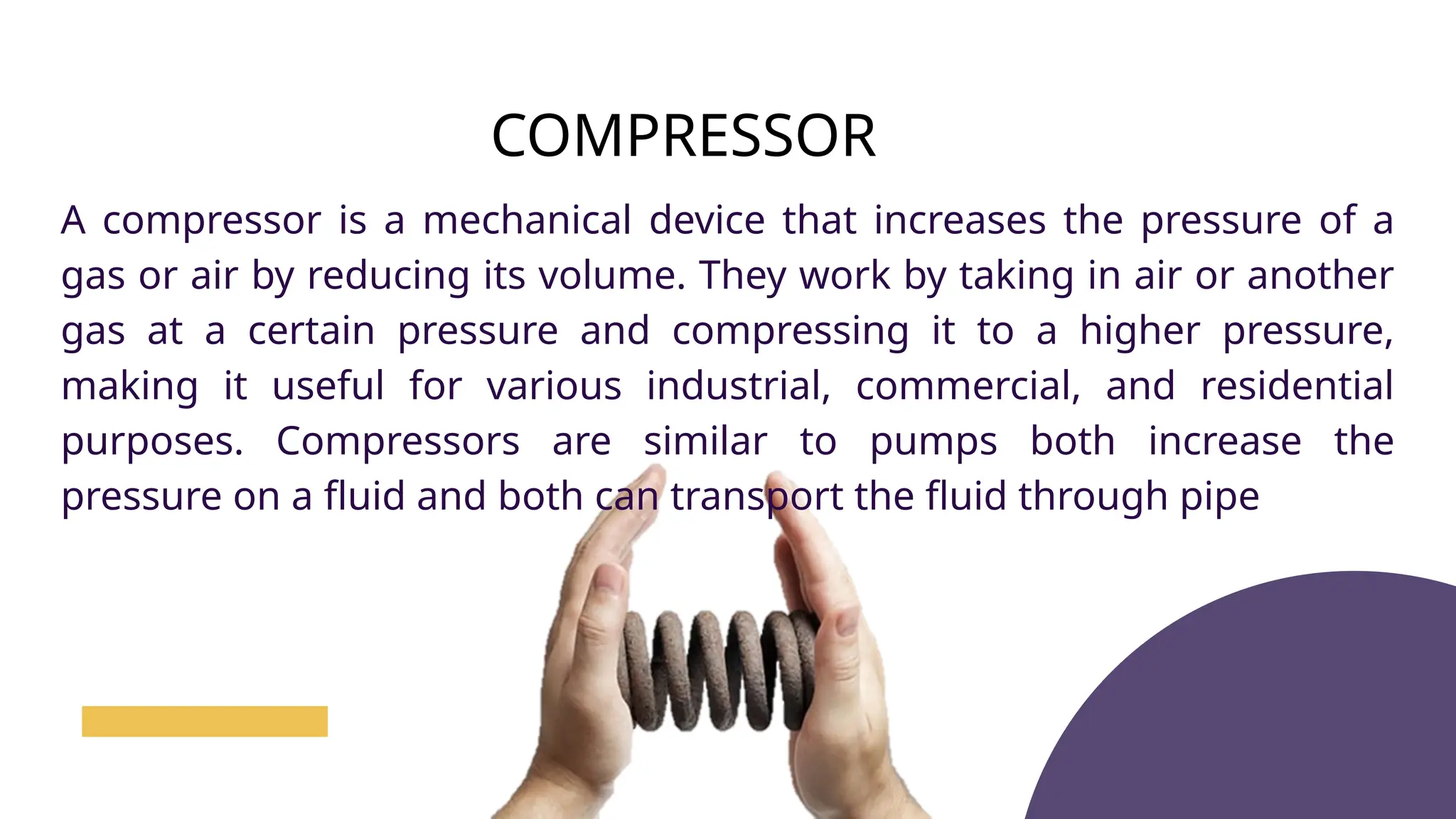
A compressor is a mechanical device that increases the pressure of a
gas or air by reducing its volume. They work by taking in air or another
gas at a certain pressure and compressing it to a higher pressure,
making it useful for various industrial, commercial, and residential
purposes. Compressors are similar to pumps both increase the
pressure on a fluid and both can transport the fluid through pipe
COMPRESSOR
TYPES OF COMPRESSOR
Reciprocating Compressor
Rotary Compressor
Scroll Compressor
Screw Compressor
Centrifugal Compressor
RECIPROCATING
COMPRESSOR
Is a type of compressor that uses a piston driven by a
crankshaft to compress gases, such as air or natural gas,
within a cylinder. The compressor operates in a similar
manner to an internal combustion engine, with the piston
moving back and forth (reciprocating) inside the cylinder to
compress the gas. They can be driven by electricity or
internal combustion engine. It is mostly used in oil refineries,
gas pipelines, chemical plants, natural gas processing plant
etc.
A piston in a compressor is a crucial component
that moves within a cylinder to compress gas or air.
The piston operates by moving back and forth
(reciprocating motion) inside the cylinder.
A crankshaft in a compressor is a key mechanical
component that converts the rotational motion of
the motor or engine into the reciprocating motion
of the pistons. It plays a vital role in the operation of
reciprocating compressors.
CLASSIFICATION OF RECIPROCATING
COMPRESSOR
Single Stage Reciprocating Compressor
Double Stage Reciprocating Compressor
Multi Stage Reciprocating Compressor
SINGLE STAGE RECIPROCATING
COMPRESSOR
A single-stage reciprocating compressor is a type of
compressor that compresses air or gas in a single
step or stage. In this type of compressor, the entire
compression process—from atmospheric pressure
to the final discharge pressure—takes place in one
cylinder.
DOUBLE STAGE RECIPROCATING
COMPRESSOR
A double-stage reciprocating compressor, also
known as a two-stage reciprocating compressor, is a
type of compressor that compresses air or gas in
two stages to achieve higher pressure levels than a
single-stage compressor. The compression process
is divided into two distinct stages, with an
intercooling process between them.
MULTI STAGE RECIPROCATING
COMPRESSOR
A multi-stage reciprocating compressor is a type of
compressor that compresses air or gas through
more than two stages to achieve very high pressure
levels. Each stage of compression progressively
increases the pressure of the air or gas, with
cooling processes between stages to improve
efficiency and reduce the temperature of the
compressed air.
ROTARY
COMPRESSOR
A rotary compressor is a type of compressor that
uses a rotating mechanism to compress air or gas.
Unlike reciprocating compressors, rotary
compressors do not have pistons or crankshafts.
Instead, they use continuous rotary motion, making
them smoother, quieter, and more efficient in
certain applications.
Rotary compressor have vanes, screws, scrolls and other devices
which rotates and thus compress air and gasses.
A scroll compressor is a type of rotary compressor
that uses two interleaved spiral-shaped scrolls to
compress air or gas. One of the scrolls is fixed in
place, while the other orbits around it. This
mechanism creates pockets of air that are
progressively compressed as they move towards
the center of the scrolls.
SCROLL
COMPRESSOR
It has one fixed scroll that remains stationary and one moving or
orbiting scroll that rotates through the use of a scroll link. It is
widely used for airconditioning purpose, used as a vaccum pump
and also in automobiles as a supercharger.
A screw compressor is a type of rotary compressor
that uses two intermeshing helical screws, known as
rotors, to compress air or gas. The rotors, which are
precisely engineered to fit together, rotate in opposite
directions within a sealed chamber. As the screws
turn, they trap air between the rotor teeth and the
compressor casing, compressing it as the volume
between the rotors decreases.
SCREW
COMPRESSOR
Uses a pair of helical rotors where it traps and compresses the air or
gas as the rotor revolve in the cylinder
A centrifugal compressor is a type of dynamic compressor that uses
the principles of centrifugal force to compress air or gas. It operates by
converting the kinetic energy of the gas into pressure energy using a
high-speed rotating impeller. This type of compressor is commonly
used in applications requiring large volumes of compressed air or gas
at relatively moderate to high pressures.
CENTRIFUGAL
COMPRESSOR
Centrifugal compressor widely used in chemical plants, refineries, for
gas injection applications and in the transmission & storage of natural
gas.
In this compressor the air and gas moved in circular motion that
known as centrifugal force. An impeller which is a disk with radial
blades spins rapidly inside the housing causing the gas to gain
velocity
THANK YOU
FOR YOUR ATTENTION

TYPES AND CLASSIFICATION OF COMPRESSOR SYSTEM.pptx

  • 1.
    COMPRESSOR S Y ST E M ARTIAGA DATAHAN ROSALES EE-413
  • 2.
    A compressor isa mechanical device that increases the pressure of a gas or air by reducing its volume. They work by taking in air or another gas at a certain pressure and compressing it to a higher pressure, making it useful for various industrial, commercial, and residential purposes. Compressors are similar to pumps both increase the pressure on a fluid and both can transport the fluid through pipe COMPRESSOR
  • 3.
    TYPES OF COMPRESSOR ReciprocatingCompressor Rotary Compressor Scroll Compressor Screw Compressor Centrifugal Compressor
  • 4.
    RECIPROCATING COMPRESSOR Is a typeof compressor that uses a piston driven by a crankshaft to compress gases, such as air or natural gas, within a cylinder. The compressor operates in a similar manner to an internal combustion engine, with the piston moving back and forth (reciprocating) inside the cylinder to compress the gas. They can be driven by electricity or internal combustion engine. It is mostly used in oil refineries, gas pipelines, chemical plants, natural gas processing plant etc.
  • 5.
    A piston ina compressor is a crucial component that moves within a cylinder to compress gas or air. The piston operates by moving back and forth (reciprocating motion) inside the cylinder. A crankshaft in a compressor is a key mechanical component that converts the rotational motion of the motor or engine into the reciprocating motion of the pistons. It plays a vital role in the operation of reciprocating compressors.
  • 6.
    CLASSIFICATION OF RECIPROCATING COMPRESSOR SingleStage Reciprocating Compressor Double Stage Reciprocating Compressor Multi Stage Reciprocating Compressor
  • 7.
    SINGLE STAGE RECIPROCATING COMPRESSOR Asingle-stage reciprocating compressor is a type of compressor that compresses air or gas in a single step or stage. In this type of compressor, the entire compression process—from atmospheric pressure to the final discharge pressure—takes place in one cylinder.
  • 8.
    DOUBLE STAGE RECIPROCATING COMPRESSOR Adouble-stage reciprocating compressor, also known as a two-stage reciprocating compressor, is a type of compressor that compresses air or gas in two stages to achieve higher pressure levels than a single-stage compressor. The compression process is divided into two distinct stages, with an intercooling process between them.
  • 9.
    MULTI STAGE RECIPROCATING COMPRESSOR Amulti-stage reciprocating compressor is a type of compressor that compresses air or gas through more than two stages to achieve very high pressure levels. Each stage of compression progressively increases the pressure of the air or gas, with cooling processes between stages to improve efficiency and reduce the temperature of the compressed air.
  • 10.
    ROTARY COMPRESSOR A rotary compressoris a type of compressor that uses a rotating mechanism to compress air or gas. Unlike reciprocating compressors, rotary compressors do not have pistons or crankshafts. Instead, they use continuous rotary motion, making them smoother, quieter, and more efficient in certain applications.
  • 11.
    Rotary compressor havevanes, screws, scrolls and other devices which rotates and thus compress air and gasses.
  • 12.
    A scroll compressoris a type of rotary compressor that uses two interleaved spiral-shaped scrolls to compress air or gas. One of the scrolls is fixed in place, while the other orbits around it. This mechanism creates pockets of air that are progressively compressed as they move towards the center of the scrolls. SCROLL COMPRESSOR
  • 13.
    It has onefixed scroll that remains stationary and one moving or orbiting scroll that rotates through the use of a scroll link. It is widely used for airconditioning purpose, used as a vaccum pump and also in automobiles as a supercharger.
  • 14.
    A screw compressoris a type of rotary compressor that uses two intermeshing helical screws, known as rotors, to compress air or gas. The rotors, which are precisely engineered to fit together, rotate in opposite directions within a sealed chamber. As the screws turn, they trap air between the rotor teeth and the compressor casing, compressing it as the volume between the rotors decreases. SCREW COMPRESSOR
  • 15.
    Uses a pairof helical rotors where it traps and compresses the air or gas as the rotor revolve in the cylinder
  • 16.
    A centrifugal compressoris a type of dynamic compressor that uses the principles of centrifugal force to compress air or gas. It operates by converting the kinetic energy of the gas into pressure energy using a high-speed rotating impeller. This type of compressor is commonly used in applications requiring large volumes of compressed air or gas at relatively moderate to high pressures. CENTRIFUGAL COMPRESSOR
  • 17.
    Centrifugal compressor widelyused in chemical plants, refineries, for gas injection applications and in the transmission & storage of natural gas.
  • 18.
    In this compressorthe air and gas moved in circular motion that known as centrifugal force. An impeller which is a disk with radial blades spins rapidly inside the housing causing the gas to gain velocity
  • 19.