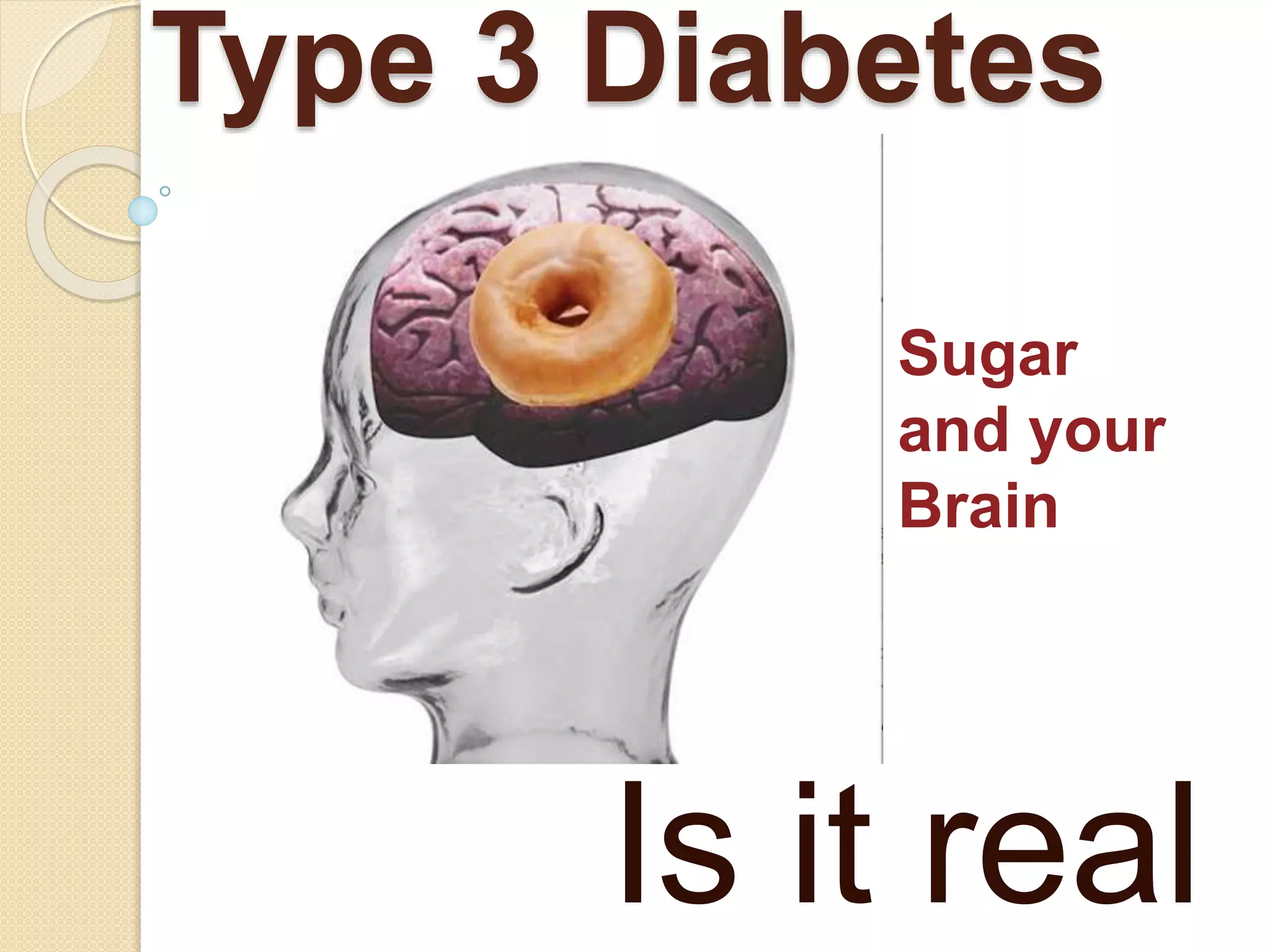
Type 3 Diabetes
Is it real
Sugar
and your
Brain
Is Alzheimer’s Disease Actually
Type 3 Diabetes?
 It starves your brain, tangles and
twists vital cells, and for decades it has
been misrepresented as an untreatable,
genetically determined disease.
Alzheimer's disease is the 6th
leading cause of death in North
America1. The truth, however, is
that this devastating illness shares a
strong link with another sickness
that wreaks havoc on millions of
— Could Alzheimer's disease
simply be Type 3 Diabetes?
 We all know that individuals affected by
Type 1 and Type 2 Diabetes have a notable
resistance to insulin. Type 1 is caused by
the body's inability to produce insulin, and
Type 2 is caused by the deterioration of the
body's insulin receptors and associated
with the consumption of too much refined
carbohydrates like processed grains and
sugar. But when studies began to appear
in 2005 that revealed a shocking
correlation between insulin and brain
cell deterioration, major breaks were
made around Alzheimer's prevention.
Health practitioners became curious about
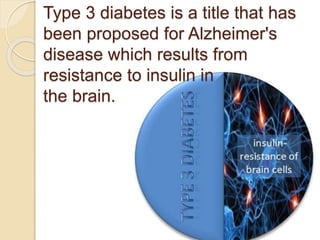
Type 3 diabetes is a title that has
been proposed for Alzheimer's
disease which results from
resistance to insulin in
the brain.
Alzheimer's disease has long been
perceived as mysterious and inevitable. 5.3
million individuals suffer every year from the
disease that appears to be untreatable. But,
if this illness is associated with insulin
resistance, this simply isn't the case.
We already know that diabetics are at least
twice as likely to experience dementia. The
cells of your brain can become insulin-
resistant just like other cells in the body.
What was once considered a mysterious
accumulation of beta amyloid plaques
characteristic in the Alzheimer brain is now
associated with the same lack of insulin that
Your Brain on Carbohydrates
 Most people know that a diet high in
carbohydrates indicates a relationship to
serious diseases like cancer, heart
disease, and diabetes. What we haven't
always known is the serious affect sugar
has on our brain health. When you eat
carbohydrates, which break down into
sugar in the body, your blood sugar levels
sky-rocket. High blood sugar levels also
create inflammation, further causing your
brain's health to weaken. Over time, a diet
high in sugar translates into the
accelerated death of healthy brain cells.
 Studies have shown that brain cells
shrink and become tangled from high
blood sugar levels over time. This means
that your sugar intake could be
drastically affecting long-term brain
health, inherently increasing the
likelihood of developing lesions in the
brain, which are linked to the deadly
disease process we call Alzheimer's.
 The good news is that the brain is
very resilient. A handful of well-
researched, holistic prevention tools
have been shown to restore damaged
brain cells, and return a dying brain to its
How do I decrease my risk for Type 3
Diabetes?
 Many think it an unusual treatment, but it's
the leading preventative tool in cognitive
health. It doesn't take years or even
months — Coconut Oil takes action on
the brain after just one 40 ml dose.
Medium Chain Triglycerides (MCTs) (are
the primary fat) found in coconut oil, and
they are powerful in rapidly helping to
boost brain metabolism and thereby
increasing cognitive functioning. Recent,
insightful research has shown that
patients experienced significant
neurological healing after 4-6 weeks of
 Coconut oil is also a valuable source of fuel for
the brain. When brain cells have undergone
metabolic deterioration associated with insulin
resistance, they can no longer accept glucose,
(the brain's main fuel source.) However,
coconut oil is rich in the medium chain fatty
acids that break down into ketones in the Liver
(organic compound/ chemical substance the
body makes when it does not have enough
insulin in the blood), it is an alternative fuel
for the brain that is as efficient as glucose.
 Using coconut oil has been shown to control
or even reverse the progression of what has
been recently reported as Type 3 diabetes.
Try using extra virgin coconut oil in your
cooking, baking, or your morning smoothies to
receive exceptional cognitive benefits.
Cause &
Prevention
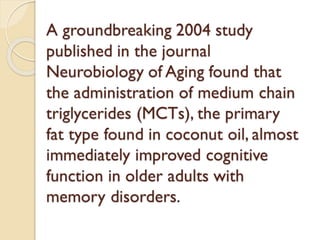
Extra Virgin Coconut Oil
 Best Not recommended
Cold Pressed Processed
Non GMO GMO
Light Color Dark color
Expensive Cheap
 The study was conducted with a double-blind
placebo controlled design with two study visits.
During each visit, subjects received one of two iso-
caloric conditions (690 calories) in a randomized
order: emulsified MCTs, or emulsified long chain
triglycerides as a placebo. NeoBee 895 (Stepan,
Inc.) was used for MCTs. To increase palatability,
heavy whipping cream was used as a source of
long chain triglycerides and as a source of long
chain mono- and di-glycerides for emulsification.
MCTs (40ml) were blended with 152ml heavy
whipping cream to create the emulsified test
sample. Heavy whipping cream alone (232ml) was
blended to create the placebo.
 Subjects fasted from 8:00 p.m. on the night prior to
the study visit. They arrived in the morning and
blood was drawn to determine plasma β-OHB levels
and APOE genotyping (first visit only). Subjects
then consumed the test beverage and rested quietly
for 90min, after which blood was drawn and a 30-
How Medium Chain Triglycerides Work-
MCT’s
 How could a single dose of MCTs (40 ml or 2.7
tablespoons) cause an almost immediate
improvement in cognitive performance in those
suffering from cognitive impairments as serious
as Alzheimer's disease? The explanation is
found both in the unique metabolic needs of the
brain and in the configuration of MCTs
themselves. Whereas the primary fuel source for
the energy-hungry brain is glucose, when insulin
resistance and suboptimal metabolism (hypo-
metabolism) develops in the brain, both the brain's
structure and function are compromised. Ketone
bodies provide a much needed alternative fuel
source to glucose that can recharge metabolic
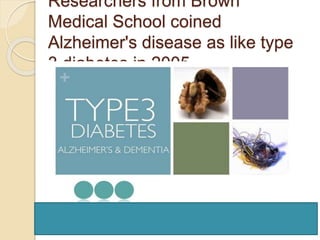
Researchers from Brown
Medical School coined
Alzheimer's disease as like type
3 diabetes in 2005.
Mark A Reger, Samuel T Henderson, Cathy
Hale, Brenna Cholerton, Laura D Baker, G S
Watson, Karen Hyde, Darla Chapman, Suzanne
Craft. Effects of
beta-hydroxybutyrate on cognition in memory-
impaired adults. Neurobiol Aging. 2004
Mar;25(3):311-4. PMID: 15123336
- Anonymous: Medium chain triglycerides. Alt
Med Rev 2002, 7:418-420.
- Lauren C Costantini, Linda J Barr, Janet L
Vogel, Samuel T Henderson. Hypometabolism
as a therapeutic target in Alzheimer's disease.
BMC Neurosci. 2008 ;9 Suppl 2:S16. Epub 2008
References

Type 3 diabetes

  • 1.
    Type 3 Diabetes Isit real Sugar and your Brain
  • 2.
    Is Alzheimer’s DiseaseActually Type 3 Diabetes?  It starves your brain, tangles and twists vital cells, and for decades it has been misrepresented as an untreatable, genetically determined disease. Alzheimer's disease is the 6th leading cause of death in North America1. The truth, however, is that this devastating illness shares a strong link with another sickness that wreaks havoc on millions of
  • 3.
    — Could Alzheimer'sdisease simply be Type 3 Diabetes?  We all know that individuals affected by Type 1 and Type 2 Diabetes have a notable resistance to insulin. Type 1 is caused by the body's inability to produce insulin, and Type 2 is caused by the deterioration of the body's insulin receptors and associated with the consumption of too much refined carbohydrates like processed grains and sugar. But when studies began to appear in 2005 that revealed a shocking correlation between insulin and brain cell deterioration, major breaks were made around Alzheimer's prevention. Health practitioners became curious about
  • 4.
    Type 3 diabetesis a title that has been proposed for Alzheimer's disease which results from resistance to insulin in the brain.
  • 5.
    Alzheimer's disease haslong been perceived as mysterious and inevitable. 5.3 million individuals suffer every year from the disease that appears to be untreatable. But, if this illness is associated with insulin resistance, this simply isn't the case. We already know that diabetics are at least twice as likely to experience dementia. The cells of your brain can become insulin- resistant just like other cells in the body. What was once considered a mysterious accumulation of beta amyloid plaques characteristic in the Alzheimer brain is now associated with the same lack of insulin that
  • 6.
    Your Brain onCarbohydrates  Most people know that a diet high in carbohydrates indicates a relationship to serious diseases like cancer, heart disease, and diabetes. What we haven't always known is the serious affect sugar has on our brain health. When you eat carbohydrates, which break down into sugar in the body, your blood sugar levels sky-rocket. High blood sugar levels also create inflammation, further causing your brain's health to weaken. Over time, a diet high in sugar translates into the accelerated death of healthy brain cells.
  • 7.
     Studies haveshown that brain cells shrink and become tangled from high blood sugar levels over time. This means that your sugar intake could be drastically affecting long-term brain health, inherently increasing the likelihood of developing lesions in the brain, which are linked to the deadly disease process we call Alzheimer's.  The good news is that the brain is very resilient. A handful of well- researched, holistic prevention tools have been shown to restore damaged brain cells, and return a dying brain to its
  • 8.
    How do Idecrease my risk for Type 3 Diabetes?  Many think it an unusual treatment, but it's the leading preventative tool in cognitive health. It doesn't take years or even months — Coconut Oil takes action on the brain after just one 40 ml dose. Medium Chain Triglycerides (MCTs) (are the primary fat) found in coconut oil, and they are powerful in rapidly helping to boost brain metabolism and thereby increasing cognitive functioning. Recent, insightful research has shown that patients experienced significant neurological healing after 4-6 weeks of
  • 9.
     Coconut oilis also a valuable source of fuel for the brain. When brain cells have undergone metabolic deterioration associated with insulin resistance, they can no longer accept glucose, (the brain's main fuel source.) However, coconut oil is rich in the medium chain fatty acids that break down into ketones in the Liver (organic compound/ chemical substance the body makes when it does not have enough insulin in the blood), it is an alternative fuel for the brain that is as efficient as glucose.  Using coconut oil has been shown to control or even reverse the progression of what has been recently reported as Type 3 diabetes. Try using extra virgin coconut oil in your cooking, baking, or your morning smoothies to receive exceptional cognitive benefits.
  • 10.
  • 11.
    Extra Virgin CoconutOil  Best Not recommended Cold Pressed Processed Non GMO GMO Light Color Dark color Expensive Cheap
  • 13.
     The studywas conducted with a double-blind placebo controlled design with two study visits. During each visit, subjects received one of two iso- caloric conditions (690 calories) in a randomized order: emulsified MCTs, or emulsified long chain triglycerides as a placebo. NeoBee 895 (Stepan, Inc.) was used for MCTs. To increase palatability, heavy whipping cream was used as a source of long chain triglycerides and as a source of long chain mono- and di-glycerides for emulsification. MCTs (40ml) were blended with 152ml heavy whipping cream to create the emulsified test sample. Heavy whipping cream alone (232ml) was blended to create the placebo.  Subjects fasted from 8:00 p.m. on the night prior to the study visit. They arrived in the morning and blood was drawn to determine plasma β-OHB levels and APOE genotyping (first visit only). Subjects then consumed the test beverage and rested quietly for 90min, after which blood was drawn and a 30-
  • 14.
    How Medium ChainTriglycerides Work- MCT’s  How could a single dose of MCTs (40 ml or 2.7 tablespoons) cause an almost immediate improvement in cognitive performance in those suffering from cognitive impairments as serious as Alzheimer's disease? The explanation is found both in the unique metabolic needs of the brain and in the configuration of MCTs themselves. Whereas the primary fuel source for the energy-hungry brain is glucose, when insulin resistance and suboptimal metabolism (hypo- metabolism) develops in the brain, both the brain's structure and function are compromised. Ketone bodies provide a much needed alternative fuel source to glucose that can recharge metabolic
  • 15.
    Researchers from Brown MedicalSchool coined Alzheimer's disease as like type 3 diabetes in 2005.
  • 16.
    Mark A Reger,Samuel T Henderson, Cathy Hale, Brenna Cholerton, Laura D Baker, G S Watson, Karen Hyde, Darla Chapman, Suzanne Craft. Effects of beta-hydroxybutyrate on cognition in memory- impaired adults. Neurobiol Aging. 2004 Mar;25(3):311-4. PMID: 15123336 - Anonymous: Medium chain triglycerides. Alt Med Rev 2002, 7:418-420. - Lauren C Costantini, Linda J Barr, Janet L Vogel, Samuel T Henderson. Hypometabolism as a therapeutic target in Alzheimer's disease. BMC Neurosci. 2008 ;9 Suppl 2:S16. Epub 2008 References