Power Foods for the Brain
Neal D. Barnard, MD
Physicians Committee for Responsible Medicine
Adjunct Associate Professor of Medicine
The George Washington University School of Medicine
What Matters Most?
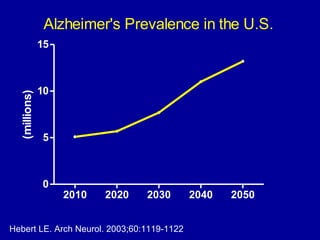
Alzheimer’s attacks half of us by age 85.
2010 2020 2030 2040 2050
0
5
10
15
Alzheimer's Prevalence in the U.S.(millions)
Hebert LE. Arch Neurol. 2003;60:1119-1122
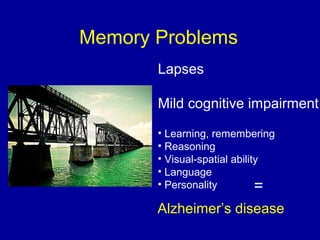
Memory Problems
Lapses
Mild cognitive impairment
• Learning, remembering
• Reasoning
• Visual-spatial ability
• Language
• Personality
Alzheimer’s disease
=
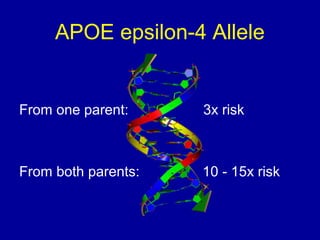
APOE epsilon-4 Allele
From one parent: 3x risk
From both parents: 10 - 15x risk
Chicago Health
and Aging Project
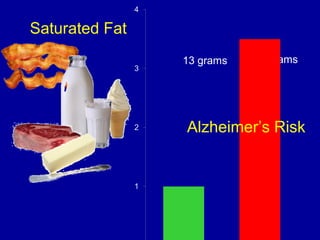
Saturated Fat
13 grams 25 grams
Alzheimer’s Risk
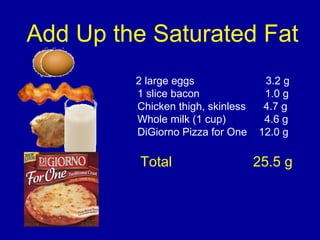
Add Up the Saturated Fat
2 large eggs 3.2 g
1 slice bacon 1.0 g
Chicken thigh, skinless 4.7 g
Whole milk (1 cup) 4.6 g
DiGiorno Pizza for One 12.0 g
Total 25.5 g
Cardiovascular risk factors, Aging, and
Dementia (CAIDE) study, Finland
Eskelinen MH. Int J Geriatric Psychiatr.
2008; 23: 741–747.
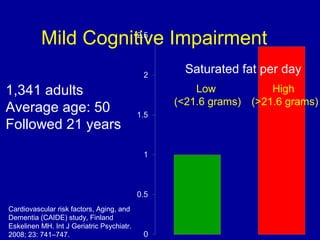
1,341 adults
Average age: 50
Followed 21 years
Mild Cognitive Impairment
Saturated fat per day
Low
(<21.6 grams)
High
(>21.6 grams)
Cardiovascular risk factors, Aging, and
Dementia (CAIDE) study, Finland
Eskelinen MH. Int J Geriatric Psychiatr.
2008; 23: 741–747.
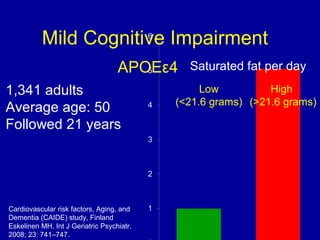
1,341 adults
Average age: 50
Followed 21 years
Mild Cognitive Impairment
APOEε4
Low
(<21.6 grams)
High
(>21.6 grams)
Saturated fat per day
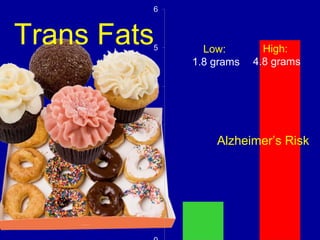
Trans Fats Low:
1.8 grams
High:
4.8 grams
Alzheimer’s Risk
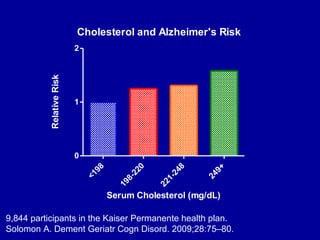
Cholesterol and Alzheimer's Risk
<198
198-220
221-248
249+
0
1
2
Serum Cholesterol (mg/dL)
RelativeRisk
9,844 participants in the Kaiser Permanente health plan.
Solomon A. Dement Geriatr Cogn Disord. 2009;28:75–80.
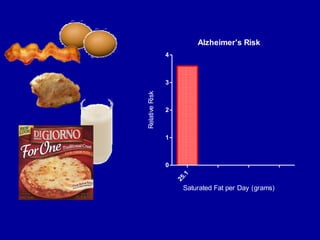
Alzheimer's Risk
25.1
0
1
2
3
4
Saturated Fat per Day (grams)
RelativeRisk
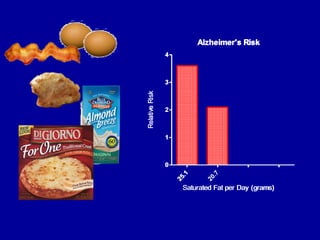
Alzheimer's Risk
25.1
20.7
0
1
2
3
4
Saturated Fat per Day (grams)
RelativeRisk
Alzheimer's Risk
25.1
0
1
2
3
4
Saturated Fat per Day (grams)
RelativeRisk
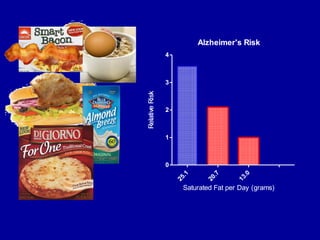
Alzheimer's Risk
25.1
20.7
13.0
0
1
2
3
4
Saturated Fat per Day (grams)
RelativeRisk
Alzheimer's Risk
25.1
20.7
0
1
2
3
4
Saturated Fat per Day (grams)
RelativeRisk
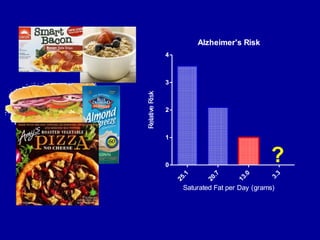
Alzheimer's Risk
25.1
20.7
13.0
3.3
0
1
2
3
4
Saturated Fat per Day (grams)
RelativeRisk
?
Alzheimer's Risk
25.1
20.7
13.0
0
1
2
3
4
Saturated Fat per Day (grams)
RelativeRisk
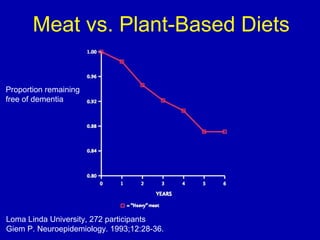
Meat vs. Plant-Based Diets
Proportion remaining
free of dementia
Loma Linda University, 272 participants
Giem P. Neuroepidemiology. 1993;12:28-36.
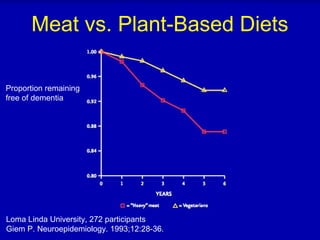
Meat vs. Plant-Based Diets
Loma Linda University, 272 participants
Giem P. Neuroepidemiology. 1993;12:28-36.
Proportion remaining
free of dementia
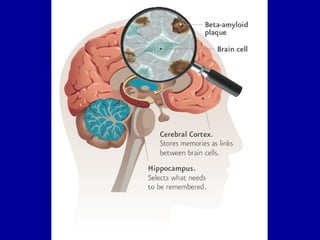
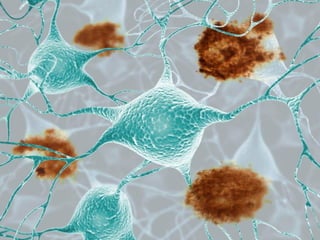
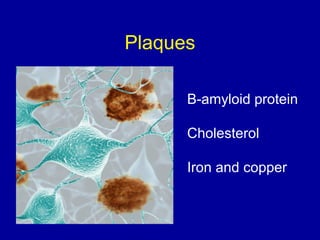
What else is lurking in plaques?
Plaques
Β-amyloid protein
Cholesterol
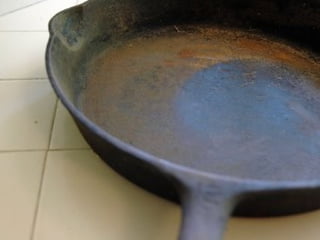
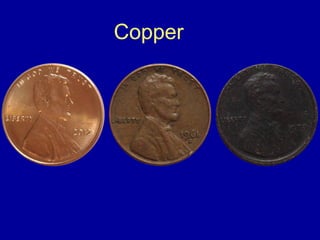
Iron and copper
Copper
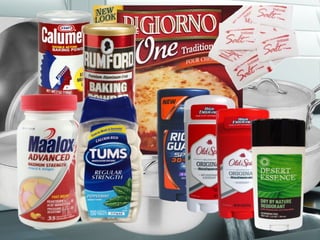
Another Culprit?
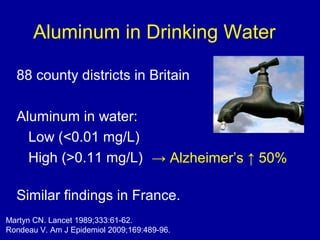
Aluminum in Drinking Water
88 county districts in Britain
Aluminum in water:
Low (<0.01 mg/L)
High (>0.11 mg/L)
Similar findings in France.
Martyn CN. Lancet 1989;333:61-62.
Rondeau V. Am J Epidemiol 2009;169:489-96.
→ Alzheimer’s ↑ 50%
Vitamin E
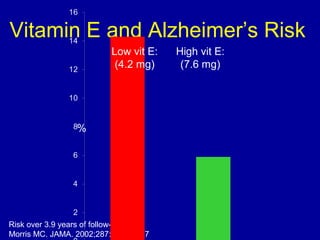
Vitamin E and Alzheimer’s Risk
Risk over 3.9 years of follow-up
Morris MC. JAMA. 2002;287:3230-3237
Low vit E:
(4.2 mg)
High vit E:
(7.6 mg)
%
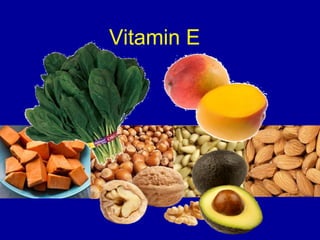
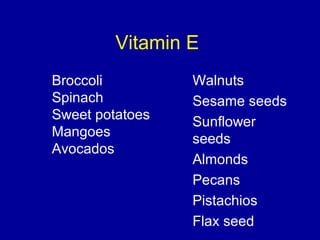
Vitamin E
Walnuts
Sesame seeds
Sunflower
seeds
Almonds
Pecans
Pistachios
Flax seed
Broccoli
Spinach
Sweet potatoes
Mangoes
Avocados
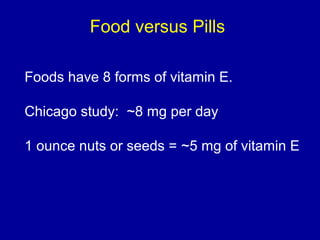
Food versus Pills
Foods have 8 forms of vitamin E.
Chicago study: ~8 mg per day
1 ounce nuts or seeds = ~5 mg of vitamin E
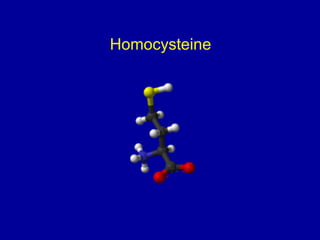
Homocysteine
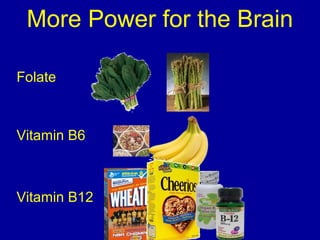
Folate
Vitamin B6
Vitamin B12
More Power for the Brain
B-Vitamins for Brain Power
Folate: 800 mcg
Vitamin B6: 20 mg
Vitamin B12: 500 mcg
223 people over age 70 with MCI, homocysteine ≥11.3 µmol/L
University of Oxford, VITACOG study
de Jager CA. Int J Geriatr Psychiatry. 2011; [Epub ahead of print]
Hopkins Verbal Learning Test, revised, with delayed recall
University of Oxford, VITACOG study
de Jager CA. Int J Geriatr Psychiatry. 2011; [Epub ahead of print]
0 1 2
5
6
7
8
9 Memory
(Delayed Recall)
Years
Placebo
6.9
5.9
Hopkins Verbal Learning Test, revised, with delayed recall
University of Oxford, VITACOG study
de Jager CA. Int J Geriatr Psychiatry. 2011; [Epub ahead of print]
0 1 2
5
6
7
8
9 Memory
(Delayed Recall)
B-Vitamins
Years
Placebo
6.9
7.2
5.9
6.8
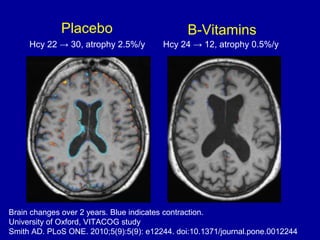
Placebo B-Vitamins
Hcy 22 → 30, atrophy 2.5%/y Hcy 24 → 12, atrophy 0.5%/y
Brain changes over 2 years. Blue indicates contraction.
University of Oxford, VITACOG study
Smith AD. PLoS ONE. 2010;5(9):5(9): e12244. doi:10.1371/journal.pone.0012244
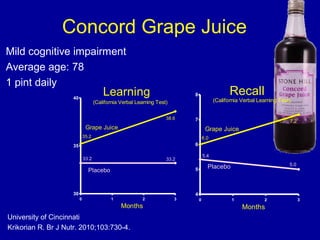
Concord Grape Juice
Mild cognitive impairment
Average age: 78
1 pint daily
0 1 2 3
30
35
40
Learning
(California Verbal Learning Test)
Grape Juice
Months
Placebo
33.2
38.6
33.2
35.2
University of Cincinnati
Krikorian R. Br J Nutr. 2010;103:730-4.
0 1 2 3
4
5
6
7
8 Recall
(California Verbal Learning Test)
Grape Juice
Months
Placebo
5.4
7.2
5.0
6.0
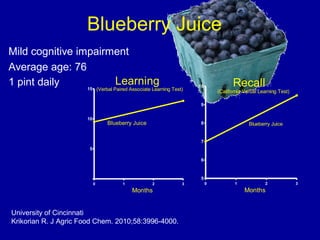
Blueberry Juice
Mild cognitive impairment
Average age: 76
1 pint daily
0 1 2 3
5
10
15
Learning
(Verbal Paired Associate Learning Test)
Blueberry Juice
Months
University of Cincinnati
Krikorian R. J Agric Food Chem. 2010;58:3996-4000.
0 1 2 3
5
6
7
8
9
10 Recall
(California Verbal Learning Test)
Months
Blueberry Juice
Who eats that way?
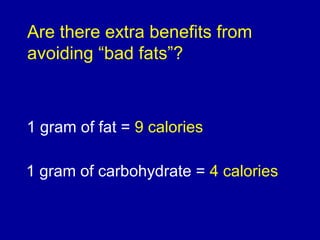
Are there extra benefits from
avoiding “bad fats”?
1 gram of fat = 9 calories
1 gram of carbohydrate = 4 calories
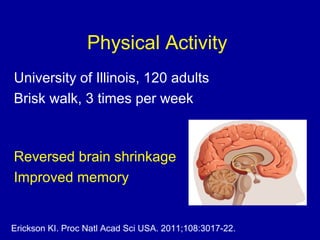
Physical Activity
University of Illinois, 120 adults
Brisk walk, 3 times per week

Reversed brain shrinkage
Improved memory
Erickson KI. Proc Natl Acad Sci USA. 2011;108:3017-22.
Dr. Barnard’s Exercise Tips
1. Arrive at airport as late as possible.
2. Carry massively heavy luggage.
3. Run for the plane.
Beginning Aerobic Exercise
Begin with 10-minute brisk walk.
Increase 5 minutes per week, up to 40 minutes.
The Bilingual Advantage
Languages protect your brain.
Delays cognitive decline by ~5 years.
Craik FI. Neurology. 2010;75:1726-9.
Mental Activity Reduces
Alzheimer’s Risk
• Intellectual activities
• Documentaries, newspapers
• Crosswords, anagrams
WELL
ILL
Online Cognitive Training
Lumosity.comFamiliar Faces
Online Cognitive Training
Lumosity.comWord Bubbles
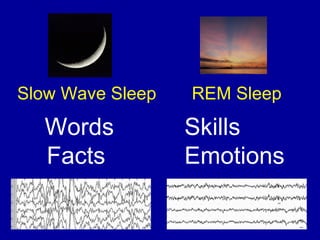
Words
Facts
Skills
Emotions
Slow Wave Sleep REM Sleep
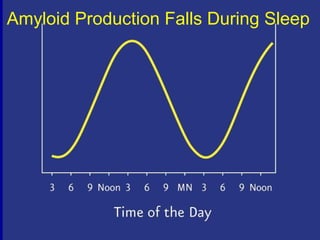
Amyloid Production Falls During Sleep
But wait, there’s more….
Medications That Affect Memory
Midazolam (Versed)
Cholesterol-lowering drugs
Sleeping medications
Antidepressants
Antihistamines
Anxiety medications
Blood pressure medications
Acid blockers
Medical Conditions That Affect
Memory
Depression
Thyroid disease
Infections
Migraines
Chemotherapy
Gluten intolerance
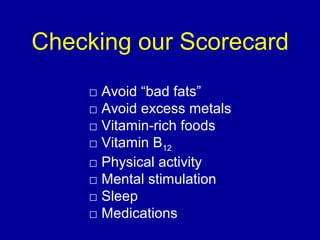
□ Avoid “bad fats”
□ Avoid excess metals
□ Vitamin-rich foods
□ Vitamin B12
□ Physical activity
□ Mental stimulation
□ Sleep
□ Medications
Checking our Scorecard
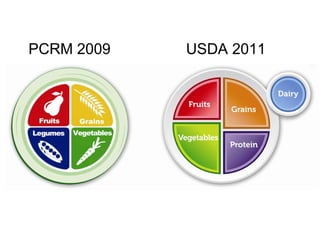
PCRM 2009 USDA 2011
Beginning a Healthful Diet
Step 1. Check out the possibilities
Breakfast
Lunch
Dinner
Snack
Foods to Try
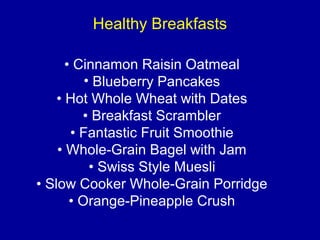
Healthy Breakfasts
• Cinnamon Raisin Oatmeal
• Blueberry Pancakes
• Hot Whole Wheat with Dates
• Breakfast Scrambler
• Fantastic Fruit Smoothie
• Whole-Grain Bagel with Jam
• Swiss Style Muesli
• Slow Cooker Whole-Grain Porridge
• Orange-Pineapple Crush
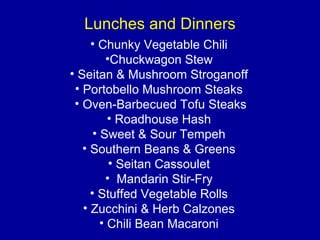
Lunches and Dinners
• Chunky Vegetable Chili
•Chuckwagon Stew
• Seitan & Mushroom Stroganoff
• Portobello Mushroom Steaks
• Oven-Barbecued Tofu Steaks
• Roadhouse Hash
• Sweet & Sour Tempeh
• Southern Beans & Greens
• Seitan Cassoulet
• Mandarin Stir-Fry
• Stuffed Vegetable Rolls
• Zucchini & Herb Calzones
• Chili Bean Macaroni
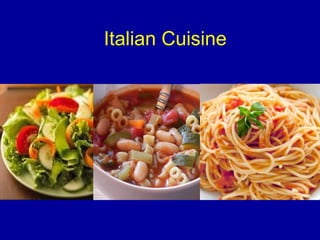
Italian Cuisine
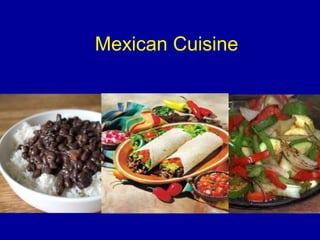
Mexican Cuisine
Chinese Cuisine
Japanese Cuisine
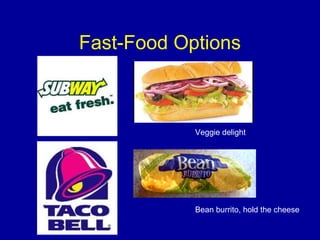
Fast-Food Options
Veggie delight
Bean burrito, hold the cheese
Beginning a Healthful Diet
Step 1. Check out the possibilities
Step 2. Do a 3-week test drive
Optional: Use transition foods
Resources
www.pcrm.org
PCRM.org
PCRM.org
PCRM.org
PCRM.org

Power Foods for the Brain

Editor's Notes

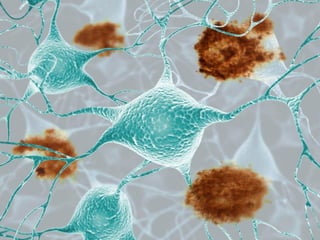
  • #11 Hi Neal: Sorry it took so log, but here are images of a plaque and a tangle from one of the world`s leading authorities on AD and he is happy to let you use them.  Plaques are extracellular, in contrast to tangles that are initially intraneuronal but persist after neuron death and disappearance as “ghost” or “tomestone”  extacellular tangles sitting where the neuron cell bodies that had once contained them used to be but no longer are.  Larry From: Eliezer Masliah [mailto:emasliah@ucsd.edu] Sent: Wednesday, April 25, 2012 9:59 PM To: Lawrence A.Hansen Subject: Re: Pictures of plague and tangle Hi Larry please find enclosed, plaques are with anti-Abeta and tangles with phospho Tau Beta amyloid only reveals itself as filamentous at the resolution level of the electron microscope. The images I sent are brown because an antibody to the beta amyloid protein was attached to a brown chromagen  to label the  otherwise nearly invisible fibrils.  Larry
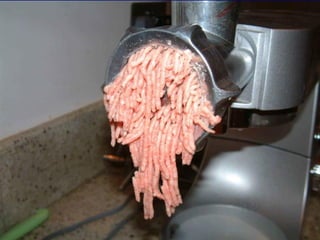
  • #12 Rent sausage maker, try Gimme Lean
  • #13 Hi Neal: Sorry it took so log, but here are images of a plaque and a tangle from one of the world`s leading authorities on AD and he is happy to let you use them.  Plaques are extracellular, in contrast to tangles that are initially intraneuronal but persist after neuron death and disappearance as “ghost” or “tomestone”  extacellular tangles sitting where the neuron cell bodies that had once contained them used to be but no longer are.  Larry From: Eliezer Masliah [mailto:emasliah@ucsd.edu] Sent: Wednesday, April 25, 2012 9:59 PM To: Lawrence A.Hansen Subject: Re: Pictures of plague and tangle Hi Larry please find enclosed, plaques are with anti-Abeta and tangles with phospho Tau Beta amyloid only reveals itself as filamentous at the resolution level of the electron microscope. The images I sent are brown because an antibody to the beta amyloid protein was attached to a brown chromagen  to label the  otherwise nearly invisible fibrils.  Larry
  • #15 Show butter, cheese, meat Ask Dr. Morris for actual percentages of AD risk, so I can say, with this much sat fat, your risk is this. Take out this fat and it’s reduced to this.
  • #16 Could show an array of foods, in line from lowest to highest sat fat content.
  • #19 Show snack foods contain trans fats
  • #21 Could show an array of foods, in line from lowest to highest sat fat content.
  • #40 Show foods: You’ll find traces of vitamin E in broccoli, spinach, sweet potatoes, mangoes, and avocados. And there is much more in nuts and seeds, especially almonds, walnuts, hazelnuts, pine nuts, pecans, pistachios, sunflower seeds, sesame seeds, and flaxseed. Black walnuts 8.1 Sesame seeds 8.0 Pecans 6.9 Pistachios 6.4 English walnuts 5.9 Flaxseed 5.7 Sunflower seeds 7.4 Almonds 7.3 Almond butter 6.9 Hazelnuts 4.3 Pine nuts 2.6 Brazil nuts 1.6
  • #45 Researchers at Oxford University went a step further, testing folate, vitamin B6, and vitamin B12 in older people who were having memory problems that were sufficient for a diagnosis of mild cognitive impairment.10 As you will recall, that means they had significant forgetfulness but were otherwise fine for the moment. The researchers gave everyone a set of cognitive tests. Then, over the next two years, the participants started a daily regimen that consisted of 800 micrograms of folate, 500 micrograms of vitamin B12 and 20 milligrams of vitamin B6, all of which are well above the recommended dietary allowance for these vitamins and more than one would typically get from foods. The effects were remarkable. High homocysteine levels fell sharply, and many people found their memory improving significantly. Accuracy on testing was improved by as much as 70 percent. And brain scans showed that the B-vitamins also helped protect against brain shrinkage over time. de Jager CA, Oulhaj A, Jacoby R, Refsum H, Smith AD. Cognitive and clinical outcomes of homocysteine-lowering B-vitamin treatment in mild cognitive impairment: a randomized controlled trial. Int J Geriatr Psychiatry. 2011; Jul 21. doi: 10.1002/gps.2758. [Epub ahead of print]
  • #46 Figure 4. Selected subtraction MRI scans. The images are from the baseline scan with colour superimposed to show the brain tissue change over the following two years. Colours show expansion (red/yellow) or contraction (blue/light blue) of the brain of 0.3 to 1.0 mm, with the lightest colour indicating the biggest change. (A) Subtraction image of female participant in the placebo group, age 79 years, with baseline tHcy of 22 mmol/ L, whose tHcy concentration increased by 8 mmol/L over two years. Atrophy rate was 2.50% per year. Atrophy most strongly appears here as enlargement of the ventricles. (B) Subtraction image of female participant in active treatment group, age 72 years, with baseline tHcy of 24 mmol/L at baseline, whose tHcy concentration decreased by 12 mmol/L over two years. Atrophy rate 0.46% per year. There is no clear visible pattern of atrophy. doi:10.1371/journal.pone.0012244.g004

  • #75 1
  • #76 1