TWO PHASE
SAMPLING
BY
UMME SALMA SHAIK
SAPTAMI RJ
INTRODUCTION
• Neyman (1938)
• double sampling
• sample selection- X-Y
• Two-phase sampling is particularly useful when the cost for observing x is
relatively cheap compared with the cost for observing Y
• To formalize, two-phase sampling can be described as follows:
• [Step 1] - From the finite population, select a first-phase sample A1 of size
n1 and observe x.
• [Step 2] - Treat the first-phase sample A1 as the population and select a
second phase sample A2 of size n2.
• In this case, the selection probability for the second-phase sample is often
determined by the value of x obtained from the first-phase sample
• Since the second-phase sample selection probability depends on the
observed value of the first-phase sample, the sample inclusion probability
for the second phase sample is a random variable in the sense that its value
is changed as the first-phase sample changes
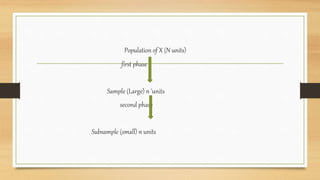
Population of X (N units)
first phase
Sample (Large) n 'units
second phase
Subsample (small) n units
Example :
Capture-recapture estimation
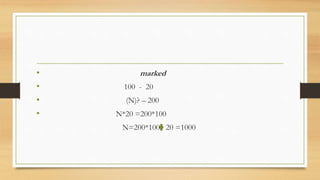
• A lake has N fish.
• Catch and mark 200 fish; then release them.
• Later catch 100 fish
• Suppose 20 of the fish in the second sample are marked
• We estimate that 20% (20/100) of the fish in the lake are marked.
• marked
• 100 - 20
• (N)? – 200
• N*20 =200*100
N=200*100 20 =1000
ASSUMPTIONS
• Population is closed. (N stays the same.)
• The two samples are independent.
• Application :
• The double sampling method is designed to determine
biomass by sampling in quadrats. It can be applied to a wide variety of
vegetation types, particularly grasslands and shrublands.
• This method can reduce time for taking sample , but still fairly accurate
• Clipping and weighing vegetation is expensive and tedious
• With this method ocular estimates of biomass are made for a small number
of quadrats
• And vegetation on the quadrats is clipped and weighed
• For the remaining quadrats only the ocular estimates are performed
ADVANTAGES
• Less time consuming than the harvest method ( since estimating is faster
than the clipping )
• And more accurate than the estimation method ( since estimating
production can be subjective and cause error )
• How ever it still requires a lot of training which involves weighing
representative units of a plant
DISADVANTAGES
• Formulae for data analysis and sample size estimation are much more
complex than for some other method
THANK YOU

Two phase sampling

  • 1.
  • 2.
    INTRODUCTION • Neyman (1938) •double sampling • sample selection- X-Y • Two-phase sampling is particularly useful when the cost for observing x is relatively cheap compared with the cost for observing Y
  • 3.
    • To formalize,two-phase sampling can be described as follows: • [Step 1] - From the finite population, select a first-phase sample A1 of size n1 and observe x. • [Step 2] - Treat the first-phase sample A1 as the population and select a second phase sample A2 of size n2. • In this case, the selection probability for the second-phase sample is often determined by the value of x obtained from the first-phase sample
  • 4.
    • Since thesecond-phase sample selection probability depends on the observed value of the first-phase sample, the sample inclusion probability for the second phase sample is a random variable in the sense that its value is changed as the first-phase sample changes
  • 5.
    Population of X(N units) first phase Sample (Large) n 'units second phase Subsample (small) n units
  • 6.
    Example : Capture-recapture estimation •A lake has N fish. • Catch and mark 200 fish; then release them. • Later catch 100 fish • Suppose 20 of the fish in the second sample are marked • We estimate that 20% (20/100) of the fish in the lake are marked.
  • 7.
    • marked • 100- 20 • (N)? – 200 • N*20 =200*100 N=200*100 20 =1000
  • 8.
    ASSUMPTIONS • Population isclosed. (N stays the same.) • The two samples are independent. • Application : • The double sampling method is designed to determine biomass by sampling in quadrats. It can be applied to a wide variety of vegetation types, particularly grasslands and shrublands. • This method can reduce time for taking sample , but still fairly accurate • Clipping and weighing vegetation is expensive and tedious
  • 9.
    • With thismethod ocular estimates of biomass are made for a small number of quadrats • And vegetation on the quadrats is clipped and weighed • For the remaining quadrats only the ocular estimates are performed
  • 10.
    ADVANTAGES • Less timeconsuming than the harvest method ( since estimating is faster than the clipping ) • And more accurate than the estimation method ( since estimating production can be subjective and cause error ) • How ever it still requires a lot of training which involves weighing representative units of a plant
  • 11.
    DISADVANTAGES • Formulae fordata analysis and sample size estimation are much more complex than for some other method
  • 12.