Twitter OAuth


                                @nov
2010   6   25
OAuth Echo


2010   6   25
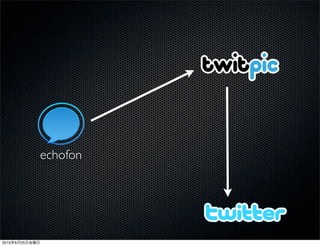
echofon


2010   6   25
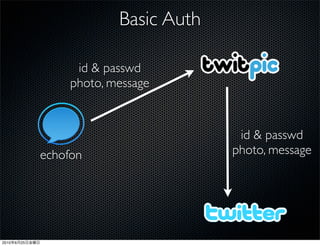
Basic Auth

                      id & passwd
                     photo, message


                                           id & passwd
                echofon                   photo, message


2010   6   25
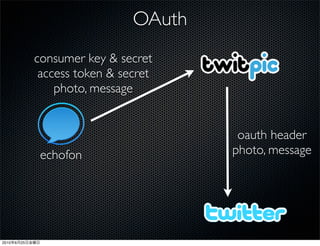
OAuth
                consumer key & secret
                 access token & secret
                    photo, message


                                           oauth header
                 echofon                  photo, message


2010   6   25
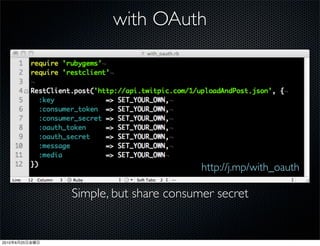
with OAuth


                                        http://j.mp/with_oauth

                Simple, but share consumer secret


2010   6   25
2010.02.10
                OAuth Echo - delegation in identity verification
                                            http://j.mp/raffi_echo


2010   6   25
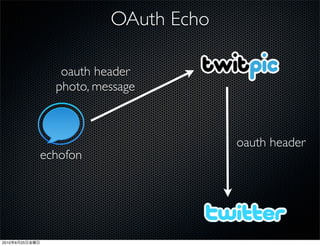
OAuth Echo

                   oauth header
                  photo, message


                                        oauth header
                echofon


2010   6   25
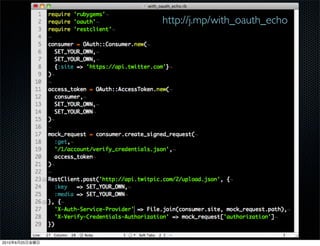
http://j.mp/with_oauth_echo


2010   6   25
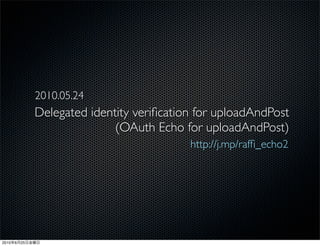
2010.05.24
                Delegated identity verification for uploadAndPost
                               (OAuth Echo for uploadAndPost)
                                             http://j.mp/raffi_echo2


2010   6   25
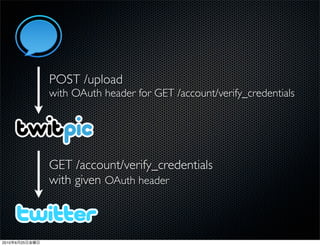
POST /upload
                with OAuth header for GET /account/verify_credentials


                GET /account/verify_credentials
                with given OAuth header


2010   6   25
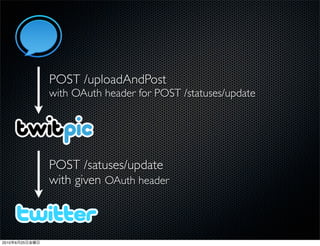
POST /uploadAndPost
                with OAuth header for POST /statuses/update


                POST /satuses/update
                with given OAuth header


2010   6   25
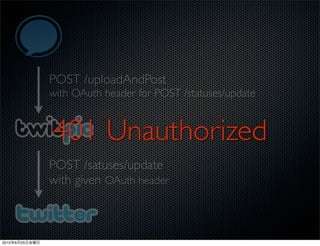
POST /uploadAndPost
                with OAuth header for POST /statuses/update


                401 Unauthorized
                POST /satuses/update
                with given OAuth header


2010   6   25
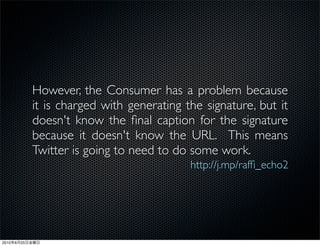
However, the Consumer has a problem because
                it is charged with generating the signature, but it
                doesn't know the final caption for the signature
                because it doesn't know the URL. This means
                Twitter is going to need to do some work.
                                               http://j.mp/raffi_echo2


2010   6   25
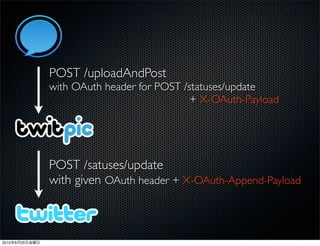
POST /uploadAndPost
                with OAuth header for POST /statuses/update
                                             + X-OAuth-Payload


                POST /satuses/update
                with given OAuth header + X-OAuth-Append-Payload


2010   6   25
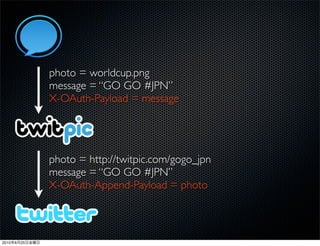
photo = worldcup.png
                message = “GO GO #JPN”
                X-OAuth-Payload = message


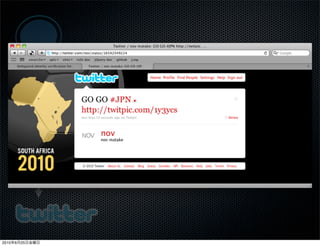
                photo = http://twitpic.com/gogo_jpn
                message = “GO GO #JPN”
                X-OAuth-Append-Payload = photo


2010   6   25
photo = worldcup.png
                message = “GO GO #JPN”
                X-OAuth-Payload = message


                photo = http://twitpic.com/gogo_jpn
                message = “GO GO #JPN”
                X-OAuth-Append-Payload = photo


2010   6   25
This is not yet implemented on the Twitter
                side, but it will hopefully be soon. I'm definitely
                soliciting feedback.            http://j.mp/raffi_echo2


2010   6   25
follow @raffi


2010   6   25
OAuth for Open Source


2010   6   25
Coming soon: a solution for Open Source
                applications using OAuth with the Twitter API
                                       http://j.mp/twitter_dev_talk


2010   6   25
Open Source using Twitter API ... ?


2010   6   25
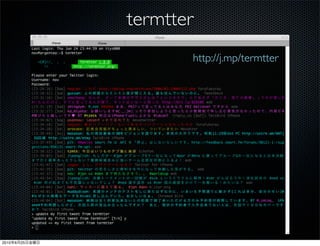
termtter
                       http://j.mp/termtter


2010   6   25
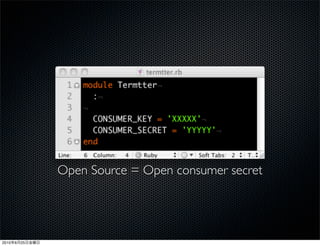
Open Source = Open consumer secret


2010   6   25
Coming soon: a solution for Open Source
                applications using OAuth with the Twitter API
                                       http://j.mp/twitter_dev_talk


2010   6   25
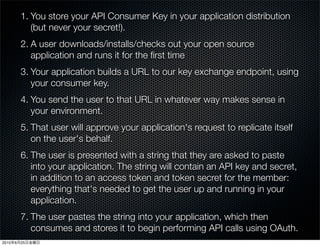
1. You store your API Consumer Key in your application distribution
              (but never your secret!).
           2. A user downloads/installs/checks out your open source
              application and runs it for the first time
           3. Your application builds a URL to our key exchange endpoint, using
              your consumer key.
           4. You send the user to that URL in whatever way makes sense in
              your environment.
           5. That user will approve your application's request to replicate itself
              on the user's behalf.
           6. The user is presented with a string that they are asked to paste
              into your application. The string will contain an API key and secret,
              in addition to an access token and token secret for the member:
              everything that's needed to get the user up and running in your
              application.
           7. The user pastes the string into your application, which then
              consumes and stores it to begin performing API calls using OAuth.
2010   6   25
1. You store your API Consumer Key in your application distribution
              (but never your secret!).
           2. A user downloads/installs/checks out your open source
              application and runs it for the first time
           3. Your application builds a URL to our key exchange endpoint, using
              your consumer key.
        4. You send the user to that URL in whatever way makes sense in
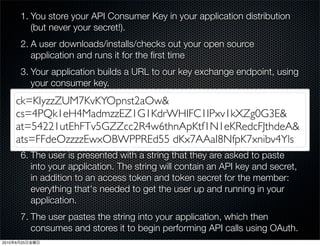
       ck=KIyzzZUM7KvKYOpnst2aOw&
           your environment.
       cs=4PQk1eH4MadmzzEZ1G1KdrWHIFC1IPxv1kXZg0G3E&
       at=54221utEhFTv5GZZcc2R4w6thnApKtf1N1eKRedcFJthdeA&
        5. That user will approve your application's request to replicate itself
       ats=FFdeOzzzzEwxOBWPPREd55 dKx7AAaI8NfpK7xnibv4Yls
           on the user's behalf.
           6. The user is presented with a string that they are asked to paste
              into your application. The string will contain an API key and secret,
              in addition to an access token and token secret for the member:
              everything that's needed to get the user up and running in your
              application.
           7. The user pastes the string into your application, which then
              consumes and stores it to begin performing API calls using OAuth.
2010   6   25
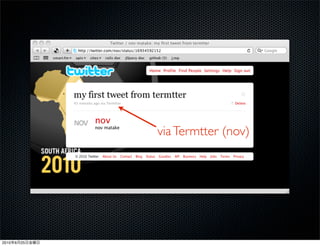
via Termtter (nov)


2010   6   25
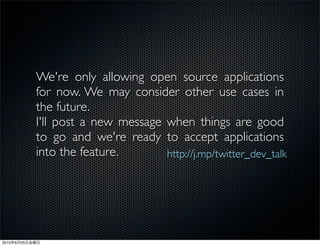
We're only allowing open source applications
                for now. We may consider other use cases in
                the future.
                I'll post a new message when things are good
                to go and we're ready to accept applications
                into the feature.       http://j.mp/twitter_dev_talk


2010   6   25
after #worldcup


2010   6   25

Twitter oauth #idcon7

  • 1.
    Twitter OAuth @nov 2010 6 25
  • 2.
  • 3.
  • 4.
    Basic Auth id & passwd photo, message id & passwd echofon photo, message 2010 6 25
  • 5.
    OAuth consumer key & secret access token & secret photo, message oauth header echofon photo, message 2010 6 25
  • 6.
    with OAuth http://j.mp/with_oauth Simple, but share consumer secret 2010 6 25
  • 7.
    2010.02.10 OAuth Echo - delegation in identity verification http://j.mp/raffi_echo 2010 6 25
  • 8.
    OAuth Echo oauth header photo, message oauth header echofon 2010 6 25
  • 9.
  • 10.
    2010.05.24 Delegated identity verification for uploadAndPost (OAuth Echo for uploadAndPost) http://j.mp/raffi_echo2 2010 6 25
  • 11.
    POST /upload with OAuth header for GET /account/verify_credentials GET /account/verify_credentials with given OAuth header 2010 6 25
  • 12.
    POST /uploadAndPost with OAuth header for POST /statuses/update POST /satuses/update with given OAuth header 2010 6 25
  • 13.
    POST /uploadAndPost with OAuth header for POST /statuses/update 401 Unauthorized POST /satuses/update with given OAuth header 2010 6 25
  • 14.
    However, the Consumerhas a problem because it is charged with generating the signature, but it doesn't know the final caption for the signature because it doesn't know the URL. This means Twitter is going to need to do some work. http://j.mp/raffi_echo2 2010 6 25
  • 15.
    POST /uploadAndPost with OAuth header for POST /statuses/update + X-OAuth-Payload POST /satuses/update with given OAuth header + X-OAuth-Append-Payload 2010 6 25
  • 16.
    photo = worldcup.png message = “GO GO #JPN” X-OAuth-Payload = message photo = http://twitpic.com/gogo_jpn message = “GO GO #JPN” X-OAuth-Append-Payload = photo 2010 6 25
  • 17.
    photo = worldcup.png message = “GO GO #JPN” X-OAuth-Payload = message photo = http://twitpic.com/gogo_jpn message = “GO GO #JPN” X-OAuth-Append-Payload = photo 2010 6 25
  • 18.
    This is notyet implemented on the Twitter side, but it will hopefully be soon. I'm definitely soliciting feedback. http://j.mp/raffi_echo2 2010 6 25
  • 19.
  • 20.
    OAuth for OpenSource 2010 6 25
  • 21.
    Coming soon: asolution for Open Source applications using OAuth with the Twitter API http://j.mp/twitter_dev_talk 2010 6 25
  • 22.
    Open Source usingTwitter API ... ? 2010 6 25
  • 23.
    termtter http://j.mp/termtter 2010 6 25
  • 24.
    Open Source =Open consumer secret 2010 6 25
  • 25.
    Coming soon: asolution for Open Source applications using OAuth with the Twitter API http://j.mp/twitter_dev_talk 2010 6 25
  • 26.
    1. You storeyour API Consumer Key in your application distribution (but never your secret!). 2. A user downloads/installs/checks out your open source application and runs it for the first time 3. Your application builds a URL to our key exchange endpoint, using your consumer key. 4. You send the user to that URL in whatever way makes sense in your environment. 5. That user will approve your application's request to replicate itself on the user's behalf. 6. The user is presented with a string that they are asked to paste into your application. The string will contain an API key and secret, in addition to an access token and token secret for the member: everything that's needed to get the user up and running in your application. 7. The user pastes the string into your application, which then consumes and stores it to begin performing API calls using OAuth. 2010 6 25
  • 27.
    1. You storeyour API Consumer Key in your application distribution (but never your secret!). 2. A user downloads/installs/checks out your open source application and runs it for the first time 3. Your application builds a URL to our key exchange endpoint, using your consumer key. 4. You send the user to that URL in whatever way makes sense in ck=KIyzzZUM7KvKYOpnst2aOw& your environment. cs=4PQk1eH4MadmzzEZ1G1KdrWHIFC1IPxv1kXZg0G3E& at=54221utEhFTv5GZZcc2R4w6thnApKtf1N1eKRedcFJthdeA& 5. That user will approve your application's request to replicate itself ats=FFdeOzzzzEwxOBWPPREd55 dKx7AAaI8NfpK7xnibv4Yls on the user's behalf. 6. The user is presented with a string that they are asked to paste into your application. The string will contain an API key and secret, in addition to an access token and token secret for the member: everything that's needed to get the user up and running in your application. 7. The user pastes the string into your application, which then consumes and stores it to begin performing API calls using OAuth. 2010 6 25
  • 28.
  • 29.
    We're only allowingopen source applications for now. We may consider other use cases in the future. I'll post a new message when things are good to go and we're ready to accept applications into the feature. http://j.mp/twitter_dev_talk 2010 6 25
  • 30.