CASRAI Tutorial
More research, less paperwork, better information
Tutorial Agenda
● CASRAI Foundations
○ What is Research Information?
○ Users, Requirements,
Pain-points
● CASRAI Approach
○ Glossary Terms
○ Document Templates
What is Research
Information?
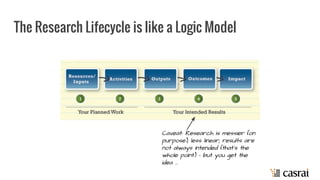
The Research Lifecycle is like a Logic Model
Caveat: Research is messier (on
purpose); less linear; results are
not always intended (that’s the
whole point) - but you get the
idea ...
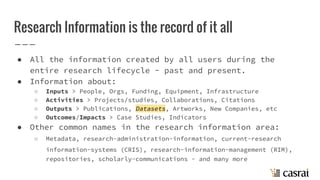
Research Information is the record of it all
● All the information created by all users during the
entire research lifecycle - past and present.
● Information about:
○ Inputs > People, Orgs, Funding, Equipment, Infrastructure
○ Activities > Projects/studies, Collaborations, Citations
○ Outputs > Publications, Datasets, Artworks, New Companies, etc
○ Outcomes/Impacts > Case Studies, Indicators
● Other common names in the research information area:
○ Metadata, research-administration-information, current-research
information-systems (CRIS), research-information-management (RIM),
repositories, scholarly-communications - and many more
What about
Research Data?
Research Data: A Completely Different Ballgame
● Observational: data captured in real-time, usually irreplaceable. For
example, sensor data, survey data, sample data, neurological images.
● Experimental: data from lab equipment, often reproducible, but can be
expensive. For example, gene sequences, chromatograms, toroid magnetic
field data.
● Simulation: data generated from test models where model and metadata are
more important than output data. For example, climate models, economic
models.
● Reference or canonical: a (static or organic) conglomeration or collection
of smaller (peer-reviewed) datasets, most probably published and curated.
For example, gene sequence databanks, chemical structures, or spatial data
portals
http://www.bu.edu/datamanagement/background/whatisdata/
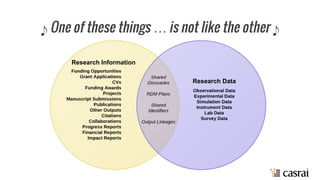
One of these things … is not like the other
Research Information
Research Data
Users,
Requirements,
Pain-points
Who are the USERS? Who are the AGENTS?
● Information Users: the people who know about the
information they can provide and the information they
require throughout the research logic model:
○ Researchers, students, research admins, librarians, finance officers,
funding program officers, stakeholder executives
● Information Agents: the software systems (and the various
technologists who manage them) that
‘store/secure/process/display’ the information for the
Users:
○ Database managers, modellers, programmers, software integrators
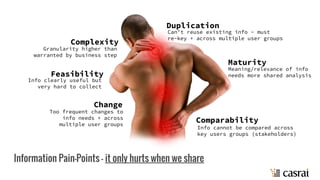
Information Pain-Points - it only hurts when we share
Duplication
Complexity
Change
Feasibility
Maturity
Comparability
Can’t reuse existing info - must
re-key + across multiple user groups
Meaning/relevance of info
needs more shared analysis
Granularity higher than
warranted by business step
Info clearly useful but
very hard to collect
Too frequent changes to
info needs + across
multiple user groups
Info cannot be compared across
key users groups (stakeholders)
Challenge: name an
admin burden NOT
caused by these 6
pain-points
CASRAI is an open
community of users
mastering common
requirements -
together
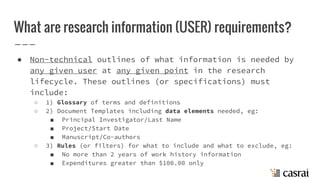
What are research information (USER) requirements?
● Non-technical outlines of what information is needed by
any given user at any given point in the research
lifecycle. These outlines (or specifications) must
include:
○ 1) Glossary of terms and definitions
○ 2) Document Templates including data elements needed, eg:
■ Principal Investigator/Last Name
■ Project/Start Date
■ Manuscript/Co-authors
○ 3) Rules (or filters) for what to include and what to exclude, eg:
■ No more than 2 years of work history information
■ Expenditures greater than $100.00 only
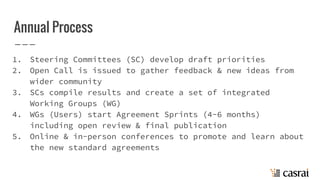
Annual Process
1. Steering Committees (SC) develop draft priorities
2. Open Call is issued to gather feedback & new ideas from
wider community
3. SCs compile results and create a set of integrated
Working Groups (WG)
4. WGs (Users) start Agreement Sprints (4-6 months)
including open review & final publication
5. Online & in-person conferences to promote and learn about
the new standard agreements
Examples
Thanks!
Janet Halliwell
David Baker
info@casrai.org
We hope you will get
involved

Tutorial: CASRAI Standards Development (for a non-technology audience) - David Baker (CASRAI)

  • 1.
    CASRAI Tutorial More research,less paperwork, better information
  • 2.
    Tutorial Agenda ● CASRAIFoundations ○ What is Research Information? ○ Users, Requirements, Pain-points ● CASRAI Approach ○ Glossary Terms ○ Document Templates
  • 3.
  • 4.
    The Research Lifecycleis like a Logic Model Caveat: Research is messier (on purpose); less linear; results are not always intended (that’s the whole point) - but you get the idea ...
  • 5.
    Research Information isthe record of it all ● All the information created by all users during the entire research lifecycle - past and present. ● Information about: ○ Inputs > People, Orgs, Funding, Equipment, Infrastructure ○ Activities > Projects/studies, Collaborations, Citations ○ Outputs > Publications, Datasets, Artworks, New Companies, etc ○ Outcomes/Impacts > Case Studies, Indicators ● Other common names in the research information area: ○ Metadata, research-administration-information, current-research information-systems (CRIS), research-information-management (RIM), repositories, scholarly-communications - and many more
  • 6.
  • 7.
    Research Data: ACompletely Different Ballgame ● Observational: data captured in real-time, usually irreplaceable. For example, sensor data, survey data, sample data, neurological images. ● Experimental: data from lab equipment, often reproducible, but can be expensive. For example, gene sequences, chromatograms, toroid magnetic field data. ● Simulation: data generated from test models where model and metadata are more important than output data. For example, climate models, economic models. ● Reference or canonical: a (static or organic) conglomeration or collection of smaller (peer-reviewed) datasets, most probably published and curated. For example, gene sequence databanks, chemical structures, or spatial data portals http://www.bu.edu/datamanagement/background/whatisdata/
  • 8.
    One of thesethings … is not like the other Research Information Research Data
  • 9.
  • 10.
    Who are theUSERS? Who are the AGENTS? ● Information Users: the people who know about the information they can provide and the information they require throughout the research logic model: ○ Researchers, students, research admins, librarians, finance officers, funding program officers, stakeholder executives ● Information Agents: the software systems (and the various technologists who manage them) that ‘store/secure/process/display’ the information for the Users: ○ Database managers, modellers, programmers, software integrators
  • 11.
    Information Pain-Points -it only hurts when we share Duplication Complexity Change Feasibility Maturity Comparability Can’t reuse existing info - must re-key + across multiple user groups Meaning/relevance of info needs more shared analysis Granularity higher than warranted by business step Info clearly useful but very hard to collect Too frequent changes to info needs + across multiple user groups Info cannot be compared across key users groups (stakeholders)
  • 12.
    Challenge: name an adminburden NOT caused by these 6 pain-points
  • 13.
    CASRAI is anopen community of users mastering common requirements - together
  • 14.
    What are researchinformation (USER) requirements? ● Non-technical outlines of what information is needed by any given user at any given point in the research lifecycle. These outlines (or specifications) must include: ○ 1) Glossary of terms and definitions ○ 2) Document Templates including data elements needed, eg: ■ Principal Investigator/Last Name ■ Project/Start Date ■ Manuscript/Co-authors ○ 3) Rules (or filters) for what to include and what to exclude, eg: ■ No more than 2 years of work history information ■ Expenditures greater than $100.00 only
  • 15.
    Annual Process 1. SteeringCommittees (SC) develop draft priorities 2. Open Call is issued to gather feedback & new ideas from wider community 3. SCs compile results and create a set of integrated Working Groups (WG) 4. WGs (Users) start Agreement Sprints (4-6 months) including open review & final publication 5. Online & in-person conferences to promote and learn about the new standard agreements
  • 16.
  • 17.