www.cranfield.ac.uk
Mapping the
Information Needs of
Researchers and
Research Students
Mandy Smith
Research Support Coordinator
Overview of presentation
• Cranfield University: an introduction
• Research Support Master Group
• Findings: researchers
• Findings: research students
• Outcomes of the project
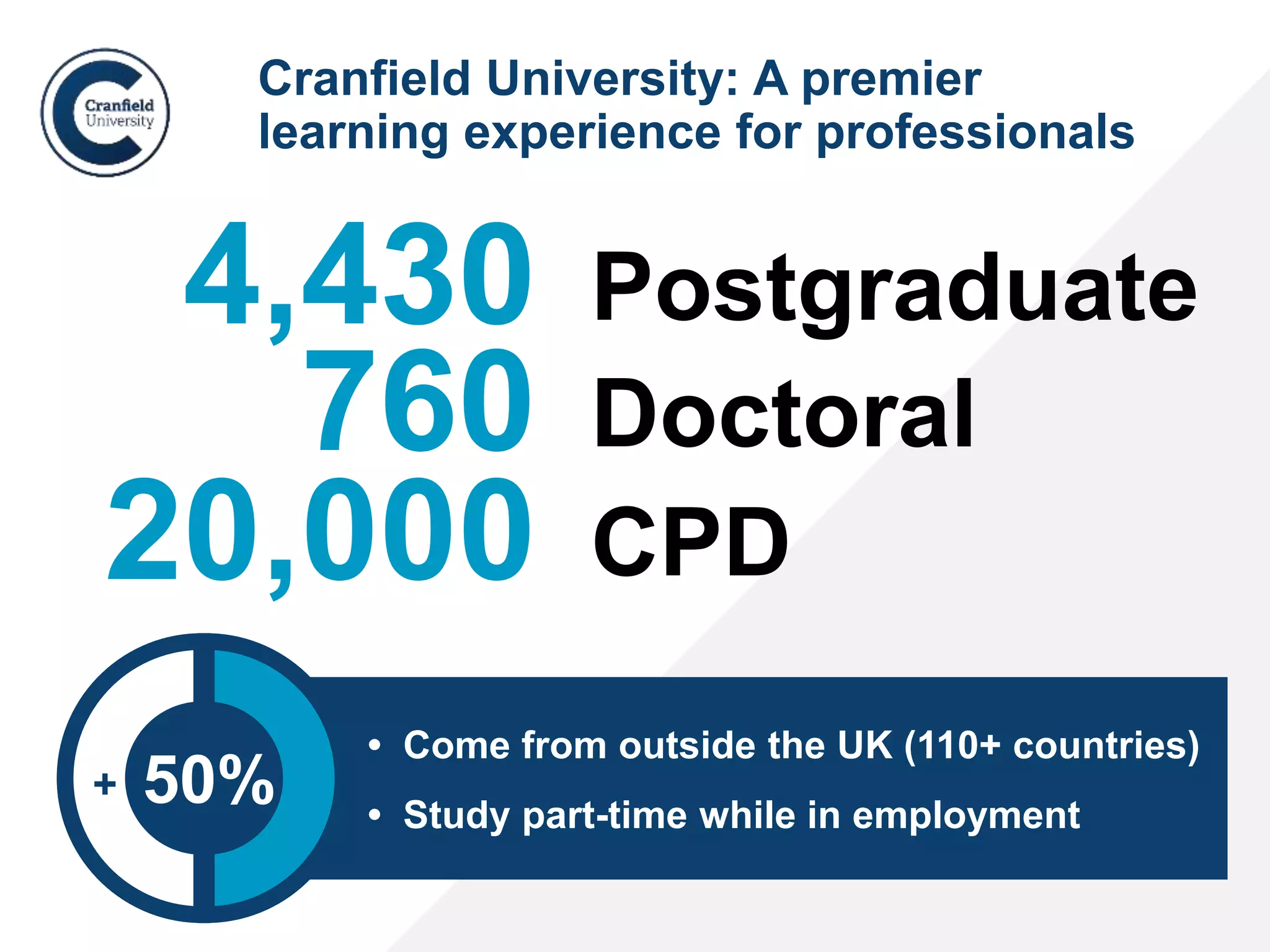
Cranfield University: A premier
learning experience for professionals
• Come from outside the UK (110+ countries)
• Study part-time while in employment
20,000 CPD
760 Doctoral
4,430 Postgraduate
+ 50%
Cranfield Defence
and Security
Academic Provider to the MOD
through the Defence Academy of
the UK
Strategic relationships with
DSTL, AWE & BAE Systems
Leading contributor to Defence
and Human Capability Science &
Technology Centre
Urgent operational requirements
to support MOD and UK armed
forces
Security sector reform through
FCO, MOD, DFID and
international governments
Defence & Security Short Film
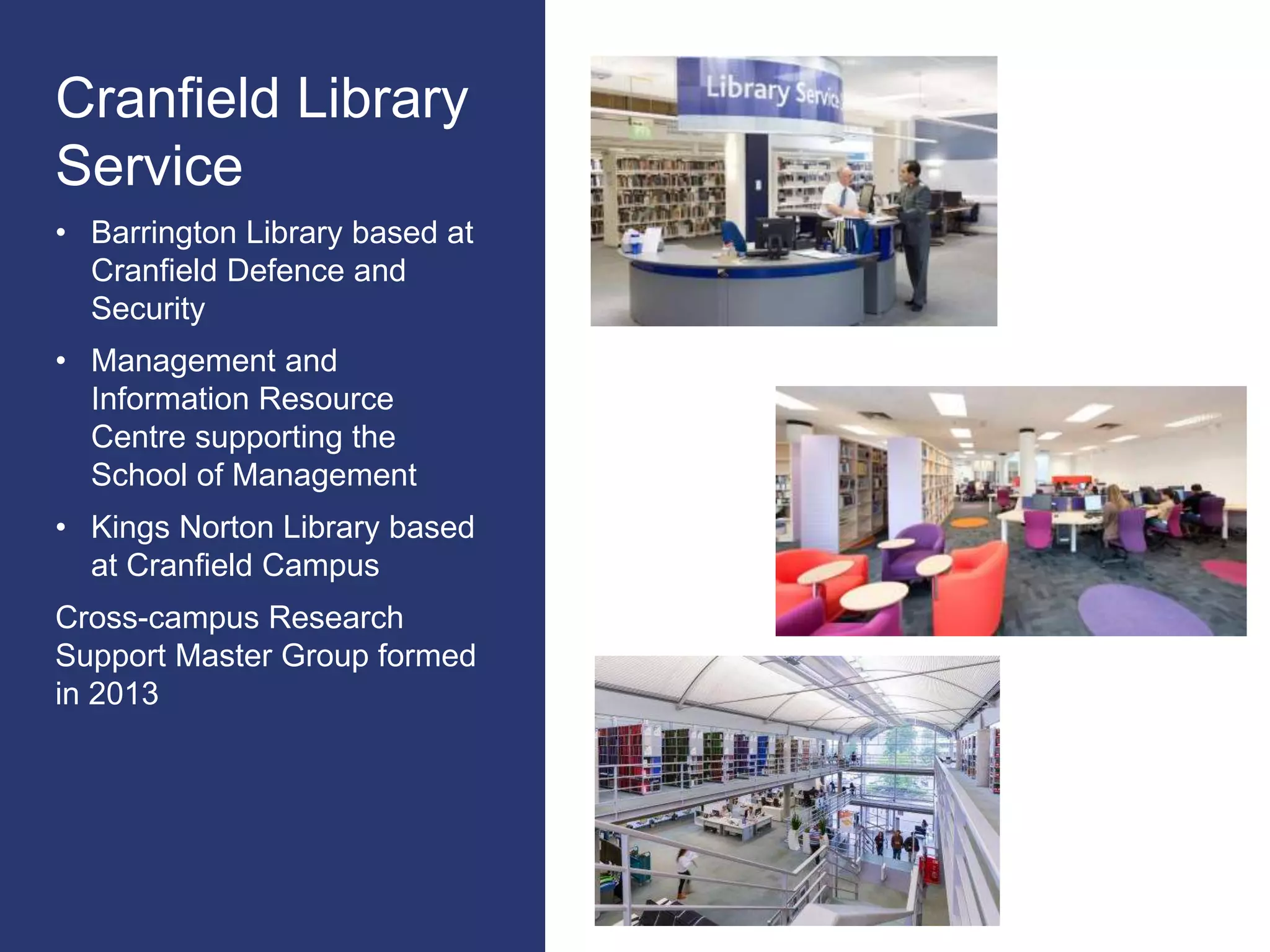
Cranfield Library
Service
• Barrington Library based at
Cranfield Defence and
Security
• Management and
Information Resource
Centre supporting the
School of Management
• Kings Norton Library based
at Cranfield Campus
Cross-campus Research
Support Master Group formed
in 2013
Mapping the
needs of
researchers and
research students
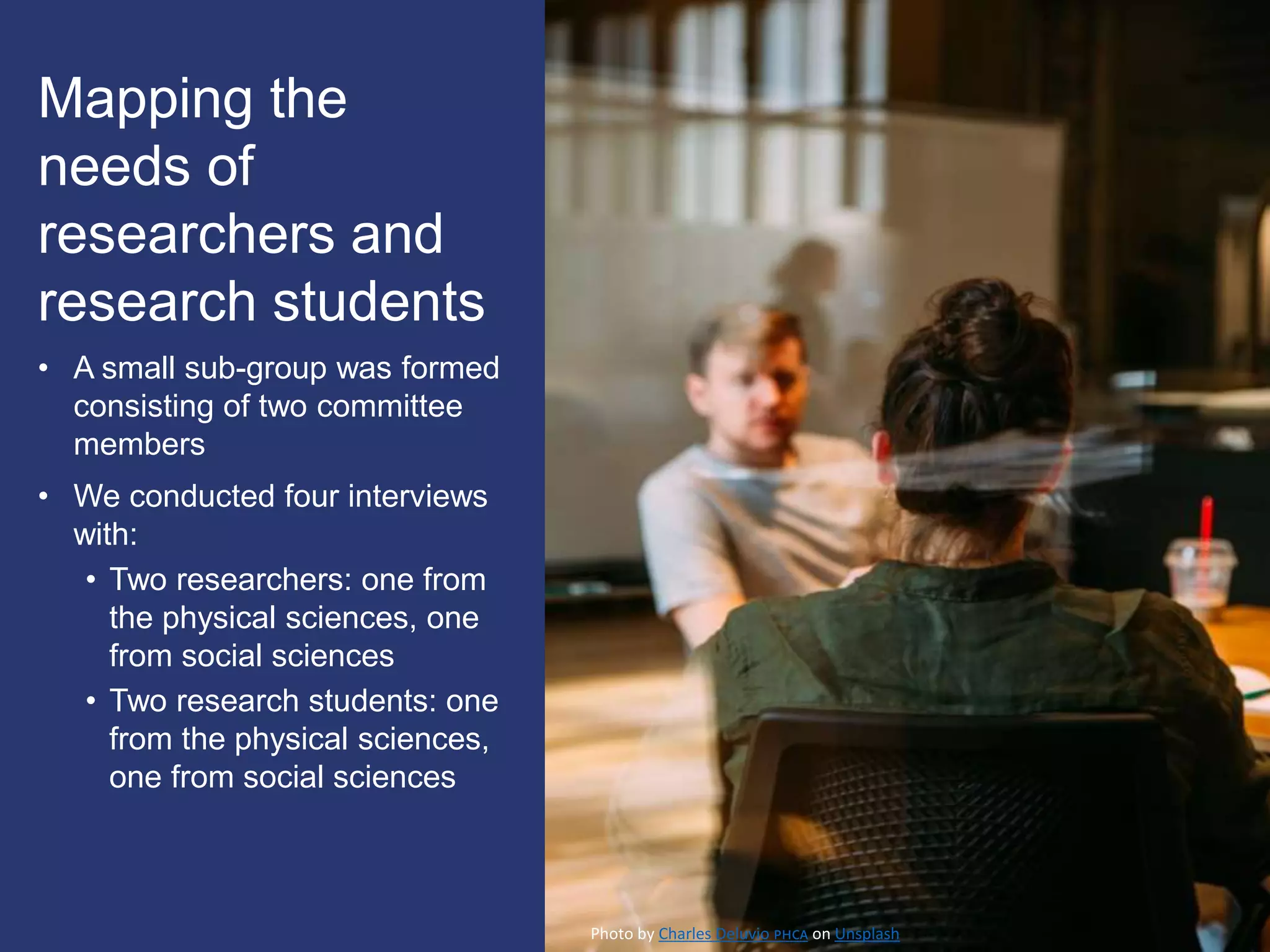
• A small sub-group was formed
consisting of two committee
members
• We conducted four interviews
with:
• Two researchers: one from
the physical sciences, one
from social sciences
• Two research students: one
from the physical sciences,
one from social sciences
Photo by Charles Deluvio 🇵🇭🇨🇦 on Unsplash
Findings:
researchers
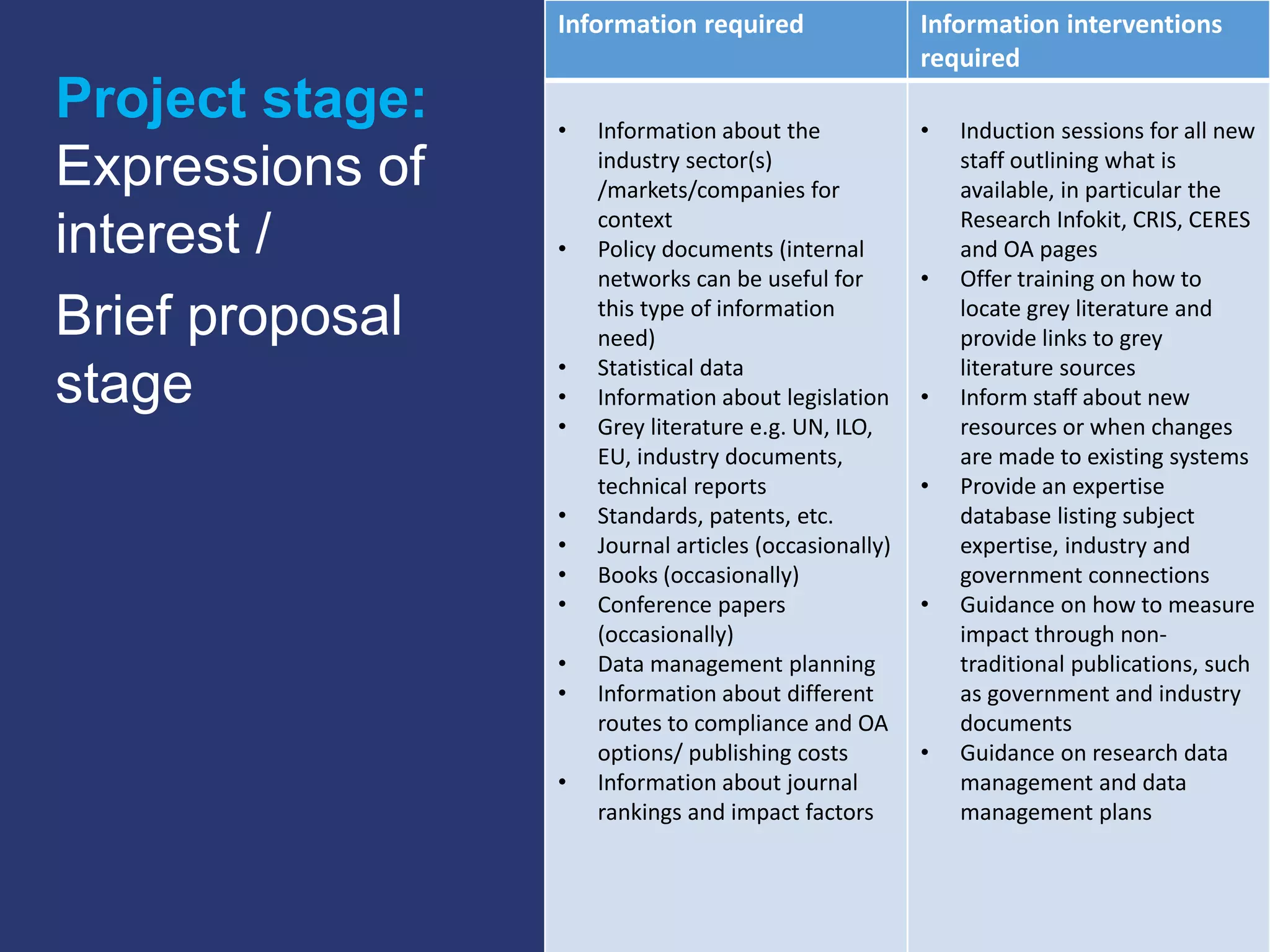
Information required Information interventions
required
• Information about the
industry sector(s)
/markets/companies for
context
• Policy documents (internal
networks can be useful for
this type of information
need)
• Statistical data
• Information about legislation
• Grey literature e.g. UN, ILO,
EU, industry documents,
technical reports
• Standards, patents, etc.
• Journal articles (occasionally)
• Books (occasionally)
• Conference papers
(occasionally)
• Data management planning
• Information about different
routes to compliance and OA
options/ publishing costs
• Information about journal
rankings and impact factors
• Induction sessions for all new
staff outlining what is
available, in particular the
Research Infokit, CRIS, CERES
and OA pages
• Offer training on how to
locate grey literature and
provide links to grey
literature sources
• Inform staff about new
resources or when changes
are made to existing systems
• Provide an expertise
database listing subject
expertise, industry and
government connections
• Guidance on how to measure
impact through non-
traditional publications, such
as government and industry
documents
• Guidance on research data
management and data
management plans
Project stage:
Expressions of
interest /
Brief proposal
stage
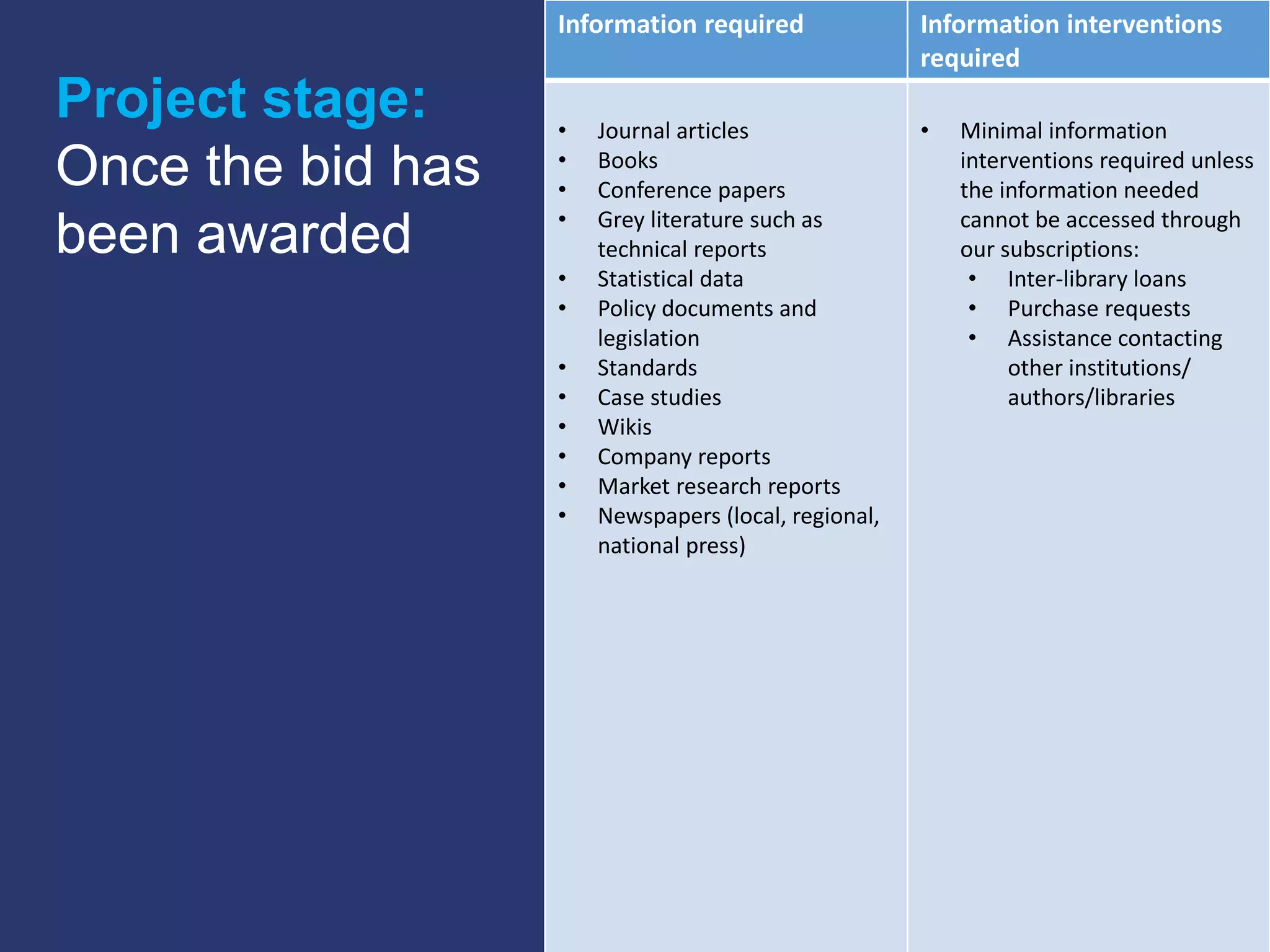
Information required Information interventions
required
• Journal articles
• Books
• Conference papers
• Grey literature such as
technical reports
• Statistical data
• Policy documents and
legislation
• Standards
• Case studies
• Wikis
• Company reports
• Market research reports
• Newspapers (local, regional,
national press)
• Minimal information
interventions required unless
the information needed
cannot be accessed through
our subscriptions:
• Inter-library loans
• Purchase requests
• Assistance contacting
other institutions/
authors/libraries
Project stage:
Once the bid has
been awarded
Information required Information interventions
required
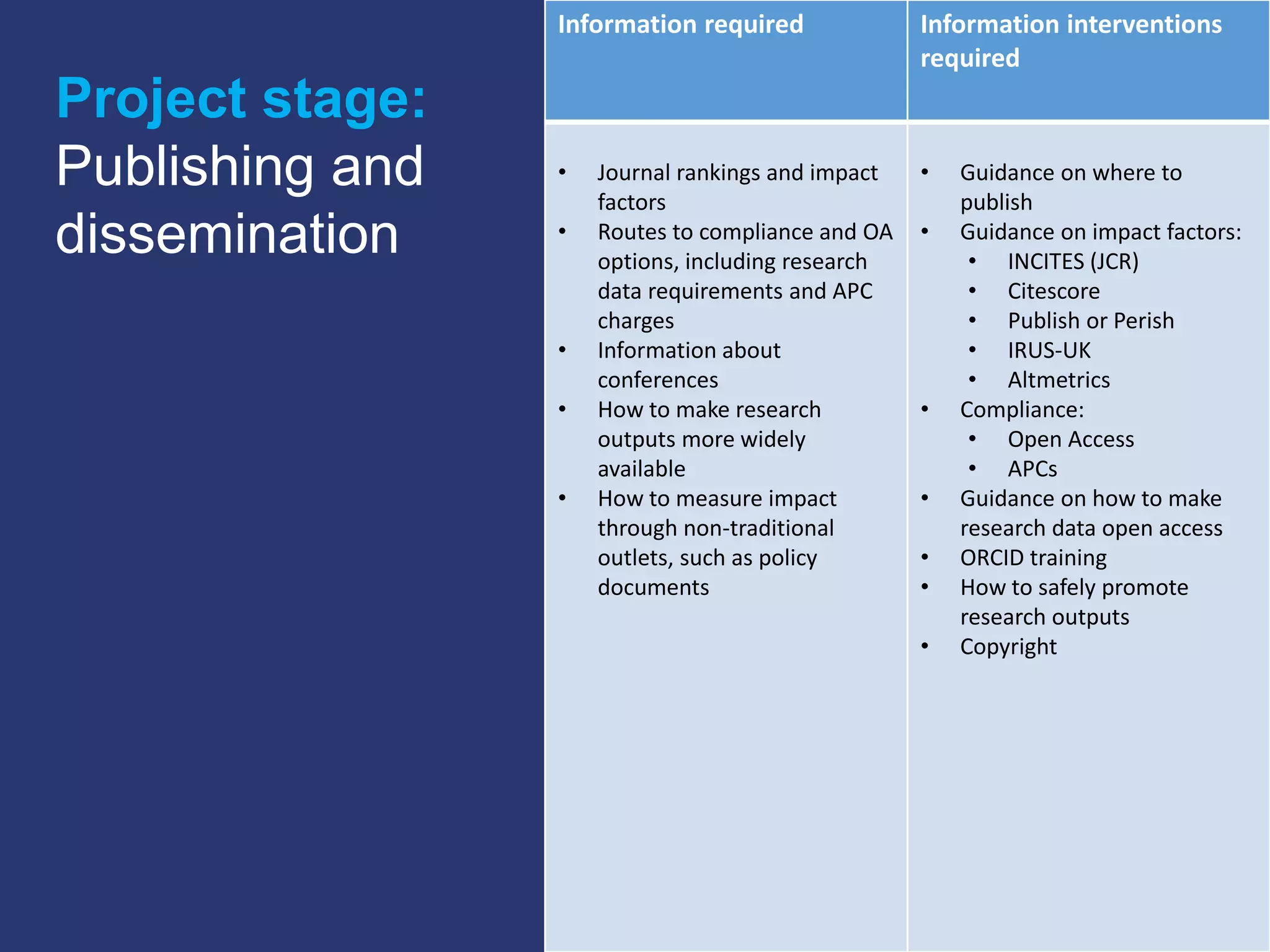
• Journal rankings and impact
factors
• Routes to compliance and OA
options, including research
data requirements and APC
charges
• Information about
conferences
• How to make research
outputs more widely
available
• How to measure impact
through non-traditional
outlets, such as policy
documents
• Guidance on where to
publish
• Guidance on impact factors:
• INCITES (JCR)
• Citescore
• Publish or Perish
• IRUS-UK
• Altmetrics
• Compliance:
• Open Access
• APCs
• Guidance on how to make
research data open access
• ORCID training
• How to safely promote
research outputs
• Copyright
Project stage:
Publishing and
dissemination
Findings:
research
students
Information required Information interventions
required
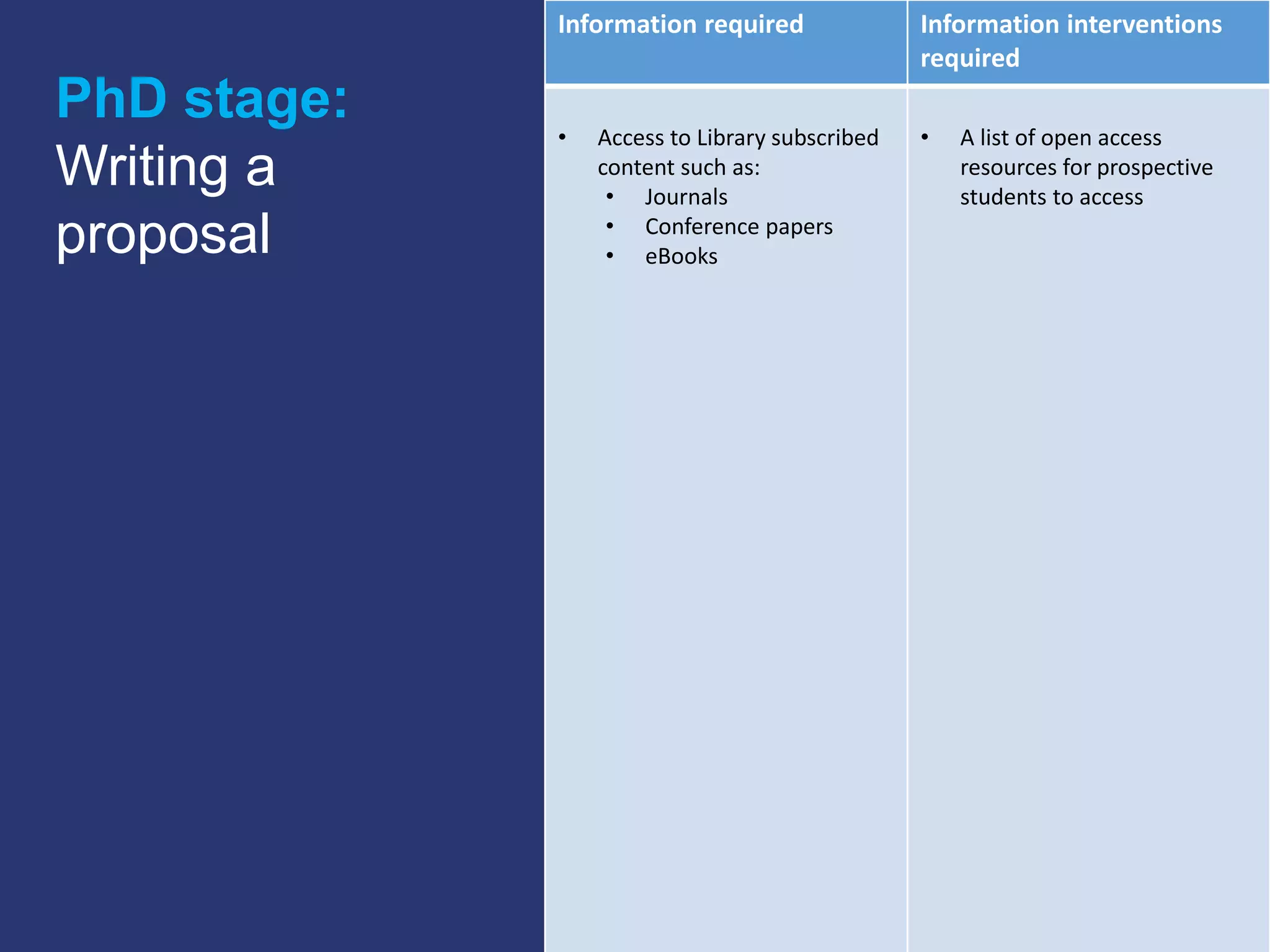
• Access to Library subscribed
content such as:
• Journals
• Conference papers
• eBooks
• A list of open access
resources for prospective
students to access
PhD stage:
Writing a
proposal
Information required Information interventions
required
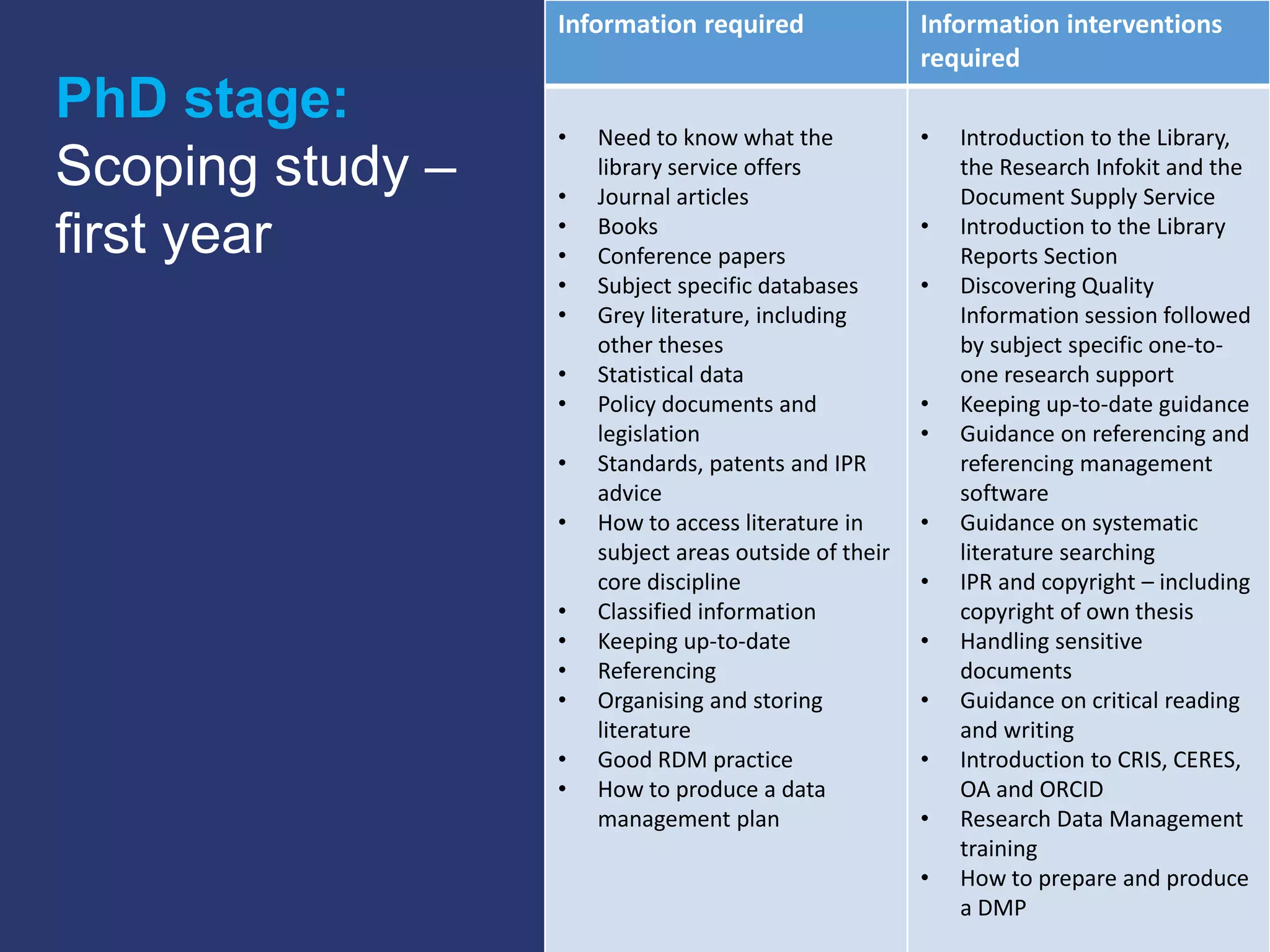
• Need to know what the
library service offers
• Journal articles
• Books
• Conference papers
• Subject specific databases
• Grey literature, including
other theses
• Statistical data
• Policy documents and
legislation
• Standards, patents and IPR
advice
• How to access literature in
subject areas outside of their
core discipline
• Classified information
• Keeping up-to-date
• Referencing
• Organising and storing
literature
• Good RDM practice
• How to produce a data
management plan
• Introduction to the Library,
the Research Infokit and the
Document Supply Service
• Introduction to the Library
Reports Section
• Discovering Quality
Information session followed
by subject specific one-to-
one research support
• Keeping up-to-date guidance
• Guidance on referencing and
referencing management
software
• Guidance on systematic
literature searching
• IPR and copyright – including
copyright of own thesis
• Handling sensitive
documents
• Guidance on critical reading
and writing
• Introduction to CRIS, CERES,
OA and ORCID
• Research Data Management
training
• How to prepare and produce
a DMP
PhD stage:
Scoping study –
first year
Information required Information interventions
required
• Journal articles
• Books, e.g. research methods
• Conference papers
• Grey literature
• Statistical data
• Research data, e.g. UK Data
Archive
• Policy documents and
legislation
• Subject specific databases
• Standards and patents
• Papers and reports from the
Reports Section – including
sensitive material
• How and where to publish
• How to disseminate work
and make an impact
• Continued research support
from IS through one-to-one
sessions
• Literature review writing
guidance
• Acquisition of niche subject-
specific resources
• Guidance on impact factors
and where to publish
• CRIS, CERES, RDM, CORD and
OA (ongoing)
PhD stage:
Second year
Information required Information interventions
required
• How to keep literature
review up-to-date
• Company information
• Market research or sector
information
• Financial information
• Economic information
• Statistical data
• Journals, indexes, conference
papers, books, technical
reports, standards, etc.
• Papers and reports from the
Reports Section – including
sensitive material
• Inter-Library Loans
• How and where to publish
• How to disseminate work
and make an impact
• More one-to-one support
depending on the student
and the type of information
required
• Information on how to
publish post-thesis
publication
• Storage of research data
(licences, etc.)
PhD stage:
Third year
Outcomes of the
project
Questions?

Mandy Smith (Cranfield University) - “Mapping the information needs of researchers and research students”

  • 1.
    www.cranfield.ac.uk Mapping the Information Needsof Researchers and Research Students Mandy Smith Research Support Coordinator
  • 2.
    Overview of presentation •Cranfield University: an introduction • Research Support Master Group • Findings: researchers • Findings: research students • Outcomes of the project
  • 3.
    Cranfield University: Apremier learning experience for professionals • Come from outside the UK (110+ countries) • Study part-time while in employment 20,000 CPD 760 Doctoral 4,430 Postgraduate + 50%
  • 4.
    Cranfield Defence and Security AcademicProvider to the MOD through the Defence Academy of the UK Strategic relationships with DSTL, AWE & BAE Systems Leading contributor to Defence and Human Capability Science & Technology Centre Urgent operational requirements to support MOD and UK armed forces Security sector reform through FCO, MOD, DFID and international governments Defence & Security Short Film
  • 5.
    Cranfield Library Service • BarringtonLibrary based at Cranfield Defence and Security • Management and Information Resource Centre supporting the School of Management • Kings Norton Library based at Cranfield Campus Cross-campus Research Support Master Group formed in 2013
  • 6.
    Mapping the needs of researchersand research students • A small sub-group was formed consisting of two committee members • We conducted four interviews with: • Two researchers: one from the physical sciences, one from social sciences • Two research students: one from the physical sciences, one from social sciences Photo by Charles Deluvio 🇵🇭🇨🇦 on Unsplash
  • 7.
  • 8.
    Information required Informationinterventions required • Information about the industry sector(s) /markets/companies for context • Policy documents (internal networks can be useful for this type of information need) • Statistical data • Information about legislation • Grey literature e.g. UN, ILO, EU, industry documents, technical reports • Standards, patents, etc. • Journal articles (occasionally) • Books (occasionally) • Conference papers (occasionally) • Data management planning • Information about different routes to compliance and OA options/ publishing costs • Information about journal rankings and impact factors • Induction sessions for all new staff outlining what is available, in particular the Research Infokit, CRIS, CERES and OA pages • Offer training on how to locate grey literature and provide links to grey literature sources • Inform staff about new resources or when changes are made to existing systems • Provide an expertise database listing subject expertise, industry and government connections • Guidance on how to measure impact through non- traditional publications, such as government and industry documents • Guidance on research data management and data management plans Project stage: Expressions of interest / Brief proposal stage
  • 9.
    Information required Informationinterventions required • Journal articles • Books • Conference papers • Grey literature such as technical reports • Statistical data • Policy documents and legislation • Standards • Case studies • Wikis • Company reports • Market research reports • Newspapers (local, regional, national press) • Minimal information interventions required unless the information needed cannot be accessed through our subscriptions: • Inter-library loans • Purchase requests • Assistance contacting other institutions/ authors/libraries Project stage: Once the bid has been awarded
  • 10.
    Information required Informationinterventions required • Journal rankings and impact factors • Routes to compliance and OA options, including research data requirements and APC charges • Information about conferences • How to make research outputs more widely available • How to measure impact through non-traditional outlets, such as policy documents • Guidance on where to publish • Guidance on impact factors: • INCITES (JCR) • Citescore • Publish or Perish • IRUS-UK • Altmetrics • Compliance: • Open Access • APCs • Guidance on how to make research data open access • ORCID training • How to safely promote research outputs • Copyright Project stage: Publishing and dissemination
  • 11.
  • 12.
    Information required Informationinterventions required • Access to Library subscribed content such as: • Journals • Conference papers • eBooks • A list of open access resources for prospective students to access PhD stage: Writing a proposal
  • 13.
    Information required Informationinterventions required • Need to know what the library service offers • Journal articles • Books • Conference papers • Subject specific databases • Grey literature, including other theses • Statistical data • Policy documents and legislation • Standards, patents and IPR advice • How to access literature in subject areas outside of their core discipline • Classified information • Keeping up-to-date • Referencing • Organising and storing literature • Good RDM practice • How to produce a data management plan • Introduction to the Library, the Research Infokit and the Document Supply Service • Introduction to the Library Reports Section • Discovering Quality Information session followed by subject specific one-to- one research support • Keeping up-to-date guidance • Guidance on referencing and referencing management software • Guidance on systematic literature searching • IPR and copyright – including copyright of own thesis • Handling sensitive documents • Guidance on critical reading and writing • Introduction to CRIS, CERES, OA and ORCID • Research Data Management training • How to prepare and produce a DMP PhD stage: Scoping study – first year
  • 14.
    Information required Informationinterventions required • Journal articles • Books, e.g. research methods • Conference papers • Grey literature • Statistical data • Research data, e.g. UK Data Archive • Policy documents and legislation • Subject specific databases • Standards and patents • Papers and reports from the Reports Section – including sensitive material • How and where to publish • How to disseminate work and make an impact • Continued research support from IS through one-to-one sessions • Literature review writing guidance • Acquisition of niche subject- specific resources • Guidance on impact factors and where to publish • CRIS, CERES, RDM, CORD and OA (ongoing) PhD stage: Second year
  • 15.
    Information required Informationinterventions required • How to keep literature review up-to-date • Company information • Market research or sector information • Financial information • Economic information • Statistical data • Journals, indexes, conference papers, books, technical reports, standards, etc. • Papers and reports from the Reports Section – including sensitive material • Inter-Library Loans • How and where to publish • How to disseminate work and make an impact • More one-to-one support depending on the student and the type of information required • Information on how to publish post-thesis publication • Storage of research data (licences, etc.) PhD stage: Third year
  • 16.
  • 17.