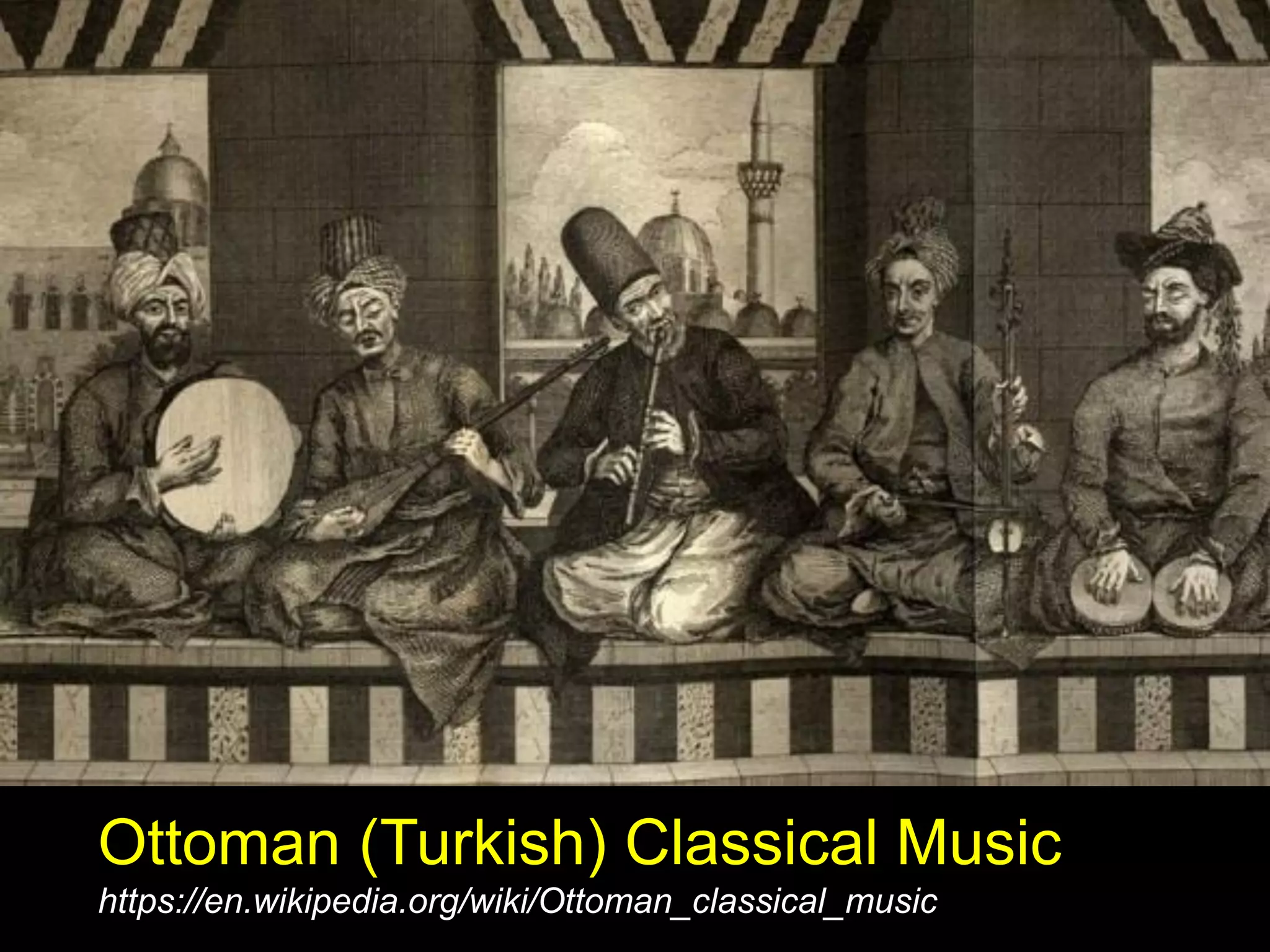
Ottoman (Turkish) Classical Music
https://en.wikipedia.org/wiki/Ottoman_classical_music
https://kylielefkowitz.com/world-history-timeline-map.html
Ottoman Empire (1860-1923): The empire was created by Turkish tribes in
Anatolia (Asia Minor) that grew to be one of the most powerful states in the world
during the 15th and 16th centuries. The Ottoman period spanned more than 600
years and came to an end only in 1923, when it was replaced by the Turkish
Republic and various successor states in southeastern Europe and the Middle East.
https://www.britannica.com/place/Ottoman-Empire (Written By: Malcolm Edward Yapp &Stanford Jay Shaw
Last Updated: Nov 27, 2018 )
Turkey is a nation straddling eastern Europe and western Asia with cultural connections to
ancient Greek, Persian, Roman, Byzantine and Ottoman empires. Cosmopolitan Istanbul, on
the Bosphorus Strait, is home to the iconic Hagia Sophia, with its soaring dome and Christian
mosaics, the massive 17th-century Blue Mosque and the circa-1460 Topkapı Palace, former
home of sultans. Ankara is Turkey’s modern capital. https://en.wikipedia.org/wiki/Turkey
Flag of Turkey
A brief introduction of Republic of Turkey
Official language: Turkish
Spoken languages: Turkish, Kurmanji, Arabic,
Zaza, Kabardian and others
Capital: Ankara (largest city: Istanbul)
Currency: Turkish Lira (TRY)
Population: 80,810,525 (2017) - 19th
Ethnic groups: Turks, Kurds, Arabs, Laz & others
Religion: Islam (99.8%), (Sunni 80.5%; Shia 16.5%)
Declaration of Republic on 29 October 1923
The Republic of Turkey has no official national emblem, but the star
and crescent design from the national flag is in use as de facto emblem,
among other things printed on Turkish passports, on Turkish identity
cards and diplomatic missions of Turkey. Wikipedia
Sultan Ahmet Mosque in Istanbul, Turkey
1 Turkish lira = 6.20 Thai Baht
Tulip or Tulipa, derived from the Turkish word tulbend or turban,
which the flower resembles, is the national flower of Turkey.
Gray Wolf: The National Animal of Turkey
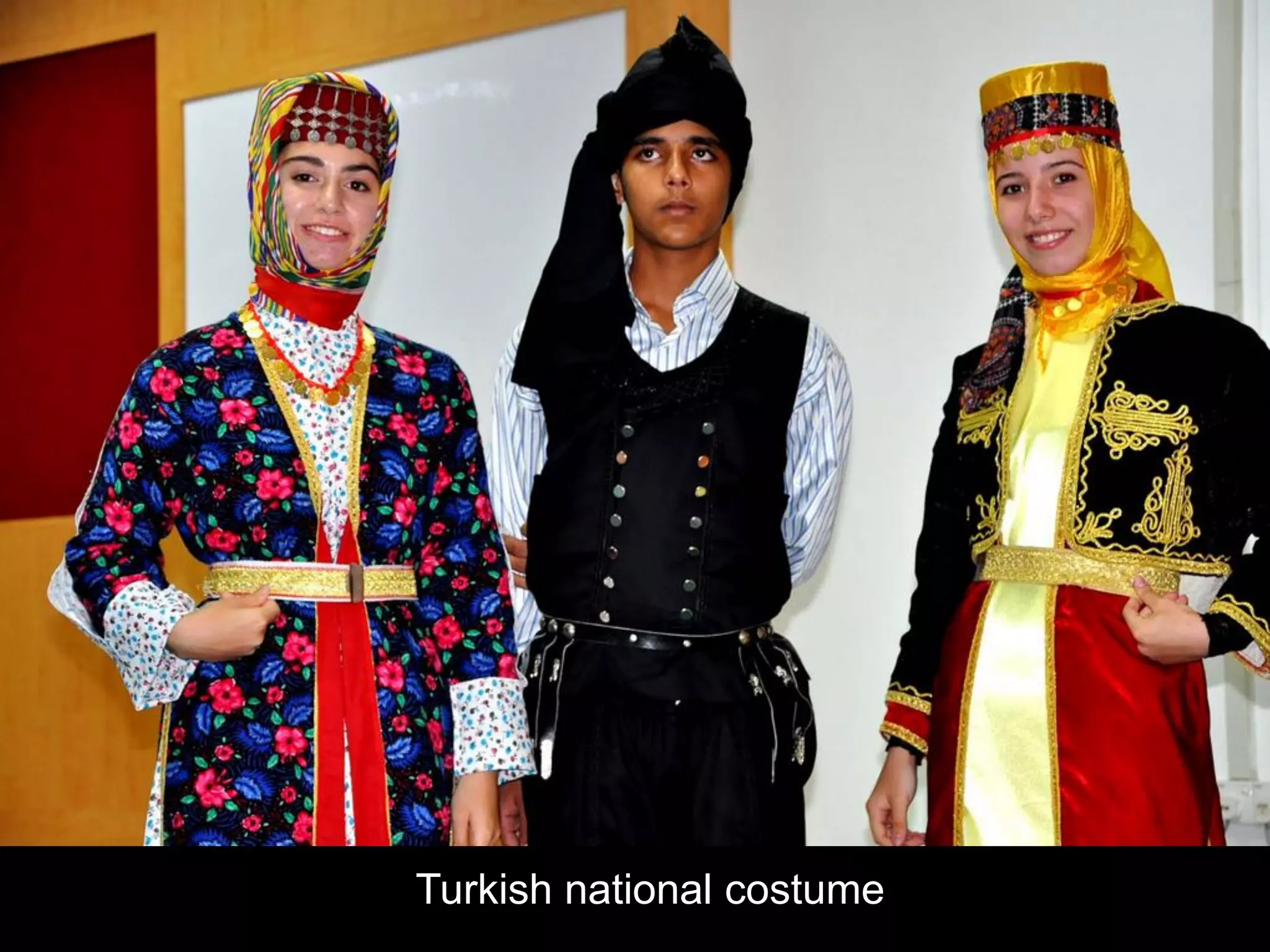
Turkish national costume
Classical Turkish music sometimes known as Ottoman
classical music, developed in Istanbul and other major
Ottoman cities and towns through the palaces and Sufi
lodges of the Ottoman Empire. Above all a vocal music,
Ottoman music traditionally accompanies a solo singer
with a small instrumental ensemble. In recent times,
instruments might include tambur (lute), ney (flute),
kemençe (fiddle), keman (Western violin), kanun (zither),
or other instruments. Sometimes described as
monophonic music, the variety of ornamentation and
variation in the ensemble requires the more accurate
term heterophonic.
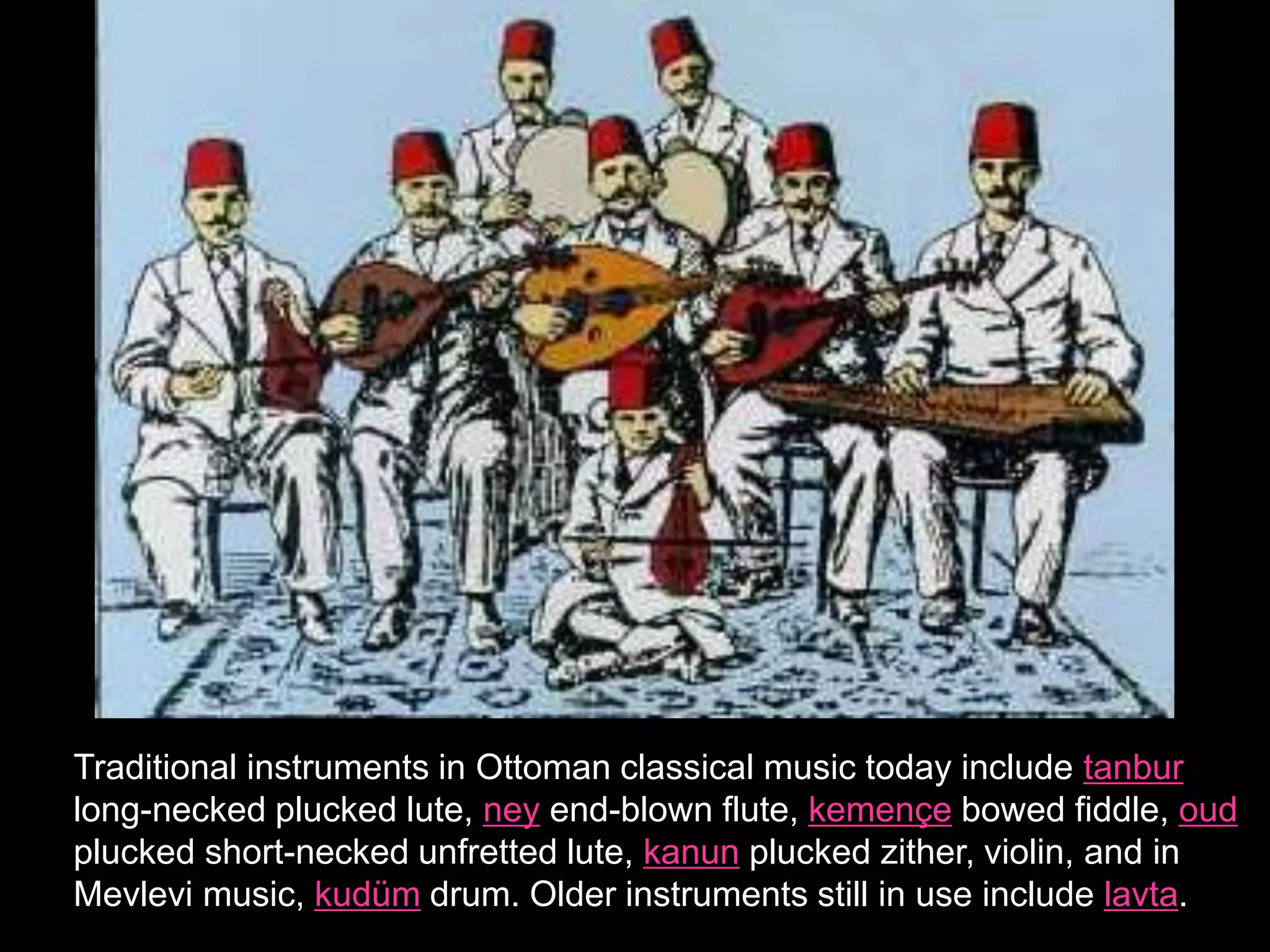
Traditional instruments in Ottoman classical music today include tanbur
long-necked plucked lute, ney end-blown flute, kemençe bowed fiddle, oud
plucked short-necked unfretted lute, kanun plucked zither, violin, and in
Mevlevi music, kudüm drum. Older instruments still in use include lavta.
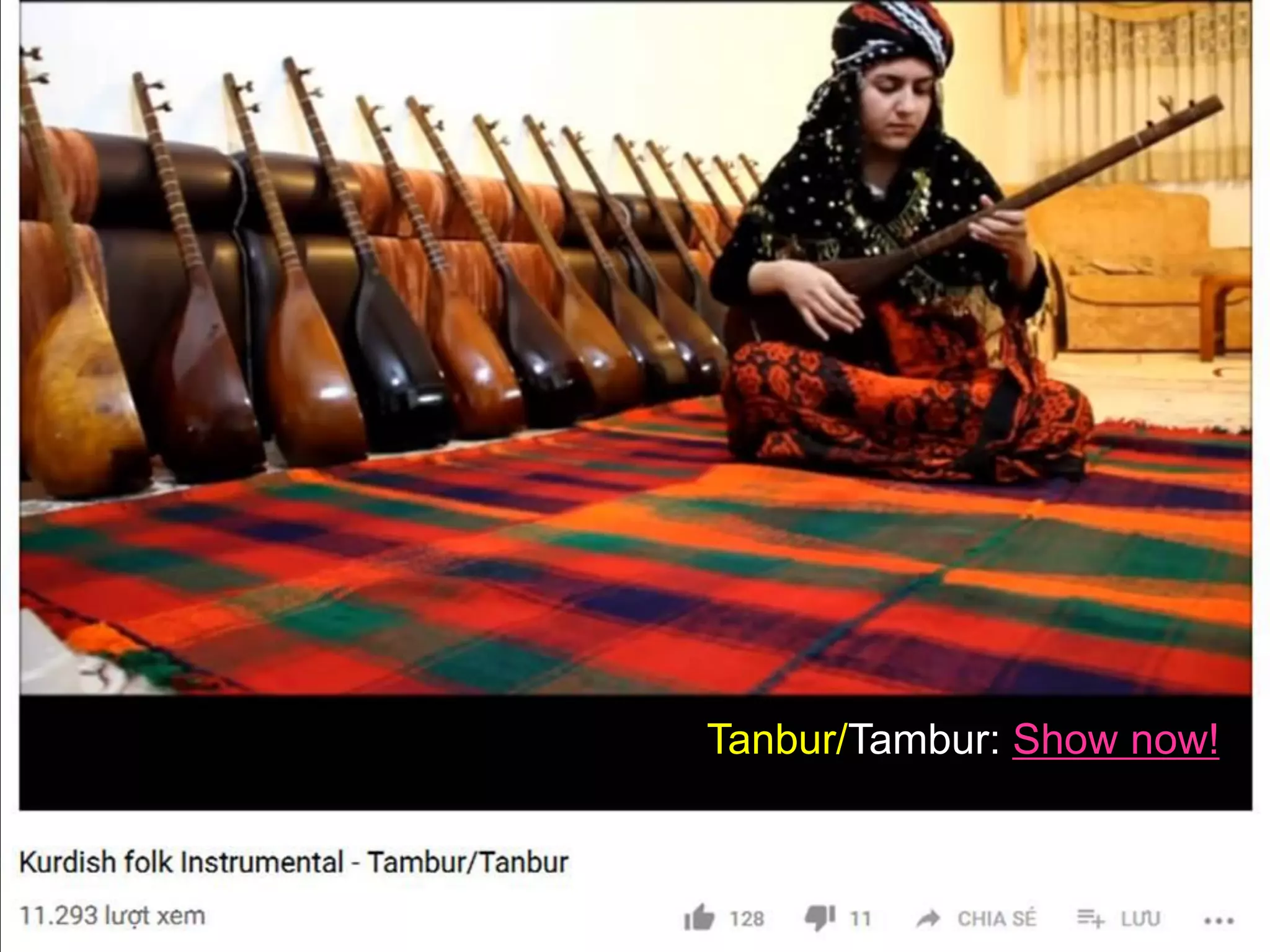
The Tanbur/Tambur, long-necked plucked lute, is a fretted
string instrument of Turkey and the former lands of the
Ottoman Empire. Show now!
Tanbur/Tambur: Show now!
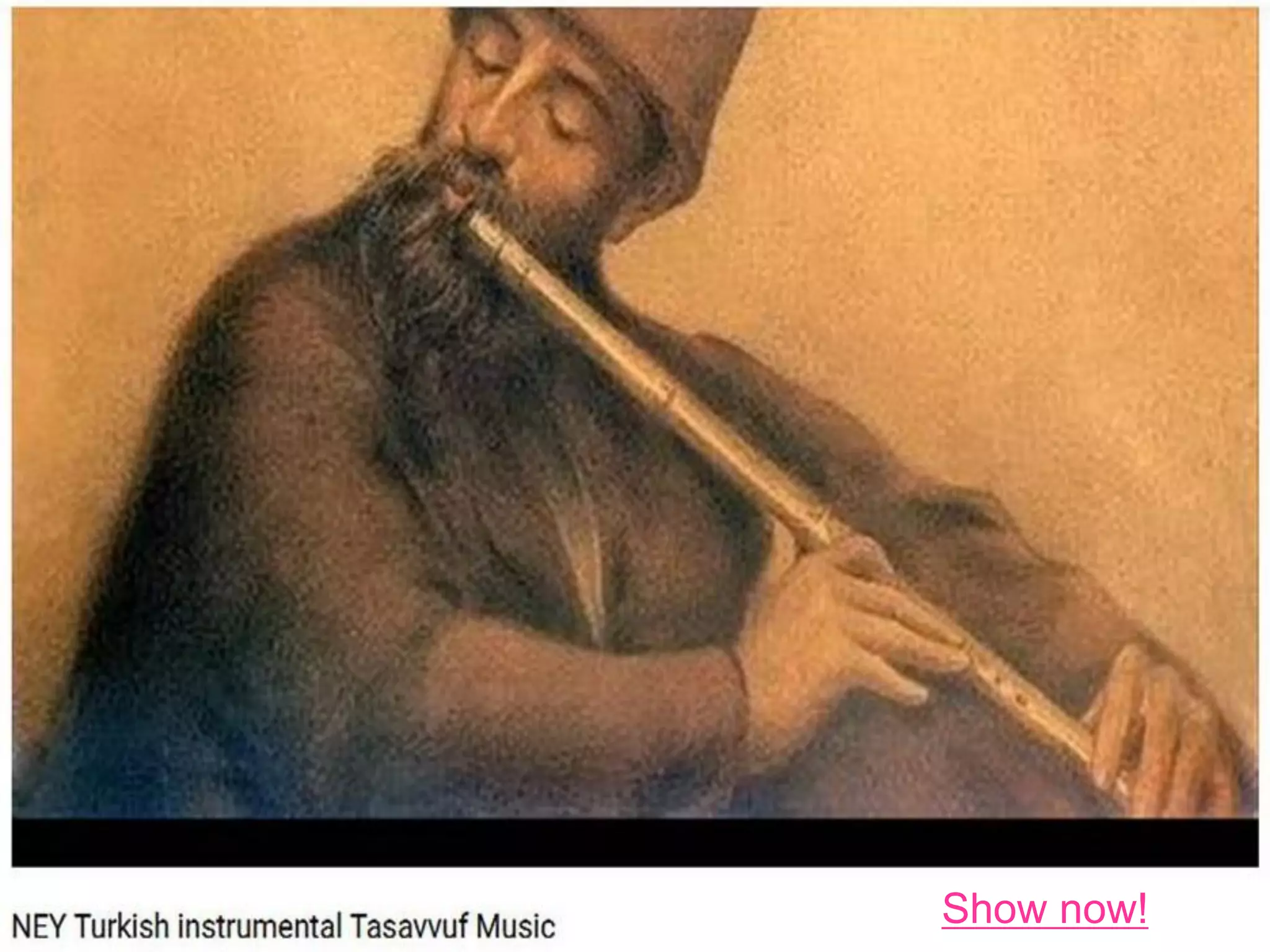
The ney is an end-blown flute, that figures prominently in
Middle Eastern music. In some of these musical traditions,
it is the only wind instrument used. The ney has been played
continuously for 4,500–5,000 years, making it one of the oldest
musical instruments still in use.
Show now!
Kemenche or kemençe is a name used for various types of
stringed bowed musical instruments having their origin in the
Eastern Mediterranean, particularly in Greece, Iran, Turkey,
Armenia, and regions adjacent to the Black Sea.
Tanbur/Tambur: Show now!
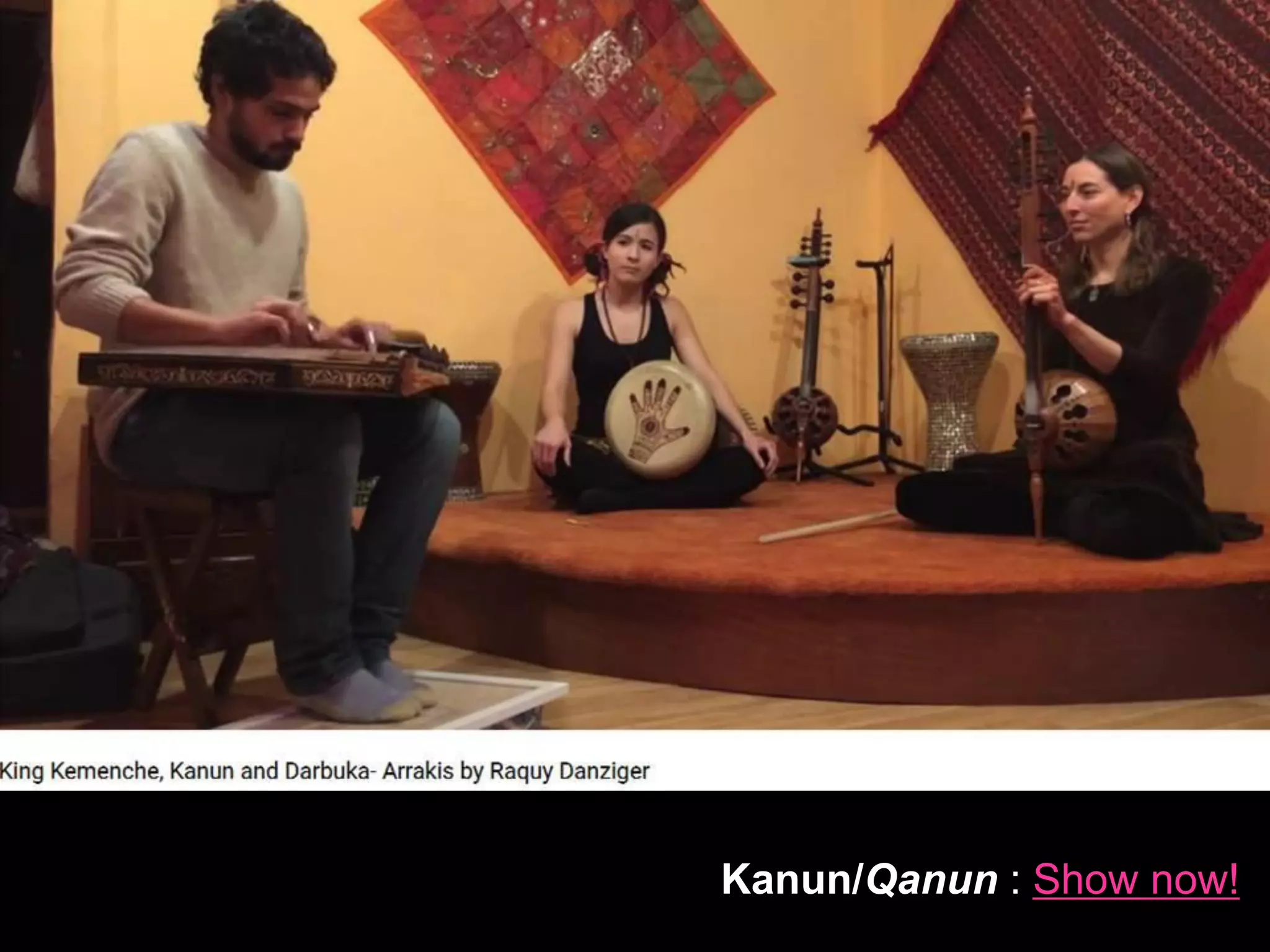
Kanun/Qanun: plucked zither, is a string instrument played
either solo, or more often as part of an ensemble, in much of
the Middle East, Maghreb, West Africa, Central Asia, and
southeastern regions of Europe.
Kanun/Qanun : Show now!
The violin, also known informally as a fiddle, is a wooden
string instrument in the violin family. Most violins have a
hollow wooden body. It is the smallest and highest-pitched
instrument in the family in regular use. Wikipedia
Violin: Show now!
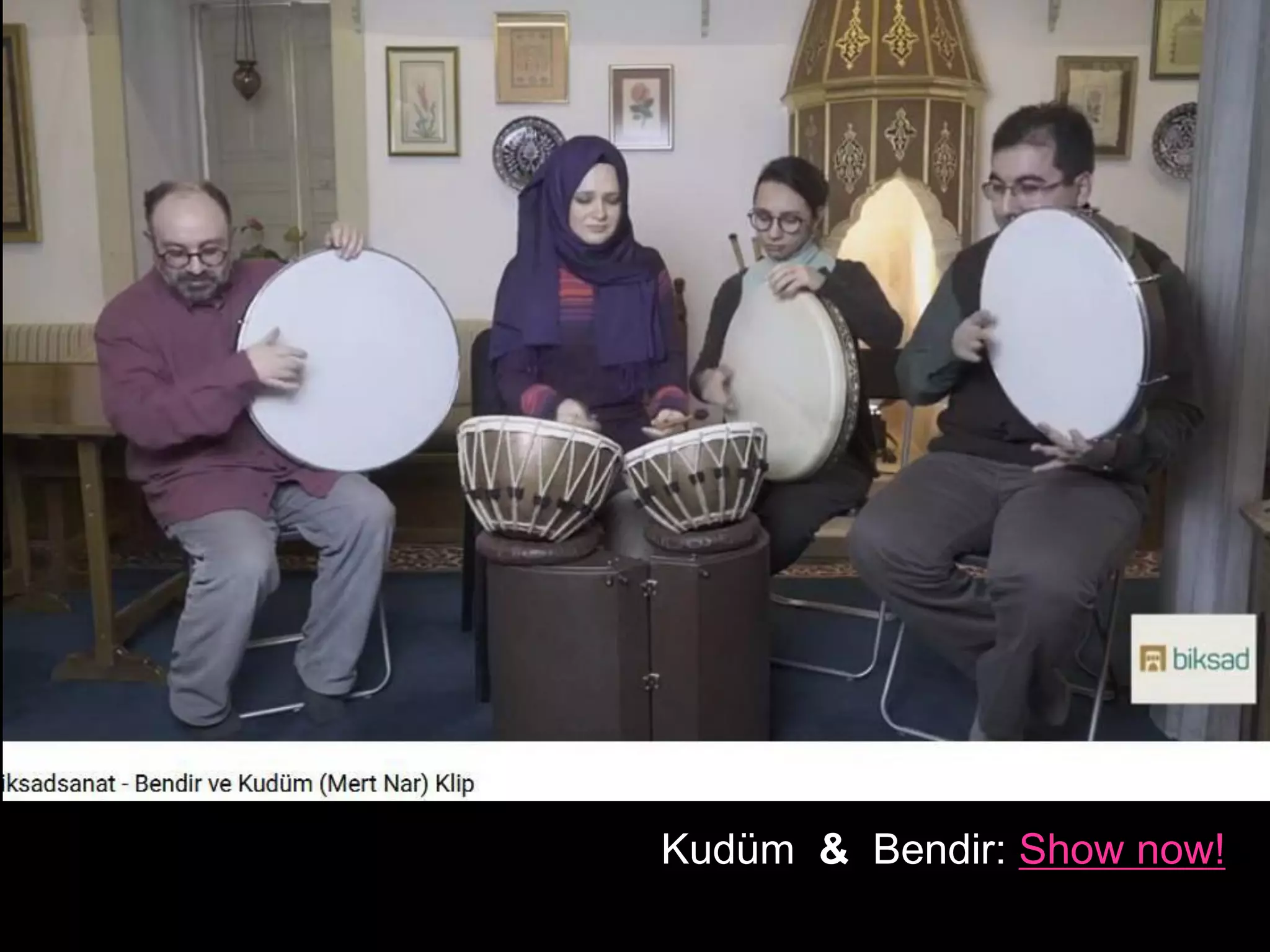
Kudüm is one of the most fundamental rhythm
instruments in classical Turkish (Mevlevi) music.
The person playing it is called kudümzen.
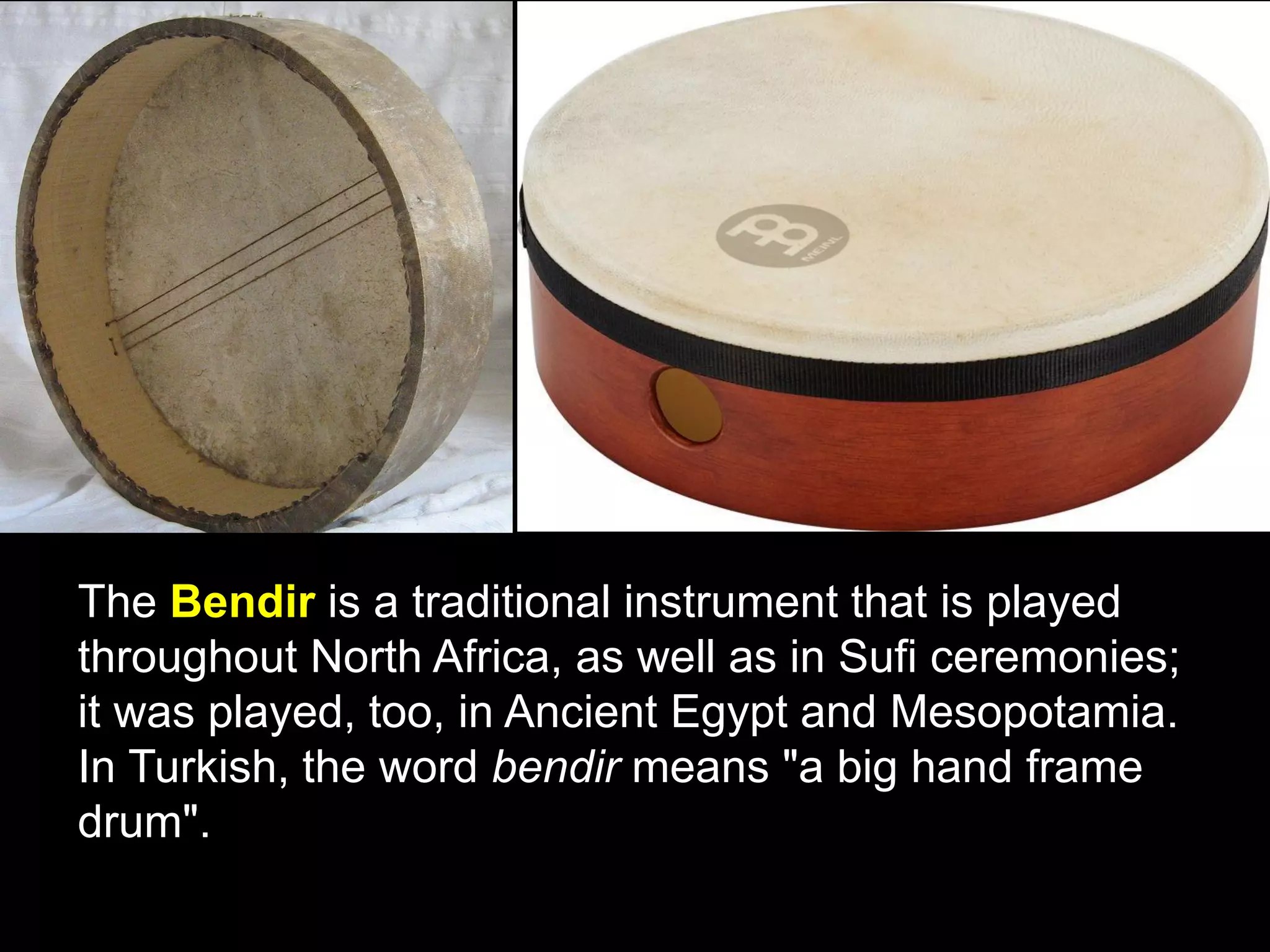
The Bendir is a traditional instrument that is played
throughout North Africa, as well as in Sufi ceremonies;
it was played, too, in Ancient Egypt and Mesopotamia.
In Turkish, the word bendir means "a big hand frame
drum".
Kudüm & Bendir: Show now!
The Oud is a short-neck unfretted lute-type, with 11 or 13 strings grouped in
5 or 6 courses, commonly used in Egyptian, Syrian, Sudanese, Palestinian,
Lebanese, Iraqi, Arabian, Jewish, Persian, Greek, Armenian, Turkish,
Azerbaijani, North African (Chaabi, Classical, and Spanish Andalusian),
Somali, and various other forms of Middle Eastern and North African music.
Oud: Show now!
The lavta is a plucked string instrument from Istanbul.
It has a small body made of many ribs using carvel
bending technique, looking like a small (Turkish) oud
but only 7 strings in 4 courses.
Lavta: Show now!
Kanun/Qanun, Oud, Clarinet @ the Secret Trio Zurich :
Show now!
Thank you for watching

Turkish/Ottoman traditional music

  • 1.
    Ottoman (Turkish) ClassicalMusic https://en.wikipedia.org/wiki/Ottoman_classical_music
  • 2.
  • 3.
    Ottoman Empire (1860-1923):The empire was created by Turkish tribes in Anatolia (Asia Minor) that grew to be one of the most powerful states in the world during the 15th and 16th centuries. The Ottoman period spanned more than 600 years and came to an end only in 1923, when it was replaced by the Turkish Republic and various successor states in southeastern Europe and the Middle East. https://www.britannica.com/place/Ottoman-Empire (Written By: Malcolm Edward Yapp &Stanford Jay Shaw Last Updated: Nov 27, 2018 )
  • 4.
    Turkey is anation straddling eastern Europe and western Asia with cultural connections to ancient Greek, Persian, Roman, Byzantine and Ottoman empires. Cosmopolitan Istanbul, on the Bosphorus Strait, is home to the iconic Hagia Sophia, with its soaring dome and Christian mosaics, the massive 17th-century Blue Mosque and the circa-1460 Topkapı Palace, former home of sultans. Ankara is Turkey’s modern capital. https://en.wikipedia.org/wiki/Turkey
  • 5.
  • 6.
    A brief introductionof Republic of Turkey Official language: Turkish Spoken languages: Turkish, Kurmanji, Arabic, Zaza, Kabardian and others Capital: Ankara (largest city: Istanbul) Currency: Turkish Lira (TRY) Population: 80,810,525 (2017) - 19th Ethnic groups: Turks, Kurds, Arabs, Laz & others Religion: Islam (99.8%), (Sunni 80.5%; Shia 16.5%) Declaration of Republic on 29 October 1923
  • 7.
    The Republic ofTurkey has no official national emblem, but the star and crescent design from the national flag is in use as de facto emblem, among other things printed on Turkish passports, on Turkish identity cards and diplomatic missions of Turkey. Wikipedia
  • 8.
    Sultan Ahmet Mosquein Istanbul, Turkey
  • 9.
    1 Turkish lira= 6.20 Thai Baht
  • 10.
    Tulip or Tulipa,derived from the Turkish word tulbend or turban, which the flower resembles, is the national flower of Turkey.
  • 11.
    Gray Wolf: TheNational Animal of Turkey
  • 12.
  • 13.
    Classical Turkish musicsometimes known as Ottoman classical music, developed in Istanbul and other major Ottoman cities and towns through the palaces and Sufi lodges of the Ottoman Empire. Above all a vocal music, Ottoman music traditionally accompanies a solo singer with a small instrumental ensemble. In recent times, instruments might include tambur (lute), ney (flute), kemençe (fiddle), keman (Western violin), kanun (zither), or other instruments. Sometimes described as monophonic music, the variety of ornamentation and variation in the ensemble requires the more accurate term heterophonic.
  • 14.
    Traditional instruments inOttoman classical music today include tanbur long-necked plucked lute, ney end-blown flute, kemençe bowed fiddle, oud plucked short-necked unfretted lute, kanun plucked zither, violin, and in Mevlevi music, kudüm drum. Older instruments still in use include lavta.
  • 15.
    The Tanbur/Tambur, long-neckedplucked lute, is a fretted string instrument of Turkey and the former lands of the Ottoman Empire. Show now!
  • 16.
  • 17.
    The ney isan end-blown flute, that figures prominently in Middle Eastern music. In some of these musical traditions, it is the only wind instrument used. The ney has been played continuously for 4,500–5,000 years, making it one of the oldest musical instruments still in use.
  • 18.
  • 19.
    Kemenche or kemençeis a name used for various types of stringed bowed musical instruments having their origin in the Eastern Mediterranean, particularly in Greece, Iran, Turkey, Armenia, and regions adjacent to the Black Sea.
  • 20.
  • 21.
    Kanun/Qanun: plucked zither,is a string instrument played either solo, or more often as part of an ensemble, in much of the Middle East, Maghreb, West Africa, Central Asia, and southeastern regions of Europe.
  • 22.
  • 24.
    The violin, alsoknown informally as a fiddle, is a wooden string instrument in the violin family. Most violins have a hollow wooden body. It is the smallest and highest-pitched instrument in the family in regular use. Wikipedia
  • 25.
  • 26.
    Kudüm is oneof the most fundamental rhythm instruments in classical Turkish (Mevlevi) music. The person playing it is called kudümzen.
  • 27.
    The Bendir isa traditional instrument that is played throughout North Africa, as well as in Sufi ceremonies; it was played, too, in Ancient Egypt and Mesopotamia. In Turkish, the word bendir means "a big hand frame drum".
  • 28.
  • 29.
    The Oud isa short-neck unfretted lute-type, with 11 or 13 strings grouped in 5 or 6 courses, commonly used in Egyptian, Syrian, Sudanese, Palestinian, Lebanese, Iraqi, Arabian, Jewish, Persian, Greek, Armenian, Turkish, Azerbaijani, North African (Chaabi, Classical, and Spanish Andalusian), Somali, and various other forms of Middle Eastern and North African music.
  • 30.
  • 31.
    The lavta isa plucked string instrument from Istanbul. It has a small body made of many ribs using carvel bending technique, looking like a small (Turkish) oud but only 7 strings in 4 courses.
  • 32.
  • 33.
    Kanun/Qanun, Oud, Clarinet@ the Secret Trio Zurich : Show now!
  • 35.
    Thank you forwatching