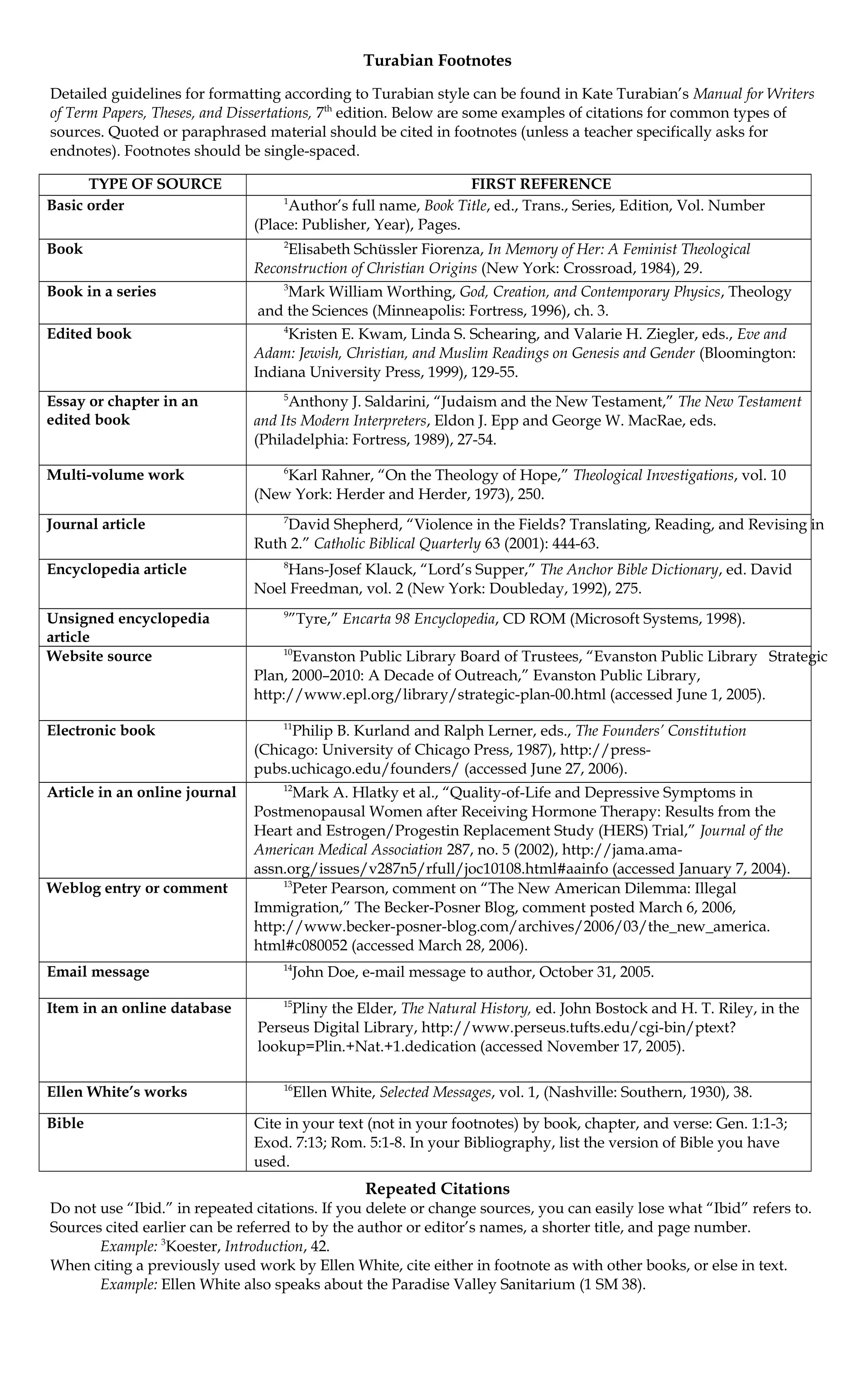
Turabian Footnotes 
Detailed guidelines for formatting according to Turabian style can be found in Kate Turabian’s Manual for Writers 
of Term Papers, Theses, and Dissertations, 7th edition. Below are some examples of citations for common types of 
sources. Quoted or paraphrased material should be cited in footnotes (unless a teacher specifically asks for 
endnotes). Footnotes should be single-spaced. 
TYPE OF SOURCE FIRST REFERENCE 
Basic order 1Author’s full name, Book Title, ed., Trans., Series, Edition, Vol. Number 
(Place: Publisher, Year), Pages. 
Book 2Elisabeth Schüssler Fiorenza, In Memory of Her: A Feminist Theological 
Reconstruction of Christian Origins (New York: Crossroad, 1984), 29. 
Book in a series 3Mark William Worthing, God, Creation, and Contemporary Physics, Theology 
and the Sciences (Minneapolis: Fortress, 1996), ch. 3. 
Edited book 4Kristen E. Kwam, Linda S. Schearing, and Valarie H. Ziegler, eds., Eve and 
Adam: Jewish, Christian, and Muslim Readings on Genesis and Gender (Bloomington: 
Indiana University Press, 1999), 129-55. 
Essay or chapter in an 
edited book 
5Anthony J. Saldarini, “Judaism and the New Testament,” The New Testament 
and Its Modern Interpreters, Eldon J. Epp and George W. MacRae, eds. 
(Philadelphia: Fortress, 1989), 27-54. 
Multi-volume work 6Karl Rahner, “On the Theology of Hope,” Theological Investigations, vol. 10 
(New York: Herder and Herder, 1973), 250. 
Journal article 7David Shepherd, “Violence in the Fields? Translating, Reading, and Revising in 
Ruth 2.” Catholic Biblical Quarterly 63 (2001): 444-63. 
Encyclopedia article 8Hans-Josef Klauck, “Lord’s Supper,” The Anchor Bible Dictionary, ed. David 
Noel Freedman, vol. 2 (New York: Doubleday, 1992), 275. 
Unsigned encyclopedia 
article 
9”Tyre,” Encarta 98 Encyclopedia, CD ROM (Microsoft Systems, 1998). 
Website source 10Evanston Public Library Board of Trustees, “Evanston Public Library Strategic 
Plan, 2000–2010: A Decade of Outreach,” Evanston Public Library, 
http://www.epl.org/library/strategic-plan-00.html (accessed June 1, 2005). 
Electronic book 11Philip B. Kurland and Ralph Lerner, eds., The Founders’ Constitution 
(Chicago: University of Chicago Press, 1987), http://press-pubs. 
uchicago.edu/founders/ (accessed June 27, 2006). 
Article in an online journal 12Mark A. Hlatky et al., “Quality-of-Life and Depressive Symptoms in 
Postmenopausal Women after Receiving Hormone Therapy: Results from the 
Heart and Estrogen/Progestin Replacement Study (HERS) Trial,” Journal of the 
American Medical Association 287, no. 5 (2002), http://jama.ama-assn. 
org/issues/v287n5/rfull/joc10108.html#aainfo (accessed January 7, 2004). 
Weblog entry or comment 13Peter Pearson, comment on “The New American Dilemma: Illegal 
Immigration,” The Becker-Posner Blog, comment posted March 6, 2006, 
http://www.becker-posner-blog.com/archives/2006/03/the_new_america. 
html#c080052 (accessed March 28, 2006). 
Email message 14John Doe, e-mail message to author, October 31, 2005. 
Item in an online database 15Pliny the Elder, The Natural History, ed. John Bostock and H. T. Riley, in the 
Perseus Digital Library, http://www.perseus.tufts.edu/cgi-bin/ptext? 
lookup=Plin.+Nat.+1.dedication (accessed November 17, 2005). 
Ellen White’s works 16Ellen White, Selected Messages, vol. 1, (Nashville: Southern, 1930), 38. 
Bible Cite in your text (not in your footnotes) by book, chapter, and verse: Gen. 1:1-3; 
Exod. 7:13; Rom. 5:1-8. In your Bibliography, list the version of Bible you have 
used. 
Repeated Citations 
Do not use “Ibid.” in repeated citations. If you delete or change sources, you can easily lose what “Ibid” refers to. 
Sources cited earlier can be referred to by the author or editor’s names, a shorter title, and page number. 
Example: 3Koester, Introduction, 42. 
When citing a previously used work by Ellen White, cite either in footnote as with other books, or else in text. 
Example: Ellen White also speaks about the Paradise Valley Sanitarium (1 SM 38).
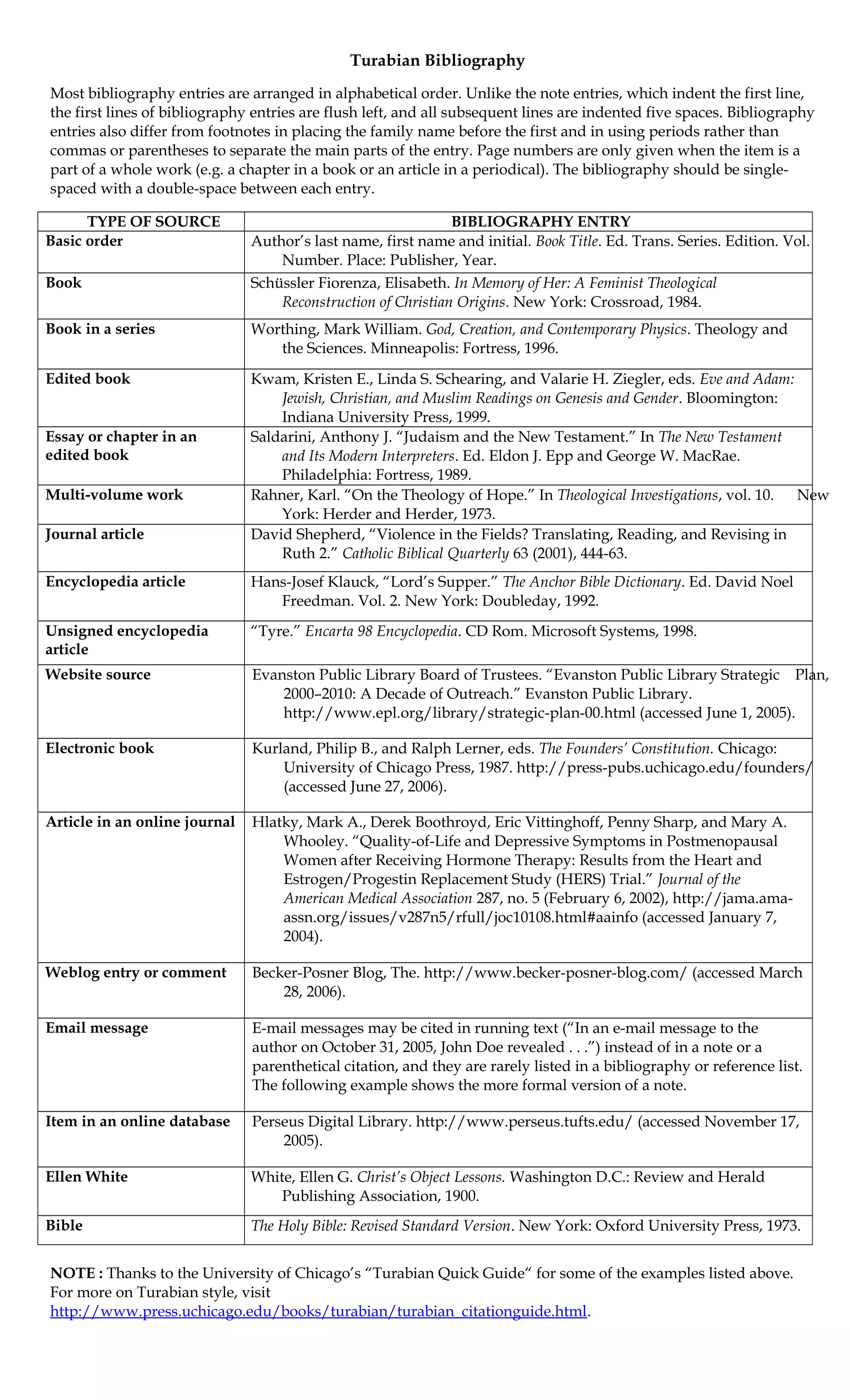
Turabian Bibliography 
Most bibliography entries are arranged in alphabetical order. Unlike the note entries, which indent the first line, 
the first lines of bibliography entries are flush left, and all subsequent lines are indented five spaces. Bibliography 
entries also differ from footnotes in placing the family name before the first and in using periods rather than 
commas or parentheses to separate the main parts of the entry. Page numbers are only given when the item is a 
part of a whole work (e.g. a chapter in a book or an article in a periodical). The bibliography should be single-spaced 
with a double-space between each entry. 
TYPE OF SOURCE BIBLIOGRAPHY ENTRY 
Basic order Author’s last name, first name and initial. Book Title. Ed. Trans. Series. Edition. Vol. 
Number. Place: Publisher, Year. 
Book Schüssler Fiorenza, Elisabeth. In Memory of Her: A Feminist Theological 
Reconstruction of Christian Origins. New York: Crossroad, 1984. 
Book in a series Worthing, Mark William. God, Creation, and Contemporary Physics. Theology and 
the Sciences. Minneapolis: Fortress, 1996. 
Edited book Kwam, Kristen E., Linda S. Schearing, and Valarie H. Ziegler, eds. Eve and Adam: 
Jewish, Christian, and Muslim Readings on Genesis and Gender. Bloomington: 
Indiana University Press, 1999. 
Essay or chapter in an 
edited book 
Saldarini, Anthony J. “Judaism and the New Testament.” In The New Testament 
and Its Modern Interpreters. Ed. Eldon J. Epp and George W. MacRae. 
Philadelphia: Fortress, 1989. 
Multi-volume work Rahner, Karl. “On the Theology of Hope.” In Theological Investigations, vol. 10. New 
York: Herder and Herder, 1973. 
Journal article David Shepherd, “Violence in the Fields? Translating, Reading, and Revising in 
Ruth 2.” Catholic Biblical Quarterly 63 (2001), 444-63. 
Encyclopedia article Hans-Josef Klauck, “Lord’s Supper.” The Anchor Bible Dictionary. Ed. David Noel 
Freedman. Vol. 2. New York: Doubleday, 1992. 
Unsigned encyclopedia 
article 
“Tyre.” Encarta 98 Encyclopedia. CD Rom. Microsoft Systems, 1998. 
Website source Evanston Public Library Board of Trustees. “Evanston Public Library Strategic Plan, 
2000–2010: A Decade of Outreach.” Evanston Public Library. 
http://www.epl.org/library/strategic-plan-00.html (accessed June 1, 2005). 
Electronic book Kurland, Philip B., and Ralph Lerner, eds. The Founders’ Constitution. Chicago: 
University of Chicago Press, 1987. http://press-pubs.uchicago.edu/founders/ 
(accessed June 27, 2006). 
Article in an online journal Hlatky, Mark A., Derek Boothroyd, Eric Vittinghoff, Penny Sharp, and Mary A. 
Whooley. “Quality-of-Life and Depressive Symptoms in Postmenopausal 
Women after Receiving Hormone Therapy: Results from the Heart and 
Estrogen/Progestin Replacement Study (HERS) Trial.” Journal of the 
American Medical Association 287, no. 5 (February 6, 2002), http://jama.ama-assn. 
org/issues/v287n5/rfull/joc10108.html#aainfo (accessed January 7, 
2004). 
Weblog entry or comment Becker-Posner Blog, The. http://www.becker-posner-blog.com/ (accessed March 
28, 2006). 
Email message E-mail messages may be cited in running text (“In an e-mail message to the 
author on October 31, 2005, John Doe revealed . . .”) instead of in a note or a 
parenthetical citation, and they are rarely listed in a bibliography or reference list. 
The following example shows the more formal version of a note. 
Item in an online database Perseus Digital Library. http://www.perseus.tufts.edu/ (accessed November 17, 
2005). 
Ellen White White, Ellen G. Christ’s Object Lessons. Washington D.C.: Review and Herald 
Publishing Association, 1900. 
Bible The Holy Bible: Revised Standard Version. New York: Oxford University Press, 1973. 
NOTE : Thanks to the University of Chicago’s “Turabian Quick Guide“ for some of the examples listed above. 
For more on Turabian style, visit 
http://www.press.uchicago.edu/books/turabian/turabian_citationguide.html.

Turabian 7th ed

  • 1.
    Turabian Footnotes Detailedguidelines for formatting according to Turabian style can be found in Kate Turabian’s Manual for Writers of Term Papers, Theses, and Dissertations, 7th edition. Below are some examples of citations for common types of sources. Quoted or paraphrased material should be cited in footnotes (unless a teacher specifically asks for endnotes). Footnotes should be single-spaced. TYPE OF SOURCE FIRST REFERENCE Basic order 1Author’s full name, Book Title, ed., Trans., Series, Edition, Vol. Number (Place: Publisher, Year), Pages. Book 2Elisabeth Schüssler Fiorenza, In Memory of Her: A Feminist Theological Reconstruction of Christian Origins (New York: Crossroad, 1984), 29. Book in a series 3Mark William Worthing, God, Creation, and Contemporary Physics, Theology and the Sciences (Minneapolis: Fortress, 1996), ch. 3. Edited book 4Kristen E. Kwam, Linda S. Schearing, and Valarie H. Ziegler, eds., Eve and Adam: Jewish, Christian, and Muslim Readings on Genesis and Gender (Bloomington: Indiana University Press, 1999), 129-55. Essay or chapter in an edited book 5Anthony J. Saldarini, “Judaism and the New Testament,” The New Testament and Its Modern Interpreters, Eldon J. Epp and George W. MacRae, eds. (Philadelphia: Fortress, 1989), 27-54. Multi-volume work 6Karl Rahner, “On the Theology of Hope,” Theological Investigations, vol. 10 (New York: Herder and Herder, 1973), 250. Journal article 7David Shepherd, “Violence in the Fields? Translating, Reading, and Revising in Ruth 2.” Catholic Biblical Quarterly 63 (2001): 444-63. Encyclopedia article 8Hans-Josef Klauck, “Lord’s Supper,” The Anchor Bible Dictionary, ed. David Noel Freedman, vol. 2 (New York: Doubleday, 1992), 275. Unsigned encyclopedia article 9”Tyre,” Encarta 98 Encyclopedia, CD ROM (Microsoft Systems, 1998). Website source 10Evanston Public Library Board of Trustees, “Evanston Public Library Strategic Plan, 2000–2010: A Decade of Outreach,” Evanston Public Library, http://www.epl.org/library/strategic-plan-00.html (accessed June 1, 2005). Electronic book 11Philip B. Kurland and Ralph Lerner, eds., The Founders’ Constitution (Chicago: University of Chicago Press, 1987), http://press-pubs. uchicago.edu/founders/ (accessed June 27, 2006). Article in an online journal 12Mark A. Hlatky et al., “Quality-of-Life and Depressive Symptoms in Postmenopausal Women after Receiving Hormone Therapy: Results from the Heart and Estrogen/Progestin Replacement Study (HERS) Trial,” Journal of the American Medical Association 287, no. 5 (2002), http://jama.ama-assn. org/issues/v287n5/rfull/joc10108.html#aainfo (accessed January 7, 2004). Weblog entry or comment 13Peter Pearson, comment on “The New American Dilemma: Illegal Immigration,” The Becker-Posner Blog, comment posted March 6, 2006, http://www.becker-posner-blog.com/archives/2006/03/the_new_america. html#c080052 (accessed March 28, 2006). Email message 14John Doe, e-mail message to author, October 31, 2005. Item in an online database 15Pliny the Elder, The Natural History, ed. John Bostock and H. T. Riley, in the Perseus Digital Library, http://www.perseus.tufts.edu/cgi-bin/ptext? lookup=Plin.+Nat.+1.dedication (accessed November 17, 2005). Ellen White’s works 16Ellen White, Selected Messages, vol. 1, (Nashville: Southern, 1930), 38. Bible Cite in your text (not in your footnotes) by book, chapter, and verse: Gen. 1:1-3; Exod. 7:13; Rom. 5:1-8. In your Bibliography, list the version of Bible you have used. Repeated Citations Do not use “Ibid.” in repeated citations. If you delete or change sources, you can easily lose what “Ibid” refers to. Sources cited earlier can be referred to by the author or editor’s names, a shorter title, and page number. Example: 3Koester, Introduction, 42. When citing a previously used work by Ellen White, cite either in footnote as with other books, or else in text. Example: Ellen White also speaks about the Paradise Valley Sanitarium (1 SM 38).
  • 2.
    Turabian Bibliography Mostbibliography entries are arranged in alphabetical order. Unlike the note entries, which indent the first line, the first lines of bibliography entries are flush left, and all subsequent lines are indented five spaces. Bibliography entries also differ from footnotes in placing the family name before the first and in using periods rather than commas or parentheses to separate the main parts of the entry. Page numbers are only given when the item is a part of a whole work (e.g. a chapter in a book or an article in a periodical). The bibliography should be single-spaced with a double-space between each entry. TYPE OF SOURCE BIBLIOGRAPHY ENTRY Basic order Author’s last name, first name and initial. Book Title. Ed. Trans. Series. Edition. Vol. Number. Place: Publisher, Year. Book Schüssler Fiorenza, Elisabeth. In Memory of Her: A Feminist Theological Reconstruction of Christian Origins. New York: Crossroad, 1984. Book in a series Worthing, Mark William. God, Creation, and Contemporary Physics. Theology and the Sciences. Minneapolis: Fortress, 1996. Edited book Kwam, Kristen E., Linda S. Schearing, and Valarie H. Ziegler, eds. Eve and Adam: Jewish, Christian, and Muslim Readings on Genesis and Gender. Bloomington: Indiana University Press, 1999. Essay or chapter in an edited book Saldarini, Anthony J. “Judaism and the New Testament.” In The New Testament and Its Modern Interpreters. Ed. Eldon J. Epp and George W. MacRae. Philadelphia: Fortress, 1989. Multi-volume work Rahner, Karl. “On the Theology of Hope.” In Theological Investigations, vol. 10. New York: Herder and Herder, 1973. Journal article David Shepherd, “Violence in the Fields? Translating, Reading, and Revising in Ruth 2.” Catholic Biblical Quarterly 63 (2001), 444-63. Encyclopedia article Hans-Josef Klauck, “Lord’s Supper.” The Anchor Bible Dictionary. Ed. David Noel Freedman. Vol. 2. New York: Doubleday, 1992. Unsigned encyclopedia article “Tyre.” Encarta 98 Encyclopedia. CD Rom. Microsoft Systems, 1998. Website source Evanston Public Library Board of Trustees. “Evanston Public Library Strategic Plan, 2000–2010: A Decade of Outreach.” Evanston Public Library. http://www.epl.org/library/strategic-plan-00.html (accessed June 1, 2005). Electronic book Kurland, Philip B., and Ralph Lerner, eds. The Founders’ Constitution. Chicago: University of Chicago Press, 1987. http://press-pubs.uchicago.edu/founders/ (accessed June 27, 2006). Article in an online journal Hlatky, Mark A., Derek Boothroyd, Eric Vittinghoff, Penny Sharp, and Mary A. Whooley. “Quality-of-Life and Depressive Symptoms in Postmenopausal Women after Receiving Hormone Therapy: Results from the Heart and Estrogen/Progestin Replacement Study (HERS) Trial.” Journal of the American Medical Association 287, no. 5 (February 6, 2002), http://jama.ama-assn. org/issues/v287n5/rfull/joc10108.html#aainfo (accessed January 7, 2004). Weblog entry or comment Becker-Posner Blog, The. http://www.becker-posner-blog.com/ (accessed March 28, 2006). Email message E-mail messages may be cited in running text (“In an e-mail message to the author on October 31, 2005, John Doe revealed . . .”) instead of in a note or a parenthetical citation, and they are rarely listed in a bibliography or reference list. The following example shows the more formal version of a note. Item in an online database Perseus Digital Library. http://www.perseus.tufts.edu/ (accessed November 17, 2005). Ellen White White, Ellen G. Christ’s Object Lessons. Washington D.C.: Review and Herald Publishing Association, 1900. Bible The Holy Bible: Revised Standard Version. New York: Oxford University Press, 1973. NOTE : Thanks to the University of Chicago’s “Turabian Quick Guide“ for some of the examples listed above. For more on Turabian style, visit http://www.press.uchicago.edu/books/turabian/turabian_citationguide.html.