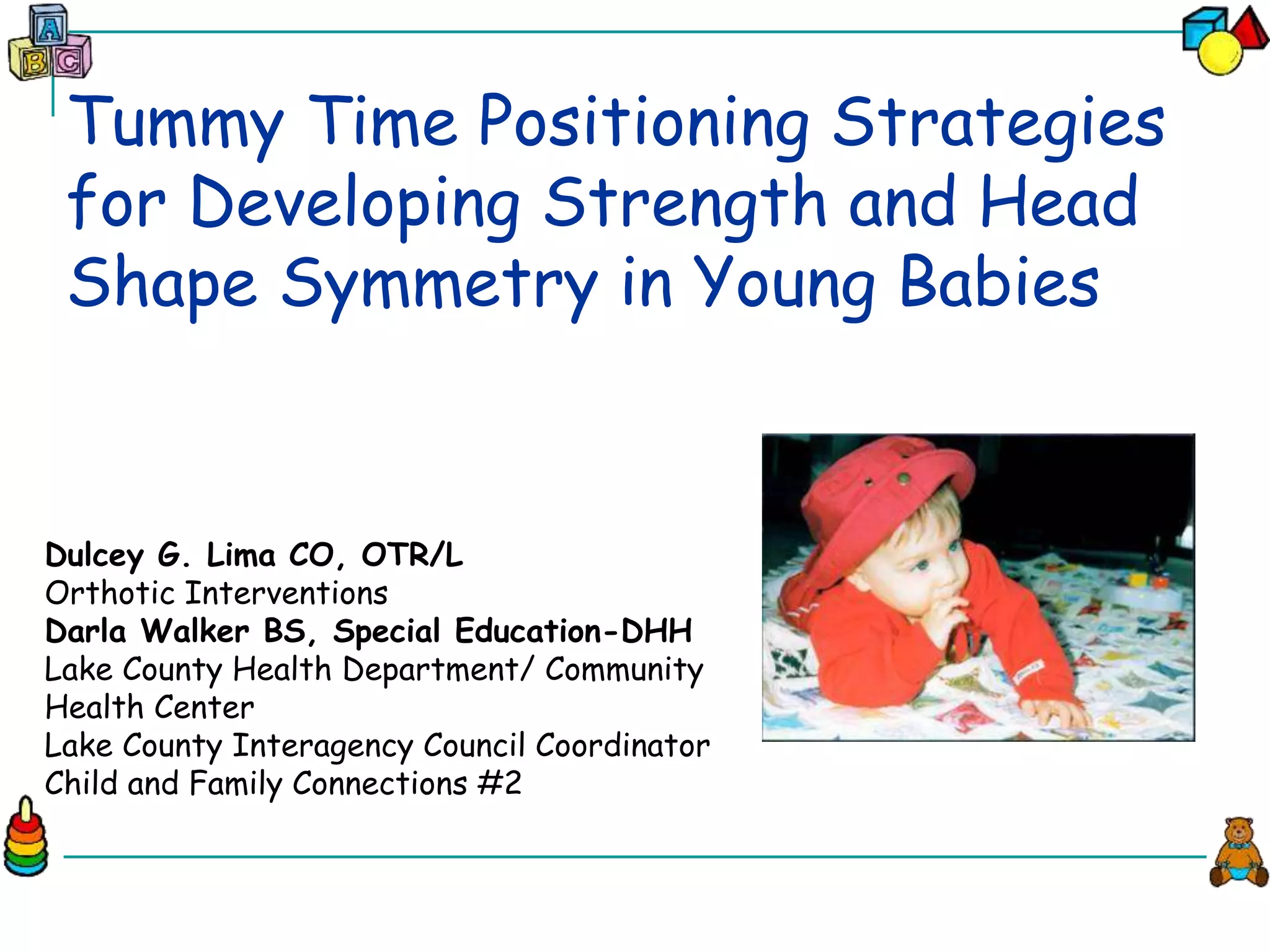
Tummy Time Positioning Strategies
for Developing Strength and Head
Shape Symmetry in Young Babies
Dulcey G. Lima CO, OTR/L
Orthotic Interventions
Darla Walker BS, Special Education-DHH
Lake County Health Department/ Community
Health Center
Lake County Interagency Council Coordinator
Child and Family Connections #2
Why incorporate Tummy Time
into your baby’s daily routine?
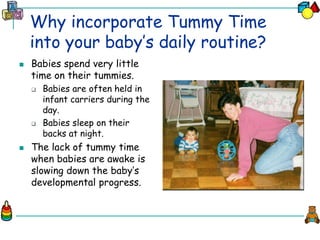
 Babies spend very little
time on their tummies.
 Babies are often held in
infant carriers during the
day.
 Babies sleep on their
backs at night.
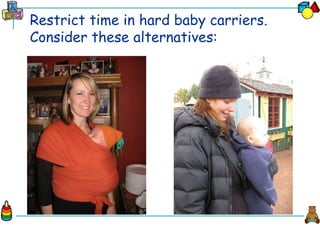
 The lack of tummy time
when babies are awake is
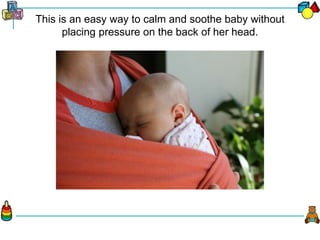
slowing down the baby’s
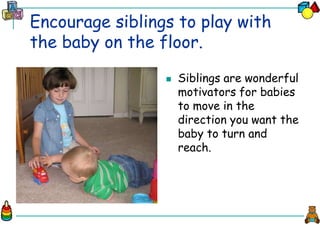
developmental progress.
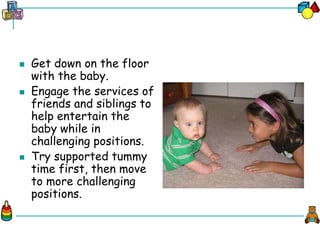
Benefits
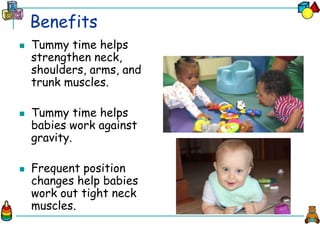
 Tummy time helps
strengthen neck,
shoulders, arms, and
trunk muscles.
 Tummy time helps
babies work against
gravity.
 Frequent position
changes help babies
work out tight neck
muscles.
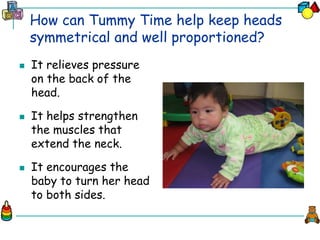
How can Tummy Time help keep heads
symmetrical and well proportioned?
 It relieves pressure
on the back of the
head.
 It helps strengthen
the muscles that
extend the neck.
 It encourages the
baby to turn her head
to both sides.
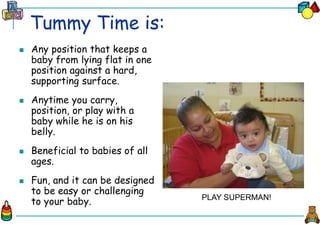
Tummy Time is:
 Any position that keeps a
baby from lying flat in one
position against a hard,
supporting surface.
 Anytime you carry,
position, or play with a
baby while he is on his
belly.
 Beneficial to babies of all
ages.
 Fun, and it can be designed
to be easy or challenging
to your baby. PLAY SUPERMAN!
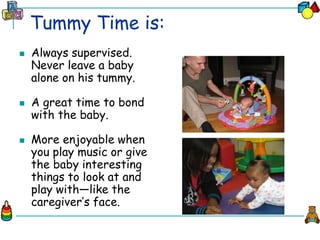
Tummy Time is:
 Always supervised.
Never leave a baby
alone on his tummy.
 A great time to bond
with the baby.
 More enjoyable when
you play music or give
the baby interesting
things to look at and
play with—like the
caregiver’s face.
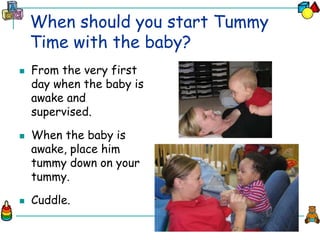
When should you start Tummy
Time with the baby?
 From the very first
day when the baby is
awake and
supervised.
 When the baby is
awake, place him
tummy down on your
tummy.
 Cuddle.
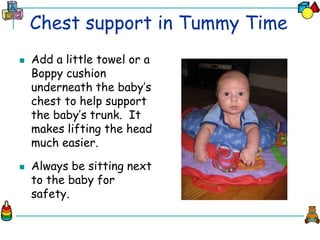
Chest support in Tummy Time
 Add a little towel or a
Boppy cushion
underneath the baby’s
chest to help support
the baby’s trunk. It
makes lifting the head
much easier.
 Always be sitting next
to the baby for
safety.
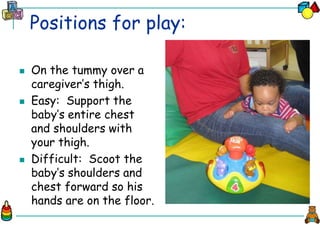
Positions for play:
 On the tummy over a
caregiver’s thigh.
 Easy: Support the
baby’s entire chest
and shoulders with
your thigh.
 Difficult: Scoot the
baby’s shoulders and
chest forward so his
hands are on the floor.
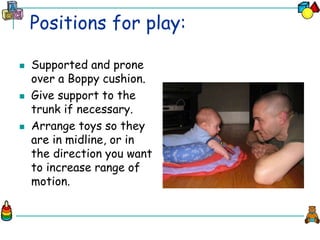
Positions for play:
 Supported and prone
over a Boppy cushion.
 Give support to the
trunk if necessary.
 Arrange toys so they
are in midline, or in
the direction you want
to increase range of
motion.
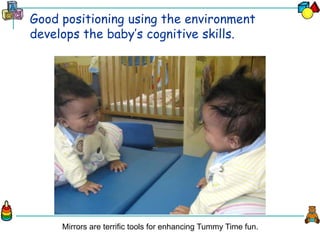
Good positioning using the environment
develops the baby’s cognitive skills.
Mirrors are terrific tools for enhancing Tummy Time fun.
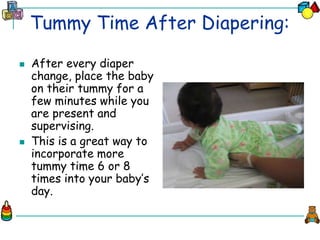
Tummy Time After Diapering:
 After every diaper
change, place the baby
on their tummy for a
few minutes while you
are present and
supervising.
 This is a great way to
incorporate more
tummy time 6 or 8
times into your baby’s
day.
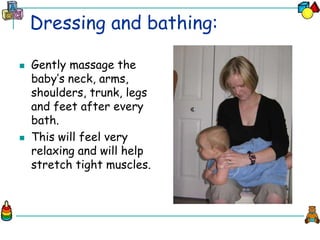
Dressing and bathing:
 Gently massage the
baby’s neck, arms,
shoulders, trunk, legs
and feet after every
bath.
 This will feel very
relaxing and will help
stretch tight muscles.
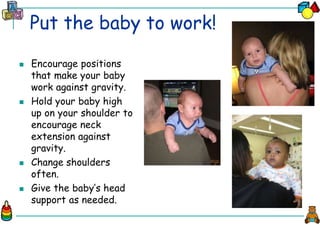
Put the baby to work!
 Encourage positions
that make your baby
work against gravity.
 Hold your baby high
up on your shoulder to
encourage neck
extension against
gravity.
 Change shoulders
often.
 Give the baby’s head
support as needed.
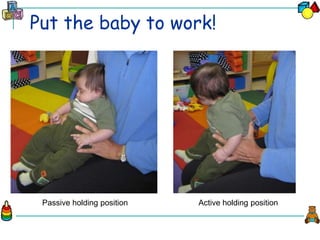
Put the baby to work!
Passive holding position Active holding position
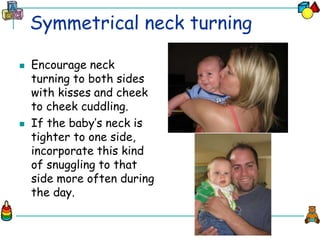
Symmetrical neck turning
 Encourage neck
turning to both sides
with kisses and cheek
to cheek cuddling.
 If the baby’s neck is
tighter to one side,
incorporate this kind
of snuggling to that
side more often during
the day.
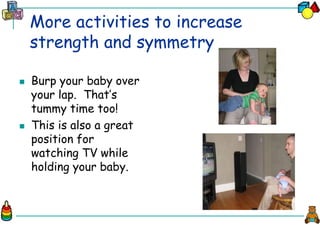
More activities to increase
strength and symmetry
 Burp your baby over
your lap. That’s
tummy time too!
 This is also a great
position for
watching TV while
holding your baby.
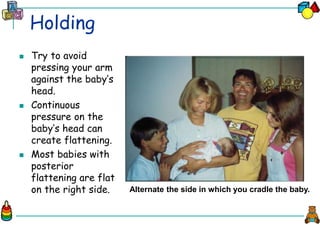
Holding
 Try to avoid
pressing your arm
against the baby’s
head.
 Continuous
pressure on the
baby’s head can
create flattening.
 Most babies with
posterior
flattening are flat
on the right side. Alternate the side in which you cradle the baby.
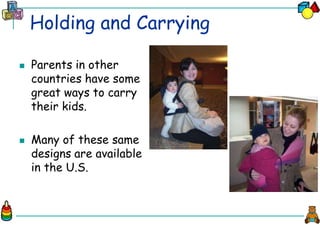
Holding and Carrying
 Parents in other
countries have some
great ways to carry
their kids.
 Many of these same
designs are available
in the U.S.
Restrict time in hard baby carriers.
Consider these alternatives:
This is an easy way to calm and soothe baby without
placing pressure on the back of her head.
Encourage siblings to play with
the baby on the floor.
 Siblings are wonderful
motivators for babies
to move in the
direction you want the
baby to turn and
reach.
 Get down on the floor
with the baby.
 Engage the services of
friends and siblings to
help entertain the
baby while in
challenging positions.
 Try supported tummy
time first, then move
to more challenging
positions.
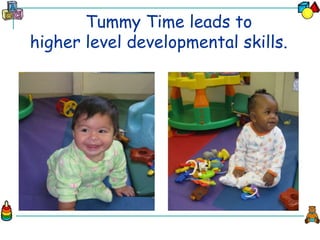
Tummy Time leads to
higher level developmental skills.
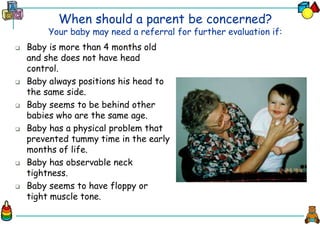
When should a parent be concerned?
Your baby may need a referral for further evaluation if:
 Baby is more than 4 months old
and she does not have head
control.
 Baby always positions his head to
the same side.
 Baby seems to be behind other
babies who are the same age.
 Baby has a physical problem that
prevented tummy time in the early
months of life.
 Baby has observable neck
tightness.
 Baby seems to have floppy or
tight muscle tone.
SIDS prevention program is now called First
Candle. Information for parents and
professionals may be found at
http://www.firstcandle.org/
 BACK TO SLEEP.
 No shared bed sleeping.
 No blankets, bumpers or
toys in the crib.
 Crib should be in the room
with the parents for first
6 months. (room sharing)
 No smoking in the house.
 The baby’s room should be
kept cool.
Which Baby Is Sleeping
According to SIDS Guidelines?
This baby is covered with too many
blankets and is not positioned well.
This baby looks great!
BACK TO SLEEP!
 No exceptions to this
rule except as ordered
by a physician for a
medical reason.
 Do not succumb to
pressure from older
parents or others who
did not raise their
children during the Back
to Sleep Era.
 Remember that this
program has saved
thousands of babies
from Sudden Infant
Death Syndrome.
Where can I go to get more information
on developmental screening sites or
information on referring my child for
further developmental evaluations?
 http://www.lakecountyil.gov/Health/resour
ces/Pages/CFC.aspx
 Click on the web site above and then scroll
down the right hand side to “Screening
Sites” for a list of free, developmental
screening sites

Tummy time tips

  • 1.
    Tummy Time PositioningStrategies for Developing Strength and Head Shape Symmetry in Young Babies Dulcey G. Lima CO, OTR/L Orthotic Interventions Darla Walker BS, Special Education-DHH Lake County Health Department/ Community Health Center Lake County Interagency Council Coordinator Child and Family Connections #2
  • 2.
    Why incorporate TummyTime into your baby’s daily routine?  Babies spend very little time on their tummies.  Babies are often held in infant carriers during the day.  Babies sleep on their backs at night.  The lack of tummy time when babies are awake is slowing down the baby’s developmental progress.
  • 3.
    Benefits  Tummy timehelps strengthen neck, shoulders, arms, and trunk muscles.  Tummy time helps babies work against gravity.  Frequent position changes help babies work out tight neck muscles.
  • 4.
    How can TummyTime help keep heads symmetrical and well proportioned?  It relieves pressure on the back of the head.  It helps strengthen the muscles that extend the neck.  It encourages the baby to turn her head to both sides.
  • 5.
    Tummy Time is: Any position that keeps a baby from lying flat in one position against a hard, supporting surface.  Anytime you carry, position, or play with a baby while he is on his belly.  Beneficial to babies of all ages.  Fun, and it can be designed to be easy or challenging to your baby. PLAY SUPERMAN!
  • 6.
    Tummy Time is: Always supervised. Never leave a baby alone on his tummy.  A great time to bond with the baby.  More enjoyable when you play music or give the baby interesting things to look at and play with—like the caregiver’s face.
  • 7.
    When should youstart Tummy Time with the baby?  From the very first day when the baby is awake and supervised.  When the baby is awake, place him tummy down on your tummy.  Cuddle.
  • 8.
    Chest support inTummy Time  Add a little towel or a Boppy cushion underneath the baby’s chest to help support the baby’s trunk. It makes lifting the head much easier.  Always be sitting next to the baby for safety.
  • 9.
    Positions for play: On the tummy over a caregiver’s thigh.  Easy: Support the baby’s entire chest and shoulders with your thigh.  Difficult: Scoot the baby’s shoulders and chest forward so his hands are on the floor.
  • 10.
    Positions for play: Supported and prone over a Boppy cushion.  Give support to the trunk if necessary.  Arrange toys so they are in midline, or in the direction you want to increase range of motion.
  • 11.
    Good positioning usingthe environment develops the baby’s cognitive skills. Mirrors are terrific tools for enhancing Tummy Time fun.
  • 12.
    Tummy Time AfterDiapering:  After every diaper change, place the baby on their tummy for a few minutes while you are present and supervising.  This is a great way to incorporate more tummy time 6 or 8 times into your baby’s day.
  • 13.
    Dressing and bathing: Gently massage the baby’s neck, arms, shoulders, trunk, legs and feet after every bath.  This will feel very relaxing and will help stretch tight muscles.
  • 14.
    Put the babyto work!  Encourage positions that make your baby work against gravity.  Hold your baby high up on your shoulder to encourage neck extension against gravity.  Change shoulders often.  Give the baby’s head support as needed.
  • 15.
    Put the babyto work! Passive holding position Active holding position
  • 16.
    Symmetrical neck turning Encourage neck turning to both sides with kisses and cheek to cheek cuddling.  If the baby’s neck is tighter to one side, incorporate this kind of snuggling to that side more often during the day.
  • 17.
    More activities toincrease strength and symmetry  Burp your baby over your lap. That’s tummy time too!  This is also a great position for watching TV while holding your baby.
  • 18.
    Holding  Try toavoid pressing your arm against the baby’s head.  Continuous pressure on the baby’s head can create flattening.  Most babies with posterior flattening are flat on the right side. Alternate the side in which you cradle the baby.
  • 19.
    Holding and Carrying Parents in other countries have some great ways to carry their kids.  Many of these same designs are available in the U.S.
  • 20.
    Restrict time inhard baby carriers. Consider these alternatives:
  • 21.
    This is aneasy way to calm and soothe baby without placing pressure on the back of her head.
  • 22.
    Encourage siblings toplay with the baby on the floor.  Siblings are wonderful motivators for babies to move in the direction you want the baby to turn and reach.
  • 23.
     Get downon the floor with the baby.  Engage the services of friends and siblings to help entertain the baby while in challenging positions.  Try supported tummy time first, then move to more challenging positions.
  • 24.
    Tummy Time leadsto higher level developmental skills.
  • 25.
    When should aparent be concerned? Your baby may need a referral for further evaluation if:  Baby is more than 4 months old and she does not have head control.  Baby always positions his head to the same side.  Baby seems to be behind other babies who are the same age.  Baby has a physical problem that prevented tummy time in the early months of life.  Baby has observable neck tightness.  Baby seems to have floppy or tight muscle tone.
  • 26.
    SIDS prevention programis now called First Candle. Information for parents and professionals may be found at http://www.firstcandle.org/  BACK TO SLEEP.  No shared bed sleeping.  No blankets, bumpers or toys in the crib.  Crib should be in the room with the parents for first 6 months. (room sharing)  No smoking in the house.  The baby’s room should be kept cool.
  • 27.
    Which Baby IsSleeping According to SIDS Guidelines? This baby is covered with too many blankets and is not positioned well. This baby looks great!
  • 28.
    BACK TO SLEEP! No exceptions to this rule except as ordered by a physician for a medical reason.  Do not succumb to pressure from older parents or others who did not raise their children during the Back to Sleep Era.  Remember that this program has saved thousands of babies from Sudden Infant Death Syndrome.
  • 29.
    Where can Igo to get more information on developmental screening sites or information on referring my child for further developmental evaluations?  http://www.lakecountyil.gov/Health/resour ces/Pages/CFC.aspx  Click on the web site above and then scroll down the right hand side to “Screening Sites” for a list of free, developmental screening sites