Delft  O pen C ourse W are Willem van Valkenburg, E-learning Consultant www.e-learn.nl
Agenda The pilot phase (2007/2008)   Evaluation of the pilot phase Outline for the next phase
Pilot Phase OCW-project: Characteristics Start: May 2007 Initiated by the central board 6 pilots (MSc-programmes) on a voluntary basis:  Micro-Electronics, Offshore Engineering, Drinking   Water   Sustainable development, Nano science, Biomedical Engineering   ‘ Content centred’  model  like MIT  Technical infrastructure: Hive (repository) and Typo3 (CMS)  Close cooperation: Library, departments of ICT and Education, pilots Steering group headed by the rector magnificus Basis for the future (technical, organisational, financial implications,  further growth) Completed: September 2008
Why this initiative (1) Board Core tasks university is to  deliver know-how and building knowledge networks in an international context. Way to improve quality of education Reputation/ branding Irreversible trend
Why this initiative (2) 6 Pilots  (different motives) Reputation/Exposure/Visibility; Additional contribution to knowledge networks; Attracting new students and researchers  (clear picture of what TU Delft is doing); Easy access (material is part of a joint degree); Preparation for future students; Opening up for new connections worldwide;  Investing in future learning and education methods/basis for blended learning.
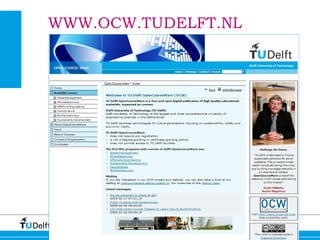
WWW.OCW.TUDELFT.NL
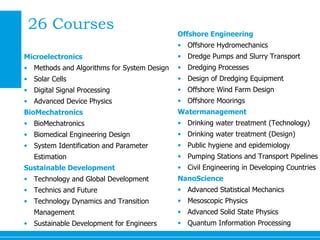
26 Courses Offshore Engineering Offshore Hydromechanics Dredge Pumps and Slurry Transport Dredging Processes Design of Dredging Equipment Offshore Wind Farm Design Offshore Moorings Watermanagement Drinking water treatment (Technology) Drinking water treatment (Design) Public hygiene and epidemiology Pumping Stations and Transport Pipelines Civil Engineering in Developing Countries NanoScience Advanced Statistical Mechanics Mesoscopic Physics Advanced Solid State Physics Quantum Information Processing Microelectronics Methods and Algorithms for System Design Solar Cells Digital Signal Processing Advanced Device Physics BioMechatronics BioMechatronics Biomedical Engineering Design System Identification and Parameter Estimation Sustainable Development Technology and Global Development Technics and Future Technology Dynamics and Transition Management Sustainable Development for Engineers
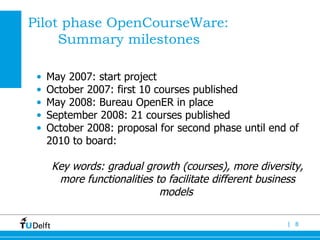
Pilot phase OpenCourseWare:  Summary milestones May 2007: start project October 2007: first 10 courses published May 2008: Bureau OpenER in place September 2008: 21 courses published October 2008: proposal for second phase until end of 2010 to board:  Key words: gradual growth (courses), more diversity, more functionalities to facilitate different business models
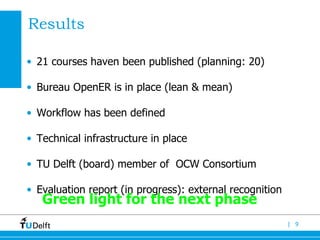
Results  21 courses haven been published (planning: 20) Bureau OpenER is in place (lean & mean)  Workflow has been defined Technical infrastructure in place  TU Delft (board) member of  OCW Consortium Evaluation report (in progress): external recognition  Green light for the next phase
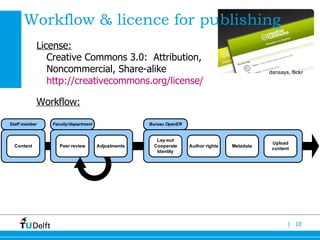
License:   Creative Commons 3.0:  Attribution, Noncommercial, Share-alike  http://creativecommons.org/license/ Workflow: Workflow & licence for publishing dansays, flickr
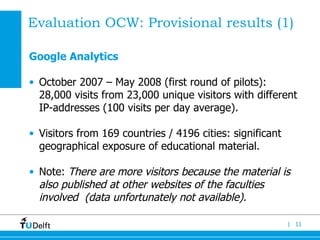
Evaluation OCW: Provisional results (1) Google Analytics   October 2007 – May 2008 (first round of pilots):  28,000 visits from 23,000 unique visitors with different IP-addresses (100 visits per day average).  Visitors from 169 countries / 4196 cities: significant geographical exposure of educational material.  Note:  There are more visitors because the material is also published at other websites of the faculties involved  (data unfortunately not available).
Evaluation OCW: Provisional Results (2) General High appreciation of the initiative; Vey positive about the quality of the content; TU Delft ‘signature’ is important; Clear website structure
Where do we go from here ?  General: TU Delft policy: not only open access of educational materials: All dissertations (full text); Multi-media. Recently, a project has started for the development of a multi-media portal for the disclosure of all streaming video (lecturers), digital cartographic material and historical collections; Open Access publishing in journals  More materials are available in digital and new formats (games, VodCast). Tremendous growth in the use of streaming video. How do we make optimal uses of these developments?
Where do we go from here ?  Challenges Sustainability: how to create (financial) incentives for staff to publish educational materials?  Different motives: how to create a business model when departments have different motives to participate? Examples of motives : Drinking water:  more international students, OCW will be integrated in the blended learning modules Nanoscience:  reputation, more master students Industrial Design:  Open source design Micro Electronics:  collaboration with industries (sponsorships)
Outline for the second phase   until  2010 Website: From repository to community Sustainable business model for the publication of courses Include material for other target group Editorial board  Growth number of publications  PhD-research on OER? External Sponsorship?
From repository to community:  Add website functionalities: who else used these resources, others who used these resources also used the following documents, number of views, rating, discussion area..; Link to other university resources:  DIScover (TU Library project to link  all  kinds of resources integrated in the OCW-website)  User centered approach for the functional design of the website. Materials of the Open-Source Design project will serve as starting point;  Depository: other people can add content; Additional services like customized support/courses, student projects; Communities for people who have shared interest.
Thank You for Your Time Questions?  OCW.TUDelft.nl

TU Delft OpenCourseWare presentation

  • 1.
    Delft Open C ourse W are Willem van Valkenburg, E-learning Consultant www.e-learn.nl
  • 2.
    Agenda The pilotphase (2007/2008) Evaluation of the pilot phase Outline for the next phase
  • 3.
    Pilot Phase OCW-project:Characteristics Start: May 2007 Initiated by the central board 6 pilots (MSc-programmes) on a voluntary basis: Micro-Electronics, Offshore Engineering, Drinking Water Sustainable development, Nano science, Biomedical Engineering ‘ Content centred’ model like MIT Technical infrastructure: Hive (repository) and Typo3 (CMS) Close cooperation: Library, departments of ICT and Education, pilots Steering group headed by the rector magnificus Basis for the future (technical, organisational, financial implications, further growth) Completed: September 2008
  • 4.
    Why this initiative(1) Board Core tasks university is to deliver know-how and building knowledge networks in an international context. Way to improve quality of education Reputation/ branding Irreversible trend
  • 5.
    Why this initiative(2) 6 Pilots (different motives) Reputation/Exposure/Visibility; Additional contribution to knowledge networks; Attracting new students and researchers (clear picture of what TU Delft is doing); Easy access (material is part of a joint degree); Preparation for future students; Opening up for new connections worldwide; Investing in future learning and education methods/basis for blended learning.
  • 6.
  • 7.
    26 Courses OffshoreEngineering Offshore Hydromechanics Dredge Pumps and Slurry Transport Dredging Processes Design of Dredging Equipment Offshore Wind Farm Design Offshore Moorings Watermanagement Drinking water treatment (Technology) Drinking water treatment (Design) Public hygiene and epidemiology Pumping Stations and Transport Pipelines Civil Engineering in Developing Countries NanoScience Advanced Statistical Mechanics Mesoscopic Physics Advanced Solid State Physics Quantum Information Processing Microelectronics Methods and Algorithms for System Design Solar Cells Digital Signal Processing Advanced Device Physics BioMechatronics BioMechatronics Biomedical Engineering Design System Identification and Parameter Estimation Sustainable Development Technology and Global Development Technics and Future Technology Dynamics and Transition Management Sustainable Development for Engineers
  • 8.
    Pilot phase OpenCourseWare: Summary milestones May 2007: start project October 2007: first 10 courses published May 2008: Bureau OpenER in place September 2008: 21 courses published October 2008: proposal for second phase until end of 2010 to board: Key words: gradual growth (courses), more diversity, more functionalities to facilitate different business models
  • 9.
    Results 21courses haven been published (planning: 20) Bureau OpenER is in place (lean & mean) Workflow has been defined Technical infrastructure in place TU Delft (board) member of OCW Consortium Evaluation report (in progress): external recognition Green light for the next phase
  • 10.
    License: Creative Commons 3.0: Attribution, Noncommercial, Share-alike http://creativecommons.org/license/ Workflow: Workflow & licence for publishing dansays, flickr
  • 11.
    Evaluation OCW: Provisionalresults (1) Google Analytics October 2007 – May 2008 (first round of pilots): 28,000 visits from 23,000 unique visitors with different IP-addresses (100 visits per day average). Visitors from 169 countries / 4196 cities: significant geographical exposure of educational material. Note: There are more visitors because the material is also published at other websites of the faculties involved (data unfortunately not available).
  • 12.
    Evaluation OCW: ProvisionalResults (2) General High appreciation of the initiative; Vey positive about the quality of the content; TU Delft ‘signature’ is important; Clear website structure
  • 13.
    Where do wego from here ? General: TU Delft policy: not only open access of educational materials: All dissertations (full text); Multi-media. Recently, a project has started for the development of a multi-media portal for the disclosure of all streaming video (lecturers), digital cartographic material and historical collections; Open Access publishing in journals More materials are available in digital and new formats (games, VodCast). Tremendous growth in the use of streaming video. How do we make optimal uses of these developments?
  • 14.
    Where do wego from here ? Challenges Sustainability: how to create (financial) incentives for staff to publish educational materials? Different motives: how to create a business model when departments have different motives to participate? Examples of motives : Drinking water: more international students, OCW will be integrated in the blended learning modules Nanoscience: reputation, more master students Industrial Design: Open source design Micro Electronics: collaboration with industries (sponsorships)
  • 15.
    Outline for thesecond phase until 2010 Website: From repository to community Sustainable business model for the publication of courses Include material for other target group Editorial board Growth number of publications PhD-research on OER? External Sponsorship?
  • 16.
    From repository tocommunity: Add website functionalities: who else used these resources, others who used these resources also used the following documents, number of views, rating, discussion area..; Link to other university resources: DIScover (TU Library project to link all kinds of resources integrated in the OCW-website) User centered approach for the functional design of the website. Materials of the Open-Source Design project will serve as starting point; Depository: other people can add content; Additional services like customized support/courses, student projects; Communities for people who have shared interest.
  • 17.
    Thank You forYour Time Questions? OCW.TUDelft.nl