A framework for understanding
  Trustworthy digital repositories
                                                                                     Kara Van Malssen
                                                         AudioVisual Preservation Solutions / NYU MIAP
                                                                    Smithsonian TDR Roundtable
                                                                                  April 15, 2013


Wednesday, April 24, 13

I'm going to start at a very high level in order to paint a big picture of the concept of Trustworthy Digital Repositories before we
     get into specifics in our discussions today. Sometimes we can't see the forest for the trees in these sorts of discussions.
     Perhaps the most important issue is the one we are not looking at.
What does a trustworthy repository for media art look like? In order to answer this, we need to break down this question, and
     look at standards and recommended practice.
☞͓͔̤͗!"ْٓ༜༛↱⃝ trust ↲≻≼◵⠓⁸# ( ั⿶अ


Wednesday, April 24, 13
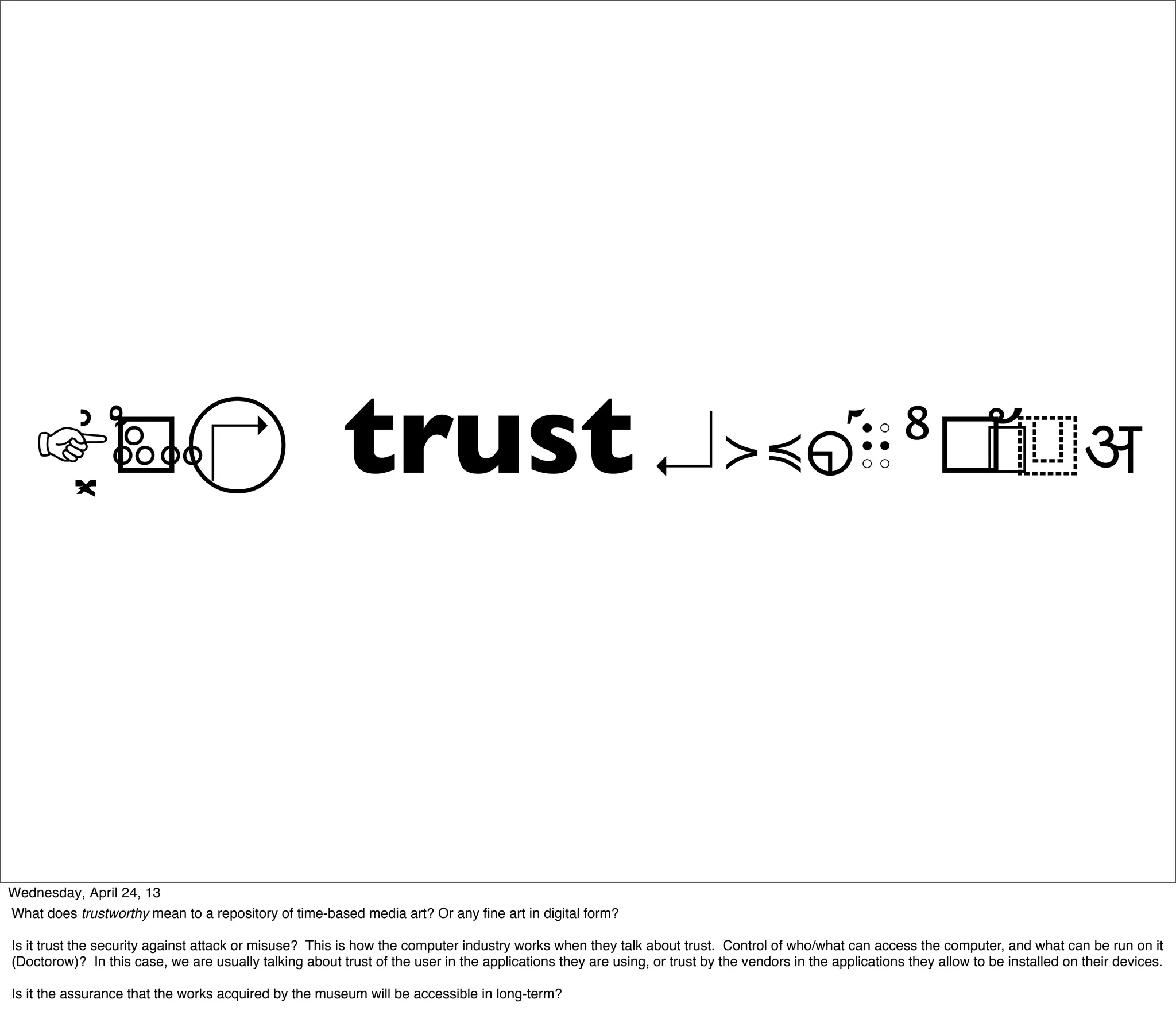
What does trustworthy mean to a repository of time-based media art? Or any fine art in digital form?

Is it trust the security against attack or misuse? This is how the computer industry works when they talk about trust. Control of who/what can access the computer, and what can be run on it
(Doctorow)? In this case, we are usually talking about trust of the user in the applications they are using, or trust by the vendors in the applications they allow to be installed on their devices.

Is it the assurance that the works acquired by the museum will be accessible in long-term?
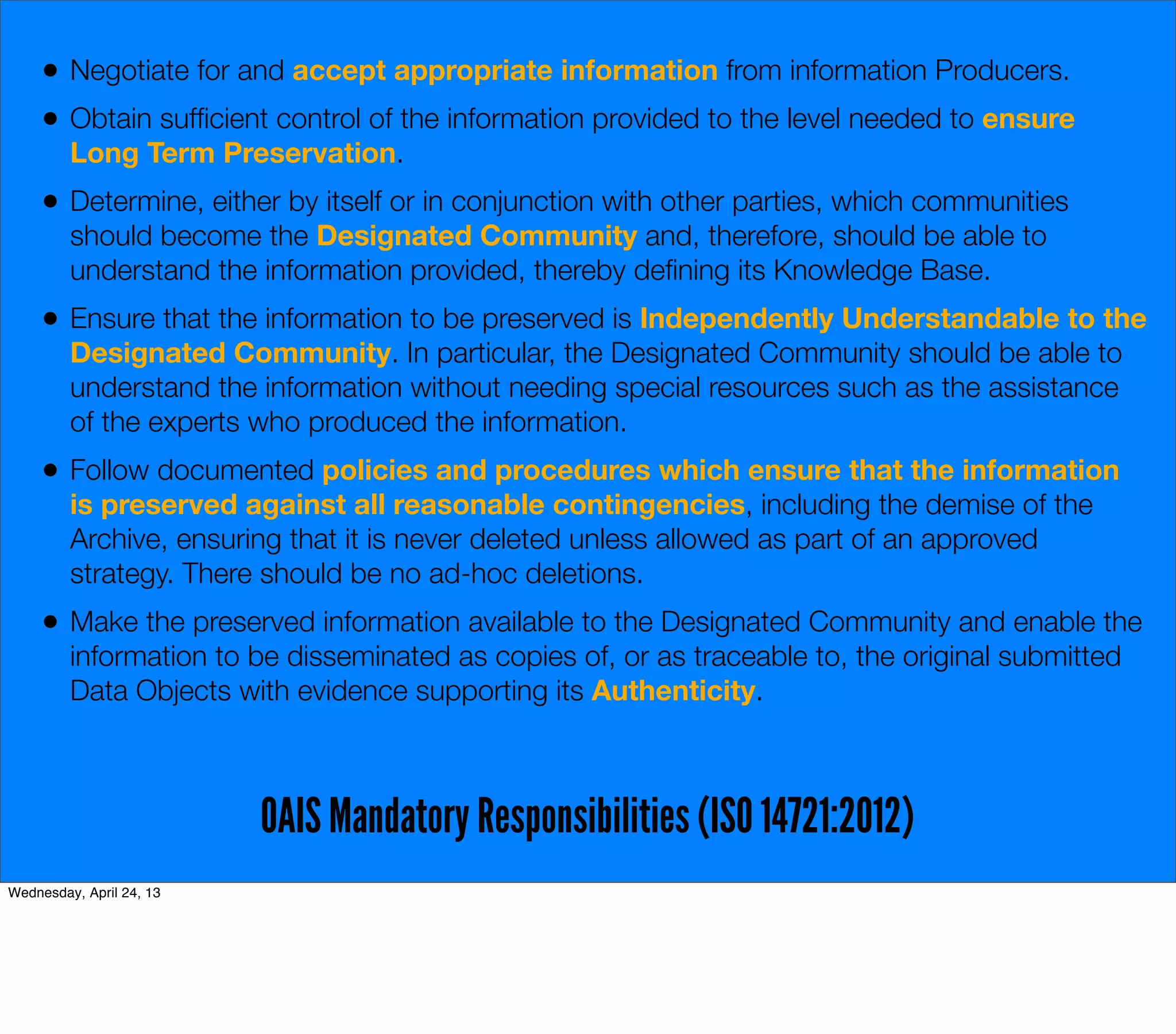
•   Negotiate for and accept appropriate information from information Producers.
     •   Obtain sufficient control of the information provided to the level needed to ensure
         Long Term Preservation.
     •   Determine, either by itself or in conjunction with other parties, which communities
         should become the Designated Community and, therefore, should be able to
         understand the information provided, thereby defining its Knowledge Base.
     •   Ensure that the information to be preserved is Independently Understandable to the
         Designated Community. In particular, the Designated Community should be able to
         understand the information without needing special resources such as the assistance
         of the experts who produced the information.
     •   Follow documented policies and procedures which ensure that the information
         is preserved against all reasonable contingencies, including the demise of the
         Archive, ensuring that it is never deleted unless allowed as part of an approved
         strategy. There should be no ad-hoc deletions.
     •   Make the preserved information available to the Designated Community and enable the
         information to be disseminated as copies of, or as traceable to, the original submitted
         Data Objects with evidence supporting its Authenticity.


                          OAIS Mandatory Responsibilities (ISO 14721:2012)
Wednesday, April 24, 13
1. How long is long-term?


Wednesday, April 24, 13
1. How long is long-term?
             2. What is meant by accessible?


Wednesday, April 24, 13
1. How long is long-term?
             2. What is meant by accessible?
             3. Whose trust do we need / who are we
                trusting?


Wednesday, April 24, 13
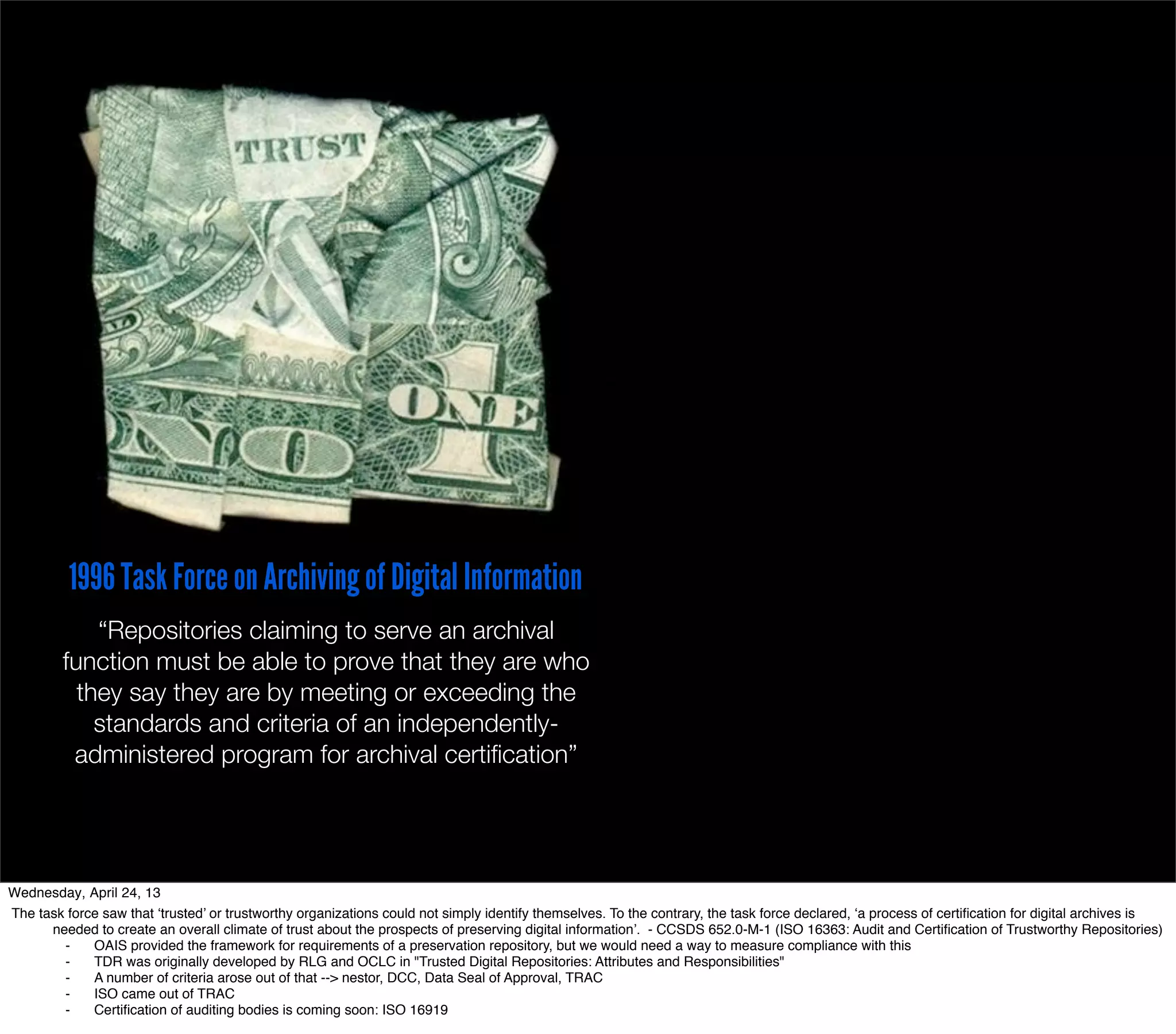
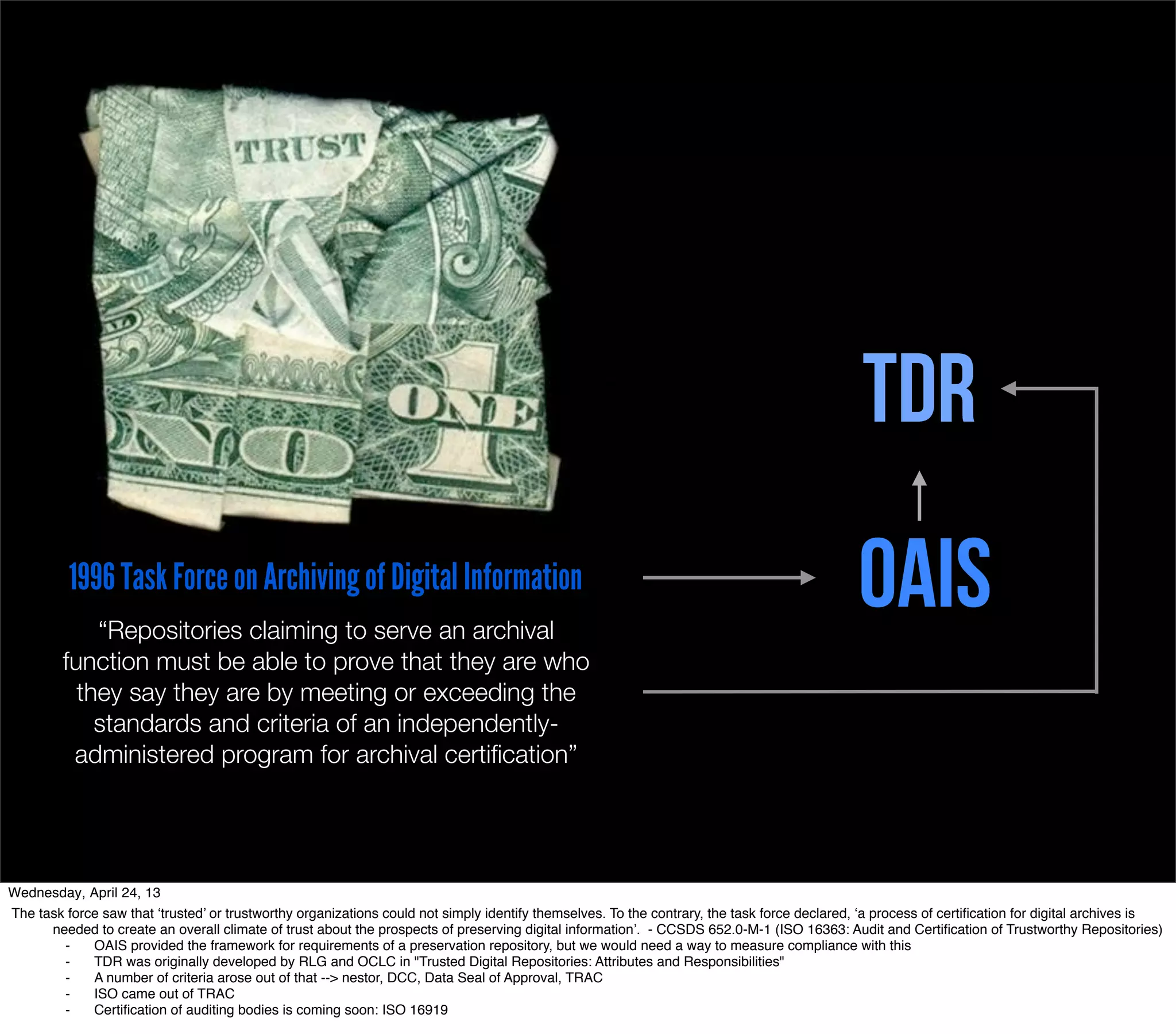
The task force saw that ‘trusted’ or trustworthy organizations could not simply identify themselves. To the contrary, the task force declared, ‘a process of certification for digital archives is
      needed to create an overall climate of trust about the prospects of preserving digital information’. - CCSDS 652.0-M-1 (ISO 16363: Audit and Certification of Trustworthy Repositories)
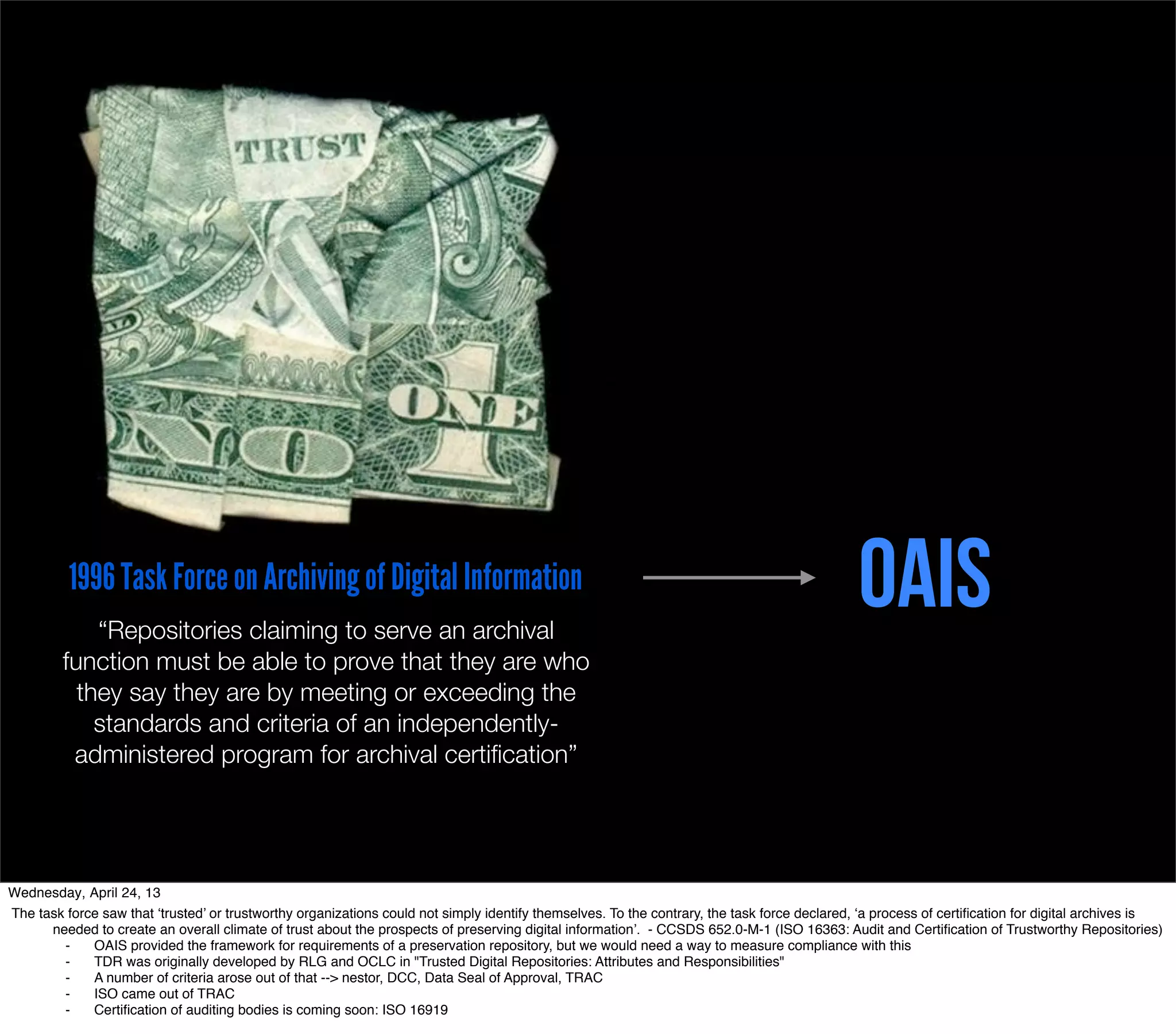
        ⁃    OAIS provided the framework for requirements of a preservation repository, but we would need a way to measure compliance with this
        ⁃    TDR was originally developed by RLG and OCLC in "Trusted Digital Repositories: Attributes and Responsibilities"
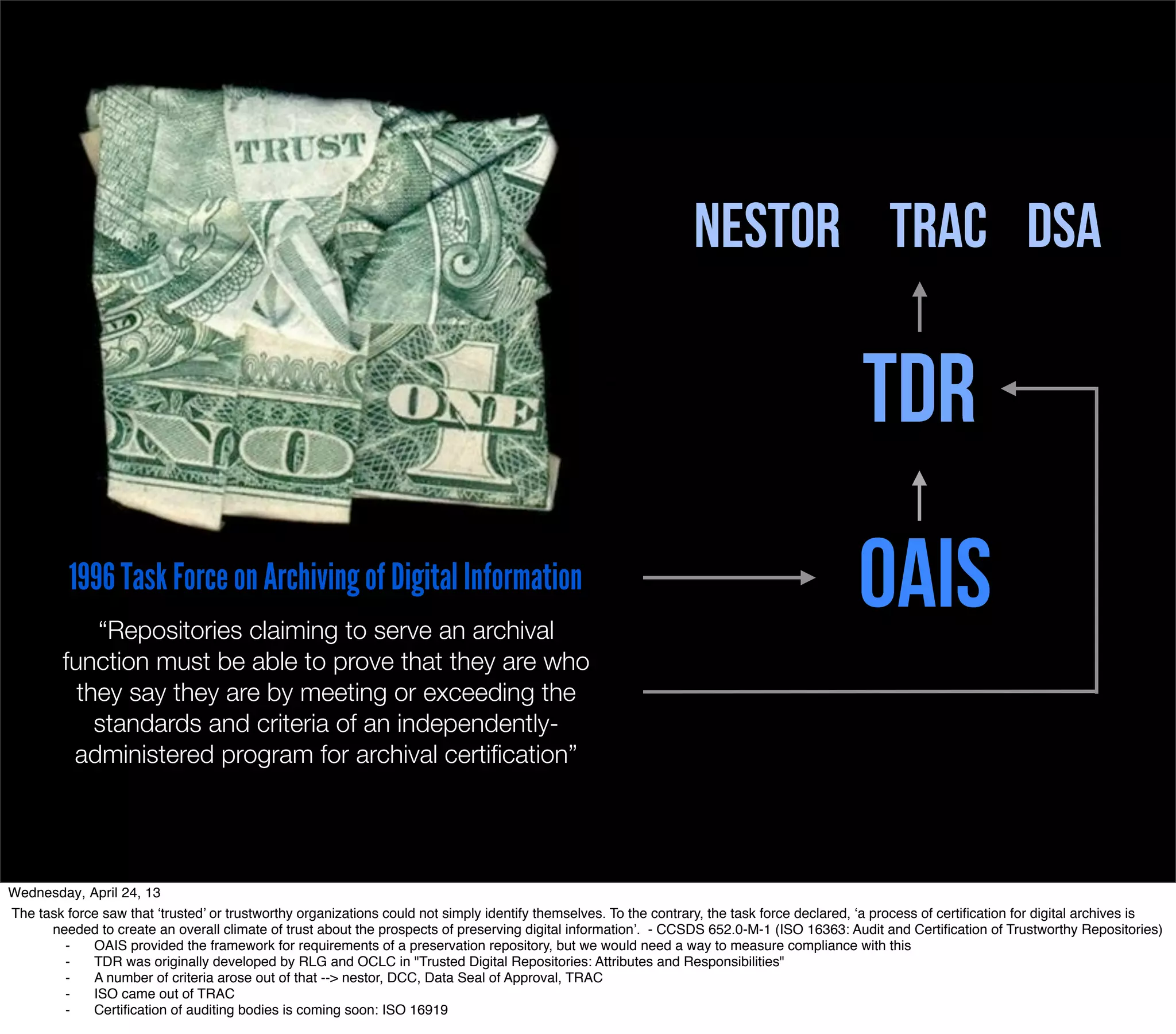
        ⁃    A number of criteria arose out of that --> nestor, DCC, Data Seal of Approval, TRAC
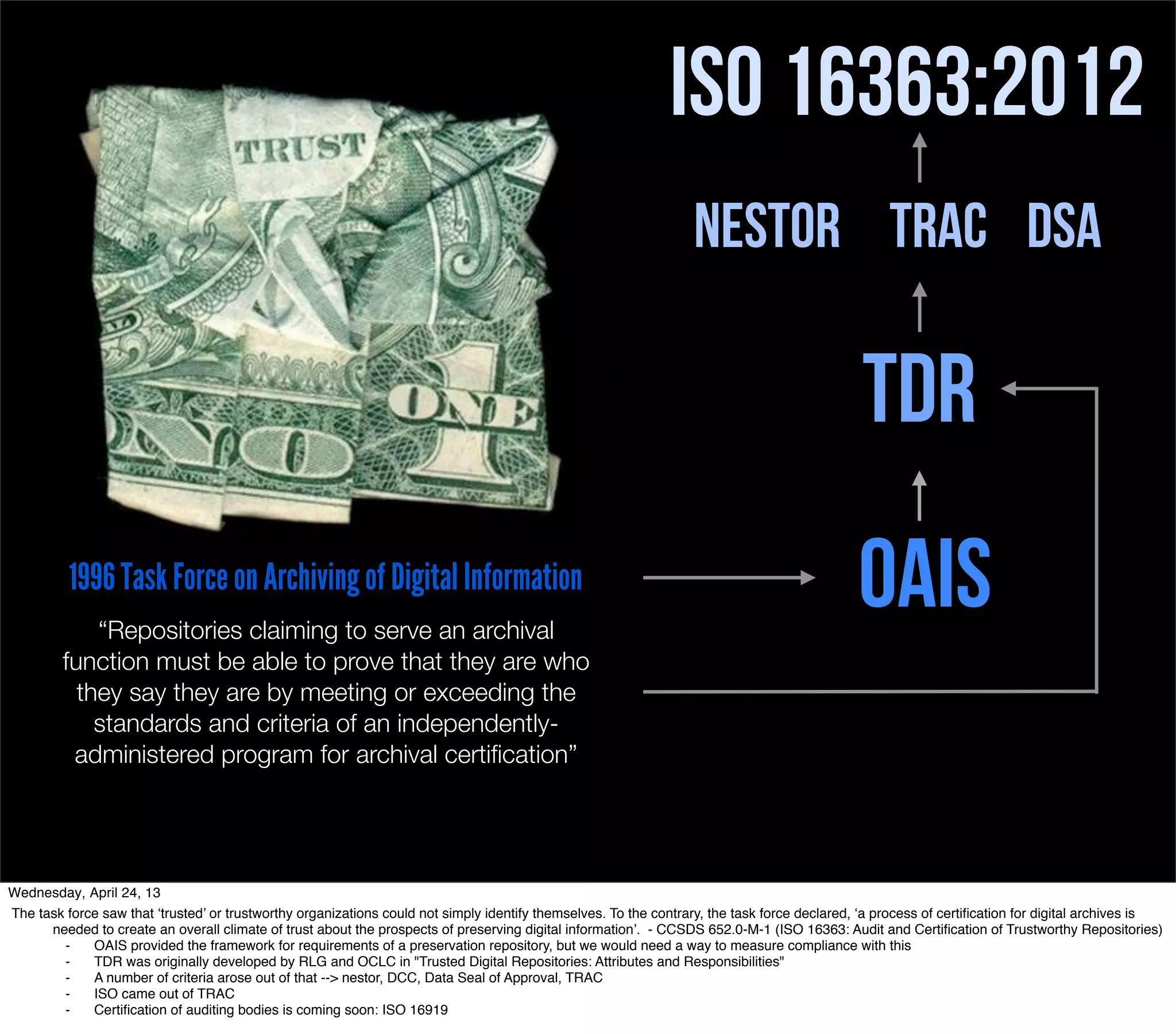
        ⁃    ISO came out of TRAC
        ⁃    Certification of auditing bodies is coming soon: ISO 16919
1996 Task Force on Archiving of Digital Information
             “Repositories claiming to serve an archival
         function must be able to prove that they are who
           they say they are by meeting or exceeding the
             standards and criteria of an independently-
          administered program for archival certification”


Wednesday, April 24, 13
The task force saw that ‘trusted’ or trustworthy organizations could not simply identify themselves. To the contrary, the task force declared, ‘a process of certification for digital archives is
      needed to create an overall climate of trust about the prospects of preserving digital information’. - CCSDS 652.0-M-1 (ISO 16363: Audit and Certification of Trustworthy Repositories)
        ⁃    OAIS provided the framework for requirements of a preservation repository, but we would need a way to measure compliance with this
        ⁃    TDR was originally developed by RLG and OCLC in "Trusted Digital Repositories: Attributes and Responsibilities"
        ⁃    A number of criteria arose out of that --> nestor, DCC, Data Seal of Approval, TRAC
        ⁃    ISO came out of TRAC
        ⁃    Certification of auditing bodies is coming soon: ISO 16919
1996 Task Force on Archiving of Digital Information
             “Repositories claiming to serve an archival
                                                                                                                                              OAIS
         function must be able to prove that they are who
           they say they are by meeting or exceeding the
             standards and criteria of an independently-
          administered program for archival certification”


Wednesday, April 24, 13
The task force saw that ‘trusted’ or trustworthy organizations could not simply identify themselves. To the contrary, the task force declared, ‘a process of certification for digital archives is
      needed to create an overall climate of trust about the prospects of preserving digital information’. - CCSDS 652.0-M-1 (ISO 16363: Audit and Certification of Trustworthy Repositories)
        ⁃    OAIS provided the framework for requirements of a preservation repository, but we would need a way to measure compliance with this
        ⁃    TDR was originally developed by RLG and OCLC in "Trusted Digital Repositories: Attributes and Responsibilities"
        ⁃    A number of criteria arose out of that --> nestor, DCC, Data Seal of Approval, TRAC
        ⁃    ISO came out of TRAC
        ⁃    Certification of auditing bodies is coming soon: ISO 16919
TDR
          1996 Task Force on Archiving of Digital Information
             “Repositories claiming to serve an archival
                                                                                                                                              OAIS
         function must be able to prove that they are who
           they say they are by meeting or exceeding the
             standards and criteria of an independently-
          administered program for archival certification”


Wednesday, April 24, 13
The task force saw that ‘trusted’ or trustworthy organizations could not simply identify themselves. To the contrary, the task force declared, ‘a process of certification for digital archives is
      needed to create an overall climate of trust about the prospects of preserving digital information’. - CCSDS 652.0-M-1 (ISO 16363: Audit and Certification of Trustworthy Repositories)
        ⁃    OAIS provided the framework for requirements of a preservation repository, but we would need a way to measure compliance with this
        ⁃    TDR was originally developed by RLG and OCLC in "Trusted Digital Repositories: Attributes and Responsibilities"
        ⁃    A number of criteria arose out of that --> nestor, DCC, Data Seal of Approval, TRAC
        ⁃    ISO came out of TRAC
        ⁃    Certification of auditing bodies is coming soon: ISO 16919
NESTOR TRAC DSA

                                                                                                                                              TDR
          1996 Task Force on Archiving of Digital Information
             “Repositories claiming to serve an archival
                                                                                                                                              OAIS
         function must be able to prove that they are who
           they say they are by meeting or exceeding the
             standards and criteria of an independently-
          administered program for archival certification”


Wednesday, April 24, 13
The task force saw that ‘trusted’ or trustworthy organizations could not simply identify themselves. To the contrary, the task force declared, ‘a process of certification for digital archives is
      needed to create an overall climate of trust about the prospects of preserving digital information’. - CCSDS 652.0-M-1 (ISO 16363: Audit and Certification of Trustworthy Repositories)
        ⁃    OAIS provided the framework for requirements of a preservation repository, but we would need a way to measure compliance with this
        ⁃    TDR was originally developed by RLG and OCLC in "Trusted Digital Repositories: Attributes and Responsibilities"
        ⁃    A number of criteria arose out of that --> nestor, DCC, Data Seal of Approval, TRAC
        ⁃    ISO came out of TRAC
        ⁃    Certification of auditing bodies is coming soon: ISO 16919
ISO 16363:2012
                                                                                                                  NESTOR TRAC DSA

                                                                                                                                              TDR
          1996 Task Force on Archiving of Digital Information
             “Repositories claiming to serve an archival
                                                                                                                                              OAIS
         function must be able to prove that they are who
           they say they are by meeting or exceeding the
             standards and criteria of an independently-
          administered program for archival certification”


Wednesday, April 24, 13
The task force saw that ‘trusted’ or trustworthy organizations could not simply identify themselves. To the contrary, the task force declared, ‘a process of certification for digital archives is
      needed to create an overall climate of trust about the prospects of preserving digital information’. - CCSDS 652.0-M-1 (ISO 16363: Audit and Certification of Trustworthy Repositories)
        ⁃    OAIS provided the framework for requirements of a preservation repository, but we would need a way to measure compliance with this
        ⁃    TDR was originally developed by RLG and OCLC in "Trusted Digital Repositories: Attributes and Responsibilities"
        ⁃    A number of criteria arose out of that --> nestor, DCC, Data Seal of Approval, TRAC
        ⁃    ISO came out of TRAC
        ⁃    Certification of auditing bodies is coming soon: ISO 16919
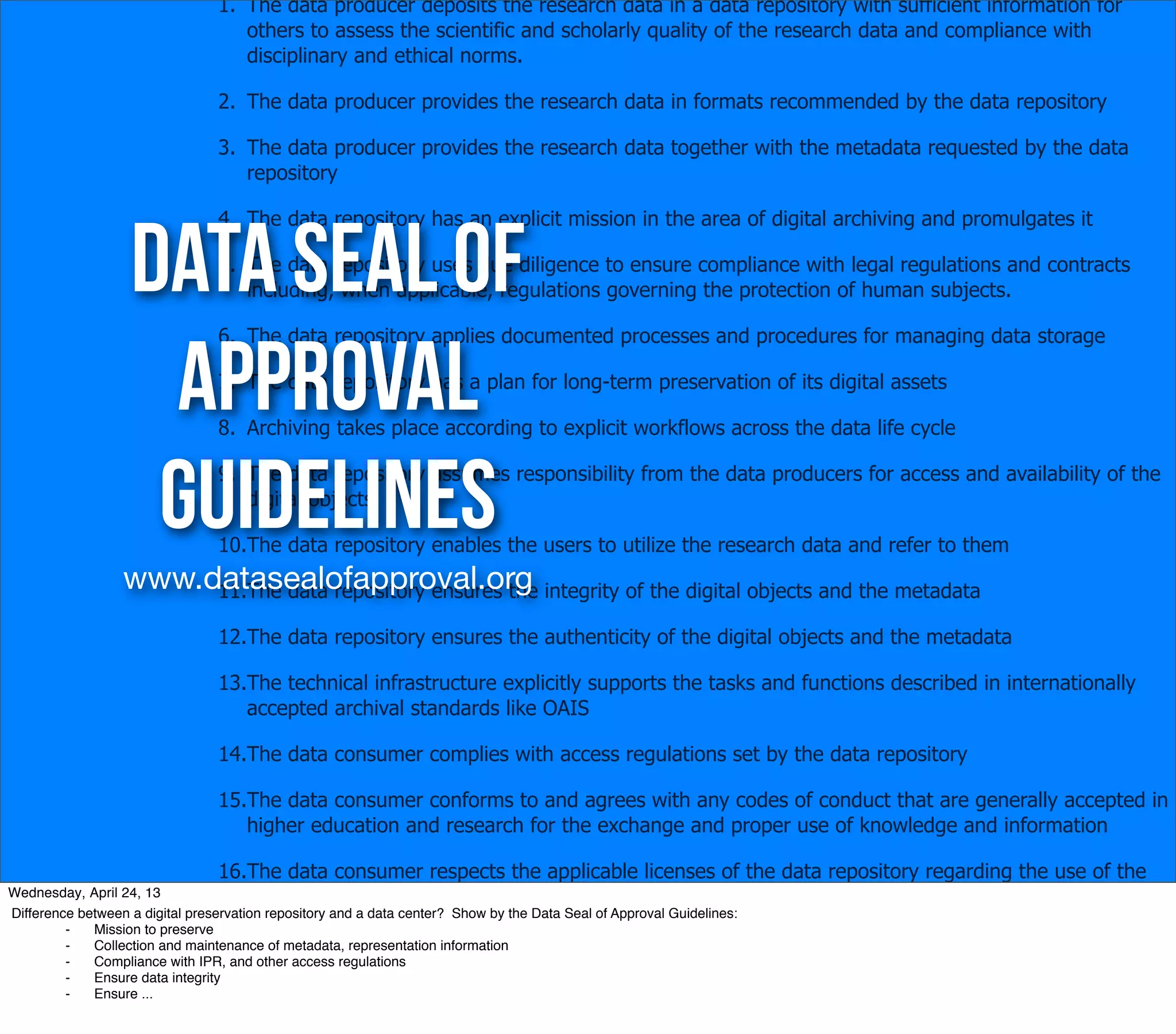
1. The data producer deposits the research data in a data repository with sufficient information for
                                    others to assess the scientific and scholarly quality of the research data and compliance with
                                    disciplinary and ethical norms.

                                 2. The data producer provides the research data in formats recommended by the data repository

                                 3. The data producer provides the research data together with the metadata requested by the data
                                    repository


                   Data Seal of
                                 4. The data repository has an explicit mission in the area of digital archiving and promulgates it

                                 5. The data repository uses due diligence to ensure compliance with legal regulations and contracts
                                    including, when applicable, regulations governing the protection of human subjects.


                    Approval
                                 6. The data repository applies documented processes and procedures for managing data storage

                                 7. The data repository has a plan for long-term preservation of its digital assets

                                 8. Archiving takes place according to explicit workflows across the data life cycle


                    Guidelines   9. The data repository assumes responsibility from the data producers for access and availability of the
                                    digital objects

                                 10.The data repository enables the users to utilize the research data and refer to them
                  www.datasealofapproval.org integrity of the digital objects and the metadata
                       11.The data repository ensures the

                                 12.The data repository ensures the authenticity of the digital objects and the metadata

                                 13.The technical infrastructure explicitly supports the tasks and functions described in internationally
                                    accepted archival standards like OAIS

                                 14.The data consumer complies with access regulations set by the data repository

                                 15.The data consumer conforms to and agrees with any codes of conduct that are generally accepted in
                                    higher education and research for the exchange and proper use of knowledge and information

                                 16.The data consumer respects the applicable licenses of the data repository regarding the use of the
Wednesday, April 24, 13             research data
Difference between a digital preservation repository and a data center? Show by the Data Seal of Approval Guidelines:
         ⁃   Mission to preserve
         ⁃   Collection and maintenance of metadata, representation information
         ⁃   Compliance with IPR, and other access regulations
         ⁃   Ensure data integrity
         ⁃   Ensure ...
ISO                                                                                                                TRAC


Wednesday, April 24, 13

Let's take a moment to recognize that the ISO standards that are the bookends of this story were developed by the space
     science data community. Research libraries in many ways lead the charge in audit and certification. Currently, the only
     "official" certification body is CRL, for TRAC. 4 repositories have received certification.

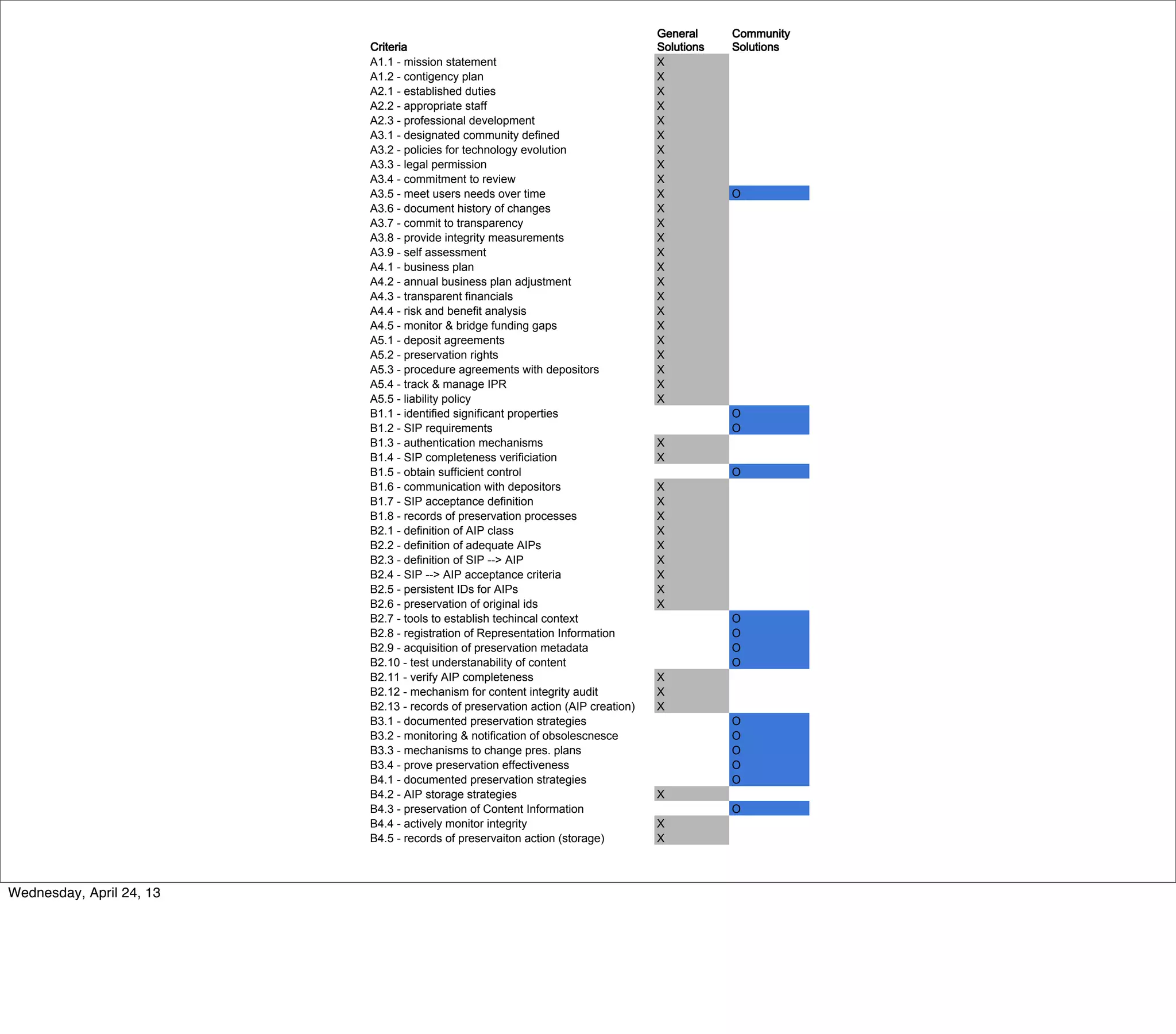
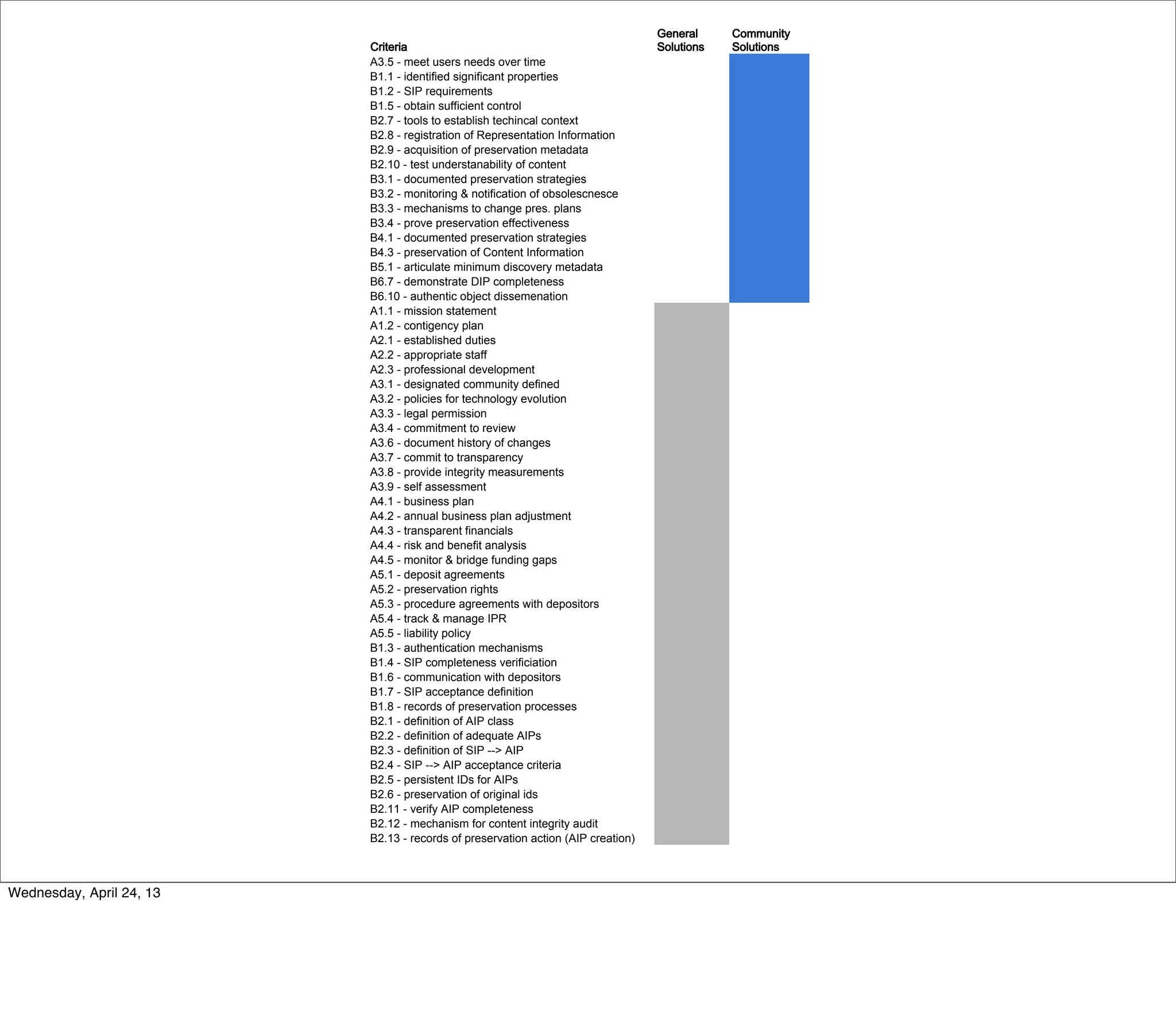
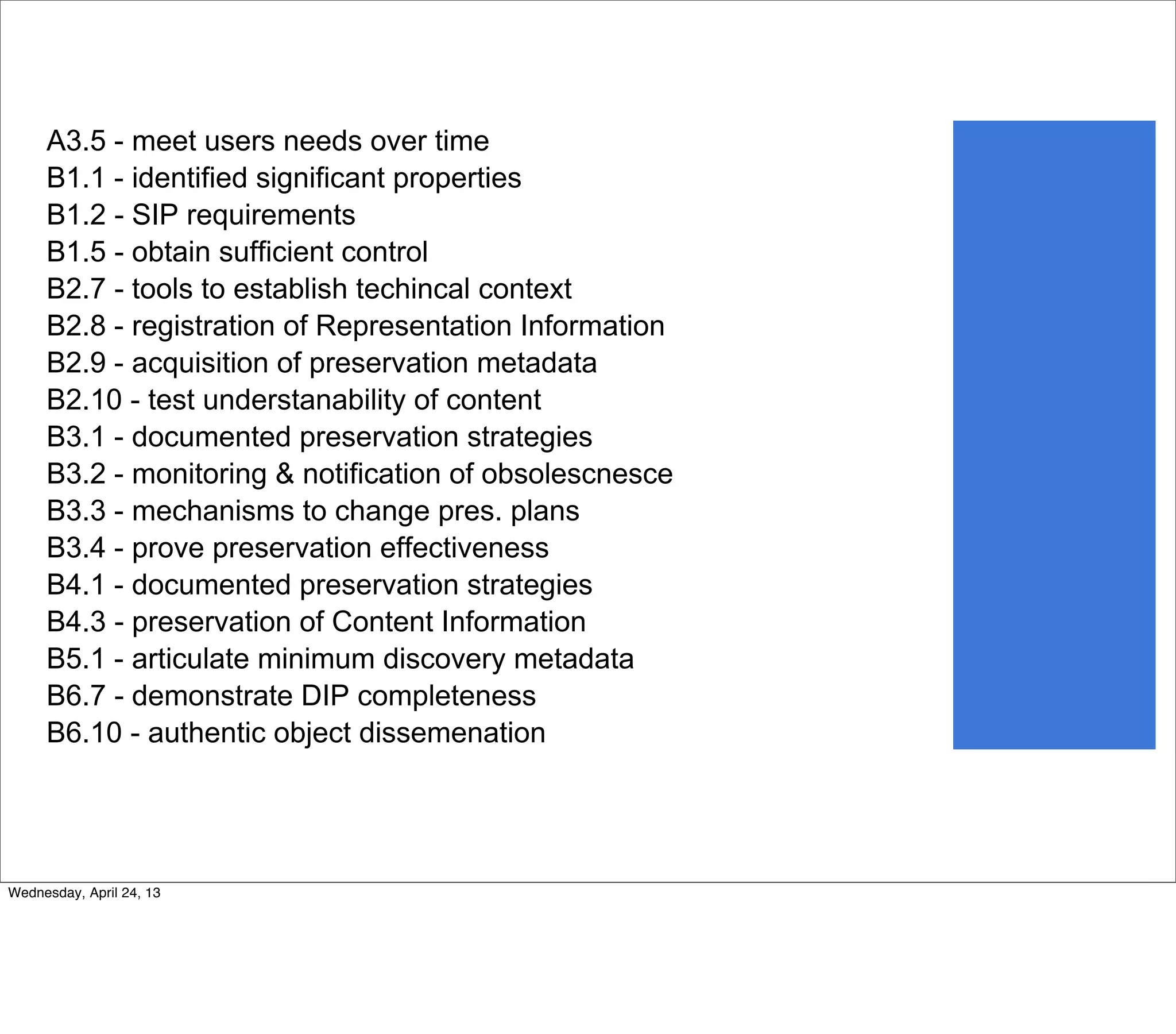
Let's use TRAC for the purposes of this discussion - it provides a broadly applicable set of criteria that has to fit the context. It tells us what are the responsibilities
ISO                                                                                                                TRAC


Wednesday, April 24, 13

Let's take a moment to recognize that the ISO standards that are the bookends of this story were developed by the space
     science data community. Research libraries in many ways lead the charge in audit and certification. Currently, the only
     "official" certification body is CRL, for TRAC. 4 repositories have received certification.

Let's use TRAC for the purposes of this discussion - it provides a broadly applicable set of criteria that has to fit the context. It tells us what are the responsibilities
ISO                                                                                                                TRAC


Wednesday, April 24, 13

Let's take a moment to recognize that the ISO standards that are the bookends of this story were developed by the space
     science data community. Research libraries in many ways lead the charge in audit and certification. Currently, the only
     "official" certification body is CRL, for TRAC. 4 repositories have received certification.

Let's use TRAC for the purposes of this discussion - it provides a broadly applicable set of criteria that has to fit the context. It tells us what are the responsibilities
Wednesday, April 24, 13
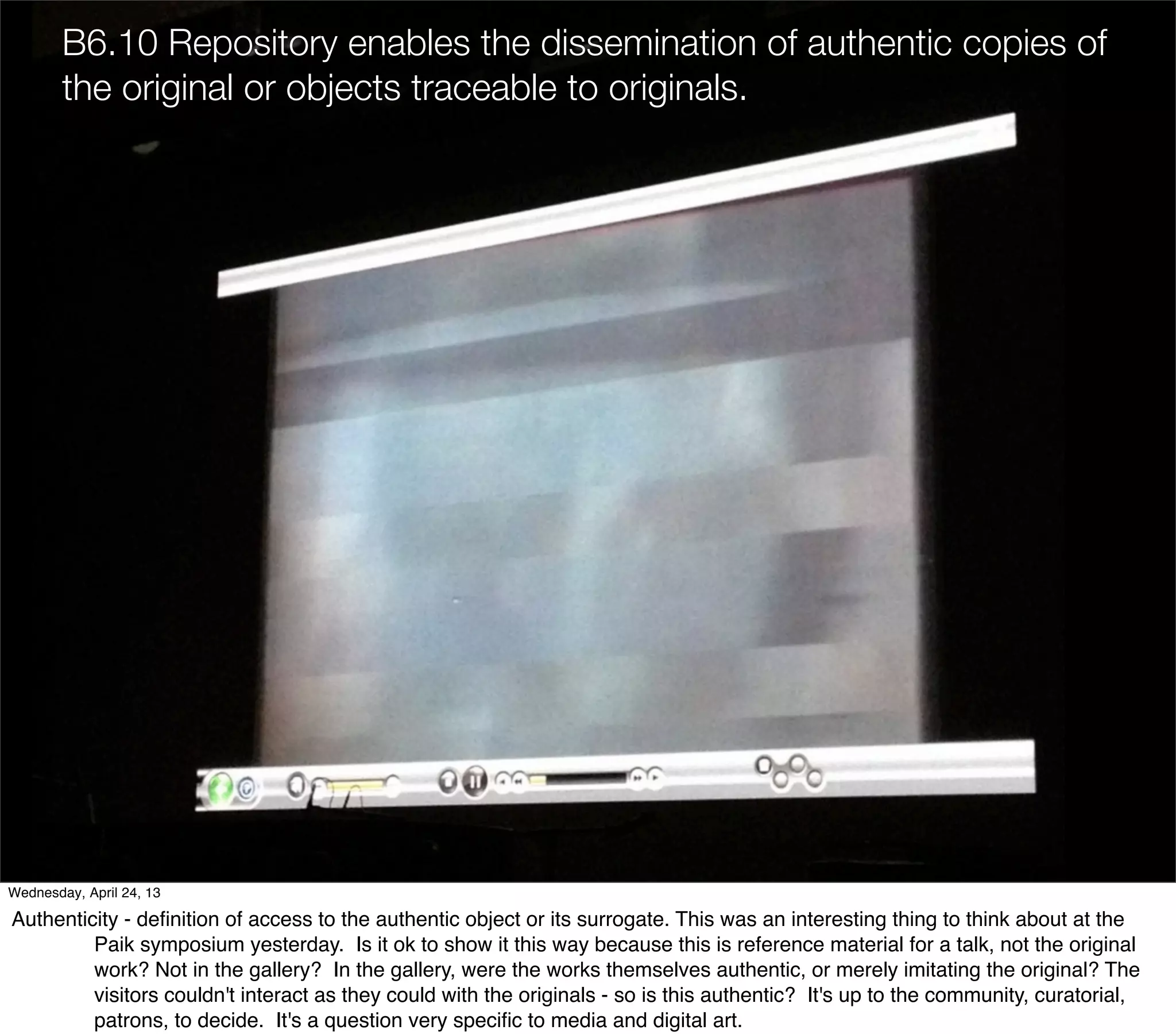
B6.10 Repository enables the dissemination of authentic copies of
        the original or objects traceable to originals.


Wednesday, April 24, 13

Authenticity - definition of access to the authentic object or its surrogate. This was an interesting thing to think about at the
         Paik symposium yesterday. Is it ok to show it this way because this is reference material for a talk, not the original
         work? Not in the gallery? In the gallery, were the works themselves authentic, or merely imitating the original? The
         visitors couldn't interact as they could with the originals - so is this authentic? It's up to the community, curatorial,
         patrons, to decide. It's a question very specific to media and digital art.
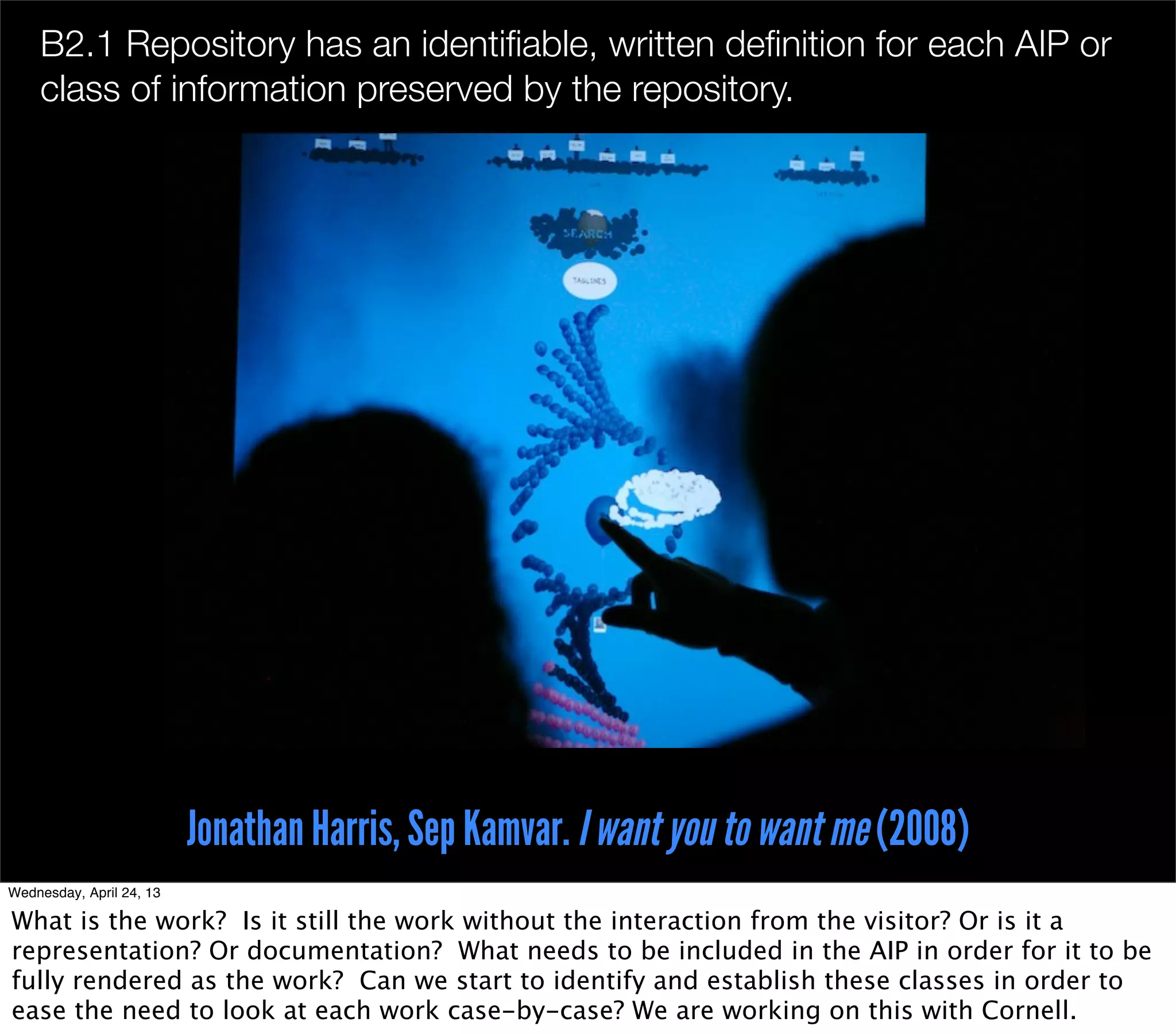
B2.1 Repository has an identifiable, written definition for each AIP or
    class of information preserved by the repository.


                          Jonathan Harris, Sep Kamvar. I want you to want me (2008)
Wednesday, April 24, 13

What is the work? Is it still the work without the interaction from the visitor? Or is it a
representation? Or documentation? What needs to be included in the AIP in order for it to be
fully rendered as the work? Can we start to identify and establish these classes in order to
ease the need to look at each work case-by-case? We are working on this with Cornell.
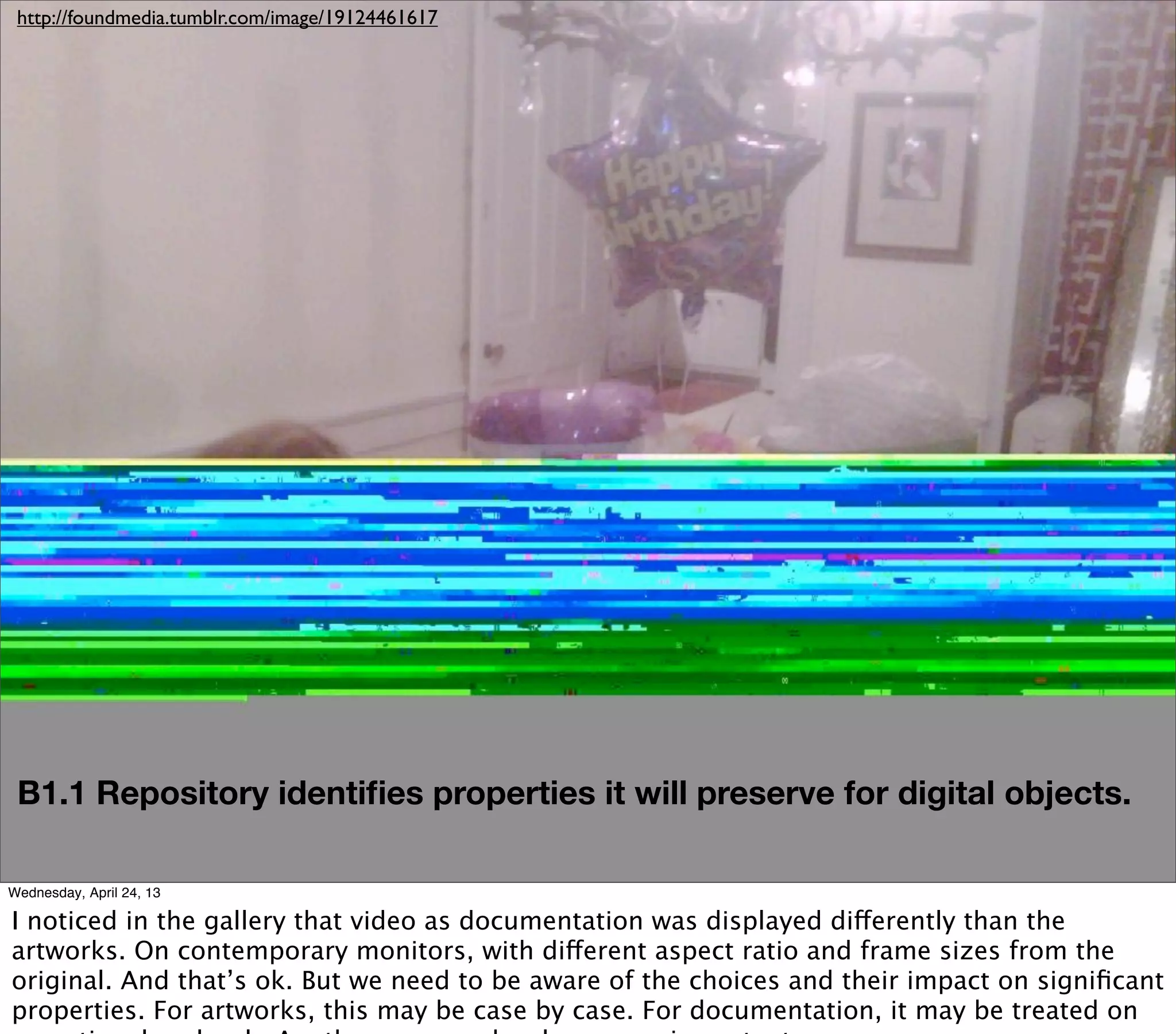
http://foundmedia.tumblr.com/image/19124461617


 B1.1 Repository identifies properties it will preserve for digital objects.

Wednesday, April 24, 13

I noticed in the gallery that video as documentation was displayed differently than the
artworks. On contemporary monitors, with different aspect ratio and frame sizes from the
original. And that’s ok. But we need to be aware of the choices and their impact on significant
properties. For artworks, this may be case by case. For documentation, it may be treated on
Wednesday, April 24, 13
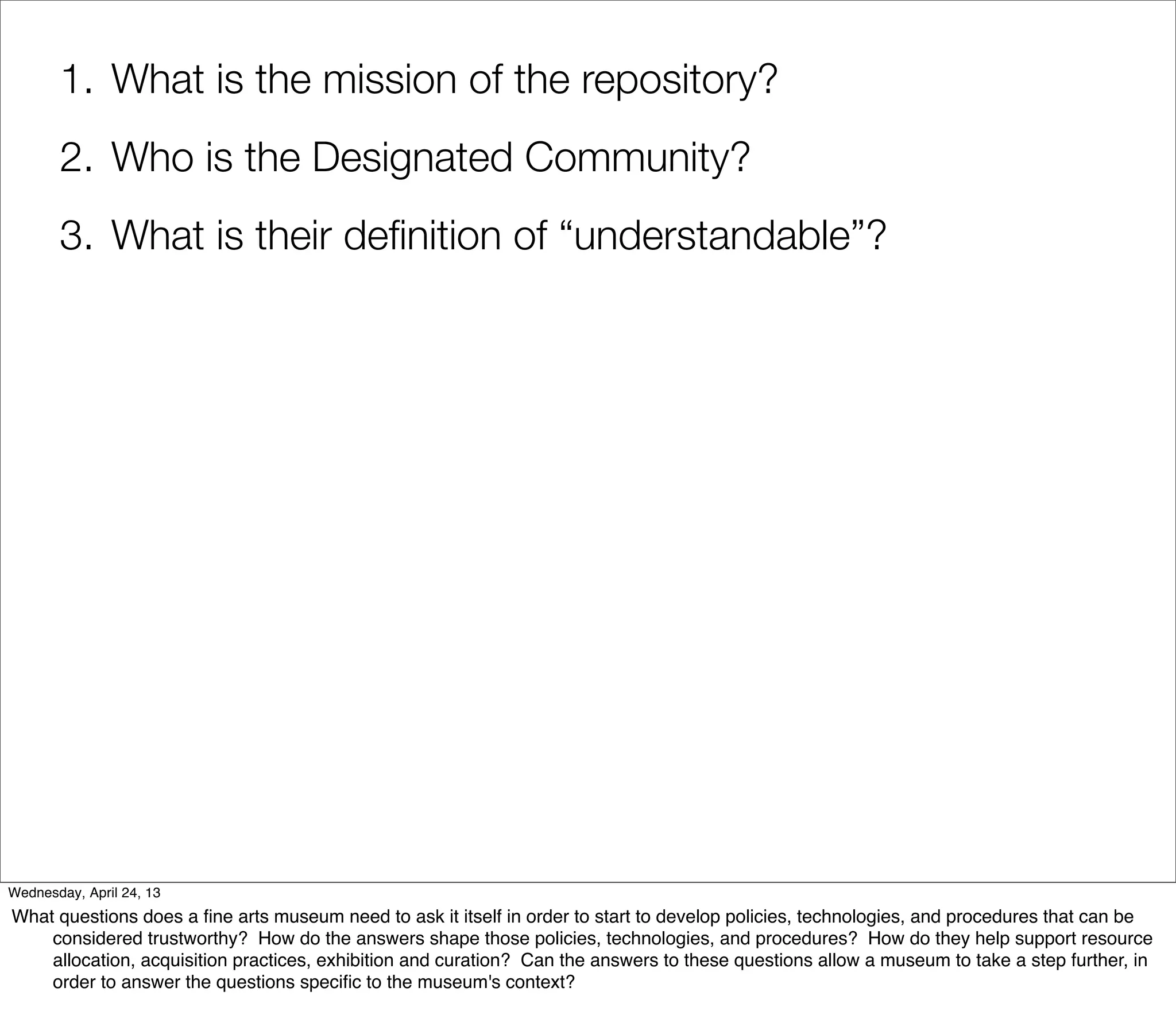
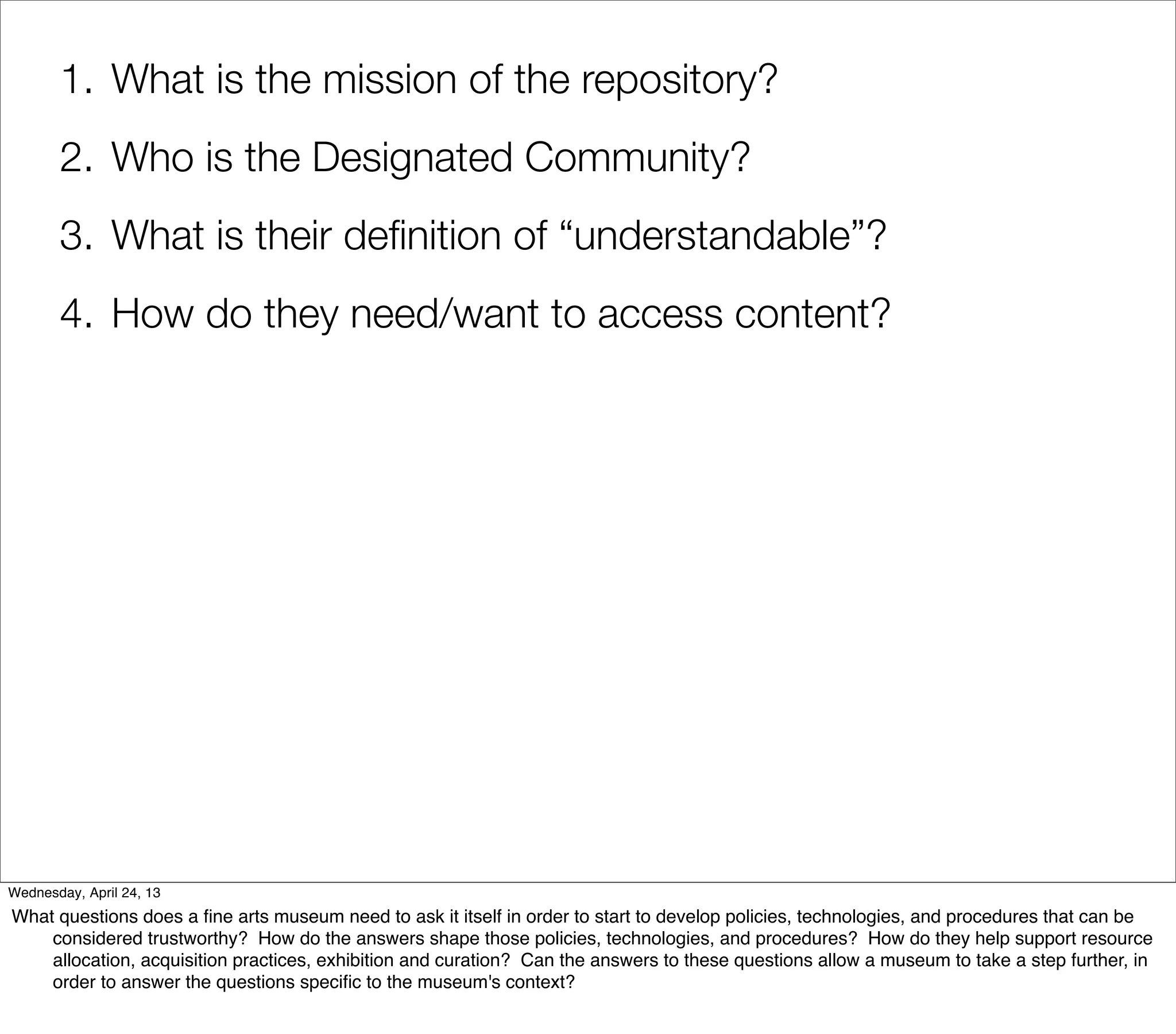
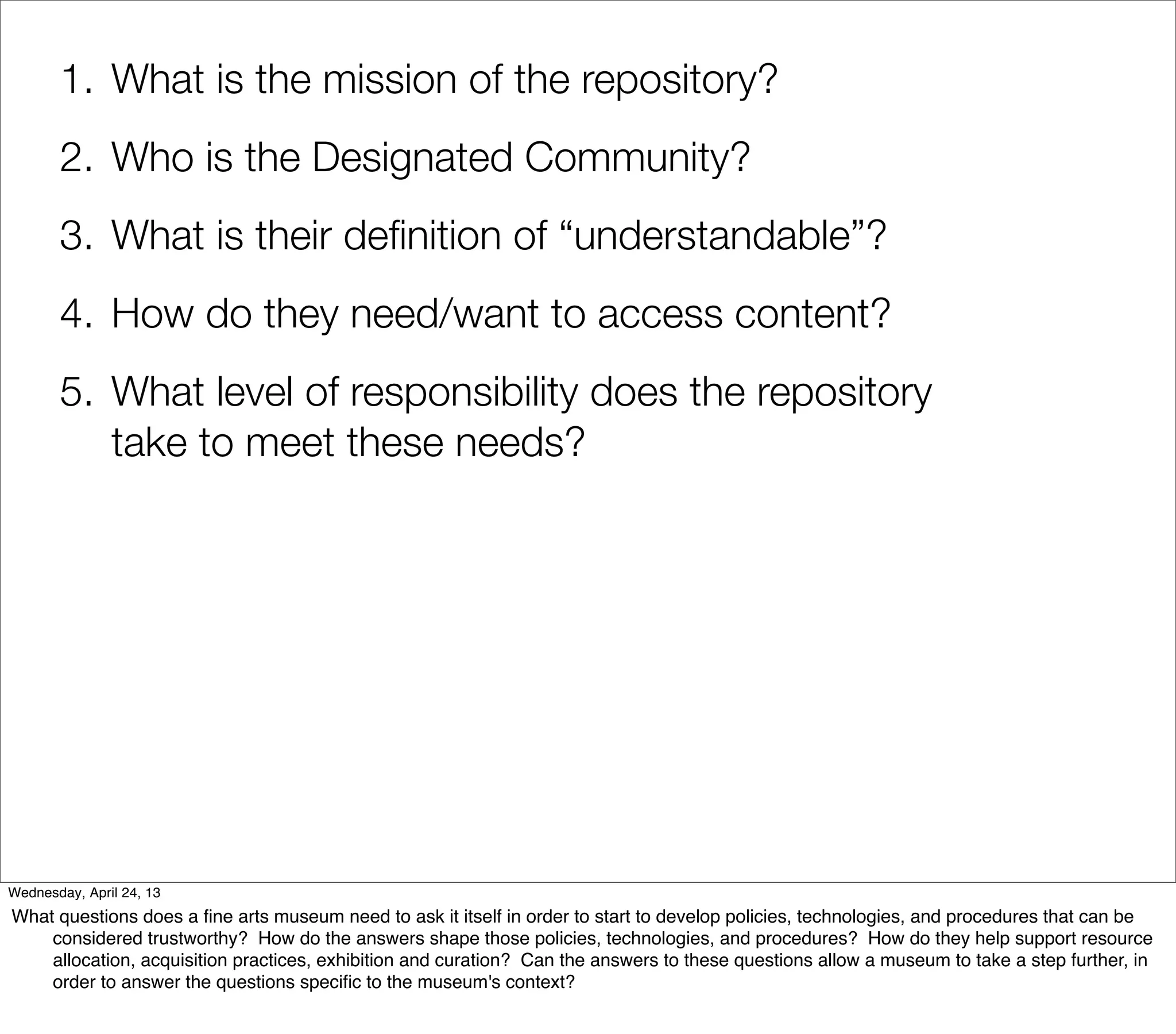
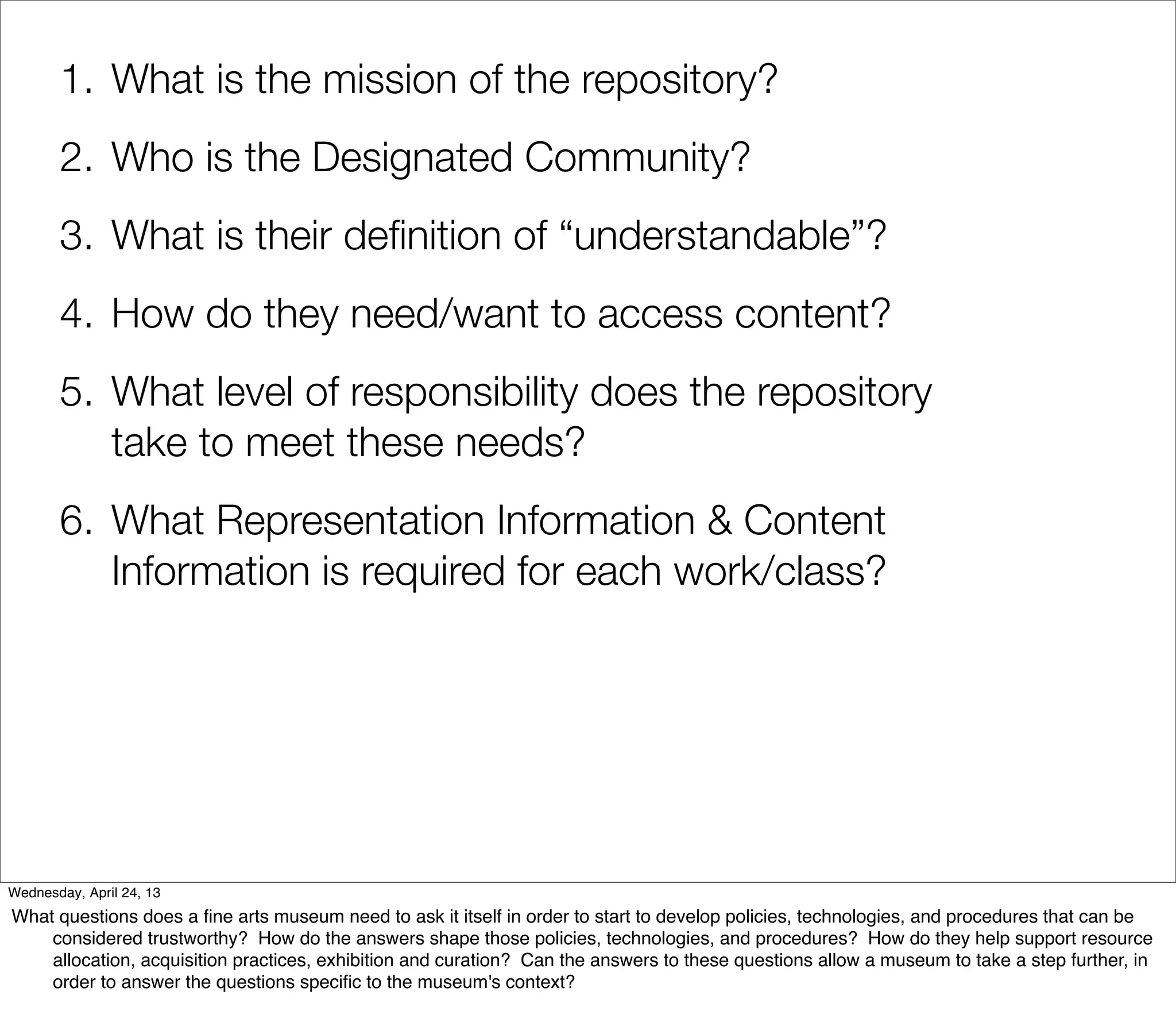
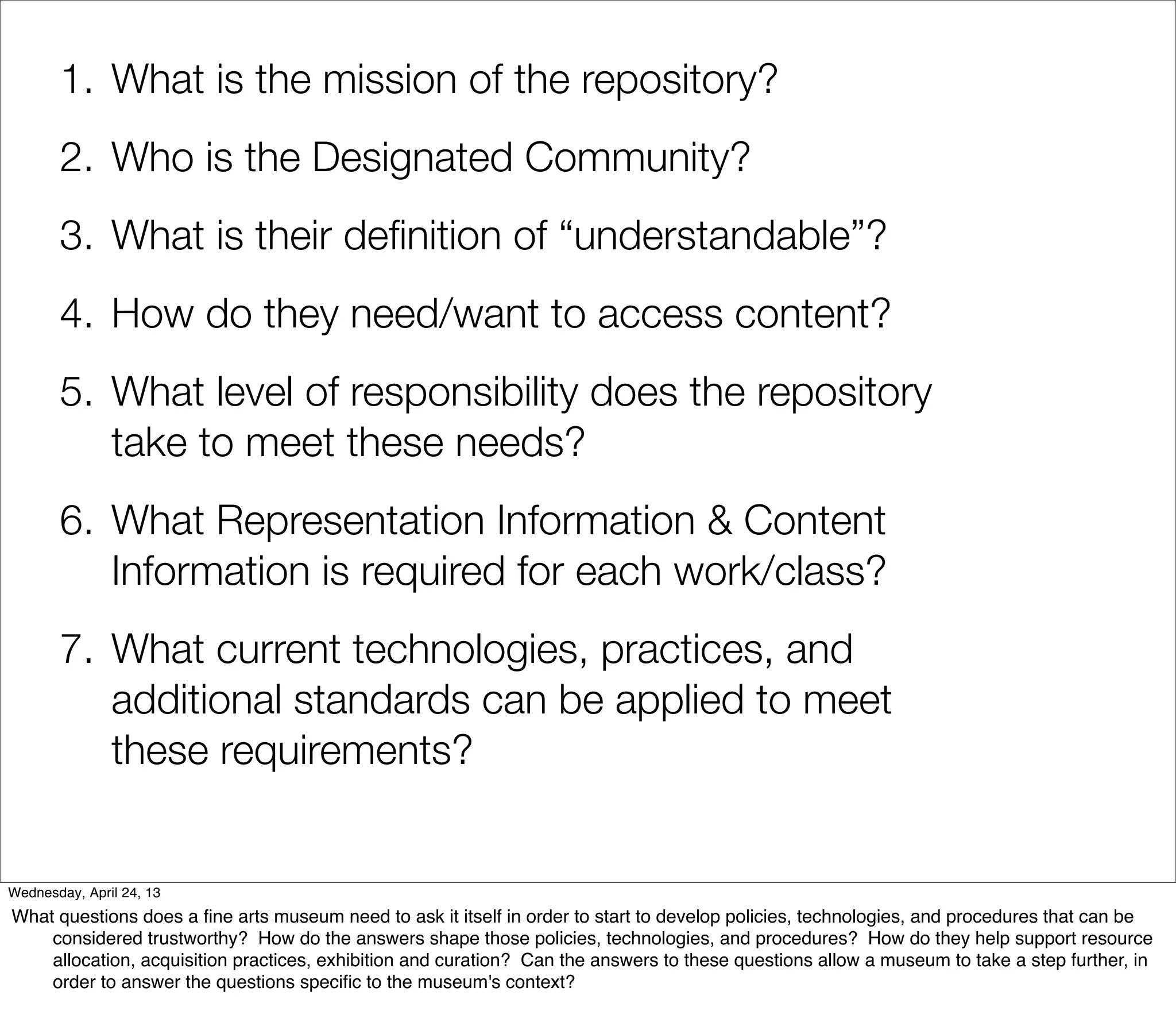
What questions does a fine arts museum need to ask it itself in order to start to develop policies, technologies, and procedures that can be
    considered trustworthy? How do the answers shape those policies, technologies, and procedures? How do they help support resource
    allocation, acquisition practices, exhibition and curation? Can the answers to these questions allow a museum to take a step further, in
    order to answer the questions specific to the museum's context?
1. What is the mission of the repository?


Wednesday, April 24, 13
What questions does a fine arts museum need to ask it itself in order to start to develop policies, technologies, and procedures that can be
    considered trustworthy? How do the answers shape those policies, technologies, and procedures? How do they help support resource
    allocation, acquisition practices, exhibition and curation? Can the answers to these questions allow a museum to take a step further, in
    order to answer the questions specific to the museum's context?
1. What is the mission of the repository?
       2. Who is the Designated Community?


Wednesday, April 24, 13
What questions does a fine arts museum need to ask it itself in order to start to develop policies, technologies, and procedures that can be
    considered trustworthy? How do the answers shape those policies, technologies, and procedures? How do they help support resource
    allocation, acquisition practices, exhibition and curation? Can the answers to these questions allow a museum to take a step further, in
    order to answer the questions specific to the museum's context?
1. What is the mission of the repository?
       2. Who is the Designated Community?
       3. What is their definition of “understandable”?


Wednesday, April 24, 13
What questions does a fine arts museum need to ask it itself in order to start to develop policies, technologies, and procedures that can be
    considered trustworthy? How do the answers shape those policies, technologies, and procedures? How do they help support resource
    allocation, acquisition practices, exhibition and curation? Can the answers to these questions allow a museum to take a step further, in
    order to answer the questions specific to the museum's context?
1. What is the mission of the repository?
       2. Who is the Designated Community?
       3. What is their definition of “understandable”?
       4. How do they need/want to access content?


Wednesday, April 24, 13
What questions does a fine arts museum need to ask it itself in order to start to develop policies, technologies, and procedures that can be
    considered trustworthy? How do the answers shape those policies, technologies, and procedures? How do they help support resource
    allocation, acquisition practices, exhibition and curation? Can the answers to these questions allow a museum to take a step further, in
    order to answer the questions specific to the museum's context?
1. What is the mission of the repository?
       2. Who is the Designated Community?
       3. What is their definition of “understandable”?
       4. How do they need/want to access content?
       5. What level of responsibility does the repository
          take to meet these needs?


Wednesday, April 24, 13
What questions does a fine arts museum need to ask it itself in order to start to develop policies, technologies, and procedures that can be
    considered trustworthy? How do the answers shape those policies, technologies, and procedures? How do they help support resource
    allocation, acquisition practices, exhibition and curation? Can the answers to these questions allow a museum to take a step further, in
    order to answer the questions specific to the museum's context?
1. What is the mission of the repository?
       2. Who is the Designated Community?
       3. What is their definition of “understandable”?
       4. How do they need/want to access content?
       5. What level of responsibility does the repository
          take to meet these needs?
       6. What Representation Information & Content
          Information is required for each work/class?


Wednesday, April 24, 13
What questions does a fine arts museum need to ask it itself in order to start to develop policies, technologies, and procedures that can be
    considered trustworthy? How do the answers shape those policies, technologies, and procedures? How do they help support resource
    allocation, acquisition practices, exhibition and curation? Can the answers to these questions allow a museum to take a step further, in
    order to answer the questions specific to the museum's context?
1. What is the mission of the repository?
       2. Who is the Designated Community?
       3. What is their definition of “understandable”?
       4. How do they need/want to access content?
       5. What level of responsibility does the repository
          take to meet these needs?
       6. What Representation Information & Content
          Information is required for each work/class?
       7. What current technologies, practices, and
          additional standards can be applied to meet
          these requirements?


Wednesday, April 24, 13
What questions does a fine arts museum need to ask it itself in order to start to develop policies, technologies, and procedures that can be
    considered trustworthy? How do the answers shape those policies, technologies, and procedures? How do they help support resource
    allocation, acquisition practices, exhibition and curation? Can the answers to these questions allow a museum to take a step further, in
    order to answer the questions specific to the museum's context?
1. What is the mission of the repository?
       2. Who is the Designated Community?
       3. What is their definition of “understandable”?
       4. How do they need/want to access content?
       5. What level of responsibility does the repository
          take to meet these needs?
       6. What Representation Information & Content
          Information is required for each work/class?
       7. What current technologies, practices, and
          additional standards can be applied to meet
          these requirements?


Wednesday, April 24, 13
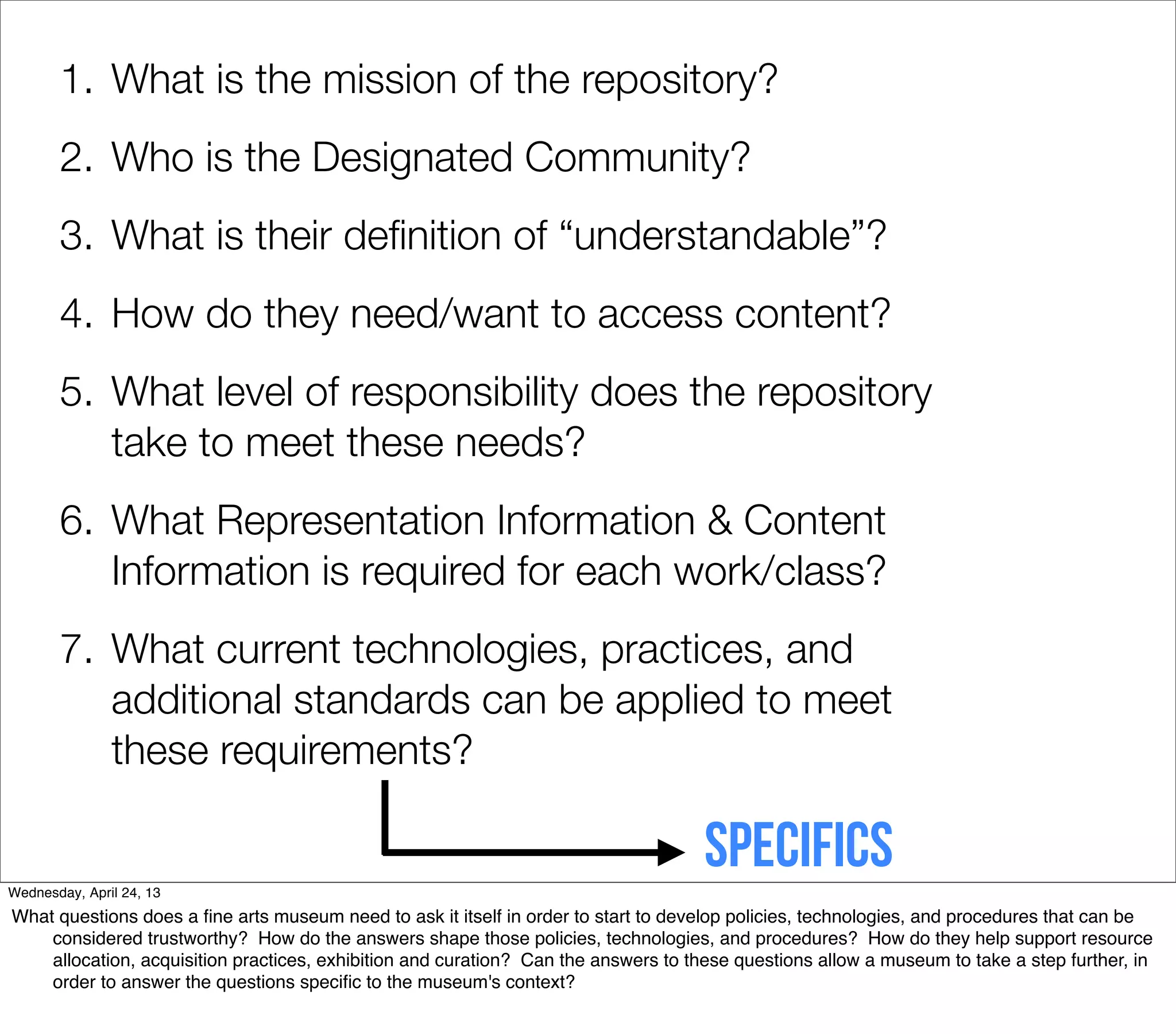
                                                                                    Specifics
What questions does a fine arts museum need to ask it itself in order to start to develop policies, technologies, and procedures that can be
    considered trustworthy? How do the answers shape those policies, technologies, and procedures? How do they help support resource
    allocation, acquisition practices, exhibition and curation? Can the answers to these questions allow a museum to take a step further, in
    order to answer the questions specific to the museum's context?
Wednesday, April 24, 13
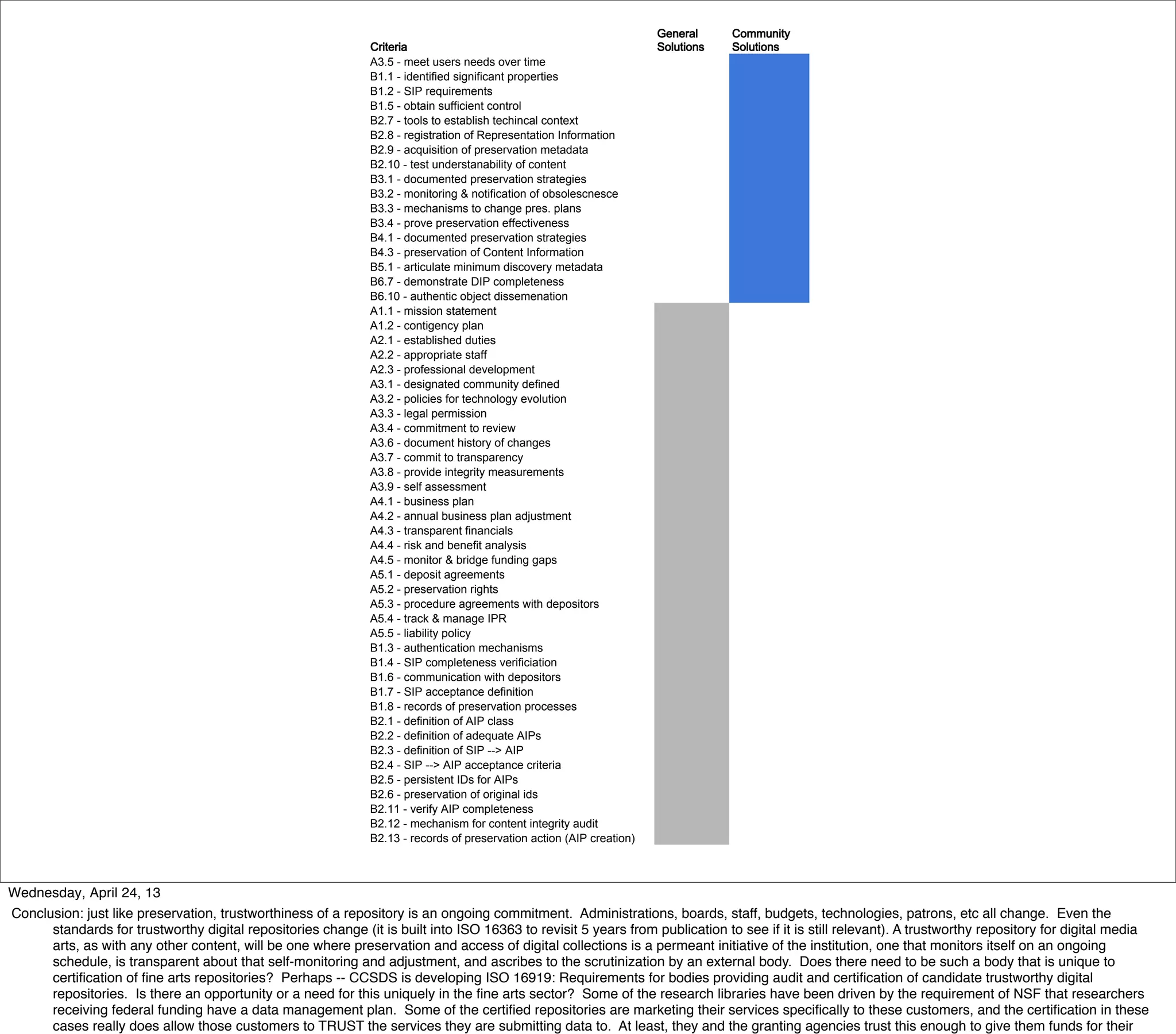
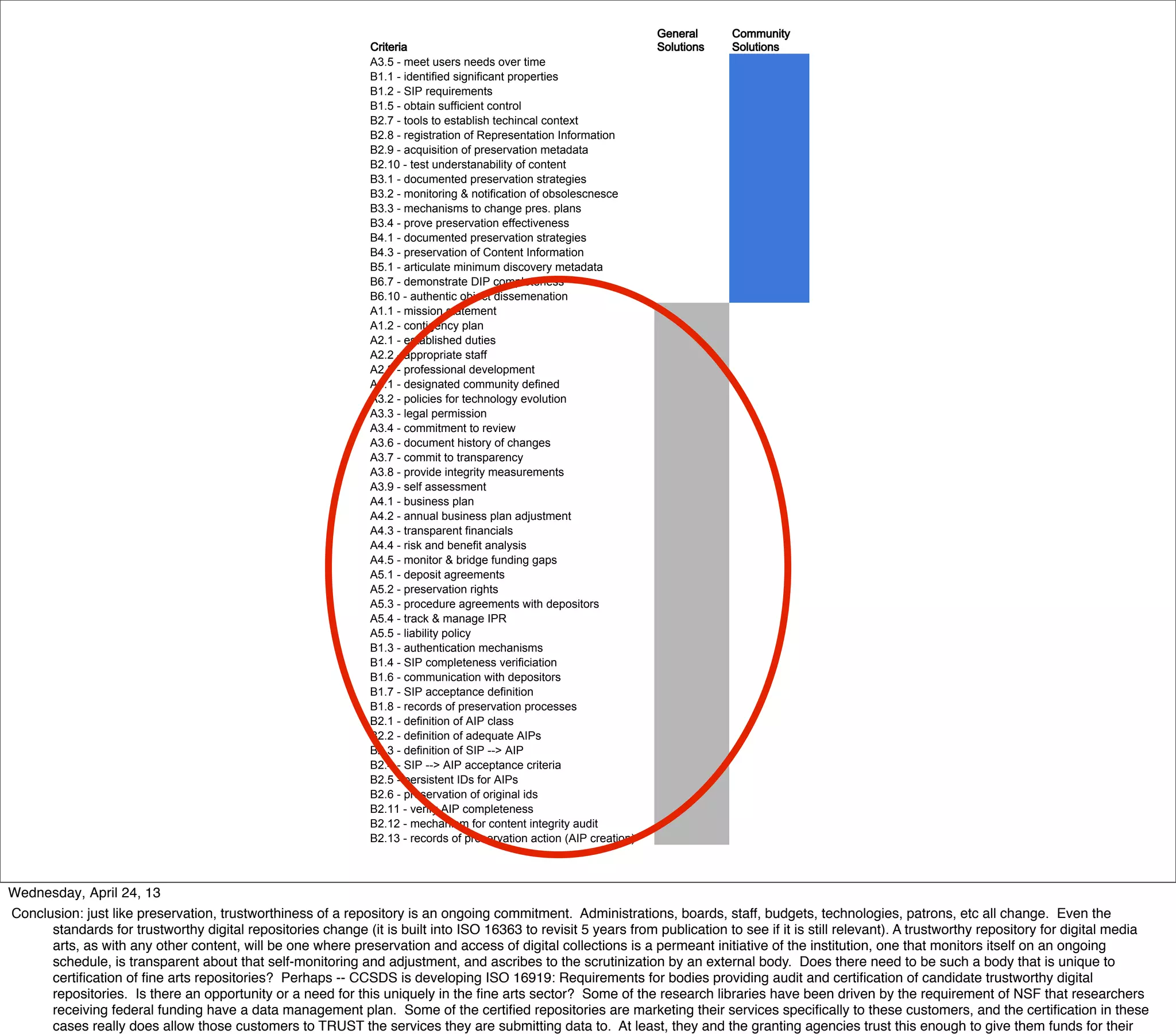
Conclusion: just like preservation, trustworthiness of a repository is an ongoing commitment. Administrations, boards, staff, budgets, technologies, patrons, etc all change. Even the
      standards for trustworthy digital repositories change (it is built into ISO 16363 to revisit 5 years from publication to see if it is still relevant). A trustworthy repository for digital media
      arts, as with any other content, will be one where preservation and access of digital collections is a permeant initiative of the institution, one that monitors itself on an ongoing
      schedule, is transparent about that self-monitoring and adjustment, and ascribes to the scrutinization by an external body. Does there need to be such a body that is unique to
      certification of fine arts repositories? Perhaps -- CCSDS is developing ISO 16919: Requirements for bodies providing audit and certification of candidate trustworthy digital
      repositories. Is there an opportunity or a need for this uniquely in the fine arts sector? Some of the research libraries have been driven by the requirement of NSF that researchers
      receiving federal funding have a data management plan. Some of the certified repositories are marketing their services specifically to these customers, and the certification in these
      cases really does allow those customers to TRUST the services they are submitting data to. At least, they and the granting agencies trust this enough to give them funds for their
Wednesday, April 24, 13
Conclusion: just like preservation, trustworthiness of a repository is an ongoing commitment. Administrations, boards, staff, budgets, technologies, patrons, etc all change. Even the
      standards for trustworthy digital repositories change (it is built into ISO 16363 to revisit 5 years from publication to see if it is still relevant). A trustworthy repository for digital media
      arts, as with any other content, will be one where preservation and access of digital collections is a permeant initiative of the institution, one that monitors itself on an ongoing
      schedule, is transparent about that self-monitoring and adjustment, and ascribes to the scrutinization by an external body. Does there need to be such a body that is unique to
      certification of fine arts repositories? Perhaps -- CCSDS is developing ISO 16919: Requirements for bodies providing audit and certification of candidate trustworthy digital
      repositories. Is there an opportunity or a need for this uniquely in the fine arts sector? Some of the research libraries have been driven by the requirement of NSF that researchers
      receiving federal funding have a data management plan. Some of the certified repositories are marketing their services specifically to these customers, and the certification in these
      cases really does allow those customers to TRUST the services they are submitting data to. At least, they and the granting agencies trust this enough to give them funds for their

Smithsonian Trustworthy Digital Repository Roundtable

  • 1.
    A framework forunderstanding Trustworthy digital repositories Kara Van Malssen AudioVisual Preservation Solutions / NYU MIAP Smithsonian TDR Roundtable April 15, 2013 Wednesday, April 24, 13 I'm going to start at a very high level in order to paint a big picture of the concept of Trustworthy Digital Repositories before we get into specifics in our discussions today. Sometimes we can't see the forest for the trees in these sorts of discussions. Perhaps the most important issue is the one we are not looking at. What does a trustworthy repository for media art look like? In order to answer this, we need to break down this question, and look at standards and recommended practice.
  • 2.
    ☞͓͔̤͗!"ْٓ༜༛↱⃝ trust ↲≻≼◵⠓⁸# (ั⿶अ Wednesday, April 24, 13 What does trustworthy mean to a repository of time-based media art? Or any fine art in digital form? Is it trust the security against attack or misuse? This is how the computer industry works when they talk about trust. Control of who/what can access the computer, and what can be run on it (Doctorow)? In this case, we are usually talking about trust of the user in the applications they are using, or trust by the vendors in the applications they allow to be installed on their devices. Is it the assurance that the works acquired by the museum will be accessible in long-term?
  • 3.
    Negotiate for and accept appropriate information from information Producers. • Obtain sufficient control of the information provided to the level needed to ensure Long Term Preservation. • Determine, either by itself or in conjunction with other parties, which communities should become the Designated Community and, therefore, should be able to understand the information provided, thereby defining its Knowledge Base. • Ensure that the information to be preserved is Independently Understandable to the Designated Community. In particular, the Designated Community should be able to understand the information without needing special resources such as the assistance of the experts who produced the information. • Follow documented policies and procedures which ensure that the information is preserved against all reasonable contingencies, including the demise of the Archive, ensuring that it is never deleted unless allowed as part of an approved strategy. There should be no ad-hoc deletions. • Make the preserved information available to the Designated Community and enable the information to be disseminated as copies of, or as traceable to, the original submitted Data Objects with evidence supporting its Authenticity. OAIS Mandatory Responsibilities (ISO 14721:2012) Wednesday, April 24, 13
  • 4.
  • 5.
    1. How longis long-term? Wednesday, April 24, 13
  • 6.
    1. How longis long-term? 2. What is meant by accessible? Wednesday, April 24, 13
  • 7.
    1. How longis long-term? 2. What is meant by accessible? 3. Whose trust do we need / who are we trusting? Wednesday, April 24, 13
  • 8.
    Wednesday, April 24,13 The task force saw that ‘trusted’ or trustworthy organizations could not simply identify themselves. To the contrary, the task force declared, ‘a process of certification for digital archives is needed to create an overall climate of trust about the prospects of preserving digital information’. - CCSDS 652.0-M-1 (ISO 16363: Audit and Certification of Trustworthy Repositories) ⁃ OAIS provided the framework for requirements of a preservation repository, but we would need a way to measure compliance with this ⁃ TDR was originally developed by RLG and OCLC in "Trusted Digital Repositories: Attributes and Responsibilities" ⁃ A number of criteria arose out of that --> nestor, DCC, Data Seal of Approval, TRAC ⁃ ISO came out of TRAC ⁃ Certification of auditing bodies is coming soon: ISO 16919
  • 9.
    1996 Task Forceon Archiving of Digital Information “Repositories claiming to serve an archival function must be able to prove that they are who they say they are by meeting or exceeding the standards and criteria of an independently- administered program for archival certification” Wednesday, April 24, 13 The task force saw that ‘trusted’ or trustworthy organizations could not simply identify themselves. To the contrary, the task force declared, ‘a process of certification for digital archives is needed to create an overall climate of trust about the prospects of preserving digital information’. - CCSDS 652.0-M-1 (ISO 16363: Audit and Certification of Trustworthy Repositories) ⁃ OAIS provided the framework for requirements of a preservation repository, but we would need a way to measure compliance with this ⁃ TDR was originally developed by RLG and OCLC in "Trusted Digital Repositories: Attributes and Responsibilities" ⁃ A number of criteria arose out of that --> nestor, DCC, Data Seal of Approval, TRAC ⁃ ISO came out of TRAC ⁃ Certification of auditing bodies is coming soon: ISO 16919
  • 10.
    1996 Task Forceon Archiving of Digital Information “Repositories claiming to serve an archival OAIS function must be able to prove that they are who they say they are by meeting or exceeding the standards and criteria of an independently- administered program for archival certification” Wednesday, April 24, 13 The task force saw that ‘trusted’ or trustworthy organizations could not simply identify themselves. To the contrary, the task force declared, ‘a process of certification for digital archives is needed to create an overall climate of trust about the prospects of preserving digital information’. - CCSDS 652.0-M-1 (ISO 16363: Audit and Certification of Trustworthy Repositories) ⁃ OAIS provided the framework for requirements of a preservation repository, but we would need a way to measure compliance with this ⁃ TDR was originally developed by RLG and OCLC in "Trusted Digital Repositories: Attributes and Responsibilities" ⁃ A number of criteria arose out of that --> nestor, DCC, Data Seal of Approval, TRAC ⁃ ISO came out of TRAC ⁃ Certification of auditing bodies is coming soon: ISO 16919
  • 11.
    TDR 1996 Task Force on Archiving of Digital Information “Repositories claiming to serve an archival OAIS function must be able to prove that they are who they say they are by meeting or exceeding the standards and criteria of an independently- administered program for archival certification” Wednesday, April 24, 13 The task force saw that ‘trusted’ or trustworthy organizations could not simply identify themselves. To the contrary, the task force declared, ‘a process of certification for digital archives is needed to create an overall climate of trust about the prospects of preserving digital information’. - CCSDS 652.0-M-1 (ISO 16363: Audit and Certification of Trustworthy Repositories) ⁃ OAIS provided the framework for requirements of a preservation repository, but we would need a way to measure compliance with this ⁃ TDR was originally developed by RLG and OCLC in "Trusted Digital Repositories: Attributes and Responsibilities" ⁃ A number of criteria arose out of that --> nestor, DCC, Data Seal of Approval, TRAC ⁃ ISO came out of TRAC ⁃ Certification of auditing bodies is coming soon: ISO 16919
  • 12.
    NESTOR TRAC DSA TDR 1996 Task Force on Archiving of Digital Information “Repositories claiming to serve an archival OAIS function must be able to prove that they are who they say they are by meeting or exceeding the standards and criteria of an independently- administered program for archival certification” Wednesday, April 24, 13 The task force saw that ‘trusted’ or trustworthy organizations could not simply identify themselves. To the contrary, the task force declared, ‘a process of certification for digital archives is needed to create an overall climate of trust about the prospects of preserving digital information’. - CCSDS 652.0-M-1 (ISO 16363: Audit and Certification of Trustworthy Repositories) ⁃ OAIS provided the framework for requirements of a preservation repository, but we would need a way to measure compliance with this ⁃ TDR was originally developed by RLG and OCLC in "Trusted Digital Repositories: Attributes and Responsibilities" ⁃ A number of criteria arose out of that --> nestor, DCC, Data Seal of Approval, TRAC ⁃ ISO came out of TRAC ⁃ Certification of auditing bodies is coming soon: ISO 16919
  • 13.
    ISO 16363:2012 NESTOR TRAC DSA TDR 1996 Task Force on Archiving of Digital Information “Repositories claiming to serve an archival OAIS function must be able to prove that they are who they say they are by meeting or exceeding the standards and criteria of an independently- administered program for archival certification” Wednesday, April 24, 13 The task force saw that ‘trusted’ or trustworthy organizations could not simply identify themselves. To the contrary, the task force declared, ‘a process of certification for digital archives is needed to create an overall climate of trust about the prospects of preserving digital information’. - CCSDS 652.0-M-1 (ISO 16363: Audit and Certification of Trustworthy Repositories) ⁃ OAIS provided the framework for requirements of a preservation repository, but we would need a way to measure compliance with this ⁃ TDR was originally developed by RLG and OCLC in "Trusted Digital Repositories: Attributes and Responsibilities" ⁃ A number of criteria arose out of that --> nestor, DCC, Data Seal of Approval, TRAC ⁃ ISO came out of TRAC ⁃ Certification of auditing bodies is coming soon: ISO 16919
  • 14.
    1. The dataproducer deposits the research data in a data repository with sufficient information for others to assess the scientific and scholarly quality of the research data and compliance with disciplinary and ethical norms. 2. The data producer provides the research data in formats recommended by the data repository 3. The data producer provides the research data together with the metadata requested by the data repository Data Seal of 4. The data repository has an explicit mission in the area of digital archiving and promulgates it 5. The data repository uses due diligence to ensure compliance with legal regulations and contracts including, when applicable, regulations governing the protection of human subjects. Approval 6. The data repository applies documented processes and procedures for managing data storage 7. The data repository has a plan for long-term preservation of its digital assets 8. Archiving takes place according to explicit workflows across the data life cycle Guidelines 9. The data repository assumes responsibility from the data producers for access and availability of the digital objects 10.The data repository enables the users to utilize the research data and refer to them www.datasealofapproval.org integrity of the digital objects and the metadata 11.The data repository ensures the 12.The data repository ensures the authenticity of the digital objects and the metadata 13.The technical infrastructure explicitly supports the tasks and functions described in internationally accepted archival standards like OAIS 14.The data consumer complies with access regulations set by the data repository 15.The data consumer conforms to and agrees with any codes of conduct that are generally accepted in higher education and research for the exchange and proper use of knowledge and information 16.The data consumer respects the applicable licenses of the data repository regarding the use of the Wednesday, April 24, 13 research data Difference between a digital preservation repository and a data center? Show by the Data Seal of Approval Guidelines: ⁃ Mission to preserve ⁃ Collection and maintenance of metadata, representation information ⁃ Compliance with IPR, and other access regulations ⁃ Ensure data integrity ⁃ Ensure ...
  • 15.
    ISO TRAC Wednesday, April 24, 13 Let's take a moment to recognize that the ISO standards that are the bookends of this story were developed by the space science data community. Research libraries in many ways lead the charge in audit and certification. Currently, the only "official" certification body is CRL, for TRAC. 4 repositories have received certification. Let's use TRAC for the purposes of this discussion - it provides a broadly applicable set of criteria that has to fit the context. It tells us what are the responsibilities
  • 16.
    ISO TRAC Wednesday, April 24, 13 Let's take a moment to recognize that the ISO standards that are the bookends of this story were developed by the space science data community. Research libraries in many ways lead the charge in audit and certification. Currently, the only "official" certification body is CRL, for TRAC. 4 repositories have received certification. Let's use TRAC for the purposes of this discussion - it provides a broadly applicable set of criteria that has to fit the context. It tells us what are the responsibilities
  • 17.
    ISO TRAC Wednesday, April 24, 13 Let's take a moment to recognize that the ISO standards that are the bookends of this story were developed by the space science data community. Research libraries in many ways lead the charge in audit and certification. Currently, the only "official" certification body is CRL, for TRAC. 4 repositories have received certification. Let's use TRAC for the purposes of this discussion - it provides a broadly applicable set of criteria that has to fit the context. It tells us what are the responsibilities
  • 18.
  • 19.
  • 20.
  • 21.
    B6.10 Repository enablesthe dissemination of authentic copies of the original or objects traceable to originals. Wednesday, April 24, 13 Authenticity - definition of access to the authentic object or its surrogate. This was an interesting thing to think about at the Paik symposium yesterday. Is it ok to show it this way because this is reference material for a talk, not the original work? Not in the gallery? In the gallery, were the works themselves authentic, or merely imitating the original? The visitors couldn't interact as they could with the originals - so is this authentic? It's up to the community, curatorial, patrons, to decide. It's a question very specific to media and digital art.
  • 22.
    B2.1 Repository hasan identifiable, written definition for each AIP or class of information preserved by the repository. Jonathan Harris, Sep Kamvar. I want you to want me (2008) Wednesday, April 24, 13 What is the work? Is it still the work without the interaction from the visitor? Or is it a representation? Or documentation? What needs to be included in the AIP in order for it to be fully rendered as the work? Can we start to identify and establish these classes in order to ease the need to look at each work case-by-case? We are working on this with Cornell.
  • 23.
    http://foundmedia.tumblr.com/image/19124461617 B1.1 Repositoryidentifies properties it will preserve for digital objects. Wednesday, April 24, 13 I noticed in the gallery that video as documentation was displayed differently than the artworks. On contemporary monitors, with different aspect ratio and frame sizes from the original. And that’s ok. But we need to be aware of the choices and their impact on significant properties. For artworks, this may be case by case. For documentation, it may be treated on
  • 24.
    Wednesday, April 24,13 What questions does a fine arts museum need to ask it itself in order to start to develop policies, technologies, and procedures that can be considered trustworthy? How do the answers shape those policies, technologies, and procedures? How do they help support resource allocation, acquisition practices, exhibition and curation? Can the answers to these questions allow a museum to take a step further, in order to answer the questions specific to the museum's context?
  • 25.
    1. What isthe mission of the repository? Wednesday, April 24, 13 What questions does a fine arts museum need to ask it itself in order to start to develop policies, technologies, and procedures that can be considered trustworthy? How do the answers shape those policies, technologies, and procedures? How do they help support resource allocation, acquisition practices, exhibition and curation? Can the answers to these questions allow a museum to take a step further, in order to answer the questions specific to the museum's context?
  • 26.
    1. What isthe mission of the repository? 2. Who is the Designated Community? Wednesday, April 24, 13 What questions does a fine arts museum need to ask it itself in order to start to develop policies, technologies, and procedures that can be considered trustworthy? How do the answers shape those policies, technologies, and procedures? How do they help support resource allocation, acquisition practices, exhibition and curation? Can the answers to these questions allow a museum to take a step further, in order to answer the questions specific to the museum's context?
  • 27.
    1. What isthe mission of the repository? 2. Who is the Designated Community? 3. What is their definition of “understandable”? Wednesday, April 24, 13 What questions does a fine arts museum need to ask it itself in order to start to develop policies, technologies, and procedures that can be considered trustworthy? How do the answers shape those policies, technologies, and procedures? How do they help support resource allocation, acquisition practices, exhibition and curation? Can the answers to these questions allow a museum to take a step further, in order to answer the questions specific to the museum's context?
  • 28.
    1. What isthe mission of the repository? 2. Who is the Designated Community? 3. What is their definition of “understandable”? 4. How do they need/want to access content? Wednesday, April 24, 13 What questions does a fine arts museum need to ask it itself in order to start to develop policies, technologies, and procedures that can be considered trustworthy? How do the answers shape those policies, technologies, and procedures? How do they help support resource allocation, acquisition practices, exhibition and curation? Can the answers to these questions allow a museum to take a step further, in order to answer the questions specific to the museum's context?
  • 29.
    1. What isthe mission of the repository? 2. Who is the Designated Community? 3. What is their definition of “understandable”? 4. How do they need/want to access content? 5. What level of responsibility does the repository take to meet these needs? Wednesday, April 24, 13 What questions does a fine arts museum need to ask it itself in order to start to develop policies, technologies, and procedures that can be considered trustworthy? How do the answers shape those policies, technologies, and procedures? How do they help support resource allocation, acquisition practices, exhibition and curation? Can the answers to these questions allow a museum to take a step further, in order to answer the questions specific to the museum's context?
  • 30.
    1. What isthe mission of the repository? 2. Who is the Designated Community? 3. What is their definition of “understandable”? 4. How do they need/want to access content? 5. What level of responsibility does the repository take to meet these needs? 6. What Representation Information & Content Information is required for each work/class? Wednesday, April 24, 13 What questions does a fine arts museum need to ask it itself in order to start to develop policies, technologies, and procedures that can be considered trustworthy? How do the answers shape those policies, technologies, and procedures? How do they help support resource allocation, acquisition practices, exhibition and curation? Can the answers to these questions allow a museum to take a step further, in order to answer the questions specific to the museum's context?
  • 31.
    1. What isthe mission of the repository? 2. Who is the Designated Community? 3. What is their definition of “understandable”? 4. How do they need/want to access content? 5. What level of responsibility does the repository take to meet these needs? 6. What Representation Information & Content Information is required for each work/class? 7. What current technologies, practices, and additional standards can be applied to meet these requirements? Wednesday, April 24, 13 What questions does a fine arts museum need to ask it itself in order to start to develop policies, technologies, and procedures that can be considered trustworthy? How do the answers shape those policies, technologies, and procedures? How do they help support resource allocation, acquisition practices, exhibition and curation? Can the answers to these questions allow a museum to take a step further, in order to answer the questions specific to the museum's context?
  • 32.
    1. What isthe mission of the repository? 2. Who is the Designated Community? 3. What is their definition of “understandable”? 4. How do they need/want to access content? 5. What level of responsibility does the repository take to meet these needs? 6. What Representation Information & Content Information is required for each work/class? 7. What current technologies, practices, and additional standards can be applied to meet these requirements? Wednesday, April 24, 13 Specifics What questions does a fine arts museum need to ask it itself in order to start to develop policies, technologies, and procedures that can be considered trustworthy? How do the answers shape those policies, technologies, and procedures? How do they help support resource allocation, acquisition practices, exhibition and curation? Can the answers to these questions allow a museum to take a step further, in order to answer the questions specific to the museum's context?
  • 33.
    Wednesday, April 24,13 Conclusion: just like preservation, trustworthiness of a repository is an ongoing commitment. Administrations, boards, staff, budgets, technologies, patrons, etc all change. Even the standards for trustworthy digital repositories change (it is built into ISO 16363 to revisit 5 years from publication to see if it is still relevant). A trustworthy repository for digital media arts, as with any other content, will be one where preservation and access of digital collections is a permeant initiative of the institution, one that monitors itself on an ongoing schedule, is transparent about that self-monitoring and adjustment, and ascribes to the scrutinization by an external body. Does there need to be such a body that is unique to certification of fine arts repositories? Perhaps -- CCSDS is developing ISO 16919: Requirements for bodies providing audit and certification of candidate trustworthy digital repositories. Is there an opportunity or a need for this uniquely in the fine arts sector? Some of the research libraries have been driven by the requirement of NSF that researchers receiving federal funding have a data management plan. Some of the certified repositories are marketing their services specifically to these customers, and the certification in these cases really does allow those customers to TRUST the services they are submitting data to. At least, they and the granting agencies trust this enough to give them funds for their
  • 34.
    Wednesday, April 24,13 Conclusion: just like preservation, trustworthiness of a repository is an ongoing commitment. Administrations, boards, staff, budgets, technologies, patrons, etc all change. Even the standards for trustworthy digital repositories change (it is built into ISO 16363 to revisit 5 years from publication to see if it is still relevant). A trustworthy repository for digital media arts, as with any other content, will be one where preservation and access of digital collections is a permeant initiative of the institution, one that monitors itself on an ongoing schedule, is transparent about that self-monitoring and adjustment, and ascribes to the scrutinization by an external body. Does there need to be such a body that is unique to certification of fine arts repositories? Perhaps -- CCSDS is developing ISO 16919: Requirements for bodies providing audit and certification of candidate trustworthy digital repositories. Is there an opportunity or a need for this uniquely in the fine arts sector? Some of the research libraries have been driven by the requirement of NSF that researchers receiving federal funding have a data management plan. Some of the certified repositories are marketing their services specifically to these customers, and the certification in these cases really does allow those customers to TRUST the services they are submitting data to. At least, they and the granting agencies trust this enough to give them funds for their