TRUST MODELING IN SOCIAL
TAGGING OF MULTIMEDIA
CONTENT
By
C. Nirmala
Abstract
Tagging in online social networks is very popular these days,
as it facilitates search and retrieval of multimedia content.
 However, noisy and spam annotations often make it difficult
to perform an efficient search.
Users may make mistakes in tagging and irrelevant tags and
content may be maliciously added for advertisement or self-
promotion.
EXISTING SYSTEM
 Ratings in online reputation systems, such as eBay, Amazon
are very similar to tagging systems and they may face the
problem of unfair ratings by artificial inflating or deflating
reputations.
PROPOSED SYSTEM
In a social tagging system, spam or noise can be injected at
three different levels and trust modeling can be performed at
each level or at different combined levels to assess user’s
reliability. The levels are
1.Spam content
2.Spam tag-content association
3.Spammer
Contd..
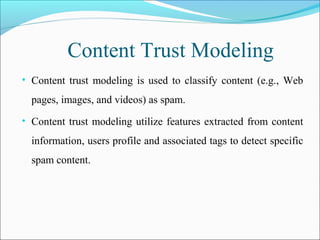
In this project, categorize trust modeling approaches into two
classes according to the target of trust, i.e., user and content
trust modeling.
Present approaches are sorted based on their complexity from
simple to advanced, separately for both content and user trust
models.
Categorization of Trust Models
Content Trust Modeling
• Content trust modeling is used to classify content (e.g., Web
pages, images, and videos) as spam.
• Content trust modeling utilize features extracted from content
information, users profile and associated tags to detect specific
spam content.
User Trust Modeling (Static)
Before mentioned studies consider users’ reliability as static at
a specific moment.
The tagging history of a user is better to consider, because a
consistent good behavior of a user in the past can suddenly
change by a few mistakes, which consequently ruins users trust
in tagging.
User Trust Modeling(Dynamic)
 A dynamic trust score, called SocialTrust, is derived for each
user.
 It depends on the quality of the relationship with his/her
neighbours in a social graph and personalized feedback ratings
received from neighbours so that trust scores are updated as the
social network evolves.
Users trust modeling is more popular than the content the trust
modeling.
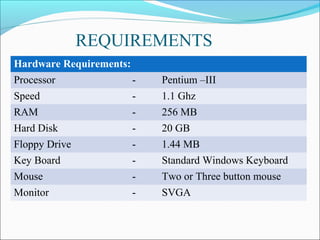
Hardware Requirements:
Processor - Pentium –III
Speed - 1.1 Ghz
RAM - 256 MB
Hard Disk - 20 GB
Floppy Drive - 1.44 MB
Key Board - Standard Windows Keyboard
Mouse - Two or Three button mouse
Monitor - SVGA
REQUIREMENTS
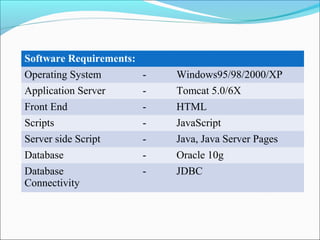
Software Requirements:
Operating System - Windows95/98/2000/XP
Application Server - Tomcat 5.0/6X
Front End - HTML
Scripts - JavaScript
Server side Script - Java, Java Server Pages
Database - Oracle 10g
Database
Connectivity
- JDBC
UML Diagrams
• Unified Modeling Language (UML) is a standardized general
purpose modeling language in the field of software
engineering. UML diagrams commonly created in visual
modeling tools.
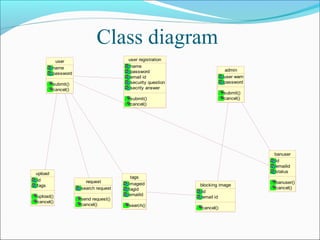
Class diagram
user registration
name
password
email id
security question
secrity answer
submit()
cancel()
upload
id
tags
upload()
cancel()
request
search request
send request()
cancel()
user
name
password
submit()
cancel()
tags
imageid
tagid
emailid
search()
blocking image
id
email id
cancel()
admin
user warn
password
submit()
cancel()
banuser
id
emailid
status
banuser()
cancel()
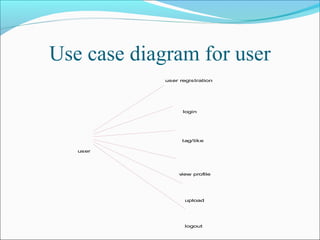
Use case diagram for user
user registration
login
tag/like
view profile
upload
user
logout
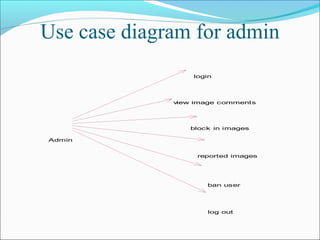
Use case diagram for admin
login
block in images
reported images
ban user
log out
Admin
view image comments
Activity diagram for user
user login
check s un authorised
user
no
upload images search images
tagging/like
log out
yes
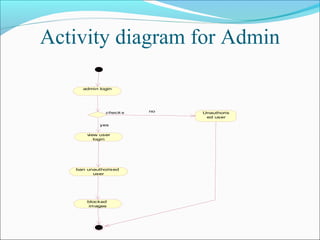
Activity diagram for Admin
check s Unauthoris
ed user
no
view user
login
yes
admin login
ban unauthorised
user
blocked
images
Screen shots:
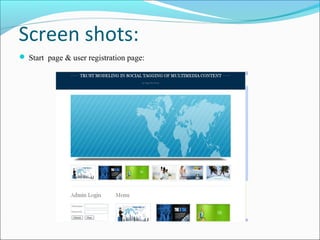
 Start page & user registration page:
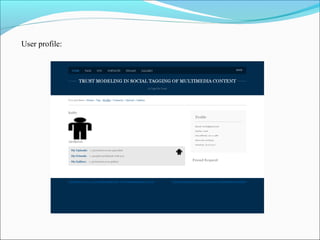
User profile:
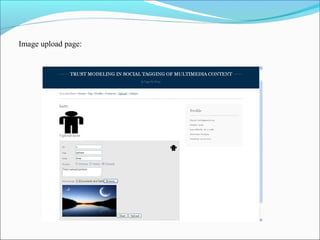
Image upload page:
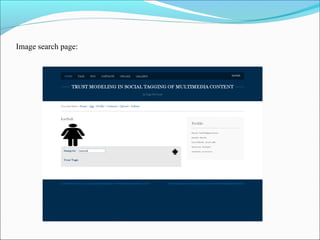
Image search page:
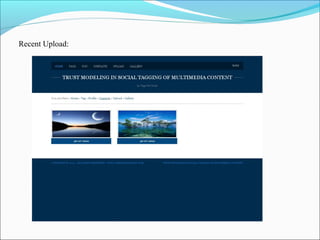
Recent Upload:
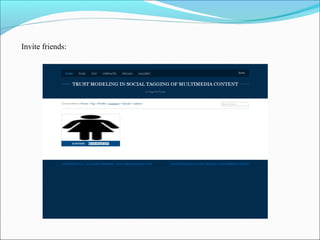
Invite friends:
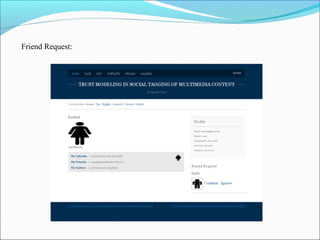
Friend Request:
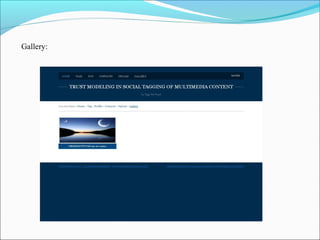
Gallery:
 
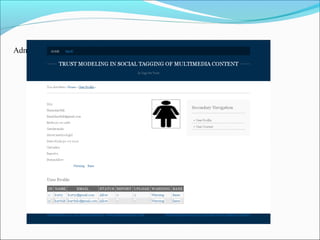
Admin page(User profile):
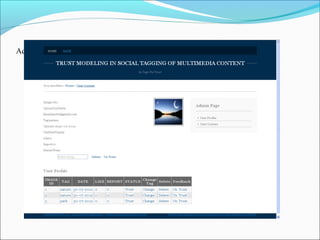
Admin page(User Content):
Conclusion:
As online social networks and content sharing services
evolve rapidly, we believe that the research on enhancing
reliability and trustworthiness of such services will become
increasingly important.
trust1

trust1

  • 1.
    TRUST MODELING INSOCIAL TAGGING OF MULTIMEDIA CONTENT By C. Nirmala
  • 2.
    Abstract Tagging in onlinesocial networks is very popular these days, as it facilitates search and retrieval of multimedia content.  However, noisy and spam annotations often make it difficult to perform an efficient search. Users may make mistakes in tagging and irrelevant tags and content may be maliciously added for advertisement or self- promotion.
  • 3.
    EXISTING SYSTEM  Ratingsin online reputation systems, such as eBay, Amazon are very similar to tagging systems and they may face the problem of unfair ratings by artificial inflating or deflating reputations.
  • 4.
    PROPOSED SYSTEM In asocial tagging system, spam or noise can be injected at three different levels and trust modeling can be performed at each level or at different combined levels to assess user’s reliability. The levels are 1.Spam content 2.Spam tag-content association 3.Spammer
  • 5.
    Contd.. In this project,categorize trust modeling approaches into two classes according to the target of trust, i.e., user and content trust modeling. Present approaches are sorted based on their complexity from simple to advanced, separately for both content and user trust models.
  • 6.
  • 7.
    Content Trust Modeling •Content trust modeling is used to classify content (e.g., Web pages, images, and videos) as spam. • Content trust modeling utilize features extracted from content information, users profile and associated tags to detect specific spam content.
  • 8.
    User Trust Modeling(Static) Before mentioned studies consider users’ reliability as static at a specific moment. The tagging history of a user is better to consider, because a consistent good behavior of a user in the past can suddenly change by a few mistakes, which consequently ruins users trust in tagging.
  • 9.
    User Trust Modeling(Dynamic) A dynamic trust score, called SocialTrust, is derived for each user.  It depends on the quality of the relationship with his/her neighbours in a social graph and personalized feedback ratings received from neighbours so that trust scores are updated as the social network evolves. Users trust modeling is more popular than the content the trust modeling.
  • 10.
    Hardware Requirements: Processor -Pentium –III Speed - 1.1 Ghz RAM - 256 MB Hard Disk - 20 GB Floppy Drive - 1.44 MB Key Board - Standard Windows Keyboard Mouse - Two or Three button mouse Monitor - SVGA REQUIREMENTS
  • 11.
    Software Requirements: Operating System- Windows95/98/2000/XP Application Server - Tomcat 5.0/6X Front End - HTML Scripts - JavaScript Server side Script - Java, Java Server Pages Database - Oracle 10g Database Connectivity - JDBC
  • 12.
    UML Diagrams • UnifiedModeling Language (UML) is a standardized general purpose modeling language in the field of software engineering. UML diagrams commonly created in visual modeling tools.
  • 13.
    Class diagram user registration name password emailid security question secrity answer submit() cancel() upload id tags upload() cancel() request search request send request() cancel() user name password submit() cancel() tags imageid tagid emailid search() blocking image id email id cancel() admin user warn password submit() cancel() banuser id emailid status banuser() cancel()
  • 14.
    Use case diagramfor user user registration login tag/like view profile upload user logout
  • 15.
    Use case diagramfor admin login block in images reported images ban user log out Admin view image comments
  • 16.
    Activity diagram foruser user login check s un authorised user no upload images search images tagging/like log out yes
  • 17.
    Activity diagram forAdmin check s Unauthoris ed user no view user login yes admin login ban unauthorised user blocked images
  • 18.
    Screen shots:  Startpage & user registration page:
  • 19.
  • 20.
  • 21.
  • 22.
  • 23.
  • 24.
  • 25.
  • 26.
  • 27.
  • 28.
    Conclusion: As online socialnetworks and content sharing services evolve rapidly, we believe that the research on enhancing reliability and trustworthiness of such services will become increasingly important.