

TRUST AND REPUTATION ON THE SOCIAL WEB
Social capital
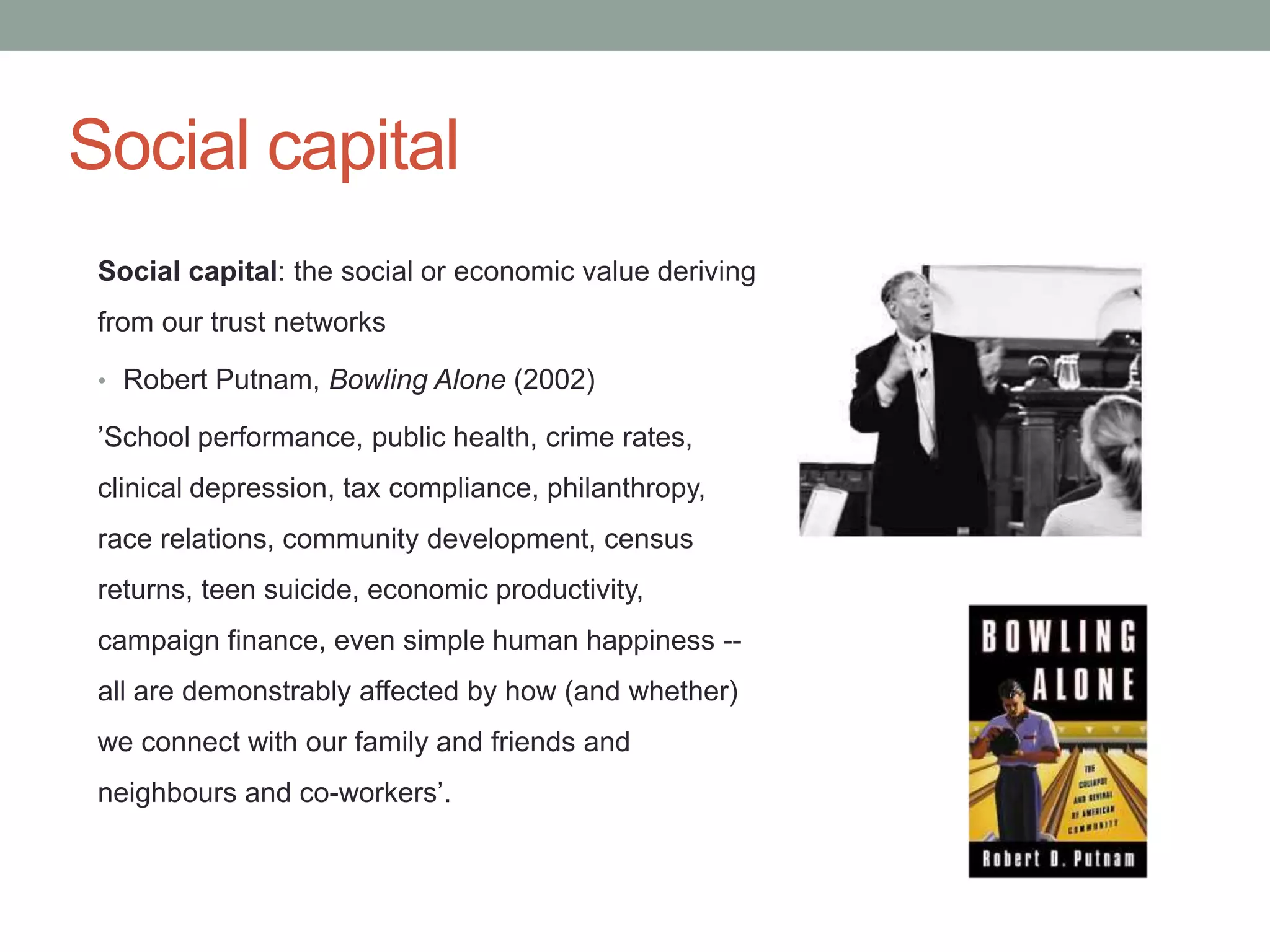
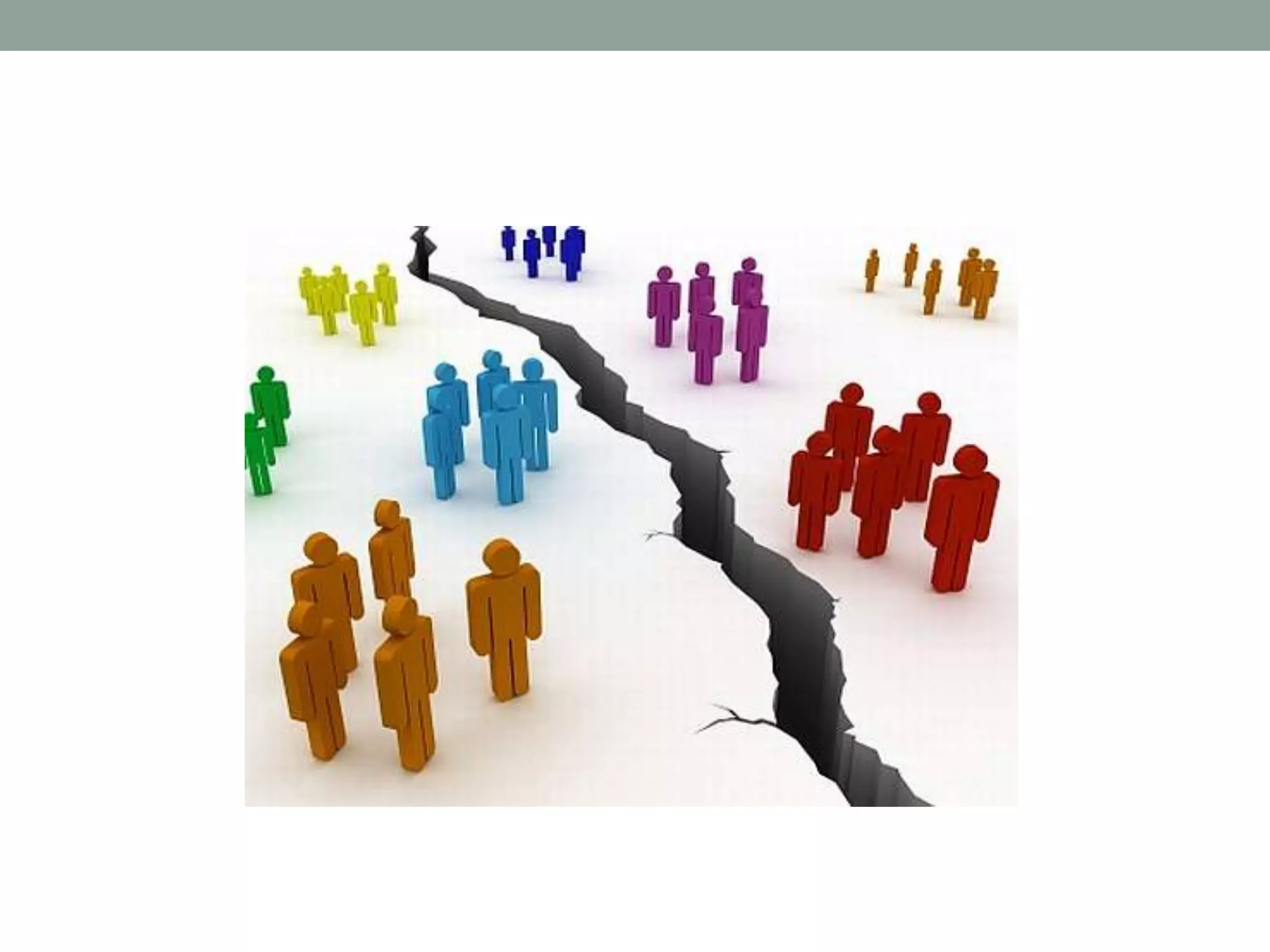
 Social capital: the social or economic value deriving
 from our trust networks

 • Robert Putnam, Bowling Alone (2002)

 ’School performance, public health, crime rates,
 clinical depression, tax compliance, philanthropy,
 race relations, community development, census
 returns, teen suicide, economic productivity,
 campaign finance, even simple human happiness --
 all are demonstrably affected by how (and whether)
 we connect with our family and friends and
 neighbours and co-workers’.
Strong and weak ties
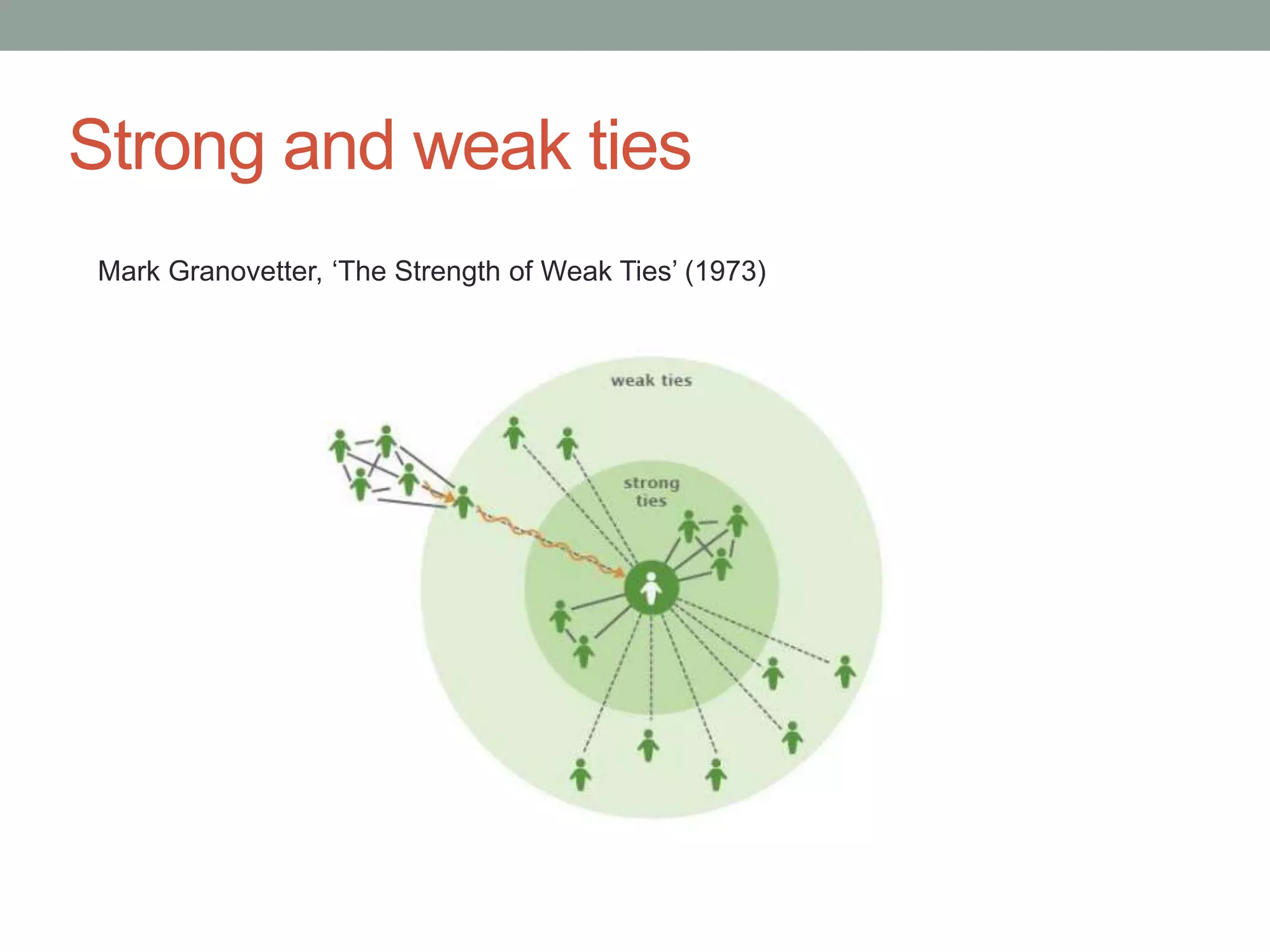
Mark Granovetter, ‘The Strength of Weak Ties’ (1973)
Social capital online
 Bases of social capital

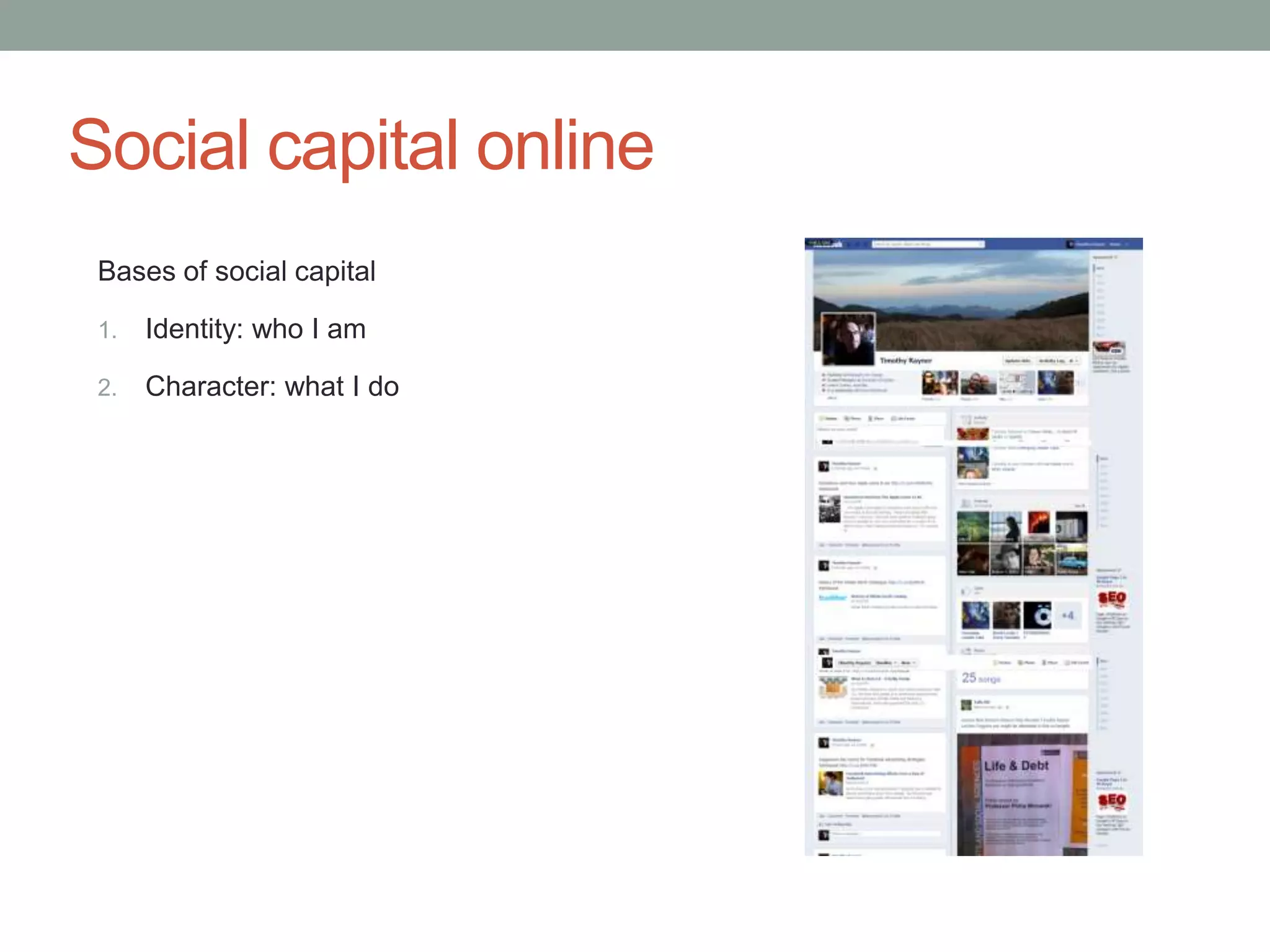
 1.   Identity: who I am

 2.   Character: what I do
Social capital online
 Bases of social capital

 1.   Identity: who I am

 2.   Character: what I do

 • Identity + character = reputation
Social capital online
 Bases of social capital

 1.   Identity: who I am

 2.   Character: what I do

 • Identity + character = reputation
Social capital online
 Bases of social capital

 1.   Identity: who I am

 2.   Character: what I do

 • Identity + character = reputation
Reputation systems
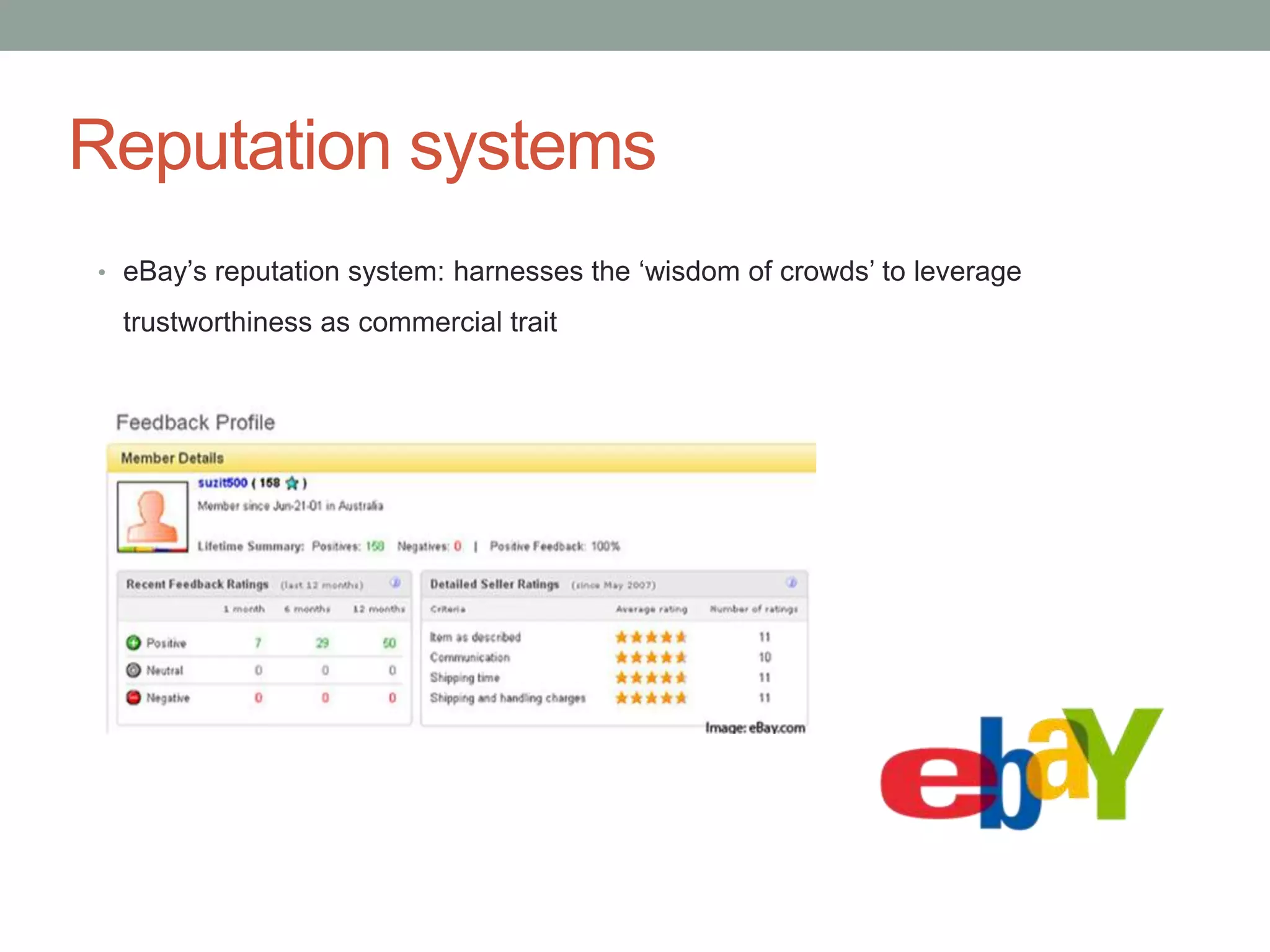
• eBay’s reputation system: harnesses the ‘wisdom of crowds’ to leverage

 trustworthiness as commercial trait
Reputation systems
Reputation systems
Reputation systems
Reputation systems
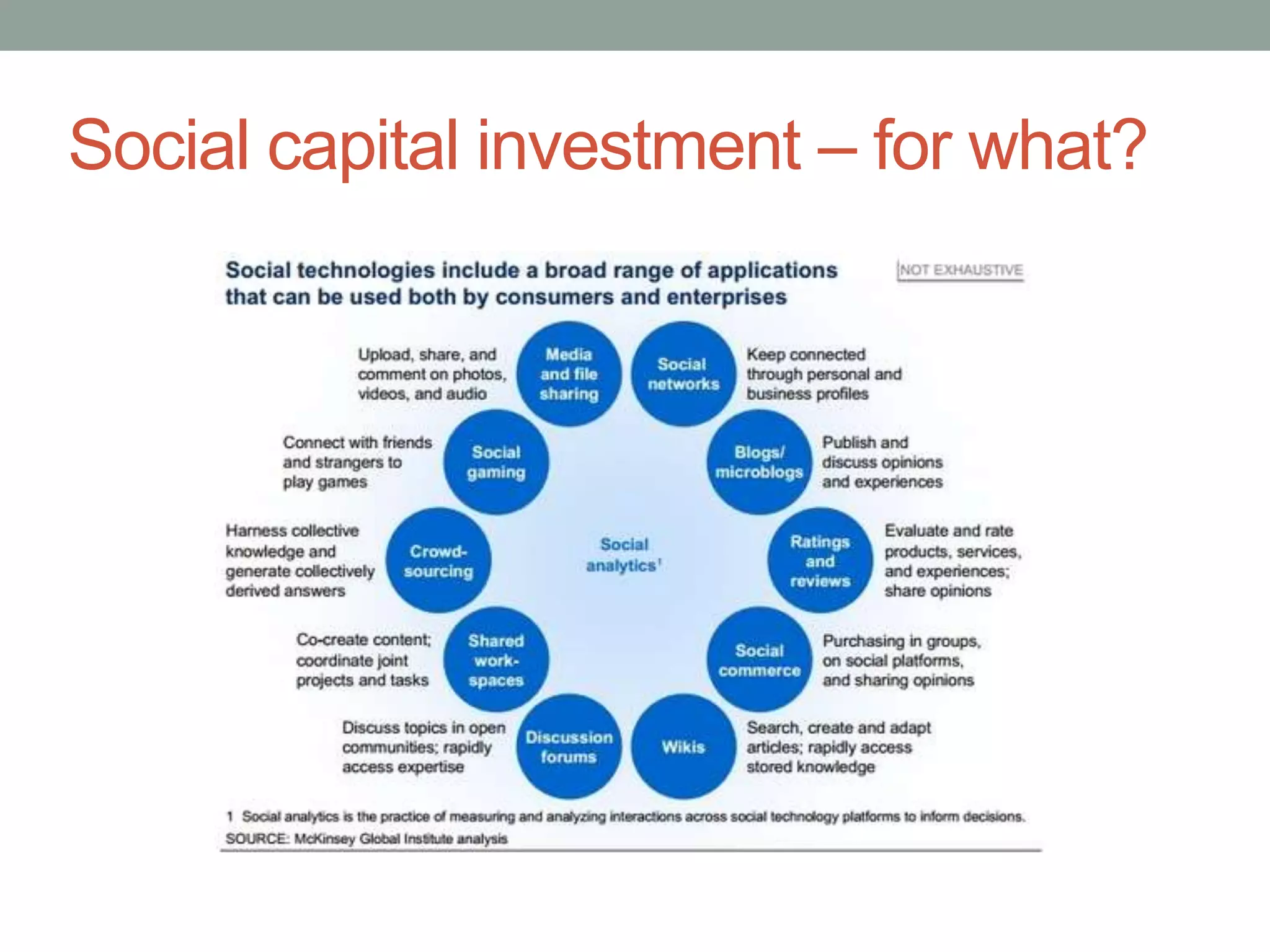
Social capital investment – for what?
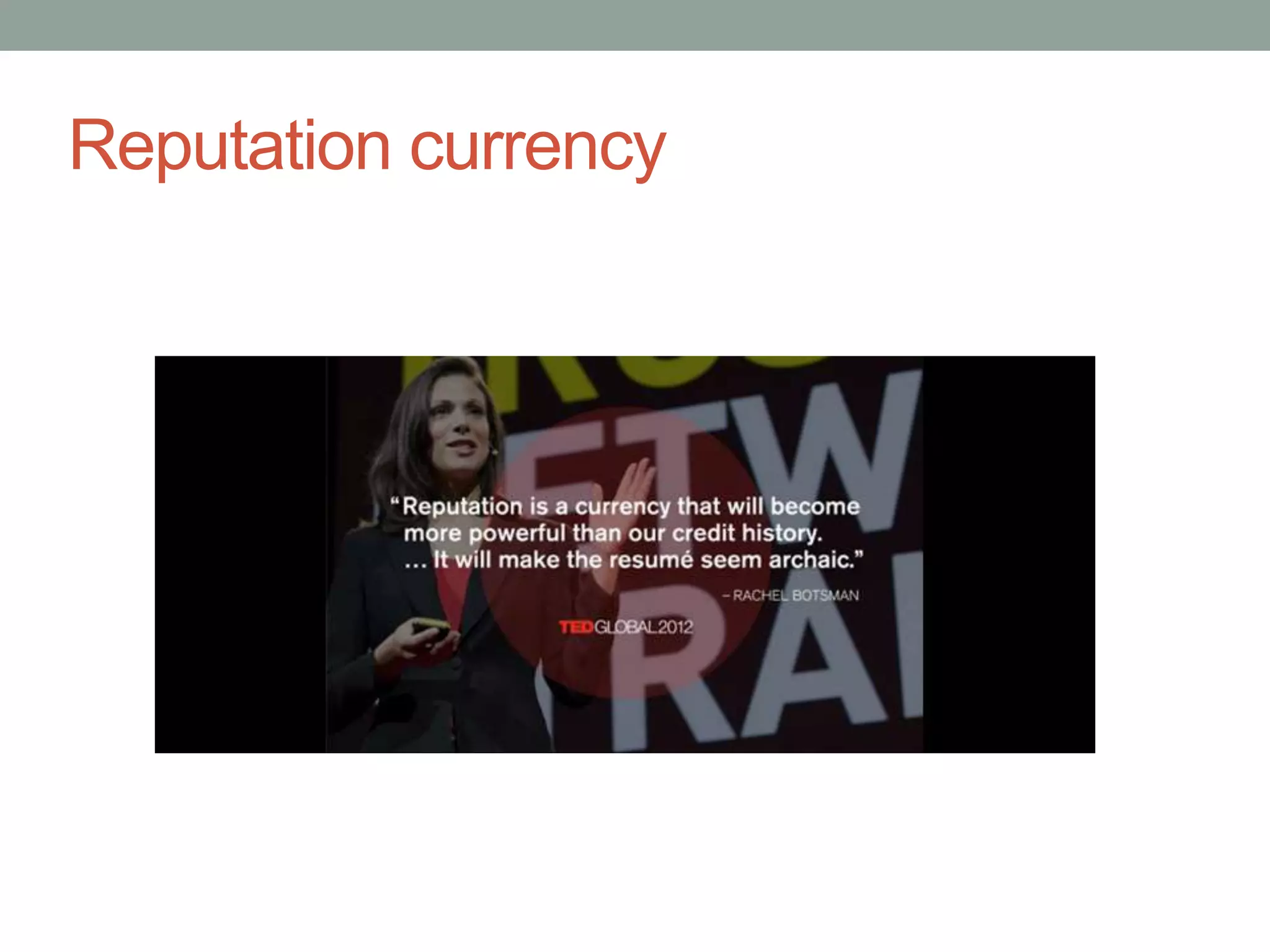
Reputation currency
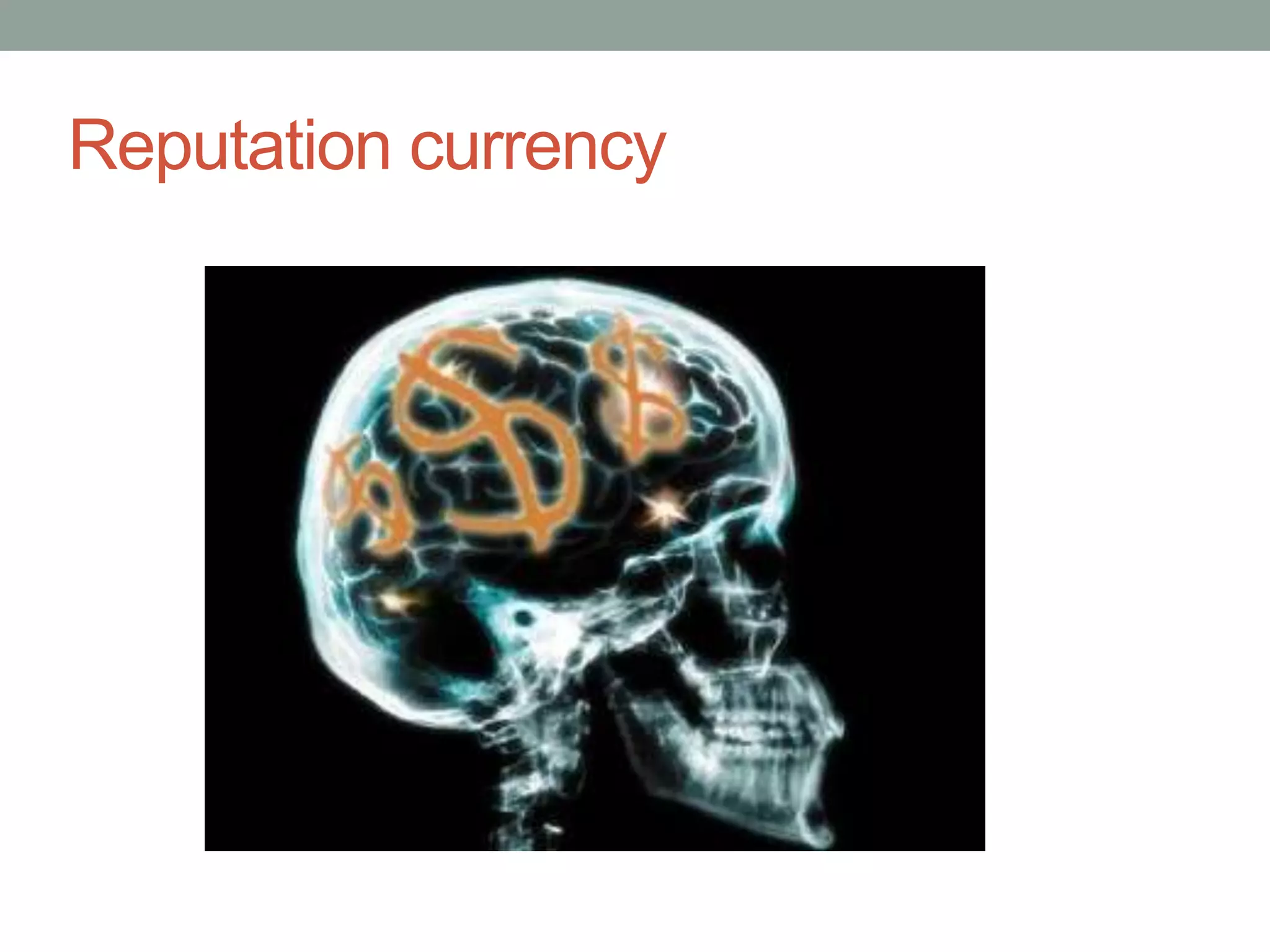
Reputation currency
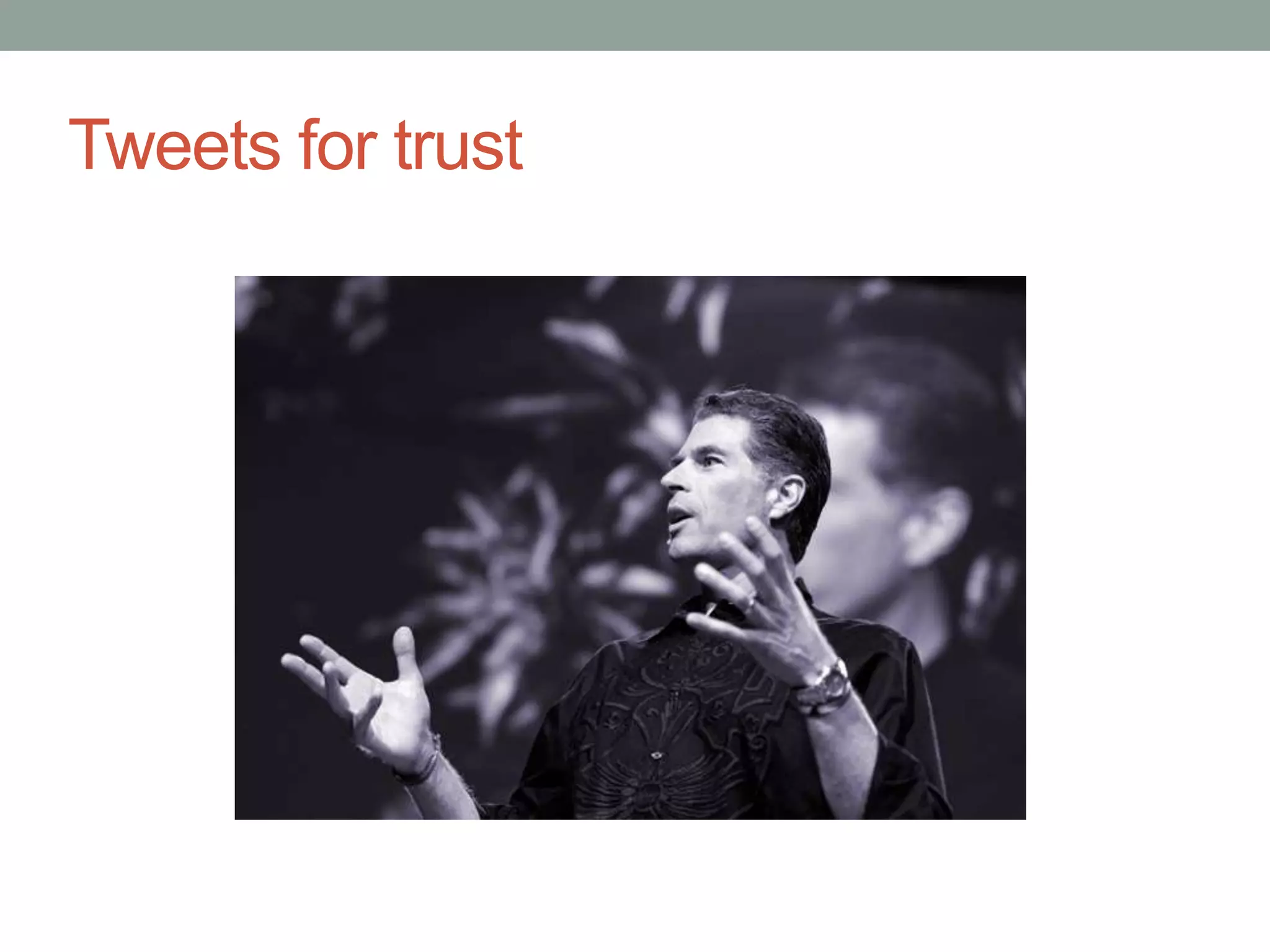
Tweets for trust
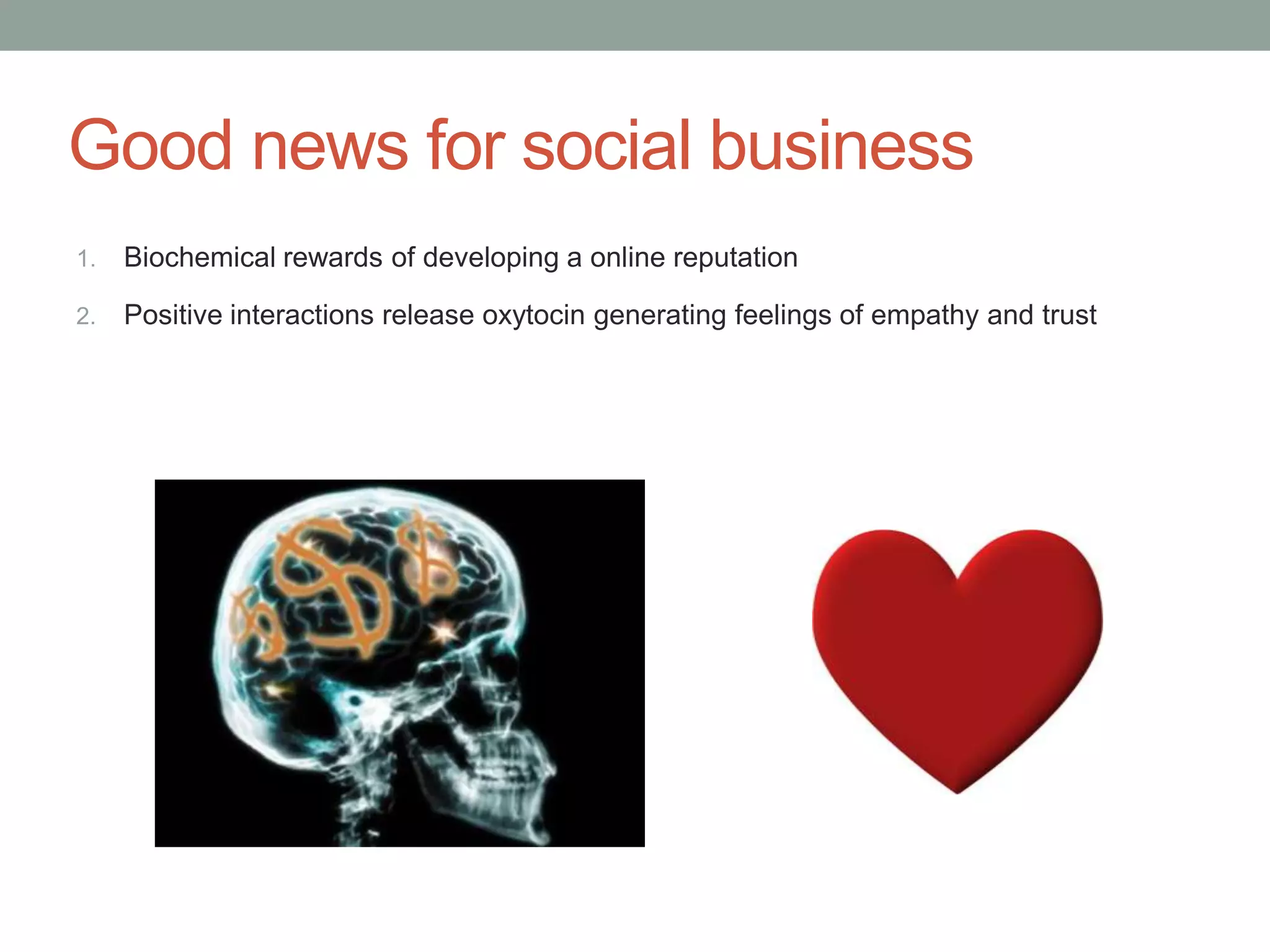
Good news for social business
1.   Biochemical rewards of developing a online reputation

2.   Positive interactions release oxytocin generating feelings of empathy and trust
The rise of reputation systems
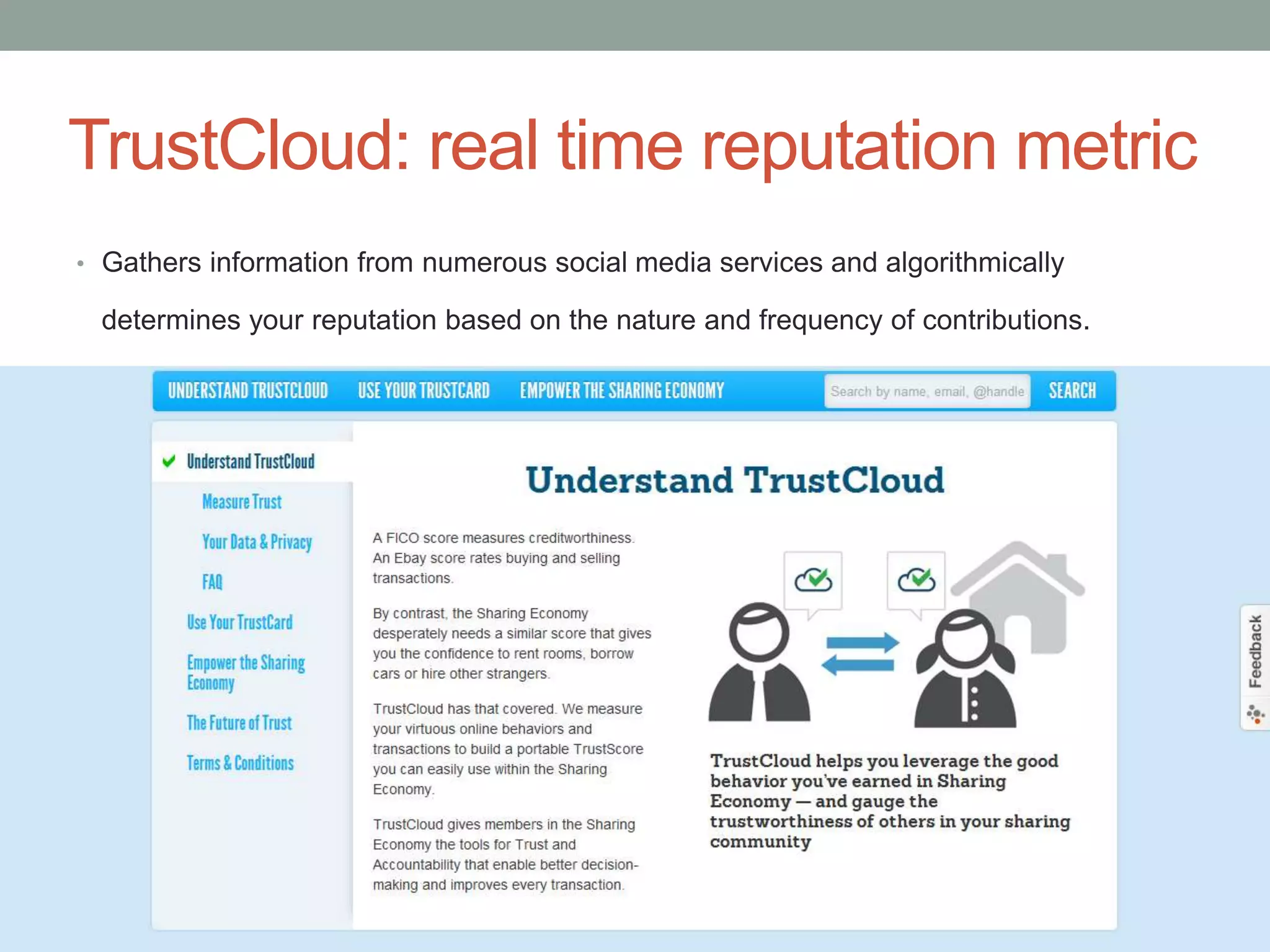
TrustCloud: real time reputation metric
• Gathers information from numerous social media services and algorithmically

 determines your reputation based on the nature and frequency of contributions.
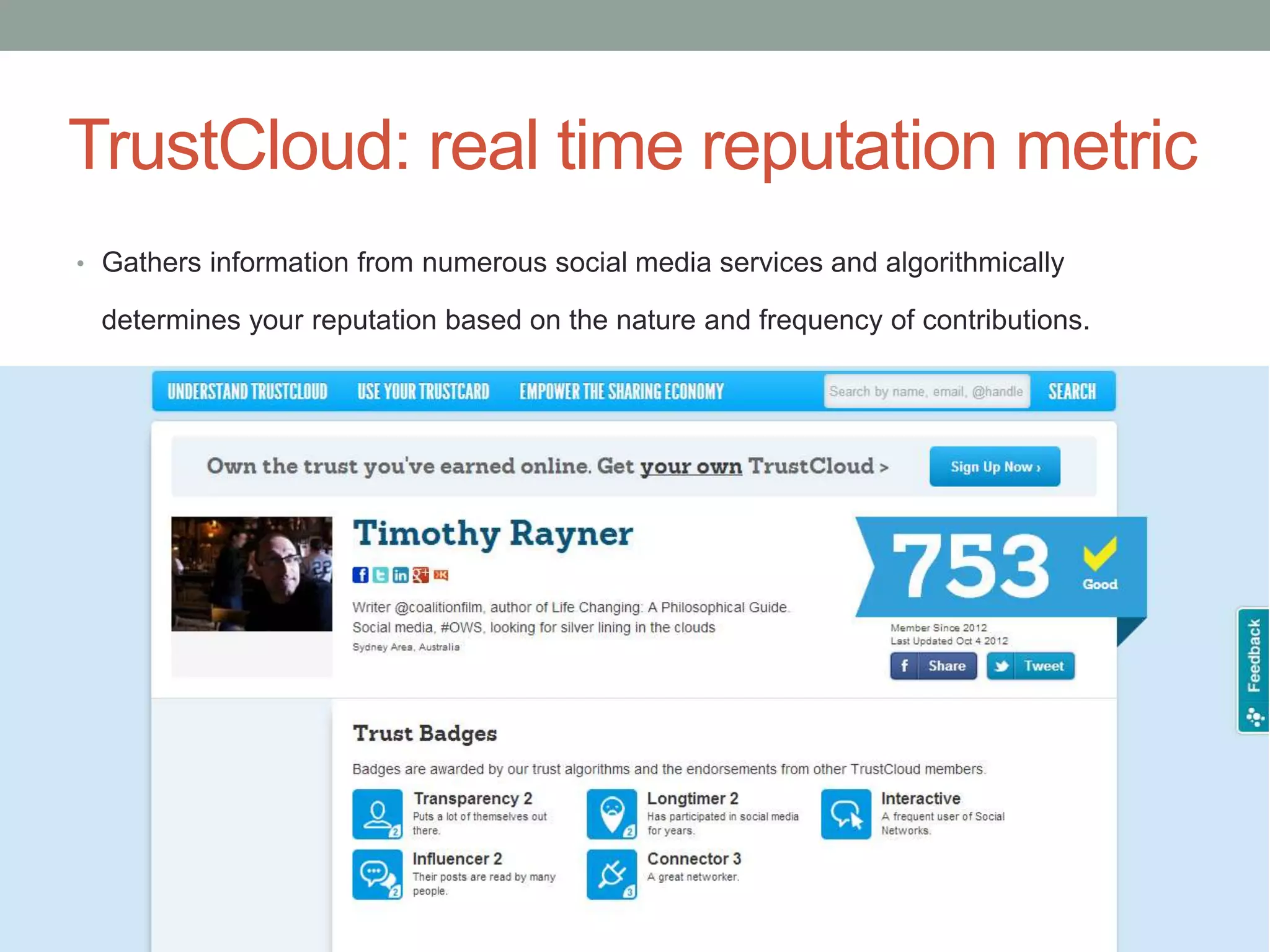
TrustCloud: real time reputation metric
• Gathers information from numerous social media services and algorithmically

 determines your reputation based on the nature and frequency of contributions.
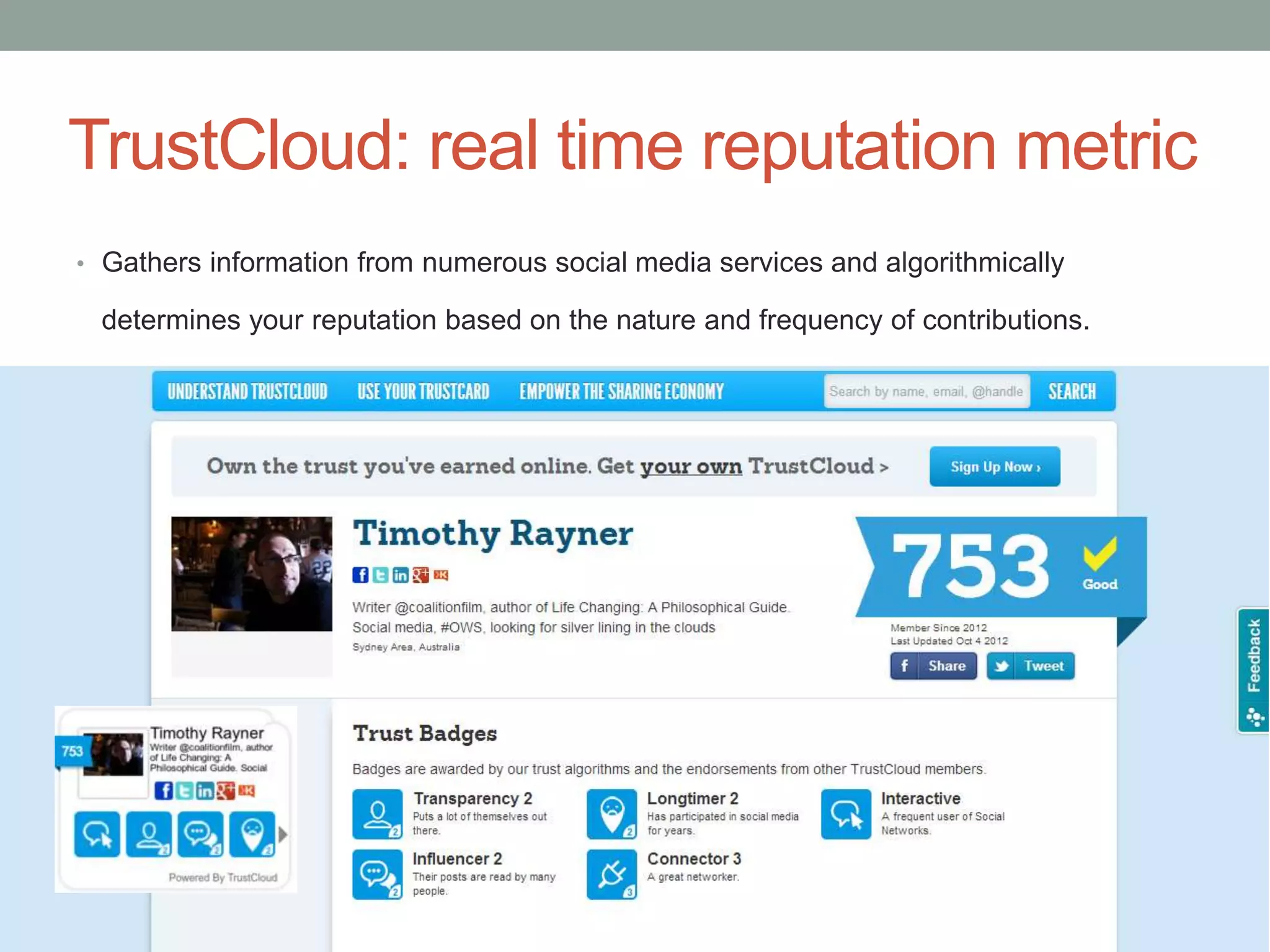
TrustCloud: real time reputation metric
• Gathers information from numerous social media services and algorithmically

 determines your reputation based on the nature and frequency of contributions.
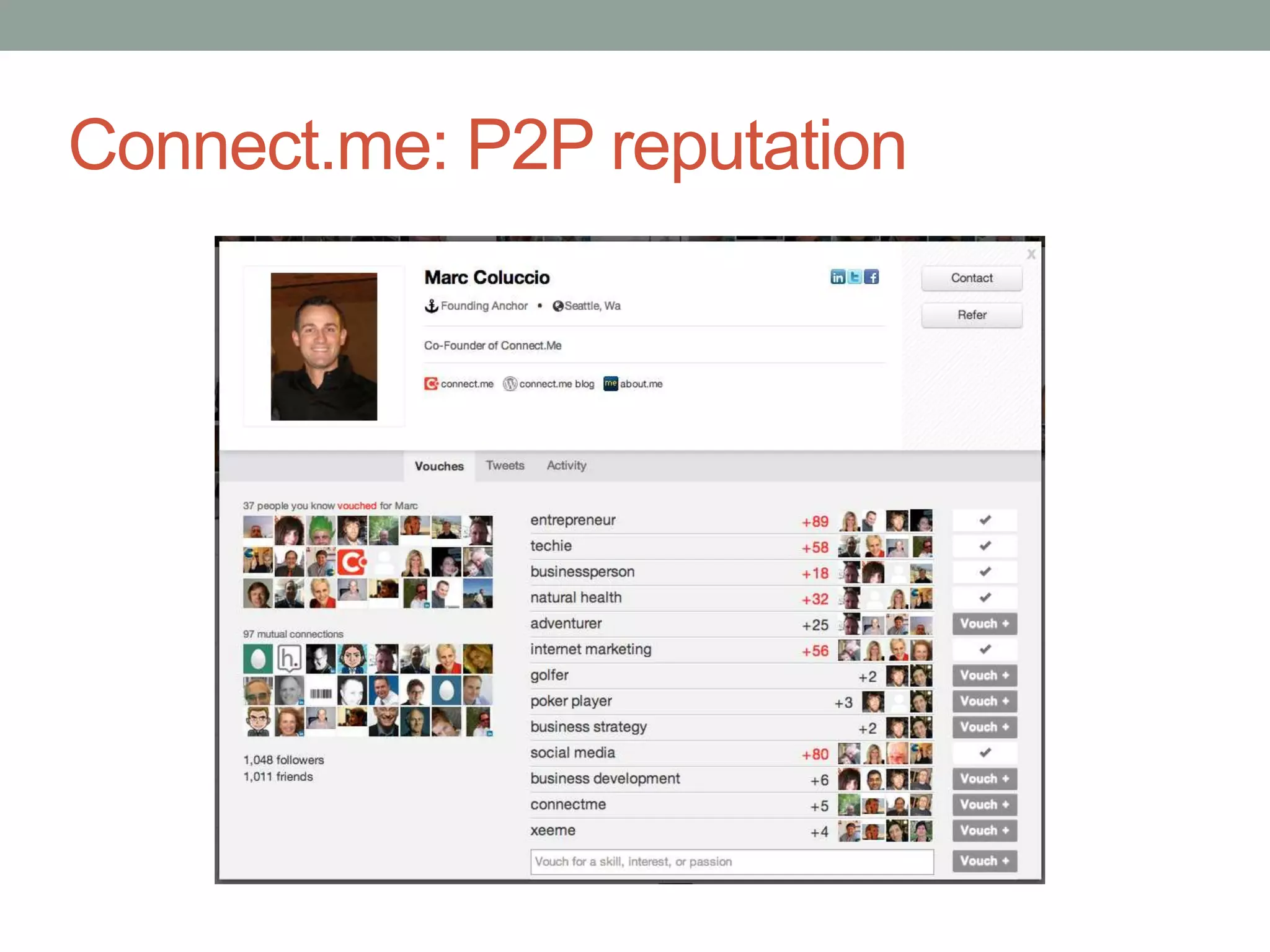
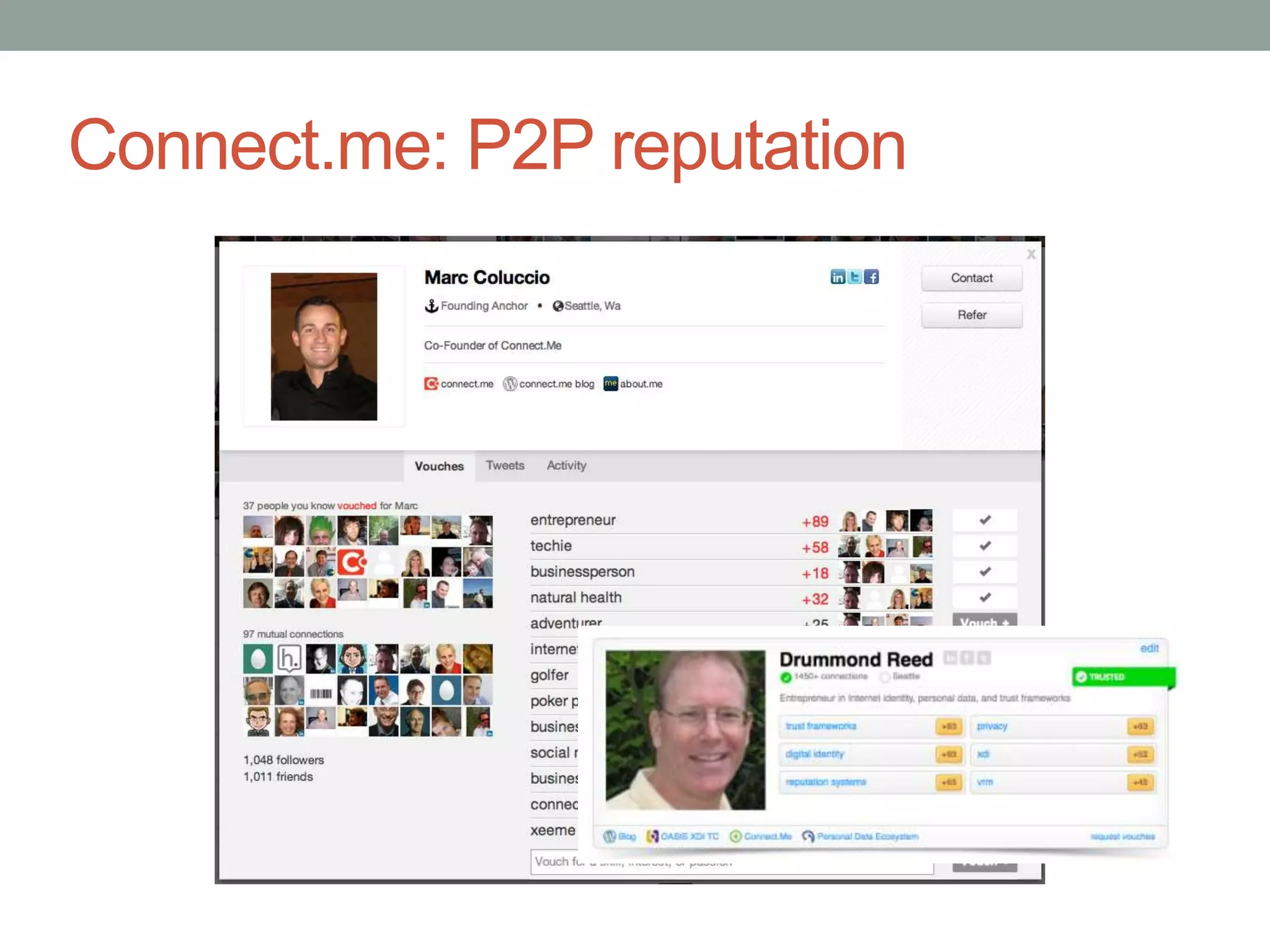
Connect.me: P2P reputation
How to build social capital online
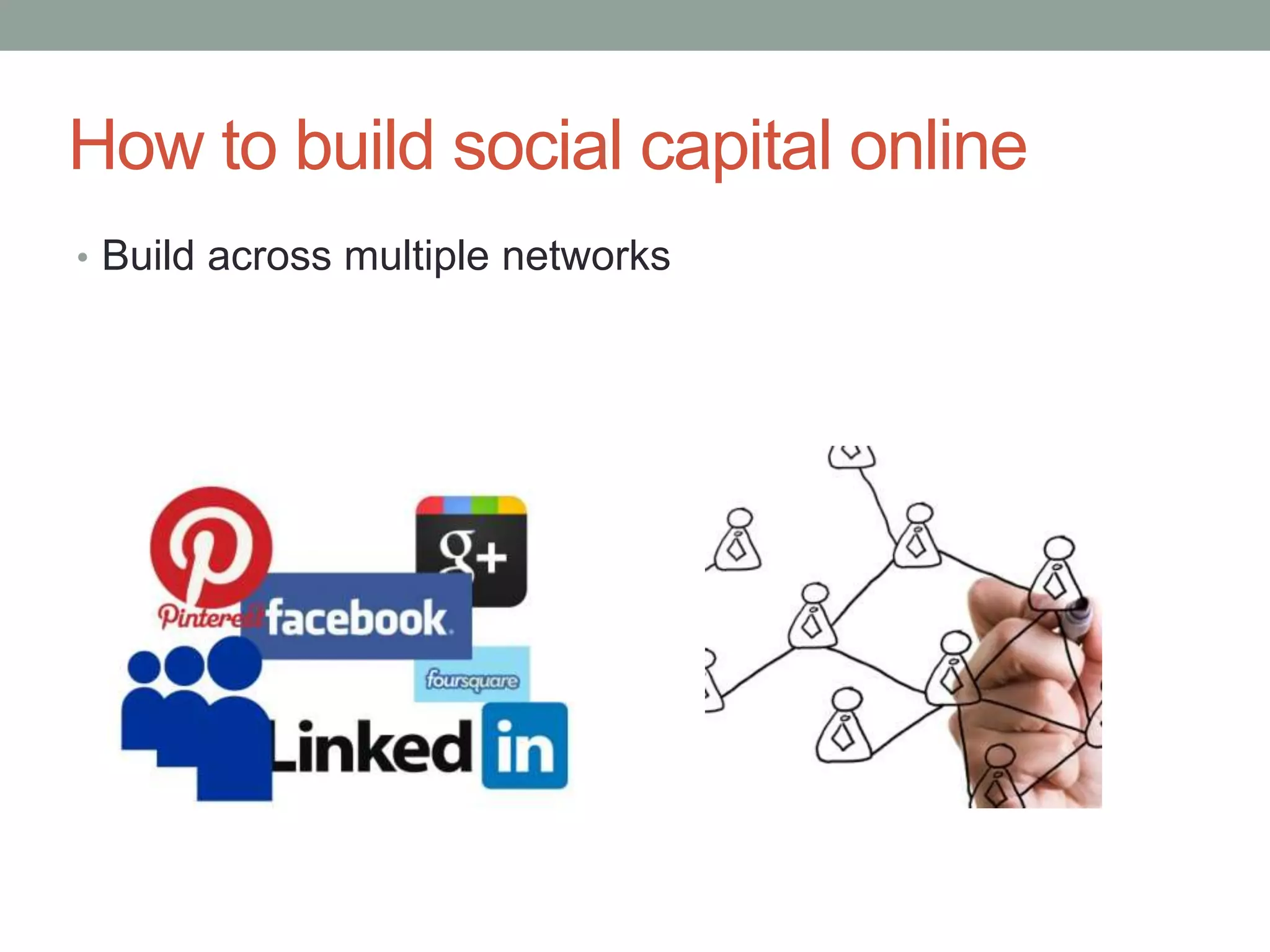
• Build across multiple networks
How to build social capital online
• Build across multiple networks
How to build social capital online
• Engage: follow, share, comment, like
How to build social capital online
• Engage: follow, share, comment, like
How to build social capital online
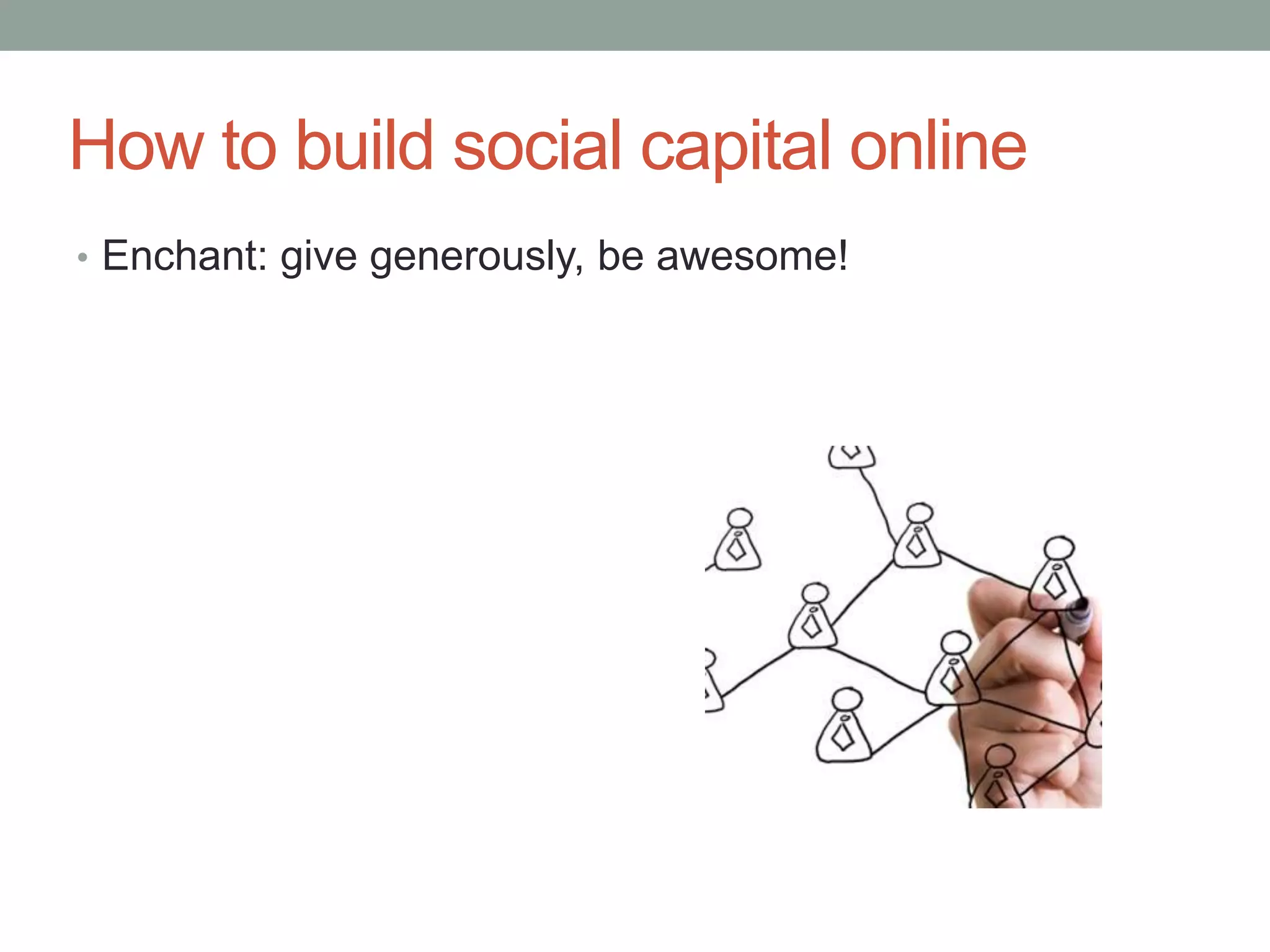
• Enchant: give generously, be awesome!
How to build social capital online
• Enchant: give generously, be awesome!
How to build social capital online
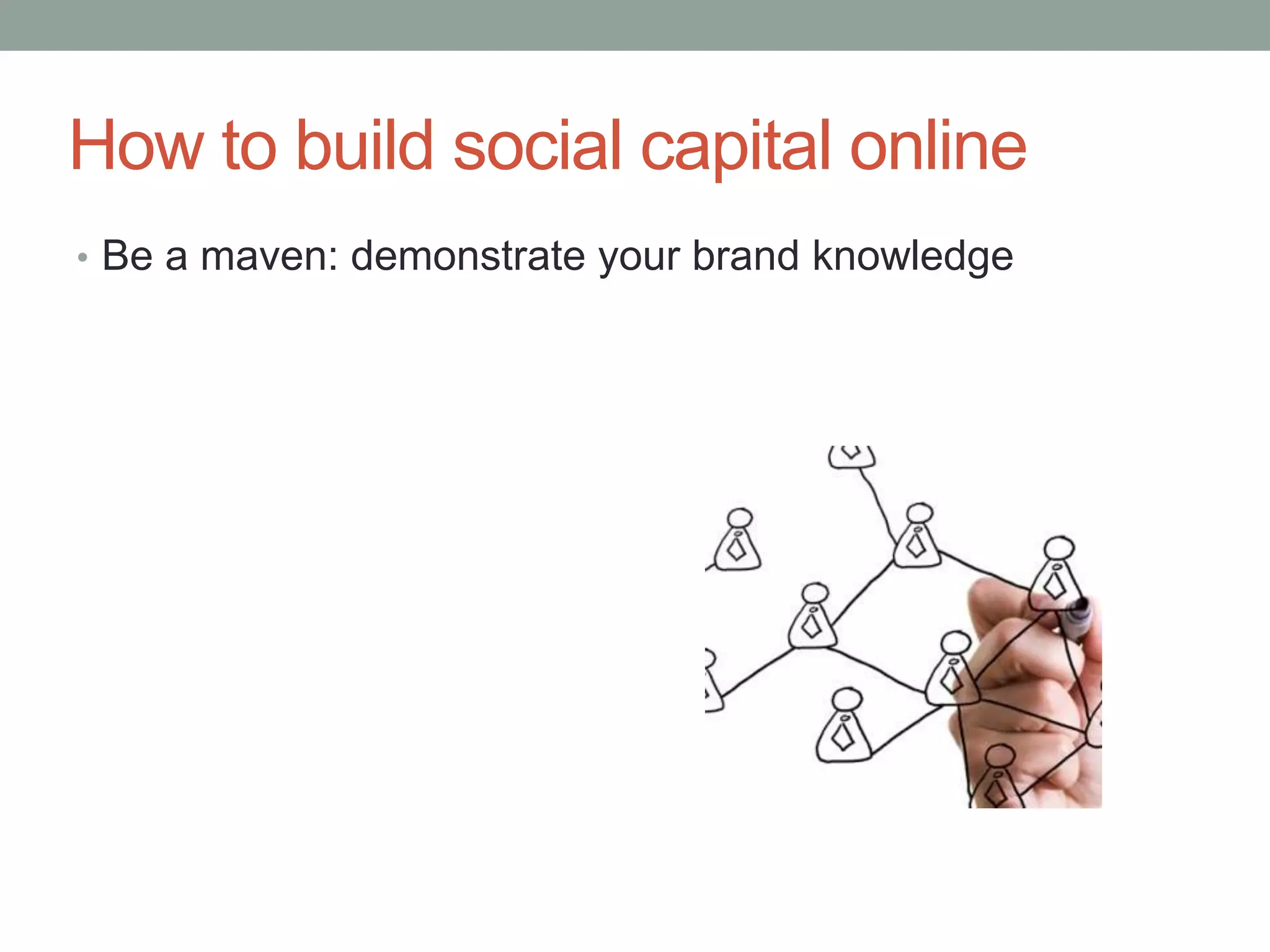
• Be a maven: demonstrate your brand knowledge
How to build social capital online
• Be a maven: demonstrate your brand knowledge
How to build social capital online
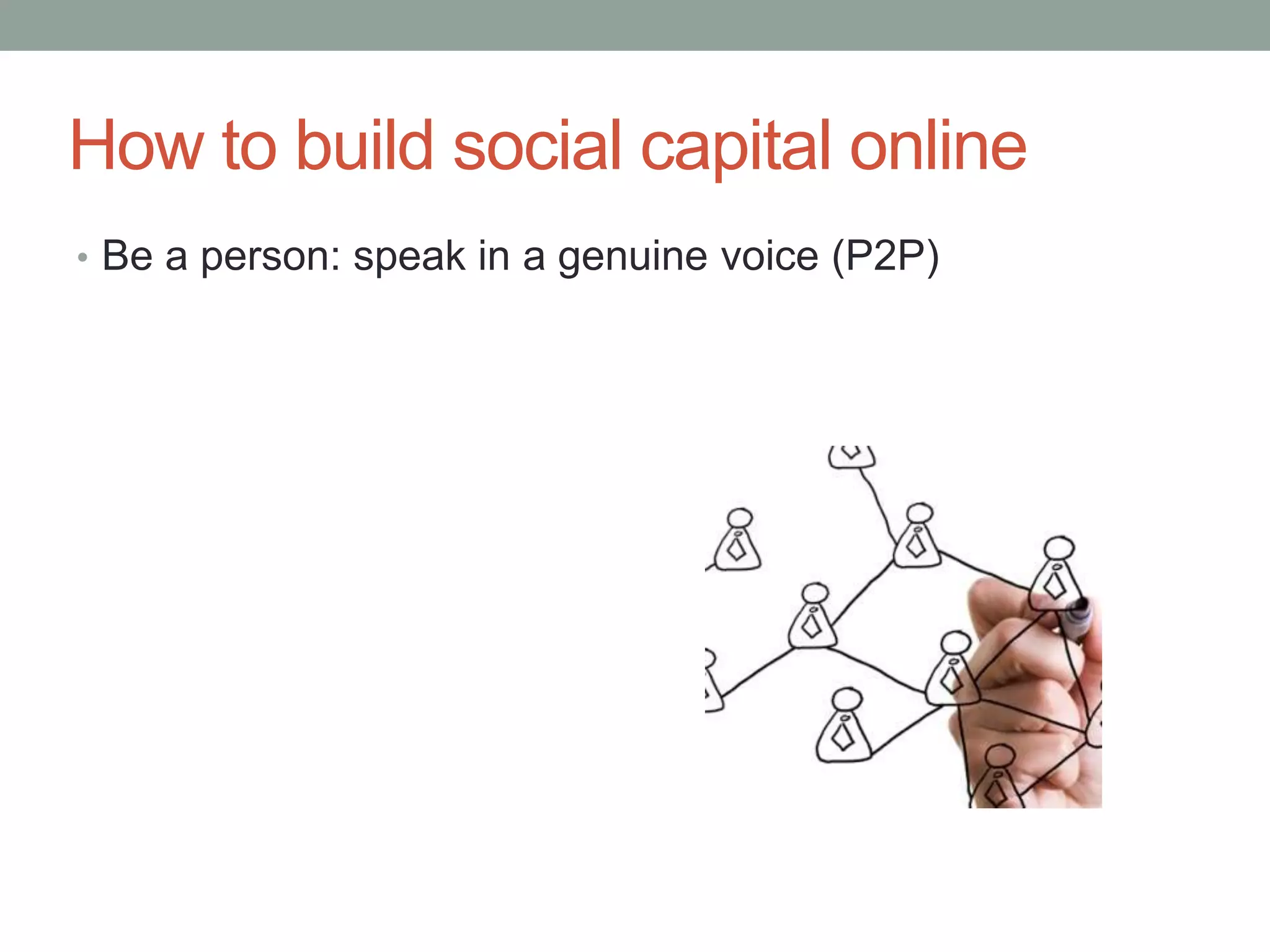
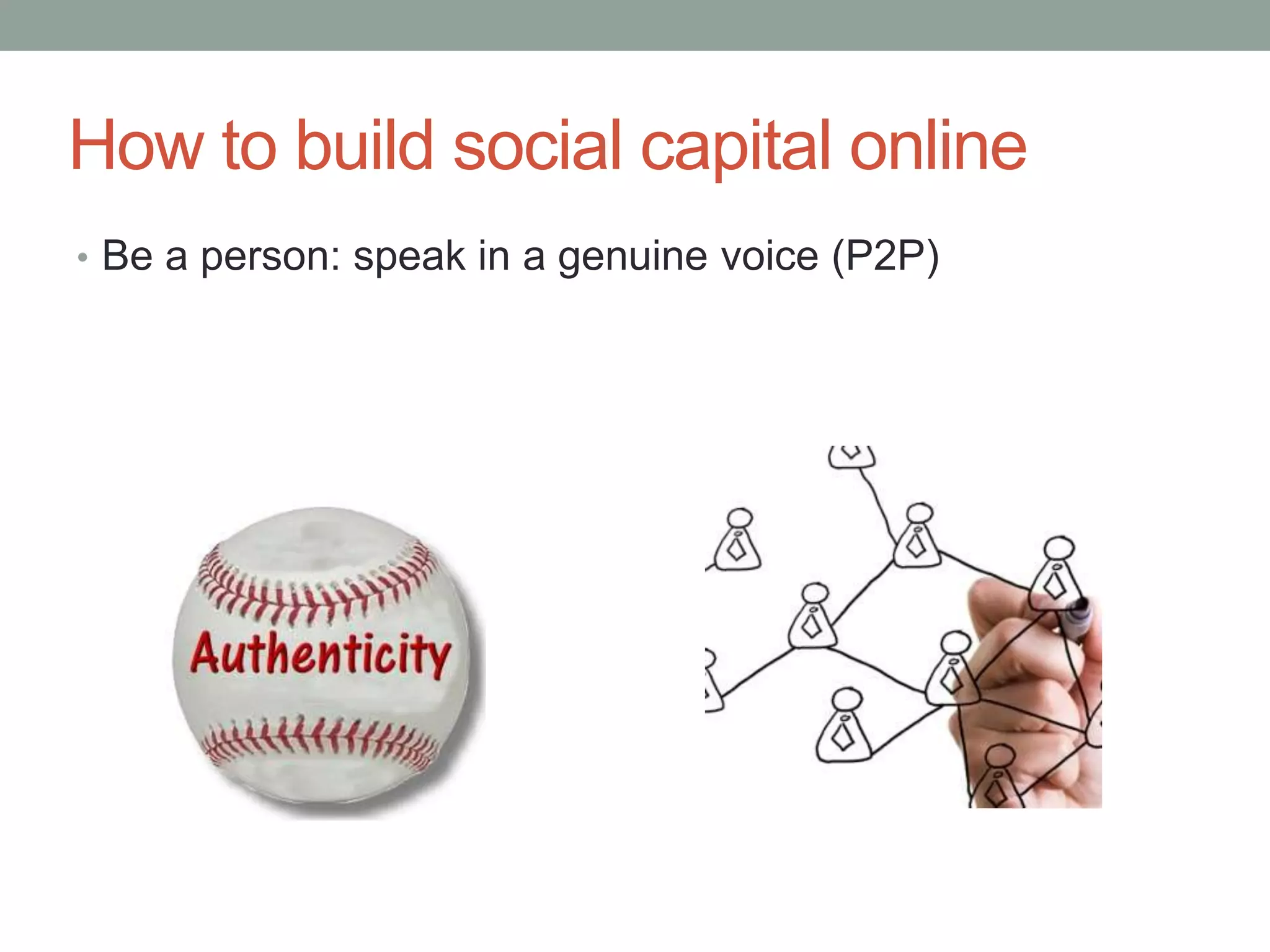
• Be a person: speak in a genuine voice (P2P)
How to build social capital online
• Be a person: speak in a genuine voice (P2P)
TRUST AND REPUTATION ON THE SOCIAL WEB

Trust and Reputation on the Social Web

  • 1.
    TRUST AND REPUTATIONON THE SOCIAL WEB
  • 4.
    Social capital Socialcapital: the social or economic value deriving from our trust networks • Robert Putnam, Bowling Alone (2002) ’School performance, public health, crime rates, clinical depression, tax compliance, philanthropy, race relations, community development, census returns, teen suicide, economic productivity, campaign finance, even simple human happiness -- all are demonstrably affected by how (and whether) we connect with our family and friends and neighbours and co-workers’.
  • 5.
    Strong and weakties Mark Granovetter, ‘The Strength of Weak Ties’ (1973)
  • 6.
    Social capital online Bases of social capital 1. Identity: who I am 2. Character: what I do
  • 7.
    Social capital online Bases of social capital 1. Identity: who I am 2. Character: what I do • Identity + character = reputation
  • 8.
    Social capital online Bases of social capital 1. Identity: who I am 2. Character: what I do • Identity + character = reputation
  • 9.
    Social capital online Bases of social capital 1. Identity: who I am 2. Character: what I do • Identity + character = reputation
  • 10.
    Reputation systems • eBay’sreputation system: harnesses the ‘wisdom of crowds’ to leverage trustworthiness as commercial trait
  • 11.
  • 12.
  • 13.
  • 14.
  • 16.
  • 17.
  • 18.
  • 19.
  • 20.
    Good news forsocial business 1. Biochemical rewards of developing a online reputation 2. Positive interactions release oxytocin generating feelings of empathy and trust
  • 21.
    The rise ofreputation systems
  • 22.
    The rise ofreputation systems
  • 23.
    TrustCloud: real timereputation metric • Gathers information from numerous social media services and algorithmically determines your reputation based on the nature and frequency of contributions.
  • 24.
    TrustCloud: real timereputation metric • Gathers information from numerous social media services and algorithmically determines your reputation based on the nature and frequency of contributions.
  • 25.
    TrustCloud: real timereputation metric • Gathers information from numerous social media services and algorithmically determines your reputation based on the nature and frequency of contributions.
  • 26.
  • 27.
  • 30.
    How to buildsocial capital online
  • 31.
    How to buildsocial capital online • Build across multiple networks
  • 32.
    How to buildsocial capital online • Build across multiple networks
  • 33.
    How to buildsocial capital online • Engage: follow, share, comment, like
  • 34.
    How to buildsocial capital online • Engage: follow, share, comment, like
  • 35.
    How to buildsocial capital online • Enchant: give generously, be awesome!
  • 36.
    How to buildsocial capital online • Enchant: give generously, be awesome!
  • 37.
    How to buildsocial capital online • Be a maven: demonstrate your brand knowledge
  • 38.
    How to buildsocial capital online • Be a maven: demonstrate your brand knowledge
  • 39.
    How to buildsocial capital online
  • 40.
    How to buildsocial capital online • Be a person: speak in a genuine voice (P2P)
  • 41.
    How to buildsocial capital online • Be a person: speak in a genuine voice (P2P)
  • 42.
    TRUST AND REPUTATIONON THE SOCIAL WEB

Editor's Notes

  • #3 Community fundraiser: who can make it a success?
  • #4 Settling a dispute between different groups: who is best placed to do it?
  • #6 Strong and weak tie networks. You are 3 times as likely to find a job through weak tie connections as through advertisements. A recent study of Facebook showed that weak ties improve access to information.
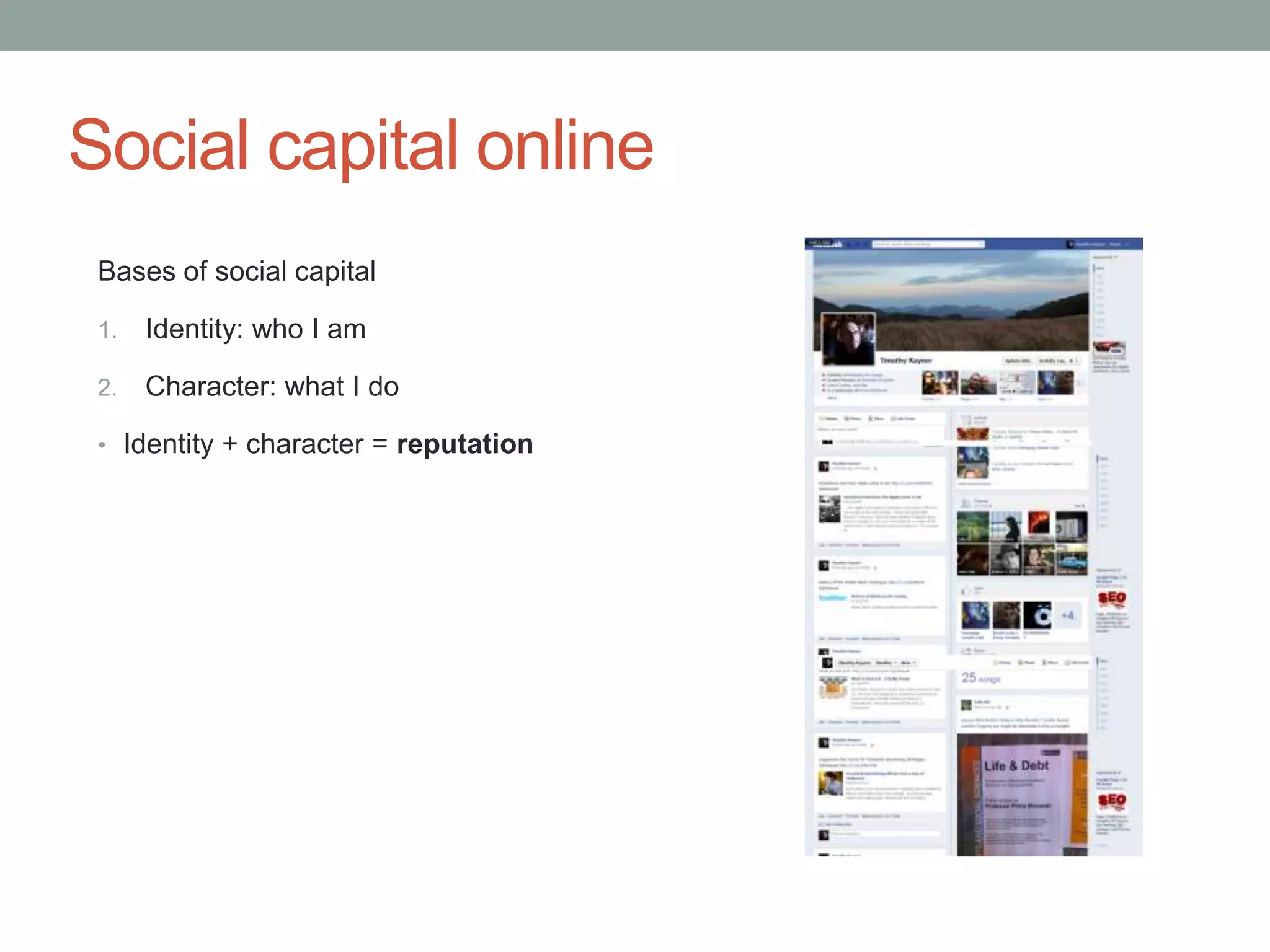
  • #7 Facebook profile establishes identity. Timeline is a record of character.
  • #8 Reputation is a reflection of your online character over time.
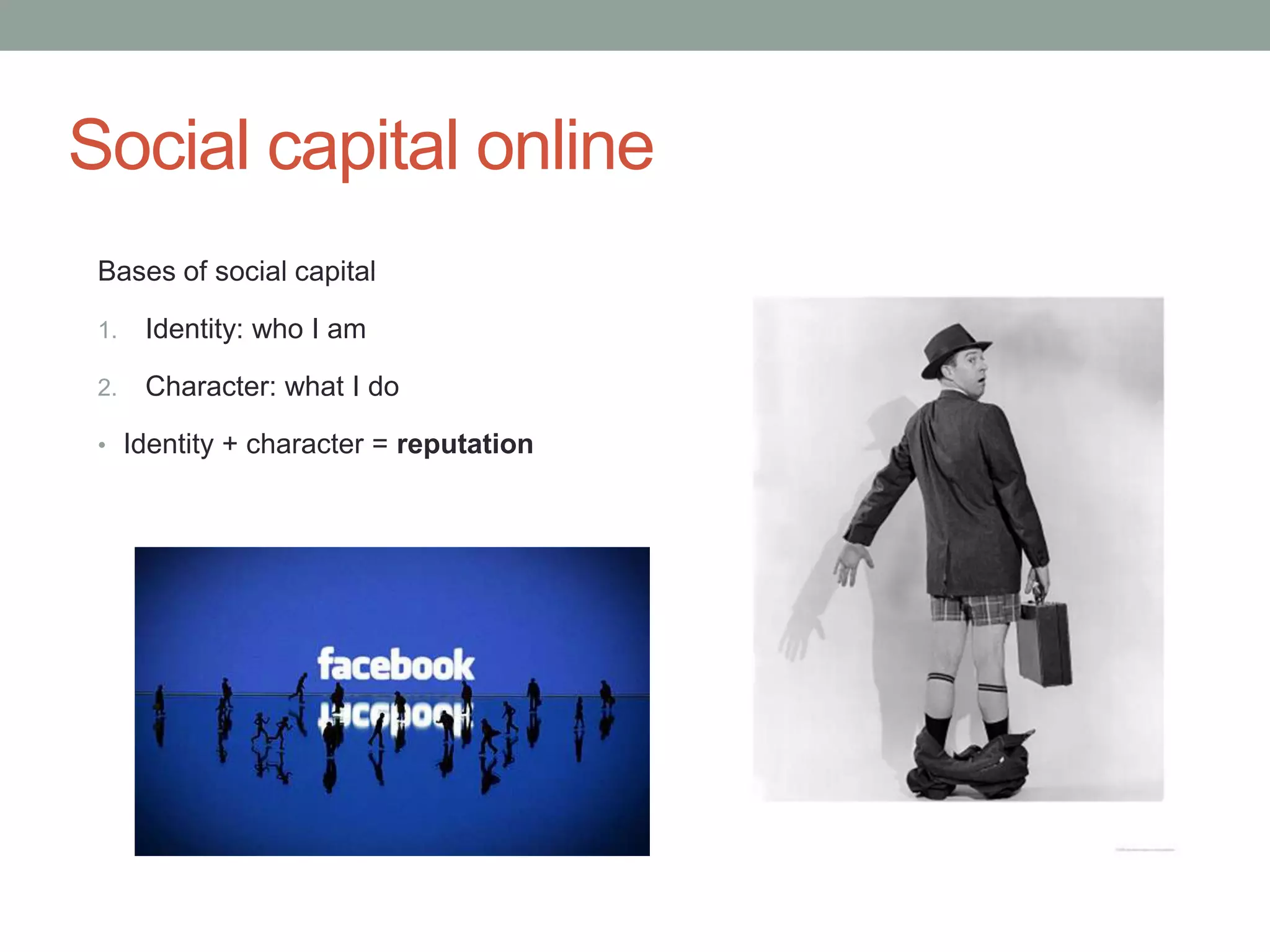
  • #9 Good reputation generates TRUST. What’s the hidden component? SOCIALITY
  • #10 Social networks circulate identity. We need to engage with sharing systems to demonstrate behaviour. RISK: inappropriate behaviour is seen by crowd. This is why many businesses are reluctant to engage with social media. BUT THIS IS COMING TO AN END
  • #11 Reputation systems provide a measure of social capital. The more popular they become, the greater the disadvantage of individuals and businesses who don’t participate in the social web. If you can’t visibly display your social reputation, you are clearly not social. And social = good.
  • #12 Rise of reputation systems driven by rise of peer-to-peer sharing.
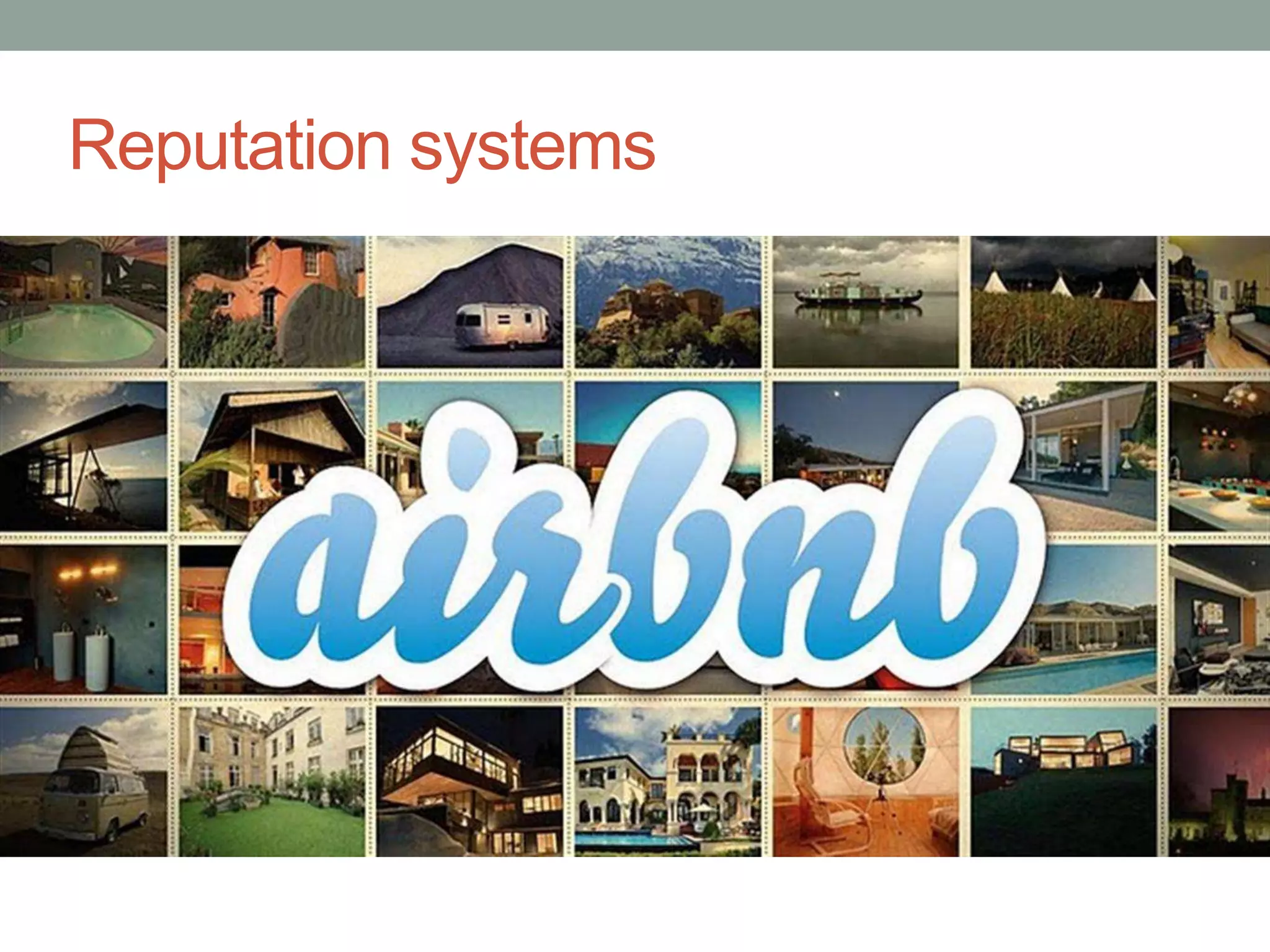
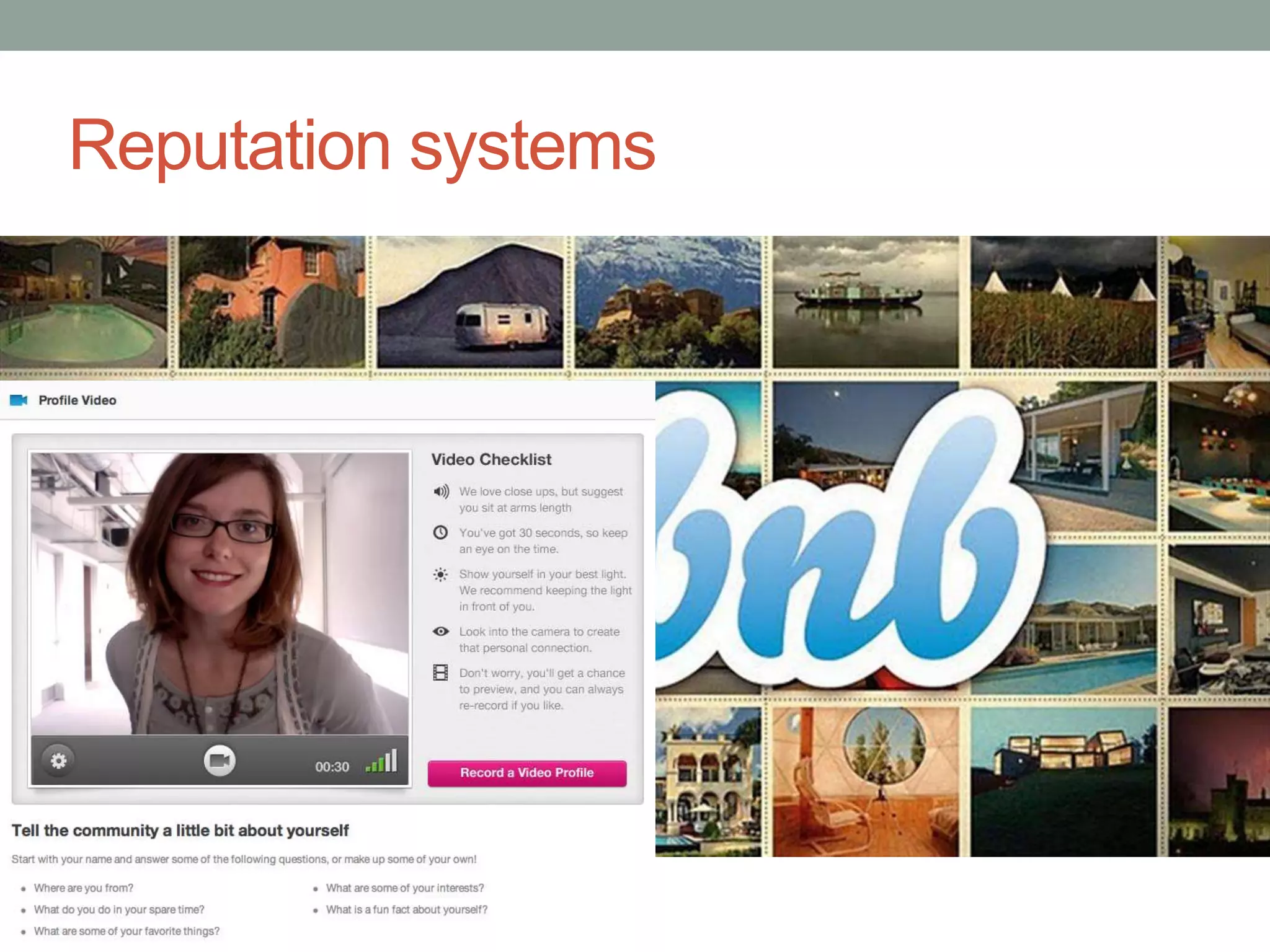
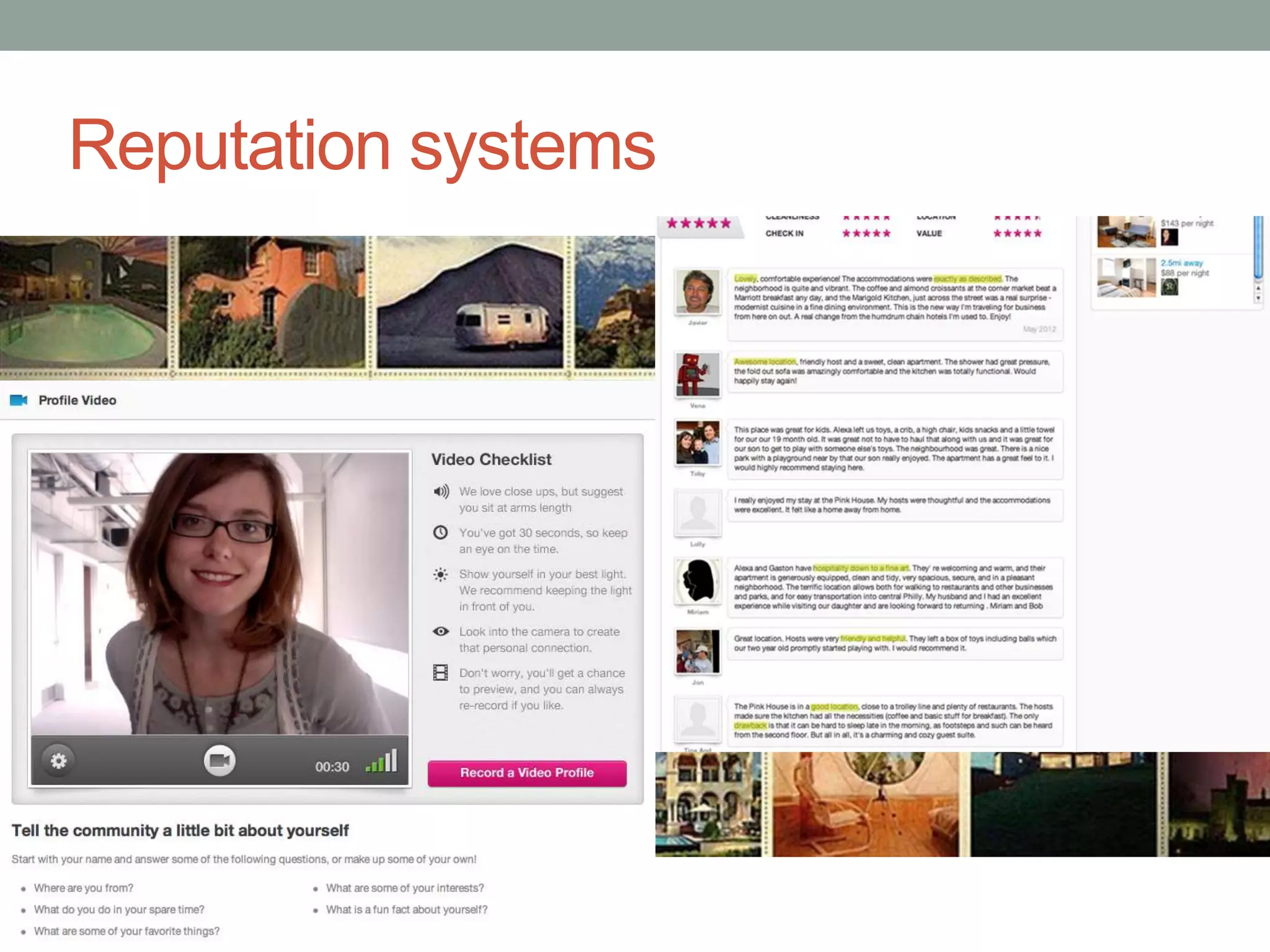
  • #13 AirBnB verifies identity through FB and LI profiles; invites guests and hosts to profile themselves; review system establishes character and reputation.
  • #14 AirBnB verifies identity through FB and LI profiles; invites guests and hosts to profile themselves; review system establishes character and reputation.
  • #15 AirBnB verifies identity through FB and LI profiles; invites guests and hosts to profile themselves; review system establishes character and reputation.
  • #16 But this is siloed information. Increasingly, people want to carry it around.
  • #17 1.5 billion people using social networks. Average US knowledge worker spends 28 hours a week on social networks for professional purposes. All this time invested, social capital built… People are asking: why can’t I make this visible as reputation capital and use it?
  • #18 With every trade we make, comment we leave, person we flag, badge we earn, we leave a reputation trail’. We’re investing huge amounts of time and energy into creating social capital online, often for professional purposes. All our data is being recorded. We could be using that data to establish a visible reputation record to use in ecommerce, P2P exchanges, or just social networking online. Reputation currency is an idea whose time has come.
  • #19 "We found that these seemingly different kinds of rewards -- a good reputation versus money -- are biologically coded by the same neural structure, the striatum," said Dr.NorihiroSadato of the Japanese National Institute for Physiological Sciences in Okazaki, Japan.
  • #20 Paul J. Zac at Claremont Graduate Uni studies oxytocin, the ‘love hormone’. Recent studies have begun to investigate oxytocin's role in various behaviors, including orgasm, social recognition, pair bonding,anxiety, and maternal behaviors. Also linked to empathy and trust. Zac studies the relationship between social interaction and oxytocin levels. Experiments showed positive exchanges on Twitter can raise oxytocin by 13.2% - same as groom at wedding
  • #22 Miicard and Scaffold provide identity verification services. Legit is a cross-platform reputation service for P2P services.
  • #23 Trustcloud and Connect.me are reputation systems for social web users.
  • #25 Algorithm developed with the help of StanfordUni Sociology Department. Focus is on the frequency and consistency of social contributions, including comments, replies, likes, shares…
  • #26 What’s the reputational value of social interactions online? If I see that someone is consistently social, and that people respond positively to their sociality, it suggests to me that they are a 'friendly', if nothing else.
  • #27 Connect.me is more straightforward. People ‘vouch’ for each other in terms of different categories that users select for themselves.
  • #28 P2P is cool but it’s a popularity contest. Brittany Spears would rate highly a pop icon if she could get enough fans on the system. This would reflect her reputation as a pop icon, but does this make her more trustworthy than anyone else? I guess she is a reliable pop icon – that’s the point.
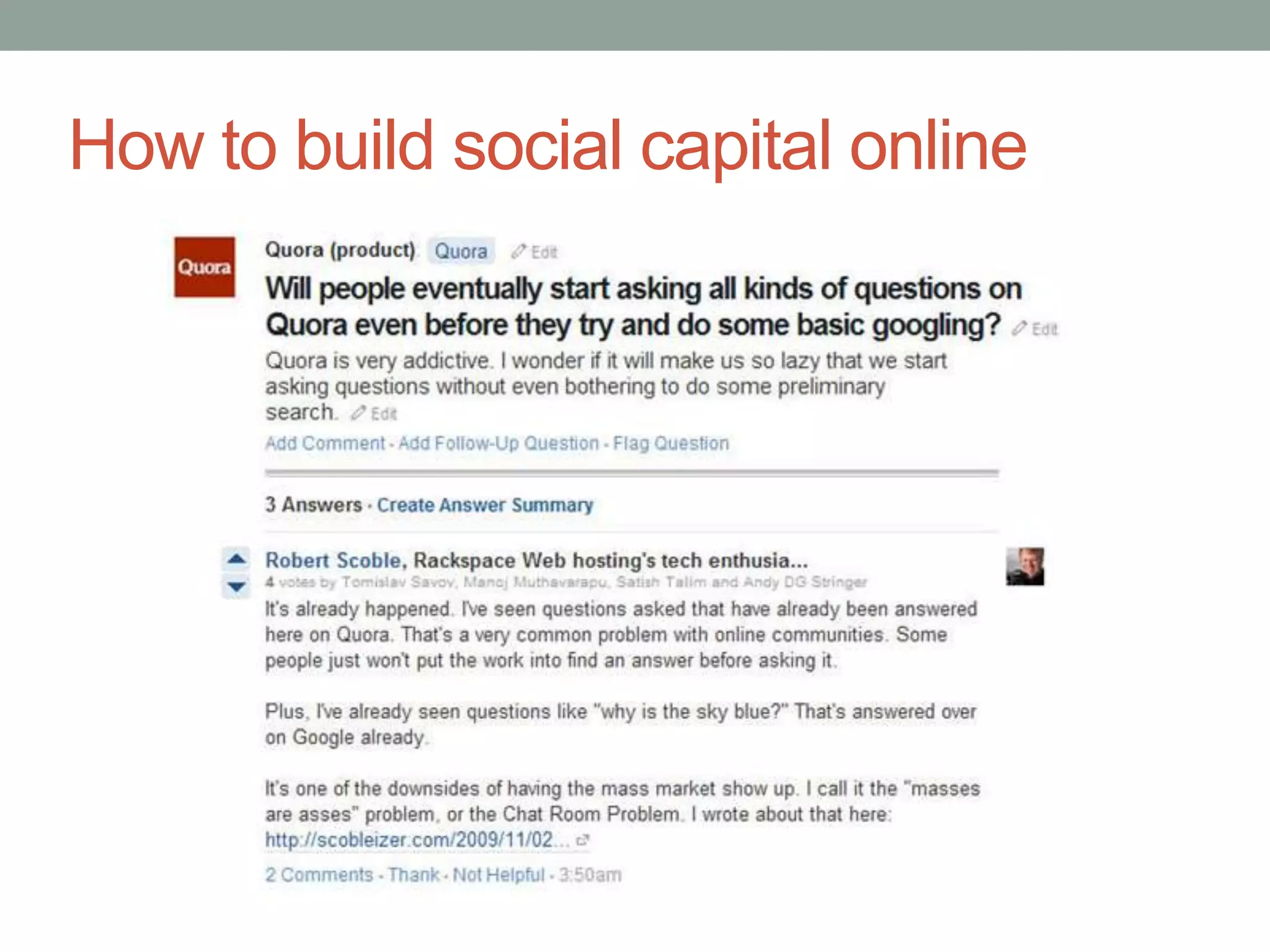
  • #29 The upshot is that you can’t build online reputation by pushing a few buttons.
  • #35 Social media is a gift culture. You earn reputation through the quality and consistency of your gifts. By following people who share your values and interests and sharing with them, you aggregate into values-based tribes.