
Building Our API Strategy
Your name, title
How to contact you
Why APIs?
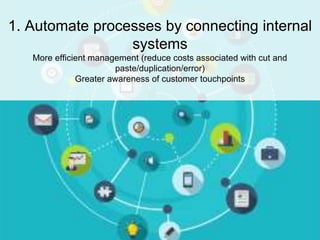
1. Automate processes by connecting internal systems
2. Unlock assets
3. Wider reach, New market entry, Greater customer stickiness
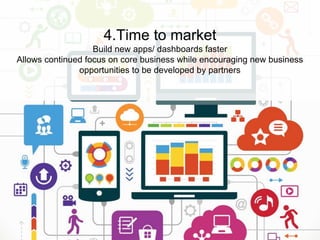
4. Time to market
Connect various software
systems internally
More efficient management (reduce costs associated with cut and paste/duplication/error)
Greater awareness of customer touchpoints
1. Automate processes by connecting internal
systems
More efficient management (reduce costs associated with cut and
paste/duplication/error)
Greater awareness of customer touchpoints
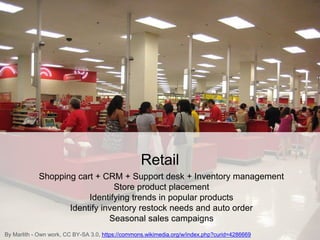
Retail
Shopping cart + CRM + Support desk + Inventory management
Store product placement
Identifying trends in popular products
Identify inventory restock needs and auto order
Seasonal sales campaigns
By Marlith - Own work, CC BY-SA 3.0, https://commons.wikimedia.org/w/index.php?curid=4286669
Turn capital assets into a
service/income stream
Data assets can be marketed
Turn customers into assets/partners
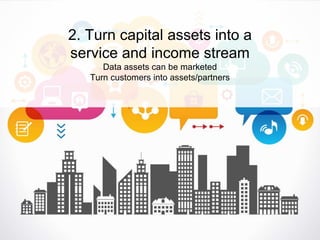
2. Turn capital assets into a
service and income stream
Data assets can be marketed
Turn customers into assets/partners
Banking
Sell aggregated transaction data on purchasing behavior
Now offering identity management as an API product
Customers with expertise with a bank’s product share their
knowledge with other customers
By Billy Hathorn (Own work) [CC BY-SA 3.0 (http://creativecommons.org/licenses/by-sa/3.0) or GFDL (http://www.gnu.org/copyleft/fdl.html)], via Wikimedia Commons
Asset management
Parking garages sell data on vacancies to GPS systems to optimize
their assets
Can sell data on city movements to planners/urban developers
By Jonathan Schilling (Own work) [CC BY-SA 3.0 (http://creativecommons.org/licenses/by-sa/3.0)], via Wikimedia Commons
24/7 availability
Be available within other
businesses services/websites
Let partners introduce you to new markets
Products that integrate are more valuable to customers
and get used more often
3. Wider reach, new market entry, greater
customer stickiness
24/7 availability
Let other businesses and partners introduce you to new markets
Products that integrate are more valuable to customers and get used more often
Cities and Government
Citizens more engaged through open311 feedback loop
Patients more interested in maintaining health programs when linking
health data with third party apps
Analysts able to make use of more gov data via spreadsheets directly
By Júlio Boaro [CC BY-SA 2.0 (http://creativecommons.org/licenses/by-sa/2.0)], via Wikimedia Commons
Build new apps/ dashboards faster
Allows continued focus on core business
while encouraging new business
opportunities to be developed by partners
Data assets can be marketed
Turn customers into assets/partners
4.Time to market
Build new apps/ dashboards faster
Allows continued focus on core business while encouraging new business
opportunities to be developed by partners
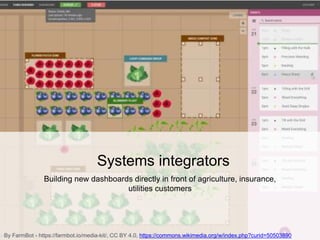
Systems integrators
Building new dashboards directly in front of agriculture, insurance,
utilities customers
By FarmBot - https://farmbot.io/media-kit/, CC BY 4.0, https://commons.wikimedia.org/w/index.php?curid=50503890
What is an API?
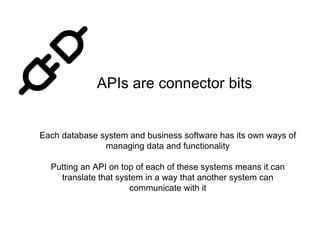
APIs are connector bits
Each database system and business software has its own ways of
managing data and functionality
Putting an API on top of each of these systems means it can
translate that system in a way that another system can
communicate with it
How Businesses are using
APIs
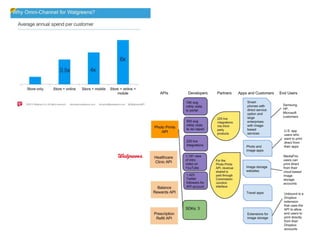
Walgreens
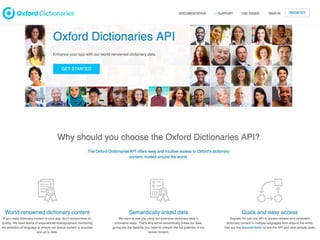
Oxford Dictionaries
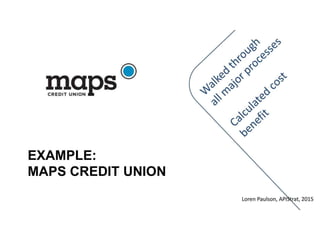
Maps Credit Union
Agricolus
Our APIs
Our API Opportunity
Problem
Solution
Traction
Market
Competition
Business Model
Team
Budget
Thank you
Repeat your contact details
Leave people with a question or followup opportunity
A Note on the Graphics
To create this slide deck, we purchased some stock images from Shutterstock, and also used some creative commons licensed graphics.
The Shutterstock images we purchased mean that we can use them in a slide deck. But if you are downloading and planning to use the
slide deck, you will need to either replace the four Shutterstock images or purchase them as well, as they were purchased for unlimited use
by one user.
Shutterstock images:
• https://www.shutterstock.com/pic-215835544.html by Hilch
• https://www.shutterstock.com/pic-333802814.html by ProStockStudio
• https://www.shutterstock.com/pic-190446536.html by VLADGRIN
• http://www.shutterstock.com/pic-197541896.html by VLADGRIN
Creative Commons images:
• Retail: By Marlith — Own work, CC BY-SA 3.0, https://commons.wikimedia.org/w/index.php?curid=4286669
• Banking: By Billy Hathorn (Own work) [CC BY-SA 3.0 (http://creativecommons.org/licenses/by-sa/3.0) or GFDL
(http://www.gnu.org/copyleft/fdl.html)], via Wikimedia Commons
• Parking: By Jonathan Schilling (Own work) [CC BY-SA 3.0 (http://creativecommons.org/licenses/by-sa/3.0)], via Wikimedia Commons
• Cities and Government: By Júlio Boaro [CC BY-SA 2.0 (http://creativecommons.org/licenses/by-sa/2.0)], via Wikimedia Commons
• Systems integrators: By FarmBot — https://farmbot.io/media-kit/, CC BY 4.0, https://commons.wikimedia.org/w/index.php?curid=50503890

The Hitch Pitch Deck

  • 1.
    Building Our APIStrategy Your name, title How to contact you
  • 2.
  • 3.
    1. Automate processesby connecting internal systems 2. Unlock assets 3. Wider reach, New market entry, Greater customer stickiness 4. Time to market
  • 4.
    Connect various software systemsinternally More efficient management (reduce costs associated with cut and paste/duplication/error) Greater awareness of customer touchpoints 1. Automate processes by connecting internal systems More efficient management (reduce costs associated with cut and paste/duplication/error) Greater awareness of customer touchpoints
  • 5.
    Retail Shopping cart +CRM + Support desk + Inventory management Store product placement Identifying trends in popular products Identify inventory restock needs and auto order Seasonal sales campaigns By Marlith - Own work, CC BY-SA 3.0, https://commons.wikimedia.org/w/index.php?curid=4286669
  • 6.
    Turn capital assetsinto a service/income stream Data assets can be marketed Turn customers into assets/partners 2. Turn capital assets into a service and income stream Data assets can be marketed Turn customers into assets/partners
  • 7.
    Banking Sell aggregated transactiondata on purchasing behavior Now offering identity management as an API product Customers with expertise with a bank’s product share their knowledge with other customers By Billy Hathorn (Own work) [CC BY-SA 3.0 (http://creativecommons.org/licenses/by-sa/3.0) or GFDL (http://www.gnu.org/copyleft/fdl.html)], via Wikimedia Commons
  • 8.
    Asset management Parking garagessell data on vacancies to GPS systems to optimize their assets Can sell data on city movements to planners/urban developers By Jonathan Schilling (Own work) [CC BY-SA 3.0 (http://creativecommons.org/licenses/by-sa/3.0)], via Wikimedia Commons
  • 9.
    24/7 availability Be availablewithin other businesses services/websites Let partners introduce you to new markets Products that integrate are more valuable to customers and get used more often 3. Wider reach, new market entry, greater customer stickiness 24/7 availability Let other businesses and partners introduce you to new markets Products that integrate are more valuable to customers and get used more often
  • 10.
    Cities and Government Citizensmore engaged through open311 feedback loop Patients more interested in maintaining health programs when linking health data with third party apps Analysts able to make use of more gov data via spreadsheets directly By Júlio Boaro [CC BY-SA 2.0 (http://creativecommons.org/licenses/by-sa/2.0)], via Wikimedia Commons
  • 11.
    Build new apps/dashboards faster Allows continued focus on core business while encouraging new business opportunities to be developed by partners Data assets can be marketed Turn customers into assets/partners 4.Time to market Build new apps/ dashboards faster Allows continued focus on core business while encouraging new business opportunities to be developed by partners
  • 12.
    Systems integrators Building newdashboards directly in front of agriculture, insurance, utilities customers By FarmBot - https://farmbot.io/media-kit/, CC BY 4.0, https://commons.wikimedia.org/w/index.php?curid=50503890
  • 13.
  • 14.
    APIs are connectorbits Each database system and business software has its own ways of managing data and functionality Putting an API on top of each of these systems means it can translate that system in a way that another system can communicate with it
  • 15.
  • 16.
  • 18.
  • 20.
  • 22.
  • 24.
  • 25.
  • 26.
  • 27.
  • 28.
  • 29.
  • 30.
  • 31.
  • 32.
  • 33.
  • 34.
    Thank you Repeat yourcontact details Leave people with a question or followup opportunity
  • 35.
    A Note onthe Graphics To create this slide deck, we purchased some stock images from Shutterstock, and also used some creative commons licensed graphics. The Shutterstock images we purchased mean that we can use them in a slide deck. But if you are downloading and planning to use the slide deck, you will need to either replace the four Shutterstock images or purchase them as well, as they were purchased for unlimited use by one user. Shutterstock images: • https://www.shutterstock.com/pic-215835544.html by Hilch • https://www.shutterstock.com/pic-333802814.html by ProStockStudio • https://www.shutterstock.com/pic-190446536.html by VLADGRIN • http://www.shutterstock.com/pic-197541896.html by VLADGRIN Creative Commons images: • Retail: By Marlith — Own work, CC BY-SA 3.0, https://commons.wikimedia.org/w/index.php?curid=4286669 • Banking: By Billy Hathorn (Own work) [CC BY-SA 3.0 (http://creativecommons.org/licenses/by-sa/3.0) or GFDL (http://www.gnu.org/copyleft/fdl.html)], via Wikimedia Commons • Parking: By Jonathan Schilling (Own work) [CC BY-SA 3.0 (http://creativecommons.org/licenses/by-sa/3.0)], via Wikimedia Commons • Cities and Government: By Júlio Boaro [CC BY-SA 2.0 (http://creativecommons.org/licenses/by-sa/2.0)], via Wikimedia Commons • Systems integrators: By FarmBot — https://farmbot.io/media-kit/, CC BY 4.0, https://commons.wikimedia.org/w/index.php?curid=50503890

Editor's Notes

  • #3 This section looks at four key advantages of APIs and hope various industry sectors are creating these advantages.
  • #6 Retail are using APIs to connect data on customers, their shopping purchases, and their calls to customer service. They are also able to use this data on purchases to better manage their inventory and warehousing. Big data analysis on when shoppers buy certain items is being g fed by API to help optimize product placement and in-store promotions. Data on customers purchasing habits, stick inventory levels and weather APIs are being combined to promote particular sales campaigns. In addition, by connecting these data points via API, retail is able to introduce automation to increase efficiency for things like automatic restocking of warehouse inventory, and identifying trends in what products people purchase together so that they can be used in recommendation engines and specific promotional campaigns.
  • #8 Banks like BBVA are anonymizing and aggregating transactional data made through BBVA point off sale systems and using BBVA affiliated debit and credit cards. This data is then packaged up and made available via API to help businesses identify the demographics of customers shopping in their business area. Banks are also able to leverage their industry reputations as a product by offering an identity API. Some banks are also exploring network effects via API by creating platforms where customers can share their product experience and expertise with other customers.
  • #9 Parking garages are looking to add APIs onto their parking vacancy sensors so that they can integrate this data into GPS systems. Their goal is to optimize their car parking spaces by having realtime availability directly connected to car GPS software. They are also looking at how they could sell that data to urban developers and business associations who may be interested in understanding the flow of movement within a city centre.
  • #11 APIs increase the “stickiness” off products by making them more useful to customers because they integrate better with their lives. People are more likely to better manage their health, for example, off they can combine their health and activity data. Analysts tend to make more use of government open data if they have an easy way to integrate it into their spreadsheets. And cities are increasing the engagement of citizens by using APIs to link between how citizens report city problems like potholes, how they allocate resources to repairs, and then how they use APIs to then inform the citizen when the repair work has been completed.
  • #13 Systems integrators are creating new customers by using APIs to build realtime dashboards with them directly in front of them. In agriculture, for example, systems integrators are building dashboards that combine market data on grain sales and demand with weather data and the farmer’s own crop sensor data.
  • #15 To explain APIs, i usually like to say they are the connector bits that connect one system to another. Each customer database, point of sale action, or business service is in its own software or process system. To make them able to connect to another part of the overall business, you need to have them in a format that another system can communicate with. APIs are the connector bits between the two systems that let them talk to each other. I then usually give a general example of how APIs can help connect point of sales systems with customer records and make this data ready and available for customer support or repair calls. APIs connect all of those systems together so a business can improve the customer experience and solidify their customer relationship. The APIs also mean they can automate actions like identifying which customers need to be sent a reminder about annual checkups of whatever they have bought. This sort of general example is relatable and demonstrates the business advantage and you can keep building it out to talk about mobile, sensors and IoT, automated responses, etc.
  • #18 Pharmacy and wellness retailer Walgreens provides a Photo Prints API that enables developers to integrate directly with Walgreens’ photo printing service from their own mobile and web app products, particularly image and photo apps. Walgreens found that customers who connect with the brand over mobile as well as come in to the store spend 4 times the amount of customers who just visit the store without using mobile. By focusing on the photo printing API first, the dev team were able to demonstrate the business benefits of APIs, and this single handedly helped reinvigorate Walgreens photo printing kiosks which were seeing reduced usage before this initiative. The success of this API also gave the enterprise confidence in more sensitive APIs such as prescription refilling APIs and customer loyalty programs. The API provides a revenue share model, whereby developers can earn income for every image that is ordered for printing from within the developer’s app or website. The API has seen developer adoption grow more than 200% through 2014 and into 2015. Walgreens is a fascinating API to watch as it shows how a large-scale enterprise with significant market share in a traditional industry is adapting to leverage its APIs and maintain the focus on customer experience. http://www.programmableweb.com/news/how-walgreens-api-program-leverages-seasonality-and-revenue-sharing/analysis/2015/12/03 http://www.slideshare.net/apigee/the-walgreens-story-putting-an-api-around-their-stores
  • #20 Oxford Dictionaries had previously sold their data to big corporations like Google for use in search results through a one-off payment. Now they are able to create a transactional business model based on word searches and collect more data on what words people are searching. They are able to make their data resources available to game developers who may want to create word puzzles, and to researchers who are studying cultural trends. The dictionary resource becomes a range of products that can be integrated directly via API into new digital products and services.
  • #22 Smaller financial institutions are demonstrating how banks can implement API strategies and are acting as examples that banks can follow. Loren Paulsen is Software Development Manager at Maps Credit Union in the U.S, and led a work program that saw the Oregon-based credit union recently receive the prestigious Celent Financial Services Industry Award. “The award was a reflection of our culture and our use of APIs,” says Paulsen. Paulsen says the journey started several years ago with the enterprise’s core conversion to DNA from Fiserv, a banking IT hub that includes an open API allowing users to access its data and banking functionalities. “A major decision criteria for us was the presence of an open API. It is a mindset that is not terribly common in the credit union industry,” says Paulsen. (While such an option may not be available to banks, many are seeking ways to create an abstraction layer on their legacy systems that builds an API gateway to their banking functionalities, in much the same way that DNA channels access to banking functions through its open API.) Maps Credit Union then initiated an Idea Lab to help various departments identify new opportunities to leverage the power of APIs. “Through the open architecture, we have been able to automate very easily. Drawing on multiple APIs and composing them together is becoming a reality for us,” Paulsen shares. Paulsen has been able to lead solutions that couple internal banking data with external APIs to create seamless workflows that end up in significant administration savings for the credit union. “We have these insufficient funds notices, and we were able to use the SendGrid API to send out these notices, paperless. In another case, where we have our own text banking platform, we are using the Twilio API as the backbone of that service. Another API we use is Formstack that allows our marketing and other departments to make their own forms and we use the Formstack webhook to draw stuff back to us to use programmatically and start automatic workflows based on those form submissions,” Paulsen describes. Paulsen says that one of the advantages of this is that the credit union is not locked in to using software that it doesn’t need, but can instead be nimble and gain “a more powerful result just using the API”. To encourage other departments to understand what is possible, Paulsen’s Idea Lab team would meet with various internal stakeholders and identify tasks that required spreadsheets or email reports, or that tended to involve repetitive administration tasks. He gives an example where at the start of each day, accounts that were overdrawn would be marked with a warning flag. Before their API infrastructure was in place, someone would manually mark each of the day’s accounts to be locked, based on the day’s report. Now all of that is done automatically via API.
  • #24 Agricolus use APIs to allow farms to efficiently manage pesticide and fertiliser treatments of agriculture crops. It has already been adopted by the Umbria region in Italy to help with managing the olive fly pest risk that two years ago decimated an entire seasonal crop production across the region. “This was a big problem the region had two years ago,” says Agricolus founder Andrea Cruciani. “The olive pest fly caused the loss of up to 90% of the harvest from olive trees. And the region was unprepared for how to manage this disease on large scale.” Cruciani says that they have used sensors and APIs to connect data with historical data records to identify risks, and then shares this data in realtime using Agricolus. Within one month of building the API-driven farm management platform, 300 farmers were registered with the program, and they are now expecting up to 3000 to register this season.
  • #25 Overview Demonstrate how the API works toward the goals of the company. Make the overview quick and to the point.
  • #26 Opportunity Lay out the opportunity your API serves. (i.e. “Accelerate user acquisition by using developers as portals to other potential users.”) Where possible, link to wider business plan goals
  • #27 Problem Talk about the problem your customer or your company faces without the API. (i.e. “We’re not where our customers are.”)
  • #28 Solution How your API solves the problem. (i.e. “Allows us to integrate with Slack, where our customers are.”)
  • #29 Traction Does your API meet an unmet need? Would your customers or the business suffer if the API were to go away? What kind of traction do you have in the space?
  • #30 Market Understand and articulate how your API fits in the market landscape, and how you will differentiate yourself. If possible, discuss how your partners/aligned industry stakeholders are using APIs
  • #31 Competition Know your competition — who they are and how you compete. What are your strengths and theirs? What can you learn from them? How are they using APIs?
  • #32 Business Model The basic structure of how the API will function as a business. John Musser has an excellent overview of API business models here.
  • #33 Describe your team and how your colleagues can connect with your team. For a discussion of possible team roles, see: http://bit.ly/2gPj0OE
  • #34 Discuss resource needs and how you will demonstrate return on investment Document the business case of creating an API strategy vs the costs of not doing it.