The Marshall Plan By: Morgan Terry 1947-1951
History   The Marshall Plan was created to restore Europe after World War II. George C. Marshall came up with this program for U.S. assistance to the cities of Europe. Marshall had his idea approved by congress and raised thirteen billion dollars in economic and technical assistance to 16 European countries.  George C. Marshall
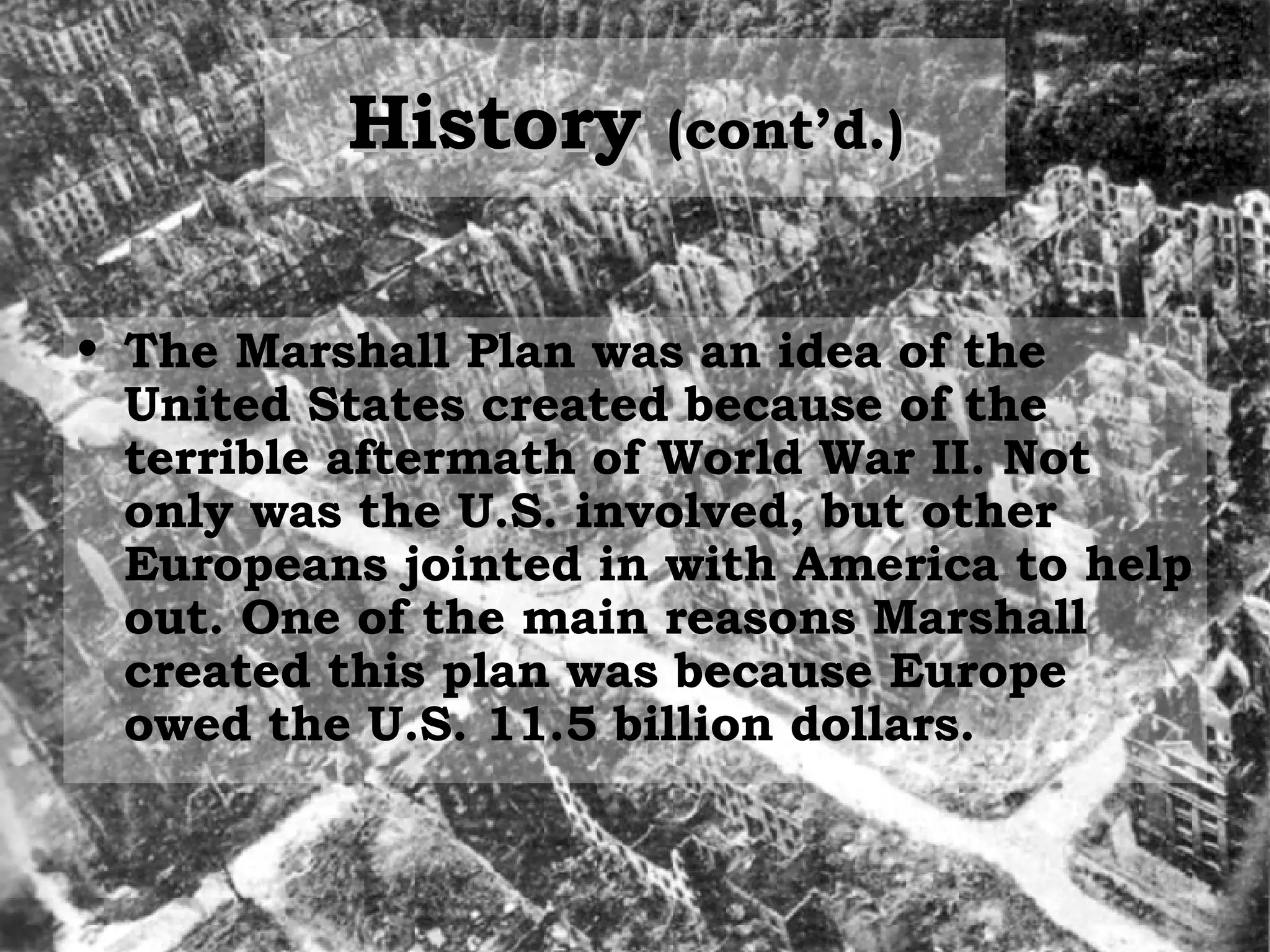
History  (cont’d.)   The Marshall Plan was an idea of the  United States created because of the terrible aftermath of World War II. Not only was the U.S. involved, but other Europeans jointed in with America to help out. One of the main reasons Marshall created this plan was because Europe owed the U.S. 11.5 billion dollars.
What For?   The Marshall plan aimed to stop the spread of communism, to help Europe get out of their war debts, and to provide a market for American goods.
Needs for the Aide General George Marshall, American Secretary of State Restoration of Europe’s economic needs Churchill was a “rubble of heap and a breeding ground of hate”
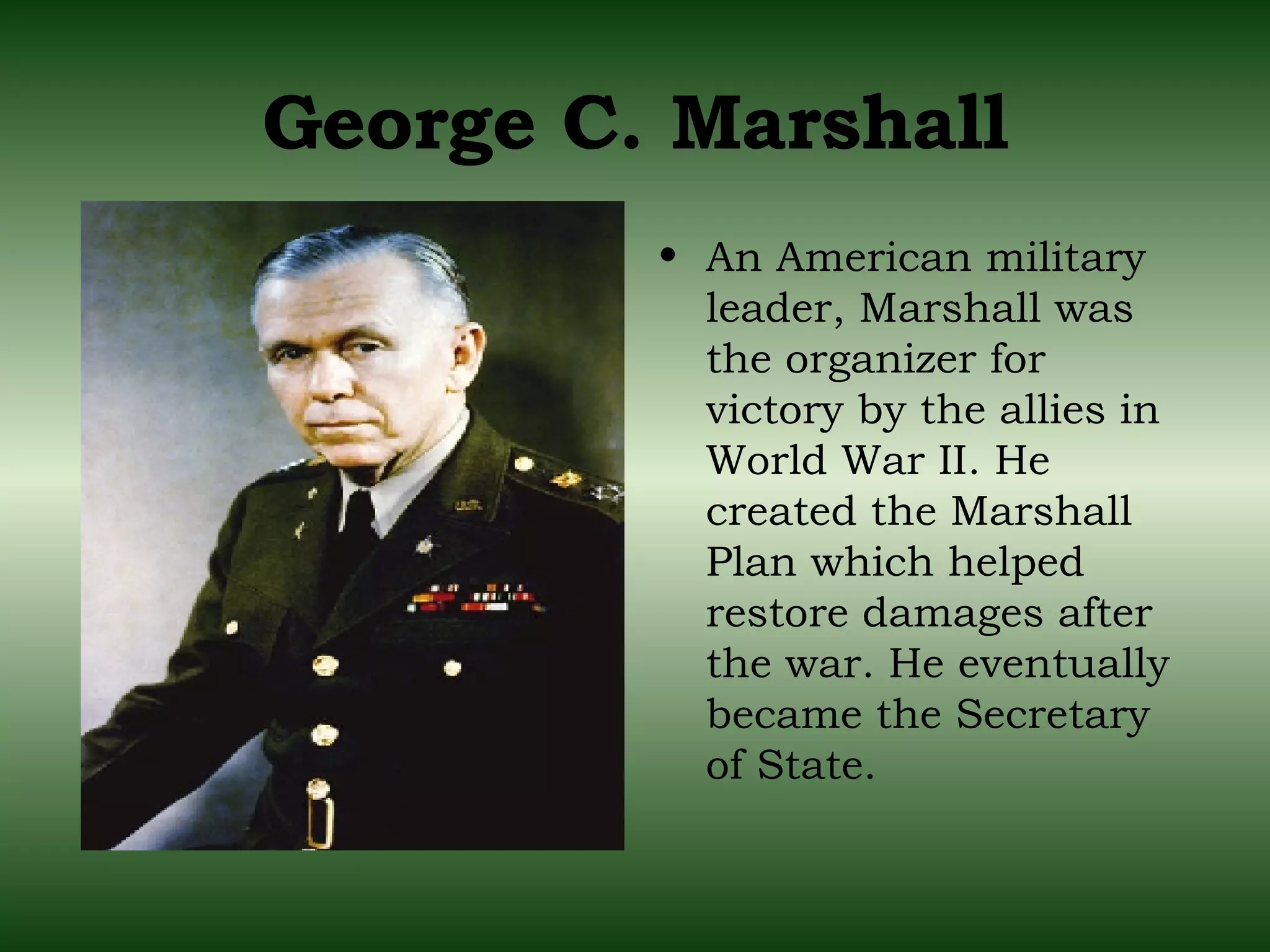
George C. Marshall An American military leader, Marshall was the organizer for victory by the allies in World War II. He created the Marshall Plan which helped restore damages after the war. He eventually became the Secretary of State.
Harry S. Truman Harry Truman was the U.S. president at the time of World War II. He supported the Marshall Plan and even his own, the Truman Doctrine. Truman had many arguments to Congress for the plans to take effect.
William L. Clayton William Clayton was an American government official. He strongly supported the United State’s economic aide to Europe. He played a major role in shaping the Marshall Plan.
Soviet Response Joseph Stalin was the General Secretary of the Communist Party of the Soviet Union during World War II. His country was offered Marshall aide and refused it. He forbade Eastern Europe countries from having anything to do with it. Stalin saw the plan as a significant threat to the Soviet’s control of Eastern Europe.
Soviet Response  (cont’d.)   He believed that economic integration with the West would allow these countries to escape Soviet control. He then put an even stronger control of the Eastern countries. Joseph Stalin
Map of affected areas   The red areas show the parts of Europe that received the Marshall Plan aide. The larger the red bar, the more aide the city had.
How successful was the plan?   $12-13 billion dollars poured into Europe 16 European states accepted the aid from the U.S. 25% improvements in most countries Reduced poverty Communism never got popular
Primary Source: Text of the Plan   I need not tell you that the world situation is very serious. That must be apparent to all intelligent people. I think one difficulty is that the problem is one of such enormous complexity that the very mass of facts presented to the public by press and radio make it exceedingly difficult for the man in the street to reach a clear appraisement of the situation.
Furthermore, the people of this country are distant from the troubled areas of the Earth, and it is hard for them to comprehend the plight and consequent reactions of the long-suffering peoples and the effect of those reactions on their governments in connection with our efforts to promote peace in the world. Primary Source: Text of the Plan   (cont’d.)
Timeline 1947-1951 1947>Marshall offered aid to Europe 1948>Congress approves $5 billion of Marshall Plan aid  1949>more countries are receiving money for aid, a total of $3,652 1950>Yugoslavia signs an agreement with the U.S. government, receives $150 million of Marshall Plan aid  1951> The Marshall Plan ended
Bibliography &quot;Marshall Plan.&quot;  Wikipedia, The Free Encyclopedia . 18 Nov 2007, 04:19 UTC. Wikimedia Foundation, Inc. 20 Nov 2007 < http:// en.wikipedia.org/w/index.php?title = Marshall_Plan&oldid =172216763 >.   Stein, R. Conrad.  World War II in Europe.  Enslow Publishers 2002. http://www.usaid.gov/multimedia/video/marshall/speeches.html. 27-Jun-2002.  http://www.infoplease.com/ce6/history/A0831964.html http://www.ourdocuments.gov/doc.php?flash=true&doc=82

Marshall Plan

  • 1.
    The Marshall PlanBy: Morgan Terry 1947-1951
  • 2.
    History The Marshall Plan was created to restore Europe after World War II. George C. Marshall came up with this program for U.S. assistance to the cities of Europe. Marshall had his idea approved by congress and raised thirteen billion dollars in economic and technical assistance to 16 European countries. George C. Marshall
  • 3.
    History (cont’d.) The Marshall Plan was an idea of the United States created because of the terrible aftermath of World War II. Not only was the U.S. involved, but other Europeans jointed in with America to help out. One of the main reasons Marshall created this plan was because Europe owed the U.S. 11.5 billion dollars.
  • 4.
    What For? The Marshall plan aimed to stop the spread of communism, to help Europe get out of their war debts, and to provide a market for American goods.
  • 5.
    Needs for theAide General George Marshall, American Secretary of State Restoration of Europe’s economic needs Churchill was a “rubble of heap and a breeding ground of hate”
  • 6.
    George C. MarshallAn American military leader, Marshall was the organizer for victory by the allies in World War II. He created the Marshall Plan which helped restore damages after the war. He eventually became the Secretary of State.
  • 7.
    Harry S. TrumanHarry Truman was the U.S. president at the time of World War II. He supported the Marshall Plan and even his own, the Truman Doctrine. Truman had many arguments to Congress for the plans to take effect.
  • 8.
    William L. ClaytonWilliam Clayton was an American government official. He strongly supported the United State’s economic aide to Europe. He played a major role in shaping the Marshall Plan.
  • 9.
    Soviet Response JosephStalin was the General Secretary of the Communist Party of the Soviet Union during World War II. His country was offered Marshall aide and refused it. He forbade Eastern Europe countries from having anything to do with it. Stalin saw the plan as a significant threat to the Soviet’s control of Eastern Europe.
  • 10.
    Soviet Response (cont’d.) He believed that economic integration with the West would allow these countries to escape Soviet control. He then put an even stronger control of the Eastern countries. Joseph Stalin
  • 11.
    Map of affectedareas The red areas show the parts of Europe that received the Marshall Plan aide. The larger the red bar, the more aide the city had.
  • 12.
    How successful wasthe plan? $12-13 billion dollars poured into Europe 16 European states accepted the aid from the U.S. 25% improvements in most countries Reduced poverty Communism never got popular
  • 13.
    Primary Source: Textof the Plan I need not tell you that the world situation is very serious. That must be apparent to all intelligent people. I think one difficulty is that the problem is one of such enormous complexity that the very mass of facts presented to the public by press and radio make it exceedingly difficult for the man in the street to reach a clear appraisement of the situation.
  • 14.
    Furthermore, the peopleof this country are distant from the troubled areas of the Earth, and it is hard for them to comprehend the plight and consequent reactions of the long-suffering peoples and the effect of those reactions on their governments in connection with our efforts to promote peace in the world. Primary Source: Text of the Plan (cont’d.)
  • 15.
    Timeline 1947-1951 1947>Marshalloffered aid to Europe 1948>Congress approves $5 billion of Marshall Plan aid 1949>more countries are receiving money for aid, a total of $3,652 1950>Yugoslavia signs an agreement with the U.S. government, receives $150 million of Marshall Plan aid 1951> The Marshall Plan ended
  • 16.
    Bibliography &quot;Marshall Plan.&quot; Wikipedia, The Free Encyclopedia . 18 Nov 2007, 04:19 UTC. Wikimedia Foundation, Inc. 20 Nov 2007 < http:// en.wikipedia.org/w/index.php?title = Marshall_Plan&oldid =172216763 >. Stein, R. Conrad. World War II in Europe. Enslow Publishers 2002. http://www.usaid.gov/multimedia/video/marshall/speeches.html. 27-Jun-2002. http://www.infoplease.com/ce6/history/A0831964.html http://www.ourdocuments.gov/doc.php?flash=true&doc=82