TRIGEMINAL NERVE
1
By- Pushpa Kumari (1st Yr PGT)
Presenter:Dr.RUQAIA BANU N
First Year PGT
Department of Paediatric and Preventive
Dentistry
CONTENTS
➢ CRANIAL NERVES
➢ INTRODUCTION
➢ TRIGEMINAL NUCLEI
➢ COURSE AND DISTRIBUTION
➢ TRIGEMINAL GANGLION
➢ DIVISION OF TRIGEMINAL NERVE
➢ CLINICAL EXAMINATION
➢ APPLIED ANATOMY
➢ CONCLUSION
➢ REFERENCES
2
3
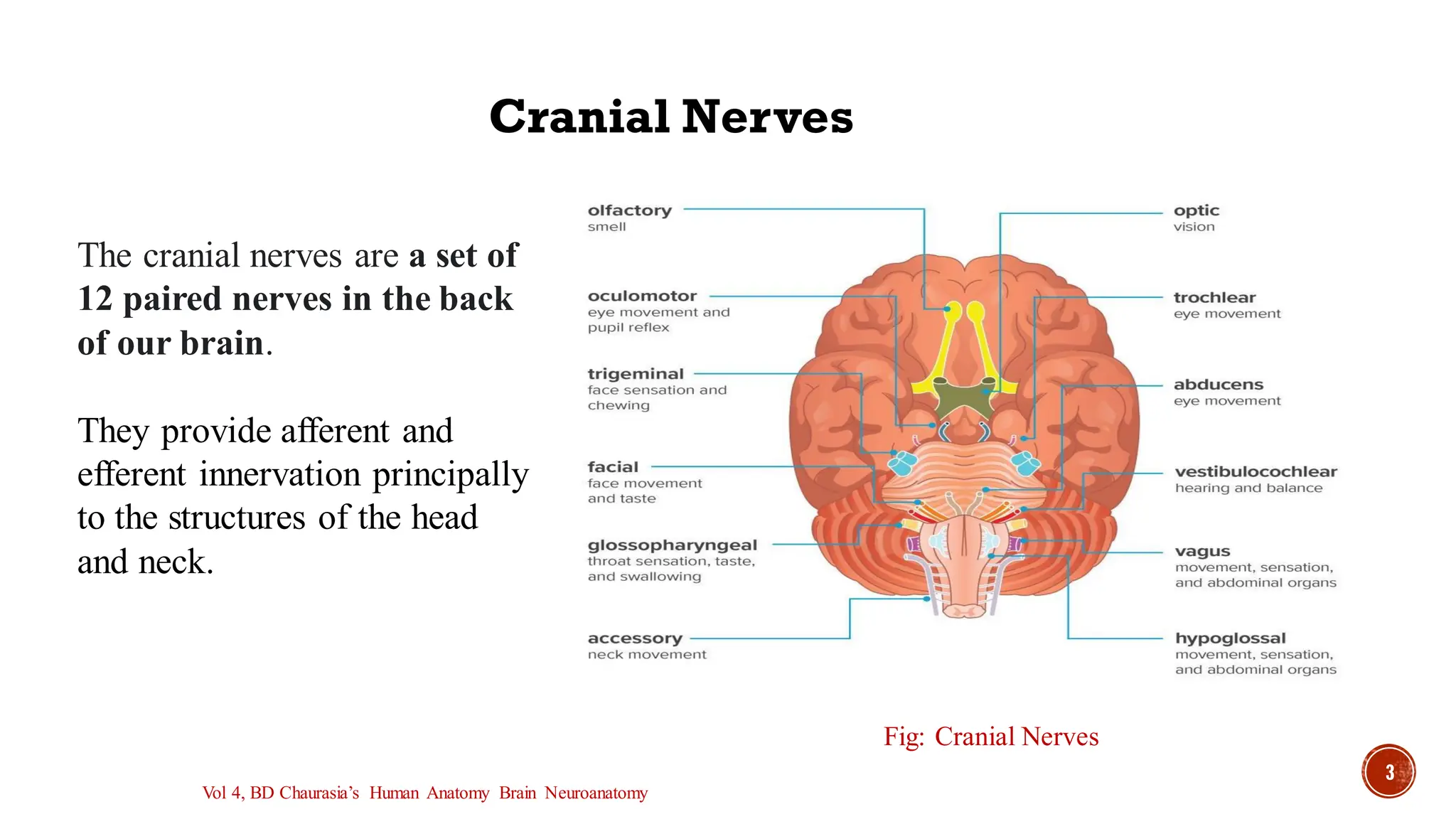
Cranial Nerves
The cranial nerves are a set of
12 paired nerves in the back
of our brain.
They provide afferent and
efferent innervation principally
to the structures of the head
and neck.
Fig: Cranial Nerves
Vol 4, BD Chaurasia’s Human Anatomy Brain Neuroanatomy
4
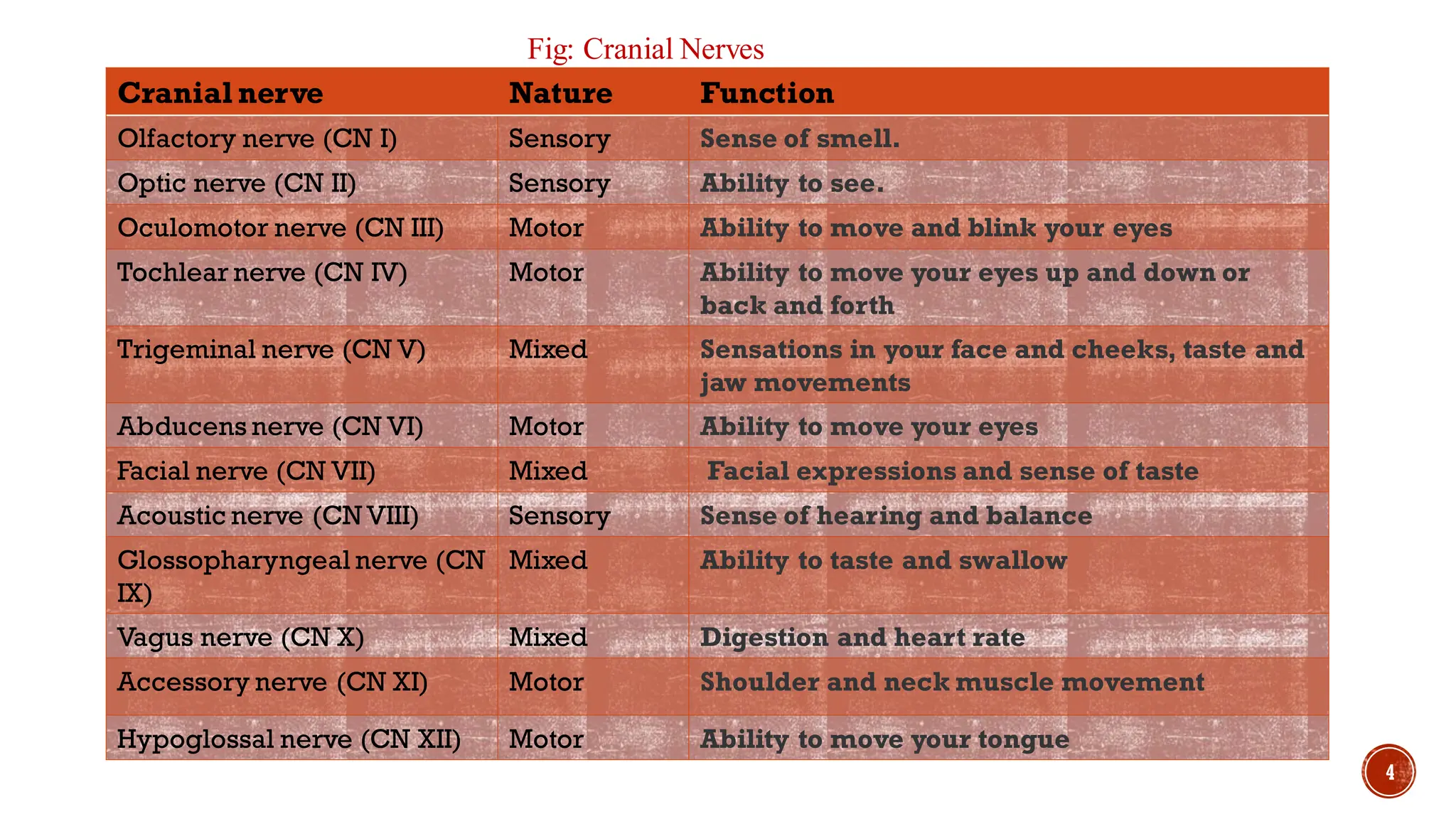
Cranial nerve Nature Function
Olfactory nerve (CN I) Sensory Sense of smell.
Optic nerve (CN II) Sensory Ability to see.
Oculomotor nerve (CN III) Motor Ability to move and blink your eyes
Tochlear nerve (CN IV) Motor Ability to move your eyes up and down or
back and forth
Trigeminal nerve (CN V) Mixed Sensations in your face and cheeks, taste and
jaw movements
Abducens nerve (CN VI) Motor Ability to move your eyes
Facial nerve (CN VII) Mixed Facial expressions and sense of taste
Acoustic nerve (CN VIII) Sensory Sense of hearing and balance
Glossopharyngeal nerve (CN
IX)
Mixed Ability to taste and swallow
Vagus nerve (CN X) Mixed Digestion and heart rate
Accessory nerve (CN XI) Motor Shoulder and neck muscle movement
Hypoglossal nerve (CN XII) Motor Ability to move your tongue
Fig: Cranial Nerves
INTRODUCTION
• Derived from first pharyngeal arch.
• It is largest cranial nerve, mixed in nature.
• Fifth cranial nerve, cranial nerve V, or simply CN V.
• It is so called because of its three main divisions.
• Ophthalmic and maxillary nerves purely sensory, whereas
• mandibular nerve motor as well as sensory functions.
• It is responsible for sensation in the face and motor functions such as biting and chewing.
5
Vol 4, BD Chaurasia’s Human Anatomy Brain Neuroanatomy
6
Vol 4, BD Chaurasia’s Human Anatomy Brain Neuroanatomy
NUCLEUS
7
TRIGEMINAL NUCLEI
Two types of nuclei :
• Sensory nuclei
➢ Mesencephalic nucleus
➢ Principal Sensory Nucleus
➢ Spinal Trigeminal Nucleus
• Motor nuclei
8
Vol 4, BD Chaurasia’s Human Anatomy Brain Neuroanatomy
Fig: Trigeminal Nuclei
Sensory Nuclei
Mesencephalic Nuclei :–
• Situated in Midbrain
• Contains primary sensory neurons that innervates the muscle
spindle of the masticatory and other muscle in oro-facial region
• Relay proprioception from muscle of mastication
9
Vol 4, BD Chaurasia’s Human Anatomy Brain Neuroanatomy
• The principal sensory nucleus is located lateral to the motor nucleus within the
posterolateral surface of the pons
• Fibers carrying fine touch and pressure synapse in the principal sensory nucleus
Spinal Trigeminal Nucleus :-
• Caudal extension of the principal sensory nucleus and descends from the lower pons
to the upper cervical levels of the spinal cord (C2-4).
• The spinal trigeminal nucleus is mainly dedicated to thermoceptive and nociceptive
fibers for the face.
Principal Sensory Nucleus:-
10
Vol 4, BD Chaurasia’s Human Anatomy Brain Neuroanatomy
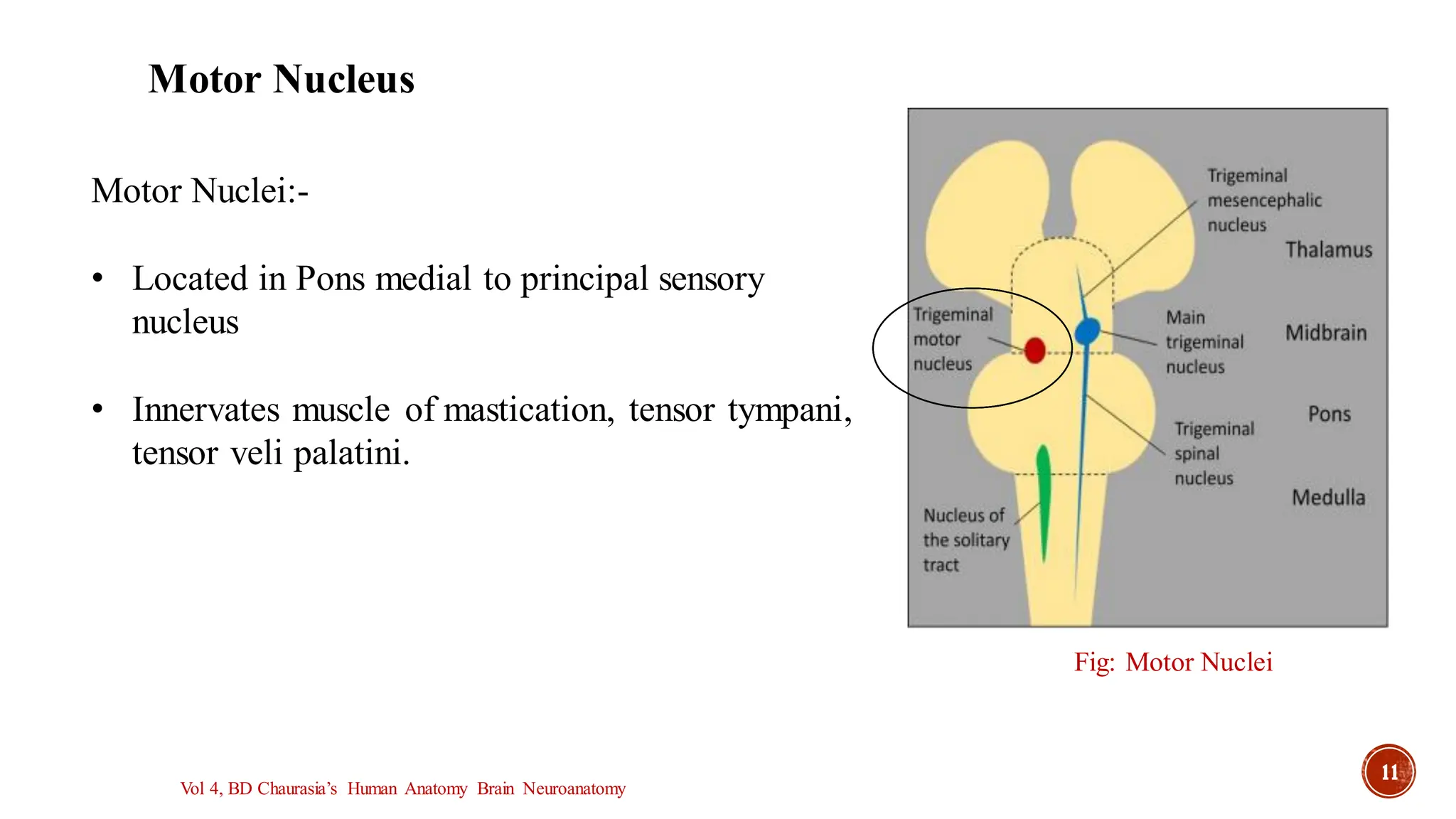
Motor Nuclei:-
• Located in Pons medial to principal sensory
nucleus
• Innervates muscle of mastication, tensor tympani,
tensor veli palatini.
Motor Nucleus
11
Vol 4, BD Chaurasia’s Human Anatomy Brain Neuroanatomy
Fig: Motor Nuclei
Fig: Explaining the course and distribution 12
Vol 4, BD Chaurasia’s Human Anatomy Brain Neuroanatomy
13
Ganglion
14
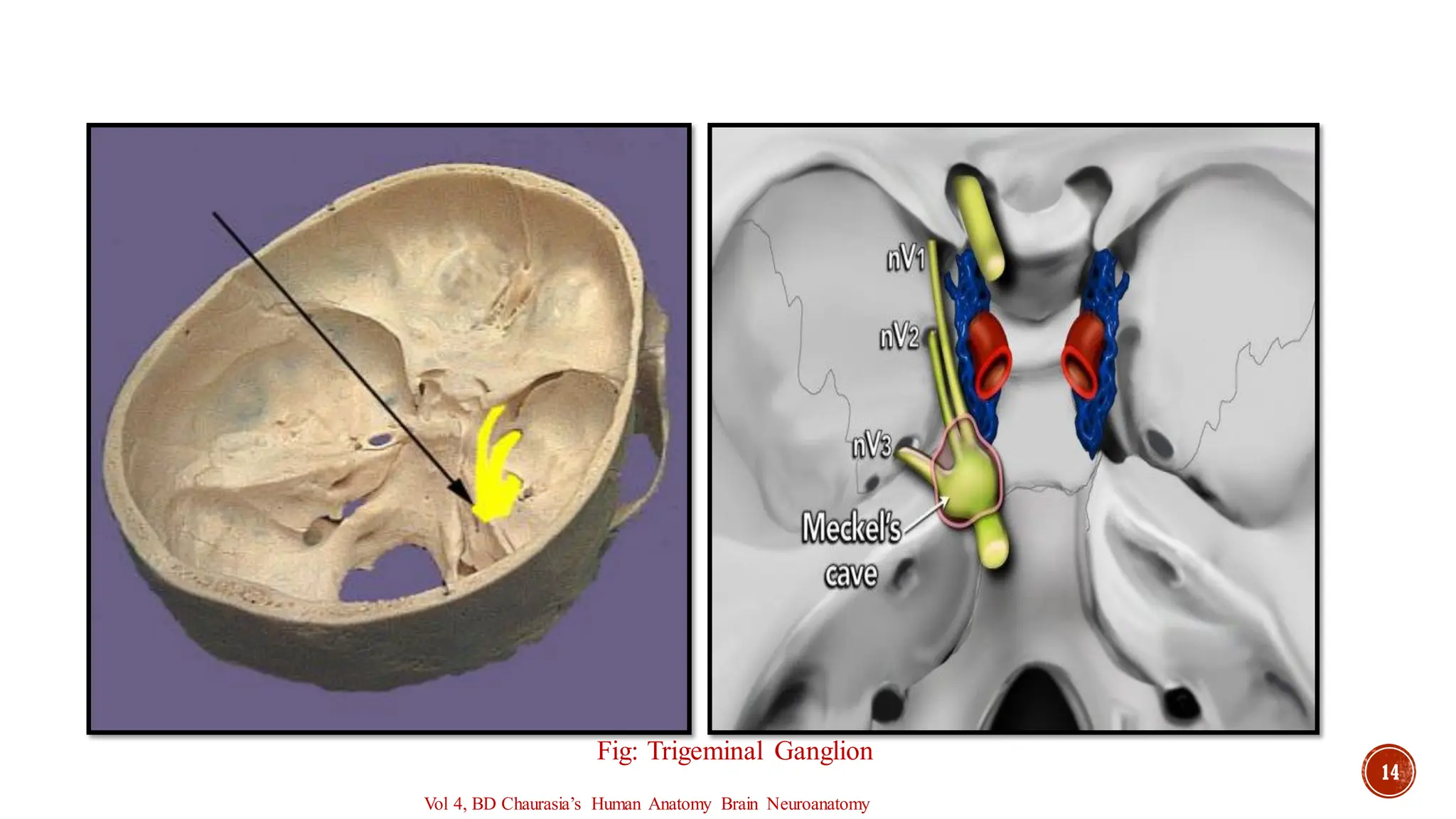
Fig: Trigeminal Ganglion
Vol 4, BD Chaurasia’s Human Anatomy Brain Neuroanatomy
TRIGEMINAL GANGLION
• Known as Semilunar or Gasserian ganglion, lies within cranial cavity.
• Located within Meckel's cave, a CSF-filled space between two layers of
dura mater over the petrous portion of the temporal bone.
• The trigeminal neurons in the trigeminal ganglion are pseudo-unipolar
neurons with two axonal branches
15
Vol 4, BD Chaurasia’s Human Anatomy Brain Neuroanatomy
Ophthalmic
Maxillary
Mandibular
DIVISION OF TRIGEMINAL NERVE
16
17
Textbook of clinical neuroanatomy by Vishram Singh
Fig: Divisions od Trigeminal Nerve
18
Vol 4, BD Chaurasia’s Human Anatomy Brain Neuroanatomy
Fig: Branches of trigeminal nerve
• First division of the trigeminal nerve.
• Purely sensory (afferent) nerve.
• Smallest division of the trigeminal nerve.
• Supplies sensation to the forehead, eyeball, lacrimal glands, upper
eyelids, frontal sinuses, and the side of the nose.
Ophthalmic Nerve
19
• Textbook of clinical neuroanatomy by Vishram Singh
This nerve derives from the anteromedial aspect of the trigeminal ganglion.
It runs forward in the lateral wall of the Cavernous Sinus below the oculomotor and
trochlear nerves.
Before leaving the cavernous sinus, it splits into its main branches: the frontal,
lacrimal, and Nasocilliary Nerves which enter the orbital cavity through
the Superior Orbital fissure
COURSE AND DISTRIBUTION
20
• Textbook of clinical neuroanatomy by Vishram Singh
Branches Of Ophthalmic Nerve
• Frontal
➢ Supratrochlear - Upper Eyelid, Conjunctiva, Lower
part of forehead
➢ Supraorbital– Frontal air sinus, uppereyelid,
forehead, Scalp till apex
• Nasomaxillary
➢ Long Ciliary – Sensory to eyeball
➢ Branch to Ciliary Ganglion
➢ PosteriorEthmoidal – Sphenoidal air sinus, posterior
ethmoidal air sinus
➢ Anterior Ethmoidal
➢ Infratrochlear – Both eyelids, side of nose, lacrimal
sac
• Lacrimal
21
• Textbook of clinical neuroanatomy by Vishram Singh
Fig: Branches of Ophthalmic nerve
• Medium-sized branch.
• Exclusively sensory and carries pain, temperature, and tactile information
from the region below the orbits and above mouth.
• This includes lower eyelid, skin that covers the side of the nose, cheek,
maxillary sinus, nasopharynx, nasal cavity, palate, upper teeth, upper lip, and
dura mater of the middle cranial fossa.
Maxillary Nerve
22
• Textbook of clinical neuroanatomy by Vishram Singh
The maxillary nerve arises from the anteriorconvexity of trigeminal ganglion.
It courses forward embedded in the lateral wall of the cavernous sinus, It runs inferior and
lateral to the ophthalmic nerve.
It then leaves the middle cranial fossa through foramenrotundum
enters the superior part of the pterygopalatinefossa.(pterygopalatinefossa is a bilateral cone-
shaped space posterior to the maxilla)
nerve then leaves the fossa and enters the floor of the orbit through inferior orbital fissure as the
infraorbital nerve.
Infraorbital nerve courses forward, first through the infraorbital groove, and then through the
infraorbital canal on the floor of the orbit. It finally emerges on the face through the infraorbital
foramen, located near the inferior margin of orbit.
COURSE AND DISTRIBUTION
23
• Textbook of clinical neuroanatomy by Vishram Singh
24
• Textbook of clinical neuroanatomy by Vishram Singh
Fig: Course and distribution of maxillary nerve
Branches Of Maxillary nerve
• In Middle CranialFossa
➢ Meningeal Branch – Supplyto meninges.
• In PterygopalatineFossa
➢ Ganglionic Branches
❑ Lesser palatineN – SupplySoft palate
❑ Greater palatineN – Supplygums, mucous membrane and glands of gland of the hard palate
➢ Zygomatic
➢ Posterior Superior – Supplyto maxillary molars
• In Infraorbital Canal
➢ Middlesuperior alveolar – Supplyto mesio buccal root of molars & premolars.
➢ Anterior superior alveolar – Supplyto canines & Incisors.
• On Face
➢ Infraorbital
❑ Palpebral– Supplyto the skin of lower eyelid
❑ Nasal – Supplyto skin of side of nose
❑ Labial – Supplyto cheek & upper lip
25
• Textbook of clinical neuroanatomy by Vishram Singh
26
• Mandibular nerve is only branch of the trigeminal nerve that contains a motor
root.
• Arises from 3 nuclei large sensory root.
• Motor nucleus located in the upper area of the pons gives rise to the
motor root of the nerve.
• The motor root runs along the trigeminal cave and joins the sensory root before
leaving the skull through the foramen ovale and enters the infratemporal fossa.
Mandibular Nerve
Introduction:
• Textbook of clinical neuroanatomy by Vishram Singh
27
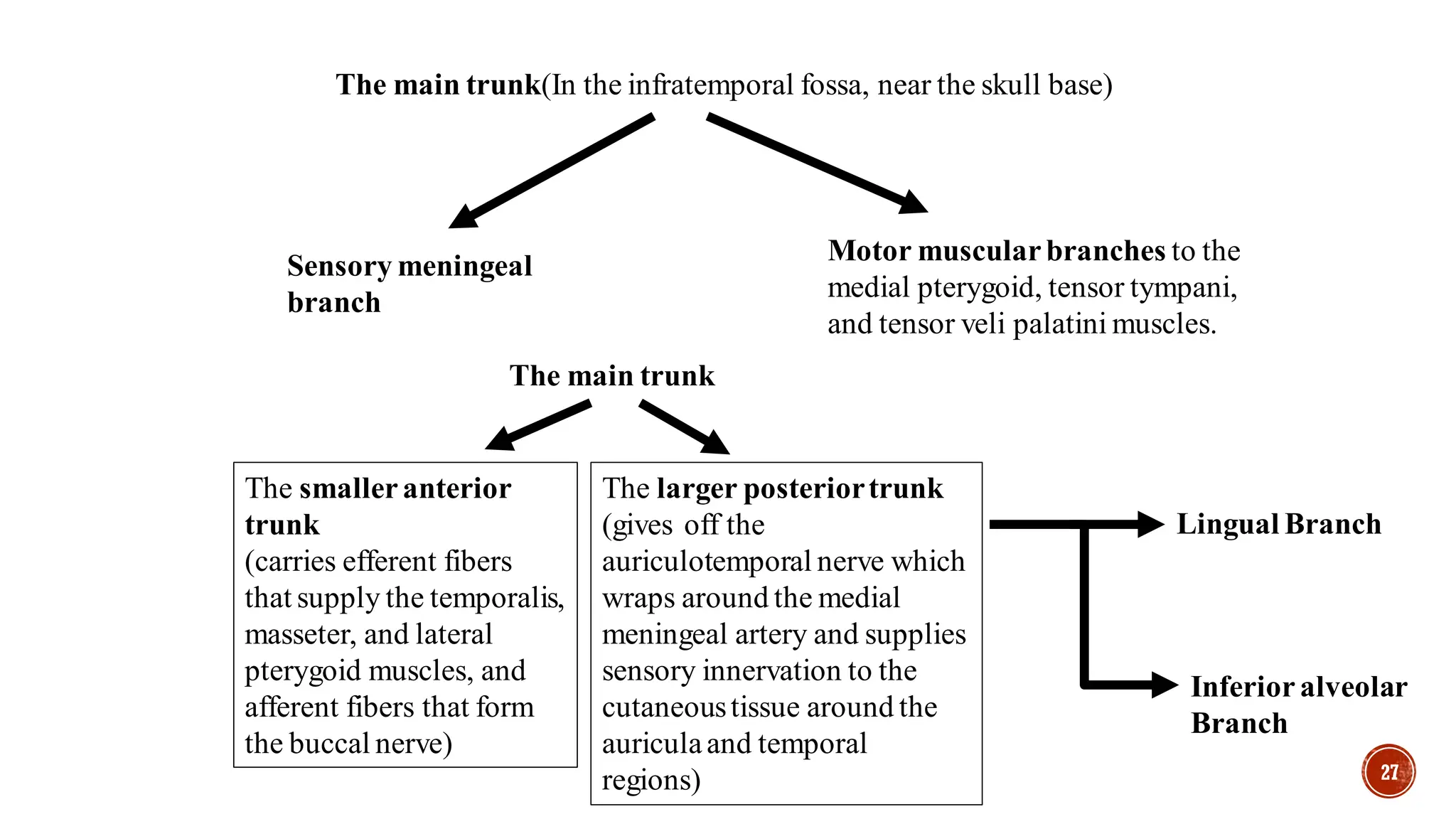
The main trunk(In the infratemporal fossa, near the skull base)
Sensory meningeal
branch
Motor muscularbranches to the
medial pterygoid, tensor tympani,
and tensor veli palatini muscles.
The main trunk
The smalleranterior
trunk
(carries efferent fibers
that supply the temporalis,
masseter, and lateral
pterygoid muscles, and
afferent fibers that form
the buccal nerve)
The larger posteriortrunk
(gives off the
auriculotemporal nerve which
wraps around the medial
meningeal artery and supplies
sensory innervation to the
cutaneoustissue around the
auriculaand temporal
regions)
Lingual Branch
Inferioralveolar
Branch
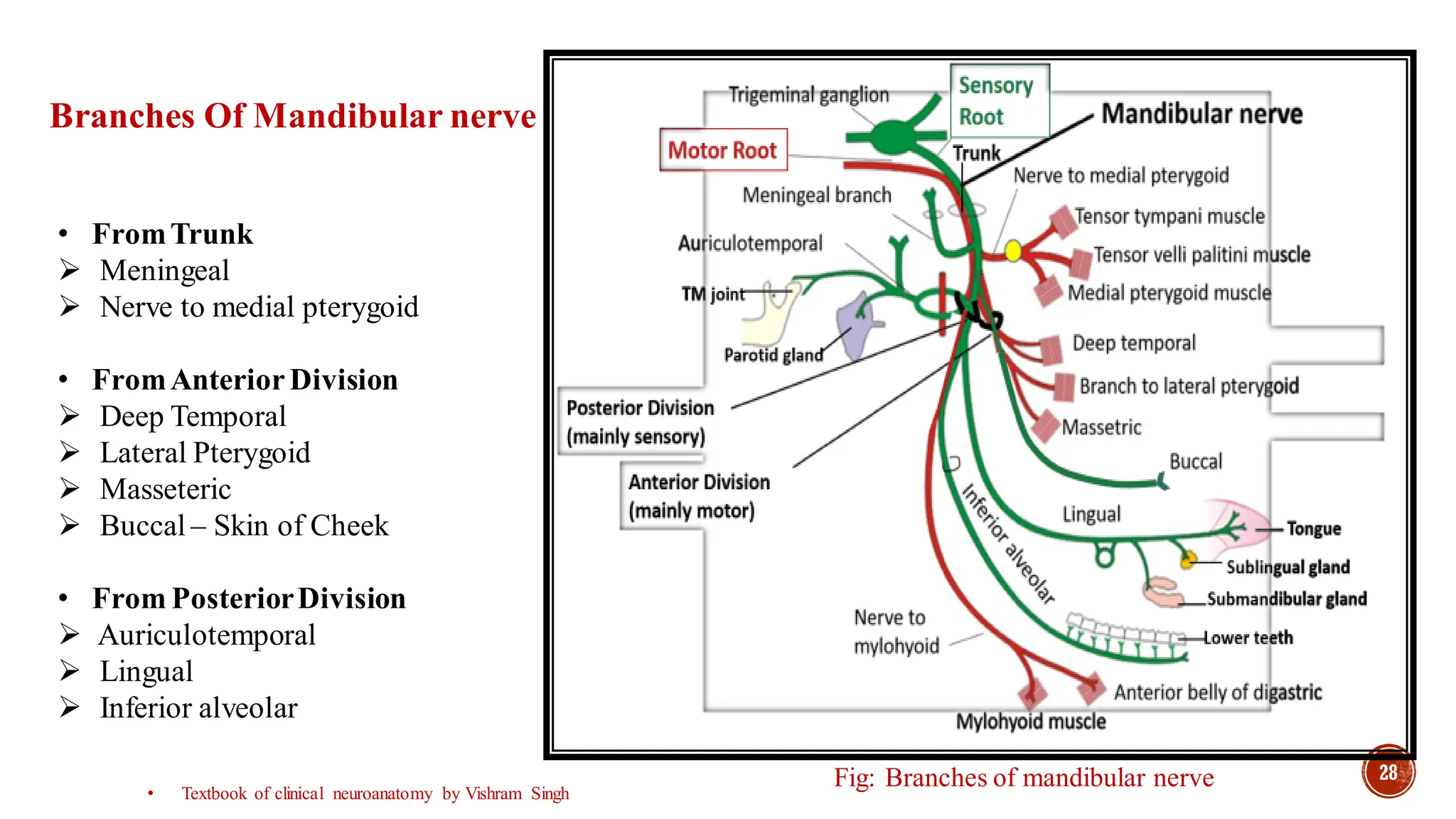
Branches Of Mandibular nerve
28
• FromTrunk
➢ Meningeal
➢ Nerve to medial pterygoid
• FromAnteriorDivision
➢ Deep Temporal
➢ Lateral Pterygoid
➢ Masseteric
➢ Buccal – Skin of Cheek
• From PosteriorDivision
➢ Auriculotemporal
➢ Lingual
➢ Inferior alveolar
• Textbook of clinical neuroanatomy by Vishram Singh
Fig: Branches of mandibular nerve
Clinical Examination
Sensory
• Take a piece of cotton ball on finger. Lightly touch either one or both sides of each of the
three divisions of the trigeminal. Ask the patient to show or say whether you touched one
or both sides of the face.
• Next, take a safety pin and gently prick first one side of each division and then the other,
asking the patient if there is any difference in the sensation on one side compared to the
other.
• Test the corneal reflex.
29
• Textbook of clinical neuroanatomy by Vishram Singh
Test for motor abnormalities as follows:
• Observe the skin over the temporal masseter muscles. Concavity or asymmetry suggests
atrophy. The tip of the mandible should be in the midline.
• Ask the patient to clench his or her jaws. Palpate the masseter and temporal muscles for
asymmetry of volume and for tone.
• Observe for deviation of the tip of the mandible as the jaws are opened.
• Ask the patient to move the jaw from side to side against the resistance of your palm.
The paralyzed side will not move laterally.
30
• Textbook of clinical neuroanatomy by Vishram Singh
CLINICAL SIGNIFICANCE
Injury to
Ophthalmic Nerve- Loss of corneal blink reflex
Maxillary nerve- Loss of Sneeze reflex
Mandibularnerve- Loss of jaw jerk reflex
31
Vol 4, BD Chaurasia’s Human Anatomy Brain Neuroanatomy
Fig: Corneal blink reflex Fig: Jaw jerk reflex
Any lesion involving the sensory portion can produce ipsilateral pain or varying degree of
anesthesia.
Etiology:-
❑ Peripheral lesions: craniofacial trauma, basilar skull fractures, dental trauma, maxillary
sinusitis, primary or metastatic tumors, aneurysm of the internal carotid artery, cavernous
sinus thrombosis, lupus, scleroderma, Sjøgren's syndrome, and a fairly common
idiopathic benign sensory neuropathy.
❑ Lesions of the ganglion: herpes zoster infection, primary and metastatic tumors.
❑ Trigeminal root lesions: adjacent tumors and vascular malformations, especially acoustic
neurinoma and cholesteatomas. These lesions are prone to produce facial pain that is often
misdiagnosed as tic douloureux or tooth pain.
32
Vol 4, BD Chaurasia’s Human Anatomy Brain Neuroanatomy
33
Tic douloureux, or Trigeminal Neuralgia
• Frequent cause of facial pain.
• Paroxysmal pain of great intensity that involves any or all of the trigeminal division.
More frequent in the maxillary or mandibular division.
• Nature of pain- sudden, severe, brief, stabbing, recurrent pain, electric shock like
lancinating, burning, excruciating.
• Pain in areas supplied by the trigeminal nerve, including the cheek, jaw, teeth, gums,
lips, or less often the eye and forehead.
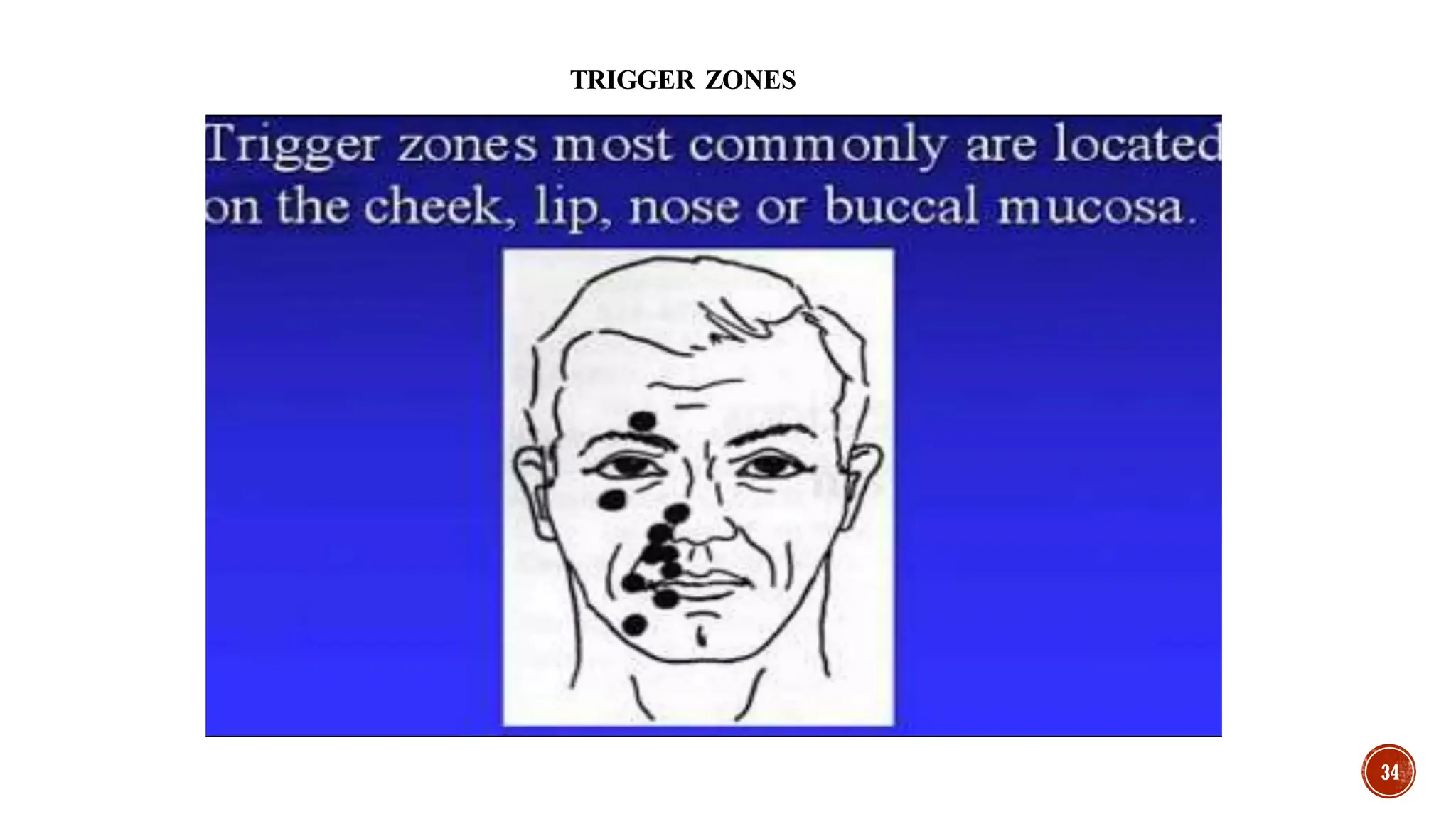
• A variety of triggers may set off the pain of trigeminal neuralgia, including : Shaving,
Touching your face, Eating, Drinking, Brushing your teeth, Talking, Putting on
makeup, Breeze lightly blowing over your face, Smiling, Washing your face
Shankar Kikkeri N, Nagalli . Trigeminal Neuralgia. [Updated 2022 Jul 9]. In: StatPearls [Internet]. Treasure Island (FL): StatPearls Publishing; 2022 Jan
34
TRIGGER ZONES
INCIDENCE:
▪ The incidence of TGN is estimated at 12.6 per 100,000 person-years, with the
mean age at diagnosis of 51.5 years and women are more often affected than
men.
▪ Rarely, TGN presents during childhood and only 1.5% of cases occur in
pediatric cases.
35
• International Journal of Clinical Pediatrics, ISSN 1927-1255 print, 1927-1263 online, Open Access
Article copyright, the authors; Journal compilation copyright, Int J Clin Pediatr and Elmer Press Inc
36
Etiology
• Dental aetiology – loss of teeth degeneration of nerve proceeds proximally to involve areas
of spinal nucleus
• Infections
• Multiple sclerosis Olfson (1966) suggested the presence of sclerotic plaque located at the
root entry zone of the trigeminal nerve
• Post-traumatic neuralgia
• Intracranial tumours
• Intracranial vascular abnormalities
• Viral aetiology such as Postherpetic neuralgia or patient with history of infection by
varicella zoster virus
• Walker HK. Cranial Nerve V: The Trigeminal Nerve. In: Walker HK, Hall WD, Hurst JW, editors. Clinical Methods: The History, Physical, and Laboratory Examinations. 3rd
37
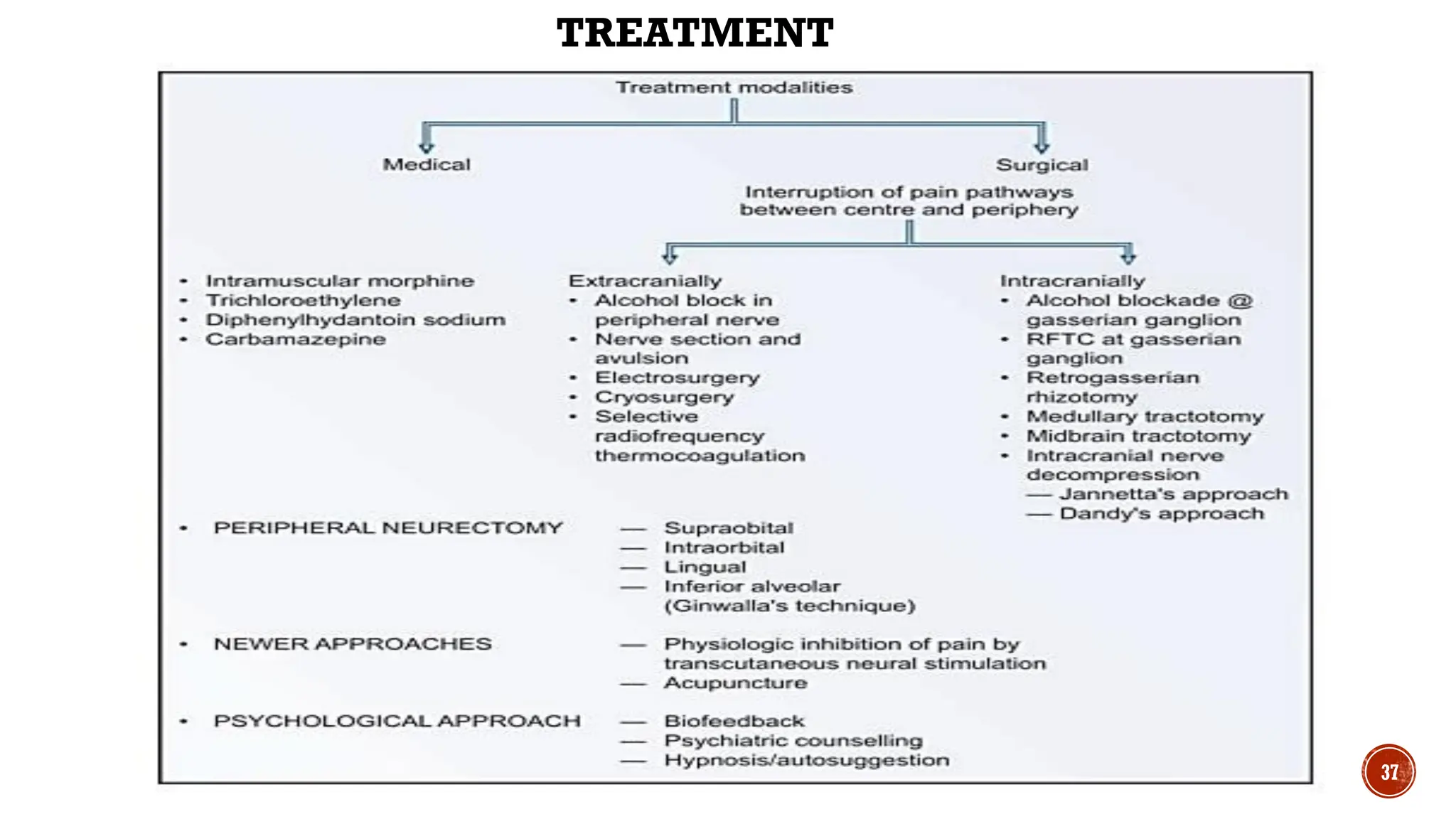
TREATMENT
38
Drug therapy
• Carbamazepine is a gold standard as first line of therapeutic agent. Side
effect drowsiness, dizziness, double vision, and nausea.
• Adults—At first, 200 milligrams (mg) once a day. Your doctor may increase your dose as
needed and tolerated. However, the dose is usually not more than 1200 mg per day.
• Children—Use and dose must be determined by your doctor.
• Oxcarbazepine is a newer drug and is being increasingly used as first-line therapy for TN
in patients who do not respond to or who cannot tolerate carbamazepine. 150mg twice daily
upto max dosage of 1800mg/day
• Baclofen is a muscle relaxant that can be used to treat TN.10-20 mg/day upto max dosage
of 60-80 mg/day
• All above drugs are not in use now because of their side – effects.
• Nowadays Gabapentin is used. 300m/day upto 1800 mg/day
• Huff T, Weisbrod LJ, Daly DT. Neuroanatomy, Cranial Nerve 5 (Trigeminal) [Updated 2022 Nov 9]. In: StatPearls [Internet]. Treasure Island (FL):StatPearls Publishing; 2022 Jan.
39
Conclusion
• Trigeminal nerve, its anatomic course and branches are very important from a our point
of view .
• Disorders of Trigeminal nerve are not rare, knowing about it will help in formulating
appropriate diagnosis and treatment thus achieving best possible recovery.
• Nerve blocks given for carrying various dental procedures involves various branches of
trigeminal nerve, hence to avoid complications, one needs to have a knowledge about
course and branches of the nerve.
40
References
• Vol 4, BD Chaurasia’s Human Anatomy Brain Neuroanatomy
• Textbook of clinical neuroanatomy by Vishram Singh
• Textbook of oral and maxillofacial Surgery by Neelima malik.
• Shankar Kikkeri N, Nagalli S. Trigeminal Neuralgia. [Updated 2022 Jul 9]. In: StatPearls[Internet].
Treasure Island (FL): StatPearlsPublishing; 2022 Jan.
• Huff T, Weisbrod LJ, Daly DT. Neuroanatomy, Cranial Nerve 5 (Trigeminal) [Updated 2022 Nov 9]. In:
StatPearls[Internet]. Treasure Island (FL): StatPearlsPublishing; 2022 Jan.
• Walker HK. Cranial Nerve V: The Trigeminal Nerve. In: Walker HK, Hall WD, Hurst JW, editors. Clinical
Methods:The History, Physical, and LaboratoryExaminations. 3rd edition. Boston:Butterworths; 1990.
Chapter61.
• International Journal of Clinical Pediatrics, ISSN 1927-1255print, 1927-1263online, Open Access
Article copyright, the authors; Journal compilationcopyright, Int J Clin Pediatr and Elmer Press Inc
Journal website http://www.theijcp.org
THANK YOU

TRIGEMINAL NERVE/Neuralgia/5th cranial nerve

  • 1.
    TRIGEMINAL NERVE 1 By- PushpaKumari (1st Yr PGT) Presenter:Dr.RUQAIA BANU N First Year PGT Department of Paediatric and Preventive Dentistry
  • 2.
    CONTENTS ➢ CRANIAL NERVES ➢INTRODUCTION ➢ TRIGEMINAL NUCLEI ➢ COURSE AND DISTRIBUTION ➢ TRIGEMINAL GANGLION ➢ DIVISION OF TRIGEMINAL NERVE ➢ CLINICAL EXAMINATION ➢ APPLIED ANATOMY ➢ CONCLUSION ➢ REFERENCES 2
  • 3.
    3 Cranial Nerves The cranialnerves are a set of 12 paired nerves in the back of our brain. They provide afferent and efferent innervation principally to the structures of the head and neck. Fig: Cranial Nerves Vol 4, BD Chaurasia’s Human Anatomy Brain Neuroanatomy
  • 4.
    4 Cranial nerve NatureFunction Olfactory nerve (CN I) Sensory Sense of smell. Optic nerve (CN II) Sensory Ability to see. Oculomotor nerve (CN III) Motor Ability to move and blink your eyes Tochlear nerve (CN IV) Motor Ability to move your eyes up and down or back and forth Trigeminal nerve (CN V) Mixed Sensations in your face and cheeks, taste and jaw movements Abducens nerve (CN VI) Motor Ability to move your eyes Facial nerve (CN VII) Mixed Facial expressions and sense of taste Acoustic nerve (CN VIII) Sensory Sense of hearing and balance Glossopharyngeal nerve (CN IX) Mixed Ability to taste and swallow Vagus nerve (CN X) Mixed Digestion and heart rate Accessory nerve (CN XI) Motor Shoulder and neck muscle movement Hypoglossal nerve (CN XII) Motor Ability to move your tongue Fig: Cranial Nerves
  • 5.
    INTRODUCTION • Derived fromfirst pharyngeal arch. • It is largest cranial nerve, mixed in nature. • Fifth cranial nerve, cranial nerve V, or simply CN V. • It is so called because of its three main divisions. • Ophthalmic and maxillary nerves purely sensory, whereas • mandibular nerve motor as well as sensory functions. • It is responsible for sensation in the face and motor functions such as biting and chewing. 5 Vol 4, BD Chaurasia’s Human Anatomy Brain Neuroanatomy
  • 6.
    6 Vol 4, BDChaurasia’s Human Anatomy Brain Neuroanatomy
  • 7.
  • 8.
    TRIGEMINAL NUCLEI Two typesof nuclei : • Sensory nuclei ➢ Mesencephalic nucleus ➢ Principal Sensory Nucleus ➢ Spinal Trigeminal Nucleus • Motor nuclei 8 Vol 4, BD Chaurasia’s Human Anatomy Brain Neuroanatomy Fig: Trigeminal Nuclei
  • 9.
    Sensory Nuclei Mesencephalic Nuclei:– • Situated in Midbrain • Contains primary sensory neurons that innervates the muscle spindle of the masticatory and other muscle in oro-facial region • Relay proprioception from muscle of mastication 9 Vol 4, BD Chaurasia’s Human Anatomy Brain Neuroanatomy
  • 10.
    • The principalsensory nucleus is located lateral to the motor nucleus within the posterolateral surface of the pons • Fibers carrying fine touch and pressure synapse in the principal sensory nucleus Spinal Trigeminal Nucleus :- • Caudal extension of the principal sensory nucleus and descends from the lower pons to the upper cervical levels of the spinal cord (C2-4). • The spinal trigeminal nucleus is mainly dedicated to thermoceptive and nociceptive fibers for the face. Principal Sensory Nucleus:- 10 Vol 4, BD Chaurasia’s Human Anatomy Brain Neuroanatomy
  • 11.
    Motor Nuclei:- • Locatedin Pons medial to principal sensory nucleus • Innervates muscle of mastication, tensor tympani, tensor veli palatini. Motor Nucleus 11 Vol 4, BD Chaurasia’s Human Anatomy Brain Neuroanatomy Fig: Motor Nuclei
  • 12.
    Fig: Explaining thecourse and distribution 12 Vol 4, BD Chaurasia’s Human Anatomy Brain Neuroanatomy
  • 13.
  • 14.
    14 Fig: Trigeminal Ganglion Vol4, BD Chaurasia’s Human Anatomy Brain Neuroanatomy
  • 15.
    TRIGEMINAL GANGLION • Knownas Semilunar or Gasserian ganglion, lies within cranial cavity. • Located within Meckel's cave, a CSF-filled space between two layers of dura mater over the petrous portion of the temporal bone. • The trigeminal neurons in the trigeminal ganglion are pseudo-unipolar neurons with two axonal branches 15 Vol 4, BD Chaurasia’s Human Anatomy Brain Neuroanatomy
  • 16.
  • 17.
    17 Textbook of clinicalneuroanatomy by Vishram Singh Fig: Divisions od Trigeminal Nerve
  • 18.
    18 Vol 4, BDChaurasia’s Human Anatomy Brain Neuroanatomy Fig: Branches of trigeminal nerve
  • 19.
    • First divisionof the trigeminal nerve. • Purely sensory (afferent) nerve. • Smallest division of the trigeminal nerve. • Supplies sensation to the forehead, eyeball, lacrimal glands, upper eyelids, frontal sinuses, and the side of the nose. Ophthalmic Nerve 19 • Textbook of clinical neuroanatomy by Vishram Singh
  • 20.
    This nerve derivesfrom the anteromedial aspect of the trigeminal ganglion. It runs forward in the lateral wall of the Cavernous Sinus below the oculomotor and trochlear nerves. Before leaving the cavernous sinus, it splits into its main branches: the frontal, lacrimal, and Nasocilliary Nerves which enter the orbital cavity through the Superior Orbital fissure COURSE AND DISTRIBUTION 20 • Textbook of clinical neuroanatomy by Vishram Singh
  • 21.
    Branches Of OphthalmicNerve • Frontal ➢ Supratrochlear - Upper Eyelid, Conjunctiva, Lower part of forehead ➢ Supraorbital– Frontal air sinus, uppereyelid, forehead, Scalp till apex • Nasomaxillary ➢ Long Ciliary – Sensory to eyeball ➢ Branch to Ciliary Ganglion ➢ PosteriorEthmoidal – Sphenoidal air sinus, posterior ethmoidal air sinus ➢ Anterior Ethmoidal ➢ Infratrochlear – Both eyelids, side of nose, lacrimal sac • Lacrimal 21 • Textbook of clinical neuroanatomy by Vishram Singh Fig: Branches of Ophthalmic nerve
  • 22.
    • Medium-sized branch. •Exclusively sensory and carries pain, temperature, and tactile information from the region below the orbits and above mouth. • This includes lower eyelid, skin that covers the side of the nose, cheek, maxillary sinus, nasopharynx, nasal cavity, palate, upper teeth, upper lip, and dura mater of the middle cranial fossa. Maxillary Nerve 22 • Textbook of clinical neuroanatomy by Vishram Singh
  • 23.
    The maxillary nervearises from the anteriorconvexity of trigeminal ganglion. It courses forward embedded in the lateral wall of the cavernous sinus, It runs inferior and lateral to the ophthalmic nerve. It then leaves the middle cranial fossa through foramenrotundum enters the superior part of the pterygopalatinefossa.(pterygopalatinefossa is a bilateral cone- shaped space posterior to the maxilla) nerve then leaves the fossa and enters the floor of the orbit through inferior orbital fissure as the infraorbital nerve. Infraorbital nerve courses forward, first through the infraorbital groove, and then through the infraorbital canal on the floor of the orbit. It finally emerges on the face through the infraorbital foramen, located near the inferior margin of orbit. COURSE AND DISTRIBUTION 23 • Textbook of clinical neuroanatomy by Vishram Singh
  • 24.
    24 • Textbook ofclinical neuroanatomy by Vishram Singh Fig: Course and distribution of maxillary nerve
  • 25.
    Branches Of Maxillarynerve • In Middle CranialFossa ➢ Meningeal Branch – Supplyto meninges. • In PterygopalatineFossa ➢ Ganglionic Branches ❑ Lesser palatineN – SupplySoft palate ❑ Greater palatineN – Supplygums, mucous membrane and glands of gland of the hard palate ➢ Zygomatic ➢ Posterior Superior – Supplyto maxillary molars • In Infraorbital Canal ➢ Middlesuperior alveolar – Supplyto mesio buccal root of molars & premolars. ➢ Anterior superior alveolar – Supplyto canines & Incisors. • On Face ➢ Infraorbital ❑ Palpebral– Supplyto the skin of lower eyelid ❑ Nasal – Supplyto skin of side of nose ❑ Labial – Supplyto cheek & upper lip 25 • Textbook of clinical neuroanatomy by Vishram Singh
  • 26.
    26 • Mandibular nerveis only branch of the trigeminal nerve that contains a motor root. • Arises from 3 nuclei large sensory root. • Motor nucleus located in the upper area of the pons gives rise to the motor root of the nerve. • The motor root runs along the trigeminal cave and joins the sensory root before leaving the skull through the foramen ovale and enters the infratemporal fossa. Mandibular Nerve Introduction: • Textbook of clinical neuroanatomy by Vishram Singh
  • 27.
    27 The main trunk(Inthe infratemporal fossa, near the skull base) Sensory meningeal branch Motor muscularbranches to the medial pterygoid, tensor tympani, and tensor veli palatini muscles. The main trunk The smalleranterior trunk (carries efferent fibers that supply the temporalis, masseter, and lateral pterygoid muscles, and afferent fibers that form the buccal nerve) The larger posteriortrunk (gives off the auriculotemporal nerve which wraps around the medial meningeal artery and supplies sensory innervation to the cutaneoustissue around the auriculaand temporal regions) Lingual Branch Inferioralveolar Branch
  • 28.
    Branches Of Mandibularnerve 28 • FromTrunk ➢ Meningeal ➢ Nerve to medial pterygoid • FromAnteriorDivision ➢ Deep Temporal ➢ Lateral Pterygoid ➢ Masseteric ➢ Buccal – Skin of Cheek • From PosteriorDivision ➢ Auriculotemporal ➢ Lingual ➢ Inferior alveolar • Textbook of clinical neuroanatomy by Vishram Singh Fig: Branches of mandibular nerve
  • 29.
    Clinical Examination Sensory • Takea piece of cotton ball on finger. Lightly touch either one or both sides of each of the three divisions of the trigeminal. Ask the patient to show or say whether you touched one or both sides of the face. • Next, take a safety pin and gently prick first one side of each division and then the other, asking the patient if there is any difference in the sensation on one side compared to the other. • Test the corneal reflex. 29 • Textbook of clinical neuroanatomy by Vishram Singh
  • 30.
    Test for motorabnormalities as follows: • Observe the skin over the temporal masseter muscles. Concavity or asymmetry suggests atrophy. The tip of the mandible should be in the midline. • Ask the patient to clench his or her jaws. Palpate the masseter and temporal muscles for asymmetry of volume and for tone. • Observe for deviation of the tip of the mandible as the jaws are opened. • Ask the patient to move the jaw from side to side against the resistance of your palm. The paralyzed side will not move laterally. 30 • Textbook of clinical neuroanatomy by Vishram Singh
  • 31.
    CLINICAL SIGNIFICANCE Injury to OphthalmicNerve- Loss of corneal blink reflex Maxillary nerve- Loss of Sneeze reflex Mandibularnerve- Loss of jaw jerk reflex 31 Vol 4, BD Chaurasia’s Human Anatomy Brain Neuroanatomy Fig: Corneal blink reflex Fig: Jaw jerk reflex
  • 32.
    Any lesion involvingthe sensory portion can produce ipsilateral pain or varying degree of anesthesia. Etiology:- ❑ Peripheral lesions: craniofacial trauma, basilar skull fractures, dental trauma, maxillary sinusitis, primary or metastatic tumors, aneurysm of the internal carotid artery, cavernous sinus thrombosis, lupus, scleroderma, Sjøgren's syndrome, and a fairly common idiopathic benign sensory neuropathy. ❑ Lesions of the ganglion: herpes zoster infection, primary and metastatic tumors. ❑ Trigeminal root lesions: adjacent tumors and vascular malformations, especially acoustic neurinoma and cholesteatomas. These lesions are prone to produce facial pain that is often misdiagnosed as tic douloureux or tooth pain. 32 Vol 4, BD Chaurasia’s Human Anatomy Brain Neuroanatomy
  • 33.
    33 Tic douloureux, orTrigeminal Neuralgia • Frequent cause of facial pain. • Paroxysmal pain of great intensity that involves any or all of the trigeminal division. More frequent in the maxillary or mandibular division. • Nature of pain- sudden, severe, brief, stabbing, recurrent pain, electric shock like lancinating, burning, excruciating. • Pain in areas supplied by the trigeminal nerve, including the cheek, jaw, teeth, gums, lips, or less often the eye and forehead. • A variety of triggers may set off the pain of trigeminal neuralgia, including : Shaving, Touching your face, Eating, Drinking, Brushing your teeth, Talking, Putting on makeup, Breeze lightly blowing over your face, Smiling, Washing your face Shankar Kikkeri N, Nagalli . Trigeminal Neuralgia. [Updated 2022 Jul 9]. In: StatPearls [Internet]. Treasure Island (FL): StatPearls Publishing; 2022 Jan
  • 34.
  • 35.
    INCIDENCE: ▪ The incidenceof TGN is estimated at 12.6 per 100,000 person-years, with the mean age at diagnosis of 51.5 years and women are more often affected than men. ▪ Rarely, TGN presents during childhood and only 1.5% of cases occur in pediatric cases. 35 • International Journal of Clinical Pediatrics, ISSN 1927-1255 print, 1927-1263 online, Open Access Article copyright, the authors; Journal compilation copyright, Int J Clin Pediatr and Elmer Press Inc
  • 36.
    36 Etiology • Dental aetiology– loss of teeth degeneration of nerve proceeds proximally to involve areas of spinal nucleus • Infections • Multiple sclerosis Olfson (1966) suggested the presence of sclerotic plaque located at the root entry zone of the trigeminal nerve • Post-traumatic neuralgia • Intracranial tumours • Intracranial vascular abnormalities • Viral aetiology such as Postherpetic neuralgia or patient with history of infection by varicella zoster virus • Walker HK. Cranial Nerve V: The Trigeminal Nerve. In: Walker HK, Hall WD, Hurst JW, editors. Clinical Methods: The History, Physical, and Laboratory Examinations. 3rd
  • 37.
  • 38.
    38 Drug therapy • Carbamazepineis a gold standard as first line of therapeutic agent. Side effect drowsiness, dizziness, double vision, and nausea. • Adults—At first, 200 milligrams (mg) once a day. Your doctor may increase your dose as needed and tolerated. However, the dose is usually not more than 1200 mg per day. • Children—Use and dose must be determined by your doctor. • Oxcarbazepine is a newer drug and is being increasingly used as first-line therapy for TN in patients who do not respond to or who cannot tolerate carbamazepine. 150mg twice daily upto max dosage of 1800mg/day • Baclofen is a muscle relaxant that can be used to treat TN.10-20 mg/day upto max dosage of 60-80 mg/day • All above drugs are not in use now because of their side – effects. • Nowadays Gabapentin is used. 300m/day upto 1800 mg/day • Huff T, Weisbrod LJ, Daly DT. Neuroanatomy, Cranial Nerve 5 (Trigeminal) [Updated 2022 Nov 9]. In: StatPearls [Internet]. Treasure Island (FL):StatPearls Publishing; 2022 Jan.
  • 39.
    39 Conclusion • Trigeminal nerve,its anatomic course and branches are very important from a our point of view . • Disorders of Trigeminal nerve are not rare, knowing about it will help in formulating appropriate diagnosis and treatment thus achieving best possible recovery. • Nerve blocks given for carrying various dental procedures involves various branches of trigeminal nerve, hence to avoid complications, one needs to have a knowledge about course and branches of the nerve.
  • 40.
    40 References • Vol 4,BD Chaurasia’s Human Anatomy Brain Neuroanatomy • Textbook of clinical neuroanatomy by Vishram Singh • Textbook of oral and maxillofacial Surgery by Neelima malik. • Shankar Kikkeri N, Nagalli S. Trigeminal Neuralgia. [Updated 2022 Jul 9]. In: StatPearls[Internet]. Treasure Island (FL): StatPearlsPublishing; 2022 Jan. • Huff T, Weisbrod LJ, Daly DT. Neuroanatomy, Cranial Nerve 5 (Trigeminal) [Updated 2022 Nov 9]. In: StatPearls[Internet]. Treasure Island (FL): StatPearlsPublishing; 2022 Jan. • Walker HK. Cranial Nerve V: The Trigeminal Nerve. In: Walker HK, Hall WD, Hurst JW, editors. Clinical Methods:The History, Physical, and LaboratoryExaminations. 3rd edition. Boston:Butterworths; 1990. Chapter61. • International Journal of Clinical Pediatrics, ISSN 1927-1255print, 1927-1263online, Open Access Article copyright, the authors; Journal compilationcopyright, Int J Clin Pediatr and Elmer Press Inc Journal website http://www.theijcp.org
  • 41.